
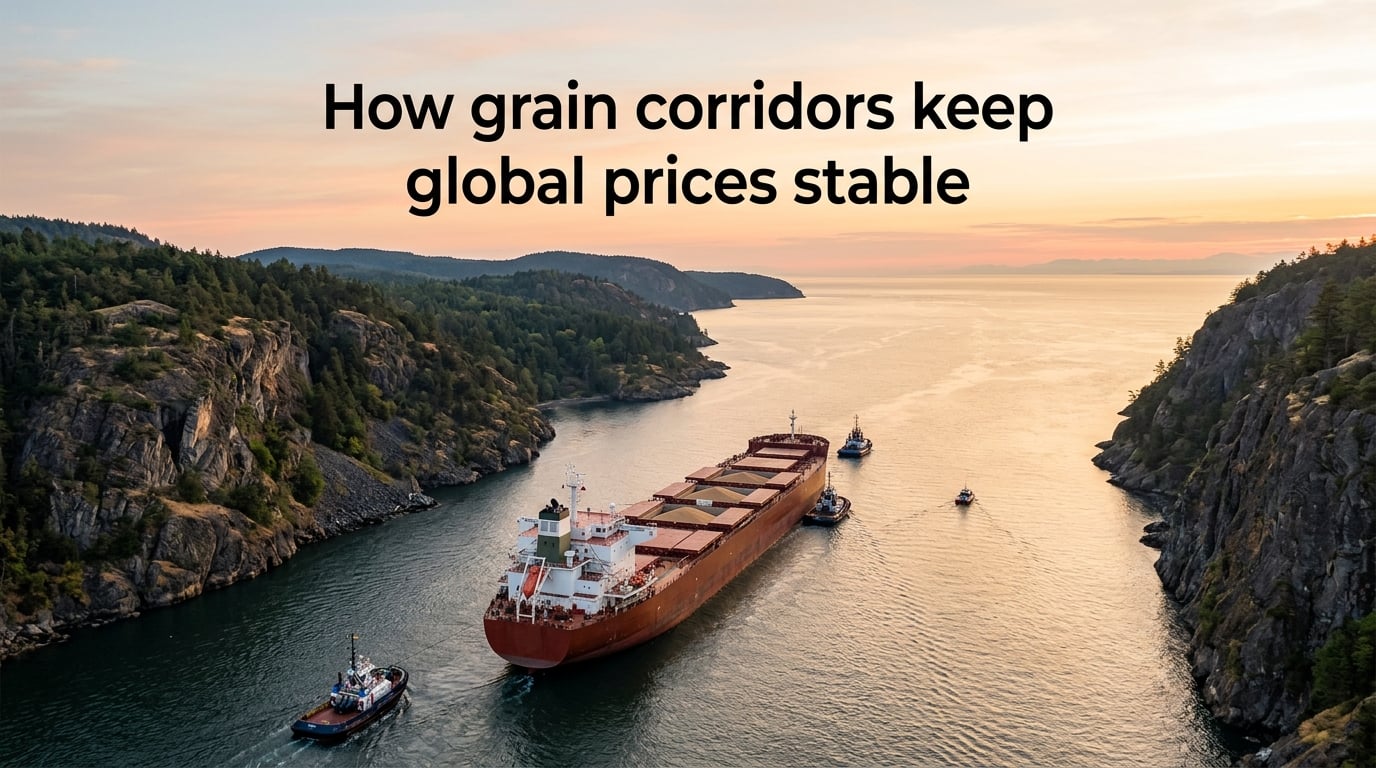
Grain corridors are secured maritime or land export routes that let agricultural commodities move from producing countries to global markets during war or political disruption. The Black Sea Grain Initiative, signed in July 2022 between Ukraine, Russia, Turkey, and the UN, was the most prominent recent example. It kept global wheat prices stable by guaranteeing a predictable supply flow, settling commodity futures, compressing shipping insurance premiums, and giving import-dependent countries confidence they could buy bread without panic.
In this guide, I’ll walk you through exactly how those five steps work, why a single corridor off the coast of Odesa can move a futures contract in Chicago, and what changed when Russia walked away from the deal in July 2023. I’ve been tracking Black Sea grain flows for our team since the start of the war, and the stabilization mechanism is one of the clearest examples of how logistics policy translates directly into the price of bread in Cairo, Sana’a, and Beirut.
Table of Contents
What is a grain corridor?
A grain corridor is a negotiated, secured export route that allows agricultural commodities to leave a producing country when normal shipping lanes are blocked or unsafe. It can be maritime (a designated sea lane with neutral inspection) or land-based (rail, road, or river routes coordinated by neighboring states).
The core feature is diplomatic backing. Without a corridor, ship owners refuse to sail, insurers refuse to write policies, and importers cannot source grain. With a corridor, governments and international bodies provide safe-passage guarantees, inspection regimes, and often military deconfliction. That combination restores trade flows that would otherwise grind to a halt.
The most widely discussed grain corridor in 2026 is the Ukrainian humanitarian corridor, a unilaterally declared sea lane along Romania’s and Bulgaria’s Black Sea coasts that has operated since August 2023. Before that, the Black Sea Grain Initiative (July 2022 to July 2023) was the canonical example. Before either, historical corridors like the Berlin Airlift of 1948-49, and the UN-administered aid corridors of the Bosnian conflict, demonstrated the same principle in different commodities.
Maritime vs land corridors
Maritime corridors move bulk grain at scale. A single panamax vessel carries 60,000 tonnes, enough wheat for 1.5 million people for a year. Maritime corridors are also the cheapest per tonne, but the most exposed to blockade, mines, and naval attack.
Land corridors move grain by rail, barge, and truck. The EU’s Solidarity Lanes, launched in May 2022, use Romania’s Danube ports and overland routes through Poland, Slovakia, Hungary, and the Balkans. Land corridors are slower and more expensive per tonne, but harder to fully cut off.
Why grain corridors matter for global price stability
Grain corridors matter because global grain supply is dangerously concentrated. Ukraine and Russia account for roughly 28% of global wheat exports, 15% of corn exports, and over 50% of sunflower oil exports. When even a fraction of that supply is removed from world markets, the price impact is immediate and global.
For wheat specifically, the price of a futures contract in Chicago or Paris reacts to Black Sea logistics faster than to any harvest forecast. Day traders on r/Daytrading and r/Commodities regularly report 10-15% intraday moves when Russia announces a new blockade or Ukraine strikes a port facility. That kind of volatility is what triggers food inflation in countries that cannot absorb a 15% wheat price spike without subsidies or aid.
Three structural realities make the global grain market so corridor-sensitive:
- Supply concentration: a small number of producing regions dominate the export market.
- Import dependency: countries like Egypt, Lebanon, Yemen, Tunisia, Bangladesh, and Pakistan source 50-100% of their wheat from imports, much of it from the Black Sea.
- Futures pricing: commodity markets price expected supply months ahead, so any signal that a corridor is at risk moves the curve immediately.
The price-transmission chain
When a corridor shuts, the price transmission looks like this: a futures spike in Chicago -> higher tender prices for government buyers in Egypt -> a domestic bread subsidy bill that forces currency devaluation -> a doubling of bread prices on Cairo streets within weeks. The 2022-2023 sequence played out almost exactly that way. Egypt’s pound lost more than half its value, and the WFP estimated that an additional 13.5 million people fell into acute food insecurity across the MENA region after the war began.
How the Black Sea Grain Initiative worked
The Black Sea Grain Initiative was a four-party agreement signed on 22 July 2022 at Dolmabahçe Palace in Istanbul. Ukraine and Russia signed parallel documents with Turkey and the UN. Both Russia and Ukraine committed to allow commercial food exports from three Ukrainian Black Sea ports: Odesa, Chornomorsk, and Yuzhny/Pivdennyi.
The operational center was the Joint Coordination Centre (JCC), based in Istanbul. Each of the four parties sent roughly 20 delegates, for a total staff of about 80. The JCC’s job was to coordinate ship inspections, verify cargoes were not carrying weapons, and issue routing instructions that both Ukrainian and Russian naval units had agreed to respect.
The inspection regime
Every outbound vessel was inspected before departure. Inspectors from Ukraine, Russia, Turkey, and the UN boarded the ship in a Turkish port, checked the cargo manifest against the declared grain tonnage, and verified no weapons or military equipment were hidden in the holds. Only then did the vessel receive authorization to transit a designated humanitarian sea lane.
The corridor itself was a demined channel extending roughly 10 nautical miles into the Black Sea, plus a buffer security zone. Vessels followed fixed routing to avoid mines laid since the start of the war, and they carried transponders that the JCC tracked in real time.
The 120-day renewal cycle
The agreement ran on 120-day renewable terms. Each renewal was a negotiation, not an automatic extension. Russia used renewal rounds to extract concessions on its own agricultural exports, especially the lifting of sanctions on the Russian Agricultural Bank and the reconnection of ammonia exports via the Tolyatti-Odesa pipeline.
Three renewals occurred: November 2022, March 2023, and May 2023. The fourth renewal was blocked when Russia refused to extend, and the deal expired on 17 July 2023.
The mirror agreement
Russia signed a parallel agreement committing to facilitate its own agricultural and fertilizer exports, which had been hit by sanctions on shipping, insurance, and SWIFT access. The mirror agreement was meant to be the carrot that kept Russia at the table. In practice, sanctions relief on Russian fertilizer exports moved slowly enough that Moscow cited non-implementation as the reason for withdrawal.
How grain corridors stabilize prices: a five-step mechanism
This is the part most coverage skips, but it is the heart of the question. Here is the step-by-step chain that turns a working corridor into stable global prices.
Step 1: Supply guarantee. A functioning corridor removes the physical blockade that prevents grain from leaving Ukrainian ports. Within weeks of the July 2022 deal, Odesa loaded and dispatched its first commercial bulk carrier in months. By October 2022, the initiative had moved more than 7 million tonnes of grain.
Step 2: Importer confidence. Government buyers in Egypt, the world’s largest wheat importer, and in countries like Bangladesh and Pakistan could tender for wheat deliveries with confidence that contracts would actually be filled. That confidence reduces the urgency of panic buying.
Step 3: Futures stability. When physical supply is reliable, the risk premium that commodity traders build into futures contracts falls. Chicago wheat futures settled roughly 15% lower by late July 2022 than they had been at the invasion-month peak, as the market priced in Ukrainian exports returning to world markets.
Step 4: Risk premium compression. With the corridor operating, war-risk insurance premiums on Black Sea voyages dropped from triple-digit percentages of hull value to single digits. Lower insurance means lower delivered cost for every tonne of grain that reaches an importer’s port.
Step 5: Price ceiling effect. The combined effect of steps 1-4 acts as a price ceiling. When futures rise toward politically uncomfortable levels (bread riots are politically toxic in MENA), the corridor’s existence reassures the market that supply will catch up, which caps the spike.
The mechanism runs in reverse when a corridor collapses. Russia’s July 2023 withdrawal produced the mirror image of all five steps within ten days.
Timeline of the Black Sea Grain Initiative (2022-2026)
The corridor’s lifecycle played out in distinct phases that map directly onto price action in commodity markets.
- February 2022: Russia invades Ukraine; Black Sea ports blockaded; wheat futures spike to record highs above 13 USD per bushel.
- 22 July 2022: Initiative signed in Istanbul; first shipments within weeks.
- October-November 2022: Russia briefly suspends participation after drone strikes on Sevastopol; deal resumes after UN and Turkish mediation.
- 17 November 2022: First 120-day renewal.
- 18 March 2023: Second renewal, shortened to 60 days after disputes.
- 17 May 2023: Third renewal extended 60 days only.
- 17 July 2023: Russia refuses to extend; deal expires; wheat futures rise sharply within days.
- August 2023: Ukraine declares a unilateral humanitarian corridor along the western Black Sea coast, protected by naval drones.
- 2024-2025: Ukrainian corridor, Danube ports, and Solidarity Lanes gradually rebuild export volumes; Russia targets port infrastructure with missile strikes.
- 2026: Exports continue through a mix of Ukrainian unilateral corridor, Danube, and land routes; war-risk insurance remains elevated but futures volatility has moderated.
What happened when the corridor collapsed
The collapse in July 2023 produced an immediate, measurable price shock. Chicago wheat futures rose more than 12% in the ten trading days after Russia’s withdrawal announcement. Paris milling wheat contracts hit multi-month highs. The WFP’s procurement costs for wheat shipments to the Horn of Africa and Yemen rose by an estimated 25%, forcing program cuts.
For countries with structural exposure, the human cost translated into subsidies, debt, or hunger. Egypt’s government, already straining under the cumulative effect of pandemic, war, and currency pressure, accelerated a delayed devaluation of the pound in early 2024. Yemen’s already dire food security situation worsened; the WFP reduced monthly rations in Houthi-controlled areas.
Two quantitative anchors capture the scale of the impact:
- Wheat futures: Chicago wheat rose from roughly 6.30 USD per bushel on 14 July 2023 to above 7.10 USD per bushel by 26 July 2023, a 12-13% move in two weeks.
- WFP costs: The WFP’s flagship Ukraine grain operation, which had purchased 80% of its wheat from Ukraine at peak, scrambled for alternative origins at higher cost.
The collapse also exposed a structural reality the deal had masked: even with full diplomatic support, a corridor backed by no enforcement mechanism is one withdrawal away from disappearing.
Countries most exposed to corridor disruption
Five countries stand out as the most exposed to grain corridor disruption. The table below summarizes the dependency structure that determines who feels the price shock first and hardest.
| Country | Wheat import share sourced from Black Sea region | Buffer policy tools | Acute vulnerability |
|---|---|---|---|
| Egypt | ~70% | Strategic reserves (4-6 months), subsidy program | Highest; population-scale bread subsidy |
| Lebanon | ~60% | Limited reserves, no subsidy reform | High; currency crisis compounds shock |
| Yemen | ~50% | WFP and humanitarian aid dominate supply | High; famine risk in Houthi areas |
| Tunisia | ~50% | State grain Office stockpiles | Moderate-High; political pressure from bread subsidy |
| Bangladesh | ~35% | Government-to-government contracts, strategic stocks | Moderate; diversifies to India and Australia |
Egypt’s exposure is the largest in absolute terms because it imports more wheat than any other country in the world, and because its domestic subsidy program, the baladi bread loaf sold for a fraction of a cent, depends on affordable imported wheat. Any sustained corridor disruption is, for Cairo, both an economic and a political emergency.
Alternative export routes and their limits
When the Black Sea corridor collapsed, four alternative routes took on the load. None of them by itself matches the capacity of the original maritime corridor, but together they have rebuilt roughly 70-75% of pre-war export volumes as of 2026.
Ukrainian unilateral humanitarian corridor. Declared in August 2023, this is a sea lane hugging the Romanian and Bulgarian Black Sea coasts, running from Odesa to the Bosphorus. Ukrainian naval drones escort outbound convoys. Russia has hit port facilities but has not routinely intercepted vessels in international waters.
Danube ports. The Romanian port of Constanta and the Ukrainian river ports of Reni and Izmail became major grain hubs. Grain moves by barge down the Danube, then transships to seagoing vessels at Constanta. Capacity rose sharply but is bottlenecked by barge availability and river dredging.
EU Solidarity Lanes. Land-based routes through Romania, Poland, Slovakia, Hungary, and the Balkans. The EU set up the lanes in May 2022 to move Ukrainian grain overland when sea routes were blocked. They handle a meaningful share of grain but are constrained by rail gauge differences, trucker capacity, and EU farmer protests about Ukrainian competition.
Rail and road. Direct rail and truck movement into EU countries. Highest per-tonne cost, most affected by border frictions, but most flexible.
The limits of alternatives
All alternatives share one structural limit: they are more expensive per tonne than the Black Sea maritime corridor. The price differential ranges from roughly 30 USD per tonne (Danube) to more than 100 USD per tonne (overland rail). That gap is the corridor’s economic value. A working Black Sea route does not just move grain; it moves grain cheaper than any competitor, anchoring global price formation.
Current status and outlook for 2026
As of 2026, Ukrainian grain exports continue through a mix of the unilateral corridor, the Danube ports, and Solidarity Lanes. Monthly export volumes have stabilized at roughly 5-6 million tonnes, compared with peaks above 6 million tonnes under the original Initiative and lows near 3 million tonnes immediately after July 2023.
Industry analysts at Fastmarkets describe the 2026 Black Sea wheat outlook as “stabilized but evolving,” with weather and war risk remaining the dominant price drivers rather than corridor status itself. Markets.financialcontent.com notes that global agriculture remains “tethered to the volatile rhythm of the Black Sea.” Both observations point to the same conclusion: the corridor mechanism has been replaced, not eliminated.
Three risks will shape the 2026 outlook:
- Russian strikes on port infrastructure, including Danube terminals, could again compress export capacity overnight.
- Insurance market reactions to a single incident can spike war-risk premiums and freeze chartering for days.
- Renewed Russian naval blockade or escalation in the Bosphorus could close the unilateral route entirely.
The structural lesson
The deeper lesson of the Black Sea corridor episode is that global food security depends on a small number of chokepoints, and a small number of corridors. The mechanism that keeps prices stable is the same one that breaks when a corridor collapses. Understanding the chain, supply guarantee to importer confidence to futures stability to risk premium compression to price ceiling, is the only way to interpret what the next disruption will actually do.
Frequently Asked Questions
What is a grain corridor and how does it work?
A grain corridor is a negotiated, secured export route that lets agricultural commodities leave a producing country when normal shipping lanes are blocked. Maritime corridors designate a sea lane with neutral inspection and safe-passage guarantees from the parties to the conflict. Land corridors coordinate rail, road, and barge movement through neighboring states. The Black Sea Grain Initiative of 2022-2023 was the most prominent recent example, using a Joint Coordination Centre in Istanbul to inspect every outbound vessel and issue routing that both Ukrainian and Russian naval units respected.
How do grain corridors keep global prices stable?
Grain corridors keep prices stable through a five-step mechanism: supply guarantee (grain leaves blocked ports), importer confidence (government buyers tender reliably), futures stability (risk premium in commodity contracts falls), risk premium compression (war insurance rates drop), and a price ceiling effect (futures cap as the market prices in supply catch-up). The reverse of all five steps played out within ten days of Russia’s July 2023 withdrawal, when Chicago wheat futures rose more than 12%.
Why did Russia leave the Black Sea Grain Initiative in July 2023?
Russia refused to extend the deal on 17 July 2023, citing what it called non-implementation of the parallel agreement to facilitate Russian agricultural and fertilizer exports. In practice, the deal had become a recurring political lever used by Moscow to extract concessions on sanctions, SWIFT access for the Russian Agricultural Bank, and the Tolyatti-Odesa ammonia pipeline. When those concessions stalled, Russia declined the fourth renewal.
Which countries are most affected by the corridor’s collapse?
Egypt, Lebanon, Yemen, Tunisia, and Bangladesh are the most exposed. Egypt sources roughly 70% of its wheat imports from the Black Sea region and runs the world’s largest bread subsidy program. Lebanon depends on imports for roughly 60% of its wheat, with limited reserves. Yemen relies heavily on WFP shipments routed through Black Sea ports. Bangladesh and Tunisia have somewhat more diversified sourcing but still absorb significant price shocks.
How does Ukraine export grain now?
Ukraine exports grain through four main routes in 2026: a unilateral humanitarian corridor along the Romanian and Bulgarian Black Sea coast, declared in August 2023 and protected by Ukrainian naval drones; Danube river ports such as Reni and Izmail transshipping via Constanta; EU Solidarity Lanes moving grain by rail and road through Romania, Poland, Slovakia, Hungary, and the Balkans; and direct rail and truck movement into EU countries. Together these have rebuilt roughly 70-75% of pre-war volumes.
How much grain does Ukraine export each year?
Ukraine exported about 50 million tonnes of grain in the 2021-2022 marketing year, including roughly 18.7 million tonnes of wheat, 27 million tonnes of corn, and 4.6 million tonnes of barley. Volumes fell sharply after Russia’s February 2022 invasion and the Black Sea blockade, then partially recovered through the Initiative and again through the alternative route mix. Recent monthly volumes have stabilized near 5-6 million tonnes.
Why is the Black Sea so important for global grain prices?
The Black Sea region accounts for roughly 28% of global wheat exports, 15% of corn exports, and over half of sunflower oil exports. Because so much of the exportable surplus of staple grains originates from such a small geographic area, any disruption to Black Sea ports moves global futures contracts within hours. The concentration of supply is the structural reason that corridor status translates so directly into world prices.
What is the World Food Programme’s role in the grain corridor?
The UN World Food Programme is both a signatory party to the Black Sea Grain Initiative and a major buyer of Ukrainian grain for humanitarian operations. The WFP used the corridor to source roughly 80% of its wheat at peak, supplying Yemen, the Horn of Africa, and other crisis-affected regions. The WFP also staffs inspectors at the JCC in Istanbul, giving it direct visibility into corridor operations.
Key takeaways
Grain corridors keep global prices stable by guaranteeing supply at lower cost than any alternative. The Black Sea Grain Initiative demonstrated the mechanism end-to-end between July 2022 and July 2023, and its collapse in July 2023 demonstrated the speed at which that stability can unravel.
Three things are worth holding onto. First, the mechanism is a chain, not a single event: a corridor works only if all five links (supply, confidence, futures, premiums, ceiling) hold. Second, the cost difference between the maritime corridor and alternative routes is the real economic value the corridor creates. Third, the corridor status of 2026 is “stabilized but evolving,” which means the next disruption is a question of when, not whether.
For anyone tracking food security or commodity markets in 2026, the practical move is to watch three indicators: Black Sea port strike frequency, war-risk insurance premium levels on Danube and Odesa routes, and WFP procurement cost trends for wheat. Each one signals a step in the stabilization mechanism the moment it shifts.