
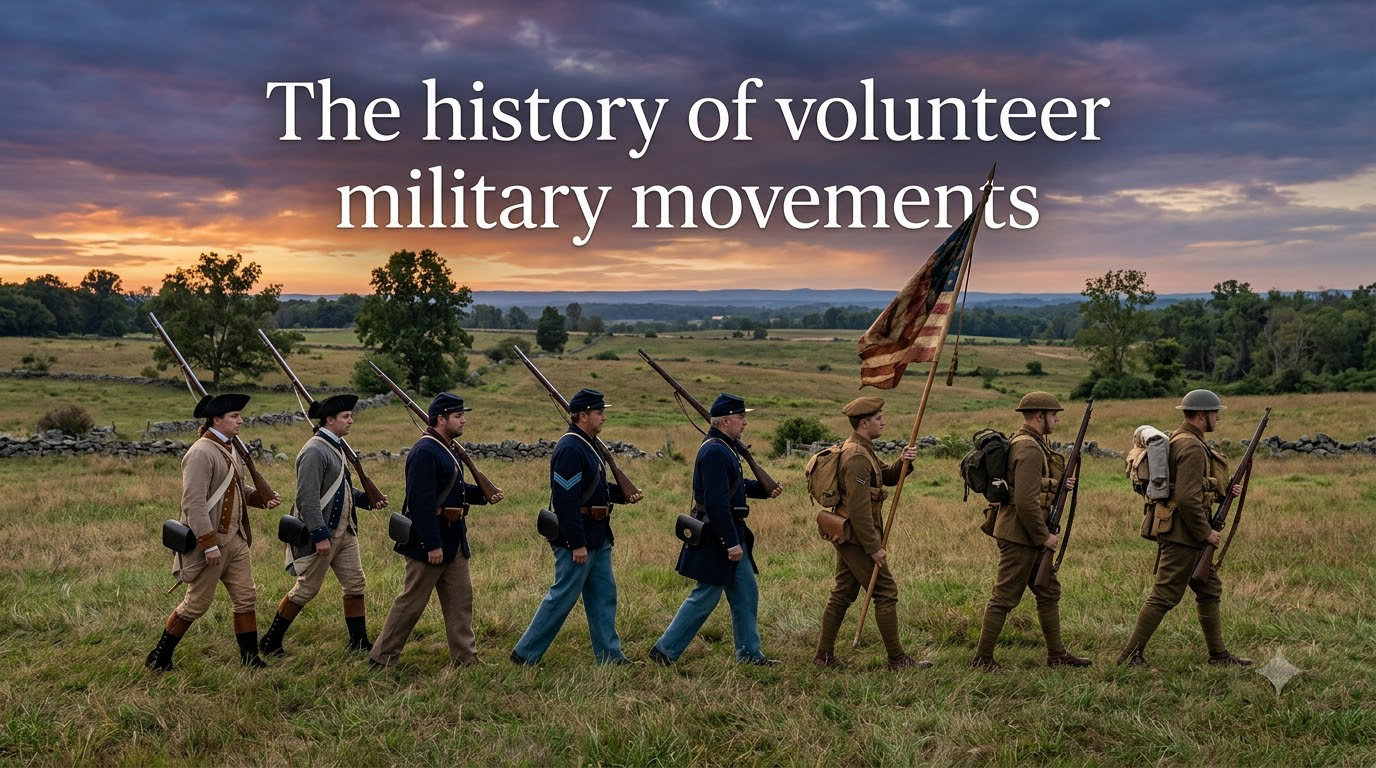
The history of volunteer military movements is a long story of citizens picking up arms without being forced to. From the militias of ancient Greece to the all-volunteer professional armies of today, the idea that free people choose to defend their communities has shaped warfare for over two thousand years.
I have spent the last several months studying this topic in depth, reading academic histories, war office records, and firsthand accounts from soldiers who chose to serve. What I found surprised me. Volunteer forces were not a modern invention born from the horrors of the draft. They were the original way that most societies raised armies, and the modern all-volunteer military is really a return to an older tradition rather than a break from it.
This guide walks you through that full story. You will learn how ancient citizen-soldiers became medieval levies, how colonial militias turned into standing armies, why the British Volunteer Force of 1859 was one of the most important citizen armies ever raised, and how the United States moved from the draft to its current all-volunteer force in 1973. We will also cover the International Brigades of the Spanish Civil War, the foreign legions, and the modern challenges facing volunteer recruitment.
By the end, you will have a clear timeline and a deep understanding of how volunteer military movements shaped the modern world.
Table of Contents
What Are Volunteer Military Movements and Where Did They Begin?
Volunteer military movements are organized efforts in which civilians choose to join armed forces without being compelled by law. A volunteer soldier enlists freely, motivated by patriotism, pay, ideology, or a sense of civic duty rather than a conscription notice. The history of volunteer military movements starts long before the modern era.
The earliest examples come from the city-states of Greece. In Athens and Sparta, every free male citizen was expected to serve, but in many Greek colonies service was truly voluntary. Men formed citizen militias, elected their own officers, and trained together after work. Thucydides describes how entire communities marched out together at the start of a campaign season, then returned to their farms.
Rome mixed both systems. During the Republic, Roman legions were raised from property-owning citizens who volunteered for a fixed term of service. A Roman soldier signed up because land grants and a share of the spoils awaited him. The Marian reforms of 107 BC changed this, allowing the propertyless to enlist, but service still remained voluntary for most recruits.
In medieval Europe, the system changed. Kings relied on feudal obligations, where nobles owed knights and peasants owed days of service. Standing armies of paid volunteers were rare. The English longbowmen at Agincourt in 1415 were largely conscripted, though many English archers also volunteered for pay. By the late Middle Ages, mercenaries dominated European warfare. The Swiss pikemen, the Italian condottieri, and the Landsknechte of Germany were all volunteers who fought for wages and glory.
Volunteer service returned to the foreground with the colonial era. English colonists in America formed local militias from the moment they landed. Every able-bodied man was expected to turn out for drill and to defend the settlement when attacked. These were not professional soldiers. They were farmers, shopkeepers, and craftsmen who drilled a few days a month and rushed to arms in an emergency.
The British militia tradition grew alongside this. By the 18th century, both Britain and her American colonies had well-developed militia systems. When the American Revolution broke out in 1775, the Continental Army and state militias were drawn from volunteers. George Washington never had enough men, and the militia’s reluctance to serve for long periods became one of the central challenges of the war.
How the British Volunteer Force Changed Warfare in 1859
The British Volunteer Force was a citizen army of part-time rifle, artillery, and engineer corps created as a popular movement throughout the British Empire in 1859. It is one of the most important chapters in the history of volunteer military movements because it showed that a modern industrial nation could defend itself without a mass conscript army.
Britain had a problem. The Crimean War of 1853 to 1856 had exposed the limits of the small professional British Army. The army was too small to fight a major continental war, and public opinion rejected the idea of conscription. In 1859, rumors spread that France under Napoleon III was about to invade. The press panicked. The government dithered.
Into this gap stepped ordinary citizens. Local committees formed across England, Scotland, Wales, and Ireland to raise volunteer rifle corps. Within months, more than 100,000 men had volunteered. By the end of 1859, the count was over 150,000, and the number kept climbing. These were not soldiers. They were clerks, teachers, factory workers, and professionals who drilled in their spare time and bought their own uniforms.
The government moved quickly to regularize the movement. The Volunteer Act of 1863 placed the force on a legal footing, defined its relationship to the regular army, and provided for annual musters and inspections. A Royal Commission in 1862 had already reviewed the force and recommended integration with the regulars through shared training and a reserve system.
Volunteer corps proliferated across the British Empire. Australia, New Zealand, Canada, South Africa, and the Indian subcontinent all raised their own volunteer units. The Canadian Militia, the New Zealand Volunteer Force, and the Australian colonial forces became important parts of the Empire’s defense. Many of these units later fought in the Boer War and in World War I.
By the early 1900s, the volunteer system was straining. The Second Boer War of 1899 to 1902 had shown that part-time volunteers could not match the discipline and marksmanship of regular soldiers in long campaigns. Secretary of State for War Richard Haldane pushed through the Territorial and Reserve Forces Act of 1907, which created the Territorial Force. This new organization merged the old volunteers, the militia, and the yeomanry into a single part-time army with closer ties to the regulars.
The Territorial Force was tested almost immediately in World War I. Hundreds of thousands of part-time soldiers answered the call in 1914. The British Expeditionary Force that fought in France was overwhelmingly professional, but the Territorial divisions filled out the army and suffered terrible losses at battles like the Somme in 1916.
From Civil War Volunteers to the U.S. All-Volunteer Force in 1973
The United States has cycled through volunteer and conscript armies more than any other major nation. Understanding this cycle is essential to understanding the history of volunteer military movements in the modern era.
During the Revolutionary War, the Continental Army was a volunteer force, although the states also used drafts to fill its ranks. About 250,000 men served in the Continental Army and militias during the war. The short enlistments and constant desertions taught the new nation that a purely volunteer force was unreliable for long wars.
The Civil War pushed the United States toward conscription. Both sides began with volunteers, but the scale of the fighting overwhelmed the volunteer system. The Confederate Conscription Act of 1862 and the Union Militia Act of 1862 marked the first drafts in American history. The Civil War saw roughly 2.1 million Union soldiers and 900,000 Confederates, the majority of whom were volunteers, but conscription was used to fill the gaps.
After the Civil War, the regular army shrank to a small professional force. For most of the late 19th century, the U.S. Army was tiny and volunteer, supplemented by state militias that later became the National Guard. World War I brought the Selective Service Act of 1917, and about 2.8 million Americans served, with roughly half drafted.
World War II was the high-water mark for American conscription. About 50 million men registered for the draft, and 10 million were inducted into service. Roughly 70 percent of the 16 million Americans who served during the war were draftees. The Selective Training and Service Act of 1940 was the first peacetime draft in American history, and it remained in effect until 1947.
After World War II, the United States kept conscription through the Cold War. The Selective Service Act of 1948 instituted a peacetime draft that would remain in place for 25 years. During the Korean War, about 1.5 million men were drafted, and during the Vietnam War, more than 1.7 million were inducted. The draft was deeply unpopular by the late 1960s.
The end of the draft came through a remarkable political process. In 1969, President Richard Nixon appointed the Gates Commission, chaired by former Secretary of Defense Thomas Gates, to study replacing conscription with an all-volunteer force. The commission issued its report in 1970 and recommended the change. Influential economist Milton Friedman had argued for years that an all-volunteer force would be more efficient, and his ideas shaped the debate.
On July 1, 1973, the U.S. military became an all-volunteer force, also called the AVF. The Selective Service system remained in place for registration but stopped inducting men. The transition was risky. Critics warned that the military could not recruit enough qualified volunteers without a draft. The opposite happened. By the late 1970s, the AVF had stabilized, and by the 1980s it was widely seen as a success.
International Volunteer Forces: The Brigades, Legions, and Empires
Volunteer military movements were never confined to Britain and America. Across the world, civilians organized themselves to fight for causes, empires, and ideologies. The most famous example is the International Brigades of the Spanish Civil War.
When General Francisco Franco launched his revolt against the Spanish Republic in July 1936, left-wing sympathizers around the world flocked to defend the Republic. About 45,000 volunteers from more than 50 countries joined the International Brigades between 1936 and 1939. The largest single national group was the Abraham Lincoln Brigade from the United States, with roughly 2,800 Americans who served in Spain.
The International Brigades were organized, trained, and led by Comintern agents and Soviet military advisers. Volunteers underwent short training at bases in Albacete and other Spanish cities before being sent to the front. The Brigades fought in almost every major battle of the war, including Jarama, Brunete, Belchite, and the Battle of the Ebro in 1938. About one in ten International Brigade volunteers died in Spain.
Foreign legions are another form of volunteer military movement. The French Foreign Legion, founded in 1831, recruited foreigners to serve France. By the 20th century, it had become one of the most famous volunteer units in the world. The Spanish Foreign Legion, raised in 1920, copied the French model and played a key role in the Rif War in Morocco.
Colonial volunteer forces deserve attention too. The British, French, Belgian, and Dutch empires all raised volunteer units from local populations. The West Africa Frontier Force, the King’s African Rifles, and the Indian Army were largely composed of volunteers from colonial territories who served under European officers. These units fought in both World Wars and in countless colonial campaigns.
Closer to home, the Irish Volunteers of 1913 to 1916 were a different kind of movement. Founded to secure Home Rule for Ireland, the Volunteers split when World War I began. The majority supported the war and recruited heavily into the 10th and 16th Irish Divisions that fought in France. A minority staged the Easter Rising in 1916, which changed Irish history.
In Britain itself, the Home Guard stands out. When invasion seemed possible in 1940, the government called for volunteers to defend against German paratroopers. By the end of that year, more than 1.5 million men had enrolled in the Local Defence Volunteers, later renamed the Home Guard. Although many were too old for regular service, the Home Guard freed up regular soldiers and provided a reserve that supported operations until 1944.
Modern All-Volunteer Militaries and Today’s Recruitment Challenges
Today, most major militaries are volunteer forces. The United States, the United Kingdom, Canada, Australia, India, and Japan all rely on volunteers for their active-duty armies. Conscription has been abandoned or suspended by most NATO members, with notable exceptions like Greece, Turkey, and Norway.
The professionalization of modern volunteer militaries has transformed the experience of soldiers. Recruits today sign contracts for specific terms, often four to six years, and receive structured training, career progression, and benefits. Many modern military jobs require advanced technical skills, from cyber operations to drone piloting to medical care. The volunteer soldier of 2026 is often more like a skilled technician than the citizen-soldier of earlier centuries.
This professionalization has costs. Salaries, benefits, pensions, healthcare, and training expenses make modern volunteer forces expensive to maintain. The U.S. defense budget exceeds 800 billion dollars annually, and personnel costs are a major share. Smaller nations struggle to fund professional forces without conscription.
Recruitment has become harder since the early 2000s. The U.S. Army missed its recruiting goals in several recent years, and the other services faced similar challenges. A strong civilian job market, falling youth eligibility due to health and education issues, and public skepticism about endless deployments have all reduced the pool of potential volunteers.
Retention has its own problems. After two decades of war in Iraq and Afghanistan, many service members chose to leave rather than continue. Mental health, family strain, and the difficulty of transitioning to civilian careers drove many out. The military has responded with new bonuses, education benefits, and quality-of-life improvements, but the underlying challenge persists.
For allied nations, the picture is similar. The British Army fell below its target strength for several years. The Australian Defence Force has struggled to fill specialized roles. Even Israel’s small professional force, although supported by a large reserve, faces recruitment pressure from segments of its society.
What Are the Benefits and Challenges of Volunteer Military Forces?
Volunteer military movements offer clear advantages over conscript armies, but they also come with trade-offs. Understanding both sides helps explain why nations switch between the two systems.
The main benefits of volunteer forces include:
- Higher quality recruits. Volunteers can be screened for skills, education, and aptitude. The military can set high standards because candidates compete for limited slots.
- Better training and retention. Career soldiers accumulate experience. A professional NCO corps builds institutional knowledge that conscript armies struggle to maintain.
- Improved morale and unit cohesion. Soldiers who chose to serve tend to be more motivated. Cohesion within units is generally stronger when everyone is a volunteer.
- Specialized skills. Modern warfare demands pilots, medics, cyber operators, and linguists. Long-term volunteers can develop these skills to a degree that short-service conscripts cannot.
- Less social friction. The draft creates resentment and is widely viewed as unfair because it falls disproportionately on the poor and minorities. Volunteer service avoids this.
The challenges of volunteer military movements are real and persistent:
- Cost. A volunteer force is much more expensive than a conscript force. Pay, benefits, pensions, and training add up quickly.
- Limited size. If recruitment falls short, the military cannot meet its authorized end strength. Politicians sometimes cut end strength targets rather than raise pay.
- Class and representation issues. Although the U.S. military is more representative than critics claim, the armed forces still draw disproportionately from working-class and rural backgrounds. An all-volunteer force shifts the burden of service onto a smaller segment of society.
- Deployment strain. Without a draft, a small professional force bears repeated deployments. This was a major issue during the Iraq and Afghanistan wars.
- Civilian-military gap. When only a small percentage of citizens serve, the rest of society loses direct connection to the military. This can weaken civilian oversight and reduce public support.
Major Volunteer Military Forces Throughout History
The table below summarizes the most important volunteer military movements covered in this guide. It highlights how diverse these efforts have been across centuries and continents.
| Force | Year | Country | Approx. Size | Historical Context |
|---|---|---|---|---|
| Greek Citizen Militias | 500-300 BC | Greece | Varies by city | City-state defense, hoplite warfare |
| Roman Legions (Republic) | 500-30 BC | Rome | 200,000+ at peak | Land grants, paid service |
| British Volunteer Force | 1859-1908 | United Kingdom | 150,000+ at peak | Post-Crimean War, French invasion scare |
| Confederate and Union Armies | 1861-1865 | United States | 3 million combined | Civil War, first U.S. conscription |
| International Brigades | 1936-1939 | Spain | 45,000 | Spanish Civil War, anti-fascist volunteers |
| Home Guard | 1940-1944 | United Kingdom | 1.5 million+ | World War II, defense against invasion |
| U.S. All-Volunteer Force | 1973-present | United States | 1.3 million active | End of the draft, professional military |
Frequently Asked Questions
When did the U.S. military go all volunteer?
The U.S. military became an all-volunteer force on July 1, 1973, when the authority to induct men into the armed forces expired. The transition followed the Gates Commission report of 1970, which recommended replacing the draft with a professional volunteer system. The Selective Service registration requirement remained in place.
What is the largest all-volunteer force in history?
The largest single all-volunteer force in history is arguably the U.S. All-Volunteer Force, which has maintained roughly 1.3 million active-duty personnel continuously since the 1970s. Among historical movements, the British Volunteer Force of 1859 and its successors mobilized hundreds of thousands of part-time citizen soldiers across the British Empire.
When did U.S. military service become voluntary?
U.S. military service became fully voluntary on July 1, 1973, when the Selective Service System stopped inducting draftees. Conscription had been in effect in some form since the Civil War and continuously since 1940. Today, all branches of the U.S. armed forces recruit volunteers through enlistment contracts.
What were the International Brigades?
The International Brigades were volunteer military units formed during the Spanish Civil War from 1936 to 1939. Roughly 45,000 volunteers from more than 50 countries joined to fight for the Spanish Republic against Franco’s Nationalists. The Abraham Lincoln Brigade was the largest American contingent, with about 2,800 U.S. volunteers.
Why did countries switch to volunteer armies?
Countries switched to volunteer armies for several reasons: to avoid the social and political controversy of conscription, to recruit higher-quality soldiers willing to make military service a career, to reduce the cost of constantly rotating draftees through training, and to build a more professional force with specialized technical skills. The end of the Cold War and the rise of high-tech warfare also reduced the need for mass armies of short-term conscripts.
The Lasting Legacy of Volunteer Military Movements
The history of volunteer military movements shows that free people have always been willing to take up arms for causes they believe in. From the hoplite farmers of ancient Greece to the cyber operators serving today, volunteers have built armies, won wars, and shaped nations. The British Volunteer Force of 1859 proved that an industrial nation could mobilize its citizens without conscription. The U.S. All-Volunteer Force of 1973 proved that a professional army could recruit, train, and retain high-quality soldiers without the draft. The International Brigades showed that volunteers could cross borders for ideological reasons as well as national ones.
The lessons from this history matter today. Modern democracies are struggling to maintain volunteer forces as civilian life offers more opportunities and the burden of service falls on a smaller share of the population. Yet the same dynamics that drove the British middle class to drill with rifles in 1859 still operate. When a cause seems real and the threat feels close, citizens step forward.
As you reflect on the history of volunteer military movements, consider how the decision to serve without compulsion remains one of the most personal expressions of citizenship. The volunteers of the past faced very different wars, but they shared something with today’s soldiers: a choice freely made.
If this guide has helped you understand the long arc of citizen-soldiers, share it with someone interested in military history or defense policy. The story of volunteer military movements is still being written, and the next chapter will depend on the choices that ordinary citizens make about service, sacrifice, and the defense of their communities.