
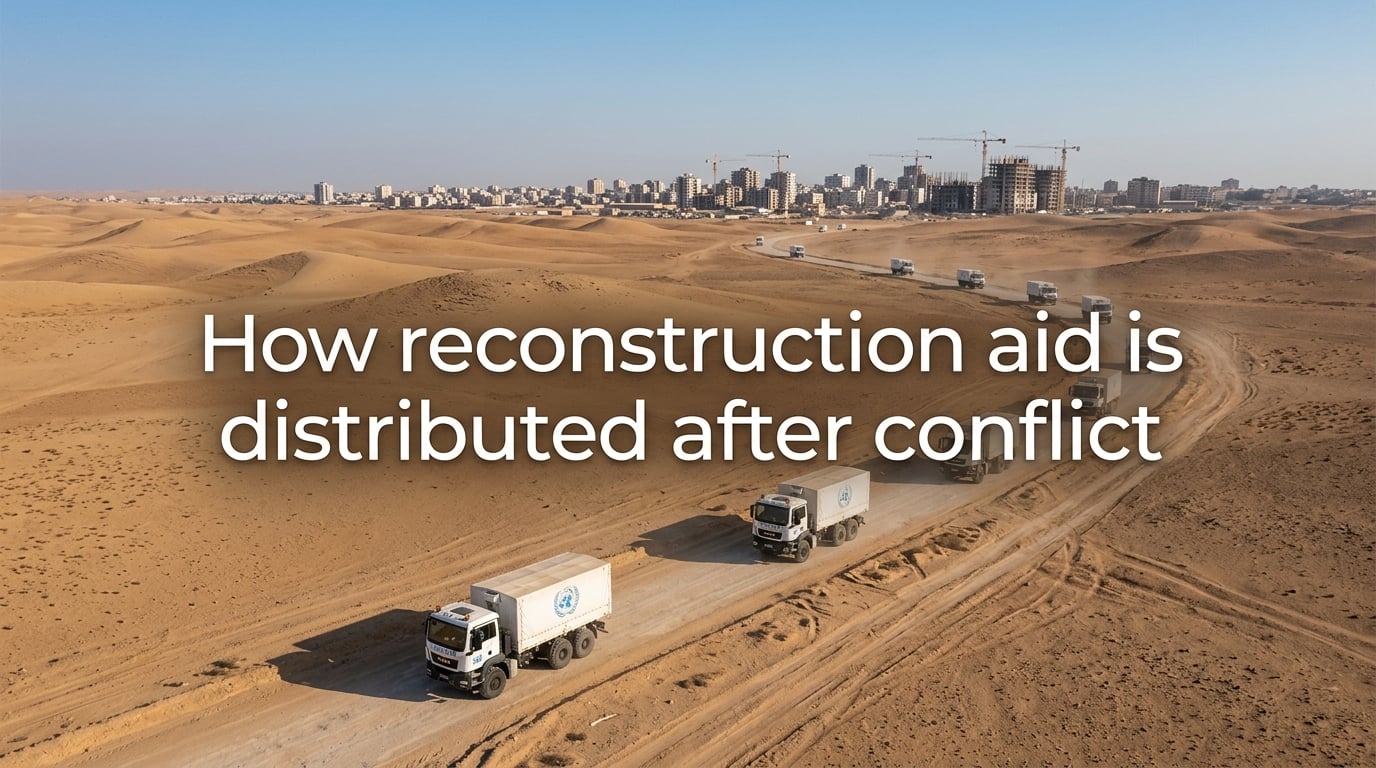
Reconstruction aid is financial, material, and technical assistance provided to countries emerging from armed conflict. It flows through a coordination system led by the UN Office for the Coordination of Humanitarian Affairs (OCHA), the World Bank, and bilateral donor governments. The process involves needs assessments, consolidated appeals, funding pledges, channeled transfers to UN agencies and NGOs, and on-the-ground distribution with independent monitoring.
If you have ever wondered how reconstruction aid is distributed after conflict and why it so often falls short of what was promised, this guide walks you through the entire pipeline – from the first donor pledge to the last monitoring report.
Understanding how reconstruction aid is distributed after conflict matters because the stakes are enormous. Historically, roughly 40 to 50 percent of post-conflict countries relapse into violence within a decade. The quality, speed, and fairness of aid distribution can determine whether a fragile peace holds or collapses.
Table of Contents
What Is Reconstruction Aid and What Does It Cover?
Reconstruction aid is not the same as emergency humanitarian relief. Emergency relief – food rations, clean water, temporary shelter, medical triage – is designed to save lives in the immediate aftermath of conflict. Reconstruction aid operates on a longer horizon: rebuilding roads, hospitals, and schools; restoring electricity grids and water systems; re-establishing courts, police forces, and civil service institutions; and reviving local economies so people can earn a living again.
The two categories overlap in practice. During the early recovery phase, humanitarian agencies hand out food while reconstruction teams begin clearing rubble. But the funding streams, decision-making structures, and lead agencies differ. Humanitarian aid is coordinated through OCHA and the Inter-Agency Standing Committee (IASC). Reconstruction funding is more often channeled through the World Bank, regional development banks, and bilateral donors who work with national governments.
Reconstruction aid covers several core tasks:
- Physical infrastructure: roads, bridges, ports, power plants, water treatment facilities
- Social services: schools, hospitals, primary healthcare clinics, vaccination programs
- Governance and security: police training, judicial reform, civil service rebuilding, election support
- Economic recovery: microfinance, agricultural inputs, market restoration, job creation programs
- Disarmament, demobilization, and reintegration (DDR): collecting weapons, disbanding armed groups, training former combatants for civilian employment
- Return and reintegration of refugees and internally displaced persons
The World Bank’s Independent Evaluation Group found that the Bank increased its lending to post-conflict countries by more than 800 percent since 1980. That growth reflects how central reconstruction has become to the international system’s response to war.
The Key Players: Who Distributes Reconstruction Aid
Reconstruction aid is distributed by a network of international organizations, donor governments, nongovernmental organizations, and increasingly, private contractors. No single entity controls the entire process. Here are the main actors and what they actually do on the ground.
United Nations Agencies
The UN system is the backbone of post-conflict aid distribution. OCHA coordinates the overall humanitarian response and manages the consolidated appeal process. Within the UN family, each agency has a specific mandate:
- UNDP leads early recovery, governance reform, and capacity building
- UNHCR manages refugee returns and camp coordination
- UNICEF focuses on children’s health, nutrition, education, and protection
- WFP handles food distribution and food security programs
- WHO coordinates health responses, disease surveillance, and hospital restoration
- UNRWA provides services to Palestinian refugees in the Middle East
- UNFPA addresses reproductive health and gender-based violence in crisis settings
The Inter-Agency Standing Committee (IASC), chaired by the Emergency Relief Coordinator, brings these agencies together to agree on priorities, divide responsibilities through the cluster system, and avoid duplication.
World Bank and International Monetary Fund
The World Bank provides concessional loans and grants for large-scale infrastructure and institutional reform. Through its International Development Association (IDA) and trust funds like the Statebuilding and Peacebuilding Fund, it finances projects that rebuild government capacity and stimulate economic growth. The IMF stabilizes macroeconomic conditions by providing balance-of-payments support and advising on monetary policy.
Bilateral Donor Governments
Individual governments – the United States, United Kingdom, Germany, Japan, the European Union, and others – fund reconstruction through their own development agencies (USAID, DFID, GIZ, JICA). Bilateral aid can move faster than multilateral channels because it involves fewer institutional layers, but it is also more susceptible to political conditionality.
Regional Development Banks
The African Development Bank, Asian Development Bank, Inter-American Development Bank, and European Bank for Reconstruction and Development provide region-specific lending and technical expertise. These institutions often fill gaps that the World Bank does not cover, particularly for middle-income countries emerging from conflict.
International NGOs and Private Contractors
Organizations like the International Committee of the Red Cross (ICRC), Médecins Sans Frontières (MSF), CARE, and Mercy Corps deliver aid directly to affected populations. Private engineering and logistics firms – sometimes criticized as part of the “relief-and-reconstruction complex” – handle infrastructure rebuilding, security, and program management under contract. Their role has grown substantially since the wars in Iraq and Afghanistan.
How Reconstruction Aid Is Distributed After Conflict: The Six-Step Pipeline
The distribution of reconstruction aid follows a general six-step pipeline, though the specifics vary by context. Here is how a single aid dollar typically moves from a donor capital to a recipient community.
Step 1: Needs Assessment
Within weeks or months of a ceasefire, the UN, World Bank, and national government conduct a joint needs assessment. This Multi-Donor Trust Fund assessment or Post-Conflict Needs Assessment (PCNA) catalogs the damage to infrastructure, the state of public services, economic losses, and institutional capacity. The assessment determines what needs to be rebuilt first and how much it will cost.
Step 2: Consolidated Appeal or Donor Conference
Based on the needs assessment, OCHA launches a Consolidated Humanitarian Appeal (CHA) or the host government convenes an international donor conference. In these pledging events, donor governments and institutions announce how much funding they will contribute. The appeal sets targets for each sector – health, education, shelter, food security – and assigns coordination responsibilities.
Step 3: Donor Pledges and Fund Disbursement
Pledges are made at conferences, but disbursement is a separate step that can take months or years. Donor governments must pass appropriations through their own legislatures. Multilateral funds like CERF (Central Emergency Response Fund) and country-based pooled funds can disburse faster because they are pre-funded. Historically, a significant gap exists between what is pledged and what is actually transferred.
Step 4: Channeling Through Implementing Partners
Funds are channeled to implementing partners – UN agencies, the World Bank, NGOs, or bilateral programs. The cluster system assigns lead agencies for each sector: WFP leads the food security cluster, UNHCR leads shelter and camp management, UNICEF leads water and sanitation. Each lead agency sub-contracts implementing partners for specific projects.
Step 5: On-the-Ground Distribution
This is where aid meets people. Distribution happens through food convoys, cash transfer programs, voucher systems, construction crews, mobile health clinics, and school rehabilitation teams. Security is a constant constraint: convoys need escorts, warehouses need guarding, and staff operate under threat. In some conflict zones, humanitarian corridors must be negotiated with armed parties.
Step 6: Monitoring, Evaluation, and Accountability
The final step is verifying that aid reached intended beneficiaries and achieved its objectives. Monitoring uses third-party monitors, satellite imagery, biometric verification, post-distribution surveys, and beneficiary feedback. The World Bank’s IEG and OCHA’s Evaluation Section publish performance assessments that inform future funding decisions.
Distribution Channels Compared: UN vs World Bank vs Bilateral vs NGOs
Not all distribution channels work the same way. Understanding the differences helps explain why some aid arrives quickly while other funds take years to reach the ground.
| Channel | Decision-Maker | Speed | Scale | Accountability |
|---|---|---|---|---|
| UN Agencies (OCHA, UNDP, WFP) | Emergency Relief Coordinator + IASC | Moderate (weeks to months) | Very large – covers entire crisis response | UN oversight bodies, third-party monitoring, member state reporting |
| World Bank / IMF | Board of Executive Directors | Slow (6-18 months for project approval) | Very large – billions in concessional lending | Independent Evaluation Group, inspection panels, government audits |
| Bilateral Donors (USAID, DFID, GIZ) | National government / legislature | Fast for emergency; slow for large projects | Moderate to large – depends on political will | National audit offices, legislative oversight, embassy reporting |
| International NGOs (ICRC, MSF, CARE) | NGO headquarters + donor requirements | Fast – can deploy within days | Moderate – project-level, not system-wide | Donor reporting, peer review (e.g., CHS Alliance), safeguarding mechanisms |
| Private Contractors | Contracting government or multilateral client | Moderate – depends on procurement cycles | Moderate – project-specific | Contract terms, government audits, but often limited public transparency |
In practice, most crises see all five channels operating simultaneously. The challenge is coordination: making sure they do not duplicate each other, leave gaps, or undercut local government capacity.
The Phases of Post-Conflict Reconstruction
Post-conflict reconstruction does not happen all at once. It unfolds in overlapping phases, each with different priorities, lead actors, and timeframes.
Phase 1: Emergency Relief (0-6 months)
The immediate priority is saving lives. Emergency relief focuses on food, water, shelter, medical care, and protection. UN agencies and major NGOs lead this phase. Funding comes primarily through consolidated appeals and the Central Emergency Response Fund.
Phase 2: Early Recovery (6-24 months)
As the acute crisis subsides, attention shifts to restoring basic services: reopening schools and clinics, clearing rubble, repairing roads, and restarting markets. UNDP typically leads early recovery coordination. This is also when DDR programs begin collecting weapons and registering former combatants.
Phase 3: Transitional Recovery (2-5 years)
During transitional recovery, the focus moves to institutional rebuilding: training civil servants, reforming the justice sector, rebuilding police forces, and establishing functioning local governance. The World Bank and bilateral donors become more active. National governments begin to take ownership of the process.
Phase 4: Long-Term Reconstruction and Development (5-15+ years)
This is the longest and most expensive phase. Major infrastructure projects – highways, power grids, water systems, ports – are completed. Economic reform programs, education system overhauls, and health system strengthening continue. The World Bank and regional development banks are the primary financiers, alongside bilateral donors.
Each phase is supposed to feed into the next, but transitions are often messy. Donors lose interest as media attention fades. Funding drops off just as the most expensive infrastructure projects begin. This “funding gap” between emergency relief and long-term reconstruction is one of the most persistent problems in the field.
Historical Evolution: From the Marshall Plan to Modern Reconstruction
The idea that the international community should help rebuild war-torn countries is relatively modern. Here is how the framework evolved.
The League of Nations Era (1920s-1930s)
After World War I, the League of Nations established the first international refugee assistance programs and reconstruction loans for Austria and Hungary. These early efforts were limited in scale and lacked enforcement mechanisms, but they introduced the principle that war damage required an international response.
The Marshall Plan (1948-1952)
The European Recovery Program – better known as the Marshall Plan – remains the most celebrated reconstruction effort in history. The United States invested roughly $13 billion (about $150 billion in 2026 dollars) to rebuild Western Europe after World War II. What made it effective was not just the money but the conditions: recipient countries had to cooperate with each other, balance budgets, and implement market reforms. The Marshall Plan is still invoked as the benchmark for what well-organized reconstruction can achieve.
The Bretton Woods Institutions and Cold War Era (1944-1990)
The World Bank and IMF, created at Bretton Woods in 1944, initially focused on post-war European recovery and then shifted to development lending in the Global South. During the Cold War, reconstruction aid was heavily politicized – the US and Soviet Union funded allied governments regardless of governance quality, creating dependencies and distortions that persist today.
The Post-Cold War Expansion (1990s)
After the Cold War ended, a wave of conflicts – in the Balkans, Rwanda, Sierra Leone, East Timor – produced massive reconstruction needs. The World Bank created the Post-Conflict Fund. The UN established the Peacebuilding Commission in 2005. Multi-Donor Trust Funds became the preferred vehicle for pooling and coordinating reconstruction resources.
The Modern Era (2026)
Today, the system is larger and more complex than ever, but faces new pressures. Donor budgets are flat or shrinking. Crises last longer – the average armed conflict now runs for over a decade. And the rise of private foundations and non-state actors has fragmented the landscape further.
Modern Disruptions and Challenges in Aid Distribution
The reconstruction aid system in 2026 faces challenges that its architects never anticipated. Some are as old as warfare itself; others are distinctly modern.
Politicization and Weaponization of Aid
Aid has always been political, but recent years have seen an escalation. Donor governments have suspended funding to UNRWA, the agency serving Palestinian refugees, over allegations involving individual staff members. Some states have imposed NGO permit bans that prevent relief organizations from operating in specific territories. Aid convoys have been fired upon, and humanitarian workers have been killed in record numbers in recent conflicts.
The concept of “starvation as a weapon of war” – deliberately blocking food to force surrender – has re-emerged in multiple conflicts. Satellite imagery has documented thousands of trucks waiting at border crossings for weeks while populations on the other side face famine conditions.
Donor Fragmentation and Pledge Fatigue
Donor governments routinely announce large sums at pledging conferences but fail to disburse the money. One study found that only a fraction of pledged aid is actually transferred within the first year. This gap between promises and delivery is a structural problem that undermines planning and leaves implementing agencies unable to commit to multi-year projects.
Competition among donors also creates duplication in some areas and neglect in others. Multiple agencies may build clinics in the same accessible district while conflict-affected rural areas receive nothing.
Security Constraints and Humanitarian Access
In active or recently ended conflicts, delivering aid requires negotiating access with armed parties. Humanitarian corridors can be denied or revoked. Checkpoint inspections delay convoys – in some documented cases, bureaucratic rejections have turned away sleeping bags with zippers, medical scissors, and hygiene kits containing nail clippers on security grounds.
When police protection collapses, aid convoys become targets for looting. Local communities have sometimes organized informal protection forces, but these arrangements are fragile and can create new power dynamics.
The Local Capacity Drain
International organizations pay salaries that dwarf local government wages. This creates a brain drain: experienced civil servants leave government jobs to work for NGOs at several times their previous pay. The result is that national institutions, which reconstruction aid is supposed to strengthen, are hollowed out from within.
Foreign professionals also earn far more than their local counterparts, creating resentment and dependency. Some critics describe this dynamic as the “relief-and-reconstruction complex” – a self-perpetuating system that benefits international staff more than affected populations.
Accountability and Safeguarding Failures
Reports of exploitation – including sexual exploitation by some aid workers in exchange for assistance – have shaken public trust. These scandals led to strengthened safeguarding mechanisms and accountability frameworks, but enforcement remains uneven, especially in remote or insecure areas.
How Technology Is Reshaping Aid Distribution
Technology is quietly transforming how reconstruction aid reaches people. Several innovations are already in widespread use.
Digital Cash Transfers
Instead of shipping physical goods across conflict zones, agencies now transfer money directly to recipients via mobile money platforms or bank accounts. Cash transfers preserve dignity – recipients choose what to buy – and support local markets rather than undercutting them with free imported goods. The World Food Programme and UNICEF have scaled up cash-based programming significantly in recent years.
Biometric Registries
Biometric systems using fingerprints, iris scans, or facial recognition help prevent fraud by ensuring that each beneficiary is a real, unique person. UNHCR uses biometric registration for refugees in dozens of countries. These systems reduce double-counting and diversion, but raise privacy concerns, especially when data could be accessed by hostile authorities.
Electronic Vouchers
E-voucher programs let recipients redeem aid at designated shops using prepaid cards. This approach gives people more choice while giving agencies real-time data on what is being purchased and where. It also reduces the risk of aid being diverted or resold on black markets.
Satellite Monitoring and Third-Party Verification
Satellite imagery helps agencies verify infrastructure damage, track refugee movements, and monitor whether aid convoys reach their destinations. Third-party monitoring organizations use remote sensing to verify reports from areas too dangerous for staff to enter in person.
These tools do not solve the political and security obstacles that block aid delivery, but they make distribution more efficient, transparent, and accountable where access exists.
Frequently Asked Questions
What is the difference between humanitarian aid and reconstruction aid?
Humanitarian aid addresses immediate, life-saving needs during and right after a crisis – food, clean water, emergency shelter, and medical care. Reconstruction aid operates on a longer timeframe, typically two to fifteen years, and focuses on rebuilding infrastructure, restoring governance, reviving the economy, and re-establishing public services like schools and hospitals. The two overlap during early recovery, but they are funded, coordinated, and managed through different institutional channels.
Who distributes reconstruction aid after conflict?
Reconstruction aid is distributed by a network of actors including UN agencies (OCHA, UNDP, UNHCR, UNICEF, WFP, WHO), the World Bank and IMF, bilateral donor governments like the United States and Germany, regional development banks, international NGOs such as ICRC and MSF, and private contractors. No single entity controls the entire process – OCHA and the IASC coordinate the humanitarian side while the World Bank and bilateral donors lead longer-term reconstruction financing.
What are the main phases of post-conflict reconstruction?
Post-conflict reconstruction unfolds in four overlapping phases: emergency relief (zero to six months, focused on saving lives), early recovery (six to twenty-four months, restoring basic services and beginning DDR), transitional recovery (two to five years, institutional rebuilding and governance reform), and long-term reconstruction and development (five to fifteen or more years, major infrastructure and economic reform). Transitions between phases are often marked by funding gaps as donor attention fades.
How does the UN coordinate humanitarian and reconstruction aid?
The UN coordinates through OCHA, which manages the consolidated appeal process and oversees the cluster system. The Inter-Agency Standing Committee (IASC), chaired by the Emergency Relief Coordinator, assigns lead agencies for each sector – WFP for food security, UNHCR for shelter, UNICEF for water and sanitation. For reconstruction, the Peacebuilding Commission addresses longer-term peacebuilding priorities, while Multi-Donor Trust Funds pool resources from multiple donors under coordinated governance.
Why is reconstruction aid sometimes blocked or delayed?
Reconstruction aid is blocked or delayed by several factors: security constraints that prevent convoys from reaching conflict zones, bureaucratic checkpoint inspections that reject supplies on technicalities, political decisions by donor governments to suspend funding to specific agencies, the gap between pledges and actual disbursements, and deliberate obstruction by parties to the conflict who use access as a bargaining tool. In recent conflicts, thousands of aid trucks have been documented waiting at border crossings for weeks while populations face acute shortages.
How was the Marshall Plan distributed and why is it still the benchmark?
The Marshall Plan (1948-1952) distributed roughly 13 billion dollars in American aid to rebuild Western Europe after World War II. It succeeded because it paired funding with conditions: recipient countries had to cooperate regionally, balance budgets, and implement market reforms. Unlike many modern aid programs, the Marshall Plan worked with functioning European governments and had clear timelines. It remains the benchmark because it achieved lasting economic recovery in a defined period, a result most subsequent reconstruction efforts have struggled to replicate.
Which country gives the most humanitarian aid?
The United States has historically been the largest single donor of humanitarian and reconstruction aid by total dollar amount. However, when measured as a percentage of gross national income, Scandinavian countries – Norway, Sweden, and Denmark – consistently rank highest. The European Union institutions also contribute heavily as a bloc. Aid levels fluctuate annually based on political priorities, legislative appropriations, and the severity of active crises.
Can aid actually make a conflict worse?
Yes, research shows that poorly managed aid can increase violence. When aid is distributed without security, it can become a target for looting and a source of conflict between groups competing for resources. Aid that bypasses local government can undermine state legitimacy. Large influxes of foreign money can cause ‘Dutch disease’ – inflating local prices and making domestic production uncompetitive. However, well-managed aid with strong monitoring, conflict sensitivity analysis, and local ownership has been shown to reduce the risk of conflict relapse.
Conclusion
Reconstruction aid is distributed after conflict through a complex pipeline involving UN agencies, the World Bank, bilateral donors, NGOs, and private contractors. The process moves from needs assessment through consolidated appeals, funding pledges, channeling, ground-level distribution, and monitoring. Each phase of post-conflict recovery – from emergency relief to long-term development – requires different actors, timeframes, and funding instruments.
The system works, imperfectly, when coordination holds and funding follows through. It fails when pledges go undelivered, access is blocked, or political agendas override humanitarian need. Understanding how reconstruction aid is distributed after conflict is the first step toward demanding that it work better – for the communities who depend on it and for the fragile peace it is meant to sustain.