
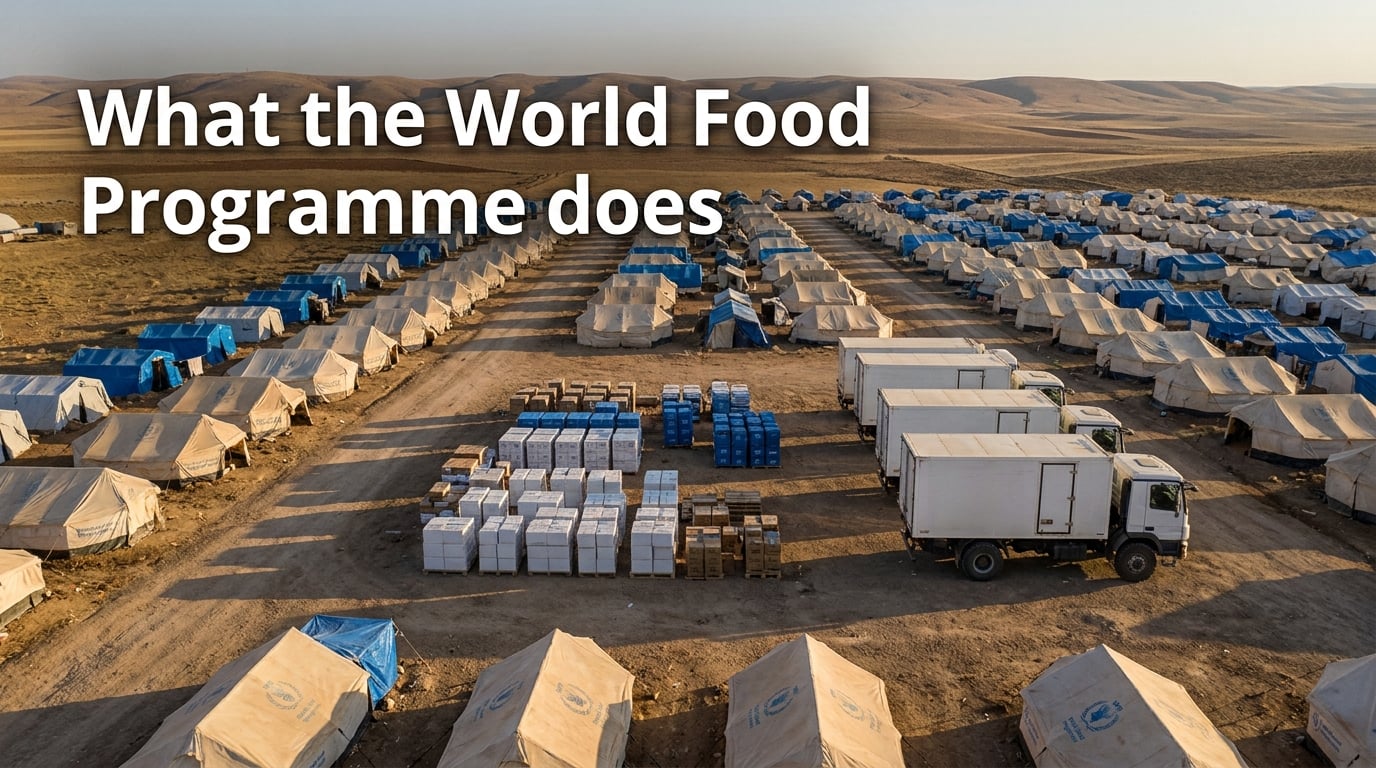
The World Food Programme (WFP) is the United Nations’ largest humanitarian organization, dedicated to fighting global hunger by providing food assistance to over 150 million people across more than 120 countries every year. If you’ve ever wondered what the World Food Programme does, the answer spans emergency relief in war zones, school meals for children, nutrition support for mothers, and long-term programs that help farmers feed their own communities.
Understanding how WFP operates matters because hunger remains one of the world’s most urgent crises. In 2026, hundreds of millions of people still face acute food insecurity driven by conflict, climate shocks, and economic instability. WFP stands at the frontline of that battle, often reaching places no other organization can.
Table of Contents
What Is the World Food Programme?
The World Food Programme is the food-assistance branch of the United Nations. It was established in 1961 and has grown into the world’s largest humanitarian organization focused entirely on hunger. WFP’s mission is straightforward: save lives during emergencies and change lives through sustainable development programs that address the root causes of hunger.
Unlike many charities, WFP operates as an intergovernmental organization with 120 member states. It does not rely on a single government for funding. Instead, it depends entirely on voluntary donations from governments, corporations, and private individuals. In 2020, the organization received the Nobel Peace Prize for its efforts to combat hunger, improve conditions for peace in conflict-affected areas, and prevent the use of hunger as a weapon of war.
WFP’s reach is enormous. The organization runs a logistics network that includes roughly 4,300 trucks, 55 aircraft, and 135 ships operating on any given day. That infrastructure allows it to deliver food and supplies to some of the most remote and dangerous places on earth.
History and Founding of WFP
The idea for the World Food Programme originated with U.S. President Dwight D. Eisenhower. In 1960, he proposed that the United Nations create a mechanism to use food surplus from developed nations to fight hunger in the developing world. The UN General Assembly formally established WFP in 1961 as an experimental program with a three-year mandate.
American diplomat George McGovern served as the first director of the program. What began as a small-scale experiment quickly proved its value. By 1965, WFP had become a permanent UN agency. Over the following decades, the organization expanded its scope from simple food distribution to a comprehensive approach that includes emergency response, nutrition programs, school feeding, and agricultural development.
Throughout its history, WFP has responded to virtually every major humanitarian crisis. From famines in Ethiopia and Somalia to earthquakes in Haiti and the Syrian refugee crisis, the organization has consistently adapted its operations to meet evolving needs. Today, WFP employs more than 23,000 staff worldwide, the majority of whom work in the field.
What Does the World Food Programme Do? Core Activities
WFP’s work falls into several interconnected categories. Each addresses a different dimension of hunger, from immediate emergency relief to long-term food security.
Emergency Food Assistance
Emergency food assistance is WFP’s most visible and urgent function. When conflict erupts, natural disasters strike, or economic crises push millions toward starvation, WFP mobilizes to deliver food and nutritional supplies to affected populations. The organization is often the first on the ground and sometimes the only humanitarian agency able to access people trapped in active conflict zones.
WFP provides this assistance through direct food distribution, cash-based transfers, and vouchers. In many operations, the organization delivers ready-to-eat meals, high-energy biscuits, and specialized nutritious foods designed for malnourished children and pregnant women. The goal is not just to feed people but to prevent famine and stabilize communities during the most acute phases of a crisis.
School Feeding Programs
One of WFP’s longest-running and most impactful programs is school feeding. The organization provides meals or snacks to roughly 20 million children in dozens of countries each year. School meals serve a dual purpose: they give children the nutrition they need to learn effectively, and they create an incentive for families to send their children, especially girls, to school rather than keeping them home to work.
In many developing countries, a school meal may be the only reliable meal a child receives during the day. Research consistently shows that school feeding programs improve attendance, concentration, and academic performance. WFP also works with national governments to build their own capacity to run school meal programs, gradually transferring ownership so the programs become self-sustaining.
Nutrition and Health Programs
Hunger is not simply about a lack of calories. Millions of people, particularly young children and mothers, suffer from micronutrient deficiencies that cause lasting physical and cognitive damage. WFP runs targeted nutrition programs that address these hidden forms of hunger.
The organization distributes specialized nutritious foods such as fortified blended flour, micronutrient powders, and ready-to-use supplementary foods. These products are designed to prevent and treat moderate acute malnutrition in children under five and support the health of pregnant and breastfeeding women. WFP also partners with health systems to integrate nutrition screening and treatment into routine healthcare services.
Cash-Based Transfers
In recent years, WFP has increasingly shifted from delivering physical food to providing cash and vouchers. Cash-based transfers allow families to purchase food from local markets, which supports local economies and gives people the dignity of choice. This approach works well in areas where food is available in markets but families cannot afford to buy it.
WFP uses digital tools to deliver these transfers efficiently. The organization has piloted blockchain-based systems for tracking transactions and has developed digital wallets that help beneficiaries receive and spend assistance securely. These innovations reduce overhead costs and increase transparency in how aid is distributed.
Smallholder Farmer Support
Supporting smallholder farmers is a key part of WFP’s long-term strategy. Small farmers produce a significant share of the food in developing countries, yet they often lack access to markets, storage facilities, and modern farming techniques. WFP connects these farmers to markets through programs like Farm to Market and Purchase for Progress (P4P), which help farmers sell their surplus production at fair prices.
The organization also provides training in post-harvest handling, helps farmers form cooperatives, and facilitates access to improved seeds and farming equipment. By strengthening smallholder agriculture, WFP addresses one of the underlying causes of food insecurity and helps communities become more resilient to future shocks.
Climate Resilience and Adaptation
Climate change is a growing driver of hunger. Droughts, floods, and extreme weather events are becoming more frequent and severe, destroying crops and disrupting food production. WFP has made climate resilience a central part of its strategy, helping communities prepare for and adapt to changing conditions.
Programs include weather-based crop insurance, which provides automatic payouts to farmers when rainfall falls below a critical threshold. WFP also invests in asset creation projects such as building irrigation systems, rehabilitating degraded land, and planting trees to prevent soil erosion. These efforts help communities withstand climate shocks and reduce their dependence on emergency aid over time.
How WFP Operations Work
Delivering food to over 150 million people across more than 120 countries requires a massive and highly coordinated logistics operation. WFP manages one of the world’s largest humanitarian supply chains, and its operational model is built on speed, efficiency, and adaptability.
The process begins with needs assessment. WFP teams on the ground evaluate the severity of a crisis, estimate the number of people affected, and determine what type of assistance is required. Once needs are clear, WFP activates its global supply chain. Food and supplies are sourced from suppliers worldwide and pre-positioned in strategic warehouses managed by the United Nations Humanitarian Response Depot (UNHRD) network.
From these hubs, supplies are transported by truck, ship, or aircraft to distribution points near affected populations. WFP also coordinates the Logistics Cluster, which manages logistics for the broader humanitarian community during major emergencies. This means WFP often handles transportation not just for its own supplies but for other UN agencies and NGOs as well.
In areas without reliable road access, WFP operates the United Nations Humanitarian Air Service (UNHAS), which provides air transport to humanitarian workers and supplies. This fleet of helicopters and fixed-wing aircraft is essential for reaching people in remote or conflict-affected regions where ground transport is impossible or too dangerous.
WFP Funding and Governance
WFP operates entirely on voluntary contributions. Unlike some UN agencies that receive assessed contributions from member states, WFP depends on donors choosing to fund its operations each year. In 2026, the organization required a multi-billion-dollar budget to meet the needs of the populations it serves.
The largest donors are national governments, with the United States, Germany, and the European Union historically among the top contributors. Corporate partners and private donors also play an increasingly important role. WFP states that 93.5 percent of government contributions go directly to operations, reflecting its commitment to keeping administrative overhead low.
WFP is governed by a 36-member Executive Board that provides intergovernmental support and oversight. The Executive Board meets regularly to review policies, approve programs, and oversee management. The organization is headed by an Executive Director appointed by the UN Secretary-General and the Director-General of the Food and Agriculture Organization (FAO). Cindy McCain served as Executive Director from 2023 through early 2026 before stepping down.
WFP also works in close partnership with other UN agencies, including the FAO and the International Fund for Agricultural Development (IFAD). These partnerships help ensure a coordinated approach to food security, nutrition, and rural development. The organization is a member of the International Aid Transparency Initiative (IATI), reflecting its commitment to making information about its spending and operations publicly accessible.
Impact and Nobel Peace Prize Recognition
The scale of WFP’s impact is significant. Each year, the organization reaches over 150 million people with food assistance, operating in some of the world’s most dangerous and hard-to-reach locations. Its school feeding programs alone benefit roughly 20 million children annually, improving both nutrition and educational outcomes.
In 2020, the Norwegian Nobel Committee awarded the Nobel Peace Prize to the World Food Programme. The committee cited WFP’s efforts to combat hunger, its contribution to bettering conditions for peace in conflict-affected areas, and its role as a driving force in efforts to prevent the use of hunger as a weapon of war and conflict. The recognition underscored the connection between food security and global stability.
WFP’s work contributes directly to Sustainable Development Goal 2: Zero Hunger, which calls for ending hunger, achieving food security, improving nutrition, and promoting sustainable agriculture by 2030. While that target remains a significant challenge, WFP continues to push toward it through a combination of emergency response and long-term development programming.
Frequently Asked Questions
What is the mission of the World Food Programme?
The World Food Programme’s mission is to save lives during emergencies and change lives through sustainable development programs. WFP works to end global hunger by providing food assistance, improving nutrition, and building food security in over 120 countries.
How does the World Food Programme operate?
WFP operates through a global logistics network of trucks, aircraft, and ships to deliver food and supplies. The organization uses direct food distribution, cash-based transfers, vouchers, and digital tools to reach people in need, coordinating with other UN agencies and NGOs.
Where does WFP operate?
WFP operates in more than 120 countries and territories worldwide, focusing on regions affected by conflict, climate disasters, and economic instability. The organization maintains presence in some of the world’s most remote and dangerous locations.
Is the World Food Programme a legitimate organization?
Yes, WFP is the United Nations’ largest humanitarian organization and an established intergovernmental agency with 120 member states. It won the Nobel Peace Prize in 2020 and is a member of the International Aid Transparency Initiative, making its operations publicly auditable.
Why did WFP win the Nobel Peace Prize?
WFP received the 2020 Nobel Peace Prize for its efforts to combat hunger, its contribution to improving conditions for peace in conflict-affected areas, and its work to prevent the use of hunger as a weapon of war.
Conclusion
Understanding what the World Food Programme does reveals an organization that combines the urgency of emergency relief with the patience of long-term development. From school meals that keep children learning to logistics networks that deliver food into active war zones, WFP addresses hunger on every front. As global food insecurity continues to grow, knowing how WFP works helps anyone looking to support or understand the fight against hunger make more informed decisions.