
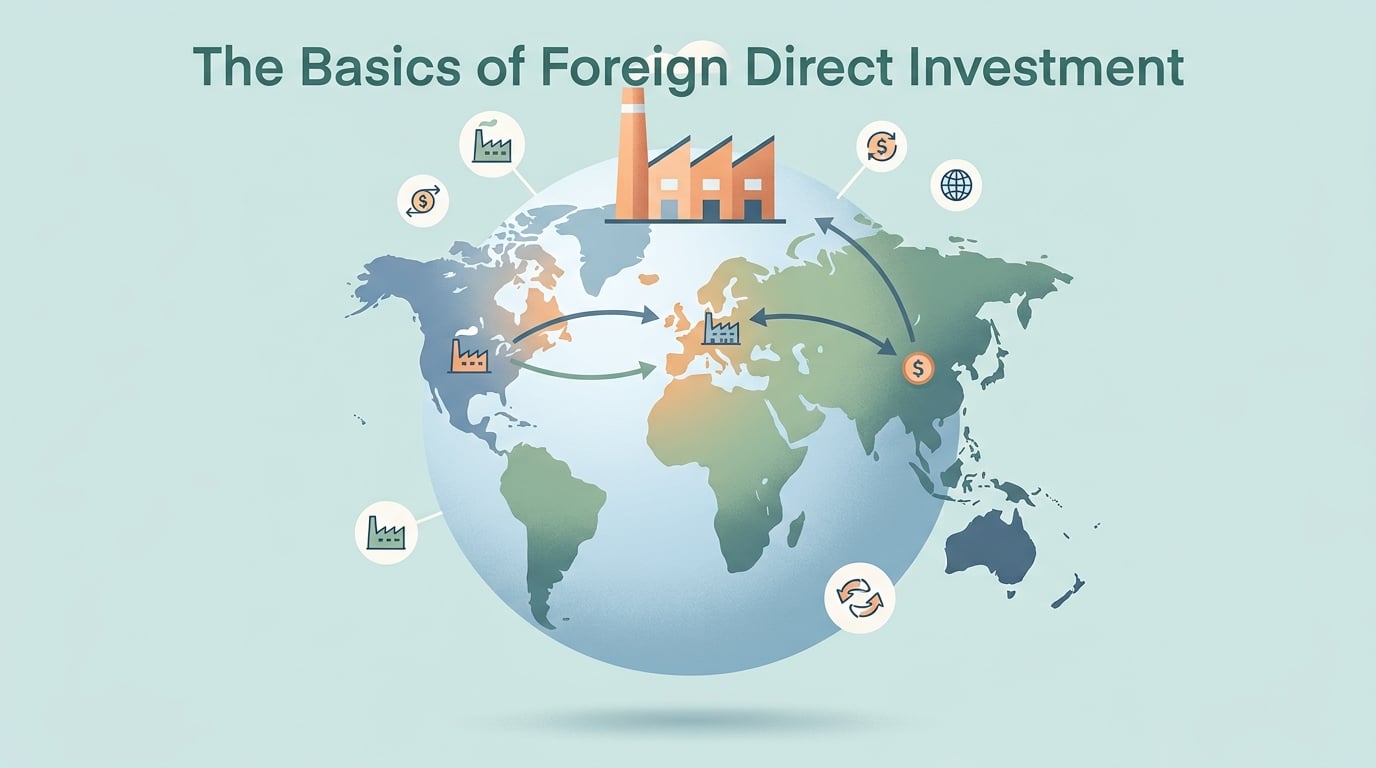
Foreign direct investment (FDI) is an ownership stake of 10% or more in a company or project located in another country, giving the investor lasting interest and meaningful management influence.
Think of it this way: shipping your products to another country is trade. Building an actual factory there, hiring local workers, and managing the operations yourself is foreign direct investment. The investor is not just selling across borders — they are putting real capital, technology, and control into a foreign economy for the long haul.
I have spent the last several weeks pulling together the 2026 data on global FDI flows, reading the latest UNCTAD World Investment Report, and comparing how the OECD, IMF, and World Bank define and measure this thing. This guide is the result. By the end, you will understand what FDI is, how it works, the four main types, the methods investors use to enter a market, and why governments around the world chase it so aggressively.
Table of Contents
Key Takeaways
- Foreign direct investment (FDI) means owning at least 10% of a foreign company or building a lasting physical presence abroad.
- The 10% threshold comes from the OECD Benchmark Definition and signals lasting management interest, not passive speculation.
- The four types of FDI are horizontal, vertical (backward and forward), conglomerate, and platform.
- The main methods of entry are greenfield investment, mergers and acquisitions, joint ventures, and brownfield investment.
- FDI differs from foreign portfolio investment (FPI) because FPI is passive and short-term, while FDI is active and long-term.
- Global FDI reached roughly 1.4 trillion dollars in 2026 flows according to UNCTAD, with the United States, China, and India among the top destinations.
What Is Foreign Direct Investment (FDI)?
Foreign direct investment is a cross-border investment in which an investor from one country establishes a lasting interest in an enterprise located in another country. The standard international threshold is ownership of at least 10% of the voting stock of the foreign enterprise, according to the OECD Benchmark Definition of Foreign Direct Investment.
The 10% rule exists for a reason. Below that threshold, an investor is generally considered a passive shareholder — someone who might buy a few shares of a foreign company through a brokerage and hope the price goes up. Above it, the investor is presumed to have a lasting interest and some degree of management influence. That shift from passive to active is what turns ordinary cross-border capital into FDI.
In simple words, FDI happens when a company or government from country A puts real money, equipment, or know-how into a business in country B, and intends to stick around long enough to run it, not just trade with it.
FDI Is Not Foreign Aid
This is a point that trips up beginners, and forum users ask about it constantly. Foreign aid is government-to-government money given, often as a grant or concessional loan, to support development, humanitarian relief, or political objectives. FDI is private or state-owned capital deployed for profit. The investor expects a financial return, not a thank-you letter.
How Foreign Direct Investment Works
Foreign direct investment works when an investor from one country acquires a controlling stake in, or builds new productive capacity in, an enterprise in another country. The OECD recognises three financial components that make up an FDI transaction: equity capital, reinvested earnings, and intracompany loans.
- Equity capital is the purchase of shares in the foreign enterprise, which gives the investor ownership rights and a say in how the business is run.
- Reinvested earnings are profits made by the foreign affiliate that the parent company chooses to keep inside the local operation rather than send home.
- Intracompany loans are funds the parent company lends to its foreign subsidiary, often to expand operations or cover short-term financing needs.
Inward vs Outward FDI
When analysts talk about FDI, they distinguish between the perspective of the home country and the host country. Outward FDI is investment that flows out of a country into foreign economies — for example, Toyota building plants in the United States. Inward FDI is investment that flows into a country from foreign investors — for example, the same Toyota plants counted as inward FDI on the U.S. side of the ledger.
How FDI Is Measured
Three numbers dominate the conversation: FDI inflows, FDI outflows, and FDI stock. Inflows and outflows measure the value of cross-border transactions during a single year — basically the flow of new investment that year. Stock measures the cumulative value of all FDI relationships at a given point in time, the total foreign-owned assets sitting inside a country. Most governments and international bodies like UNCTAD report FDI as a percentage of GDP to normalise for the size of the economy.
Types of Foreign Direct Investment
Economists classify FDI into four main types based on the strategic reason an investor is entering a foreign market. These are horizontal, vertical (with two sub-types), conglomerate, and platform FDI.
Horizontal FDI
Horizontal FDI is when a company replicates its home-country business activities in a foreign country. A car maker that builds the same model of car in Mexico that it builds in Japan is doing horizontal FDI. The motivation is market-seeking — the company wants to sell to local customers, avoid tariffs, or reduce shipping costs.
Vertical FDI
Vertical FDI happens when a company expands into a foreign country to handle a different stage of its production process. There are two flavours.
- Backward vertical FDI means moving into an upstream activity — for example, a smartphone maker acquiring a chip designer or a mine to secure inputs.
- Forward vertical FDI means moving into a downstream activity — for example, a manufacturer opening its own retail stores in foreign markets instead of selling through independent distributors.
Conglomerate FDI
Conglomerate FDI is when a company enters a foreign country in an unrelated industry. A South Korean chaebol that runs electronics, shipbuilding, and theme parks all at home might, for instance, open a resort in Vietnam. This is the rarest type in practice because unrelated diversification is hard to justify economically.
Platform FDI
Platform FDI is investment in a foreign country that serves as an export base for serving third-country markets. A Chinese electronics firm that builds a factory in Vietnam to sell to the United States is doing platform FDI. This type has grown rapidly with global supply chain restructuring.
Methods of Making Foreign Direct Investment
Investors can enter a foreign market in four main ways. Each method carries different levels of risk, capital commitment, and speed to market.
Greenfield Investment
Greenfield investment means building a brand-new operation from the ground up. The investor literally constructs factories, hires staff, installs equipment, and starts producing. It is the slowest and most capital-intensive method, but it gives the investor full control and is the cleanest way to transfer proprietary technology.
Mergers and Acquisitions (M&A)
Mergers and acquisitions are the dominant form of FDI in mature markets. Instead of building from scratch, an investor buys or merges with an existing foreign company. M&A is faster and lets the investor inherit local market knowledge, distribution networks, and an established workforce. It is also where most of the regulatory attention — and sometimes controversy — lands, especially when the target is in a sensitive sector.
Joint Ventures
A joint venture is a partnership between a foreign investor and a local company. Both parties contribute capital, technology, or expertise and share control of the resulting entity. Joint ventures are common in countries that restrict full foreign ownership in certain industries, and they help foreign firms navigate local regulations, language, and culture.
Brownfield Investment
Brownfield investment means acquiring or leasing an existing foreign facility — often one that is underused, idle, or in the process of being privatised — and then modernising or repurposing it. It is faster than greenfield, cheaper than building new, and frequently used in post-privatisation deals in Eastern Europe and parts of Latin America.
FDI vs Foreign Portfolio Investment (FPI)
The single most common confusion beginners run into is the difference between foreign direct investment and foreign portfolio investment. Both involve cross-border capital flows, but they behave very differently and matter very differently to a host country.
| Feature | FDI | FPI |
|---|---|---|
| Ownership threshold | 10% or more of voting stock | Less than 10% (typically) |
| Intent | Lasting management interest | Passive financial return |
| Horizon | Long-term (years to decades) | Short-term (minutes to months) |
| Volatility | Stable, sticky capital | Can reverse rapidly in a crisis |
| What flows with the money | Technology, jobs, training, supply chains | Mostly cash; little operational transfer |
| Host-country benefit | Capacity-building, productivity gains | Liquidity for local capital markets |
| Risk for investor | High — hard to exit quickly | Low — sell and leave |
Think of FDI as moving your workshop to another country. Think of FPI as buying shares in a workshop you will never visit. The first creates jobs and skills; the second mostly changes who owns the financial claim.
Advantages and Disadvantages of Foreign Direct Investment
Foreign direct investment has real upside for everyone involved, but it also comes with genuine downside. Here is how the balance tends to shake out.
Benefits for the Investor
- Access to new markets, customers, and distribution channels.
- Lower production costs through access to cheaper labour, land, or inputs.
- Tariff avoidance by producing inside regional trade blocs.
- Tax efficiencies from locating in jurisdictions with favourable regimes.
- Diversification of revenue across multiple countries and currencies.
Benefits for the Host Country
- Capital inflows that fund infrastructure, factories, and services.
- Technology and know-how transfer to local suppliers and employees.
- Job creation, often with wages above the local average.
- Skills development and management training for the local workforce.
- Increased tax revenue and a stronger balance of payments position.
Risks for the Investor
- Political risk: regime change, expropriation, contract revision.
- Currency risk: local-currency devaluation can wipe out repatriated profits.
- Regulatory risk: shifting rules on foreign ownership, labour, and environment.
- Reputational risk: backlash from local communities, NGOs, or labour groups.
Risks for the Host Country
- Crowding out of local firms that cannot compete with a multinational giant.
- Profit repatriation drains capital out of the local economy.
- Dependency on a foreign investor whose strategic priorities can shift overnight.
- Environmental degradation if regulation is weak or poorly enforced.
Government Policies and FDI Incentives
Governments actively compete for foreign direct investment because of the jobs, technology, and tax base it brings. The main tools they use fall into three buckets.
Tax Incentives
Many countries offer reduced corporate tax rates, multi-year tax holidays, or accelerated depreciation allowances to attract FDI into specific sectors or regions. The goal is to lower the effective cost of investing so that the foreign firm chooses this country over a neighbour.
Special Economic Zones and Export Processing Zones
A special economic zone (SEZ) is a designated area with looser regulations, tax breaks, and streamlined customs procedures. Export processing zones are a sub-type focused on manufacturing for export. China’s Shenzhen, Vietnam’s industrial parks, and the United States’ foreign trade zones all operate on this principle. According to UNCTAD data referenced in 2026 reports, the number of SEZs worldwide has grown past 5,500, and they continue to attract a meaningful share of global greenfield investment.
National Security Reviews
The other side of the coin is screening. Countries like the United States (through CFIUS), the European Union, and China have formal mechanisms to block or unwind foreign acquisitions in sensitive sectors — semiconductors, telecoms, defence, critical minerals, and data infrastructure. The trend is toward more screening, not less.
Where FDI Goes: Major Sources and Destinations
Foreign direct investment flows are heavily concentrated. A small number of advanced economies account for the majority of outward FDI, and a similarly small set of large economies absorb most inward FDI.
Top Source Countries
The United States, Japan, Germany, the United Kingdom, and China have been the largest source countries for outward FDI for decades. Multinational enterprises headquartered in these economies — Apple, Toyota, Volkswagen, Shell, Huawei — operate extensive cross-border production networks.
Top Destination Countries
The United States is consistently the world’s largest recipient of inward FDI. China, India, Brazil, Singapore, and the United Kingdom round out the top tier. UNCTAD’s World Investment Report 2026 edition put global FDI inflows at roughly 1.4 trillion dollars, with developing economies accounting for about a third of that figure despite hosting the majority of the world’s population.
FDI in Developing Economies
For developing economies, FDI can be transformative — a single auto plant can reshape a regional supply chain, train thousands of workers, and pull in dozens of local suppliers. But the gains are not automatic. The World Bank has repeatedly shown that the developmental payoff of FDI depends heavily on local absorptive capacity: education levels, infrastructure quality, financial market depth, and the rule of law.
Real-World Examples of Foreign Direct Investment
Concrete examples make FDI easier to grasp than definitions alone. Here are four that show how the concept plays out in the real economy.
Toyota in the United States
When Toyota began building assembly plants in Kentucky and Indiana in the 1980s, it was a textbook case of horizontal, market-seeking FDI. The Japanese automaker wanted to sell cars to American buyers without running into trade friction, and it built entire local ecosystems of suppliers around each plant. Today, Toyota’s U.S. operations employ tens of thousands of Americans directly and many more through local suppliers.
Apple and Foxconn
Apple’s relationship with Taiwan-based Foxconn is a classic case of vertical and platform FDI combined. Foxconn invests billions in factories in China, Vietnam, India, and other countries to assemble iPhones and other Apple products. The investment is vertical because it secures Apple’s supply chain, and platform because many of those factories serve global, not just local, markets.
Walmart and Flipkart
When Walmart acquired a majority stake in India’s Flipkart for 16 billion dollars in 2018, it was one of the largest FDI deals in history. It was a horizontal move — Walmart wanted access to India’s fast-growing e-commerce market without running afoul of rules that forbid foreign retailers from operating physical grocery stores directly in India. The Flipkart acquisition let Walmart enter the market through a domestic digital platform.
Belt and Road Initiative
China’s Belt and Road Initiative is the largest state-driven FDI programme in modern history. Through it, Chinese state-owned enterprises and private companies have invested in ports, railways, power plants, and telecoms across more than 140 countries. Critics call it debt-trap diplomacy; supporters call it development financing. Either way, it is a massive flow of outward FDI from China.
The Future of Foreign Direct Investment
The FDI landscape is shifting in 2026 under several powerful forces that every student of the topic should be aware of.
Digital FDI
Digital FDI is the cross-border investment in assets that exist primarily in the digital realm — software, cloud infrastructure, fintech platforms, and data centres. UNCTAD reports show that digital FDI has grown faster than traditional FDI since the early 2020s, partly because it sidesteps some of the geopolitical scrutiny that comes with bricks-and-mortar deals.
ESG Screening
Investors increasingly apply environmental, social, and governance filters before approving FDI projects. Coal plants, tobacco, weapons, and projects with poor labour records are now harder to finance. Conversely, renewable energy, electric vehicle supply chains, and green infrastructure attract premium capital.
Nearshoring and Friend-Shoring
After the supply chain shocks of the early 2020s, multinational firms have been moving production closer to their home markets (nearshoring) or to politically aligned countries (friend-shoring). This trend is reshaping FDI flows toward Mexico, Vietnam, India, and Eastern Europe.
Geopolitical Fragmentation
The biggest open question for the future of FDI is whether the global economy is splitting into competing blocs. If it is, FDI flows may increasingly be routed along political lines rather than efficiency lines, and the total volume of cross-border investment may shrink. UNCTAD and IMF economists are watching this closely in 2026.
Frequently Asked Questions
What is foreign direct investment in simple words?
Foreign direct investment is when a company or government from one country puts real money, factories, or know-how into a business in another country and intends to stay involved for years. It is more than just selling products abroad — it is building a lasting presence there.
What are the four main types of foreign direct investment?
The four main types of FDI are horizontal, vertical, conglomerate, and platform. Horizontal FDI replicates the same business abroad. Vertical FDI expands into a different stage of production. Conglomerate FDI enters an unrelated industry. Platform FDI uses the foreign country as an export base to serve third markets.
What is the 10% rule in FDI?
The 10% rule refers to the OECD Benchmark Definition of FDI, which states that an investor must own at least 10% of the voting stock of a foreign enterprise for the investment to count as FDI. Below 10%, the investment is generally classified as foreign portfolio investment.
What is the difference between FDI and FPI?
FDI means owning at least 10% of a foreign company with the intent to manage it over the long term. FPI means owning less than 10%, usually as passive shares, with no intention of running the business. FDI is sticky and brings technology and jobs; FPI is liquid and brings market liquidity.
Why is foreign direct investment important?
FDI matters because it transfers capital, technology, management skills, and jobs across borders. For host countries, it can drive economic growth, raise productivity, and fund infrastructure. For investors, it offers new markets, lower costs, and diversification.
What are the advantages and disadvantages of FDI?
Advantages for the host country include capital inflows, technology transfer, jobs, training, and tax revenue. Disadvantages include crowding out of local firms, profit repatriation, dependency on foreign owners, and potential environmental damage. Investors gain market access and cost advantages but face political, currency, and regulatory risk.
What is an example of foreign direct investment?
A clear example is Toyota building car assembly plants in the United States — that is horizontal, market-seeking FDI. Another is Walmart acquiring a majority stake in India’s Flipkart to enter the Indian e-commerce market. A third is China’s Belt and Road Initiative, which invests in infrastructure across more than 140 countries.
How is foreign direct investment measured?
FDI is measured as FDI inflows (new investment arriving during a year), FDI outflows (new investment leaving during a year), and FDI stock (the total cumulative value of foreign-owned assets at a given moment). Countries report these figures to the IMF, OECD, and UNCTAD, which publish them in their balance of payments and World Investment Report.
Key Takeaways on Foreign Direct Investment
Foreign direct investment is one of the most powerful forces shaping the global economy. At its core, it is a long-term, controlling investment by an entity in one country into a business in another country, with the threshold set at 10% of voting stock under the OECD definition.
We covered the four main types of FDI — horizontal, vertical, conglomerate, and platform — and the four main methods of entry — greenfield, mergers and acquisitions, joint ventures, and brownfield. We saw how FDI differs from foreign portfolio investment, why governments compete to attract it, and where the world’s biggest flows are heading. We also touched on the future of FDI: digital platforms, ESG screening, nearshoring, and the geopolitical tensions reshaping the map.
Your next step, if you want to dig deeper, is to pull up the latest UNCTAD World Investment Report for the 2026 data, skim the OECD Benchmark Definition for the technical rules, and explore a few country case studies — China, India, and the United States are the most instructive. Foreign direct investment may look abstract from a textbook, but it is what built the factory down your road and the phone in your pocket.