
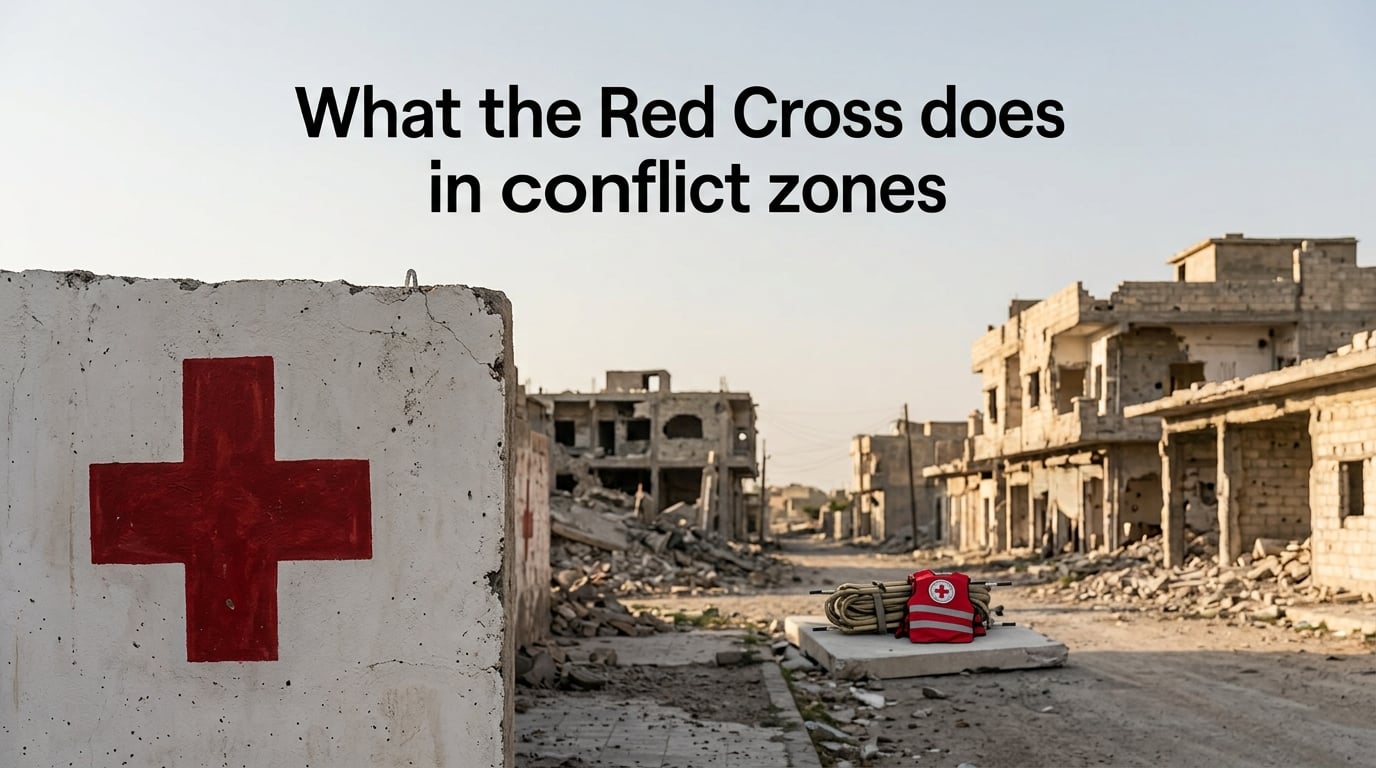
The Red Cross, led by the International Committee of the Red Cross (ICRC), protects lives and dignity in armed conflict by sending neutral, independent delegates into war zones to negotiate humanitarian access, visit detainees, reunite separated families, support hospitals, and deliver food and water. Working under the Geneva Conventions of 1949, the ICRC operates in more than 90 countries and employs roughly 16 million volunteers worldwide — making it the largest humanitarian network on earth.
I have spent years following humanitarian coverage in active conflicts, and the question of what the Red Cross actually does in conflict zones comes up constantly from readers, donors, and journalism students. The short answer above covers the headline, but the reality is more layered. This guide walks through the Movement’s history, structure, principles, core activities, legal backbone, modern operations, and the criticisms that shape the debate around humanitarian neutrality today.
Table of Contents
What the Red Cross Does in Conflict Zones at a Glance
The Red Cross’s work in armed conflict falls into three overlapping categories: protection, assistance, and prevention.
- Protection means keeping civilians out of harm’s way, monitoring how prisoners of war and detainees are treated, and pressing warring parties to follow the laws of war.
- Assistance covers the practical delivery of food, clean water, medical care, shelter, and family-tracing services.
- Prevention is the quieter work: reminding governments and armed groups of their obligations under international humanitarian law before more harm is done.
The ICRC itself is present in more than 90 countries. Across the wider International Red Cross and Red Crescent Movement there are 191 National Societies and around 16 million volunteers, a figure I have seen climb steadily as more National Societies expand their community health and disaster-response teams.
How the Red Cross Began: Solferino, Henry Dunant, and 1863
The Red Cross was born from a single day of horror on the battlefield. On 24 June 1859, Swiss businessman Henry Dunant arrived in the Italian town of Solferino and witnessed roughly 40,000 wounded and dying soldiers from the Franco-Austrian War being left without medical care.
He organized local villagers, including women and children, to gather the wounded, dress their injuries, and carry water. That experience became the book A Memory of Solferino (1862), which proposed two ideas that would reshape humanitarian law: a voluntary relief society to care for wounded soldiers, and an international agreement to protect the wounded and those who help them.
Both ideas took root in 1863 when the International Committee of the Red Cross was founded in Geneva, and in 1864 when the first Geneva Convention was adopted. The organization has since received three Nobel Peace Prizes (1917, 1944, 1963) — a record unmatched in the humanitarian sector.
The International Red Cross and Red Crescent Movement: ICRC, IFRC, and National Societies
When people say “the Red Cross,” they often mean different things. The full picture is a three-part Movement: the ICRC, the IFRC, and 191 National Societies. They cooperate but have distinct roles.
ICRC — International Committee of the Red Cross
The ICRC is the Movement’s conflict-specific agency. Based in Geneva and staffed by roughly 20,000 employees worldwide, it has a permanent mandate under international treaty law to act in armed conflict. That mandate gives it a unique right to visit prisoners of war, trace missing persons, and act as a neutral intermediary between warring parties.
IFRC — International Federation of Red Cross and Red Crescent Societies
The IFRC coordinates the work of the 191 National Societies outside active conflict. It focuses on disaster response, public health, climate resilience, and migration support. When a typhoon hits the Philippines or a cholera outbreak flares in southern Africa, the IFRC is the coordinating body.
National Societies
National Societies are the local branches — the American Red Cross, British Red Cross, Indian Red Cross Society, and so on. They recruit volunteers, run blood services, respond to domestic disasters, and contribute delegates to ICRC and IFRC operations abroad. Most operate as auxiliary to their own public authorities while staying faithful to the Movement’s Fundamental Principles.
| Component | Headquarters | Primary Mandate | Typical Scope |
|---|---|---|---|
| ICRC | Geneva, Switzerland | Humanitarian protection in armed conflict | 90+ conflict-affected countries |
| IFRC | Geneva, Switzerland | Coordination of disaster and health response | 191 National Societies worldwide |
| National Societies | Within each country | Local humanitarian service and volunteer mobilization | Domestic operations plus surge abroad |
The Seven Fundamental Principles of the Red Cross
The Seven Fundamental Principles were adopted in 1965 and are the moral operating system of the entire Movement. They are not aspirational posters — they govern daily decisions about who gets food first, whether to speak publicly about abuses, and which side of the front line a delegate can cross.
- Humanity — The Red Cross was born to prevent and alleviate human suffering wherever it is found. Protection of life and health is its first purpose.
- Impartiality — Aid is given without discrimination based on nationality, race, religion, class, or political opinion. Priority goes to the most urgent cases.
- Neutrality — To retain the trust of all parties, the Movement takes no side in hostilities and engages in no controversies of a political, racial, religious, or ideological nature.
- Independence — The Movement is independent of governments. National Societies, while auxiliary to their state in humanitarian service, must always maintain autonomy so they can act in line with the principles.
- Voluntary Service — The Red Cross is a voluntary relief movement, not motivated by the desire for gain.
- Unity — Each country has only one National Red Cross or Red Crescent Society, open to all and carrying out humanitarian work across the entire territory.
- Universality — The Movement is global. Every National Society has equal status and shares equal responsibilities in helping each other.
I find neutrality the most misunderstood of the seven. It does not mean silence, cowardice, or moral blindness. It means the Red Cross will not publicly take sides in a political dispute, because doing so would close humanitarian access to one party and leave people without aid. The trade-off is real, and I come back to it in the criticisms section below.
Core Activities: What the Red Cross Does in Conflict Zones
The day-to-day reality of Red Cross work in war zones is fragmented, dangerous, and overwhelmingly practical. Here are the activity areas the ICRC and National Societies run most often.
Protecting civilians
Civilians — especially women, children, the elderly, and the displaced — are supposed to be protected under the Geneva Conventions. In practice, they bear the heaviest cost of modern urban warfare. Red Cross delegates register displaced families, monitor evacuation routes, document violations, and lobby parties to the conflict to spare civilian infrastructure.
Visiting detainees and prisoners of war
This is one of the ICRC’s most distinctive activities and the one that sets it apart from most other humanitarian NGOs. Under the Geneva Conventions, the ICRC has the right to visit anyone detained in connection with armed conflict, monitor their conditions, register their identities, and pass messages to their families. In 2024 alone, the ICRC visited more than 680,000 detainees in over 80 countries — a number most readers find surprisingly large.
These visits are confidential by design: the ICRC shares its findings only with the detaining authority, not the press. The reasoning is that public shaming tends to end access.
Restoring Family Links and tracing missing persons
War scatters families. The Restoring Family Links (RFL) program uses a global network of tracing offices, satellite phones, the Red Cross Message system, and family-website databases to reunite separated relatives and locate the missing. The ICRC helped clarify the fate of more than 3,000 missing persons in 2024 — a fraction of the caseload, but each file is a family whose child, parent, or spouse was returned or accounted for.
Medical aid, hospitals, and physical rehabilitation
The Red Cross supports war-wounded patients through field hospitals, surgical teams, emergency primary care, and physical rehabilitation centers for those who have lost limbs to mines, bombs, or shootings. The ICRC runs specialized programs in prosthetics and runs the world’s leading physical-rehabilitation reference center in physical rehabilitation.
Water, sanitation, and shelter
Engineers from the ICRC’s Water and Habitat unit repair bombed water networks, drill boreholes, install latrines, and rebuild damaged shelter. In many active conflicts they are the only actor maintaining clean water for besieged cities.
Humanitarian forensics and weapon contamination
The ICRC runs the world’s only dedicated humanitarian forensics unit, helping authorities identify human remains so families can bury their dead with dignity. It also leads work on weapon contamination — surveying battlefields for unexploded ordnance and cluster munitions, and pressing states to clear them.
Neutral intermediary role
When two warring sides need to swap prisoners, evacuate civilians, or run a humanitarian corridor, the ICRC often acts as the neutral intermediary. It has facilitated prisoner exchanges, helped negotiate local ceasefires, and helped civilians cross front lines for medical treatment. Forum coverage from conflict-zone journalists consistently describes the neutral intermediary role as one of the Red Cross’s most undervalued contributions.
The Geneva Conventions: The Legal Backbone of Red Cross Work
Everything the ICRC does in conflict zones flows from a single piece of international law: the four Geneva Conventions of 1949 and their Additional Protocols. Together they form the core of international humanitarian law (IHL) — the rules of war.
The Conventions cover four situations: wounded and sick on land, wounded and sick at sea, prisoners of war, and civilians. The 1977 Additional Protocols extended protection in non-international armed conflicts, where most modern wars actually occur. Common Article 3, the so-called “Convention in miniature,” binds every party to every conflict, even non-state armed groups, to treat the wounded humanely and protect civilians.
The ICRC is the “custodian” of international humanitarian law — a permanent, treaty-defined role that no other organization holds. That custodian mandate is why the ICRC has the legal right to visit detainees, trace missing persons, and act as a neutral intermediary.
Why the emblem is protected
The red cross, red crescent, and red crystal emblems are protected symbols under international law. Misusing them — for example, displaying them on an ambulance during a military operation — is a war crime. The protection is what allows medical workers, ambulances, and hospitals to operate in war zones without being targeted. Forum commenters in conflict zones repeatedly cite the emblem as the only reliable visual signal of a protected humanitarian space.
Red Cross Operations in Today’s Conflicts: Ukraine, Gaza, Sudan, Myanmar
Reading about the Red Cross in the abstract is one thing. Seeing it operate in today’s active conflicts is another. Here is how the Movement is currently engaged in four of the world’s most serious humanitarian crises.
Ukraine
The ICRC runs one of its largest operations in Europe since the Second World War. It registers prisoners of war from both sides, helps separated families stay in contact, supports hospitals with surgical supplies, and repairs water and electricity infrastructure damaged by shelling. National Societies from neighboring countries — including the Polish Red Cross, German Red Cross, and Romanian Red Cross — support the response with logistics and refugee assistance.
Gaza
The International Committee of the Red Cross, together with the Palestinian Red Crescent Society, has maintained a presence throughout the escalation in Gaza. Activities include supporting emergency medical points, helping trace family members separated by the conflict, and supporting water and sanitation in displacement areas. Forum coverage consistently cites the family-tracing service as the most-requested form of Red Cross assistance.
Sudan
The civil war in Sudan has displaced more than 11 million people. The Sudanese Red Crescent Society, supported by the IFRC and ICRC, runs one of the most dangerous humanitarian operations in the world — delivering food, water, and medical care in cities under active bombardment. Volunteers describe navigating front-line checkpoints and active hostilities as routine.
Myanmar and forgotten crises
Myanmar, the Democratic Republic of the Congo, Yemen, and Haiti rarely make international headlines, but Red Cross teams are present in each. In Myanmar, the Red Cross has supported community first aid and continues to engage both state and non-state actors to maintain humanitarian access.
Criticisms and Limitations of the Red Cross Model
No honest overview can skip the criticisms, and they deserve real attention. I have heard four recurring concerns from readers and forum commenters.
The silence-versus-accountability debate
The ICRC’s commitment to confidential dialogue means that serious violations are often not made public. Critics argue this shields perpetrators. Defenders argue that public condemnation ends access, and that without access, the people inside suffer more. Both arguments have merit. Recent academic commentary in the International Review of the Red Cross has called for more nuanced approaches that protect access without abandoning accountability.
Donor concerns about transparency
Some donors wonder whether their contributions actually reach conflict-zone beneficiaries. The ICRC publishes detailed annual financial reports, but the work itself is often invisible by design — a family reunited is private, a detained person treated better does not appear in a press release.
Worker safety in modern warfare
Modern urban warfare, with strikes on hospitals and ambulances, puts aid workers at risk as never before. ICRC and Red Crescent staff have been killed in Ukraine, Sudan, and elsewhere. Forum commenters from humanitarian worker communities describe the trauma and burnout that come with extended deployments.
Whether neutrality compromises on moral positions
Some observers argue that remaining neutral during serious atrocities is itself a moral position. This is the most philosophically charged criticism, and the Movement’s response is that neutrality is the only stance that allows it to keep working with all parties.
Red Cross vs Red Crescent: Why Two Emblems
There are now three protected emblems, not one: the red cross, the red crescent, and the red crystal adopted in 2005.
- The red cross is the original, adopted in 1864, and is used by National Societies in roughly 150 countries — many of them historically Christian-majority.
- The red crescent was first used by the Ottoman Red Crescent Society in 1876 and is used by National Societies in many Muslim-majority countries.
- The red crystal was added in 2005 as a neutral alternative for states that did not want a religious symbol and as an additional emblem that any National Society can use.
All three emblems are equal under international law and offer identical legal protection.
Frequently Asked Questions
What are the 7 humanitarian principles of the Red Cross?
The seven Fundamental Principles are humanity, impartiality, neutrality, independence, voluntary service, unity, and universality. They were formally proclaimed in 1965 and govern every part of the International Red Cross and Red Crescent Movement.
What is the difference between the Red Cross and the Red Crescent?
The red cross is the original emblem from 1864, used by most National Societies. The red crescent was first adopted by the Ottoman Red Crescent in 1876 and is used in many Muslim-majority countries. The red crystal, added in 2005, is a neutral alternative. All three carry identical legal protection under international humanitarian law.
Why does the Red Cross stay neutral?
Neutrality is one of the seven Fundamental Principles. The Red Cross does not take sides in political, racial, religious, or ideological controversies because doing so would shut off humanitarian access to one party in a conflict, leaving people without food, water, medical care, or protection. The trade-off is that the ICRC often keeps its findings confidential rather than public.
How does the Red Cross reunite families separated by war?
Through the Restoring Family Links (RFL) program. The Movement uses a global network of tracing offices, satellite phones, the Red Cross Message system, family-website databases, and ICRC forensic teams to locate missing persons and reunite families. In 2024 the ICRC helped clarify the fate of more than 3,000 missing persons.
Who funds the International Committee of the Red Cross?
The ICRC is funded primarily by voluntary contributions from governments (States party to the Geneva Conventions), National Red Cross and Red Crescent Societies, and private donors. It publishes detailed annual financial reports. The IFRC and National Societies operate on a separate funding model that includes membership fees and domestic fundraising.
What challenges does the Red Cross face in modern war?
Three stand out. First, urban warfare and attacks on hospitals and ambulances put aid workers at risk as never before. Second, growing displacement and the spread of conflicts into cities make humanitarian access harder. Third, digital tools, autonomous weapons, and cyber operations are creating new categories of harm that the Geneva Conventions were not written to address.
Why the Red Cross’s Work in Conflict Zones Matters
What the Red Cross does in conflict zones is, at its core, the practice of staying present when everyone else has fled. The Geneva Conventions give it a permanent mandate, the seven Fundamental Principles give it a moral compass, and 16 million volunteers worldwide give it reach.
The Movement’s future will be tested by urban warfare, cyber operations, autonomous weapons, and the slow grinding of climate-linked conflict. None of those challenges existed when Henry Dunant walked onto the Solferino battlefield in 1859 — but the principle he set in motion still does: that even in war, there are limits, and there are people whose job is to hold the line.