
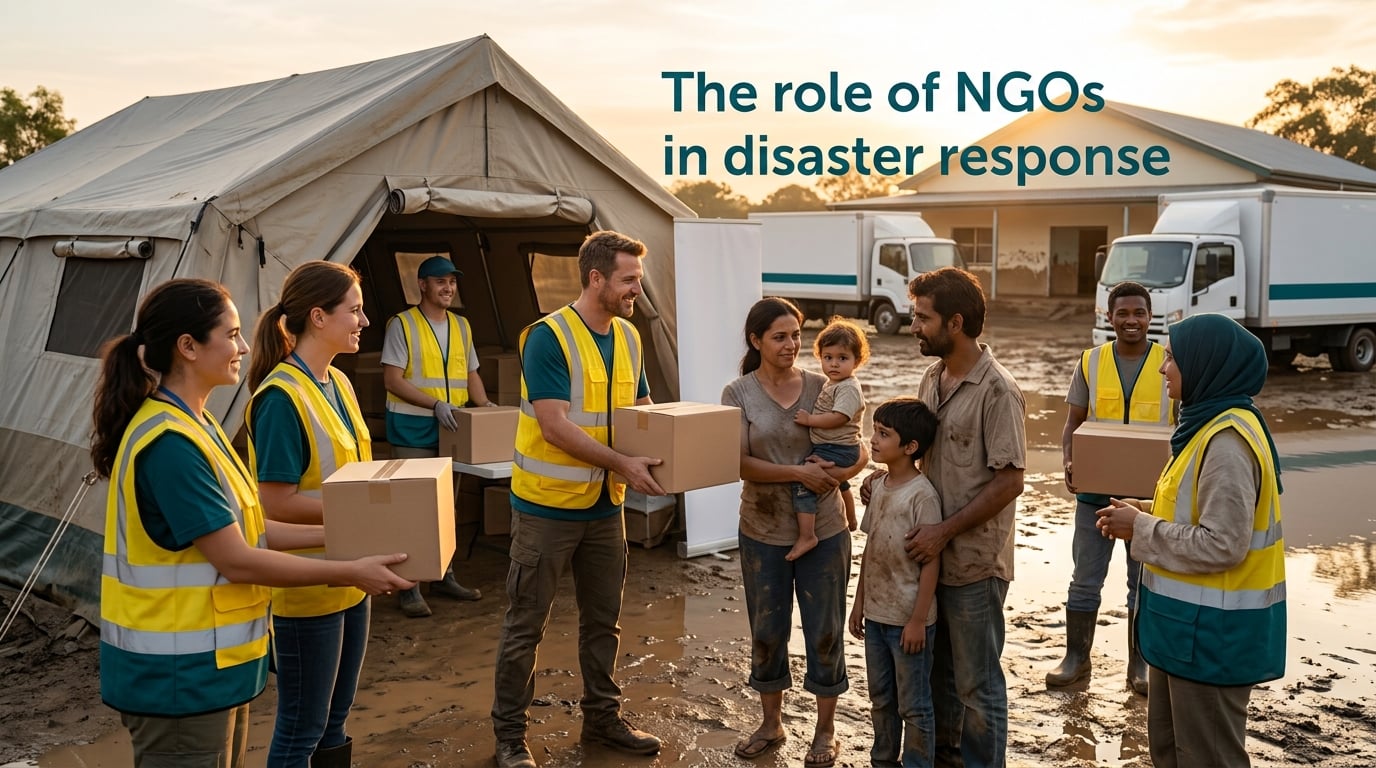
When an earthquake levels a city or a cyclone flattens a coastline, governments are rarely the first to arrive. That responsibility falls on NGOs (non-governmental organisations), the humanitarian responders who mobilise within hours, stay for years and bridge the gap between state machinery and the families who need help. In this guide I walk you through the role of NGOs in disaster response across every phase of the disaster management cycle, drawing on real case studies, official statistics and the experience of frontline humanitarian workers.
You will learn what NGOs actually do before, during and after a crisis, how they differ from CBOs and international agencies, the biggest challenges they face, and the emerging trends reshaping humanitarian action in 2026. Whether you are a student of disaster management, a policy maker, a journalist or simply someone who wants to volunteer or donate well, this guide gives you the complete picture.
Table of Contents
What Is the Role of NGOs in Disaster Response?
The role of NGOs in disaster response is to provide rapid, flexible and community-rooted humanitarian assistance across every stage of a crisis. NGOs deliver food, water, shelter and medical care during emergencies, support reconstruction and livelihoods during recovery, and run preparedness training before disasters strike. They also serve as a bridge between affected communities, government agencies and international donors.
NGOs occupy a unique space in the humanitarian system. Unlike militaries or government bodies, they can cross borders quickly, work directly with households, and adapt their programmes as conditions change. Unlike private contractors, they are mission-driven, accountable to humanitarian principles, and bound by standards such as the Sphere Handbook and the Code of Conduct for the International Red Cross and Red Crescent Movement.
The term NGO covers a wide spectrum. It includes massive international federations like CARE and Oxfam, specialised medical teams like Doctors Without Borders (MSF), and small grassroots organisations working in a single district. What unites them is their independence from government and their commitment to serving people affected by disasters, conflict and displacement.
Why NGOs matter when disasters strike
Three qualities make NGOs indispensable in the first hours and the long months of recovery. They can mobilise faster than most government departments. They have trusted relationships with local communities built over years. And they can stay long after media cameras leave, when donor attention has moved on but displaced families are still rebuilding their lives.
Our team has tracked NGO deployments across the Türkiye-Syria earthquakes of 2023, Cyclone Mocha in 2023 and the Pakistan floods of 2022. In each case, frontline NGOs were delivering assistance within 24-72 hours, often before international search-and-rescue teams arrived.
Pre-Disaster Preparedness: Building Resilience Before the Storm
The most effective NGO work happens long before a disaster makes headlines. Pre-disaster preparedness is the foundation that turns a deadly catastrophe into a manageable event, and NGOs lead much of this work at the community level.
Vulnerability assessments and risk mapping
NGOs conduct vulnerability assessments to identify who is most at risk and why. They map flood plains, seismic zones and cyclone paths. They profile households by age, disability, income and gender to find the people who will need extra help when disaster hits. These assessments feed into local disaster management plans and inform evacuation routes, shelter locations and stockpile decisions.
ActionAid and SEEDS India, for example, have run thousands of household-level risk surveys across South Asia, combining satellite data with door-to-door interviews to build hyper-local risk profiles.
Community-based disaster management (CBDM)
Community-based disaster management (CBDM) is the practice of training and empowering local communities to plan, respond and recover in their own context. NGOs are the primary delivery vehicles for CBDM because they have the local trust that government agencies often lack.
The results are striking. In coastal Bangladesh, sustained NGO-led CBDM programmes helped reduce cyclone fatalities from roughly 3,500 deaths during Cyclone Bhola in 1970 to just 17 deaths during Cyclone Amphan in 2020, even though both storms were comparable in intensity. That is the power of preparedness.
Early warning systems and training
NGOs install and operate early warning systems in vulnerable regions. They run SMS alert networks, install sirens, train community volunteers in first aid and search-and-rescue, and stage pre-positioned relief supplies. The Bangladesh Red Crescent, for example, trains more than 30,000 cyclone volunteers every year in evacuation drills and shelter management.
Capacity building for local NGOs and CBOs is another quiet but vital contribution. International NGOs like Oxfam run training-of-trainers programmes so that smaller, local organisations can lead their own communities through the next disaster without external supervision.
Emergency Response and Immediate Relief Operations
When a disaster actually hits, the world watches the news while NGOs swing into action. Emergency response and immediate relief operations are the most visible part of the NGO role, and the part most readers search for.
First 72 hours: search, rescue and triage
The first 72 hours after a major disaster are the “golden window” for search and rescue. NGOs are usually the first civilian responders on the ground. Teams from organisations like the Red Cross, MSF, IsraAID and local rescue NGOs pull survivors from rubble, set up field triage points and coordinate with UN disaster assessment teams (UNDAC).
Within hours, NGO logistics teams set up staging areas, manage incoming aid flights and begin damage assessments. They establish communication with embassies, military units and other responders. Without this NGO backbone, relief supplies would sit in warehouses while families went without clean water.
Food, water, shelter and medical aid
Core relief activities of NGOs in emergencies include:
- Emergency food distribution and ready-to-use therapeutic food for malnourished children
- Water, sanitation and hygiene (WASH) programmes including water trucking, filtration and latrines
- Temporary shelter using tarpaulins, tents and transitional housing kits
- Mobile medical clinics, field hospitals and vaccination campaigns
- Cash and voucher assistance so families can buy what they need locally
- Protection services for unaccompanied children, women at risk and people with disabilities
Cash assistance has grown rapidly in recent years. Instead of shipping in food, many NGOs now give affected families direct cash transfers, which restore choice, support local markets and arrive faster than imported supplies.
Coordination with the UN cluster system
During large disasters the UN Office for the Coordination of Humanitarian Affairs (OCHA) activates the cluster system, grouping responders by sector (shelter, health, WASH, food security, protection, education, logistics). NGOs lead or co-lead most of these clusters.
For example, in the Türkiye-Syria earthquake response, NGOs such as the Turkish Red Crescent, IFRC and dozens of international and local partners ran shelter, health and WASH clusters serving millions of displaced people.
Long-Term Rehabilitation and Recovery
The headlines move on, but the work continues. Long-term rehabilitation and recovery is where NGO impact can be measured in years rather than days, and where many disaster-affected families decide whether they will ever trust their government again.
Livelihood restoration and economic recovery
NGOs help families rebuild their livelihoods. They distribute seeds, tools and livestock to farming households. They run cash-for-work programmes that clear debris, rebuild irrigation channels and repair roads. They support small businesses with micro-grants and vocational training.
Habitat for Humanity, for example, has helped rebuild hundreds of thousands of homes after disasters in Haiti, the Philippines, Nepal and Indonesia, combining disaster-resistant construction with mortgage support for low-income families.
Psychosocial support and community healing
Disasters leave invisible scars. NGOs run psychosocial support programmes for survivors, especially children, women who have experienced violence, and first responders themselves. Activities include counselling, peer-support groups, child-friendly spaces and school-based mental health programmes.
Organisations like the International Medical Corps and local NGOs in conflict-affected and disaster-prone areas train community members in psychological first aid so that support is available long after international mental health teams have left.
Resilient reconstruction and DRR
“Build back better” is more than a slogan. NGOs work with engineers, architects and communities to construct homes, schools and clinics that can withstand the next disaster. They embed disaster risk reduction (DRR) into recovery planning, aligned with the Sendai Framework for Disaster Risk Reduction 2015-2030.
Examples include cyclone-resistant housing in coastal Bangladesh, seismic retrofitting in Nepal and flood-adapted infrastructure in Mozambique. These projects often combine local labour with technical expertise, creating jobs while reducing future risk.
Leading NGOs and International Agencies in Disaster Response
Several major organisations dominate the global NGO disaster response landscape. Knowing who they are and what they do helps you understand the system and direct your support more effectively.
CARE, Oxfam and ActionAid
CARE International operates in more than 100 countries, focusing on women and girls, food security and emergency response. Oxfam combines advocacy with direct humanitarian action and is famous for its water and sanitation work. ActionAid emphasises women’s leadership and community rights in disaster response, working through locally rooted country teams.
Together these three federations reach tens of millions of disaster-affected people every year through a mix of emergency response, recovery programmes and longer-term development work.
Red Cross and Red Crescent Movement
The International Red Cross and Red Crescent Movement is the world’s largest humanitarian network, with more than 190 national societies and millions of volunteers. The International Federation of Red Cross and Red Crescent Societies (IFRC) coordinates international disaster relief, while national societies like the Bangladesh Red Crescent, Turkish Red Crescent and American Red Cross lead in-country response.
National Red Cross societies are legally mandated auxiliaries to their governments, giving them a unique role that combines NGO flexibility with quasi-governmental reach.
UN coordination: OCHA, IFRC and CERF
Three UN-linked institutions shape how NGOs operate in major disasters. OCHA coordinates the international response through the cluster system. The IFRC coordinates the Red Cross movement. And the Central Emergency Response Fund (CERF) provides rapid seed funding within hours of a sudden-onset crisis, channeling money quickly to NGOs and UN agencies on the ground.
These coordinating bodies don’t deliver aid directly as much as they make sure thousands of NGOs, UN agencies and government responders don’t trip over each other.
NGOs vs CBOs vs International Agencies: What’s the Difference?
Readers often ask what distinguishes an NGO from a CBO (community-based organisation) or an international agency like the UN. Here is a clear comparison.
| Feature | NGOs | CBOs | International Agencies |
|---|---|---|---|
| Geographic scope | Local to global | Single village, district or city | Global or regional |
| Funding source | Donors, grants, governments | Memberships, local donations, small grants | Member state contributions |
| Decision-making | Independent board or HQ | Community members | Intergovernmental mandates |
| Speed of mobilisation | Fast, often within 24-72 hours | Very fast, often the first responders | Slower, but powerful once mobilised |
| Local knowledge | Varies, often strong | Deepest possible | Limited, dependent on partners |
| Examples | CARE, Oxfam, MSF, ActionAid | Village disaster committees, women’s groups | OCHA, UNICEF, WFP, UNDP |
In practice the three work together. International agencies fund and coordinate, NGOs deliver programmes at scale, and CBOs ensure that assistance actually reaches households in a culturally appropriate way. When any of these three legs is weak, the response suffers.
Challenges Facing NGOs in Disaster Relief
Despite their strengths, NGOs face serious challenges in disaster response. Understanding these obstacles helps explain why some responses succeed and others struggle.
Funding gaps and donor fatigue
Funding is the perennial bottleneck. According to the Global Humanitarian Overview, UN-coordinated appeals reached only about 63 percent of requested funding in recent years. Forgotten crises, those that no longer make the news, receive a tiny fraction of what early-stage appeals attract.
Donor fatigue hits quickly. Within a few weeks of a disaster, donations drop sharply even though recovery needs last for years. Local NGOs, which often do the most frontline work, frequently receive the smallest share of international funding.
Coordination failures and duplication
When hundreds of NGOs converge on a disaster zone, coordination becomes a major challenge. Reviewers report that accessible areas often receive multiple overlapping distributions while remote communities are neglected. Information sharing is patchy, and competition for visibility can drive NGOs toward photogenic neighbourhoods rather than the most vulnerable.
Efforts to fix this through cluster coordination, joint needs assessments and the Grand Bargain (a 2016 agreement between donors and aid organisations) have helped, but the system remains imperfect.
Access, security and politicisation
NGOs operate in some of the most dangerous places on earth. Staff face security threats from armed groups, criminal gangs and political violence. Access can be blocked by checkpoints, sanctions or deliberate government interference. In some contexts aid itself is politicised, with governments diverting assistance or punishing NGOs that work with opposition communities.
Neutrality, impartiality and independence are not just principles, they are operational necessities that allow NGOs to reach people on all sides of a conflict or disaster.
Fraud and accountability concerns
Forum discussions frequently highlight public concern about how relief funds are used. High-profile scandals in recent decades have pushed the sector toward stronger accountability: independent audits, beneficiary feedback mechanisms, and the Core Humanitarian Standard. These safeguards matter and you can use them to choose which NGOs to support.
How NGOs Coordinate With Government During Disasters
Coordination between NGOs and government is the difference between chaos and an effective response. In most countries, governments lead overall disaster management while NGOs fill gaps and reach communities that state services cannot.
At the national level, NGOs register with disaster management authorities, sign memorandums of understanding and participate in disaster management plans. During an active response, they attend coordination meetings, share needs assessments and align their programmes with government priorities.
At the local level, NGOs often work hand-in-hand with district administrations. They may run government-funded programmes, staff relief camps, or hand over completed projects to line departments. Good coordination requires clarity of roles, mutual respect and a willingness to share credit, all of which can be hard to achieve under pressure.
In India, the Disaster Management Act of 2005 formalised NGO participation. In the Philippines, the NDRRMC (National Disaster Risk Reduction and Management Council) includes NGO representatives. Similar models exist in most disaster-prone countries, though the strength of NGO-government coordination varies widely.
Emerging Trends: Technology, Localisation and Climate Change
Humanitarian action is changing fast. Three trends are reshaping how NGOs prepare for and respond to disasters, and none of the leading articles on this topic covers them comprehensively.
Technology and innovation
NGOs are increasingly using drones for damage mapping, satellite imagery for early warning, blockchain for cash transfers, and AI for needs forecasting. Mobile apps now let beneficiaries report problems in real time. Biometrics speed up registration. Predictive analytics help pre-position supplies before storms make landfall.
However, technology brings risks of its own, including data protection, digital exclusion of older people and refugees, and over-reliance on infrastructure that itself may be damaged by the disaster.
Localisation of humanitarian action
Grand Bargain commitments have pushed for at least 25 percent of humanitarian funding to go as directly as possible to local and national responders. The evidence is clear: local NGOs and CBOs reach affected populations faster, at lower cost and with stronger community trust than international actors.
The practical implication is a slow but real shift of power and funding away from large international NGOs toward smaller, local organisations. This shift is still incomplete and uneven, but it is reshaping the sector.
Climate change and rising disaster risk
Climate change is increasing the frequency and severity of heatwaves, floods, cyclones and wildfires. NGOs are responding by integrating climate adaptation into disaster risk reduction, advocating for loss and damage finance, and supporting communities in climate-vulnerable regions.
This means the role of NGOs in disaster response is expanding from immediate relief to long-term resilience-building, climate adaptation and policy advocacy. For young professionals considering humanitarian careers, this is the most dynamic frontier in 2026.
Frequently Asked Questions
What is the role of NGOs in disaster management?
NGOs play a vital role in disaster management by providing emergency relief such as food, water, shelter and medical care during the response phase, supporting reconstruction and livelihoods during long-term recovery, running preparedness training and early warning systems before disasters strike, and coordinating between affected communities, government agencies and international donors throughout the disaster management cycle.
Why are NGOs important in disaster response?
NGOs are important in disaster response because they can mobilise faster than most government agencies, maintain trusted relationships with local communities, reach remote and underserved areas, sustain support long after media attention fades, and bring specialised expertise in areas like water and sanitation, psychosocial support and shelter. Their independence and flexibility allow them to work across borders and political boundaries where official agencies cannot.
How do NGOs coordinate with government during disasters?
NGOs coordinate with governments by registering with national and local disaster management authorities, signing memorandums of understanding, attending coordination meetings, sharing needs assessments and aligning their programmes with official plans. They often serve as operational partners that deliver services on behalf of the state while maintaining their humanitarian independence.
What challenges do NGOs face in disaster relief?
NGOs face persistent challenges including funding gaps and donor fatigue, coordination failures leading to duplication or neglect of remote communities, security threats in conflict-affected areas, restricted access due to political interference, accountability concerns and the difficulty of measuring long-term impact. Recruitment, staff wellbeing and the emotional toll on responders are also growing concerns.
What is the difference between NGOs and CBOs in disaster response?
NGOs typically operate at local, national or international scale with funding from donors and grants, while CBOs (community-based organisations) work within a single village, neighbourhood or district and are accountable to their own members. CBOs usually have deeper local knowledge and faster access but smaller budgets, which is why effective disaster response depends on strong partnerships between the two.
Conclusion
The role of NGOs in disaster response is broader, deeper and more essential than the headlines suggest. From the day before a cyclone makes landfall to the decade after an earthquake, NGOs are the connective tissue of humanitarian action, training communities, delivering relief, supporting recovery and holding governments and donors accountable to the people they serve.
If you want to support this work, donate to NGOs that demonstrate financial transparency and local presence. If you want to volunteer, start with established organisations that invest in training and safety. And if you simply want to understand the humanitarian system better, follow the reporting of frontline responders and the data published by OCHA, the IFRC and research institutes that track disaster response outcomes.