
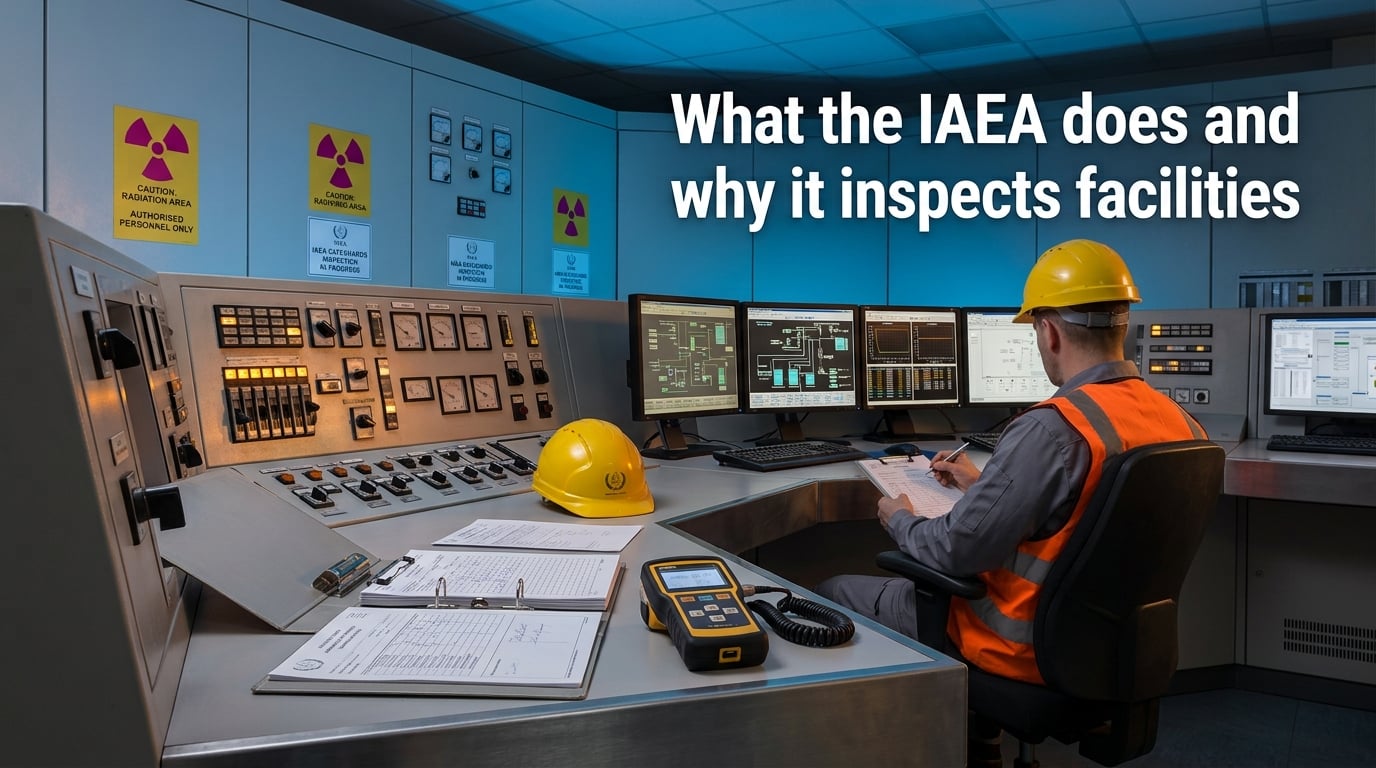
The International Atomic Energy Agency (IAEA) is an independent intergovernmental organization that promotes the safe, secure, and peaceful use of nuclear energy while preventing its misuse for military purposes, especially nuclear weapons. It inspects nuclear facilities worldwide to verify that declared nuclear material is not diverted to weapons programs, providing credible assurance to the international community that nuclear technology stays in peaceful hands. In 2026, the IAEA holds safeguards agreements with 182 states and runs roughly 280 inspectors who carry out thousands of verification activities each year.
Our team spent weeks digging through IAEA documents, treaty texts, and on-the-ground inspection accounts to put together this guide. We wanted to answer a deceptively simple question: what does the IAEA actually do, and why does it send people into some of the most sensitive facilities on Earth?
In this article, we explain the IAEA’s mandate, walk through the three types of safeguards agreements, describe the inspection methods inspectors use in the field, and address the common misconception that inspections are designed to prevent proliferation (they are not — they detect and deter it).
Table of Contents
What Is the IAEA and What Is Its Core Mission?
The IAEA was founded in 1957 as the world’s central intergovernmental forum for nuclear cooperation. Its headquarters sit in Vienna, and it reports both to its own 178 member states and, on non-compliance matters, to the United Nations Security Council.
Its mission is often summarized as “Atoms for Peace,” a phrase borrowed from President Eisenhower’s 1953 speech to the UN. In practice, that mission rests on two pillars that sometimes pull against each other.
Pillar 1 — Promoting peaceful nuclear technology. The IAEA helps member states use nuclear science in medicine, agriculture, energy production, and industry. It runs technical cooperation programs, sets safety standards, and supports research reactors in more than 100 countries.
Pillar 2 — Preventing nuclear weapons proliferation. Through its Department of Safeguards, the IAEA verifies that nuclear material in peaceful use is not diverted to weapons. This verification work is what most people picture when they hear “IAEA inspection.”
The dual mandate is what makes the IAEA unusual. It is neither purely a development agency nor a security body. It operates at the intersection, and that tension shapes everything from its budget to the way its inspectors are trained.
What Are IAEA Safeguards and Why Do They Exist?
IAEA safeguards are a set of technical measures that allow the IAEA to independently verify a state’s nuclear declarations. The objective is straightforward: deter the spread of nuclear weapons by the early detection of the misuse of nuclear material or technology.
That word “detect” matters. Safeguards are not designed to physically stop a state from building a bomb. They are designed to find out quickly if a state is doing so, so that the international community can respond before the program matures.
Safeguards exist because nuclear energy and nuclear weapons share the same fuel cycle. The same enrichment technology that powers a reactor can fuel a warhead. The same plutonium that emerges from a spent-fuel pool can be extracted for a weapon. Without independent verification, no one outside a state can tell which path its nuclear material is taking.
Three core principles underlie the entire system. First, the IAEA verifies the correctness of states’ declarations of nuclear material. Second, it verifies the completeness of those declarations, meaning it looks for undeclared material too. Third, it provides credible assurance to the international community, not to any single government, that nuclear material is staying in peaceful use.
When safeguards work as intended, they create transparency. When they fail, they usually fail because a state has hidden something — and the system’s job is to notice.
The Three Types of IAEA Safeguards Agreements
Every safeguards arrangement between the IAEA and a state flows from a written agreement. There are three main types, plus a fourth that applies to the five recognized nuclear-weapons states. Each one grants the IAEA different rights and obligates the state to different levels of disclosure.
1. Comprehensive Safeguards Agreement (CSA)
The CSA, based on the model document known as INFCIRC/153, is the standard agreement for every non-nuclear-weapon state party to the Non-Proliferation Treaty. As of 2026, 182 states have a CSA in force.
Under a CSA, a state must declare all nuclear material and facilities to the IAEA, provide design information for new facilities as they are built, and accept routine inspections. The IAEA’s verification goal is to confirm that declared material is not diverted to weapons and that there are no undeclared activities.
2. Additional Protocol (AP)
The Additional Protocol, based on INFCIRC/540, strengthens the CSA. It was developed in the 1990s in response to discoveries that Iraq had run a covert weapons program under CSA monitoring. Today, 142 states have an Additional Protocol in force.
The AP expands IAEA access dramatically. Inspectors may take environmental samples anywhere on a declared site, request information on research and development, and request complementary access to locations other than declared facilities if they suspect undeclared activity. The AP also expands the declaration to include uranium mining, fuel fabrication, and waste storage.
3. Voluntary Offer Agreement
The five recognized nuclear-weapons states — China, France, Russia, the United Kingdom, and the United States — are not required to accept full-scope safeguards on their civilian material. Instead, each has offered a Voluntary Offer Agreement, under which the IAEA may inspect specific facilities the state chooses to place under safeguards, usually to support exports of nuclear material.
Voluntary Offer Agreements are technically voluntary, but the trade-offs are real. A state that wishes to export nuclear material to a non-weapons state usually needs IAEA safeguards to be in place on that material.
4. Small Quantities Protocol (SQP)
States with very small amounts of nuclear material can sign an SQP, which suspends many CSA procedures until the state’s nuclear program grows beyond defined thresholds. The IAEA has been phasing out the original SQP since 2005 because, in practice, even states with small nuclear programs can develop expertise that matters for proliferation.
| Agreement Type | Who Signs It | Key Right Granted to IAEA |
|---|---|---|
| Comprehensive Safeguards Agreement (CSA) | Non-nuclear-weapon NPT states | Routine inspections of declared facilities |
| Additional Protocol (AP) | CSA states that also accept the model AP | Complementary access, environmental sampling, expanded declarations |
| Voluntary Offer Agreement | The five nuclear-weapons states | Inspections only on voluntarily listed facilities |
| Small Quantities Protocol (SQP) | States with minimal nuclear activity | Reduced procedures until activity thresholds are crossed |
How Does the IAEA Inspect Nuclear Facilities?
An IAEA inspection is not a single activity. It is a layered combination of verification tools, each designed to catch a different kind of deception. The four core tools are nuclear material accountancy, design information verification, environmental sampling, and containment and surveillance.
Nuclear Material Accountancy
Accountancy is the foundation. Every state operating a nuclear facility must keep records of how much nuclear material it holds, how much it has received, how much it has shipped, and how much remains. Inspectors check those records against physical measurements taken during inspections — usually weighing items, assaying their isotopic content, and reconciling the numbers.
If the records say 200 kilograms of enriched uranium are on site and the inspectors measure 198 kilograms, the difference is called a Material Unaccounted For (MUF). Large unexplained MUF is one of the clearest signs something is wrong.
Design Information Verification (DIV)
Before a new facility is built, the state must provide the IAEA with design information. Inspectors verify that the facility was built as designed and that it is being used as declared. If a state says it is building a research reactor but actually constructs a reprocessing plant, DIV is the tool that catches the discrepancy.
Environmental Sampling
Inspectors swipe cotton cloths across surfaces inside and around nuclear facilities and ship the samples to IAEA laboratories in Vienna and elsewhere. The samples reveal tiny traces of nuclear material that betray activities the state has not declared. Iraq’s covert enrichment program was uncovered in part through environmental sampling in the early 1990s.
Containment and Surveillance (C/S)
For material the IAEA cannot continuously measure — for example, sealed containers of plutonium stored between inspections — the IAEA uses tamper-indicating seals, optical surveillance systems, and unattended radiation monitors. About 300 unattended monitoring systems run continuously in facilities around the world.
The combined goal is “continuity of knowledge.” Once the IAEA has verified a container of material, it must remain confident that the container has not been opened or swapped until the next inspection. Seals and cameras preserve that continuity between inspector visits.
A Day in the Life of an IAEA Inspector
To make the inspection process tangible, here is a walkthrough of a typical in-field inspection day. We pulled this together from IAEA inspector accounts and published field reports.
07:00 — Arrival and security check-in. Inspectors typically travel in teams of two to four. They arrive at the facility, pass through security, and meet facility operators in the visitor center.
08:00 — Briefing with facility staff. The team reviews what work has been done since the last inspection, what new material has arrived or left, and any planned maintenance that might affect safeguards equipment.
09:30 — Material accountancy walk-through. Inspectors physically observe the storage areas, compare seals against their records, and select items for measurement. They may weigh fuel assemblies, count source containers, or verify inventory tags.
11:00 — Non-destructive assay. Using portable instruments, inspectors measure the isotopic content of selected items without opening them. Techniques include high-resolution gamma spectroscopy and neutron counting.
13:00 — Lunch and informal discussion. Inspectors eat in the facility cafeteria. This is not a social nicety — operators often drop useful context during informal conversations.
14:00 — Environmental sampling. The team takes swipe samples from surfaces in declared process areas, sometimes from locations the facility itself does not regularly clean. Samples are sealed and shipped to IAEA laboratories for analysis.
16:00 — Containment and surveillance check. Inspectors verify that seals are intact, review camera footage collected since the last inspection, and check that unattended monitoring systems are functioning.
17:30 — Exit meeting. The team briefs facility management on what they observed, raises any preliminary questions, and prepares for departure.
Evening — Report writing. Back at the hotel, inspectors draft their findings. Those reports eventually feed into the IAEA’s annual safeguards conclusion for the state.
The work is exacting. As one inspector put it in an IAEA Bulletin profile: you cannot just rebuild the reactor every time the inspectors show up, and so you cannot hide the fact that your reactor is producing plutonium.
The Legal Framework: NPT Article III and the IAEA’s Authority
The IAEA’s right to inspect facilities rests on treaty law, most importantly the Treaty on the Non-Proliferation of Nuclear Weapons (NPT). Article III of the NPT requires every non-nuclear-weapon state to accept IAEA safeguards on all nuclear material in peaceful use.
The NPT opened for signature in 1968 and entered into force in 1970. Today it has 191 states parties. The treaty divides the world into two categories.
Nuclear-weapon states are the five that tested a nuclear device before January 1, 1967: China, France, Russia, the United Kingdom, and the United States. They are not required to accept full-scope safeguards on their military material, although they accept voluntary arrangements on civilian material.
Non-nuclear-weapon states are all other NPT parties. They must accept a CSA and, ideally, an Additional Protocol. In exchange, they receive assurances of peaceful nuclear cooperation from the weapons states and a (now lapsed) commitment to disarmament from the weapons states.
When a state falls out of compliance, the IAEA cannot enforce anything on its own. Its role is to report. Findings of non-compliance are sent to the IAEA Board of Governors and, ultimately, to the UN Security Council. From there, enforcement becomes a political question for the five permanent members.
This is one of the most important points for understanding the IAEA. The agency detects and reports. It does not arrest, sanction, or intervene. As one Reddit user on r/NeutralPolitics put it: there is a common misconception that IAEA inspections are intended to prevent states from obtaining nuclear weapons — they are not, at least not directly.
Notable Inspection Cases: Iran, North Korea, and Iraq
Three cases illustrate how safeguards work — and where they struggle. Each one shaped the system we have today.
Iran
Iran has been under IAEA safeguards since the 1970s. After revelations in 2002 about undeclared enrichment facilities at Natanz and a heavy-water plant at Arak, the IAEA found that Iran had failed to declare nuclear material and activities over nearly two decades. The agency has issued multiple reports of non-compliance, and Iran has restricted inspector access at various points since then.
Iraq (1991)
After the Gulf War, IAEA inspectors discovered that Iraq had run a covert program to enrich uranium and build a nuclear weapon, all while operating under a CSA. The program was hidden through parallel procurement networks and unauthorized construction at sites the IAEA had not been told about. The shock of this discovery drove the design of the Additional Protocol, which gives inspectors much broader access.
North Korea
North Korea acceded to the NPT in 1985 but did not allow inspections. In 1993 the IAEA Board referred the matter to the UN Security Council. North Korea announced its withdrawal from the NPT in 2003, and since then the IAEA has had no on-the-ground access. All monitoring of North Korea’s nuclear program is now done by remote and open-source means.
These three cases show the full range of outcomes: discovery and ongoing verification (Iran), retrospective discovery that reshaped the system (Iraq), and complete denial of access (North Korea).
Challenges and Limitations of IAEA Safeguards
No treatment of IAEA inspections would be honest without addressing the limits. Several real challenges affect how well the system can do its job.
Detection, not prevention. Inspections can detect diversion or undeclared activities, but they cannot physically stop them. The system depends on the international community to act on what the IAEA finds, and that response is never guaranteed.
Access depends on consent. The IAEA inspects only where it has the legal right to enter. In states without an Additional Protocol, inspectors can be confined to declared facilities. Outside the NPT framework — for states like India, Israel, and Pakistan — the IAEA has either no agreement or only facility-specific arrangements.
Resource constraints. Roughly 280 inspectors handle thousands of facilities across more than 180 states. Inspection budgets and travel rules limit how often each facility is visited and how broadly inspectors can roam.
Loopholes and small-program thresholds. Until the SQP reforms, states with very small nuclear programs could effectively defer full safeguards implementation. Even now, a state can build expertise in uranium chemistry or plutonium metallurgy without crossing any safeguardable threshold.
Political pressure. Inspectors report to the IAEA Secretariat, which in turn answers to member states. Allegations of political interference surface periodically, and the credibility of safeguards rests on the agency’s perceived independence.
For all that, the system has real successes. South Africa’s once-covert program came forward under safeguards verification. Libya’s program was rolled back after IAEA inquiries. Iraq’s hidden program was exposed. Safeguards cannot guarantee that no state will cheat, but they make cheating far harder than it would be otherwise.
Frequently Asked Questions
What does IAEA safeguards mean?
IAEA safeguards are the technical measures the agency uses to verify that nuclear material and facilities declared by a state are used only for peaceful purposes. The objective is to deter the spread of nuclear weapons by the early detection of any misuse of nuclear material or technology.
What are the three types of IAEA safeguards agreements?
The three main types are the Comprehensive Safeguards Agreement (CSA), the Additional Protocol (AP), and the Voluntary Offer Agreement used by the five recognized nuclear-weapons states. A fourth arrangement, the Small Quantities Protocol, applies to states with very limited nuclear activity and has been progressively phased out since 2005.
Did Iran violate the IAEA?
The IAEA Board of Governors has found that Iran failed to declare nuclear material and activities over an extended period, in violation of its safeguards obligations. Iran has cooperated with IAEA verification to varying degrees since then, but the IAEA has continued to report outstanding questions about undeclared activities.
What are the IAEA’s safeguard obligations?
Under Article III of the Non-Proliferation Treaty, every non-nuclear-weapon state must accept IAEA safeguards on all nuclear material in peaceful use. In practice this means accepting routine inspections, providing accurate declarations, granting access to declared facilities, and, where an Additional Protocol is in force, allowing complementary access and expanded declarations.
Can IAEA inspectors go anywhere they want?
No. In states with only a Comprehensive Safeguards Agreement, inspectors’ access is limited to declared facilities. An Additional Protocol grants broader rights, including complementary access to non-declared locations under specific conditions. In states outside the NPT framework the IAEA may have no inspection rights at all.
What happens if a country refuses IAEA inspections?
If a state refuses inspections or is found in non-compliance, the IAEA reports the matter to its Board of Governors and may refer it to the United Nations Security Council. The agency itself has no enforcement power; political and economic pressure then becomes the responsibility of UN member states.
Conclusion: Why IAEA Inspections Matter
The IAEA does two things at once: it helps the world benefit from nuclear technology, and it works to keep that technology from being turned into weapons. Inspections are the visible side of that mission, and they rest on decades of treaty law, technical verification methods, and political negotiation.
Understanding what the IAEA does and why it inspects facilities means understanding both the strength and the limits of the system. Safeguards are powerful when states cooperate. They are essential when states do not. And the difference between a world with credible verification and one without is the difference between detection and surprise.
For readers who want to dig deeper, the IAEA’s official “What are Nuclear Safeguards?” video and the Arms Control Association factsheets are excellent starting points.