
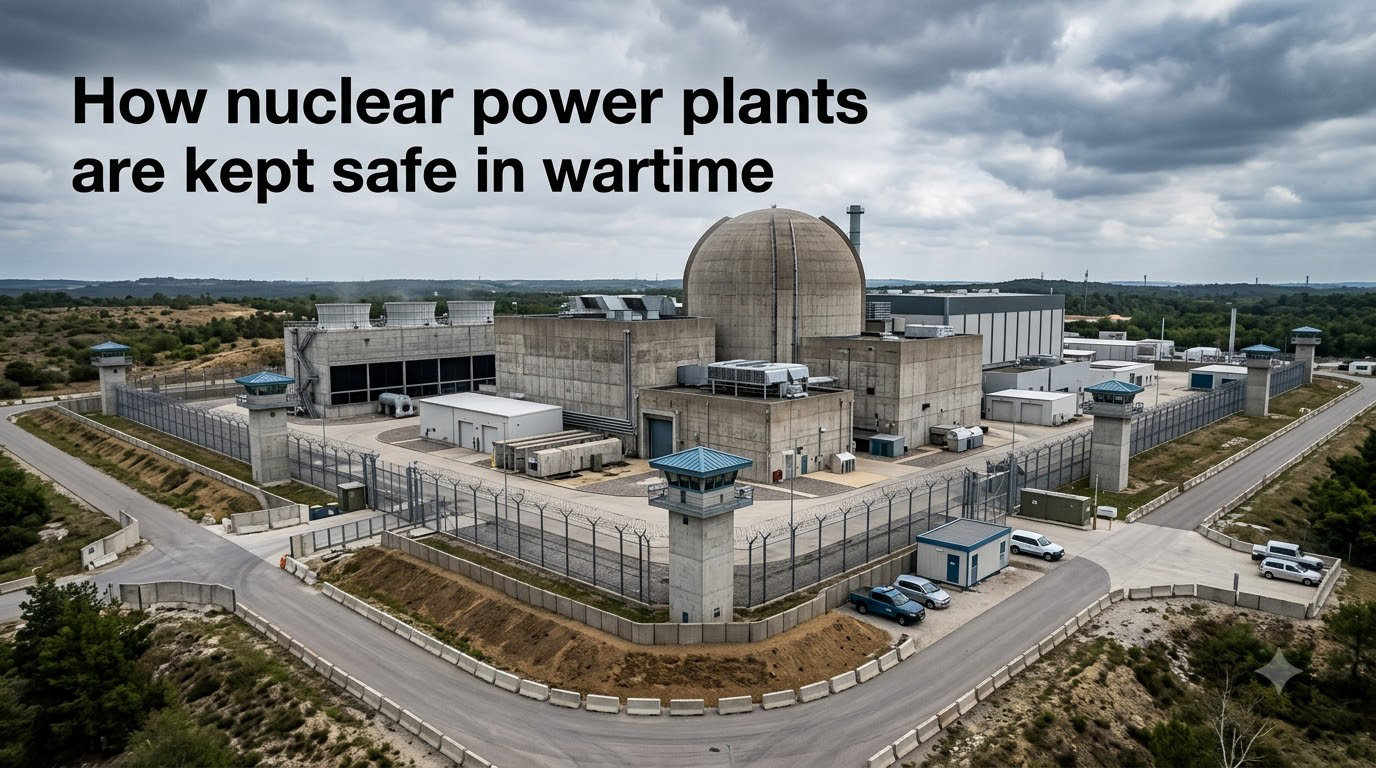
Nuclear power plants are kept safe in wartime through multiple layers of engineered protection, international law, and operational protocols. The most visible defense is the containment dome—a massive structure of pre-stressed concrete and steel designed to withstand extreme forces including aircraft impacts, missile strikes, and artillery bombardment. But physical hardening is only one piece of a much larger safety system.
The question of how nuclear power plants are kept safe in wartime has taken on new urgency since 2022. Russia’s occupation of Ukraine’s Zaporizhzhia Nuclear Power Plant—the largest in Europe—demonstrated that major nuclear facilities can become battlegrounds in modern conflicts. That event forced regulators, engineers, and policymakers worldwide to rethink assumptions about nuclear safety during armed conflict.
This guide explains the engineering, legal, and operational measures that protect nuclear reactors when nations go to war. We’ll cover the physical structures, the vulnerabilities that matter most, what international law actually says, and how emerging threats like drones and cyberattacks are changing the equation.
Table of Contents
Physical Protections: How Nuclear Plants Are Built to Survive Attacks
The first line of defense for any nuclear power plant is its physical structure. Modern reactors are surrounded by multiple containment barriers that work together to prevent radiation release, even under extreme conditions.
The containment dome is the most recognizable protection. These structures are typically made of pre-stressed concrete reinforced with steel tendons, often 3 to 4 feet thick. They’re engineered to absorb enormous forces. In the United States, the Nuclear Regulatory Commission (NRC) requires containment buildings to withstand the impact of a large commercial aircraft—a standard updated after the September 2001 attacks.
Beneath the dome sits the reactor pressure vessel, a massive steel container holding the nuclear fuel and coolant. This vessel is typically 6 to 12 inches of carbon or stainless steel, designed to operate at pressures exceeding 2,000 pounds per square inch. The combination of the pressure vessel inside the containment dome creates a double barrier between radioactive materials and the outside environment.
Modern plants add a third layer: missile shields and bunkered structures. Emergency diesel generators, battery systems, and critical control equipment are housed in hardened buildings rated for blast overpressure and projectile impact. Many European reactors built after the 1980s include dedicated missile protection for safety-critical systems.
This approach—multiple independent barriers—is called defense in depth. The philosophy assumes any single protection can fail, so the system maintains safety through redundancy. Even if a containment dome were somehow breached, the reactor pressure vessel and fuel cladding provide additional barriers against radiation release.
The Three Main Reactor Vulnerabilities in War Zones
Despite robust engineering, nuclear plants have three primary vulnerabilities that matter during armed conflict. Understanding these failure modes is essential to grasping wartime nuclear safety.
Loss of coolant accident (LOCA). Nuclear reactors generate enormous heat from fission reactions. Even after shutdown, radioactive decay continues producing significant heat for days to weeks. If cooling water circulation is interrupted—by pipe rupture, pump failure, or loss of electrical power—the fuel can overheat and melt. This is the scenario that caused the Fukushima Daiichi disaster in 2011, and it’s the most realistic wartime threat. A single well-placed strike on cooling water pipes or the power supply could initiate this chain of events.
Containment breach. While containment domes are extraordinarily strong, they aren’t invulnerable to repeated or sustained bombardment. Modern bunker-busting munitions and precision-guided weapons could potentially penetrate containment structures, especially older designs not built to current aircraft-impact standards. A breach in containment would allow radioactive materials to escape directly into the environment during or after a core damage event.
Spent fuel pool failure. This is the vulnerability that worries nuclear security experts most. Spent fuel pools are large water-filled basins located outside the primary containment in many plant designs. They hold used fuel assemblies that remain intensely radioactive and require continuous water circulation for cooling. If the water drains or evaporates—whether from structural damage or loss of power to cooling pumps—the uncovered fuel can overheat and catch fire, releasing massive amounts of radioactive material. As Professor Rodney Ewing of Stanford has noted, a single spent fuel assembly can deliver a lethal radiation dose in under one minute at one meter distance.
Spent Fuel Pools: The Hidden Danger
Spent fuel pools deserve special attention because they represent a disproportionate share of a nuclear plant’s radioactive inventory—and they’re less protected than the reactor itself.
A typical spent fuel pool at a large power plant holds hundreds of fuel assemblies containing millions of curies of radioactive material. The fission products in spent fuel include cesium-137, strontium-90, and iodine-131—substances that cause cancer, contaminate land, and persist in the environment for decades.
Unlike the reactor vessel, which sits inside the containment dome, spent fuel pools at many older plants are located in the upper levels of the reactor building but outside the primary containment boundary. Some newer designs have moved pools to ground level or below grade for better protection, but many operating plants worldwide still have vulnerable elevated pools.
The cooling requirement is the critical factor. Freshly discharged fuel must be actively cooled with circulated water for at least 5 to 10 years before it can be moved to dry cask storage. During that period, any interruption in water circulation—whether from equipment failure, structural damage, or deliberate attack—could expose the fuel and trigger a zirconium cladding fire that releases radioactive material directly into the atmosphere.
What International Law Says About Attacking Nuclear Plants
International humanitarian law provides specific protections for nuclear power plants during armed conflict, though enforcement remains a significant challenge.
Article 56 of Additional Protocol I to the Geneva Conventions (1977) provides special protection for installations containing “dangerous forces,” including nuclear power plants. The article prohibits attacks on these installations if the attack could release dangerous forces and cause severe civilian losses. This protection applies even if the plant constitutes a military objective, making nuclear plants among the most protected civilian infrastructure under international law.
Additional Protocol II extends similar protections to non-international armed conflicts, covering civil wars and internal conflicts where nuclear facilities might be at risk.
The International Atomic Energy Agency (IAEA) has established “seven pillars of nuclear safety” specifically for conflict situations. These include maintaining the physical integrity of the plant, ensuring reliable power supply, protecting security and safety systems, maintaining qualified staff, preserving supply chains, providing reliable communications, and ensuring on-site radiation monitoring. IAEA Director General Rafael Grossi has repeatedly called for a demilitarized zone around the Zaporizhzhia plant, proposing a safety perimeter of approximately 30 kilometers.
The legal protections carry real consequences. Deliberate attacks on nuclear plants that cause widespread, long-term, and severe damage to the natural environment are classified as war crimes under the Rome Statute of the International Criminal Court. However, enforcement depends on international political will, which has proven inconsistent throughout history.
Modern Threats: Drones, Cyberattacks, and Asymmetric Warfare
The nature of modern warfare has introduced threats that existing nuclear plant designs were never built to counter. These emerging risks are changing how engineers and security experts think about nuclear safety.
Drone attacks. The proliferation of cheap, commercially available drones—including first-person-view (FPV) attack drones and larger fixed-wing UAVs—has created a new threat vector. Nuclear plants were designed to withstand large, catastrophic impacts like aircraft crashes, but not the sustained, low-intensity harassment that drone swarms could deliver. A coordinated drone attack might not breach containment, but it could damage external power lines, cooling water intakes, or backup generator fuel supplies—each of which could trigger a loss-of-coolant scenario.
Cyberattacks. Nuclear plants rely on industrial control systems (ICS) and supervisory control and data acquisition (SCADA) networks to manage reactor operations. During wartime, a sophisticated cyberattack could manipulate control rod positions, disable safety alarms, or interfere with cooling system operations. The 2010 Stuxnet attack on Iran’s uranium enrichment centrifuges demonstrated that cyber weapons can target nuclear infrastructure, and wartime cyber capabilities have only advanced since then.
Modern precision munitions. Unlike the unguided artillery shells that containment domes were built to withstand, modern precision-guided weapons can strike specific targets with meter-level accuracy. A weapon designed to penetrate hardened structures could theoretically target vulnerable external systems—the switchyard, cooling water pipes, or spent fuel pool walls—rather than the heavily protected containment dome itself.
Zaporizhzhia: A Real-World Test of Wartime Nuclear Safety
The Zaporizhzhia Nuclear Power Plant in southeastern Ukraine provides the most significant real-world example of how nuclear facilities fare during active conflict.
Russian forces occupied the plant in March 2022, and it has remained under military control since then. The facility has experienced repeated shelling, loss of external power connections, and staffing challenges as Ukrainian operators work under occupation. At various points, the plant has lost connection to the external electrical grid—the primary power source for cooling systems—for extended periods, forcing reliance on emergency diesel generators.
The IAEA has maintained a continuous presence at the site since September 2022, with inspectors monitoring safety conditions and reporting violations of the seven pillars. Their reports have documented damage to cooling ponds, spent fuel dry storage areas, and the turbine halls, though the reactor containment structures have remained intact.
The Zaporizhzhia situation has demonstrated several key lessons. First, that a nuclear plant can survive military occupation without catastrophic release—so far. Second, that the real danger comes not from direct attacks on containment but from degradation of support systems: power supply, water access, and staffing. Third, that international law alone cannot prevent a determined military force from occupying a nuclear facility.
Hardening Nuclear Plants for Future Conflicts
Engineers and policymakers are now exploring how to design nuclear plants that are more resilient to wartime threats, drawing lessons from both Zaporizhzhia and evolving military technology.
Small modular reactors (SMRs) offer a fundamentally different approach to wartime resilience. Their smaller physical footprint means less visible targeting, and some designs incorporate underground or below-grade siting that makes them inherently harder to attack. Advanced SMR designs use passive safety systems that require no external power or operator action to safely shut down and cool—removing many of the vulnerabilities that plague conventional reactors.
Underground siting is being reconsidered for new plant construction. Countries like Finland have already built deep geological repositories for spent fuel, and some future reactor concepts propose placing the entire facility underground. This approach would provide natural protection against aerial bombardment, though it introduces its own engineering challenges around ventilation, access, and groundwater management.
Post-Fukushima safety upgrades are already being applied to wartime scenarios. After the 2011 disaster, plants worldwide installed additional portable cooling equipment, enhanced seismic protection, and diverse backup power sources. These same measures—particularly the distributed portable generators and hardened battery systems—increase resilience against deliberate attacks that disable primary safety systems.
Dry cask storage for spent fuel is another practical hardening measure. Moving fuel from vulnerable wet pools to robust concrete and steel dry cask systems reduces the spent fuel pool vulnerability significantly. Dry casks passively cool through natural air convection, require no active systems, and are far more resistant to physical damage than water-filled pools.
Protecting People: Exclusion Zones and Evacuation Planning
The ultimate goal of nuclear safety measures is protecting the people who live and work near these facilities. During wartime, civilian protection requires additional planning beyond normal operations.
Standard exclusion zones around nuclear plants vary by country. The United States maintains a 10-mile Emergency Planning Zone (EPZ) for immediate protective actions and a 50-mile zone for food and water contamination monitoring. France uses a 5-kilometer immediate evacuation radius and a 20-kilometer shelter-in-place zone. Japan’s post-Fukushima expanded evacuation zone reached 30 kilometers.
In wartime, these zones might need to expand significantly depending on the nature of any release. Radioactive plumes can travel hundreds of kilometers depending on wind patterns, terrain, and the specific contaminants released. European countries have pre-positioned potassium iodide tablets for populations near nuclear plants—a measure that protects against thyroid cancer from radioactive iodine exposure.
Civilians near conflict-zone nuclear plants should understand several practical steps: stay informed about plant status through official channels, have evacuation plans ready including multiple routes, maintain emergency supplies including water and food, and follow official guidance on sheltering or evacuation immediately when issued. The IAEA and national regulators provide real-time radiation monitoring data that can help inform these decisions.
Frequently Asked Questions
Can a nuclear power plant explode like a nuclear bomb?
No. A nuclear power plant cannot produce a nuclear explosion like an atomic bomb. Reactor fuel is enriched to only 3-5% uranium-235, far below the 90%+ needed for weapons-grade material. The worst-case scenario is a steam explosion or hydrogen explosion that disperses radioactive material, not a nuclear detonation.
What happens if a nuclear power plant is bombed?
The result depends on what is hit. A strike on the containment dome might crack the concrete but is unlikely to breach the reactor vessel inside. More dangerous scenarios involve attacks on cooling water systems, external power supply, or spent fuel pools—these could trigger loss of coolant and fuel damage even without penetrating the containment.
How are nuclear reactors kept safe?
Nuclear reactors are protected through defense in depth: thick concrete containment domes, steel reactor pressure vessels, redundant cooling systems with backup diesel generators, international humanitarian law protections, IAEA inspections, and operational protocols. Multiple independent barriers prevent radiation release even if one layer fails.
Are nuclear plants vulnerable to drone attacks?
Modern nuclear plants were not specifically designed to counter drone swarm attacks, which is an emerging concern. While containment domes can likely withstand small drone impacts, drones could damage external power lines, cooling water intakes, or backup generator fuel supplies—each of which could compromise safety systems and trigger a loss-of-coolant scenario.
What international law protects nuclear plants during war?
Article 56 of Additional Protocol I to the Geneva Conventions specifically protects installations containing dangerous forces, including nuclear power plants, from attack if the attack could release those forces and cause severe civilian losses. The IAEA has established seven pillars of nuclear safety for conflict situations, and deliberate attacks causing widespread environmental damage are classified as war crimes under the Rome Statute.
How close to a nuclear power plant is it safe to live?
In normal operations, it is generally safe to live near a nuclear power plant—the NRC permits residence immediately outside plant boundaries. The US maintains a 10-mile Emergency Planning Zone for evacuation planning. During wartime, safety distances depend on the nature of any incident, but experts recommend having evacuation plans ready and following official guidance on sheltering or evacuation.
How long does it take to safely shut down a nuclear reactor?
A reactor can be shut down (fission stopped) in seconds by inserting control rods. However, decay heat continues for days to weeks afterward, requiring active cooling. Full safe shutdown—where no active cooling is needed—requires 5 to 10 years for fuel to cool enough for dry cask storage. This extended cooling period is what makes loss of power so dangerous during wartime.
Conclusion
Nuclear power plants are kept safe in wartime through a combination of extraordinary physical engineering, international legal protections, and rigorous operational protocols. Containment domes, redundant cooling systems, and defense-in-depth design provide formidable barriers against radiation release. International humanitarian law explicitly prohibits attacks on nuclear facilities, and the IAEA’s seven pillars framework provides operational guidance for conflict situations.
Yet the ongoing occupation of Zaporizhzhia and the emergence of drone warfare and cyber threats reveal real gaps in current protections. The answer to how nuclear power plants are kept safe in wartime is that they are robust but not invulnerable. The most effective protection combines hardened engineering with international deterrence, continuous monitoring, and civilian preparedness. As conflicts evolve, so must the strategies for keeping these critical facilities—and the people near them—safe.