
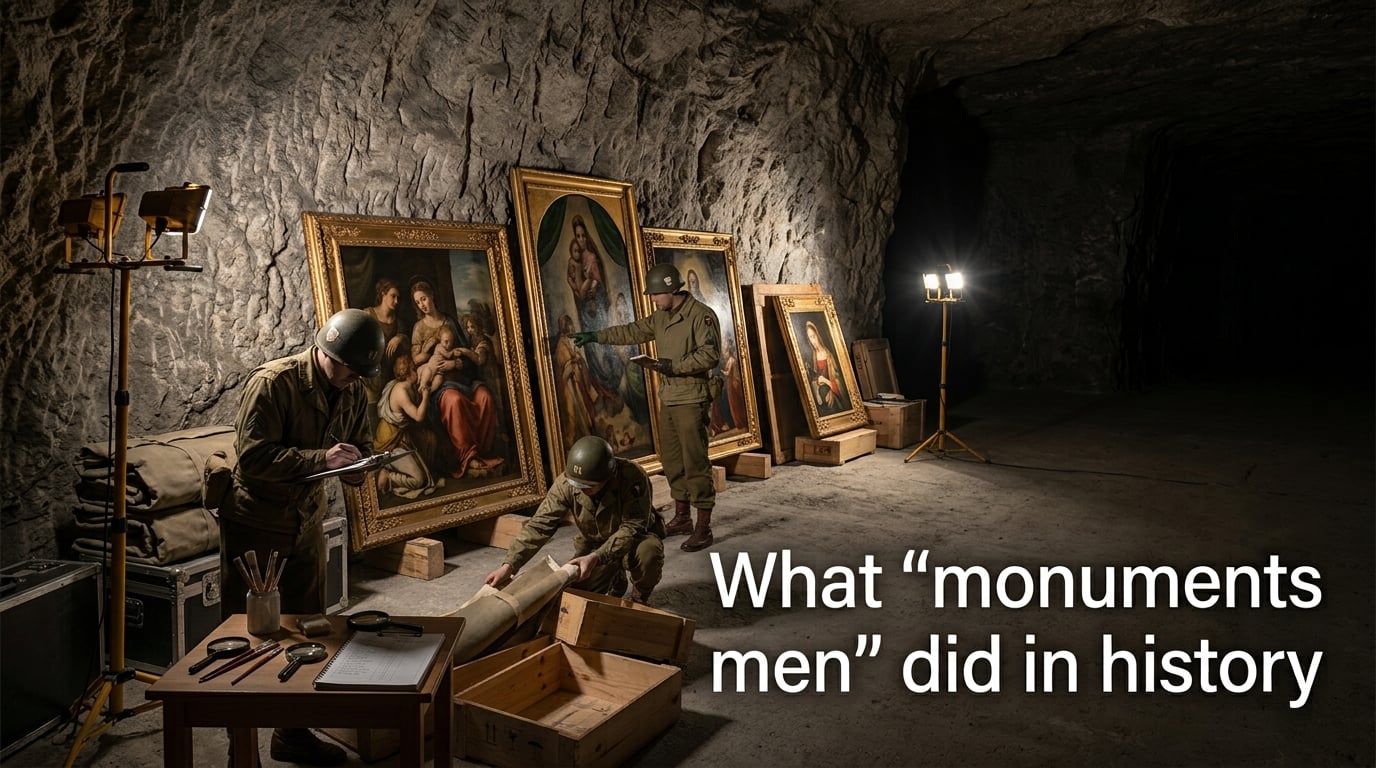
During World War II, a group of approximately 345 men and women from 13 nations served in the U.S. Army’s Monuments, Fine Arts, and Archives (MFAA) program to protect and recover millions of cultural treasures looted or threatened by the Nazis. These museum curators, art historians, and architects—nicknamed the “Monuments Men”—saved over five million irreplaceable artworks, religious artifacts, and cultural records from destruction.
What the Monuments Men did in history ranks among the most remarkable cultural preservation efforts ever undertaken during wartime. Their work spanned the battlefields of Europe and into Asia, where they raced against time, enemy forces, and even Allied bombing to protect centuries of human achievement.
I’ve spent considerable time studying their story through archival records, scholarly accounts, and primary sources. What I found was far more dramatic and complex than what most people know from the 2014 George Clooney film. In this guide, I’ll walk you through who the Monuments Men were, what they actually did, and why their legacy still matters in 2026.
Table of Contents
Who Were the Monuments Men?
The Monuments Men were members of the Monuments, Fine Arts, and Archives (MFAA) section, a little-known unit within the U.S. Army’s Civil Affairs and Military Government Division. Officially established in 1943, the program recruited museum directors, art professors, architects, archivists, and artists who had the expertise to identify, protect, and restore cultural property in war zones.
Despite the nickname “Monuments Men,” the group included women who made significant contributions. In total, about 345 individuals from 13 Allied nations served in the program at various points during and after the war.
Key Facts About the Monuments Men
- Founded: 1943
- Dissolved: 1951
- Total Members: Approximately 345
- Nations Represented: 13 Allied countries
- Items Recovered: Over 5 million cultural artifacts
- Program Name: Monuments, Fine Arts, and Archives (MFAA)
Most of these men and women had never served in the military before. They came from institutions like the Metropolitan Museum of Art, the National Gallery, Harvard, and Yale. They traded comfortable academic careers for frontline duty, often working under dangerous conditions with minimal resources.
Nazi Art Looting and the “Degenerate Art” Campaign
To understand what the Monuments Men did, you first need to understand the scale of Nazi art theft. Adolf Hitler, a failed artist himself, dreamed of building the world’s greatest art museum—the Führermuseum—in his hometown of Linz, Austria. To fill it, he authorized a systematic looting operation that plundered museums, galleries, private collections, and Jewish families across occupied Europe.
The Nazis stole an estimated 600,000 artworks during the war. Hermann Göring alone amassed a personal collection of over 1,500 pieces. Works by Vermeer, Rembrandt, Michelangelo, and Raphael were loaded onto trains and hidden in salt mines, castles, and remote repositories across Germany and Austria.
Simultaneously, the Nazis conducted their “Degenerate Art” campaign, confiscating modernist works from German museums. Art by Picasso, Kandinsky, and other avant-garde artists was either sold abroad to fund the war effort or publicly destroyed. Over 5,000 works were burned in one Berlin fire alone in 1939.
This dual assault on European culture—theft and destruction—created an urgent need for people who could both protect remaining sites and track down stolen works. That’s where the Monuments Men came in.
How the MFAA Program Was Established
The idea for protecting cultural property during wartime didn’t start with the Monuments Men. As early as 1942, art professionals and scholars began lobbying the U.S. government to create a dedicated unit for cultural preservation. The key breakthrough came with the Roberts Commission, formally known as the American Commission for the Protection and Salvage of Artistic and Historic Monuments in Europe.
Established by President Franklin D. Roosevelt in June 1943, the Roberts Commission identified important cultural sites across Europe and advocated for their protection from Allied bombing. This led to the creation of the MFAA section within the Civil Affairs Division of the U.S. Army.
The first Monuments Men arrived in Europe with the Allied invasion forces. They worked under the authority of SHAEF (Supreme Headquarters Allied Expeditionary Force), which gave them access to military resources but often left them scrambling for vehicles, supplies, and personnel. The program was perpetually underfunded and understaffed—a frustration that would define much of their work.
Major Art Recoveries and Key Repositories
The Monuments Men tracked stolen art to hundreds of locations across Europe. Some of the most dramatic recoveries took place in just a handful of major repositories that held the bulk of the Nazi loot.
The Altaussee Salt Mine
The Altaussee salt mine in the Austrian Alps was one of the most important—and most dangerous—repositories the Monuments Men encountered. Deep inside its tunnels, the Nazis had hidden thousands of artworks, including Michelangelo’s Madonna of Bruges and Jan van Eyck’s Ghent Altarpiece (also called the Adoration of the Mystic Lamb).
What makes the Altaussee story particularly dramatic is the Nero Decree. As the Allies closed in, Hitler issued orders to destroy all German assets that might fall into enemy hands—including the art in Altaussee. Local miners and mine officials defied the order, removing the demolition charges and sealing the mine entrance with rock to protect the contents.
When George Stout and his team finally reached the mine in May 1945, they faced weeks of painstaking work to extract the art from the damaged tunnels. The conditions were treacherous—narrow passages, unstable rock, and the constant risk of collapse—but they successfully recovered tens of thousands of objects.
Neuschwanstein Castle
The fairy-tale castle of Neuschwanstein in Bavaria served as a massive storage site for art stolen from French Jewish collectors. The Nazis had catalogued the stolen works there with bureaucratic precision, which actually made the Monuments Men’s recovery work somewhat easier. The castle held thousands of items, including furniture, tapestries, and paintings taken from prominent families across France.
The Uffizi and Italian Collections
In Italy, the Monuments Men faced a different challenge. German forces had systematically removed masterpieces from Italian museums and hidden them in villas, mines, and monasteries throughout the countryside. The recovery of works from the Uffizi Gallery in Florence and other major Italian institutions required extensive detective work, often relying on local informants and captured German documents.
Notable Monuments Men and Women
While the entire group showed remarkable courage, several individuals stand out for their extraordinary contributions.
George Stout
George Stout, a conservator from the Fogg Museum at Harvard, was one of the first to advocate for a cultural protection unit. He arrived in Europe before D-Day and worked his way through the front lines, eventually reaching Altaussee. Stout became the model for the character played by George Clooney in the 2014 film, though the real Stout was far more methodical and less glamorous than his Hollywood counterpart.
Stout’s conservation expertise was crucial. He developed techniques for protecting artworks during transport and storage, many of which are still used in museum conservation today.
Rose Valland
Rose Valland was a French art historian who secretly documented Nazi art theft from inside the Jeu de Paume gallery in Paris, which the Nazis used as their central sorting facility for looted art. For four years, Valland kept meticulous records of which artworks went where—information that proved invaluable when the Monuments Men arrived to recover the stolen works.
Her espionage was extraordinarily dangerous. Had the Nazis discovered her activities, she would certainly have been executed. Valland’s records helped the Monuments Men locate major repositories and identify the rightful owners of thousands of stolen pieces.
Lincoln Kirstein
Lincoln Kirstein, co-founder of the New York City Ballet, served as a special advisor to the MFAA and played a key role in recovering art from the salt mines. His cultural connections and organizational skills helped coordinate the massive logistics of art recovery operations.
Women in the MFAA
Several women made important contributions to the Monuments Men program. Edith Standen, an art historian who served in the Women’s Army Corps, worked at the Wiesbaden Collecting Point and became one of the foremost experts on restitution procedures. Ardelia Hall later led the State Department’s efforts to locate and return looted art during the Cold War era.
The Monuments Men in the Asia-Pacific Theater
While most accounts of the Monuments Men focus on Europe, the MFAA also operated in the Pacific. Under the Supreme Command of the Allied Powers (SCAP), a small team worked in Japan and the Philippines to protect and recover cultural property threatened by the Pacific war.
Japan’s cultural heritage faced unique challenges. American bombing campaigns had destroyed numerous temples and museums, and Japanese military forces had hidden art collections in caves and remote locations. The Pacific Monuments Men worked with Japanese curators and officials to inventory damaged sites and begin restoration efforts.
In the Philippines, the MFAA dealt with art and cultural objects that Japanese forces had attempted to remove or destroy during the final stages of the war. This often-overlooked theater of operations adds an important dimension to understanding the full scope of what the Monuments Men accomplished.
Collecting Points and the Return of Art
Once recovered, stolen art had to be catalogued, authenticated, and returned to its rightful owners. The Allies established several major collecting points across Germany to serve as central processing facilities.
Munich Collecting Point
The Munich Collecting Point, located in the former Nazi administrative building at 1 Alter Postgasse, became the largest art recovery center in Europe. At its peak, it held over 200,000 objects. Monuments Men spent years cataloguing, photographing, and researching the provenance of each piece before beginning the complex process of restitution.
Wiesbaden and Offenbach
The Wiesbaden Collecting Point specialized in fine art, while the Offenbach Archival Depot handled books, manuscripts, and archival materials. Together, these facilities processed millions of cultural objects during the late 1940s.
The Soviet Trophy Brigades
One of the most complicated aspects of the Monuments Men’s work was dealing with Soviet art recovery teams, known as Trophy Brigades. As the Allies advanced into Germany from the west, Soviet forces advanced from the east—and both sides were racing to secure art repositories.
The Trophy Brigades operated under different principles than the MFAA. While the Monuments Men aimed to return art to its rightful owners, the Soviets often treated recovered art as reparations for Soviet cultural losses. Millions of artworks and artifacts were transported to Soviet museums and storage facilities, where many remain to this day. This created tensions between the Allies and added another layer of complexity to the restitution process.
The Lasting Legacy of the Monuments Men
The Monuments Men program officially ended in 1951, but its impact extends far beyond the immediate postwar period.
The 1954 Hague Convention
The work of the Monuments Men directly influenced the 1954 Hague Convention for the Protection of Cultural Property in Armed Conflict. This international treaty established legal frameworks for protecting cultural heritage during wartime—frameworks that are still in use today. The Convention was a direct response to the cultural destruction of World War II, and the MFAA’s experiences provided much of the practical knowledge behind it.
Decades of Obscurity
Perhaps the most surprising aspect of the Monuments Men story is how completely it was forgotten. For nearly 50 years after the war, the MFAA’s accomplishments were largely unknown to the general public. The story was kept alive mainly by art historians and museum professionals working on provenance research.
It wasn’t until 1995 that Lynn Nicholas’s book “The Rape of Europa” brought the story to mainstream attention. Robert Edsel followed with additional research and eventually established the Monuments Men Foundation, which continues to locate missing artworks and honor the MFAA members.
Modern Provenance Research
The records created by the Monuments Men during the 1940s are still actively used today in provenance research. When museums and auction houses investigate the ownership history of artworks, they frequently consult the MFAA’s catalogues and photographs. This ongoing work has led to numerous high-profile restitution cases, returning art to the families of Holocaust victims decades after the war.
The 2014 Film and Public Awareness
George Clooney’s 2014 film “The Monuments Men” brought unprecedented public attention to the MFAA story, though it took significant creative liberties with the historical record. The film condensed multiple real events into a single narrative, invented composite characters, and added Hollywood elements that didn’t happen in reality. Despite its inaccuracies, the movie sparked renewed interest in the actual Monuments Men and led to increased support for provenance research and cultural heritage protection.
Frequently Asked Questions
How many Monuments Men were there?
Approximately 345 men and women from 13 Allied nations served in the Monuments, Fine Arts, and Archives (MFAA) program during and after World War II. The group included museum curators, art historians, architects, archivists, and artists from institutions across the United States, Britain, and other Allied countries.
What happened to the art recovered by the Monuments Men?
The over 5 million cultural artifacts recovered by the Monuments Men were processed through collecting points in Munich, Wiesbaden, and Offenbach. Works were catalogued, their provenance researched, and then returned to their rightful owners or their home countries. Art from Jewish families was returned to surviving family members when possible, or turned over to Jewish cultural organizations. Some unclaimed works remain in museums and government custody today.
How much of the Monuments Men movie was true?
The 2014 film takes significant creative liberties with the historical record. While it accurately portrays the general mission of protecting cultural property, many specific events were invented or combined. The film’s characters are composites rather than real individuals, and several dramatic scenes never happened. The real story, involving 345 people over eight years, was far more complex than any single film could capture.
How many Monuments Men died during the war?
Two Monuments Men were killed in action during World War II. Captain Walter Hancock was wounded but survived. The relatively low casualty rate reflects the nature of their work—they operated behind the front lines rather than in direct combat, though they faced significant dangers from unexploded ordnance, collapsing structures, and the general hazards of war zones.
Did the Monuments Men recover the Ghent Altarpiece?
Yes. The Ghent Altarpiece, also called the Adoration of the Mystic Lamb by Jan van Eyck, was one of the most important works recovered by the Monuments Men. The Nazis had stolen it from the Cathedral of St. Bavo in Ghent, Belgium, and hidden it in the Altaussee salt mine in Austria. George Stout and his team recovered it from the mine in 1945, and it was returned to Belgium, where it remains today.
Were there women among the Monuments Men?
Yes, although the nickname emphasizes men, women made important contributions to the MFAA program. Rose Valland secretly documented Nazi art theft from inside the Jeu de Paume gallery in Paris. Edith Standen worked at the Wiesbaden Collecting Point and became an expert on restitution procedures. Ardelia Hall later led the State Department’s efforts to locate looted art during the Cold War. Their contributions were essential to the program’s success.
Conclusion
Understanding what the Monuments Men did in history reveals one of World War II’s most remarkable yet overlooked stories. These 345 men and women from 13 nations risked their lives to protect and recover over 5 million cultural treasures that the Nazis had stolen or threatened to destroy.
Their legacy extends far beyond the artworks they saved. The MFAA’s work directly inspired international laws protecting cultural heritage during armed conflict and continues to shape provenance research in museums worldwide. The records they created in the 1940s are still being used today to return stolen art to rightful owners.
If you’re interested in learning more, I’d recommend starting with Lynn Nicholas’s “The Rape of Europa” or visiting the Monuments Men and Women Foundation website, which maintains records and continues the restitution work the original group began over 80 years ago.