
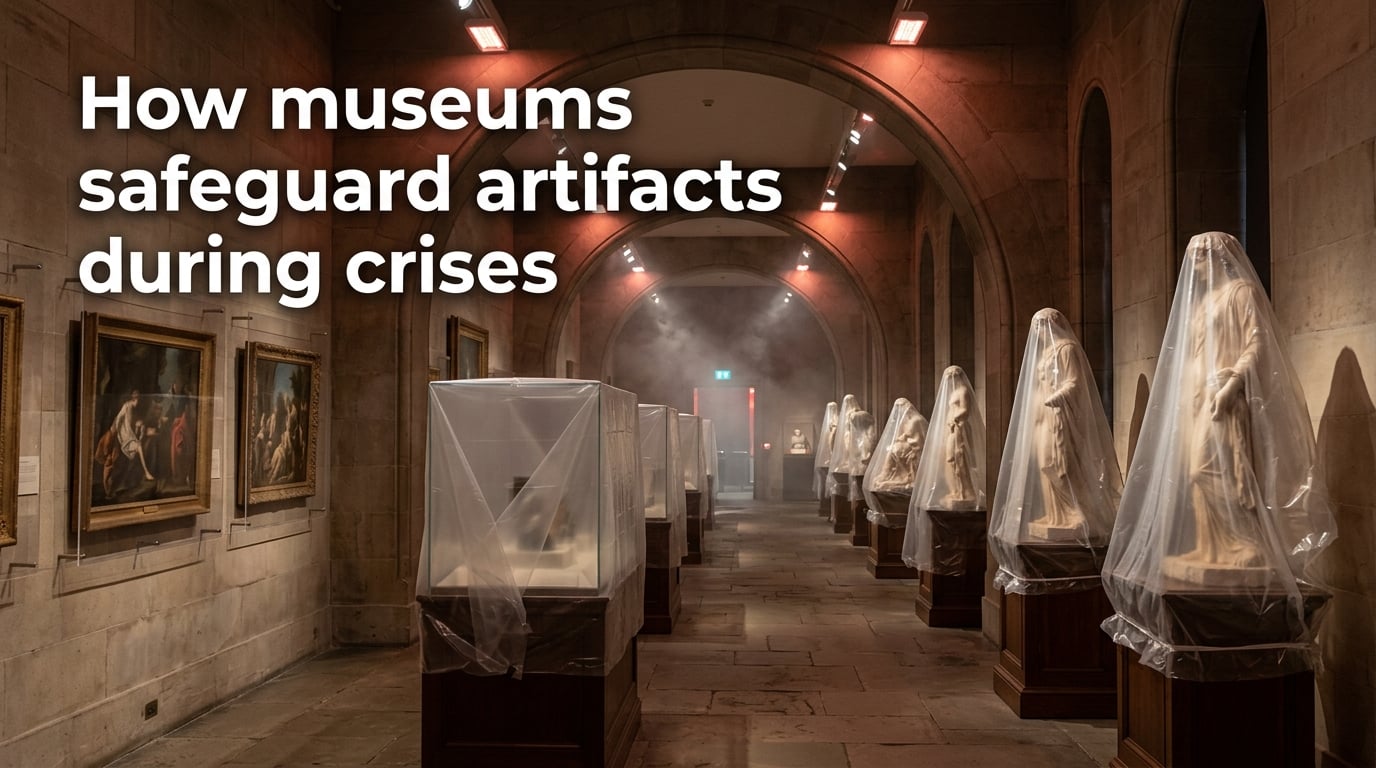
When the LA wildfires threatened the Getty Center in 2026, museum professionals around the world held their breath. The Getty survived, but the incident forced the entire museum community to confront a difficult question: what happens when disaster strikes? Understanding how museums safeguard artifacts during crises is essential for anyone working in cultural heritage protection, and this guide walks you through every critical layer of that preparedness.
Table of Contents
What Does Museum Crisis Safeguarding Involve?
Museum crisis safeguarding refers to the comprehensive set of strategies, plans, and procedures that cultural institutions implement to protect their collections from threats ranging from natural disasters to armed conflicts. It encompasses risk assessment, emergency response planning, staff training, protective infrastructure, evacuation protocols, and partnerships with international organizations.
The goal is twofold: prevent damage in the first place, and respond effectively when prevention fails. A well-prepared museum does not just react to emergencies—it anticipates them. Every institution, regardless of size or budget, needs a documented plan that outlines what to protect, how to protect it, and who is responsible for each action.
Identifying and Assessing Threats
Threat identification is the foundation of any museum disaster preparedness plan. Before you can protect artifacts, you need to understand what you are protecting them from.
Museums face three broad categories of threats:
Natural disasters include floods, hurricanes, earthquakes, wildfires, and severe storms. These events can cause immediate physical damage through water intrusion, structural collapse, or fire, and they often create secondary threats like mold growth or prolonged humidity exposure.
Human-caused threats cover armed conflict, civil unrest, theft, vandalism, and terrorism. Cultural heritage sites in conflict zones face especially severe risks, as deliberate targeting of museums and archives has become a tactic of modern warfare.
Environmental and operational threats are slower-moving but equally damaging. These include HVAC failures, water leaks from aging infrastructure, pest infestations, and the accelerating effects of climate change that alter baseline risk profiles for institutions worldwide.
A proper risk assessment evaluates each threat based on likelihood and potential impact. The National Archives recommends starting with a threat matrix that ranks each hazard from low to high across both dimensions, then matching those ratings to the vulnerabilities of specific collection materials.
Building an Emergency Response Team
Every museum needs a designated emergency response team with clearly defined roles. This is not something to improvise during a crisis—by then, it is too late.
The team should include an emergency response coordinator who has authority to make rapid decisions during an event. Below that coordinator, assign specific responsibilities: collection salvage lead, facilities and security liaison, communications officer, volunteer coordinator, and a liaison for external emergency services.
Smaller museums with limited staff can still build effective teams by cross-training individuals in multiple roles. The American Alliance of Museums (AAM) recommends that even institutions with fewer than five staff members designate at least one person as the emergency coordinator and document their authority in writing.
Communication is the thread that holds everything together. Your plan needs a contact tree with primary and backup contacts for every team member, plus emergency numbers for local fire departments, police, and utility companies. Keep printed copies of this contact tree in multiple locations—digital-only plans fail when power goes out.
Evacuation Procedures and Artifact Prioritization
When disaster strikes, you cannot save everything. That is the hardest truth in museum emergency planning, and it is precisely why a prioritization framework matters so much.
Most conservators and emergency planning professionals recommend a tiered approach to artifact triage:
Tier 1: Irreplaceable and highest-significance items. These are the objects that define your institution’s identity—unique historical documents, one-of-a-kind artworks, items with no duplicates anywhere in the world. They get evacuated first.
Tier 2: High-significance items with some redundancy. These objects are important to the collection but may exist in other institutions or could theoretically be reproduced. They come after Tier 1.
Tier 3: Replaceable or lower-priority items. Mass-produced items, duplicates, or objects with digital backups. These are protected in place rather than evacuated when time is limited.
The prioritization criteria should consider four factors: cultural and historical significance, physical vulnerability to the specific threat, replaceability, and the practical feasibility of moving the object safely. A 500-pound marble sculpture cannot be evacuated in a hurricane, but it can be wrapped and elevated on blocks to avoid floodwater.
Practically speaking, evacuation procedures should follow a clear sequence: secure the building perimeter, initiate the salvage priority list, move objects to predetermined safe zones or off-site locations, document everything with photographs and condition reports, and maintain chain-of-custody records throughout.
Specific Threat Responses
Water and Flood Protection
Water is the most common threat to museum collections and the one that causes the most widespread damage. A single inch of floodwater can destroy paper records, warp wooden artifacts, and trigger mold growth within 48 hours.
Preventive measures include installing water detection sensors in basements and storage areas, elevating collections off the floor on pallets or shelving at least six inches above grade, and maintaining roof and plumbing inspections quarterly. During an active water event, the priority is stopping the source and removing objects from contact with water as quickly as possible.
Salvage supplies should be pre-positioned and include plastic sheeting, blotting paper, fans for air circulation, and freeze-drying capacity or contracts with conservation labs that offer vacuum freeze-drying for water-damaged materials.
Fire Prevention and Response
Fire suppression systems in museums require special consideration. Standard sprinkler systems can cause as much water damage as the fire itself. Many institutions use dry-pipe or pre-action sprinkler systems that only release water when a fire is detected, reducing the risk of accidental discharge.
Gaseous suppression systems using agents like FM-200 or Novec 1230 protect sensitive areas without water damage. These are particularly important for archives, server rooms, and galleries with irreplaceable works on paper.
If evacuation becomes necessary, fire departments should be briefed in advance on museum-specific priorities. As one museum professional shared from their experience, training local firefighters to understand that water-damaged artifacts can often be restored while fire-destroyed objects cannot—it changes how they approach the situation.
Earthquake Preparedness
Seismic protection starts with securing objects to walls, shelves, and display cases using museum-grade wax, straps, and mounts. Glass cases should use laminated safety glass that holds fragments together rather than shattering.
Structural retrofitting is a longer-term investment, but even small measures like bracing tall shelving units and installing seismic isolation pads under heavy sculptures significantly reduce damage during moderate quakes.
Armed Conflict and Civil Unrest
Heritage protection during armed conflict is among the most challenging scenarios museums face. The International Council of Museums (ICOM) publishes Red Lists that help identify cultural objects at risk of illicit trafficking from conflict zones, and their Emergency Response programme provides direct support to museums in crisis areas.
Preventive strategies include dispersing collections to multiple storage locations, creating detailed photographic inventories of every object, and establishing relationships with international organizations that can provide rapid assistance when threats escalate.
Protecting Digital Collections and Data
A museum’s digital infrastructure is just as vulnerable as its physical collections, and data loss can be equally devastating. Collections management systems, digital asset management platforms, donor records, and research databases all need protection.
Cloud-native backup solutions offer the most resilient option for digital preservation. Storing backups in geographically distributed data centers ensures that a regional disaster does not wipe out both the primary system and its backup simultaneously. Encryption at rest and in transit protects sensitive donor and acquisition data.
Regular backup testing is often overlooked. A backup that has never been restored is an assumption, not a guarantee. Test your restoration process at least twice a year, and document how long it takes to bring critical systems back online.
Cost-Effective Solutions for Small Museums
One of the most persistent pain points in museum emergency preparedness is budget. Many small and mid-sized institutions operate on shoestring budgets where hiring a full-time emergency coordinator or installing specialized suppression systems simply is not feasible.
But preparedness does not have to be expensive. Here are practical strategies that work within tight budgets:
Leverage partnerships. Many museum professionals have found that local merchants and home improvement stores donate or discount supplies like plastic sheeting, shelving, and storage containers when asked. Neighboring institutions can share resources, equipment, and even storage space during emergencies.
Use free resources from professional organizations. AAM’s Museum Assessment Program (MAP) connects small museums with peer reviewers who can help build disaster plans at little or no cost. ICOM provides free emergency planning templates and guidelines.
Prioritize low-cost, high-impact measures first. Elevating collections on pallets costs almost nothing. Creating a printed contact tree and distributing it to staff is free. Conducting a walkthrough to identify the top 20 most significant objects and documenting their locations takes an afternoon.
Apply for grants. Organizations like the Foundation of the American Institute for Conservation (FAIC) and the National Endowment for the Humanities (NEH) offer grants specifically for disaster preparedness improvements at cultural institutions.
Staff Training and Emergency Drills
A plan that sits in a binder on a shelf is not a plan—it is a document. The difference between a good plan and effective preparedness is training.
Staff should receive orientation on emergency procedures during onboarding, with annual refresher training for all employees. Training should cover the basics: how to shut off water and electricity, where emergency supplies are stored, who to call first, and how to handle damaged artifacts without causing further harm.
Drills should happen at least annually, and they should simulate realistic scenarios rather than simple fire evacuations. Run a tabletop exercise where a pipe bursts in the storage room at 2 AM on a Saturday. Walk through the response step by step. What happens first? Who calls whom? Where do the objects go?
Knowledge transfer is critical when staff turn over. Document everything in writing, but also pair new hires with experienced team members for hands-on training. The loss of institutional knowledge when a long-time employee leaves is one of the most underestimated risks in museum emergency preparedness.
Key Organizations and Resources
Museums do not have to face crises alone. Several organizations provide direct support, training, and resources for emergency preparedness:
International Council of Museums (ICOM) operates a global network of over 60,000 members across 141 countries. Their Heritage Protection Department coordinates emergency response, publishes Red Lists for trafficking prevention, and runs the Heritage Emergency Response Training (HEART) programme.
American Alliance of Museums (AAM) offers the Museum Assessment Program, peer review resources, and extensive published guidance on disaster planning specifically tailored to American institutions of all sizes.
FEMA provides federal disaster assistance that cultural institutions can access, including the Heritage Emergency National Task Force partnership that coordinates federal and private-sector support during major disasters.
Getty Conservation Institute has funded and led conservation emergency response efforts worldwide, including rapid assessment teams deployed after major earthquakes and floods.
Foundation of the American Institute for Conservation (FAIC) administers the Emergency CAP (Collections Assessment for Preservation) programme, which provides free post-disaster conservation assessments for affected institutions.
Real-World Case Studies
Hurricane Sandy (2012) devastated museums and archives across the northeastern United States. The New York Historical Society lost thousands of items to flooding, but their pre-positioned salvage supplies and trained staff managed to save the vast majority of their most significant pieces. The lesson: preparation dramatically improves outcomes, even in catastrophic events.
LA Wildfires (2026) put the Getty Center’s decades of fire preparedness to the test. The museum’s fire-resistant landscaping, sealed buildings, and internal air filtration systems kept the collection safe while flames burned nearby. Their investment in infrastructure paid off precisely when it was needed.
Lytton, British Columbia (2021) saw a wildfire destroy most of the village, including its museum. The Lytton Museum and Archives lost irreplaceable First Nations artifacts and historical photographs. The devastating outcome highlighted the vulnerability of small, rural institutions that lack the resources for major infrastructure investments—a gap that the broader museum community is still working to address.
These cases demonstrate a consistent pattern: institutions with documented plans and trained staff recover faster and lose fewer objects than those that wing it.
Frequently Asked Questions
How do museums protect artifacts during natural disasters?
Museums protect artifacts during natural disasters through a combination of preventive infrastructure (water sensors, fire suppression systems, seismic mounts), evacuation protocols with prioritized object lists, and partnerships with conservation organizations that provide rapid-response support. The specific response depends on the threat type—flood protection focuses on elevating collections and stopping water intrusion, while fire response emphasizes specialized suppression systems and advance coordination with local fire departments.
How do museums prioritize which artifacts to save first?
Most museums use a tiered prioritization framework based on four criteria: cultural and historical significance, physical vulnerability to the specific threat, replaceability, and feasibility of safe transport. Tier 1 objects—irreplaceable, institution-defining items—are evacuated first. Tier 2 items with some redundancy follow. Tier 3 replaceable items are protected in place rather than evacuated when time is limited.
What organizations help museums during emergencies?
The International Council of Museums (ICOM) operates a global emergency response network across 141 countries. The American Alliance of Museums (AAM) provides assessment programs and planning resources for U.S. institutions. FEMA offers federal disaster assistance for cultural institutions, and the Getty Conservation Institute deploys rapid assessment teams after major disasters. The Foundation of the American Institute for Conservation administers free post-disaster conservation assessments.
Can small museums afford disaster preparedness?
Yes. Effective disaster preparedness does not require large budgets. Small museums can leverage free resources from AAM and ICOM, partner with neighboring institutions to share equipment and storage space, apply for grants from FAIC and NEH, and start with low-cost high-impact measures like elevating collections, creating printed contact trees, and identifying their top 20 most significant objects for priority protection.
What is the role of ICOM in museum emergency preparedness?
ICOM coordinates emergency response through its Heritage Protection Department, which manages a global network of museum professionals. They publish Red Lists to help identify cultural objects at risk of illicit trafficking, run the Heritage Emergency Response Training (HEART) programme, and provide direct on-the-ground support to museums affected by disasters and armed conflicts worldwide.
How should museums train staff for emergencies?
Museums should provide emergency procedure orientation during onboarding with annual refresher training for all staff. Training should cover shutting off utilities, locating emergency supplies, proper artifact handling during salvage, and communication protocols. Annual drills should simulate realistic scenarios like water leaks or after-hours incidents, and all procedures should be documented in writing to preserve institutional knowledge when staff turnover occurs.
Conclusion
Learning how museums safeguard artifacts during crises is not an academic exercise—it is a practical necessity that protects irreplaceable cultural heritage for future generations. Whether you run a national institution or a small local museum, the time to build your emergency preparedness plan is now, before disaster strikes. Start with a risk assessment, designate your response team, prioritize your most significant objects, and connect with the organizations that exist specifically to help you succeed. The artifacts in your care are counting on it.