
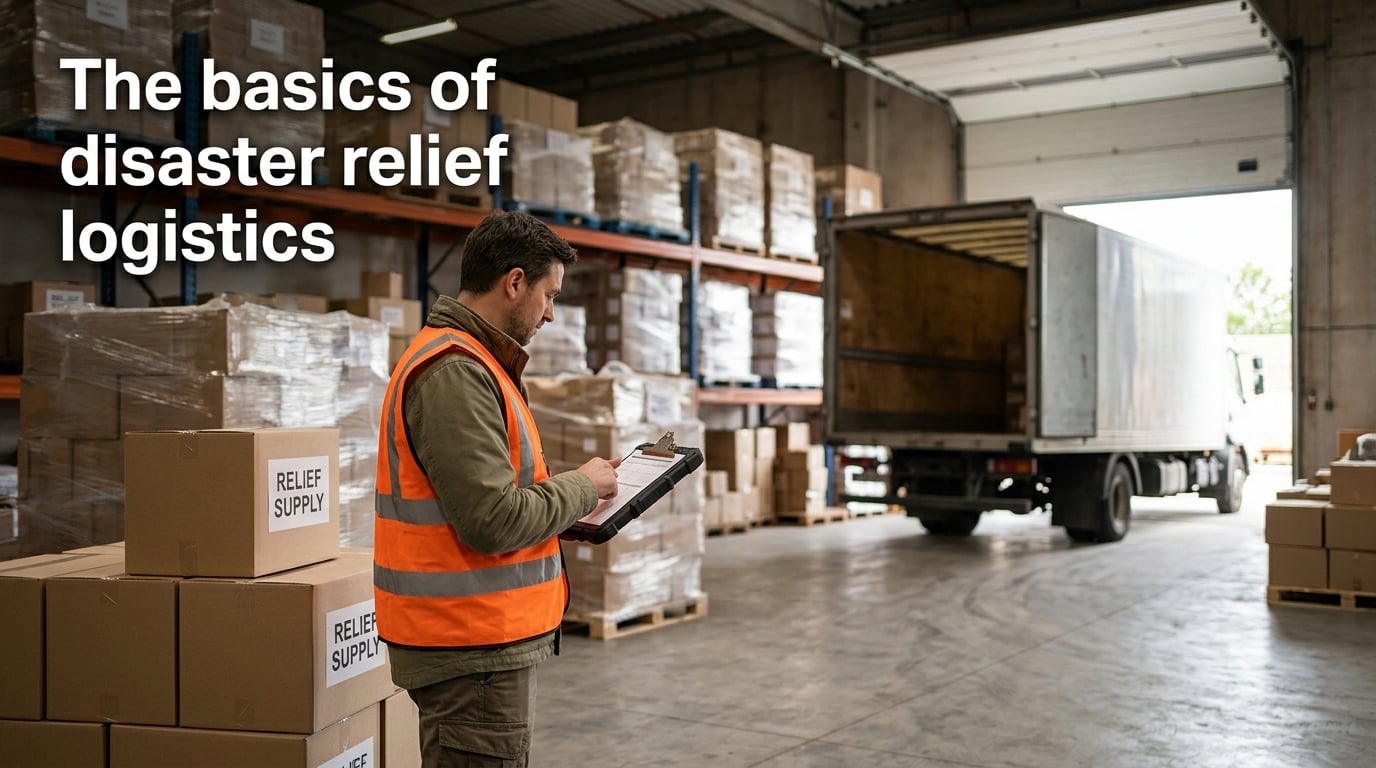
Disaster relief logistics is the process of planning, coordinating, and delivering essential supplies, such as food, water, medicine, and shelter materials, to communities hit by natural disasters, pandemics, or humanitarian crises. It blends transportation, warehousing, last-mile delivery, and information management into a single mission: getting the right aid to the right people at the right time.
I have spent years studying humanitarian supply chains, and I can tell you that the basics of disaster relief logistics come down to preparation, speed, and coordination. In the rest of this guide, I will walk you through the core components, the phases every responder follows, the frameworks professionals use, and the organizations leading the field today.
Table of Contents
What Is Disaster Relief Logistics?
Disaster relief logistics is the discipline of moving people, goods, and information before, during, and after an emergency. It covers everything from pre-positioning supplies in regional hubs to running last-mile delivery trucks, helicopters, or boats into cut-off communities.
Unlike commercial logistics, which optimizes for profit and predictability, humanitarian logistics optimizes for speed and survival. A shipment of insulin after a hurricane, or clean water after an earthquake, has a shelf life measured in hours, not days.
Why does it matter? Because every hour of delay can cost lives. Effective relief logistics reduces waste, prevents duplication of effort, and gives affected families a real chance to recover. It is the backbone of every emergency response operation, whether you are dealing with a hurricane response, an earthquake, or a pandemic supply chain.
Core Components of Disaster Relief Logistics
Every disaster relief operation relies on five core components working together. If one fails, the others collapse.
1. Transportation and rapid deployment. This is the most visible piece of relief operations. It includes trucks, cargo planes, helicopters, boats, and even drones. Multimodal transport, switching between air, sea, and road, is common when a single route is blocked.
2. Warehousing and staging. Before disaster strikes, organizations pre-position supplies in regional warehouses close to high-risk areas. After the event, temporary staging hubs receive incoming aid and break bulk shipments into smaller loads for last-mile delivery.
3. Last-mile delivery. This is the hardest mile. Roads may be flooded, airports damaged, or communities cut off by debris. Last-mile delivery in disaster zones often relies on smaller vehicles, pack animals, or foot convoys.
4. Coordination and information sharing. Government agencies, NGOs, militaries, and private carriers all converge during a crisis. Without a shared logistics common operating picture, trucks arrive at the same place while other communities go unserved.
5. Technology and data. GPS tracking, route optimization, and real-time visibility platforms let coordinators see where every shipment is and reroute around blockages. Emerging tools like AI demand forecasting and blockchain-based chain-of-custody are reshaping the field.
Phases of the Disaster Management Cycle
Relief logistics does not start when the camera crews arrive. It runs on a continuous cycle, and each phase has its own logistics priorities.
Phase 1: Preparedness. Before disaster hits, responders pre-position supplies, train staff, and run simulation drills. This is where most of the real work happens. WFP and FEMA keep strategic stockpiles, train rapid deployment teams, and pre-clear customs paperwork so aid can move the moment it is needed.
Phase 2: Response. This is the acute phase, usually the first 72 hours. The job is rapid deployment of life-saving supplies: search and rescue gear, medical kits, water, and shelter. Speed matters more than efficiency here.
Phase 3: Recovery. Once the immediate crisis stabilizes, logistics shifts to longer-term rebuilding. That means restoring supply chains, replacing damaged infrastructure, and supporting economic recovery so communities can stand back up.
Phase 4: Mitigation. After recovery, responders review what worked and what failed. Lessons feed into updated plans, better warehouse locations, and stronger emergency response planning for the next event.
Humanitarian vs Commercial Logistics
Humanitarian logistics and commercial logistics share the same physical supply chain, but they operate under very different rules. Here is how they compare.
| Factor | Humanitarian Logistics | Commercial Logistics |
|---|---|---|
| Primary goal | Save lives and reduce suffering | Profit and customer satisfaction |
| Timeline pressure | Hours to days, life-critical | Days to weeks, demand-driven |
| Demand forecasting | Highly uncertain, sudden spikes | Based on historical sales data |
| Funding | Donations, government grants, UN budgets | Revenue and investment capital |
| Stakeholders | NGOs, UN agencies, governments, militaries | Manufacturers, retailers, 3PLs, consumers |
| Risk profile | Operating in damaged, insecure areas | Operating in stable, regulated markets |
| Last-mile delivery | Often disrupted infrastructure | Stable roads, addresses, schedules |
Understanding this difference is important. A logistics professional trained only in commercial supply chains can struggle when the planning horizon collapses to hours and the destination is a flooded village with no road access.
Key Frameworks That Shape the Field
Over the years, the humanitarian logistics community has built a few shared frameworks. These show up again and again in training programs, academic papers, and field manuals, and they help everyone speak the same language.
The 5 P’s of logistics. People, Processes, Products, Partners, and Performance. People are the responders. Processes are the standard operating procedures that guide decisions. Products are the goods being delivered. Partners are the NGOs, governments, and private carriers working together. Performance is how the operation is measured and improved.
The 7 C’s of logistics. Customer, Cost, Consistency, Capacity, Communication, Coordination, and Control. Together they describe what a logistics system needs to deliver humanitarian aid reliably: a clear understanding of who you serve, what it costs, how consistent the service is, how much volume the system can handle, how information flows, how actors stay aligned, and how quality is enforced.
The 7 principles of disaster management. Prevention, Mitigation, Preparedness, Response, Recovery, Rehabilitation, and Reconstruction. These principles frame the entire disaster management cycle and guide decisions at every stage of an emergency.
The 7 pillars of logistics. Inventory, Transportation, Warehousing, Packaging, Information, Communication, and Security. Each pillar is a functional area a logistics manager must plan for, and weakness in any one of them can stall the whole operation.
You will not use every framework in every crisis, but together they give newcomers a strong starting point and experienced coordinators a shared vocabulary.
Real-World Case Studies
Two disasters stand out as turning points for modern relief logistics.
Hurricane Katrina (2005). Katrina exposed serious gaps in US disaster response: uncoordinated agencies, slow last-mile delivery, and limited pre-positioning. The after-action review led directly to the Post-Katrina Emergency Management Reform Act and a major overhaul of FEMA logistics doctrine.
2010 Haiti earthquake. Within hours of the quake, WFP, USAID, the Red Cross, and dozens of NGOs converged on Port-au-Prince. Logistics bottlenecks at the airport, customs delays, and damaged port facilities pushed responders to adopt new tools: biometric registration for aid recipients, mobile cash transfers, and the UN Logistics Cluster coordination model that is now standard practice worldwide.
Both disasters shaped how we coordinate emergency supply delivery and humanitarian aid distribution today.
The Role of Technology in Modern Disaster Logistics
Technology has changed what is possible in a disaster zone. A few shifts stand out.
Real-time tracking. GPS and IoT sensors on relief shipments let coordinators reroute around blockages and confirm deliveries.
Drones. After cyclones in Mozambique and the 2015 Nepal earthquake, drones mapped damage and delivered small medical payloads to remote villages.
AI and predictive analytics. Machine learning models now help forecast damage severity, optimize warehouse pre-positioning, and allocate scarce transport capacity.
Mobile money and biometrics. Cash transfers delivered by phone let survivors buy what they actually need, while biometric IDs cut fraud and speed up registration.
None of these tools replaces experienced human responders, but together they are reshaping emergency logistics services for disaster relief.
Key Organizations in Disaster Relief Logistics
Several organizations carry the bulk of the global humanitarian logistics load.
World Food Programme (WFP). The UN’s logistics lead agency, running the global UN Humanitarian Response Depot network and the Logistics Cluster that coordinates air, sea, and land transport during major crises.
FEMA. The US federal agency that leads domestic disaster response, including pre-positioning supplies, managing the National Response Framework, and coordinating federal logistics support.
American Red Cross and the International Red Cross. Operate shelter supply chains, first aid logistics, and blood product distribution; the international network also supports global relief operations.
USAID. Funds and deploys disaster response teams and partners through its Bureau for Humanitarian Assistance.
OCHA. The UN office that coordinates humanitarian actors, manages the humanitarian response plan, and runs financial tracking systems.
UNHCR, MSF, and the Salvation Army round out the major responders, each with deep specialty supply chains for shelter, medical care, and emergency feeding.
Challenges in Disaster Relief Logistics
Even with strong planning, disaster logistics is hard. The most common challenges include damaged or destroyed roads, ports, and airports; sudden spikes in demand that overwhelm pre-positioned stocks; customs and border delays, especially for cross-border aid; funding gaps that arrive weeks after the disaster; security risks in conflict zones; and fragmented data systems that slow coordination among dozens of responding agencies.
Each of these barriers can be the difference between aid arriving on time and aid arriving too late.
Frequently Asked Questions
What are the 5 P’s of logistics?
The 5 P’s of logistics are People, Processes, Products, Partners, and Performance. People are the responders and staff. Processes are the standard operating procedures guiding decisions. Products are the goods being moved. Partners are the NGOs, governments, and private carriers working together. Performance is how the operation is measured and improved over time.
What are the 7 C’s of logistics?
The 7 C’s of logistics are Customer, Cost, Consistency, Capacity, Communication, Coordination, and Control. They describe what a logistics system needs to deliver humanitarian aid reliably: a clear picture of who you serve, what it costs, how consistent the service is, how much volume the system can handle, how information flows, how actors stay aligned, and how quality is enforced.
What are the 7 principles of disaster management?
The 7 principles of disaster management are Prevention, Mitigation, Preparedness, Response, Recovery, Rehabilitation, and Reconstruction. Together they frame the entire disaster management cycle and guide decisions at every stage, from reducing risk before an event to rebuilding communities long after the initial response is over.
What are the 7 pillars of logistics?
The 7 pillars of logistics are Inventory, Transportation, Warehousing, Packaging, Information, Communication, and Security. Each pillar is a functional area a logistics manager must plan for, and weakness in any one of them, such as poor inventory data, damaged warehouses, or weak security, can stall the entire humanitarian supply chain.
The Takeaway on Disaster Relief Logistics
Disaster relief logistics is more than trucks and warehouses. It is a discipline that combines preparedness, rapid deployment, last-mile delivery, coordination, and technology to save lives when communities need help most. The basics come down to understanding the core components, following the four phases of the disaster management cycle, knowing the shared frameworks like the 5 P’s and 7 C’s, and learning from real-world operations such as Katrina and Haiti.
If you want to go deeper, start by following the public situation reports from WFP Logistics Cluster, FEMA, and OCHA. Volunteer with a local Red Cross chapter, take a course in humanitarian supply chain management, or shadow a logistics officer during a regional exercise. The field is growing, the demand is rising, and the basics you have learned here will travel with you into every response you support.