
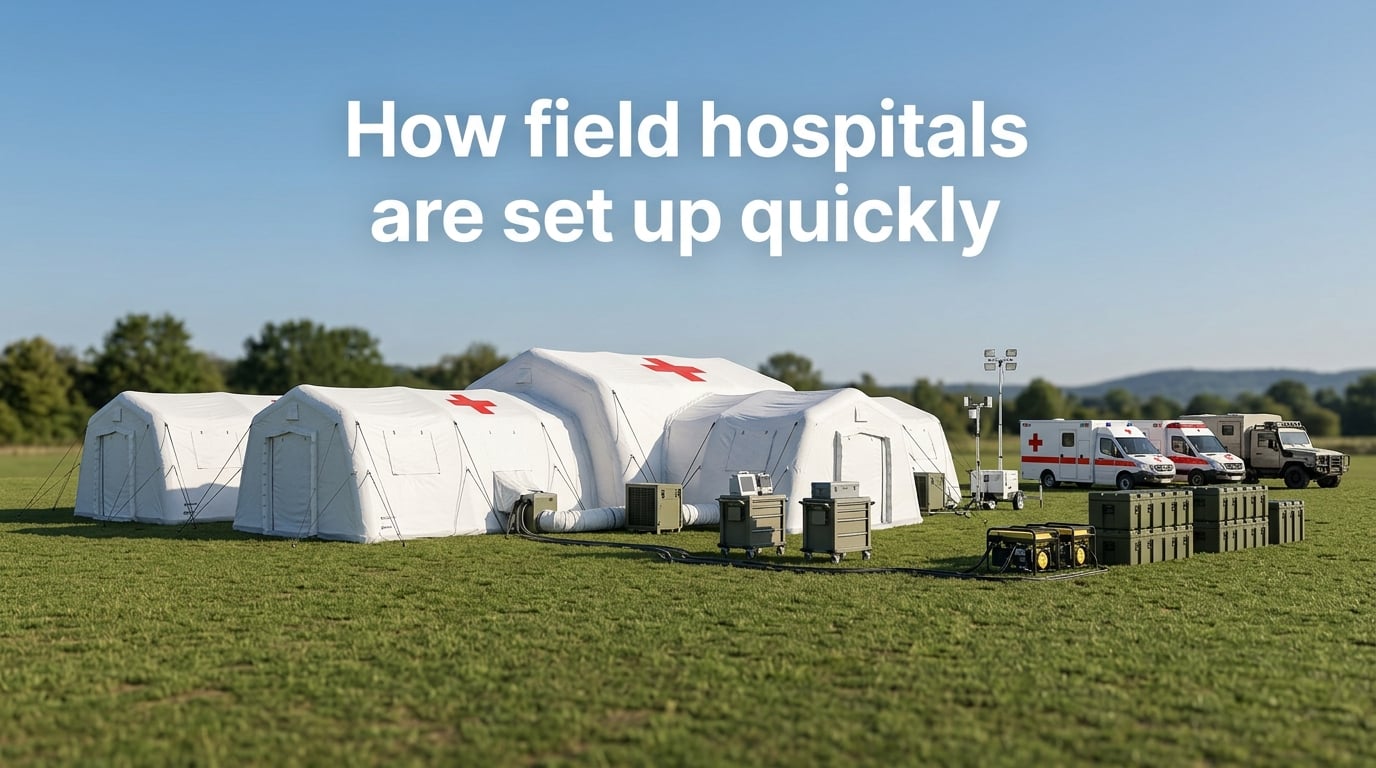
When disaster strikes and existing hospitals are overwhelmed or destroyed, field hospitals become the frontline of emergency medical care. These temporary facilities can be fully operational within 48-72 hours, providing critical care to thousands of patients in crisis zones around the world.
In this guide, I’ll walk you through exactly how field hospitals are set up so quickly, from the initial deployment decision to the moment the first patient receives treatment. Whether you’re an emergency response professional, healthcare administrator, or simply curious about disaster preparedness, you’ll understand the engineering, logistics, and medical expertise behind these life-saving facilities.
Table of Contents
What Is a Field Hospital and Why Speed Matters
A field hospital is a temporary or mobile medical facility designed to provide emergency healthcare in locations where permanent hospitals are damaged, absent, or overwhelmed. Unlike traditional hospitals that take years to build, field hospitals deploy in hours or days.
Speed is critical because the first 72 hours after a disaster are when preventable deaths occur most frequently. Traumatic injuries, untreated infections, and complications from chronic conditions all require immediate medical attention. A field hospital bridges the gap between the disaster event and the restoration of permanent healthcare infrastructure.
Modern field hospitals are pre-packaged medical systems transported in containers, pallets, or vehicles. Teams of trained medical and logistics professionals arrive on-site, unpack equipment, erect structures, and begin treating patients. UK-Med, a World Health Organization-verified Emergency Medical Team, reports that their field hospitals can treat at least 100 outpatients per day within 48-72 hours of arriving in a disaster zone.
The 72-Hour Setup Timeline: Hour-by-Hour Breakdown
No competitor provides a detailed hour-by-hour breakdown of how field hospitals are set up. Based on military standards and WHO Emergency Medical Team (EMT) guidelines, here’s how the 72-hour deployment window typically unfolds.
Hours 0-6: Arrival and Site Assessment
The advance team arrives at the designated site and conducts rapid assessments. They evaluate ground conditions, access routes, proximity to the disaster zone, and availability of utilities like water and power. Safety checks identify hazards such as unstable structures, flooding risks, or security threats.
During this phase, logistics coordinators confirm supply chain routes and establish communication with local authorities. The team marks out the hospital layout, designating zones for triage, patient care, pharmacy, and support services.
Hours 6-18: Infrastructure Erection
This is the most labor-intensive phase. Teams unload containers and begin assembling the primary structures. Modern field hospitals typically use inflatable shelters, modular container units, or rapid-erect tent systems.
Tent-based systems like those from Western Shelter can be erected by small teams in under four hours per unit. Containerized systems arrive pre-outfitted and require only positioning and connection. Environmental control units, power generators, and water purification systems are installed during this window.
Hours 18-36: Medical Equipment Installation
With structures in place, medical teams begin outfitting clinical spaces. Operating theaters receive surgical equipment, sterilization units, and anesthesia machines. Patient wards get beds, monitoring equipment, and medical gas systems (oxygen, vacuum, compressed air).
Pharmacy areas are stocked and organized. Laboratory equipment for basic diagnostics is set up. Negative pressure isolation rooms—critical for infection control—are tested and calibrated with HEPA filtration systems.
Hours 36-48: Testing and Staff Orientation
Medical equipment undergoes safety checks and calibration. Staff conduct walkthroughs to familiarize themselves with patient flow patterns, emergency exits, and equipment locations. Communication systems, including satellite links and radio networks, are tested.
Infection control protocols are reviewed. Sterilization equipment is tested. Backup systems for power and water are verified. This phase ensures that when patients arrive, the team can provide safe, coordinated care.
Hours 48-72: Operational Readiness
The field hospital transitions to operational status. Triage areas are staffed and ready to receive patients. Registration and tracking systems are activated. The facility begins accepting patients, starting with those requiring immediate stabilization.
BLU-MED systems, a leading provider of deployable field hospitals, confirms that their facilities can be fully operational within approximately 72 hours of site arrival. This timeline represents decades of refinement in emergency medical deployment.
Field Hospital Classification: Role I, II, and III
Field hospitals operate under a classification system that defines their capabilities, staffing, and patient capacity. Understanding these roles helps emergency planners match the right facility to the situation’s needs.
| Feature | Role I | Role II | Role III |
|---|---|---|---|
| Primary Function | Triage and stabilization | Emergency surgery and short-term care | Comprehensive surgical and intensive care |
| Bed Capacity | 5-10 beds | 30-60 beds | 100-300+ beds |
| Surgical Capability | Basic wound care | Emergency surgery | Multiple operating theaters |
| ICU Capability | No | Limited | Full intensive care unit |
| Staff Size | 10-20 people | 40-80 people | 150-400+ people |
| Typical Deployment | Forward operating areas | Regional disaster response | Major humanitarian crises |
The World Health Organization (WHO) verifies Emergency Medical Teams against these standards, ensuring they meet minimum requirements for deployment. WHO-verified EMTs are classified as Type 1 (equivalent to Role I), Type 2 (Role II), or Type 3 (Role III).
Core Components and Equipment
Every field hospital relies on a standard set of components that enable rapid deployment and medical capability. These systems are designed for portability, durability, and quick assembly.
Structural Systems
Modern field hospitals use three primary structural types. Inflatable shelters offer the fastest deployment—some can be inflated and ready for use in under 10 minutes. Modular container systems arrive pre-outfitted and provide excellent environmental control. Rapid-erect tent systems balance speed with flexibility, allowing customizable layouts.
Medical Gas Systems
Field hospitals require reliable supplies of medical-grade oxygen, vacuum for suction, and compressed air. These systems typically use portable concentrators, cylinders, or truck-mounted generators. Piping runs connect central supplies to individual patient stations.
Environmental Control
Temperature and humidity control are critical for patient comfort and infection prevention. Environmental control units (ECUs) provide heating, cooling, and ventilation. Negative pressure isolation rooms use HEPA filtration to prevent airborne disease transmission—essential during pandemic responses like COVID-19.
Triage and Patient Flow
Field hospitals are designed around patient flow patterns that separate incoming patients by severity. Triage areas use color-coded systems (red, yellow, green, black) to prioritize treatment. Clear pathways prevent congestion and ensure efficient movement from arrival to treatment to discharge or transfer.
Staffing Requirements Across Different Levels
The number and type of medical staff vary dramatically by field hospital role. Understanding these requirements is essential for deployment planning and training.
A Role I facility operates with 10-20 staff members, typically including emergency physicians, nurses, paramedics, and logistics personnel. These teams focus on triage and stabilization, preparing patients for transfer to higher-level care.
Role II facilities scale up to 40-80 staff. In addition to emergency physicians and nurses, they require surgeons, anesthesiologists, operating room nurses, laboratory technicians, and pharmacy staff. Logistics teams expand to manage supply chains, maintenance, and security.
Role III facilities are essentially full hospitals, requiring 150-400+ staff. Specialties include multiple surgical disciplines, intensive care specialists, radiologists, and comprehensive support services. These facilities often operate 24/7 with shift rotations.
Training requirements are significant. Staff must be proficient in austere medicine—providing care with limited resources in challenging environments. Many organizations, including the International Committee of the Red Cross (ICRC) and Doctors Without Borders (MSF), run specialized training programs for field hospital deployment.
Real-World Deployments: Case Studies
Understanding how field hospitals perform in practice provides valuable insights into their capabilities and limitations.
COVID-19 Pandemic Response
During the COVID-19 pandemic, Western Shelter outfitted the McCormick Place Convention Center in Chicago with 750 isolation units. This rapid conversion demonstrated how large-scale venues can be transformed into field hospitals using modular medical systems. The facility expanded Chicago’s hospital capacity during the critical spring 2020 surge.
Turkey-Syria Earthquake (2023)
Following the devastating earthquake in February 2023, UK-Med deployed their field hospital to Turkey. Within the standard 48-72 hour window, their team was treating patients. Over the course of their deployment, UK-Med’s medical teams treated more than 7,000 patients, providing emergency surgery, trauma care, and outpatient services to earthquake survivors.
Ukraine Humanitarian Crisis
Since 2022, multiple organizations have deployed field hospitals across Ukraine to maintain healthcare services in conflict-affected areas. These facilities provide critical care for trauma injuries while also managing chronic conditions like diabetes and cardiovascular disease that require ongoing treatment.
Natural Disaster Preparedness
Organizations like FEMA and the Army Corps of Engineers maintain pre-positioned field hospital kits that can be deployed within hours of a natural disaster. These systems are stored in strategic locations across the United States, enabling rapid response to hurricanes, earthquakes, and other emergencies.
Site Selection and Logistics Planning
Choosing the right location is critical for field hospital success. Poor site selection can delay deployment, compromise patient care, or create safety hazards.
Location Criteria
Ideal sites are flat, well-drained, and accessible by road. They should be close enough to the disaster zone for rapid patient transport but far enough away to avoid secondary hazards. Proximity to airports or helipads facilitates medical evacuations.
Utilities matter. Access to clean water reduces the burden on purification systems. Reliable electrical supply—or space for generators—supports medical equipment. Drainage prevents flooding during heavy rains.
Supply Chain Management
Field hospitals consume supplies rapidly. A well-planned logistics chain ensures continuous delivery of medications, consumables, and replacement equipment. Containerized transport allows efficient movement from warehouses to deployment sites.
Just-in-time delivery models, borrowed from commercial supply chains, help minimize on-site storage requirements while ensuring critical supplies arrive when needed. Real-time inventory tracking systems monitor stock levels and trigger automatic reorders.
Modern Innovations in Field Hospital Technology
Advances in technology are transforming field hospital capabilities, improving both deployment speed and patient outcomes.
IoT and Remote Monitoring
Internet of Things (IoT) sensors monitor equipment status, environmental conditions, and patient vital signs in real time. These systems alert staff to equipment failures, temperature fluctuations, or patient deterioration before they become critical.
Telemedicine Capabilities
Modern field hospitals connect to specialist consultants via satellite or cellular networks. Surgeons in remote locations can consult with specialists at major medical centers, improving decision-making for complex cases. Telemedicine also enables remote training and supervision for less experienced staff.
Advanced Structural Materials
New materials make shelters lighter, stronger, and faster to deploy. Inflatable structures now incorporate rigid panels that provide better insulation and durability. Composite materials reduce weight while maintaining structural integrity.
Sustainable Operations
Solar panels, battery storage, and energy-efficient equipment reduce fuel consumption and logistical burden. Water recycling systems minimize waste. These innovations extend deployment duration and reduce environmental impact.
Frequently Asked Questions
What is an emergency medical team?
An emergency medical team (EMT) is a group of medical professionals trained and equipped to deploy rapidly to disasters and emergencies. EMTs are classified by the World Health Organization into types based on their capabilities, from basic triage and stabilization (Type 1) to comprehensive surgical and intensive care (Type 3).
How long does it take to set up a field hospital?
Most field hospitals can be operational within 48-72 hours of arriving at a deployment site. The exact timeline depends on the facility type, team experience, and site conditions. Simple Role I facilities may be operational in under 24 hours, while complex Role III facilities typically require the full 72-hour window.
What equipment does a field hospital need?
Essential equipment includes structural shelters, medical gas systems (oxygen, vacuum, compressed air), environmental control units, surgical equipment, patient monitoring systems, pharmacy supplies, sterilization equipment, and communication systems. Power generation and water purification are also critical components.
How many staff work in a field hospital?
Staffing varies by facility role. Role I facilities operate with 10-20 staff, Role II facilities require 40-80 staff, and Role III facilities employ 150-400+ personnel. Staff typically include physicians, nurses, surgeons, anesthesiologists, paramedics, laboratory technicians, pharmacists, and logistics specialists.
Where are field hospitals used?
Field hospitals deploy to natural disaster zones, conflict areas, pandemic response sites, mass casualty incidents, remote locations without healthcare infrastructure, and anywhere existing hospitals are damaged or overwhelmed. They also serve as surge capacity during healthcare crises.
How much does it cost to deploy a field hospital?
Deployment costs vary significantly by facility size and location. UK-Med reports that a single field hospital deployment costs approximately £250,000 (roughly $310,000). Larger Role III facilities can cost millions to deploy and operate. Costs include transportation, equipment, staffing, supplies, and ongoing operational expenses.
Conclusion
Field hospitals represent one of humanity’s most effective tools for saving lives during emergencies. The ability to deploy a fully functional medical facility within 72 hours—complete with surgical capabilities, intensive care, and pharmacy services—is a testament to decades of innovation in emergency medicine and logistics.
Understanding how field hospitals are set up quickly helps emergency planners, healthcare administrators, and policymakers prepare for the inevitable next disaster. Whether through training programs, supply pre-positioning, or technology investment, the lessons from past deployments continue to improve our collective ability to respond to medical emergencies anywhere in the world.