
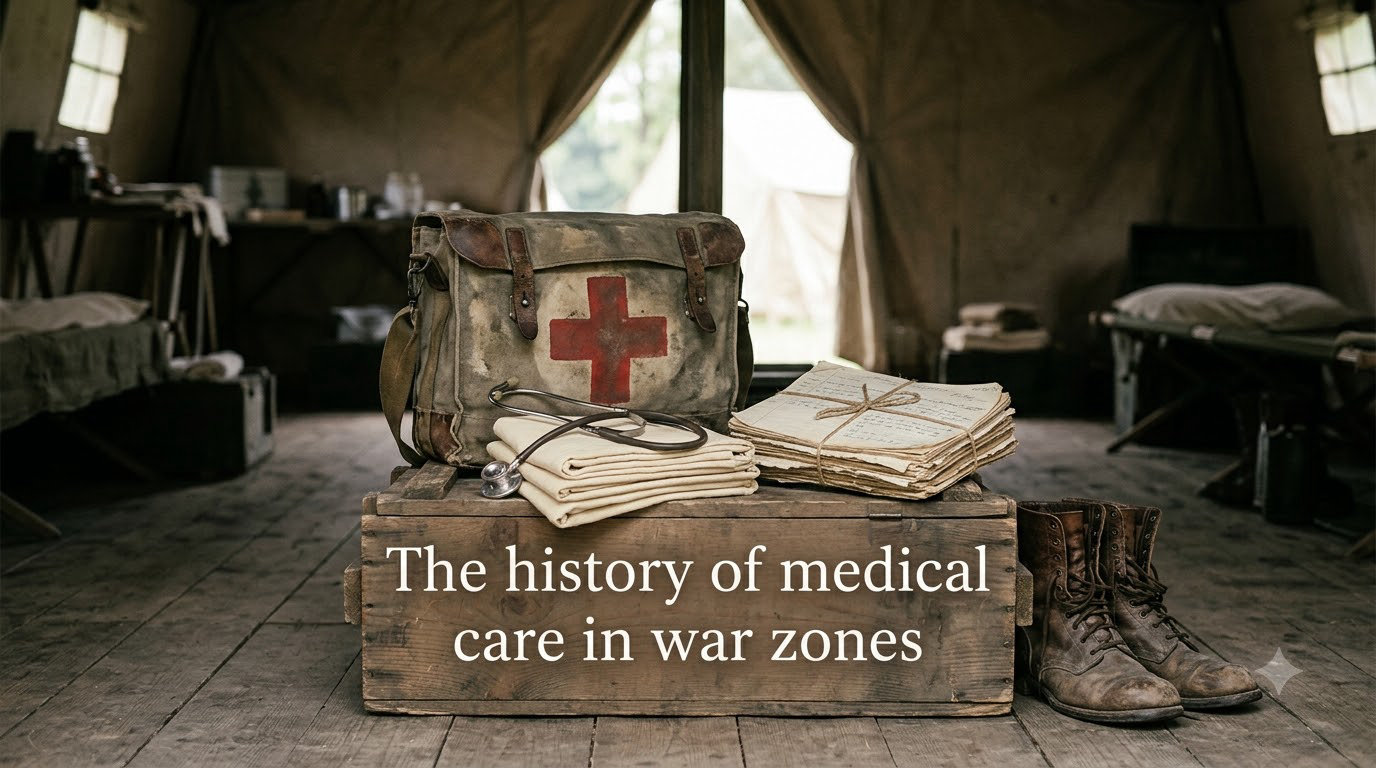
Battlefield medicine is the specialized field focused on treating wounded military personnel in or near combat zones. It has evolved from crude wound care in ancient Greece to today’s advanced tactical combat casualty care (TCCC) systems. Nearly half of all combat deaths result from blood loss, with most occurring within the first hour after injury—a window known as the “golden hour.” Understanding the history of medical care in war zones reveals how warfare has driven some of the most important medical breakthroughs in human history.
From the tourniquets used by Alexander the Great’s surgeons to the helicopter MEDEVAC units of Vietnam, each major conflict produced innovations that saved countless lives on the battlefield and transformed civilian emergency medicine. This article traces that remarkable evolution, covering the pioneers, the technologies, and the protocols that shaped modern combat casualty care.
Table of Contents
What Is Battlefield Medicine?
Battlefield medicine—also called field surgery or combat casualty care—is the treatment of wounded combatants and non-combatants in or near an area of combat. Its core mission is straightforward: stop bleeding, keep airways open, and evacuate the wounded to definitive care as fast as possible.
What makes it different from civilian medicine is the environment. Medics and surgeons work under fire, with limited supplies, and must make rapid triage decisions. The constraints of warfare have consistently pushed medical professionals to innovate under pressure, and many of those innovations eventually became standard practice in civilian hospitals and emergency rooms worldwide.
As military history enthusiasts on forums like r/WarCollege frequently point out, the reality of combat medicine bears little resemblance to Hollywood portrayals. Real battlefield medicine is a system—not just a lone medic with a bag, but an entire chain of care stretching from the point of injury to the operating table.
Ancient Origins: Battlefield Medicine in the Classical World
The earliest recorded battlefield medical practices date to ancient Greece and Rome. Greek physicians accompanying Alexander the Great’s armies in the 4th century BC are among the first known to use tourniquets to control extremity bleeding. Alexander’s personal physician, Critobulus, reportedly performed amputations and extracted arrows from the king himself during campaigns.
The Romans took military medicine further by creating dedicated medical corps. Roman legions carried capsae medicinales—medical supply chests—and established valetudinaria, which were field hospitals set up behind the lines. Roman military surgeons developed tools for extracting projectiles, cauterizing wounds, and performing basic surgeries. Their approach was systematic: each legion had trained medics, and wounded soldiers were evacuated to designated care facilities.
Galen of Pergamon, who served as physician to Roman gladiators in the 2nd century AD, advanced surgical techniques that would influence battlefield surgery for centuries. His writings on wound treatment and anatomy became foundational texts for later military surgeons.
Middle Ages and the Crusades
During the Middle Ages, battlefield medicine regressed in some ways but also saw important developments. Medieval armies rarely had organized medical support. Wounded soldiers were often left where they fell, and treatment—if it came—was provided by barbers, monks, or anyone willing to attempt surgery.
The Crusades (1096–1291) brought European knights into contact with Islamic medical knowledge. Arab physicians had preserved and advanced Greek and Roman medical texts, and their surgical techniques were often superior to Western practices. The Knights Hospitaller, a military order, established some of the earliest organized battlefield medical care, running hospitals in Jerusalem and along Crusader routes.
Ambroise Paré, a French barber-surgeon in the 16th century, revolutionized wound treatment. Before Paré, cauterization with boiling oil was standard for gunshot wounds. Paré discovered that a gentler mixture of egg yolk, rose oil, and turpentine healed wounds better than the brutal cauterization methods. His observation and willingness to challenge established practice embodied the spirit of battlefield medical innovation.
The Napoleonic Wars and the Birth of Triage
The Napoleonic Wars (1803–1815) produced one of the most consequential figures in battlefield medicine: Dominique Jean Larrey. Napoleon’s chief surgeon, Larrey invented the concept of triage—the systematic prioritization of wounded soldiers based on the severity of their injuries rather than their rank or the order in which they arrived.
Before Larrey, wounded soldiers were treated on a first-come, first-served basis, or officers received care before enlisted men. Larrey’s system ensured that those with the most life-threatening injuries received immediate attention, regardless of social standing. This principle remains the foundation of modern emergency medicine and mass casualty response.
Larrey also introduced the flying ambulance (ambulance volante)—light, horse-drawn carts designed to rapidly evacuate wounded soldiers from the battlefield. These vehicles dramatically reduced the time between injury and treatment, foreshadowing the modern MEDEVAC system. His innovations during the Napoleonic Wars saved thousands of lives and established principles still used today.
The American Civil War: A Turning Point
The American Civil War (1861–1865) was a watershed moment for military medicine. The sheer scale of casualties—over 600,000 dead and hundreds of thousands wounded—forced both Union and Confederate armies to develop medical systems on an unprecedented scale.
Jonathan Letterman, medical director of the Army of the Potomac, created the first organized ambulance corps and established a systematic approach to casualty evacuation. His system moved wounded soldiers from regimental aid stations to division hospitals and then to general hospitals behind the lines—a tiered care model that remains the backbone of military medical systems.
The Civil War also saw the widespread use of anesthesia (chloroform and ether) for battlefield surgery. Surgeons performed amputations at unprecedented speed—some could amputate a limb in under ten minutes. While brutal by modern standards, these procedures saved lives that would otherwise have been lost to infection and blood loss.
Walt Whitman, who served as a volunteer nurse during the war, documented the horrors of battlefield injuries and the dedication of medical personnel. His accounts brought public attention to the needs of wounded soldiers and helped build support for improved military medical care.
On forums like r/history, users frequently note that the Civil War era’s medical advances came at an enormous human cost. Many surgical techniques were refined through trial and error on thousands of patients, and infection killed more soldiers than bullets. The lack of germ theory knowledge meant that surgeons operated without sterilization, spreading disease between patients.
World War I: Lessons Written in Blood
World War I introduced industrialized warfare—and industrialized casualties. Machine guns, artillery, and poison gas produced injuries of a type and scale never seen before. The medical community was forced to adapt rapidly.
The war saw the development of specialized treatments for new wound types. Gas casualties required respiratory care protocols. Shrapnel wounds demanded improved debridement techniques—the surgical removal of dead tissue and foreign material. The Carrel-Dakin method of wound irrigation, developed during the war, significantly reduced infection rates.
Evacuation systems expanded dramatically. Railways, motor vehicles, and eventually aircraft were used to move wounded soldiers from the front lines to hospitals far behind the lines. The British established Casualty Clearing Stations (CCS) near the front, where surgeons could perform life-saving operations before patients were evacuated to base hospitals.
Friedrich von Esmarch, a German surgeon, had already popularized the use of first aid kits and trained soldiers in basic wound care before the war. His principles of self-aid and buddy aid became standard military training. The concept of the combat medic—soldiers trained specifically to provide medical care on the battlefield—took root during this period.
Marie Curie also contributed to battlefield medicine during World War I. She developed mobile X-ray units, nicknamed petites Curies, which could be driven to the front lines to help surgeons locate bullets and shrapnel in wounded soldiers. Her work saved countless lives and demonstrated how civilian scientific expertise could transform military medicine.
World War II and the Rise of Mobile Surgery
World War II produced several landmark advances in battlefield medicine. The most iconic was the Mobile Army Surgical Hospital (MASH), though the concept was refined during the Korean War. During World War II, forward surgical teams began operating closer to the front lines, reducing evacuation times and improving survival rates.
Blood banking and transfusion became standard practice. The ability to store and transport blood meant that surgeons could replace blood loss during surgery—a capability that dramatically improved outcomes for patients with hemorrhagic shock. The establishment of blood banks was one of the war’s most important medical innovations.
Penicillin, discovered in 1928 by Alexander Fleming, was mass-produced during the war and became widely available by 1944. It transformed the treatment of infected wounds, reducing the death rate from bacterial infections that had been a leading killer in previous wars.
The war also saw advances in burn treatment, reconstructive surgery, and the treatment of shock. Military surgeons developed techniques that would later be applied to civilian trauma care, and the experience gained in treating mass casualties influenced the development of modern emergency medicine systems.
According to AUSA research, casualty survival rates improved significantly between World War II and later conflicts. In World War II, the case fatality rate for wounded soldiers who reached medical care was approximately 30%. This improvement reflected better evacuation systems, improved surgical techniques, and the availability of antibiotics and blood products.
Korea and Vietnam: The Golden Hour Emerges
The Korean War (1950–1953) saw the first widespread use of helicopter evacuation—MEDEVAC—which revolutionized battlefield medicine. For the first time, wounded soldiers could be airlifted from the front lines directly to surgical hospitals within minutes rather than hours. This capability gave rise to the concept of the golden hour—the critical first 60 minutes after injury when treatment is most likely to save a life.
MASH units, made famous by the movie and television series, operated during the Korean War as mobile surgical facilities that could be set up close to the front. Surgeons performed life-saving operations on patients who, in previous wars, would have died during evacuation. The combination of helicopter MEDEVAC and forward surgical teams dramatically reduced combat mortality.
The Vietnam War (1955–1975) further refined these systems. Helicopter evacuation became even faster, with average evacuation times dropping to under an hour. Combat medics carried improved equipment, including better tourniquets, pressure dressings, and the early hemostatic agents that would later evolve into modern products like QuikClot and HemCon dressings.
Survival rates for wounded soldiers who reached medical care improved to over 75% in Vietnam—a significant improvement over World War II. The medical community’s understanding of shock, hemorrhage control, and airway management advanced considerably during this period. The experience in Vietnam laid the groundwork for modern tactical combat casualty care.
Women in Battlefield Medicine
Women have played crucial roles in battlefield medicine throughout history, though their contributions have often been overlooked. Florence Nightingale, who served during the Crimean War (1853–1856), is perhaps the most famous. Her insistence on sanitation, hygiene, and organized nursing care dramatically reduced mortality rates at British military hospitals. Nightingale’s work established nursing as a profession and laid the foundation for modern hospital infection control.
During World War I and World War II, women served as nurses, ambulance drivers, and medical administrators. Thousands of women served in the Army Nurse Corps and Navy Nurse Corps, often working close to the front lines under dangerous conditions. Their contributions were essential to maintaining the military medical system.
Marie Curie’s mobile X-ray units during World War I demonstrated how women with scientific expertise could make direct contributions to battlefield medicine. She personally drove X-ray trucks to the front and trained other women to operate the equipment. Her work is estimated to have facilitated over a million X-ray examinations during the war.
In more recent conflicts, women have served as combat medics, flight surgeons, and trauma surgeons in Iraq and Afghanistan. The expansion of women’s roles in military medicine reflects broader changes in military policy and recognition of women’s capabilities in all aspects of medical care.
Modern Tactical Combat Casualty Care (TCCC)
Tactical Combat Casualty Care (TCCC) represents the current standard for battlefield medicine. Developed in the 1990s by the Naval Special Warfare Command and refined through decades of combat in Iraq and Afghanistan, TCCC is a set of evidence-based guidelines for managing combat trauma.
TCCC divides battlefield care into three phases:
Care Under Fire: Treatment provided while the medic and patient are still under enemy fire. The priority is returning fire and controlling massive hemorrhage using tourniquets. Airway management and other interventions are delayed until the tactical situation improves.
Tactical Field Care: Treatment provided when the patient and medic are in a relatively safe position. This is the phase where the MARCH protocol is applied—Massive hemorrhage, Airway, Respiration, Circulation, Hypothermia prevention. Each step addresses a specific life threat in order of priority.
Tactical Evacuation Care: Treatment provided during evacuation to a higher level of care. This phase involves ongoing monitoring, advanced interventions if needed, and preparation for handoff to surgeons at the receiving facility.
The MARCH protocol, central to TCCC, has standardized combat medicine across the U.S. military and allied forces. Its emphasis on tourniquet use, hemostatic agents, needle decompression for tension pneumothorax, and tranexamic acid for hemorrhage control has saved thousands of lives. The protocol is updated regularly based on new evidence from combat and trauma research.
Modern combat medics receive extensive training far beyond basic first aid. In the U.S. Army, combat medics are designated by the military occupational specialty code 68W (68 Whiskey). Their training covers trauma management, pharmacology, advanced airway techniques, and emergency medical procedures. This training standardizes battlefield medical care and ensures that medics can apply TCCC principles effectively.
From Battlefield to Civilian EMS
Some of the most important legacies of battlefield medicine are the innovations that migrated into civilian emergency medical services. The concept of triage, developed by Larrey during the Napoleonic Wars, is now standard practice in emergency rooms and disaster response worldwide.
Helicopter evacuation, pioneered during the Korean War, became the model for civilian air ambulance services. The golden hour concept, rooted in military medical research, shaped the development of trauma center systems and emergency response times in civilian healthcare.
Tourniquet use, once discouraged in civilian medicine due to concerns about limb loss, has been rehabilitated based on military experience. Studies from Iraq and Afghanistan demonstrated that modern tourniquets, applied correctly, save lives without the complications previously feared. Today, tourniquets are standard equipment in civilian first aid kits, and public education campaigns teach bystanders how to use them.
The Tactical Combat Casualty Care model has influenced civilian tactical medicine—specialized medical care for law enforcement and first responders operating in dangerous environments. The principles of hemorrhage control, airway management, and rapid evacuation are now taught in civilian trauma courses and integrated into emergency medicine training.
The Future of Battlefield Medicine
The next generation of battlefield medicine is being shaped by emerging technologies. Telemedicine allows surgeons at rear facilities to guide medics in the field through complex procedures using video links and real-time data. This capability extends the reach of specialized medical expertise to remote and dangerous locations.
Robotic surgery and AI-assisted diagnostics are being explored for forward surgical teams. While still in early stages, these technologies could eventually allow automated or semi-automated surgical procedures in austere environments where human surgeons are unavailable.
Advanced hemostatic agents, regenerative medicine, and improved body armor continue to reduce preventable deaths on the modern battlefield. Research into freeze-dried blood products, portable ultrasound devices, and wearable vital sign monitors promises to further improve survival rates.
The U.S. military’s Role-based medical system (Role 1 through Role 4) continues to evolve, with each level providing increasingly specialized care. Role 1 is unit-level first aid; Role 4 is definitive hospital care. The goal remains the same as it has been for centuries: get the right care to the right patient as quickly as possible.
Frequently Asked Questions
What was the life expectancy of a combat medic in Vietnam?
Combat medics in Vietnam faced extremely high casualty rates. Medics were often specifically targeted by enemy forces because eliminating the medic disrupted the unit’s medical capability. While exact life expectancy figures vary by unit and time period, medics serving in frontline infantry units during the Vietnam War experienced casualty rates significantly higher than the average soldier.
Why are army medics called 68 whiskey?
68 Whiskey (68W) is the U.S. Army’s Military Occupational Specialty (MOS) code for Combat Medic Specialists. The number 68 designates the medical career field, and the W (Whiskey in the NATO phonetic alphabet) identifies the specific specialty. This designation was established to standardize training and career progression for military medical personnel.
Why were soldiers given condoms in WW1?
During World War I, condoms were distributed primarily for disease prevention rather than contraception. Sexually transmitted infections were a major military problem, causing significant troop losses. Military commanders recognized that prophylactic measures, including condoms, were more effective than abstinence campaigns at reducing disease rates among deployed soldiers.
Who was the best combat medic in history?
Several combat medics are celebrated for extraordinary heroism. Desmond Doss, a World War II Army medic who refused to carry a weapon, saved approximately 75 soldiers during the Battle of Okinawa and received the Medal of Honor. Other notable medics include Thomas Bennett and Joseph LaPointe, both of whom received the Medal of Honor for their actions in Vietnam. Each demonstrated exceptional courage and medical skill under fire.
Conclusion
The history of medical care in war zones is a story of relentless innovation under impossible conditions. From Alexander the Great’s surgeons using tourniquets in the 4th century BC to today’s TCCC protocols refined in Iraq and Afghanistan, each major conflict has produced breakthroughs that saved lives on the battlefield and transformed civilian medicine. The golden hour concept, triage, helicopter evacuation, blood banking, and modern hemorrhage control all trace their origins to military medical practice.
As warfare continues to evolve, so too will battlefield medicine. The technologies of tomorrow—telemedicine, AI-assisted diagnostics, advanced hemostatic agents, and regenerative medicine—will build on the foundation laid by centuries of military medical innovation. What remains constant is the mission: to save the lives of those who serve, as quickly and effectively as possible.