
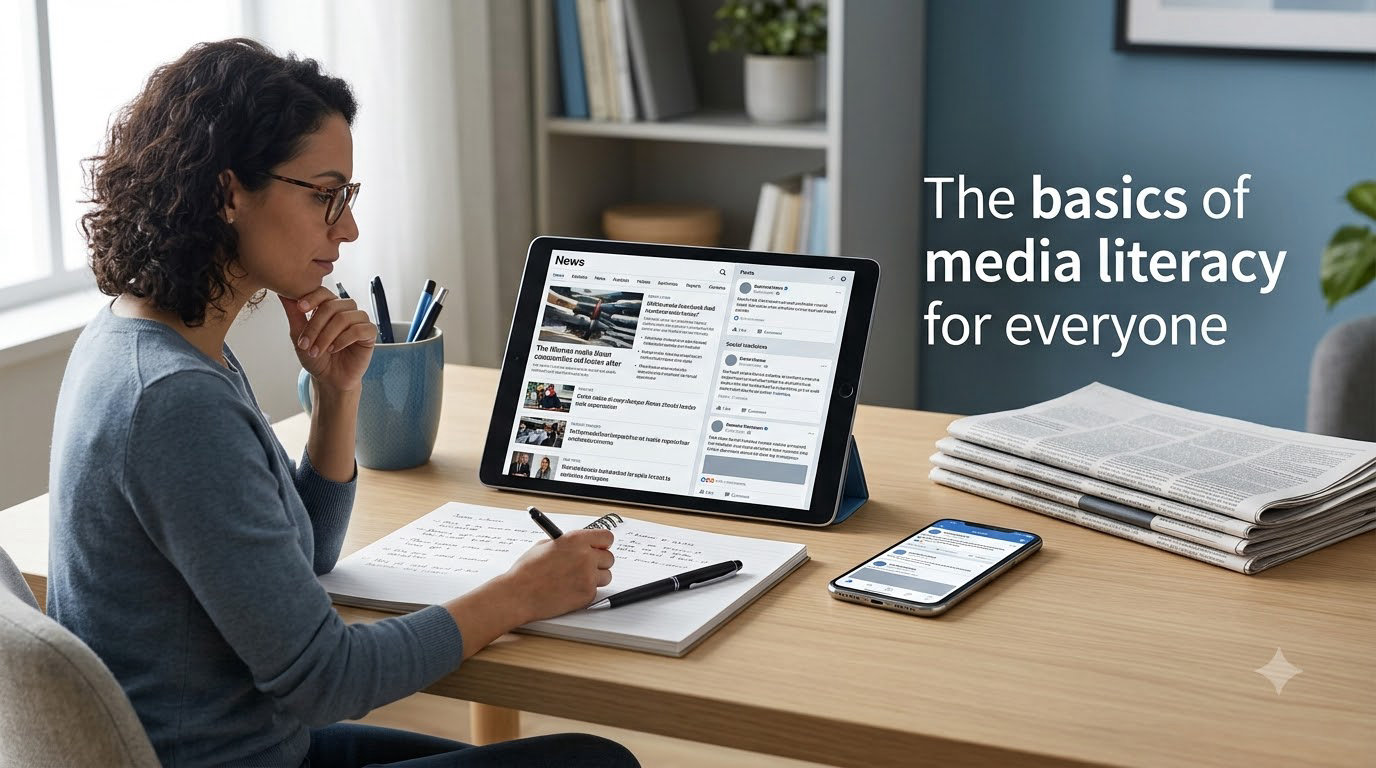
Every day, the average person scrolls past hundreds of headlines, videos, and social posts. Most of them blend fact, opinion, and outright misinformation so smoothly that we rarely stop to question what we are reading. That is exactly why the basics of media literacy matter for everyone, not just journalists or teachers.
Media literacy is a learnable skill, not an innate talent. Our team has spent weeks reviewing university research, fact-checking organization guides, and the most-cited AI Overview sources to put together this practical guide. By the end, you will have a clear framework (the SIFT method), five key concepts you can apply immediately, and concrete exercises to sharpen your critical thinking every day.
Table of Contents
What Is Media Literacy?
Media literacy is the ability to access, analyze, evaluate, and create media in a variety of forms. According to the National Association for Media Literacy Education (NAMLE), it is the ability to comprehend and critique media messages across platforms, from news articles to TikTok videos.
It goes beyond spotting fake news. Media literacy also covers how algorithms shape what you see, how bias creeps into reporting, how advertising manipulates emotion, and how symbols carry meaning in film and television. MasterClass puts it simply: media literacy is the skill of decoding every message that reaches you and deciding what it deserves from your attention.
Why Media Literacy Matters More Than Ever
Algorithms decide what shows up in your feed, search engines return different results for the same query, and AI-generated content now floods every platform. Without strong media literacy, you are exposed to misinformation and confirmation bias every time you open your phone.
A UNC-Chapel Hill study on information behavior found that even savvy internet users fall for algorithmically amplified content when they do not pause to verify. The harm is real: election interference, public-health hoaxes, financial scams, and rising polarization all trace back to gaps in critical thinking about media.
Think of media literacy as a defense skill and a thinking skill combined. It protects you from being manipulated and trains you to ask better questions about everything you consume.
The 5 Key Concepts of Media Literacy
The 5 key concepts of media literacy, drawn from NAMLE’s Core Principles and widely taught in U.S. media education programs, are these:
- Access: Finding media that is relevant, high-quality, and diverse.
- Analyze: Examining the message, structure, genre, and target audience of any piece of media.
- Evaluate: Judging the credibility, bias, and purpose of the source.
- Create: Producing your own media responsibly, with awareness of how messages shape others.
- Reflect & Act: Considering the social impact of media and acting on informed conclusions.
These five concepts work together. You cannot evaluate what you cannot access, and analysis without action has little real-world value.
Core Skills Every Media Literate Person Uses
The key skills of media literacy fall into four practical categories that anyone can practice daily:
- Source verification: Checking who wrote a piece, who funds the outlet, and whether the byline is real.
- Lateral reading: Leaving the original page to see what trusted sources say about it. Cornell University Library popularized this technique.
- Bias recognition: Identifying partisan, demographic, corporate, big-story, and false-balance bias.
- Emotional regulation: Pausing before sharing surprising or upsetting content instead of reacting immediately.
Reddit users in r/medialiteracy often describe the final skill as the hardest. Outrage feels good, and pausing to verify feels slow. The trained habit of stopping first is what separates a media-literate reader from a passive one.
The SIFT Method: A Step-by-Step Framework
The SIFT method is a four-step fact-checking framework developed by digital literacy expert Mike Caulfield. It is the most cited media literacy tool in Google’s AI Overview, and it works whether you are evaluating a tweet, a documentary, or a breaking news alert.
- Stop. Before you share, like, or even finish reading, pause. Ask yourself whether you actually know anything about this topic or whether you are reacting to a headline.
- Investigate the source. Open a new tab and search the publication or author name plus the word “reliable” or “credible.” Do not rely on the site’s own About page; check independent coverage.
- Find better coverage. Look for the same claim reported by trusted outlets you already know. If only one obscure site is making the claim, that is a red flag.
- Trace claims to their origin. Follow quotes, statistics, and screenshots back to the original source. If the original does not say what the post claims, the claim is distorted.
Cornell University Library recommends running SIFT on every breaking news item, especially on social media, where misinformation spreads roughly six times faster than verified news (per a 2018 MIT study still widely cited in 2026).
Quick SIFT Example
You see a viral post claiming a famous CEO just donated millions to a political campaign. Run the method:
- Stop: You have never seen this story before.
- Investigate: Search the CEO’s name plus the donation claim. No major outlet covers it.
- Find: The only sources sharing it are partisan blogs with a history of hoaxes.
- Trace: The “screenshot” is cropped from a 2019 interview about an unrelated charity.
Result: do not share. The whole process takes under two minutes once you practice it.
How to Spot Bias and Misinformation
Bias is not always a sin. Every outlet has a perspective. The job of media literacy is to spot the type of bias at work so you can adjust how much weight to give the message. Population Education identifies five common types:
- Partisan bias: Slanting coverage toward one political side.
- Demographic bias: Privileging certain groups’ voices over others.
- Corporate bias: Soft-pedaling stories that hurt advertisers or owners.
- Big-story bias: Overcovering dramatic, rare events and undercovering systemic issues.
- False-balance bias: Giving fringe views equal airtime with settled science.
Misinformation is false content shared without intent to harm. Disinformation is false content deliberately created to deceive. The American Psychological Association stresses that the emotional pull of a headline, especially fear or anger, is one of the strongest signals of misleading content. If a headline makes your heart race, slow down.
Three Warning Signs a Post Is Misinformation
- The domain looks almost right (for example, “BBCNews.co” instead of “BBC.com”).
- There is no author byline, only a generic “Staff Writer.”
- The post uses all caps, urgent language, or asks you to “share before it gets deleted.”
Practical Exercises to Build Your Media Literacy
Media literacy is a learned skill, not something you are born with. One Reddit user in r/NoStupidQuestions put it well: “Nobody is naturally good at this; they just practiced until patterns felt obvious.” Here are five exercises to build that pattern recognition.
- The 24-hour rule: Wait a full day before sharing any emotionally charged news. If it still matters tomorrow, share it then.
- Lateral reading drill: Pick one article per day, open three new tabs, and search for independent coverage of its main claim.
- Reverse image search: Use Google Images or TinEye to trace viral photos. Real photos usually have older versions.
- Bias log: Note one example of bias you noticed in the media you consumed today. Over a month you will start spotting it instantly.
- Diversify sources: Read one outlet you usually disagree with, every week, to break out of filter bubbles.
People with ADHD or heavy screen-time habits often find these exercises harder at first. That is normal. Start with just the 24-hour rule, then layer the rest once it feels automatic.
Best Fact-Checking Resources to Bookmark
You do not have to fact-check everything by hand. These independent, non-partisan sites are widely cited by journalists and academics:
- Snopes.com — the original internet fact-checking site, strong on viral rumors and political claims.
- PolitiFact.com — rates U.S. political statements on a Truth-O-Meter scale.
- FactCheck.org — a project of the Annenberg Public Policy Center.
- AP Fact Check — Associated Press’s dedicated verification desk.
- FullFact.org — the leading U.K. fact-checking charity.
For media-literacy training specifically, bookmark the NAMLE media literacy resource page and the News Literacy Project’s Checkology platform.
Frequently Asked Questions
What are the 5 key concepts of media literacy?
The 5 key concepts are Access, Analyze, Evaluate, Create, and Reflect and Act. They come from the National Association for Media Literacy Education and form the foundation of most U.S. media literacy curricula.
How can media literacy skills be improved?
Improve media literacy by practicing the SIFT method every time you read or share news. Stop, Investigate the source, Find better coverage, and Trace claims back to their origin. Daily habits like the 24-hour rule and a bias log build the skill fastest.
How to build media literacy from scratch?
Start by pausing before you share anything emotionally charged, then run the SIFT method. Add weekly exercises like reverse-image searching viral posts, reading one outlet outside your usual politics, and keeping a brief bias log. Media literacy is a learned skill, not innate.
What are the key skills of media literacy?
The core skills are source verification, lateral reading, bias recognition, emotional regulation while consuming news, and understanding how algorithms shape what you see. Practicing these five skills daily is how you become media literate.
Final Thoughts: Make Media Literacy a Daily Habit
The basics of media literacy for everyone come down to three habits: pause before you react, verify before you share, and reflect on what shaped your opinion. None of these skills require a journalism degree, just consistent practice.
Start small. Pick one exercise from this guide and run it for a week. Add the SIFT method to your routine whenever a headline makes you angry or excited. Over a few months, what used to feel like extra work becomes second nature, and you will find yourself reading the internet instead of just scrolling it.
In 2026, with AI-generated content and algorithm-driven feeds accelerating, these skills are no longer optional. They are the foundation of informed citizenship, smart parenting, and clear thinking at work. Our team will keep updating this guide as new tools and research appear, so bookmark it and come back whenever you need a refresher.