
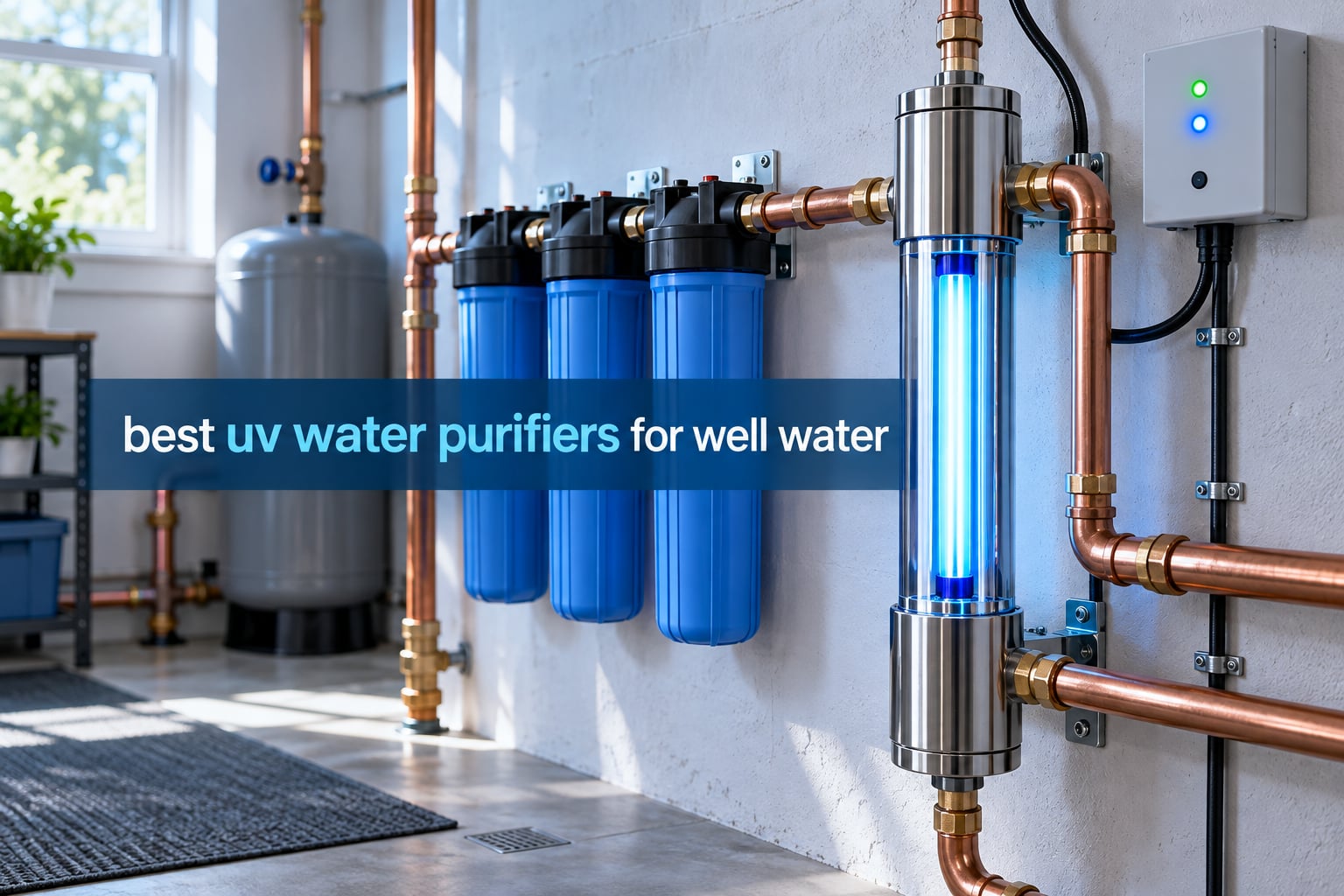
If you have ever compared the best UV water purifiers for well water, you have probably noticed something that most roundups skip. Every one of these systems does exactly one job: it inactivates bacteria, viruses, and protozoa with ultraviolet light. Not one of them strips a single particle of iron, pulls down a nitrate reading, or takes the sediment out of your water.
That distinction decides everything. A UV chamber belongs at the end of a treatment train, downstream of sediment and iron filtration, not at the head of it. Buy one first on an untreated well and you will be staring at a cloudy quartz sleeve in a year and wondering why your bacteria counts came back.
We spent weeks comparing ten of the most widely reviewed UV water purifier models for private wells, reading owner reviews rather than spec sheets alone, and checking each one against what a well owner actually needs: enough flow for a real household, a pre-filter that protects the sleeve, and parts you can still buy in five years. Our editorial choice is the HQUA OWS-12, and we explain why below.
One more framing point before we start. Private wells are the only drinking water source in the United States with no federal regulation. Nobody tests your water for you, and a compromised casing or a flooded well can introduce coliform bacteria and E. coli with no change in taste, smell, or appearance. That silent failure mode is the whole reason UV exists in a well treatment train.
Table of Contents
Top 3 UV Water Purifiers for Well Water (September 2026)
If you want a straight answer, these are the three we would shortlist. The HQUA OWS-12 takes the top spot on review volume, build quality, and the fact that a spare lamp ships in the box. The iSpring UVF55FS is the stronger technical package with its flow-sensor ballast, and the HQUA OWS-6 is the pick for small homes, cottages, and tight mechanical spaces.


Quick Overview: Every UV Water Purifier We Compared in 2026
All ten models below are true point-of-entry UV disinfection systems for well water, ordered from strongest overall evidence to most specialized. The table is the fastest way to see flow rating, chamber material, and connection size side by side before you read the individual write-ups.
| Product | Specifications | Action |
|---|---|---|
|
HQUA OWS-12 40W 12 GPM Whole House UV
|
|
Check Latest Price |
|
iSpring UVF55FS 55W 12 GPM UV Filter
|
|
Check Latest Price |
|
HQUA OWS-6 25W 6 GPM Compact UV
|
|
Check Latest Price |
 Bluonics 55W 12 GPM UV System
|
|
Check Latest Price |
 Geekpure GP-UV55W 12 GPM UV
|
|
Check Latest Price |
 Aquaboon 55W 12 GPM UV with Flow Sensor
|
|
Check Latest Price |
 Bluonics 3-Stage 110W 24 GPM System
|
|
Check Latest Price |
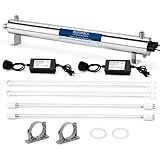 Bluonics 24 GPM 110W Dual-Lamp UV
|
|
Check Latest Price |
 Viqua VH410 18 GPM Whole-Home UV
|
|
Check Latest Price |
 ALTHY 48W 12 GPM UV with Auto Shutoff
|
|
Check Latest Price |
UV Disinfects, It Does Not Filter: What a UV Water Purifier Actually Does
A UV water purifier for well water is an ultraviolet-C disinfection unit that inactivates bacteria, viruses, and protozoa as water passes through a stainless steel chamber. It is not a filter in any conventional sense, and it removes nothing chemically or physically from the water.
The mechanism is simple. A lamp emits UV-C light at 254 nanometers, the wavelength range that damages microbial DNA. Organisms that absorb enough of that light can no longer reproduce, and a properly sized chamber delivers reductions up to 99.9999 percent for bacteria, viruses, and Cryptosporidium without adding a single drop of chemical to your supply.
Two numbers decide whether that actually happens. The first is dose, measured in millijoules per square centimeter. The second is flow rate in gallons per minute. Dose is a function of how long water sits in the lit zone, so the faster you push water through, the less light each drop receives. Every flow rating on the box assumes a particular dose at clean-water conditions.
Then there is UVT, ultraviolet transmittance, which measures how much light passes through the water itself. Clear well water has high UVT. Water carrying iron, manganese, sulfur, or heavy sediment has low UVT, and the lamp has to punch through that murk before it reaches any organism.
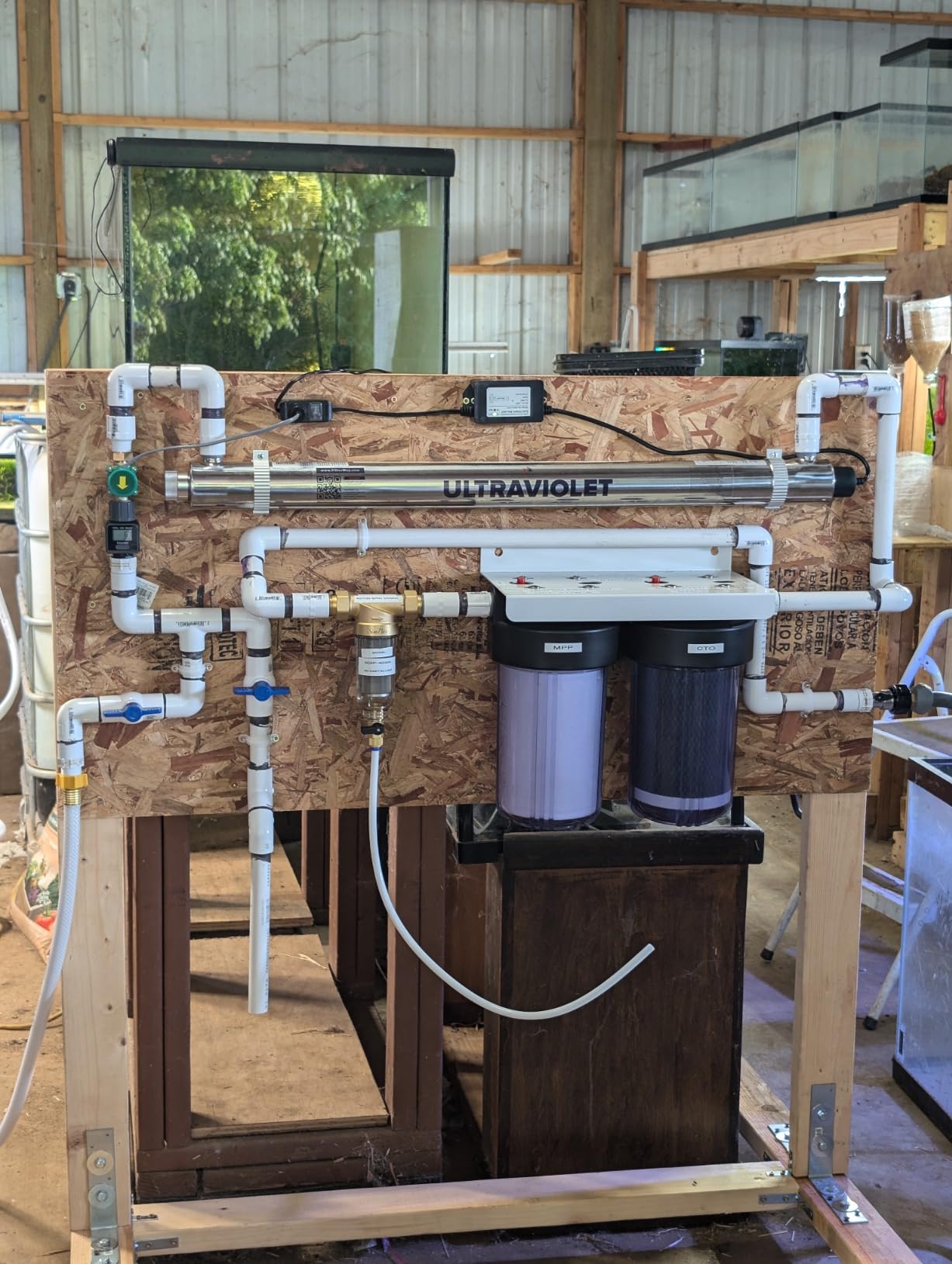
So here is the part we will keep repeating: UV does not remove sediment, iron, manganese, sulfur odor, arsenic, nitrate, hard water scale, or total dissolved solids. A quartz sleeve that has scaled over from iron or clouded from sediment will quietly stop delivering the dose printed on the box. Always install a sediment pre-filter ahead of the chamber, and add iron or carbon treatment between the sediment stage and the UV stage when your well test calls for it.
1. HQUA OWS-12 40W 12 GPM Whole House UV Water Purifier
HQUA-OWS-12 120V 40W 3/4″ MNPT Inlet/Outlet Whole House Ultraviolet Water Purifier Filter, + 1 Extra UV Bulb
40W lamp at 12 GPM
304 stainless steel chamber
3/4 inch MNPT ports
Extra UV bulb included
Pros
- Deepest review base in the group at over 1000 owner reports
- Quick straightforward DIY installation
- 304 stainless steel wetted parts with a quartz sleeve
- Dual LED indicators show bulb and ballast status
- One spare UV bulb in the box
- 120V AC with no plumber required on a simple setup
Cons
- Ballast failure reported by some owners within months to a few years
- Housing can corrode and pinhole-leak after several years
- Warms standing water in the line after long idle periods
Of the ten systems we compared, the HQUA OWS-12 has the deepest body of real owner feedback, with 1060 reviews averaging 4.4 out of 5. That volume matters more than it might seem. A UV chamber is a sealed box that only tells you something is wrong when a bacterium makes it through, so the honest long-term record is the closest thing to a reliability report you will find.
We spent the most time on this one because it sits at the top of our list. The 40 watt lamp is rated for 12 gallons per minute, which is more headroom than most family homes will ever draw at once, and the 37.2 inch chamber gives water a long dwell time inside the lit zone. Wetted parts are 304 stainless steel and quartz glass, and both material choices matter far more on well water than on treated city water.
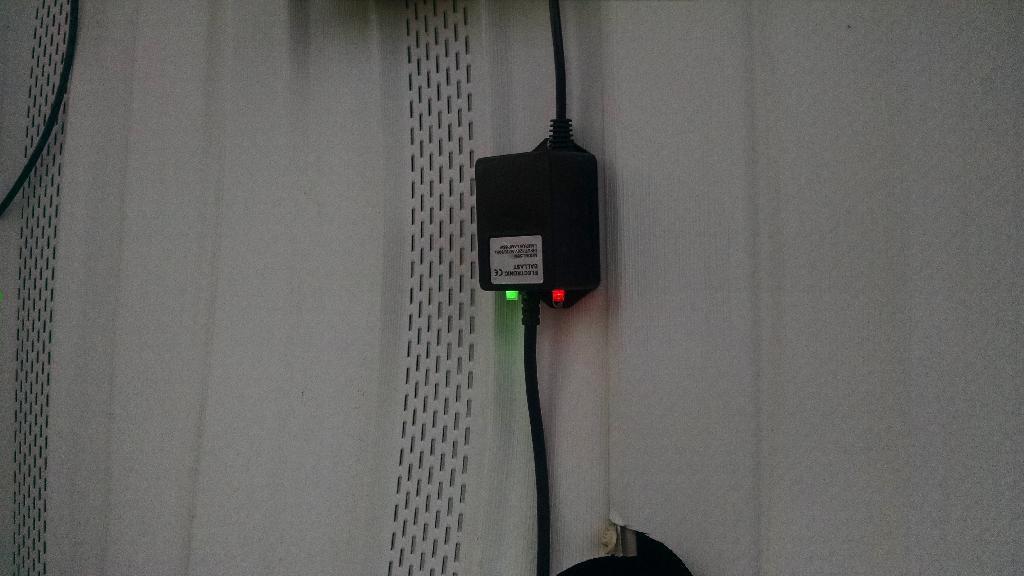
Owners consistently point to three things. Installation is genuinely simple, the instructions are clear enough for a competent DIYer, and a second UV bulb is included so your first annual replacement is already handled. The dual LED indicators on the electronic ballast give you an instant read on lamp and ballast status without taking the housing apart.
Several reviewers also report an improvement in the well water odor and taste once the system is in place, though that is almost always the pre-filter doing the work rather than the lamp. UV leaves taste, color, odor, and pH completely untouched by design, so any change you notice is coming from whatever you put in front of it.
What you should check before buying
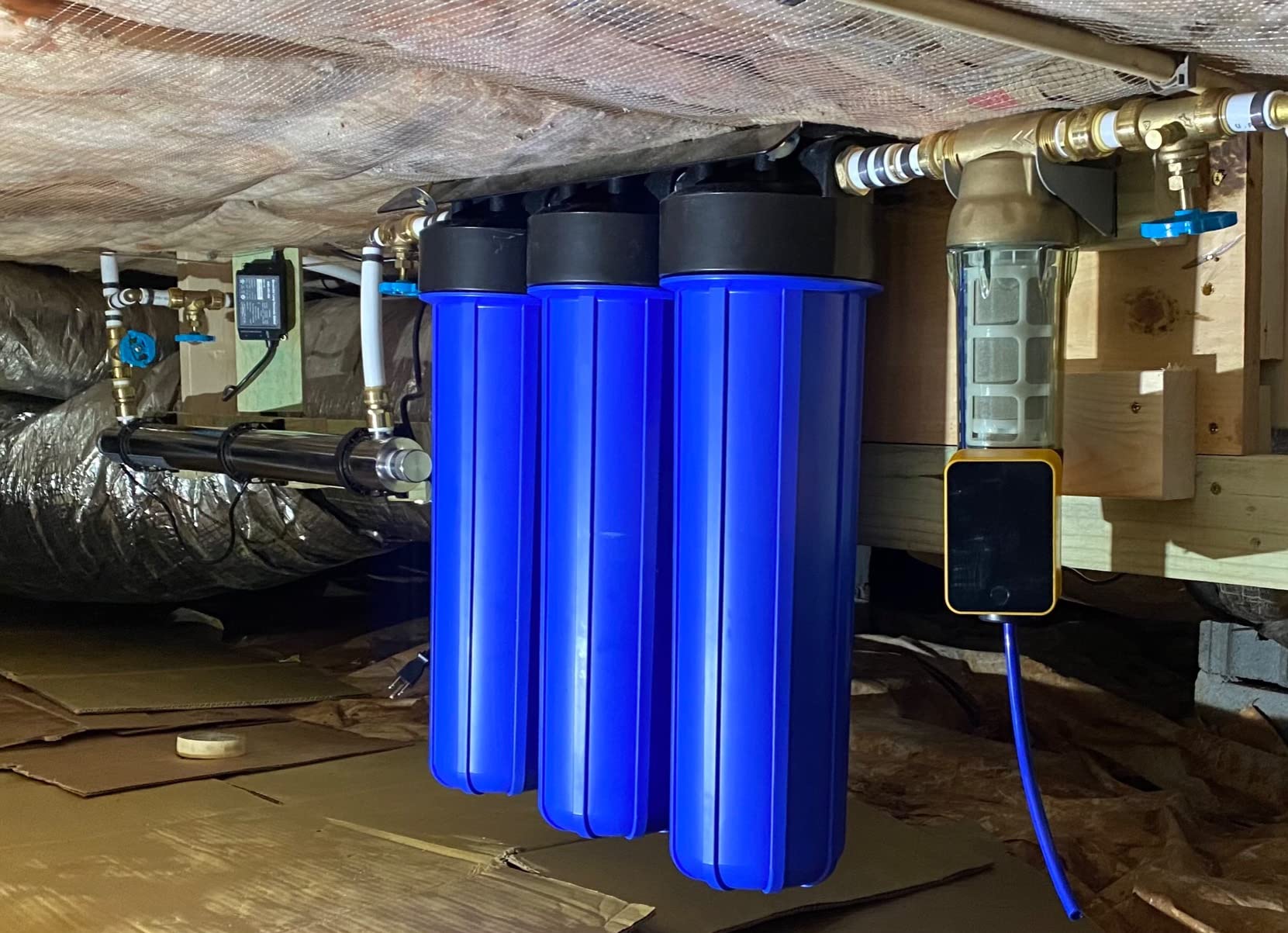
Confirm your real peak flow first. A 12 GPM rating means the chamber can pass 12 gallons per minute while still delivering a workable dose, and a typical family of four running two bathrooms, a dishwasher, and a laundry machine will rarely exceed 5 GPM even during a big morning. Oversizing past that point costs you money and warm water without buying extra protection.
Look closely at the 3/4 inch MNPT inlet and outlet. If your manifold is already built around 1 inch lines, you will need reducers and should budget for a plumber. And leave service clearance around both ends of the 37.2 inch chamber, because you will want to pull the lamp and sleeve without dismantling the plumbing.
Where owners report problems
Ballast failure is the most common long-horizon complaint, showing up in reviews of units several months to a few years old. Treat it as a consumable rather than a defect, and check whether the replacement ballast is sold separately for your model before you commit.
Some owners with five-year-old units report corrosion and pinhole leaks in the housing, and a recurring note is that the line runs warm after a period of no flow. The upside on all three of these is that HQUA support is repeatedly praised for replacing broken parts and failed ballasts, including outside the warranty window.
2. iSpring UVF55FS 55W Whole House UV Filter with Smart Flow Sensor
iSpring UVF55FS Whole House UV Water Filter, 1″ MNPT Inlet/Outlet, 12 GPM
55W lamp at 12 GPM
Smart flow sensor switch
37.5 inch 304 reactor
1 inch MNPT ports
Pros
- Flow sensor switch protects the lamp and monitors treatment in Auto mode
- Long 37.5 inch chamber supports a long dwell time
- Low pressure loss through 1 inch MNPT ports
- Mounting clips included for DIY installation
- 30 day money back guarantee plus a 1 year manufacturer warranty
Cons
- Quartz sleeve needs regular cleaning to hold performance
- Some owners report warm water after periods of no flow
The iSpring UVF55FS is the most technically interesting system in this group, and the reason is the ballast. Rather than running the lamp constantly, the upgraded UVT55FS controller watches a smart flow sensor switch with Auto, Move, and Stop modes. The sensor triggers at 0.66 gallons per minute, so the lamp powers down when water stops moving and comes back on when it does.
That matters on a well. Lamp life is rated up to 9000 hours, but hours only burn while the lamp is lit, and a well owner who irrigates a garden or runs a pump schedule benefits from not paying to disinfect a dry pipe. The chamber itself is 37.5 inches of 304 stainless steel, so you get dwell time and corrosion resistance together.
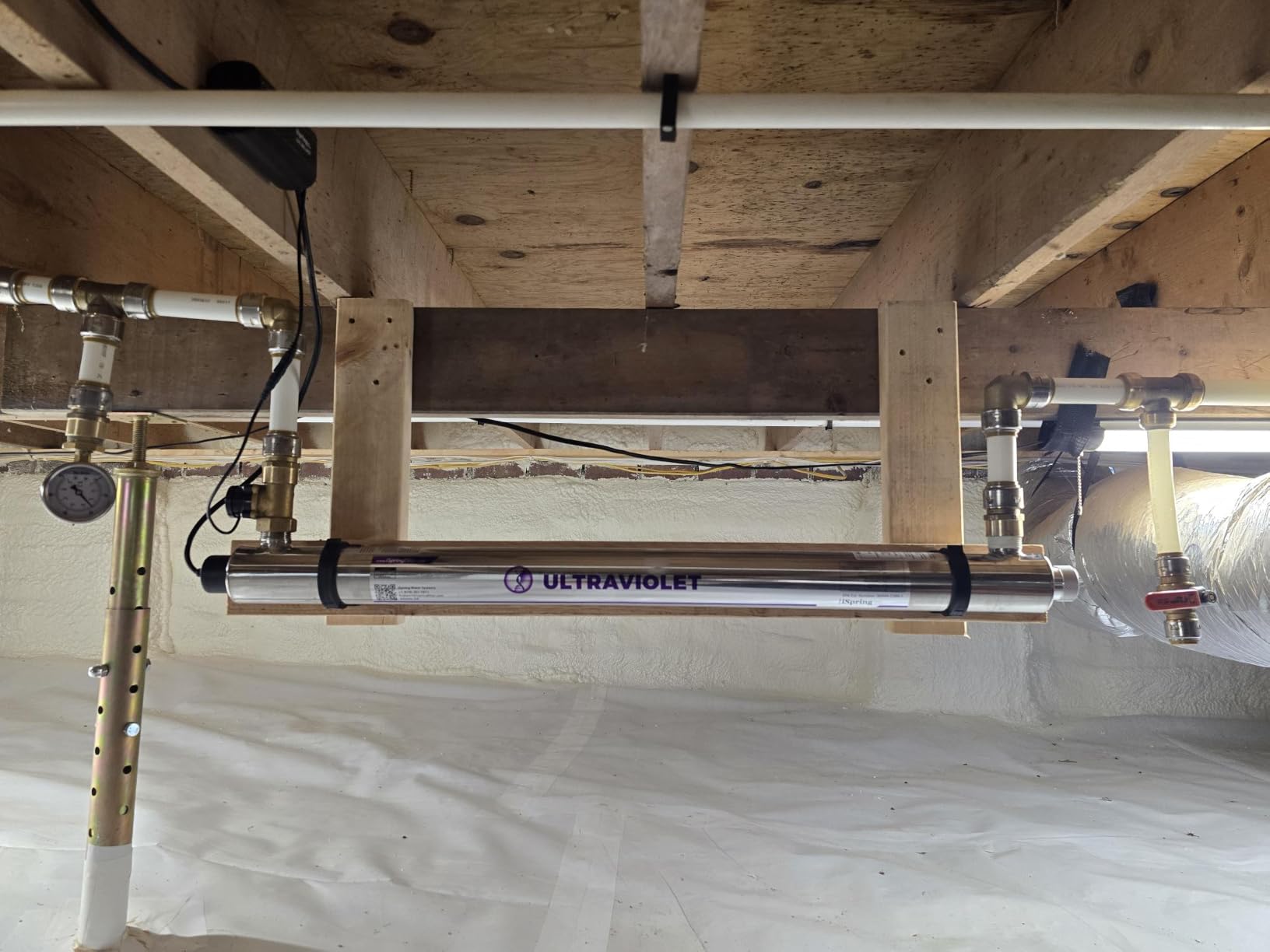
The ports are a real upgrade over the entry-level models. One inch MNPT inlet and outlet means minimal pressure loss in a whole-house manifold, and mounting clips come in the box. Buyers describe the install as straightforward for anyone who has cut pipe and joined a union before.
Warranty terms are worth reading twice. iSpring offers a 30 day money back guarantee and a 1 year manufacturer warranty, with extended coverage available upon registration. The stated maintenance interval is an annual lamp change plus quartz sleeve cleaning every 6 to 12 months, which is honest and reasonable for well water.
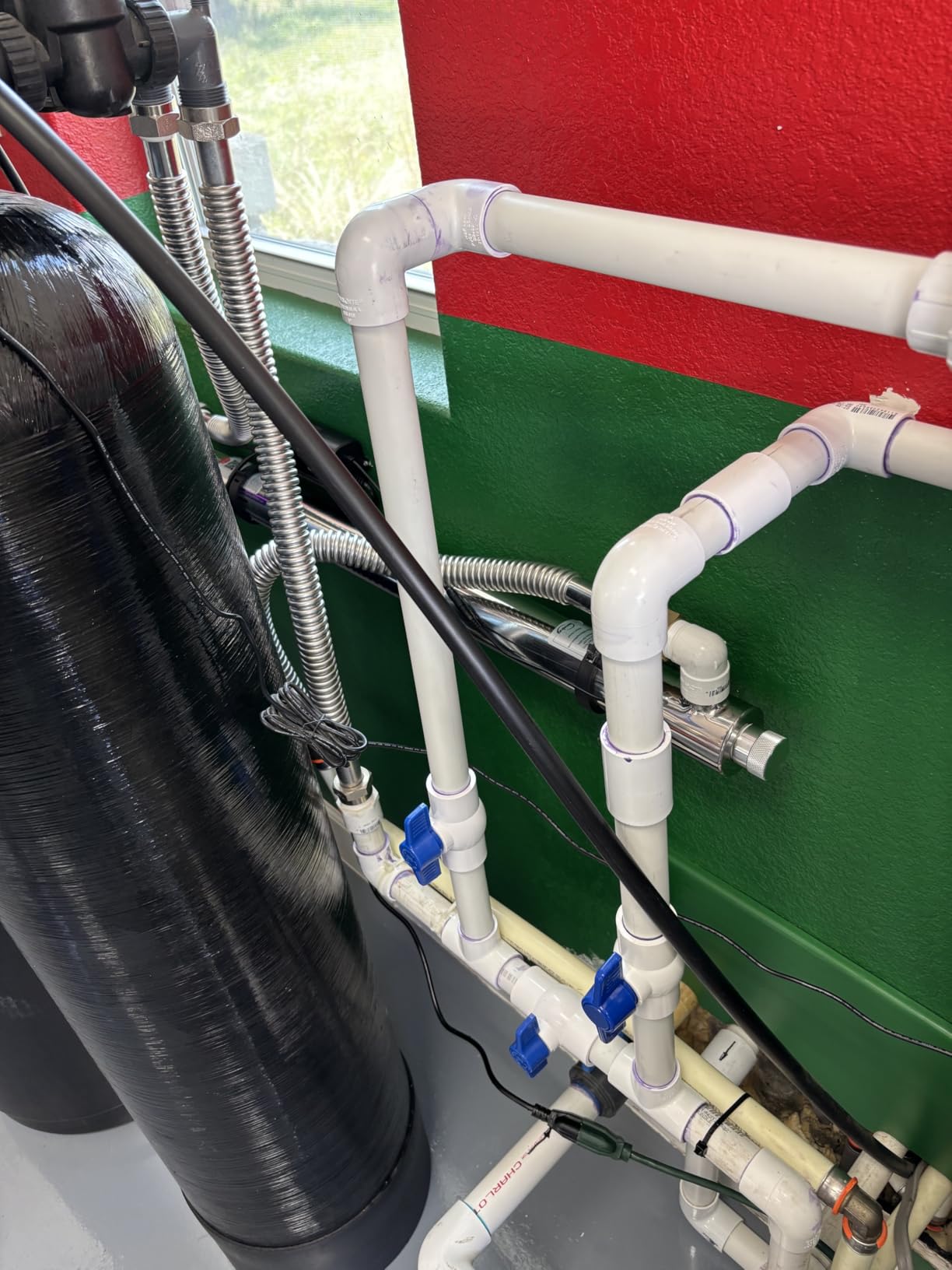
Why the flow sensor is worth paying for
Three numbers explain the benefit. A 9000 hour lamp at a typical household run rate translates to well over a year of service, and the sensor adds the equivalent of however many hours your household spends asleep or away. Over a decade that is a meaningful reduction in lamp replacements alone.
There is a second benefit that is less obvious. A constantly lit chamber heats the water standing in it, and owners on other models in this list report warm water after stagnation. A lamp that switches off with flow cuts heat build-up along with lamp wear, which makes this a better fit for homes with long periods between uses, cabins, and seasonal properties.
Where the trade-offs sit
The quartz sleeve cleaning interval is not optional on well water, and on this model it is a real recurring task. If your water carries measurable iron, the sleeve will scale faster than the 6 to 12 month guidance suggests, and you will need a descaling solution and a routine you actually keep.
You are also buying an electronic ballast with more moving logic than a simple on-off model, and that is one more component that can fail. iSpring backs it with a warranty and a money back window, which is a reasonable cushion, but plan on sleeve and lamp consumables as an ongoing line item rather than a one-time purchase.
3. HQUA OWS-6 25W 6 GPM Compact UV for Small Homes
HQUA-OWS-6 120V 25W 1/2″ MNPT Inlet/Outlet Small House,Kitchen Ultraviolet Water Purifier Filter, + 1 Extra UV Lamp
25W lamp at 6 GPM
22.5 inch 304 chamber
1/2 inch MNPT ports
Extra UV lamp included
Pros
- Compact 22.5 inch chamber fits where a larger housing will not
- Good match for small houses and cottages
- Simple low maintenance design
- Double replacement guarantee for missing or broken parts
- Works within a 4 to 125 psi operating range
Cons
- Several owners report repeated bulb failures within the first year
- Plastic end caps on some models crack and leak
- Manual advice to use Teflon tape can lead to overtightening and a cracked quartz sleeve
Not every household needs a 12 GPM chamber. If you are a couple or a single family in a small house, if the water heater and treatment manifold share a cramped mechanical room, or if this is a cottage or an RV-style backup system, the HQUA OWS-6 at 6 GPM is the sensible pick from this list.
The body is 22.5 inches long and 2.5 inches wide in 304 stainless steel, with 1/2 inch MNPT connections. The published operating range is 4 to 125 psi and 32 to 122 degrees Fahrenheit, which covers nearly every residential well pump setup, and the maximum supported TDS is 500 ppm.
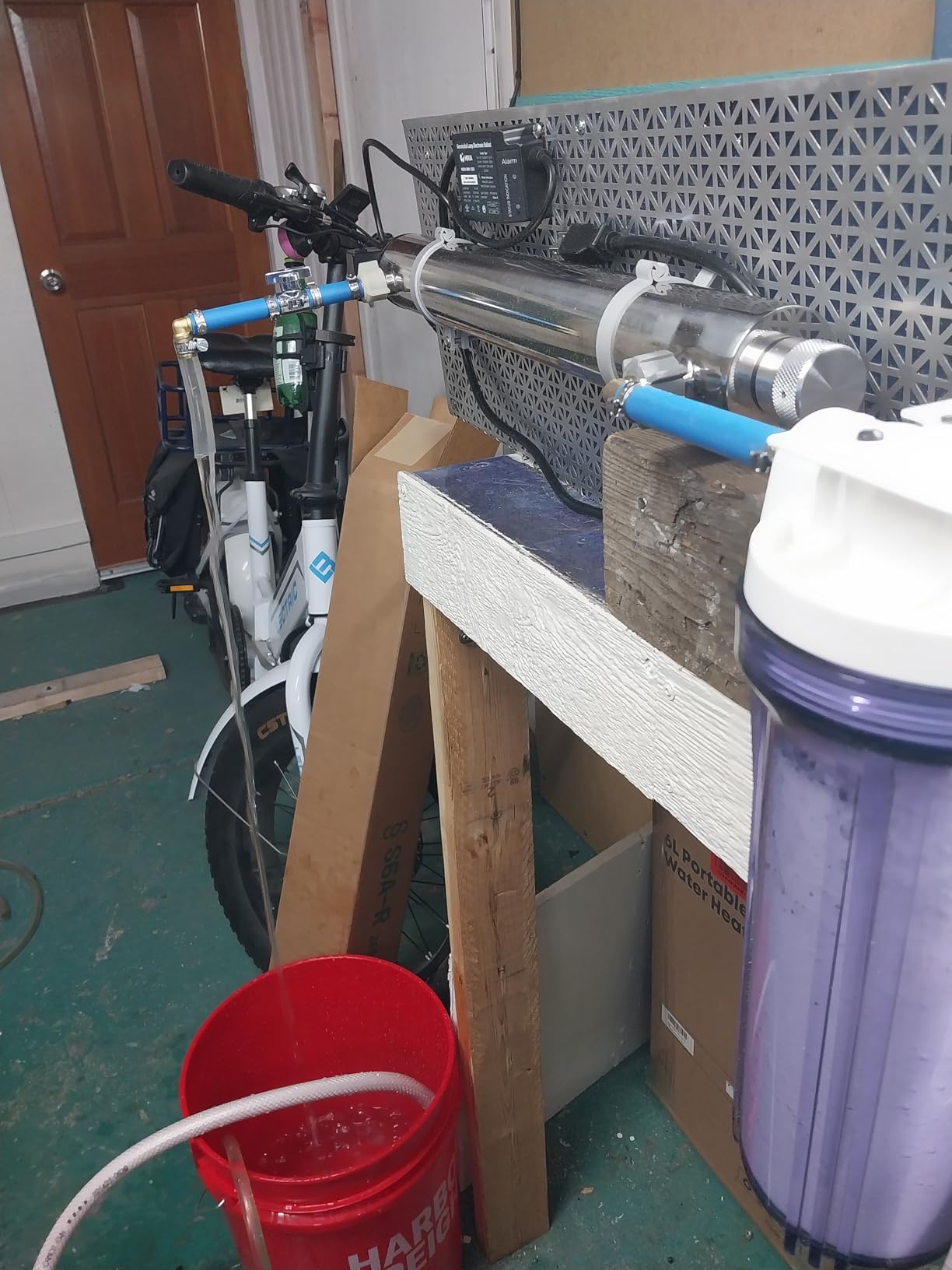
One long-term owner credits the unit with eliminating mold and algae growth in an evaporative cooler fed by the same well, which is a neat illustration of what UV is actually for. It is a disinfection stage for water and any surface the water touches, not a taste or hardness treatment.
Support is a genuine strength here. HQUA sends replacement parts quickly and sometimes doubles the quantity, and a double replacement guarantee covers missing or broken parts. One spare UV lamp also comes in the box, which is helpful given how many owners mention early lamp burnout.
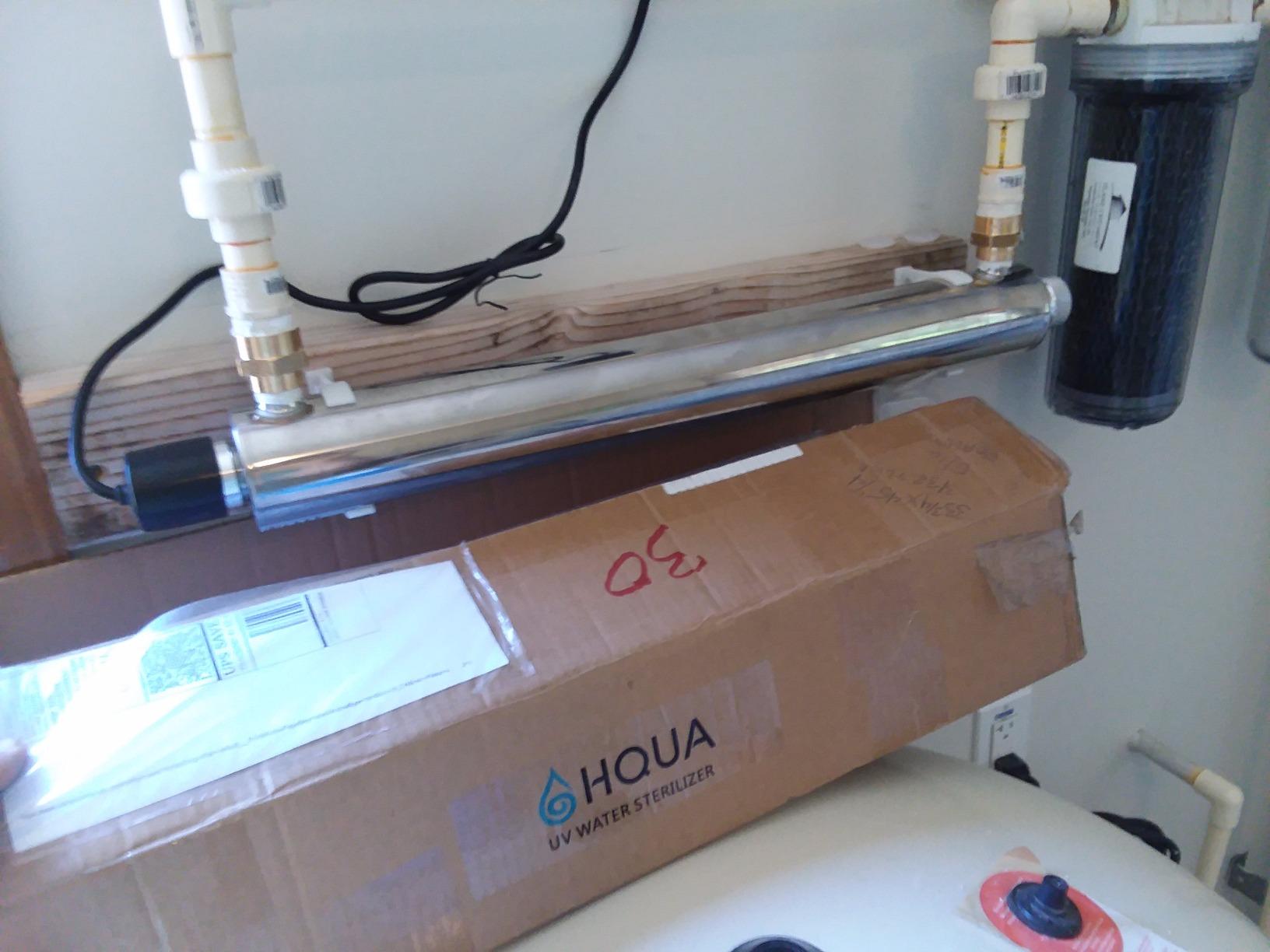
Who this smaller chamber actually fits
Run the arithmetic before you buy. A household of one or two with two fixtures and a small appliance is comfortably inside 6 GPM. Add a third bathroom, a large family, an outdoor spigot feeding a garden hose, or a well that also serves irrigation, and you are pushing a flow rating this chamber was not built to deliver at a useful dose.
Because dose falls as flow rises, a chamber pushed past its rating is not partially effective, it is substantially less effective. This is the single most common sizing mistake we see, and it is the reason we would rather see this unit matched carefully than sold as a universal answer.
What to watch in the first year
Bulb failures inside the first year are the most reported complaint, and it is the main reason this rating sits a notch below the two HQUA and iSpring models above. Treat the spare lamp as your first scheduled replacement rather than a bonus, and keep the model number handy so you can order a replacement without delay.
There is also a fitting issue worth knowing. The manual advises using Teflon tape on the housing threads, and several owners overtightened and cracked the quartz sleeve trying to seal it. Wrap sparingly, tighten by hand plus a fraction, and if you see a weep at the end cap, check the seal before you add more tape.
4. Bluonics 55W 12 GPM UV System with LED and Audible Alarm
Whole House UV Water Filter System 12 GPM – 55W Stainless Steel UV Light System – LED Indicator & Audible Alarm – for Well & City Water – Includes 2 Extra Bulbs – Bluonics
55W lamp at 12 GPM
Tolerates 2000 ppm TDS
LED and audible alarm
Two extra bulbs included
Pros
- Highest TDS tolerance in the group at 2000 ppm
- LED indicator and audible alarm make lamp status obvious
- Two spare bulbs plus a complete mounting kit in the box
- Works for well water and city water
- Step by step instructions with clear images
Cons
- Some 12 GPM models leak at the end cap when the quartz sleeve does not reach the O ring
- Ballast failures reported with slow support on out of warranty parts
- Needs extra clearance around the housing for lamp and sleeve changes
Most residential UV chambers in this list specify a maximum supported TDS of 500 or 1000 ppm. This Bluonics system states 2000 ppm, and if your well sits in a region with brackish intrusion, high mineral content, or a nearby sea, that single spec sheet line can be the deciding factor.
The hardware is otherwise conventional and competent: a 55 watt lamp, a stainless steel chamber, standard 3/4 inch NPT connections, and a rated flow of 12 GPM. What sets it apart is the status reporting. Both an LED indicator and an audible alarm tell you when the lamp or ballast has a problem, which matters because a failed lamp produces no visible symptom in your water.
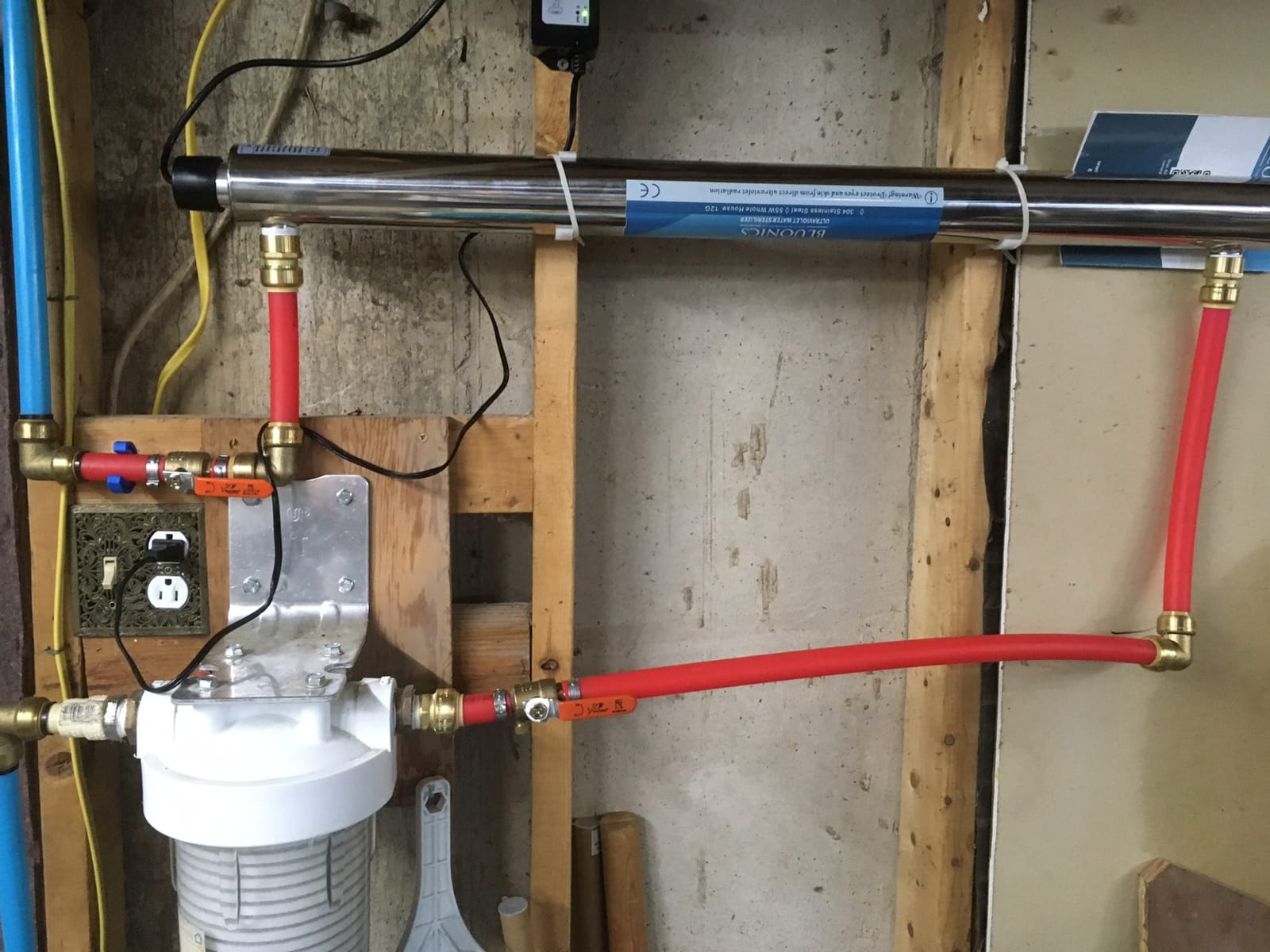
Several owners running this system on wells with a history of E. coli report clean results after installation, which is the outcome that matters most in this category. The box also includes cotton gloves, a mounting kit, ballast, quartz sleeve, bulbs, and O-rings, so the install is one trip to the hardware store rather than three.
Temperature range is 35 to 104 degrees Fahrenheit and the working pressure rating is 125 psi. Both are comfortable margins for a residential well pump, though the top of that temperature range is narrower than the HQUA units and worth checking against a summer well temperature if you are in a hot climate.
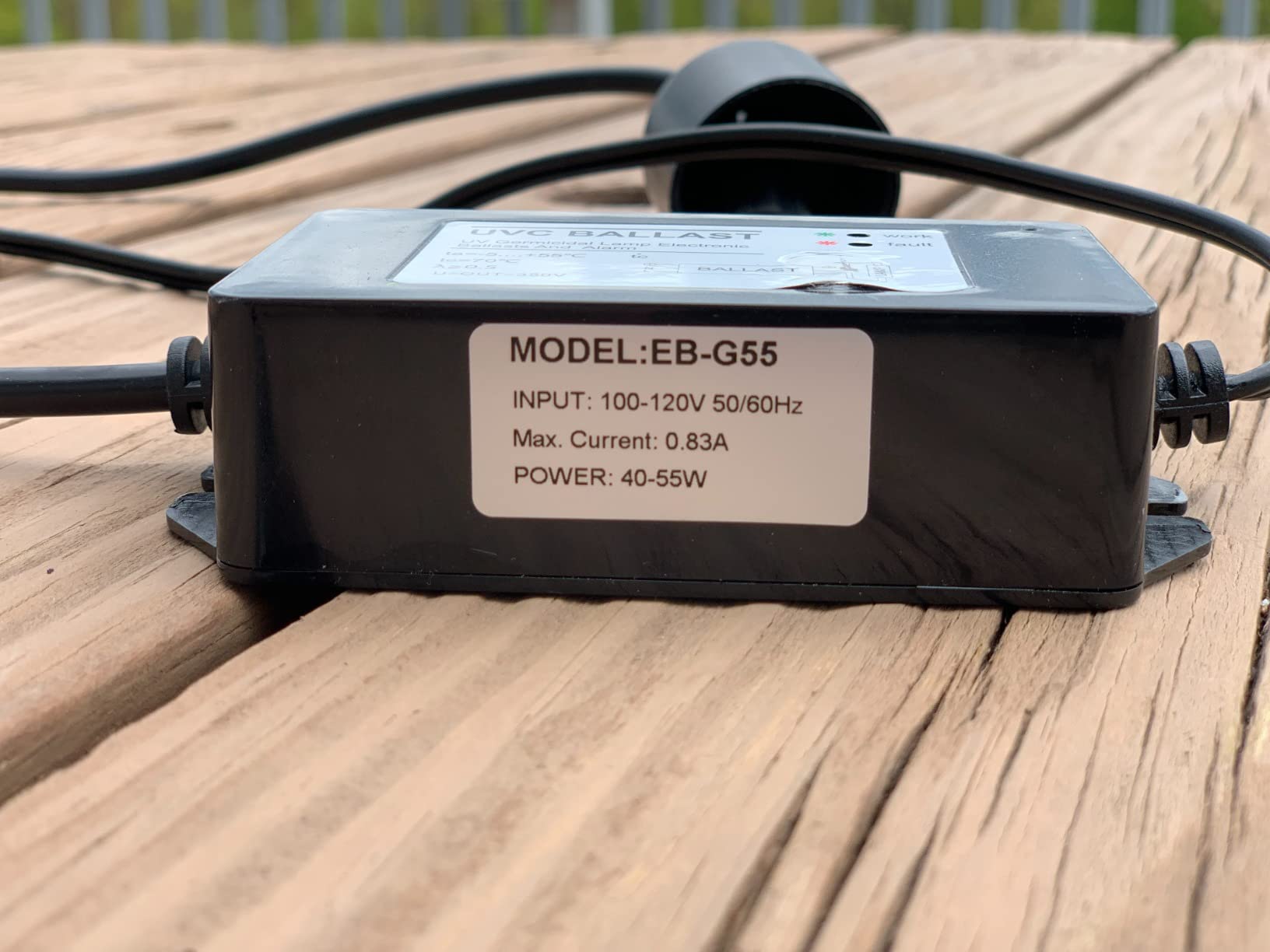
Why the TDS figure deserves attention
TDS is a proxy for how much light your water lets through, and high TDS means the lamp is fighting to reach organisms through dissolved solids. That does not mean a higher TDS rating makes the system disinfect better. It means the manufacturer is willing to certify the chamber for water that would degrade a lower-rated unit faster.
For most well owners with a routine test showing moderate mineral content, the 1000 ppm units in this roundup are entirely adequate. For anyone whose water has crept toward brackish levels, matching the chamber to the water is worth more than choosing on lamp wattage alone.
Where owners report problems
The most specific complaint involves the end cap. On some 12 GPM models the quartz sleeve does not reach fully into the O ring seal, which produces a leak that gets worse the longer the system runs. If you install this unit, check that seal during the first week and again after a month.
Ballast failures show up in reviews too, and support response times vary, particularly for parts on out of warranty systems. Leave generous clearance around both ends of the housing so sleeve and lamp changes do not require you to cut into the plumbing, which is a five minute job with room and a much bigger job without it.
5. Geekpure GP-UV55W 12 GPM UV for Coliform-Positive Wells
Geekpure 12 GPM Whole House UV Water Filter-1“NPT-55 Watt
55W lamp at 12 GPM
304 stainless chamber
Three lamps and three sleeves
Lamp rated 9000 hours
Pros
- Owners with coliform positive wells report clean tests after installing
- Three lamps and three quartz sleeves included for multi year spares
- Simple design makes lamp and sleeve changes straightforward
- Audible and visual alarm on the ballast
- Manufacturer has over 20 years of expertise with 24/7 technical support
Cons
- Quartz sleeves sometimes arrive cracked in the shipment
- Included mounting clips are too weak to hold the chamber securely
- Reactor heats standing water which can scald a long idle line
- UV alone cannot treat sediment or impurities so it must follow filtration
The Geekpure GP-UV55W is the one we would point a coliform-positive well at. Owners who installed it after a positive bacteria test report clean results on retesting, and the manufacturer states the chamber plainly as a last stage filter, which tells you the company understands how the product is meant to be used.
It is a 55 watt lamp rated to 12 GPM inside a 304 stainless steel chamber with 1 inch NPT inlet and outlet. The ballast carries both an audible and a visual alarm, and lamp life is rated at 9000 hours minimum. Feed water conditions are listed as 50 to 60 psi, 40 to 110 degrees Fahrenheit, and free chlorine under 0.1 ppm.
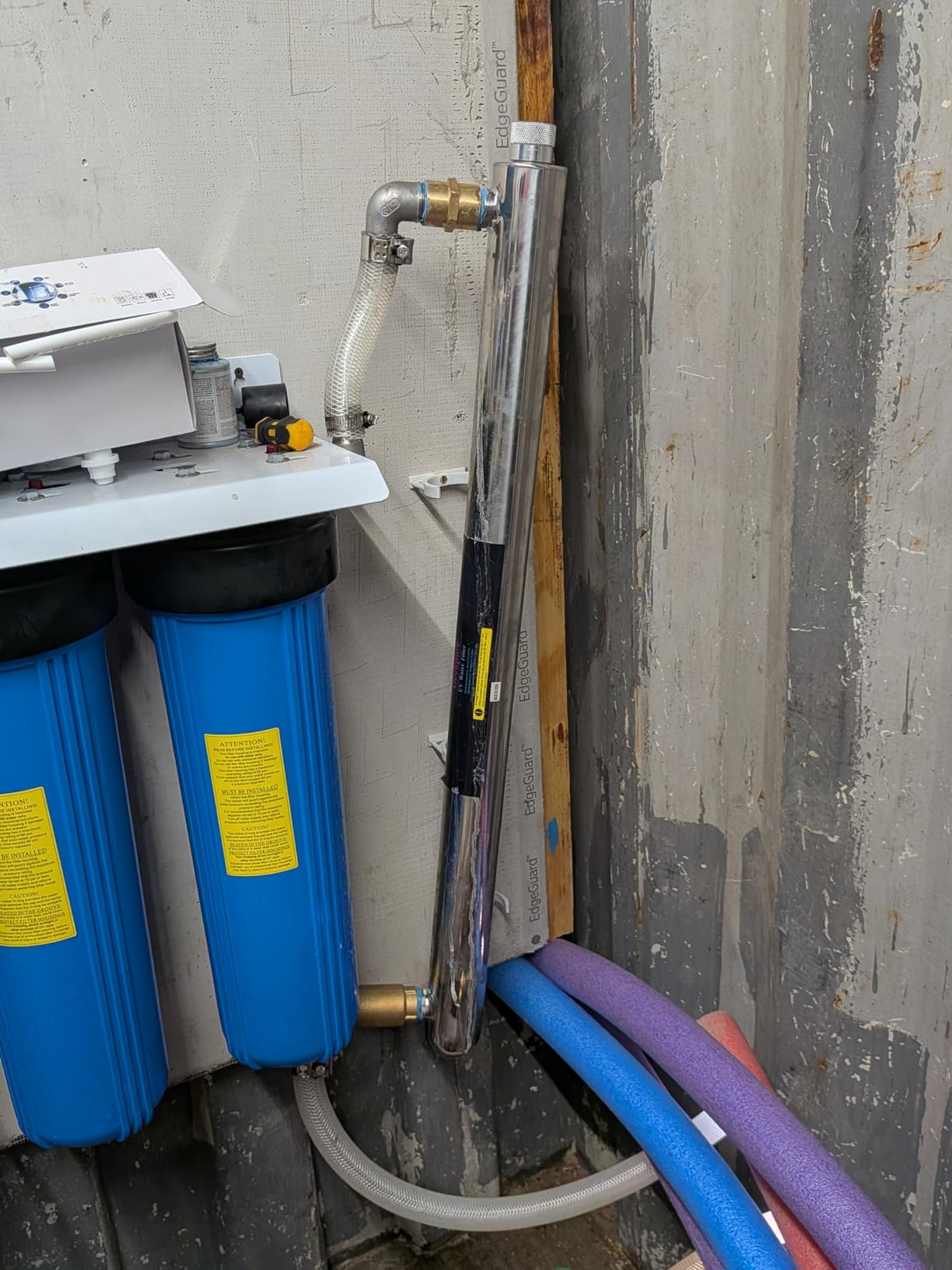
The parts package is unusually generous. Three lamps, three quartz sleeves, and three fixed clamps come in the box, which covers several years of consumables and removes the most common reason owners put off a bulb change. ISO 9001:2015 certification and WQA membership are stated for the manufacturer.
Owners also like the simple layout. Compared to units they replaced, the lamp and sleeve changes are straightforward, which matters more than it sounds because a hard-to-service chamber is a chamber that eventually gets skipped when the water is running fine.
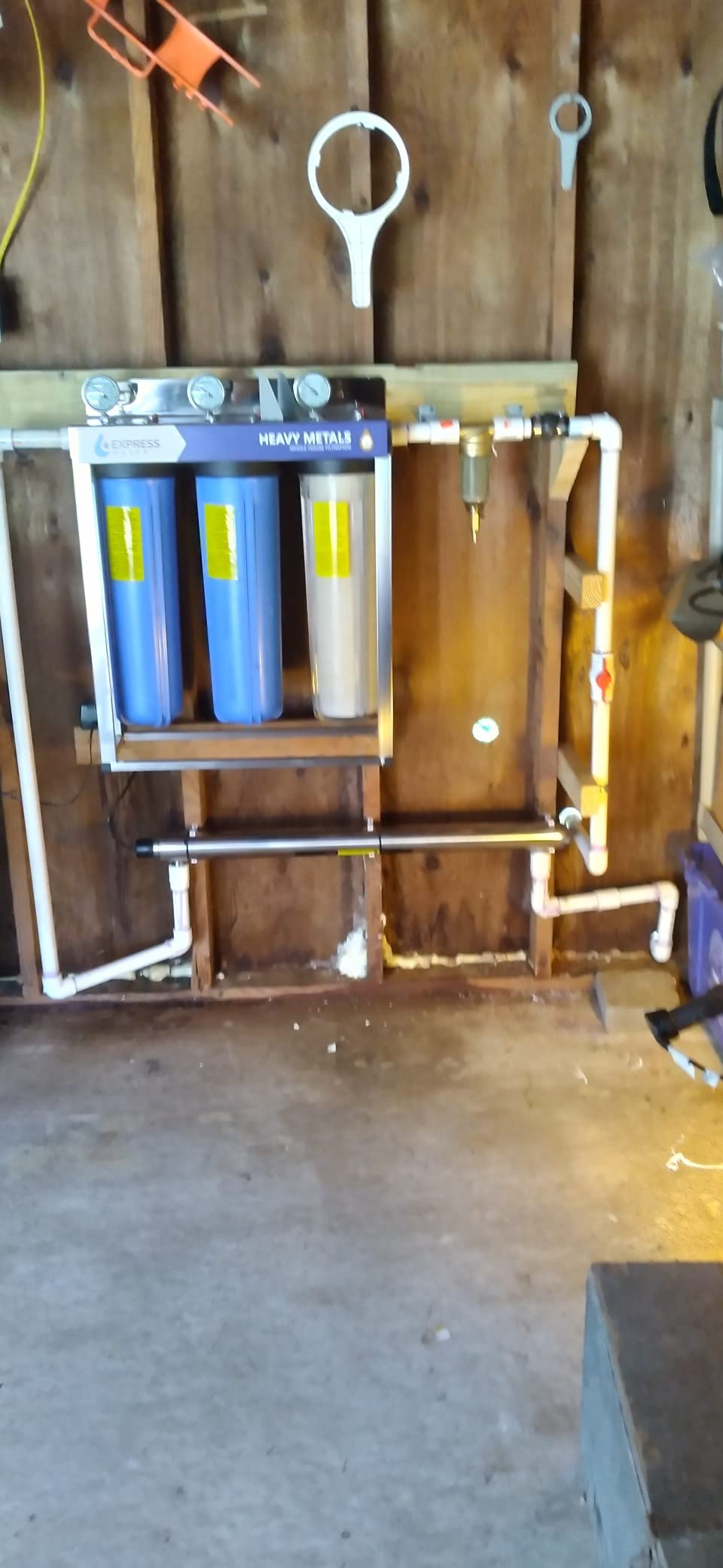
How this fits into a full treatment train
Start at the well, test the water, and let the lab report drive the order. Sediment first at 5 micron to keep grit out of the chamber, then a spin-down or KDF and catalytic carbon stage if iron, sulfur, or manganese show up, and only then the UV. Geekpure’s own documentation says UV alone cannot reduce impurities, hardness, or TDS.
If your lab report shows coliform or E. coli, UV is the right tool and no pre-filter substitutes for it. If the report shows nitrate or arsenic instead, UV is the wrong purchase entirely, and you should be looking at ion exchange or reverse osmosis. Reading the report before the listing is the step that saves people the most money.
What to fix before you install
Two things come up consistently. Quartz sleeves have arrived cracked in some shipments, so open the box and inspect the sleeve before you slide it into the housing, because a crack discovered during assembly is much cheaper than one discovered after the system is plumbed in.
The included mounting clips are also reported as too weak to hold the chamber securely, and owners suggest pipe straps instead. Combine that with the warm standing water note, and the practical advice is to mount the chamber where nobody can brush against it, leave clearance at both ends, and be aware that a line unused overnight may deliver hot water first.
6. Aquaboon 55W 12 GPM UV with Smart Flow Sensor Switch
UV Water Purification System 55W, 12 GPM – UV Water Filter with Smart Flow Sensor Switch – Whole House UV Water Purifier Ensuring Water Purity – UV Light for Well & City Water + 1 Extra Lamp
55W lamp at 12 GPM
SAE 304 stainless chamber
Fits 3/4 and 1 inch plumbing
Ballast with audible alerts
Pros
- Owners report it clears pink algae and bacteria in well water when paired with sediment and carbon filters
- Strong performance in high volume applications such as fish rooms and aquariums
- Audible alerts and clear ballast indicators simplify monitoring
- Seller replaced a failed ballast and refunded the purchase
- Includes one extra lamp
Cons
- Flow sensor switch is described as basic and has failed on one unit
- Leakage at the flow control valve if a plumber overtightens and cuts the washer
- Technical support phone line reported as not working
Two use cases come up repeatedly in the reviews for this Aquaboon. The first is high volume water movement, where fish rooms and aquariums need continuous disinfection at flow rates that would overwhelm a drinking-only system. The second is algae, and owners running it on well water alongside spin-down and carbon filters report it clears pink algae and other bacteria effectively at 8 GPM.
The chamber is SAE 304 stainless steel with a 55 watt lamp rated to 12 GPM, and the claim is 99.99 percent reduction of microorganisms at the DNA level. Two stainless steel NPT adapters are included so the unit fits either 3/4 inch or 1 inch plumbing, which removes one of the most common install surprises.
The ballast has clear indicators and audible alerts, so lamp status is visible and audible at a glance. The listed maximum supported TDS is 500 ppm, which is on the lower side, so get your lab report back before committing if your water is mineral heavy.
Seller responsiveness comes up as a genuine plus. At least one owner had a failed ballast replaced and a refund issued, and that kind of response is worth more on an unfamiliar brand than a longer warranty document would be.

Choosing it for aquaculture or a large home
If you are running a fish room, a livestock operation, or any setup where water moves continuously for long stretches, this unit is a better match than a compact residential chamber. The headroom at 12 GPM and the audible alarm both suit an application where nobody is standing next to the equipment to notice an indicator light.
For a normal family home, weigh it against the HQUA and iSpring options first. With 67 reviews, this is one of the thinner feedback records in the roundup, and the flow sensor here has drawn more criticism than the equivalent feature on the iSpring ballast.
Where owners report problems
The flow sensor switch is the most criticized part. Owners describe it as basic, and one unit had it break outright. Since the sensor is what gates the lamp during low flow, a failure there can mean the lamp runs constantly, which shortens lamp life without changing your water.
There is also a valve leak report where a plumber overtightened the flow control valve and cut the washer, and one owner found the technical support phone line not working. Both are avoidable with care at install and by relying on the seller’s written support channel rather than a phone line.
7. Bluonics 3-Stage Sediment, Carbon and 110W UV Combination System
Bluonics Whole House Water Filter System for Well Water, 3 Stage Sediment Carbon Filters with 110W UV Light, 24 GPM, 20 x 4.5 Housings, 1 in NPT
Three 20 x 4.5 filter housings
110W UV as the final stage
24 GPM capacity
1 inch NPT with gauges
Pros
- Complete sediment carbon and UV package in one kit
- Metal mounting bracket on the UV chamber instead of a plastic clip
- Owners report sulfur odor resolving to clear good tasting water
- Two lamp UV design allows staggered lamp changes
- Company is prompt with installation questions
Cons
- Filter housing threads are coarse and leak easily requiring heavy tape and putty
- UV bulbs heat standing water sometimes above 120 degrees
- Mounting hardware and gaskets are not included in the box
- Chamber brackets only allow one mounting orientation
This is the only system in the roundup that arrives as a complete treatment train. Three 20 x 4.5 inch housings handle sediment and carbon, and a 110 watt UV chamber sits downstream as the final disinfection stage. For anyone who has been quoted a professional pre-filter plus UV package, that comparison is the entire argument for this kit.
Flow capacity is 24 GPM on 1 inch NPT ports, with pressure gauges on the housings and a metal stand for the assembly. Operating range is 40 to 125 psi and 35 to 100 degrees Fahrenheit, and the maximum supported TDS is 500 ppm.
It is not a reverse osmosis system and it is not designed to reduce TDS, and the product documentation is direct about that. What it does is remove the single most common installation mistake: putting UV upstream of the filters instead of behind them.
Owners dealing with E. coli, coliform, and rotten egg sulfur water report the three stage system resolves it. Several describe the total cost as a fraction of the professional quote they received, which is the practical appeal here given how often UV gets bundled into expensive whole house packages.
When a single combined system makes sense
The strongest case is a well with two problems at once, where sediment needs catching and bacteria need inactivating. Rather than buying two housings and a UV chamber separately and engineering the connections, this arrives pre-planned with the correct order already built in.
The second case is a DIYer with limited plumbing confidence. The trade-off is that you inherit a fixed configuration. If your lab report later shows heavy iron, you may need a dedicated iron stage ahead of these housings, and at that point a modular setup you can grow into may serve you better than a sealed kit.
What to plan for during assembly
The most common install problem is the filter housing threads. They are coarse and leak easily, and owners report needing heavy Teflon tape and pipe putty to get a reliable seal. Budget extra time for the thread work and have both materials on hand before you start.
Mounting hardware and gaskets are not included, so source those separately. The chamber brackets only allow one orientation, which can be a problem in a crawlspace or a tight overhead run, and the UV bulbs heat standing water in the chamber, sometimes above 120 degrees, so plan where this sits in your plumbing order.
8. Bluonics 24 GPM 110W Dual-Lamp UV for High-Flow Homes
Whole House UV Water Filter System 24 GPM – 110W Stainless Steel UV Light – 1″ NPT – LED Indicator & Audible Alarm – for Well & City Water – Includes 2 Ballasts – Bluonics
110W dual lamp at 24 GPM
1 inch NPT stainless chamber
Two ballasts included
LED and audible alarm
Pros
- 24 GPM capacity suits larger homes and light commercial use
- Two ballasts included so a spare is already in the box
- LED indicator and audible alarm make lamp status easy to monitor
- Chemical free treatment with no change to taste odor or pH
Cons
- Lowest average rating in the group at 4.0 with 15 percent one star reviews
- Dual lamp and dual ballast design means more maintenance than a single lamp system
- Lamp and ballast electronics can fail over time
If your household genuinely runs above 12 GPM, this is the capacity class you need. Two 110 watt lamps rated together to 24 GPM sit in a stainless steel chamber with 1 inch NPT inlet and outlet, and the kit includes two lamps, two quartz sleeves, two ballasts, four O-rings, gloves, and a manual.
Two ballasts come in the box, one standard and one with a flow switch, and you can pick which to use. The LED status indicator and audible alarm give you a clear read on lamp condition, which is the single most useful feature on any UV system because lamp failure is otherwise silent.
Working range is 40 to 125 psi and 35 to 100 degrees Fahrenheit, with a maximum supported TDS of 1000 ppm. The chamber is freestanding installation type at 44 inches long, 8 inches wide, and 8 inches high, and it weighs 16 pounds.
Owners cite the spare ballast and the headroom as the two draws. For a large family, a property with multiple outbuildings, or a light commercial application where water use is genuinely high, paying for capacity you need is a rational call. For an average home, this is simply more chamber than the water can use.
When 24 GPM is the right call
Work out your peak demand honestly. Simultaneous showers, a laundry cycle, a dishwasher, and outdoor hose use can add up faster than people expect, especially on a 3 or 4 bedroom home where everyone showers in the same forty minute window. If your honest peak sits above 12 GPM, this class of chamber is the correct one.
Be careful about the opposite error too. A larger chamber is not automatically a better one. The rating reflects the flow at which the delivered dose still meets specification, and a 24 GPM chamber running a family at 4 GPM is not disinfecting better, it is just warming the water in the pipe a little more.
Where the trade-offs show
This is the lowest rated product in the roundup at 4.0, with 15 percent of reviews at one star. That is not disqualifying for a niche capacity class, but it is a signal to buy with the expectation that you will do more hands-on maintenance.
A dual lamp and dual ballast design means more components that can age out and a service routine with twice as many steps. Budget for two lamp changes and two sleeve cleanings a year rather than one of each, and keep the included spare ballast accessible, because it is the part most likely to need replacing first.
9. Viqua VH410 18 GPM Whole-Home UV System
VIQUA VH410 Whole-Home UV Water System, 18 GPM, 3/4-1 Inch NPT, 100-240V
18 GPM in a compact chamber
365 day lamp countdown timer
Threaded inner and outer ports
100 to 240V operation
Pros
- Compact chamber delivers 18 GPM in limited vertical space
- Threaded both inside and outside to accept different hose sizes
- Ballast has a 365 day countdown timer for lamp replacement
- Easy DIY installation with no leakage reported by owners
- Established brand with published compatible replacement parts
Cons
- Inlet and outlet are on opposite sides which complicates tight cabinet layouts
- Water runs hot after the system has been off overnight
- One owner reported the unit stopping and beeping after about 12 hours
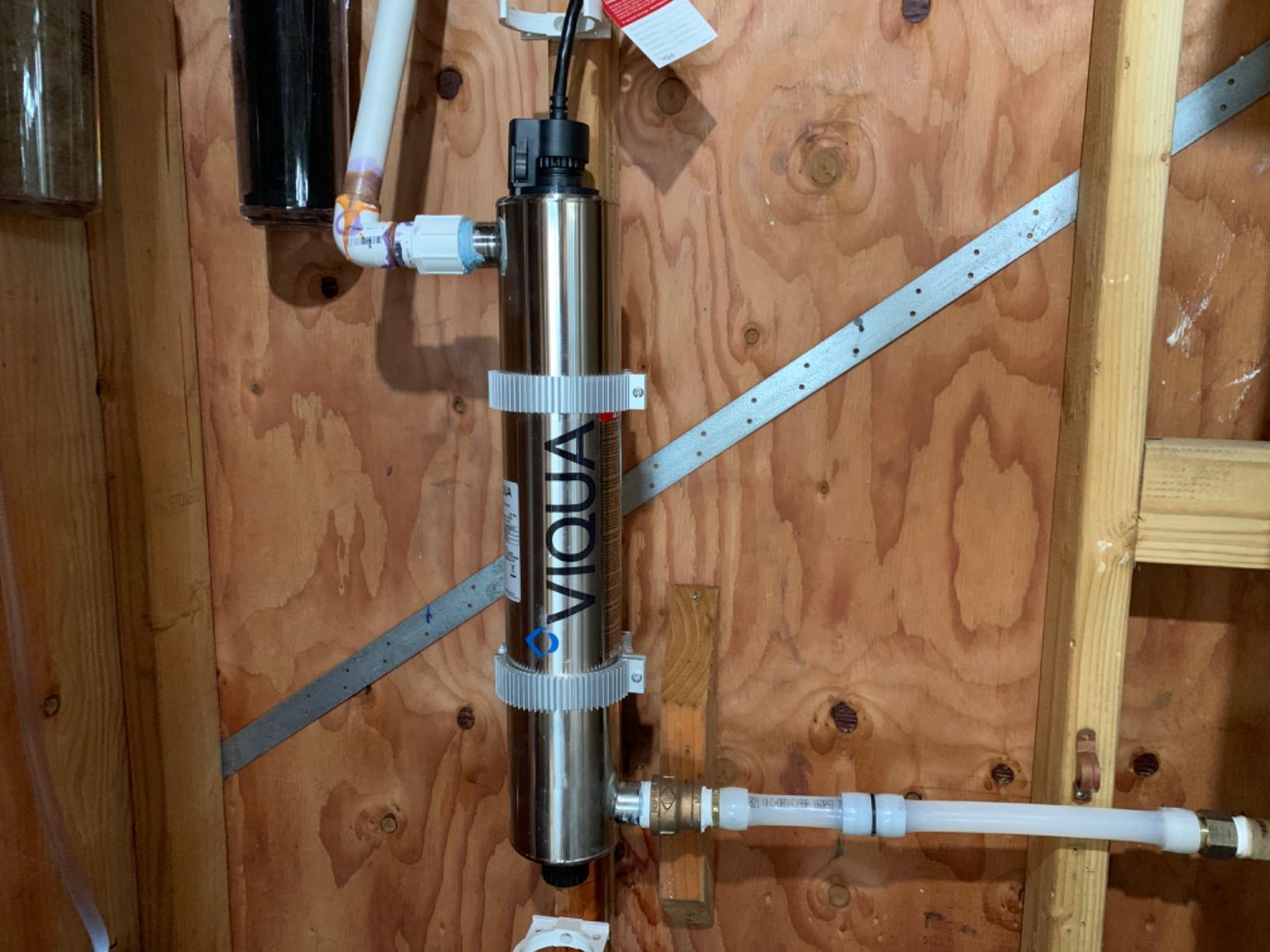
The Viqua VH410 is the one with a name most experienced well owners will already recognize, and it is the model that comes up again and again in sizing conversations. Viqua is the brand people argue about in water treatment forums because the 200, 410, and VH200 naming generates its own confusion, and getting the model right matters.
What makes this particular unit interesting is its shape. It delivers 18 GPM from a compact chamber measuring 4.5 inches long, 11.8 inches wide, and 14.3 inches high, so it can go vertical where a 44 inch horizontal chamber will not fit. Connections are threaded both inside and outside, which lets it accept two different hose sizes.
Stated treatment targets are Cryptosporidium, Giardia, E. coli, and fecal coliform. A safety cap and lamp plug prevent unsafe contact with the lamp, and the ballast carries a 365 day countdown timer for lamp replacement, so you are told when to change it instead of guessing.
Replacement parts are published and sold separately, including controller BA-ICE-CL, lamp S410RL-HO, lamp and sleeve QL-410, and sleeve QSO-410. Having a known part list decades after purchase is a real advantage over units where consumables disappear from the catalog.
Why Viqua keeps coming up in sizing advice
One recurring recommendation in plumbing forums pairs a Viqua VH200, a 9 GPM chamber, with a household running about 5 GPM, on the logic that oversizing gives you margin on peak days. The broader principle is sound: size to your peak flow, then round up one step, because a chamber running below its rating still delivers more dose than you need and costs you nothing in effectiveness.
What that logic does not support is buying three times the capacity you need. The 18 GPM rating on the VH410 already leaves most homes a comfortable margin at 5 GPM peak. Buying the next size up buys reserve, not protection, and it warms the standing water in your line.
What to consider before you commit
The geometry is the deciding factor. Inlet and outlet sit on opposite sides, which can complicate a tight cabinet or under-sink layout even though the chamber itself is compact. Measure the actual space, including room to pull the lamp, before you order.
Two smaller notes from owners: water runs hot after the system has been off overnight, and one unit stopped and started beeping after about 12 hours of use. Neither is a pattern across the reviews, but both are the kind of thing that is annoying rather than dangerous, and the 100 to 240V input gives you flexibility on supply voltage.
10. ALTHY 48W 12 GPM UV with 600-Second Auto Shutoff
ALTHY Whole House UV͎ Ultrąviolët Water Filter Purifier
48W UV-C lamp at 12 GPM
600 second auto shutoff
304 stainless reaction chamber
1 inch MNPT ports
Pros
- Smart flow sensor shuts the lamp off after 600 seconds of no flow
- Useful for off-grid and tank fed households conserving power
- Easy DIY installation with mounting clips included
- Service described as quick and willing to send replacement parts
- Works as a drop-in replacement for larger units
Cons
- 1 inch fittings can leak until threads are cleaned and rewrapped with heavy duty Teflon
- Some leakage reported between the brass flow sensor and the stainless body
- Lowest supported TDS level in the group at 300 ppm
The distinguishing feature here is the 600 second countdown. The ballast display counts down from 600 seconds to 0 and switches the lamp off when flow stops, which saves standby power and stops the chamber from heating stagnant water. For a cabin, an off-grid property, or a well on a timer, that behaviour is the reason to buy this unit.
The lamp is a 48 watt UV-C source rated to 12 GPM with bulb life up to 9000 hours. The body is 304 stainless steel with a quartz sleeve and a long residence time in the reaction chamber, and the ballast accepts 110 to 240 volts with intelligent flow sensing and automatic control.
Owners with rural and off-grid setups specifically value the automatic shutoff and the low power consumption. Customer service is described as quick, polite, and willing to send replacement ballasts and flow sensors, including internationally, which is worth knowing if you are not near a major metro area.
Where the 600 second shutoff genuinely helps
Consider a household on a well pump timer that runs the pump a few times a day. A chamber with a constantly lit lamp draws power 24 hours a day, generates heat, and burns lamp hours while nothing is flowing. A 600 second delay means the lamp powers on when you open a tap and shuts off shortly after you stop.
The trade-off is a small delay at every tap. If you are used to instant water and the unit is installed far from the fixture, that pause can feel sluggish. For a main entry installation feeding the whole house, the savings and the cooler standing water are usually worth it.
What to check before you buy
Start with the TDS limit of 300 ppm, the lowest in this roundup. That figure is not a judgement on water quality, it is a statement about what the manufacturer will certify. If your lab report shows higher dissolved solids, this is not the chamber to buy, and no amount of good intentions will change that.
The fitting seals need attention. Several owners had to disassemble the unit and rewrap the 1 inch threads with heavy duty Teflon and sealant before the leak stopped, and there are reports of leakage at the brass flow sensor attachment point. Bring proper thread tape, clean the threads before assembly, and tighten evenly rather than hard.
How to Size a UV System for Your Home
Sizing is where most UV buyers go wrong, and it is the single most repeated question in well owner forums. Get it wrong in either direction and you either overspend for capacity you will never use or install a chamber too small to deliver a real dose at peak demand. Here is the method.
First, find your actual flow rate rather than guessing from household size. Check the pump or pressure tank spec, or run a bucket test: open a cold tap and time how long it takes to fill a 5 gallon bucket. Divide 300 by the seconds elapsed and you have your flow in gallons per minute.
Second, separate average use from peak use. A family of four might average 3 GPM across a day and peak at 5 GPM when showers and laundry overlap. Size for the peak, because that is the moment when undersized chambers stop delivering the dose they are rated for.
Third, match the chamber to the peak, then round up one step at most. The r/Plumbing recommendation that comes up repeatedly pairs a 9 GPM Viqua VH200 with a 5 GPM household, and that logic generalizes: one size up for margin is sensible, three sizes up is spending money and heating water for nothing.
Fourth, check the water, not just the house. Higher iron, manganese, or sediment content lowers UV transmittance, which means a chamber running at its flow rating on dirty water delivers less effective dose than the same chamber on clear water. Clear wells can use the rated flow; iron-bearing wells should be sized down a step.
Fifth, plan the pre-filter at the same time. A 5 micron spin-down ahead of the chamber protects the quartz sleeve, and a carbon or KDF stage between the sediment filter and the UV handles iron and sulfur. Experienced users already treat pre-filtration as mandatory, and one r/WaterTreatment user was already running a 5 micron spin-down plus a 1 micron inline filter while comparing UV models.
Pre-Filtration: What Must Come Before the UV Chamber
UV goes last. Every good treatment train on a well follows the same order, and getting it wrong is the reason some owners report that their UV system stopped working within a year of a clean installation.
Stage one is sediment. A 5 micron spin-down catches sand, rust flecks, and grit that would otherwise lodge on the quartz sleeve. Without it, even clean-looking well water will cloud the sleeve from the inside, and a clouded sleeve blocks the light the dose rating depends on.
Stage two is whatever your lab report demands: KDF and catalytic carbon for iron and manganese, oxidation media for sulfur, or an iron filter ahead of the carbon stage. Keep this stage physically separate from the sediment filter so you can change one without disturbing the other.
Stage three is the UV chamber, discharging last, with a manual bypass so you can isolate it for lamp changes without shutting off water to the house. Add a 1 micron inline polish stage after the chamber only if you are chasing protozoa protection at high flow.
Keep an eye on pressure across the train. Every added housing costs flow, and a UV chamber already sized to your peak needs headroom upstream. If your pump pressure is marginal, a booster pump upstream of the train is cheaper than discovering a flow shortfall after everything is installed.
What Are the Disadvantages of UV Water Purifiers?
UV water purifiers have five real drawbacks, and every one of them is manageable once you know about it. Here they are with the fix for each.
One, UV removes nothing. Iron, sediment, sulfur, nitrate, arsenic, hardness, and total dissolved solids all pass straight through. Fix: put sediment and contaminant-specific filtration ahead of the chamber and treat UV as the final disinfection stage.
Two, it needs electricity. A UV chamber does nothing during a power outage, which is exactly when flooding or a storm surge is most likely to contaminate a well. Fix: keep a chlorine-based emergency plan alongside UV and shock the well after any flood event, because UV is not sufficient on its own following surface water intrusion.
Three, the quartz sleeve scales. Iron and hardness coat the sleeve and reduce the light reaching the water, gradually and without warning. Fix: clean the sleeve every 6 to 12 months, more often on iron-bearing wells, and keep a descaling solution on the shelf.
Four, failure is silent. A dead lamp leaves the water tasting and looking exactly as it did before, so owners often run a year on a lamp that stopped working. Fix: choose a ballast with an alarm or a countdown timer and set a calendar reminder rather than waiting for a warning light.
Five, the consumable cost is recurring. A lamp and sleeve change every year is a permanent line item on top of your pre-filters. Fix: budget for it from the start and buy a chamber whose replacement parts you can still find, which favours established brands in the long run.
Lamp Types, Maintenance and Bulb Replacement
Lamps in these systems are rated around 9000 hours of continuous operation, and manufacturers translate that into an annual change as a practical rule. A lamp that ages past its rating delivers less UV output while still lighting, so the alarm on the ballast matters as a supplement to the schedule rather than a replacement for it.
There are two lamp families you will see in listings: low pressure mercury vapor lamps, the traditional and cheapest option, and mercury-free designs including LED and dual-helix lamps. Mercury-free lamps avoid a mercury disposal question and can offer longer service intervals, but they cost more and the electronics are less standardized across brands.
Your water determines the maintenance load more than the lamp does. Clear, low-iron water on a spin-down pre-filter can run close to the 12 month interval. Iron above roughly 0.3 ppm, manganese, or hard water will scale the sleeve faster, and that is where a shorter schedule and an annual sleeve replacement matter more than the lamp choice.
Look for NSF/ANSI 55 certification if you want third-party verification that the unit meets microbial reduction standards, and remember that private wells are not federally regulated the way municipal supplies are. Nobody else is checking your water, which makes a documented lab test, a maintained filter schedule, and a UV stage with a working alarm the actual safety net.
Frequently Asked Questions
What is the best UV filter for well water?
The best UV filter for well water is a 304 stainless steel chamber rated for your home’s peak flow in gallons per minute, with a flow-sensor ballast and a 9000 hour lamp, installed behind a sediment pre-filter. From the ten we compared, the HQUA OWS-12 leads on owner history with over 1000 reviews, and the iSpring UVF55FS leads on electronics.
Which UV water purifier is the best?
There is no single best UV water purifier for every well. Match the chamber to your peak flow first: up to 6 GPM suits a small home, 12 GPM suits most families, and 18 to 24 GPM suits large homes with heavy simultaneous use. Then confirm the pre-filter ahead of the chamber can handle your iron and sediment load.
What are the disadvantages of UV water purifiers?
The main disadvantages are that UV removes no contaminants at all, it requires electricity and stops working during an outage, the quartz sleeve scales over time in hard or iron-bearing water, lamp failure is silent, and lamps and sleeves are a recurring annual cost. Each is manageable with the right pre-filtration, a maintenance schedule, and a ballast with an alarm.
How do I size a UV system for my home?
Measure your peak flow, size the chamber to that number, and round up at most one step. For most family homes, peak flow sits between 3 and 5 GPM, so a 6 to 12 GPM chamber is the right range. Wells with iron or manganese should be sized down a step because suspended contaminants reduce UV transmittance.
Does UV remove iron, sulfur, nitrates or arsenic from well water?
No. UV inactivates bacteria, viruses, and protozoa and does nothing to dissolved metals or minerals. Iron, manganese, sulfur, nitrate, arsenic, hardness, and total dissolved solids all require dedicated media filters, ion exchange, or reverse osmosis placed ahead of the UV chamber.
How often should I replace a UV bulb?
Replace the lamp annually, or sooner if you run it near continuously. Most UV lamps are rated for 9000 hours of continuous operation, and a flow-sensor ballast extends the calendar life by switching the lamp off when no water is moving. Clean the quartz sleeve at the same time and more often on iron-bearing wells.
Final Verdict: Which UV Water Purifier Fits Your Well
The best UV water purifiers for well water all share one rule: they are the last stage, never the first. Start with a lab report, build a sediment and contaminant train in front of the chamber, and pick a chamber that matches your peak flow rather than the biggest number on the page.
For most households the HQUA OWS-12 is the pick, with the deepest owner record in this comparison, a 12 GPM 40 watt chamber, and a spare lamp in the box. Choose the iSpring UVF55FS when you want the flow-sensor ballast and 1 inch ports, the Viqua VH410 when cabinet space is the constraint, and the Bluonics three-stage kit when you would rather buy the whole train assembled.
Whichever you pick, set the annual lamp reminder the day it goes in. That single habit is the difference between a UV system that protects your water for a decade and one that quietly stopped eighteen months ago.