
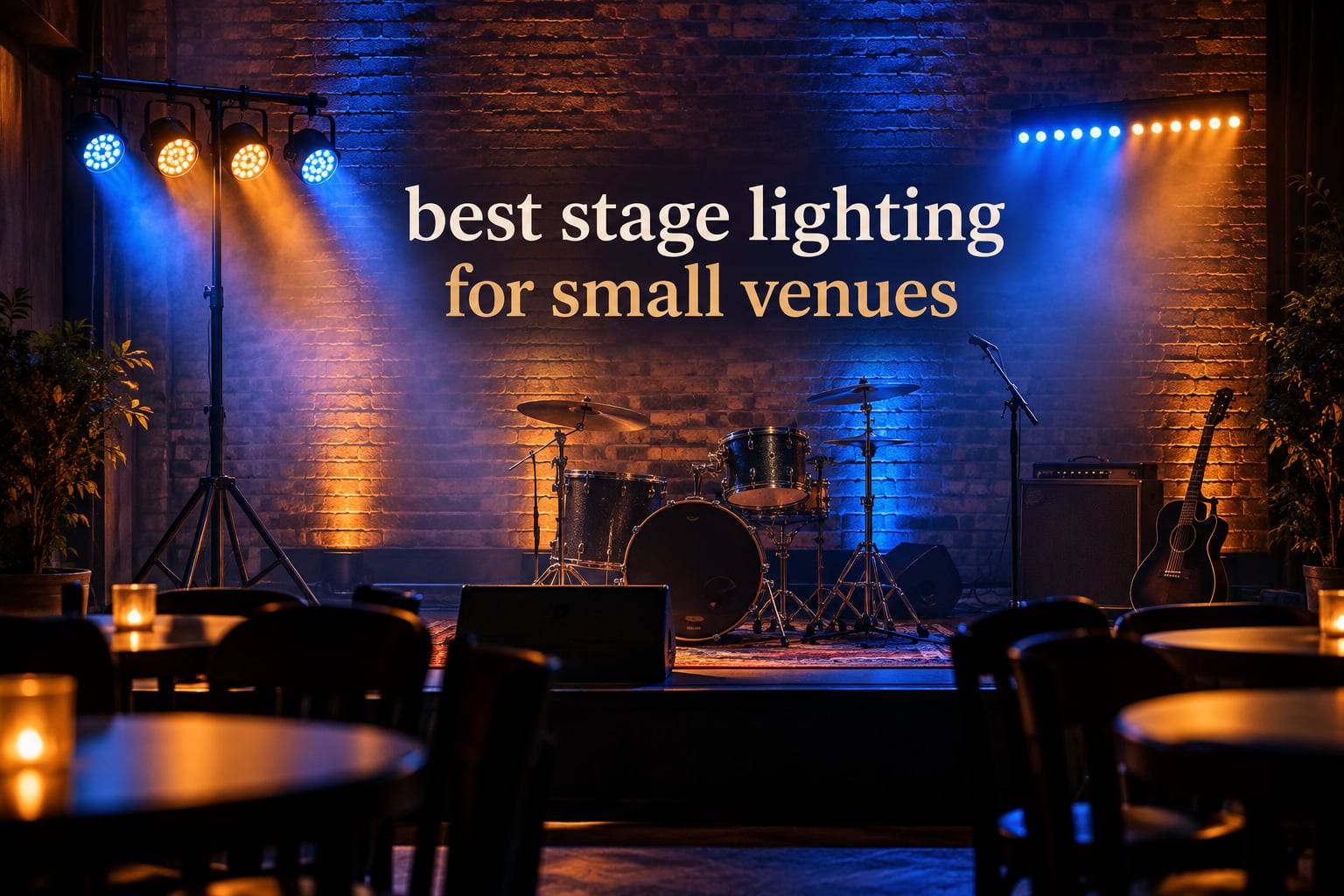
Most small venues need three to six lights, not a full rig. Two front fixtures for faces, one or two at the back for depth, and a wash bar or uplight for mood is a working setup for a room up to about 16 feet wide. I have compared ten LED fixtures that cover that brief, from four-packs of RGB PAR cans to compact moving heads and outdoor wash bars, and the right pick comes down to your ceiling height, your power outlets and who is actually going to run the desk.
What surprises most venue owners is how little of the decision is about raw brightness. A 3 m room with a low ceiling punishes moving heads far more than a bright room with headroom, and a cafe with one power outlet near the stage cannot support a rig that needs six separate runs. Fixture class and placement matter more than wattage, which is why the roundup below is grouped the way operators think about it rather than by price.
A note on control before we get into the picks. If nobody in your venue has run a lighting board, buy fixtures that work on a remote or in sound-activated mode out of the box. DMX is worth learning once you are running more than two event types a month, but buying DMX-only gear before you have a person who will use it is the most common expensive mistake in this category, and it comes up constantly in operator forums like r/stagelighting.
The forum consensus from r/stagelighting and r/lightingdesign is blunt and correct: more cheap PARs beat fewer large fixtures in a small room. Everything below respects that, and where a fixture has a genuine weakness the reviewers repeatedly report, I have named it.
Table of Contents
Top 3 Picks for Small Venue Stage Lighting (October 2026)
The three below are the fixtures I would put on a small stage first. They cover the widest range of room sizes, they all include control options that work without a lighting operator, and each has enough owner feedback behind it that I trust the spec sheet.

OPPSK 36W 36LED RGB Par 4-Pack
- Four 36W fixtures
- 36 RGB LEDs each
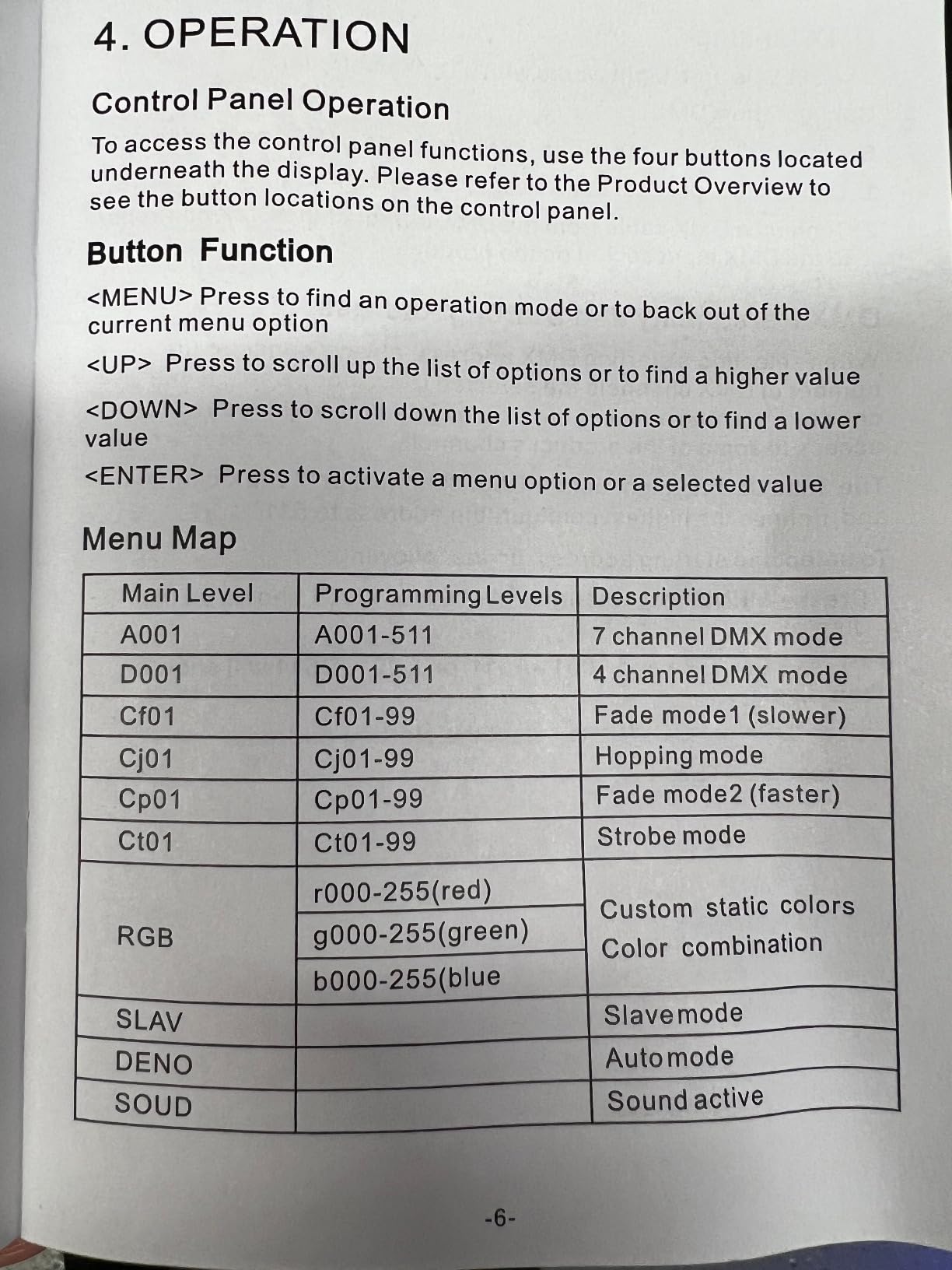
- DMX512 with 4 and 7 channel modes
- Floor or truss mount with four remotes

UKing 36 LED RGB Par 2-Pack
- 36 x 1W LEDs per fixture
- Seven modes including DMX and voice control
- Bright low-cost wash for tight rooms

OPPSK 90W 60LED Par 2-Pack
- 60 RGB LEDs per fixture
- Up to 9000 lumens output
- Quiet fan and 3 lb housing
All Ten Picks Side by Side in 2026
Every fixture below is written up in detail further down. This table is the fast version: fixture class, output and control modes, and where each one earns its place.
| Product | Specifications | Action |
|---|---|---|
|
OPPSK 36W 36LED RGB Par 4-Pack
|
|
Check Latest Price |
|
UKing 36 LED RGB Par 2-Pack
|
|
Check Latest Price |
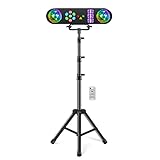 Telbum 5-in-1 DJ Light Bar with Stand
|
|
Check Latest Price |
 UKing 7x10W RGBW Moving Head
|
|
Check Latest Price |
 ZKYMZL 30W GOBO Moving Head Spotlight
|
|
Check Latest Price |
 LaluceNatz 120W RGBW LED Wash Bar
|
|
Check Latest Price |
|
OPPSK 90W 60LED Par 2-Pack
|
|
Check Latest Price |
 YeeSite IP66 LED Wash Bar 2-Pack
|
|
Check Latest Price |
 OPPSK 70W 7LED RGBWA Stage Par
|
|
Check Latest Price |
 JLPOW 15W Mini COB Par Light
|
|
Check Latest Price |
1. OPPSK 36W 36LED RGB Par 4-Pack: The Default Small Stage Front Wash
OPPSK 36W 36LEDs RGB Stage Par Lights by Remote DMX Control – 4Pack
Four fixtures at 36W each
36 RGB LEDs per fixture
25-degree beam
DMX512, sound and remote
Pros
- Four fixtures and four remotes in one box
- DMX512 with 4 and 7 channel modes
- Bright enough to throw roughly 9 feet
- Baskets mount on floor or truss
Cons
- Hardwired power cord with no linking output
- No dedicated white channel so white is mixed from RGB
- Remote struggles to sync fade and jump programs
This is the fixture I recommend to anyone opening a small venue rig from scratch. You get four matching 36W RGB PAR cans, four IR remotes and a bracket set, which is the exact count the top answer on r/stagelighting describes: two front, one at the back, one for colour or effect. Owners report reaching roughly 9 feet up a garage door with a single fixture, so a 3 m ceiling is well inside its range.
The DMX detail is the part that surprises people at this level. It runs 4-channel and 7-channel modes over standard DMX512, so when your venue grows to six or eight fixtures you can put them on a controller without replacing anything. Multiple buyers report buying a second 4-pack later and running both sets together.
Specs worth knowing: 36 RGB LEDs per can, 36W light source, 25-degree beam angle, 110V corded power, ABS and metal housing, and a 10 by 10 by 4.9 inch footprint that stacks for transport. The manufacturer warranty is 12 months.
The honest negatives are practical rather than electrical. The power cable is permanently attached with no detachable connector, and there is no power linking output, so four fixtures means four wall runs unless you use an extension block. There is also no dedicated white LED, so warm white is simulated by mixing the RGB channels and looks less clean than a true RGBW fixture for a spoken word night.
Where this four-pack works best
It suits a bar, a community hall or a small church stage where the same fixtures need to do front wash on one night and party lighting on the next. The four-pack also means you have spares; owners running church and band work treat a spare can as standard practice rather than a luxury.
If your stage is under 10 ft of ceiling, this is close to the ideal answer. The tight 25-degree beam keeps the light on the performer instead of washing the whole room, which matters in a low-ceiling space where a wide flood would hit the back wall and the audience’s drink table equally.
Who should skip it
Skip it if you need true white light on faces for video or photography, because the absence of a dedicated white channel shows up on camera. Also skip it if your venue has two outlets and no room for an extension block, since these cannot chain power from one to the next.
And if you are running a large rig long term, look at the RGBWA can later in this list instead. It costs more per fixture but adds a proper white channel and power linking, which is what you eventually want when the rig outgrows a four-pack.
2. UKing 36 LED RGB Stage Par 2-Pack: The Cheapest Front Wash That Covers a Small Room
U`King 36 LED RGB Stage Par Lights by Remote DMX Control 2pack
Two fixtures at 36W each
36 x 1W LED beads per can
Seven operating modes
120V corded
Pros
- Bright colourful output at a very low cost
- Lightweight and quick to rig
- Remote included per fixture
- One controller can drive several fixtures
Cons
- Plastic housing feels basic in the hand
- No physical power switch so unplugging is the only way off
- Some reports of units failing after a few months
Two 36W cans, two remotes and seven operating modes is the shortest route to a lit stage I have found. Reviewers repeatedly describe these as ideal for small to medium rooms, podcasts and solo live shows, which is exactly the venue profile this roundup is aimed at. They rank in the top three for stage lights on Amazon, which tells you how much of the market lives at this tier.
The seven modes are static colour, strobe, auto, voice control, master-slave, DMX and gradient. That is more control surface than most fixtures twice the cost offer, and the master-slave mode means you can run both cans together from a single remote without touching the buttons on the fixture.
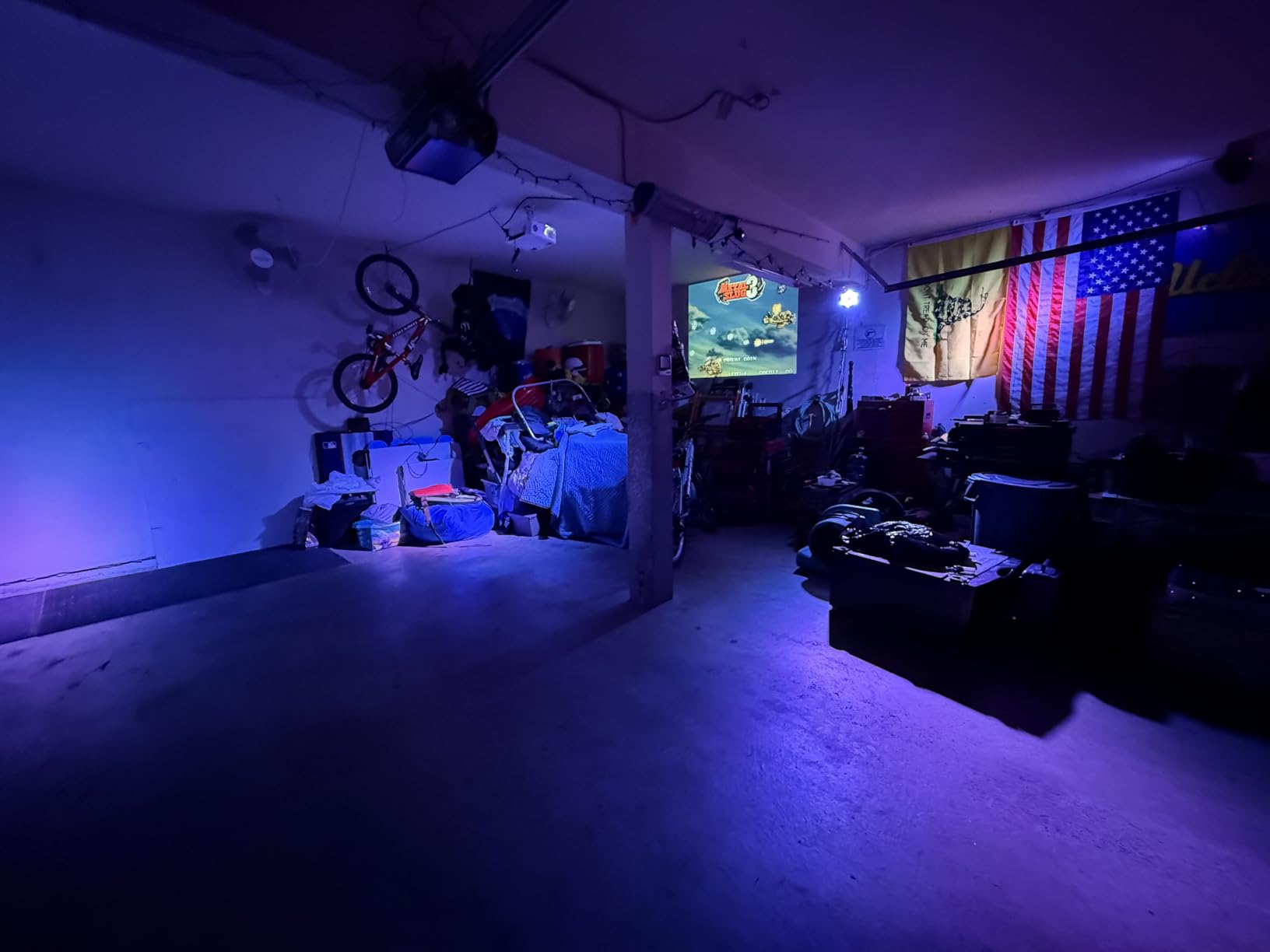
Physical details: 36 x 1W LED beads per fixture, 36W light source, ABS housing, 120V corded power, bracket mount, and an 8.3 by 3.9 by 6.9 inch body. The manufacturer warranty is 1 year.
The durability feedback is the part to weigh. Most reviews describe solid performance, but a small number of one-star reports describe units failing or glitching after a few months of light use, and the plastic shell is regularly described as basic. Treat this as a two-to-three-year fixture rather than a permanent installation, and keep a spare on hand.
Who should buy this pair
Buy this if your budget is tight and your program is acoustic sets, karaoke and open mics. Warm white from the static colour mode covers a spoken word evening, and the gradient and voice modes handle a DJ slot without any programming.
It is also the sensible first step for a venue with two or three power outlets, since two fixtures is the smallest rig that still gives you front and back coverage.
Where the limits show
There is no physical power switch, so the only way to power down is to unplug each can, which is a real annoyance at the end of a night. The IR remote can also confuse fixtures in a bigger room, which is why operators recommend DMX above about four fixtures rather than fighting remotes.
If your venue runs several nights a week, buy the four-pack at number one instead. The per-fixture cost is lower and the warranty is twice as long.
3. Telbum 5-in-1 DJ Light Bar with Stand: One Box, Five Effects, No Rigging
Telbum DJ Lights with Stand, 5 in 1 Party Bar Light Set with Rotating Ball, Strobe, UV, Colorful LED Par Light and Pattern, Sound Activated DJ Lighting System for Disco Stage Gig Band Wedding
Five effects in one 40W bar
Includes folding tripod stand
Sound activated with remote
17.7 inch bar
Pros
- Five distinct effects from a single fixture
- Stand included so setup takes minutes
- Sound mode syncs colour and speed to music
- Two bars cover a large room from opposite sides
Cons
- Fragile internals
- the ball motor and laser can fail after a drop
- Short tripod is not very sturdy
- Too dim for rooms with ambient light
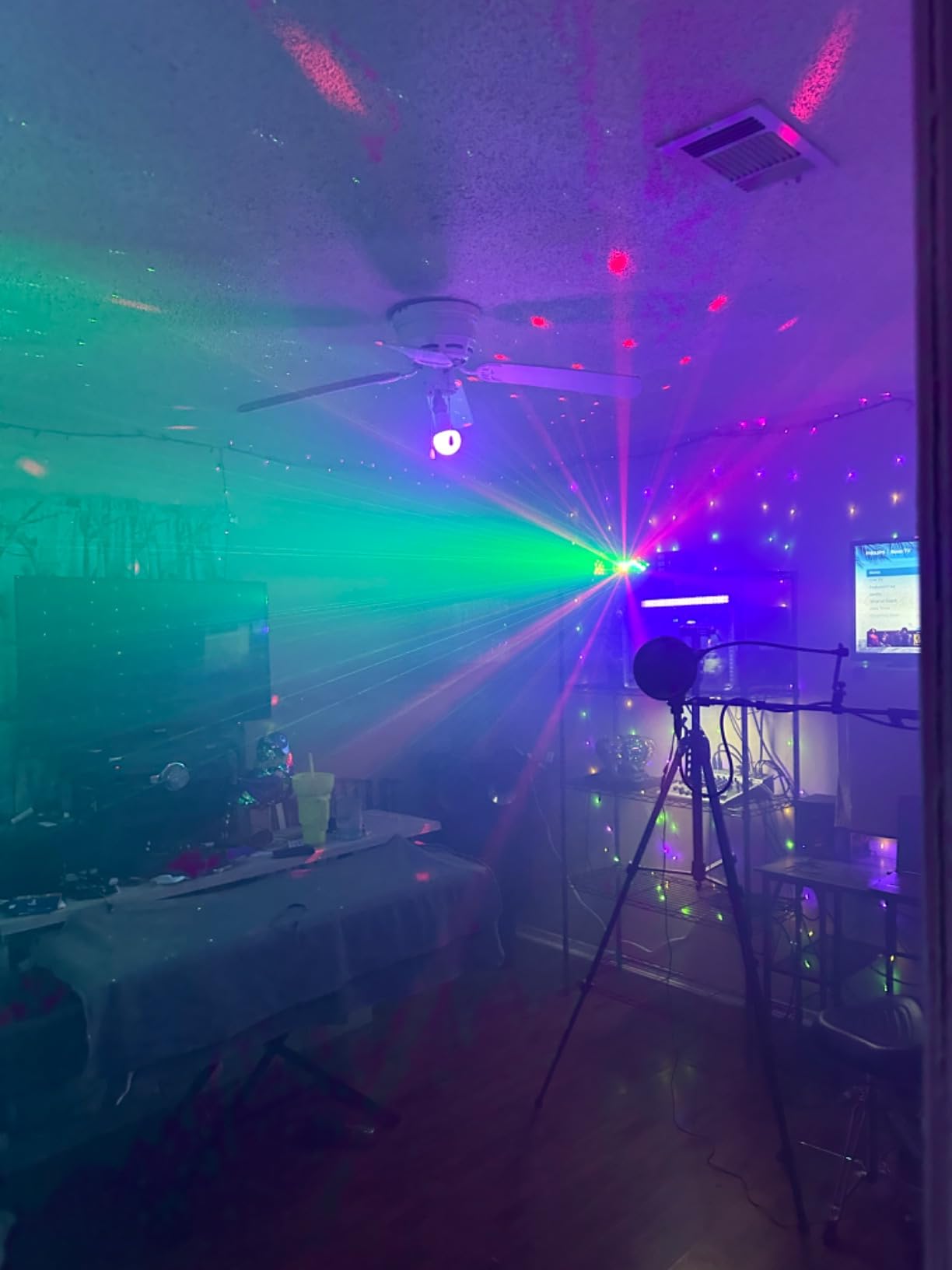
This is the fixture for a venue with no rig, no ceiling structure and no patience for a technical setup. One bar carries a rotating disco ball, a colourful PAR section, a red and green pattern light, a black light and a white strobe, and the folding tripod means you can set it up and tear it down between sets in a few minutes.
Owners use it for weddings, field days, graduation dances and mobile DJ sets, and the sound-activated mode is the reason it works without an operator. Two bars placed on opposite sides of a room cover a surprisingly large space, which is the standard workaround for venues with no lighting position at all.
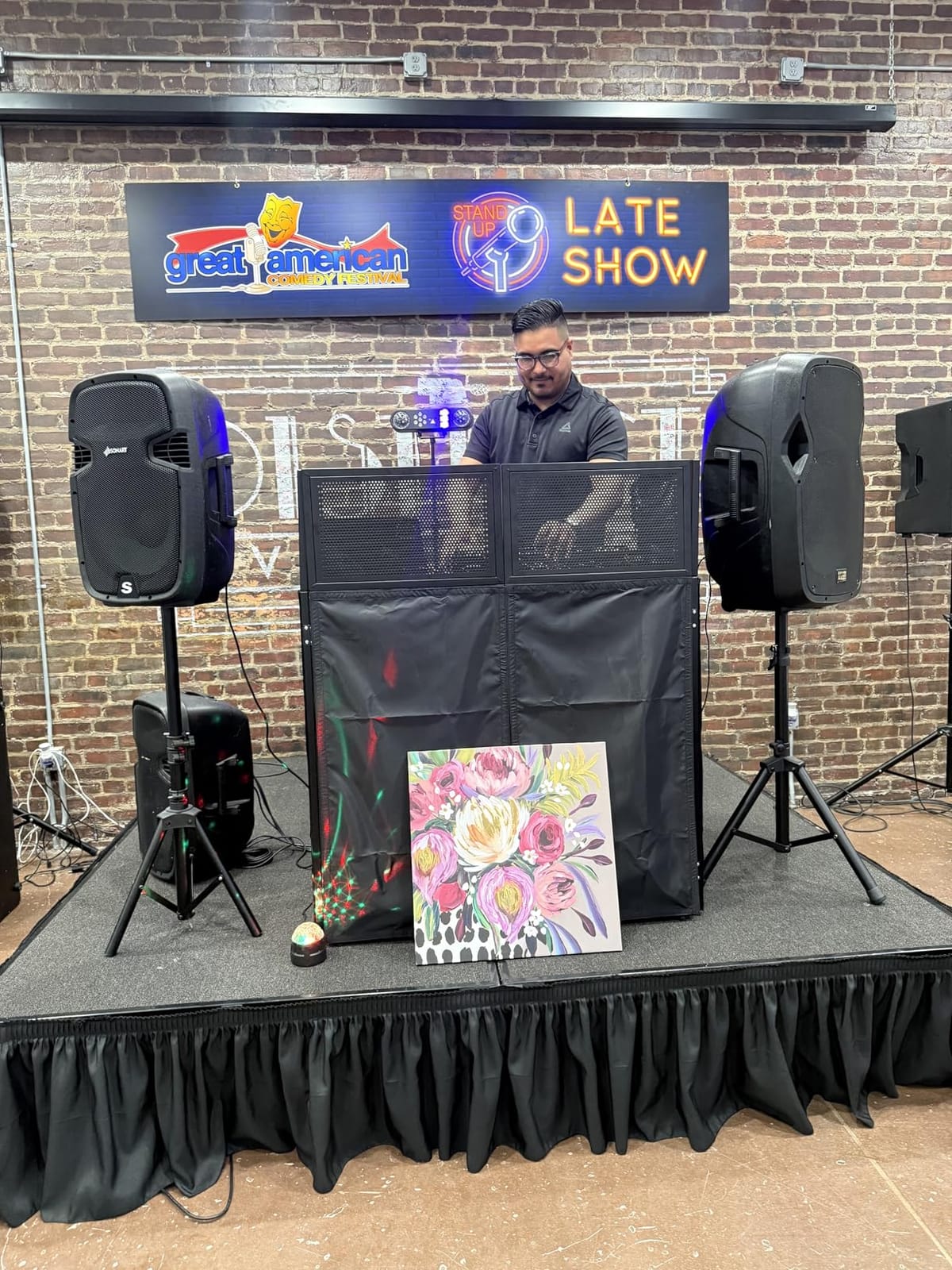
Specs: 40W total across five light sources, plastic housing, corded power, floor mount, a 17.7 by 9.8 by 4.7 inch bar weighing 4.7 pounds, and a 1-year manufacturer warranty. The box includes the bar, a remote, a tripod stand and a manual.
Durability is the weak spot. Several reviewers describe the spinning ball motor and the laser module failing after the unit was dropped, and the laser module is reportedly glued rather than mechanically mounted, so a knock can knock it out of alignment. The supplied tripod is also short and not especially sturdy, so treat the stand as temporary rather than as a permanent lighting position.
What it is genuinely good for
It is the right pick for a pop-up stage, a hall rental or a party room where the lighting budget is small and the room is dark to start with. Brightness is praised in dim spaces and criticised in lit ones, so it needs a room you can dim.
For a mobile DJ travelling to different rooms, the all-in-one format removes the biggest cost of small venue lighting, which is the gear you have to carry.
Who should skip it
Skip it for any performance where faces need to be readable. This is an effects bar, not a front wash, and a spoken word set or a comedy night needs light on the face rather than patterns over the audience.
Also note the laser and black light components. A laser module needs to be kept away from eye level and pointed at the back of the room, and a black light should be positioned so nobody can look into it. If your venue has a strict safety policy, a PAR and wash rig is a much easier thing to get signed off.
4. UKing 7x10W RGBW Moving Head: A Moving Head for Rooms With Real Headroom
U`King Moving Head Light RGBW LED Stage Lighting Effect 7x10W Moving Heads Wash Lights by DMX and Remote Control with Professional Spotlight for DJ Disco Events Wedding Birthday Party Live Show Bar
Seven 10W RGBW LEDs
540 degree pan and 180 degree tilt
DMX with power in and out
4.7 lb housing
Pros
- Wide smooth wash from seven RGBW sources
- Fast precise pan and tilt movement
- 4-digit display makes DMX addressing straightforward
- Works out of the box in sound and auto modes
Cons
- Base mount breaks when the fixture is hung rather than floored
- Lumens are limited for larger or brighter rooms
- Only a 90-day manufacturer warranty
A moving head adds movement that PARs cannot, and this is the most straightforward way into that class. Seven 10W 4-in-1 RGBW LEDs give a wide, smooth wash, and the 540 degree pan and 180 degree tilt movement is fast and precise enough to read as a real lighting effect rather than a wobble.
It runs DMX, master-slave, auto and sound active, and the 4-digit display makes addressing and menu navigation far less painful than older budget fixtures. Reviewers describe setup as simple even without lighting experience, which is the deciding factor for a venue with no operator.
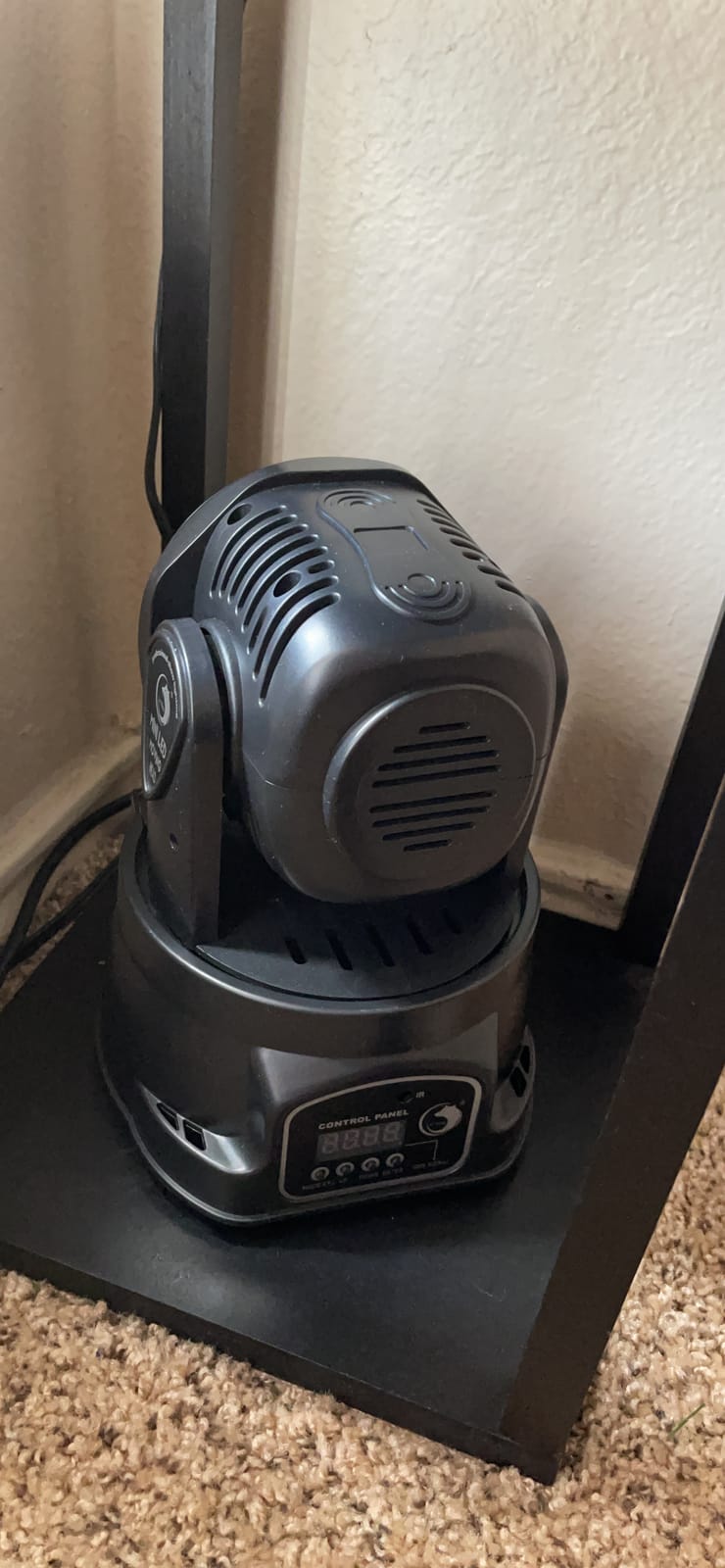
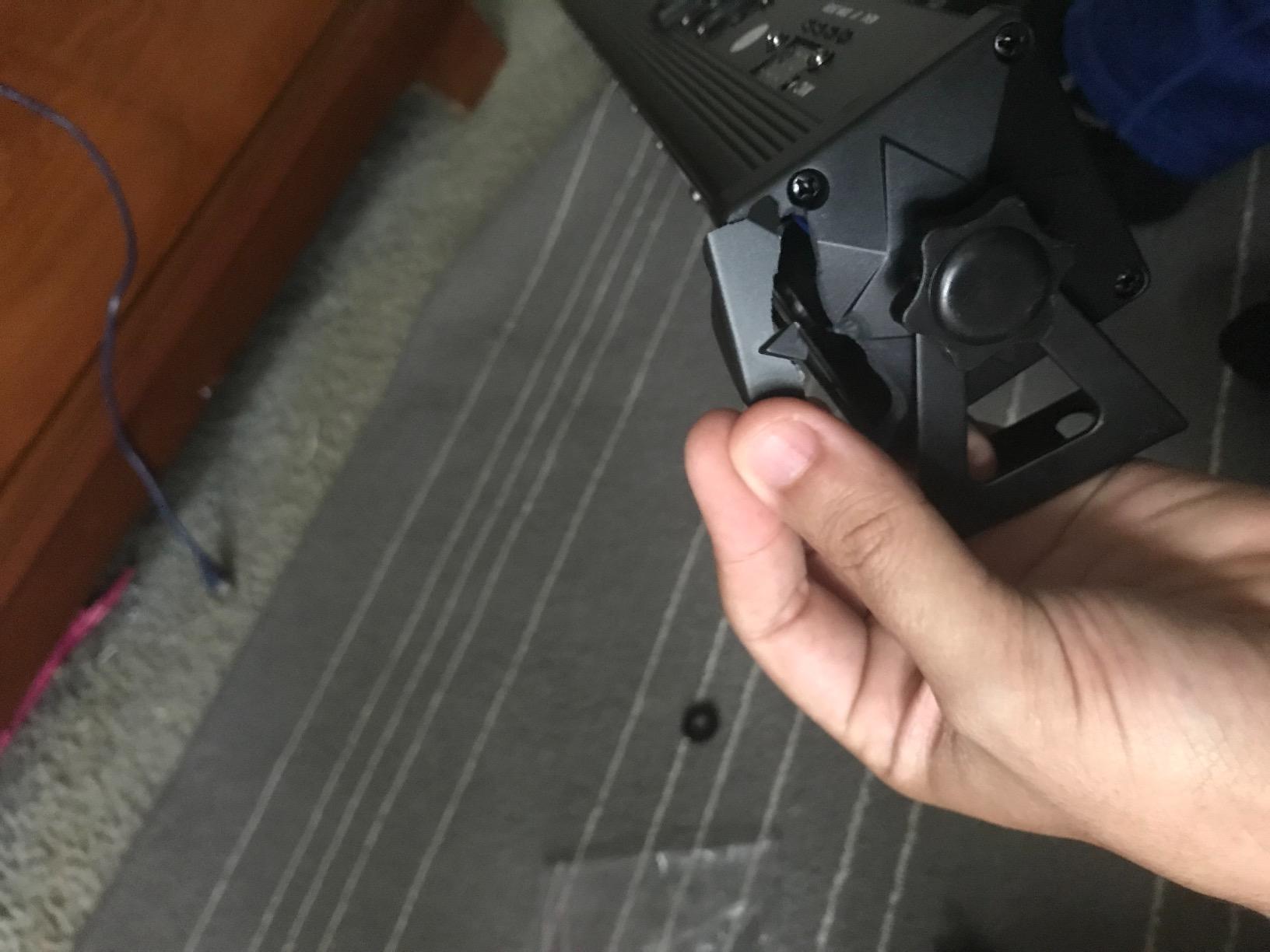
Physical and electrical details: 70W light source across seven 10W LEDs, PVC housing, 3-pin DMX in and out, power in and out, a 4.7 pound body measuring 7.1 by 6.9 by 9.1 inches, and a 90-day manufacturer warranty.
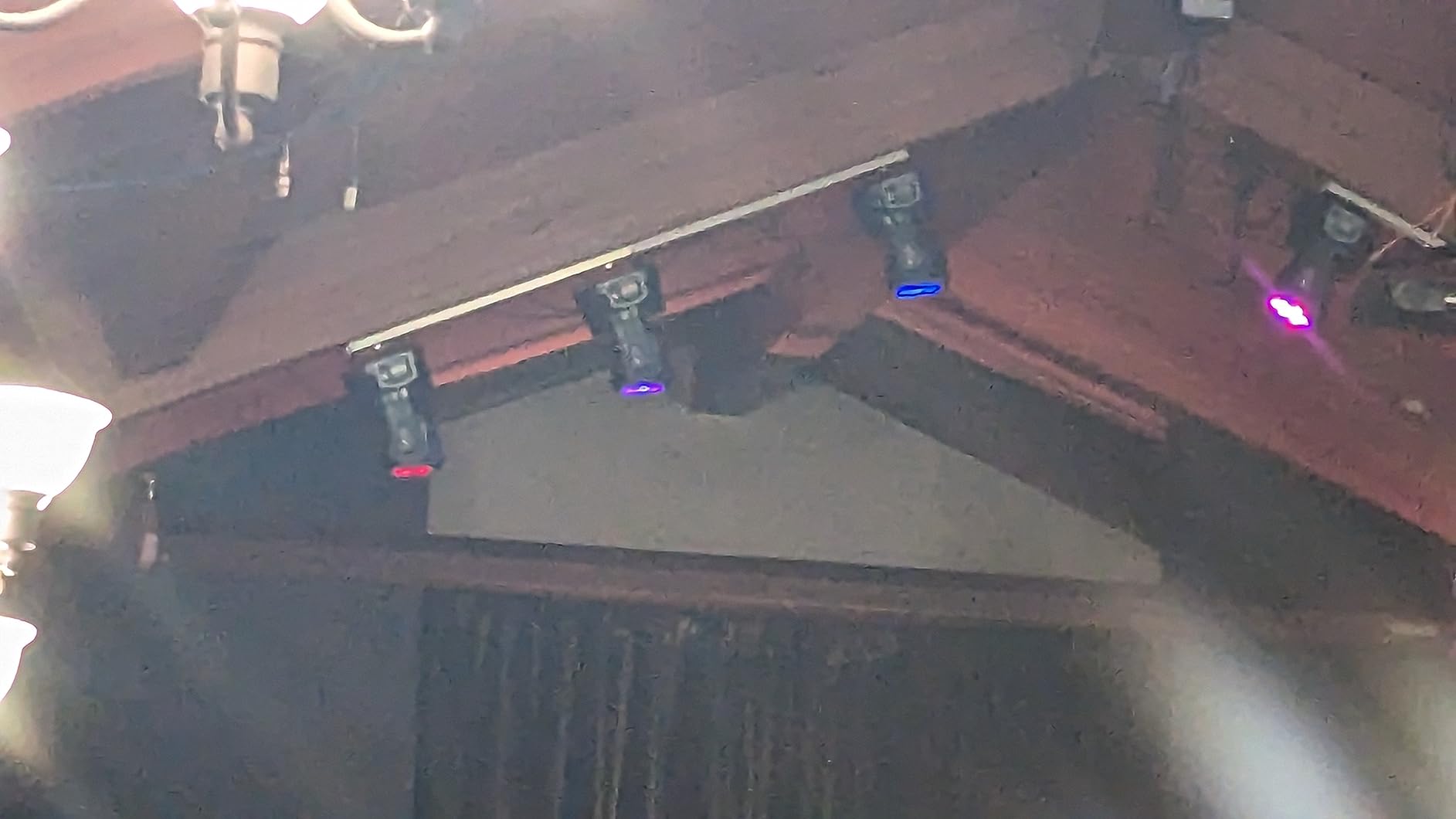
The most repeated complaint is mechanical, not electrical. Multiple owners report units breaking at the same point on the base when the fixture is hung rather than placed on the floor, and one owner broke five of eight this way. If you plan to truss it, inspect that base mount before every show.
When a moving head is the right call
Moving heads earn their place when you have 11 ft or more of ceiling and a dark room. Below about 10 ft, the head cannot throw a usable beam angle before it hits the floor, and you get a moving light that only illuminates the performers feet.
It also suits venues that want one fixture to do a wash, a beam and an effect depending on the song. That flexibility is what separates a moving head from a static can.
Why a cafe should think twice
Fixture cooling fans are audible in a quiet room, and on a spoken word or acoustic set that noise sits right where the audience is listening. Combine that with the 90-day warranty, and the risk profile is poor for a venue that runs quiet shows every week.
If your shows are loud, the fan disappears. If they are quiet, the compact silent fixture at number five is the safer buy.
5. ZKYMZL 30W GOBO Moving Head: The Quiet One for Acoustic and Spoken Word
ZKYMZL 30W LED Moving Head DJ Lights DMX512 GOBO Spotlight with 8 Colors + Color-Split Effect 8 Rotating Patterns Compact Beam Stage Lighting for Small Venues Weddings Parties Church Events (1 Piece)
30W cool white LED
8 colours plus half split
540 degree pan and 270 degree tilt
Rated for rooms up to 500 sq ft
Pros
- Very quiet
- inaudible during a live set
- Adjustable 0 to 100 mic sensitivity syncs several fixtures
- Correct DMX response out of the box
- One-year warranty with responsive replacement
Cons
- No physical power switch on the fixture
- Basic supplied colour wheel and gobos
- DMX profiles for software must be made by hand
This is the moving head for a room where the audience is listening. The manufacturer rates the motor and fan noise as low, and owners confirm it: multiple reviewers describe running eight-hour sets and report the fixture as inaudible during live performance, which is exactly the opposite of the problem with number four.
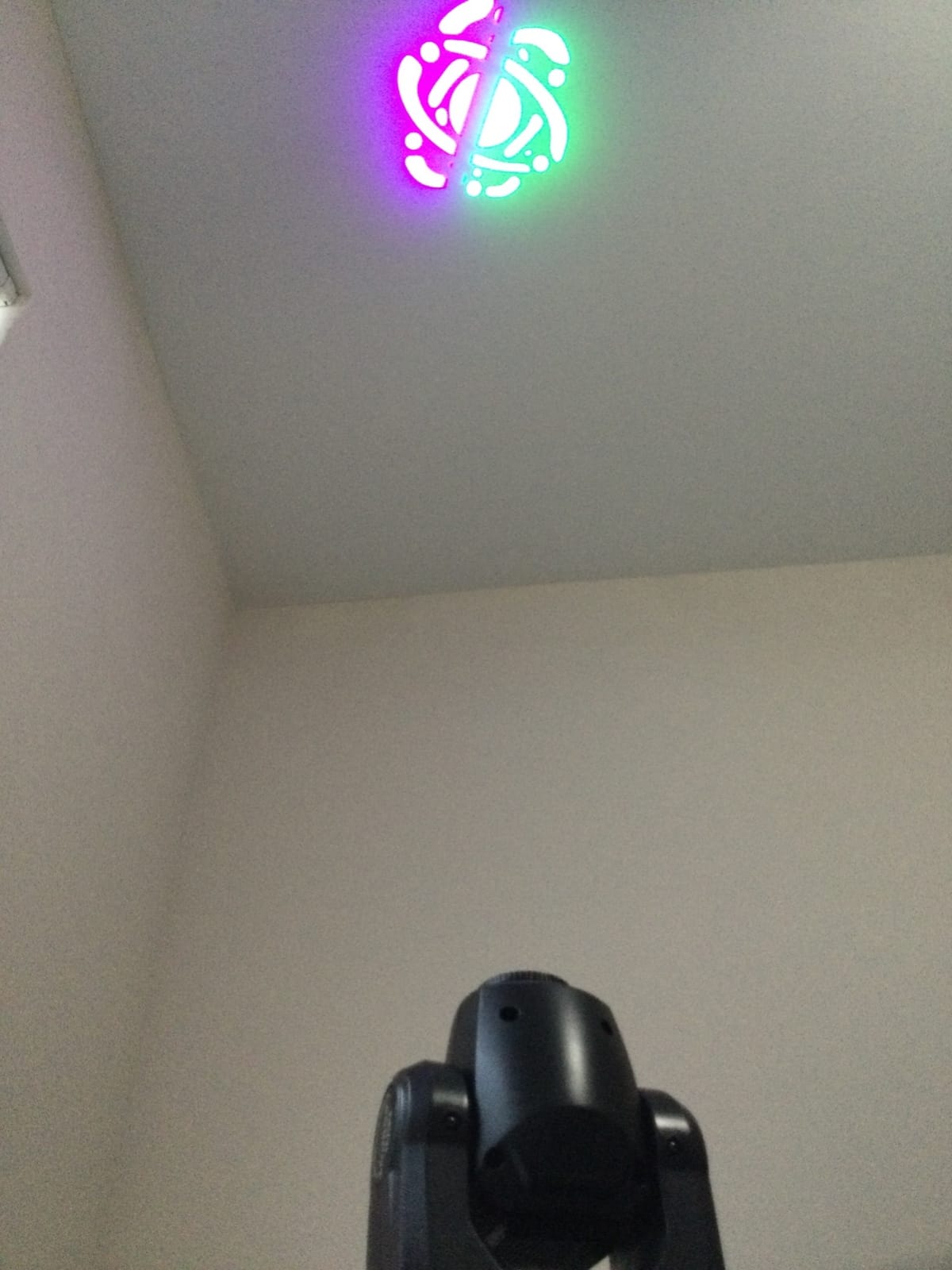
The optical side is more interesting than the price suggests. You get eight colours plus a half-colour split mode and eight interchangeable rotating gobo patterns, a 30-degree beam, a 6500K cool white source with a colour rendering index of 90, and 540 degree pan with 270 degree tilt. That is a genuine pattern-projector capability, not just a coloured wash.
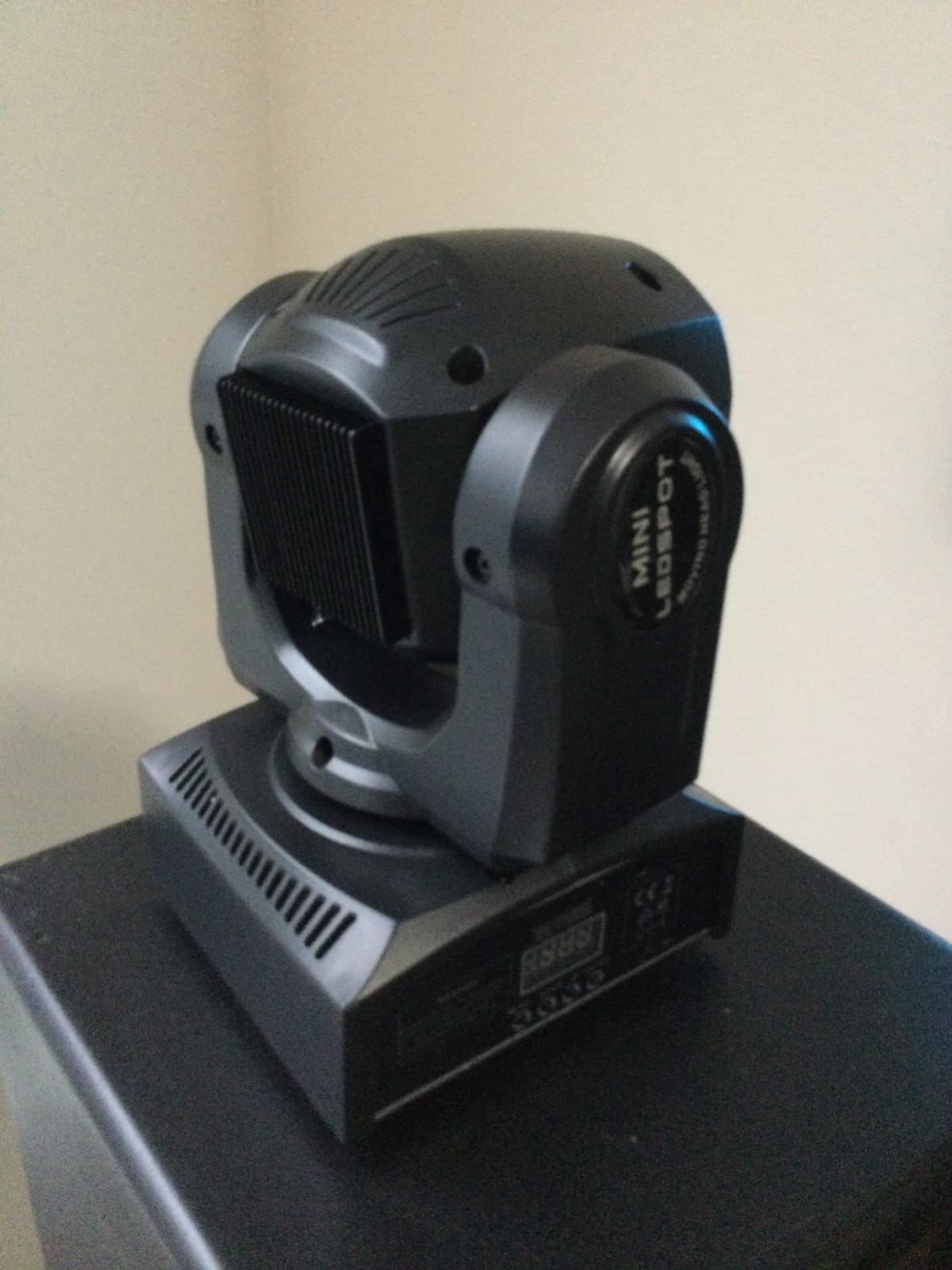
Control runs six modes including DMX, auto-run, sound-activated and master-slave, with DMX512 available in 9 and 11 channel modes. The chassis is aluminium, iron and plastic, 5.6 pounds, measuring 7 by 7 by 15 inches, with a bracket, power cable and manual included and a 1-year warranty.
The manufacturer rates it for rooms up to roughly 500 sq ft, which is an honest number rather than a marketing one. Output is modest next to professional fixtures, so in a bright cafe with daylight coming through the windows it will not compete with the room.
Best suited to
Cafes, chapels, small theatres and community halls where the show is quiet and the room is small. The adjustable microphone sensitivity from 0 to 100 is the detail that makes multiple fixtures usable together without lag, which matters if you buy a pair.
For worship or theatre use the gobo patterns also give you something a PAR cannot do, projecting a texture onto a back wall during a spoken section.
What to watch out for
There is no physical power switch, so again you power down at the wall or the extension block. The supplied colour wheel and gobos are basic and the gobo wheel has no open-beam position, which means you cannot get a plain white beam out of it without DMX.
One owner also reports a loud whine for the first minute after power-up, and some units develop a home-pan offset on startup that needs a manual reset. Rare, but worth knowing if your night depends on the fixture being ready on cue.
6. LaluceNatz 120W RGBW LED Wash Bar: The Backdrop and Wall Wash Workhorse
LaluceNatz Stage Wash Light Bar: 120W RGBW LEDs Individually Controlled DMX Light Bar – 114 Colorful Chase Effects & 15 Static Colors – Sound DMX Control for DJ Wedding Party Club GigBar Live Show
18 x 8W RGBW LEDs on a 40 inch bar
114 chase programs and 15 statics
DMX in 4, 8, 26 or 72 channels
Daisy-chain up to six fixtures
Pros
- Bright smooth colour mixing for walls and uplighting
- Large library of 114 chase programs
- 72-channel mode gives pixel-level control
- Power in and out connectors reduce cable runs
Cons
- 40 inch length is awkward in a very small room
- Wall mount orientation limits floor placement
- Preset-heavy outside DMX
A bar this size is not a front light, it is a background instrument, and it is the cheapest way to make a small stage look designed rather than default. Eighteen 8W RGBW LEDs spread across a 40 inch aluminium bar produce smooth mixing with no visible banding, and owners point to wall washing and uplighting as the main draw.
The control library is unusually large for the money: 114 chase programs, 15 static colours and 118 built-in program macros, plus automatic, sound-activated, master-slave, DMX512, strobe and beam modes. The 72-channel mode gives you per-LED control when you move to a controller, which is a lot of headroom for a venue that might grow into a rig.
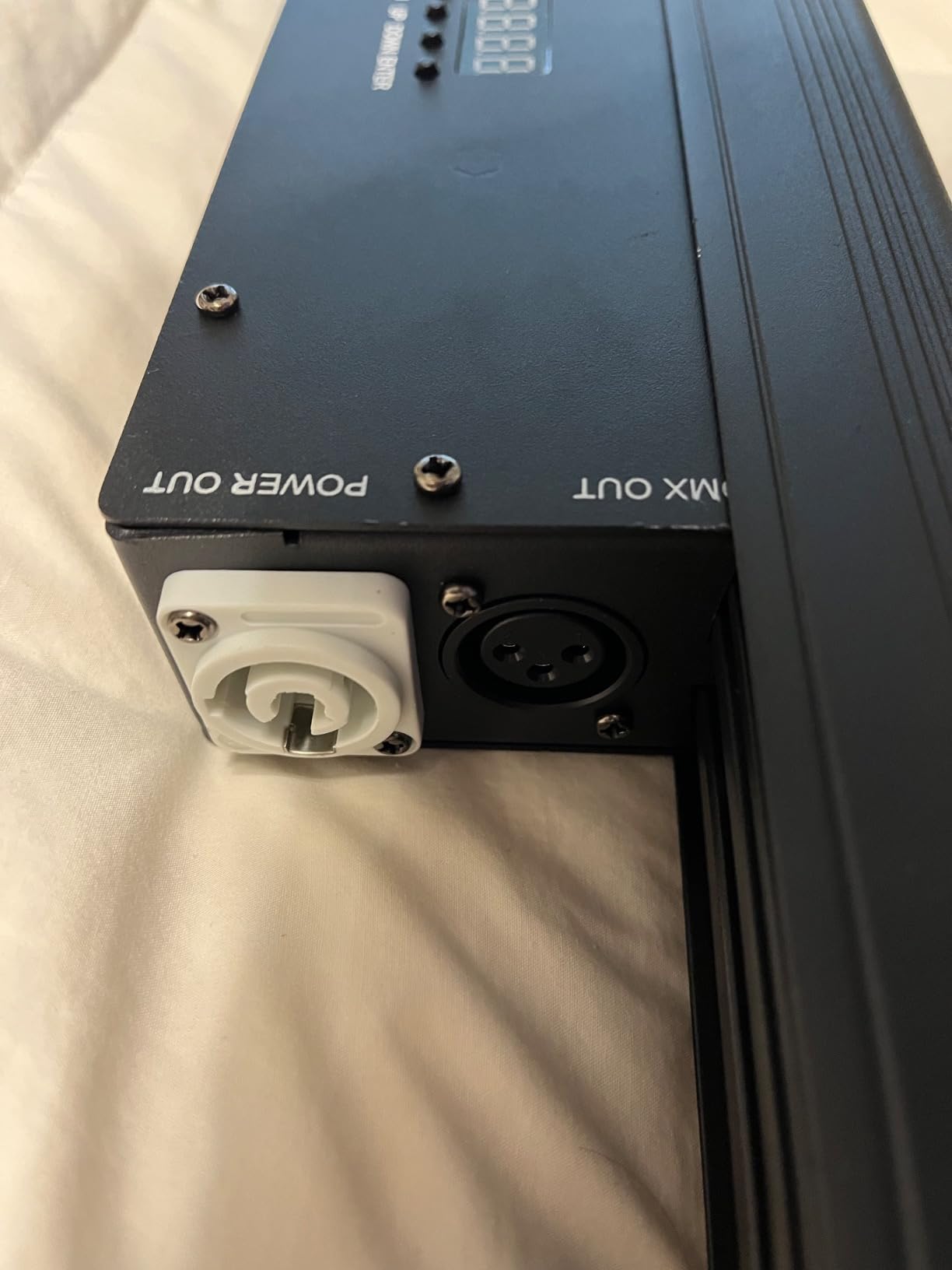
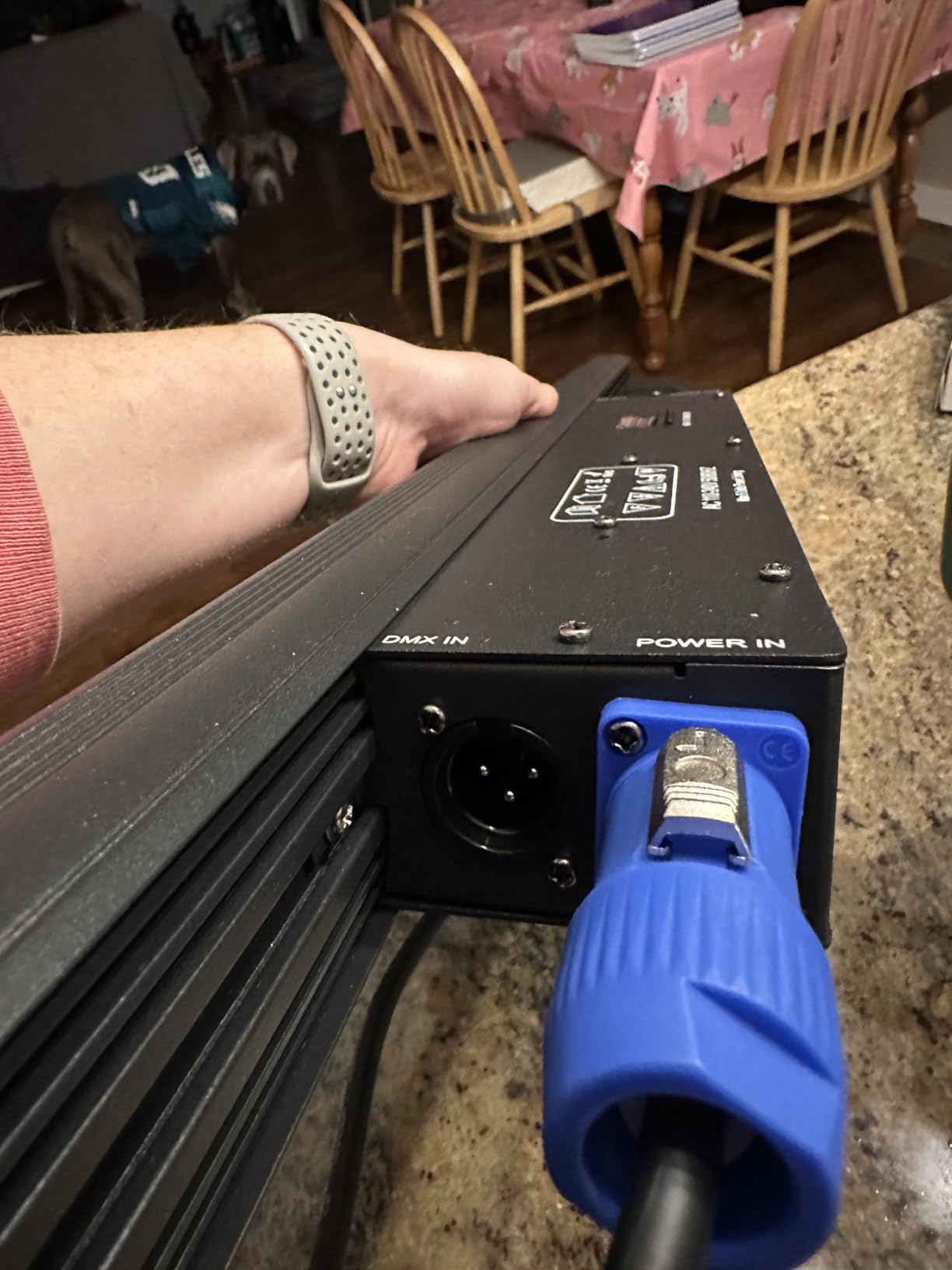
Power and logistics details matter here. The in and out connectors let you daisy-chain up to six fixtures, which is how you light a long back wall from a single outlet. Operating voltage is 110V to 240V, the cord is 3.4 ft, the aluminium shell handles heat dissipation, and the bar weighs 3.48 kg at 3.8 by 3.6 by 40 inches.
The trade-offs are physical. A 40 inch bar is awkward to carry and position in a genuinely small room, and the mounting is wall mount with limited flexibility for standing on the floor as a freestanding element.
Where it earns its place
It is the fixture for churches, small theatres and DJ rooms where the back wall or a lectern area needs light. Placing two bars either side of a stage and running a chase behind the performer is what creates the sense of depth that a front wash alone cannot give you.
Because it daisy-chains, it is also one of the few options here that works in a venue with very few power outlets.
Where it falls down
Do not buy it to light faces. The optics are for washing surfaces evenly, not for putting a controlled key light on a performer, and a 40 inch bar hung over a small stage ends up in the sightline of the front row.
Outside DMX, the effects are preset-heavy, so if you have no operator and no controller, you are running the same 114 programs forever. Pair it with remote-controlled PARs in front and this is a strong low-operator rig.
7. OPPSK 90W 60LED Par 2-Pack: Maximum Brightness per Fixture
OPPSK 90W 60LED Dimmable Stage Par Light by Remote & DMX Control – 2Pack
60 RGB LEDs per fixture
Up to 9000 lumens output
0.82A draw per can
Bracket mount, 3 lb each
Pros
- Exceptionally bright for the price class
- Quiet cooling fans that disappear under music
- Lightweight at 3 pounds per fixture
- One remote runs the whole pack
Cons
- Hardwired power cord rather than a detachable connector
- No dedicated white channel
- Knurled adjustment knobs lose tension quickly
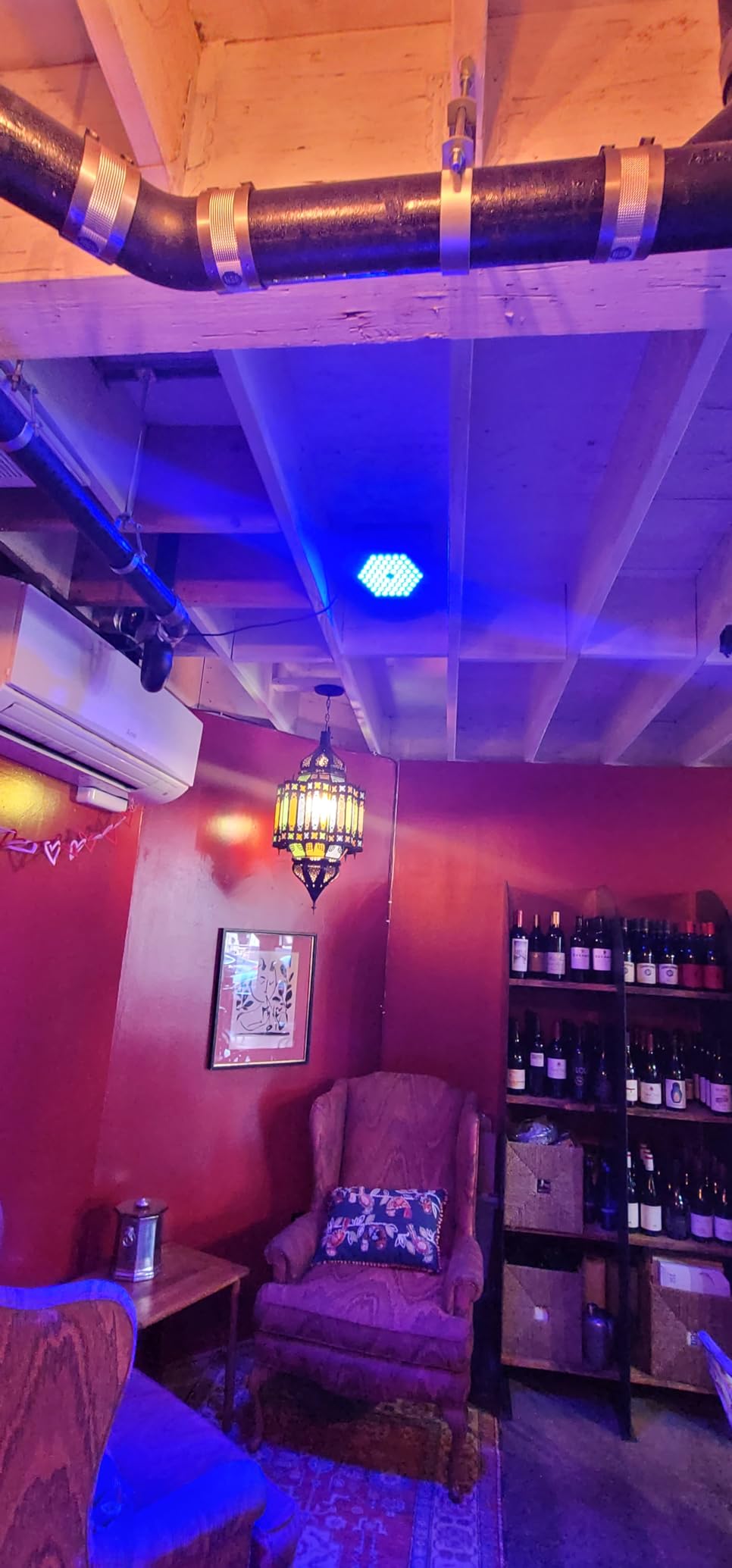
If your room has daylight in it, a dim coloured bar wall is wasted money, and brightness is the deciding factor. These cans put 60 RGB LEDs and up to 9000 lumens behind a 25-degree beam, and owners repeatedly compare them favourably against more expensive name-brand pars of the same class, sometimes describing them as brighter.
The 90W figure is the light source rating, not the wall draw. Each can pulls 0.82A at 110V, so a four-fixture rig is roughly 3.3A before anything else is plugged in, which is a useful number to know before you plan around a single power strip.
Modes cover auto, fade, strobe, jump and master-slave with sound activation, plus DMX512 and included IR remotes with a 3 to 5 m unobstructed range. Each fixture measures 8.7 by 2.4 by 10.4 inches, weighs 3 pounds, uses an ABS housing with a metal bracket, and carries a 12-month warranty.
Build is better than the price suggests, and owners report the fan noise disappearing under music playback, which is what you want in a live room. The criticisms are mechanical: the power cord is hardwired, the cord is short and often needs an extension, and the knurled adjustment knobs are cheap-feeling and lose tension.
Best used for
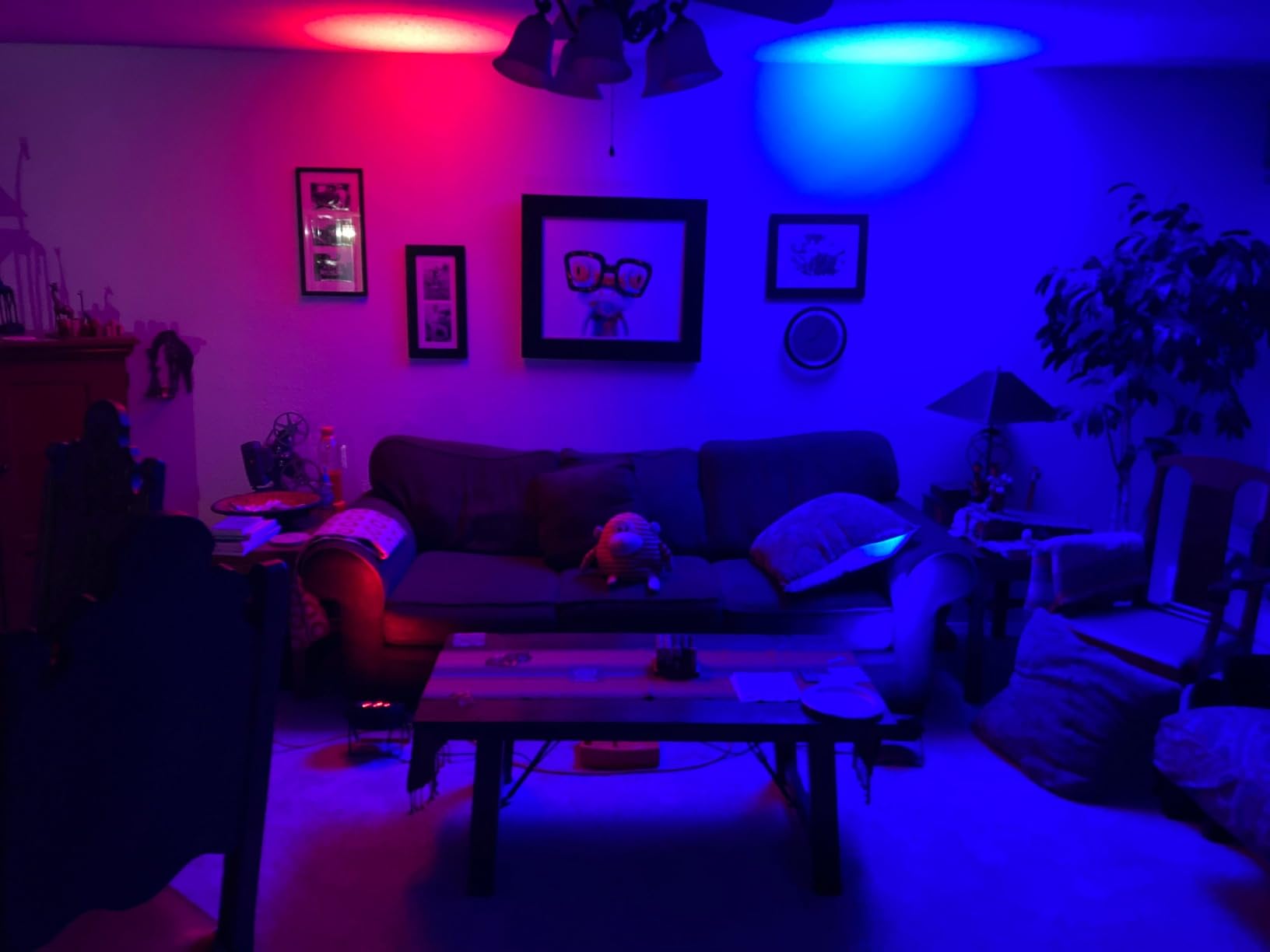
Bright, saturated front wash in a room that cannot be dimmed, or a stage in a community hall with high ambient light. Two of these plus the four-pack at number one gives you a six-fixture rig that covers almost any room under 16 feet wide.
Because they are light, they suit a mobile operator or a band carrying their own rig between gigs.
What to be careful about
There is no dedicated white channel, so white is produced by matching the RGB channels and it looks flatter than a true RGBW source. For photography or a livestream, that shows.
There is also no dedicated slave mode in the DMX channel map, which complicates mixing these with other OPPSK pars on one controller. If you plan to build up over time, keep the channel map consistent and buy from one product line.
8. YeeSite IP66 LED Wash Bar 2-Pack: The Outdoor and Patio Option
Yeesite LED Stage Wash Light Bar 2Pack for Outdoor Indoor Party
Two 48W wash bars
IP66 rated for -25C to 50C
120-degree beam
Bluetooth app and 90ft remote
Pros
- IP66 housing works outdoors in poor weather
- Colour temperature adjustable from 2700K to 6500K
- Bluetooth app groups several bars together
- Timer scheduling and memory function save setup time
Cons
- No DMX input so it cannot join a conventional rig
- Wall washer format rather than a stage front light
- 48W per bar is low for larger stages
Outdoor is the one venue type none of the other picks in this roundup can genuinely serve, and the IP66 rating on these bars is the reason. The housing is rated for weather and for operating temperatures between -25C and 50C, which covers a backyard stage, a patio or a pop-up in a season with real conditions.
Each bar mixes RGB with cool and warm white across a 2700K to 6500K range with 16 million colours and 27 effect modes. That adjustable white is genuinely useful for a venue that also lights a catering area, because you can match a warm white to existing house lighting rather than fighting it.
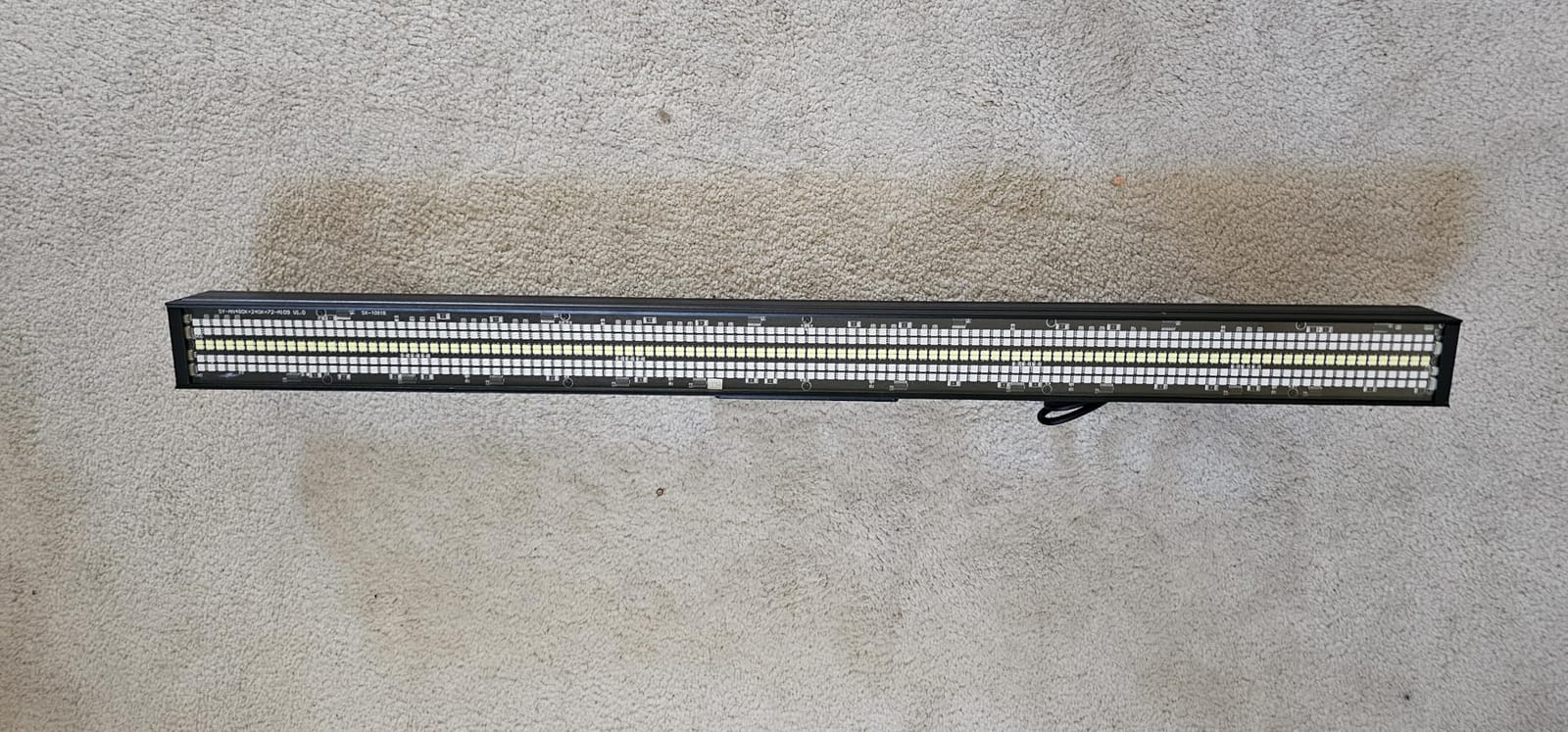
Control is app and remote rather than DMX. Bluetooth app control reaches 20 m, the remote reaches 90 ft, and the app can group up to 10 bars on iOS or 8 on Android. Music sync works through app playback or the phone microphone, and there is timer scheduling plus a last-setting memory function, which is exactly what you want for a recurring event.
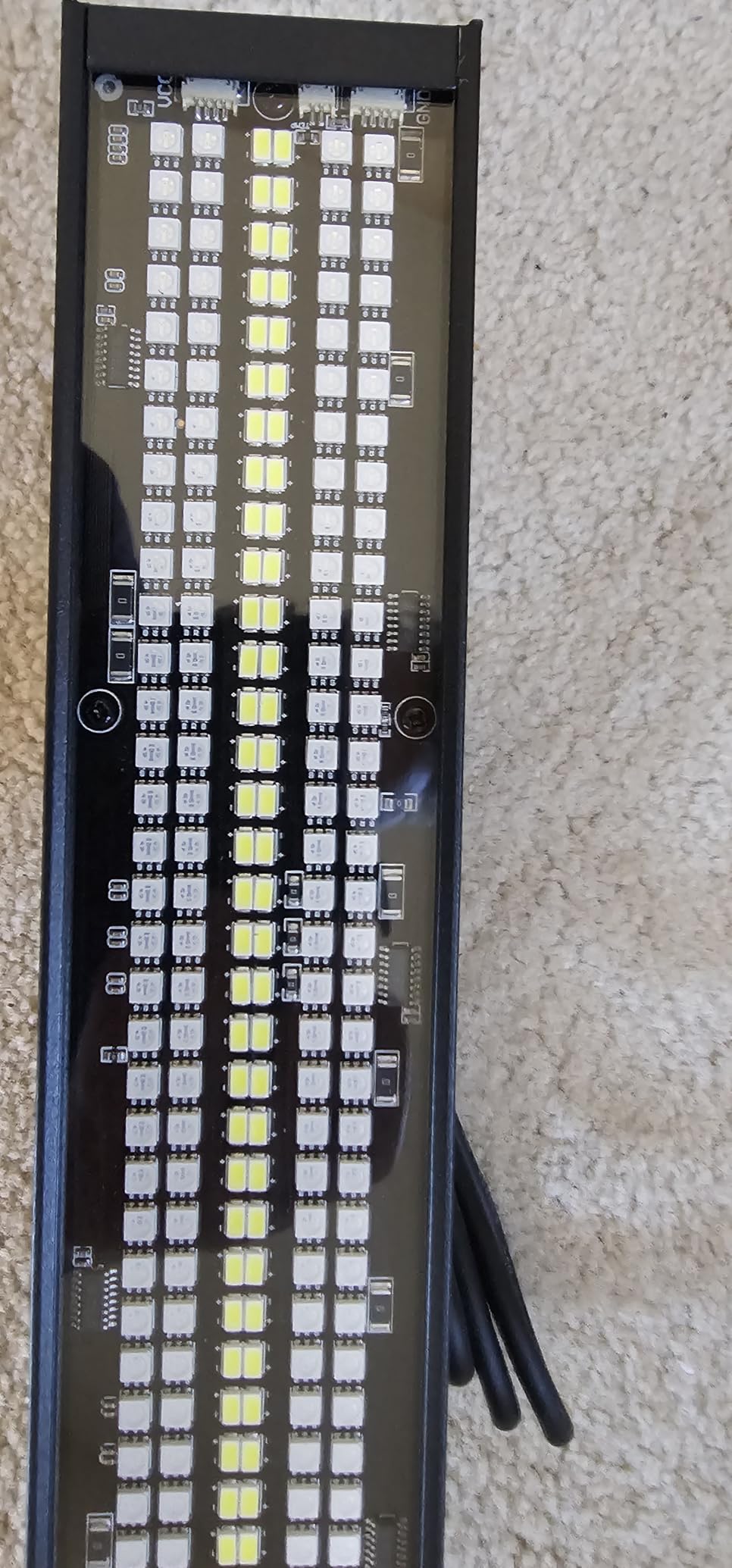
Each bar is 48W, 17 by 7.5 by 2 inches and 1.5 kg, in an aluminium housing with a wide 120-degree beam. The box includes two bars, four stands, a remote and a manual, with a 12-month warranty and a rated 50,000 hour lifespan.
Best used for
Outdoor stages, patios, garden events and architectural backdrops where weather is the deciding factor. The included stands mean a pop-up stage needs no truss and no rigging knowledge, which is a real saving on a one-night event.
It is also a good streaming and content studio bar, where a wide wash and tunable white matter more than beam control.
Why it is not a stage instrument
There is no DMX input, so these cannot be integrated into a conventional lighting run and will not sync with the PARs on your front stage. That is fine if they are standalone, and frustrating if you already own a small rig.
At 48W per bar the manufacturer itself notes the output is low for larger stages, so two bars light a patio well and a covered stage poorly.
9. OPPSK 70W 7LED RGBWA Stage Par: The Best Single Can for Hybrid Rooms
OPPSK 70W 7LED RGBWA Stage Par Lights by Remote & DMX Control
7 x 10W RGBWA LEDs
25-degree beam with 15m throw
Nine DMX channels across nine modes
Power daisy-chain for 6 to 8 fixtures
Pros
- Colour stays consistent across a large rig
- Nine DMX channels plus sound-activated mode
- Power in and out cut the number of power strips
- Light enough to rig without heavy truss
Cons
- Constant fan is audible in quiet rooms
- IR remote cannot dim
- Fixture snaps to sound mode if DMX drops
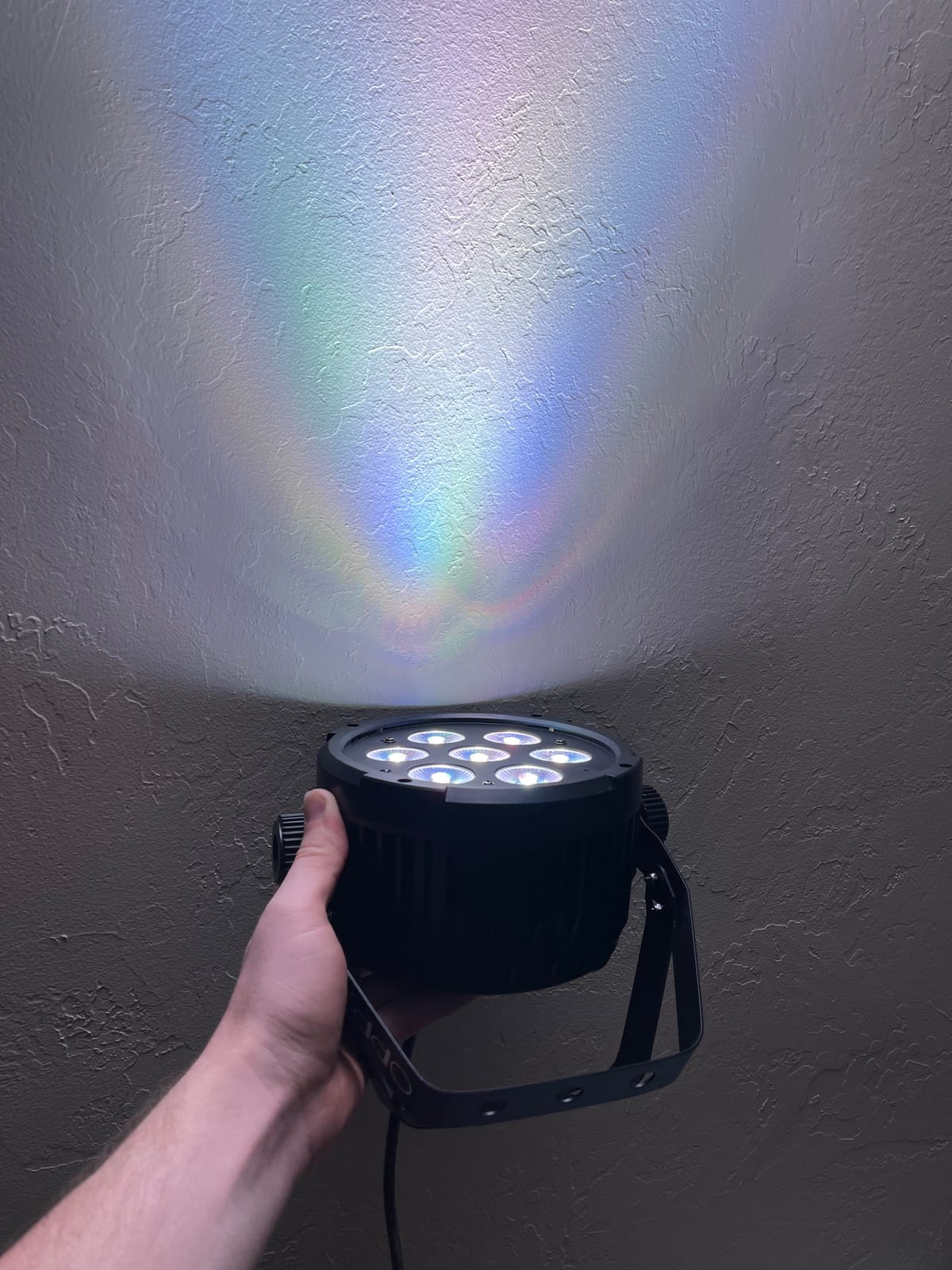
Two things separate this can from the cheaper RGB PARs: a dedicated white channel, and power linking. The RGBWA engine gives you proper white output rather than white mixed from RGB, which is what makes it usable for a service, a recital or a livestream, and the in and out connectors let you daisy-chain 6 to 8 fixtures so one outlet serves the whole rig.
Long-term owners report two to three years of reliable use and single out colour consistency across a large rig as the standout feature, which is exactly the problem forum users raise when they mix brands and end up with visible tint differences between fixtures. Long-term consistency is a real, verifiable advantage here.
Specs: 7 x 10W high-intensity RGBWA LEDs, 25-degree beam, up to 15m throw, 9 DMX channels across 9 operational modes, DMX512 and IR remote control, a 4-button LED display, and flicker-free operation for video. The body is 2.4 pounds and 6.69 by 6.69 by 3.94 inches, with truss, wall and floor mounting options and a 1-year warranty.
It also covers the highest BSR in the stage lights category of anything in this list, so a lot of owners have bought it. The consensus caveat is the constant cooling fan, which is audible in a quiet room, and the fact that the IR remote cannot dim, so dimming needs a DMX controller.
Why hybrid rooms should buy this
A church, a chapel or a community hall that runs a service on Sunday and a band on Saturday needs the same fixtures to do two jobs. A true white channel handles the service and the spoken word, and colour handles the band, without changing fixtures between them.
Because the beam throws up to 15m, one can covers a raised stage in a hall that has no lighting position, which is a common situation in rented community spaces.
Where it annoys people
The constant fan is the top complaint, and it matters in a room where the first speaker is a violin. If your quiet program is the priority, weigh this against the compact COB can at number ten, which stays cool and nearly silent.
There is also an annoying failure mode: if the DMX signal drops, the fixture snaps into sound mode and needs a power cycle to return. And the blinking address display is distracting enough that owners mask it with tape, so plan for that if the fixture is visible from the audience.
10. JLPOW 15W Mini COB Par: The Smallest Useful Light in the Roundup
Stage Wash Light, JLPOW Super Bright Mini COB Par Can Lights with DMX and Remote Control, Smooth RGB Color Mixing DJ Up Lighting, for Wedding/Birthdays/Christmas Party Show Dance Gigs Bar Club Church
15W COB LED source
6-channel DMX
4.8 inch body at 1.2 pounds
Up to 10000 hour LED life
Pros
- Compact and light enough for a tabletop or carry bag
- Bright 15W source for a small room
- Runs cool with little heat output
- Remote can change the DMX address
Cons
- DMX mode can drop out after 10 to 15 minutes
- Fan whine is audible in quiet rooms
- No power daisy-chain and a short cable
At 4.8 inches across and 1.2 pounds, this is the fixture for a stage made of a rug, a table and a laptop, and for anyone who genuinely cannot carry a full rig. Owners describe it as roughly 90 percent lighter than a conventional par, and it stays cool during operation, which matters when you are setting up in someone’s front room.
The 15W COB source gives smooth RGB mixing with no camera flicker, and it runs 6-channel DMX alongside voice-activated, auto and master-slave modes. Several owners have modified theirs with a heatsink or a different power connector, which tells you how much they like it despite its limits.
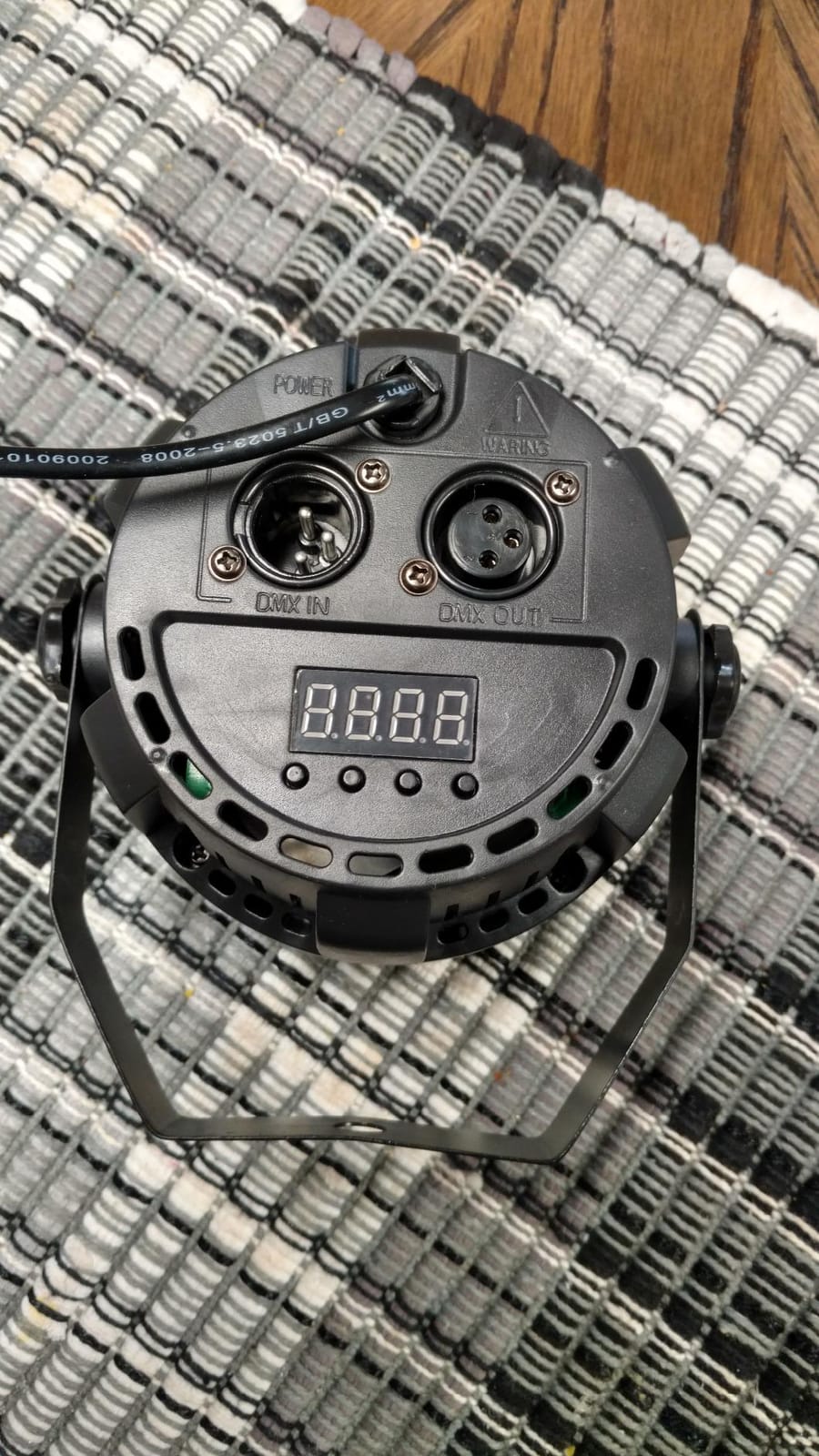
Physical details: 15W light source, PVC housing with an ABS and metal shade, floor mount, corded power, a colour rendering index of 80, a 4.8 by 4.8 by 3.6 inch body at 1.2 pounds, and a rated LED lifespan of up to 10,000 hours. No manufacturer warranty is listed, so treat it as a consumable accessory rather than an investment.
It is used for karaoke, church and small solo performances, which is the honest range. A single can will not light a band, and the colour transitions around the colour wheel are hard rather than smooth when you fade.
Where it is the right tool
It is the right pick for a content creator, a pop-up acoustic set, a market stall stage or a venue where storage space is measured in a cupboard. It also works well as an accent or fill light around a main rig rather than as your primary front wash.
Remote and sound-activated operation is reported as reliable and responsive, so if you only ever run it in those modes, the DMX weakness may never touch you.
Where it falls down
The serious documented issue is DMX instability. Multiple reviews report the fixture dropping out of DMX mode after 10 to 15 minutes and needing a full power cycle to recover, which is disqualifying if you plan to run it from a controller.
There is no power daisy-chain, the cable is short for hanging from a light stand, and some owners note a high-pitched LED whine in quiet rooms. At 15W the output is also modest, with several owners explicitly wishing for a brighter version.
How Many Lights Does a Small Venue Actually Need?
Three to six fixtures covers almost every small venue. A stage 6 to 10 ft wide needs three: two front, one back. A stage 10 to 16 ft wide needs four to five, adding a second backlight or a side fill. Beyond 16 ft wide you are into six or more, and at that point you should be counting watts and circuits rather than fixture types.
The universal starting point, and the answer given most often in operator discussions, is four RGBW LED PAR cans: two front, one back, one for colour or effect. That configuration covers faces, gives depth, and leaves a spare.
Ceiling height is the hard constraint. Under 10 ft, use PARs and bars only, because a moving head cannot throw a usable beam angle before it hits the floor. At 11 to 12 ft and above, compact moving heads become viable. This threshold is the single most useful number in the whole category, and it is the one most often left out of buying guides.
For placement, the three-point setup is the standard: a front key light, a fill from the side to open the shadows the key creates, and a backlight to separate the performer from the background. The 3-point rule, sometimes called the 3 lighting rule in forums, is simply that arrangement. Aim the two front fixtures at roughly 45 degrees from each side, above head height, so faces are lit evenly and nobody grows a chin shadow.
On the height question people keep asking about, the useful version of the 5 foot 7 inch rule is that front fixtures should sit above the tallest performer’s eye line but below the ceiling, usually with the head of the stand between 4 and 5 ft for a seated or acoustic performer in a low room. Mount any higher and the light comes down on the top of the head; mount lower and you get shadows under the eyes. For a standing band, the same rule scales up by roughly 6 inches per foot of performer height.
Power is the planning step people skip. Add up the labelled amperage of every fixture, divide by the circuit capacity of the venue outlet, and keep 20 percent headroom. A four-fixture PAR rig at 0.82A per can is around 3.3A, which is unremarkable; add a moving head at 70W and a 120W wash bar and you are near 2.5A more on the same circuit. Fixtures with power in and out connectors, like the wash bar at number six and the RGBWA can at number nine, cut the number of power strips you need in a venue with two outlets.
Used gear is the budget route forum users recommend most often, and it is worth taking seriously. Compact spotlights and wash bars from established lighting lines turn up secondhand at a fraction of new cost, and the search term people use is simple: know the model number and check the DMX channel map before you commit. The one rule forum operators repeat is to avoid mixing fixture brands inside a single DMX run, because channel maps do not match and you end up debugging instead of performing.
Remote, Sound-Activated or DMX: Who Actually Runs the Lights?
Buy the control system that matches your staffing, not the one that sounds most professional. If a member of staff will stand at the desk for every show, DMX. If someone has to run the lights between setting up chairs and serving drinks, sound-activated. If the venue has a rota of volunteers who change every week, remote control.
Sound-activated mode reads the beat and changes colour and speed automatically. It needs no operator at all, which is why it is the default recommendation for small venues, and the fixtures here all include it. The catch is that a microphone also picks up claps, conversation and chair scraping, so sensitivity matters and a room with a talkative audience will look chaotic.
DMX is a digital control protocol that lets one controller run many fixtures with precise control of colour, dimming and movement. It is the right investment once you are running several different event types a month or you have a moving head in the rig, because it is the only way to dim smoothly, cue changes and mix a wash with a beam. The learning curve is real, and the recurring complaint from forum users is that they bought movement and had to learn DMX to get it.
Remote and IR control sits between the two. It is instant and requires nothing, but on several fixtures here the remote range is short, and IR can confuse fixtures in a larger setup, which is why operators recommend DMX above about four lights.
Practically, most small venues end up in a mixed rig: remote or sound-activated fixtures doing the front wash that nobody touches, and DMX fixtures on a controller for the parts of the set that need a cue. That is a sensible split and it is how several of the picks in this roundup are meant to be used together.
Colour, Scenes and Safe Operation in a Tight Room
Light faces in warm white and let colour do the mood. Amber and warm white suits acoustic instruments, spoken presentation and anything being photographed, because it flatters skin tone. Saturated colour in your face wash is a choice, not a default, and it is the fastest way to make a small room look like a nightclub rather than a listening space.
When you do use colour, a simple colour wheel approach beats random combinations. Complementary pairs, which sit opposite each other on the wheel, create the highest contrast. Triads of three evenly spaced colours create variety without clashing. Adjacent colours create calm, unified scenes. Monochromatic scenes, one hue at different brightness levels, look expensive and are the safest choice for a venue running mixed content.
Colour temperature matters more than people expect. Mixing 2700K warm white and 6500K cool white in the same frame, which happens the moment you combine the wash bar at number eight with a cool white PAR, gives you a visible tint difference that reads as a fault. Match your white temperatures across every fixture in the room, which is another argument for buying from one product line.
On strobes, keep the flash rate low enough to stay within accepted safety guidance, which treats more than four flashes per second as a seizure risk. If you use the strobe functions on any fixture in this roundup, warn the audience, keep the option off during open mic and spoken word segments, and check your venue policy before you run a strobe at all.
Haze makes beams visible and is the cheapest way to make a small room look professional, but it trips fire alarms and breaches venue policy more often than any other accessory. Ask before you buy, and never run fog in a room with a hard ceiling and a smoke detection system you have not checked. It also settles dust and turns a room filthy within a few weeks if you use it every night.
Finally, heat and cabling. LED fixtures run cool compared with halogen, but a moving head still needs air movement around its base, so do not box it into a sealed alcove. And in a small room the cables are the first thing the audience sees, so route them along the back wall or under the stage edge and use the fixtures with power in and out connectors to reduce the number of runs across the floor.
Frequently Asked Questions
What are the best stage lights for a small stage?
RGBW or RGB LED PAR cans for front wash, one or two backlights or a wash bar for depth, and compact moving heads only if your ceiling is 11 ft or higher. Three to six fixtures covers almost every small venue, and warm white should light faces while colour handles mood.
How many lights do I need for a small stage?
Three lights for a stage 6 to 10 ft wide, four to five for 10 to 16 ft, and six or more beyond 16 ft. The common starting point is four RGBW LED PAR cans: two front, one back, one for colour or effect.
What is the 5 foot 7 inch lighting rule?
Front fixtures should sit just above the tallest performer’s eye line. For a seated or acoustic performer in a low room, a stand head between 4 and 5 ft usually works. Mount higher and the light falls on the top of the head; mount lower and you get shadows under the eyes.
What is a 3-point lighting setup for a stage?
A key light, a fill light and a backlight. Aim two front fixtures at about 45 degrees from each side, above eye level, to light faces evenly without chin shadows, then place a fixture behind the performer to separate them from the background and add depth.
What is the best angle for stage lighting to maximize visibility?
About 45 degrees from the front on each side, with the fixture heads above the performer’s eye line. This crosses the light across the face so both sides read evenly. Straight-on frontal light flattens faces, and uplights alone wash out features.
The Best Stage Lighting for Small Venues in 2026
The OPPSK 36W 36LED four-pack is the fixture I would buy first for stage lighting for small venues. Four matching cans cover the front, the back and an effect, they run DMX when you outgrow the remotes, and the feedback behind them is the deepest of anything in this roundup. Add the LaluceNatz wash bar behind the stage for depth and you have a complete, operator-free rig.
If you need to move, take the pair of UKing cans and the Telbum bar with its tripod. If your ceiling is 11 ft or higher and you want movement, the ZKYMZL gobo head is the quiet one to buy. If your stage is outside, the YeeSite IP66 bars are the only weather-rated option here.
Measure the room first, count the outlets second, and only then pick fixtures. Most disappointing small venue lighting is not a bad purchase, it is a good purchase hung in the wrong room.