
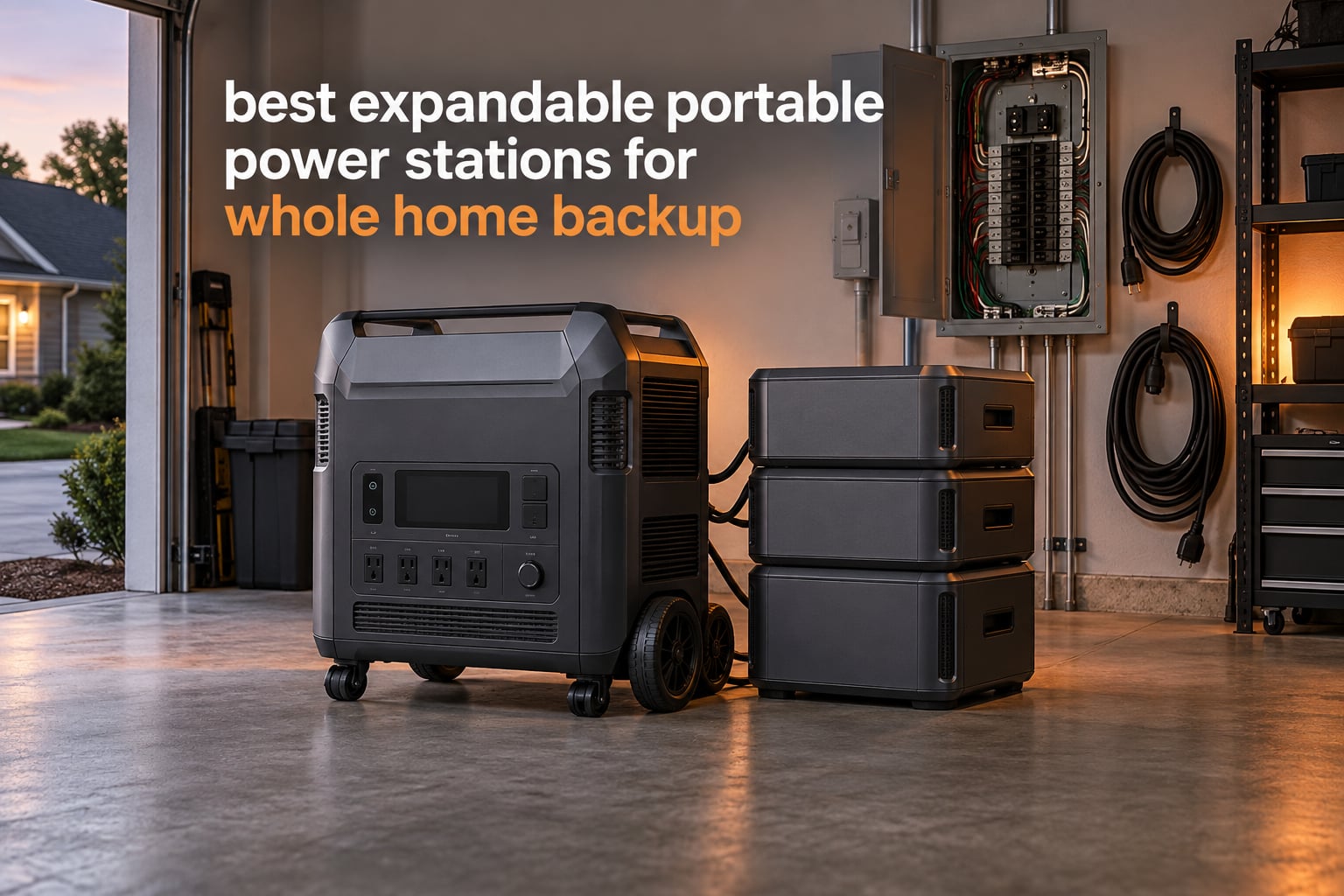
A power outage rarely ends when the storm does. The grid comes back in an hour or two, then fails again that night, and again the next afternoon, and suddenly the question is no longer whether you have backup power but how many days of it you can afford to sit on. That is the entire reason to buy an expandable portable power station for whole home backup instead of a fixed-capacity unit: the base box you buy today can grow to ten, twenty, or forty kilowatt-hours over the next five years without you replacing the inverter, the wheels, or the wiring plan.
We spent weeks going through specifications, review histories and forum threads to build this list of the best expandable portable power stations for whole home backup in 2026. Every model here has a documented path to add capacity with the manufacturer’s own expansion batteries. That filter matters, because plenty of popular portable power stations are physically closed to expansion, and buyers discover that fact after the box is already open. We also sorted on the two numbers that decide whether a unit actually keeps a house running: continuous inverter output in watts, and usable battery capacity in watt-hours.
The short version of what follows: the EcoFlow DELTA Pro 3 with its extra battery is the one we would build a multi-day system around, the Anker SOLIX F3800 is the strongest choice if you need to run a dryer or water heater, and the AFERIY 3,840Wh gets you the most usable capacity per dollar without leaving the value tier. Everything else earns its place for a specific household situation, and we say which one.
Table of Contents
Top 3 Picks for Whole-Home Backup (October 2026)

EcoFlow DELTA Pro 3 + Extra…
- 4096Wh LFP expanding to 48kWh
- 4000W continuous output
- 120V and 240V dual voltage
- 10ms UPS switchover

EcoFlow DELTA Pro 3,600Wh
- 3600Wh expanding to 25kWh
- 3600W output and 7200W paired
- 15 output ports
- 1.8 hour recharge on 240V

AFERIY 3,840Wh
- 3840Wh expanding to 11.5kWh
- 3600W continuous and 7200W peak
- Under 10ms UPS
- UL Listed
Before the long version, here is the shortlist. We balanced rating against review volume, expansion headroom, and whether the unit can handle a 240V circuit without a second inverter.
Each of these three carries the same core advantage: LiFePO4 cells, a documented expansion path, and a fast enough recharge that you can refill it from a gas generator or solar during the outage rather than after it.
Quick Overview: All 10 Expandable Power Stations in 2026
All ten units below are genuinely expandable. The expansion ceiling column is the single most useful number here, because it tells you whether the unit you are pricing today can still grow into a three-day system later.
| Product | Specifications | Action |
|---|---|---|
|
EcoFlow DELTA Pro 3 + Extra Battery
|
|
Check Latest Price |
|
EcoFlow DELTA Pro 3,600Wh
|
|
Check Latest Price |
 Anker SOLIX F3000 Bundle
|
|
Check Latest Price |
|
AFERIY 3,840Wh
|
|
Check Latest Price |
 Jackery HomePower 3600 Plus
|
|
Check Latest Price |
 Anker SOLIX F3800
|
|
Check Latest Price |
 ABOK Ark3600 Bundle
|
|
Check Latest Price |
 GROWATT HELIOS 3600
|
|
Check Latest Price |
 Jackery 5000 Plus
|
|
Check Latest Price |
 EcoFlow DELTA 3 Ultra Plus
|
|
Check Latest Price |
Two patterns jump out. First, the capacity ceiling splits the list in half: five of them stop below 25kWh and five reach 25kWh or beyond. Second, wattage and capacity are engineered separately, so the heaviest units are not always the largest.
1. EcoFlow DELTA Pro 3 with Extra Battery – 4,096Wh Expanding to 48kWh
EF ECOFLOW 8kWh Portable Power Station: DELTA Pro 3 with Extra Battery
4,096Wh LFP
Expands to 48kWh
4,000W continuous
120V and 240V
10ms UPS
188 lb
Pros
- Runs as low as 30 dB in quiet mode so it can sit indoors
- 10ms switchover keeps NAS and servers running through outages
- 48kWh ceiling supports 2-4 days of whole-home backup
- 5-year warranty with IP65-rated battery pack
Cons
- Expansion batteries cannot be charged independently
- 188 lb is a two-person carry up stairs
- App discharge floor occasionally ignored
This is the configuration we keep coming back to. The bundle arrives as two boxes, the DELTA Pro 3 and an extra battery, so you begin at roughly 8kWh of storage rather than the 4,096Wh base, which is already most of what a refrigerator, router and medical device need for a full day.
The inverter is where this unit separates itself. Continuous output is 4,000W, it reaches 6,000W with X-Boost enabled, and EcoFlow documents scaling to 12,000W, so a three-ton central air conditioner or a one-horsepower water pump is within reach on a 240V circuit from a single box.
Owners consistently describe the build as solid and well packed. One reviewer framed it simply as built like a tank, which matches the IP65-rated CTC pack and the five-year warranty.
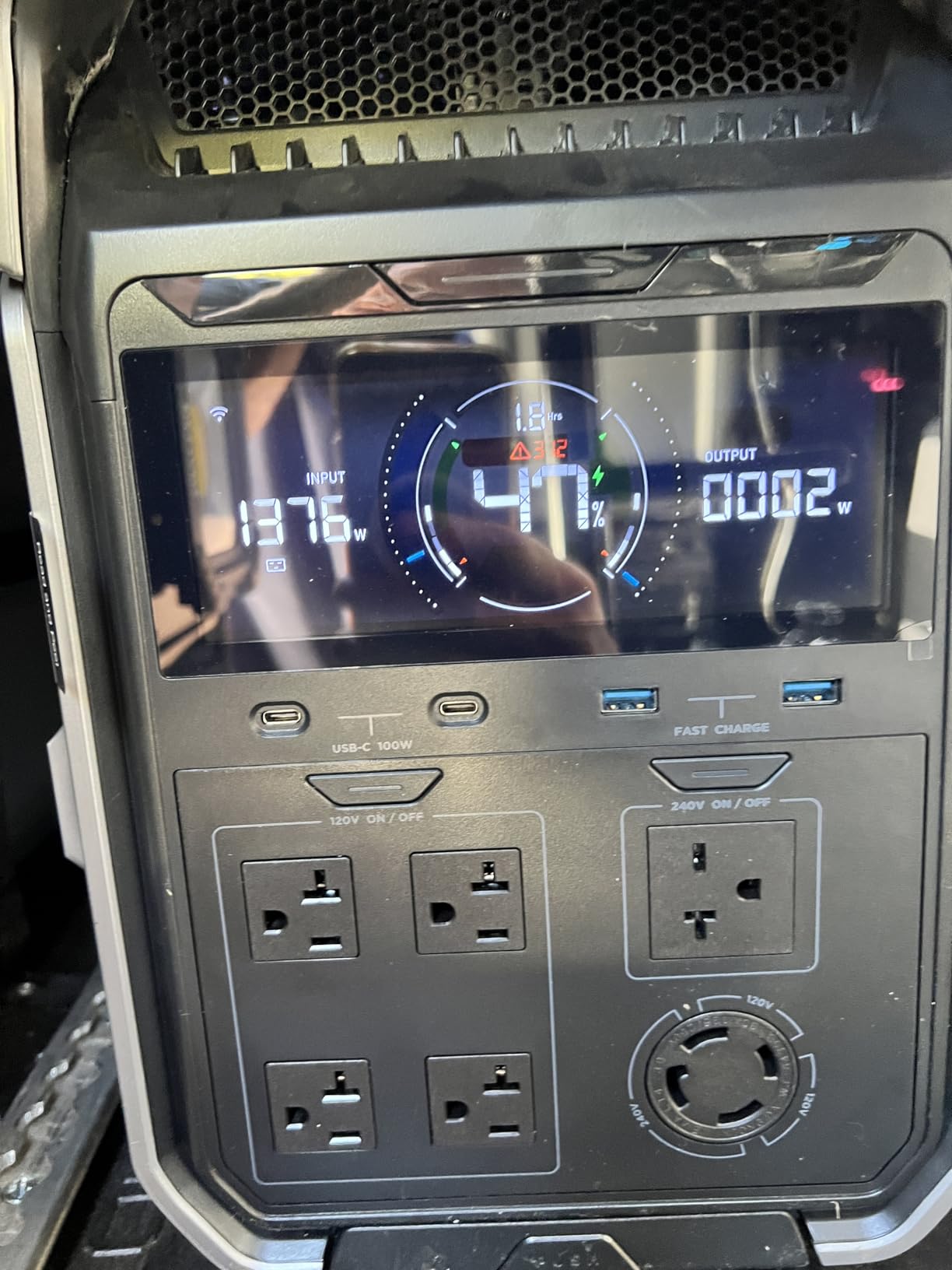
The 10ms switchover is the sleeper feature. That is fast enough that a NAS, a home server or a network switch does not reboot when the grid drops, which matters if anyone in the house works from home or runs anything with local data on it.
Charging flexibility is broad: wall outlet, solar, gas generator, EV charging pile, and the EcoFlow smart home panel. That generator option is the practical answer to a long outage, because a small gas generator charging a 4kWh pack in an hour resets a day of runtime.
Noise is the detail that gets the most praise from owners who did not expect it. At as low as 30 dB in quiet mode, several people report running it beside a bed through the night without complaint.
Who this is sized for
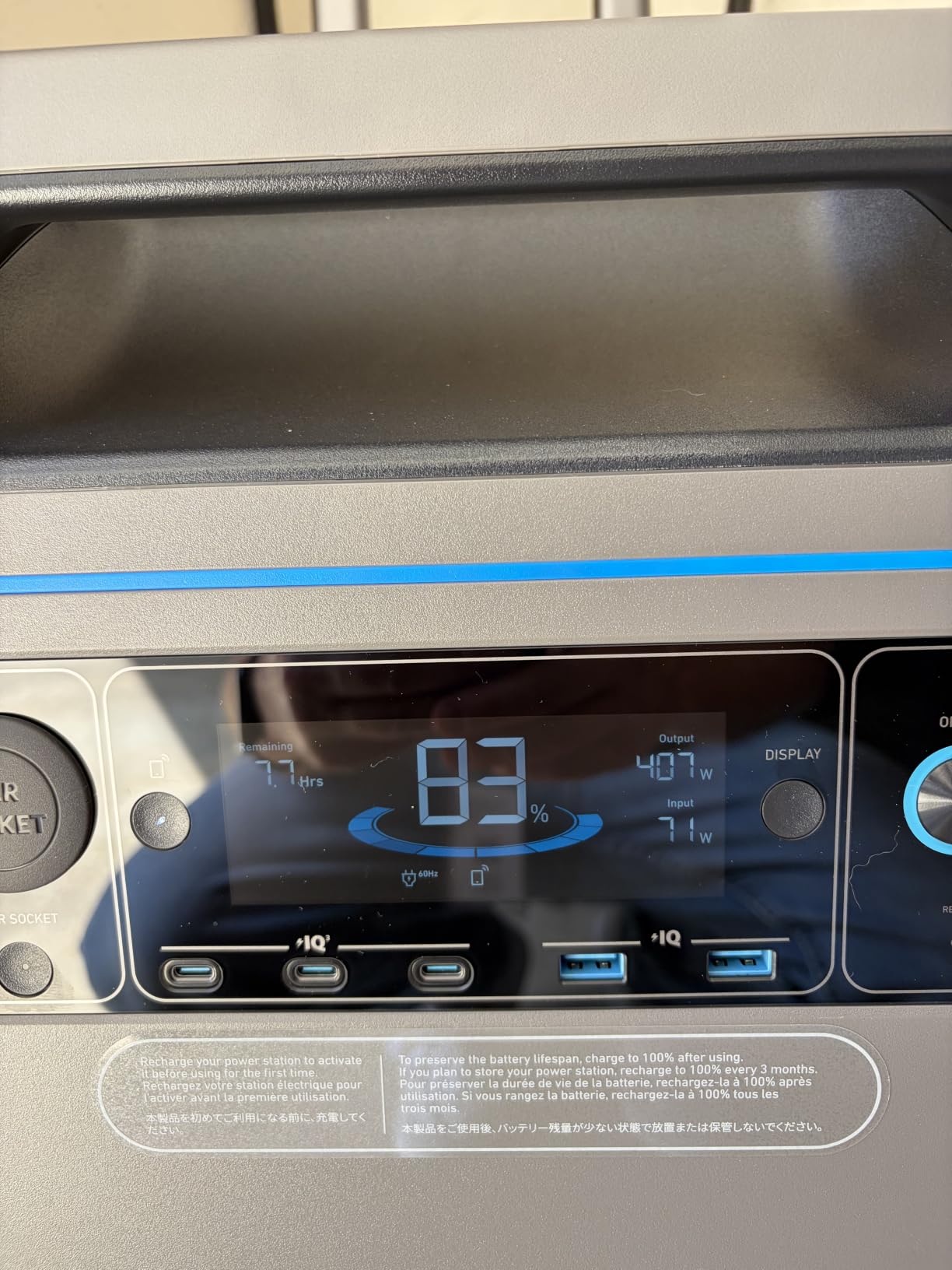
This is the unit for someone who has done the math and knows they want days, not hours. If your load list includes a refrigerator, a freezer, internet equipment, a CPAP or other medical device, a well pump, and some lighting across two or three days, 48kWh of headroom is the difference between a system and an apology.
It also suits anyone who needs genuine 240V from a single unit rather than pairing two stations. Households with a central air conditioner, an electric water heater, or a three-phase-adjacent well pump setup are the natural owners of this box.
Where it falls short
The 188 lb weight is real. Owners mention the wheeled handle, but this is a two-person job on stairs and it does not roll itself across a garage threshold.
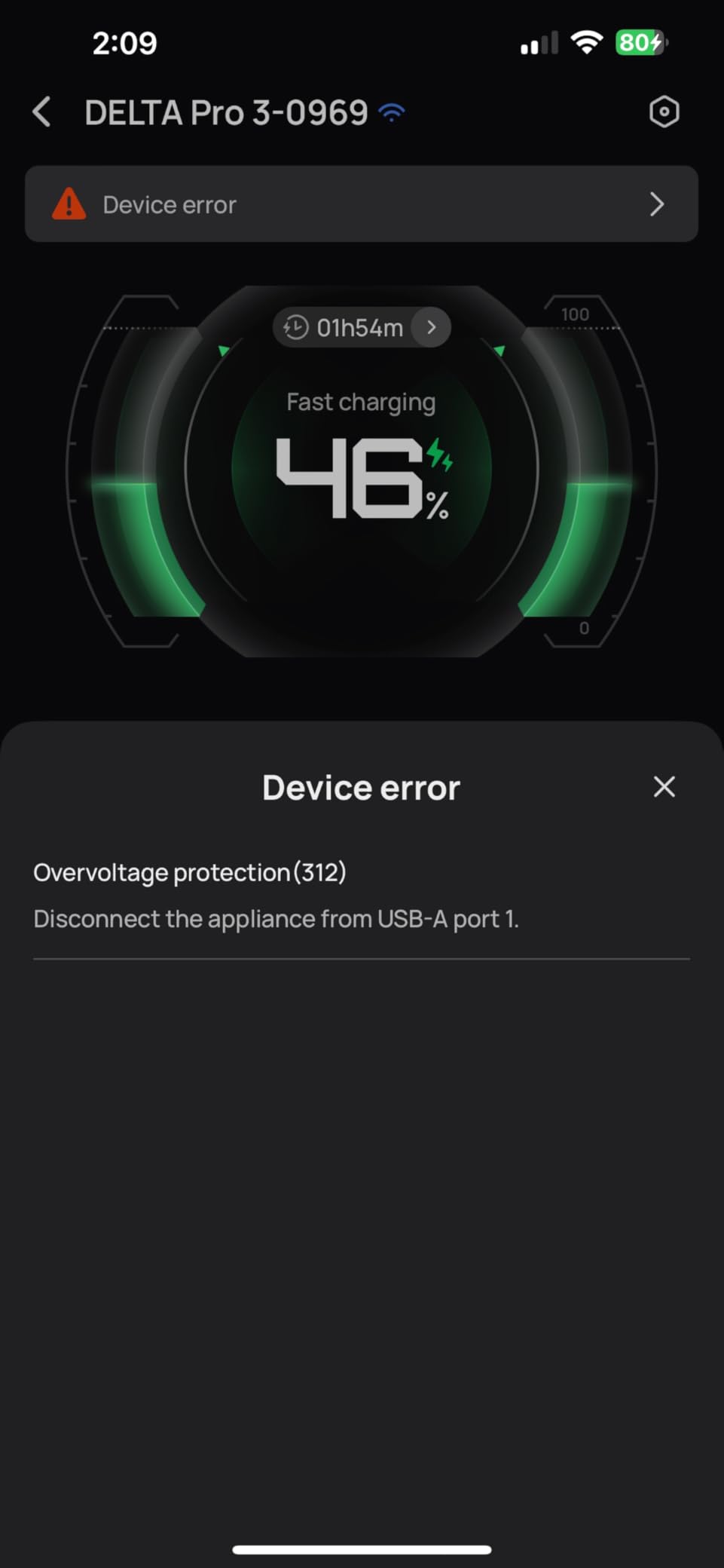
Two firmware complaints recur: some owners report the app-issued discharge floor occasionally being ignored so the pack drains past the level they set, and a few describe rare 120V dropouts. Separately, expansion batteries cannot be charged on their own, which means every added pack must be charged through the main unit.
2. EcoFlow DELTA Pro 3,600Wh – Most Reviewed Backup Station Here
EF ECOFLOW Portable Power Station 3600Wh DELTA Pro, 120V 3600W AC Output
3,600Wh LFP
Expands to 25kWh
3,600W continuous
15 ports
99 lb
Pros
- Largest review pool in the round at 652 ratings
- Full recharge in 1.8 hours on a 240V outlet
- Handles heat presses and AC units with no voltage drop
- Expands from 3.6kWh to 25kWh
Cons
- Solar input limited to roughly 15 amps
- 99 lb needs the extendable handle
- Some buyers report limited warranty support outside the US
With 652 ratings, this is the most battle-tested unit on the list by a wide margin, and that matters more than it sounds. When a firmware update lands or a component revision happens, a large installed base tends to get faster fixes and better documentation than a newer model with a thin review history.
The core spec sheet is 3,600Wh of LiFePO4 storage expanding to 25kWh, with 3,600W continuous AC output, 4,500W using X-Boost, and 7,200W when two units are paired. Fifteen output ports cover 120V household needs without any adapter hunting.
Recharge speed is the quiet star here. A full recharge takes about 1.8 hours on a 240V outlet, 2.7 hours on a 1,800W wall outlet, and 2.8 hours with four 400W solar panels, which is what makes an overnight refill between outage windows realistic.
Owners in outage-prone regions report running refrigerators, furnace blowers, internet and computers off this unit and topping it up from a gas generator. Business users running vendor equipment praise the stable output under sustained load.
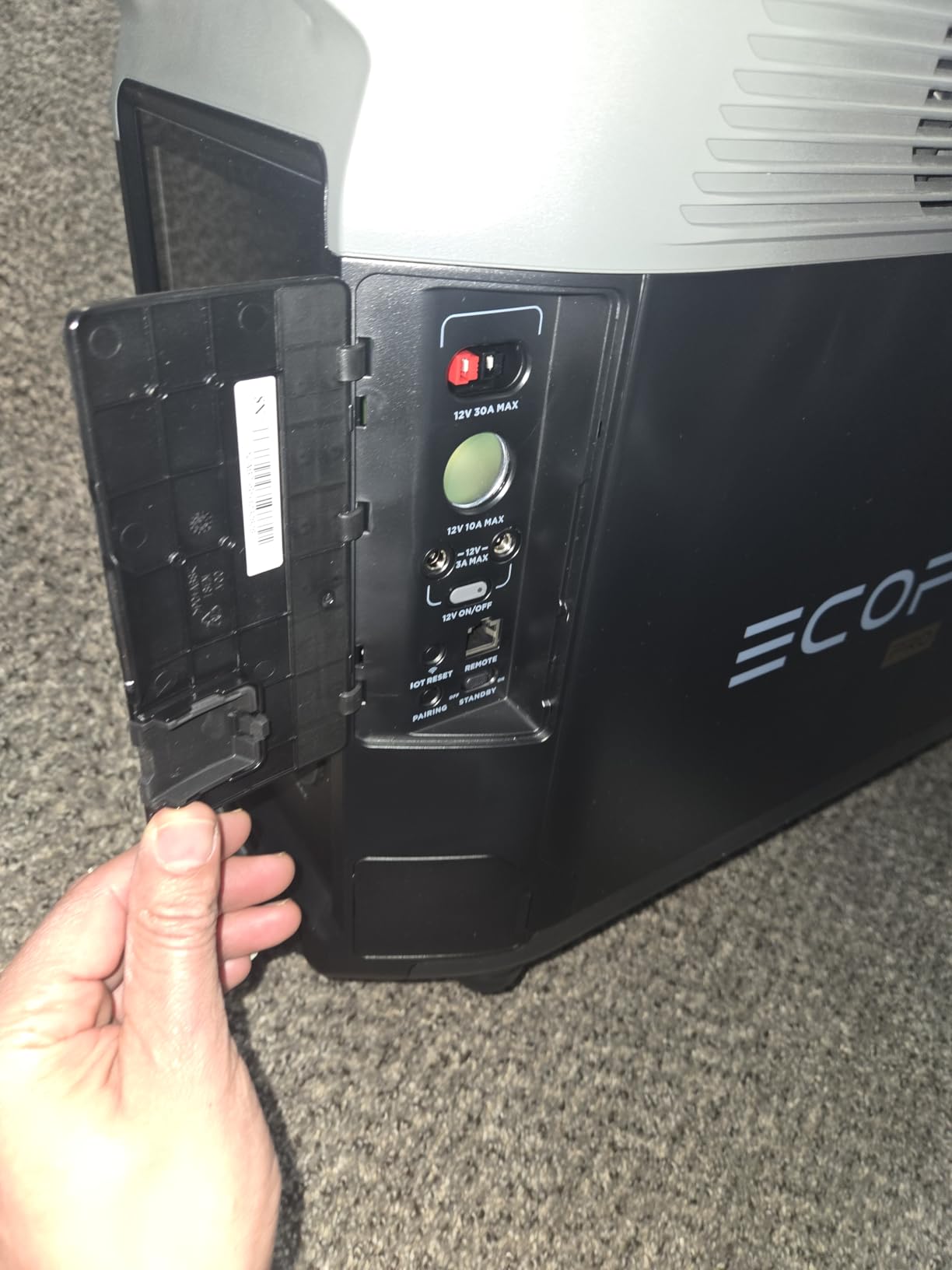
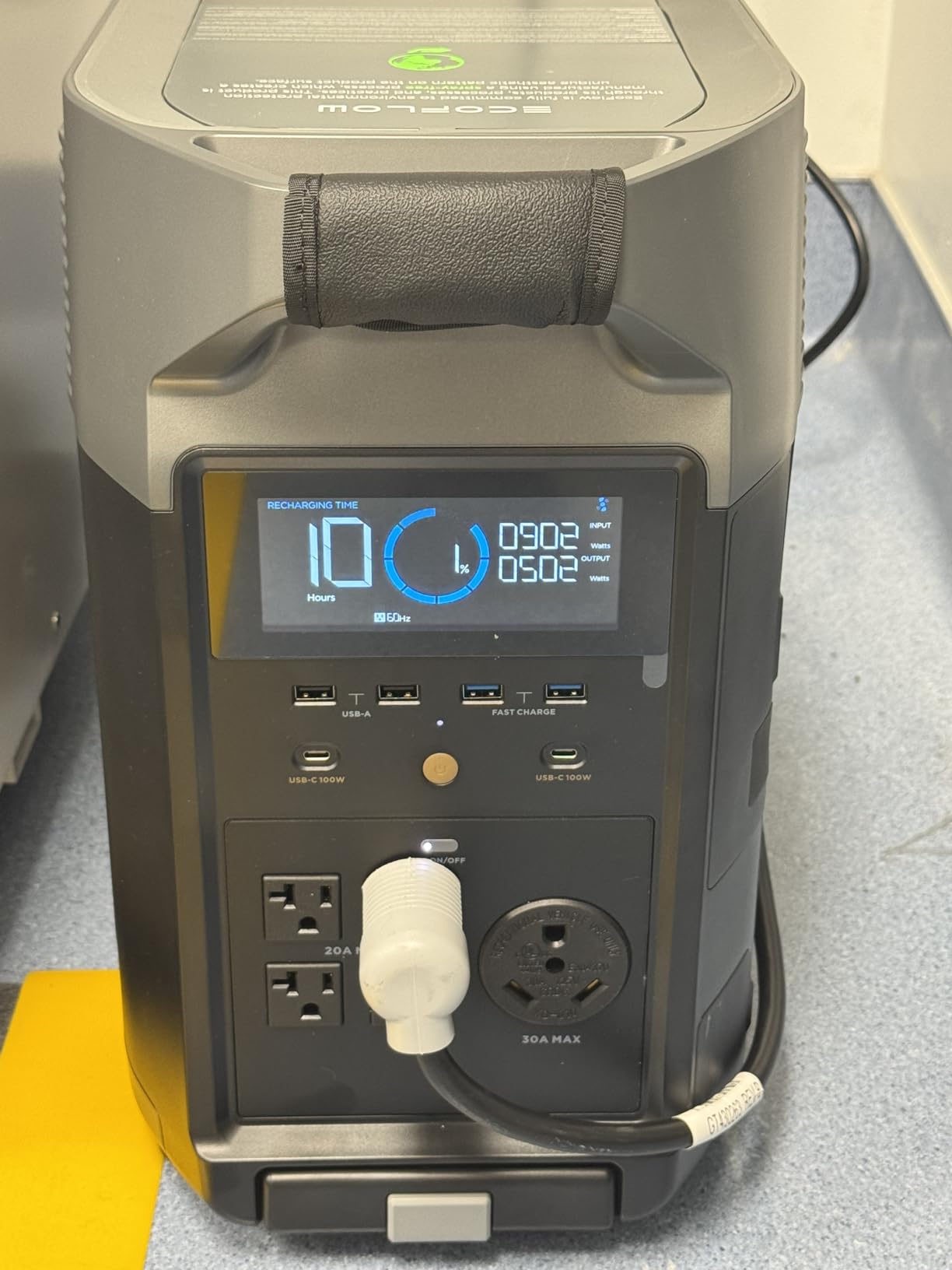
The 15-port layout is genuinely useful for a house rather than a campsite. Two USB-A, two USB-A fast charge, two USB-C at 100W, five AC outlets, two DC outlets, a car outlet and an Anderson port cover a whole weekend of essential loads at once.
App control over Wi-Fi or Bluetooth lets you check state of charge and temperature remotely, which is more useful than it sounds when the unit is in a garage and you are not home.
Who this is sized for
This suits households that want dependable 120V backup and a proven support path rather than headline expansion numbers. If your critical loads are all standard household circuits and you want a unit with an enormous amount of field history behind it, this is the safe selection.
It also works well as a first unit in a two-station 240V setup, since EcoFlow supports pairing for 7,200W of combined output. Buyers running small commercial equipment at home frequently land here.
Where it falls short
The roughly 15 amp solar input ceiling is the most repeated limitation. It caps how large an array you can attach, so if your recharge plan depends on folding panels at full midday output, that constraint will shape your setup.
At 99 lb it is not a one-person carry, and a few buyers report limited local warranty support outside the US. A handful of one-star reviews concern error codes on early units.
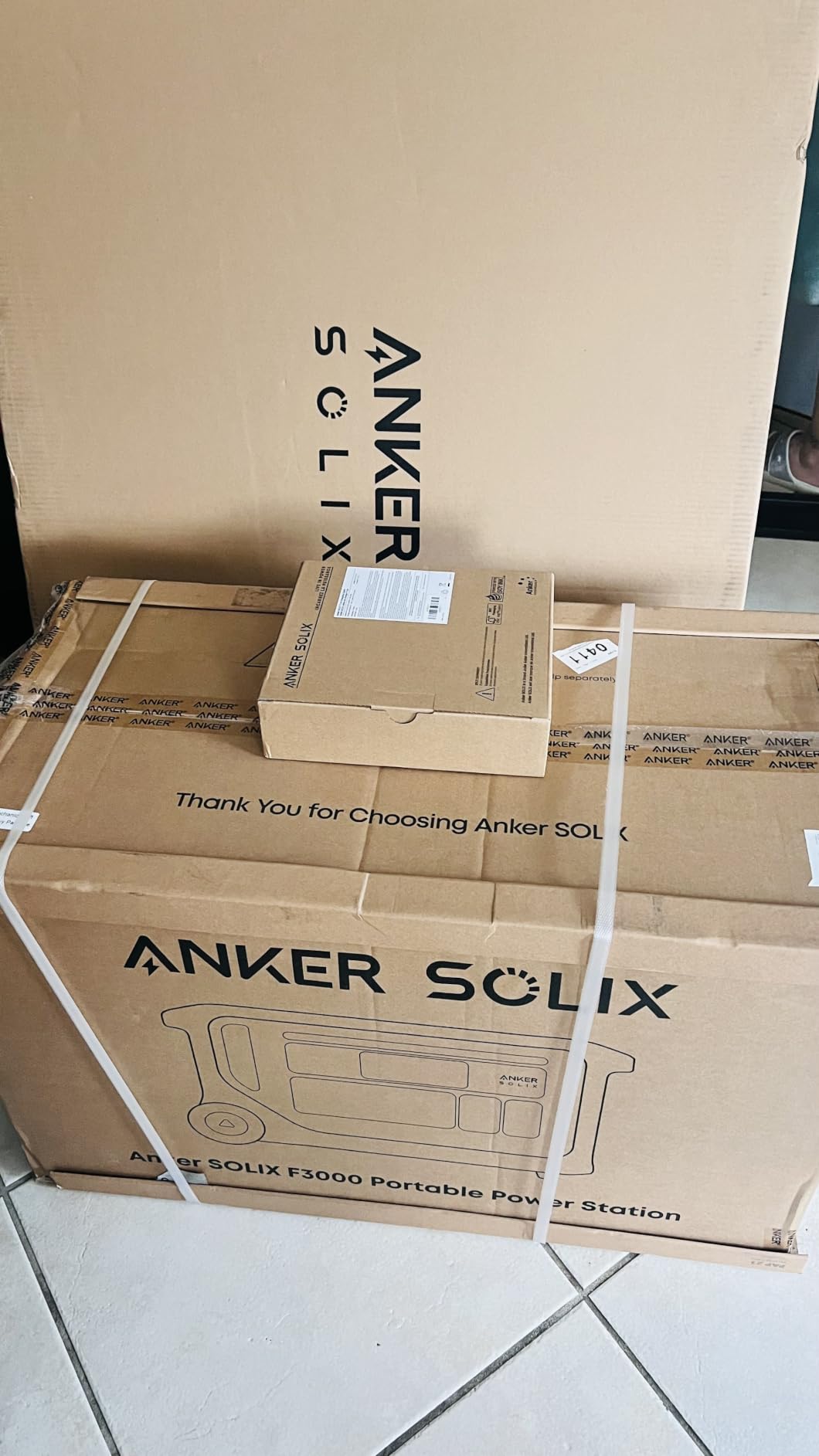
3. Anker SOLIX F3000 with BP3000 – Pass-Through Charging and Low Idle Draw
Anker SOLIX F3000 Portable Power Station and Expansion Battery, 3,072Wh
3,072Wh base, 6kWh with pack
Expands to 24kWh
3,600W pass-through
91.5 lb
Pros
- 3600W pass-through charging refills from a generator without cutting loads
- Very low idle draw with 125 hours of AC standby
- Bundle includes the BP3000 expansion battery
- 6000W combined generator plus solar recharging
Cons
- 3072Wh base is the smallest high-capacity entry here
- 91.5 lb is awkward for one person
- Grid-tied features need separately purchased hardware
This bundle is the clearest answer to a specific problem. Most power stations interrupt output when you connect an input. The F3000’s 3,600W pass-through charging means a gas generator or solar array can refill the battery while the house stays lit and the refrigerator keeps running.
The reason this one appears here is the included BP3000 expansion battery. You start at about 6kWh of usable storage rather than 3,072Wh, which moves a refrigerator-plus-internet-plus-medical-equipment weekend into range on day one without a second purchase.
Owners single out the low idle draw more than almost anything else. Anker claims 125 hours of AC idle standby and 42 hours running a 190W refrigerator, and that standby behavior is what protects capacity across a multi-day outage.
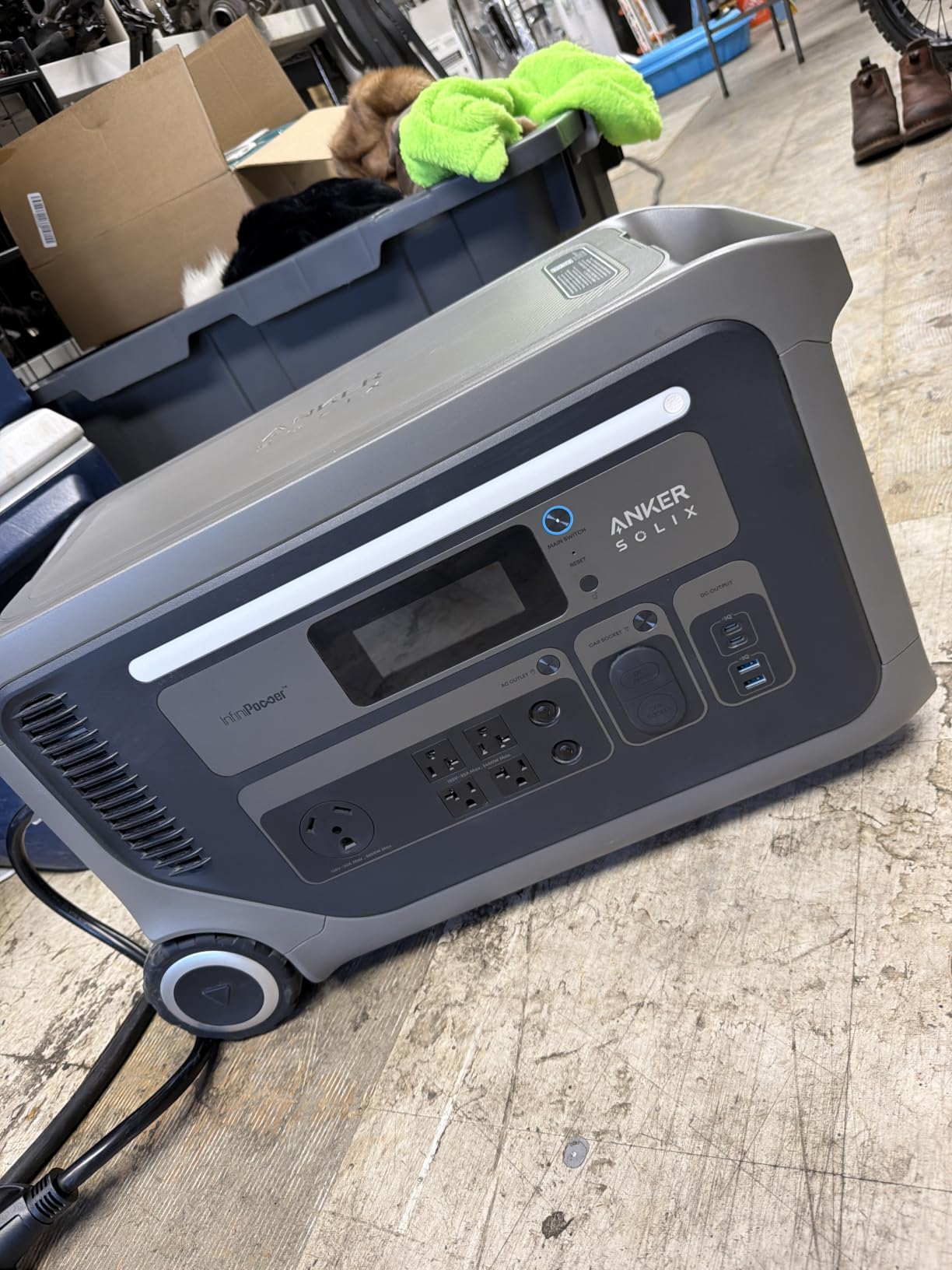
Solar input runs up to 2,400W through either the 165V or 60V port, which is among the higher ceilings in this round and means a large array actually recharges at close to its rated speed.
Output is 120V from a single station, and pairing two stations produces 240V. That pairing route is a legitimate way to get split-phase capability without buying a flagship dual-voltage unit.
The combined 6,000W recharging figure applies when a fuel generator and solar input are used together, which shortens turnaround time considerably when you are running a generator anyway.
Who this is sized for
This is the pick for someone who already owns or plans to own a small gas generator and wants the battery to work alongside it rather than replace it. Pass-through charging plus a 2,400W solar ceiling is a genuinely different operating model from the rest of this list.
It also suits buyers who rate standby drain highly. If your outage pattern is long and the loads are small, the 125-hour idle standby figure protects a meaningful slice of your capacity that would otherwise disappear overnight.
Where it falls short
The 3,072Wh base is the smallest high-capacity figure here, and while the bundle compensates by including an expansion pack, the ceiling of 24kWh is lower than the DELTA Pro 3 or the Jackery 5000 Plus.
Weight of 91.5 lb makes single-person repositioning awkward, and the grid-tied features, the bi-directional inlet box and smart meter, require extra purchased hardware that is not in the box.
4. AFERIY 3,840Wh – UL Listed With 11.5kWh Expansion Headroom
AFERIY 3840Wh Portable Power Station,Expandable Solar Generator to 11520Wh
3,840Wh LFP
Expands to 11.5kWh
3,600W continuous
7200W peak
UL Listed
Pros
- Under 10ms UPS keeps electronics running
- 15 ports including USB-C PD 3.0 and XT60
- UL Listed with a 7-year support period
- Recovers in about 1.5 hours under supported input
Cons
- Less field history than EcoFlow or Anker
- 104.7 lb listed weight
- runtime figures vary sharply with load
Look at the raw numbers before you look at the badge. 3,840Wh of LiFePO4 storage expanding to 11.5kWh, with 3,600W continuous output and 7,200W peak, delivered in a UL Listed package with a 7-year support period, is a difficult combination to match on value anywhere on this list.
The upsell switchover is under 10ms, which keeps computers, security cameras, medical freezers, video calls and pet feeders running through an outage without a reboot.
Buyers generally frame this as the value option, with comparable kWh and expansion headroom to units costing considerably more. The four-star band sits at 15 percent, reflecting mild reservations about brand support depth rather than performance.
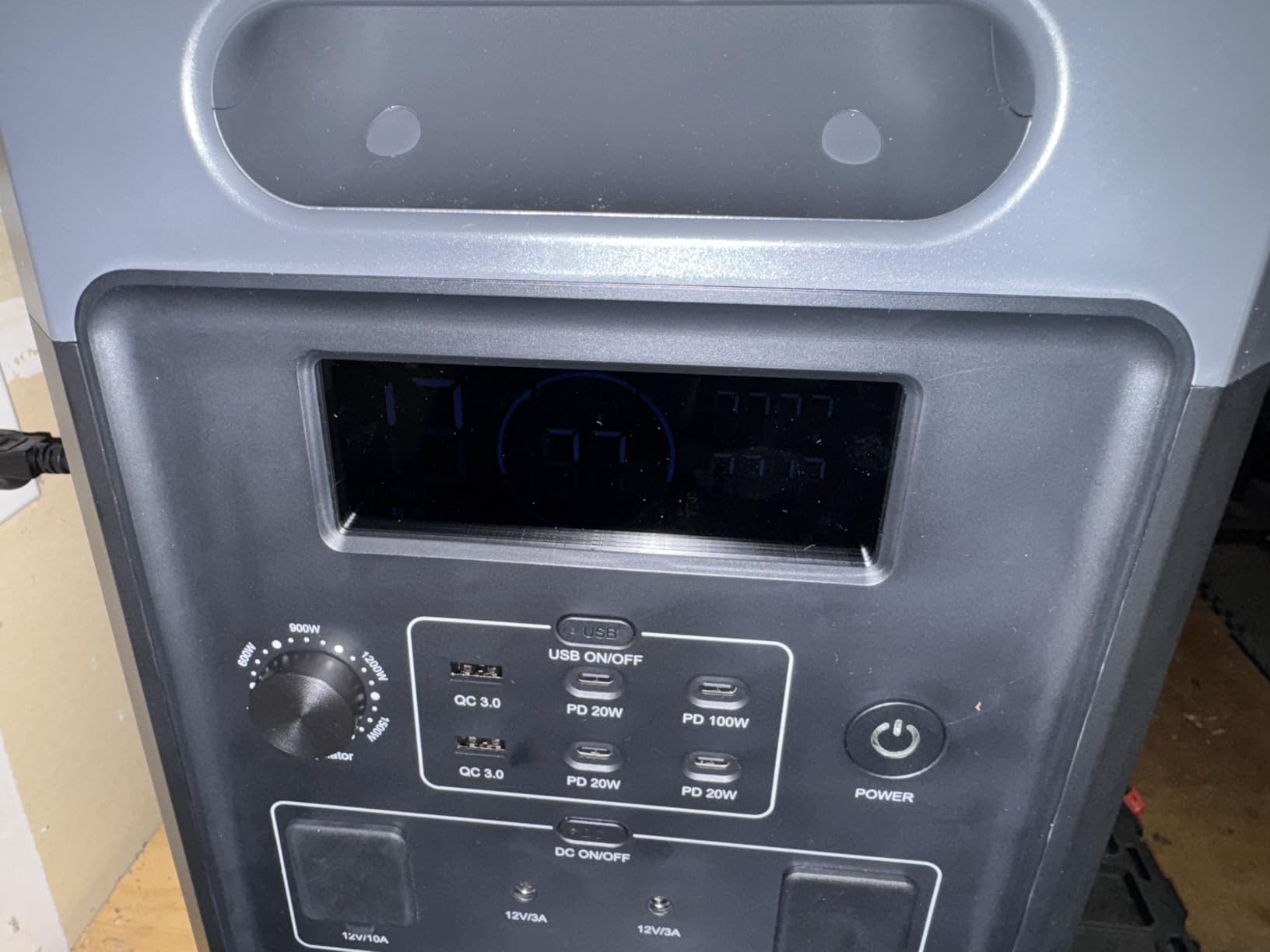
Fifteen output ports is generous for the class, covering AC outlets, USB-A, USB-C with PD 3.0, DC5521, XT60 and a 12V car socket. That XT60 output is a genuine advantage if you are working with 12V equipment rather than just AC loads.
Recharge options are AC wall, solar, car charging, or AC and solar combined, with the manufacturer claiming full charge in as little as 1.5 hours under supported input conditions. App control handles monitoring, scheduled charging, light modes and remote power off.
Rated runtime is about 17 hours for common household essentials, and one to two days for a refrigerator depending on load. Treat those as ceiling figures rather than planning numbers.
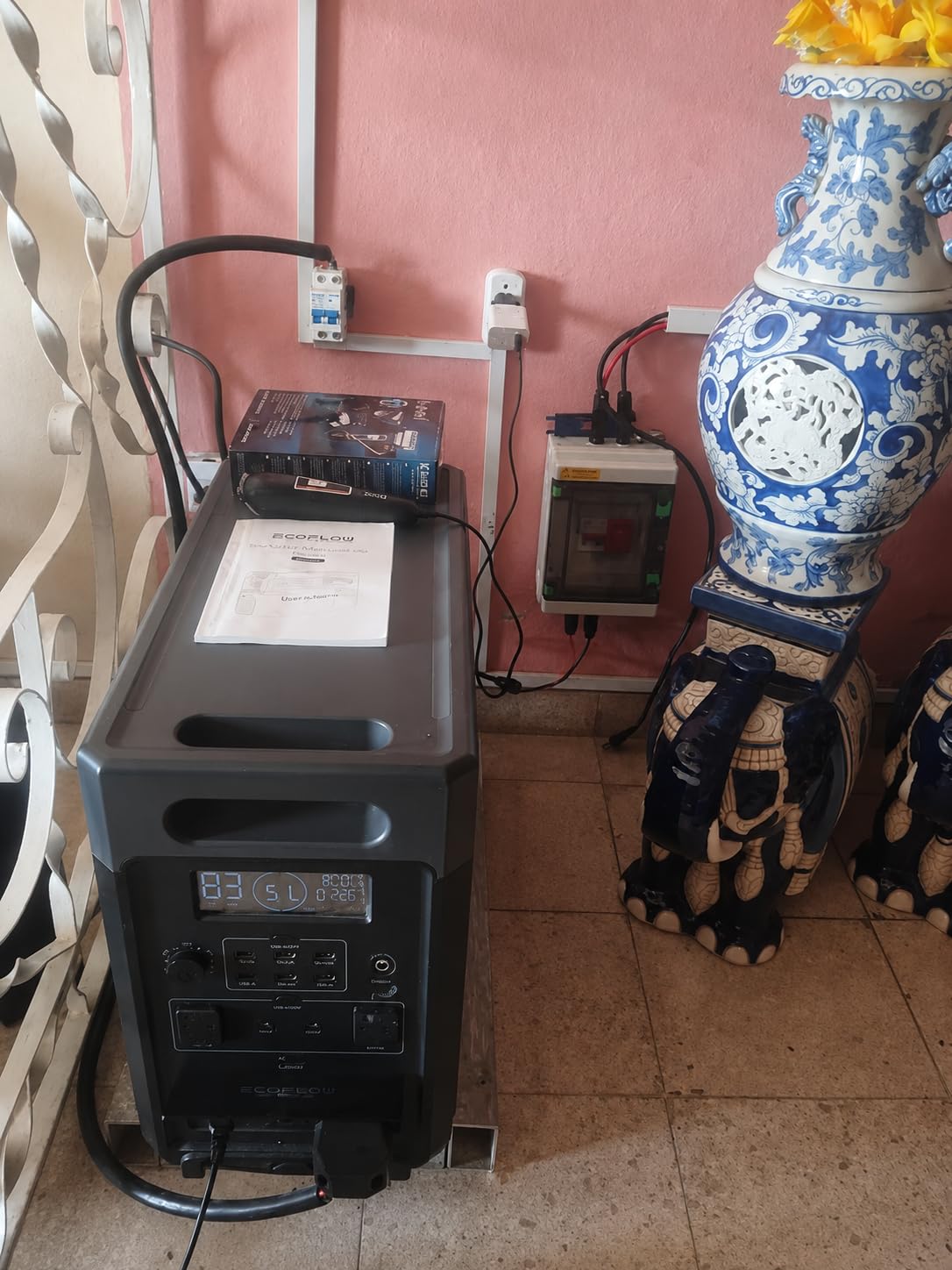
Who this is sized for
This fits a buyer who has done the sizing math, decided that roughly 10kWh of expanded capacity covers their actual load, and would rather spend the difference on solar panels or a transfer switch than on a more recognizable badge.
The UL Listing and 7-year support period matter here more than they would on a similar-sized unit from a no-name seller, because they are the two signals that separate a real manufacturer from a white-label reseller.
Where it falls short
Field history is the honest weakness. Established brands have more deployed units, so firmware bugs and error-code behavior tend to be documented and worked around faster.
The listed weight of 104.7 lb makes it one of the heavier units in this round, and mobility depends on the pull handle. Buyers also report that runtime claims for refrigerators and essentials vary significantly with actual load.
5. Jackery HomePower 3600 Plus – Longest Rated Cell Life at 6,000 Cycles
Jackery HomePower 3600 Plus Power Station, 3584Wh, 3600W AC Output
3,584Wh LFP
Expands to 21kWh
3600W output
7200W parallel
77.2 lb
Pros
- Highest cycle rating here at 6000 cycles and a 10-year lifespan
- Weighs 77.2 lb with wheels and a telescopic handle for rolling between rooms
- Runs water heaters
- AC and microwaves at the same time
- Reaches 0-100 percent in about 2 hours on hybrid AC plus DC
Cons
- Expansion and parallel setups add real cost for full coverage
- Still a heavy lift for stairs despite the hand truck
- Some buyers reported the order arriving late
Cycle rating is the headline here. Jackery rates these ceramic membrane cells at 6,000 cycles with a 10-year lifespan, the highest rated figure we found on any unit in this round, and they were tested to 302 degrees F to resist thermal runaway.
The second distinguishing detail is mobility. At 77.2 lb with wheels and a telescopic handle, this unit rolls between rooms rather than being lifted between them, and Jackery claims 34 percent smaller and 29.3 percent lighter than comparable models.
Owners in hurricane, monsoon and winter-storm regions use this as their primary supply and recharge from generators or solar. They report handling water heaters, induction cooktops, refrigerators and medical equipment without drama.

Expansion goes to 21kWh per unit and 43kWh across multiple units, and parallel operation delivers 7,200W with dual 120V and 240V output. That parallel route is how you reach split-phase without buying a dedicated dual-voltage flagship.
Cold-weather performance is a genuine differentiator. Rated operation down to -4 degrees F means it still functions in the winter ice-storm outages where many owners actually need it.
Charging runs 0 to 100 percent in about 2 hours via hybrid AC and DC, 2.5 hours on AC alone, 4 hours on solar, and 2.5 hours from a gas generator. The luggage-style frame means you can roll it rather than carry it.
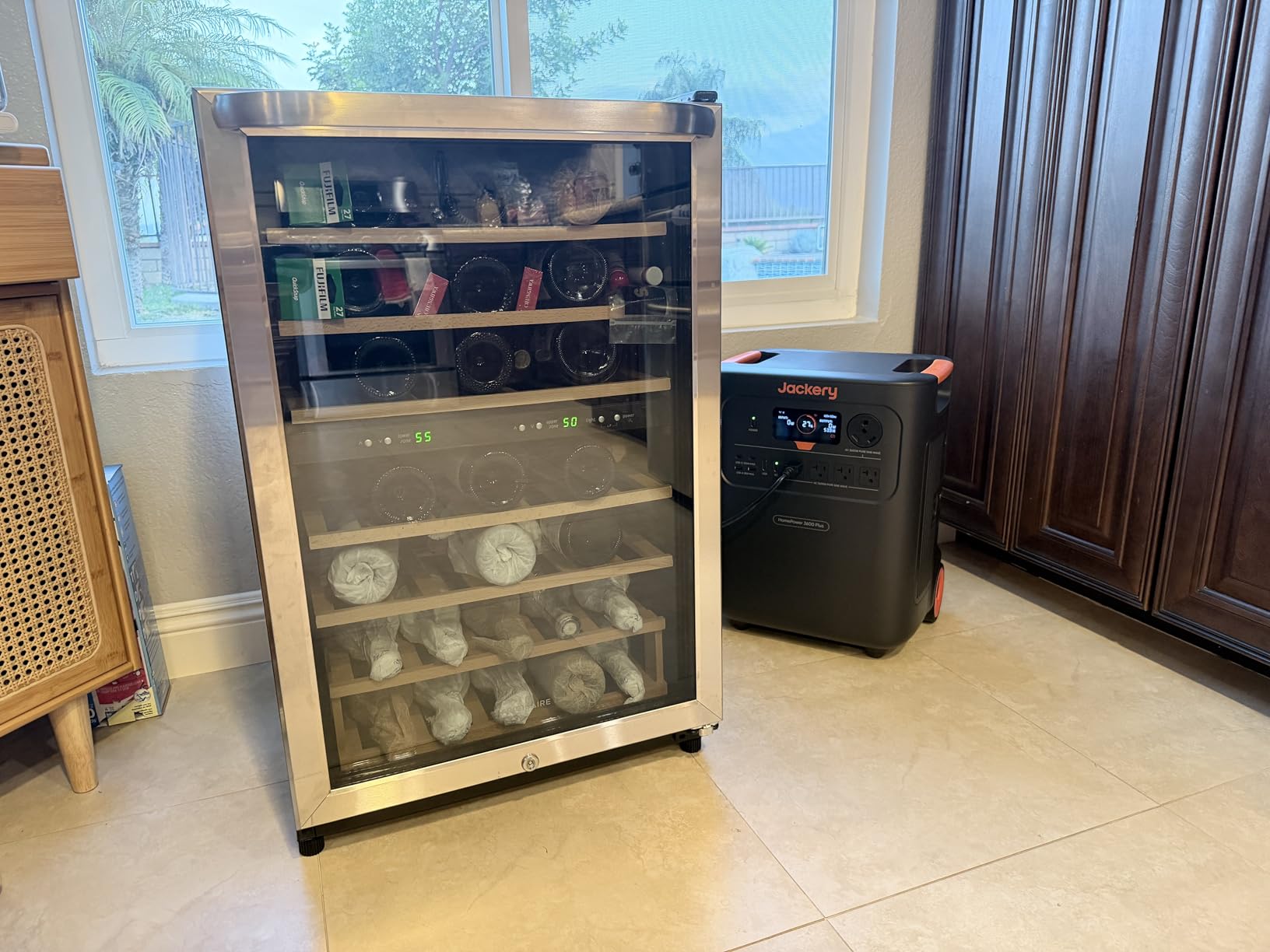
Who this is sized for
This suits anyone who needs genuine mobility, whether that means moving the unit between a kitchen and a basement during a flood, or loading it into a vehicle for an evacuation. Few high-capacity stations are this easy to relocate.
It is also the pick for buyers who plan to keep this system for a decade. A 6,000 cycle rating at a usable daily depth means the battery outlasts most storm seasons without meaningful degradation.
Where it falls short
Reaching true whole-home coverage is not cheap on this platform. Expansion packs plus a second unit for parallel 240V operation can add up quickly, and the base configuration only covers about 12 hours of fridge and freezer.
It is still a heavy lift for stairs despite the built-in hand truck, and a small number of buyers reported the order arriving late.
6. Anker SOLIX F3800 – 6,000W Dual-Voltage Output for Heavy Loads
Anker SOLIX F3800 Portable Power Station, 3,840Wh
3,840Wh LFP base
Expands to 26.9kWh
6,000W output
120V and 240V
132.3 lb
Pros
- 6000W continuous output covers dryers and water heaters
- Expands to 26.9kWh per unit or 53.8kWh with a second
- Charges an EV at 6000W through the NEMA 14-50 port
- NEMA 14-50 and L14-30 RV inputs need no extra hardware
Cons
- At 132.3 lb it is one of the heavier units here
- 34 inch cube footprint needs real floor space
- Smart Generator 5500 integration is an extra purchase
This is the wattage class. 6,000W of continuous AC output from a single portable unit is what separates the F3800 from everything else on this list, and it is the reason buyers who need to run a dryer, a water heater or a 240V load past the essential tier choose it.
Capacity starts at 3.84kWh and expands to 26.9kWh with six battery packs, or 53.8kWh when paired with a second F3800 plus 12 packs. Paired, output reaches 12,000W, which is genuine whole-house territory rather than essential-circuits territory.
Owners who picked this unit report the 6,000W headroom delivering on loads that smaller inverters simply refuse, and the dual 120V and 240V output removes the need for a second device entirely.
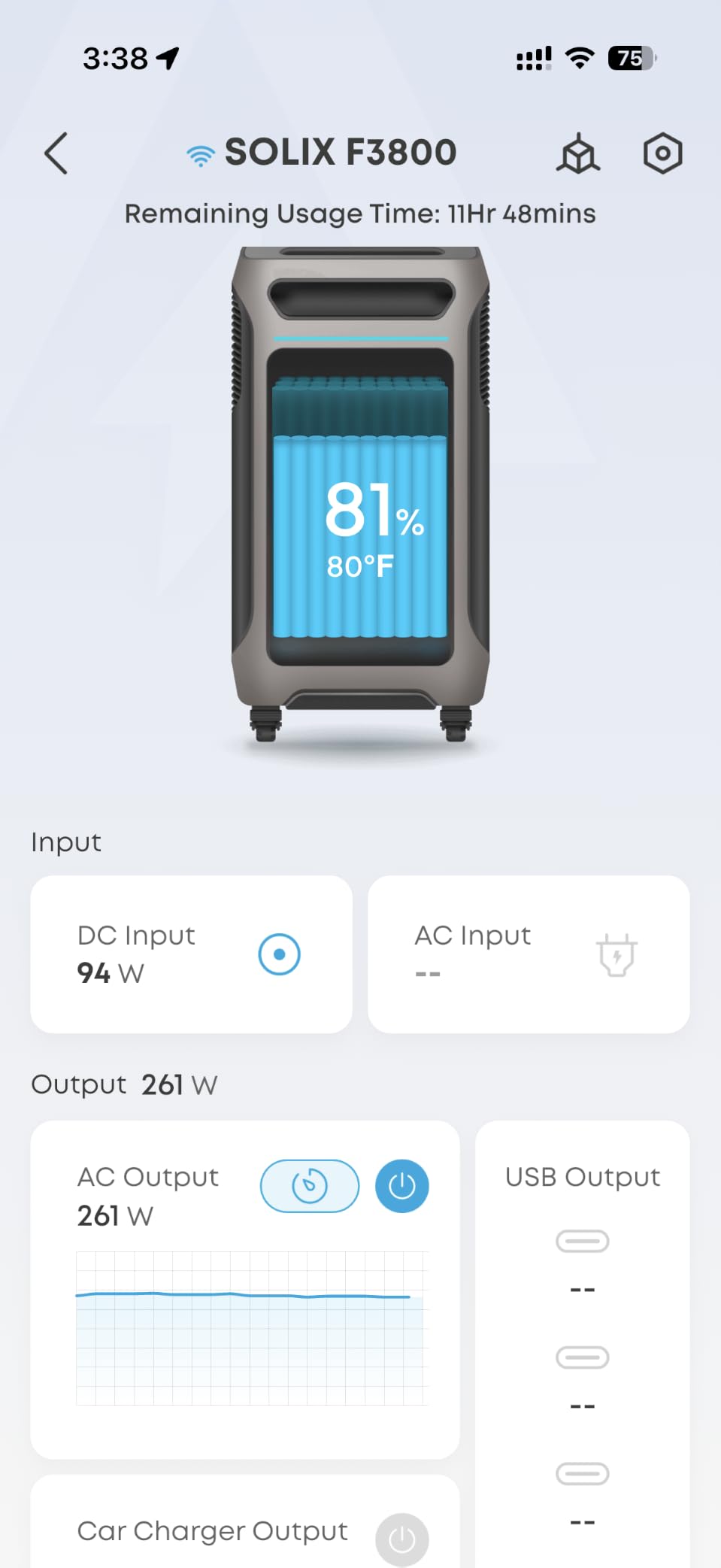
RV owners value the input side. The unit charges directly through NEMA 14-50 or L14-30 ports and can charge an EV at 6,000W through the NEMA 14-50 port with a standard cable, which removes a whole category of adapter gear.
Battery longevity is rated at 10 years of design life behind a 5-year warranty, using EV-class LFP cells with Anker InfiniPower technology and a smart temperature system. Solar input runs up to 2,400W.
An app over Wi-Fi or Bluetooth lets you monitor power sources and direct usage, and an optional Smart Generator 5500 adds automatic start-stop hands-free runtime.
Who this is sized for
This is the choice for a household that wants to keep more than essentials running. If the goal is a dryer, a water heater, a well pump plus a refrigerator and internet at the same time, continuous watts are the binding constraint and only this unit clears it comfortably in one box.
It also fits RV owners and EV households who want one device to cover charging and backup, since the NEMA inputs handle both without separate equipment.
Where it falls short
At 132.3 lb this is one of the heavier units in the comparison, and the listed 34 inch cube dimensions mean it needs genuine floor space rather than a corner. Weight and footprint are the standard complaints in reviews.
The Smart Generator 5500 that extends runtime hands-free is a separate purchase, and this listing is not Prime-eligible, which is a practical consideration if you want fast replacement.
7. ABOK Ark3600 With Extra Battery – 1.29 Hour AC Plus Solar Recharge
ABOK Ark3600 Portable Power Station with Extra Battery, up to 11520Wh
3,840Wh LFP
Expands to 11,520Wh
3600W rated
4500W peak
includes extra battery
Pros
- Ships with an extra expansion battery for double the storage on day one
- 1.29 hour AC plus PV recharge among the fastest here
- 15 ports including 30A AC and USB-C PD 100W
- EV-grade LFP rated 4000 plus cycles and up to 10 years
Cons
- Less established brand than EcoFlow
- Jackery or Anker
- Warranty described as 2+3 years
- 120V output only with no native 240V
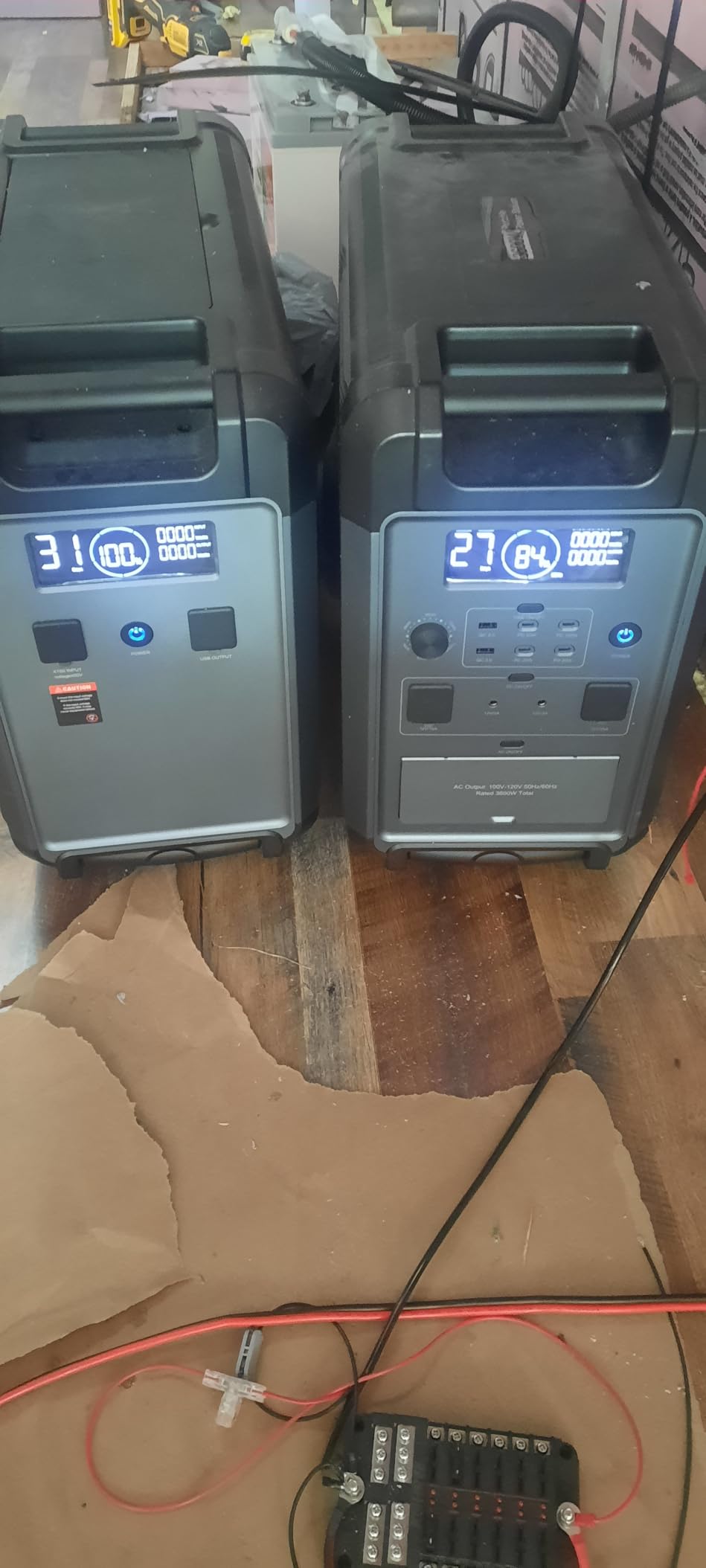
What makes this bundle unusual is what arrives in the box. Two packs ship together, the station plus an extra battery, so effective storage is roughly double what most competitors deliver at the same size class. Buyers repeatedly justify the purchase on exactly that point.
Charging speed is the other headline. Full charge in 1.29 hours with AC and PV combined, or 3 hours on AC alone, which is one of the fastest stated recharges in the round and directly reduces how long you depend on grid or generator power during a long outage.
Cell quality is specified as EV-grade LiFePO4 rated over 4,000 cycles with a lifespan of up to 10 years, which sits close to the top of the range here.
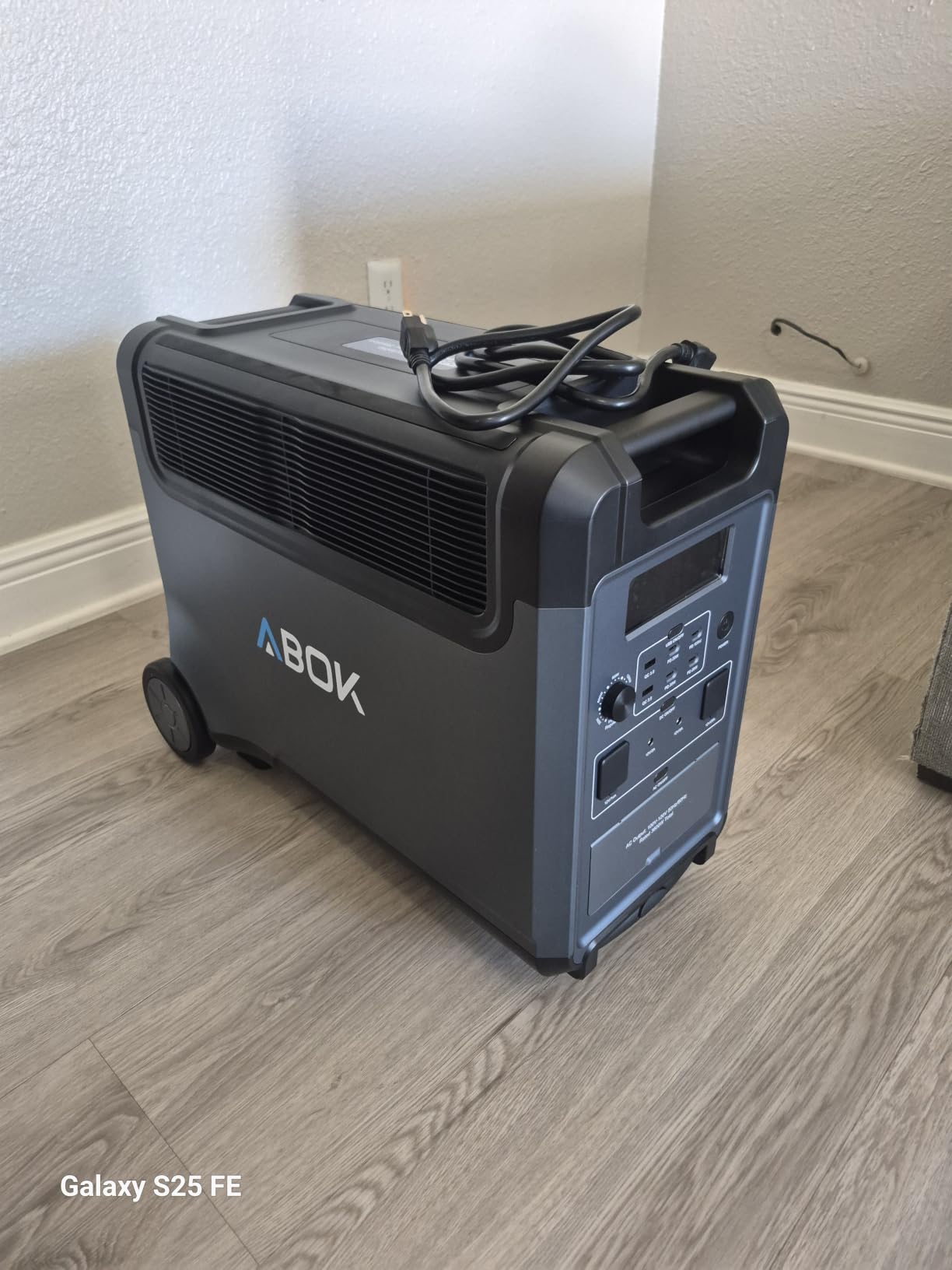
Fifteen ports include a 30A AC outlet, four 20A AC outlets, two USB-A with QC3.0, three USB-C at 20W, one USB-C at 100W, two DC5521, an XT60 and a 12V car socket. The 30A circuit is unusual at this capacity and useful for heavier 120V tools.
Input side runs AC at 1,500W, PV at 2,000W and car at 120W, with the AC plus PV combination producing the 1.29 hour figure. A telescoping handle and durable wheels address the mobility problem that most units in this class ignore.
A Bluetooth app handles remote monitoring and adjustment, and the manufacturer is listed as Shenzhen SYD Network Technology.
Who this is sized for
This fits a buyer who has already worked out that they need roughly 8kWh immediately and want it from day one rather than after a second purchase. That is a genuine advantage when the first outage could come sooner than you can wait for expansion packs.
It is also a reasonable fit for anyone with 12V and tool-oriented loads, given the 30A AC outlet, the XT60 and the PD 100W USB-C port.
Where it falls short
Brand longevity is the honest caveat. Established names have more deployed units and deeper support networks over a ten-year ownership horizon, which matters when your plan is to add capacity to this unit for years.
The warranty is described as 2+3 years, shorter than the 5 to 10 years offered by rivals, and output is 120V only, so no heavy appliances without a parallel partner. Manufacturer weight and dimensions were not stated in the source data.
8. GROWATT HELIOS 3600 – Lightest Unit Here With Split-Phase Parallel
GROWATT HELIOS 3600 Portable Power Station, 3600Wh LFP Solar Generator
3,600Wh LFP
Expands to 18kWh
3600W output
7200W parallel
51 lb
Pros
- Lightest unit in the round at 51 lb with wheels and a handle
- Split-phase parallel gives 240V and 7200W with no electrician work
- Cold start rated down to -22 degrees F
- Under 1.5 hours on hybrid AC-DC charging
Cons
- App is the most criticized element with Bluetooth pairing failures
- EPS is all-or-nothing and cannot be set per outlet
- Some units arrived damaged in shipping
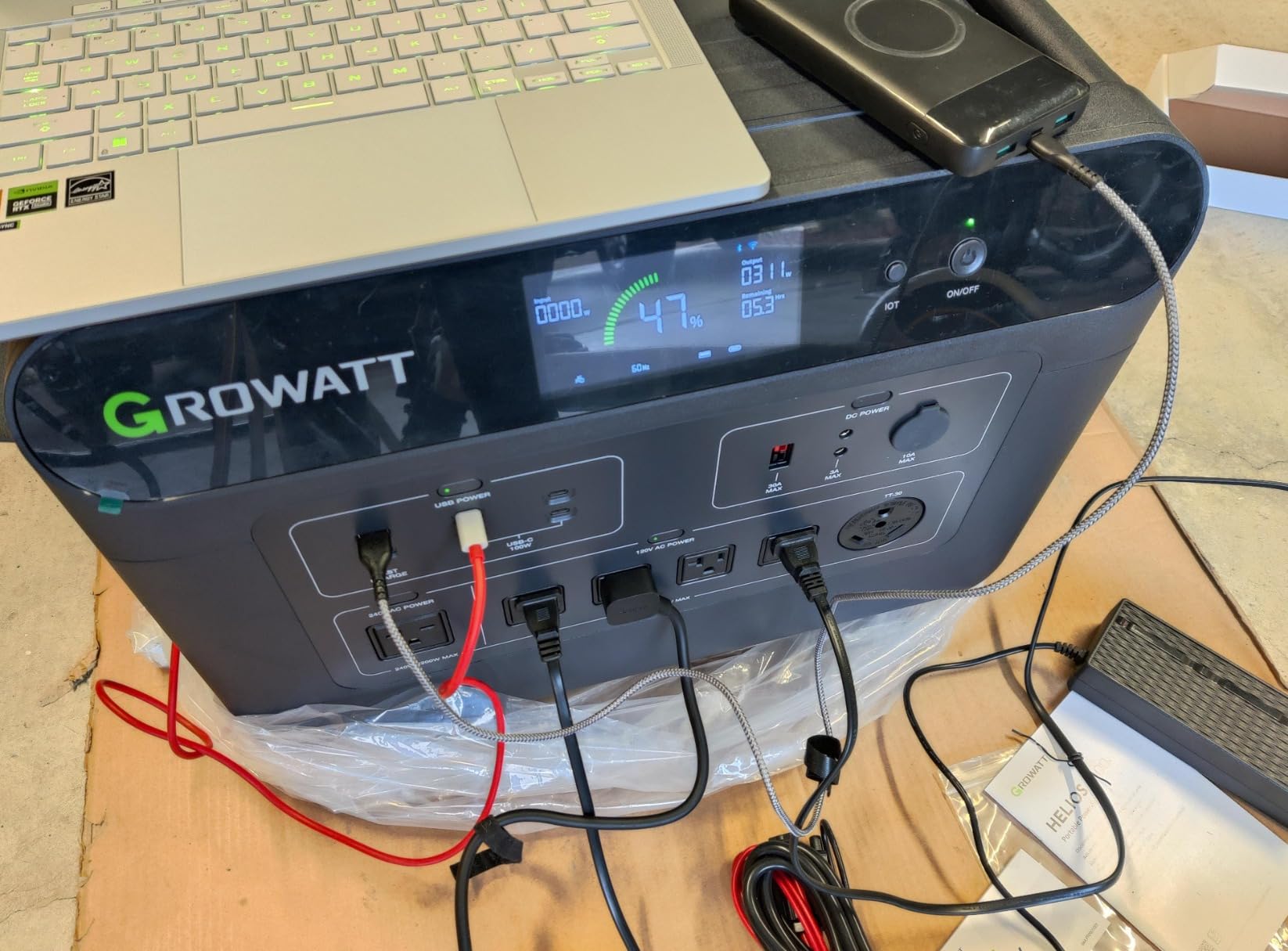
At 51 lb, this is the unit we could actually carry up a set of stairs ourselves, and it is the only high-capacity station in this round that a single person can genuinely lift without planning. Owners in the r/solar community describe running refrigeration, internet, fans, lights and medical equipment off a HELIOS for more than 24 hours.
Split-phase parallel is the underrated feature. Connect two units and you get 240V at 7,200W, expandable to 36kWh, with plug-and-play expansion that needs no professional installation. For owners who want 240V without a dedicated dual-voltage flagship, this is a cheaper path.
Cold start to -22 degrees F, against -4 degrees F on the Jackery HomePower 3600 Plus, is the rating we would trust most for genuinely cold outages in ice-storm and northern scenarios.
Charging runs 2,000W solar with a full charge in 2.8 hours, AC at 3 hours on 120V or 1.5 hours on 240V, and a 3,600W hybrid AC-DC cycle in under 1.5 hours. Owners running window air conditioners and gaming PCs report long runtimes and solid inverter performance.
Port selection is broad at 16 plug-and-play ports, including Anderson connectors and a NEMA TT-30 output. Battery aging is rated at 80 percent capacity retained after 4,000 cycles, with UL certification and a 5-year warranty.
One owner notes the unit works without Wi-Fi or Bluetooth for basic function, which is a small thing that matters when your backup depends on a device with a flaky app.
Who this is sized for
This is the pick for anyone with mobility constraints, an upstairs installation point, or a need to move the station between a primary and secondary location. Nothing else in this class comes close to 51 lb.
It also fits households that want 240V capability through two parallel units and would rather avoid electrician work and panel modifications to get it.
Where it falls short
The app is the clearest weak point and the reason this unit carries the lowest average rating here. Multiple reviews describe Bluetooth connection dropping mid-pairing and one characterizes its permission requests as predatory, which drags the average down despite solid hardware ratings.
EPS behavior is all-or-nothing. You cannot select it per outlet, and it turns off automatically when using the combiner for 240V, so you lose UPS protection the moment you go split-phase. A few units also arrived damaged in shipping.
9. Jackery 5000 Plus – Largest Capacity and 7,200W With 240V
Jackery Explorer 5000 Plus Power Station, 5040Wh, 7200W AC Output
5,040Wh LFP
Expands to 60kWh
7,200W rated
14,400W surge
134.5 lb
Pros
- Largest base capacity in the round at 5040Wh expanding to 60kWh
- 7200W rated and 14400W surge covers 5-ton AC and water heaters
- Recharges in about 2 hours with up to 4000W solar input
- Pairs with the Jackery 60A Smart Transfer Switch for 12 circuits
Cons
- At 134.5 lb it is one of the heaviest units here
- Transfer switch is a separate purchase
- Smallest review base in the round at 58
This is the spec-sheet leader of the group and the reviews say so. 5,040Wh of LiFePO4 storage expands to 60kWh, which is the highest ceiling anywhere on this list, and rated power of 7,200W with 14,400W surge is the highest continuous output too.
The dual voltage matters at this wattage. Both 120V and 240V are supported from a single unit, so a five-ton air conditioner or a water heater on a 240V circuit is within the design envelope without pairing two devices.
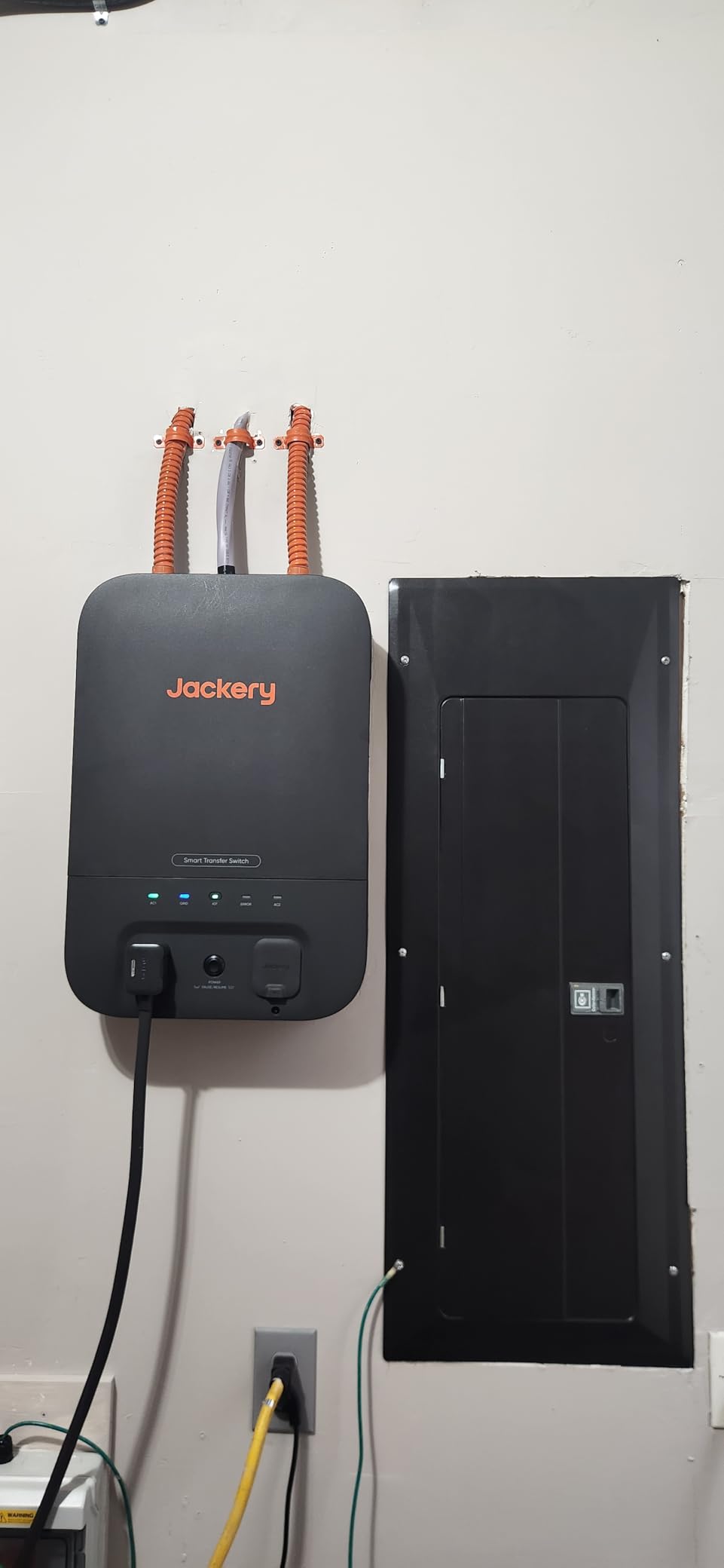
The home integration path is the most complete we found. The Jackery 60A Smart Transfer Switch powers up to 12 circuits at 120V or 6 circuits at 240V, which is how a portable unit becomes actual whole-home coverage.
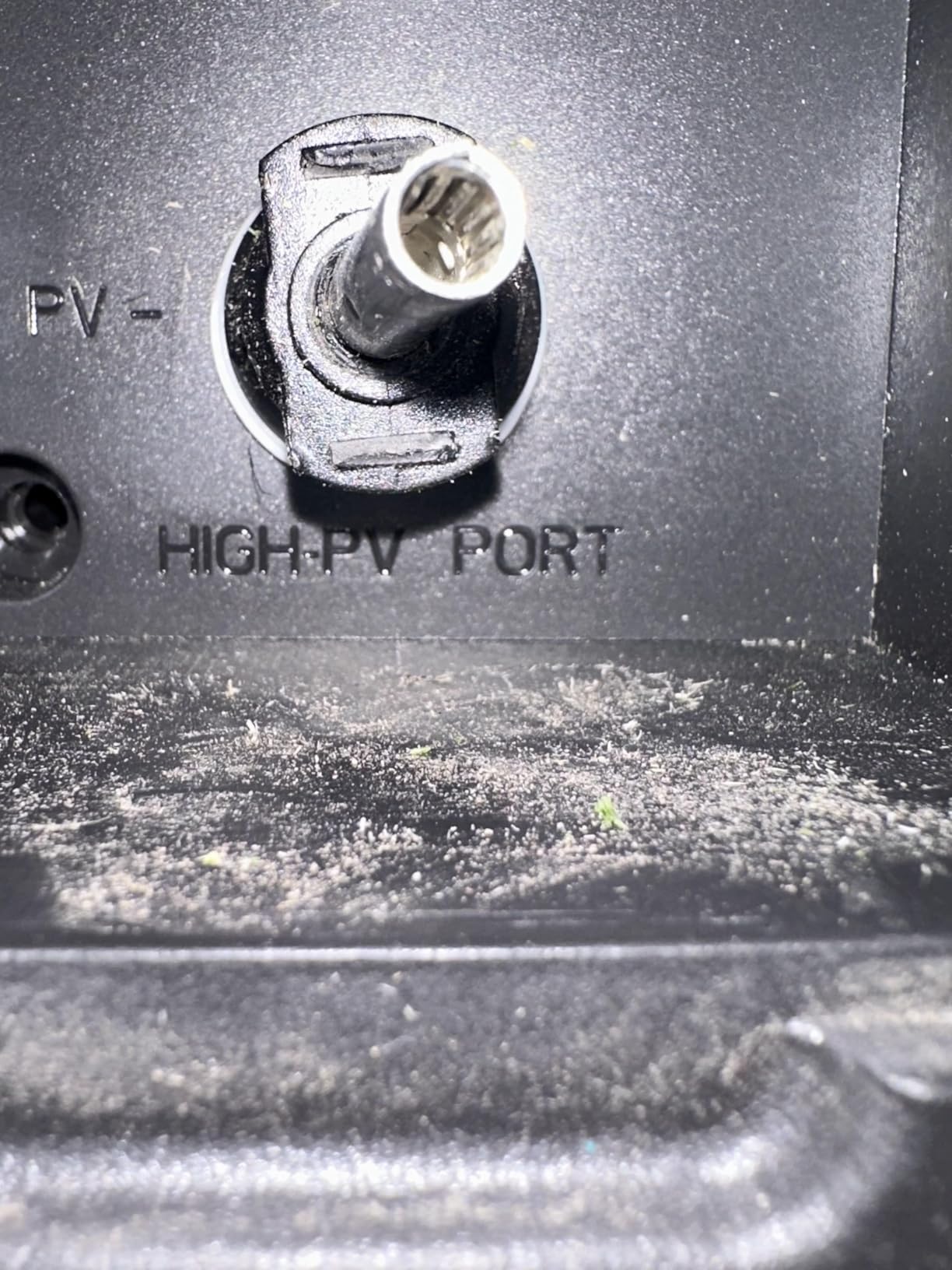
Solar input accepts high- and low-voltage panels with up to 4,000W, giving roughly a 2 hour recharge. That flexibility means you are not locked into one panel voltage class if your array is a mix of portable and rigid panels.
Battery longevity is rated at up to 11 years of daily use using ChargeShield 2.0 technology, backed by a 5-year manufacturer warranty. Buyers consistently cite the capacity, wattage and 240V numbers as the reason they chose it.
One review theme worth noting: the three-star band is the highest share in the round at 8 percent, most likely reflecting what is the highest outlay here against the smallest pool of long-term owners.
Who this is sized for
This is the choice when the plan is genuinely whole-home, not essential-circuits. Refrigerator, freezer, HVAC, water heater, internet and laundry on a 240V circuit simultaneously is only realistic on a unit with this much continuous output and this much expansion headroom.
Households with a large solar array who want the fastest possible refill will also benefit from the 4,000W solar input ceiling, the highest in this round.
Where it falls short
At 134.5 lb it is one of the heavier units in the comparison, and the listing does not state verified dimensions, so plan the footprint with the manufacturer rather than assuming a compact form factor.
The transfer switch needed for real whole-home wiring is a separate purchase, and with 58 reviews this is the least battle-tested listing here, which matters for a device intended to last a decade.
10. EcoFlow DELTA 3 Ultra Plus – Quietest at 25 dB With Under 10ms UPS
EF ECOFLOW DELTA 3 Ultra Plus 3072Wh Portable Power Station, 3600W Output
3,072Wh LFP
Expands to 11kWh
3600W continuous
7200W surge
25 dB
74 lb
Pros
- Quietest unit here at 25 dB under load
- Weighs 74 lb for 3600W of continuous output
- Under 10ms UPS protects computers and medical equipment
- 80 percent charge in under an hour with X-Stream
Cons
- 3072Wh base expanding only to 11kWh
- 240V whole-home operation is not a headline feature here
- Newer listing with a smaller review base
Silence is the decisive trait here. At 25 dB under load with X-Quiet 3.0 cooling, this is the only unit in the round rated low enough to sit in a bedroom or an office overnight without the fan becoming the thing you notice.
That combination with a sub-10ms UPS switchover makes it a genuinely useful medical and network backup. Computers, routers and medical equipment do not reboot when the grid drops, which is the difference between a backup power supply and a backup power station.
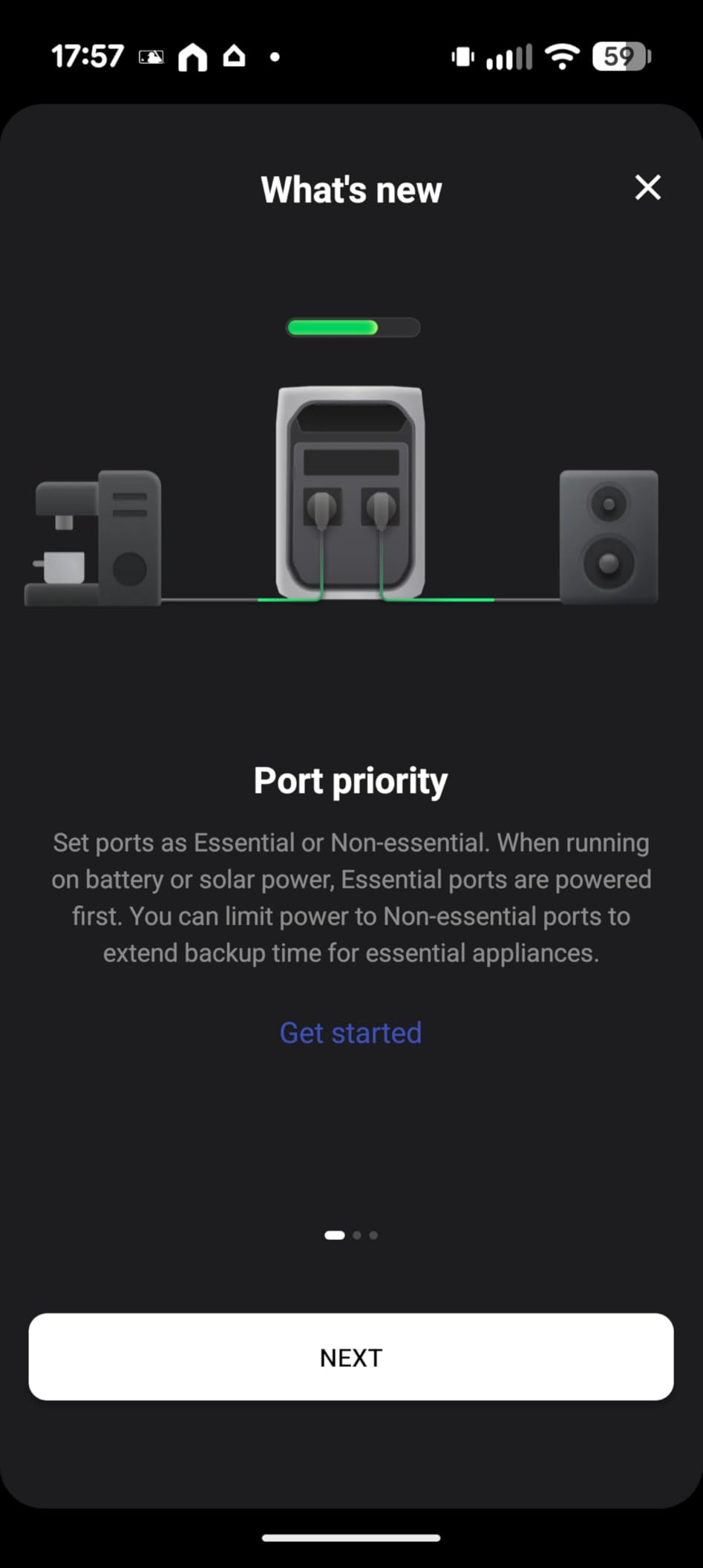
Owners use the EcoFlow app for scheduling and load prioritization, which is how you decide during an outage that the well pump matters more than the television. Six charging methods cover home outlets, solar, car chargers, EV stations, generators and the EcoFlow Smart Generator.
Charging speed is a highlight: 80 percent in under an hour with X-Stream fast charging. That is among the quickest refill times in the round, and for short outages that recur on a schedule it changes how often you need a generator.
Battery construction uses LiFePO4 cells with an EV-grade CTC structure and 24/7 smart battery management, engineered for 10 years of daily use. The share of five-star ratings here is 86 percent.
At 74 lb it is the lighter of the two 3,600W units with a sub-11kWh expansion ceiling, which makes it easier to relocate without giving up inverter headroom.

Who this is sized for
This suits a home where the power station has to live somewhere people are, or sleep. Bedside or home-office placement, or a medical equipment setup where fan noise is genuinely unwelcome, are the situations where 25 dB changes the outcome.
It is also a strong second unit for a household that already has a larger station and wants a dedicated low-noise box for network, medical and communications loads that never need shutting off.
Where it falls short
Capacity is the constraint. A 3,072Wh base expanding to 11kWh is the smallest ceiling in the round, so this is not the unit to build a three-day whole-home plan around.
Whole-home 240V operation is not a headline feature of this model, and with 105 reviews it is still a newer listing with less field history than the DELTA Pro.
How to Size an Expandable Power Station for Whole-Home Backup
Sizing is where most buyers go wrong, and the pattern that shows up repeatedly in homeowner forums is buying a 1 to 2kWh unit first and needing a second purchase within a season. The fix is not a bigger box, it is writing your load list down before you shop.
Step one, list the circuits you cannot lose. A refrigerator, a freezer, internet equipment, a CPAP or oxygen concentrator, lighting, a well or sump pump, and one room with outlets is a realistic essential list. Add a room heater or an induction cooktop and your list becomes a power list instead of an essentials list.
Step two, convert each load to watts and add duty cycles. A refrigerator does not run continuously. A well pump runs in short bursts but has a high startup draw that determines your surge requirement, not its steady draw. The number that matters is watts times hours per day.
Step three, divide by the inverter losses. Claimed watt-hours are not delivered watt-hours. Competitors that lab-test this measure usable AC capacity at roughly 60 to 93 percent of the label figure depending on load, so plan on about 85 percent of nameplate for a typical mixed household load.
Step four, set a day count. For a one-day outage, roughly 3 to 5kWh covers the essential list above. For two to three days you want 10kWh or more, and for a week of grid instability you are looking at 20kWh and upward, which is exactly where expansion stops being optional.
Step five, check idle draw against your day count. This is the number most roundups skip. A station that draws 20W while idle loses nearly half a kilowatt-hour a day doing nothing. The Anker SOLIX F3000 bundle is the clearest example here, claiming 125 hours of AC idle standby, and idle behavior is the single cheapest way to extend a multi-day system.
Step six, match inverter watts to your largest single load. Continuous output must exceed your biggest appliance, and surge must exceed its startup. A 3,600W inverter covers most refrigerator, router and pump combinations; running a water heater, dryer or central air at the same time pushes you into the 6,000W to 7,200W class.
Do you need 120V or 240V?
Almost every appliance in a typical essential list is 120V, and any unit in this round will run them. The question is what forces you to 240V. Electric water heaters, dryers, central air conditioners, electric ranges and ovens, and large well pumps are the usual culprits.
Here is the decision. If your outage list is refrigeration, internet, medical equipment, lighting and a small pump, stay 120V and buy on capacity and idle draw. If you want heat, hot water, laundry or central cooling to stay on, you need 240V, and your choices are a natively dual-voltage unit like the DELTA Pro 3, the Anker SOLIX F3800 or the Jackery 5000 Plus, or a parallel pair like the GROWATT HELIOS 3600 or the Jackery HomePower 3600 Plus.
Parallel is meaningfully cheaper in watts but doubles the floor space and halves the redundancy. A single dual-voltage unit keeps working when the other one has a problem, and it halves the number of batteries you are tracking.
Battery chemistry is not really a choice anymore. Every unit in this round uses LiFePO4 cells, rated between roughly 4,000 and 6,000 cycles. That chemistry tolerates deep discharge and high heat far better than the NMC packs used in older portable stations, and homeowners on forums consistently point to LiFePO4 as the reason their older unit survived.
Installation is the part nobody budgets for. Running extension cords through a window frame is fine for a weekend. Powering a refrigerator, a sump pump and a medical device continuously is a different project that usually involves a transfer switch or a smart panel, a permit in many jurisdictions, and an electrician. Owners on homeowner forums report that installation and panel work frequently cost more than the unit itself, so get that quote before you finalize the purchase rather than after.
Before You Buy: Expansion Batteries, Transfer Switches and Third-Party Packs
Expanding capacity is cheap per added kilowatt-hour compared with buying a second full unit, but it is not free, and the community consensus on expansion packs is firm: use the same brand as the base unit.
Mixing brands is not a supported configuration on any platform in this round. A third-party expansion pack may physically connect and may even negotiate a charge, but firmware-level battery management, cell balancing and warranty coverage are all defined around one manufacturer’s chemistry and bus protocol. Owners who have tried it consistently warn that support becomes the first casualty.
There is also a stack footprint question that rarely comes up in reviews. Every extra battery is another box roughly the size of the base unit, stacked or lined up on the floor. A system going to 48kWh or 60kWh is a small closet, not a corner, and that has to be planned before the first pack is ordered.
For home wiring, a manual transfer switch is the simplest path and the Jackery HomePower 3600 Plus pairs with one directly. A smart panel goes further, handling the switchover automatically and allowing the station to work as a grid-tied storage asset when the grid is up, which shortens the payback but adds cost and permits.
One last practical point on noise. Fans run harder at higher output, so a unit you plan to sleep next to should be evaluated on its dB figure under load rather than idle. The 25 dB rating on the EcoFlow DELTA 3 Ultra Plus and the 30 dB quiet mode on the DELTA Pro 3 are the two figures in this round that are low enough for a bedroom; most of the rest are better placed in a garage, basement or utility room.
Frequently Asked Questions
What is the best portable power station for home backup?
For most households, the best portable power station for home backup is the EcoFlow DELTA Pro 3 with an extra battery. It combines 4,096Wh of LiFePO4 storage expanding to 48kWh, 4,000W of continuous output and native 120V and 240V support, so one unit covers both essential circuits and heavier loads like a water heater or central air. The Anker SOLIX F3800 wins on wattage at 6,000W, and the AFERIY 3,840Wh wins on capacity per dollar.
Can a portable power station power a house?
A portable power station can power a house, but the honest answer is that it powers selected circuits rather than everything. A refrigerator, freezer, router, medical equipment, lighting and a well pump are realistic on a 3,000Wh to 4,000Wh unit for most of a day. Running heat, hot water, laundry or central air simultaneously requires a 6,000W to 7,200W unit, expansion batteries, and a transfer switch or smart panel installed at the panel.
What is the best battery backup system for a whole house?
The best battery backup system for a whole house combines three things: a dual-voltage station rated at 6,000W or higher, expansion batteries totaling 20kWh or more, and a transfer switch or smart panel to feed selected circuits. In this round that points to the Anker SOLIX F3800 at 6,000W expanding to 26.9kWh per unit, or the Jackery 5000 Plus at 7,200W expanding to 60kWh. A gas standby generator still beats batteries on runtime for the same money.
Is there a portable generator that can run a whole house?
There are portable generators that can run a whole house, but gas units are a separate category from portable power stations. A gas generator runs indefinitely on fuel with no battery degradation, while a battery station is silent, needs no fuel supply and fits indoors, but is bounded by its stored kilowatt-hours. Most owners end up running both, using a generator to recharge an expansion battery stack during a long outage.
Which one is better, Jackery or EcoFlow?
Jackery or EcoFlow depends on the household. EcoFlow offers higher continuous wattage and wider expansion ceilings, with the DELTA Pro 3 reaching 4,000W and 48kWh, and its dual-voltage support is simpler than pairing units. Jackery counters with lighter rolling hardware, a rated 6,000 cycle cell life on the HomePower 3600 Plus, and the 5,040Wh 5000 Plus with a 7,200W output and 60kWh expansion ceiling.
Which Expandable Power Station Should You Buy?
Build a multi-day system around the EcoFlow DELTA Pro 3 with its extra battery. It is the only unit here that pairs native 240V, 4,000W of continuous output, a 48kWh expansion ceiling and a 10ms switchover in one box, and its 30 dB quiet mode means it can live inside the house rather than in the garage.
Run heavy loads and you want the Anker SOLIX F3800 or the Jackery 5000 Plus, since 6,000W and 7,200W of continuous output respectively is what makes dryer, water heater and refrigerator loads possible at the same time. Move the station between rooms often and the GROWATT HELIOS 3600 at 51 lb or the Jackery HomePower 3600 Plus at 77.2 lb are the practical picks. Sleep near it and the EcoFlow DELTA 3 Ultra Plus at 25 dB wins.
Whatever you choose, confirm the expansion path, write down your load list before you size anything, and get an electrician’s quote for the transfer switch before the unit arrives. That last step is the one that turns a portable power station into real backup for the best expandable portable power stations for whole home backup, and skipping it is the most common reason a system disappoints.