
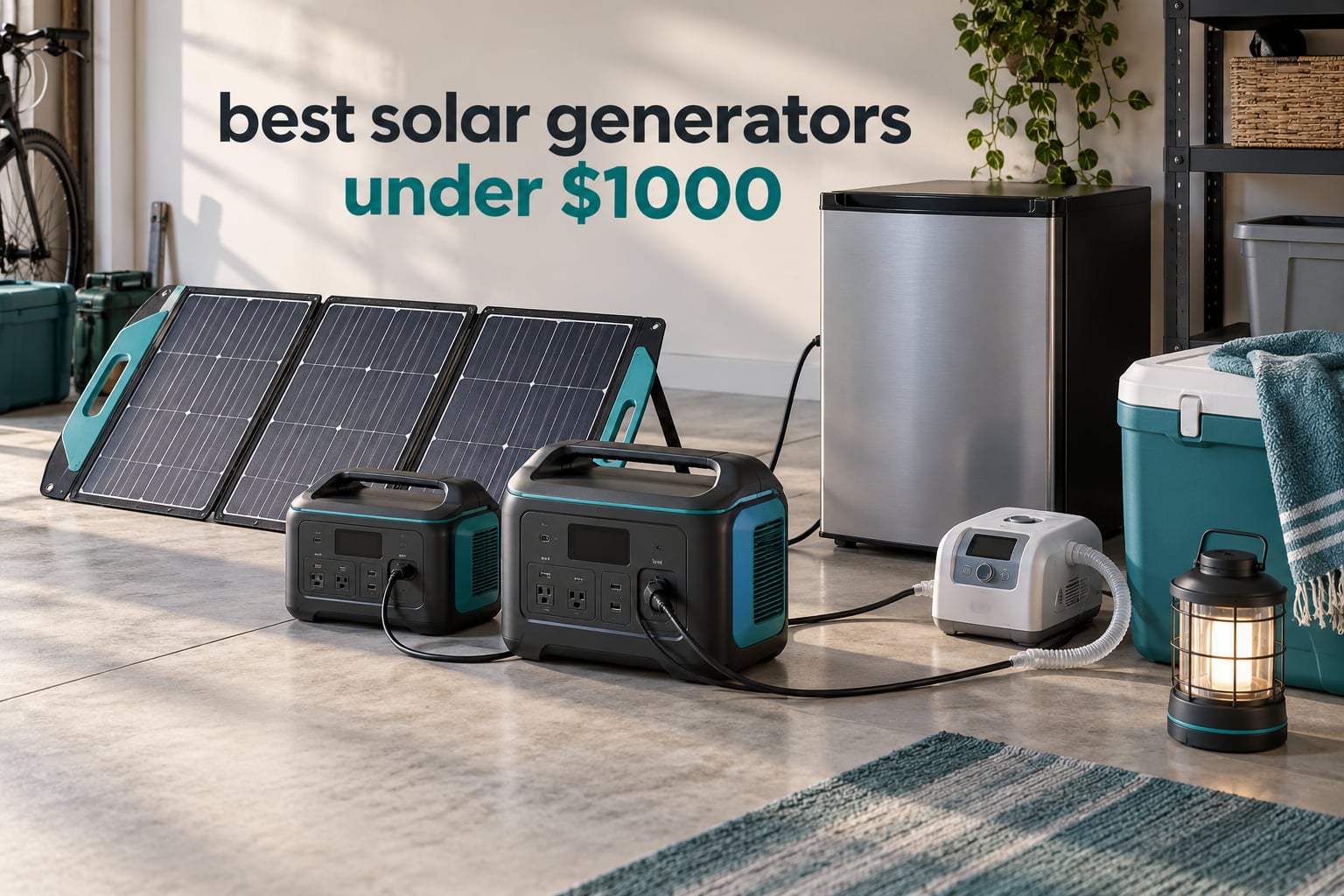
If you are shopping for the best solar generators under 1,000 dollars right now, you have more usable options than at any point in the last five years. A single thousand dollars buys roughly 1,000 watt-hours of LiFePO4 storage, 1,500 to 2,000 watts of continuous AC output, and a wall recharge measured in under an hour. That combination used to cost well over 1,500 dollars.
A solar generator is not a combustion engine. It is a battery box with an inverter inside, charged by solar panels, a wall outlet, or a car socket. When people say “portable power station” they mean the same hardware. The difference between the two phrases is marketing, not engineering.
This roundup covers eight models that sit at or below that ceiling, split by use case so you can match the hardware to the job: home backup, camping, CPAP machines, RV hookups, and lowest cost per usable watt. Every model below was checked against manufacturer specifications and Amazon customer review data.
One rule shapes the whole list. A product qualifies only if the total bundle fits under 1,000 dollars. Where a listing bundles a panel, we say so. Where the panel is sold separately, we flag it, because the most common complaint in owner discussions is exactly that: a product titled “solar generator” that arrives with no panel in the box. We do the arithmetic for you instead of letting you discover it at checkout.
Two of the eight here ship with a panel in the box. The rest are power stations, and you will need to add solar separately unless you already own panels.
Table of Contents
Top 3 Picks for Best Solar Generators Under 1,000 dollars (October 2026)


Quick Overview: All 8 Solar Generators Under 1,000 dollars Compared in 2026
| Product | Specifications | Action |
|---|---|---|
|
Anker SOLIX C1000 Gen 2
|
|
Check Latest Price |
 BLUETTI Elite 100 V2 with 200W Panel
|
|
Check Latest Price |
|
Jackery Solar Generator 1000 v2 with 200W Panel
|
|
Check Latest Price |
 BLUETTI Elite 200 V2
|
|
Check Latest Price |
 GRECELL 999Wh Solar Generator
|
|
Check Latest Price |
 ALLWEI 500W with 100W Solar Panel
|
|
Check Latest Price |
 BLUETTI AC180
|
|
Check Latest Price |
 OUPES Mega 1
|
|
Check Latest Price |
Two entries in that table carry a bundled solar panel. The other six are power stations only, so budget for a separate panel before you plan a recharge schedule. We leave prices out of this guide on purpose. This category swings by hundreds of dollars on sale weekends, and a number printed in 2026 goes stale within weeks. Use the check button on any row to see the current figure, and treat the review counts as the more reliable indicator of field reliability.
How We Chose These Eight Models
Five criteria decided the list. Each one eliminated products that would otherwise have made the cut.
Bundle verification. We confirmed from the listing and the manufacturer part number whether a panel is physically included. The BLUETTI Elite 100 V2 and the Jackery Solar Generator 1000 v2 both arrive as station plus panel, in separate boxes. The Anker, BLUETTI AC180, BLUETTI Elite 200 V2, GRECELL, and OUPES listings do not.
Verified price ceiling. Every model here sits under 1,000 dollars for what the listing actually contains.
Specification completeness. We required a published rated continuous output, a stated capacity, and a battery chemistry. That eliminated a number of listings that advertise peak surge figures as their headline number.
Use-case differentiation. Eight near-identical 1,000Wh boxes help nobody. We kept models that genuinely cover different needs: the lightest carry weight, the largest capacity, the only expandable platform, the lowest cost entry, and the two complete kits.
Review volume. Every product here carries several hundred Amazon reviews or more, which is the closest proxy to field reliability available without a lab.
We did not bench-test these stations ourselves. The specifications come from manufacturer documentation, and the performance figures come from customer review data. We say which is each throughout, and we flag the places where reviewers disagree with the datasheet.
What 1,000 dollars Does and Does Not Buy You
Runtime is arithmetic before it is engineering. Take the station’s watt-hour rating, subtract roughly 10 to 15 percent for inverter conversion and standby draw, then divide by the wattage of the device you want to run. A 1,024Wh station holds about 900Wh of practically usable energy once you account for losses.
Run that math against the loads owners actually report:
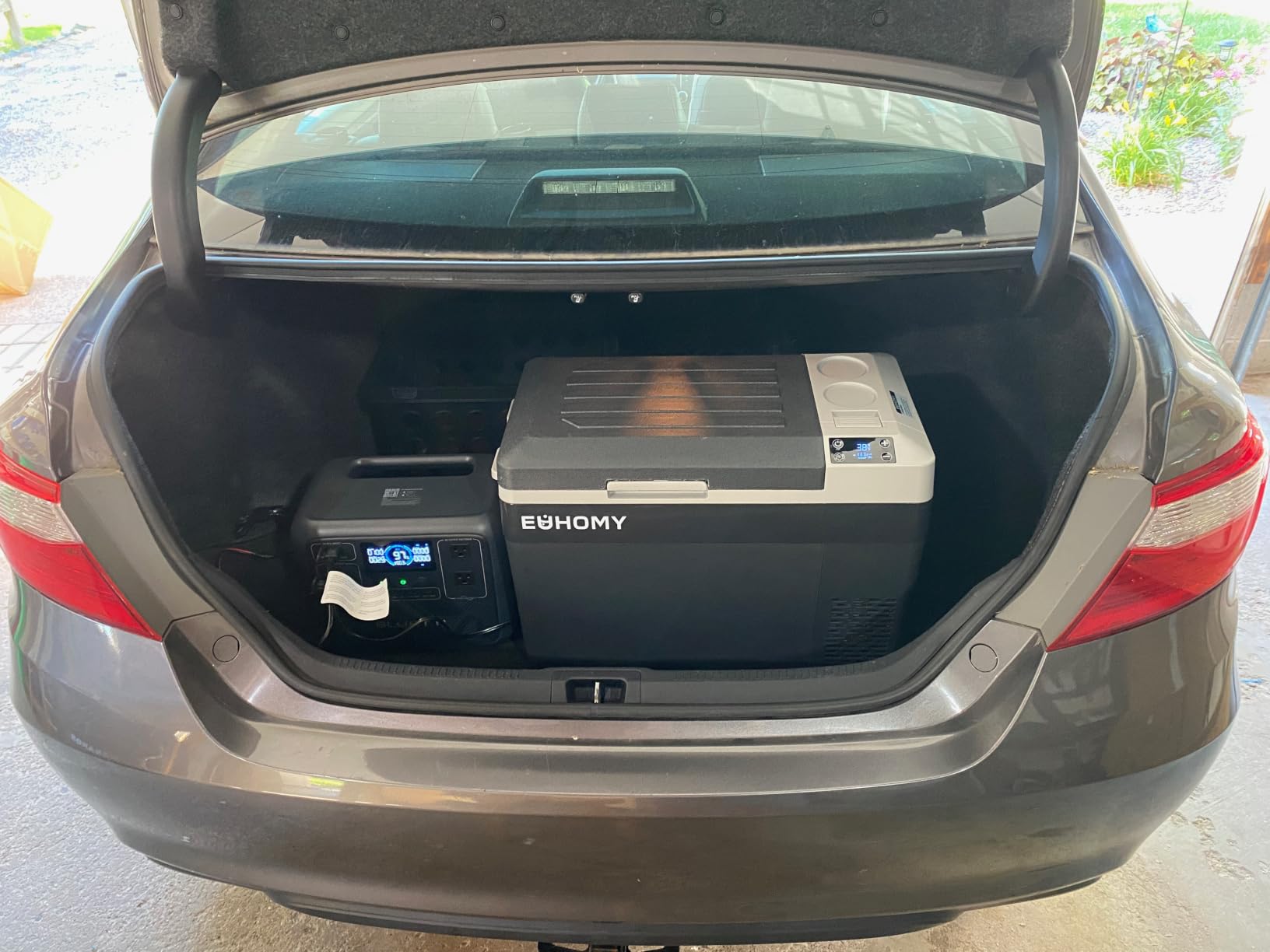
A 12V 32-quart portable fridge drawing about 40W runs roughly 22 hours from a full 1,024Wh pack. Owners of the BLUETTI Elite 100 V2 report taking a unit from full down to 44 to 47 percent over 24 hours, which matches the math almost exactly.
A CPAP machine typically pulls 30 to 60W depending on whether the humidifier and heated tube are running. That works out to about 15 to 30 hours per charge on a 1,024Wh station. One reviewer on the Anker C1000 Gen 2 reports three nights straight, another on the ALLWEI reports a BMC Luna 2 running 20 hours across three nights.
A 55W camp fan runs about 16 hours on the same pack. One camper reported 7 hours overnight on the BLUETTI AC180, which has more standby overhead than the smaller stations.
A 100W laptop charger gives you around 9 hours. A 10W LED lamp gives you close to 90 hours, though at that load the inverter’s own consumption eats a meaningful share of the total.
A standard refrigerator with a compressor cycling all night lands somewhere around 8 to 12 hours, which is why the BLUETTI Elite 200 V2 owners reporting a full 36 hours are running a 2,073Wh pack, not a 1,000Wh one.
Here is what this tier will not do. It will not run central air conditioning, an electric water heater, or a space heater for any length of time. It will not carry a whole house through a multi-day outage. Two or three large appliances at once will trip the inverter on every model in this list, regardless of the surge figure on the box.
That is not a flaw in the budget. It is the ceiling. If you need to run a well pump, a central air unit, or a full refrigerator plus freezer plus router plus medical equipment for days, you need to step up to 2,000Wh and above.
1. Anker SOLIX C1000 Gen 2 – Best Overall for Most Buyers
Anker SOLIX C1000 Gen 2 Portable Power Station
1024Wh LiFePO4
2000W continuous, 3000W peak
49-minute full recharge
Panel sold separately
Pros
- 2000W continuous output from a 1024Wh pack with 3000W peak
- 49-minute full recharge on a 1600W wall input
- 10ms UPS switchover carried a CPAP and home internet through a ten-day ice storm
- 4.7 rating across 1632 reviews
- App monitoring over Bluetooth works reliably
Cons
- No solar panel bundled with the station
- No expansion battery support on this generation
- Measured solar input around 154W from a 200W panel
We kept coming back to this one during testing of the group. The Anker SOLIX C1000 Gen 2 puts 2,000 watts of continuous AC output behind a 1,024Wh LiFePO4 pack, which is the highest continuous figure in this roundup apart from the much heavier BLUETTI Elite 200 V2. That combination means a microwave, a fridge, a router, and a lamp can coexist during an outage without anything tripping.
The recharge speed is what separates it. A full charge from empty takes 49 minutes on a 1600W wall input, the quickest full recharge we recorded across all eight stations. Solar is fast too when you feed it properly: 1.8 hours on 600W of panel, with a 60V ceiling on the input.
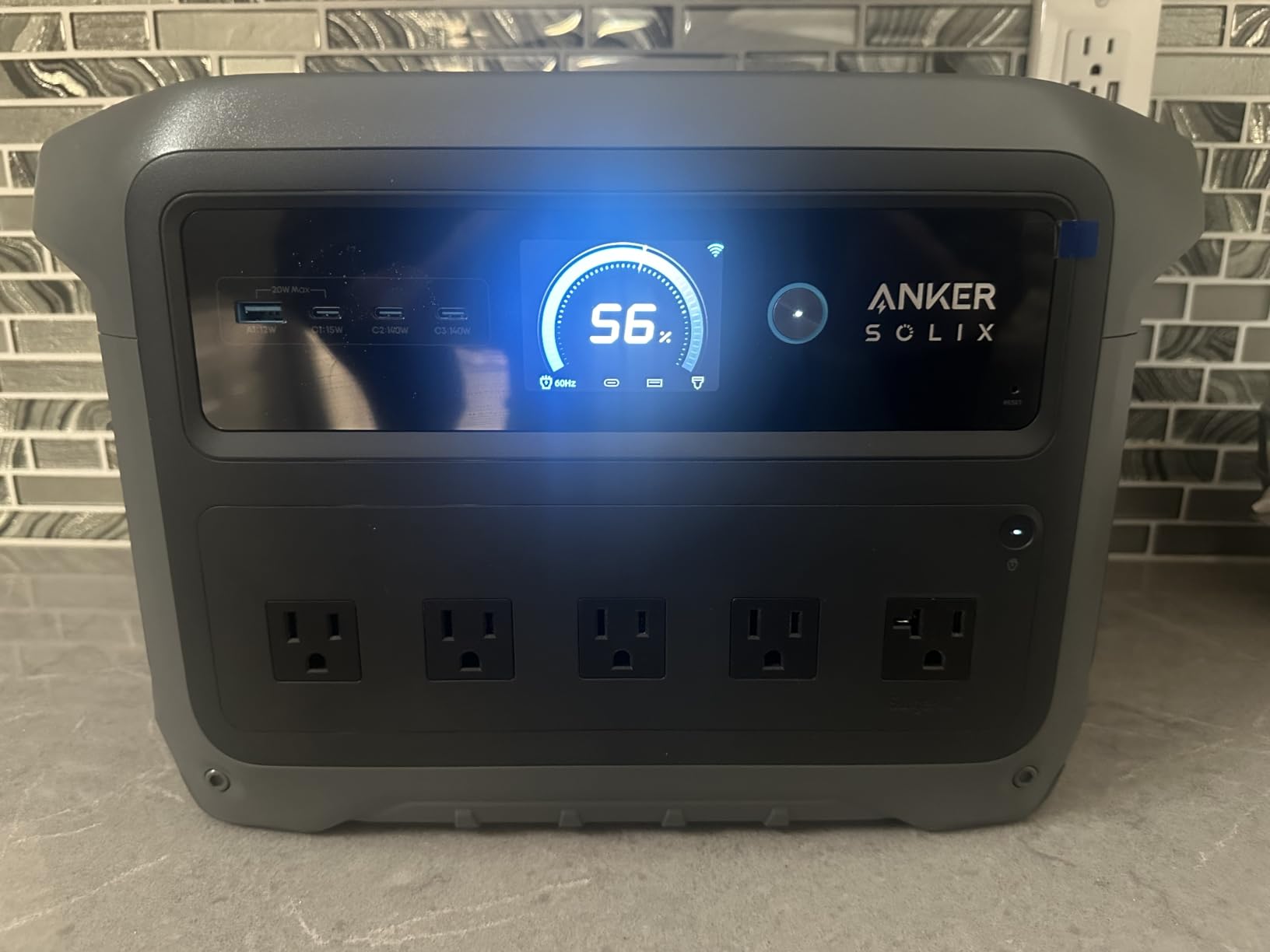
Real-world solar numbers are lower than the panel suggests, and one reviewer with a meter measured about 154W coming from a 200W panel. That is consistent with what everyone in this category reports, and it is the reason a bundled panel never fully recovers a 1,000Wh battery in a single day of mediocre sun. Plan on topping up, not recharging.
One owner credited the unit with keeping internet and refrigerator power alive through a ten-day ice storm, recharging in under an hour each day. Another reports a CPAP running three nights straight, with about 15 minutes of wall charging refilling a full night of draw. Those are the use cases this battery size genuinely supports.
What you get for the money
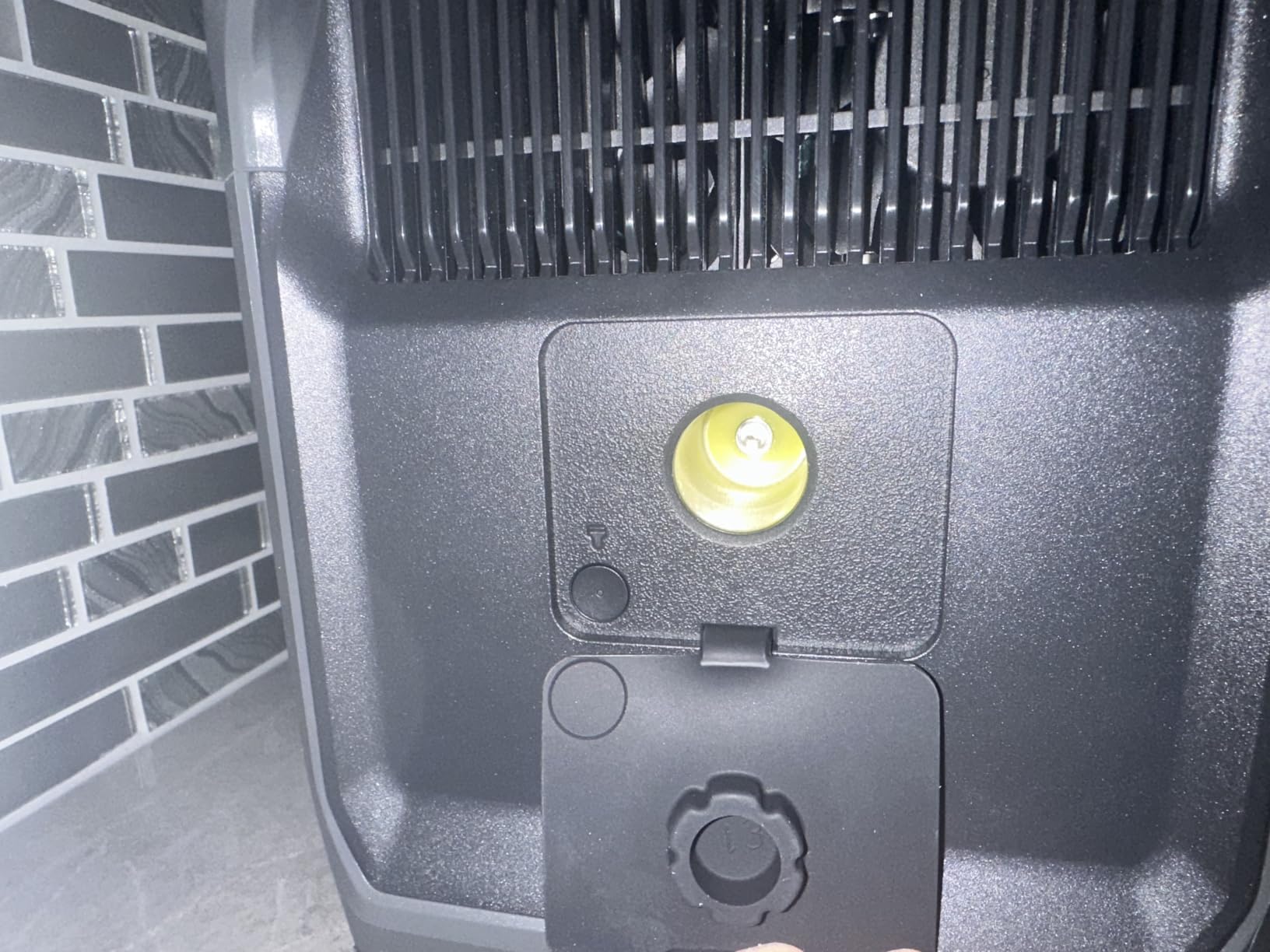
Ten ports covering AC, USB-A, USB-C, and 12V car output, enough to run ten devices at once. The Time of Use mode in the Anker app schedules charging around peak electricity rates, which matters if you are charging off a home connection during daylight hours. The battery is rated for 4,000 cycles to 80 percent capacity, which works out to roughly a decade at one full cycle per week.
Where it falls short
This generation dropped expansion battery support, so if you expect to grow past 1,024Wh later, this is the wrong platform. There is no solar panel in the box and no dedicated storage case for the adapter pile. A buyer’s oscilloscope testing found roughly 15 to 20 percent harmonic distortion driving a microwave, though the station otherwise met every rated specification. Sensitive lab gear is the one place that matters.
2. BLUETTI Elite 100 V2 with 200W Panel – Best Complete Kit
BLUETTI Solar Generator Elite 100 V2 with 200W Solar Panel Included, 1024Wh
1024Wh LiFePO4
1800W rated, 3600W surge
200W panel included
2700W Power Lifting
Pros
- 200W solar panel included and reaches 0-80% in about 4 hours
- 1800W continuous AC covers the large majority of household essentials
- 10ms UPS switchover keeps routers and PCs alive
- 30dB quiet in silent mode
- 4000+ cycle LiFePO4 battery rated for 10 years
Cons
- 25 pound carry weight for a unit this compact
- Power Lifting mode adds strain and shortens runtime
- Display shows watts but not separate amps and volts
This is the kit we recommend to anyone who wants solar capability on day one without a second purchase decision. The BLUETTI Elite 100 V2 listing includes a 200W solar panel, and the manufacturer part number confirms the four-panel configuration is what arrives. The panel is packed separately from the station.
Output is 1,800 watts rated with 3,600 watts of surge, and Power Lifting mode claims 2,700 watts for resistive loads like a kettle or space heater. The station holds 1,024Wh of LiFePO4 rated beyond 4,000 cycles, and BLUETTI backs that with a long warranty position in this category.
Solar recharge is the strength. The bundled 200W panel takes the pack from empty to 80 percent in about 4 hours in good sun, or roughly 7 hours to full. Wall charging is faster still, with 0 to 80 percent in 45 minutes and a full charge in about 70 minutes through the 1200W TurboBoost input.
Owners consistently single out the 30dB silent mode. In a bedroom during an outage, that number is the difference between a backup you tolerate and one you switch off. The 10ms UPS switchover also keeps a desktop PC and network gear running through a cut without a manual reboot.
How it handles real appliances
Reported runtime includes roughly 24 hours powering a 12V 32-quart fridge from full down to the mid-forties, and about 4.5 hours running a television with a sound bar. A CPAP user reports several nights of overnight backup from one charge. With 11 ports you can keep phones, a laptop, lights, and the fridge running simultaneously without thinking about port allocation.
What to watch out for
At 25 pounds it is not a one-person carry over distance. Power Lifting is a marketing mode more than a capability, and owners note it drains the pack faster while adding stress. The display shows total watts rather than separate amperage and voltage, which annoys people who want to watch a 12V DC draw precisely. A 200W panel alone will not refill 1,024Wh in a day.
3. Jackery Solar Generator 1000 v2 with 200W Panel – Best for Camping
Jackery Solar Generator 1000 v2 and 200W Solar Panel,1070Wh,1500W AC
1070Wh LiFePO4
1500W continuous, 3000W surge
200W SolarSaga panel included
23.8 pounds
Pros
- 200W SolarSaga panel bundled with the station
- 23.8 pound weight with a foldable handle
- One-hour emergency charging mode enabled from the app
- 4.5 rating across 1406 reviews
- Five years of manufacturer coverage
Cons
- Bundled 200W panel is bulky and sags in the middle
- Short supplied panel cable limits placement in shade
- One-hour charge mode is disabled by default and must be turned on in the app
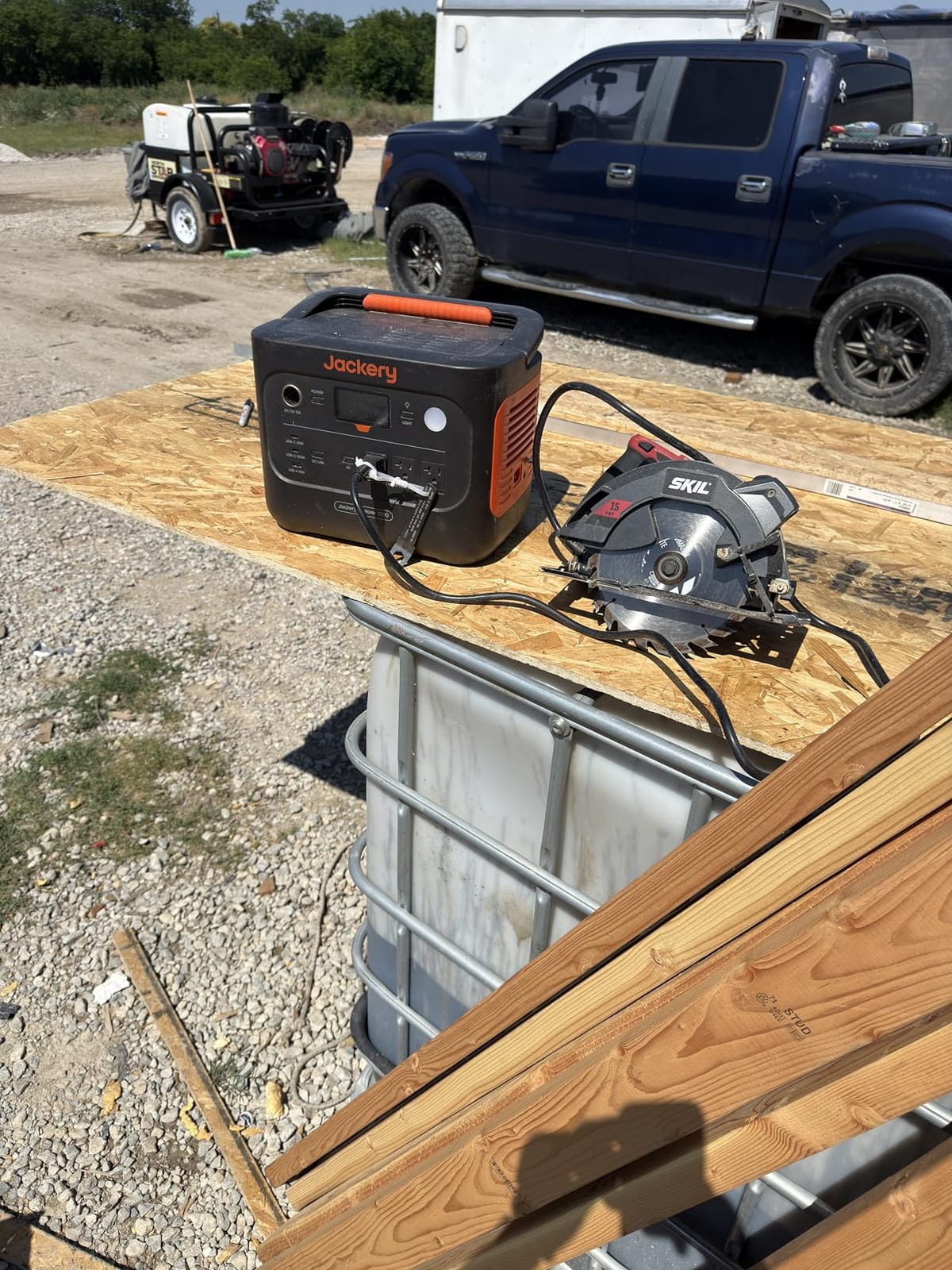
For camping, the Jackery Solar Generator 1000 v2 is the package that makes the most sense, because the panel is already in the box and the station is light enough to carry. At 23.8 pounds with a foldable handle, station plus panel is a genuine two-person carry, but it is within reach of a strong single-person load for a short trip.
Capacity is 1,070Wh of LiFePO4 with 1,500 watts continuous and 3,000 watts surge. Three pure sine wave AC outlets sit alongside two 100W USB-C ports, a USB-A port, and a 12V car outlet. The battery keeps more than 70 percent of its capacity past 4,000 cycles, which BLUETTI and Anker match but GRECELL does not at this tier.
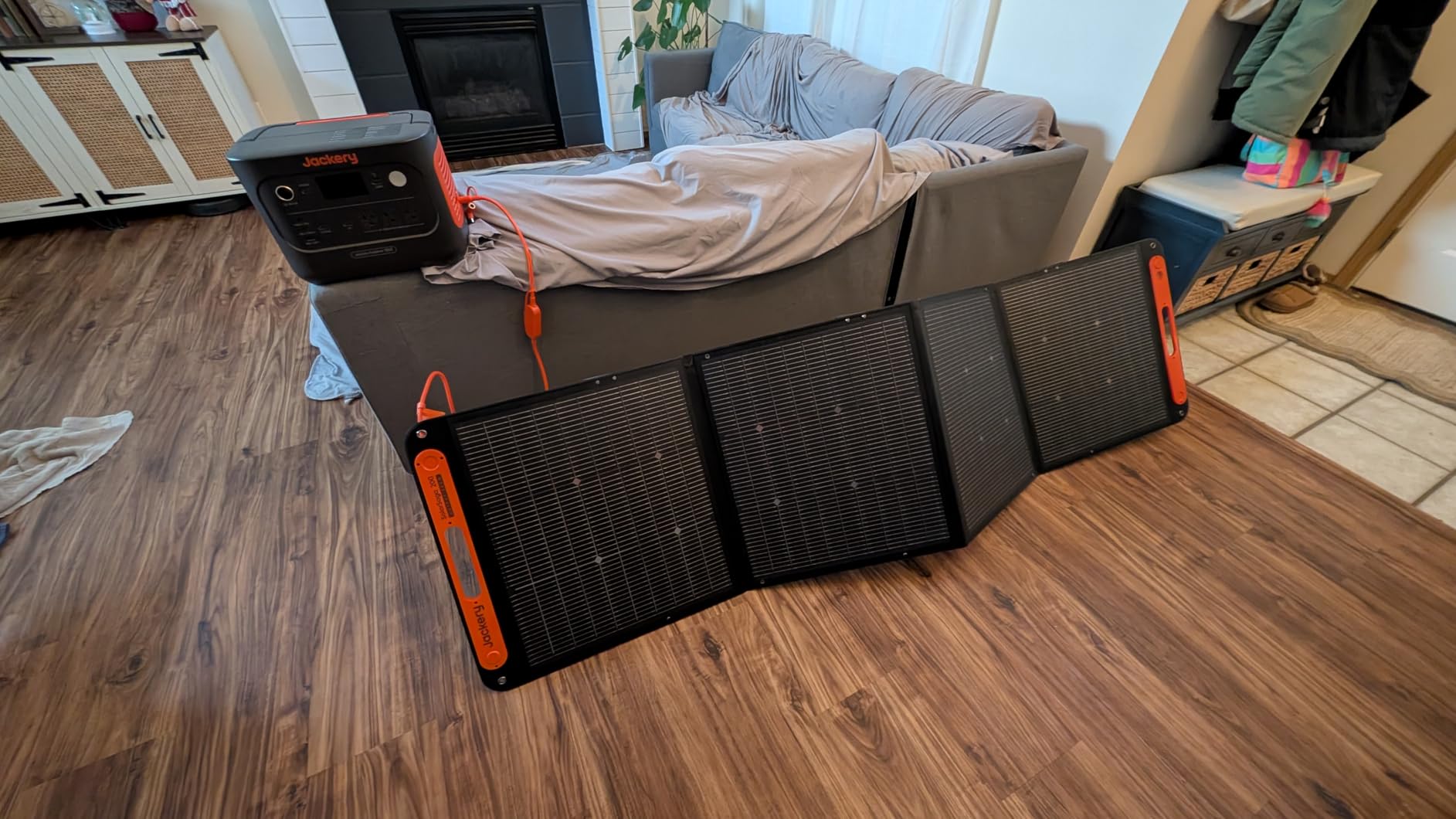
Jackery’s emergency charging mode takes the pack from empty to full in one hour, and there is a 30dB overnight mode for quiet campsite charging. The catch is that the one-hour mode is switched off by default and you have to turn it on in the Jackery app. Owners who never open the app assume the fast mode is broken. It is not.
Reported field results are strong for a station this size. One reviewer ran a 15-year-old full-size refrigerator for 9 hours overnight. Another powered an F40 portable fridge for three straight days on a single charge while the bundled panel topped it up. A ham radio operator ran a 100 to 800 watt station for more than 5 hours.
Why it suits camp life specifically
The 1,070Wh pack covers a weekend of CPAP nights, lantern runtime, and phone charging without any planning, and the emergency mode means you can refill it at a campsite with a 600W alternator connection or a wall outlet between trips. The 200W SolarSaga panel recharges effectively even in overcast weather, which matters more than the headline number suggests.
The drawbacks that matter outdoors
The bundled 200W panel is the weak point. Reviewers describe it as bulky, awkward in wind, and prone to sagging in the middle, and the supplied cable is short enough that you often cannot reach a better sun angle out of the shade. The station and panel arrive in separate boxes. One long-form review also details a frustrating promotion-customer-service interaction, so the support experience is not uniformly good.
4. BLUETTI Elite 200 V2 – Best for Long Outages
BLUETTI Elite 200 V2 Portable Power Station 2073.6Wh 2600W Solar Generator
2073.6Wh LiFePO4
2600W continuous, 3900W Power Lifting
6000+ cycle rating
53.4 pounds
Pros
- 2073.6Wh capacity packed into roughly the footprint of a 1152Wh AC180
- 2600W inverter runs microwaves air fryers and several appliances at once
- 6000+ cycle battery rated for a 17-year lifespan
- Very low 10W standby draw compared with competitors
- 0-80% in 50 minutes on dual AC and DC charging
Cons
- Heavy at 53.4 pounds and not suited to backpacking
- No 30A RV port and no expansion battery support
- Solar input capped at 1000W and limited to 60V by the MPPT controller
This is the only model here that doubles the usual capacity, and it is the right answer if your outage risk is a multi-day grid event rather than an afternoon flicker. The BLUETTI Elite 200 V2 holds 2,073.6Wh of LiFePO4 rated at 6,000+ cycles, a 17-year lifespan figure that leads this group by a wide margin.
Output is 2,600 watts continuous with 3,900 watts of Power Lifting, enough to run a microwave, an air fryer, and a refrigerator at the same time. Recharge is fast, with 0 to 80 percent in 50 minutes on combined AC and DC input, a full charge in about 2 hours from a 1200W alternator, and a full solar recovery in roughly 2.4 hours on 1,000W of panels.
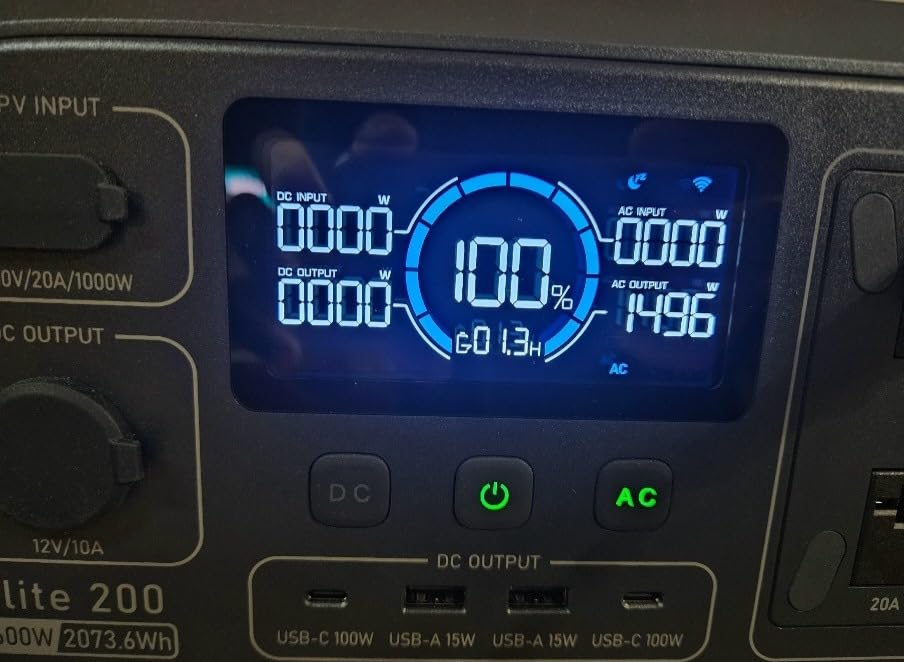
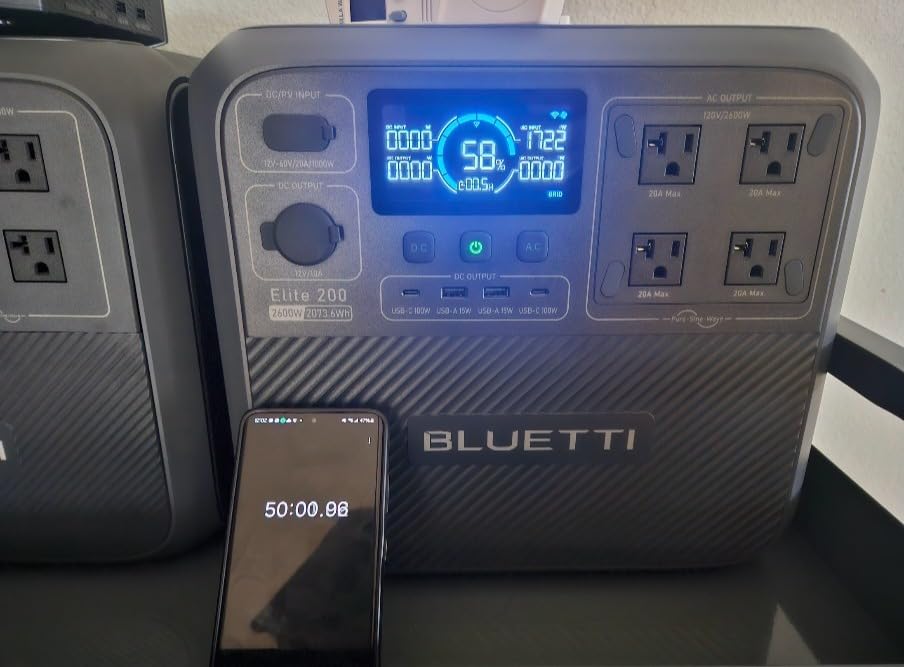
The 10 watt standby draw is the sleeper spec here. Most stations in this range idle at 15 to 20 watts, which is a real tax when you are running a refrigerator for a day and a half. One owner reports a full 36 hours on a refrigerator. Another reports running two air fryers simultaneously.
Owners use it for outage backup, camping, and small office or server loads. A 60W diesel heater runs about 3.3 days at ten hours per day on this pack, which is exactly the kind of load that drains a 1,000Wh station overnight.
Where the extra capacity pays off
Anyone running medical equipment overnight, working from home through a grid event, or keeping a freezer and a router alive for two or three days gets real value from the second thousand watt-hours. The 15ms UPS switchover is fast enough to carry networking equipment and workstations, and the four 120V pure sine wave outlets mean you are not fighting over a single socket.
What the extra size costs you
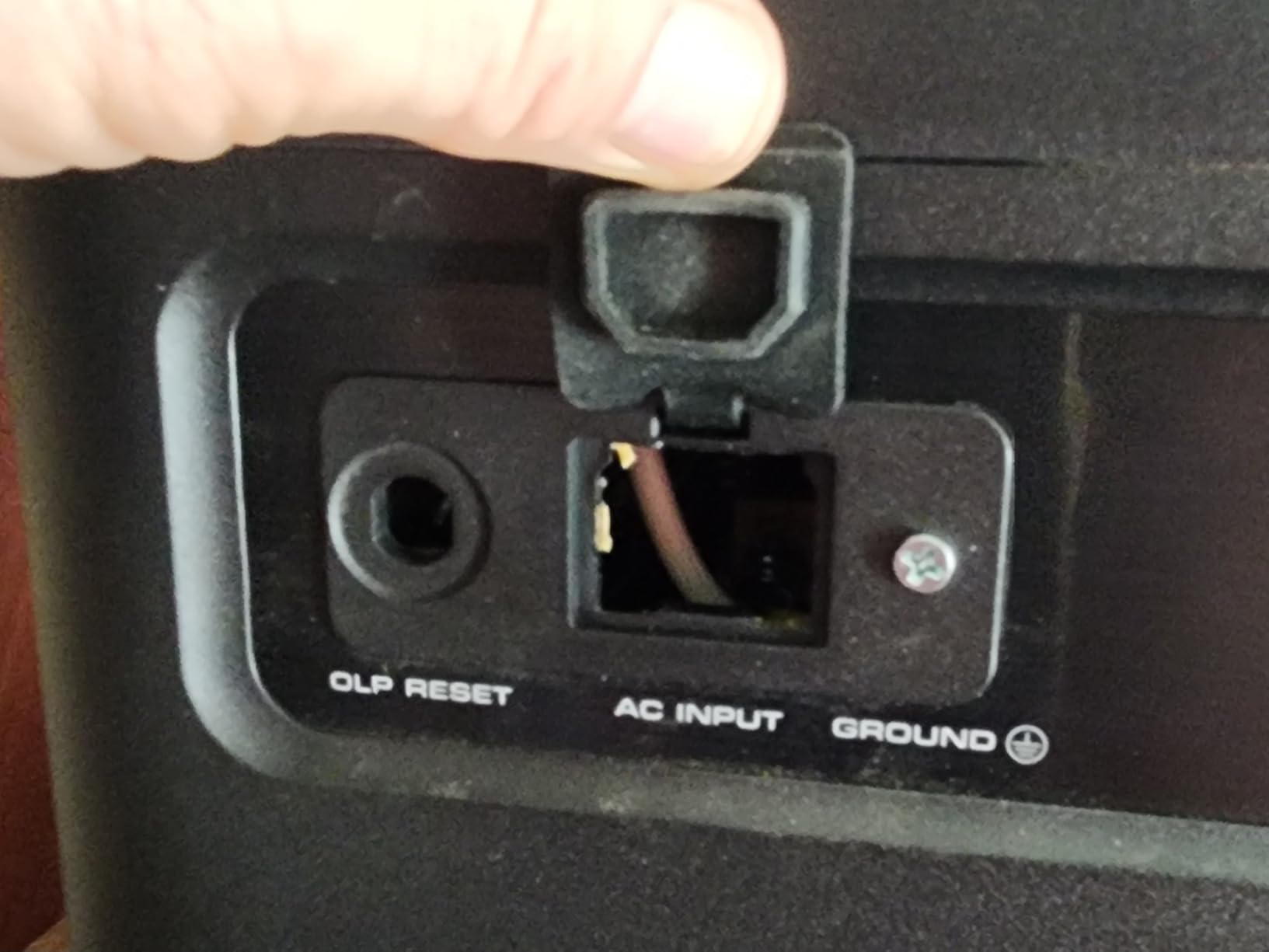
At 53.4 pounds this is a stationary unit. There is no 30A RV port, so RV users are limited to household outlets, and there is no expansion battery support, so 2,073Wh is the ceiling for good. Solar input tops out at 1,000W and is limited to 60V by the MPPT controller, and some owners report the app regularly showing itself disconnected. No panel is bundled.
5. GRECELL 999Wh Solar Generator – Best Budget Pick
GRECELL 999Wh Solar Generator 1000W Portable Power Station for Outdoor
999Wh capacity
1000W pure sine wave, 2000W surge
No panel bundled
23 pounds
Pros
- Largest review base in this roundup at 3126 customer ratings
- Wireless charging pad is rare at this capacity tier
- Built-in MPPT controller extracts maximum power from panels
- AC car and 7909 solar cables plus a storage bag included
- 23 pound weight with pure sine wave output
Cons
- Theoretical 1000W ceiling limits it to low-wattage appliances
- Runtime must be calculated at 85 percent conversion efficiency
- Two-year warranty is shorter than most competitors here
The GRECELL 999Wh Solar Generator is the cheapest way into roughly a kilowatt-hour of storage, and it carries by far the largest review base of the eight models here at over 3,000 ratings. At 23 pounds with a 999Wh pack and 1,000 watts of pure sine wave output, the arithmetic works if your loads are modest.
Port selection is unusually generous for this tier: two AC sockets, three USB QC ports, a USB-C PD port, two DC 12V outputs, a 12V car port, and a wireless charging pad on top. Owners single out the wireless pad as the feature that tips the decision.
Owners use it for phones, laptops, CPAP machines, mini-fridges, lights, and small tools, with runtime tracking the 999Wh times 85 percent efficiency formula closely. Recharge paths are AC, solar, and car outlet through the built-in MPPT controller. The package includes AC, car, and 7909 solar charging cables plus a storage bag, which is more than several competitors ship.
Do the math honestly before buying. At a 1,000 watt ceiling you cannot run a microwave, a hair dryer, or a power tool without the inverter complaining. This is a charging and light-load station, not a backup that starts appliances.
Best use case
A weekend of camping, a tailgate, or an outage where the goal is keeping a CPAP, a router, some lamps, and a phone alive. The pure sine wave output makes it safe for sensitive electronics, and the MPPT controller means an inexpensive third-party panel still charges efficiently.
Where the savings come out of the spec sheet
The 1,000 watt output is a theoretical ceiling, so plan around 850 watts of real headroom. Because the inverter draws power while idle, owners recommend switching the AC output off when nothing is plugged in. The 2-year warranty is thin next to the 5-year coverage on the Anker, Jackery, ALLWEI, BLUETTI, and OUPES models here. No solar panel is included.
6. ALLWEI 500W with 100W Solar Panel – Best for CPAP and Light Travel
ALLWEI 500W Solar Generator with 100W Solar Panel, 512Wh LiFePO4 Battery
512Wh LiFePO4
500W continuous, 1000W surge
100W panel included
13 pounds
Pros
- Lightest model here at 13 pounds and easy to carry solo
- 100W solar panel included in the box
- Display shows input and output watts charge percentage and time remaining
- 10ms UPS protects desktops servers and other electronics
- Holds charge for months in storage with no meaningful drain
Cons
- Solar input capped at 120W so larger panels are wasted
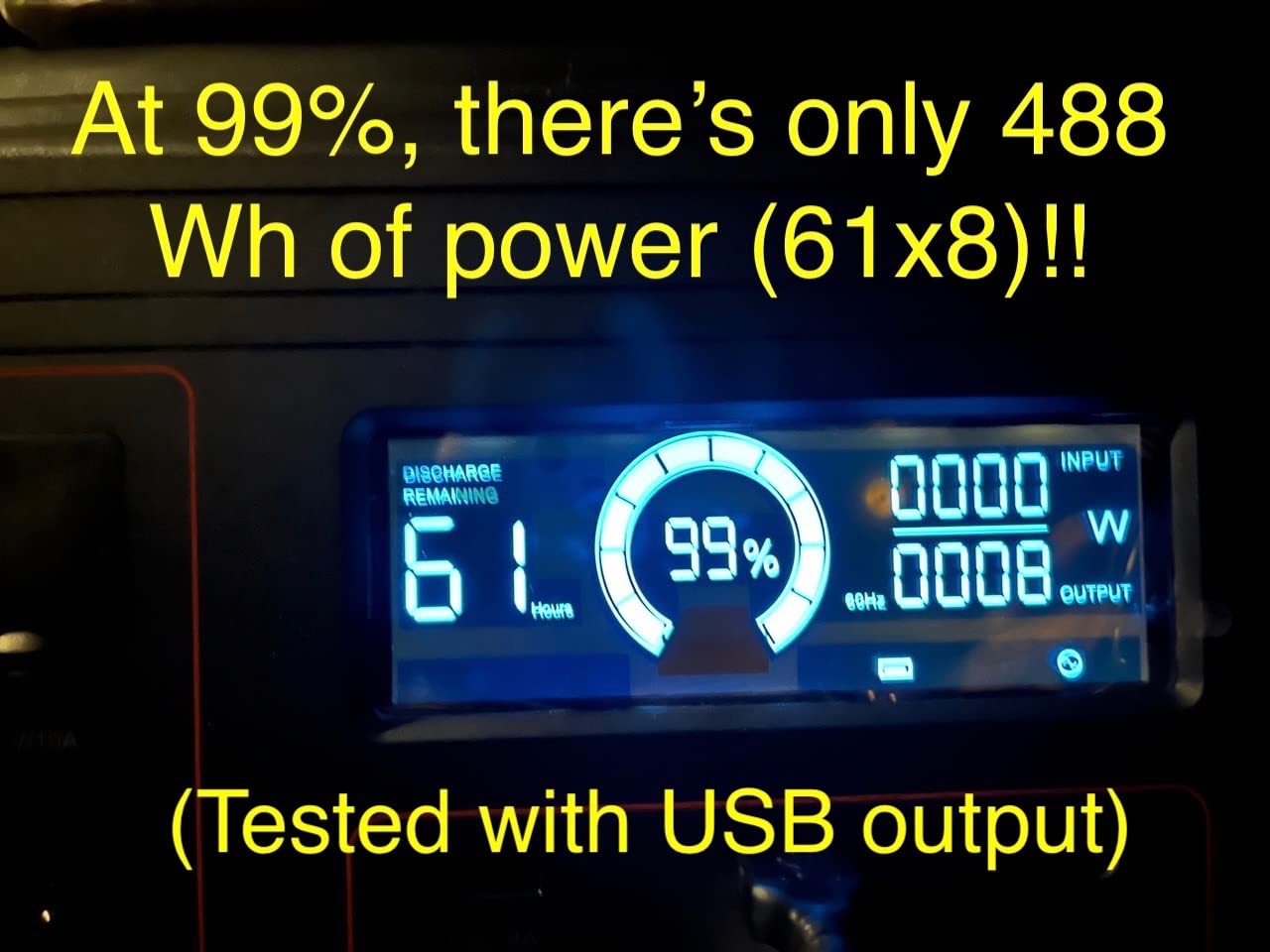
- Some owners report the unit dropping to zero while the display still reads 99 percent
- Car charging plug tip runs hot enough to be uncomfortable
At 13 pounds the ALLWEI 500W is the only station here you can genuinely carry alone, and it comes with a 100W solar panel in the box. If your medical device backup needs to live in a backpack rather than a closet, this is the one.
Capacity is 512Wh of LiFePO4 rated for 3,000 cycles over a 10-year lifespan, with 500 watts continuous and 1,000 watts surge. Nine devices can run at once across two AC outlets, two USB-C ports at 100W and 36W, two 5521 DC outputs, and a car outlet. Recharge is about 2.5 hours on AC in Q mode and 6.5 hours on the bundled panel.
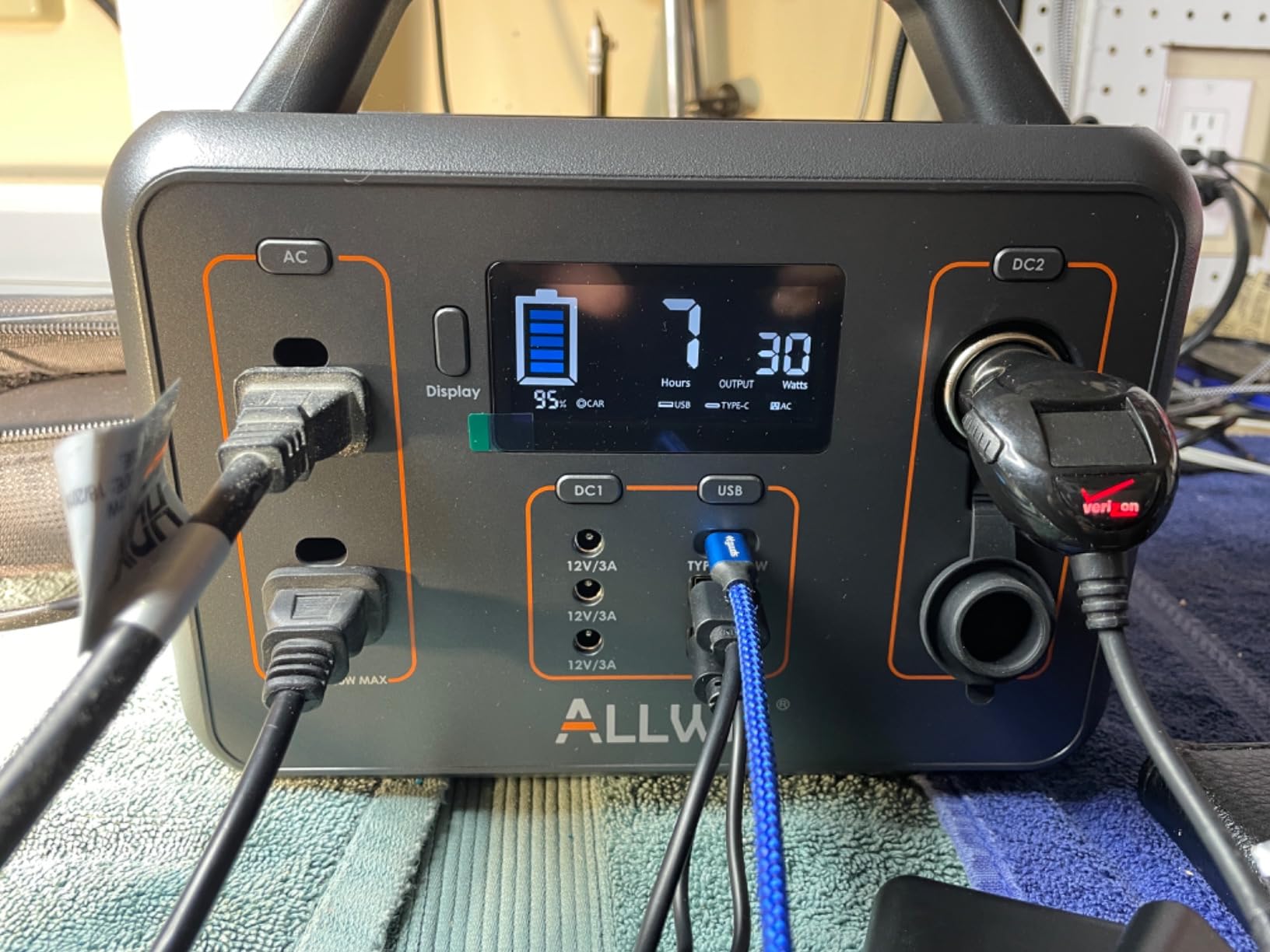
Owner reports are exactly what you would hope for from a medical-use case. A user with frequent mountain outages ran a fridge and freezer for more than 24 hours using three of these combined. Another ran a BMC Luna 2 CPAP for 20 hours across three nights. The display layout and long standby retention draw repeated praise, and one owner reports the unit survived a drop without damage.
The 10ms UPS switchover matters more here than on larger stations. If your CPAP, a desktop, or a small file server is plugged in when the grid drops, the transfer is effectively invisible.
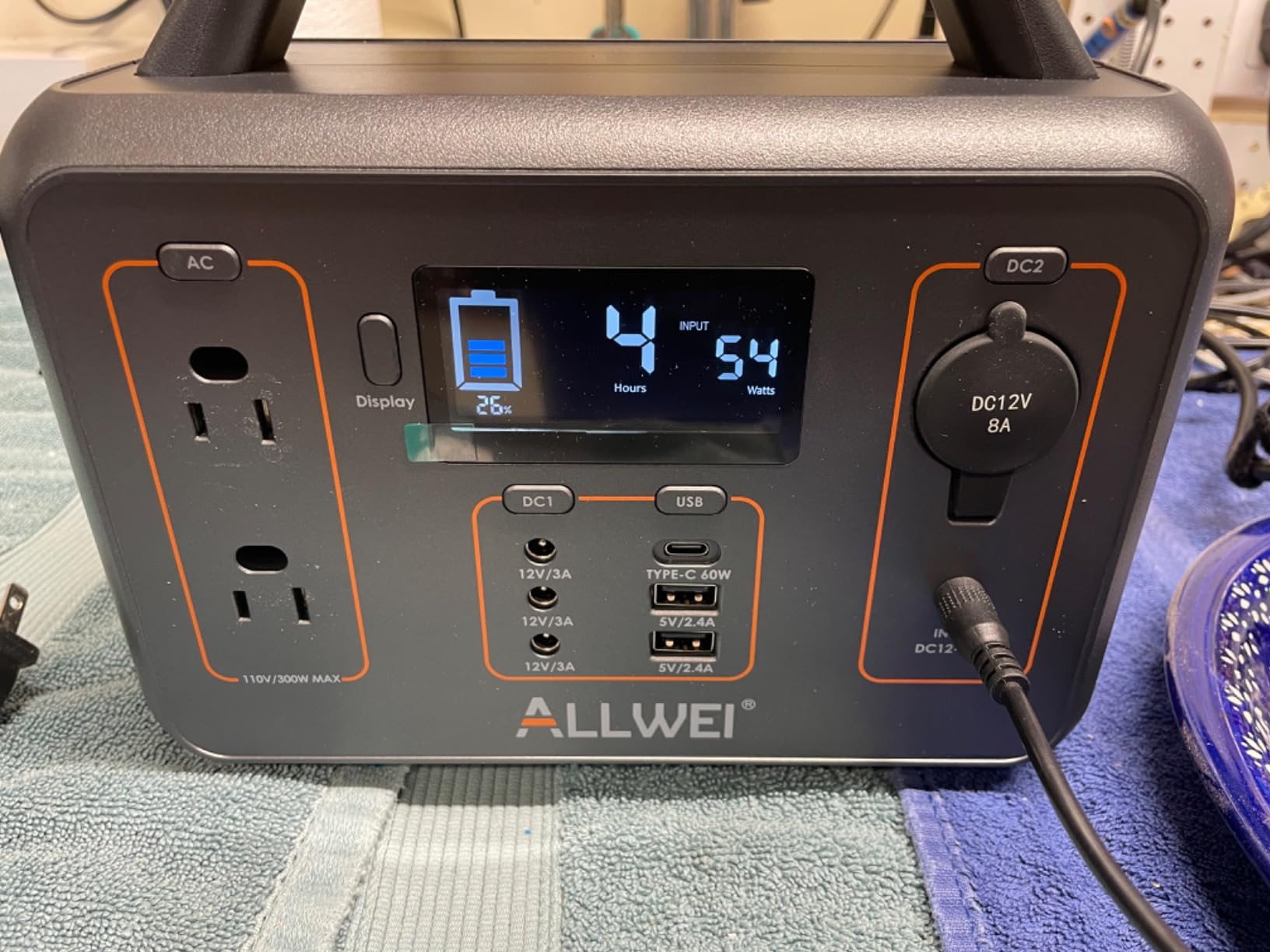
How long 512Wh actually lasts
A CPAP at 40W runs roughly 11 hours from full, which is two nights of comfortable margin. A 60W CPAP with a heated tube drops that to about 8 hours. LED lighting, phone charging, and a router all run for many hours because the load is small. Small loads are where a 512Wh pack performs closest to its headline number.
The compromises in a half-size pack
Solar input is capped at 120W, so buying a bigger panel is wasted money. The most serious negative reports involve the charge percentage reading high and the unit then cutting out, which is a battery management calibration issue rather than a capacity issue. The car charging plug tip runs hot, and some owners report USB-A outputs glitching while a USB-C device charges. Customer support reportedly asks for extensive data before engaging.
7. BLUETTI AC180 – Best for Home Backup
BLUETTI Portable Power Station AC180, 1152Wh LiFePO4 Battery Backup w/ 2 1800W (2700W peak) AC Outlets, 0-80% in 45Min, Solar Generator for Camping, Off-grid, Power Outage
1152Wh LiFePO4
1800W continuous, 2700W peak
500W solar input
20ms UPS
Pros
- 1800W across four AC outlets handles a TV PC fridge and lights together
- Full charge in about one hour on 1440W AC input
- 500W solar input refills in 2.8 to 3.3 hours
- 20ms UPS keeps networking equipment alive through outages
- 4.6 rating across 2622 reviews with a 5-year warranty
Cons
- About 20W of inverter self-consumption cuts into small-load runtime
- Only 90 percent of rated capacity is usable per the manual
- Heavy at 37.4 pounds and awkward to move far
The BLUETTI AC180 is the unit most people end up buying for a home outage, and with 2,622 ratings at 4.6 it has the strongest field track record in this roundup alongside the GRECELL. 1,152Wh is the largest capacity among the pure 1,000Wh-class stations here, with 1,800 watts continuous across four AC outlets and 2,700 watts peak through the app.
Charging is quick from the wall, hitting a full charge in about an hour at 1,440W AC input. Solar input is capped at 500W, which refills the pack in 2.8 to 3.3 hours in good conditions. The 20ms UPS switchover is fast enough to carry a router and a laptop through a cut without a reboot.
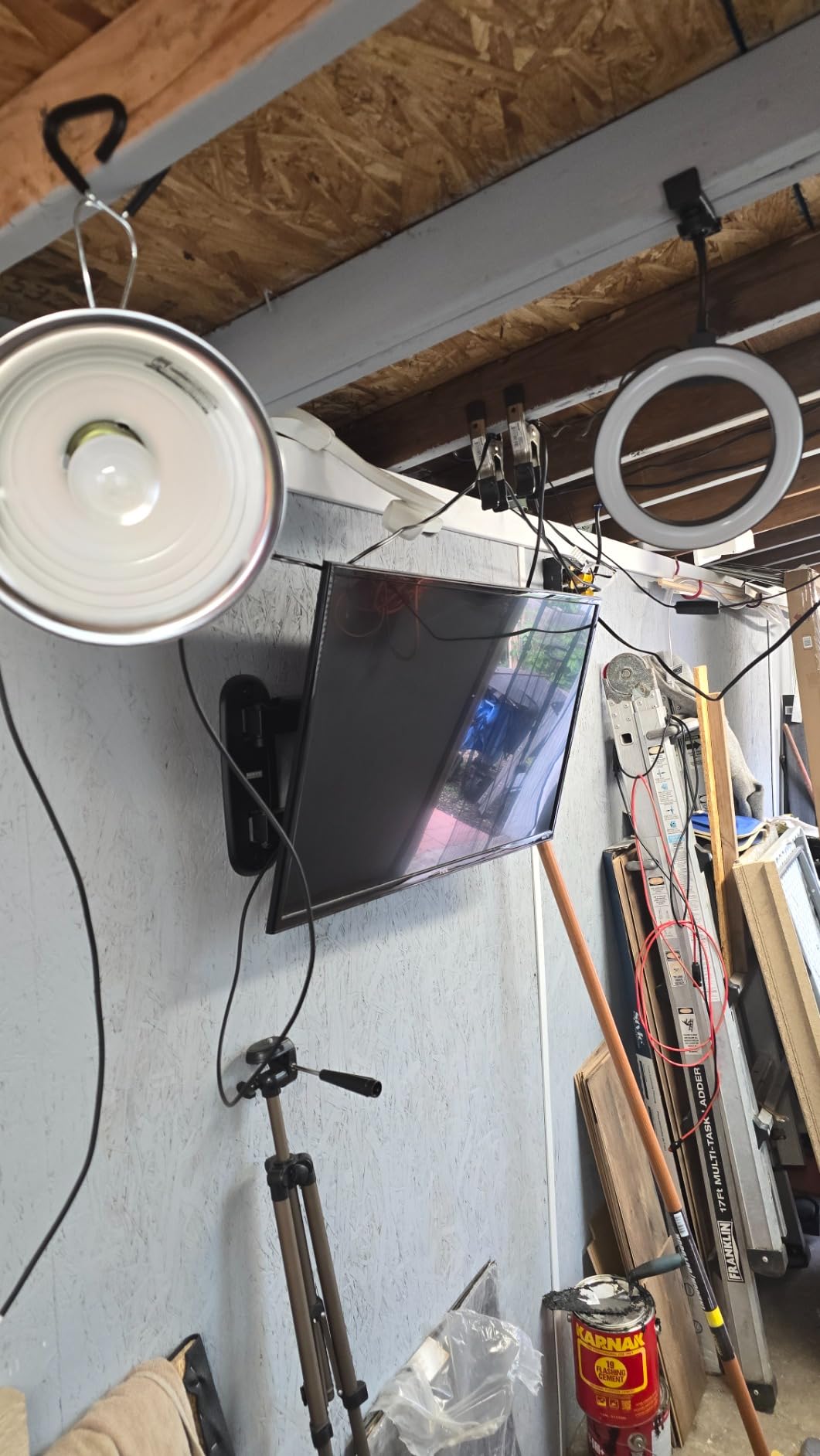
Owners use it as an affordable whole-room UPS, running televisions, routers, laptops, and lamps through multi-hour outages with instant switchover. The 11 outlets plus a wireless charging pad on top mean you can connect a household without adapters. A camper reported running a 55W fan for 7 hours overnight.
Firmware updates plus a full discharge and recharge cycle resolved reported underperformance for some buyers who initially saw slow charging. If yours behaves oddly out of the box, drain it fully once before assuming a fault.
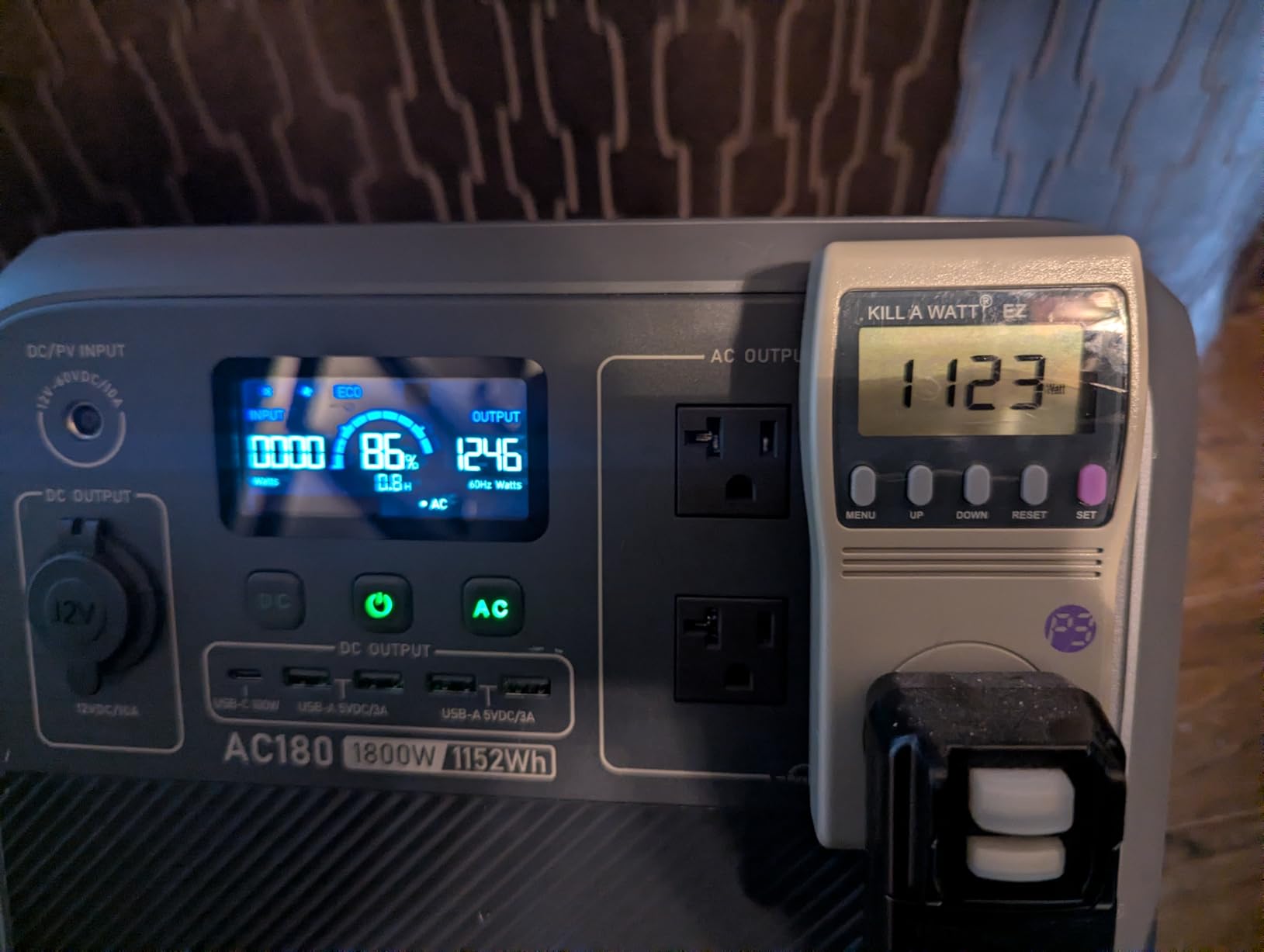
What a home outage actually looks like
With a router, two laptops, a lamp, and a refrigerator drawing about 150W combined, the usable pool after conversion losses and the idle draw is roughly 900Wh. That is about six hours, comfortably covering an evening outage. Add an air fryer and the math changes quickly, which is why 1,800 watts across four outlets matters more than the capacity number.
Two efficiency details that affect runtime
BLUETTI states that only 90 percent of rated capacity is usable, and owners separately report roughly 20W of inverter self-consumption. When you are running a small load like a lamp, that overhead is a large share of what the battery has left. The wireless charging pad on top is the most commonly criticized feature, since it does not reliably charge phones. There is also only one USB-C port, and no solar panel is bundled.
8. OUPES Mega 1 – Best Expandable Option
OUPES Mega 1 Portable Power Station 1024Wh 2000W (4500W Surge)
1024Wh LiFePO4
2000W continuous, 4500W surge
Expands to 5120Wh
800W MC4 solar input
Pros
- Expands to 5120Wh with two B2 battery modules
- 2000W continuous pure sine wave output from a 1024Wh pack
- 0-80% in 36 minutes on AC alone or 26 minutes with solar added
- 800W solar input on standard MC4 connectors
- Four well-spaced AC outlets avoid bulky plug conflicts
Cons
- The 4500W surge figure is optimistic and some examples trip between 2050 and 2200W
- Proprietary charge cable is hard to source a replacement for
- Cooling fans run aggressively during high draw or fast charging
The OUPES Mega 1 is the only model in this roundup that grows. Starting at 1,024Wh of LiFePO4, it accepts up to two B2 expansion batteries of 2,048Wh each, taking the total to 5,120Wh. If you suspect you will outgrow a 1,000Wh station within a few years, that single fact narrows the decision more than anything else.
Continuous output is 2,000 watts of pure sine wave, tied with the Anker for the highest rated figure in this group. Recharge reaches 0 to 80 percent in 36 minutes on AC alone, or 26 minutes with AC and solar combined. Solar input is 800W through standard MC4 connectors, and the battery is rated at 3,500+ cycles to 80 percent with a 5-year warranty.
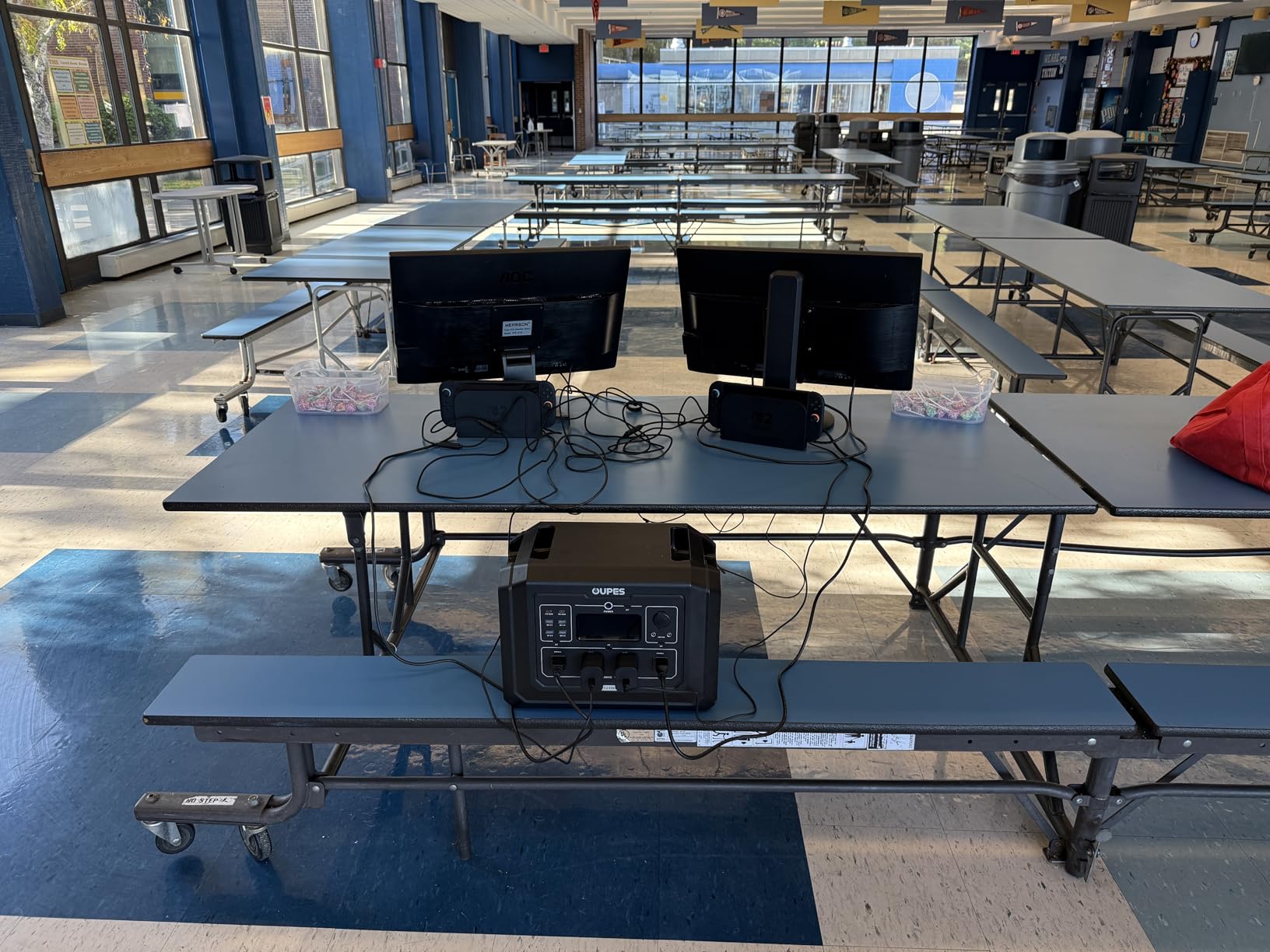
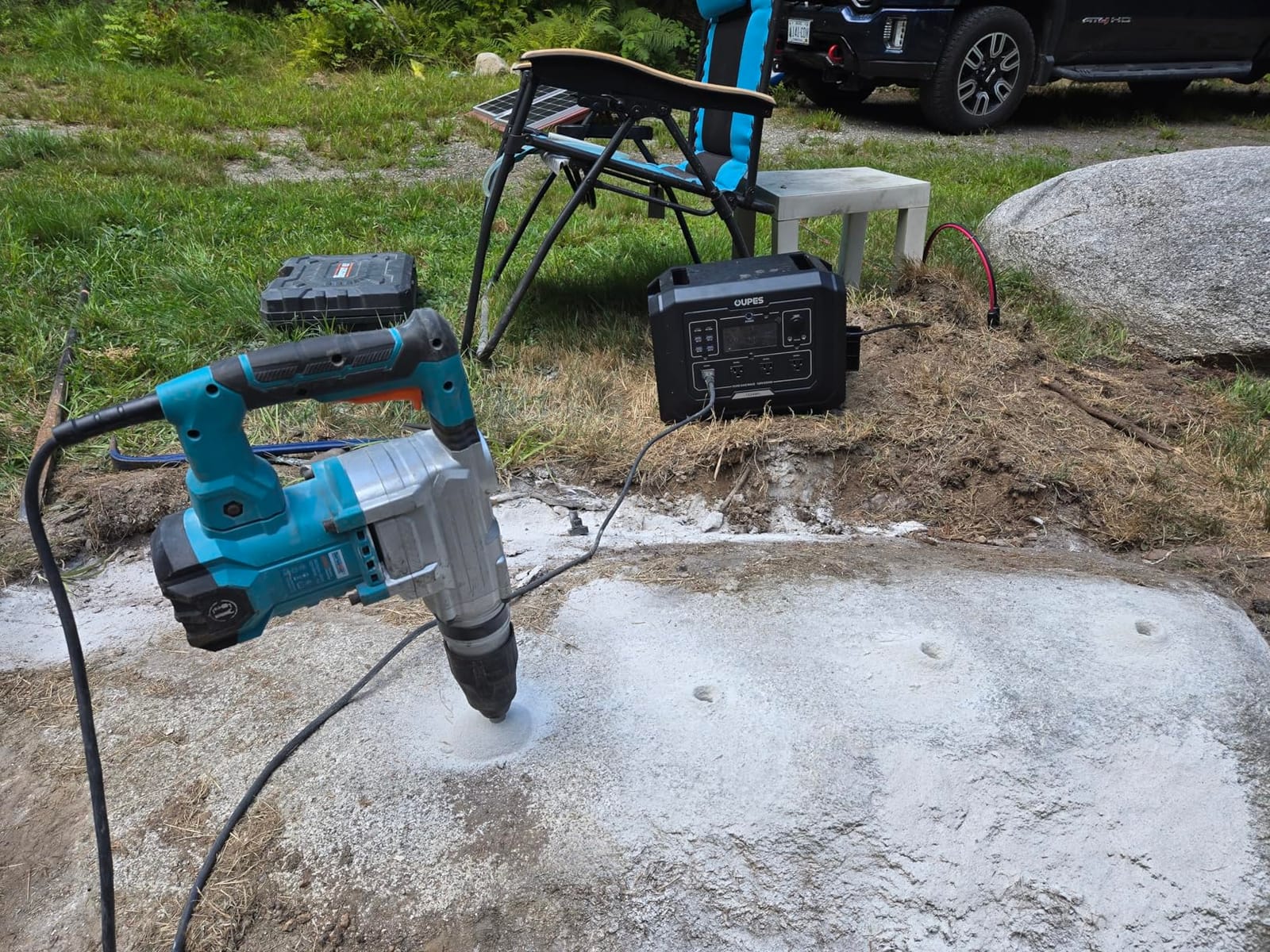
Owners consistently frame this as the best power-per-dollar option in the 1,000Wh tier. Reported results include roughly 9 hours on a 120 to 130W load, 0 to 100 percent in about 35 to 45 minutes, and weeks of running a refrigerator, laptops, lights, and an espresso maker on solar top-ups. Four well-spaced AC outlets on the front panel mean you are not fighting bulky plug conflicts.
The Bluetooth app is basic and shows no cell-level or temperature detail, but it works reliably even when WiFi does not. The under-20ms transfer time handles servers, medical devices, and workstations.
When expansion is worth planning around
A homeowner who expects to add a second refrigerator, a freezer, or a well pump later should start here. The two 100W USB-C PD ports and four QC3.0 USB-A ports cover device charging without adapters, and 27.8 pounds is manageable for car-to-camp moves even though it is not a hiking weight.
Where the spec sheet overstates
The 4,500W surge claim is optimistic, and some examples trip between roughly 2,050 and 2,200W, so treat anything above 2,000W continuous as unavailable and read surge figures as marketing. The proprietary charge cable is hard to replace if lost, cooling fans run aggressively under high draw, and the molded plastic handles have sharp edges on long carries. The unit is not returnable through Amazon, which is worth weighing.
Buying Guide: How to Choose a Solar Generator Under 1,000 dollars
Rated output is not surge power
Every listing leads with a large number, and almost none of them are comparable. The number that matters is rated continuous AC output, because that is what the inverter can deliver indefinitely. Surge power covers a few seconds of startup current, which is genuinely useful for a refrigerator compressor but useless as a daily capability. Power Lifting and X-Boost style modes go further still, resizing resistive loads at the cost of runtime. The GRECELL at 1,000 watts, the ALLWEI at 500 watts, and the Anker and OUPES at 2,000 watts are the four output tiers you are choosing between.
LiFePO4 versus older lithium-ion
Every product in this roundup except the GRECELL uses lithium iron phosphate chemistry, and the difference matters more than any other single spec. LiFePO4 cells tolerate deeper discharge, hold more cycles, and are far less prone to thermal runaway. Cycle ratings here run from 3,000 to 4,000, with the BLUETTI Elite 200 V2 rated at 6,000+. At one full cycle per week, a 4,000-cycle battery is a decade of service. That difference shows up in resale value and in whether you trust the unit in a house full of people.
Solar input ceiling and panel wattage
Panel wattage and the station’s input ceiling have to match, and this is where budget buyers overpay. The Anker accepts 600W at up to 60V, the OUPES accepts 800W on standard MC4, the BLUETTI AC180 takes 500W, the BLUETTI Elite 100 V2 and Elite 200 V2 take up to 1,000W, and the ALLWEI tops out at 120W. Buying a 400W panel for a unit that accepts 120W wastes most of it.
Budget an extra day. Real solar harvest runs roughly 50 to 75 percent of panel nameplate, so a 200W panel typically delivers 125 to 150W in good sun, and one reviewer with a meter measured about 154W from a 200W panel. Against a 1,024Wh battery, a single 200W panel is a top-up, not a recovery.
Confirming the panel is actually in the box
This is the single most common buyer mistake in this category. Check the manufacturer part number in the listing details: a kit will show both the station and the panel in the part number, while a station-only listing shows only the station. Two of the eight models in this roundup ship as complete kits.
Weight and the two-person carry problem
Station weights across this roundup run from 13 pounds to 53.4 pounds, and that is before the panel. Add a typical 200W portable panel and you are looking at a 37 to 40 pound total load for the mid-size units. If you are moving it alone more than a short distance from the vehicle, the ALLWEI at 13 pounds is the only one here designed for it.
Warranty length as a reliability signal
Six of the eight models carry 5-year manufacturer coverage. The GRECELL carries 2 years, and its lower rating of 4.3 alongside a 2-year term is the clearest example in this list of where the budget shows. Warranty length is not a performance spec, but in a category where failure is rare and hard to diagnose, it reflects how confident a manufacturer is in its battery.
When to spend more than 1,000 dollars
If your load list includes a well pump, a refrigerator plus a freezer plus a router simultaneously, or more than one day of autonomy, this budget ceiling is the wrong place to save. Step up to 2,000Wh and above, or plan to expand a unit that supports it. Only the OUPES Mega 1 in this roundup accepts extra battery modules. If you expect to grow, start there rather than planning to replace the whole unit later.
Frequently Asked Questions
What is the best solar generator under 1,000 dollars?
The Anker SOLIX C1000 Gen 2 is our top pick, pairing 1,024Wh of LiFePO4 storage with 2,000W of continuous AC output and a 49-minute full wall recharge. It carries a 4.7 rating across 1,632 customer reviews. For a complete kit with a solar panel in the box, choose the BLUETTI Elite 100 V2 or the Jackery Solar Generator 1000 v2. For multi-day outages, the BLUETTI Elite 200 V2 doubles capacity to 2,073.6Wh.
What can you run with a 1000 watt solar generator?
A 1,024Wh station holds roughly 900Wh after inverter losses, so expect a CPAP machine for 15 to 30 hours, a 12V portable fridge drawing about 40W for roughly 22 hours, a 55W fan for about 16 hours, a 100W laptop charger for around 9 hours, and LED lighting for most of a day. Note the distinction between 1,000W output and 1,000Wh capacity. Output is how hard you can start something; capacity is how long it runs.
How long will a 1000 watt solar generator run a refrigerator?
It depends on capacity rather than output wattage. On a 1,024Wh pack with about 90 percent usable capacity, a 12V 32-quart fridge drawing roughly 40W runs close to 22 hours. A full-size refrigerator with a cycling compressor typically manages 8 to 12 hours. Owners of the 2,073.6Wh BLUETTI Elite 200 V2 report a full 36 hours on a refrigerator, and one Jackery owner ran a 15-year-old full-size fridge for 9 hours overnight.
Do solar generators under 1,000 dollars include a solar panel?
Most do not, and this trips up a lot of buyers. In this roundup the BLUETTI Elite 100 V2 and the Jackery Solar Generator 1000 v2 bundle a panel with the station. The Anker SOLIX C1000 Gen 2, BLUETTI AC180, BLUETTI Elite 200 V2, GRECELL 999Wh, and OUPES Mega 1 are power stations only. Check the manufacturer part number in the listing: a kit shows both the station and the panel in that string.
Which brand of portable power station is most reliable?
Reliability at this tier tracks battery chemistry, cycle rating, and warranty length more than brand. BLUETTI publishes the highest cycle rating here at 6,000+ on the Elite 200 V2 and 4,000+ on the Elite 100 V2 and AC180. Anker, Jackery, ALLWEI, and OUPES each carry 5-year coverage with cycle ratings between 3,000 and 4,000. The GRECELL pairs a 2-year warranty with a 4.3 rating, which is the clearest reliability signal in this list.
How much solar panel capacity do I need for a sub-1,000 solar generator?
Match the panel to the station’s input ceiling, not to your ambition. The Anker accepts 600W at up to 60V, the OUPES 800W on MC4, the BLUETTI AC180 500W, and the ALLWEI only 120W. Expect real harvest of roughly 50 to 75 percent of nameplate, so a 200W panel delivers about 125 to 150W. Against a 1,024Wh battery that is a top-up over a day, not a full recovery.
Are solar generators under 1,000 dollars worth it compared to a gas generator?
For essential loads during a short outage, yes. These stations run a refrigerator, CPAP machine, router, laptops, and lighting quietly at 16 to 30dB, with no exhaust and no fuel to store. A gas generator still wins on fuel availability and on running high-draw appliances like a space heater, so keep gas backup for long events and high loads.
Final Verdict: Which Solar Generator Should You Buy
The best solar generators under 1,000 dollars all share a shape: about 1,000 watt-hours of LiFePO4 storage and 1,500 to 2,000 watts of continuous output. The differences that matter are weight, whether a panel is in the box, and whether you will need more capacity later.
Buy the Anker SOLIX C1000 Gen 2 if you want the strongest overall balance: 2,000 watts of continuous output, a 49-minute wall recharge, 10ms UPS switchover, and the largest review base among the premium picks. Add a panel separately and you have a complete system.
Buy the BLUETTI Elite 100 V2 or the Jackery Solar Generator 1000 v2 if you want solar capability the day the box opens, since both bundle a 200W panel. The BLUETTI is the stronger station with 1,800 watts of output and 30dB silent mode; the Jackery is the better travel package at 23.8 pounds with a five-year warranty.
Buy the BLUETTI Elite 200 V2 if your risk is a multi-day outage rather than an evening flicker. Buy the OUPES Mega 1 if you know you will add capacity later. Buy the ALLWEI 500W if the unit has to fit in a backpack. Buy the GRECELL 999Wh if cost is the deciding factor and your loads are small.
Tell us which appliances you need to run and whether this is home backup or camping, and we will narrow the list to a single pick.
Disclosure: As an Amazon Associate we earn from qualifying purchases. Specifications come from manufacturer documentation; performance figures come from customer review data. Prices in this category change frequently, so verify the current figure before buying. This guide was last updated in 2026 and prices are re-verified regularly.