
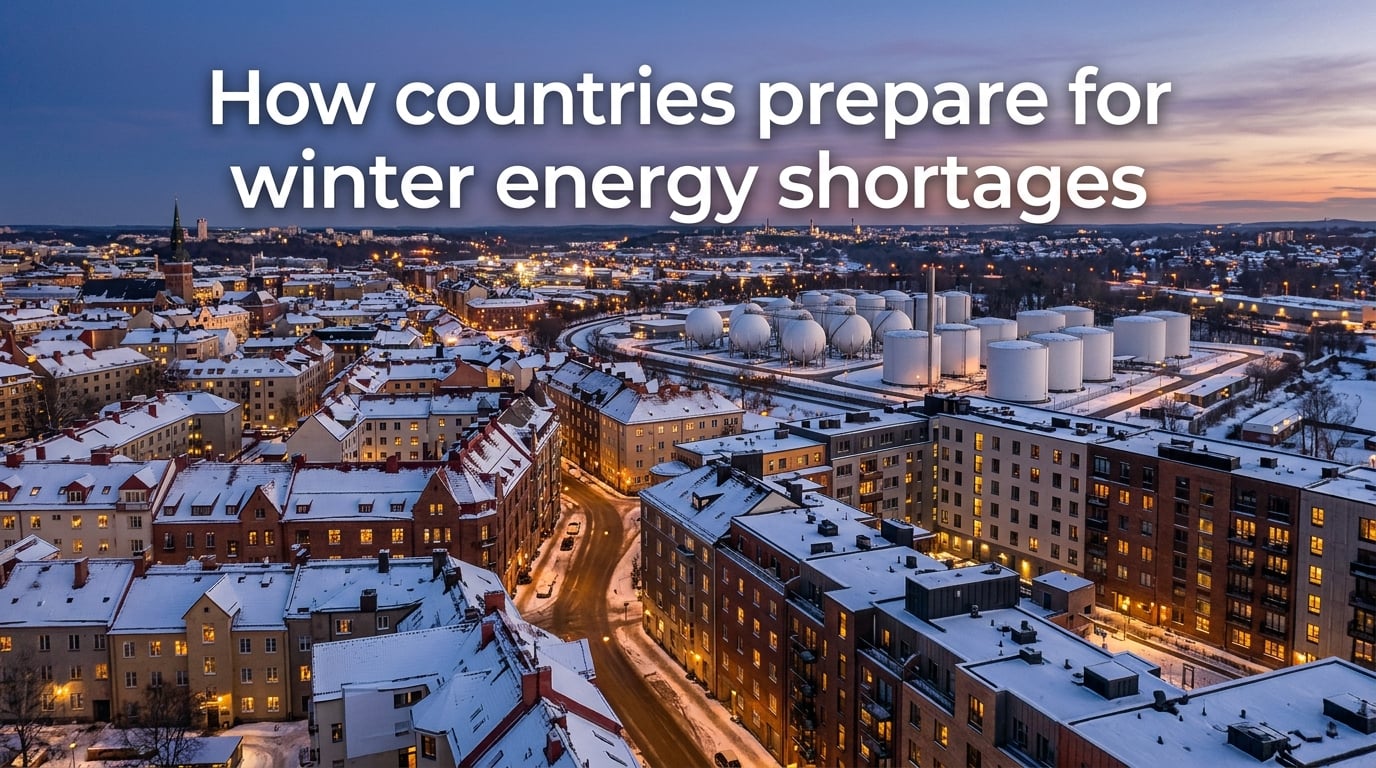
When temperatures plunge and heating demand spikes, even the most sophisticated energy systems can buckle under pressure. How countries prepare for winter energy shortages is a question that has gained urgency since the 2022 European energy crisis and the 2026 Iran-war-driven oil shock. This guide breaks down the strategies governments use to keep the lights on and homes warm when winter hits.
Quick Answer: Countries combine supply-side measures (filling gas storage to 80-95% before November, securing LNG contracts, diversifying pipeline sources) with demand-side levers (work-from-home mandates, thermostat caps, public transit subsidies, energy vouchers) and long-term resilience investments (renewables, heat pumps, EVs).
Table of Contents
Why Winter Is Uniquely Challenging for Energy Systems
Winter concentrates heating demand into a few months, often overwhelming grids and gas systems that run with minimal spare capacity the rest of the year. A single cold snap can drain weeks of reserves in days.
Heating degree days measure how much heating a region needs based on outdoor temperature. During winter, these numbers spike dramatically, creating synchronized demand across entire continents. When everyone turns up their thermostat at the same time, supply chains that work fine in September suddenly face critical shortfalls.
Weather-correlated supply disruption compounds the problem. Freezing temperatures can freeze gas pipelines, ice storms can down power lines, and extreme weather can halt coal deliveries. This creates a dangerous feedback loop where supply drops just as demand peaks.
The countries most vulnerable are those that import a large share of their heating fuel. Most of Europe, South Korea, and Japan face significant exposure. Countries with weather-vulnerable grids, like parts of the US and UK, risk simultaneous generation outages and transmission failures during winter storms.
How Countries Prepare for Winter Energy Shortages
Governments deploy a mix of short-term emergency measures and long-term structural reforms. Here are the seven primary strategies:
1. Build strategic reserves — Fill gas storage to 80-95% capacity before November 1 and maintain emergency oil stockpiles.
2. Diversify supply sources — Secure LNG contracts, develop non-Russian pipelines, and establish bilateral agreements with multiple suppliers.
3. Reduce demand through mandates — Implement work-from-home policies, thermostat limits, and public transportation subsidies.
4. Invest in energy efficiency — Accelerate building retrofits, insulation upgrades, and heat pump installations.
5. Deploy financial protections — Cap energy prices, provide subsidies, and distribute vouchers to vulnerable households.
6. Run public awareness campaigns — Launch nationwide energy-saving initiatives and behavior-change programs.
7. Build long-term resilience — Expand renewable energy, grid-scale batteries, and electric vehicle adoption.
Building Strategic Reserves
The most visible preparation measure is filling storage facilities to capacity well before winter begins. The EU set a binding target of 90% gas storage by November 1, a goal most member states achieved in both 2023 and 2024.
Natural gas storage facilities act as energy savings accounts. Countries fill them during summer when prices are lower and draw them down during winter heating season. Germany, Europe’s largest gas consumer, operates roughly 24 billion cubic meters of underground storage capacity in depleted gas fields and salt caverns.
Oil stockpiles provide a second layer of defense. The International Energy Agency coordinates emergency stockpiles among member nations, requiring each to maintain reserves equivalent to at least 90 days of net imports. Countries can release these reserves during acute supply disruptions to stabilize markets.
The IEA’s framework provides a structured response protocol. When supply disruptions threaten, member countries coordinate releases, share data on storage levels, and avoid panic buying that could spike prices further.
Diversifying Supply Sources
Dependence on a single supplier creates catastrophic vulnerability. Russia’s invasion of Ukraine in 2022 demonstrated this when European countries scrambled to replace Russian pipeline gas that supplied 40% of their needs.
LNG (liquefied natural gas) imports surged as the primary alternative. Countries built new import terminals at breakneck speed. Germany, which had zero LNG import capacity in early 2022, commissioned its first floating terminal by January 2023 and now operates multiple facilities. Global LNG trade reached record levels as Europe competed with Asia for shipments.
Non-Russian pipeline development accelerated. Norway increased gas exports to Europe, becoming the continent’s largest supplier. The Southern Gas Corridor brought Azerbaijani gas to Southern Europe. Algeria expanded pipeline capacity to Spain and Italy.
The Strait of Hormuz remains a critical chokepoint. About 20% of global oil supply passes through this narrow waterway between Iran and Oman. Geopolitical tensions in the region can ripple through global energy markets within hours, making diversification away from any single shipping route essential.
Demand Reduction Measures
Reducing consumption during peak periods is often faster and cheaper than increasing supply. Governments have developed a toolkit of demand-side interventions tested during the 2022 crisis.
Work-from-home mandates reduce commercial building energy consumption and commuting fuel use. During the 2022 crisis, France and Germany encouraged remote work during cold snaps. Pakistan implemented public-sector four-day work weeks with Friday work-from-home, seen as an effective demand-shedding tool.
Thermostat limits became controversial but widespread. Some countries mandated maximum temperatures in public buildings and offices. Spain set a 27°C cooling limit in summer and a 19°C heating limit in winter for commercial buildings.
Public transportation subsidies encourage commuters to leave cars at home. Several European cities offered free or discounted transit passes during energy crisis periods. This reduces both fuel consumption and traffic congestion.
Energy-saving campaigns tap into public solidarity. The UK’s “Every Little Bit Helps” campaign and similar initiatives across Europe encouraged citizens to lower boiler flow temperatures, switch to lower-temperature laundry cycles, and unplug unused devices.
Energy Efficiency and Electrification
Long-term efficiency improvements permanently reduce heating demand. The IEA calls faster deployment of efficiency measures, renewables, and heat pumps the most critical actions to reduce winter energy crisis risk.
Heat pumps are a game-changer for heating efficiency. These electric devices move heat rather than generating it, achieving 300-400% efficiency compared to 90% for gas boilers. A heat pump uses one unit of electricity to deliver three to four units of heat. Countries offering generous installation subsidies have seen adoption rates soar.
Building retrofits address the massive heat loss in older structures. Adding insulation, upgrading windows, and sealing air leaks can cut heating demand by 30-50%. The EU’s Renovation Wave strategy targets doubling renovation rates by 2030, with a focus on the worst-performing buildings first.
Electric vehicle adoption reduces oil dependence for transportation. Norway leads the world with over 80% of new car sales being electric. Each EV on the road displaces roughly 1,500 liters of gasoline per year, reducing oil import requirements.
Grid-scale batteries and renewable energy build structural resilience. Solar and wind power don’t require fuel imports. Battery storage smooths out intermittent generation, providing reliable power even during low-wind, low-sun winter days.
Financial Protections for Households
Energy price spikes hit low-income households hardest, forcing impossible choices between heating and eating. Governments intervene with various financial instruments to protect vulnerable populations.
Price caps limit what consumers pay per unit of energy. The UK’s Energy Price Guarantee froze typical household bills at £2,500 during the 2022 crisis. France capped electricity price increases at 4% for households. While effective at protecting consumers, caps shift costs to governments or utilities.
Direct subsidies reduce energy costs for all consumers or targeted groups. Germany spent over €200 billion on energy price relief in 2022-2023. Italy provided income-based energy bonuses worth up to €600 per household.
Energy vouchers target the most vulnerable. These means-tested payments help low-income families cover heating costs without subsidizing wealthy households. The UK’s Warm Home Discount and Winter Fuel Payment are established examples.
Forum discussions on r/Frugal and r/preppers reveal that many households struggle to understand which government programs apply to them. Clear, accessible communication about available support is as important as the support itself.
Country Case Studies
Germany offers the most dramatic transformation. After losing Russian pipeline gas that supplied 55% of its needs, Germany built LNG terminals from scratch in months, achieved record gas storage levels, and accelerated renewable deployment. By 2026, Germany had reduced Russian gas imports to near zero and met its 90% storage target months ahead of schedule.
France relies heavily on nuclear power, which provides about 70% of electricity. When reactor maintenance issues reduced nuclear output in 2022, France imported electricity from neighbors and implemented aggressive demand-reduction campaigns. Nuclear’s low marginal cost provides long-term price stability but requires massive upfront investment.
The UK faces unique challenges with an aging housing stock and high gas dependence for heating. The government’s response included the Energy Price Guarantee, expanded Warm Home Discount, and push for heat pump adoption. The UK’s island geography limits pipeline connections, making LNG imports critical.
China has pursued energy security through massive renewable deployment. China installed more solar capacity in 2023 than the entire world did in 2022. Coal stockpiles were built to record levels as insurance against gas supply disruptions. China’s dual strategy combines clean energy buildout with fossil fuel backup.
Norway demonstrates how resource wealth enables preparation. As Europe’s largest gas exporter, Norway benefits from high energy prices while neighbors struggle. Norway’s nearly 100% hydropower electricity system provides inherent flexibility. The sovereign wealth fund, built on oil revenues, provides fiscal capacity to support domestic consumers.
Pakistan’s severe 2022-2023 energy crisis forced creative solutions. Rolling blackouts lasted 12-18 hours daily in some areas. The government implemented four-day work weeks for public sector employees, mandated early business closures, and launched aggressive conservation campaigns. Pakistan’s experience highlights how countries with limited fiscal resources must rely more on behavioral measures than expensive infrastructure.
Household Preparation Checklist
While national policies matter, individual households can take concrete steps to prepare. Forum discussions on r/preppers and r/UKPreppers offer practical advice tested during real energy crises:
1. Do a home energy audit — Identify your biggest power draws and cut waste first. A plug-in energy meter costs little and reveals surprising consumption patterns.
2. Layer your clothing — Quality long underwear and warm layers let you lower the thermostat by 2-3°C without discomfort. This can cut heating costs by 15-20%.
3. Focus heating on one room — If you must ration heating, choose the room you use most and close doors to unused spaces. Cover windows with thick curtains or blankets for added insulation.
4. Consider a small solar kit — A battery, inverter, and panels can run phones, lights, and a small heater during outages. Widely recommended by prepper communities as affordable insurance.
5. Lower your boiler flow temperature — Condensing boilers work most efficiently at lower flow temperatures. Reducing from 70°C to 55°C can improve efficiency by 10-15%.
6. Switch to cold-water laundry — Modern detergents work well in cold water. This eliminates the energy used to heat water for every wash cycle.
7. Stock essential supplies — Keep enough blankets, warm clothing, and non-perishable food for a few days without heating. Having a portable gas camping stove provides backup cooking capability.
Apartment dwellers face unique constraints. You cannot install wood stoves or large solar arrays. Focus on insulation improvements you can make (draft excluders, thermal curtains, window film) and backup power solutions that work in small spaces.
Frequently Asked Questions
Which countries are facing fuel shortages?
Countries most vulnerable to fuel shortages include those heavily dependent on energy imports. Pakistan, Bangladesh, and several African nations experienced severe shortages during the 2022-2023 energy crisis. European countries like Germany, Italy, and the UK faced tight supply situations after losing Russian gas. In 2026, countries dependent on oil shipments through the Strait of Hormuz face renewed risk.
How do I prepare for an energy crisis at home?
Start with a home energy audit to identify waste. Layer clothing and focus heating on one room. Consider a small solar battery kit for backup power. Lower your boiler flow temperature to 55°C and switch to cold-water laundry. Stock blankets, warm clothing, and non-perishable food for several days. Join community preparedness groups for local advice and mutual support.
What countries are rationing fuel?
Fuel rationing has been implemented in various forms across different countries. Pakistan used rolling blackouts and early business closures during its 2022-2023 crisis. Some European countries mandated temperature limits in public buildings. Iran has long maintained fuel rationing through smart cards. During acute crises, countries may restrict fuel sales to certain days or quantities per vehicle.
Will there be an oil shock in 2026?
The 2026 Iran war and Strait of Hormuz tensions created significant oil price volatility. While prices stabilized somewhat after initial spikes, supply risks remain. Countries that invested in renewables, EVs, and battery storage since 2022 are better positioned. The IEA maintains emergency stockpiles that can be released during acute supply disruptions to stabilize markets.
Why is winter harder for energy grids?
Winter concentrates heating demand into a few months, creating synchronized demand across entire regions. A single cold snap can drain weeks of reserves. Weather-correlated supply disruption compounds the problem — freezing temperatures can freeze pipelines, ice storms can down power lines, and extreme weather can halt coal deliveries. This creates simultaneous demand spikes and supply drops.
Conclusion
How countries prepare for winter energy shortages combines immediate crisis response with long-term structural resilience. The most successful strategies layer supply diversification, strategic reserves, demand reduction, efficiency investments, and financial protections into a comprehensive defense system.
Since the 2022 European crisis, countries have invested heavily in LNG terminals, renewable energy, and heat pump deployment. The 2026 Iran war tested these preparations, revealing both progress and remaining vulnerabilities. Nations that diversified supply sources and invested in clean energy infrastructure weathered the shock better than those that remained dependent on single suppliers.
For households, the lesson is clear: national policies provide the framework, but individual preparation makes the difference. A home energy audit, layered clothing, focused heating, and backup power solutions can keep you safe and comfortable during energy disruptions. Start preparing now, before winter arrives.