
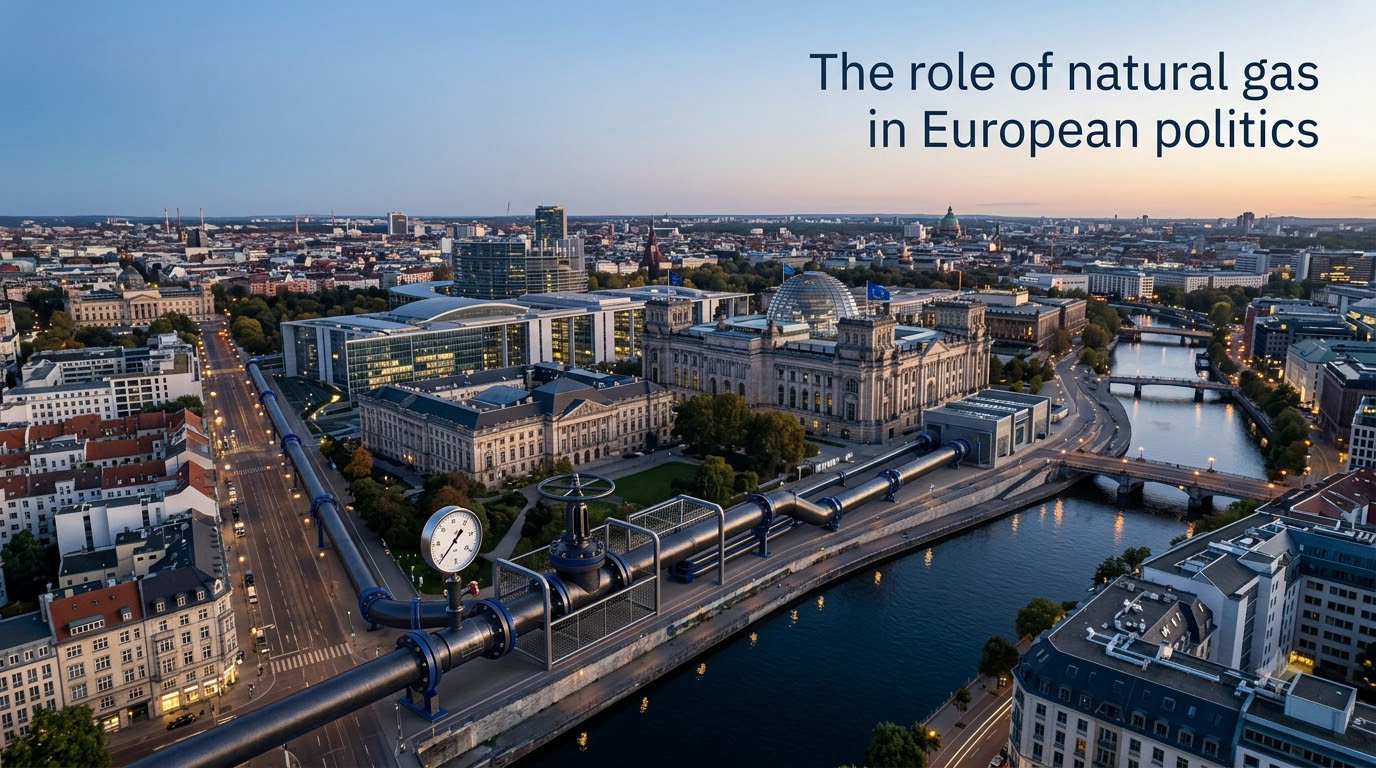
Natural gas plays a central role in European politics because it heats roughly a third of EU households, generates about a fifth of EU electricity, and feeds energy-intensive industry, while around 80 to 90 percent of it is imported, so every pipeline and cargo of LNG reshapes foreign policy, sanctions, and the energy transition.
Over the past decade, no commodity has done more to reshape the European project. Gas has decided friendships, broken alliances, and forced governments to rethink climate policy under emergency conditions. In 2026, the politics of gas is still the politics of the continent.
What gas does for Europe at a glance:
- Heats about one in three EU homes, mostly through district networks and individual boilers.
- Generates roughly a fifth of EU electricity, often as flexible backup for wind and solar.
- Feeds industry: ammonia, fertilizers, glass, steel, ceramics, and chemicals.
- Imports cover around 80 to 90 percent of consumption, making supplier choice a security decision.
- Acts as a bridge fuel between coal and renewables, while methane leaks complicate that role.
- Drives EU diplomacy with Norway, the United States, Qatar, Algeria, and former partners like Russia.
Table of Contents
Why Gas Became Central to European Politics
Gas became a political question because it sits at the intersection of three things Europeans care about: keeping warm, paying the bills, and avoiding dependence on hostile suppliers.
Unlike oil, gas is hard to ship and hard to store. Pipelines are physical, fixed, and hard to reverse. Liquefied natural gas terminals take years to build and need specialised ports. That inertia means whoever controls the pipe or the terminal controls leverage, which is why governments, not just markets, decide gas policy.
Add climate commitments to the mix and gas becomes even more political. Burning it produces about half the CO2 of coal, so it was rebranded as a transition fuel. But methane, the main component of natural gas, leaks across the supply chain and warms the planet over twenty years far more aggressively than CO2. Every tonne of methane kept in the pipe is a climate win; every leaked tonne quietly undermines the Green Deal.
The result is a commodity that EU leaders cannot ignore: too strategic to ban, too dirty to celebrate, too foreign-sourced to ignore.
The Historical Role of Gas in the European Energy Mix
Natural gas was once the quiet achiever of European energy: cheap, clean-burning compared with coal and oil, and easy to pipe from friendly neighbours.
Through the 1990s and 2000s, the EU doubled down on gas for three reasons. First, North Sea output from the UK, Norway, and the Netherlands was abundant. Second, Russian pipeline gas via Gazprom was discounted and contractually locked in for 20 to 30 years. Third, gas-fired power plants offered flexible baseload that complemented nuclear and, later, renewables.
By the late 2010s, gas heated around 30 percent of EU homes, generated about 20 percent of EU electricity, and supplied roughly a quarter of industrial energy demand. The single biggest beneficiary was Germany, whose Energiewende plan retired nuclear and coal faster than renewables could scale, leaving gas to fill the gap.
Russia as the Former Dominant Supplier and the Dependency Problem
For decades, Russia was Europe’s largest gas supplier, and that dependence gave Moscow political leverage, a fact that Western capitals only slowly accepted.
At its 2021 peak, Russia supplied around 40 to 45 percent of EU gas imports, roughly 155 billion cubic metres a year. Most of it travelled through four pipeline corridors: Yamal (via Belarus and Poland), Nord Stream 1 (directly to Germany under the Baltic), TurkStream (via Turkey to the Balkans), and routes through Ukraine.
For Brussels, this was always uncomfortable. The European Commission’s own documents warned repeatedly about overreliance, and the Polish, Baltic, and Ukrainian governments argued loudly that buying more Russian gas was funding the Kremlin’s foreign policy. Germany disagreed. Berlin saw Nord Stream 2 as a purely commercial project that would let Russia sell more gas while bypassing unstable transit countries.
That political divide was the backdrop when Russia annexed Crimea in 2014. The EU imposed sanctions, but gas contracts were exempted. Russian supply kept flowing, German utilities kept signing long-term deals, and Gazprom kept booking record revenues.
The 2022 Turning Point: Weaponization of Supply
The full-scale invasion of Ukraine in February 2022 turned a quiet commercial relationship into an open energy confrontation, and gas became the most visible front of the war.
Within weeks, Russia began throttling supplies to “unfriendly” EU states, then cut gas entirely to Bulgaria, Poland, Finland, the Netherlands, and Denmark. Gazprom cited refusal to pay in roubles as the technical reason; the political one was punishment for supporting Ukraine. Wholesale prices on the Dutch TTF hub spiked to historic highs, peaking at more than 300 euros per megawatt-hour in August 2022, roughly ten times the previous five-year average.
Then came sabotage. In September 2022, explosions damaged three of the four strings of the Nord Stream pipelines under the Baltic Sea, an act still under investigation. Nord Stream 2 had never entered commercial operation; Nord Stream 1 was effectively finished. Ukraine’s pipeline transit route was extended through 2024, then wound down at the end of that year.
By 2025, Russian pipeline gas to the EU had collapsed to roughly 60 billion cubic metres, almost entirely via TurkStream to a handful of buyers like Hungary, Austria, and Slovakia. The era of Russian dominance was over, replaced by a more expensive, more diversified, and more politically charged market.
The EU Policy Response: REPowerEU, Fit for 55, and Sanctions
The EU’s answer to the gas shock came in three layers: emergency demand reduction, sanctions on Russian revenues, and a structural plan to end fossil fuel dependence.
The flagship document is REPowerEU, presented in May 2022 and revised several times since. It set three concrete targets: cut EU demand for Russian gas by two thirds before the end of that year, end all Russian gas imports well before 2030, and accelerate the rollout of renewables and heat pumps. A May 2026 roadmap from the European Commission lays out a legal path to phase out remaining Russian gas and LNG contracts on a country-by-country schedule.
Alongside REPowerEU sits the Fit for 55 package, which tightens the Emissions Trading System, phases out free allowances for industry, and introduces a Carbon Border Adjustment Mechanism. The effect on gas is indirect but powerful: every euro added to the carbon price makes coal and gas more expensive relative to renewables, heat pumps, and efficiency.
Sanctions also bite directly. The EU has banned new investments in the Russian energy sector, imposed an oil price cap with G7 partners, and progressively restricted services to Russian LNG terminals. Methane regulation, agreed in 2024, will require importers to report and reduce leaks across the supply chain, which effectively tightens the screws on older Russian and Central Asian fields.
Inside the European Parliament and Council, these measures were never unanimous. Hungary and Slovakia have used every legal tool to preserve their Russian supply. Italy softened, then hardened. Germany moved fastest of all, having learned the cost of being wrong on Nord Stream.
Diversification: Where EU Gas Comes From Now
EU gas imports in 2026 look radically different from 2021, with Russia replaced by a wider, more expensive cast of suppliers.
Norway is now the largest single supplier, accounting for roughly 30 percent of EU gas demand, piped mostly through the North Sea and into continental networks. The United States has become the biggest source of LNG, supplying around 18 percent of EU gas, much of it via new terminals in Germany, the Netherlands, Poland, France, and Greece.
Qatar contributes around 10 percent via long-term LNG contracts. Algeria holds roughly 8 percent through the Medgaz pipeline to Spain and Italy and through shipments of LNG. The United Kingdom, Azerbaijan via the Southern Gas Corridor, and small LNG cargoes round out the supply mix.
This diversification has clear benefits: no single supplier can hold Europe hostage. It has clear costs too: LNG is roughly two to three times more expensive than piped gas, requires massive terminal investment, and creates a new dependency on countries whose political priorities do not always align with Europe’s.
EU gas imports by partner, comparing 2021 and 2025:
- Russia: roughly 40 percent of imports in 2021, below 15 percent by 2025 and falling.
- Norway: stable around 25 to 30 percent of imports, dominant pipeline supplier.
- United States: minimal in 2021, around 18 percent of EU gas by 2025 via LNG.
- Qatar: around 10 percent, mostly through long-term LNG contracts.
- Algeria: roughly 8 percent via the Medgaz pipeline and small LNG volumes.
- Azerbaijan and others: the remaining share, including new Southern Gas Corridor flows.
Member-State Fault Lines: Germany, Italy, Hungary, France, and Poland
There is no single “EU position” on gas, only the constant negotiation of 27 national positions with very different histories.
Germany was the most exposed and the slowest to wake up. Chancellor Schröder’s lobbying for Nord Stream 2 left a lasting political scar, and the 2022 crisis forced Berlin to backtrack, delay coal phase-out, build LNG terminals at record speed, and adopt a 200 billion euro relief package that was criticised across the bloc for distorting the single market.
Italy, under Meloni, has balanced Atlantic alignment with pragmatism on Algerian and Libyan gas, while expanding regasification capacity to become a southern gas hub. France has used the crisis to relaunch nuclear, arguing that gas was always a fallback and that low-carbon baseload should be the strategic priority.
Poland and the Baltic states, long hawkish on Russia, led the charge for sanctions and pushed hard for Nordic-Baltic pipeline interconnections to replace Russian flows. Hungary under Orbán has been the loudest dissenter, blocking EU statements, signing new Turkish-Bulgarian gas deals, and arguing that national sovereignty includes the right to buy cheap Russian gas.
Austria, long a Russian gas hub, has been slower to phase out contracts than its neighbours. The split matters: EU gas policy is decided by qualified majority, but enforcement runs through national regulators and ministries, which gives reluctant capitals many veto points.
Bridge Fuel or Stranded Asset: The Climate Debate
Whether natural gas is a bridge to a renewable future or a stranded asset in a warming world is the question now dividing Europe’s climate coalition.
The bridge-fuel argument is straightforward. Replacing coal with gas roughly halves CO2 emissions per unit of electricity and gives grid operators a flexible partner to balance intermittent wind and solar. In the short term, every coal-to-gas switch is a climate win, which is why climate economists from the IEA to Bruegel still treat gas as a transitional resource.
The stranded-asset argument has two parts. First, methane leaks across extraction, processing, and transport can erase the climate advantage over coal within twenty years, and Russian gas in particular has some of the worst methane intensity on record. Second, building new gas infrastructure today risks locking in emissions for decades, just as renewables, batteries, and heat pumps are reaching cost parity.
This tension plays out in EU taxonomy negotiations, where gas was briefly labelled “sustainable” in 2022, then partly reversed after political backlash. It shapes the design of the next Emissions Trading System revision, and it influences which countries still permit new gas connections in housing. The European Parliament increasingly leans toward accelerated phase-down; several member-state governments disagree.
Industrial Competitiveness and the Cost of Energy
High gas prices have exposed a hard truth: Europe’s industrial base can absorb a temporary spike, but a sustained price gap with the United States and China forces investment decisions that politics alone cannot reverse.
Between 2021 and 2024, TTF wholesale prices averaged roughly three to four times US Henry Hub levels. Energy-intensive sectors responded by cutting output, idling plants, or relocating: ammonia, fertilizer, aluminium, glass, ceramics, and parts of the steel industry all announced closures or capacity reductions. The European Chemical Industry Council has warned that without affordable gas and electricity, the continent faces structural deindustrialisation.
The political response has been uneven. Germany and France adopted state aid packages and electricity price caps. The Commission launched the Temporary Crisis and Transition Framework to allow subsidies for clean-tech investment. Critics argue these measures distort the single market and slow the energy transition; defenders say they buy time for industry to electrify.
Households feel the squeeze too. Energy poverty, defined as spending more than 10 percent of income on energy bills, affects an estimated 40 million Europeans. Subsidies for heating bills, VAT cuts, and caps on retail prices have become standard political tools, and gas remains at the centre of those debates because most household heating in Europe still runs on it.
The Future: 2030 and 2050 Scenarios
Where European gas politics goes next depends on three intersecting questions: how fast demand actually falls, whether supply stays diversified, and whether new geopolitical shocks arrive.
The Commission’s REPowerEU trajectory targets roughly a 30 percent reduction in EU gas demand by 2030 compared with 2021 levels, achieved through efficiency, electrification, biomethane, hydrogen, and renewables. Most analysts expect gas use to decline but plateau in the late 2020s before falling faster in the 2030s, as heat pumps, electric vehicles, and industrial electrification scale.
By 2050, the European Climate Law commits the EU to climate neutrality. That does not mean zero gas, but it does mean a much smaller role, mostly in hard-to-abate sectors, possibly paired with carbon capture or with renewable and low-carbon hydrogen blends. Critics warn that any new gas infrastructure built today risks becoming a stranded asset within fifteen years; supporters argue that some flexible thermal capacity will always be needed for grid stability.
The wild card is geopolitics. Trade tensions with the United States have already raised the political cost of LNG dependency, with European leaders wary of a future where tariffs or licensing decisions make American gas a lever of foreign policy. Greenland and Arctic exploration, Mediterranean discoveries off Egypt and Cyprus, and revived North Sea drilling are all back on the table. So is the slow-burning question of Russian gas returning in some future political settlement, an outcome the Commission has publicly ruled out but which some capitals quietly discuss.
Frequently Asked Questions
What happens if Russia cuts off gas to Europe?
Europe has already lived through that scenario. After the 2022 invasion of Ukraine, Russia throttled and then cut gas supplies to multiple EU states, sending wholesale prices on the TTF hub to historic highs. The bloc responded with emergency demand cuts, alternative LNG imports, and the REPowerEU plan, and by 2025 Russian pipeline gas to the EU had collapsed from around 155 bcm a year to roughly 60 bcm.
Is Europe buying natural gas from the USA?
Yes, and the United States is now one of the EU’s largest gas suppliers. American LNG, shipped across the Atlantic, accounts for around 18 percent of EU gas demand in 2025, up from almost nothing before 2022. New terminals in Germany, the Netherlands, Poland, France, and Greece made that shift possible.
Where does Europe get most of its natural gas?
Norway is now the EU’s biggest gas supplier, providing roughly 30 percent of consumption via pipelines under the North Sea. The United States, Qatar, Algeria, the United Kingdom, and Azerbaijan round out the top sources, while Russia has fallen from around 40 percent of imports in 2021 to under 15 percent in 2025.
Does Russia still supply natural gas to Europe?
A small amount, yes. Russia still sends gas to a handful of EU member states, mainly through the TurkStream pipeline to Hungary, Austria, and Slovakia, totalling around 60 bcm a year compared with roughly 155 bcm before the war. The European Commission’s 2026 roadmap sets a legal path to phase out these remaining contracts before 2030.
What is REPowerEU?
REPowerEU is the EU’s 2022 plan to end dependence on Russian fossil fuels by accelerating renewables, diversifying gas and oil suppliers, and cutting demand. It was revised several times and underpins the Commission’s May 2026 roadmap to fully end Russian energy imports well before 2030.
How has the Ukraine war changed European gas imports?
It triggered a historic reorientation. The EU cut Russian gas from roughly 40 percent of imports in 2021 to under 15 percent by 2025, replaced mainly by Norwegian pipeline gas and American LNG, while speeding up renewables, heat pumps, and storage to manage the gap.
Why Gas Will Keep Shaping European Politics
The role of natural gas in European politics is no longer about how much Europe burns, but about who supplies it, who pays for the transition, and who decides the timeline.
Three forces will keep gas at the centre of EU debate through the rest of this decade. First, even a shrinking gas sector still touches household heating, industrial competitiveness, and climate targets. Second, the politics of supply, from Norwegian pipelines to American LNG to Russian contracts, runs through national capitals before it reaches Brussels. Third, the transition itself, from heat pumps to hydrogen to carbon capture, is being negotiated in real time under pressure from voters, industry, and climate campaigners.
What began as a quiet commodity story in the 1990s has become the central political project of the European Union: how to keep the lights on, the homes warm, and the climate stable, without ever again handing a hostile supplier a lever over the continent. That project is unfinished, and the next chapter will be written in this decade.