
Landmines and unexploded ordnance kill or injure thousands of people every year, decades after the conflicts that placed them end. Understanding how humanitarian demining organizations operate reveals an intricate, life-saving process that restores safety to entire communities. In this guide, we break down the full operational cycle, the five pillars of mine action, the major organizations driving clearance worldwide, and the challenges and innovations shaping this field today.
Humanitarian demining is the non-military process of locating, removing, and destroying landmines and explosive remnants of war (ERW) so civilians can safely return home, farm, travel, and rebuild. Unlike military breaching, which prioritizes speed to create a safe passage for troops, humanitarian clearance must achieve near-total removal of every explosive item before land is released back to a community. That difference in purpose shapes everything — the tools, the pace, the standards, and the risk tolerance.
According to the Landmine Monitor, over 60 countries and territories remain contaminated by landmines or ERW. Ukraine alone faces an estimated 174,000 square kilometers of suspected hazardous land — an area larger than many European countries. Cambodia, Afghanistan, Laos, Colombia, Iraq, and Syria carry enormous contamination legacies from wars that ended years or decades ago. The scale of the problem is staggering, but the organizations tackling it have developed a remarkably systematic approach.
Table of Contents
What Is Humanitarian Demining?
Humanitarian demining is the systematic survey, detection, removal, and disposal of landmines, unexploded ordnance, and other explosive hazards from areas where civilians live, work, and travel. Its ultimate goal is to return land to productive civilian use with zero residual risk. The term covers a broad range of activities organized under the International Mine Action Standards (IMAS), maintained by the Geneva International Centre for Humanitarian Demining (GICHD).
Humanitarian demining differs sharply from military demining in several important ways. Military operations use armored vehicles, line charges, and explosive breaching to punch through minefields quickly — accepting residual risk because lives depend on forward movement. Humanitarian demining, by contrast, moves slowly and methodically. A deminer working in heavy contamination may clear only 10 to 20 square meters per day, painstakingly checking every centimeter of ground with hand tools and detectors. The entire process exists to ensure that when land is handed back, a farmer can drive a plow through it without fear.
The humanitarian approach also demands rigorous quality assurance. Every cleared area is re-sampled and independently verified before formal release. National mine action authorities oversee this process with support from UNMAS and GICHD, ensuring that international standards are met consistently regardless of which NGO performed the clearance.
How Humanitarian Demining Organizations Operate: Step by Step
Humanitarian demining follows a six-stage operational process standardized by the International Mine Action Standards. Each stage feeds into the next, and skipping or compressing a stage compromises safety. Here is how a typical clearance project unfolds from first contact to final handover.
Step 1: Non-Technical Survey (NTS)
Before any deminer touches the ground, a Non-Technical Survey team collects information about suspected hazardous areas. They interview local residents, review historical battle maps, examine records from previous conflicts, and walk the boundaries of suspect land. The goal is to gather enough evidence to classify an area as either confirmed hazardous, suspected hazardous, or — importantly — to rule out areas that are likely safe. NTS is one of the most cost-effective tools in mine action because it can release large tracts of land without ever sending a deminer in with a detector.
Step 2: Marking and Fencing
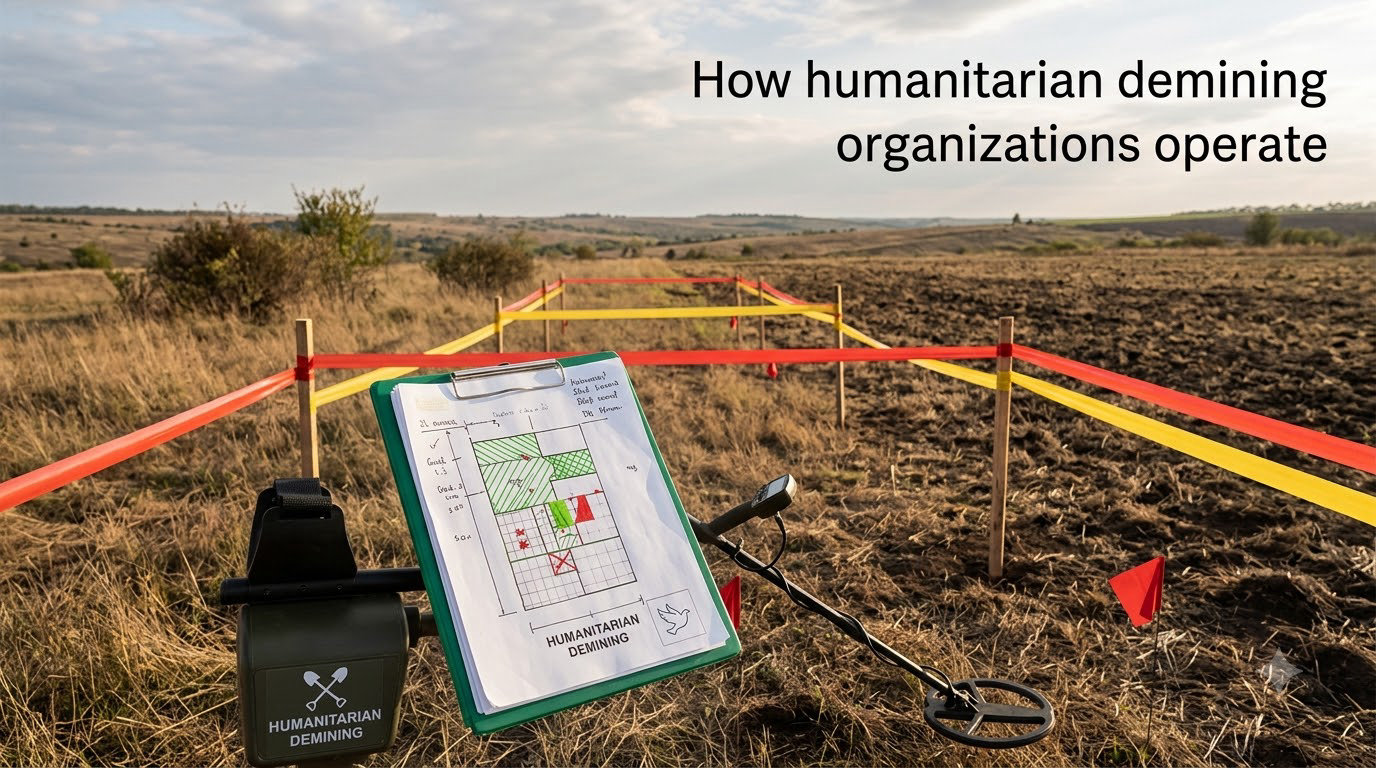
Once an area is confirmed or strongly suspected to contain explosive hazards, it is physically marked and fenced. Teams use painted stones, colored posts, barbed wire, and warning signs in local languages to keep people out. Community liaison officers work with village leaders to ensure residents understand what the markers mean and why they must not enter marked zones. This step saves lives immediately, even before clearance begins.
Step 3: Technical Survey
A Technical Survey team then enters the marked area to precisely locate individual explosive items or narrow down the boundaries of contamination. Using metal detectors, ground-penetrating radar, and sometimes detection dogs or rats, they map each hazard to a GPS coordinate. This data feeds into the national Information Management System for Mine Action (IMSMA), run by GICHD, which tracks every hazardous area and clearance milestone in the country.
Step 4: Manual Clearance
Manual clearance is the most labor-intensive and dangerous stage. Deminers work in teams, often on their hands and knees, using metal detectors, prodders (thin steel rods), and hand trowels to detect and excavate each explosive item. They work in carefully defined lanes, typically one meter wide, advancing centimeter by centimeter. In heavy contamination, a single deminer might spend an entire shift clearing a few square meters. Protective equipment includes blast-resistant visors, body armor, and reinforced gloves, but the work carries inherent risk that no amount of equipment can fully eliminate.
Step 5: Explosive Ordnance Disposal (EOD)
When clearance teams find mines or UXO that cannot be safely removed in place, they call in an EOD specialist. These highly trained technicians assess each item, decide whether to defuse it or destroy it with a controlled detonation, and carry out the disposal. EOD work demands years of additional training beyond standard deminer certification, and EOD specialists are among the most sought-after professionals in the mine action sector.
Step 6: Handover and Land Release
After clearance, the area undergoes a final technical survey or quality assurance sampling. Independent monitors — often from the national mine action authority — verify that the clearance meets IMAS standards. Once approved, the land is formally released to the community through a handover ceremony. The community receives documentation confirming that the area is safe, and post-clearance monitoring begins to check that no new hazards have surfaced. This stage is critical because it represents the moment when land transitions from a danger zone to a productive asset.
The 5 Pillars of Mine Action
The United Nations Mine Action Service (UNMAS) organizes all humanitarian mine action around five interconnected pillars. This framework, endorsed by the international community, ensures that clearance is not treated as an isolated technical exercise but as part of a comprehensive approach to the explosive contamination problem.
Pillar 1: Clearance
Clearance is the physical removal and disposal of landmines, unexploded ordnance, and other explosive remnants of war from contaminated land. This is the operational backbone of humanitarian demining, encompassing the six-stage process described above — from Non-Technical Survey through to formal handover. Clearance teams include manual deminers, EOD specialists, mechanical clearance operators, and detection animal handlers. The goal is not merely to remove known hazards but to systematically verify that entire areas are free of any explosive item, enabling confident land release.
Pillar 2: Explosive Ordnance Risk Education (EORE)
Formerly known as mine risk education, EORE teaches people living in contaminated areas how to recognize, avoid, and report explosive hazards. EORE teams work in schools, community centers, and through local media to deliver messages tailored to each audience — children receive different training than farmers or construction workers. In many countries, EORE is the first and most immediate life-saving intervention, reducing casualties while clearance teams work their way through the backlog of contaminated land. Post-clearance EORE also helps communities understand and trust the handover process.
Pillar 3: Victim Assistance
Victim Assistance provides medical care, rehabilitation, psychological support, and socioeconomic reintegration for survivors of landmine and UXO incidents. This pillar connects mine action to broader disability rights frameworks and ensures that clearance alone does not define the response. Organizations like Humanity and Inclusion (formerly Handicap International) operate prosthetic workshops, physiotherapy programs, and livelihood training projects specifically for landmine survivors. The 1997 Nobel Peace Prize, shared by the International Campaign to Ban Landmines and its coordinator Jody Williams, brought global attention to the human cost that Victim Assistance addresses.
Pillar 4: Advocacy
Advocacy promotes the universalization and implementation of international treaties banning antipersonnel mines, cluster munitions, and other indiscriminate weapons. The Anti-Personnel Mine Ban Convention (Ottawa Treaty), signed in 1997, prohibits the use, production, stockpiling, and transfer of antipersonnel mines and requires states to destroy stockpiles and clear mined areas. The Convention on Cluster Munitions (CCM), adopted in 2008, extends similar prohibitions to cluster munitions. Advocacy efforts also push for adequate funding, stronger national legislation, and compliance with the Political Declaration on Explosive Weapons in Populated Areas (EWIPA), signed in 2022.
Pillar 5: Stockpile Destruction
Stockpile Destruction is the systematic elimination of stored antipersonnel mines, cluster munitions, and other explosive weapons before they can be used. Under the Ottawa Treaty, states parties must destroy their stockpiles within four years of joining. Since 1997, over 55 million stockpiled antipersonnel mines have been destroyed. This pillar reduces future contamination risk by ensuring that weapons are never deployed in the first place. Compliance is monitored through annual transparency reports submitted to the treaty’s implementation support unit.
Major Humanitarian Demining Organizations
The humanitarian demining sector operates through a network of specialized NGOs, UN agencies, and advisory bodies. Each plays a distinct role in the global effort to clear contaminated land and protect civilian lives.
Key Non-Governmental Organizations
The HALO Trust is the world’s largest humanitarian demining NGO, employing over 10,000 staff across more than 30 countries. Founded in 1988 in Afghanistan, HALO focuses on clearance, weapons and ammunition management, and risk education. The organization clears tens of thousands of mines and items of UXO annually and has destroyed millions of stockpiled weapons.
The Mines Advisory Group (MAG), founded in 1989 in the United Kingdom, operates in roughly 15 countries and specializes in clearance, risk education, and advocacy. MAG shared the 1997 Nobel Peace Prize through its involvement in the International Campaign to Ban Landmines.
Norwegian People’s Aid (NPA) is one of the largest clearance operators globally, with particularly strong programs in Southeast Asia, the Balkans, and the Middle East. NPA combines clearance operations with advocacy and capacity building for national mine action programs.
APOPO stands out for its innovative use of giant African pouched rats — known as HeroRATs — to detect landmines and tuberculosis. Operating primarily in Cambodia, Angola, and Colombia, APOPO’s rats can survey an area in a fraction of the time it takes human deminers, dramatically accelerating clearance in low-metal-content minefields.
The Fondation Suisse de Déminage (FSD), Danish Demining Group (DDG), and Humanity and Inclusion round out the major operational NGOs, each bringing particular expertise in clearance, community safety, or survivor assistance to the sector.
Coordination Bodies
The United Nations Mine Action Service (UNMAS) coordinates mine action across the UN system, managing programs in some of the world’s most contaminated contexts including Iraq, South Sudan, and Mali. UNMAS does not typically clear mines directly — it coordinates, sets priorities, and channels funding to implementing partners.
The Geneva International Centre for Humanitarian Demining (GICHD) serves as the global knowledge hub. GICHD develops and maintains the International Mine Action Standards (IMAS), operates the IMSMA information management system, and provides technical advisory services to national mine action authorities. The standards GICHD publishes form the operational rulebook that every demining organization worldwide follows.
National Mine Action Authorities (NMAAs) in contaminated countries set clearance priorities, accredit operators, and oversee quality assurance. They serve as the primary coordination point between international NGOs, UN agencies, and the host government.
Funding, Treaties, and Standards
Humanitarian demining relies on international funding flows that move from donor governments through coordination bodies to implementing NGOs in the field. The top five donors — the United States, the European Union, Japan, Norway, and the Netherlands — together provide roughly 72 percent of all international mine action funding. Germany, the United Kingdom, Denmark, Canada, and Australia are also significant contributors.
The funding process typically begins when a donor pledges support through a bilateral agreement or a multilateral fund. UNMAS, GICHD, or a national mine action authority may receive and allocate the funds. NGOs then submit project proposals and, once approved, deploy clearance teams, EORE educators, or victim assistance workers to the designated areas. The entire flow is audited, and implementing partners must report on results — hectares cleared, items destroyed, beneficiaries reached — using standardized metrics.
The regulatory framework binding this work together rests on several key treaties and standards. The Ottawa Treaty (Anti-Personnel Mine Ban Convention, 1997) has been ratified by 164 states and remains the cornerstone of the ban on antipersonnel mines. The Convention on Cluster Munitions (2008) extends similar protections. The Convention on Certain Conventional Weapons (1981) provides additional protocols on specific weapon types. And the International Mine Action Standards, maintained by GICHD, provide the detailed technical and operational guidelines that demining organizations follow on the ground every day.
Challenges Facing Demining Organizations
Despite decades of effort, humanitarian demining faces enormous challenges that test the limits of current capacity and funding.
The sheer scale of contamination is the most pressing problem. Ukraine’s ongoing conflict has generated contamination across an area estimated at 174,000 square kilometers, and experts estimate the country will need between $35 billion and $50 billion and decades of sustained work to achieve full clearance. Cambodia, more than 40 years after the fall of the Khmer Rouge, still has contaminated land. The backlog is growing faster than clearance capacity.
Funding volatility creates operational uncertainty. When a major donor shifts priorities or reduces its budget, clearance programs can be suspended or scaled back, leaving communities in limbo. Small fluctuations in government aid budgets can have outsized effects on demining operations that depend on steady, multi-year funding cycles.
The mental health burden on deminers is significant and under-discussed. Working daily with explosive devices under extreme physical conditions leads to high rates of post-traumatic stress, burnout, and fatigue. Forum discussions among deminers on platforms like Reddit’s r/EOD community consistently highlight the psychological toll, and organizations are only beginning to invest systematically in mental health support for their teams.
Coordination friction between UNMAS, GICHD, national authorities, and dozens of NGOs operating in the same country creates inefficiencies. Different organizations may use different reporting standards, compete for the same funding, or struggle to align their clearance priorities with each other and with the national mine action authority’s plan.
Technology and Innovation in Demining
Emerging technologies are beginning to transform how humanitarian demining organizations operate, though adoption remains uneven across the sector.
Ground-penetrating radar (GPR) can detect non-metallic mines that traditional metal detectors miss. When combined with metal detectors in dual-sensor systems, GPR significantly reduces false alarm rates and speeds up Technical Survey work. Several organizations are field-testing vehicle-mounted GPR arrays that can survey large areas far faster than handheld detectors.
Drones equipped with multispectral and thermal cameras are being used for aerial survey and mapping, helping teams identify terrain features, old fortifications, and surface-level indicators of contamination from the air. This supports both Non-Technical Survey and clearance planning by giving deminers a detailed map before they enter an area.
Artificial intelligence is being applied to the massive datasets stored in IMSMA, helping mine action authorities predict where contamination is most likely to exist based on conflict history, terrain analysis, and community reports. AI-assisted image analysis can also help interpret drone and satellite imagery for survey purposes.
Mechanical clearance systems — armored flails, tillers, and vegetation cutters — can prepare ground and neutralize surface mines before manual deminers enter, reducing the time and risk involved in manual clearance. Robotics research is advancing, though fully autonomous demining remains years away from practical deployment.
The IMSMA data management platform, operated by GICHD, gives national mine action authorities a real-time view of contamination status, clearance progress, and resource allocation across their countries. This data-driven approach helps prioritize limited resources toward the areas of greatest need and tracks progress against national clearance targets.
Frequently Asked Questions
How does demining work?
Demining works through a six-stage process: Non-Technical Survey to identify suspect areas, marking and fencing for immediate safety, Technical Survey to pinpoint individual explosive items, manual clearance using metal detectors and hand tools, Explosive Ordnance Disposal to safely destroy each item, and a formal handover after independent verification confirms the land is safe.
What are the 5 pillars of mine action?
The five pillars of mine action are Clearance (removing mines and UXO), Explosive Ordnance Risk Education (teaching communities to avoid hazards), Victim Assistance (supporting survivors), Advocacy (promoting treaties and banning weapons), and Stockpile Destruction (eliminating stored munitions).
What is the difference between military and humanitarian demining?
Military demining uses armored vehicles and explosive breaching to create safe passages quickly, accepting residual risk. Humanitarian demining removes every explosive item methodically, often clearing only 10-20 square meters per deminer per day, to ensure zero residual risk before land is returned to civilians.
How long does humanitarian demining take?
Clearing a single minefield can take weeks to months depending on contamination density and terrain. At the national level, demining a heavily contaminated country like Cambodia or Afghanistan takes decades. Ukraine’s demining effort is expected to last 10 to 30 years given the scale of current contamination.
What tools do deminers use?
Deminers use metal detectors, ground-penetrating radar, prodders (thin steel rods), hand trowels, blast-resistant visors, body armor, mine detection dogs, giant African pouched rats (HeroRATs), mechanical flails and tillers, and controlled detonation equipment for disposal.
Who funds humanitarian demining?
The top donor governments are the United States, the European Union, Japan, Norway, and the Netherlands, which together provide roughly 72 percent of international mine action funding. Additional funding comes from the United Kingdom, Germany, Denmark, Canada, and private foundations.
How are minefields surveyed?
Minefields are surveyed in two phases. Non-Technical Survey collects information from communities, maps, and historical records to identify suspect areas. Technical Survey then uses metal detectors, ground-penetrating radar, detection dogs, and GPS mapping to precisely locate individual explosive items within those areas.
What country has the most landmines?
Egypt is believed to have the highest concentration of landmines globally, with an estimated 23 million mines from World War II and later conflicts. Other heavily contaminated countries include Iran, Afghanistan, Angola, Cambodia, Iraq, Bosnia, and Ukraine, where the ongoing conflict continues to add new contamination.
Conclusion
Understanding how humanitarian demining organizations operate reveals a complex, highly coordinated field where specialized NGOs, UN agencies, national authorities, and donor governments work together to save lives and restore land. The six-stage operational process, anchored by the five pillars of mine action and governed by international standards, provides a proven framework for tackling one of the most persistent legacies of armed conflict. As contamination spreads in places like Ukraine and persists in countries like Cambodia and Afghanistan, the work of these organizations remains as urgent as ever. If you want to support this effort, consider donating to established demining NGOs, advocating for sustained government funding, or simply sharing what you have learned here — because awareness is itself a form of mine risk education.