
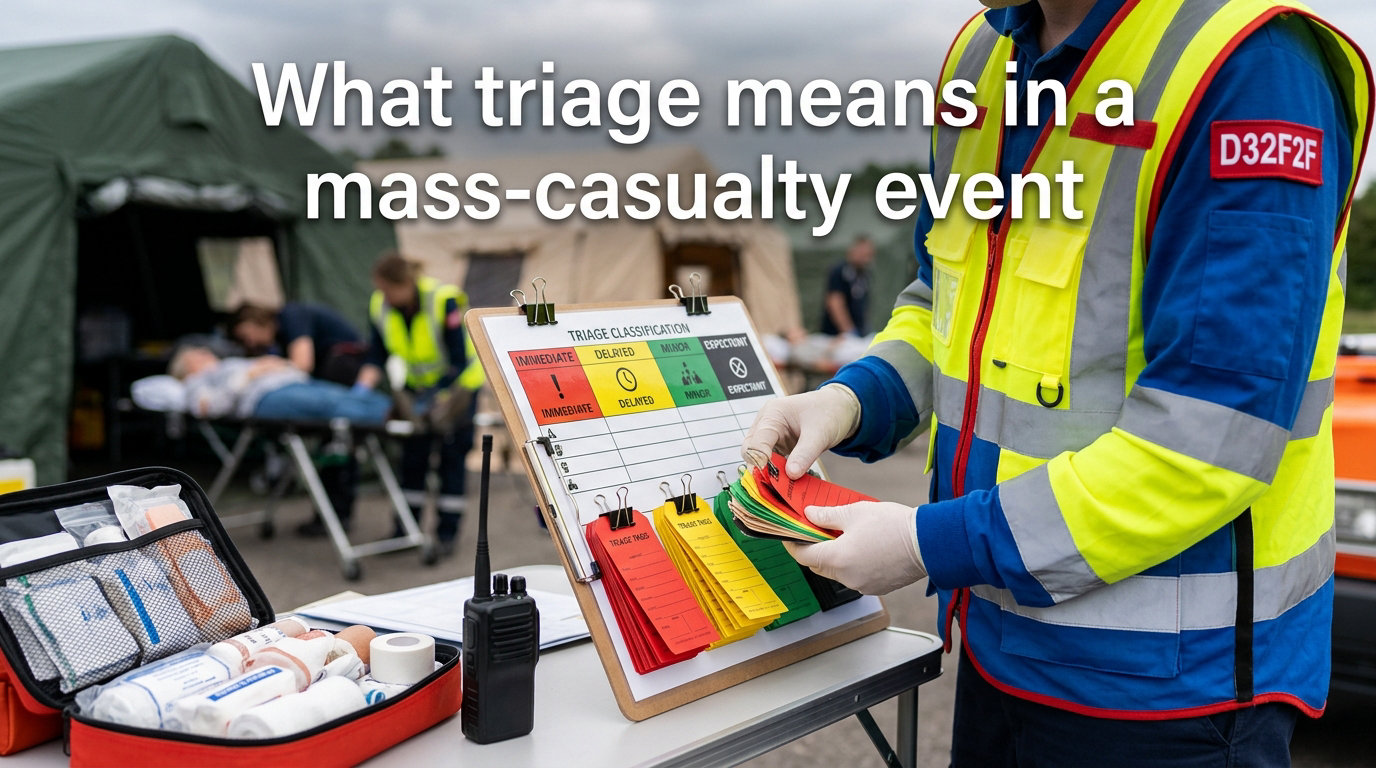
Triage in a mass casualty event is the rapid sorting of patients by injury severity so that limited medical resources save the greatest number of lives. Instead of treating each person as an individual priority, trained responders use a color-coded system to decide who needs care first, who can wait, and who cannot be helped given current resources.
If you have ever watched news footage of a disaster and wondered why some victims were walked past while others were carried away on stretchers, the answer is triage. Understanding what triage means in a mass-casualty event helps you make sense of decisions that look counterintuitive but are designed to maximize survival.
This guide explains how mass casualty triage works, why it differs from everyday emergency room triage, what the color-coded tags mean, and how the two most widely used triage systems operate. We will also walk through a realistic scenario so you can see the process in action.
Table of Contents
What Is Triage in a Mass Casualty Event?
In everyday emergency medicine, triage simply means deciding the order in which patients are seen. A busy ER on a Friday night uses triage to make sure the person having a heart attack goes before the person with a sprained ankle. Each patient still gets treated eventually.
Mass casualty triage is fundamentally different. It activates when the number of injured people dramatically exceeds the available staff, equipment, ambulances, and hospital beds. The World Health Organization defines a mass casualty incident (MCI) as any event that generates more patients than the local healthcare system can manage with its normal resources.
In that situation, the goal of triage shifts. Responders are no longer asking “What does this patient need?” They are asking “Given what we have right now, which patients are most likely to survive with immediate treatment?” That shift from individual care to population-level thinking is what makes MCI triage so difficult for both practitioners and the public to accept.
A highway pile-up with 40 injured people in a rural county, a building collapse in a city, a bombing at a public event, or a hurricane that overwhelms local hospitals can all trigger mass casualty triage. The common thread is that demand for care exceeds supply.
A Brief History of Mass Casualty Triage
The concept of sorting patients by severity did not begin in modern hospitals. Its origins are military.
During the Napoleonic Wars, French surgeon Dominique-Jean Larrey faced overwhelming numbers of wounded soldiers on the battlefield. He developed a system of “ambulances volantes” (flying ambulances) that prioritized treatment based on wound severity rather than social rank. Larrey’s approach was revolutionary: for the first time, a common soldier with a survivable wound received care before an officer whose injuries were beyond help.
The practice evolved through both World Wars, Korea, and Vietnam. By the late 20th century, civilian emergency medicine adopted triage principles for disaster response. In 1983, doctors at Hoag Hospital in Newport Beach, California developed the START system (Simple Triage and Rapid Treatment), which became the most widely used civilian MCI triage tool in the United States.
The SALT triage system (Sort, Assess, Lifesaving Interventions, Treatment/Transport) emerged in 2012 as a recommended update, developed by the Centers for Disease Control and Prevention (CDC) with input from national emergency medicine organizations. Today, both START and SALT are used across the United States, while other countries have their own adapted systems.
Triage Color Categories: What Each Tag Means
Mass casualty triage uses color-coded tags to classify patients. The specific colors are remarkably consistent across systems and countries. Here is what each tag means:
| Tag Color | Category | What It Means | Typical Example |
|---|---|---|---|
| Red | Immediate (Priority 1) | Life-threatening injuries that are treatable. This patient needs care within minutes to survive. | Airway obstruction, severe bleeding controlled by tourniquet, tension pneumothorax |
| Yellow | Delayed (Priority 2) | Serious injuries, but the patient can wait hours without dying. Stable for now. | Broken femur with stable vital signs, moderate burns not affecting airway |
| Green | Minimal (Priority 3) | Walking wounded. Minor injuries that do not require immediate treatment. These patients can often help themselves or each other. | Superficial lacerations, minor fractures, anxiety without physical injury |
| Black | Expectant or Deceased | Either already dead or injuries so severe that survival is extremely unlikely given available resources. In a mass casualty event, these patients receive comfort care only. | Cardiac arrest, massive head trauma, unsurvivable burns |
| Grey | Expectant – Alive (MUCC) | Introduced by the Model Uniform Core Criteria (MUCC). A patient alive but with injuries that have very low survival probability even with treatment. Separated from “Black” to ensure living expectant patients still receive comfort measures. | Severe traumatic brain injury with brainstem signs, massive internal hemorrhage unresponsive to interventions |
The key thing to understand is that these categories are not permanent. A “Green” patient who begins hemorrhaging internally can be re-triaged to “Red” at the next reassessment pass. Triage is a dynamic, repeating process, not a one-time label.
Online discussions among EMS professionals frequently highlight how confusing this looks to bystanders. As one paramedic on Reddit’s r/ems community explained, “Your job is to triage and manage the scene until backup arrives. Tourniquet placement and airway adjustments are solid, life-saving interventions.” The point is that triage and treatment happen simultaneously, not sequentially.
START vs SALT: The Two Main Triage Systems Compared
If you search for information on mass casualty triage, you will encounter two acronyms constantly: START and SALT. Both are used in the United States, and understanding the difference matters.
START: Simple Triage and Rapid Treatment
START was developed in 1983 and remains the most widely recognized MCI triage system. It uses a simple decision algorithm based on three physiological checks, sometimes summarized as “RPM 30-2-can-do”:
- Respiration (R): Is the patient breathing? If not, reposition the airway. If still no breathing, tag Black. If breathing, count the rate. Over 30 breaths per minute = Red.
- Perfusion (P): Check capillary refill (press a fingernail and see how fast color returns) or radial pulse. If capillary refill takes more than 2 seconds or there is no radial pulse, tag Red.
- Mental Status (M): Ask the patient to do something simple like squeeze your hand or follow a command. If they cannot follow commands = Red. If they can = Green (if walking) or Yellow (if not walking but otherwise stable).
The entire assessment is designed to take under 60 seconds per patient. Responders do not stop to treat injuries during initial triage beyond opening an airway or controlling catastrophic hemorrhage.
SALT: Sort, Assess, Lifesaving Interventions, Treatment/Transport
SALT was published in 2006 and endorsed by the CDC in 2012 as a recommended replacement for START. It adds a “global sort” step at the beginning:
- Sort: Use voice commands to divide the crowd into those who can move, those who wave or gesture, and those who are still. This takes seconds and gives responders an initial map of severity.
- Assess: Walk to each patient and perform a rapid assessment similar to START’s RPM check.
- Lifesaving Interventions: Perform only three interventions during triage: control hemorrhage with direct pressure or a tourniquet, open the airway, and chest decompression for tension pneumothorax if trained.
- Treatment/Transport: Assign the color tag and move patients to the Casualty Collection Point for definitive care.
| Feature | START | SALT |
|---|---|---|
| Year Developed | 1983 | 2006 (CDC endorsed 2012) |
| Initial Step | Walk to each patient individually | Global sort using voice commands first |
| Physiological Checks | Respiration, Perfusion, Mental status (RPM) | Similar rapid assessment |
| Lifesaving Interventions During Triage | Minimal (airway repositioning only) | Three defined interventions (hemorrhage, airway, chest decompression) |
| Speed Per Patient | Under 60 seconds | Under 60 seconds |
| Current Usage | Widely used across the US | Increasingly adopted; recommended by CDC |
Both systems sort patients into the same color-coded categories. The main practical difference is that SALT provides more structure at the scene level and explicitly defines which treatments are acceptable during the triage phase.
Pediatric Triage: How Children Are Triaged Differently
Children are not small adults. Their vital signs, anatomy, and physiological responses to injury differ enough that standard START triage can misclassify pediatric patients. That is why a separate system called JumpSTART exists.
JumpSTART was developed in 2001 specifically for children under eight years old. It modifies the START algorithm in a few critical ways:
- Respiratory rate thresholds are adjusted for children, since normal breathing rates in young children are higher than in adults. The START threshold of 30 breaths per minute would incorrectly flag many healthy children as Red.
- Rescue breathing is included as an assessment step. If a child is not breathing, responders check for a pulse and provide five rescue breaths before determining whether the child is viable. START does not include rescue breathing during initial triage.
- Perfusion is assessed by palpating a peripheral pulse rather than capillary refill, which can be unreliable in cold or stressed children.
When both adults and children are present at the same incident, responders may run two parallel triage passes or use JumpSTART for anyone who appears to be under eight. The goal is to prevent undertriage of children whose vital signs look abnormal by adult standards but are perfectly normal for their age.
The Ethics of Triage: Who Decides and How
Triage in a mass casualty event forces a philosophical shift that most healthcare workers find deeply uncomfortable. In normal practice, the medical ethic is simple: do everything possible for every patient. In an MCI, the ethic becomes utilitarian: allocate resources to achieve the greatest good for the greatest number.
That means some patients who might survive with unlimited resources will not receive treatment because those resources are needed by patients with a higher probability of survival. This is the “expectant” category, and it is the single most difficult part of MCI triage for both clinicians and the public.
Forum discussions among emergency medicine professionals reveal the emotional weight of these decisions. Multiple EMS workers have described the tension between their training to save everyone and the reality that a mass casualty event forces them to choose. One experienced paramedic described walking past screaming patients to reach quieter ones who were more critically injured, a scene that looks like neglect to bystanders but is actually correct triage behavior.
Overtriage and undertriage add further complexity. Overtriage occurs when patients are classified as more severe than they truly are, consuming resources that Red patients need. Undertriage is the opposite, and potentially more dangerous. Most systems accept an overtriage rate of up to 50% as the cost of preventing undertriage.
How Mass Casualty Triage Works: A Scenario Walkthrough
To make this concrete, imagine a multi-vehicle collision on a highway involving eight vehicles and 25 injured people. The first fire engine arrives with a crew of four.
Patient A is a 45-year-old man who is not breathing and has no pulse after airway repositioning. He is tagged Black. The crew moves on.
Patient B is a 30-year-old woman screaming in pain with an obviously broken arm but no signs of shock. She can walk when directed. She is tagged Green and told to move to a safe area away from the vehicles.
Patient C is a 60-year-old man trapped in a car. He is breathing at 34 breaths per minute and his capillary refill is slow. His injuries are life-threatening but potentially survivable if treated soon. He is tagged Red.
Patient D is a 25-year-old woman with a deep laceration on her leg controlled by a bystander’s improvised tourniquet. She is breathing normally, has a strong radial pulse, and can follow commands. She is tagged Yellow because her injuries are serious but she is currently stable.
Patient E is a 10-year-old child who appears dazed and has shallow breathing at 40 breaths per minute. By adult START criteria, the respiratory rate alone would not flag them. Using JumpSTART, the responder recognizes that 40 is within normal range for this age and instead checks for other signs of distress. The child is tagged Yellow.
As more units arrive, responders repeat their triage passes every few minutes. Patient D’s tourniquet begins to fail and she starts bleeding heavily. She is re-triaged from Yellow to Red and moved to the front of the treatment queue.
This scenario illustrates why triage is described as “dynamic and fluid” by StatPearls. Patients are constantly reassessed as conditions change and resources arrive.
What Bystanders Should Know Before First Responders Arrive
If you find yourself at a mass casualty event before professional help arrives, there are a few things that can genuinely help.
Call 911 immediately and describe the situation clearly: how many people are injured, the nature of the event, and your exact location. This single call triggers the MCI response system that brings additional ambulances, mutual aid, and hospital notifications.
Control severe bleeding if you can do so safely. Direct pressure with cloth or a makeshift tourniquet on a limb with life-threatening hemorrhage is one of the most effective life-saving interventions a bystander can perform.
Do not move patients unless they are in immediate danger (fire, structural collapse, traffic). Moving a person with a spinal injury can cause permanent paralysis.
Keep calm and visible. Responders arriving at a chaotic scene need to quickly identify who can help and who needs help. Waving, calling out, and staying in place makes their initial triage sort much faster.
What you should not do is attempt to perform formal triage unless you have been trained. Well-meaning bystanders who move patients or apply incorrect treatment can inadvertently make things worse. Focus on calling for help, controlling bleeding, and keeping yourself and others safe.
Frequently Asked Questions
What are the 5 stages of triage?
The five triage categories used in mass casualty events are Immediate (Red), Delayed (Yellow), Minimal (Green), Expectant (Black or Grey), and Dead (Black). Some systems add a fifth category for expectant patients who are still alive but unlikely to survive, using a Grey tag to distinguish them from deceased patients.
What is START mass casualty triage?
START stands for Simple Triage and Rapid Treatment. It is a field triage system developed in 1983 that sorts patients in under 60 seconds using three checks: respiration rate, perfusion (pulse or capillary refill), and mental status. Patients are assigned a color tag based on the results.
How long should it take to triage a victim in a mass casualty incident?
Standard MCI triage aims for 30 to 60 seconds per patient during the initial assessment pass. Responders check breathing, circulation, and mental status, assign a color tag, and move to the next person. Reassessment happens every few minutes as conditions change and resources arrive.
What does a black tag mean in triage?
A black tag means the patient is either already deceased or has injuries so severe that survival is extremely unlikely given the resources available during a mass casualty event. These patients receive comfort care only. This category exists because treating someone who cannot survive would divert resources from patients who can.
How is triage done in a mass casualty incident?
Trained responders walk the scene, spending under a minute per patient. They check breathing rate, circulation (pulse or capillary refill), and whether the person can follow simple commands. Based on these three checks, each patient receives a color-coded tag: Red for immediate, Yellow for delayed, Green for minimal, and Black for expectant or deceased.
What is a level 5 mass casualty incident?
A level 5 mass casualty incident is typically classified based on the number of casualties and the scale of resources required. Classification systems vary by jurisdiction, but higher levels indicate more patients and a greater need for mutual aid and regional resource mobilization. The specific definition depends on your local emergency management framework.
How do first responders decide who gets treated first?
First responders follow a structured triage algorithm that evaluates each patient’s breathing, circulation, and mental status. Patients with life-threatening but survivable injuries get treated first. Those with minor injuries wait. Those with unsurvivable injuries receive comfort care. The goal is to save the maximum number of lives with the resources available.
Final Thoughts
Understanding what triage means in a mass casualty event is not just useful for healthcare workers. It helps anyone make sense of emergency scenes where decisions look harsh or unfair. The color-coded system exists because when too many people are injured at once, treating everyone simultaneously is physically impossible.
Triage is not about giving up on anyone. It is about making sure the people most likely to survive with immediate help get that help first. The system has evolved over two centuries of military and civilian disaster response, and it continues to improve with every real-world event.
If you want to go deeper, consider taking a Community Emergency Response Team (CERT) course offered free through your local fire department or emergency management agency. These courses teach basic triage concepts and give you practical skills that could make a real difference in your community.