
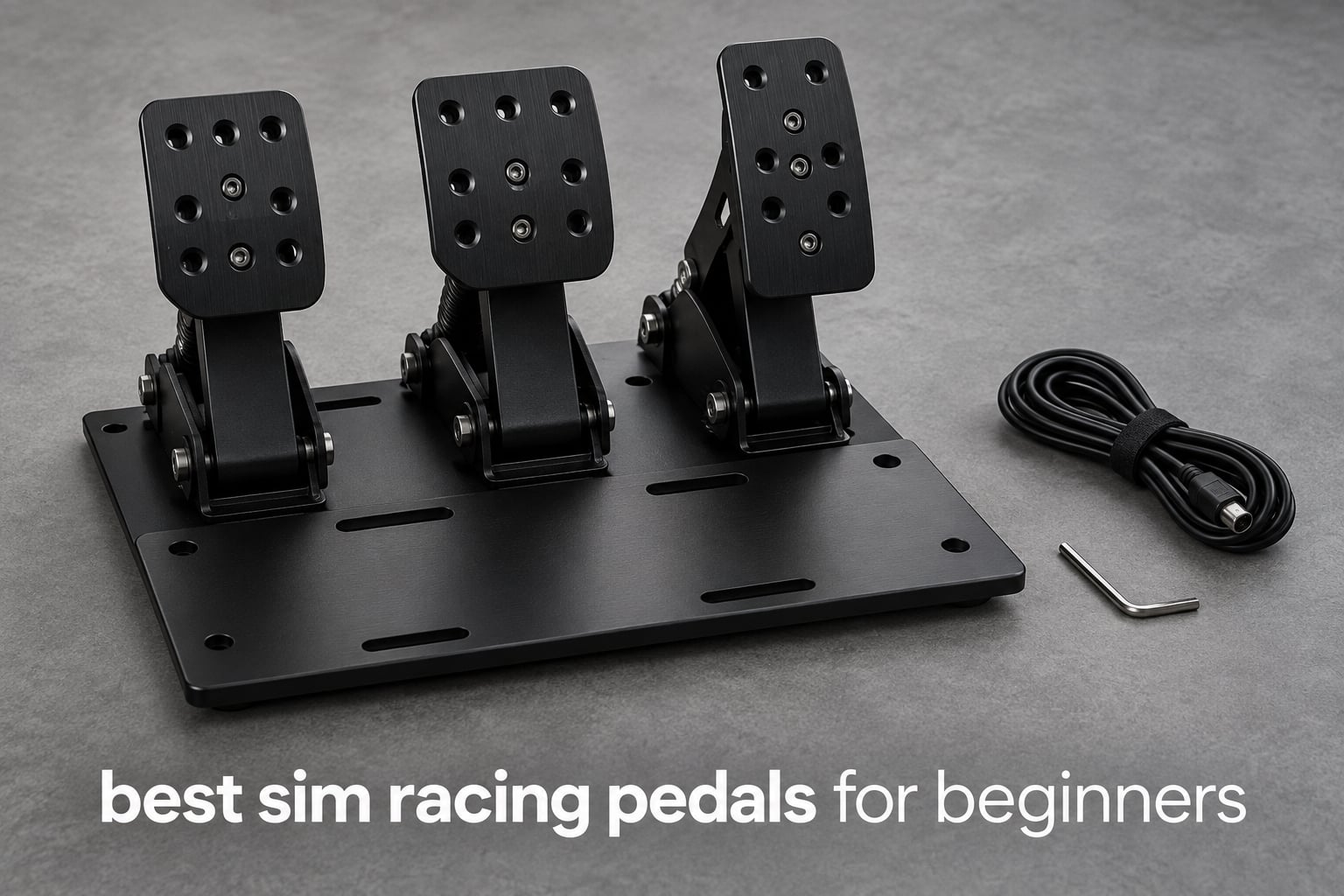
The fastest lap time improvement most beginners can make is not a new wheel. It is a proper brake pedal. A mediocre wheelbase with good sim racing pedals will brake more consistently than a premium wheel with the spring-loaded plastic pedals that ship in the box, and consistency at the brake is where lap times live.
There is one catch, and it is the thing community members complain about most. Good pedals measure how hard you press. If the frame they are bolted to flexes, that measurement becomes noise. So the best sim racing pedals for beginners in 2026 are the ones that suit your mount as much as they suit your budget.
We put eight pedal sets side by side to work out which ones earn a place in a first serious rig, which are sensible second upgrades, and which are worth skipping until you know what you want. The short version: buy a rigid base first, buy a load cell brake second, and treat everything else as later.
Table of Contents
Do pedals actually make a difference in sim racing?
Yes, and more than most people expect. Pedals replace a gamepad trigger or a spring-loaded position sensor with a direct analogue measurement of your foot, which means your braking input is repeatable lap after lap. That repeatability is what lets you learn threshold braking and trail braking, the two fastest skills a new driver can build. The catch is that the gain only shows up on a rigid mount, which is why every recommendation below assumes a wheel stand or cockpit rather than a desk.
Top 3 sim racing pedals for beginners right now (October 2026)
Three sets stand out from the group, and they cover three very different first-time racer situations. One is the straightforward entry point into load cell braking, one is the upgrade to buy once you know you are staying, and one is the strongest three-pedal feel at this tier.
Logitech G RS Sim Racing…
- 75 kg load cell brake
- Hall effect accelerator and clutch
- Adjustable pedal positions
- Steel frame with carpet grippers

Logitech G PRO Racing Pedals
- 100 kg load cell brake
- Swappable springs and elastomers
- Fully modular layout
- Hall effect sensors

Fanatec CSL Elite Pedals V2
- Dual-stage load cell brake to 90 kg
- Hall effect clutch and throttle
- Three elastomer hardnesses
- RJ12 and USB
Logitech G RS for the first six months. A 75 kg load cell brake, hall effect accelerator and clutch, and a steel frame that stays planted on hard floors or carpet. It is the cleanest jump from bundled plastic pedals to real force measurement, and it needs no separate brake kit to do it.
Logitech G PRO for the committed upgrade. A 100 kg load cell brake with swappable springs and brake elastomers, a fully modular frame, and the largest owner feedback base in this group. Tuning takes minutes once you know which spring you want.
Fanatec CSL Elite Pedals V2 for the three-pedal feel. A dual-stage load cell brake measured to 90 kg with three elastomer hardnesses supplied, plus hall effect clutch and throttle sensors and a three-year warranty.
All 8 pedal sets compared at a glance in 2026
Every set below covers PC over USB. Console support is the column most beginners get wrong, so it is flagged in each entry rather than buried in a spec sheet. Brake force is the figure the community treats as the credibility marker.
| Product | Specifications | Action |
|---|---|---|
|
Logitech G RS Sim Racing Pedals
|
|
Check Latest Price |
|
Logitech G PRO Racing Pedals
|
|
Check Latest Price |
|
Fanatec CSL Elite Pedals V2
|
|
Check Latest Price |
 MOZA SRP2 Pedals
|
|
Check Latest Price |
 Thrustmaster Raceline Pedals III LC
|
|
Check Latest Price |
 PXN PD HM Brake and Throttle
|
|
Check Latest Price |
 DOYO Racing Wheel Pedals
|
|
Check Latest Price |
 SIMSONN Plus X Hydraulic Pedals
|
|
Check Latest Price |
1. Logitech G RS Sim Racing Pedals – the best entry load cell brake
Logitech G RS Sim Racing Pedals (with 75 kg Load Cell Brake)
75 kg load cell brake
Hall effect accelerator and clutch
10.8 lb steel frame
PC, PS4, PS5, Xbox Series
Pros
- 75 kg load cell brake for precise trail braking
- Hall effect sensors on accelerator and clutch
- Adjustable pedal positions and spacing
- Steel frame stays planted on hard floors and carpet
- Works with PRO and RS50 bases or plain USB
Cons
- Clutch module sold separately
- Older G-Series wheels need the Racing Adapter
- Bulkier frame than a bare two-pedal set
This is the set we would hand to a beginner with no hesitation. The brake is a genuine 75 kg load cell, which means the game reads how hard you press rather than how far the pedal has travelled, and 75 kg is a real race-car order of force rather than a token figure.
Reviewers consistently treat it as the single biggest step up from the spring and position-sensor pedals bundled with entry wheels. The reported change is specific: trail braking becomes controllable and the car stops settling differently at each corner entry.
The accelerator and clutch use contactless hall effect sensors, so there is no surface abrasion to wear the reading down over time. That matters more than it sounds, because sensor wear is the historical failure mode that made older budget pedals drift.
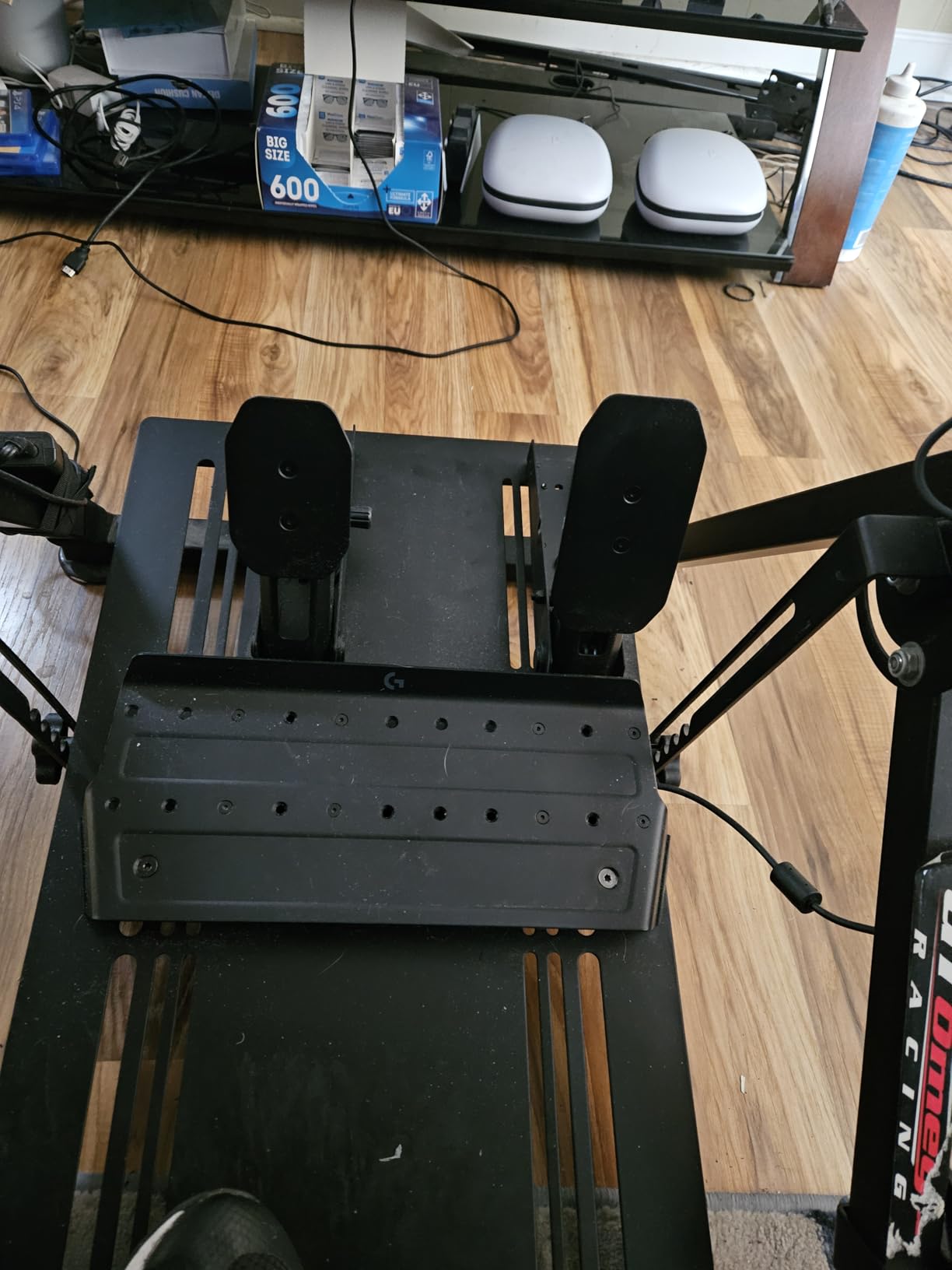
The steel frame is the part we would highlight for a first rig. It weighs 10.8 pounds, carries an anti-tip design, and ships with large rubber feet for hard floors plus carpet grippers, which is exactly the flex problem that wrecks brake consistency on a cheap mount.
Adjustable pedal positions let you slide each pedal along the frame, and pedal spacing is enough to suit most foot sizes without moving the whole unit.
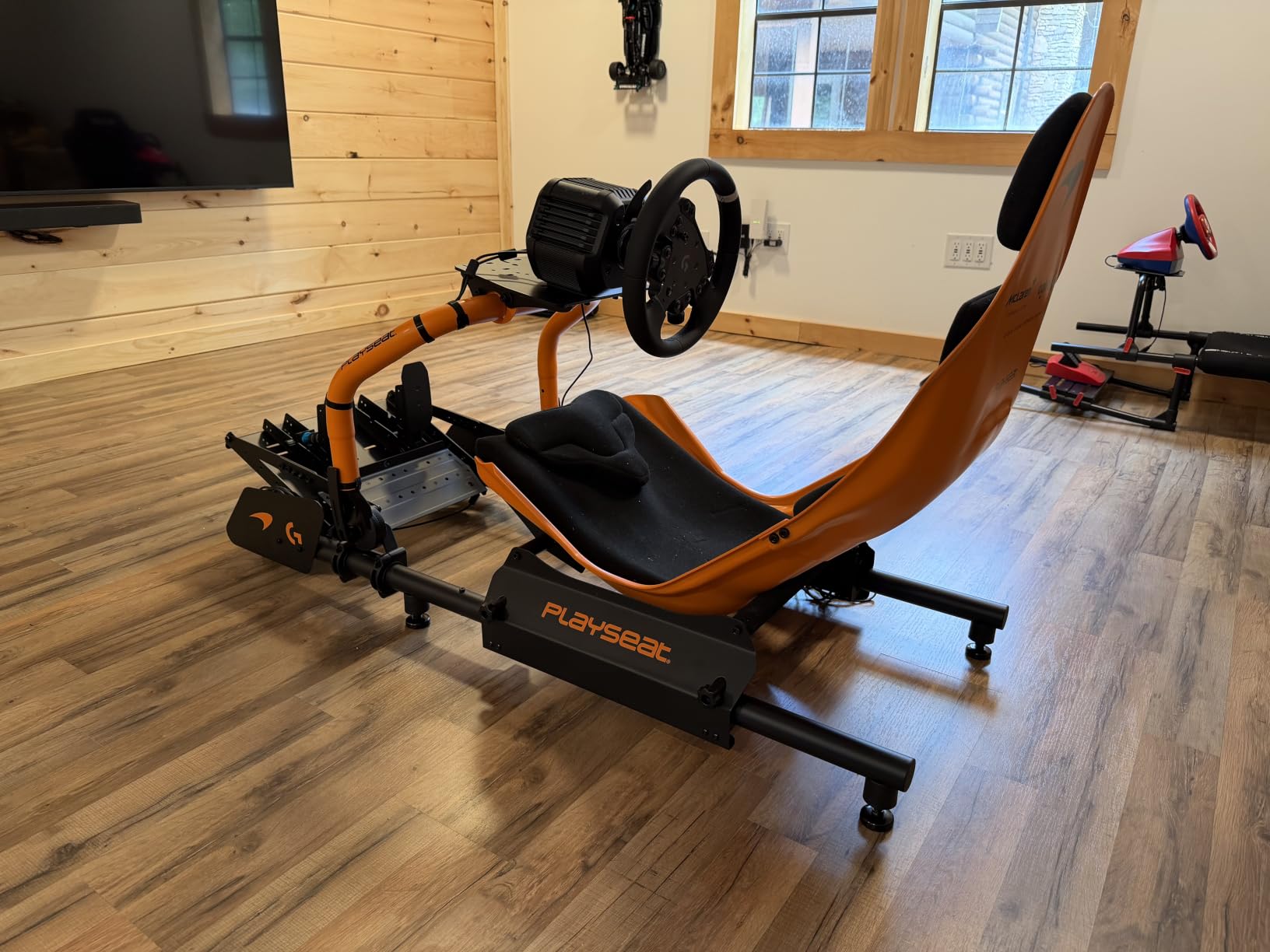
What you gain by switching to a load cell brake
The single measurable change is input consistency. Position sensors change their reading slightly as the pedal warms, wears, or sits at a different angle under your foot. Load cells do not, so the same brake pressure produces the same input every lap, and that is what allows threshold braking to become a repeatable habit rather than a guess.
The second gain is feel. A load cell brake has a defined bite point you can hold, which is what makes ABS and traction control emulation behave the way the game intends rather than stuttering.
Where it falls short for a beginner
The clutch is an optional module sold apart from the set, so a full three-pedal layout is two purchases rather than one. If you are starting on PC and only need brake and throttle, that is not a problem at all.
Connecting to an older G-Series wheel requires the separately sold Racing Adapter, and the frame is bulkier than a bare two-pedal budget unit, so it wants floor space rather than desk space.
2. Logitech G PRO Racing Pedals – the tuning-heavy upgrade
Logitech G PRO Racing Pedals Simulator with 100kg Load Cell Brake
100 kg load cell brake
Swappable springs and elastomers
Fully modular layout
Hall effect sensors
Pros
- 100 kg load cell brake for ABS and TC style control
- Swappable springs and brake elastomers for fast tuning
- Pedals slide horizontally and modules can be removed
- Contactless hall effect sensors
- Long braided cable reaches a distant wheel base
Cons
- Most expensive set in this group
- Adapter needed for non-Logitech brake resistance
- Large metal frame needs a solid mounting position
This is the set owners with older Logitech wheels call the best upgrade they have made, and the 201 reviews here are the largest feedback pool in the group. The brake is a 100 kg load cell, so it has real headroom for hard braking without feeling like a wall.
Where it separates from the entry sets is tuning. Swappable gas and clutch springs plus brake elastomers let you change the feel without tools, and the frame is fully modular, so you can slide each pedal horizontally for spacing or pull a module out entirely for a two-pedal layout.
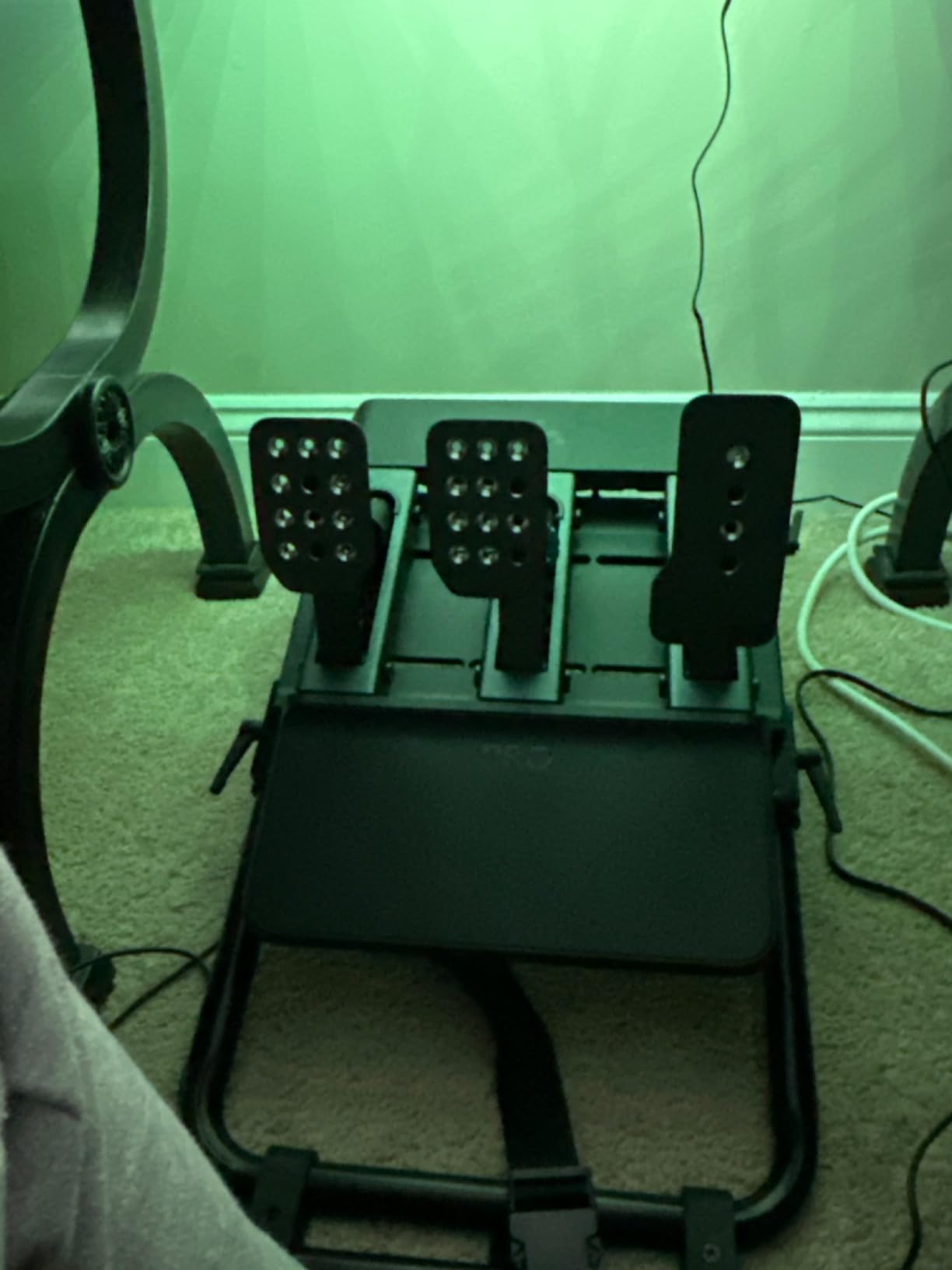
Brake elastomers are the cheapest upgrade in sim racing and this set supports them from the box. Swap the hardness and you change the bite point and the initial bite resistance without touching any software.
The construction is all metal with contactless hall effect sensors, and the braided cable is long enough to reach a wheel base positioned across a room rather than tucked under the desk.
When tuning matters more than price
If you are chasing consistent braking for league racing, the ability to change springs and elastomers is worth more than raw force. Most drivers end up on a softer elastomer for road cars and a firmer one for GT and prototype cars, and this set makes that a two-minute change rather than a re-purchase.
The modular layout also solves the clutch question. Drivers who never use the clutch can physically remove the module instead of leaving it to catch a boot.
What it costs you to buy here
This is the priciest set in the group, at roughly two and a half times the entry Logitech RS pedals, and the budget difference is the main reason we do not hand it to a total beginner.
Brake resistance on non-Logitech wheel bases needs the separately sold Racing Adapter, and the setup diagram can genuinely confuse people over which USB port to use first. The frame is also large and heavy, so it wants a proper floor position on a wheel stand or cockpit.
3. Fanatec CSL Elite Pedals V2 – best three-pedal feel at this tier
Fanatec Sim Racing CSL Elite Pedals V2 – PC, PS5, PS4
Load cell brake measured to 90 kg
Hall effect clutch and throttle
65/75/85 Shore elastomers
RJ12 and USB
Pros
- Dual-stage load cell brake measures up to 90 kg of foot force
- Three elastomer hardnesses plus a metal spring supplied
- Tool-free brake feel adjustment
- Hall effect clutch and throttle avoid sensor wear
- Reconfigurable as a two-pedal set
- Three-year manufacturer warranty
Cons
- Console use needs a licensed Fanatec base
- Rubber pedal covers and fixed heel rest limit foot placement
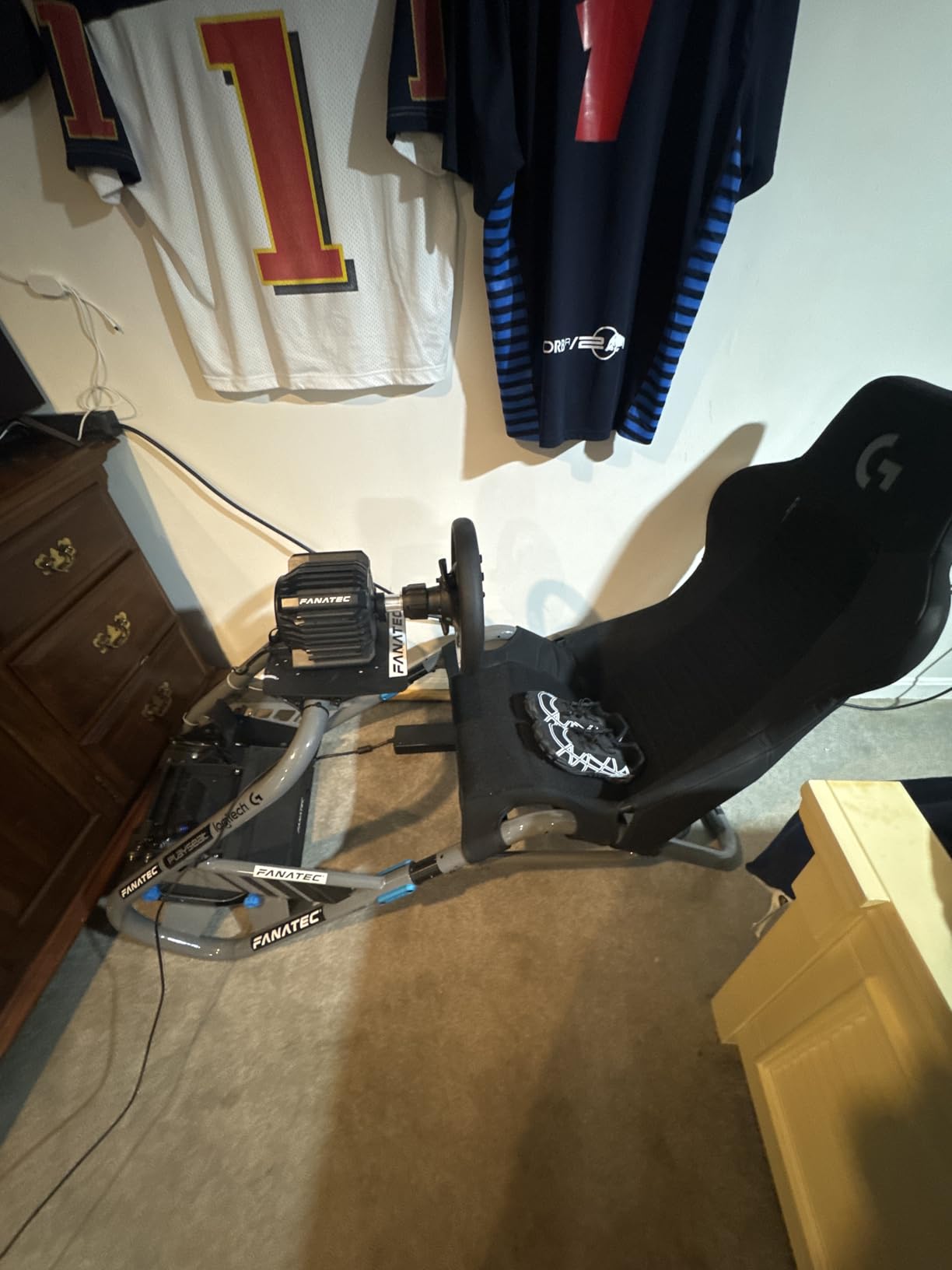
- Built around a rigid cockpit mount rather than a desk
The brake here is the most sophisticated mechanism in this group. The load cell sensor itself is rated above 200 kg, and the unit measures up to 90 kg of actual foot force on the pedal plate, which is what lets the force reading stay accurate through the whole stroke instead of flattening out at the end.
Paired with that is an elastomer stack, and Fanatec supplies three hardnesses at 65, 75, and 85 Shore plus an alternative metal spring for stiffer preload. The swap is tool-free, which makes dialling in a feel for a new car a quick job rather than an afternoon.
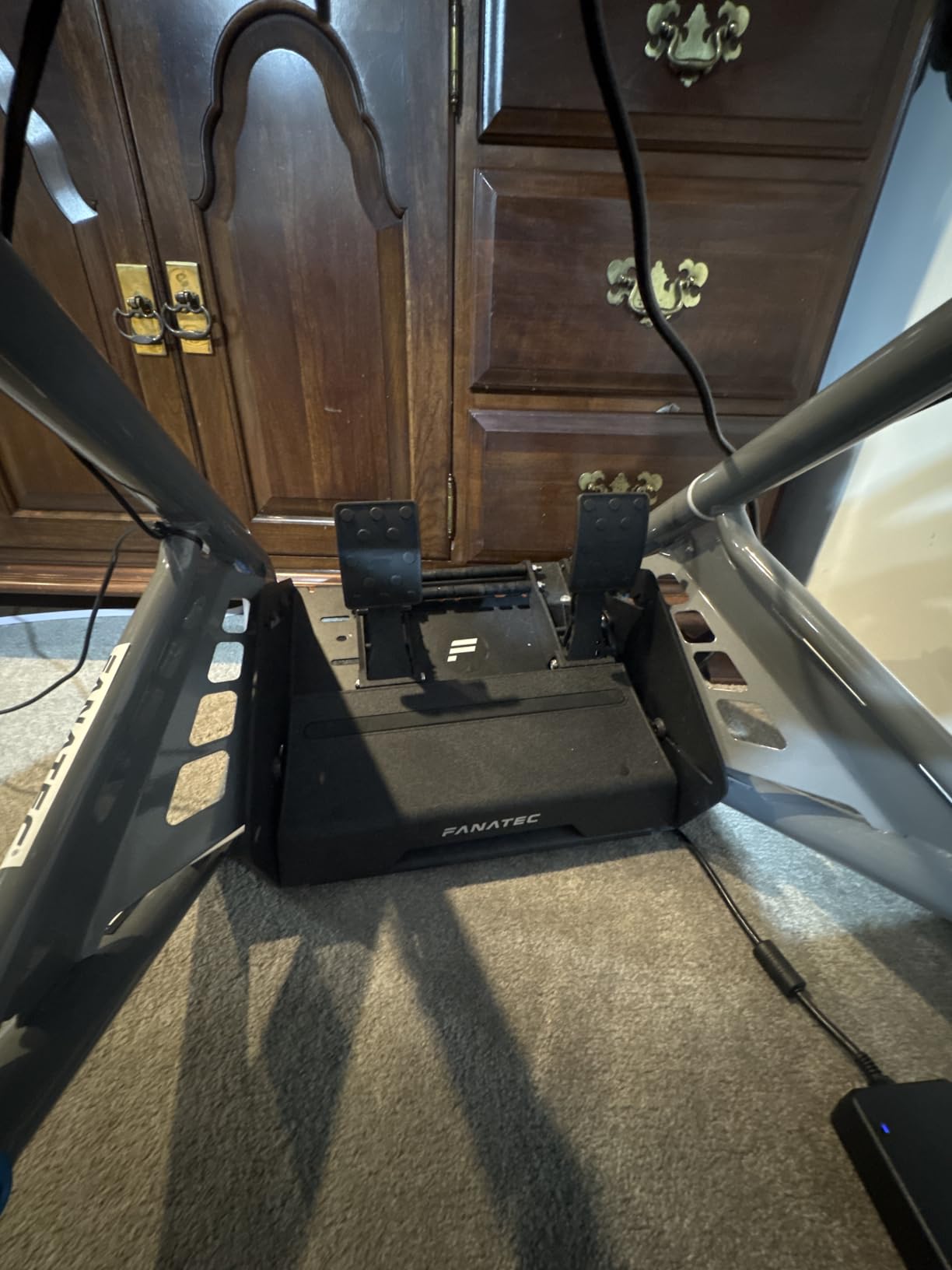
The clutch and throttle use contactless hall sensors, so they hold their accuracy over years of use, and the whole thing reconfigures as a two-pedal set with sideways pedal position adjustment along the heel rest if you decide the clutch is dead weight.
Connection is either RJ12 straight into a compatible Fanatec base, which is the recommended route, or plain USB as a standalone PC input device. A three-year manufacturer warranty is the longest in this group by some distance.
Why the elastomer stack matters more than the force rating
A brake rated at 90 kg tells you the ceiling, not the shape of the curve. The elastomer stack shapes what happens between the first millimetre of travel and full pressure, and it is that shape which decides whether you can feel the locking point or whether the pedal just goes numb.
Having three supplied hardnesses means you can find a match for different disciplines without buying another set, which is the practical reason this pedal set holds up as drivers move from open-wheelers to GT cars.
Where beginners get caught out
Console support is the catch. Running on PS5 or PS4 needs a PlayStation-licensed Fanatec base, and Xbox needs an Xbox-licensed one, so for a console-only beginner these are effectively PC pedals until a base is added.
The rubber pedal covers and fixed heel rest also limit foot placement compared with frames that let you move everything, and the design assumes a rigid cockpit mount, so it is a poor match for a desk setup.
4. MOZA SRP2 Pedals – compact two-pedal with a 100 kg brake
MOZA SRP2 Pedals Set Throttle Brake Pedal Equipped With 100KG Load Cell
100 kg load cell brake
15-bit angle sensor
CNC aluminium and steel
Two-pedal, PC only
Pros
- 100 kg load cell brake with instant response
- CNC aerospace aluminium and high-strength steel
- Two-stage pedal face angle at 10 and 25 degrees
- Spacing adjustment of 15mm either way
- Height adjustment across a 36mm range
- Compact two-pedal footprint
Cons
- Two-pedal layout with no clutch
- PC only with no console support
- Only 14 reviews so reliability data is thin
- Performance Kit sold separately
The SRP2 is unusual in this group because it is a two-pedal set with a 100 kg load cell brake, which means you get real force measurement without paying for a clutch you will probably never use. For a first-time racer, that combination is genuinely useful.
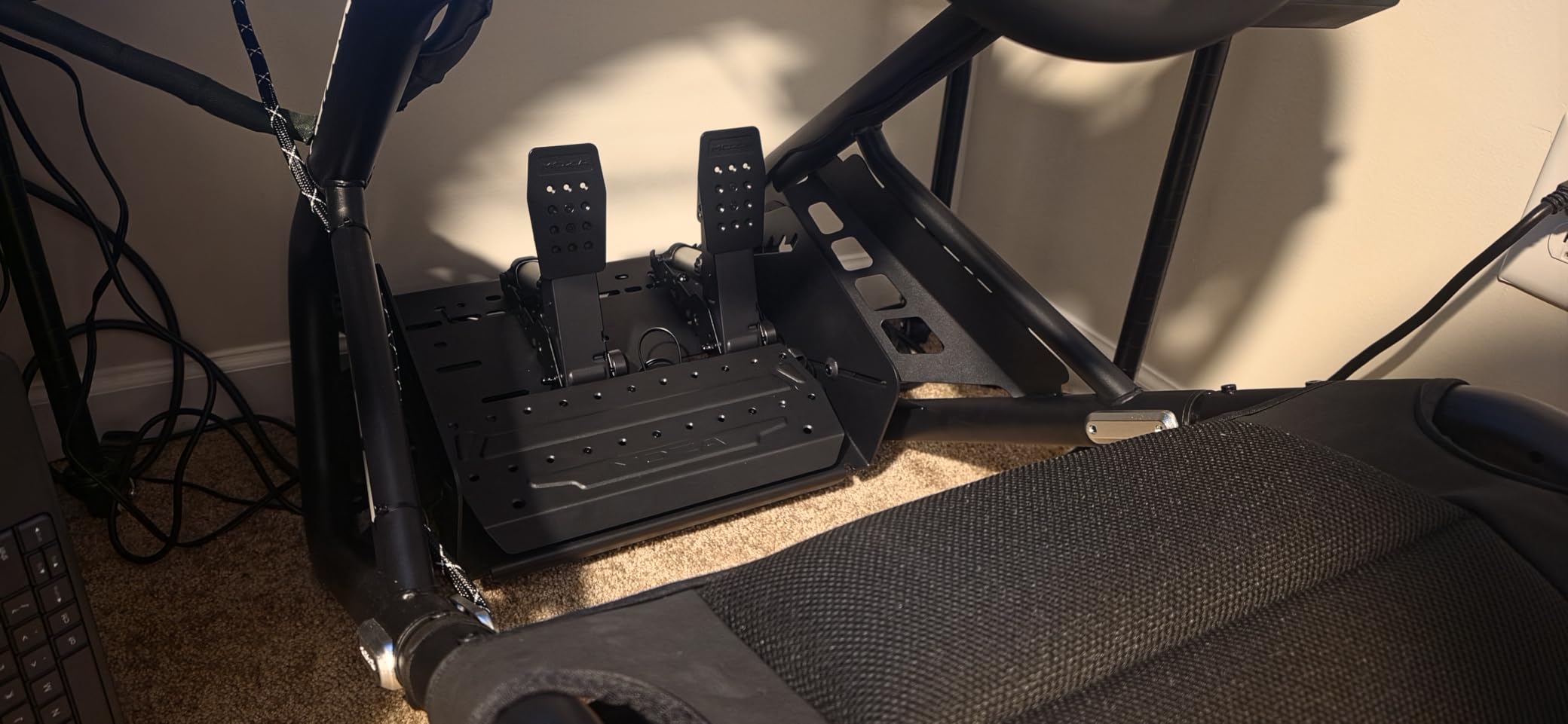
Adjustment is where it stands out. The pedal face has two-stage angle adjustment at 10 or 25 degrees, spacing moves by plus or minus 15mm, and height runs through a 36mm range. In practice that is enough fitment range to place it in a small cockpit or a tight wheel stand without improvising.
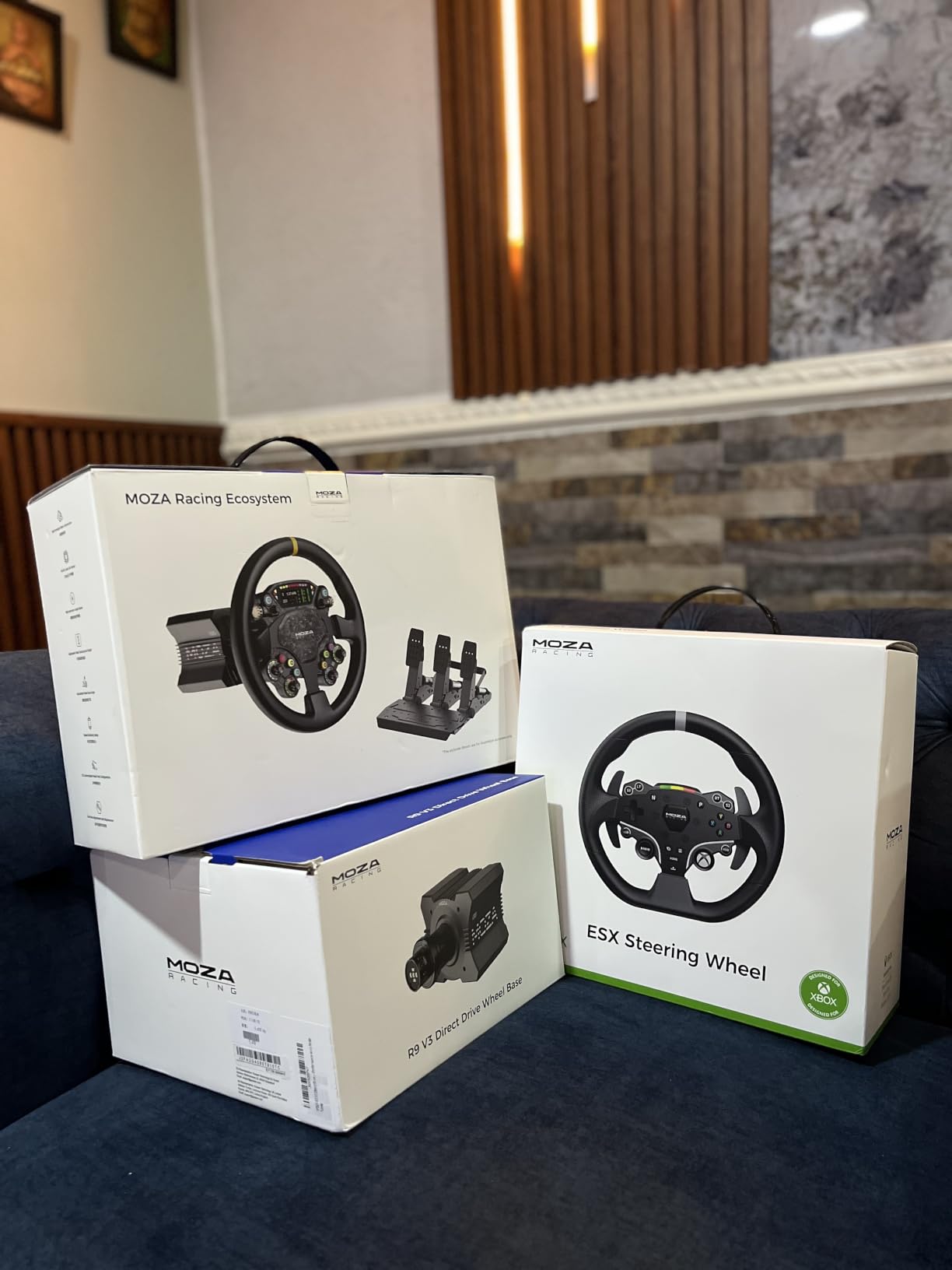
Construction is CNC-machined aerospace-grade aluminium with high-strength steel, which is why the unit weighs 6 pounds and still feels planted. MOZA also merges a 15-bit angle sensor with the load cell through sensor fusion, which smooths the linear feel of both pedals.
Out of the box, the standard elastomer and multi-hardness spring set gives 25 brake configurations. The optional Performance Kit pushes that past a thousand, but only if you want to go further.
Best fit for smaller feet and tighter rigs
Two-stage angle and a 36mm height range solve the most common fitment complaint in budget pedal sets, which is that the pedal face sits at the wrong angle for your ankle no matter how you move the unit. Angling the face flattens the brake line for some drivers and steepens it for others, and this is one of the few sets here where that is a screw rather than a workaround.
The compact two-pedal footprint also leaves more footroom on a small frame, which matters in an apartment setup where a full three-pedal set forces your knees outward.
Where the compromise shows
There is no clutch, so rally, road racing, and anything requiring a manual shift pattern is out of reach without a second purchase. Console support is absent as well, since the unit is PC only over USB.
The honest caveat is the review pool. At 14 reviews the rating is thin, so long-term durability data does not exist yet for this model, and the larger set of tuning options depends on hardware sold separately.
5. Thrustmaster Raceline Pedals III LC – console-friendly 100 kg brake
Thrustmaster Raceline Pedals III LC – 3-Pedal Simracing Set Featuring Brake Pedal with Load Cell Sensor (220 lb / 100 kg) – for PS5, PS4, Xbox Series, Xbox One, PC
100 kg load cell at 24-bit
25 to 100 kg brake range
All-metal modular frame
PS5, PS4, Xbox and PC
Pros
- 24-bit resolution load cell brake rated to 100 kg
- Brake force configurable from 25 to 100 kg
- Four brake configurations plus a preload dial
- Hall effect sensors on accelerator and clutch
- Fully metal modular construction with adjustable positions
- Equalizer and dead zone tuning in software
Cons
- Lowest rated set here at 4.1 with 19 percent of ratings at one star
- Console support limited to Thrustmaster force feedback bases
- Software tuning depends on the Race Dash screen or a desktop app
Brake force here is configurable from 25 to 100 kg across four configurations built from three springs plus an elastomer buffer, with a further plus or minus 5 kg from the preload dial. That is the widest tuning range in this group, and for a beginner it means the pedal can start light and be stiffened as technique improves.
The load cell reads at 24-bit resolution, and the accelerator and clutch use Thrustmaster hall effect sensors for precision and durability. Construction is entirely metal with a fully modular frame, and both pedal positions and pedal heads adjust.
Console coverage is the reason this set earns its place. It runs on PS5, PS4, Xbox Series, and Xbox One with Thrustmaster force feedback bases, and on PC with any wheel base, connected over USB C.
Software tuning covers dead zones and an equalizer, either through the Race Dash screen on a T598 racing wheel or through the My Thrustmaster Panel app on a desktop.
What the wide force range actually gives you
Starting at 25 kg matters more than it looks. A beginner who cannot comfortably reach a stiff brake will end up modulating with less of the pedal travel than intended, which is the most common reason new drivers feel the ABS lightening constantly. Being able to soften the pedal means you can learn the technique on a setup you can actually reach the bottom of.
The preload dial is the part you will use most, since it shifts the whole feel without changing parts.
The honest weakness here
This set carries the lowest rating in the group at 4.1, with 19 percent of ratings at one star. The pattern in the reviews is consistent: the metal modular build and the wide brake force range earn praise, while a meaningful share of buyers found the experience did not match the spec sheet.
Console use also depends on owning a Thrustmaster force feedback base, and software tuning requires either the Race Dash screen or a separate desktop application.
6. PXN PD HM Brake and Throttle – cheapest way out of plastic pedals
PXN PD HM Brake&Throttle Sim Racing Pedals, All-Metal 2-Pedal Set
All-metal carbon steel frame
Hall effect on both pedals
Brake resistance kit to 20 kg
USB-A, Type-C, RJ45
Pros
- All-metal carbon steel construction instead of plastic
- Hall effect sensors with no signal drift
- Adjustable angle
- height and horizontal spacing
- Included damper kit raises brake resistance to 20 kg
- Triple connectivity covers PC and PXN bases
Cons
- Two pedals only with no clutch
- No load cell so brake feel is position based
- PC only with no console support
- Small review pool at 21 with 14 percent two-star feedback
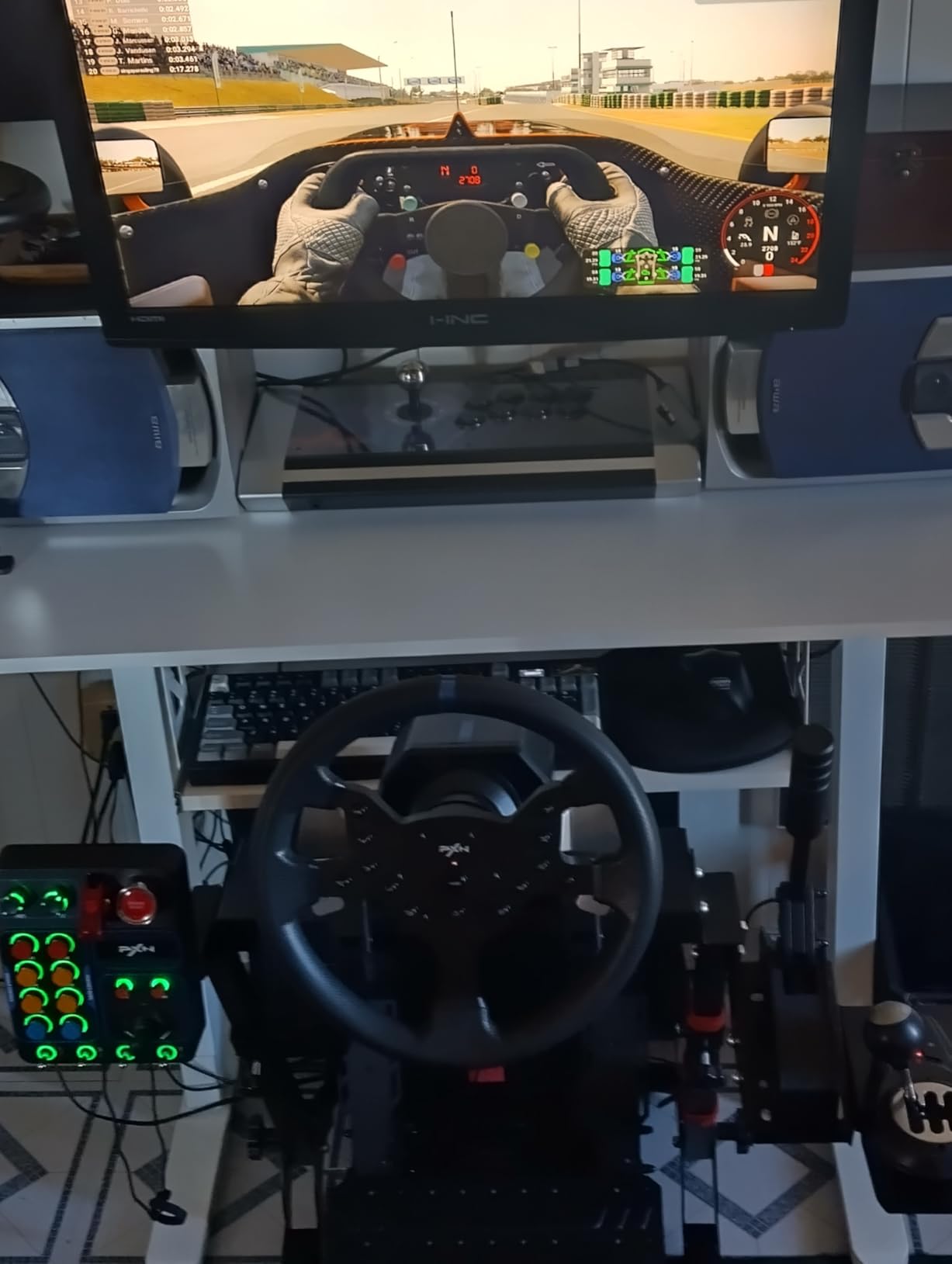
This is the cheapest credible step away from the plastic pedals bundled with entry wheels. The whole frame is carbon steel and metal, which removes the flex that makes cheap pedal sets feel vague, and both pedals use non-contact hall effect sensors so there is no drift and no mechanical wear.
Adjustability covers pedal angle, height, and horizontal spacing, which is more fitment control than most sets at this level offer. The included spring damper accessory can raise brake resistance up to a 20 kg feel without any extra purchase.
Connectivity is unusually broad for a budget set: USB-A for direct PC use, Type-C for PXN VD series bases, and RJ45 for the V10 and V12.
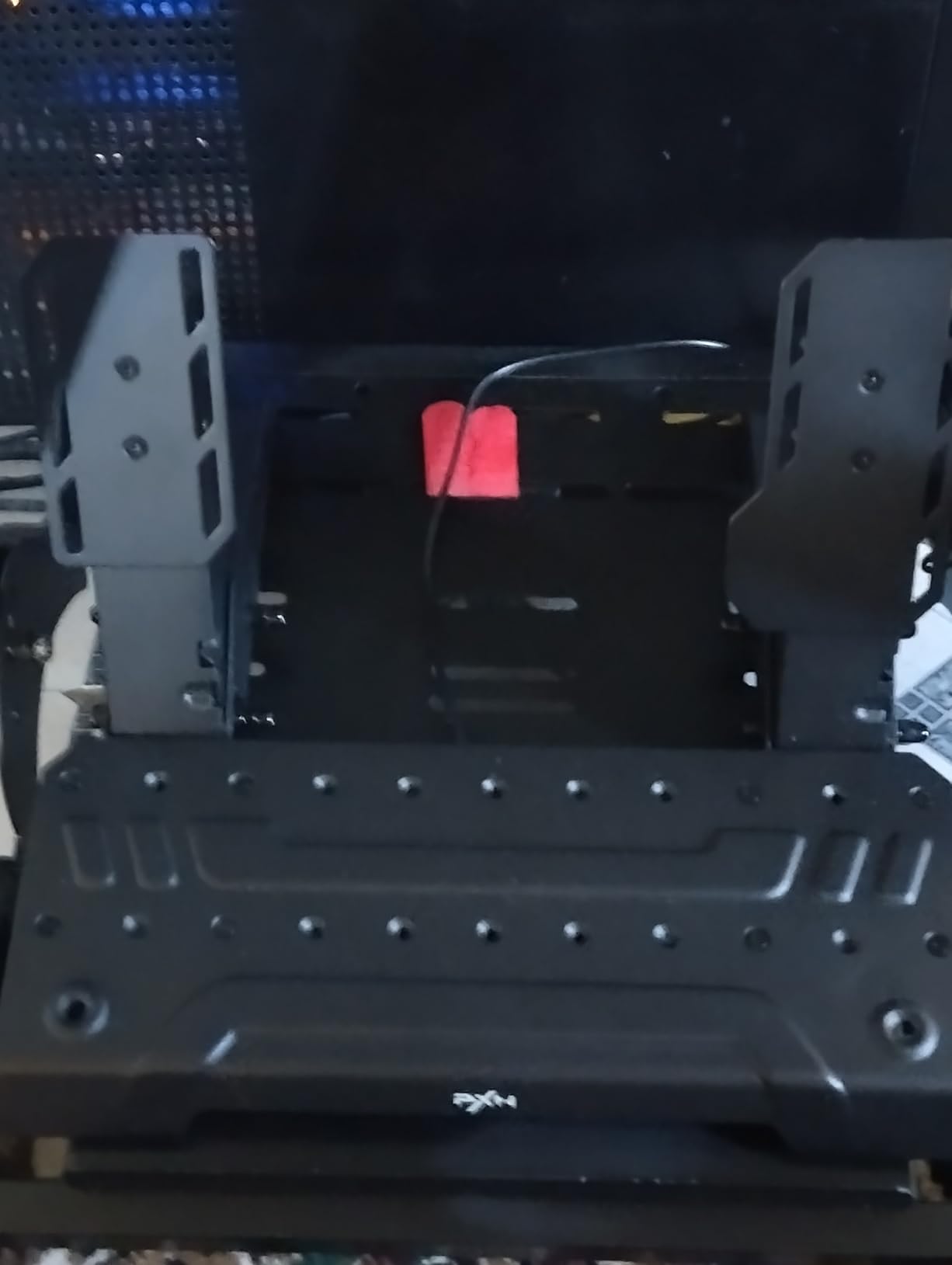
For someone who has never run anything but a bundled plastic set, the change in chassis rigidity is the whole story. The pedal stops wobbling against your foot, so the input the game receives matches the input you intended.
Why hall effect sensors matter at this price
Older budget pedals used potentiometers, which wear at the pivot and gradually report a different value for the same physical position. Hall effect sensors read a magnetic field instead of a resistive track, so there is nothing rubbing against anything. The practical effect is that calibration holds for years rather than needing a re-tune every few months.
Where this one stops
It is a two-pedal set, so clutch users cannot use it as delivered. More importantly, there is no load cell, which means brake input is measured from pedal travel rather than applied force, so the reading shifts a little depending on where on the pedal face your foot sits.
Console support is not offered, and with 21 reviews and a 4.1 rating the long-term picture is thinner than the sets above it.
7. DOYO Racing Wheel Pedals – three pedals with swappable springs
DOYO Racing Wheel Pedals, PC Gaming Steering Wheel Pedal Set, Swappable Springs, Adjustable, Durable, Compatible with PC Win11/Win10/Win7
Hall effect on all three pedals
Springs adjustable 2.9 to 6.2 kg
Adjustable angle and gap
USB, PC only
Pros
- Hall effect sensors across all three pedals
- Three-pedal layout at the lowest cost here
- Swappable springs that need no tools
- Spring holes line up with G29 and MOZA SRP parts
- Adjustable angle
- gap and 12mm spacing movement
- Does not lift or slide on hard floors
Cons
- Brake spring far too light out of the box
- Some users report a dead zone at default settings
- Occasional random disconnects
- Does not grip carpet
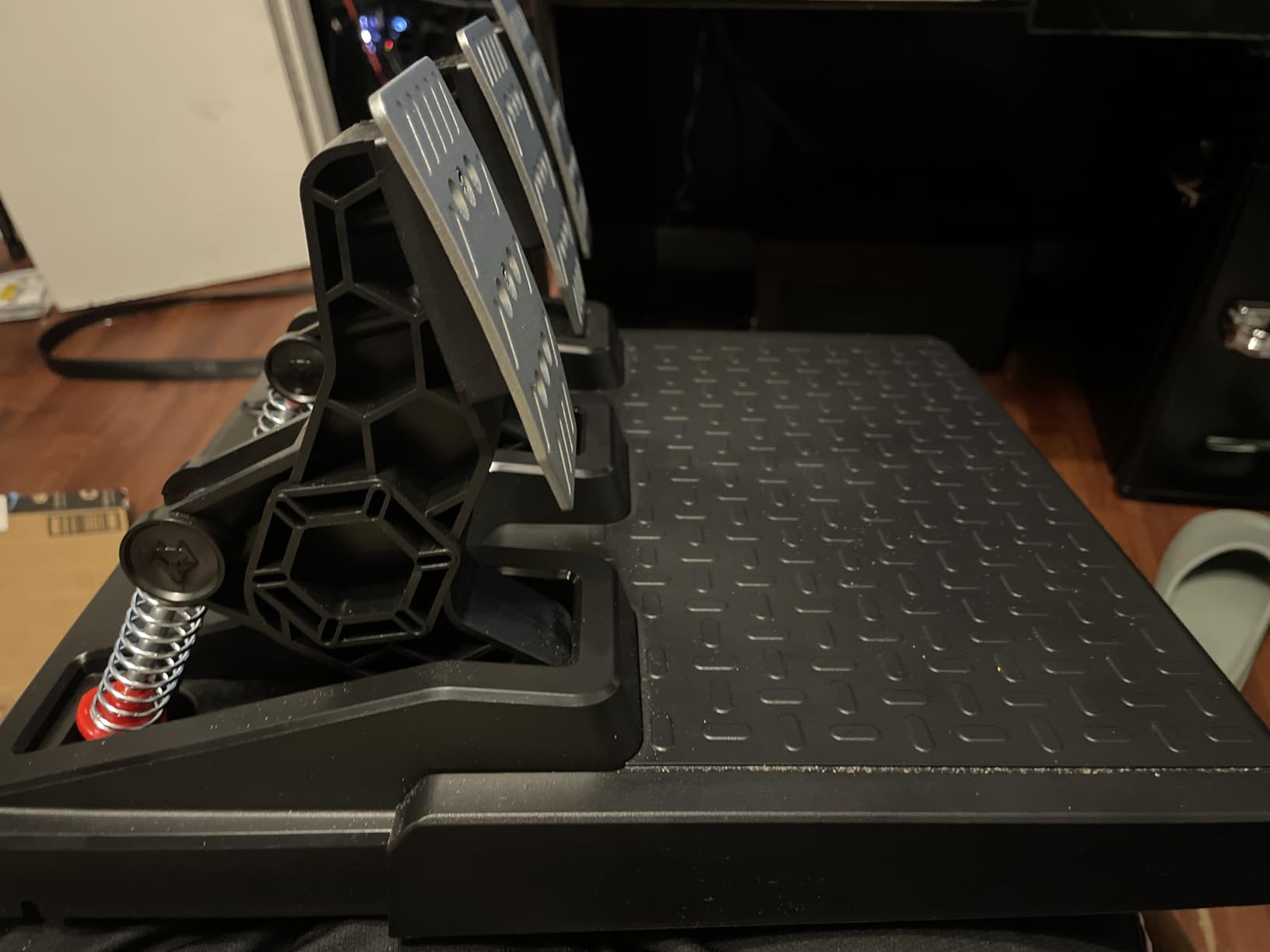
This set exists to solve one specific problem: you want three pedals, hall effect sensors, and a metal build without spending much. It delivers all three, and the pedal plates are metal rather than the plastic used on most sets at this cost.
Two adjustable tension springs cover a 2.9 to 6.2 kg range and can be swapped between pedals without tools. Mounting holes at the bottom line up with G29 and MOZA SRP parts, which means spring and plate upgrades from those ecosystems fit.
Footprint is 385mm long by 340mm wide and 210.6mm high, with pedal spacing of 55mm and 53mm that can shift by a further 12mm after removing a pedal.
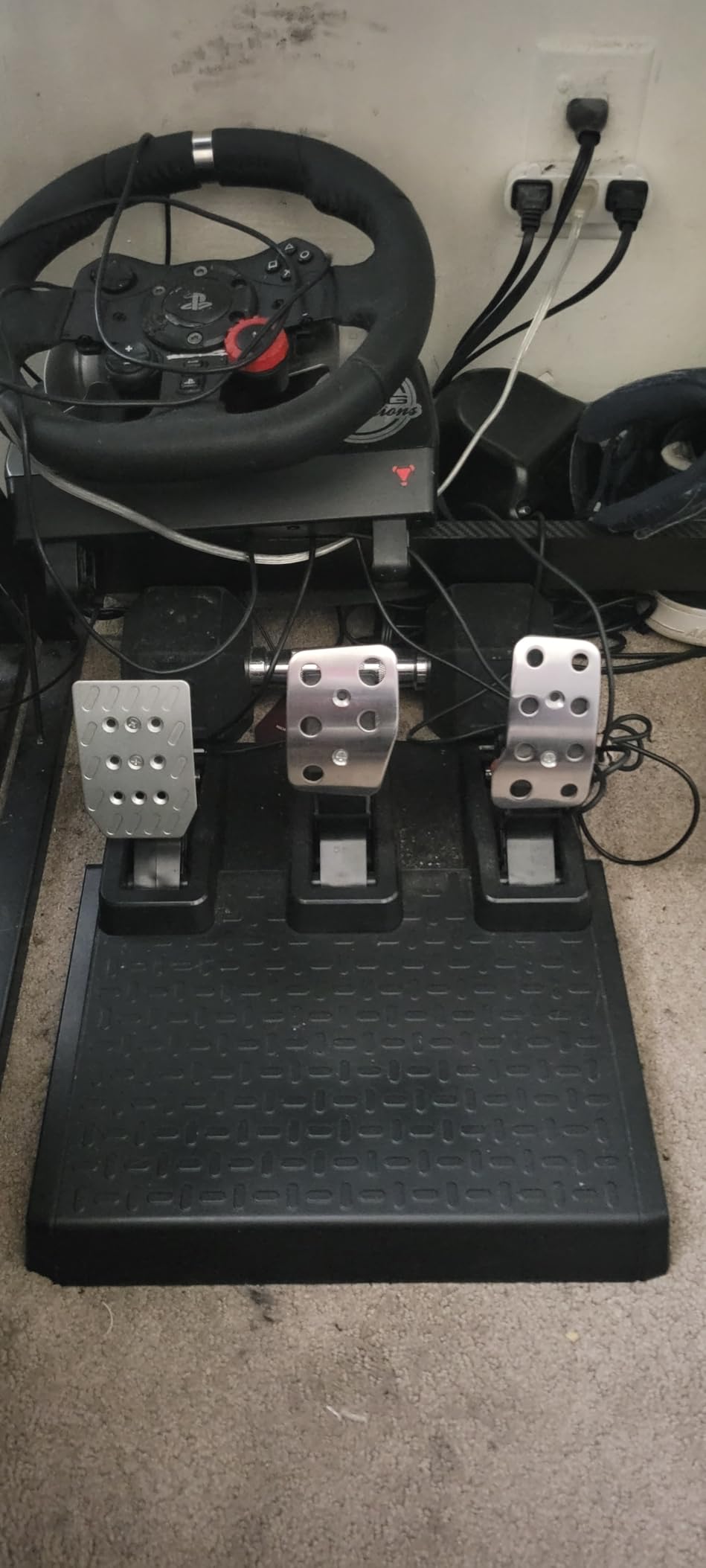
Calibration is straightforward in Windows, the set is recognised across mainstream racing titles, and it does not lift or slide on hard floors, which is more than several sets in this roundup can say.
Budget for an afternoon of tuning
The recurring complaint is the default brake spring, which is well below what most drivers can modulate. The springs are designed to be changed, so treat that as the first job rather than a fault. Swapping in a firmer spring is the single change that turns this set from an odd-feeling pedal into a usable one.
A smaller dead zone at default settings is also reported by some owners and is handled in-game rather than in hardware.
Reliability is the real question
Two reviewers report random disconnects, including one during a long endurance session, and the set does not grip carpet without an unofficial fix. With 29 reviews and 23 percent of ratings at two stars, this is the one in the group where we would call the feedback genuinely split.
The clutch sensor resolution is also lower than the throttle and brake, which matters if you plan to rely on bite-point clutch work later.
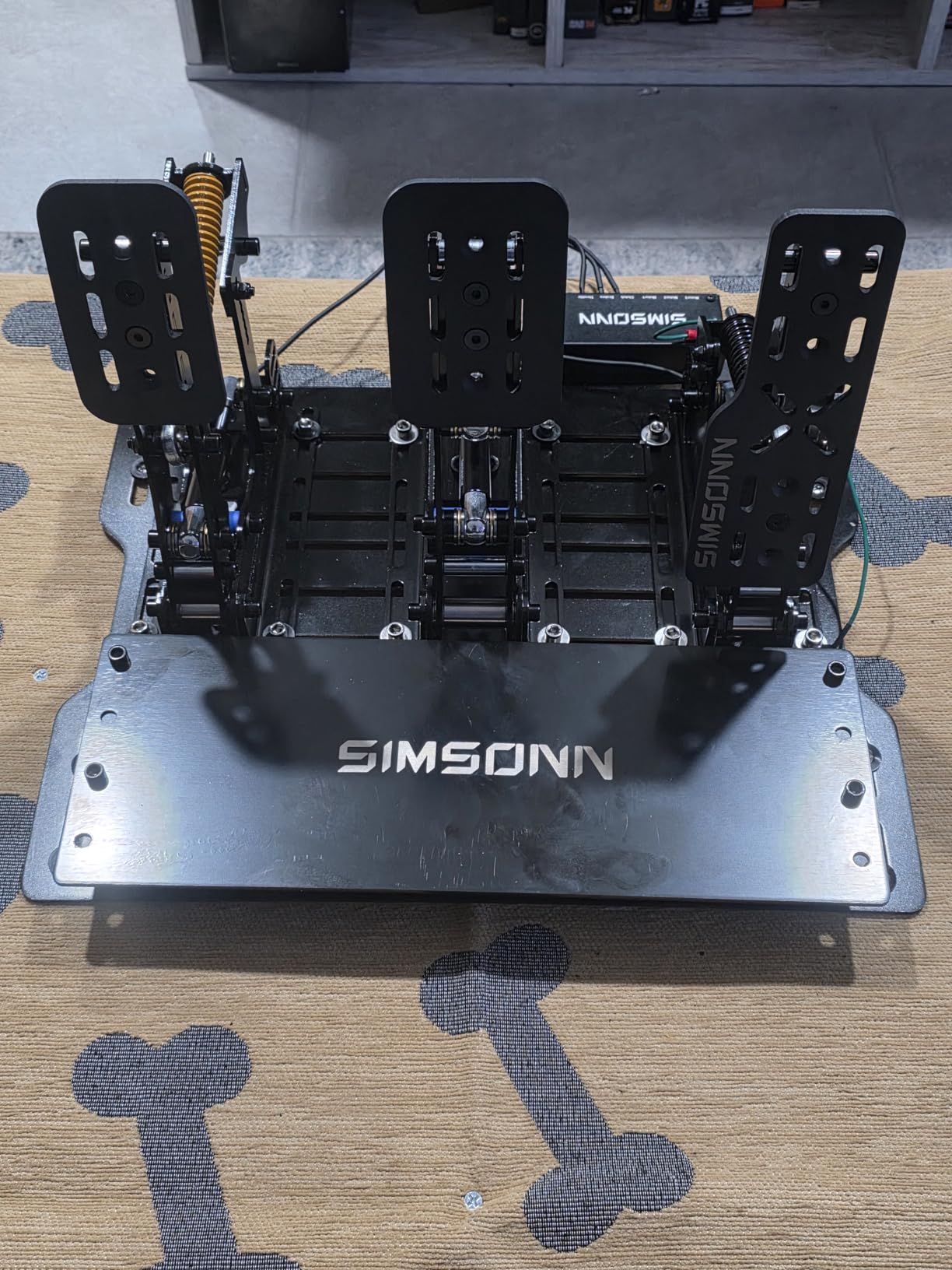
8. SIMSONN Plus X Hydraulic Pedals – software control over brake feel
SIMSONN Plus X Racing Simulator Hydraulic Pedals Sim Racing Pedals Support Haptic Reactor (Plus X Black P3-H3)
Load cell brake with hydraulic damping
60, 70 and 80HA elastomers
Non-linear curve software
PC only, 24-month warranty
Pros
- Load cell braking at a fraction of the branded cost
- 13 spacer positions across three elastomer types
- SIMSONN Manager sets non-linear curves and dead zones
- Dual-bearing design for smooth travel
- High-strength steel frame that bolts to common rigs
- Three vibration module ports
Cons
- Brake extremely stiff until broken in and calibrated
- Reports of a hydraulic strut failure within days
- Throttle can produce a distracting squelching noise
- No baseplate in this variant
- PC only
This is the only set in the group that combines a load cell brake with hydraulic damping and a software layer, and the software is the reason it is interesting. SIMSONN Manager lets you set non-linear output curves, define dead zones, and save profiles to a config file you can reload in a couple of clicks.
On the hardware side, the elastomer pack covers 60, 70, and 80HA across 13 spacer positions, so the brake feel range is wide enough to cover very different vehicle types. The pedals use a dual-bearing design with flange and plane bearings, which is what keeps travel smooth through the stroke.
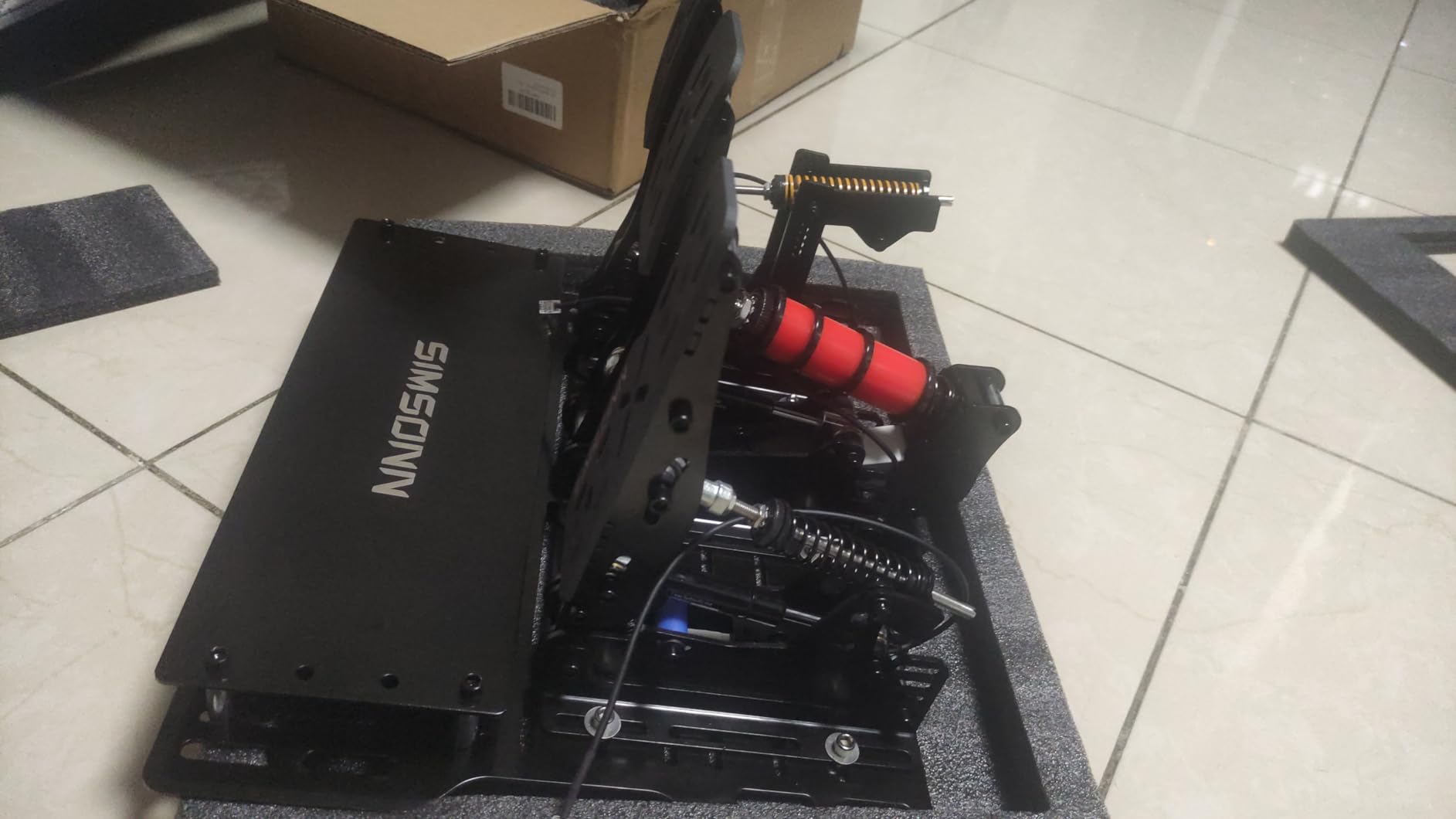
The frame is high-strength steel and bolts directly to rigs like the Playseat Trophy. There are also three vibration module ports supporting SIMSONN haptic feedback units, and a 24-month product warranty.
Who non-linear curves are for
A linear brake curve means the first 20 percent of travel always produces the first 20 percent of input, regardless of the car. A non-linear curve lets you remap that, so a car with strong brakes can have a shorter usable range while a touring car keeps a long one.
If you are driving multiple very different cars and want one pedal setup rather than a per-car profile, this is the set in the group that solves it properly. It is also the only one where software tuning is the primary control rather than a secondary feature.
Why we would not hand this to a first-time racer
The brake is extremely stiff out of the box and barely travels until the elastomer stack is broken in and recalibrated. Several owners had to do that work before the pedal felt usable, and a beginner will read that as a fault rather than a break-in period.
Durability of the hydraulic struts is the other concern. One reviewer reported a throttle strut failure within two days along with a possible leak developing on the clutch, another removed the throttle because of a squelching noise, and one could not download the software at all. No baseplate is included in this variant either, so mounting is awkward without a rigid rig.
Load cell vs potentiometer vs hydraulic brakes explained
Most realistic sim racing pedals use load cells. A load cell measures the force you apply rather than how far the pedal travels, so the input stays accurate no matter where on the pedal face your foot sits, which is the main reason brake consistency improves.
A potentiometer measures pedal travel instead. It is cheaper and perfectly usable in budget sets, but the reading depends on foot position and the mechanism wears at the pivot over time. Hall effect sensors are a contactless alternative to potentiometers that avoid that wear without moving to force measurement.
A hydraulic pedal uses fluid pressure, so the pedal gets progressively harder the further you press, exactly like a real race car. That progressive feel is the appeal, and the trade-off is stiffness at the start of travel plus a higher cost.
Load cells sit in the sweet spot for beginners: real force measurement and progressive build-up without the break-in fuss of hydraulics.
Do beginners actually need a clutch pedal?
No, and community threads make this point more often than the manufacturers would like. A clutch is essential in rally and in road cars with a manual gearbox, but if you are starting in GT or endurance racing with sequential or paddle shifting, a third pedal you never press is dead weight and a wider frame that takes up floor space.
Two of the sets here are two-pedal only, and the Fanatec CSL Elite Pedals V2 reconfigures as a two-pedal set by sliding the modules along the heel rest, so you can start without one and add it later if your discipline demands it.
What to mount pedals on: desk clamp, wheel stand or cockpit
The mount decides how much of the pedal you paid for actually reaches the game. Community discussion on the subject is blunt: pedals flexing or sliding on a soft base destroy brake consistency, and this is the most repeated beginner complaint by a distance.
The rule that follows is simple and it is the upgrade order we would give any new sim racer:
First, get a rigid base. A wheel stand or cockpit bolted to the floor removes the flex that a desk clamp introduces when your weight shifts onto the pedals.
Second, add load cell braking. Only now does the brake measurement mean something, because the force is being read off a frame that is not moving.
Third, consider the wheel. Wheel upgrades change feel and precision, but they produce smaller lap time gains than the first two steps.
A desk clamp setup is workable for the first few months and fine for testing whether you enjoy the hobby. If your chair wheels roll forward slightly under braking pressure, you have a mount problem, not a pedal problem.
What not to buy yet
Do not buy top-tier pedals while your base is still a desk clamp. Premium load cell sets measure force precisely, and a flexing frame turns that measurement into noise, so the money buys a better sensor pointed at an unstable signal. This is the single most reported regret pattern in community threads about pedal purchases.
Do not buy hydraulic pedals as a first upgrade either. They are genuinely excellent, but they are also the most demanding to set up and the least forgiving of a wobbly mount. Learn your braking technique on a load cell set first.
Do not buy a clutch you will never use, and do not buy a pre-assembled kit that includes one for that reason. Several sets here can be reconfigured as two pedals, which is the cheaper route to the same result.
And if your current pedals are the bundled plastic set from an entry wheel, check the pedals before replacing the wheel. Reviewers repeatedly describe the jump from a position-sensor plastic pedal to a hall effect or load cell pedal as the single most noticeable upgrade in a first rig.
Compatibility checklist before you order
Mounting pattern. Check the bolt pattern against your rig. Some sets here bolt directly to common frames, while others assume a cockpit mount and include no baseplate at all, which is the case with the SIMSONN variant.
Angle and height adjustment. Pedal face angle, pedal height, and spacing are what determine whether the pedal suits your ankle and foot size. The MOZA SRP2 offers the widest physical adjustment in this group, while the Logitech RS relies more on sliding the pedals along the frame.
Console connection. On PS5 and PS4 the pedals need an RJ12 adapter cable, and on Xbox they need the equivalent RJ12 or USB adapter for that console generation. This is the most common reason a new pedal set simply does not respond on a console.
Wheel base pairing. Some sets connect directly to matching bases over RJ12 or USB, while others need a separately sold adapter when the wheel is from a different brand. Fanatec pedals over USB work standalone on PC, and console use needs a licensed Fanatec base.
PC connection. All eight sets here run on Windows over USB, and several support USB C or additional connector types. Confirm the connector matches your wheel base or PC port before ordering.
Frequently Asked Questions
Do pedals make a difference in sim racing?
Yes, more than most people expect. Pedals replace a gamepad trigger or a spring-loaded position sensor with a direct analogue measurement of your foot, so your braking input is repeatable lap after lap. That repeatability is what lets you learn threshold braking and trail braking. The gain only appears on a rigid mount, because a flexing frame turns the force reading into noise.
What are the most realistic sim racing pedals?
The most realistic pedals at a beginner-friendly level are load cell sets, because they measure how hard you press rather than how far the pedal travels. In this roundup the Fanatec CSL Elite Pedals V2, with a load cell measuring up to 90 kg plus a three-stage elastomer stack, gives the most progressive brake feel. Hydraulic pedals are more realistic still but cost more and demand a firmer mount.
What is the best sim racing setup for beginners?
Build in this order: a rigid base such as a wheel stand or cockpit, then load cell pedals, then a better wheel. Pedals produce larger lap time gains than a wheel upgrade, and load cell pedals only measure correctly if the frame they are bolted to does not move. A desk clamp is acceptable for the first few months while you learn whether you enjoy the hobby.
Should beginners buy load cell pedals?
Yes, once your base is rigid enough to hold them. Load cell pedals measure applied force instead of pedal travel, which removes the variation caused by where your foot sits on the pedal and makes braking repeatable. On a desk clamp or a flexing wheel stand the extra accuracy is wasted. On a wheel stand or cockpit it is the most valuable upgrade in a first rig.
Is a clutch pedal necessary in sim racing?
It depends entirely on the discipline. A clutch is essential in rally and in road cars with a manual gearbox, but sequential and paddle-shift cars need none. Most beginners in GT or endurance racing never press it. Several sets here can be reconfigured as two pedals, or ship as two pedals only, so you can start smaller and add a clutch later if your discipline needs it.
Which sim racing pedals are compatible with PS5?
Most of these pedal sets reach a PlayStation 5 through an RJ12 adapter cable when used with a compatible force feedback wheel base. The Thrustmaster Raceline Pedals III LC supports PS5 and PS4 with Thrustmaster bases. The Fanatec CSL Elite Pedals V2 needs a PlayStation-licensed Fanatec base, and the Logitech RS pedals connect to the PRO and RS50 bases for console use. Sets marked PC only will not work on a console.
The beginner default: our final recommendation
The default recommendation for the best sim racing pedals for beginners in 2026 is the Logitech G RS set. It has a real 75 kg load cell brake, hall effect sensors on both other pedals, and a steel frame heavy enough to stay planted, which is the combination that solves the most beginner problems at once.
Buy a wheel stand or a floor-mounted cockpit before you buy it, and you will have the setup that most people in community threads wish they had started with. If you already own one of these pedal sets and want more tuning, move up to the Logitech G PRO for swappable springs and elastomers, or the Fanatec CSL Elite Pedals V2 for the best three-pedal brake feel in this group.
Skip hydraulics, skip a clutch you will never use, and skip anything premium while your base is still flexing. Fix the mount, then spend on the brake.