
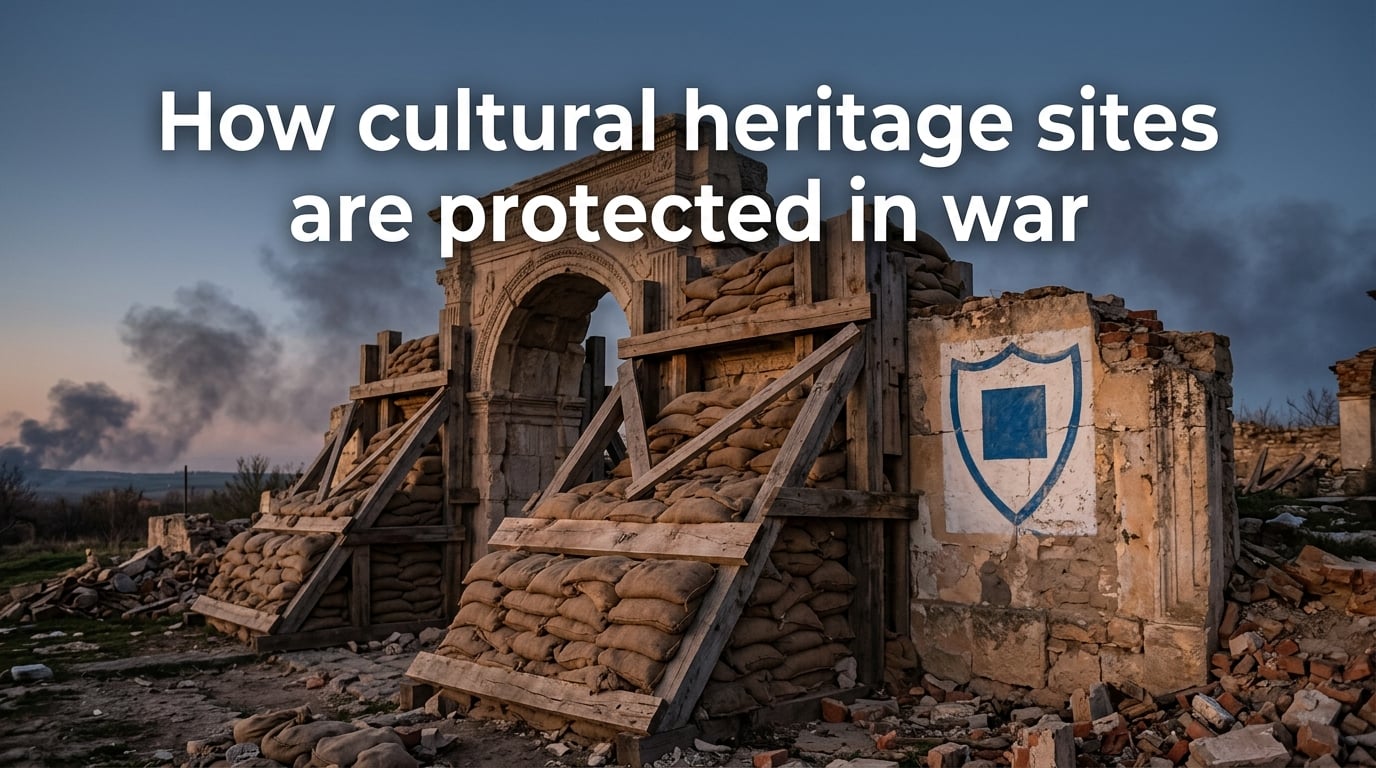
Cultural heritage sites are protected in war primarily through the 1954 Hague Convention for the Protection of Cultural Property in the Event of Armed Conflict, working alongside customary international humanitarian law that already treats cultural property as civilian property.
This system combines binding treaties, military identification protocols like the Blue Shield emblem and No-Strike Lists, and hands-on emergency planning by cultural workers on the ground.
Damage to the cultural property of any people is, in the words of the 1954 Hague Convention’s preamble, “damage to the cultural heritage of all mankind.” That principle underwrites every layer of protection we’ll explore in this guide.
In this explainer, I walk through the legal instruments, the institutions, the practical protective measures, and the modern monitoring tools that together answer the question of how cultural heritage sites are protected in war. Our team has drawn on UNESCO, ICRC, the Georgetown Journal of International Affairs, and the Defence Horizon Journal to build a complete picture for 2026.
Table of Contents
What Counts as Cultural Heritage in Armed Conflict
The first step in understanding how cultural heritage sites are protected in war is knowing what the law actually covers.
Cultural property, the legal term used in the 1954 Hague Convention, includes movable and immovable property of great importance to the cultural heritage of every people. Movable examples include paintings, sculptures, manuscripts, archival records, and museum collections. Immovable examples include monuments, architecture, archaeological sites, and historic city centers.
Cultural heritage is the broader concept that includes intangible elements such as traditions, language, and ritual sites, alongside the tangible objects the treaties name. When a state ratifies the 1954 Hague Convention, it accepts an obligation to safeguard both movable and immovable cultural property from the foreseeable effects of armed conflict.
The Hague Convention’s definition is deliberately broad so that protection covers libraries, museums, archives, refuges containing cultural property, and centers containing monuments. A 500-year-old minaret and a freshly archived newspaper both qualify when a state recognizes their cultural significance through inventories and registers.
How Cultural Heritage Sites Are Protected in War: The Legal Foundation
The 1954 Hague Convention for the Protection of Cultural Property in the Event of Armed Conflict is the foundational treaty and the most-cited international legal instrument for protecting cultural heritage in times of war.
Drafted in the aftermath of the Second World War, when the destruction of European cities exposed how vulnerable heritage was to total war, the Convention entered into force on 7 August 1954. It establishes two layers of protection that still shape the answer to how cultural heritage sites are protected in war today.
The first layer is general international humanitarian law, the body of rules that govern how wars may be fought. Under the 1949 Geneva Conventions and their 1977 Additional Protocols, cultural property is treated as civilian property. Attacking civilian objects is prohibited unless they are used for military purposes, and the principle of distinction requires combatants to separate military targets from protected persons and objects at all times.
The second layer is the specific protection regime created by the 1954 Hague Convention, its 1954 First Protocol, and its 1999 Second Protocol. These instruments impose dedicated obligations to safeguard, identify, mark, and refrain from damaging cultural property, and they create criminal liability for violations.
Additional Protocol I to the Geneva Conventions, Article 53, reinforces this regime in international armed conflicts by prohibiting acts of hostility directed against historic monuments, works of art, or places of worship that constitute the cultural or spiritual heritage of peoples. Additional Protocol II, Article 16, extends equivalent protection in non-international armed conflicts.
The Rome Statute of the International Criminal Court, adopted in 1998, makes intentional attacks against cultural property a war crime when committed in international or non-international armed conflicts. Together, these instruments answer how cultural heritage sites are protected in war through a stack of overlapping legal duties.
Legal Instruments at a Glance: A Comparison Table
This table summarizes the major legal instruments that answer how cultural heritage sites are protected in war. Use it as a quick reference when you need to identify which treaty applies to a specific situation.
| Instrument | Year | Scope | Key Obligations |
|---|---|---|---|
| 1954 Hague Convention | 1954 | International and non-international armed conflict | Safeguard, mark, and refrain from damaging cultural property; respect immunity of sites under Special Protection |
| First Protocol (Hague) | 1954 | Occupation, removal of cultural property | Prevent export of cultural property from occupied territory; return removed property after conflict |
| Second Protocol (Hague) | 1999 | Enhanced Protection regime, state responsibility | Create Enhanced Protection register; criminalize serious violations; reinforce the war crimes framework |
| Geneva Convention AP I, Article 53 | 1977 | International armed conflict | Prohibit acts of hostility against historic monuments, works of art, places of worship |
| Geneva Convention AP II, Article 16 | 1977 | Non-international armed conflict | Prohibit acts of hostility against cultural property and punish violations |
| Rome Statute | 1998 | International criminal accountability | Criminalize intentional attacks on cultural property as a war crime; enable ICC prosecution |
Notice how the conventions build on each other. The 1954 Hague Convention provides the framework, the First Protocol addresses occupation, the Second Protocol strengthens enforcement, and the Rome Statute adds criminal accountability. Each layer reinforces the others.
The Blue Shield Emblem and How Cultural Sites Are Marked
The Blue Shield emblem is the internationally recognized symbol for the protection of cultural property, designed in 1950 and adopted under the 1954 Hague Convention to mark protected sites and movable property during armed conflict.
The emblem consists of a royal blue and white shield, shaped like a pointed escutcheon and divided into four quarters by a white cross. It is repeated three times in a triangular formation on protected buildings and shelters, and once on movable cultural property.
Marking cultural property with the Blue Shield emblem creates a visual signal to combatants that the site is protected under the Hague Convention. Combined with No-Strike Lists maintained by military planners, the emblem helps belligerents identify sites that must be preserved unless imperative military necessity exceptionally requires otherwise.
The 1999 Second Protocol created an even stronger designation called Enhanced Protection. Cultural property inscribed on the Enhanced Protection List, currently a small group including sites in Italy, Germany, and Cyprus, receives immunity from attack and from use as a military objective, provided it is properly marked and verified.
Despite these tools, public awareness of the Blue Shield remains low. Forum users on Reddit’s r/AskHistorians regularly express surprise when they learn what the emblem means, which is why UNESCO and Blue Shield International continue to promote wider recognition.
Practical Protection Measures on the Ground
Treaties alone do not save monuments. Cultural workers, military personnel, and heritage professionals apply concrete measures before and during conflict.
Sandbagging is the most visible step. Staff place sandbags around the base of monuments and statues, around doorways, and against vulnerable walls to absorb blast and shrapnel. Sandbags have saved the colonnades at the Parthenon, the minarets of Aleppo, and countless small historic tombs.
Sheltering in place is the second measure. When immovable objects such as historic buildings or statuary cannot be relocated, teams wrap them in fire-resistant fabric, brace them with timber, and shore up their foundations. Where possible, fire suppression systems are installed.
Relocation of collections is the third measure. Museums and archives move portable artifacts to purpose-built refuges, basements, or even off-site storage. During the Second World War, the United States relocated treasures from the National Gallery of Art to a quarry in West Virginia. More recently, Syrian museum staff evacuated mosaic panels and sculptures from Palmyra, and Ukrainian curators evacuated collections from Kherson and Kharkiv.
Inventories and documentation form the fourth measure. Detailed photographic and written records, often held in redundant digital archives, allow recovery and identification even when an object is damaged or stolen. The Smithsonian Cultural Rescue Initiative, the Penn Cultural Heritage Center, and ICCROM all maintain resources for these emergency inventories.
Forensic marking and registration round out the practical toolkit. Registry numbers, RFID tags, and forensic fingerprints help investigators trace trafficked objects long after a war ends.
Emergency Planning Checklist for Cultural Workers
Cultural workers operate under extreme time pressure when conflict approaches. The following checklist distills what teams at UNESCO, ICCROM, and Blue Shield International recommend when there is no time to consult a handbook.
- Inventory: photograph every item from multiple angles, record dimensions, weight, materials, and condition.
- Mark: apply invisible forensic markers, RFID tags, or registry numbers to movable objects.
- Sandbag: protect immovable monuments with sandbags, fire-resistant covers, and timber bracing.
- Secure: relocate the most portable and most significant objects to basement refuges or off-site storage.
- Document: back up all digital records to servers in third countries; print paper copies that can survive power outages.
- Communicate: share inventories with UNESCO, Blue Shield, and partner institutions so that No-Strike Lists can be updated.
- Train: rehearse evacuation routes and emergency contacts with local fire and rescue services.
ICCROM’s First Aid to Cultural Heritage in Times of Crisis handbook expands each of these steps into a full operational module. Many national cultural agencies now run annual exercises to keep their teams familiar with the sequence.
Forum users on r/Anthropology often ask how effective these measures actually are. The honest answer is that preparation matters far more than last-minute improvisation. Sites with completed inventories and rehearsed teams recover much faster than sites without them.
Who Protects Cultural Heritage in War: Key Institutions
No single agency protects heritage alone. A network of intergovernmental, professional, and non-governmental organizations shares responsibility.
UNESCO sets international standards through the 1972 World Heritage Convention and the 1954 Hague Convention, maintains the World Heritage List and the lists of cultural property under Special and Enhanced Protection, and convenes the Intergovernmental Committee that responds to emergencies. UNESCO is the only UN body with a dedicated cultural heritage emergencies program.
The International Committee of the Red Cross (ICRC) promotes respect for international humanitarian law, advises parties to armed conflict on their obligations, and supports national authorities in domestic implementation. The ICRC’s legal fact sheets and casebooks are standard references for military legal advisers.
Blue Shield International is the advisory body to UNESCO on cultural heritage protection. Its national committees, including the United States Committee of the Blue Shield, train military personnel and cultural professionals on the emblem, the marking system, and civil-military cooperation.
ICCROM (the International Centre for the Study of the Preservation and Restoration of Cultural Property) builds technical capacity, especially through its First Aid to Cultural Heritage in Times of Crisis program. ICCROM trains a global network of responders who deploy when heritage is threatened.
ICOM (the International Council of Museums) operates the Red Lists of Cultural Objects at Risk, which flag categories of artifacts most vulnerable to looting and trafficking so that customs officers, dealers, and auction houses can be alert.
Beyond these international bodies, universities and NGOs contribute essential capacity. The Smithsonian Cultural Rescue Initiative trains rapid-response teams and runs the Cultural Rescue Initiative. The Penn Cultural Heritage Center produces research and policy guidance on antiquities trafficking. The Artistic Freedom Initiative supports cultural workers at risk.
Modern Monitoring Tools: Satellites, AI, and Sensors
How cultural heritage sites are protected in war has changed dramatically in the last decade through new monitoring technology.
UNESCO’s Reactive Monitoring missions use satellite imagery to verify the condition of World Heritage properties. Since 2016, UNESCO has partnered with the European Space Agency and NASA to detect damage to sites in Syria, Iraq, and Yemen, then publish the findings in periodic state-of-conservation reports.
The Cultural Heritage Monitoring Lab at the Virginia Museum of Natural History, established in 2017, uses radar and optical satellite data to flag sudden changes at heritage sites worldwide. The lab issues rapid alerts when new damage appears, often before on-the-ground reports arrive.
AI damage detection is the newest frontier. Machine learning models trained on pre-war and post-war imagery can automatically classify whether a building has collapsed, been shelled, or remained intact. The Smithsonian Cultural Rescue Initiative and UNESCO’s Global Priority Fund have piloted these tools to produce faster damage maps after recent attacks in Ukraine.
On-site sensors add a complementary layer. Accelerometers, tilt meters, and acoustic emission sensors detect structural stress in real time. The Italian Carabinieri’s Comando per la Tutela del Patrimonio Culturale has used such sensors to monitor monuments during nearby construction or military activity.
Together, these tools fill the gap between the last observation before an attack and the first inspection after. They also produce evidence that supports later criminal prosecution and insurance claims.
Threats to Cultural Heritage During War
Protection always exists in response to threats. The principal threats that drive how cultural heritage sites are protected in war fall into four categories.
Deliberate destruction is the most publicized threat. Examples include the Taliban’s destruction of the Bamiyan Buddhas in 2001, ISIS’s demolition of temples at Palmyra in 2015, and Russian strikes that damaged the Transfiguration Cathedral in Odesa in 2023. Deliberate destruction is increasingly prosecuted as a war crime under the Rome Statute.
Iconoclasm is the symbolic destruction of monuments because they carry identity. Blowing up the minaret of a mosque, defacing an Assyrian relief, or burning a manuscript collection removes not only the object but the memory it carries.
Looting and pillage extract economic value. Organized groups profit from antiquities trafficking, often using the same routes as arms or natural resources. The Red Lists published by ICOM identify categories most at risk. The UN Security Council has imposed sanctions on traffickers tied to ISIS and other armed groups.
Collateral damage and military misuse cause unintended harm. Using cultural sites for military purposes (storing ammunition, billeting troops, mounting observation posts) strips them of protected status and turns them into legitimate targets under the law of armed conflict. It also exposes them to incidental attack.
Each threat requires a different protective response. The next section shows how real conflicts have tested these protections.
Case Studies: Ukraine, Syria, Iraq, and Bamiyan
Recent conflicts illustrate both the strengths and the limits of the system that explains how cultural heritage sites are protected in war.
Ukraine has produced the most documented case. UNESCO verified damage to more than 248 cultural sites between February 2022 and early 2026, including the Transfiguration Cathedral in Odesa and the historic center of Chernihiv. The 1954 Hague Convention was invoked within weeks, the World Heritage Committee inscribed several sites on the List of World Heritage in Danger, and international partners supported emergency inventories and evacuation of collections.
Syria demonstrates the cost of failed protection. Between 2011 and the late 2010s, the ancient city of Aleppo, the Krak des Chevaliers, and the UNESCO World Heritage Site of Palmyra suffered repeated damage. The site’s chief archaeologist Khaled al-Assad was executed by ISIS in 2015 for refusing to reveal the location of hidden artifacts, a stark reminder of the personal risk cultural workers bear.
Iraq saw deliberate destruction on a scale that shaped international law. The 2015 demolition by ISIS of the Northwest Palace at Nineveh, the Assyrian statues in the Mosul Museum, and the Temple of Bel at Palmyra (in Syria but linked to the same network) prompted the UN Security Council to adopt Resolution 2199, which obligates member states to prevent trafficking in looted cultural property.
The Bamiyan Buddhas in Afghanistan were destroyed by the Taliban in 2001. The destruction predated the 1999 Second Protocol’s criminalization framework but remains a touchstone case for why heritage needs explicit protection.
Counter-examples also exist. The Protection of Mostar Bridge in Bosnia in the 1990s, the safeguarding of the Stari Most reconstruction after the Dayton Accords, and the careful handover of German cultural objects after the Second World War all show that deliberate cooperation can save heritage even during conflict.
How Cultural Workers Are Protected as Second Responders
Heritage professionals are increasingly recognized as second responders, the cultural equivalent of medical first responders, who step in when conflict threatens a community’s memory.
This framing emerged after the Bosnian war, when researchers documented how local librarians, curators, and archaeologists preserved manuscripts and archives at personal risk. The term has since been adopted by ICCROM, the Smithsonian Cultural Rescue Initiative, and the Georgetown Journal of International Affairs.
International law protects cultural workers indirectly through civilian status under the Geneva Conventions. Direct support comes from sectoral funding programs that pay small salaries to cultural professionals so they can keep working during conflict. Aida Buturovic in Bosnia and Olena Pekh in Ukraine, both highlighted in the Georgetown Journal, received stipends from international partners that allowed them to continue emergency conservation work.
The Artistic Freedom Initiative maintains a list of cultural workers at risk and advocates for their safety. UNESCO’s Heritage Emergency Response Initiative, established after the 2015 Nepal earthquake, has extended to conflict zones to support these responders.
Recognition as second responders also matters for military planning. The U.S. Law of War Manual and NATO doctrine both instruct commanders to facilitate, where feasible, the work of cultural professionals, because their continued presence preserves the human capital needed for post-war recovery.
Prosecuting Destruction as a War Crime Under the Rome Statute
Criminal accountability is the newest pillar of the system that explains how cultural heritage sites are protected in war.
Article 8 of the Rome Statute makes intentional attacks against cultural property a war crime when the property is protected under the Geneva Conventions or the 1954 Hague Convention and the attack causes serious damage. The provision applies in both international and non-international armed conflicts.
The first conviction came in 2016, when the International Criminal Court sentenced Ahmad al-Faqi al-Mahdi to nine years in prison for the destruction of mausoleums in Timbuktu, Mali. The judgment confirmed that destroying cultural sites can be a war crime even when no civilians are killed.
Investigations into destruction in Ukraine, Syria, and Iraq continue. The ICC, the European Court of Human Rights, and national courts in several countries have opened cases relating to deliberate destruction and antiquities trafficking.
Forum users on Quora and Reddit often question whether these prosecutions actually deter future attacks. Honest observers note that deterrence is hard to measure. The stronger argument is that criminal accountability creates a permanent record, supports restitution claims, and affirms the underlying norm that heritage destruction is never acceptable.
Community-Led Protection and Emerging Frontiers
The most innovative protection work is increasingly community-led, locally driven, and often invisible to international institutions.
The Idleb Antiquities Center in Syria, founded by local volunteers during the Syrian civil war, documented and stabilized archaeological remains in opposition-held territory long before international observers could access the sites. The Heritage Emergency Response Initiative, based at the Royal Institute of British Architects, has supported similar locally rooted projects.
Digital cultural heritage is a new frontier. The Endangered Archives Programme at the British Library has digitized manuscripts and records from conflict-affected regions so that at least a digital copy survives even if the original is destroyed. The Software Preservation Network preserves born-digital cultural artifacts.
Climate change compounds the conflict risk to heritage. Sea level rise, desertification, and extreme heat stress monuments even before conflict arrives. UNESCO and the Climate Heritage Network are now mapping sites that face combined climate-conflict threats, a category that includes coastal cities in Yemen, river valleys in Iraq, and forested regions in Ukraine.
Restitution after war is the final frontier. The post-1945 return of Nazi-looted art established the template. The 1998 Washington Principles on Nazi-Confiscated Art guide ongoing restitution. Researchers now use the same framework for antiquities looted from Iraq and Syria, which is one reason the Idleb Antiquities Center’s work on provenance is so important.
Frequently Asked Questions
How is cultural heritage protected during armed conflict?
Cultural heritage is protected during armed conflict through a layered legal regime built on the 1954 Hague Convention, the Geneva Conventions and their Additional Protocols, and the Rome Statute. These instruments obligate states to safeguard, mark, and refrain from attacking cultural property, supported by the Blue Shield emblem and No-Strike Lists that help combatants identify protected sites.
How is cultural property protected during armed conflict?
Cultural property is protected during armed conflict in two ways. General international humanitarian law treats it as civilian property, so attacks are prohibited unless the property is used for military purposes. The 1954 Hague Convention and its two Protocols add specific duties to safeguard, mark, and avoid damaging cultural property, with the 1999 Second Protocol extending criminal liability to serious violations.
Are World Heritage sites protected?
World Heritage sites are protected under both the 1972 World Heritage Convention and the 1954 Hague Convention. The World Heritage Committee can inscribe sites on the List of World Heritage in Danger, mobilize international assistance, and require states to report on site condition. The Hague Convention requires parties to a conflict to respect cultural property inscribed under Special or Enhanced Protection unless imperative military necessity exceptionally requires otherwise.
What is the Blue Shield emblem?
The Blue Shield emblem is the internationally recognized symbol for the protection of cultural property during armed conflict. Adopted under the 1954 Hague Convention, the blue and white shield is repeated three times in a triangular formation on protected buildings and once on movable cultural property, signaling to combatants that the Hague Convention’s protection rules apply.
Conclusion
How cultural heritage sites are protected in war depends on a four-layer system that has evolved over seven decades. The 1954 Hague Convention and its Protocols provide the legal foundation, the Blue Shield emblem and No-Strike Lists offer practical identification tools, cultural workers on the ground apply emergency measures from sandbagging to collection relocation, and modern technology from satellite monitoring to AI damage detection adds evidence and accountability.
For anyone who wants to act on this knowledge, the path is clear: support organizations that fund emergency planning and cultural worker stipends, advocate for universal ratification of the 1954 Hague Convention and its Second Protocol, train through ICCROM’s First Aid to Cultural Heritage program, and amplify accurate reporting when heritage comes under threat. The protection of cultural heritage in war ultimately depends on individuals who understand the system and choose to strengthen it.