
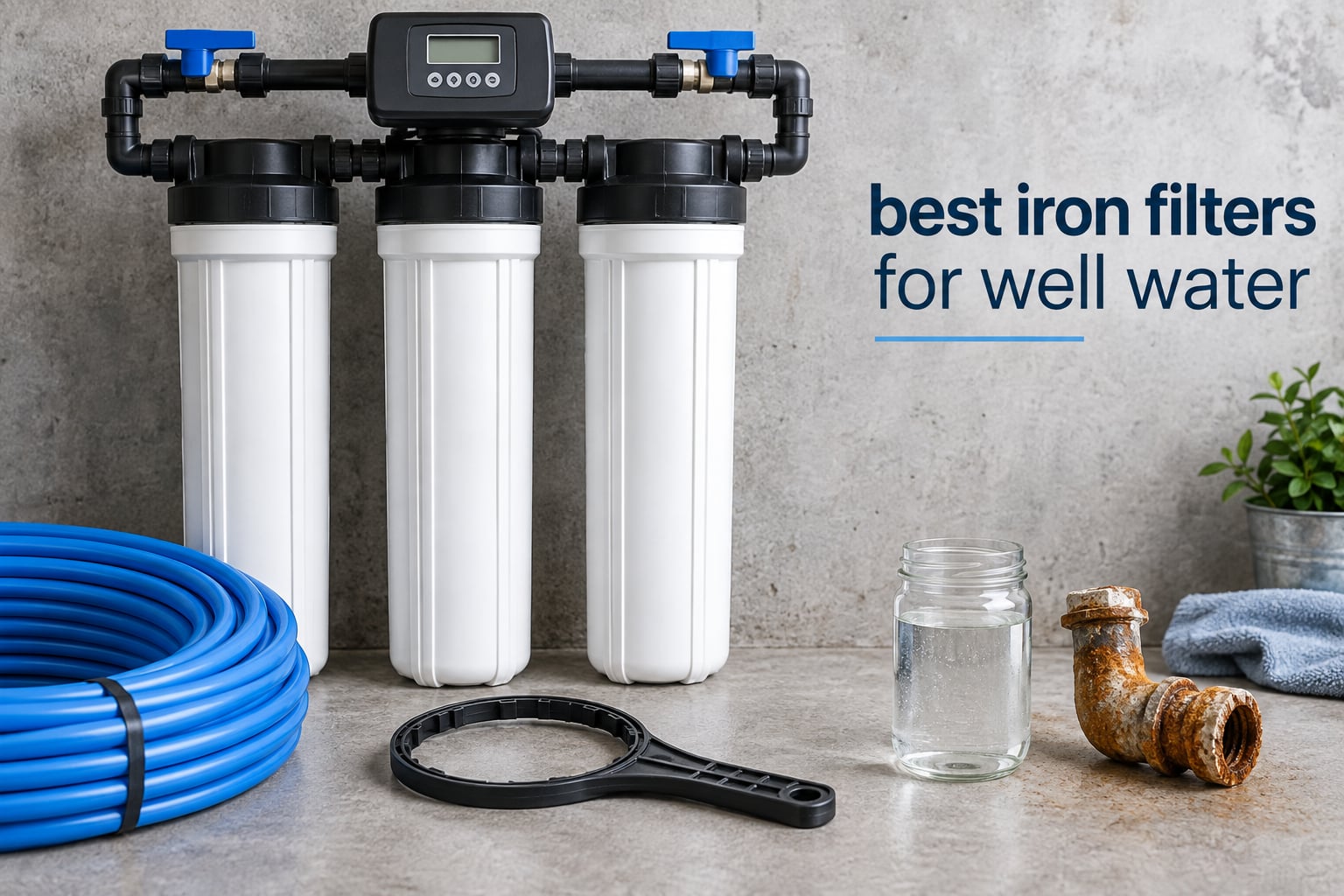
If your well water runs orange in the toilet bowl and leaves rust rings in the tub, you do not need a bigger water softener. You need iron filters for well water sized to the actual iron concentration coming out of your aquifer, and the right technology for the form that iron takes. We spent weeks reading lab specs, owner reviews and installer threads on the ten systems below, and the pattern was clear: most disappointing iron filtration results come from capacity mismatch, not from a bad unit.
The EPA secondary standard for iron is 0.3 ppm. That is an aesthetic limit, not a health limit, so the water is usually safe to drink once treated even though it tastes metallic and stains everything it touches. What makes iron worth removing is what it does downstream: it fouls aerators, water heaters, dishwashers, softener resin and reverse osmosis membranes long before anyone calls a plumber.
Here is our roundup of the best iron filters for well water in 2026, from a two-stage cartridge unit to a salt-free air injection tank rated for severe iron. We have split them by the job they do, because the honest answer to “what is the best whole house iron filter for well water” depends on whether your iron is dissolved, particulate, or bacterial, and on how much your well actually yields.
Table of Contents
What Type of Iron Do You Have?
Iron arrives in three very different forms, and matching the form to the treatment is the single decision that separates a system that works for a decade from one that fails in eighteen months. Here is the framework we use, and the one we suggest you take to your water test.
Ferrous iron (clear-water iron) — dissolved iron in well water that looks clear when you fill a glass. It leaves an orange or rust stain the moment it hits air, which is why a clear sample from the kitchen tap can still stain a toilet. The standard fix is an oxidation filter: air injection oxidation (AIO) with Katalox Light, Filox or Birm media, or chemical-free catalytic media that does the oxidation through the media bed itself.
Ferric iron (red-brown particulate) — already-oxidized iron that shows up as orange-brown flecks, sediment or cloudy water. A backwashing sediment and media filter handles this well. Ferrous iron oxidizes into ferric iron inside an oxidation tank, so most oxidation systems address both forms as long as the tank is big enough for the load.
Iron bacteria — bacteria that consume dissolved iron and produce a slimy orange-black slime in the toilet bowl, staining that reappears within a day or two of cleaning. No media filter will fix this on its own. Iron bacteria needs disinfection — chlorine, hydrogen peroxide, or a UV sterilizer placed ahead of the filtration — plus a shock treatment to strip the biofilm out of the well casing and pipes.
Manganese often travels with iron and stains the same fixtures black. Sulfur, which smells like rotten eggs at low concentrations, needs catalytic carbon or specialized media and is not something a standard iron cartridge will touch.
Top 3 Iron Filters for Well Water (September 2026)
These three cover the widest range of real well conditions: the highest-rated cartridge system, the sturdiest three-stage frame, and the best value per stage.

iSpring WGB21BM
- Two-stage carbon block plus iron and manganese stage
- Iron reduction up to 3.0 ppm
- Up to 15 GPM flow
- 50000 gallon capacity
Express Water 3-Stage
- Three-stage iron and manganese filtration
- Up to 17 GPM flow
- Stainless steel freestanding frame
- Pressure gauges on each stage

iSpring WGB32BM
- Sediment then carbon then iron stage
- Iron reduction up to 3.0 ppm
- 100000 gallon capacity
- 20 inch Big Blue cartridges
Quick Comparison of All 10 Iron Filters
Every pick below, in one place, with the numbers that decide whether it fits your well.
| Product | Specifications | Action |
|---|---|---|
|
iSpring WGB21BM 2-Stage Whole House Filter
|
|
Check Latest Price |
|
Express Water Whole House 3-Stage Iron and Manganese
|
|
Check Latest Price |
|
iSpring WGB32BM Iron and Manganese System
|
|
Check Latest Price |
 iSpring WGB22BM 2-Stage 20 Inch Commercial Grade
|
|
Check Latest Price |
 Pentair Pentek RFFE20-BB Iron Reduction Cartridge
|
|
Check Latest Price |
 AFWFilters Iron Pro 2 Combination Softener and Iron Filter
|
|
Check Latest Price |
 PUREPLUS 1-Stage Whole House Iron and Manganese
|
|
Check Latest Price |
 Fleck 5600 SXT Iron Blaster 48000 Grain Softener
|
|
Check Latest Price |
 Fleck 5600 SXT Air Injection Iron Eater 1.5 cu ft
|
|
Check Latest Price |
 Home Master Whole House Three Stage Fine Sediment Iron Carbon
|
|
Check Latest Price |
1. iSpring WGB21BM – Best Overall Iron Filter for Well Water
iSpring WGB21BM 2-Stage Whole House Water Filtration System, 10” x 4.5” Carbon Block and Iron & Manganese Reducing Filters, 1″ Ports
Two-stage CTO carbon block plus FM15B iron and manganese stage
Iron to 0.01 ppm from 3.0 ppm max
Up to 15 GPM flow
50000 gallon capacity
Pros
- Reduces iron up to 3 ppm and manganese up to 1 ppm to near zero
- Sturdy thick-walled housings
- Pre-assembled bracket and filter wrench included
- Does not reduce TDS
- Responsive support that sends replacement parts
Cons
- NPT fittings can leak if not taped generously
- Bracket may rock and needs leveling
- Cartridges do not screw fully in and leave a gap
- Sediment pre-filtration helps on dirty well water
This is the unit we recommend most often, and the reason is not the spec sheet, it is the review count. Just over 4,270 ratings at 4.6 stars gives you a much clearer picture of long-term behaviour than any other cartridge system here.
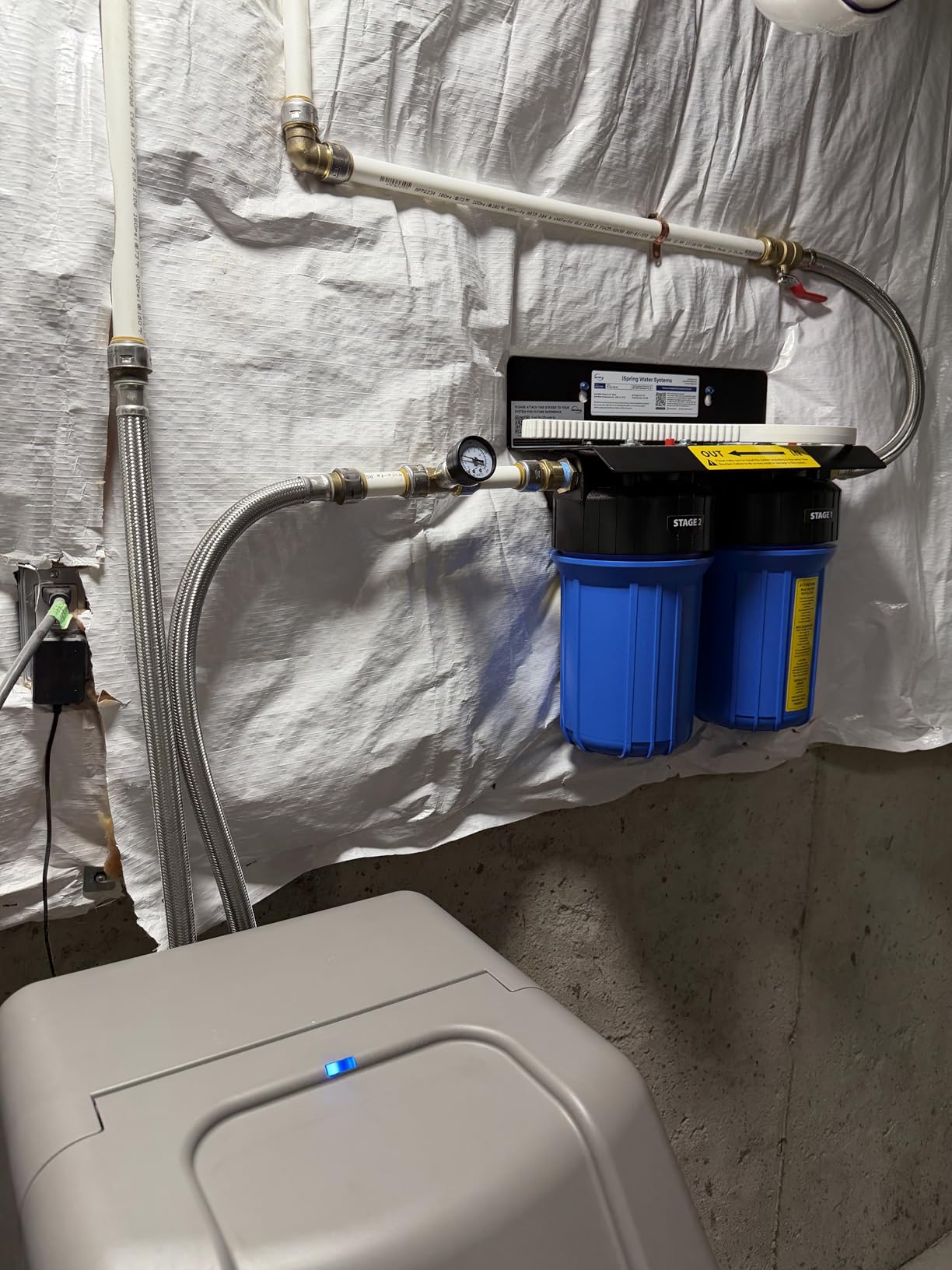
Stage one is a coconut shell carbon block, stage two is an FM15B iron and manganese reducing filter rated to take iron from a maximum of 3.0 ppm down to 0.01 ppm, and manganese from 1.0 ppm to 0.01 ppm. Flow is up to 15 GPM on 1 inch NPT ports in 10 by 4.5 inch housings.
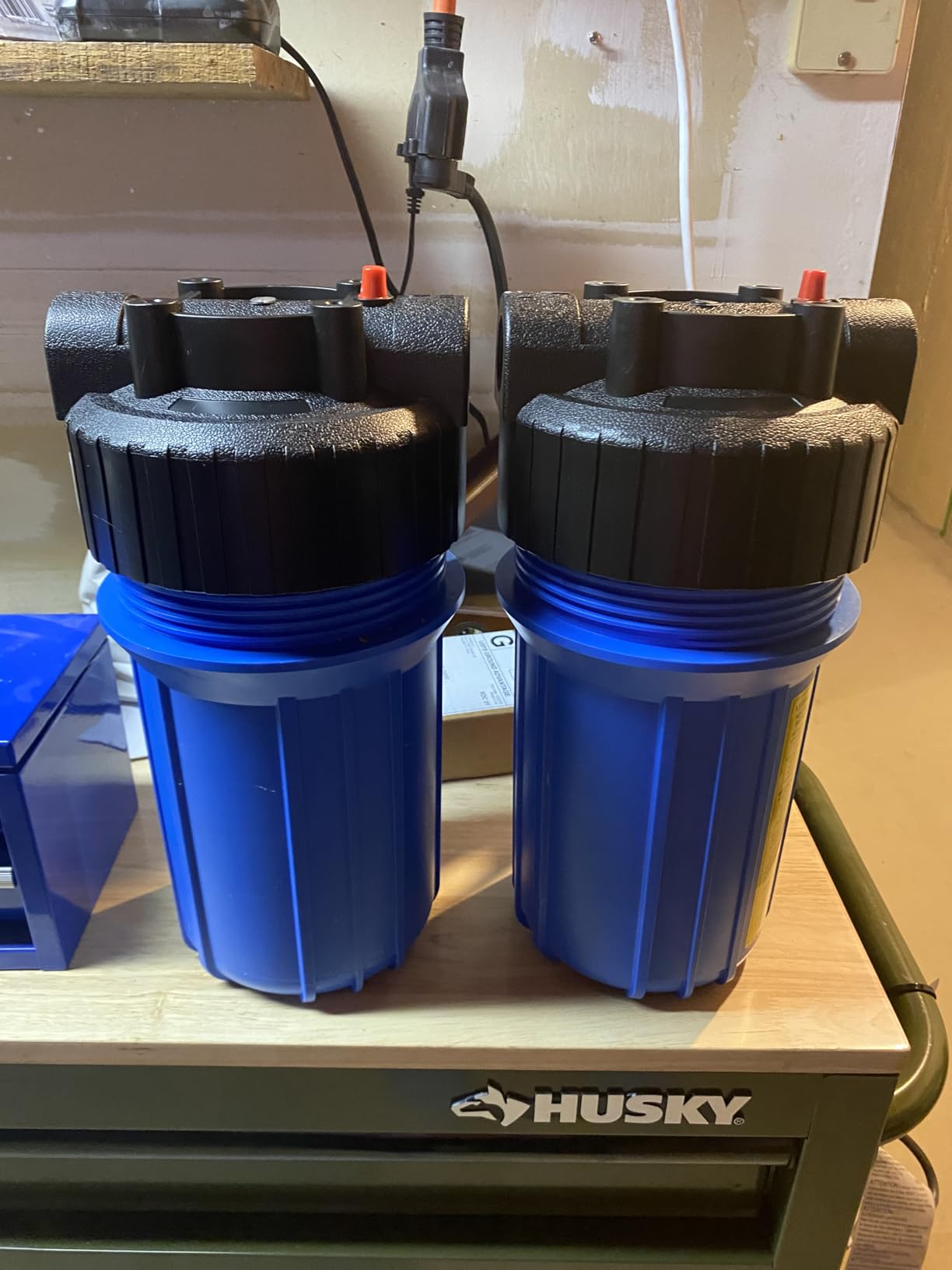
Owners consistently report the staining problem disappearing within a few weeks of the swap, and the metallic taste going with it. The support team sends replacement parts rather than telling you to buy a new unit, which matters a lot on a system with plastic threads.
What you should check before buying
Get your iron number first. This stage is rated to 3 ppm, and the single most common regret we read about involves wells running 5 to 7 ppm being sold a 3 ppm cartridge. The media cannot be pushed past its rating and the result is water that still stains.
Budget for a sediment pre-filter upstream. A dirty well feeding a fine carbon block is the fast route to a pressure drop that looks like a bad system when it is really a plugged stage.
Where it falls short
The 1 inch NPT plastic fittings are the recurring complaint across reviews, and they leak if overtightened or under-taped. Plan on PTFE tape and a drip pan under the housing for the first hour after install.
It also is a 50,000 gallon system in 10 inch housings, which means more frequent cartridge changes than the 20 inch models later in this list. If you can handle a heavier cartridge once or twice a year, the 20 inch units hold three times the water in the same floor space.
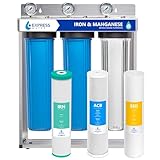
2. Express Water 3-Stage – Best Sturdy Whole House Iron Filter
Express Water Whole House Water Filter System, Iron & Manganese, 3-Stage
Three-stage whole house iron and manganese filtration
Up to 17 GPM flow
100000 gallon total capacity
20 to 80 PSI operating range
Pros
- Stainless steel freestanding frame is more rigid than plastic brackets
- Built-in pressure gauges and release buttons
- Targets reddish-brown staining on fixtures and laundry
- Protects pipes and appliances from silt
Cons
- Cartridges need replacing every 6 to 12 months
- Does not reduce TDS
- Freestanding frame needs more vertical space
If your well pump space is tight, awkward or unfinished, the rigid stainless frame on this Express Water system is the reason to choose it. Plastic bracket assemblies flex, and flex is what turns a threaded plastic joint into a leak.
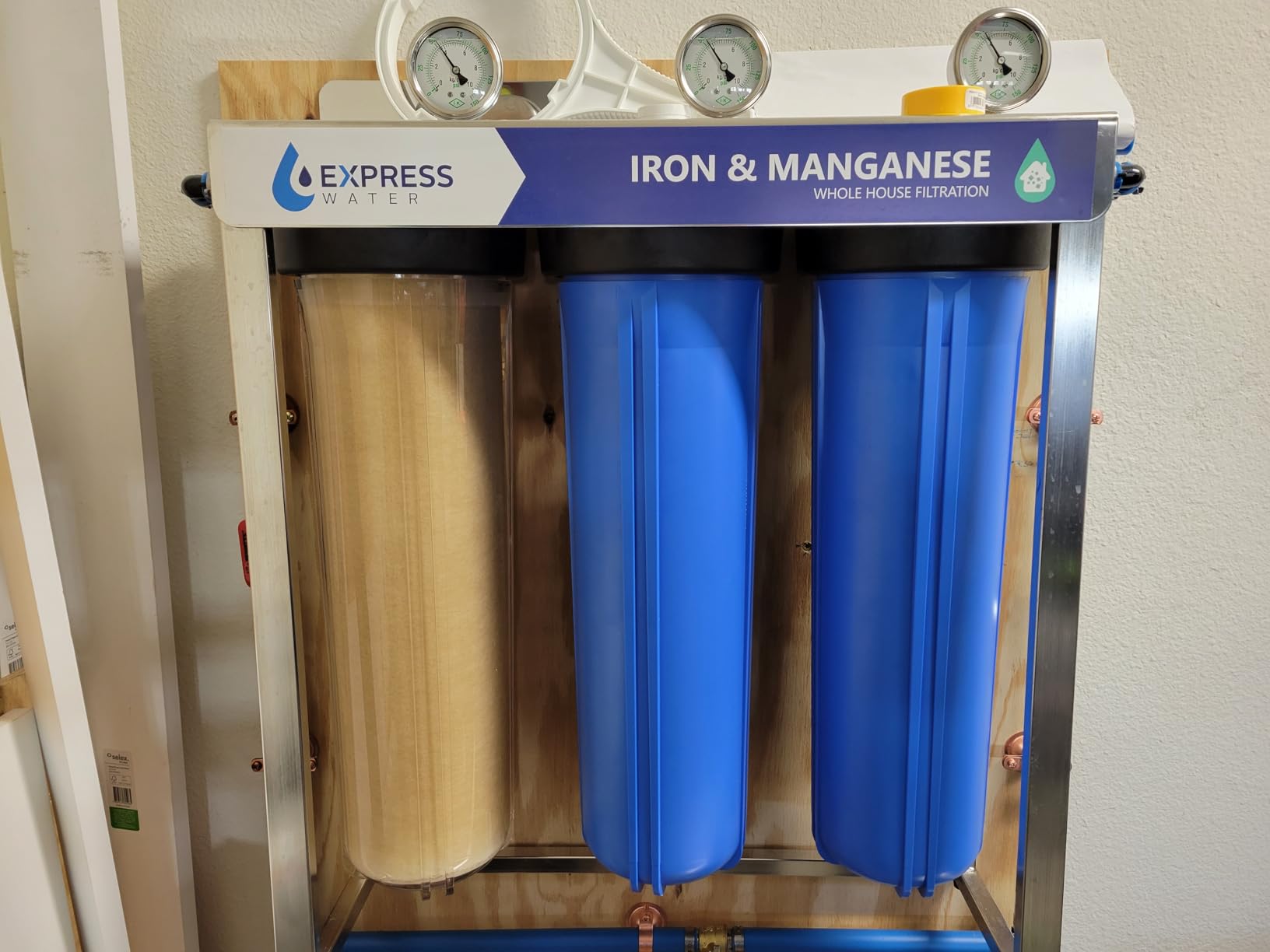
Three stages, up to 17 GPM at 0.25 gallons per second between 45 and 80 PSI, and 100,000 gallons of total capacity with the first three filters rated at 6 to 12 months each. Pressure gauges on the assembly let you watch for loading, and the release buttons make cartridge swaps faster.
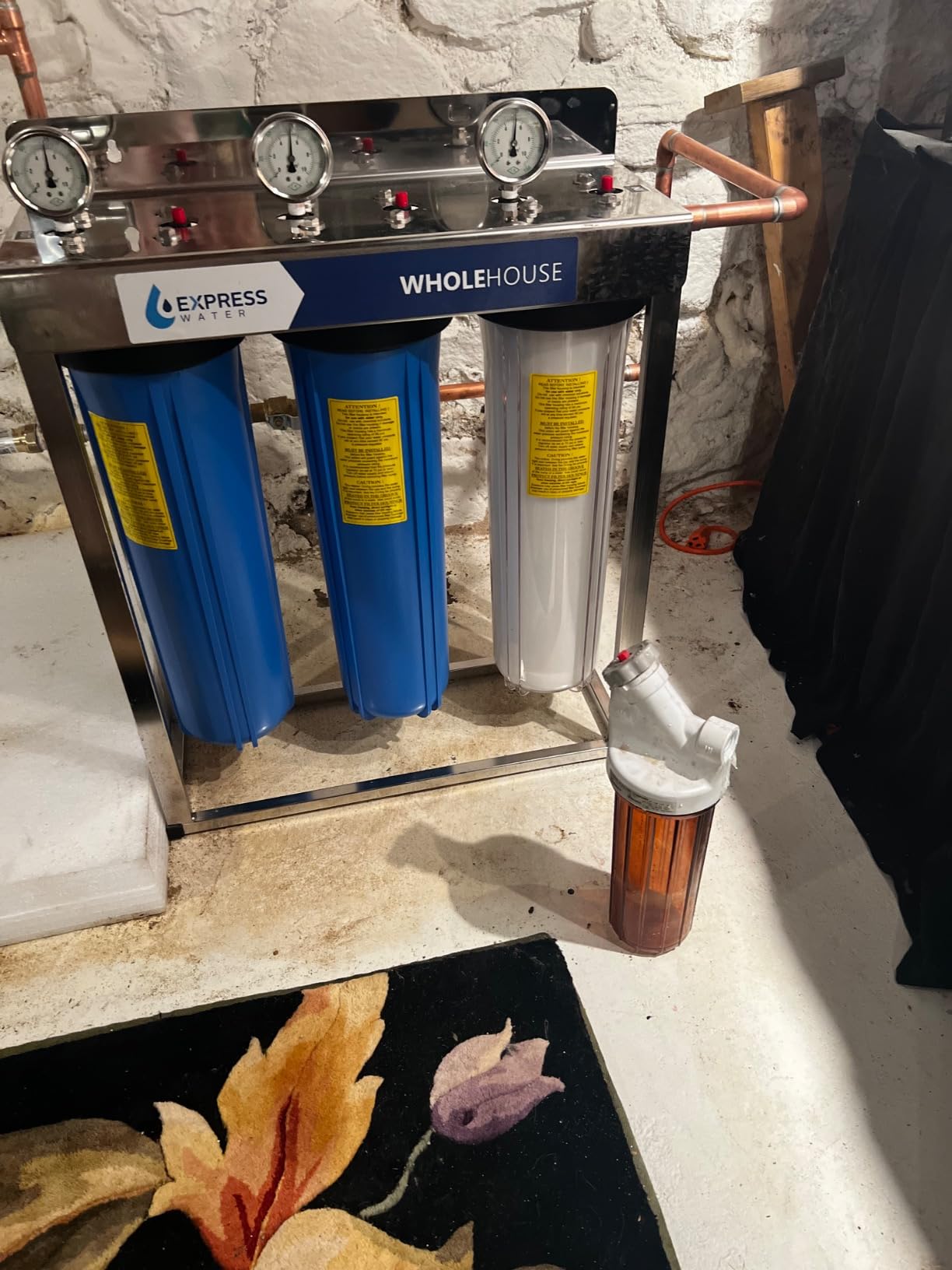
Buyers credit it with clearer water across the whole house and fewer rust marks in the dishwasher. The replacement cartridges are NSF certified and widely stocked, which matters for a system you will keep for a decade.
What you should check before buying
Measure the vertical clearance. The assembly stands 29.25 inches tall and 23.5 inches wide, so it needs a real floor or wall footprint rather than a small wall bracket behind a water heater.
It works in a 20 to 80 PSI band, so if your well pressure tank is set very high or very low, check the numbers before the day of install.
Where it falls short
The maintenance cadence is the honest drawback. Cartridges every 6 to 12 months across three stages is a recurring cost that never stops, and users on forum threads say that is what eventually pushes them toward a salt-free media tank.
Like most cartridge systems in this roundup, it does not reduce dissolved solids. If your goal is lower TDS, that is a different problem needing a different technology.
3. iSpring WGB32BM – Top Rated Three-Stage Iron Filter
iSpring WGB32BM Iron, Manganese Whole House Water Filter System
Sediment then carbon block then FM25B iron and manganese
Iron 3.0 ppm max and manganese 1.0 ppm max
100000 gallon capacity
Up to 15 GPM
Pros
- Three stages cover more contaminant types than two-stage units
- Catalytic iron media lasts up to three times longer than greensand
- Owners report clear odor-free water and no more orange toilet stains
- Knowledgeable US-based technical support
Cons
- 20 inch cartridges are heavy and wet to change
- Plastic 1 inch NPT threads cross-thread easily
- Instructions are vague on housing torque
- Stage order matters and is not obvious in the manual
This is the one we suggest when someone wants a complete sediment, carbon and iron package in a single bracket without moving up to a tank system. The sediment stage at the front is the piece most two-stage units leave out, and it is the piece that keeps the iron stage from choking on well sediment.
It runs in a 25 to 80 PSI window, handles up to 15 GPM, and uses 20 by 4.5 inch Big Blue cartridges with 1 inch NPT connections. Each cartridge arrives individually wrapped for freshness, and that wrapper has to come off before install.
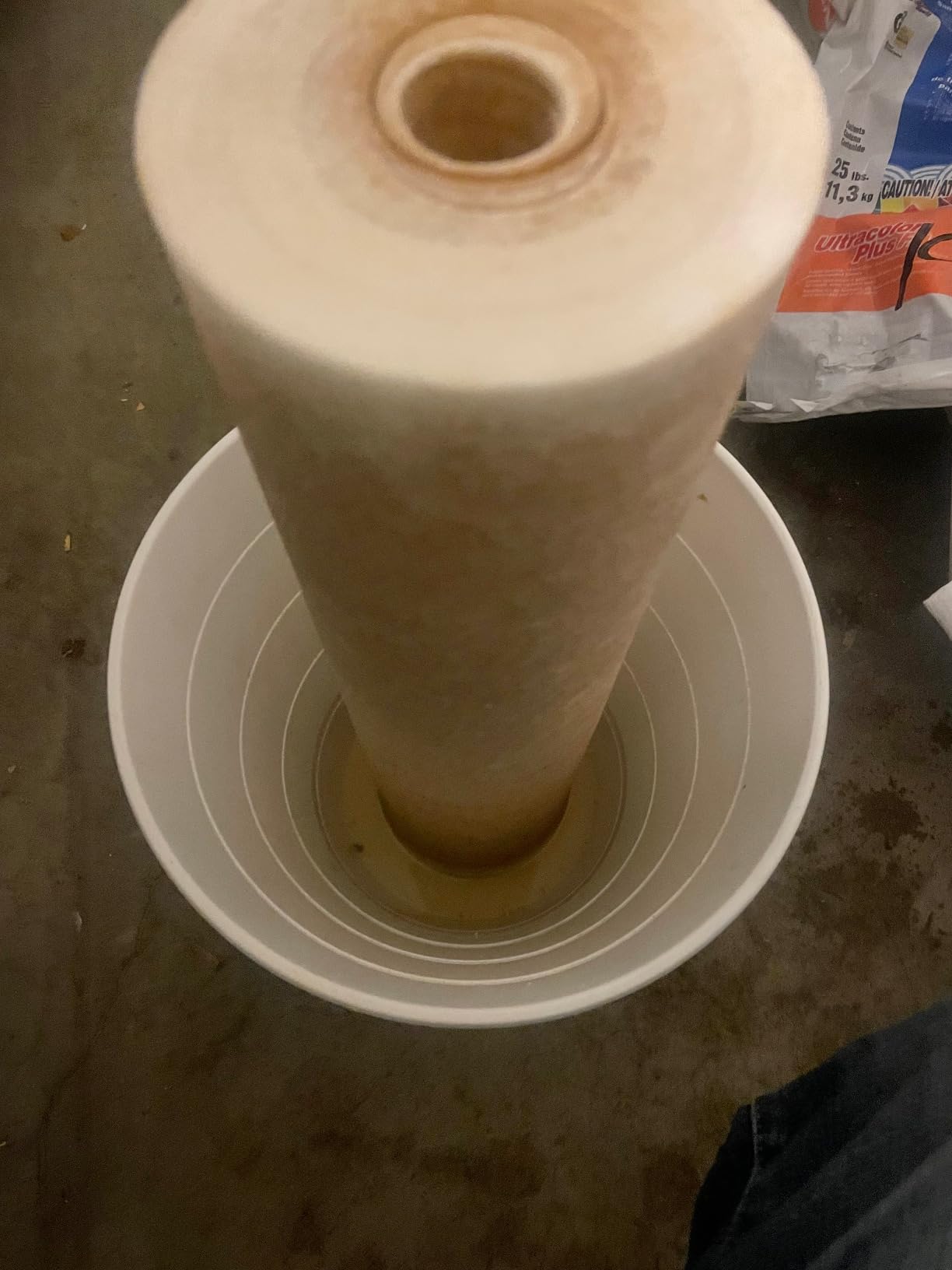
Long-term owners report the system still doing its job years in with no meaningful pressure drop. The catalytic iron media is the reason: it is not consumed the way greensand is, which is why the manufacturer claims up to three times the service life of a greensand equivalent.
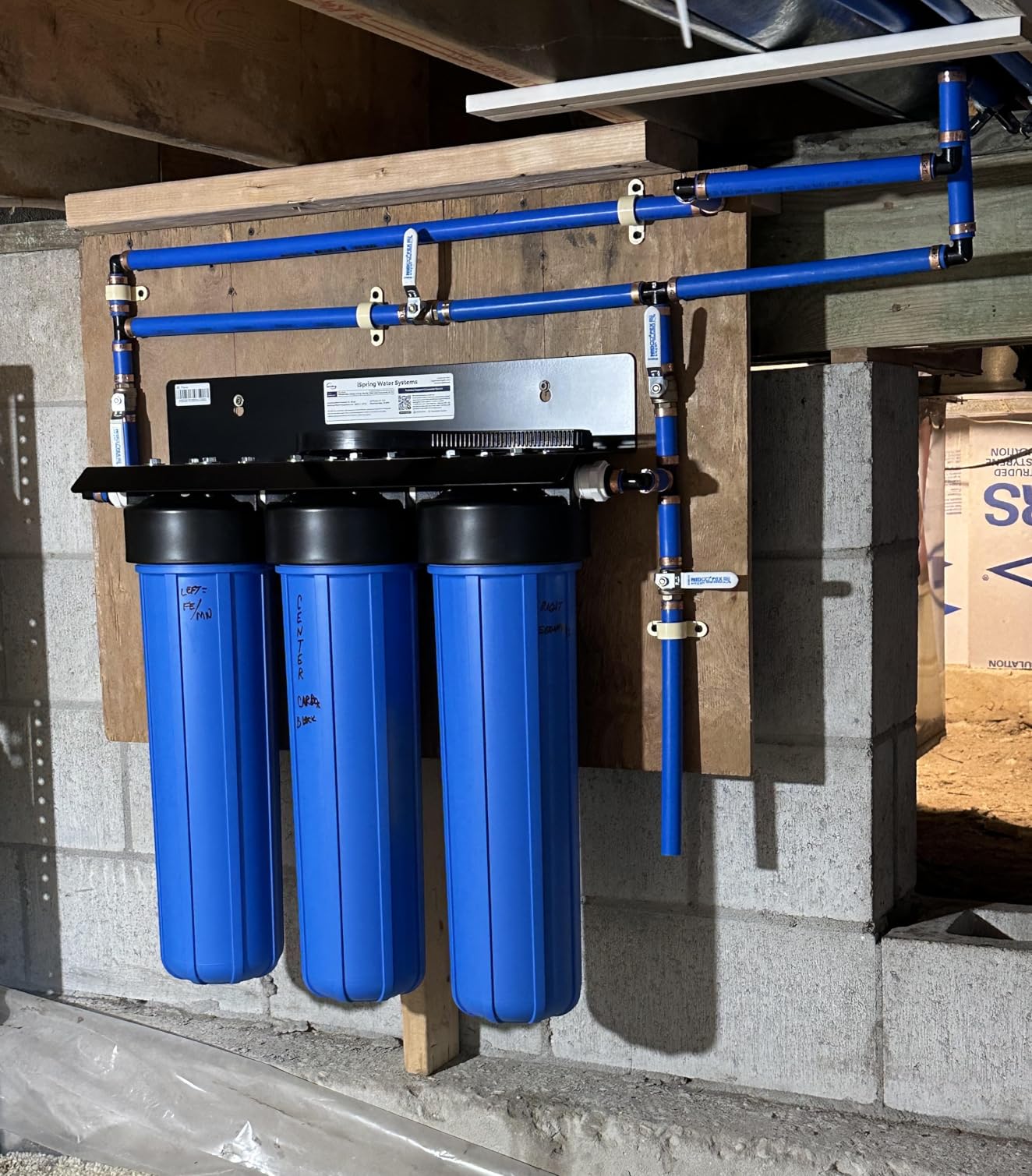
What you should check before buying
Confirm the stage order on install. Sediment goes first, carbon second, iron third. Get this wrong and the iron stage feeds on the debris the sediment stage was supposed to catch.
If you have ever cross-threaded a plastic 1 inch NPT port, know that this housing uses them heavily. A good wrap of PTFE tape on every joint is not optional here.
Where it falls short
The 20 inch cartridges are genuinely heavy and awkward when wet, and the reviews repeatedly recommend a workbench and drip pan for changes. Budget ten minutes and a towel rack of patience for each swap.
The manual is vague on how tightly to torque the housings, which is a common source of the initial leaks buyers report. Tighten snug, not hard.
4. iSpring WGB22BM – Best for Chlorine, Taste and Odor
iSpring Iron, Mangaese Whole House Water Filter System Also Eliminates Chlorine, Taste, and Odor, 2-Stage Commercial-Grade 20″ x 4.5″ Industry Standard-Sized Filters, 1″ Inlet/Outlet, Model: WGB22BM
CTO coconut shell carbon block plus FM25B iron and manganese
Iron 3.0 ppm and manganese 1.0 ppm max
Chlorine reduction up to 99 percent
Up to 15 GPM
Pros
- Commercial grade 20 inch housings give longer filter life
- Two stages handle iron plus chlorine taste and odor
- 15 GPM with minimal impact on pressure
- Manufacturer points higher iron wells to dedicated models
Cons
- Cartridges must be unwrapped before use and this step is easy to miss
- Rated to 3 ppm iron only
- Does not lower TDS
Two stages does it take to cover both iron and the chlorine taste that shows up in well water after shock treatment. The coconut shell CTO carbon block reduces up to 99 percent of chlorine while the FM25B handles iron and manganese.
It is a DIY install on a metal bracket with 20 by 4.5 inch industry standard cartridges, rated for 25 to 80 PSI, up to 15 GPM and 100,000 gallons. The 500 ppm TDS ceiling matters if you are pairing it downstream of a softener.
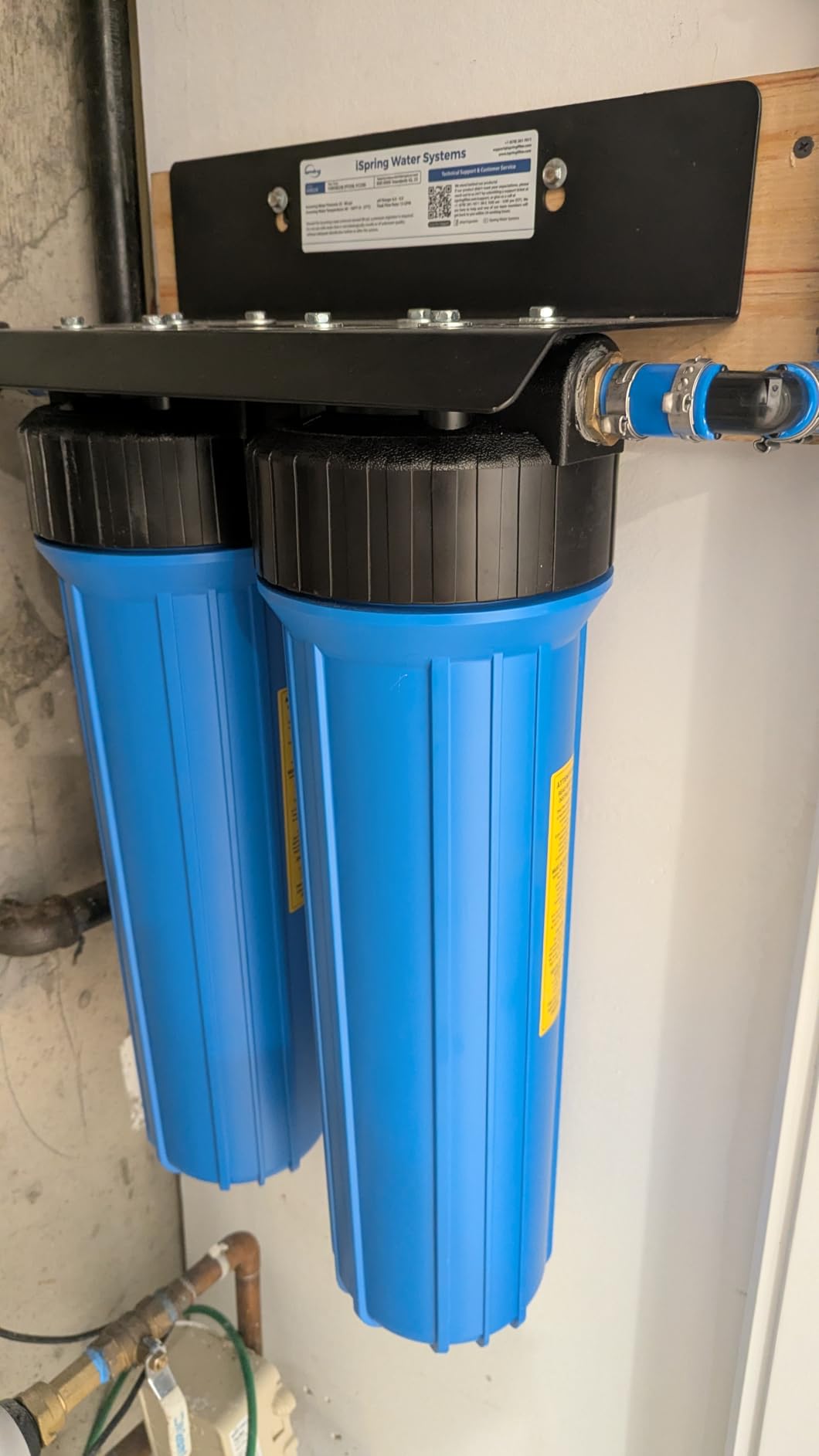
Owners point out the build quality of the metal bracket and the housings, and report that metallic taste, chlorine odor and orange staining all improve at once. That three-problem improvement is the reason to pick it over a pure iron cartridge.
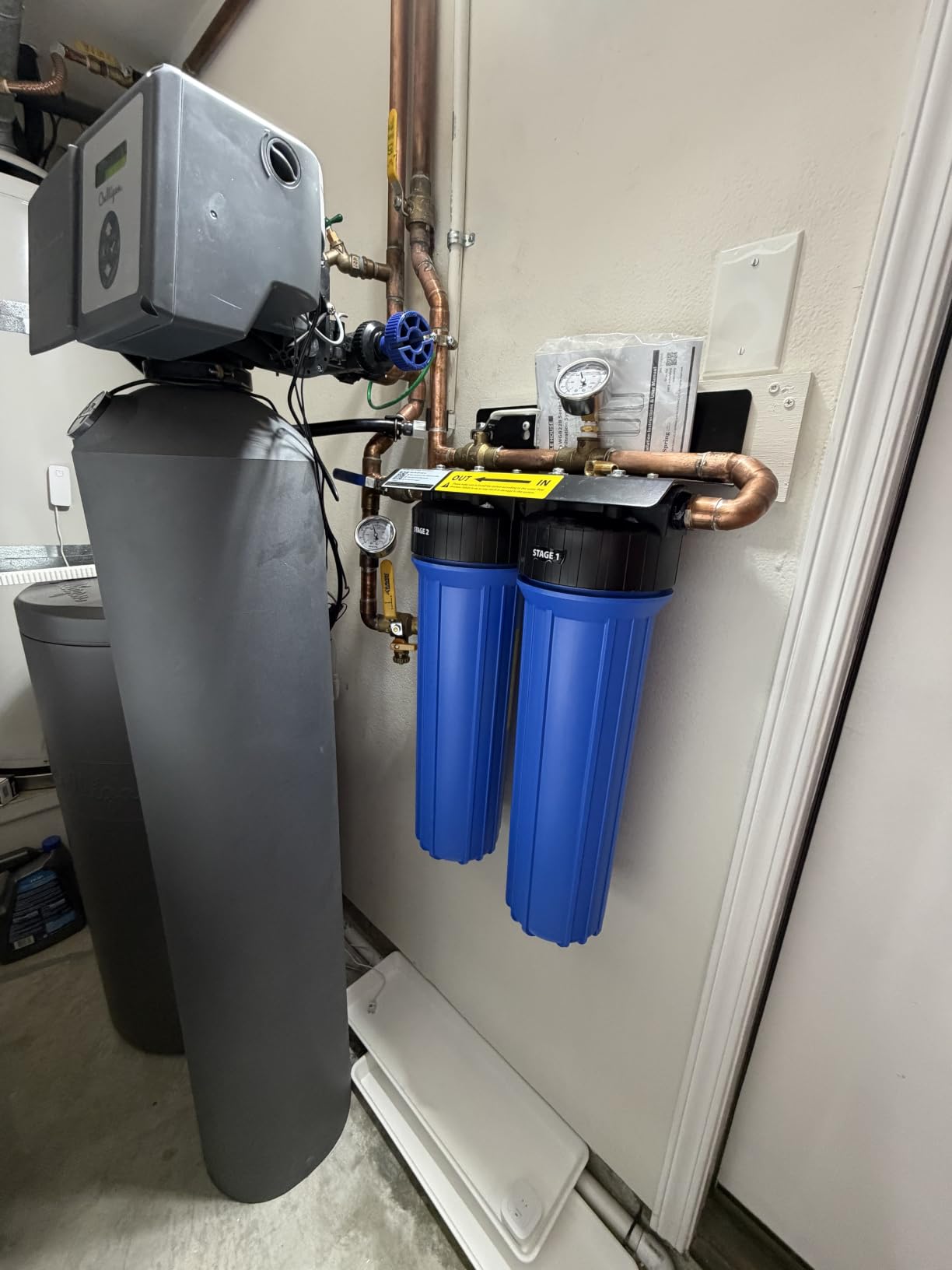
What you should check before buying
Read the stated limit before you order. The system is designed for iron and manganese up to 3 ppm, and owners with heavier well water are steered toward the manufacturer’s dedicated higher-capacity models rather than being sold a bigger promise.
Unwrap every cartridge before you install it. Individually wrapped cartridges that go in still wrapped will not flow, and this is a well-known first-week stumble.
Where it falls short
No sediment stage. On a well with heavy particulate, put a dedicated sediment filter in front of this bracket or you will be changing carbon blocks on a schedule you did not plan for.
It preserves dissolved minerals by design, which is a feature for anyone who wants healthy minerals retained but rules it out as a TDS reduction solution.
5. Pentek RFFE20-BB – Best Iron Cartridge for DIY Stack Builders
Pentair Pentek RFFE20-BB Big Blue Water Filter, 20-Inch, Whole House Radial Flow Iron Reduction Replacement Cartridge, 20″ x 4.5″, White
Radial flow iron reduction cartridge for 20 inch Big Blue housings
Reduces up to 3 ppm dissolved iron
About 26000 gallon capacity at 3 ppm
NSF certified manganese activated zeolite
Pros
- Fits any 20 inch Big Blue housing
- Reduces up to 3 ppm dissolved iron and metallic taste
- Helps reduce orange and brown staining
- No added chemicals and safe for drinking water
- Lasts longer at lower iron levels
Cons
- About 3 to 4 months of life for a family of four at 3 ppm
- Does not remove manganese or chlorine on its own
- Cartridge only and needs an existing housing
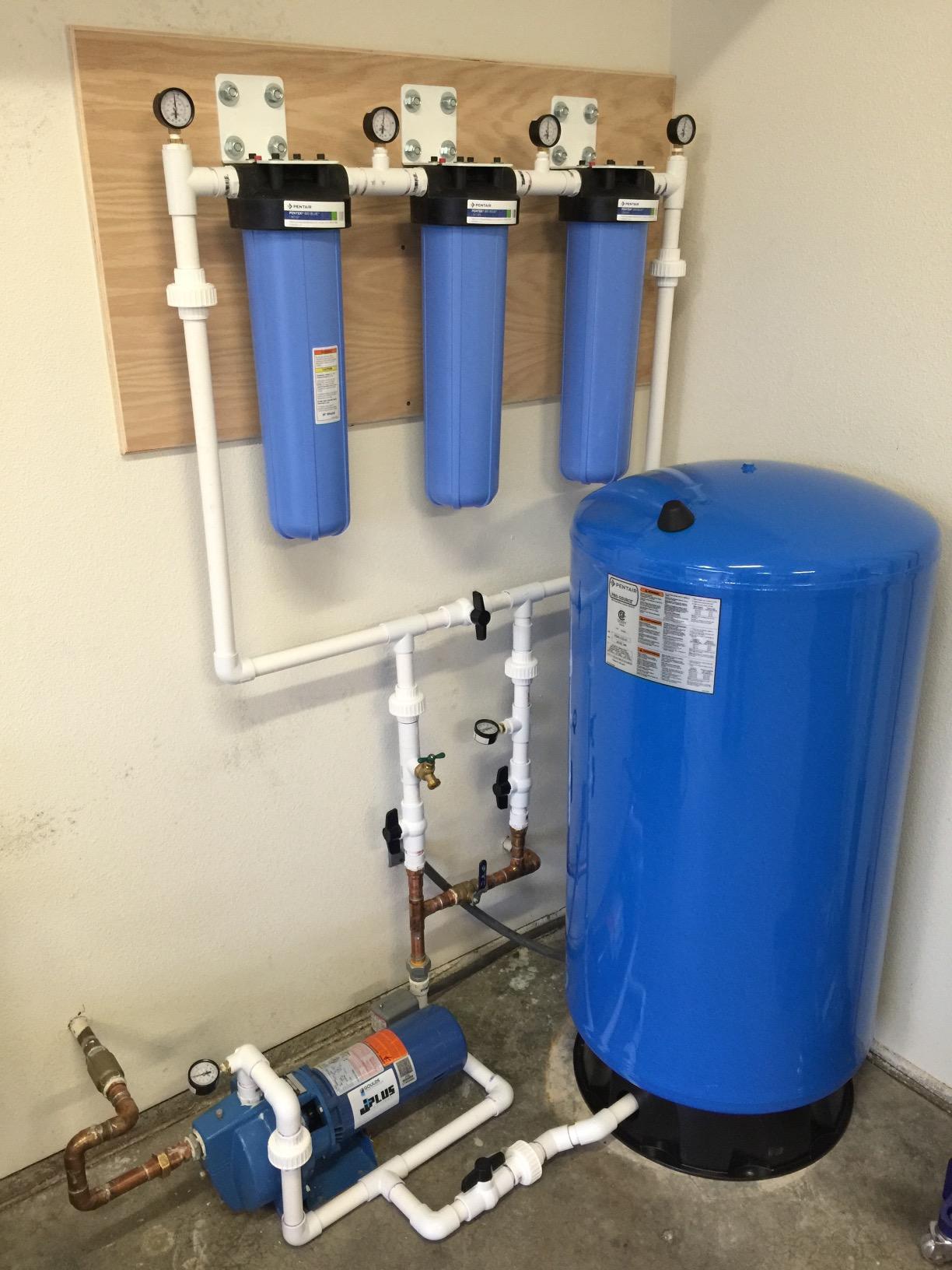
This is a cartridge, not a system, and that framing decides whether it belongs in your house. Forum DIY builders routinely assemble their own stack from a spin-down, a sediment cartridge, this iron cartridge and a polishing filter, and this is the iron stage in that chain.
It is manganese activated zeolite media, NSF certified, sized 20 by 4.5 inches for standard Big Blue housings, and rated to about 26,000 gallons of capacity at 3 ppm iron. Install it on the main cold line after the pressure tank or meter.
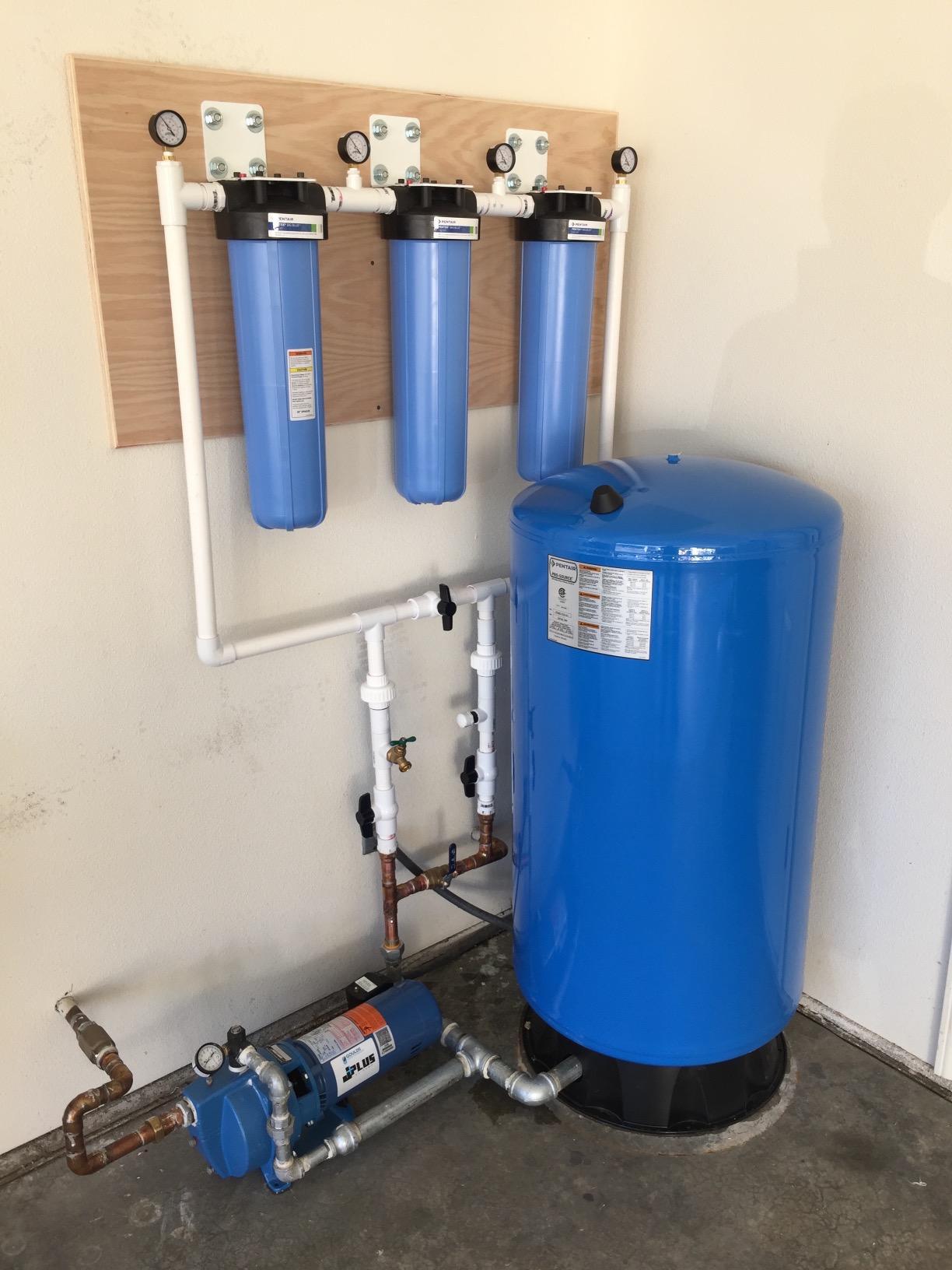
Owners using it inside existing housings report reduced metallic taste and fewer stains on sinks and toilets. The pairing advice in the reviews matches ours: a sediment pre-filter and a carbon post-filter turn this from a partial fix into a complete stage.
What you should check before buying
Do the math on replacement frequency. At 3 ppm iron, roughly 26,000 gallons works out to about three to four months for a family of four, and the cartridge lasts considerably longer at lower iron levels.
Confirm you already have a 20 inch Big Blue housing. This is a cartridge only, and buying it without a housing means owning a very expensive tube of media.
Where it falls short
It does not touch manganese or chlorine on its own, so on its own it is never the whole answer. It needs neighbours upstream and downstream.
It is also the least hands-off option here. There is no backwash, so the cost shows up as a trip to the hardware store several times a year rather than as a drain line.
6. AFWFilters Iron Pro 2 – Best Iron and Hard Water Combination
AFWFilters Iron Pro 2 Combination Water Softener Iron Filter Fleck 5600SXT Digital Metered Valve 64,000 Grain – High Flow for Whole House Use – Removes Hardness, Iron, Manganese, Sediment, Rust
Fleck 5600SXT digital metered valve
Iron up to 6 ppm and manganese up to 6 ppm
64000 grain softening capacity
5 year warranty
Pros
- Softener and iron filter in one tank
- Handles iron to 6 ppm and manganese to 6 ppm
- Owners report clear water and no rotten egg smell
- Proven widely serviced Fleck control head
- Less than a regional contractor quote
Cons
- Resin tank arrives very heavy and needs a dolly
- Programming instructions are incomplete
- Not a cure for high TDS
- A separate sediment pre-filter is advisable
Most homes that fight iron also fight hardness, and this unit puts both in one tank. That is a genuine space and cost saving, and it is the only pick here rated to 6 ppm of iron in a unit you can install yourself.
You get a Fleck 5600SXT digital metered control valve, 64,000 grain of softening capacity, iron removal to 6 ppm and manganese to 6 ppm, all on a high-flow whole house design under a 5 year warranty.
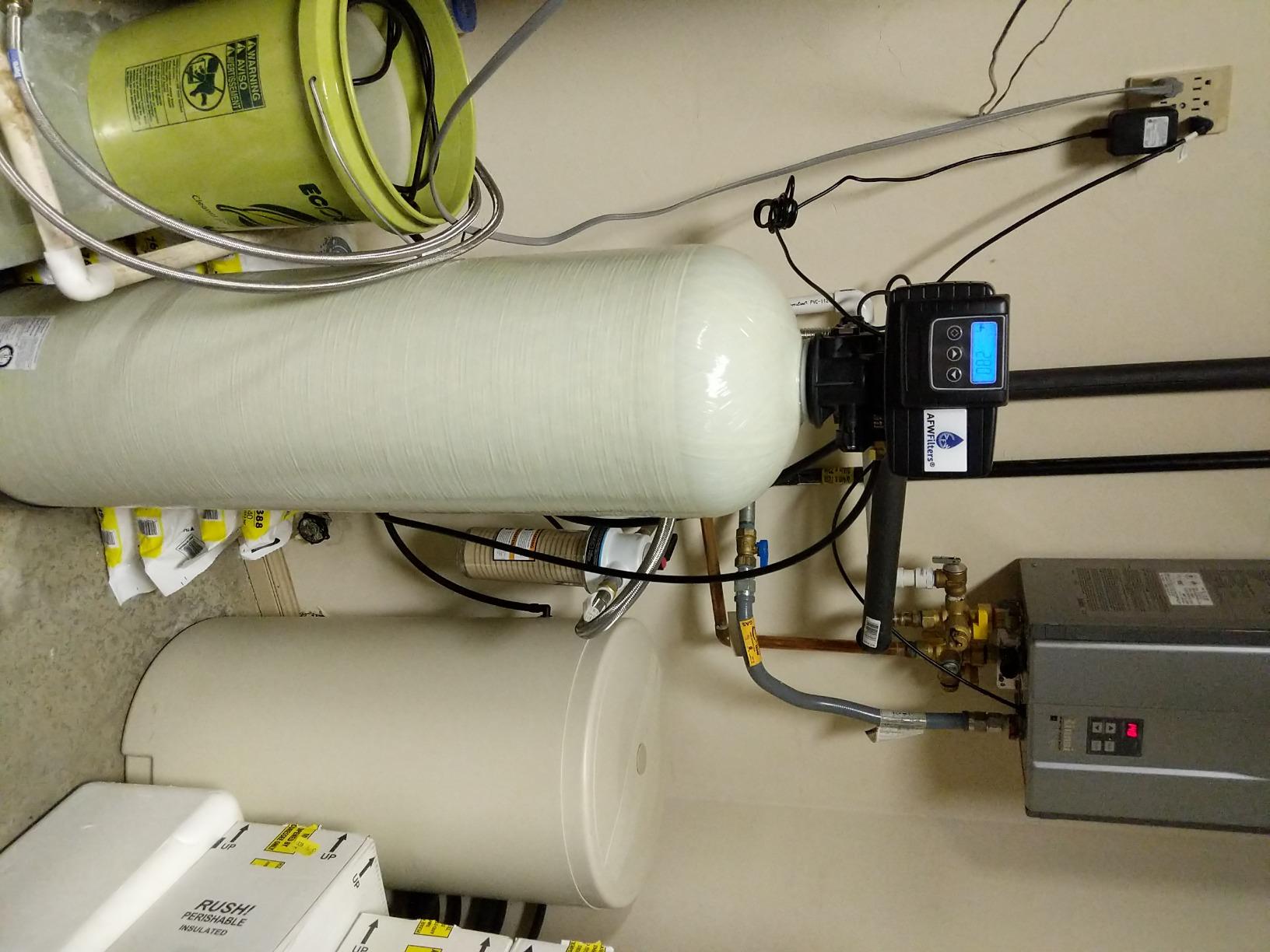
Owners on heavy well iron report dramatic before-and-after results, with test readings dropping from untreated levels to near zero and red stains not returning over weeks. The Fleck head is a big part of why: it is the most widely serviced control valve on the market, and parts are available everywhere.
What you should check before buying
Think hard about salt. A combination unit softens, so you are buying salt and a brine tank you do not otherwise need. Owners who only wanted iron removal often come away happy with the result and surprised by the running cost.
Plan the move. At 119 pounds, the resin tank needs a dolly or a second pair of hands to get through a basement doorway or up a set of stairs.
Where it falls short
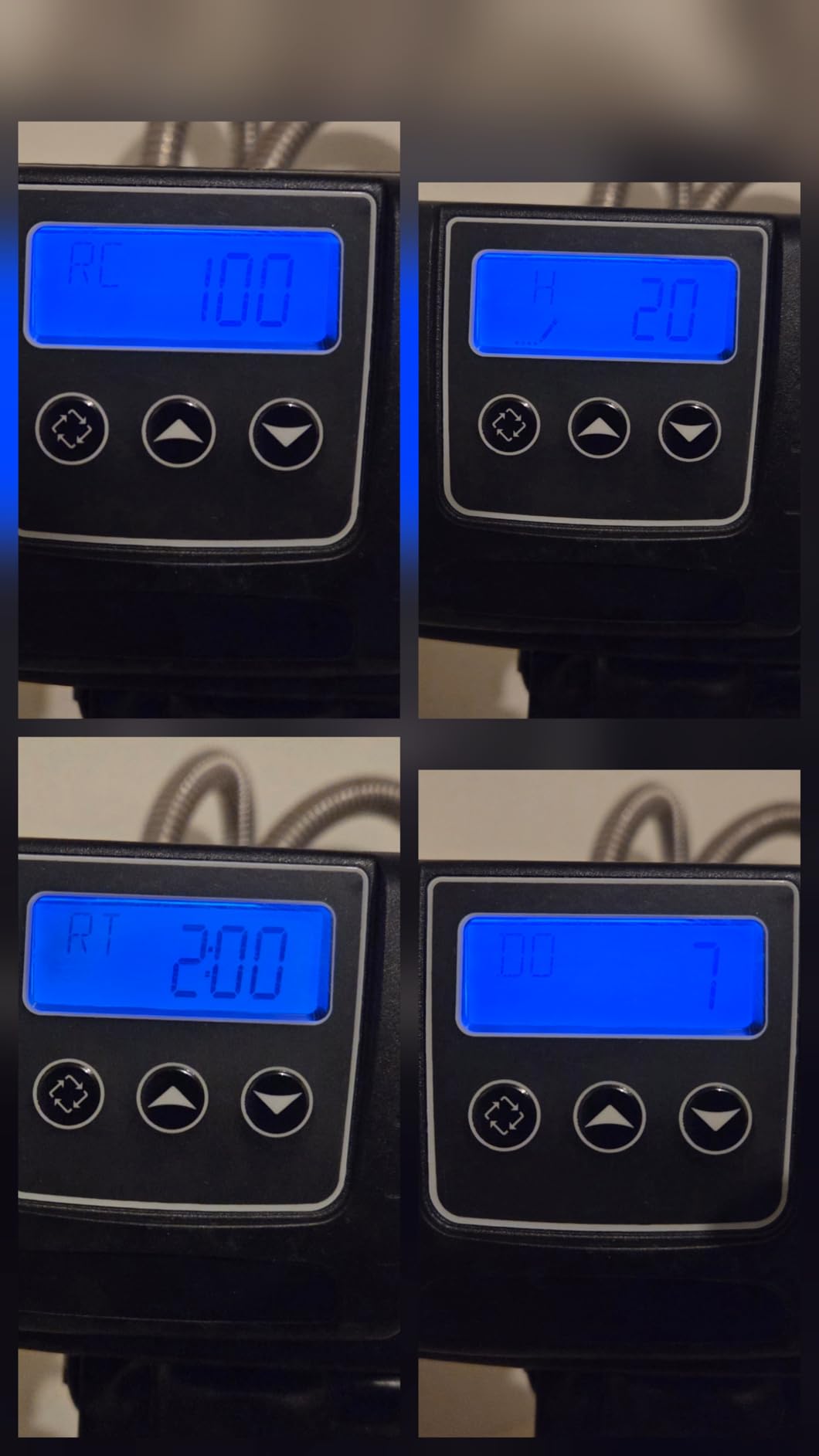
The programming instructions have gaps, and reaching the advanced settings on the Fleck 5600SXT requires setting the clock to 12:01. Budget an evening with the manual and a phone manual of your own.
It does not reduce dissolved solids. One reviewer on very hard water still measured high TDS after install, which is the honest boundary of what a softener does.
7. PUREPLUS 1-Stage – Budget Iron Filter for Light Duty Wells
PUREPLUS 1-Stage Whole House Water Filter System, Iron & Manganese Reduce
Single stage PPW10BB-SZ sediment and iron cartridge
Food grade polypropylene housing with brass threads
Reduces up to 99 percent of sand silt rust and scale
Steel bracket wrench and pressure gauge included
Pros
- Lowest entry point in this category
- Clear housing shows sediment loading
- Double O-rings and brass threads resist leaks
- Universal 10 inch housing accepts several cartridge types
- Visible brown buildup confirms the filter is working
Cons
- Single stage does not address chlorine taste or odor
- O-rings are not a standard size and are hard to source
- A few reports of housings bursting or leaking
- Some listings arrive as housing only
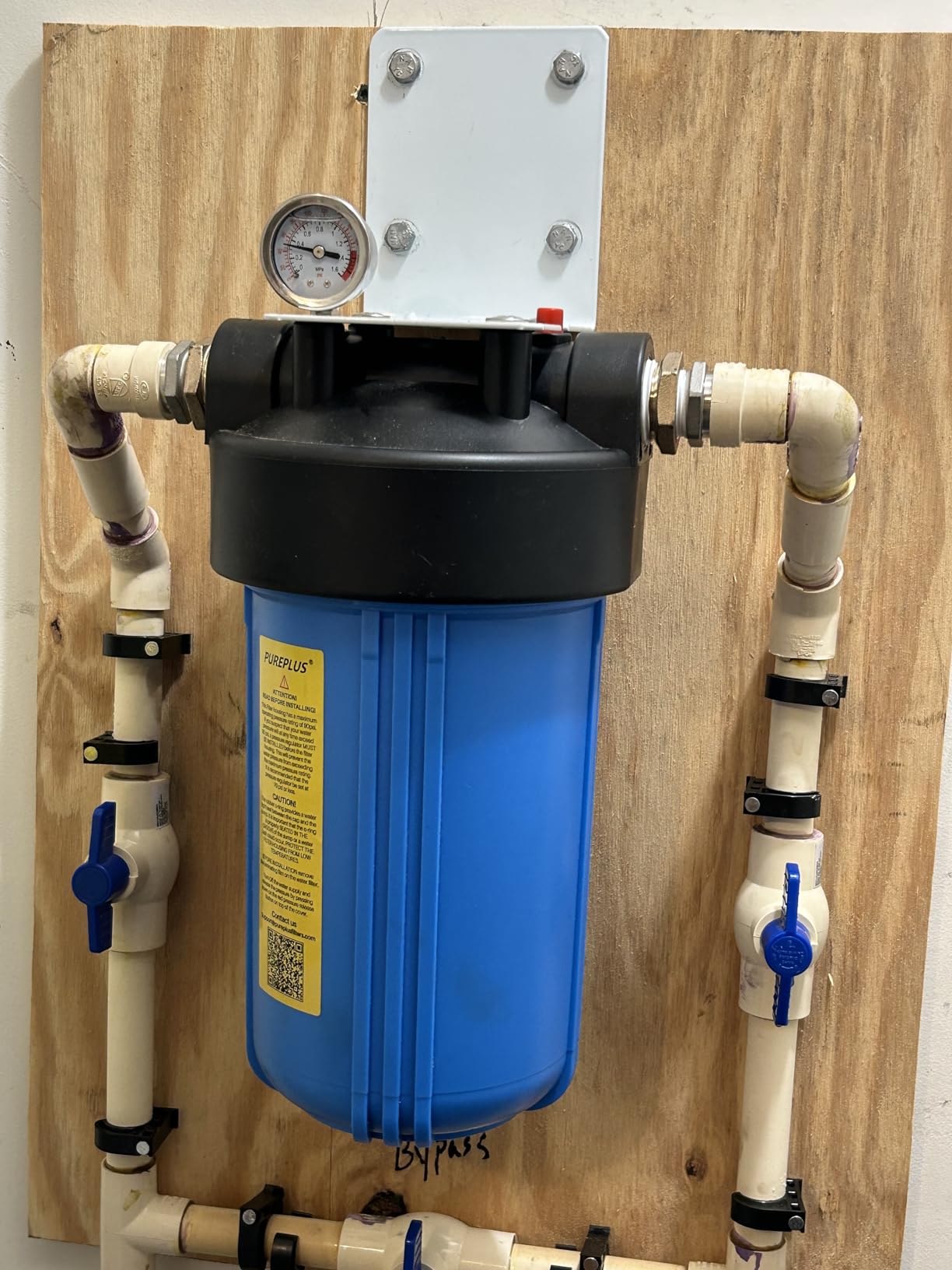
This is the entry point, not the answer to a severe iron problem. It works well as a first stage on a well with light sediment and a bit of iron, and the clear bowl lets you see the media loading without pulling the housing apart.
Inside is a PPW10BB-SZ compound sediment and iron reduction cartridge rated to cut up to 99 percent of sand, silt, rust, dirt and scale. The housing is food grade polypropylene with a brass threaded junction and a pressure gauge, and it accepts several common 10 by 4.5 inch cartridge types.
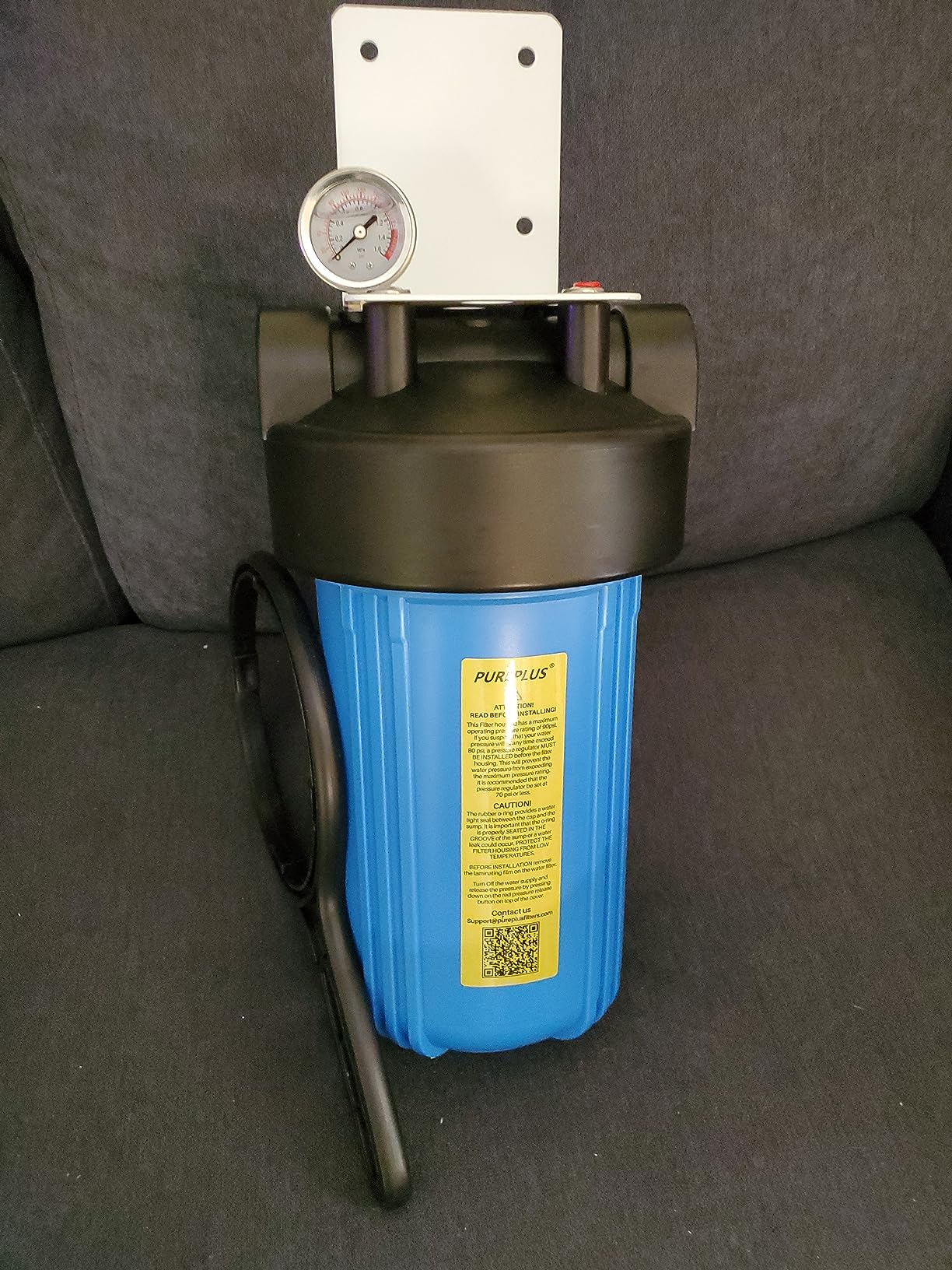
The bracket is heavier than the housing needs, and that is a good thing on a well pump pad. Many positive reviews treat it as a general purpose well water filter rather than a dedicated iron system, which is the right way to think about it.
What you should check before buying
Know your iron number. A single sediment and iron stage like this is not sized for a well running 5 ppm or more, and pairing it with a softener behind it will simply move the problem downstream.
Verify the box contents on arrival. Some listings arrive as the housing without the advertised cartridge, and finding that out on install day is a wasted trip to the plumbing section.
Where it falls short
It is the lowest rated pick in this roundup, and the 13 percent share of one-star reviews reflects that. Burst housings and stubborn fittings are the recurring themes, and the non-standard O-rings are genuinely hard to replace.
One stage means no chlorine, taste or odor control. Use liquid thread sealer rather than plain PTFE tape on these fittings if you want to avoid a wet floor.
8. Fleck 5600 SXT Iron Blaster – Best Softener for Hard Water Owners
DURAWATER Fleck 5600 SXT Iron Blaster 48,000 Grain Water Softener
Fleck 5600 SXT digital metered valve
48000 grain capacity with fine mesh iron-rated resin
10 x 54 inch tank preloaded with resin
60 month warranty
Pros
- Fine mesh resin handles high iron better than standard resin
- Metered regeneration cuts salt consumption
- Tank arrives preloaded with resin
- Owners report years of service with no rust staining
- Large brine tank holds about 250 pounds of salt
Cons
- Primarily a softener so it often needs an iron filter ahead of it
- Uses a meaningful amount of salt per regeneration
- Connector hoses are not included
- Warranty service can involve a runaround
Be clear about what this is: a softener with iron-tolerant resin, not an iron filter. For a house whose main problem is hardness and whose iron is moderate, that is exactly the right tool.
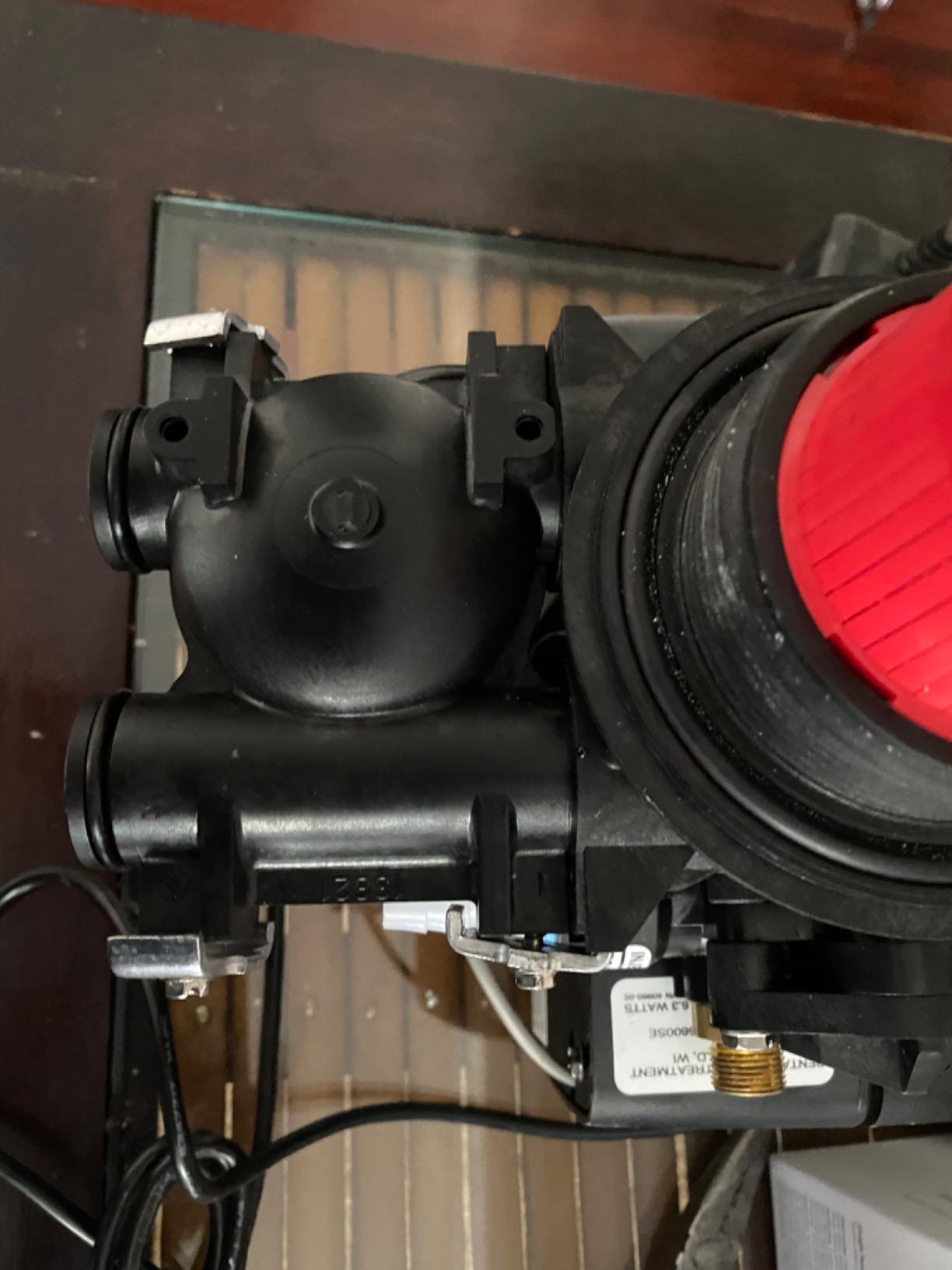
It pairs a Fleck 5600 SXT digital metered valve with 48,000 grain of capacity in a 10 by 54 inch mineral tank, using upgraded fine mesh resin tuned for well water with higher iron. The brine tank is 14 inch square with a safety float, holds about 250 pounds of salt, and the warranty runs 60 months.
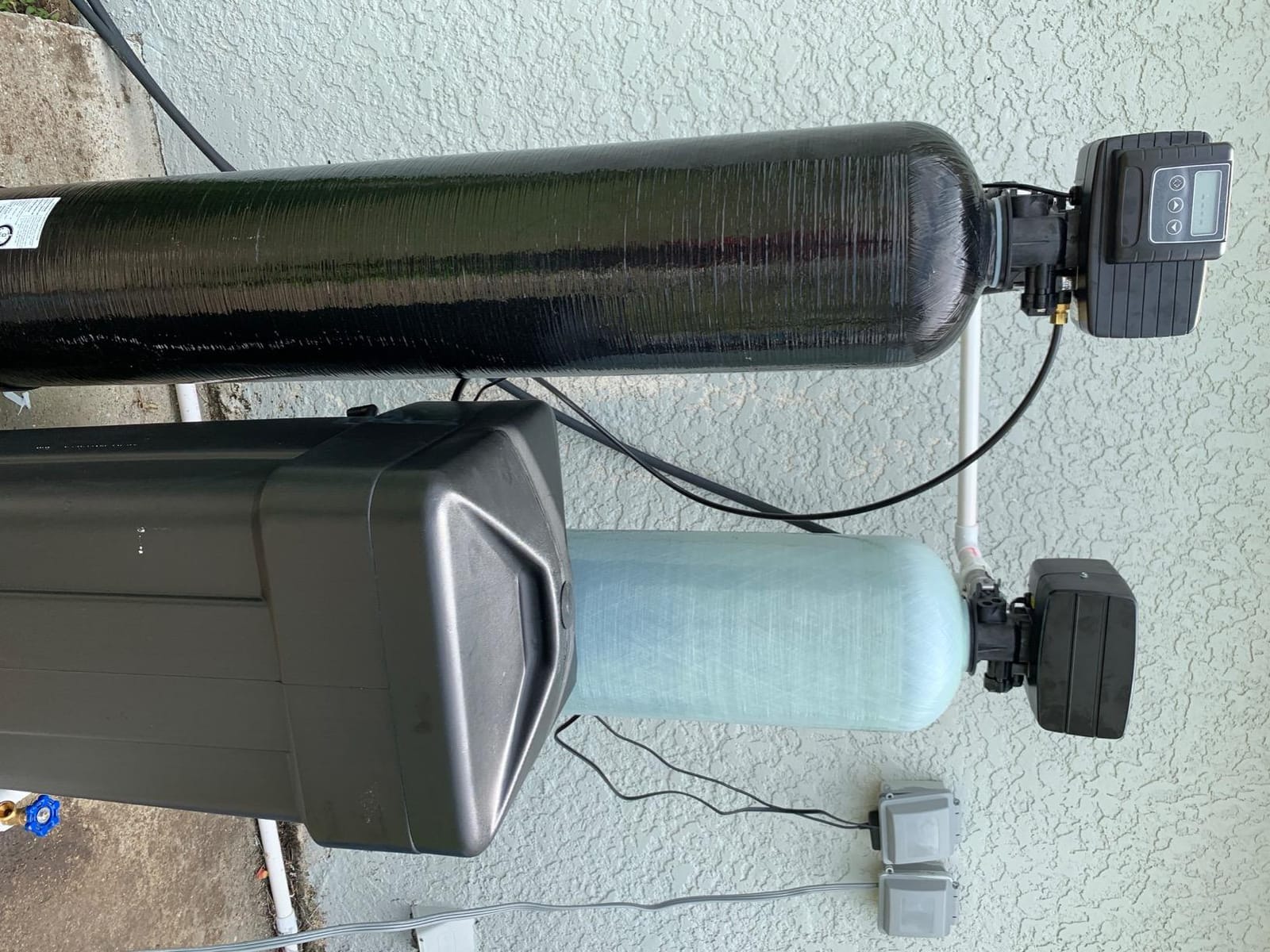
The most useful advice in the reviews is consistent across owners: this unit softens water very well but needs help with iron, so putting a dedicated iron filter ahead of it gives the best result. The upgraded paddle wheel meter also tracks usage accurately, so regeneration only happens when it needs to.
What you should check before buying
Decide where it sits in your stack. The correct sequence is sediment, then iron removal, then the softener. A softener ahead of iron removal fouls the resin, and that is the single most common well-water installation mistake.
Source your hoses. Connector hoses are not included, so pick up supply and drain line before the tank shows up.
Where it falls short
It is a compromise, and owners with heavy iron say so directly. If your lab report shows iron well above 3 ppm, this alone will not clear the staining.
Salt use is a real ongoing cost, and a 48,000 grain capacity means frequent regen on a larger household unless the metered valve is programmed well.
9. Fleck 5600 SXT Air Injection Iron Eater – Best for High Iron
DuraWater Fleck 5600 SXT Air Injection Iron Eater Filter 1.5 cu ft, Black
Fleck 5600 SXT digital air injection control valve
1.5 cubic feet of Centaur catalytic carbon media
Salt-free oxidation of dissolved iron
Automatic daily backwash
Pros
- No salt and no chemical feed
- Owners report iron readings dropping from about 14 ppm to 0
- Removes orange staining within days
- Resolves H2S sulfur odor for many owners
- Nozzles seals and valves cleaned by the owner
- Phone support from people who know the system
Cons
- Default daily 15 minute backwash uses 75 to 120 gallons
- Air injection cone can weep a little water
- Needs a sediment filter ahead of it
- Backwash water must reach a suitable drain
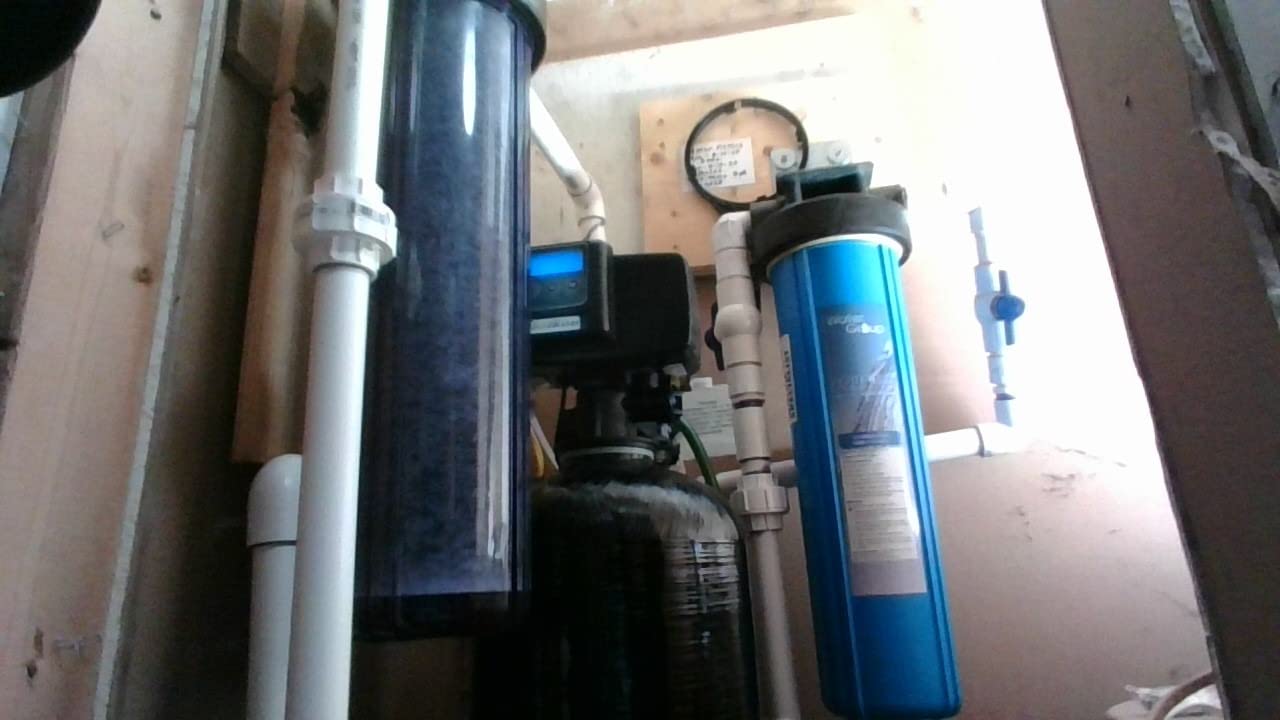
This is the pick for a well with serious iron, and it is the one we point people toward when their lab report is embarrassing. It is a salt-free air injection system: the valve injects air at the top of the tank, oxygen oxidizes dissolved iron into particles, and 1.5 cubic feet of Centaur catalytic carbon media traps them.
It sits on a Fleck 5600 SXT digital air injection control valve in a 10 by 54 tank with a 1 inch plastic bypass. A recharge of the catalytic carbon treats up to about 500 gallons between backwashes.
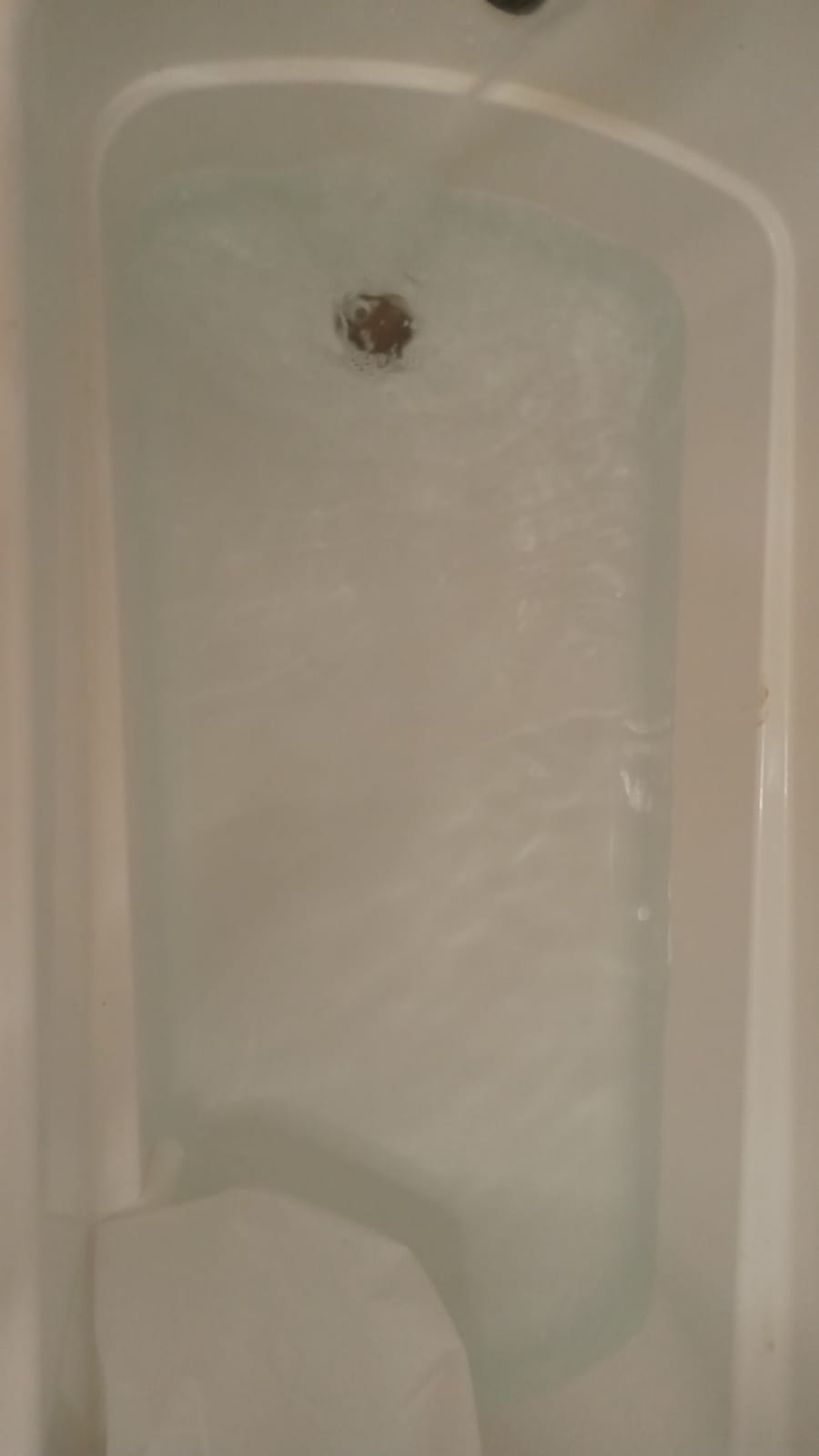
Owners with severe iron and sulfur problems describe results as transformative and cite measured before-and-after test strips. The system is also fully serviceable: nozzles, seals and valves come out for cleaning in about ten minutes with no special tools.
What you should check before buying
Check your well yield before the install date. This tank backwashes daily, and a well under roughly 6 GPM can struggle to refill the tank between cycles. On a low-yield well, either extend the interval or plan on a holding tank.
Where does the drain line go? Every backwash cycle sends water somewhere, and that volume has to be planned before you plumb it.
Where it falls short
The default schedule is aggressive. A daily 15 minute regeneration at 7 to 10 GPM works out to roughly 75 to 120 gallons per cycle, and users with septic systems are advised to change the interval to every two or three days so the drain field is not overwhelmed.
Put a spin-down or sediment filter ahead of it. Iron flakes reaching the control valve are the fastest way to shorten the life of the most expensive part of the system.
10. Home Master Three Stage – Best for Sediment Heavy Wells
Home Master Whole House Three Stage Water Filtration System with Fine Sediment, Iron and Carbon, Blue
Fine sediment then iron reduction then carbon block
Handles up to 3 ppm combined iron manganese and sulfur
Up to 15 GPM through 1 inch ports
100000 gallon capacity
Pros
- Four-layer 25-10-5-1 micron sediment cartridge holds more dirt
- Removes up to 95 percent of iron manganese and sediment
- Oversized housings hold 15 GPM
- Owners report whiter laundry and better pressure
- Manufacturer follows up annually to check the system
Cons
- O-rings lose diameter and pop out of the groove
- Plastic threads on copper fittings can leak
- Not suitable for city water
- Sediment cartridge can load in under three months
- A sediment pre-filter and gauges are recommended
This is the one to look at when your well produces visible grit and you have never filtered it. The four-layer 25-10-5-1 micron sediment cartridge at the front holds far more dirt than a standard single-layer filter, and that dirt capacity is the whole point on a sediment heavy well.
Three stages of 25-10-5-1 micron sediment, iron reduction and carbon block, removing up to 95 percent of iron, manganese, sediment and taste and odor chemicals, on 1 inch ports sized for up to 15 GPM with 100,000 gallons of capacity and a 2 year parts warranty.
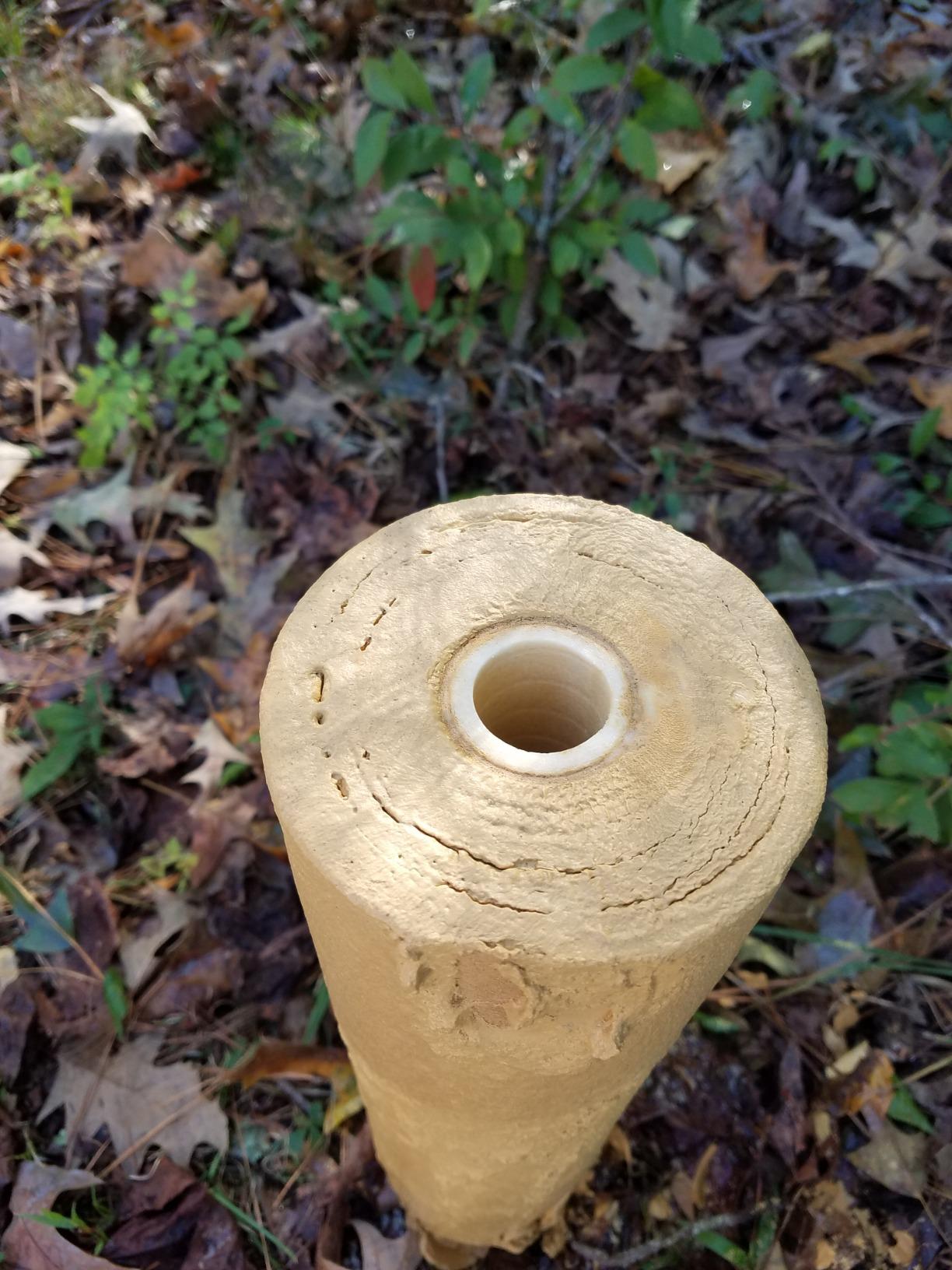
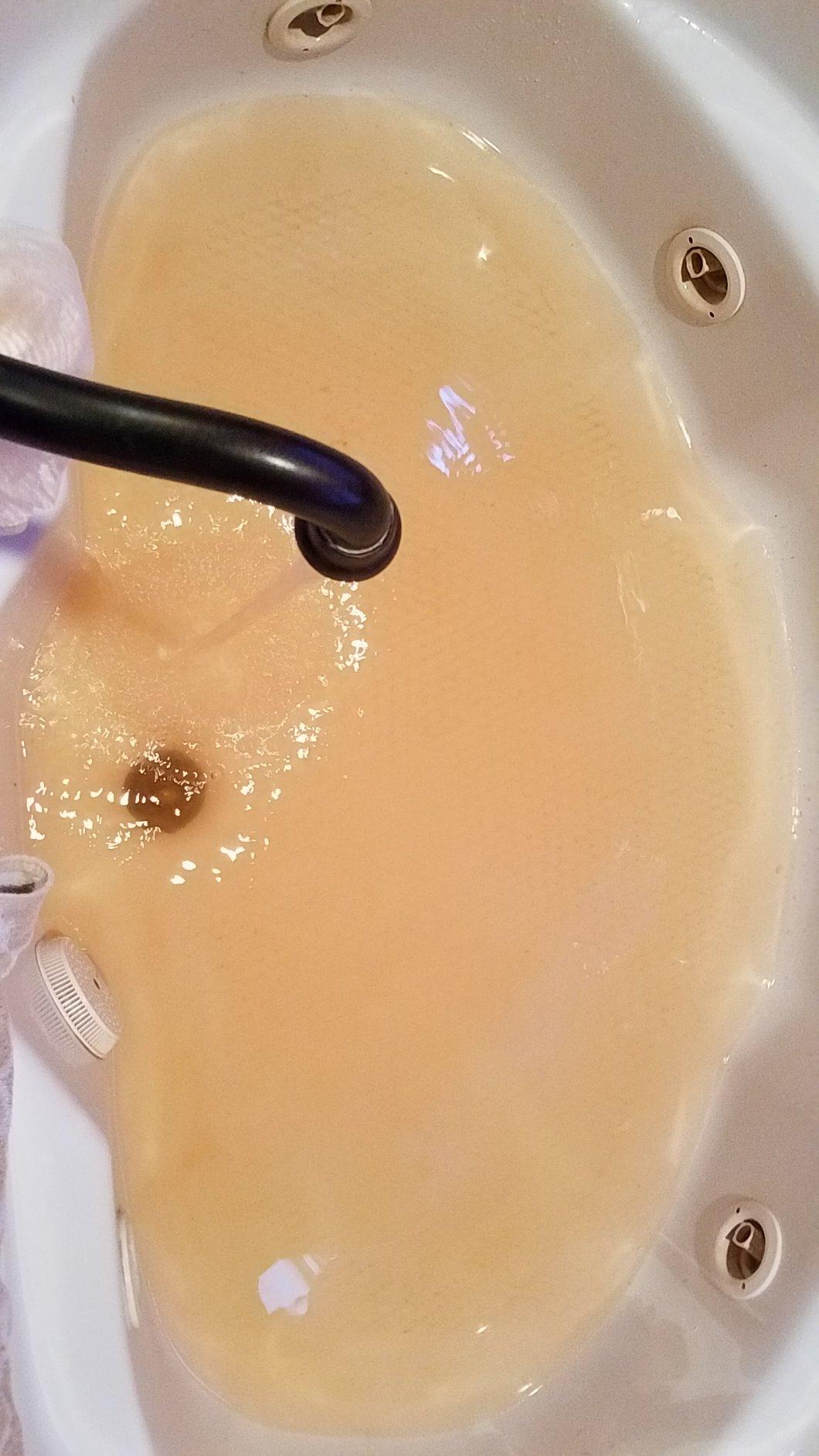
The reviews skew instructional, which is useful: owners who tested their water first and put the sediment stage in the correct position report strong results. The manufacturer also points city water users to a different model, so know which one you need before you order.
What you should check before buying
Test first. This is the least reviewed pick here, and the pattern in the reviews is stark: people who tested saw the iron drop, people who guessed sometimes saw disappointing removal or even browner water.
Add pressure gauges before and after the assembly if you want to know what the filters are doing. On a system that loads, that is the difference between a guess and a measurement.
Where it falls short
The O-ring problem is the most cited flaw by a wide margin. O-rings lose their diameter with use and pop out of the housing groove, so keep a spare set on hand from day one.
On a heavy sediment well, the sediment cartridge can load in under three months. Plan the change interval from your measured pressure drop rather than from the calendar.
How to Choose the Right Iron Filter for Well Water
Spend an hour on this section and you will not spend a month regretting a purchase. Six decisions account for nearly every complaint we read.
1. Get a real lab report before you buy anything
Order a panel that includes iron, manganese, pH, hardness, total coliform, E. coli, nitrates and arsenic. Ask specifically for dissolved versus total iron where available, because a clear-water ferrous reading and a particulate ferric reading point at different equipment.
Do not guess from a glass of water. A kitchen tap sample can look clean and still have an iron number that dictates your whole treatment design.
2. Match the technology to the iron level
Under about 3 ppm, a cartridge system such as the iSpring WGB21BM or the Home Master three-stage handles the load and keeps costs low. Between 3 and 10 ppm, go to catalytic media in a backwashing tank, because cartridges will burn through on a schedule you cannot control.
Above 10 ppm, or when you are seeing sulfur odor at the same time, a salt-free air injection tank with catalytic carbon media is the right branch. Chemical injection with chlorine or peroxide is the branch above that, and it is the only path that reliably handles iron in the tens of ppm.
3. Size for flow and household demand
Check your well yield in gallons per minute, not just the number on a box. A family of two or three with two bathrooms usually lives comfortably in the 10 GPM range. Four or more people with four or more bathrooms need a 15 GPM capable system, and matching it means a 1 inch bypass and short enough runs to avoid pressure loss.
Forum users report that losing 2 to 3 PSI is acceptable and anything beyond that gets noticed immediately. A larger diameter bypass valve is the cheapest way to protect against that.
4. Read the pH requirement of the media
Media chemistry matters more than most listings admit. Birm needs pH 7.0 and above to oxidize iron. Katalox Light works down around pH 6.0. Greensand generally wants a 6.2 to 8.5 band and needs a chemical regenerant. Katalox Light is usually the most forgiving choice across a typical well range.
5. Plan the backwash water and the drain
Backwash math is simple: minutes multiplied by backwash flow rate equals gallons per cycle. A 15 minute cycle at 10 GPM is about 150 gallons, and on a daily schedule that is real water you are putting on your septic field every day.
If you are on a septic system, lengthen the interval to every two or three days. If you are on a municipal sewer, this constraint mostly disappears.
6. Get the treatment order right
The correct sequence is sediment pre-filter, then iron removal, then water softener, then UV sterilizer, then carbon. Putting the softener ahead of iron removal is the mistake that fouls resin and shortens the service life of both pieces of equipment.
If you have iron bacteria, disinfection goes ahead of everything else, because bacteria regenerate downstream of a filter and the slime comes back within days.
When an Iron Filter Is the Wrong Purchase
Some wells need something other than iron filtration, and buying a filter for the wrong problem is how people end up with a wall of equipment and dirty water.
If your lab report comes back clean on iron, an iron filter is a water polisher rather than a treatment. Spend the money on disinfection and a softener instead.
If the problem is nitrates above 10 mg/L, arsenic, or total dissolved solids, no iron cartridge will touch them. Those need reverse osmosis at the point of use, either alone or as a drinking-water complement to your whole-house iron removal.
If the only issue is hardness, buy a softener. And if you have iron bacteria, no amount of media filtration will hold, because the organisms keep producing new slime downstream of the media.
Installation, Backwashing and Ongoing Costs
All ten systems go on the main cold line after the pressure tank or the meter, and all of them want a bypass valve so you can service them without shutting off the house. Budget for a drain line within code distance of the sewer or septic, and for enough vertical clearance that you can pull a full housing.
Cartridge systems have no backwash. Their ongoing cost is a stack of replacement filters and a trip to the hardware store, roughly two or three times a year on a heavy well. Backwashing media systems cost nothing to run but water, and the drain line is the part homeowners most often forget.
Over a five year window the ranking by total cost is usually the reverse of the ranking by sticker price. A single low-cost housing with frequent cartridges can cost more in five years than a higher-cost salt-free media tank, which is the argument we hear most often from owners who have lived with both.
Measure pressure before and after install and again at 60 and 90 days. If you see more than about 3 PSI of loss at peak demand, the media bed or sediment stage is undersized for your flow, and no amount of adjusting the bypass will fix it.
Frequently Asked Questions
Do iron filters work on well water?
Yes. Iron filters are built specifically for private wells, where dissolved iron is the most common nuisance contaminant. An oxidation system injects air to convert dissolved iron into particles, traps them in a media bed, and flushes them to drain on a backwash cycle. Cartridge systems work too, but they are sized for iron up to about 3 ppm and need regular replacement above that.
What is the best whole house iron filter for well water?
For most wells, a salt-free air injection tank with catalytic media is the best whole house iron filter, because it handles iron well past the 3 ppm limit of any cartridge and needs no salt or chemicals. For lighter iron, the iSpring WGB21BM is a strong two-stage pick, and for homes that also need hardness removal the AFWFilters Iron Pro 2 combines both in one tank.
What is the most effective way to remove iron from well water?
For dissolved ferrous iron, air injection oxidation with Katalox Light, Filox or catalytic carbon media is the most effective and chemical-free approach. For already-oxidized ferric particles, a backwashing sediment and media filter works well. For iron above roughly 10 ppm, chemical injection with chlorine or hydrogen peroxide ahead of a media filter is the most reliable path.
How much water pressure drop is normal for a whole house filter?
A loss of 2 to 3 PSI at peak household demand is the range most owners report as acceptable, and anything beyond that gets noticed at the shower. Pressure drop comes from undersized media beds and from 3/4 inch bypass valves, so match the system flow rating to your household demand and use a full 1 inch bypass to keep the loss minimal.
How often should an iron filter backwash?
Most air injection and oxidation tanks backwash once a day on the factory default, and each 15 minute cycle at 7 to 10 GPM sends roughly 100 to 150 gallons to drain. Owners on septic systems typically change the interval to every two or three days to protect the drain field. Sediment loading and iron level, not the calendar, are what actually determine how often you need it.
Why is my water pressure low after changing the filter?
A new cartridge has not yet developed a flow path through settled media, so a fresh filter can briefly restrict flow more than the old one did. Other common causes are a housing installed without the O-ring seated in its groove, a cartridge wrapper still in place, a partially closed bypass valve, or a sediment stage that loaded up while the system was down. Test pressure again after a few days of running.
Can a water softener remove iron?
Only to a point. Standard softener resin can handle about 2 to 3 ppm of dissolved iron before it fouls, and above that the resin surface becomes coated and stops softening effectively. Softeners with fine mesh iron-rated resin do better. If your iron is higher, put a dedicated iron filter ahead of the softener in the treatment sequence.
Is it safe to drink well water with high iron?
Iron above the 0.3 ppm EPA secondary standard is primarily an aesthetic issue rather than a health one, so most people can drink it. It tastes metallic, stains fixtures, and will foul water heaters, softener resin and RO membranes over time. Always test for coliform and E. coli at the same time, since iron reduction does not disinfect water and a well can have both problems together.
Final Verdict
The iSpring WGB21BM is our pick for the best iron filters for well water overall, because at 4.6 stars across more than 4,270 ratings it is the best-documented system here, and it handles the sub-3 ppm range that most wells actually sit in.
Move up to a salt-free air injection tank with catalytic media, such as the Fleck 5600 SXT Iron Eater, the moment your lab report passes 3 ppm or you are dealing with sulfur odor at the same time. Add a sediment pre-filter in front of either, keep the softener downstream of the iron stage, and backwash into a drain you have actually planned for.
Our picks and specs were reviewed in 2026. Check the latest product details before you order, and test your water first, every time.