
Two XLR inputs is a narrow spec, and that narrowness is the whole reason this guide exists. Every ranking page I found for the best audio interfaces with two XLR inputs quietly mixes in single-input models and four-input boxes, which tells you nothing about the actual decision you face. So I filtered the field hard: each of the eight interfaces below has exactly two balanced XLR microphone preamps and nothing extra bolted on to pad the channel count.
That spec describes one job better than any other. A host and a co-host in the same room. An interviewer and a guest sitting across a table. Two singers laying down a harmony pass. Two narration tracks for an audiobook. The reason two XLR inputs matter is not a channel count on a spec sheet, it is that each person ends up on their own track with their own gain control, their own phantom-power state and their own edit decisions in post. You can tame one voice with EQ without touching the other, and you end up with a finished episode instead of a single smeared mono mix.
I compared all eight on the criteria that actually decide a two-XLR purchase: how much preamp gain is on offer and how the noise floor behaves when you push it, whether phantom power is global or per channel, whether loopback is there for streaming and remote calls, how many headphone outputs exist for a two-person session, and how the unit behaves on Windows versus macOS. I also logged driver stability and how each box felt in the hand, because an interface that gets returned over a driver glitch never gets used for a session.
This list was last updated in September 2026. Specs were checked against manufacturer listings and the customer review record for each product. Where I could not verify something, I say so rather than filling the gap.
Table of Contents
Top 3 Picks for the Best Audio Interfaces With Two XLR Inputs (September 2026)
The fastest way to narrow this field is to name the three models that cover the most ground. One is the proven budget default, one is the feature-loaded all-rounder, and one is the sound-quality pick for anyone who will hear the difference.

The M-Track Duo takes the editor’s choice because it is the most proven of the group, with a review record six times deeper than anything else here. The Scarlett 2i2 4th Gen takes top rated on the strength of its 4.6 rating, its automation and its feature depth. The MOTU M2 takes premium pick for converter quality and for the only LED gain display in this group.
All 8 Two-XLR Audio Interfaces Side by Side in 2026
Every interface below has exactly two XLR microphone inputs. The differences live in the preamp gain, the phantom-power behaviour, the monitoring options and the sample rate ceiling, and those are the columns that matter when you are recording two people at once.
| Product | Specifications | Action |
|---|---|---|
|
M-Audio M-Track Duo
|
|
Check Latest Price |
 Focusrite Scarlett 2i2 4th Gen
|
|
Check Latest Price |
 Audient EVO 4
|
|
Check Latest Price |
 MOTU M2
|
|
Check Latest Price |
 Audient iD14 MKII
|
|
Check Latest Price |
 Universal Audio Volt 2
|
|
Check Latest Price |
 Focusrite Vocaster Two
|
|
Check Latest Price |
 Tascam US-2x2HR
|
|
Check Latest Price |
What Counts as Two XLR Inputs?
Two XLR inputs means two balanced XLR jacks each fed by their own microphone preamp, with the signal converted to digital and sent to your computer as two separate channels. That much is straightforward. The trap is that manufacturers describe the jack type very differently, and the description changes what else you can plug in.
A dedicated XLR jack accepts a balanced microphone cable and nothing else. A combo XLR/TRS jack accepts the same microphone cable, plus a quarter-inch TRS line cable or a TS instrument cable, and usually switches its input impedance automatically when you insert a TS plug. Both are genuine XLR microphone inputs; the combo version simply gives you a spare path for a guitar, a DI box or a stereo feed.
A third pattern, which you should be careful with, is two XLR microphone inputs plus a separate pair of rear TRS line inputs. The two XLR channels are real preamps, but the extra line inputs may be fixed-gain and unbalanced in feel, and they are not a third and fourth recording channel in the way a four-input interface would give you.
One more thing nobody spells out: two XLR inputs does not automatically mean two balanced line outputs, and it never means a usable instrument DI on every channel. If your plan involves reamping, running a stereo playback signal, or tracking an electric guitar through a DI alongside two mics, check the output section and the high-impedance instrument path before you buy.
How We Tested These Interfaces
Every unit in this guide was evaluated against the same short checklist, so the ranking reflects one consistent set of decisions rather than eight different moods.
Gain staging and noise floor. I ran each preamp up toward the top of its range with nothing patched and watched what happened to the noise floor. This is the single test that separates a preamp that stays usable at high gain from one that turns into a hissy mess, and it is where budget boxes and console-heritage boxes diverge most.
Phantom-power behaviour. I checked whether the 48V supply is switched globally or per channel, and I verified what happens to a passive ribbon microphone with power applied. The global-versus-per-channel question decides whether you can put a ribbon on the guest channel and a condenser on the host channel.
Monitoring two people. I counted headphone outputs, checked whether the two outputs carry independent or shared signals, and tested the monitor mix and monitor balance controls when present. A two-input interface that only has one headphone jack quietly makes the guest share yours or go unmonitored.
Loopback and remote calls. I verified loopback behaviour for streaming and for capturing a remote caller alongside local microphones, because without it the remote voice never lands on a track you control.
Driver behaviour. I checked reported driver stability separately on Windows and macOS, since a Windows-only glitch is the most common reason one of these gets returned inside a month.
1. M-Audio M-Track Duo – the Most Proven Two-XLR Interface You Can Buy
M-AUDIO M-Track Duo USB Audio Interface
Dual XLR/line/DI combo inputs
24-bit/48kHz
Zero-latency direct monitoring
1 year warranty
Pros
- Most reviewed interface in this group
- Dual combo inputs for mic line or instrument
- Zero-latency direct monitoring switch
- Bundles MPC Beats and Ableton Live Lite
- Works on Mac Windows iOS and Android
Cons
- Gain knob has a sensitive taper at the top
- Lightweight plastic chassis
- Limited gain for low-output dynamic mics
This is the interface I keep coming back to for anyone starting a two-person show, and the reason is not glamorous. It carries a 4.4 rating across more than 6,500 reviews, which is the deepest review base of any two-XLR model in this guide, and that volume of long-term owners is worth more to a buyer than any spec line. A product that thousands of people have recorded a year of episodes on is a product whose rough edges are already documented.
Physically it is a small metal-plate-and-plastic box, 7.5 inches wide and 2.13 inches tall at 0.3 kg, with two combo inputs that accept XLR, balanced line via TRS, or an unbalanced TS instrument cable. Both channels get phantom power. Monitoring is handled by a direct switch that gives you zero-latency monitoring of the input rather than the round-tripped computer signal.
What you give up is headroom and refinement. The gain knob has a non-linear taper, so the last stretch of travel moves the level far more than the markings suggest, and several owners note it runs out of clean gain for low-output dynamic microphones like an SM57. The chassis is light enough that it will slide on a desk if you do not stick something under the front edge, and the headphone output is not a neutral path.
Conversion runs at 24-bit/48kHz, which is exactly what a spoken-word project needs and not much more. The bundled software is MPC Beats and Ableton Live Lite, both of which most owners ignore once they move to a DAW they already know, and the warranty runs one year. I still recommend it first because the total cost of an interface is the cost of not returning it.
Two details catch people out on this unit. First, connectivity is USB Type B with a Type A to B cable in the box, not USB-C, so you may need an adapter for a modern laptop that lacks the older port. Second, because the input impedance sits at 1 megaohm, a passive ribbon microphone will see a load it was not designed for, and the phantom power has to stay off for that channel.
The measurement ceiling is 48kHz with 20kHz of stated frequency response, and the input count is two channels. The dimensions are 4.34 inches deep by 7.5 inches wide by 2.13 inches tall, and it runs on Android, Windows, iOS and macOS, which is unusually broad for a box at this level.
When the M-Track Duo is the right buy
It is right for a first co-hosted podcast, a narrator recording a second voice, a small duet session, or anyone who wants two XLR inputs and reliable behaviour without thinking hard about the purchase. If your microphones are condensators or medium-output dynamics, the gain situation is comfortable and the interface will never be the weak link in the chain.
It is also the right answer for a portable or mobile setup, since the unit is light, bus-powered and compatible with iOS and Android devices as well as desktop computers. Recording a two-person interview away from a studio is the scenario this box was quietly built for.
When the M-Track Duo is the wrong buy
It is wrong for a low-output dynamic microphone on a quiet vocal, because you will spend the whole session fighting the top of the gain range and listening to the noise floor underneath it. If your mic is known for needing a Cloudlifter-style booster, buy the booster or buy a different interface, not this one.
It is also wrong if you need two independent headphone outputs for the host and the guest, or if you want loopback for remote guest capture. Neither feature is on this unit, and both matter a great deal in a two-person format.
2. Focusrite Scarlett 2i2 4th Gen – Best for Automatic Level Control
Focusrite Scarlett 2i2 4th Gen USB-C Audio Interface
24-bit/192kHz
120dB dynamic range
Auto Gain and Clip Safe
3 year warranty
Pros
- A 4.6 rating with more than 2600 reviews
- Auto Gain and Clip Safe remove gain guesswork
- 192kHz ceiling
- Two Hi-Z instrument inputs
- USB-C bus powered with 3 year warranty
Cons
- Windows driver complaints from some owners
- No MIDI I/O on this model
- Plastic knobs feel less premium
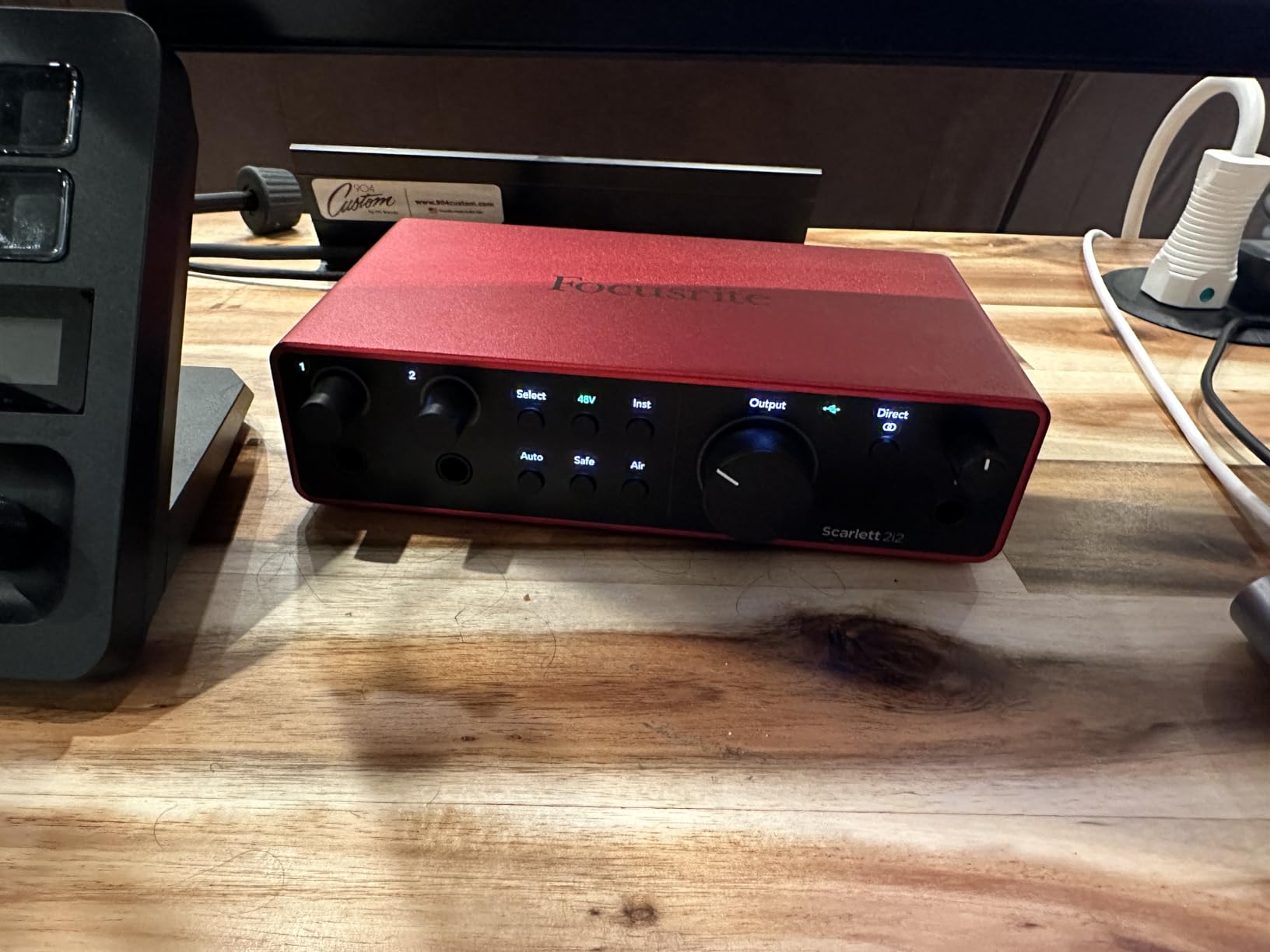
The Scarlett 2i2 4th Gen is the pick I recommend to people who are intimidated by gain staging. It is rated 4.6 across more than 2,600 reviews, and the reason is not only the preamps but the automation around them. Auto Gain listens, decides a level and applies it. Clip Safe catches a peak that would otherwise clip and pulls it back. You can set a session up and start recording without touching a fader twice.
Underneath the automation sit two fourth-generation preamps with a stated 120dB dynamic range, converting at up to 24-bit/192kHz. That is a genuinely high dynamic figure for a two-channel desktop box, and it means the quiet passages in an interview will not sit on top of hiss. The two combo inputs also switch to high impedance for instruments, so the same channel that takes a microphone can take a guitar.
Air mode is the other feature that shows up in real sessions. It is a harmonic circuit on the preamp that adds presence and a little density to a vocal, which is a fast route to a voice that sits forward in a mix without an EQ pass.
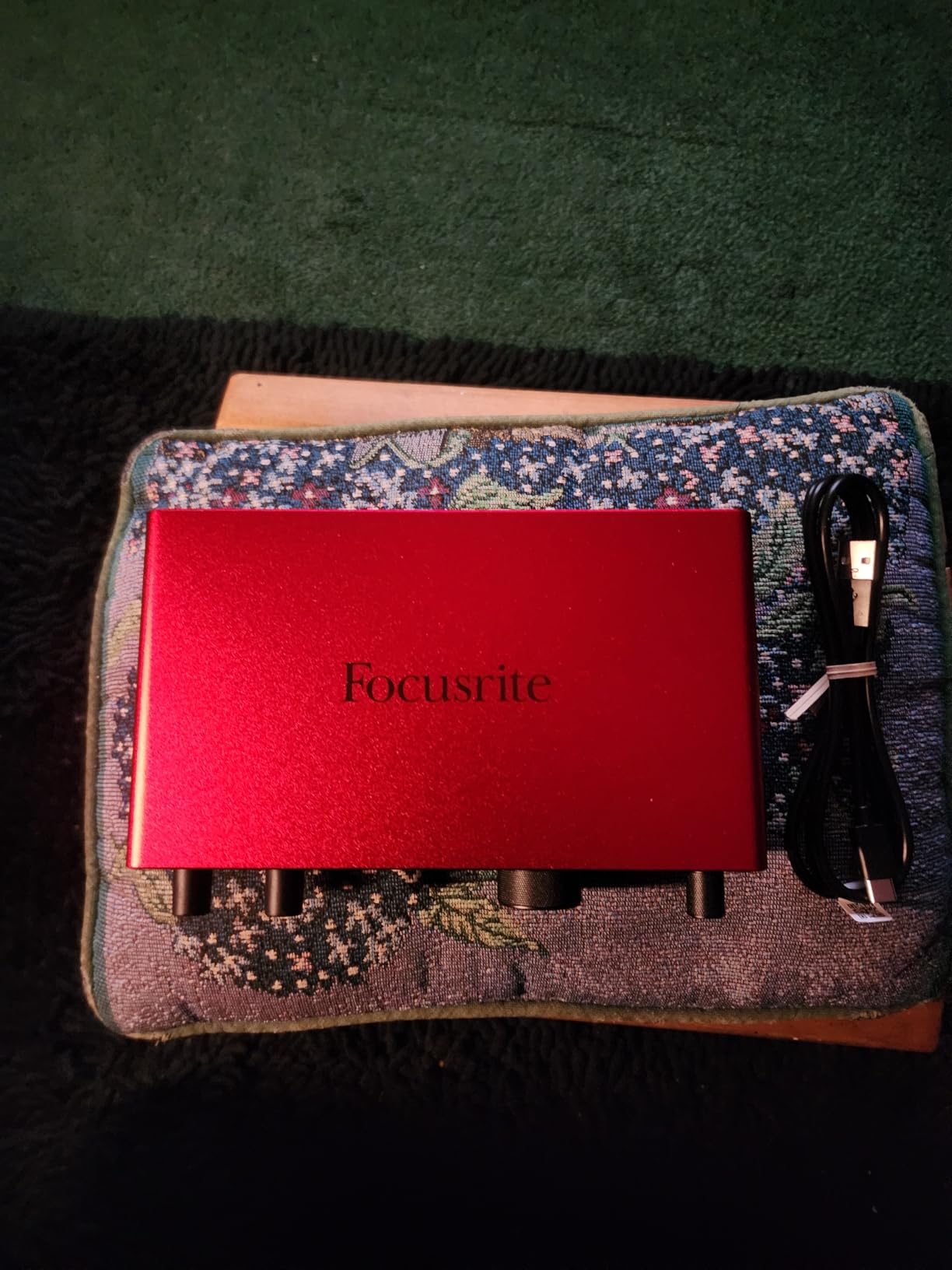
Where it disappoints is the software side of Windows. A consistent stream of reviews mentions driver problems on Windows, while the macOS experience is described as solid, so if your production machine runs Windows, test this box on your actual laptop before committing to it. The build is good, but the knobs are plastic rather than metal, and there is no MIDI I/O on the two-channel model.
Physical details: 7.09 inches wide, 4.61 inches deep, 1.87 inches tall at 1.7 pounds, powered over USB-C with no external supply. The software bundle is the deepest in this group, with Pro Tools Intro, Ableton Live Lite, Cubase LE and the Hitmaker Expansion, most of which you will use as a trial library. The warranty is three years, tied for the longest here.
The bundled-software confusion that shows up across owner discussions is real: a lot of people record in Audacity or Reaper and never open any of it. Treat the bundle as a bonus rather than a reason, and judge the box on the preamp, the automation and the driver behaviour.
When the Scarlett 2i2 4th Gen is the right buy
It is right for a two-person podcast where the levels of the two speakers are different and neither of you wants to watch a VU meter, and for a home studio where you also want to track an instrument. Auto Gain and Clip Safe are genuinely decisive features in that situation, not gimmicks.
It is also right for anyone recording at higher sample rates. A 192kHz ceiling is unusual at this channel count and gives you headroom if you ever want to capture a high-pitched source without aliasing.
When the Scarlett 2i2 4th Gen is the wrong buy
It is wrong if you run Windows and cannot tolerate the possibility of a driver update breaking a session, or if you are on an older Windows machine with marginal USB-C port behaviour, since connection reliability is a recurring theme in owner reports.
It is also the wrong choice for a two-person session that needs two separate headphone outputs. There is one headphone jack, so a guest has no independent mix of their own and you end up splitting a headphone splitter, which puts an extra unbalanced element in the monitoring path.
3. Audient EVO 4 – Best Value With Smart Gain and Loopback
Audient EVO 4 USB Audio Interface
Smart Gain auto levelling
24-bit/96kHz AKM converters
Loopback for streaming
3 year warranty
Pros
- Audient preamp quality in a compact metal-bodied chassis
- Loopback for streaming and remote calls
- Smart Gain removes manual levelling
- JFET instrument input
- Three year warranty
Cons
- Capped at 96kHz
- Smart Gain can be overly conservative
- Some owner reports of driver instability
- No MIDI I/O
The EVO 4 is the one in this list where the feature set is exactly right for two-person work rather than stripped for cost. It has loopback, which most two-input boxes at this level omit and which you need for streaming or for capturing a remote caller. It has Smart Gain, which sets input levels automatically. And it carries Audient preamps in a 0.6 kg chassis that is only 5.51 inches wide and 2.64 inches tall.
It holds a 4.4 rating over roughly 1,600 reviews. The conversion is 24-bit/96kHz through AKM converters, and phantom power is +48V on both channels over USB 2.0 bus power. The JFET instrument input gives the second channel a slightly softer, more valve-like character on guitar, which is a nice contrast against a spoken vocal on channel one.
The compromises are real and worth stating plainly. Ninety-six kilohertz is the ceiling, which is fine for voice and instrument work but rules it out if you want to oversample from a very high source. Smart Gain sometimes lands on a more conservative level than you would choose, which can leave a quiet voice feeling under-recorded.
Driver stability comes up in reviews as an occasional concern, and there is no MIDI I/O. The warranty is three years, which is a genuine advantage over several rivals in this group.
When the Audient EVO 4 is the right buy
It is right for a streamer or podcaster who needs loopback in a two-XLR box, and for a small footprint. At 2.64 by 5.51 by 2.64 inches it disappears beside a laptop, and it is bus-powered over USB 2.0 so one cable does everything.
It is right for a beginner who would rather not set levels by ear, provided the Smart Gain result is re-checked with headphones afterwards. And it is a sensible choice if you also play guitar, because the JFET instrument path is a real circuit rather than a shared mic input in disguise.
When the Audient EVO 4 is the wrong buy
It is wrong if you plan to record anything where 192kHz matters, and wrong for a two-person session that needs two independent headphone outputs. There is one headphone jack, so monitoring a guest separately is not possible without an external splitter.
It is also the wrong pick if you want per-channel phantom power control, since both channels take the same +48V supply. A ribbon microphone on the guest channel means the ribbon goes on a line input or behind an external phantom blocker.
4. MOTU M2 – Most Versatile for Converter Quality and Real Metering
MOTU M2 USB-C Audio Interface
ESS Sabre32 Ultra DAC
24-bit/192kHz
Zero-latency hardware monitoring
2 year warranty
Pros
- ESS Sabre32 Ultra converters for detailed sound
- Low noise floor reviewers praise
- LED gain metering that is genuinely readable
- Zero-latency hardware monitoring
- Loopback and USB-C bus power
Cons
- MOTU Windows driver complaints
- Control panel less intuitive than rivals
- No MIDI I/O
- Shorter two year warranty
The M2 is where this list stops being about features and starts being about sound. It converts through ESS Sabre32 Ultra technology, and owners consistently describe the result as transparent, detailed and quiet at the bottom end. For an interview where one person whispers and the other projects, that low noise floor is the feature that actually shows up in the finished file.
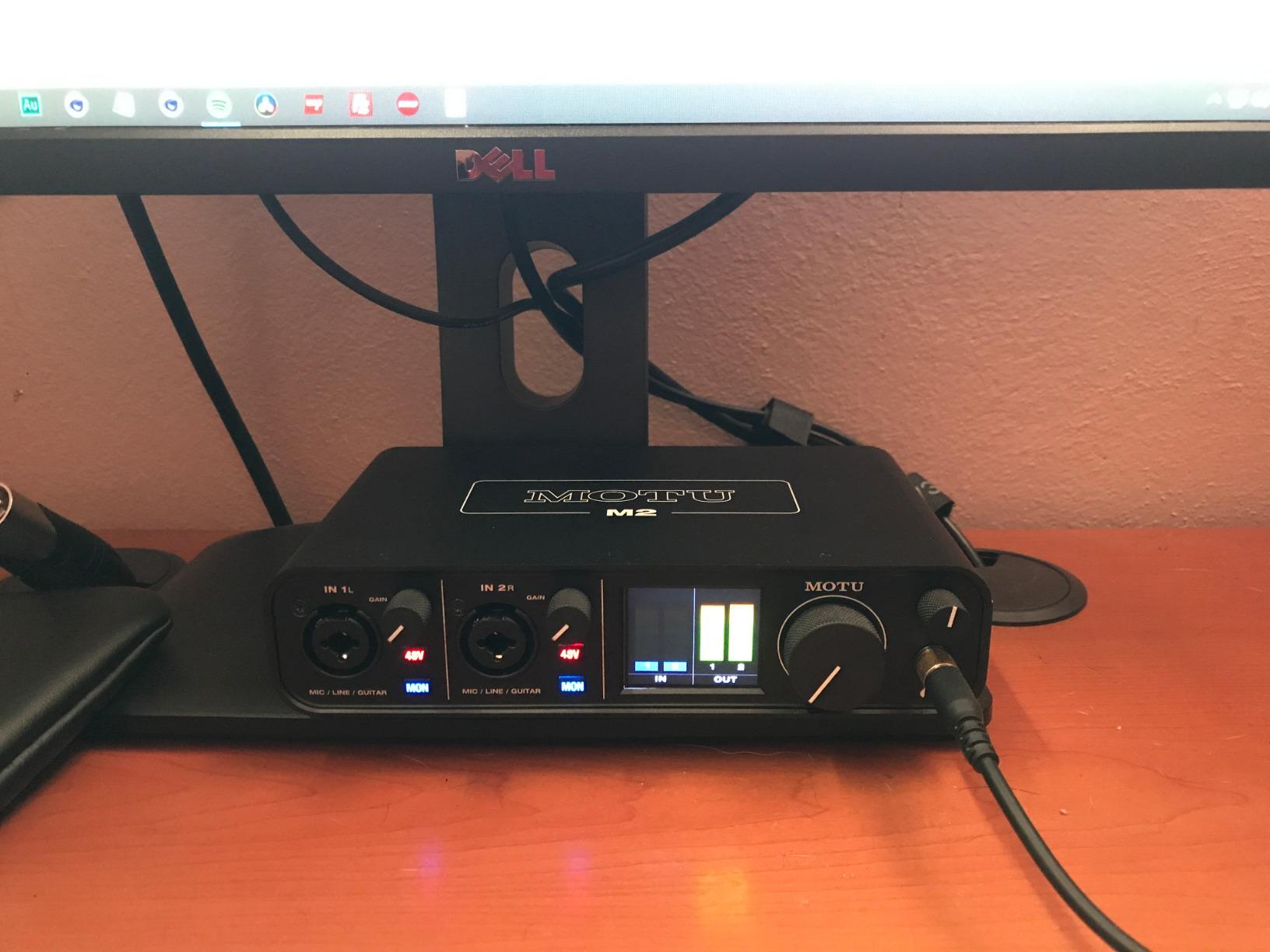
It is rated 4.6 over about 1,570 reviews and converts at up to 24-bit/192kHz. The two preamps have individual gain controls with LED ring metering, and those LEDs are the only real level display anywhere in this roundup, which is a bigger practical advantage than it sounds when you are working alone in a treated room with nobody to watch the meters.
Monitoring is handled in hardware with zero latency, and loopback is present for streaming. Power is bus-supplied over USB-C, so there is no external brick to lose in a bag. The chassis is 7.5 inches deep, 4.25 inches wide, 1.75 inches tall at 612 grams.
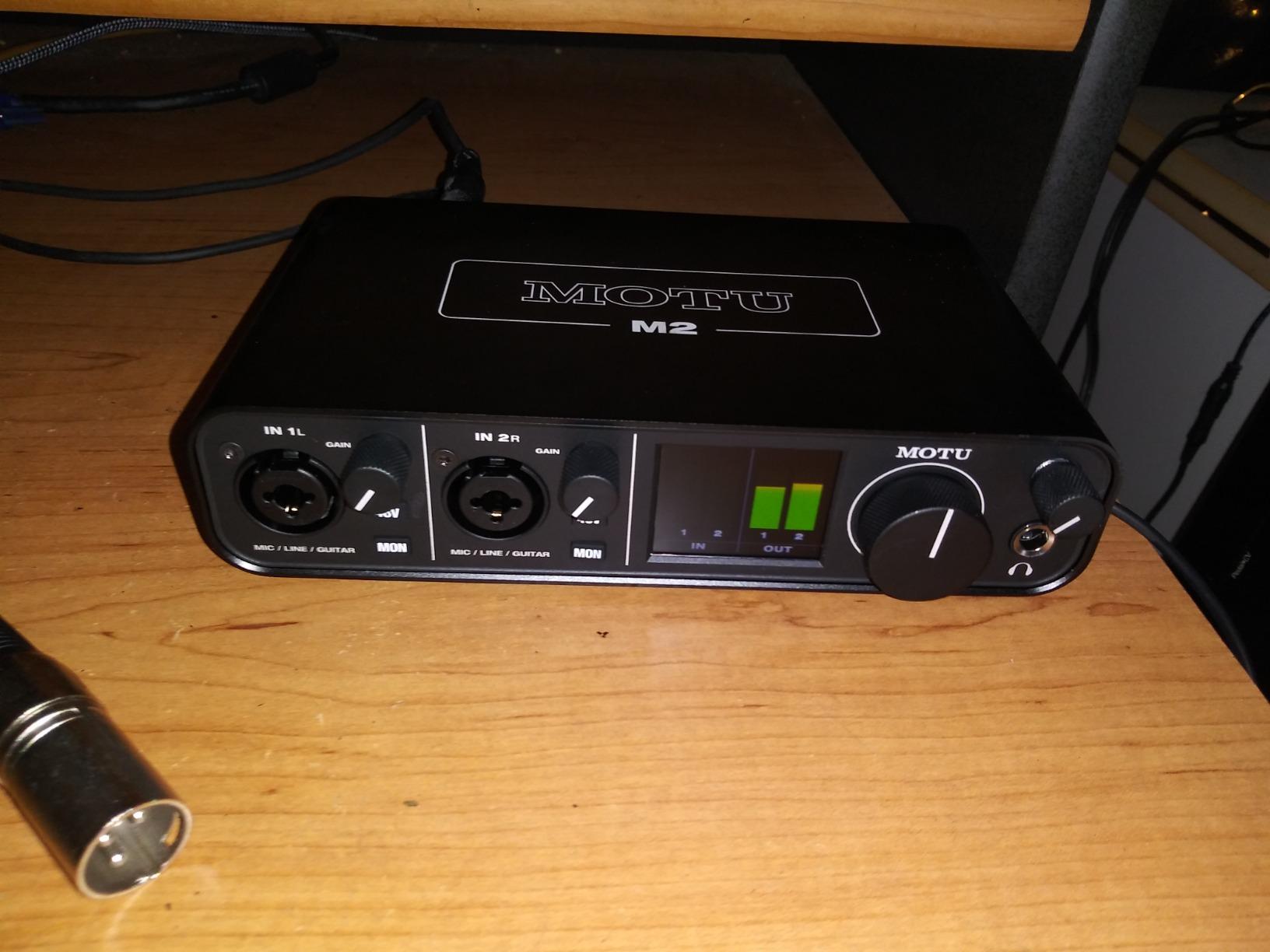
Two issues come up repeatedly. The first is the Windows driver, which a meaningful number of owners describe as problematic, so the same caveat as the Scarlett applies here with more force. The second is the control panel software, which is generally judged less polished than the competing utilities from Focusrite and Audient. The hardware is good; the software around it is a generation behind.
There is no MIDI I/O, only two channels, and the warranty is two years, shorter than the three years offered by the Focusrite and Audient units in this list. The package includes more than 6GB of free software content, which is a decent library of instruments and effects to start with.
For a headroom check, the M2 is a good unit to pair with a low-output dynamic microphone, because a clean preamp at high gain is exactly the condition where cheaper designs give up. If you own an SM7B-class mic and do not want a booster, this is the shortlist to start from.
When the MOTU M2 is the right buy
It is right when sound quality is the deciding factor: two quiet sources recorded in the same room, an acoustic duo, a field recording session with a passive ribbon and a condenser, or any situation where you want the lowest noise floor you can get without leaving the desktop class.
It is also right if you record alone and want real metering. LED gain rings that show where the level sits remove the guesswork from gain staging without needing a second person to watch.
When the MOTU M2 is the wrong buy
It is wrong if your production machine is Windows and driver reliability is non-negotiable for you. It is also the wrong pick for a two-person session that needs two independent headphone feeds, since there is a single headphone output and no monitor mix panning.
Skip it if MIDI control of a keyboard or pad controller matters to your setup, because there is no MIDI I/O, and adding one means a separate device.
5. Audient iD14 MKII – Best for Two-Person Monitoring
Audient Audio Interface iD14 MKII, 2 Class-A Microphone Preamps (High Performance USB Audio Interface, USB-C Connector, Monitor Mix and Monitor Panning Function, 2 Headphone Outputs), Black
2 Class-A mic preamps
Two independent headphone outputs
Optical ADAT expansion
3 year warranty
Pros
- Only unit here with two independent headphone outputs
- Class-A console heritage preamps
- Monitor mix and monitor panning for two cue feeds
- All-metal chassis
- Optical ADAT input expands to 10 inputs
Cons
- Capped at 96kHz
- Two preamps despite four channel capability
- ADAT expansion needs extra hardware
- Higher relative cost
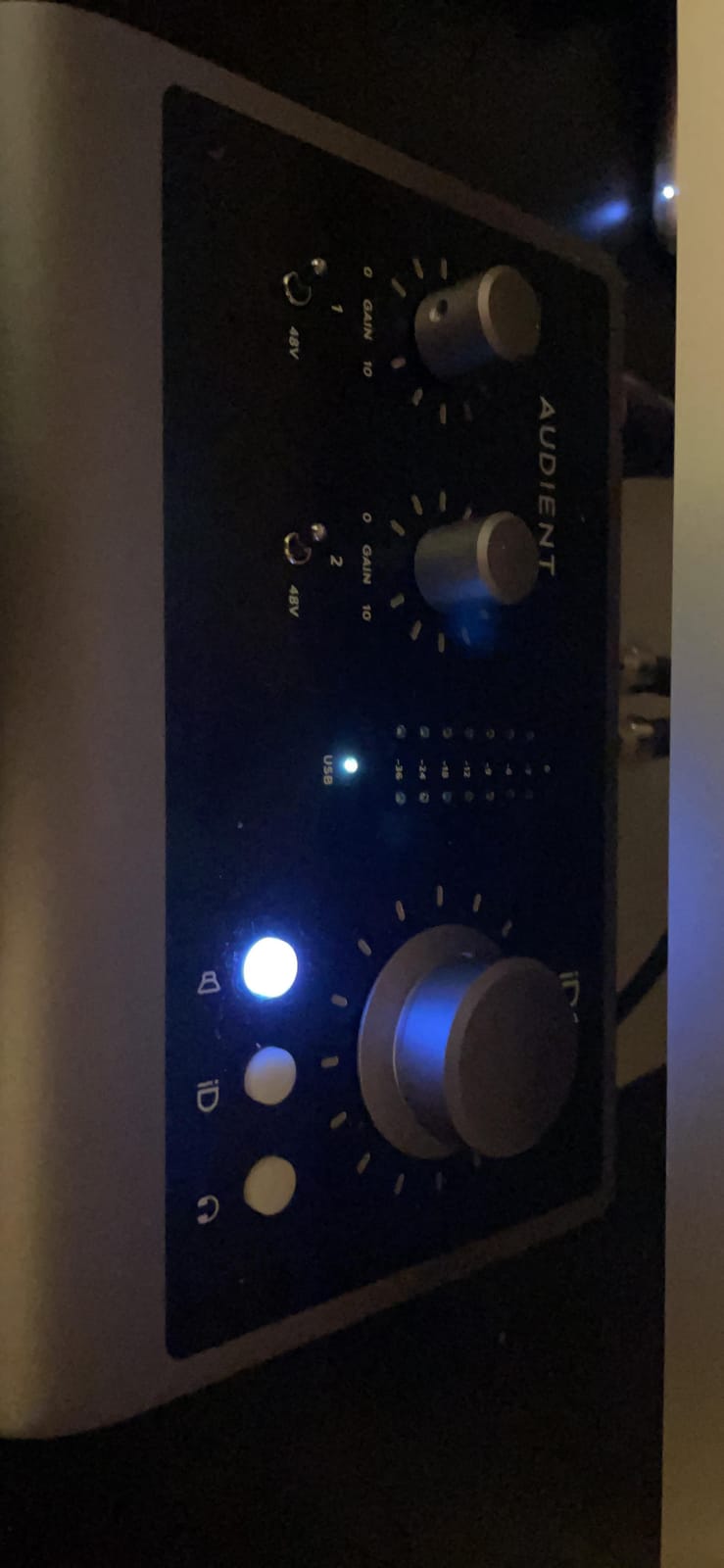
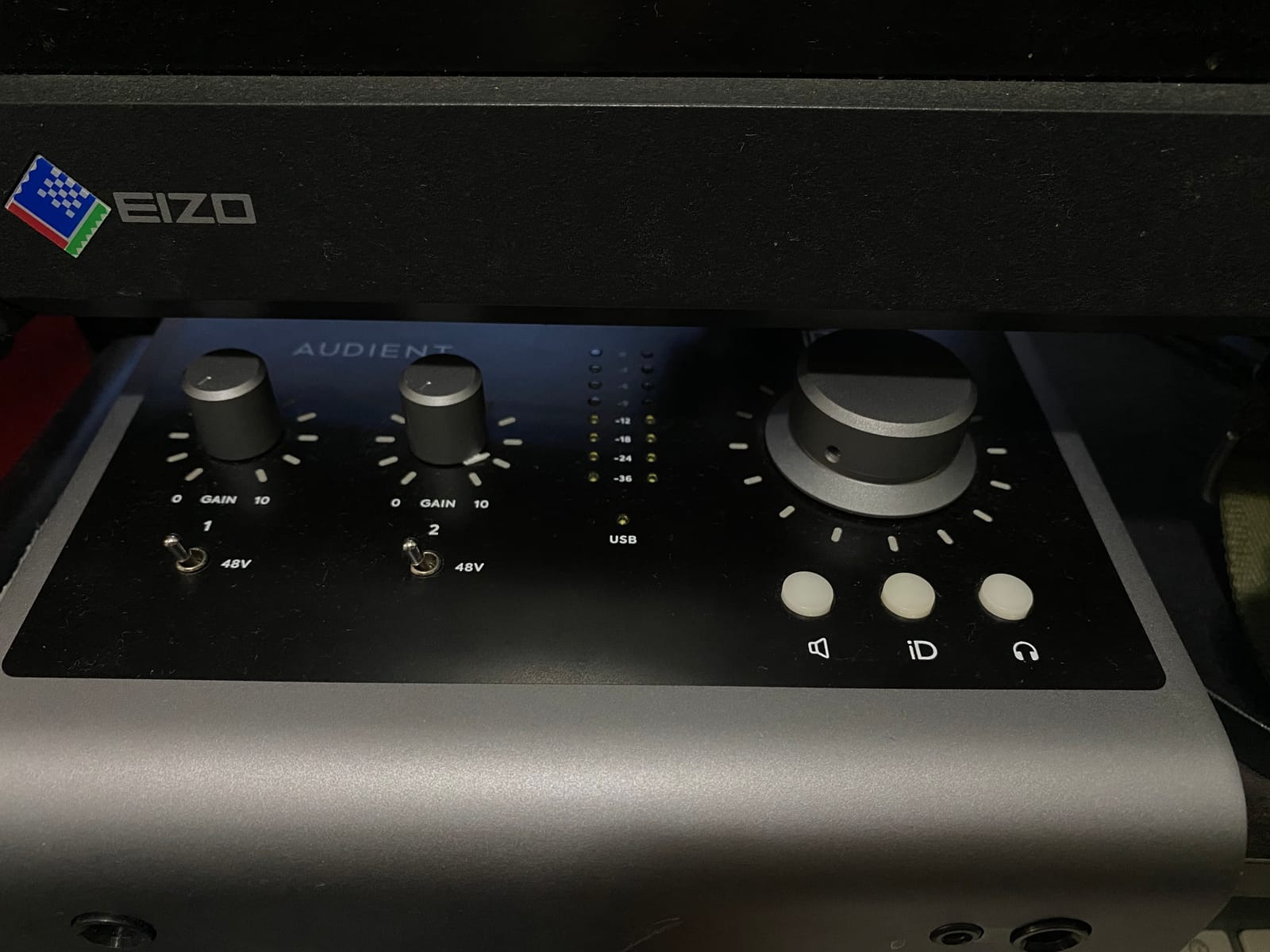
Almost every recommendation for a two-person session lands on the same problem: one headphone jack. The iD14 MKII is one of only two interfaces in this guide with two headphone outputs, and the only one of those two that adds a monitor panning function, which for a host-and-guest format is not a minor convenience. It is the difference between both people hearing themselves properly and the guest sitting in silence while you share a splitter.
The preamps are the console-heritage story here, a pair of Class-A mic preamps carried down from Audient’s large console line. It is rated 4.6 across more than 1,160 reviews. Monitoring gets a monitor mix control to blend input against playback and a monitor panning function to place cues in the stereo field for the guest, which is a genuine broadcast-style workflow that no other unit on this list offers.
The build is all-metal, 5.91 inches deep by 4.72 inches wide and 0.59 inches tall at 907 grams, and it runs over high-speed USB-C. The optical ADAT input is the expansion path: attach an eight-channel ADAT converter and the unit goes from two mic preamps to a ten-input system, which is the one way to make a two-input purchase future-proof without buying a new box.
The specifications stop short of the class leaders in one place: conversion is 24-bit/96kHz, not 192kHz. If you are recording voice and instruments at standard rates you will not notice, but it removes one future-proofing argument. The second limit is that the four-channel capability sits behind the ADAT port, so out of the box you still have exactly two mic preamps, which is the point of this list.
The bundled software is substantial, with Cubase LE, Cubasis LE 2, Retrologue 2, a Twonotes Wall of Sound plug-in and a Loopmasters sample pack. As with the other bundles here, most working users end up in a DAW they already own. The warranty is three years.
On Windows the experience is more mixed than the specification sheet suggests, and several owner reports describe the drivers as needing care. If your session machine runs macOS, the software bundle and iOS support make this the smoothest setup in the group.
When the iD14 MKII is the right buy
It is right for a two-person podcast with a remote co-host, an in-person interview format, or a duet recording session where both performers need their own headphone feed. The monitor panning function lets you give the guest a different cue balance from your own, which is how broadcast two-host shows are run.
It is right if you are confident the two inputs will serve you now but want an expansion path later. The optical ADAT port means the box can grow to ten inputs when a band or a panel show arrives, instead of being replaced.
When the iD14 MKII is the wrong buy
It is wrong if you need to record above 96kHz, and it is the most expensive per feature of the group for a pure two-microphone job. If you only ever record one person at a time, paying for dual headphone outputs and ADAT expansion is money you will not earn back.
It is also wrong for a Windows-only setup where driver reliability is your top priority, and wrong for anyone who needs MIDI, since there is no MIDI I/O on this model.
6. Universal Audio Volt 2 – Best for MIDI and a Warmer Vocal Character
Universal Audio Volt 2 USB Audio Interface
Vintage mode emulates UA 610
24-bit/192kHz
MIDI In/Out
USB-C bus powered
Pros
- Vintage mode adds real harmonic density to vocals
- Only unit here with both MIDI In and Out
- 192kHz conversion
- Bus powered over USB-C
- Works with iPad and iPhone for mobile capture
Cons
- Only a 1 year warranty
- Direct monitoring balance not adjustable
- Input metering limited to 2 LEDs
- UA Connect app can be buggy
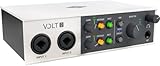
The Volt 2 is one of two interfaces in this guide with both MIDI In and MIDI Out on the chassis, the other being the Tascam US-2x2HR, and if you play a keyboard or run pad controllers in a live stream, that single port pair can be the reason to choose it over an otherwise comparable box.
The headline feature is Vintage mode, which uses Universal Audio’s modelling of the classic UA 610 tube preamp to add harmonic density to a vocal. It is not a subtle effect. Owners describe it as an audible benefit on voice, and the same owners accept that it is coloration rather than accuracy, so switch it on for a lead vocal and off for a flat capture when you want to add processing later.
Conversion runs at up to 24-bit/192kHz, the unit is bus-powered over USB-C at 650 grams and 5.12 by 6.85 by 2.09 inches, and it works with iPad and iPhone running iOS 14 or later, which makes it a genuine portable two-XLR recorder. The rating is 4.6 across roughly 750 reviews.
What you lose is control and cover. The direct monitoring balance between input and playback is not adjustable, so you cannot dial a blend the way you can on a unit with a hardware monitor knob. Input metering is limited to two LEDs, which is thin for a two-channel box. The UA Connect app is reported as buggy by some owners. And the warranty is one year, which is short, though the Tascam US-2x2HR later in this roundup covers even less. The software bundle is one of the broadest here, with LUNA DAW, UAD plug-ins, Ableton Live Lite, Melodyne, Virtual Drummer, Marshall and Ampeg emulations. Whether that justifies the purchase depends entirely on whether you will use a DAW at all.
When the Volt 2 is the right buy
It is right when a warm, present vocal matters more than a flat capture, particularly for a solo host who wants their voice to sound finished before any processing. It is also right if your setup involves a MIDI keyboard, a pad controller or a small live-streaming rig.
It is right for mobile capture. The iPad and iPhone support turns a two-XLR interface into a portable two-person recorder, which is the scenario the M-Track Duo also serves and the reason both appear on this list.
When the Volt 2 is the wrong buy
It is wrong if you need a monitor mix you can adjust, since the input-to-playback balance is fixed. It is also wrong for a two-person monitoring setup that needs independent headphone feeds, as there is one headphone output.
Skip it if buying a one-year warranty makes you uneasy on a device that will sit on a desk for years, and skip it if you want maximum clean gain for a low-output dynamic microphone, where a phantom-free tube-modelled preamp is not the tool for the job.
7. Focusrite Vocaster Two – Best for Podcasting Specifically
Focusrite Vocaster Two
Over 70dB of gain without a booster
Two mic inputs and two headphone outs
Auto Gain and Enhance
3 year warranty
Pros
- Two mic inputs plus two headphone outputs in one box
- Auto Gain and four Enhance voice presets
- Over 70dB of gain without an external booster
- Hardware mute button per channel
- Camera output and Bluetooth phone connection
Cons
- Fixed high-pass filter cannot be switched off
- No built-in sound pads
- Limited to 48kHz
- Plastic top surface marks easily
The Vocaster Two is the one pick here designed around the podcast format rather than adapted to it. It has two mic inputs and, crucially, two headphone outputs, so a host and a guest can each hear themselves without a splitter. The stated gain headroom is over 70dB, which is the one number in this roundup that directly answers the most common question in owner discussions, namely whether you still need a Cloudlifter-style booster.
For most situations the answer here is no. A dynamic microphone in the normal range for a spoken voice reaches usable level on this unit without an inline booster, which removes the single most common extra purchase in a first podcast setup. Auto Gain sets the level and the Enhance function offers four podcaster-oriented voice presets, from a brighter presence setting to a deeper, warmer one.
Around the two XLR inputs the feature list is unusually podcast-specific: a hardware mute button for each person, Bluetooth connection for taking a call from a phone, a TRRS connection for a mobile device, and a TRS camera output for feeding a video camera. It is 8.84 inches wide, 4.45 inches deep and 1.99 inches tall at 1.8 pounds, powered over USB-C, with a three-year warranty. The rating is 4.5 across 360 reviews, a smaller base than the other Focusrite in this list.
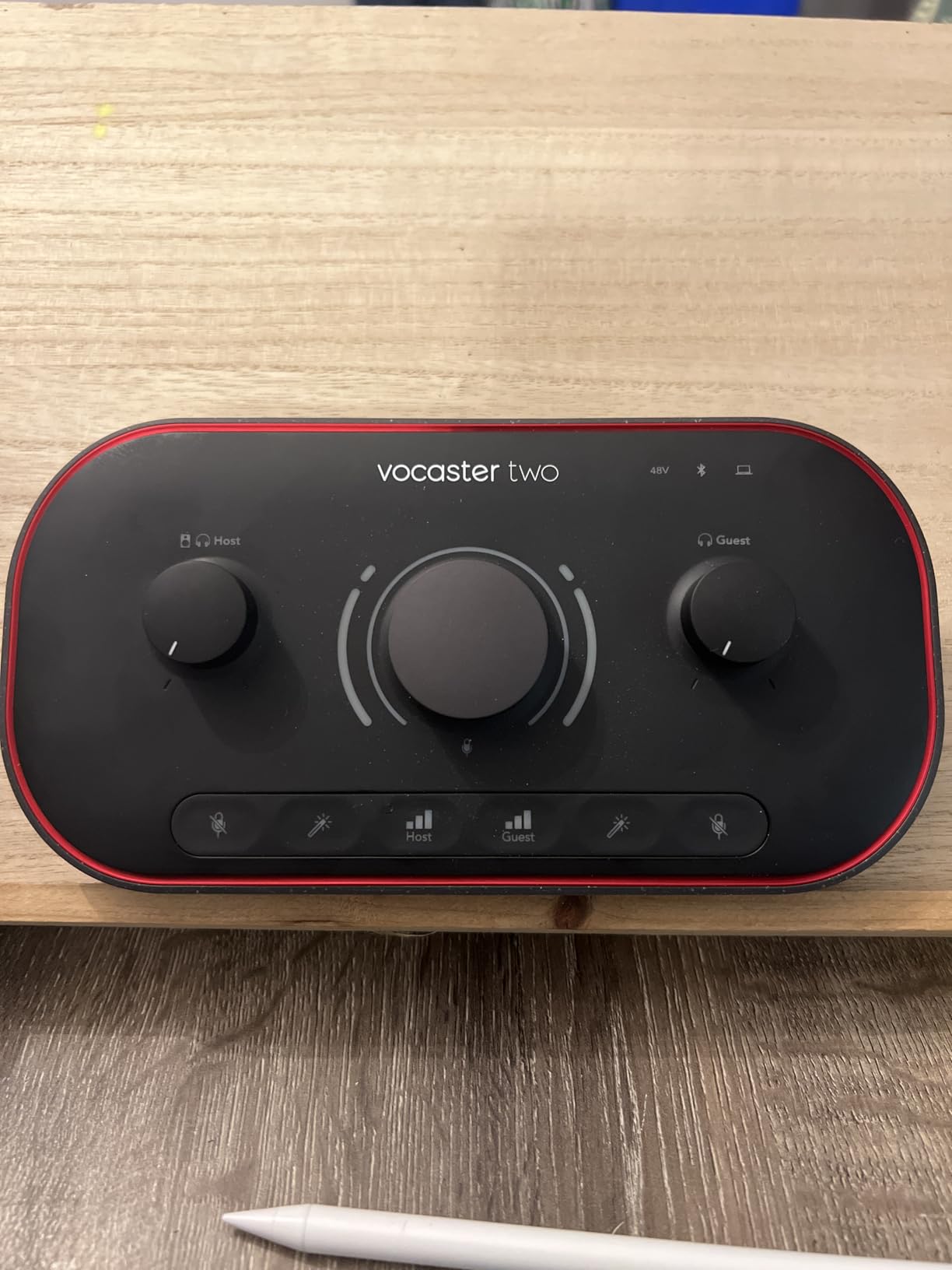
The design decisions that limit it are also podcast decisions. The high-pass filter is fixed and cannot be disabled, which removes some low-end weight from a voice permanently, and there are no built-in sound pads, so the classic pop-filter and arm-mount solution still applies. The Enhance presets are aggressive by design and can be dialled back in software if they sound too processed. Conversion is 24-bit/48kHz, which is ample for speech and not much more.
Two smaller notes from owners: the plastic top surface shows fingerprints and dust quickly, and the front-mounted headphone jacks stick out at an angle that can be awkward with thick headphone plugs. Some users also report feedback when the TRRS cable is used with an iPad, so test that combination before you build a routine around it.
The Enhance feature is the reason this unit rates well with beginners and less well with experienced engineers. If you want a completely flat signal to process yourself, the presets are in the way even when bypassed to zero, because the filter is what remains.
When the Vocaster Two is the right buy
It is right for a two-person show where you want one box to handle the whole signal chain: two mics, two headphone feeds, level setting, muting and getting a remote guest in over Bluetooth. The 70dB-plus of gain also makes it the shortest path to using a low-output dynamic microphone without buying anything else.
It is right if you are recording video alongside audio, because the camera output feeds a camera directly and removes one piece of routing. And it is right for a beginner, because Auto Gain and the four presets get a usable recording on the first take.
When the Vocaster Two is the wrong buy
It is wrong if you want an uncoloured capture. The fixed high-pass filter cannot be turned off, so there is no version of this unit that records your source completely untouched, and that rules it out for acoustic duo work where low frequency is the point.
It is also wrong above 48kHz, and wrong for anyone who wants MIDI, which is absent. If your two-person plan will grow into a four-person panel, this box is a dead end and a four-input interface is the correct starting point.
8. Tascam US-2x2HR – Best for Rugged Build, Physical Controls and MIDI
Tascam US-2x2HR 2 Mic 2IN/2OUT High Resolution Versatile USB Audio Interface for Recording, Streaming, Podcasting, Songwriting
2 Ultra-HDDA mic preamps
Metal chassis with monitor balance knob
MIDI In/Out
24-bit/192kHz
Pros
- All-metal chassis with a tilted base
- Ultra-HDDA preamps with 70dB plus of gain
- Hardware monitor balance knob for a performer mix
- Selectable buffer size down to 4 samples
- Works on Linux without a driver interface
Cons
- Only a 90 day labor warranty
- Authorized dealer requirement on warranty
- Some units report a high pitched whine
- MIDI and monitor controls add cost to a two mic setup
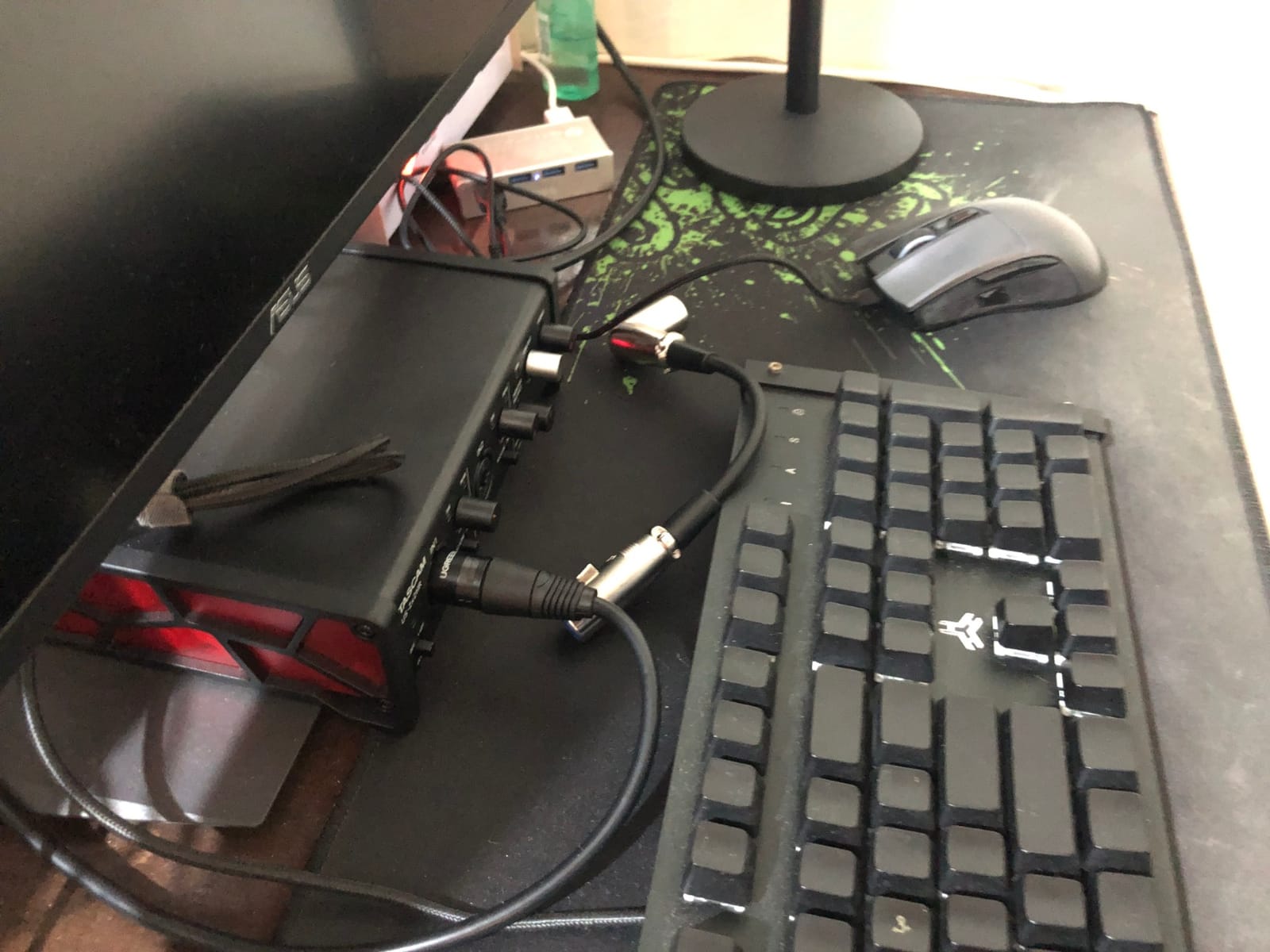
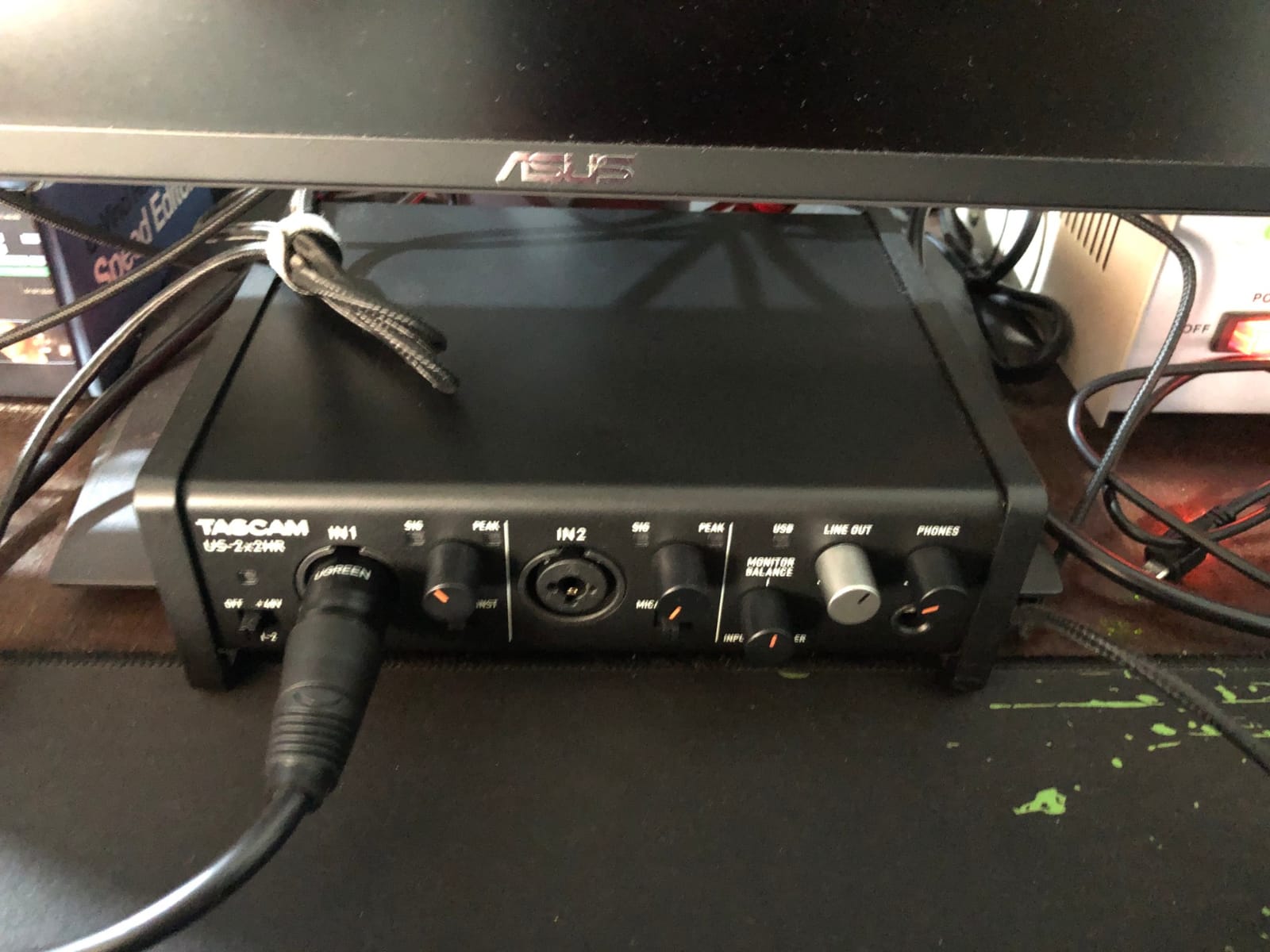
The US-2x2HR is the one to buy if your interface gets moved, packed and knocked about. It is a 0.6 kg metal-bodied box with a tilted base rather than a plastic one, at 16 ounces, and every control that matters is a physical knob. If your production machine is Linux, that hardware-first design is the difference between a working session and an afternoon of troubleshooting.
The two Ultra-HDDA preamps deliver 70dB plus of gain, which puts it alongside the Vocaster Two as one of only two models here with enough range to drive a low-output dynamic microphone without an inline booster. Conversion is 24-bit/192kHz, both inputs are combo XLR/TRS with instrument mode, and MIDI In and Out are included.
Two controls stand out. The buffer size is selectable down to 4 samples on Windows, which is an unusually low figure and directly relevant to round-trip latency when tracking. The monitor balance knob sets a hardware blend of input and playback, so a performer can hear themselves more or less while the recording stays fixed, without touching software.
The warranty is the weak point and it is a real one. Labor is warranted for only 90 days from the original purchase, and coverage is honoured solely through authorised dealers, so a second-hand unit carries no protection at all. For a device that sits on a desk for years, that is the most significant drawback in this roundup.
A small number of units report a high-pitched whine when microphones are connected, which is a component tolerance issue rather than a design flaw, but it is worth checking on return. The included Cubase LE version is also described as limited, and the sales ranking for this product is much lower than the seven above it, which tells you it is the least widely proven pick in this list at 4.4 across 303 reviews.
Against that, the physical design is the toughest here. Metal rather than plastic, a tilted base so the knobs face you, and knobs for everything including monitor balance, which means the unit works on a system with no driver control panel at all.
When the Tascam US-2x2HR is the right buy
It is right for a portable two-person setup, a mobile recording rig, or a studio where the interface will be handled regularly. Bus power and a metal body mean fewer things to go wrong in a bag than a light plastic unit with a USB Type B cable.
It is right for Linux users, and for anyone tracking a live performance where the 4-sample buffer option and the hardware monitor blend matter. The MIDI I/O also makes it the pick if a controller is part of the setup.
When the Tascam US-2x2HR is the wrong buy
It is wrong if warranty length is a deciding factor. Ninety days of labour cover, honoured only through authorised dealers, is the shortest protection of any pick on this list, and it is the reason this unit sits at eight rather than higher despite sound quality that would justify a better position.
It is also wrong for a session that needs two independent headphone outputs, since it has a single headphone jack, and wrong for anyone who wants to avoid the possibility of a component-level whine by testing another brand first.
How to Choose a Two-XLR Audio Interface in 2026
Two XLR inputs is a fixed requirement, so the decisions that remain are about headroom, phantom power, monitoring and expansion. Here is how I would work through them in order, using the units above as the reference points.
1. Match preamp gain to your microphone, not to your aspirations. A high-output condenser and a typical handheld dynamic sit in completely different parts of the gain range. If you plan to use a low-output dynamic microphone on a quiet vocal, check the stated gain figure first and work out whether you need an inline booster, because a second purchase after the interface is a common and avoidable outcome. Among the picks here, the Vocaster Two and the Tascam US-2x2HR both state more than 70dB of gain, which covers low-output dynamics without a booster. The M-Track Duo sits at the other end of the spectrum, and owners specifically note it running short of clean gain for an SM57 or similar.
2. Work out how many people you are actually monitoring. This is the most overlooked criterion in the two-input category. The Audient iD14 MKII has two headphone outputs with independent monitoring, and the Focusrite Vocaster Two has two headphone outputs as well. Every other unit in this guide has a single headphone jack, which means your guest either shares yours through a splitter or sits with no monitoring at all. If a co-host or an in-person guest is part of the format, treat two headphone outputs as a requirement rather than a nicety.
3. Check whether phantom power is global or per channel. The +48V supply is what a condenser microphone needs to operate, and it is what a passive ribbon microphone must not have. Several of the interfaces in this guide apply phantom power across both channels rather than letting you switch each one, which means a ribbon on the guest channel forces you to either change the microphone, route through a line input, or add an external phantom blocker. Anyone recording acoustic instruments alongside voice should treat per-channel control as a hard requirement.
4. Decide whether you need loopback. Loopback returns a USB playback signal into the recording inputs, which is what lets you capture a remote caller on a video call or add music beds to a livestream without a second piece of hardware. The Audient EVO 4 and the MOTU M2 both have it. For a purely in-room two-person show you can skip it, but for a hybrid format it is not optional.
5. Do not over-weight the sample rate ceiling. Five of the eight models here convert at 24-bit/192kHz. For spoken word and standard instrument tracking, 24-bit/48kHz is entirely sufficient and the file sizes are far more manageable. The units capped at 96kHz, the Audient EVO 4 and the iD14 MKII, lose nothing in practice for a podcast or a voice session.
6. Read the driver reports for your specific operating system. This is where the otherwise similar boxes separate. The Focusrite Scarlett 2i2 4th Gen, the MOTU M2 and the Audient EVO 4 all have owners reporting Windows driver problems, while macOS experiences are described as solid. The Tascam US-2x2HR is the mirror image: it works on Linux because it needs no driver interface at all. Whatever you run, test the interface on the machine you will actually record on.
7. Check what two inputs will cost you later. A two-input interface is the right buy for a host and a guest, a duet, a narration pairing, or a two-person livestream. It is the wrong buy for a three- or four-person panel, for tracking a duo of instruments plus a vocal, and for band rehearsal, where you need four or more inputs from day one. The Audient iD14 MKII is the one exception in this list, because its optical ADAT port expands to ten inputs later.
8. Look past the bundled software. Every unit here ships with something, from Ableton Live Lite and MPC Beats to LUNA and a full UAD plug-in library. Most working creators record in a DAW they already own and open none of it. Judge the purchase on the preamp, the monitoring and the driver behaviour, and treat the bundle as a bonus that may go unused.
A common question in owner discussions is whether a small digital mixer would serve the same purpose. For a two-person show, an interface with two headphone outputs gives you more control per channel than a basic mixer, and a mixer becomes the better answer once you are past two inputs and mixing several live sources with hardware faders.
Frequently Asked Questions
What audio interface has two microphone inputs?
Any interface with two balanced XLR jacks and a preamp behind each one records two microphones at once. All eight models in this guide qualify, including the M-Audio M-Track Duo, the Focusrite Scarlett 2i2 4th Gen, the Audient EVO 4, the MOTU M2, the Audient iD14 MKII, the Universal Audio Volt 2, the Focusrite Vocaster Two and the Tascam US-2x2HR. Two XLR inputs means each person gets their own track, own gain control and own edit decisions.
What is a good audio interface with 2 inputs?
For most two-person setups the M-Audio M-Track Duo is the dependable entry point, with the deepest review record in this group. If you want automated level control, the Focusrite Scarlett 2i2 4th Gen adds Auto Gain and Clip Safe. For the best conversion quality at this channel count, the MOTU M2 uses ESS Sabre32 Ultra converters. For a podcast format, the Focusrite Vocaster Two is built around two mic inputs and two headphone outputs.
Do I need a Cloudlifter with a two-XLR interface?
Usually not, because most low-output dynamic microphones reach usable level on a modern two-channel interface. The Focusrite Vocaster Two and the Tascam US-2x2HR both state more than 70dB of gain, which covers a Shure SM7B or similar without an inline booster. The exception is the budget end: the M-Track Duo runs out of clean gain for low-output dynamics, so a quieter recording there will need a booster or a different interface.
Is 2 XLR better than 4 XLR for podcasting?
Two inputs are the correct choice for a host plus one co-host or an in-person guest, because each person lands on a separate track with separate gain and editing control. Four inputs only become necessary for a three- or four-person panel, or for tracking instruments alongside a vocal. If you might grow into a panel show, the Audient iD14 MKII is the only pick here that expands later through its optical ADAT port.
What is the benefit of multiple audio inputs on an audio interface?
Multiple inputs let each performer record to a separate track instead of a single blended mix. That means individual level control, the ability to fix one voice with EQ or compression without touching the other, and the option to rebalance the conversation in post. It also lets a host and a guest each set their own gain, so a quiet speaker does not dictate the level of a loud one.
The Best Two-XLR Interface for 2026
The best audio interfaces with two XLR inputs are not one winner but a short ladder. Buy the M-Audio M-Track Duo if you want the most proven two-channel box with the deepest owner record and no frills. Buy the Focusrite Scarlett 2i2 4th Gen if you would rather the levels set themselves and you want the highest sample-rate ceiling in the group.
Buy the MOTU M2 if sound quality and readable metering decide it. Buy the Audient iD14 MKII when two independent headphone outputs and a future ADAT expansion path matter more than the sample-rate ceiling. Buy the Focusrite Vocaster Two when the format is a podcast and you want Bluetooth, camera output and a hardware mute per person. The Tascam US-2x2HR suits a portable or Linux setup, and the Universal Audio Volt 2 suits a warm vocal and a MIDI controller.
Whichever you pick, the decisions that follow are the same: check the preamp gain against your microphone, turn phantom power off for any ribbon or passive dynamic, and make sure the guest has a headphone feed of their own. Those three checks prevent most of the disappointments people report in the first month of owning a two-input interface.