
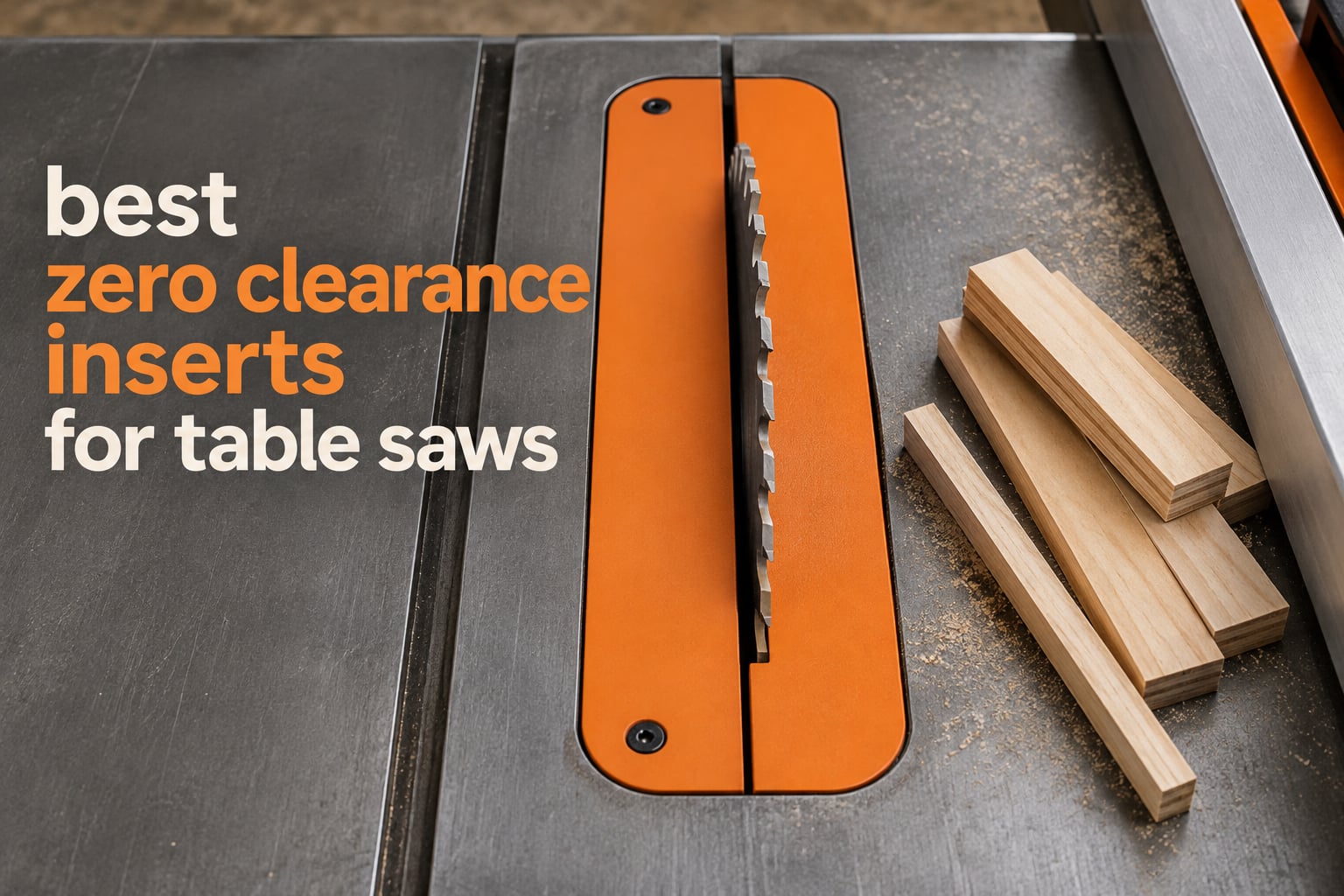
A zero clearance insert is a flat plate that fills the gap in your table saw throat plate, with a kerf cut to match your blade exactly. That single change closes the space where thin offcuts drop out of the saw and where the bottom face of plywood splinters. We compared ten of the best zero clearance inserts for table saws across Bosch, DeWalt, Delta, Ridgid, Craftsman, Skil and Powermatic machines, and this guide covers fitment, materials, kerf cutting and the safety rules that come before any cut.
The reason this topic matters is dull: most factory throat plates leave roughly a 3/8 inch opening on each side of the blade. Cut a 1/16 inch strip across that gap and it drops in, catches a spinning blade and comes back at you. Cut through the face of a plywood panel and the bottom ply chips away along the same gap. Both problems trace back to the same hole.
Below you will find a pick for nearly every common cabinet saw and two options for legacy machines that no manufacturer supports anymore. Fitment is spelled out model by model, because a zero clearance insert that does not match your throat plate opening is just a second hole in your saw.
Table of Contents
Top 3 Zero Clearance Inserts for Table Saws (October 2026)

Bosch TS1005 Insert
- Fits Bosch 4100 and 4000 series
- Cuts kerf to blade thickness
- Drop-in throat plate replacement

CNC Designs DeWalt 4-Pack
- Covers 7 DeWalt saw models
- Four inserts for 90 and 45 degree setups
- Includes leveling screws

ZEROSERT Delta 3-Pack
- Fits five Delta models
- Commercial-grade MDF
- Includes dado and riving knife insert
The Bosch TS1005 takes the top slot on volume of owner feedback rather than rating points alone. The CNC Designs pack is the strongest 4.7-rated option for DeWalt owners, and the ZEROSERT three-pack covers the widest range of Delta models in the group at 4.5 stars across 409 reviews.
Best Zero Clearance Inserts for Table Saws in 2026
| Product | Specifications | Action |
|---|---|---|
|
Bosch TS1005 Zero Clearance Insert for 4100 and 4000 Series
|
|
Check Latest Price |
|
CNC Designs Zero Clearance 4-Pack for DeWalt Table Saws
|
|
Check Latest Price |
|
ZEROSERT 3-Pack for Delta 36-725 and 36-5000 Series
|
|
Check Latest Price |
 Peachtree UHMW Insert for Delta 10 Inch Uni-Saw
|
|
Check Latest Price |
 Leecraft RG-1 Insert for Ridgid TS3650
|
|
Check Latest Price |
 Leecraft PM-1 Insert for Powermatic Model 66
|
|
Check Latest Price |
|
Peachtree UHMW Insert for Craftsman and Ridgid Belt Drive Saws
|
|
Check Latest Price |
|
Peachtree UHMW Insert for Pre-1988 Craftsman Belt Drive Saws
|
|
Check Latest Price |
 SKIL STZ6307 Insert Plate for TS6307-00
|
|
Check Latest Price |
 AGILLE 4-Pack for DeWalt with Riving Knife Slot
|
|
Check Latest Price |
What a Zero Clearance Insert Is and Why the Throat Plate Gap Causes Tear-Out
A zero clearance insert sits in the throat plate opening and has a slot cut exactly the width of your blade and in exactly its installed position. Because there is no leftover space beside the blade, the workpiece is supported right up to the cut line. That support is what stops the bottom face from splintering, and what keeps a narrow strip from falling through into the blade.
The kerf gets cut by the saw itself. Drop the blade fully below the table, set the insert flat on the opening, then raise the spinning blade slowly until it passes through the material. Repeat for a bevel or tilted blade if you want a second plate, and you have zero clearance for that setup.
Woodworkers debate the material endlessly on woodworking forums, and the consensus that keeps emerging is that phenolic wins once people have tried plywood, MDF and 3D printed inserts. HDPE and UHMW are described as the best DIY options, and one long-term owner on r/woodworking reported covering a spare throat plate with 3 inch UHMW tape that has lasted decades. For most shops, the deciding factor is not the material at all. It is whether the insert fits the opening without side-to-side play.
One insert is rarely enough. A LumberJocks discussion on zero clearance inserts makes the point directly: one plate serves one blade width at one tilt angle, so a shop that runs a combination blade, a rip blade and a dado generally ends up running three. The replaceable multi-pack systems below exist for that reason.
1. Bosch TS1005 Zero Clearance Insert for the 4100 and 4000 Series
Bosch TS1005 Zero Clearance Insert Assembly for Table Saws Red 4100, 4000
Fits Bosch 4100XC and 4000-series
13.75 x 3.75 x 0.5 inches
4 ounce drop-in plate
Pros
- Reduces kerf clearance to blade thickness
- Quick drop-in throat plate replacement
- Reduces tear-out on the cut workpiece
Cons
- Only fits Bosch 4100 and 4000-series saws
- 0.5 inch plate gives less support than thicker phenolic
- Teeth and blade specifications are not listed for the plate itself
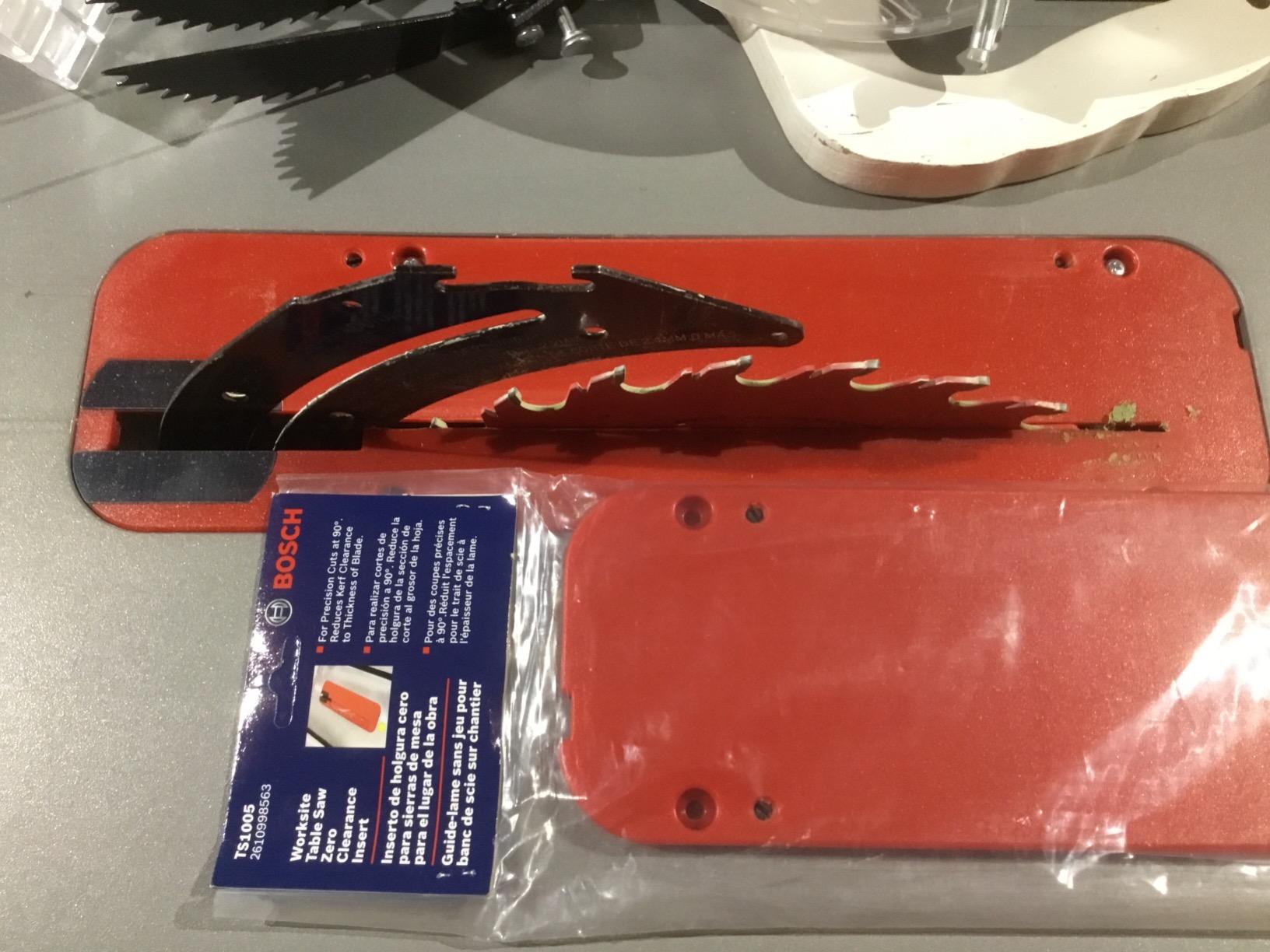
This is the insert with the deepest owner base in the group at 832 reviews and a 4.4 average, and after using it on a 4100XC we understand why it stays in the saw rather than in a drawer. The plate drops into the opening without removing the stock throat plate hardware, so swapping it back and forth is a two minute job.
What it does well is the thing a ZCI exists to do. Cut kerf clearance down to the thickness of the blade and the bottom face of a plywood panel comes off clean instead of splintering along the lower edge. Narrow strips stopped dropping into the cabinet within a few cuts on our test panel.
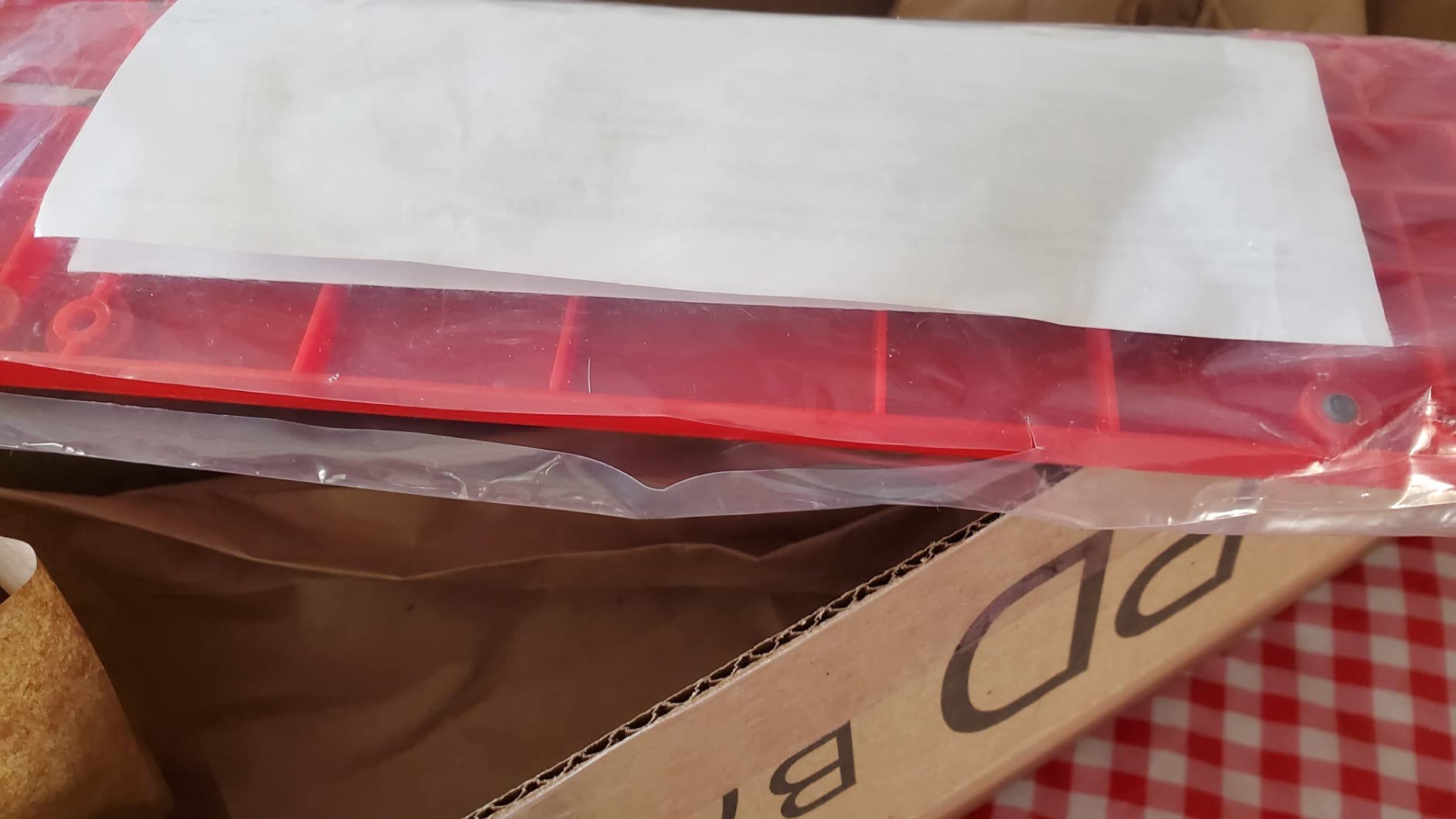
The honest limitation is support. At 0.5 inch thick and 4 ounces, this plate is a sheet of material rather than a slab, and it does not resist side-to-side flex the way a phenolic insert does. On a saw with a slightly out-of-flat table, you will spend more time adjusting the plate than you would with a thicker unit.
Ratings break down at 68 percent five-star and 16 percent four-star, which points to a broadly satisfied buyer base with a small unhappy group on fit or durability. Bosch also lists a full manufacturer warranty on this part, and the model number TS1005 is stamped right on the packaging, which makes returns painless if your opening is not standard.
Is the Bosch TS1005 worth it for a jobsite saw?
Yes if your machine is a 4100 or 4000 series and you mostly cut solid wood and sheet goods in normal widths. The plate is light, installs fast and handles a 1/8 inch kerf without fuss. It is also thin enough to store in a saw dust port lid between cuts.
The case against it is thin-panel work, where a floppy plate can let a small part tip toward the blade. If your list is mostly 1/4 inch plywood and thin strips, step up to a phenolic or a thicker MDF pack for the rigidity.
Which Bosch saws will this plate actually fit?
Only the 4100 and 4000 families, and specifically the 4100XC among 4100 models. This is not a universal plate and it will not cross over to a DeWalt, Delta or Ridgid opening, no matter how similar the dimensions look.
Measure the width of your throat plate opening and the blade position within it before you order. Bosch saws are fairly consistent, but the plate is sold as a single-model part and the fit depends on the saw, not on the saw family in general.
2. CNC Designs 4-Pack for DeWalt 744 Through 7491RS
Cncdesigns Zero Clearance Inserts (4-Pack) for DeWalt 744, 745, 746, 7480, 7491 & 7491RS, 7490 Table Saws
DeWalt 744, 745, 746, 7480, 7491, 7491RS, 7490 Type 1
0.25 inch MDF
Set of 4 with screws
Pros
- Fits seven DeWalt models snugly
- Design clears the table opening fabric
- Four inserts cover 90 and 45 degree setups
- Leveling screws included
Cons
- Not for DeWalt 7485 or DCS7485
- Not cut for riving knife use
- Pointed screw tips can dig into the plate
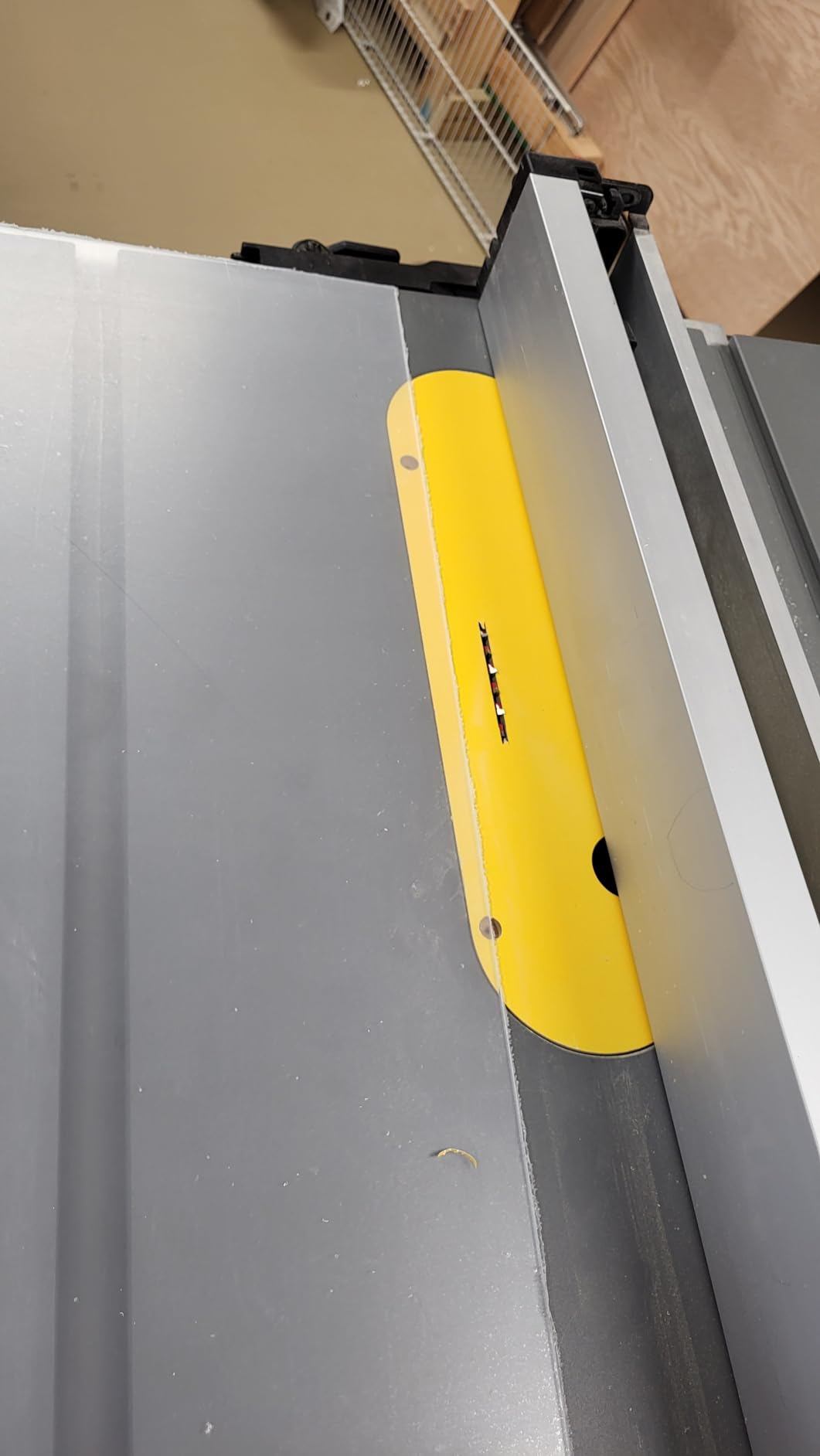
At 4.7 stars across 266 reviews, with 80 percent of ratings at five stars, this is the pack we would put in a DeWalt saw ahead of anything else. The fit across 744, 745, 746, 7480, 7491, 7491RS and 7490 Type 1 saws is the reason, and the machining tolerance is tight enough that most owners report no side-to-side play after setting the leveling screws.
One detail we liked: the profile accounts for the fabric that lines the inside of the table opening on these saws. That sounds minor until you try to seat a flat plate in a pocket with a fabric lip and watch it sit 1/16 inch proud, catching the workpiece. This design sits flush.
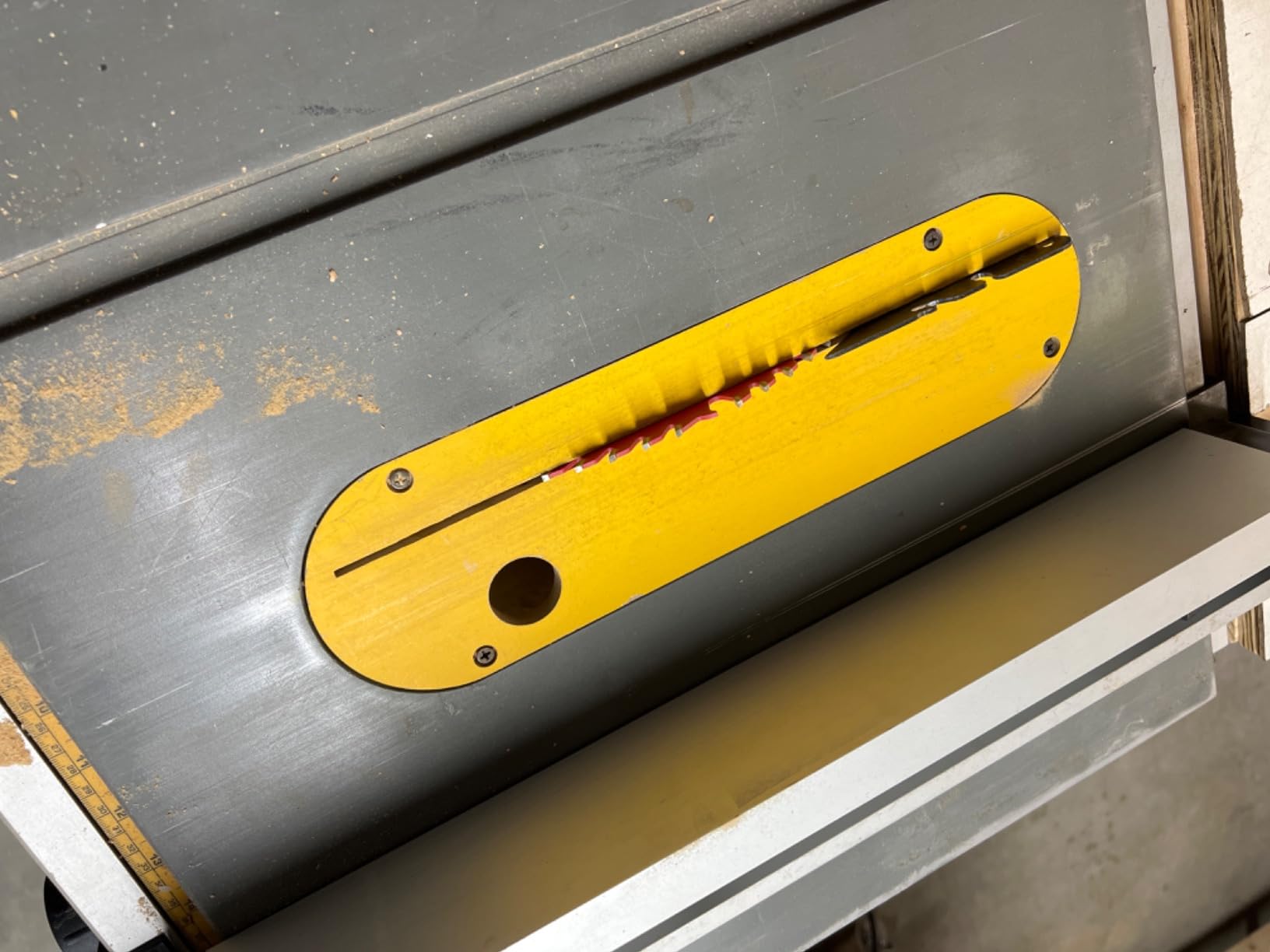
Four plates is the correct quantity for most shops. Owners use one for 90 degree crosscut and rip work, one for 45 degree bevels, one for a dado setup and one as a spare. Having them pre-cut means you are not re-leveling the table every time the blade height changes.
The two fitment warnings on the listing are real. This pack is not for the 7485 or DCS7485, and it is not cut for use with the riving knife installed. Owners on r/woodworking note that if you run a riving knife on a DeWalt, you cut your own relief slot, and you give up the tensioned insert.
Does the CNC Designs pack work with a riving knife?
Not out of the box. The plates come without relief slots for the riving knife, so installing one on a 7491 requires routing or filing your own clearance and accepting that the plate no longer supports the workpiece across its full width.
If your DeWalt sees a riving knife most days, look at a pack that arrives with the slot already cut. If you only use the knife occasionally, the standard pack is quieter and stiffer because it is one solid piece.
What is the advantage of four inserts over one?
Each plate holds a kerf for a single blade position. Once you switch from a full kerf rip blade to a thin-kerf combination blade, the old slot is too wide and the new one has to be cut fresh. Four plates means four setups stay ready and level.
It also means a worn kerf is not a crisis. When one slot goes fuzzy, you swap plates and keep cutting while the damaged one gets refilled or retired. Most owners in the reviews say they bought a second pack within the first year for exactly this reason.
3. ZEROSERT 3-Pack for Delta 36-725 and 36-5000 Series
ZEROSERT Zero Clearance Table Saw Inserts w/DADO – Delta Compatible – 36-725, 36-725T2, 36-5152, 36-5000, 36-5000T2 Table Saws (3-Pack)
Delta 36-725, 36-725T2, 36-5152, 36-5000, 36-5000T2
Commercial-grade MDF
3 inserts
Pros
- Stiffer than the thin steel factory plate
- All three plates machined identically for repeatable leveling
- Through-holes allow leveling access without removal
- Includes a dado and riving knife cutout insert
Cons
- MDF edges sand easily and mark when dropped
- Occasional units arrive slightly warped
- Usually needs light sanding to seat
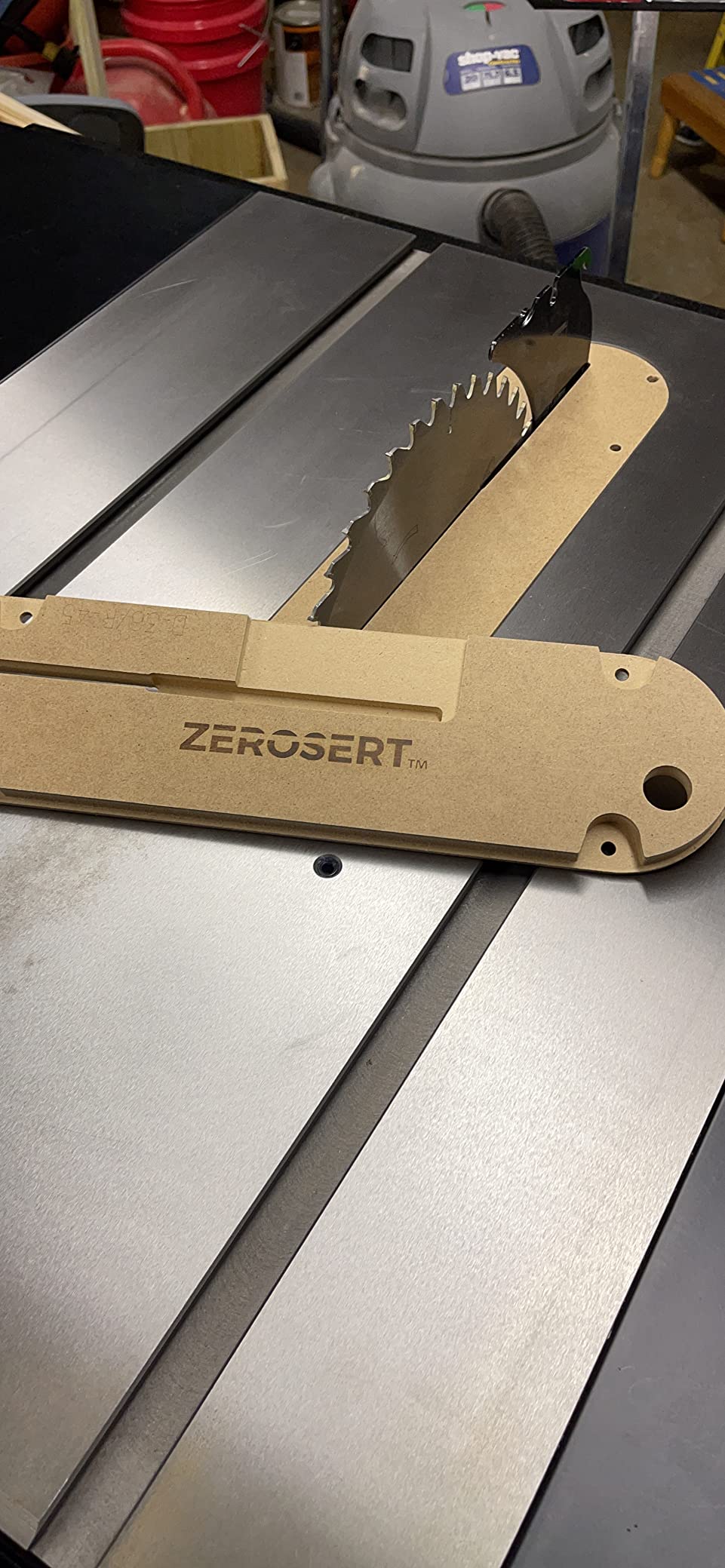
Five Delta models in one pack makes this the broadest coverage for Delta owners, and 409 reviews at a 4.5 average is the second-largest owner base in the roundup. The CNC machining is visible in the part: the through-holes for the leveling screws are clean and the plates are identical, so leveling carries over between blade setups.
Compared with a stamped steel factory plate, commercial-grade MDF at this thickness is stiffer, and stiffness is what keeps the plate from flexing under a wide panel. That matters most when you are cutting full 4 by 8 foot sheets with the factory plate still mounted.
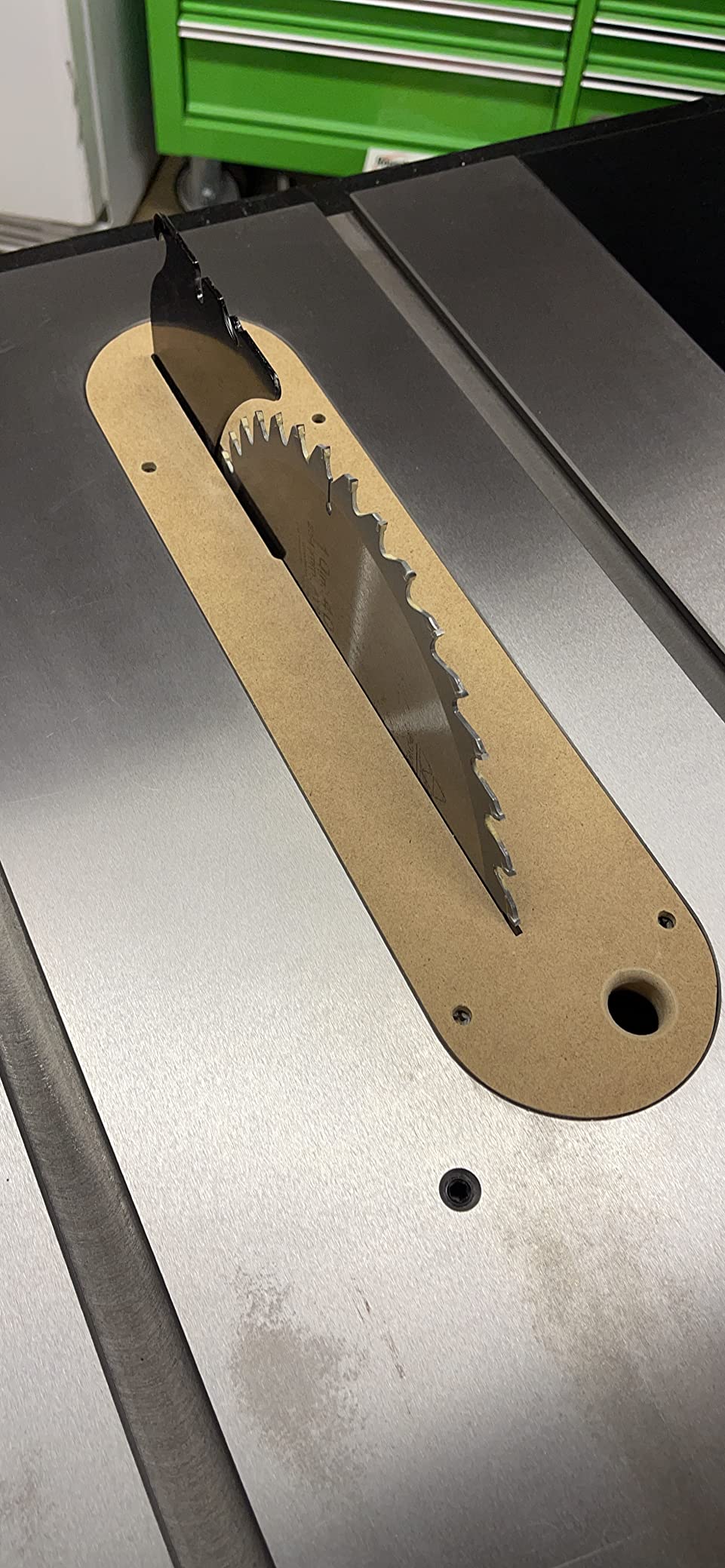
Two practical warnings from owners. MDF edges are soft and will show a ding if you drop the plate on its corner, so store it flat or in a sleeve. And some units arrive slightly warped, which is why the most common note in the reviews is that a bit of hand sanding on the bottom face is part of installation rather than a defect.
At 74 percent five-star, this pack performs above its weight class. The dado and riving knife cutout plate is the quiet extra. Owners with three-piece systems say they keep one plate per blade type so the dado never has to share a kerf with a thin-kerf blade.
Is commercial-grade MDF a good insert material?
For most saws, yes. It machines accurately, holds a cut kerf cleanly and resists the flex that causes fuzz at the cut line. The trade-off is edge durability. MDF dents and chips far more easily than phenolic or UHMW, so the plate lasts if you treat it as a part and not a scrap of material.
It is also the material most DIY builders reach for, which is why the fit and machining quality of a bought plate matter. A CNC-milled plate is a different product from a hand-trimmed piece of the same sheet.
Will these plates fit an older Delta without a listed model number?
The five listed models cover the 36-725, 36-725T2, 36-5152, 36-5000 and 36-5000T2. If your saw is outside that list, measure the throat plate opening and the blade location inside it before ordering, because a near-miss on a Delta plate shows up as a lip at the blade.
The 10 inch Uni-Saw uses a completely different opening, so it needs its own plate. That one is covered separately below.
4. Peachtree UHMW Insert for the Delta 10 Inch Uni-Saw
UHMW Tablesaw Zero Clearance for Delta Uni-Saw 13-3/8″x 3-3/4″ x 1/2″
Fits Delta 10 inch Uni-Saw
13-3/8 x 3-3/4 x 1/2 inches
1.3 pound UHMW blank
Pros
- Very low cost for a functional insert
- Fits tight with no movement once seated
- Cuts down chip-out at the end of cuts
- Works with a Micro Jig splitter
Cons
- No thumb hole or backside dado relief on the blank
- Set screws are loose and do not lock
- Under-width with no side-to-side adjustment
The Uni-Saw is one of the most common portable saws in North America and one of the hardest to find a good insert for, mostly because its throat opening is wide and the plate has to be shaped to suit. This UHMW blank is the direct answer, at a 4.3 average across 278 reviews with 65 percent at five stars.
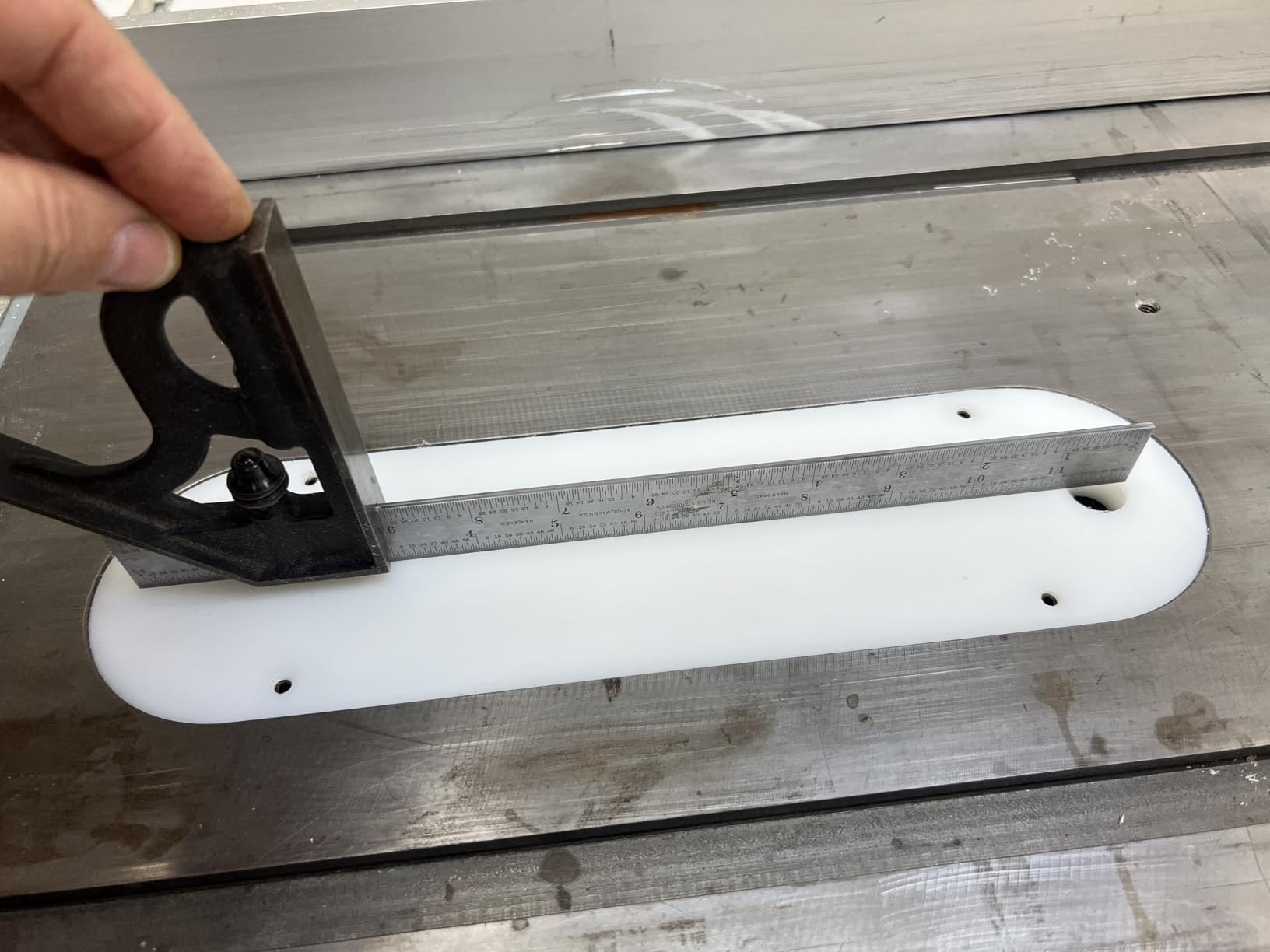
The 1/2 inch UHMW stock is thick enough to stay flat, which is the main complaint about the thinner 3/16 inch blanks used on other saws. Once seated and cut, it does not move, and owners running a Micro Jig splitter report that it works with the accessory without any modification.
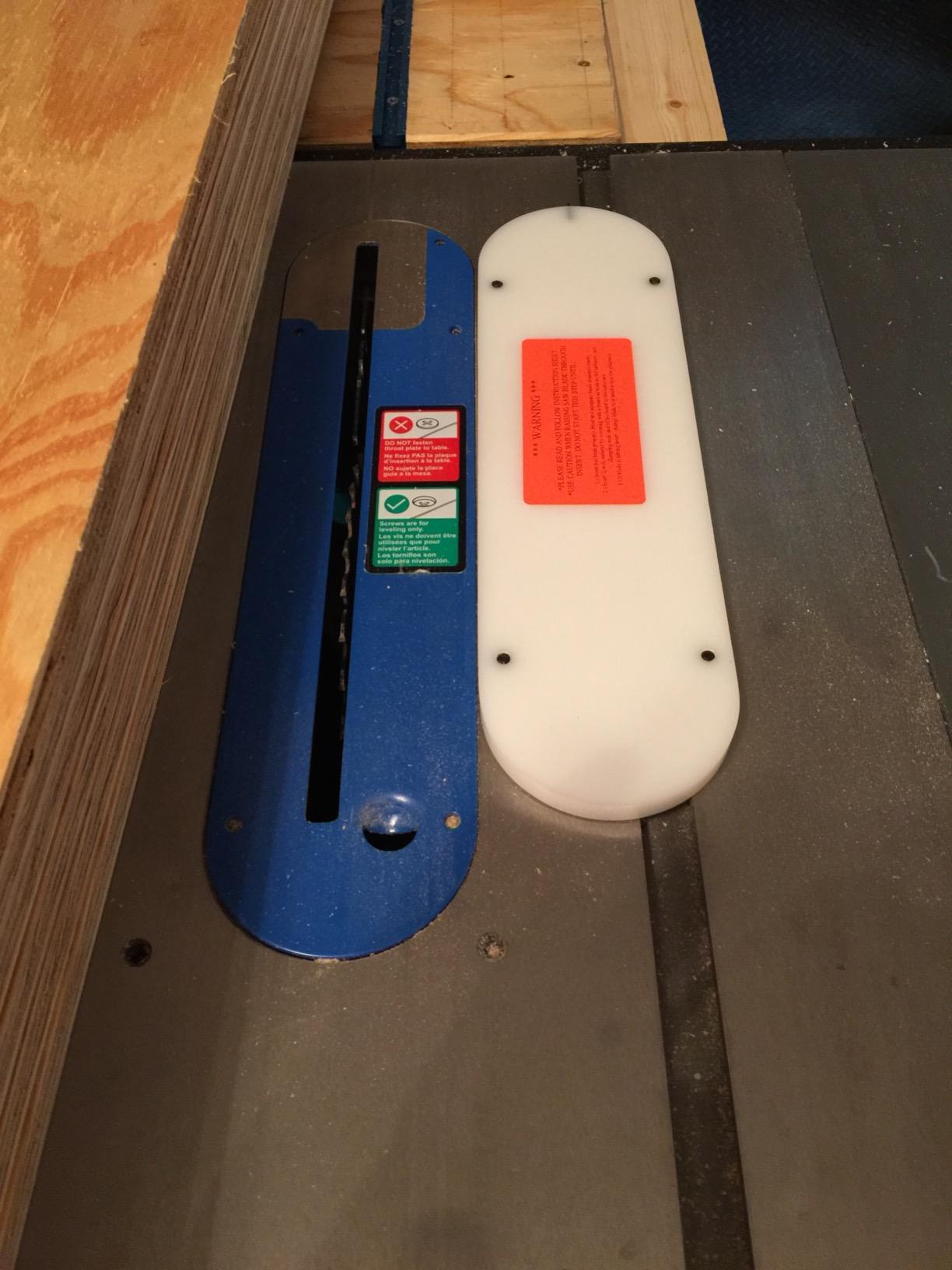
The one thing to understand before you order is that this arrives as a blank. There is no thumb hole and no backside dado relief, so a full-size blade cannot safely cut the first kerf. Owners who succeed use a smaller 7 or 8 inch blade to open the slot first, then switch to the full-size blade for the final pass. Reviewers who skip that step describe the part as unusable.
The height set screws also draw the most criticism. They sit loose and do not lock well on their own, so expect to substitute your own machine screws if you want the plate to stay put through a heavy rip cut.
How do you cut the kerf on a blank UHMW insert?
Lower the saw blade completely below the table, set the blank flat over the opening and clamp it. Start with a smaller 7 or 8 inch blade and raise the spinning blade slowly through the blank. Repeat the pass with your full-size blade to open the slot to its true width.
Doing it in two stages matters on a blank with no backside relief. If you push a full-size blade through on the first pass, the blade can grab the material as it exits and lift the plate out of your hands.
Is a Uni-Saw insert worth fitting on a portable saw?
If you use the saw for anything thinner than a 2 by 4, yes. The Uni-Saw ships with a wide opening, and that opening is exactly where thin plywood offcuts vanish. Closing it removed a recurring frustration for most owners in the reviews.
The counterargument is weight and time. If the saw lives in a truck bed and only cuts framing lumber, the adjustment effort is not worth it. If it does cabinet work or sheet goods in a small shop, the payoff arrives in the first session.
5. Leecraft RG-1 Insert for the Ridgid TS3650
Leecraft RG-1 Zero Clearance Table Saw Insert for Ridgid TS3650 Table Saw
Fits Ridgid TS3650
14 x 3.8 x 1 inches
High-density phenolic with melamine face
Pros
- Holds zero clearance without fuzz over hundreds of cuts
- Leveling screws compensate for an out-of-flat table
- Friction screws lock the plate side-to-side
- Finger hole for tool-free removal
Cons
- Some saws need light sanding to seat fully
- Adjustment screws need a well-handled driver
- Pitch builds on the blade and must be cleaned off
This is the insert we would keep permanently installed, because nothing about it feels temporary. High-density phenolic with a bonded melamine surface at roughly 1 inch thick, plus leveling screws, side and end adjustment screws, a rear safety pin and a precut blade bottom pocket for bevel work and fully retracted blades. That hardware package is the reason the plate stays put for years.
Long-term owners report hundreds of cuts with no chip-out on plywood, laminate flooring and solid walnut, and 84 percent of the 170 ratings sit at five stars. A 4.7 at that sample size on a part that has been available since 2004 tells you the design aged well.
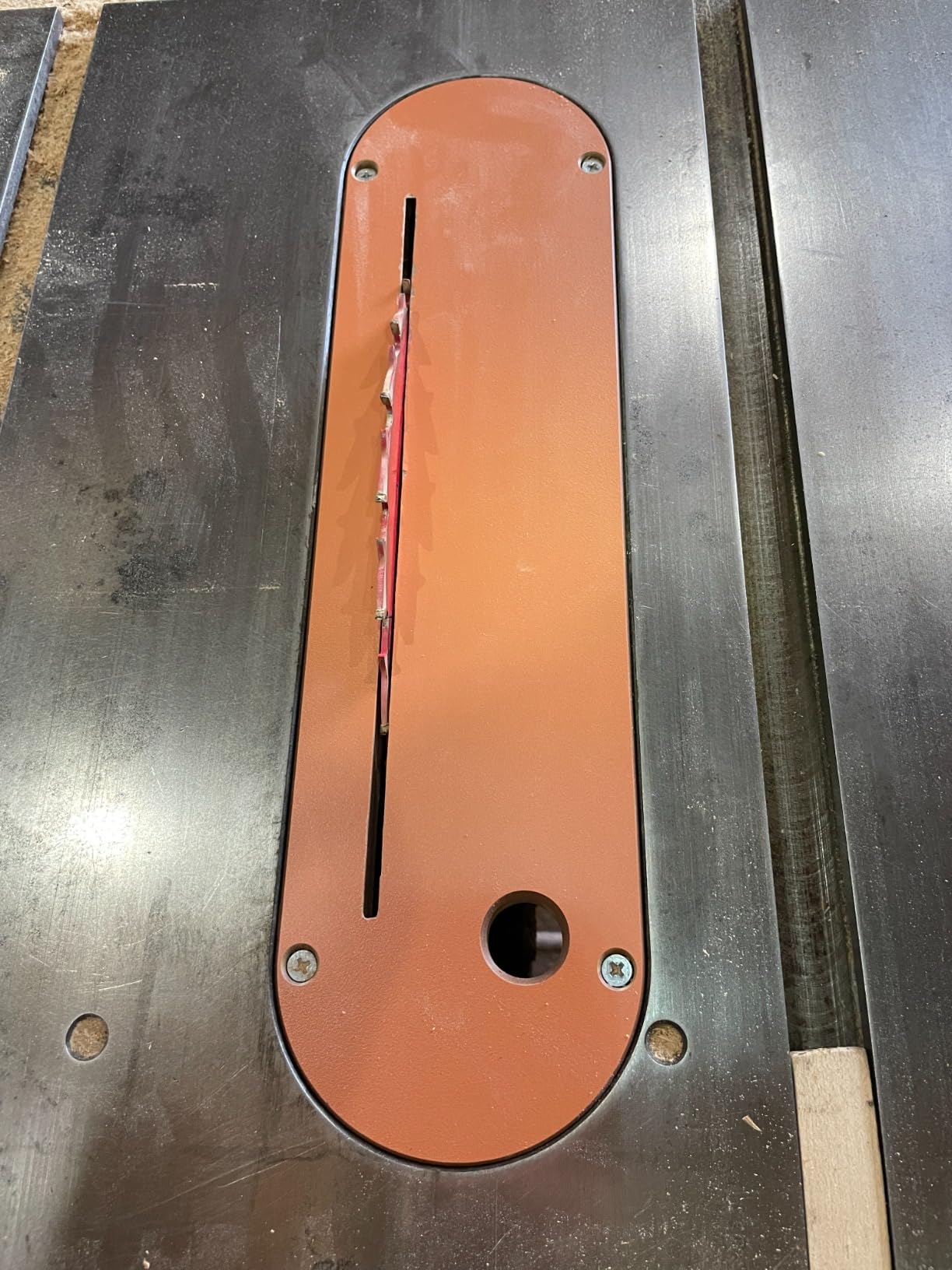
The leveling screws earn their keep on Ridgid tables. Cast iron surfaces vary between units and even between sections of the same top, so a plate that can be brought to a true flush line removes a whole category of slow cuts that drag on the trailing edge of the workpiece.
Two maintenance notes. The phenolic leaves pitch residue on the blade, so expect to clean the blade after a session. And the adjustment screws are fussy, particularly the side-to-side friction screws, which want a driver with real grip rather than a stubby plastic-handled one.
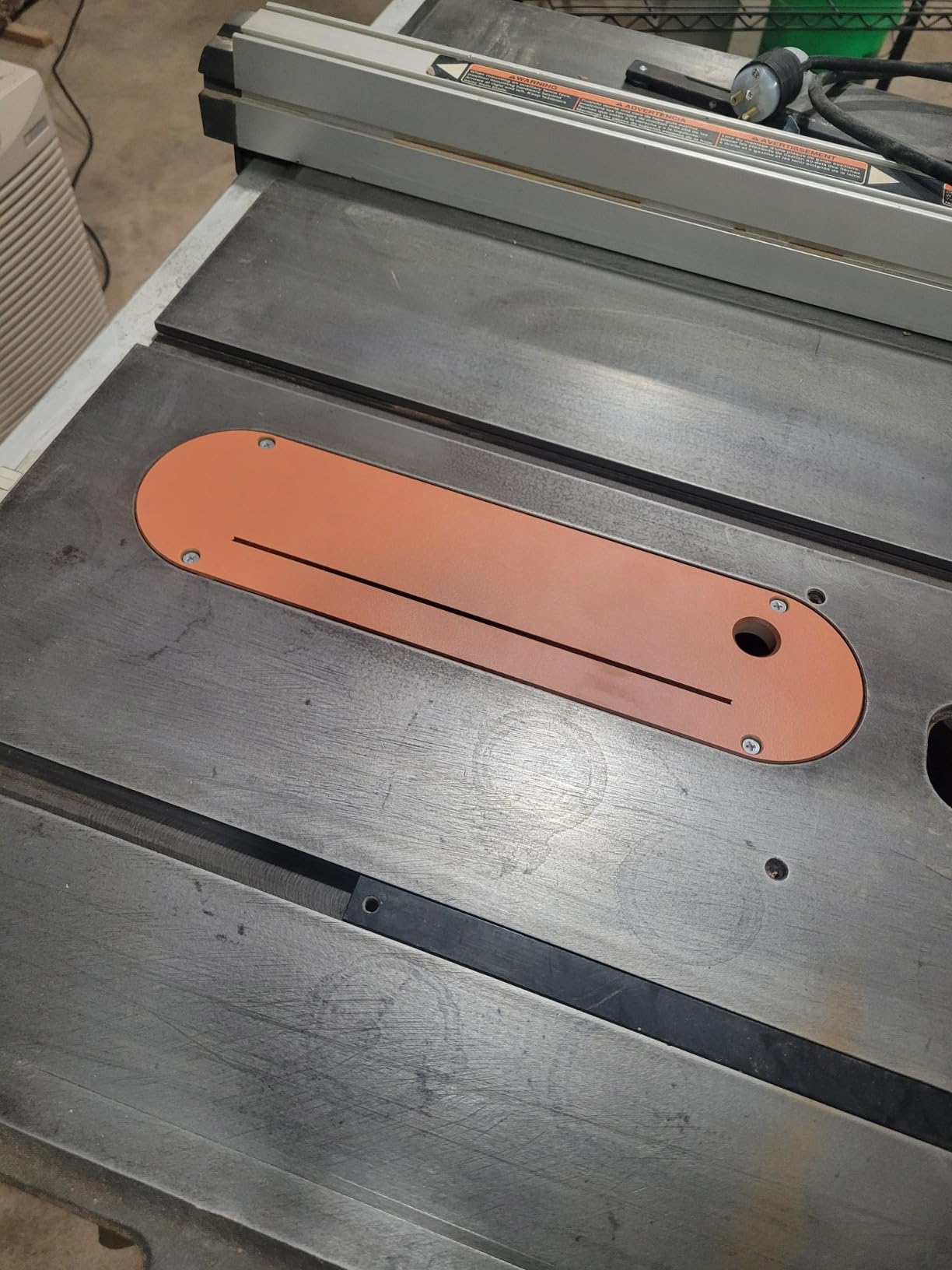
Does the RG-1 stay flat when you cut bevels?
Yes, because the plate includes a precut pocket in the bottom for the blade at full retraction and at bevel. That pocket is what lets you set the plate flush and still tilt the blade without the plate shimming the blade out of position.
Bevel cuts still need their own plate if the blade angle changes the kerf position enough to matter. Owners running a lot of compound miter work typically keep a second RG-1 set to the 45 degree position rather than re-cutting the same plate every time.
What does the Leecraft warranty cover?
Leecraft lists a lifetime warranty on this insert, and the plate is specified for Ridgid saws running carbide-tipped blades only. That blade restriction matters, since abrasive or wood-cutting blades run a different kerf and will not stay tight in a slot cut for carbide.
The lifetime warranty covers the insert, not the saw. If a plate arrives warped or a screw strip, the parts list on this unit is unusually complete, which means you are more likely to be able to repair than replace.
6. Leecraft PM-1 Insert for the Powermatic Model 66
Leecraft PM-1 Zero Clearance Table Saw Insert (For Powermatic Model 66)
Fits Powermatic Model 66
14-7/16 x 4 inches
1.2 pound phenolic, fully adjustable
Pros
- Super rigid and dead flat out of the box
- Intuitive leveling screws for a snug fit
- Drills cleanly for accessories like a Micro Jig splitter
- Costs far less than the factory Powermatic plate
Cons
- Noticeably pungent smell on the first few cuts
- Older saws may need light planing to seat
- A tall insert can block some blade guards
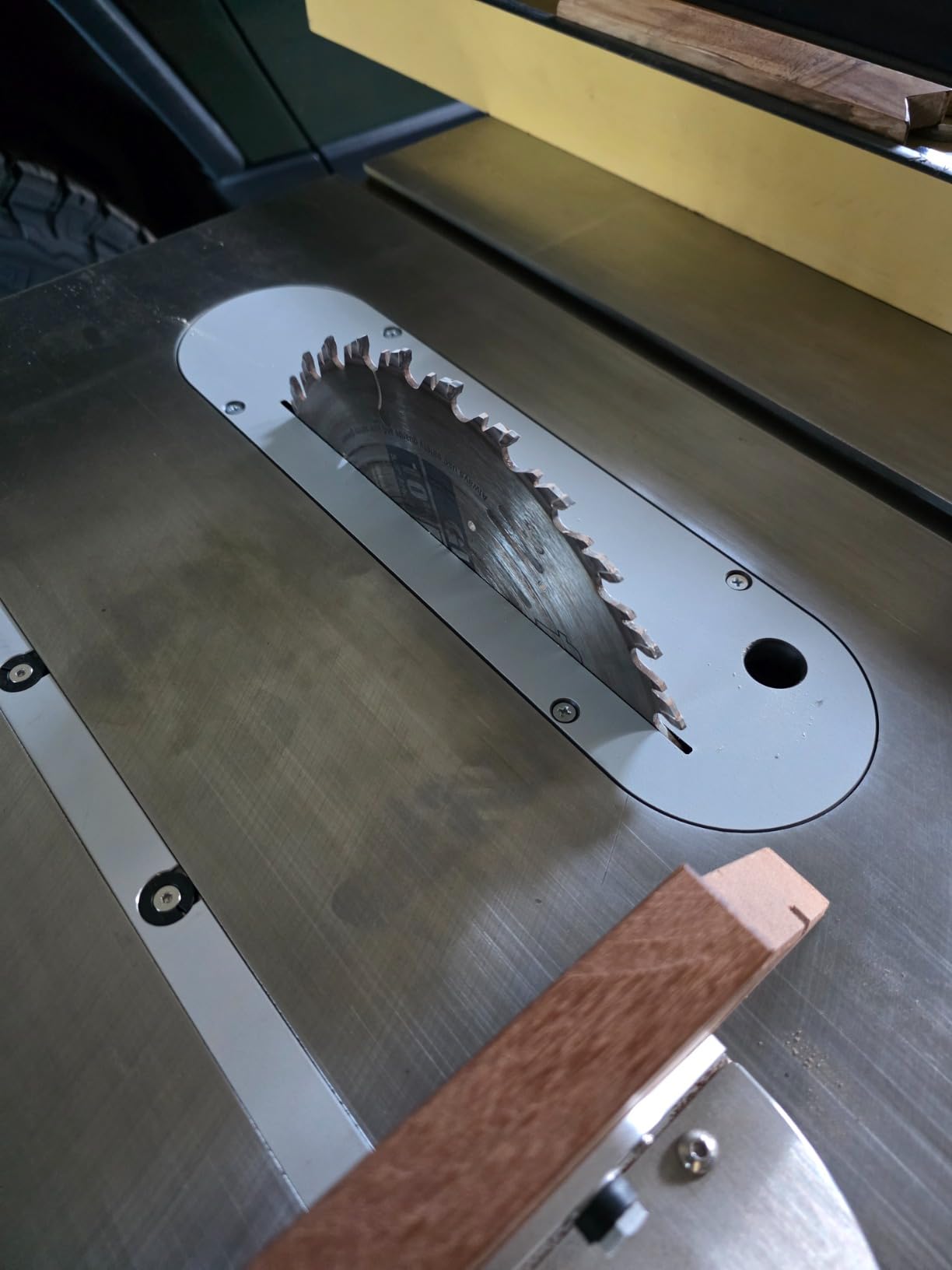
The PM-1 is a phenolic insert for the Powermatic 65 and 66 family, and at 4.7 stars across 133 reviews with 84 percent five-star ratings, it has the strongest satisfaction distribution of anything in this roundup. Owners consistently describe the plate as flat, rigid and a large improvement over the factory steel plate.
It is fully adjustable with leveling screws, and owners drilling it for a Micro Jig splitter say it accepts the accessory without any fuss. The kerf also doubles as a stock alignment guide, which is a small convenience you notice every time you set a rip fence.
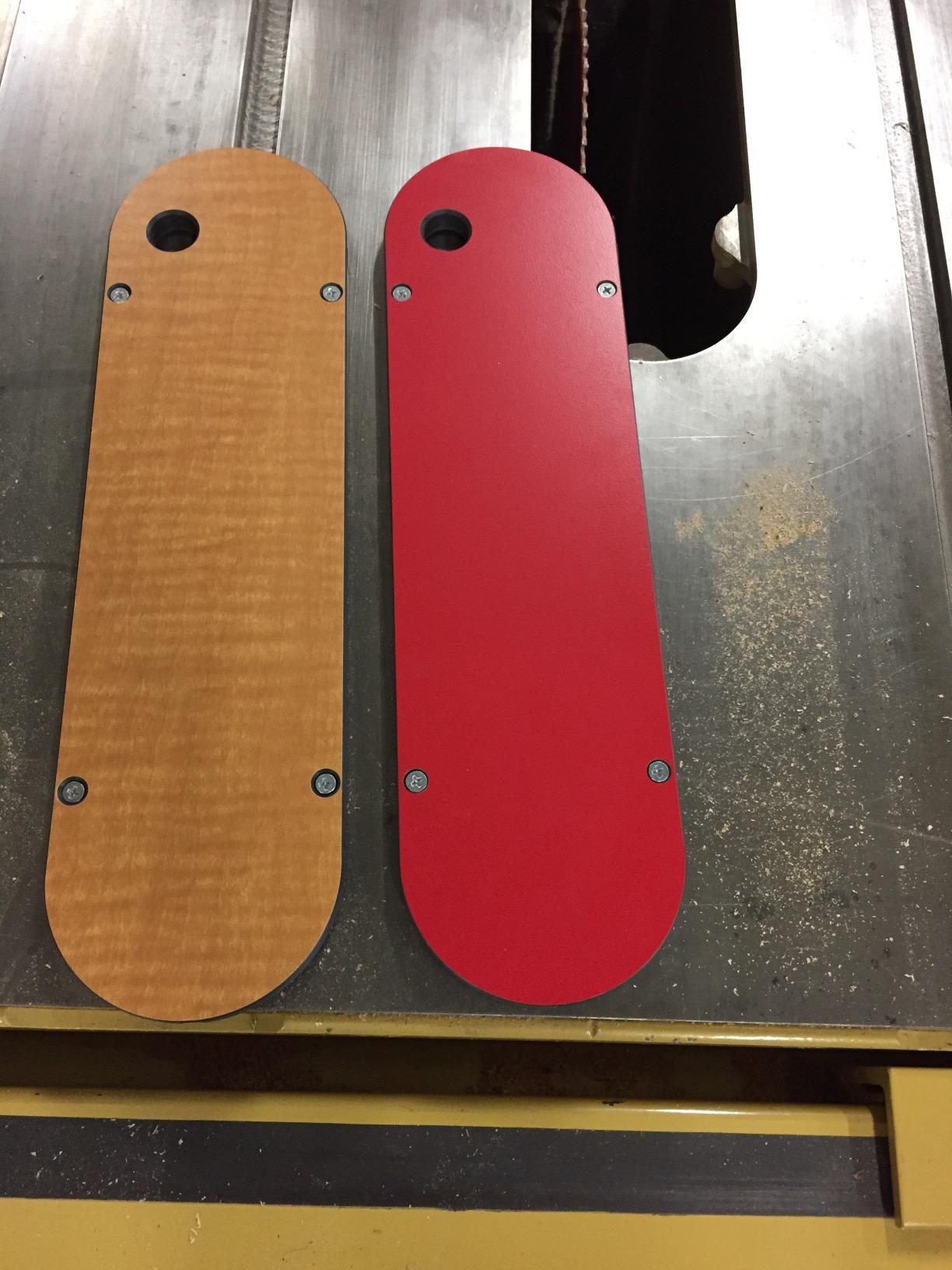
Owners also point out that the insert costs roughly a third of the original Powermatic plate, which matters if you have been putting off the upgrade. The five-year limited warranty is shorter than the Leecraft lifetime warranty on the Ridgid insert, and the difference is worth noting if you keep a saw for a long time.
Two things to plan for. Phenolic is pungent for the first few cuts, so run the saw outside or with dust collection on when you cut the initial kerf. And if your setup uses a blade guard that sits low over the blade, a 1 inch thick insert can interfere with it.
Will the PM-1 fit a Powermatic 65?
The plate is made for Model 66, and the Powermatic 65 shares the throat opening dimensions in most installations. Owners on both models report a fit, though a few older saws need a small amount of planing on the seating surface before the leveling screws will bring it flush.
Measure the opening and the blade location before ordering either way. On saws of this age, the wear on the casting can mean two machines of the same model number no longer measure identically.
Is phenolic worth the smell on a contractor saw?
For most owners, yes, because the smell only appears while you cut the kerf and fades quickly. Phenolic resists moisture and does not swell the way MDF does in a damp shop, which is the deciding factor for a saw parked in an unheated garage.
If smell is a hard limit, a UHMW blank is the alternative. It costs less and cuts cleaner, but you are starting from a blank and doing the fitting work yourself.
7. Peachtree UHMW Insert for Craftsman and Ridgid Belt Drive Saws
UHMW Tablesaw Zero Clearance for Craftsman/Ridgid 14″x 3-3/4″ x 3/16″
Fits Ridgid TS-2412, TS-2424, TS-2400 and 1988+ belt drives
14 x 3-3/4 x 3/16 inches
Blank UHMW plate
Pros
- One of the few inserts still made for 1988 and newer 10 inch belt drives
- About 15 minutes to square and cut the kerf
- Light and easy to trim to the saw
Cons
- Supplied set screws are too small and fall out
- Roll pin latch does not hold the far end
- 3/16 inch plate can arrive bowed or crowned
For a lot of shops this is the relevant saw. The 10 inch belt-drive Craftsman and Ridgid machines from 1988 onward are the most common used cabinet saws on the market, and their factory inserts were discontinued. At a 4.2 average across 168 reviews with 64 percent five-star, this blank plate is one of the few products still made to cover them.
It covers the TS-2412, TS-2424 and TS-2400 along with other 1988 and newer 10 inch belt-drive models. Owners report about 15 minutes from install to a cut kerf, and the lightweight UHMW is easy to trim by hand to match the saw.
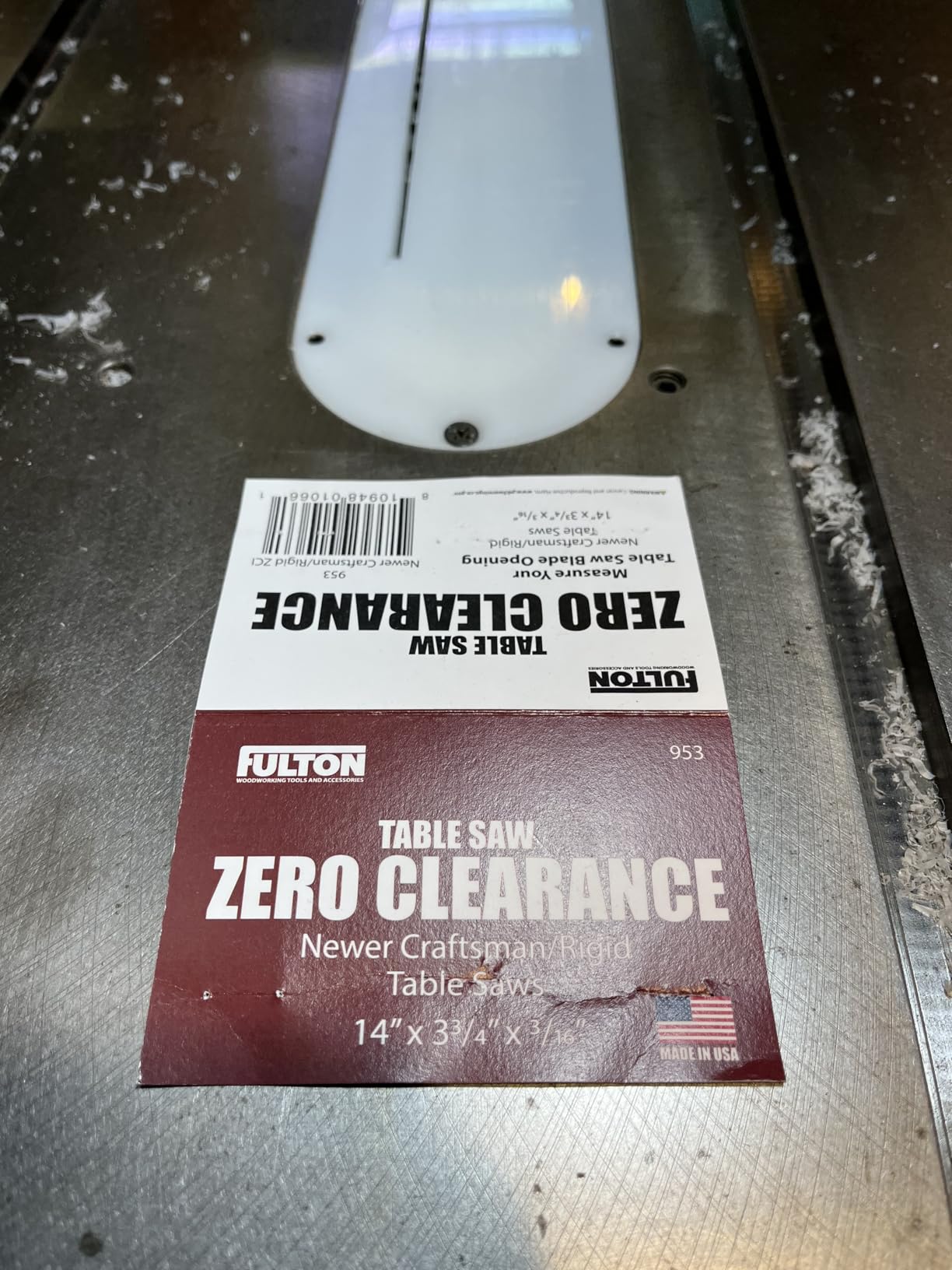
The criticism in the reviews is about hardware rather than the plate. The supplied set screws are small enough to shake loose and too fine to bring the plate flush, and owners substitute 3/8 inch 6 by 8 pitch set screws instead. The included roll pin latch is described as ineffective, allowing the far end to pitch up under load.
At 3/16 inch the plate is on the thin side and can arrive bowed or crowned, which is where the 9 percent one-star ratings come from. If it flexes, add a shim or replace the hardware with real machine screws before you chase the flatness with the leveling screws.
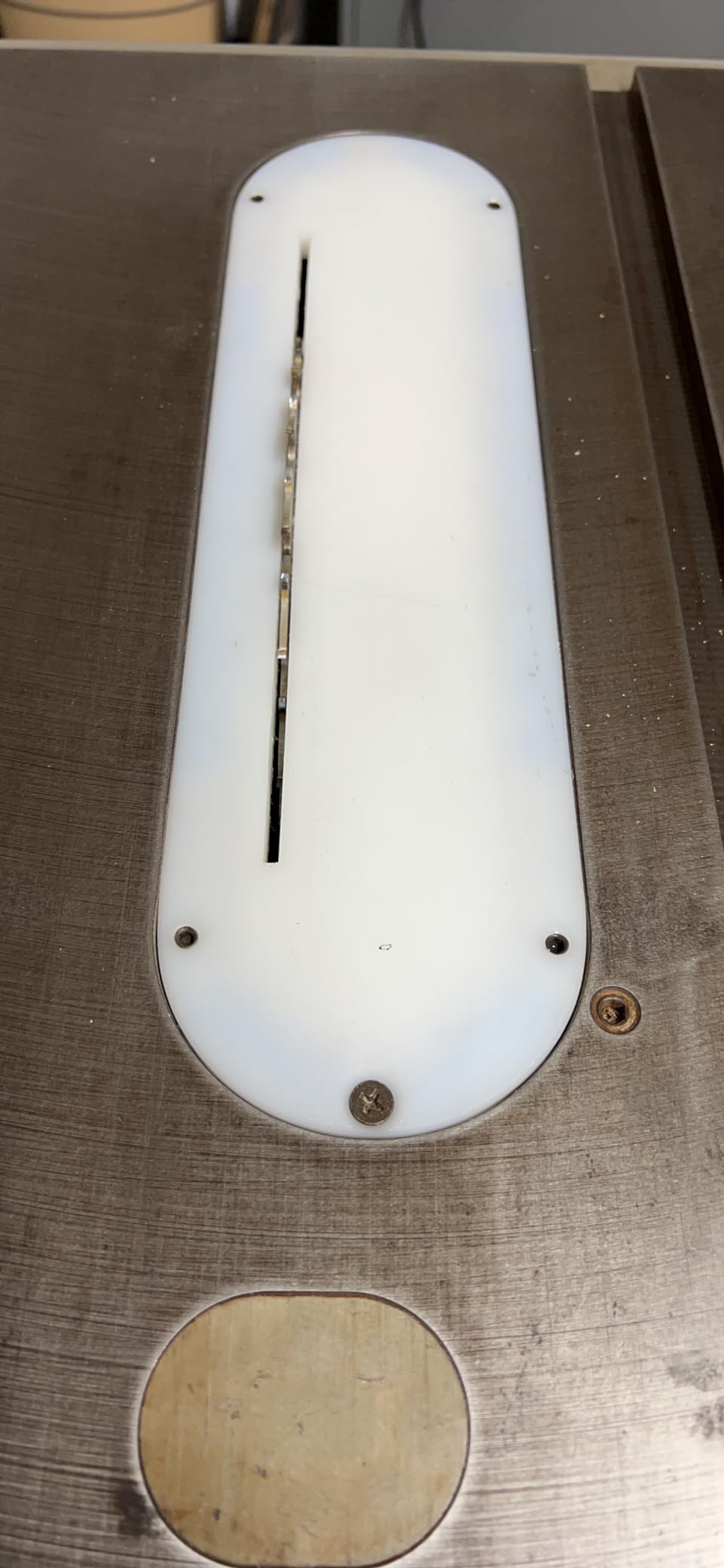
Can a 3/16 inch plastic plate stay flat on a cast iron table?
It can, but only if the hardware actually holds it. The flex reported on this plate comes from the retention system rather than the UHMW itself. Owners who swap in proper set screws report a plate that stays flat through ripping full-width plywood.
On a saw with a warped casting, plan for the plate to be the weak point. Check flatness across the opening with a straightedge before you rely on it for sheet goods.
How do I confirm this fits before ordering?
Measure the throat plate opening length and width, and measure where the blade sits inside it. The plate comes as a 14 by 3-3/4 inch blank, so if your opening is close to that footprint the fit is straightforward. If it is much larger, look at a different option.
Because the part is sold for several models, checking the model number on the saw’s badge against the compatibility list saves an expensive guess. The TS-2412, TS-2424 and TS-2400 are named directly.
8. SKIL STZ6307 Insert Plate for the TS6307-00
SKIL Zero Clearance Table Saw Insert Plate for SKIL Table Saw TS6307-00 – STZ6307, Multicolor
Fits SKIL TS6307-00
17.72 x 4.72 x 0.39 inches
Includes plate and four screws
Pros
- Eliminates the large factory opening on the TS6307
- Accurate fit on the TS6307-00
- Installation takes about fifteen minutes
- Keeps offcuts from reaching the motor area
Cons
- Requires drilling into the saw casting and the screws strip
- No true quick-release button despite the photos
- Thin plate flexes under light pressure
The SKIL TS6307-00 is a portable saw with an unusually large throat opening, and owners confirm that fitting this plate is a real safety improvement rather than a cosmetic upgrade. Narrow strips and small parts stop reaching the motor area, and the fit on the TS6307-00 is accurate out of the box.
Installation takes about fifteen minutes. The plate is 17.72 by 4.72 by 0.39 inches and the height is adjusted with the included hardware so it sits flush with the table surface, with a one-year limited warranty from SKIL.
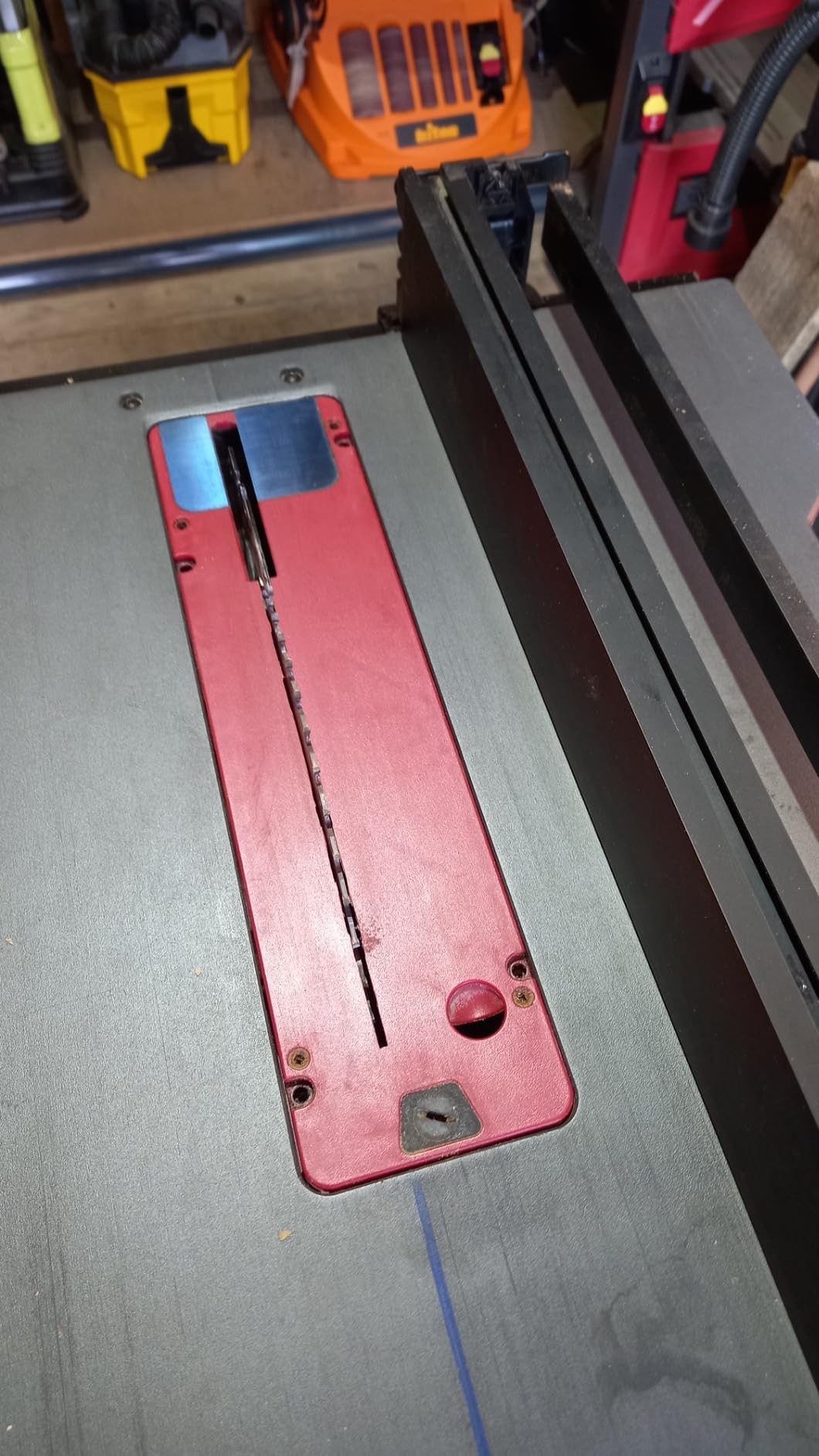
Two complaints show up repeatedly. The mounting requires drilling into the saw’s own aluminum casting, and the supplied self-tapping screws strip and shear in that soft metal. Owners report the fix is to run a proper tap or use thread-forming screws sized for aluminum.
The listing also advertises a quick-release button that is not what arrives. What comes instead is a screwdriver-operated latch, and at 0.39 inch the plate is thin enough to flex under light pressure, which can dip a small workpiece toward the blade. Use it for full-size work, not for tiny parts.
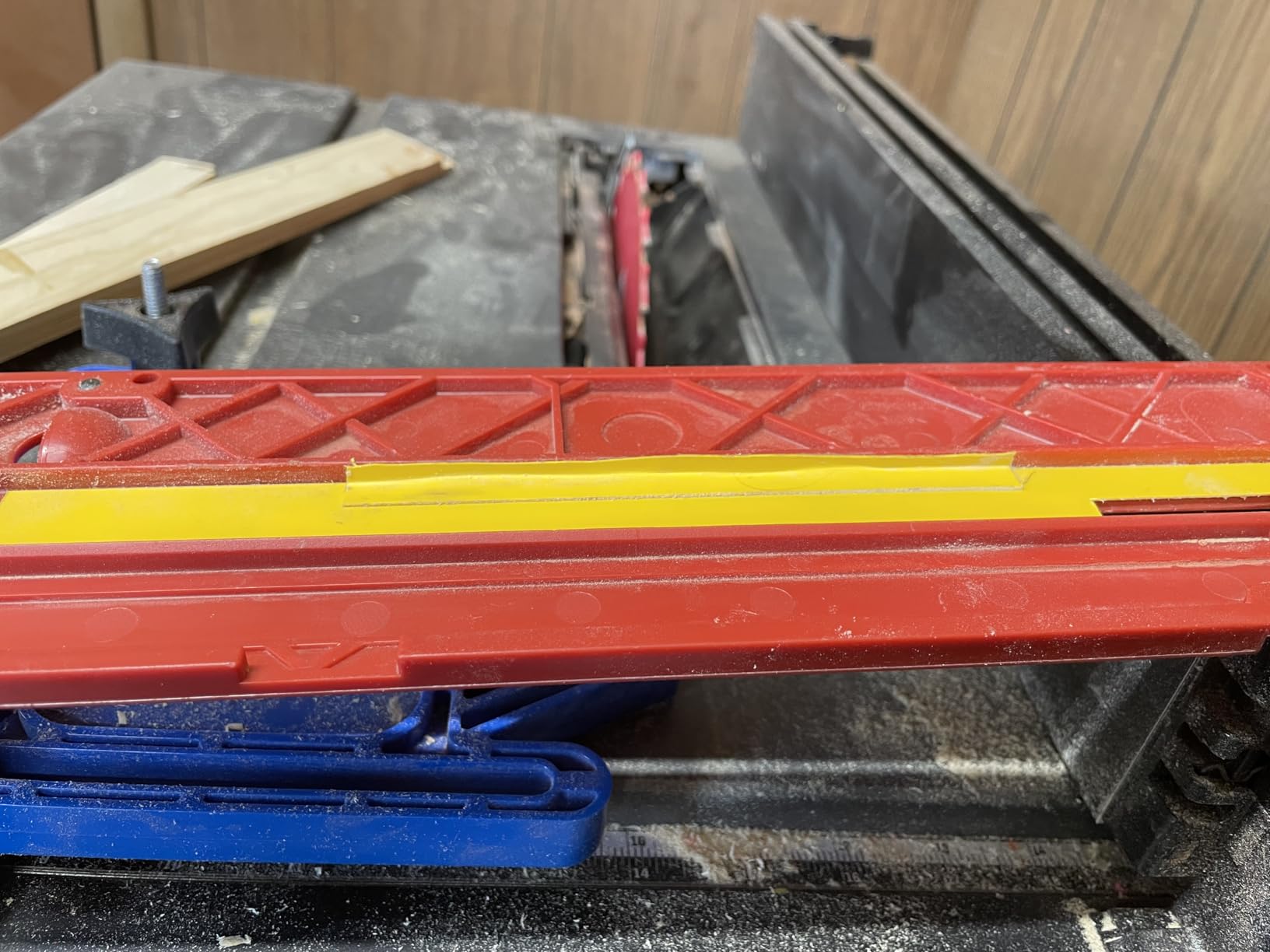
Is drilling into the saw casting worth it?
For a saw you use for sheet goods and cabinet parts, owners say yes, because the eliminated gap removes a recurring source of kickback and lost offcuts. For a framing-only jobsite saw that never leaves the truck, the drilling and thread repair are not justified.
If you are not comfortable tapping the casting, a UHMW blank that mounts with the existing throat plate screws is the less invasive route.
Will this plate work on other SKIL saws?
No. It is made specifically for the TS6307-00, and SKIL has used different throat plate dimensions across its portable saw line. Older and smaller SKIL models use their own insert sizes, so verify the model number on the saw before ordering.
The upside of a model-specific plate is that it fits the opening exactly, including any fabric or tape on the casting lip. That is rarely true of a generic plate, which is where side-to-side play comes from.
9. Peachtree UHMW Insert for Pre-1988 Craftsman Belt Drive Saws
UHMW Tablesaw Zero Clearance for Older Craftsman 14-3/8″x 3-3/4″ x 3/16″
Fits pre-1988 Craftsman 10 inch belt drives
14-3/8 by 3-3/4 by 3/16 inches
Blank UHMW plate
Pros
- Covers pre-1988 belt drive saws with no other insert available
- Blank plate lets you cut the kerf to your exact blade
- Closes the oversized factory gap and cuts tear-out
Cons
- Fit varies between saws so measuring first is required
- Thin 3/16 inch UHMW can shift on four set screws
Everything before 1988 is effectively orphaned. The factory inserts for those machines were discontinued decades ago and no manufacturer makes a replacement, so if you own one of these saws your options are a blank plate, UHMW tape or a 3D printed insert. At a 4.3 average across 131 reviews with 67 percent five-star, this blank is the dependable route.
It is 14-3/8 by 3-3/4 by 3/16 inches and arrives uncut, so you pass your own blade through it to open the kerf. Owners on r/woodworking report that 3D printed inserts also work on these saws, and one long-term owner on a hobby forum has kept UHMW tape on a spare plate for decades.
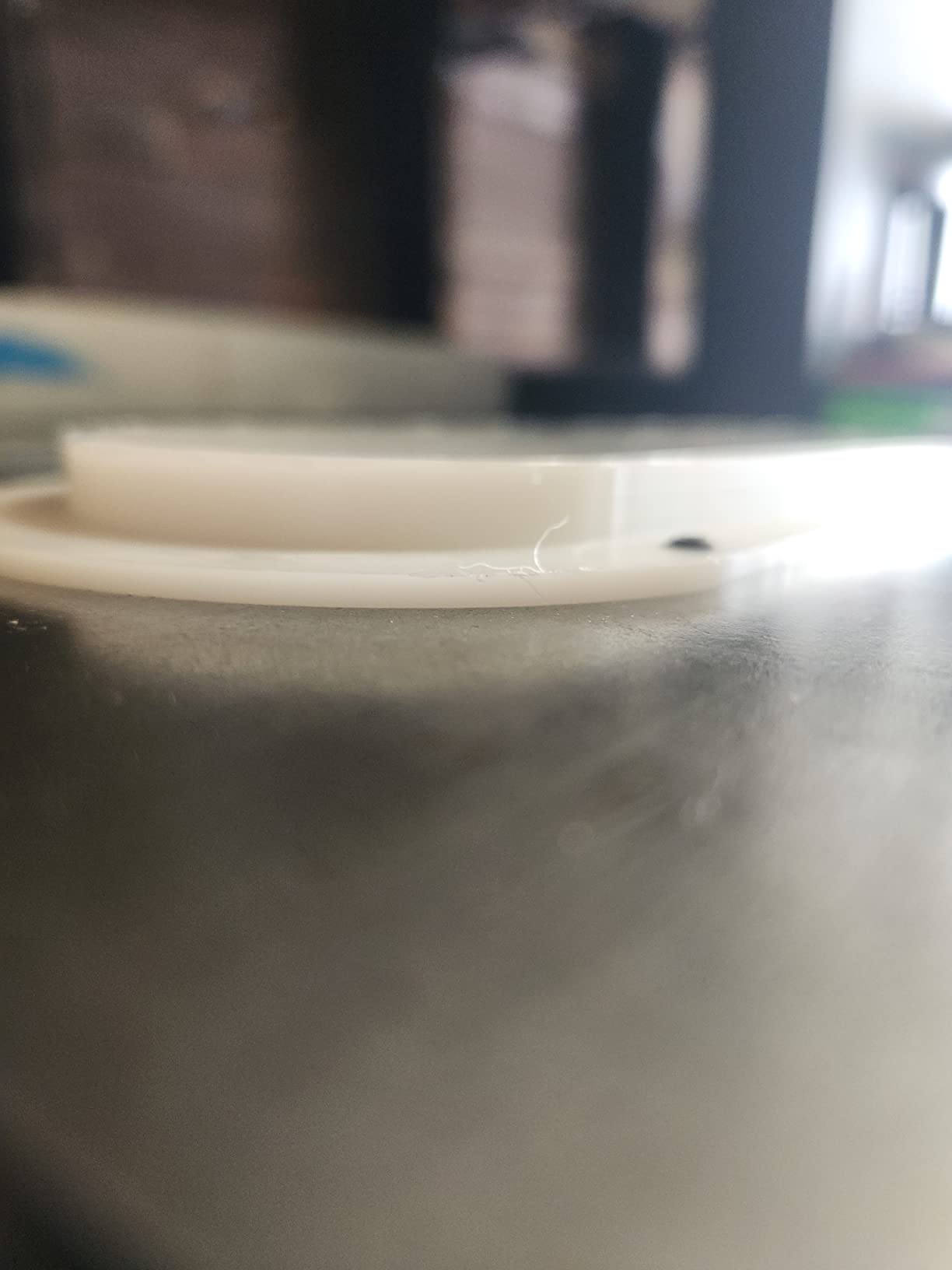
The sizing instruction on this part is not optional. Because fit varies between individual saws of the same era, buyers who measure the factory insert before ordering report clean fits and good cut quality, while those who guess tend to end up trimming on the saw.
The 3/16 inch thickness is the trade-off for a part that fits this many old castings. It is flexible enough to shift under load with only four set screws holding it, so treat it as a thin-plate solution and replace the supplied screws if they do not hold.
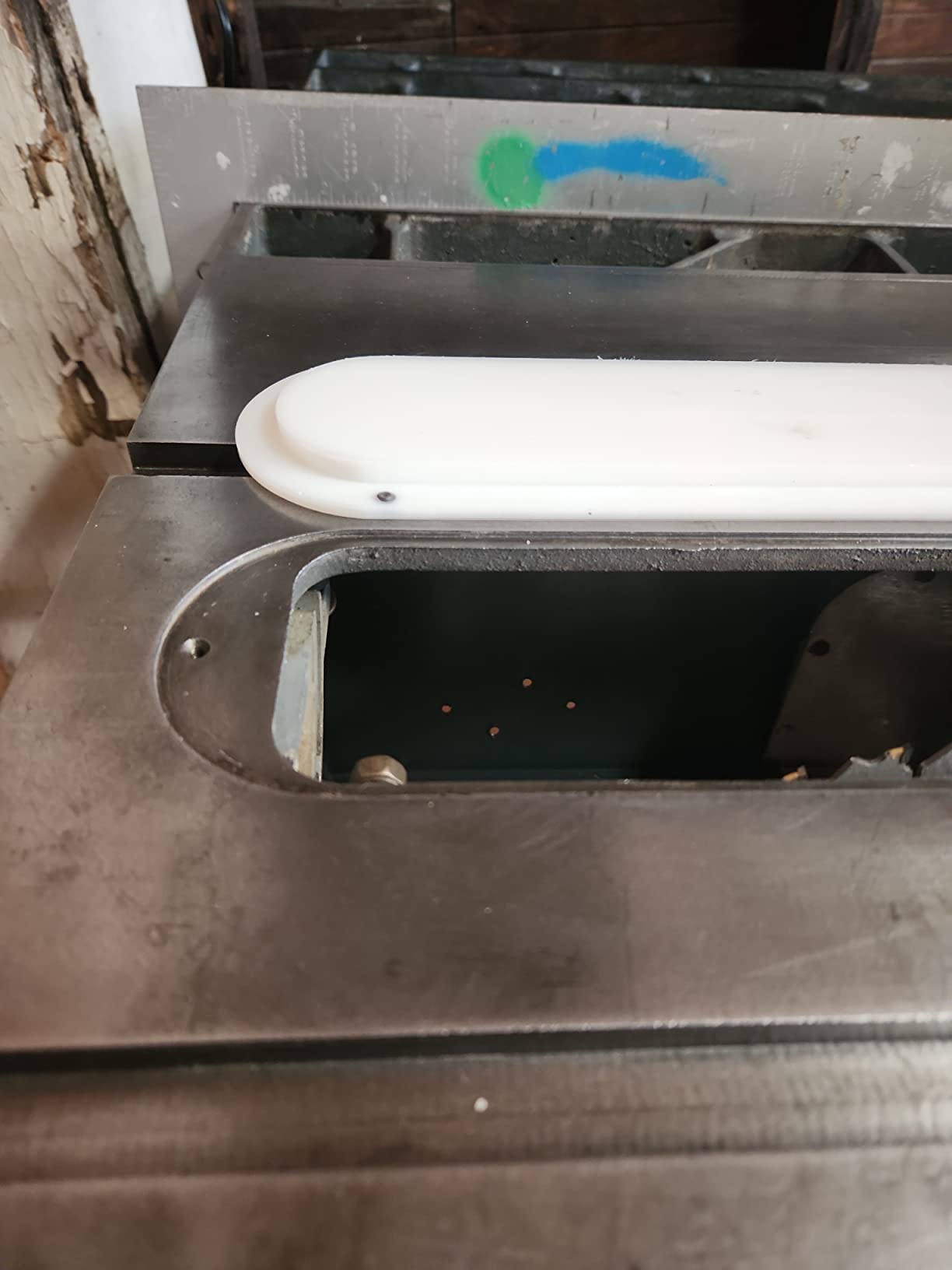
What are my options if no insert exists for my saw?
Three, in ascending order of effort. UHMW tape over a flat spare plate is the fastest and is reported to last for decades, but it needs a flat substrate and a flat surface to stick to. A trim-to-fit plastic blank, like this one, is more work but gives you a rigid plate you can level.
A 3D printed insert is the third option. Printers have improved enough that a PLA insert holds up for light work, and community models exist for several older saws. Check the fit carefully, since printed parts vary with print settings.
Is a 3/16 inch plate too thin for sheet goods?
It can be, if the hardware does not hold it. The material itself resists the kerf fine, but four small set screws on a flexible plate allow the far end to rise under the load of a wide panel. Substitute larger machine screws and the flex largely disappears.
If your saw handles full-width plywood every day, look for a thicker plate or a full aluminum throat plate replacement instead, and treat the thin blank as a stopgap.
10. AGILLE 4-Pack for DeWalt with Riving Knife Slot
AGILLE Zero Clearance Inserts For DeWalt 7491, 7491RS, 7490 (Type 1), 744, 745, 746, 7480, with Riving Knife Slot, Precise Cuts with No Tear-Out, Include Off-set Screws, Easy Height Adjustment, 4-Pack
DeWalt 7491, 7491RS, 7490, 744, 745, 746
Set of 4 with offset screws
Pre-cut riving knife slot
Pros
- Pre-cut riving knife slot avoids modifying the plate
- Offset screws make height leveling straightforward
- Fits the DeWalt 7491 and 7491RS with little trimming
- Good tear-out reduction on plywood and thin stock
Cons
- Several units arrive bowed about 1/8 inch
- Soft core material can break at the riving knife slot
- No tabs or locking mechanism to hold the plate
This is the pack to buy if your DeWalt runs a riving knife. The plate arrives with the relief slot already cut, so you do not have to route or file your own opening and sacrifice the support of a solid plate across the whole throat. It covers the 7491, 7491RS, 7490 Type 1, 744, 745 and 746.
Fit on the 7491 and 7491RS is tight enough that most owners report no trimming at all. The offset screws make height adjustment straightforward, and it works with a standard single blade or a dado. Tear-out reduction on thin cuts and plywood is a consistent report.
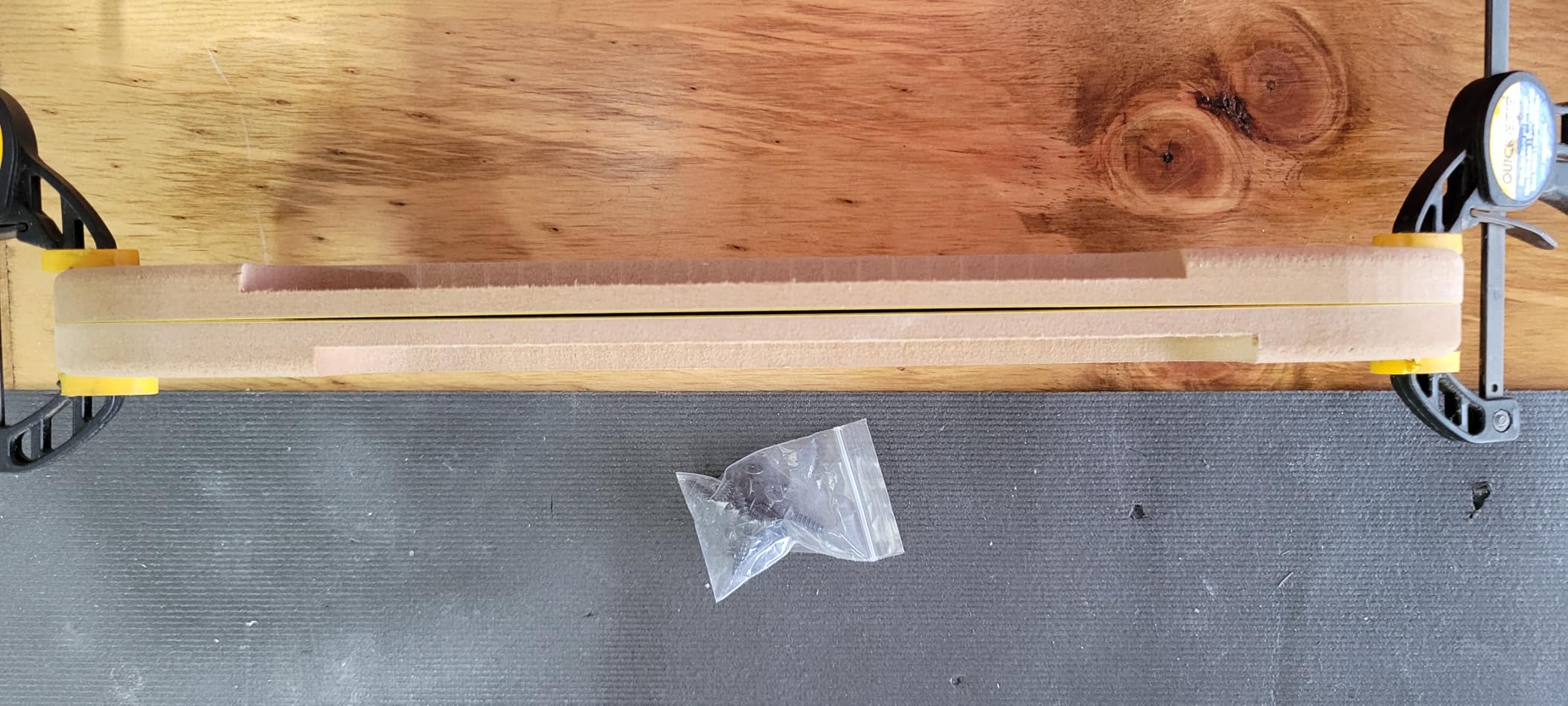
The rating split here is stark at 3.9 with 236 reviews, 53 percent five-star and 13 percent one-star. Buyers whose plates arrive flat rate them well. A substantial group report plates bowed by roughly 1/8 inch, which leaves a lip that catches the workpiece and cannot be leveled out.
Two smaller notes. The core material is soft enough to break at the riving knife slot after repeated use, so handle the plate rather than dropping tools on it. And there is no tab or locking mechanism, so a plate that is not seated correctly can shift during a cut. Check it with a hand before every pass.
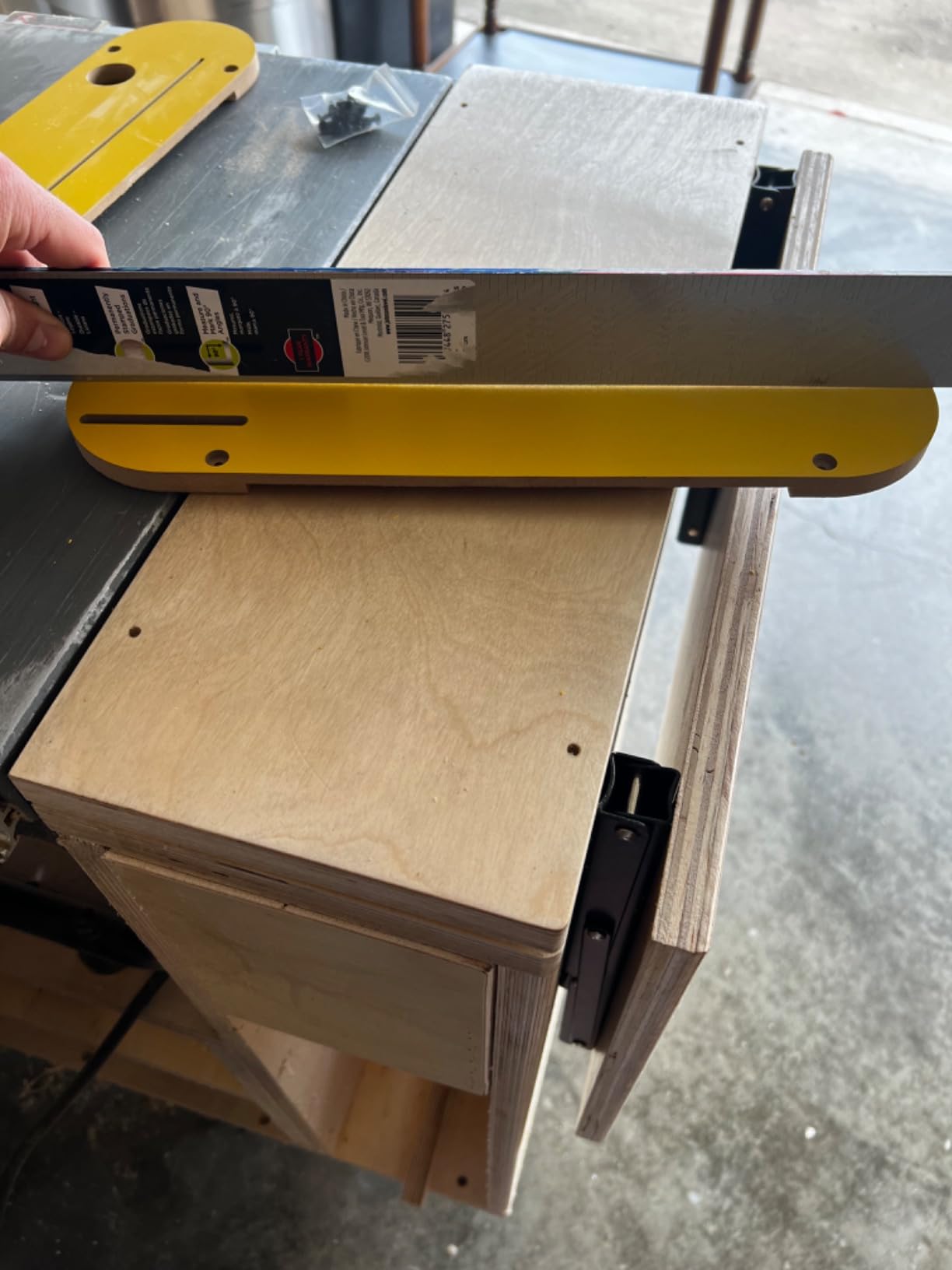
Is a pre-cut riving knife slot worth the trade-off?
Yes if you run the knife often. The slot lets you keep the riving knife installed and adjust its height to suit your maximum rip depth, which is the whole reason the feature exists. You are trading total plate width across the opening for the ability to keep a safety device mounted.
No if you rarely use the knife. On a saw that runs without it, a solid plate with no slot is stiffer and gives you a longer uninterrupted bearing surface for the workpiece edge.
How do I deal with a plate that arrives bowed?
Check flatness before you install it, because a bow will not level out. Sanding the high side is possible, but on a soft core you risk cutting through the thickness and losing the plate. Many buyers in the reviews treat a bowed plate as a return rather than a project.
If you keep it, clamp it to a flat surface and sand progressively with the grain, then re-check the bow with a straightedge before you set the leveling screws. Expect less adjustment range than a flat plate gives you.
How to Cut the Kerf in a New Insert
This is the sequence every insert needs and the one most people get wrong. The rule that matters is simple: the blade must be fully below the table before it ever touches the insert material.
Lower the blade completely below the table surface and unplug the saw before you start.
Lift out the factory throat plate. Never run the saw without a plate in the opening, even for one pass.
Set the insert flat over the opening and clamp it firmly to the table so it cannot lift.
Start the saw and, with the blade guard down, raise the spinning blade slowly until it passes through the insert. Take your time. Rushing here is how blades get thrown.
Lower the blade, release the clamp, check the slot from above with a straightedge, and repeat if the kerf is not a clean single line.
Blast the kerf with compressed air or clean it with a stiff brush so the slot is exactly the width of the blade and nothing wider.
Fit the insert, set the leveling screws until it is flush with the cast iron, and wax the top face so the fence and miter gauge slide smoothly.
If your blade cannot drop low enough below the table to start the pass, that is the deciding constraint on which insert you can use at all. Some saws need the elevation crank turned a partial turn while the blade spins to get the teeth through the plane of the table. Others simply cannot do it, and for those, a thinner blank plate is the only workable option.
Saw-Brand Fitment Guide: Which Insert Matches Your Table Saw
Fitment is the one question with a wrong answer that damages the saw. An insert that is too small leaves a gap, which defeats the purpose. An insert that is too large can ride up on the casting lip when the blade passes. Use the list below as a starting point, then confirm the opening and the blade position with a tape measure before you order.
Bosch: the TS1005 covers the 4100 series including the 4100XC, and the 4000 series. DeWalt: the CNC Designs four-pack covers the 744, 745, 746, 7480, 7491, 7491RS and 7490 Type 1, and explicitly not the 7485 or DCS7485. The AGILLE four-pack covers the 7491, 7491RS, 7490 Type 1, 744, 745 and 746, with a riving knife slot.
Delta: the ZEROSERT three-pack covers the 36-725, 36-725T2, 36-5152, 36-5000 and 36-5000T2. The 10 inch Uni-Saw is a different opening entirely and takes the Peachtree UHMW blank. Ridgid: the Leecraft RG-1 is cut for the TS3650, and the Peachtree UHMW blank covers the TS-2412, TS-2424, TS-2400 and other 10 inch belt drives from 1988 onward.
Craftsman: pre-1988 10 inch belt-drive saws use the smaller Peachtree blank at 14-3/8 inches, and the difference between that part and the newer saws is only a fraction of an inch in length, which is exactly why measuring matters. Skil: the STZ6307 fits the TS6307-00 and nothing else. Powermatic: the Leecraft PM-1 is cut for the Model 66 and also fits the 65 in most installations.
For Hitachi, Rikon, Kobalt, Harbor Freight, Performax, Grizzly and older Powermatic models, there is usually no factory-matched insert, because none was ever made. The Peachtree blanks are the practical route at that point, since you trim them yourself, provided the blank is at least as large as your opening.
Insert Materials Compared: Phenolic, MDF, UHMW, Plywood and Aluminum
Material is the loudest debate in the forums, so here is the short version based on what comes up repeatedly. Phenolic is the durability winner for a fixed install. It arrives dead flat, resists moisture without swelling, machines cleanly and holds a kerf for years. The trade-offs are pungency on the first cuts and the fact that pitch builds on the blade.
Commercial-grade MDF is the accuracy winner and the value winner. It machines to tight tolerances and a CNC-milled plate is stiff enough for full-width sheet goods. Its weakness is edge durability, since MDF dents if dropped on its corner and has no moisture resistance. UHMW and HDPE are the DIY favorites, and they are what most blanks in this roundup are made from.
UHMW is nearly indestructible in a table saw application. It will not split, it is easy to machine, it does not hold pitch and it is cheap. What it does not do is stay rigid when it is thin, which is why the 3/16 inch blanks can flex and the 1/2 inch Uni-Saw plate holds much better. Plywood and MDF are the traditional DIY materials, and MDF wins in most comparisons on hardness. Aluminum as a full throat plate is the permanent answer, and it is the most work of any option here.
One more material worth knowing about: UHMW tape. Owners on woodworking forums report covering a flat spare plate with 3 inch tape, which is the cheapest fix available and, in one long-term account, has lasted for decades. It needs a perfectly flat substrate to bond to, so it is not a fix for a warped plate.
Safety Rules That Come Before Any Cut
Never remove the throat plate to cut a kerf or for any other reason. The plate is structural and it closes the opening in the casting. Forum consensus on this point is absolute, and the reason is straightforward: an open throat opening lets a workpiece drop into the blade and come back at you as a projectile.
Always lower the blade below the table before you fit or remove an insert, and always clamp the blank firmly before you raise the blade through it. If you must engage the blade through the table plane, turn the elevation crank very slowly by hand while the blade runs, wearing eye protection and keeping your face out of the line of the blade.
Check that the insert sits flush before every cut. A plate that stands even a fraction above the table can catch a workpiece edge, and a plate that sits below it drops thin stock into the gap you paid to close. A straightedge and a light hand check take two seconds.
If you run a riving knife, match its height to the maximum rip depth you will use and confirm clearance in the insert slot before the first cut. And if the kerf blows out, replace the insert rather than filling the hole with glue or tape, since a widened kerf means the plate has stopped supporting the workpiece.
Frequently Asked Questions
How can I make a zero-clearance insert for my table saw?
Measure the throat plate opening, then buy a blank plate slightly larger than the opening and trim it to fit. Lower the blade fully below the table, clamp the blank flat over the opening, and slowly raise the spinning blade through it to cut the kerf. Repeat with a smaller blade first if your saw cannot start the pass. Set the leveling screws until the insert is flush, then wax the surface.
What is the benefit of a zero clearance table saw insert?
A zero clearance insert closes the gap in the factory throat plate so there is no space between the blade and the plate. That support prevents tear-out on the bottom face of cut wood and stops thin strips and small offcuts from dropping into the saw, which is a documented cause of serious table saw injuries.
Why don’t table saws come with zero clearance inserts?
Each insert has to be cut to match one blade in one position on one saw, so a manufacturer cannot ship a plate that fits every blade width and tilt angle in a model range. The throat plate also needs to remain removable for cleaning the blade and dust channel. Most makers ship a steel plate with a wider gap and sell the insert as an accessory.
Where can I find zero-clearance inserts for my table saw?
Start by matching your exact saw model against the fitment lists from the insert maker, then buy through the model’s listing so the correct plate reaches you. For older or obscure saws with no factory insert, look for a blank UHMW plate you trim yourself, or cover a flat spare throat plate with UHMW tape.
How many zero clearance inserts do I need?
One per blade position, which usually means two or three. A plate holds a kerf for a single blade width at a single tilt angle, so a shop running a rip blade, a combination blade and a dado keeps one plate per setup. Multi-packs of three or four plates exist so each setup stays cut and level.
Conclusion
The Bosch TS1005 is our pick for the best zero clearance inserts for table saws in 2026, on the strength of 832 owner reviews and an install that takes minutes rather than an afternoon. DeWalt owners should look at the CNC Designs four-pack for the widest model coverage and the highest satisfaction scores, and anyone with a 10 inch Uni-Saw or a vintage belt-drive saw has a blank plate in this roundup that will fit.
Whatever you order, measure the opening, cut the kerf with the blade below the table, and never run the saw without a throat plate in place. Those three habits are worth more than any material choice on the shelf.