
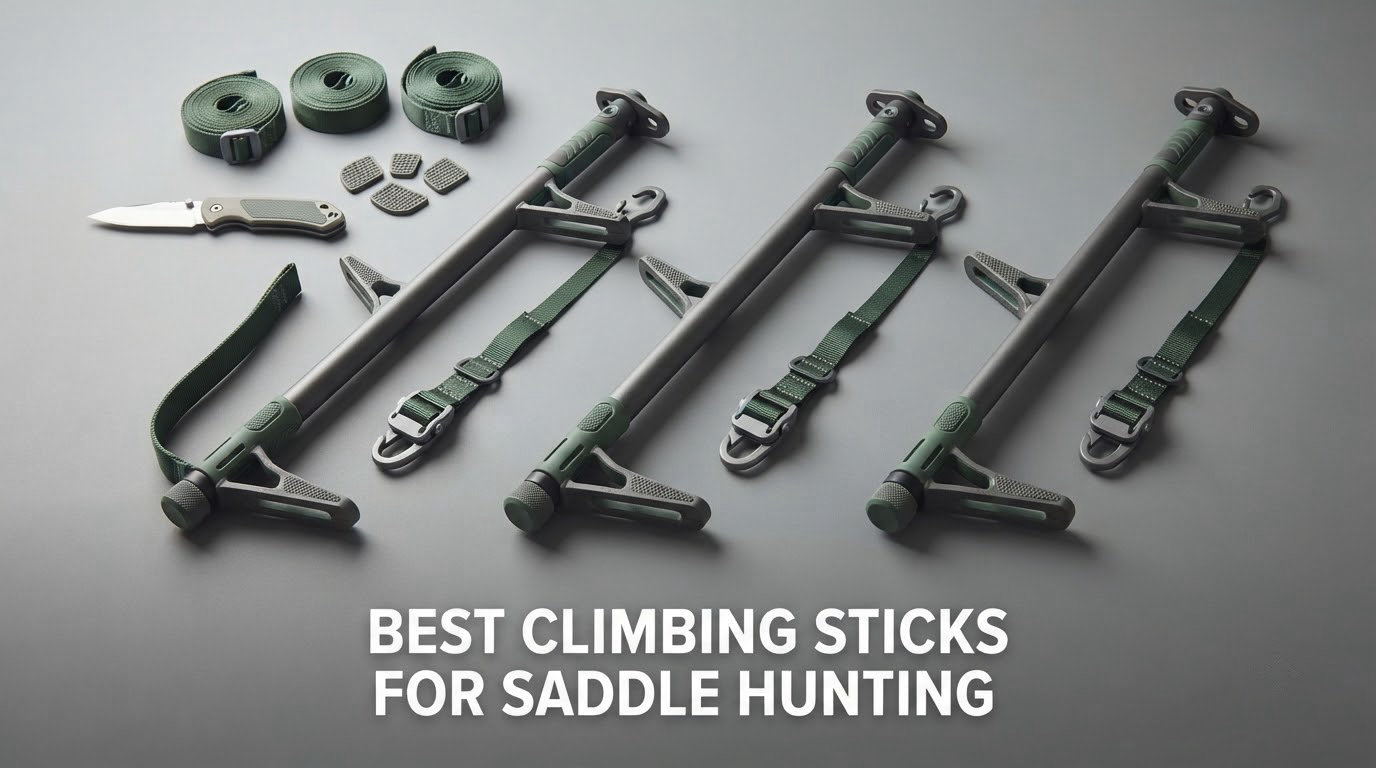
Climbing sticks are lightweight, sectional ladder-style steps that a saddle hunter hangs on a tree to climb silently to platform height. A tree saddle carries no climbing mechanism of its own, so sticks supply the rungs. You wrap a rope or strap around the trunk, hang three or four sticks up the trunk, attach your safety line and saddle platform to the top stick, then pull the lower sticks as you climb.
For the best climbing sticks for saddle hunting, weight matters more than almost anything else. The whole promise of a saddle setup is mobility: you carry your tree to fresh game rather than sitting on one stand all season. A set of aluminum sticks adds roughly 2 pounds per stick, and that figure multiplies fast when the saddle, platform, and safety gear go on the same pack.
We compared 10 sets of climbing sticks, from ultralight aluminum sections to 20-foot powder-coated steel ladder systems, using manufacturer spec sheets plus the accumulated buyer feedback on each one. Ten products is enough to cover every meaningful tier without padding the list, and it let us look honestly at where the cheap options hold up and where the heavy ones do not.
Before the picks, here is what actually decides whether a stick set works for you:
Weight per stick. Under 2 pounds per stick is the ultralight tier. 2 to 2.5 pounds is the sweet spot for most mobile hunters. Anything over 3 pounds per stick is a semi-permanent or trail-side tool.
Attachment method. Cam buckles are fast but heavy and noisy. Rope and tab systems like DynaLite and AmSteel add almost no weight and no mechanical parts to rattle.
Standoff distance. The gap between your boot and the bark. 5 inches or more clears insulated boots and keeps your ankles from jamming into the trunk.
Step design. Dual-sided steps give you a step facing whichever direction you climb from. Single-sided layouts force you to plan your whole ascent in advance.
Noise. Buckles, sliding clips, and metal-to-metal contact are the loud parts. Stealth tape on contact points fixes most of it for very little money.
Stacking. Whether the sticks nest into a single bundle for the pack, and whether they nest without an extra strap or bungee.
Load rating. 300 pounds is common, 350 pounds is better. Know your own bodyweight and stay well inside the number.
Tree diameter range. Some sets need a 9-inch minimum trunk, which rules out a lot of younger public-land timber.
One warning before we get into the list. The three steel systems below are genuinely strong, and two of them have been in service for years. They are also 17, 20, and 24 pounds. Calling any of them a mobile saddle hunting stick would be a disservice to you, so we have placed them where they belong: as trail-side and semi-permanent equipment, not as backpack gear.
Table of Contents
Top 3 Climbing Sticks for Saddle Hunting (October 2026)

Hawk Helium 20 inch Sticks
- 2.5 lb per stick
- 300 lb rating
- Dual-sided steps
- Silent Lock nesting


Tethrd Skeletor 4 Pack
- 2 lb per stick
- Folding dual steps
- DynaLite rope
- StickLoc stacking
Hawk Helium is the pick for most people. Nearly a thousand ratings, 300-pound capacity, dual-sided steps, and a weight that disappears into a pack. It is the set that the saddle hunting community owns most widely, and the complaints about it are all fixable with a rope mod.
XOP X2 is the lightest thing in this roundup at 1.6 pounds per stick and the only one with a documented 5-inch standoff and a 10-inch-wide coated step. If you wear large boots or climb in the cold, that geometry is the difference between comfortable and miserable.
Tethrd Skeletors score the highest rating in the group and the folding dual steps are a genuinely clever answer to the bark-scraping problem. The rating sits on a much smaller review base, so treat it as proven but less battle-tested than the Hawk.
Best Climbing Sticks for Saddle Hunting in 2026: Full Spec Comparison
| Product | Specifications | Action |
|---|---|---|
|
Hawk Helium 20 inch Climbing Sticks
|
|
Check Latest Price |
 Muddy Pro Climbing Sticks Rope Cam
|
|
Check Latest Price |
 Guide Gear Quick 3 Pack Steel Sticks
|
|
Check Latest Price |
 BIG GAME 20 ft Quick Stick
|
|
Check Latest Price |
|
XOP X2 Double Step Climbing Sticks
|
|
Check Latest Price |
 Guide Gear 20 ft Rapid 4 Pack
|
|
Check Latest Price |
 Tomaki Lightweight Aluminum Sticks
|
|
Check Latest Price |
 RiteAim Collapsible Aluminum Sticks
|
|
Check Latest Price |
 XOP 34 Inch Aluminum Climbing Sticks
|
|
Check Latest Price |
|
Tethrd Skeletor 4 Pack
|
|
Check Latest Price |
A few numbers in that table deserve emphasis. The XOP X2 at 1.6 pounds per stick and the RiteAim at 1.87 pounds are the two lightest sections here, while the Hawk Helium sits at 2.5 pounds. At the other end, the Guide Gear 20-foot Rapid weighs 24.2 pounds, which is more than a full four-stick aluminum setup plus your saddle and platform combined.
How We Evaluated 10 Sets of Climbing Sticks
We did not climb trees for six weeks with ten different sets. What we did was pull the manufacturer spec data for every product, read the accumulated buyer reviews on each listing, and score both against the criteria that actually break saddle hunting sticks in the field. Here is the honest version of the method.
Weight per stick and total set weight. Weight is the first screen. We recorded the per-stick figure where the manufacturer publishes it and the total for the set where only that is available, because a 10-pound four-pack and a 24.2-pound four-pack are not comparable without normalizing.
Step geometry. We recorded step width, step spacing, and standoff distance where given. A 5-inch standoff is the number that separates a comfortable climb from a boot-scraping one, and it is the specification most often missing from competing roundups.
Attachment hardware. Cam buckles, rope cams, rope and tab systems, and webbing straps were separated into groups, because noise and weight follow the attachment method more reliably than they follow the brand.
Load rating. Where a rating is documented, we recorded it. Where it is not documented, we treat that as a gap rather than filling in an assumption, because an undocumented rating was on the community list of deal breakers.
Buyer-reported failures. We read the negative reviews most closely. Suction cups that will not separate, rubber mounts ripping off, straps fraying after a season, and metal squeaking during a climb are all field failures that show up repeatedly and matter more than any marketing line.
Long-term reports. Where reviews mention second-season or multi-season use, we weighted those over first-week impressions. The steel options win here, and the winners are not shy about that.
1. Hawk Helium 20 Inch Climbing Sticks: Best Overall for Saddle Hunting
Hawk Lightweight Non-Slip Aluminum Helium Climbing Sticks, 4-Pack
Aluminum
2.5 lb per stick
300 lb rating
20 inch length
4 pack
Pros
- Lightest-reviewed set in the group with 985 ratings
- Dual-sided steps with grip grooves and raised ends
- Bark-gripping teeth hold position quietly
- Silent Lock cups nest the set for transport
Cons
- Suction cups are very hard to separate when new
- Some nesting rubber mounts have ripped off
- Supplied strap is thin and awkward with cold hands
The Hawk Helium is the one I keep coming back to. It is the set that shows up in forum threads about saddle hunting more than any other, and after reading through the buyer feedback it is easy to see why. At 2.5 pounds per stick it is not the lightest aluminum option here, but it is the one with the deepest body of real-world reporting behind it, and that matters more in a safety-adjacent tool than a half-pound of savings.
The step design is where it earns its place. Dual-sided steps with grip grooves and raised ends mean you can climb from either direction without planning your route, and the raised ends do real work on wet mornings when a boot slides forward. Owners at higher body weights report no flex and no rocking at height.
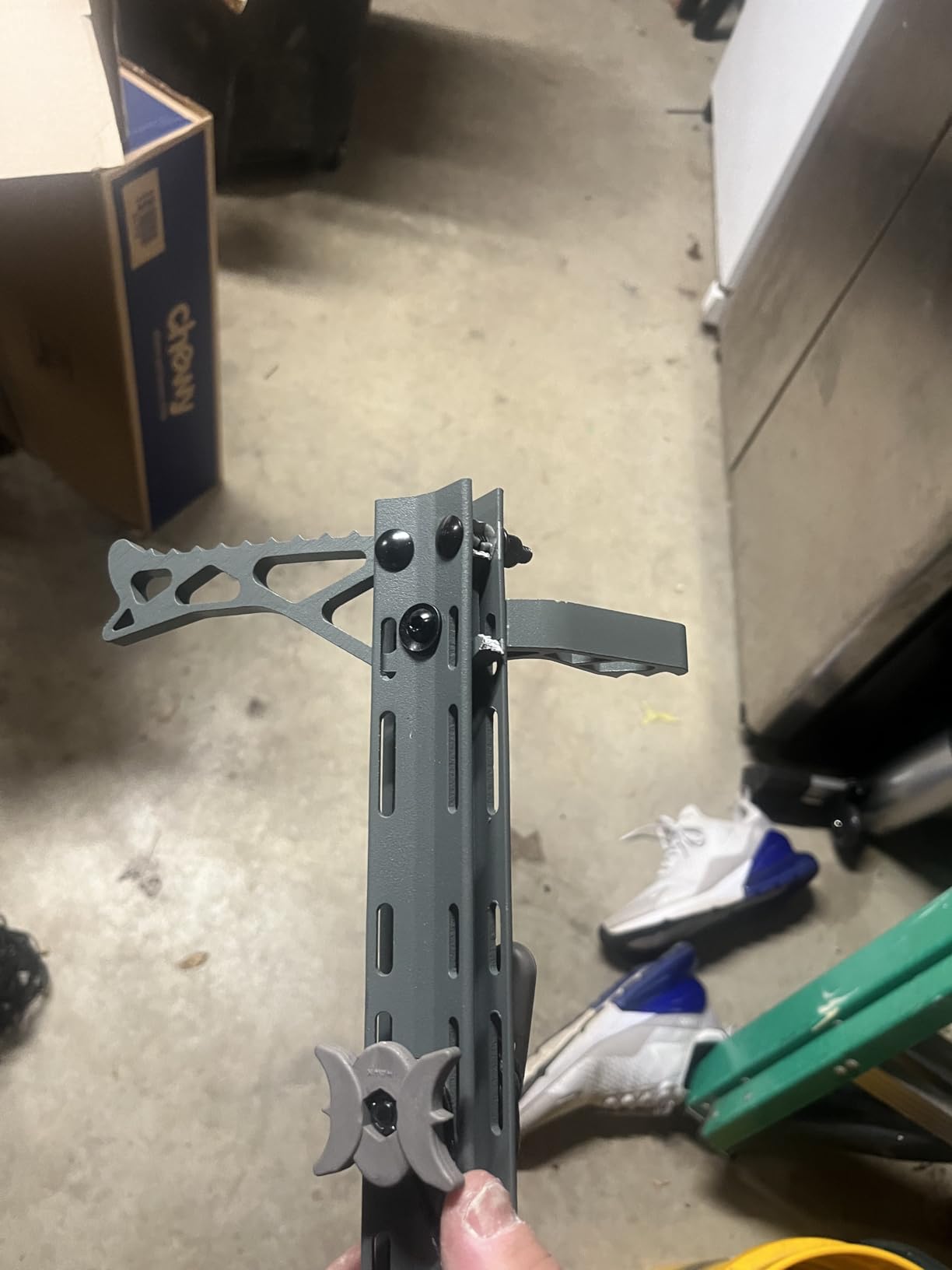
The bark-gripping teeth bite into the trunk and stay put, and the whole hang-and-climb cycle is quiet enough that owners happily use it for archery setups. The 300-pound rating covers essentially every hunter reading this. Dimensions are simple: 20 inches extended, one stick per placement, four sticks in the pack.
The one thing that catches people out is the Silent Lock suction cup nesting system. Multiple owners report that the cups are nearly impossible to separate when the set is new, and a smaller number report the rubber mounts ripping off during that first forceful separation. A drop of silicone lubricant on the cups before you ever join them solves the whole problem, and it is worth doing in the parking lot rather than at the base of a tree at 4:30 in the morning.
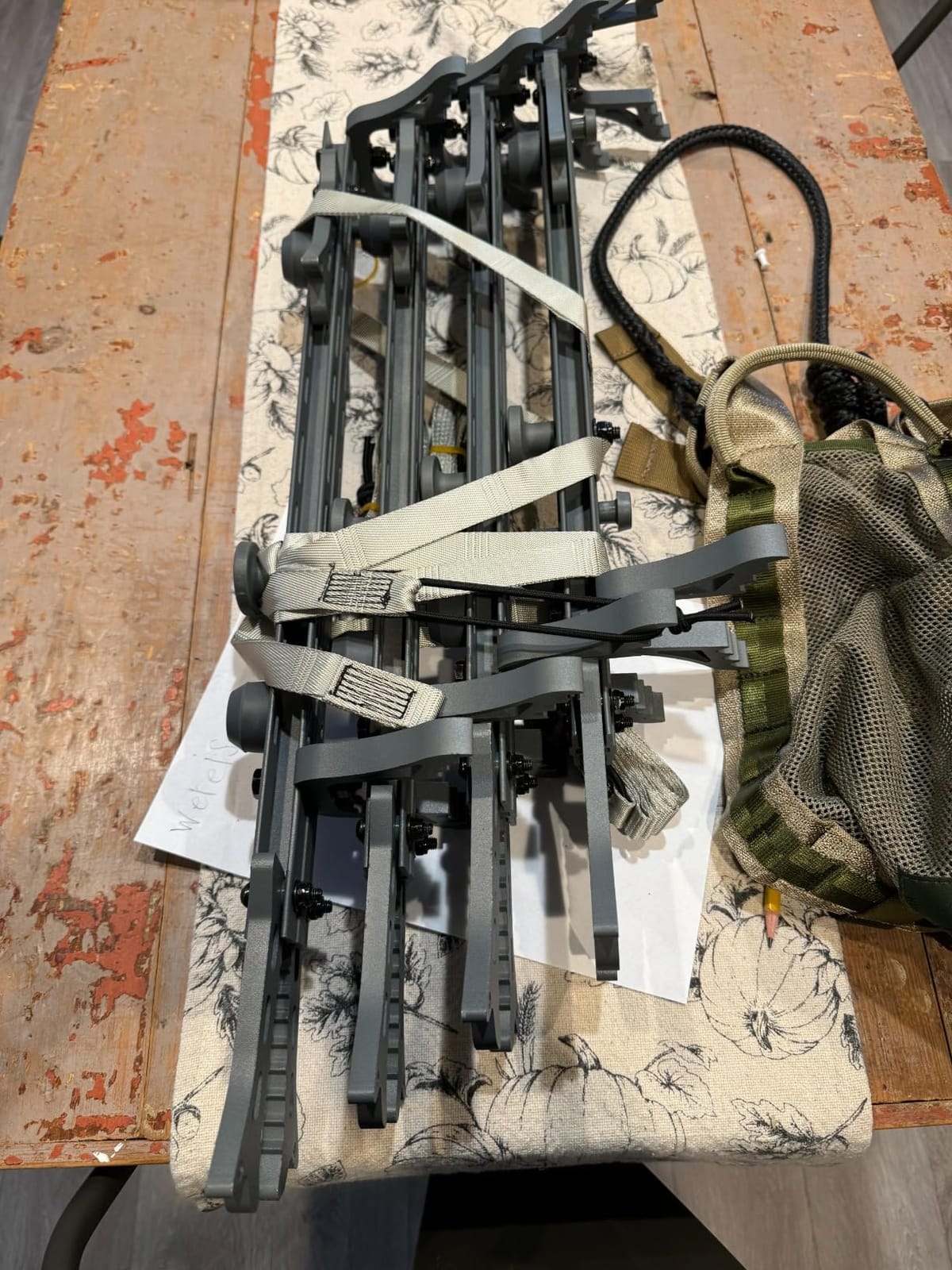
When the Hawk Helium is the right call
Choose the Helium if you want proven hardware, a deep review history, and a step you can climb from either direction. It suits hunters moving between trees on foot, semi-permanent setups where the sticks stay in one tree for a season, and anyone who wants the 300-pound rating without thinking about it.
It is also the set most owners modify rather than replace. The supplied strap is thin and gets difficult to handle with frozen fingers, and a common community conversion is to swap the strap system for a cam cleat or a length of AmSteel rope, which is quieter and lighter. That single mod transforms the sticks and is widely discussed on r/saddlehunting.
When to pick something else
If you wear insulated winter boots or size 12 footwear, look at the XOP X2 instead. The 5-inch documented standoff on the X2 gives you real boot-to-tree clearance, while the Hawk’s geometry is better suited to smaller hunters in size 10 boots, which is what reviewers actually report.
If your priority is the lowest possible carry weight and you are comfortable with a rope attachment from the start, the XOP X2 at 1.6 pounds per stick or the RiteAim at 1.87 pounds will take nearly a pound off a four-stick setup. You give up some of the Helium’s proven track record to get there.
2. Muddy Pro Climbing Sticks with Rope Cam: Best Bark Grip
Muddy Pro Climbing Sticks with Rope Cam Attachment – Hunting Gear
Aluminum
10 lb for 4 pack
300 lb rating
20 inch sections
9 inch minimum tree
Pros
- Bark biters hold on crooked and straight trees
- 300 pound capacity
- Simple rope cam installation
- Packs flat with Muddy fixed-position treestands
Cons
- 10 pounds for the 4 pack is heavy for mobile hunting
- Requires a minimum 9 inch diameter tree
The Muddy Pro is the set forum veterans keep coming back to when the conversation turns to attachment systems. The rope cam is the reason. It installs quickly, it has no buckle to fumble in the dark, and on saddlehunter.com the cam cleat system is repeatedly named as the preferred attachment among experienced users. That is a specific, well-earned reputation rather than a marketing line.
Grip is the other strength. The aluminum bark biters are reported to hold reliably on both crooked and straight trees, which matters more than it sounds. A saddle setup is only as good as the tree you picked, and a stick that slides on a slight lean is a stick you will re-rig twice.
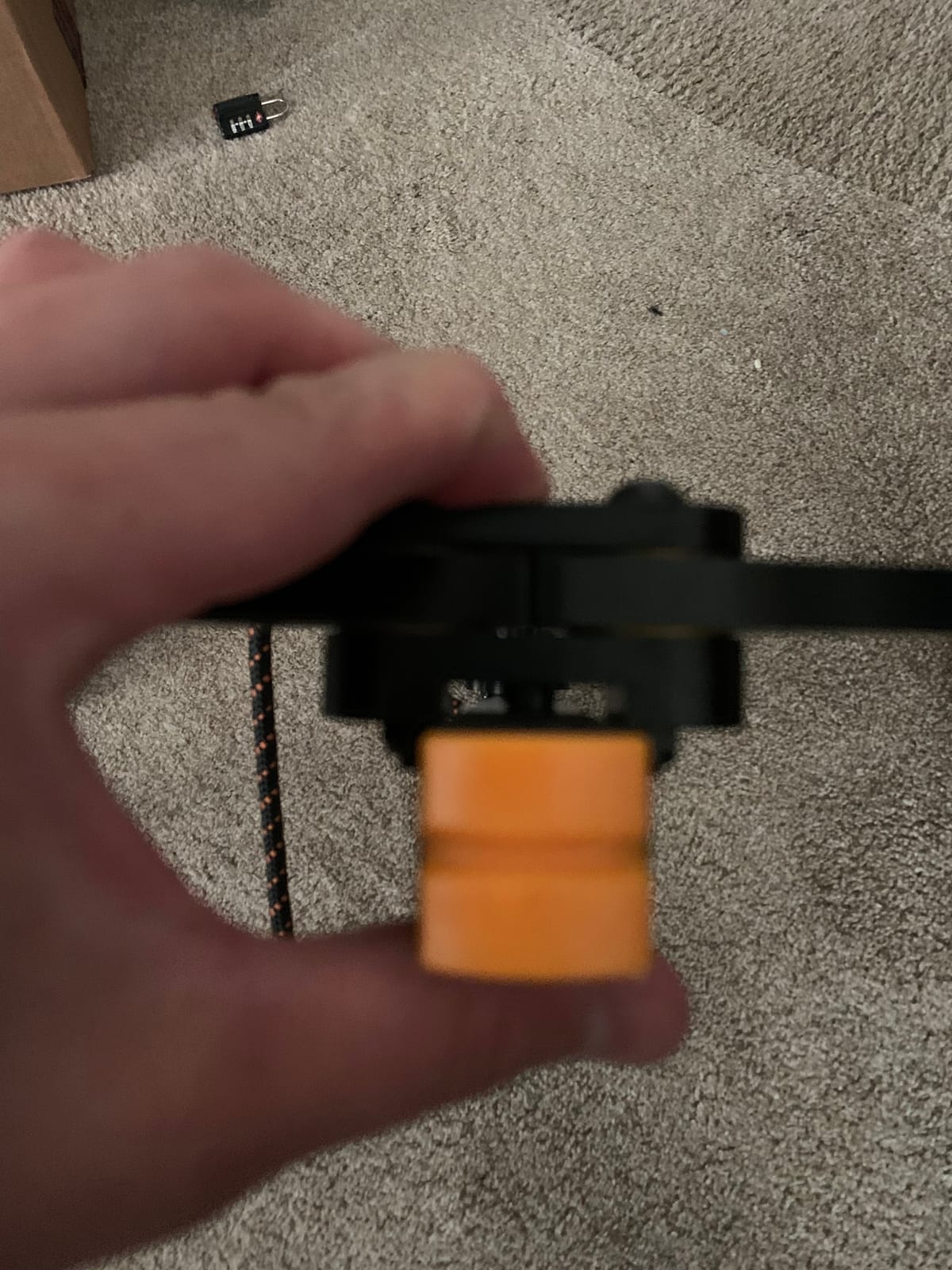
The fold-out steps on each 20-inch section give you a usable surface, and the whole set packs flat alongside Muddy fixed-position treestands, which is a genuine advantage if you already own that platform. The 300-pound rating is standard for the category and covers most hunters with room to spare.
Now the honest part. The four-pack weighs 10 pounds, which puts it at 2.5 pounds per stick, and that is exactly the complaint the saddle hunting community raises most often about this set. Owners love the design and still call it too heavy for packing in far. On a long walk to a remote stand, two extra pounds per stick is the difference between carrying your setup comfortably and leaving it at the truck.
There is a second limitation worth planning around: the sticks need a tree of 9 inches minimum diameter. That rules out a lot of younger timber on public land, and if your hunting area is mostly second-growth you will spend a lot of time walking past trees instead of climbing them.
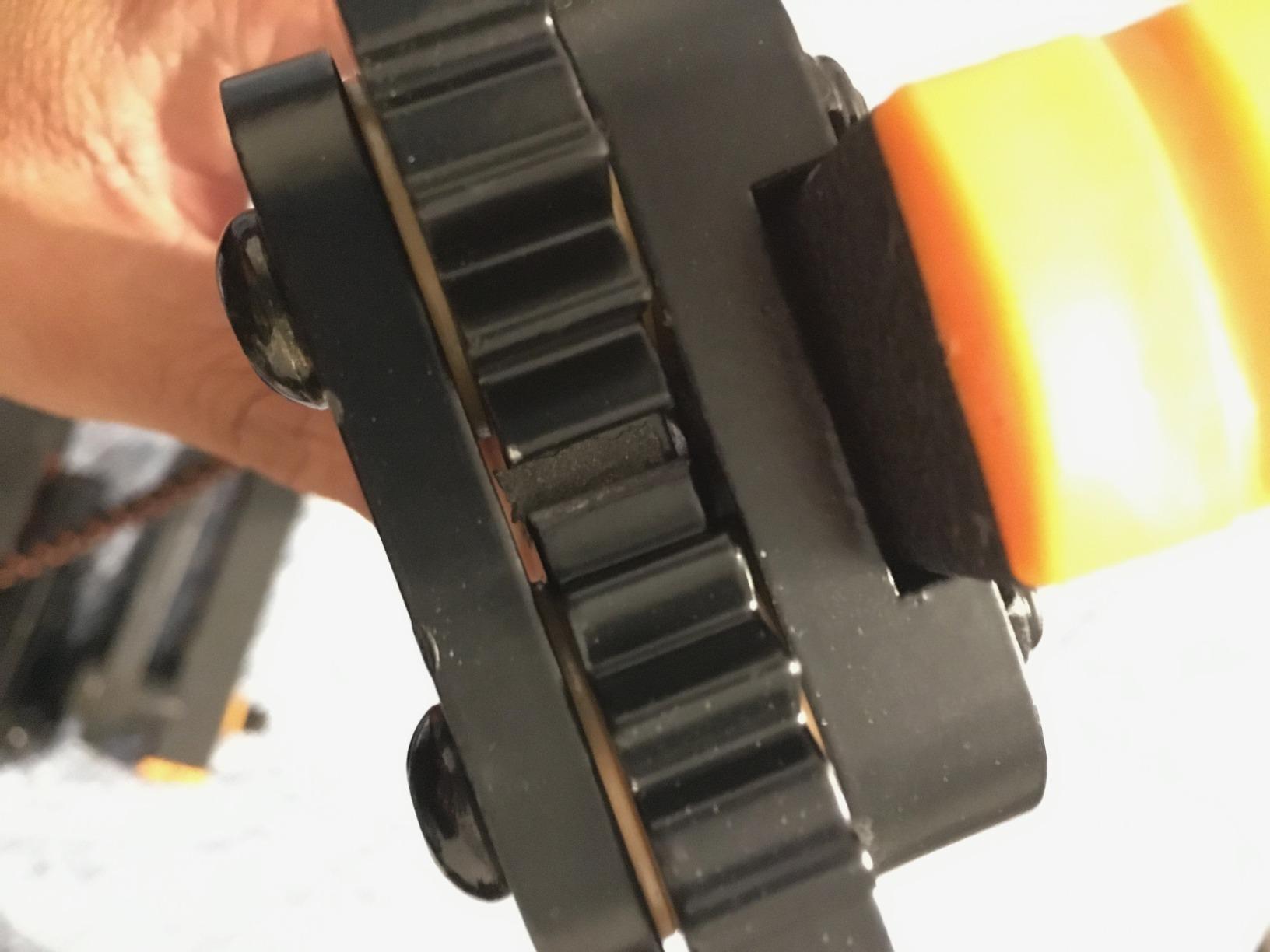
Who the Muddy Pro fits best
Pick the Muddy Pro if you value attachment reliability above all else, if you are already running a Muddy platform, or if your setups are semi-permanent and you are not carrying the sticks far. The rope cam is the quietest, most foolproof attachment in this roundup, and buyers consistently report the stick holds once it bites.
It is also a good choice if you are working trees of 9 inches or larger and know that going in. In mature hardwood cover, where most ladder and stick hunting happens, that constraint rarely comes up.
Where it will disappoint you
Run-and-gun hunters should pass. At 10 pounds for four sticks, the Muddy Pro is one of the heaviest aluminum sets here, and the community consensus is that weight is the number one reason people move off it. The Tethrd Skeletors and the Hawk Helium both sit at about 2 pounds per stick or less and give you a lighter pack.
If you hunt in young timber, the 9-inch minimum is a real constraint rather than a detail. Pair that with the weight and this set moves from a strong choice to a compromise, which is exactly where the XOP X2 overtakes it.
3. Guide Gear Quick Steel Tree Climbing Sticks: Best Budget Starter Set
Guide Gear Quick Tree Climbing Sticks Ladder Steps for Treestands Deer Hunting Gear and Accessories, 3 Pack
Welded steel
17.1 lb for 3 pack
300 lb rating
32 inch sections
Double sided rungs
Pros
- Years of reported service from owners
- Double rungs on both sides for stable footing
- Strap-on design leaves the tree undamaged
- Cam buckle straps with quick attaching clips
Cons
- About 5 pounds per stick is far too heavy to carry
- Sections do not nest and are awkward to strap to a pack
- Grip tape stickers fall off and the paint finish wears
The Guide Gear Quick set gets recommended constantly for one reason: it works, it has worked for a long time, and owners report years of service. This design has been in production for well over a decade, and that decade-plus of field reports is worth more in a climbing tool than any newer feature. The welded tubular steel frame does not flex, and stability is not something you have to think about once you are on it.
The double rungs sit on both sides of each section, so you always have a step facing your climbing direction. Each 32-inch section can be repositioned on the tree, and the three sections together cover roughly 12 to 14 feet of climbing height above the platform. The 300-pound capacity is documented and adequate.
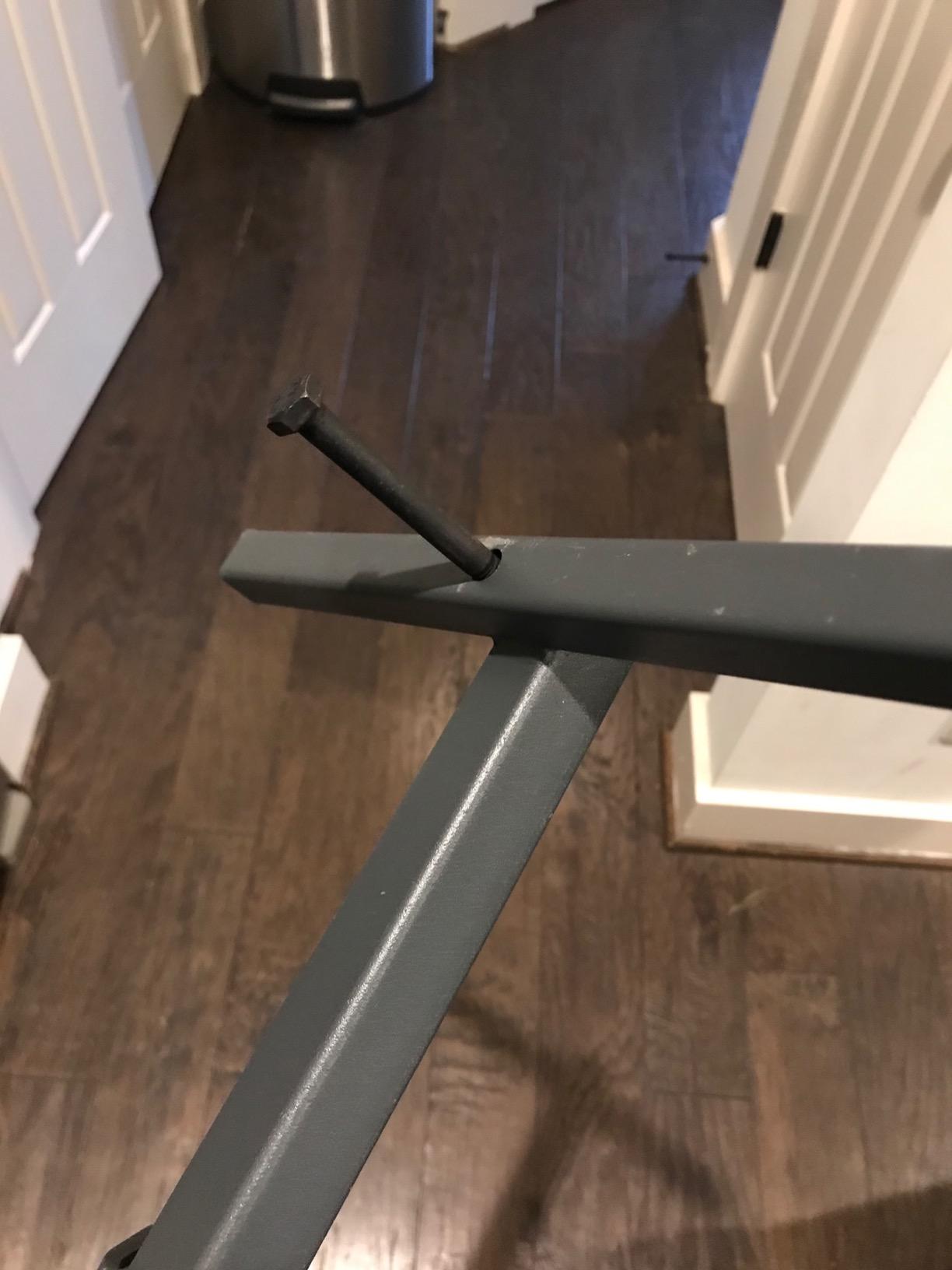
Two details make it more tree-friendly than it sounds. It is a strap-on design, so nothing is screwed into the trunk, and the cam buckle straps with quick attaching clips are faster than the improvised rigging many stick sets require. Owners also report the straps hold firmly enough that they have not been replaced in years.
Then there is the weight. The set is listed at 17.1 pounds, which works out to about 5 pounds per stick, and the sections do not nest for transport. You are carrying a rigid ladder on your pack, not a bundle of aluminum. If your hunting is anything like run-and-gun, this is a non-starter, and we would rather say so plainly than pretend otherwise.
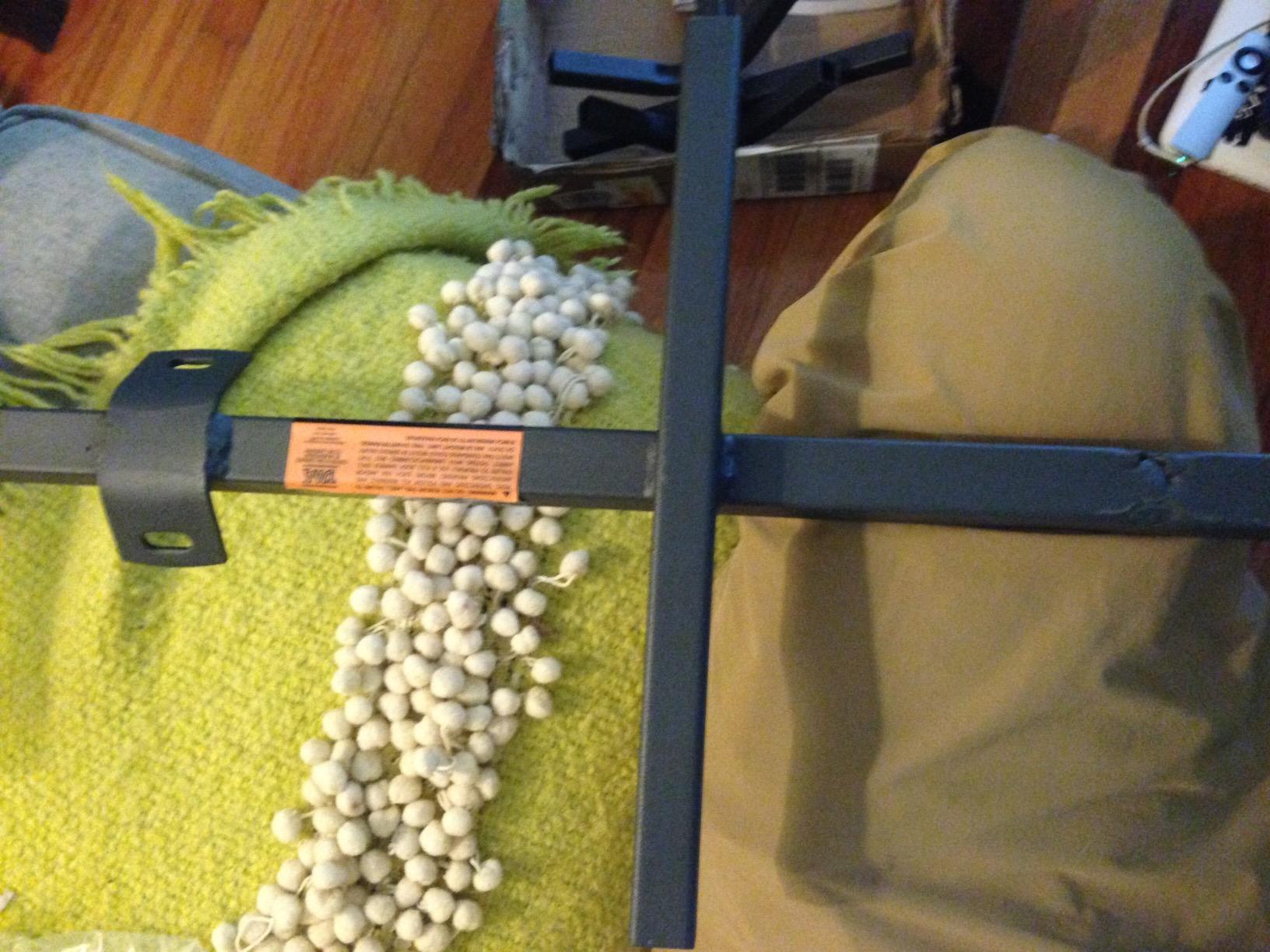
The maintenance items are predictable. Grip tape stickers fall off after a few uses, and the thin paint finish chips and eventually shows rust over multiple seasons. One reported hole stripped its thread and would not accept the bolt without drilling. None of these are safety failures, but all of them need occasional attention.
When steel is the right answer
Buy this set if you are setting up semi-permanent tree locations and leaving the sticks in place, if you want the cheapest way into saddle hunting without buying a lightweight system you will outgrow, or if you need a second set of climbing sticks you leave cached in a treestand.
It is genuinely the lowest-cost entry into saddle hunting here, and the strap-on design means you can move it between trees when the deer move. For a hunter who sets up on the same piece of timber for a week, that flexibility is worth more than packability.
When to spend more
Do not carry this on your back for a mobile hunt. Five pounds per stick adds up faster than almost any other weight decision in saddle hunting, and the non-nesting sections make it worse because you need separate straps to keep the bundle together on the pack.
If you intend to move between trees, an aluminum set halves the weight and packs into a fraction of the space. The Hawk Helium is the direct upgrade path, and the XOP X2 is the lighter one. Save the steel for the setups where you are not walking.
4. BIG GAME 20 Foot Quick-Stick Climbing System: Tallest Reach
BIG GAME Climbing Ladder Sticks, Tree Stand and Hunting Gear System, 20’ Quick-Stick – Portable Safety Accessories and Equipment for Mobile Deer Hunters, Climbers, and Shooters
Alloy steel
20 lb total
5 sections
Reaches 20 feet
5 inch cam buckle straps
Pros
- Rigid steel that survives many seasons of use
- Breaks into 5 sections for transport and setup
- Includes 5 inch cam buckle straps
- Fits trees of 9 inch diameter or larger
Cons
- 20 pounds in a system marketed to mobile hunters
- Requires a 9 inch minimum diameter tree
- Metal sections are loud during a climb
The BIG GAME Quick-Stick is the tallest thing in this roundup at a documented maximum height of 20 feet, and that reach is the entire point. It breaks into five sections for transport and setup, and the rigid alloy steel construction is described by owners as lasting through many seasons without complaint. If you need to get well above the browse line and the deer are not coming down, height is not a luxury.
Five steps per the spec sheet, with included 5-inch cam buckle straps for attachment. The packed dimensions of 16 by 3.5 by 52.5 inches tell you everything about how this carries: it is a long rigid object, not a bundle, and it needs to be strapped along a pack or carried under an arm.
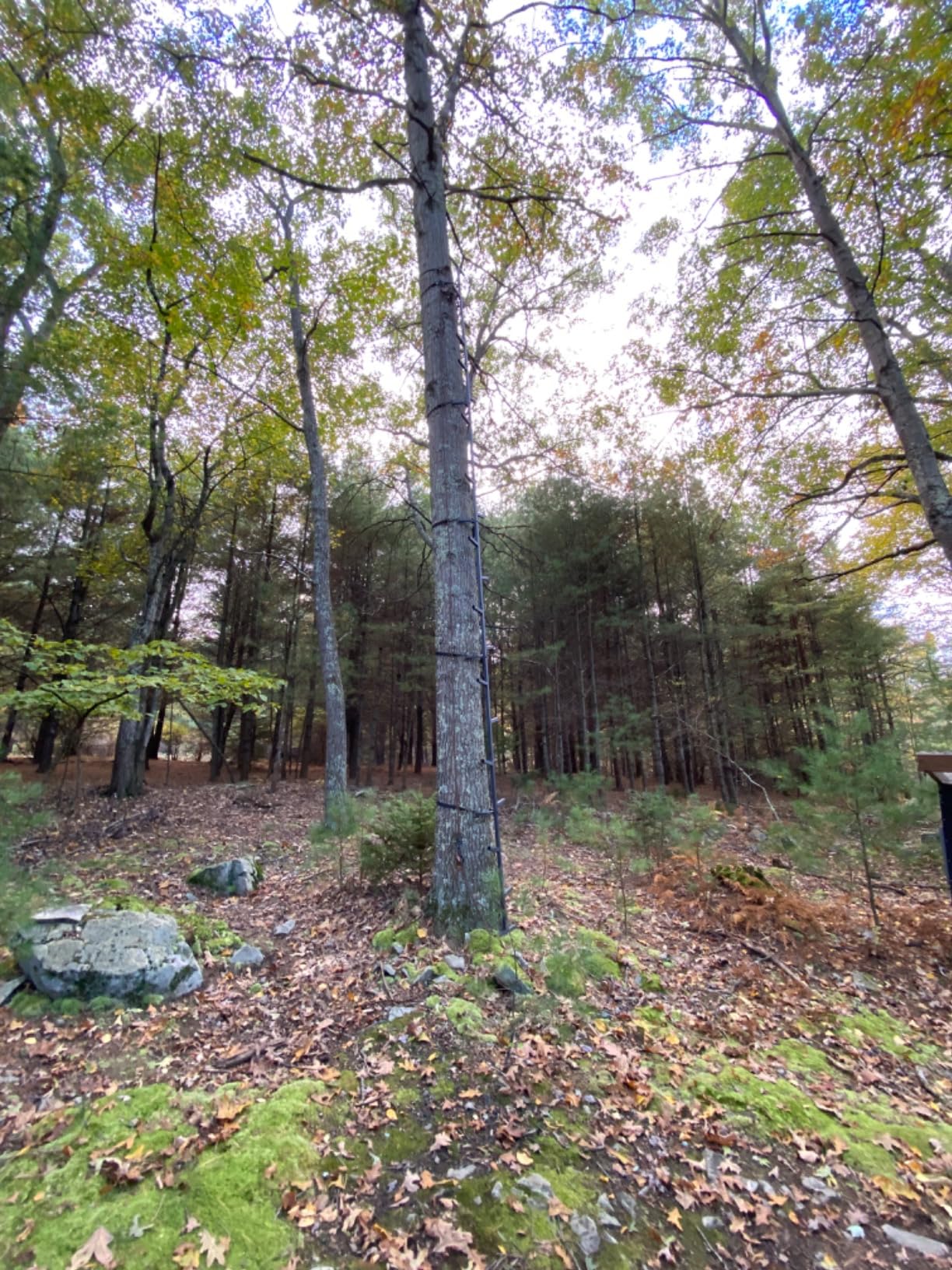
The honest problem is the 20-pound total weight in a system marketed to mobile deer hunters. That contradiction is the single most common reviewer complaint, and it is not a marketing quibble. Owners value the build and question the portable positioning at the same time, which is a fair reading of what the product is.
Like the Muddy Pro, it needs a minimum 9-inch diameter tree. Add that constraint to the weight and you have a system that works beautifully within about 200 yards of a road and becomes miserable anywhere else. Metal-to-metal section joints are also a noise concern during a pre-dawn climb, and stealth tape on the contact points is close to mandatory.
The one-year limited warranty is the shortest documented coverage in this group. For a steel system that could sit in a tree for a season, that is worth factoring in alongside everything else.
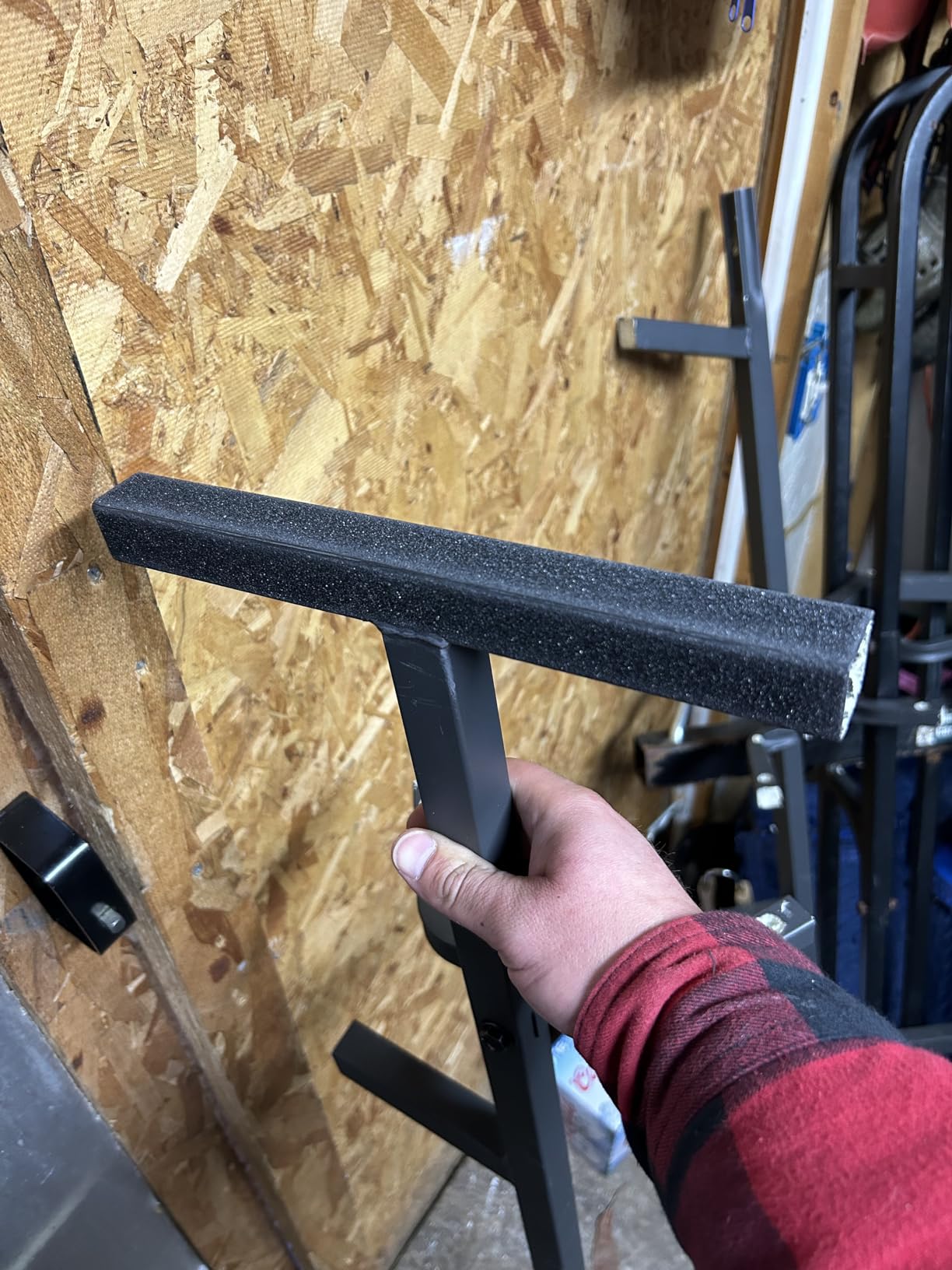
When the extra 20 feet changes the hunt
This set makes sense for high-angle setups on open mature timber, where you are working a canopy edge and need a platform well above the surrounding growth. It is also a reasonable choice for anyone building semi-permanent setups on land they can reach by vehicle, where the weight never enters the picture.
If you have ever watched a deer at 22 feet that you could not reach, this is the answer. Nothing else in this roundup gets you there with a saddle platform attached.
When it is the wrong tool
Skip it for anything that involves a real walk. Twenty pounds of rigid steel changes how you move through terrain, and it will shape where you hunt in ways that have nothing to do with the animals. For run-and-gun on public land, a four-stick aluminum set gets you a workable platform at less than a quarter of the weight.
The 9-inch minimum tree diameter is another reason to look elsewhere if your cover is young. Pair the weight, the tree minimum, and the one-year warranty with the 24.2-pound Guide Gear 20-foot Rapid and this becomes the lightest-holding option in the group, though neither belongs on a mobile pack.
5. XOP X2 Double Step Climbing Sticks: Best Value and Best Boot Clearance
XOP- X2 Hunting Climbing Steps – Set of 3, Double Step Climbing Sticks for Hunting, Midnight
6061/7075 aluminum
1.6 lb per stick
5 inch standoff
10 inch step
17 inch spacing
Pros
- Lightest stick in the roundup at 1.6 pounds each
- Deep 5 inch stand-off clears large boots
- 10 inch DURAGRIP step gives roomy footing
- Lifetime warranty on casted parts
Cons
- Supplied cam buckle straps are long and heavy
- Black plastic connector can slide down and block straps
- Heavier than the lightest imported sticks
- Knocks loudly when the tree or straps are hit
The XOP X2 is the most specified stick in this roundup, and that is why it is here. At 1.6 pounds per stick it is the lightest section in the group, and it is the only one with a documented 5-inch standoff, 10-inch step width, and 17-inch step spacing all published by the manufacturer. Numeric specificity is what lets you compare it against your boot size before you buy, and almost no competitor publishes those three numbers together.
That 5-inch standoff is the feature that changes the climb for anyone in large or insulated boots. Owners repeatedly single out the combination of wide step and deep standoff as giving a secure, roomy platform, and the DURAGRIP coating on the 10-inch step adds grip in the wet. A 6061 and 7075 aluminum build keeps the weight down without feeling flimsy.
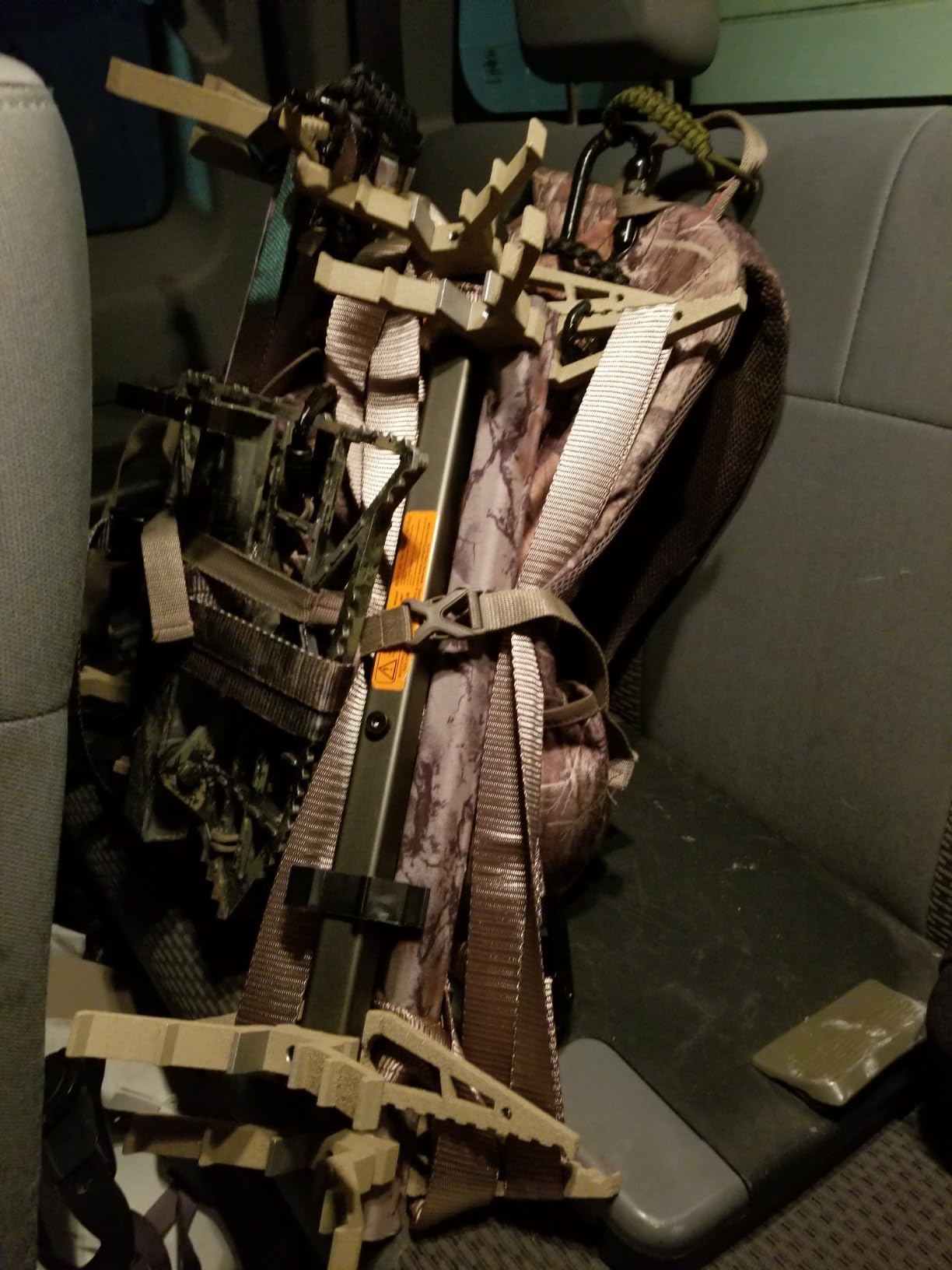
Stability is the other strength. Owners at 260 pounds report the sticks feel solid, and the teeth bite the tree hard enough that they hold position once set. It integrates with all XOP hang-on treestands for silent transport, which matters if that is your platform, and the side-locking and slide-lock stacking options let you carry the set either side-by-side or as a vertical 4-pack.
The 4.7 rating is the highest among the aluminum sets with a meaningful review count, with 80 percent five-star ratings. The lifetime warranty on casted parts is also the best-documented coverage in the group, which matters on a product whose failure mode would be a cracked step bracket.
The one nearly universal complaint is the supplied cam buckle straps. Owners describe them as unusually long and heavy, and the most common mod is replacing them with AmSteel rope or a daisy chain setup. That is straightforward to do and reduces weight and noise at the same time, so budget ten minutes for it before your first hunt. A smaller number report the black plastic sliding connector can slide down and obstruct strap attachment, so check its position before you climb.
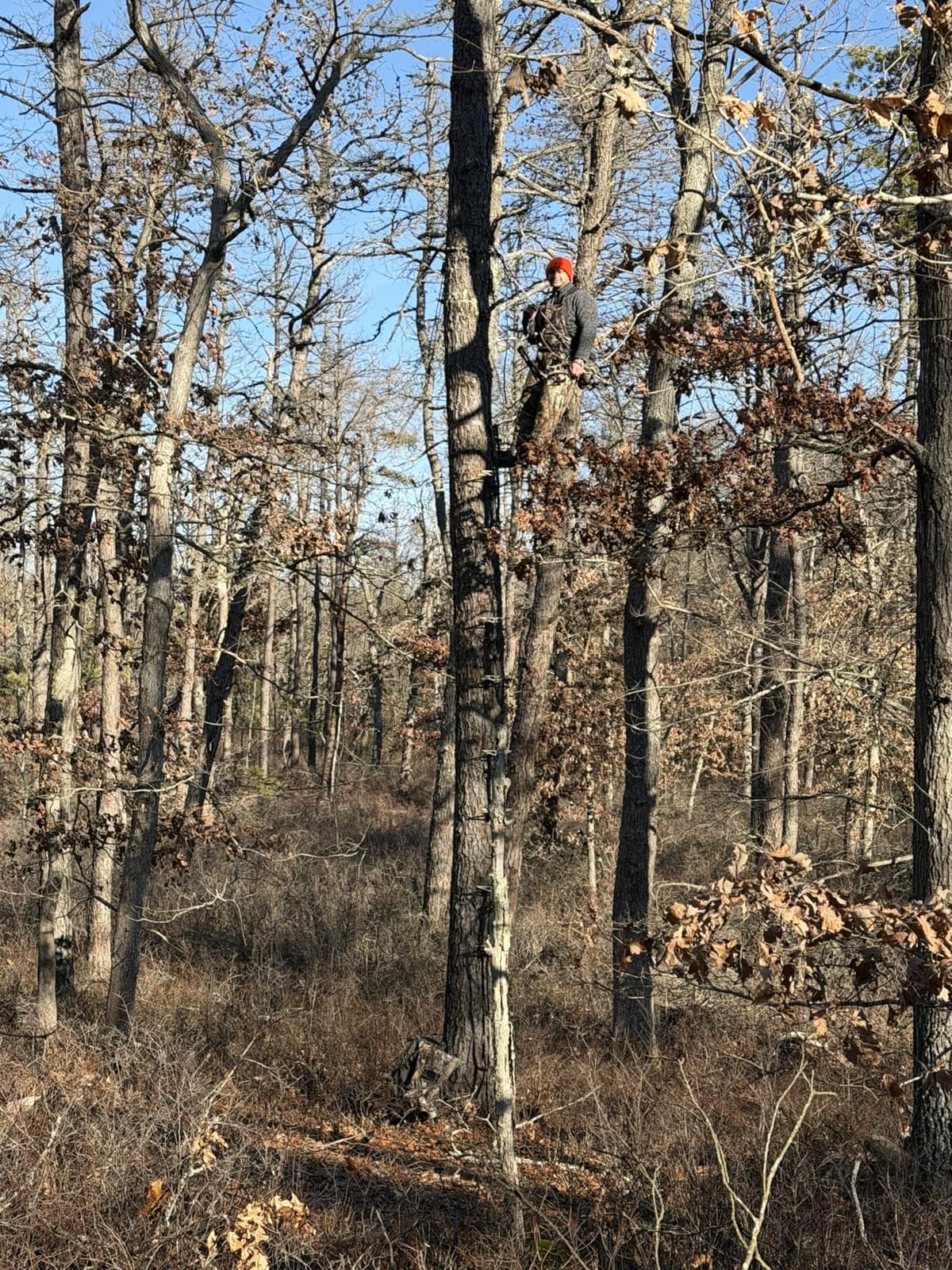
Who should buy the XOP X2
Buy the X2 if boot clearance is your problem, if you are carrying your setup any real distance, or if you run XOP hang-on treestands and want the transport integration. At 1.6 pounds per stick, a four-stick setup is about 6.4 pounds of climbing gear, which is the lightest full saddle climbing configuration in this roundup.
It is also the strongest all-round choice on paper. Every critical dimension is published, the warranty is lifetime on the cast components, and the 4.7 rating sits on 228 reviews, which is enough reporting to trust. If you are buying one set and want the least guesswork, this is it.
Where it is not the answer
If you want zero modifications out of the box, the supplied straps are a real drawback. You will be replacing or supplementing them, and that is an afternoon of work plus a small parts cost. Owners also note the sticks are loud when the tree, straps, or sticks are knocked, so add stealth tape before a dawn entry.
For the very lowest weight possible with a rope system already designed in, the Tethrd Skeletors are worth a look. For the strongest review history behind a proven design, the Hawk Helium has roughly four times the rating volume. The X2 wins on published geometry and light weight, not on how many seasons of feedback exist behind it.
6. Guide Gear 20 Foot Rapid Climbing Sticks: Best Tool-Free Assembly
Guide Gear 20′ Rapid Climbing Sticks for Tree-Stands, Hunting, 4-Pack (5′ Each)
Powder coated steel
24.2 lb total
4 by 5 foot sections
300 lb rating
Pin connected
Pros
- Pin connections mean no wrenches in the field
- Reaches 20 feet from four 5 foot sections
- Cam buckles are quieter than metal-to-metal setups
- Owners report years of durability
Cons
- Heaviest system here at 24.2 pounds
- Needs a fairly straight tree to hang properly
- Metal-to-metal contact squeaks while climbing
- Arrives with no grip surface
The Guide Gear 20-foot Rapid is built around one specific convenience: pin-connected sections. There are no bolts, no wrenches, and no tools of any kind in the field. You line up the pins, push, and the section locks. For a setup at 5 a.m. in the dark, that removes a genuinely annoying step, and it is the reason this set is worth knowing about despite its weight.
The construction is powder-coated steel in four 5-foot sections totaling 20 feet, rated to 300 pounds. Owners report the build is well made and sturdy with years of durability behind it, and the cam buckle straps included are quieter than a fully metal-to-metal system, which sets it slightly ahead of the other steel options on the noise front.
Easy to assemble and quick to hang is the consistent verdict. It reaches the desired height with the fewest separate pieces, and reaching 20 feet is one of the taller options here, which you will appreciate on open mature timber.
At 24.2 pounds this is the heaviest system in the roundup by a wide margin, and that weight is precisely the contradiction reviewers raise about a product positioned for portable setups. It needs a fairly straight tree, which limits where you can place it, and metal-to-metal contact can squeak while you climb, which matters if game is close. It also arrives with no grip surface, so owners add grip tape or stealth tape immediately, and both noise and footing improve when you do.
When tool-free assembly earns its keep
Choose the Rapid if you climb in the dark often, if you dislike carrying tools, or if you are building a fixed climbing route on a straight tree near an access point. The pin system is the honest reason to pick this over the BIG GAME Quick-Stick, which is 4 pounds lighter but needs more fiddly assembly.
It is also a good second set to leave in a semi-permanent tree. If you are not moving it, the weight stops mattering and the 20-foot reach becomes the feature you are actually paying for.
Where to draw the line
Twenty-four pounds is past the point where any mobile hunting kit is realistic. Every hunter reading this who plans to walk more than a few hundred yards should choose aluminum instead, and the XOP X2 or Hawk Helium will do the same job at roughly a quarter of the weight.
Note also the straight-tree requirement. If your hunting area is mixed-size timber, the need to find a straight trunk limits placement more than the 20-pound weight would if you were stationary. Between weight, tree requirements, and a 30-day return window instead of a stated warranty, this is a semi-permanent tool rather than a saddle hunting stick.
7. Tomaki Lightweight Aluminum Climbing Sticks: Best Raised Step Ends
Tomaki Aluminum Hunting Climbing Sticks, Non-Slip Tree Step, 4 Pack
Aluminum
350 lb rating
17 inch sections
V bracket grip
4 straps included
Pros
- Raised step ends stop wet boots sliding off
- V bracket design improves traction and bite
- Sliding lock clip for quiet transport
- Highest documented rating here at 350 pounds
Cons
- Generic brand with limited long-term review history
- No per-stick weight published by the manufacturer
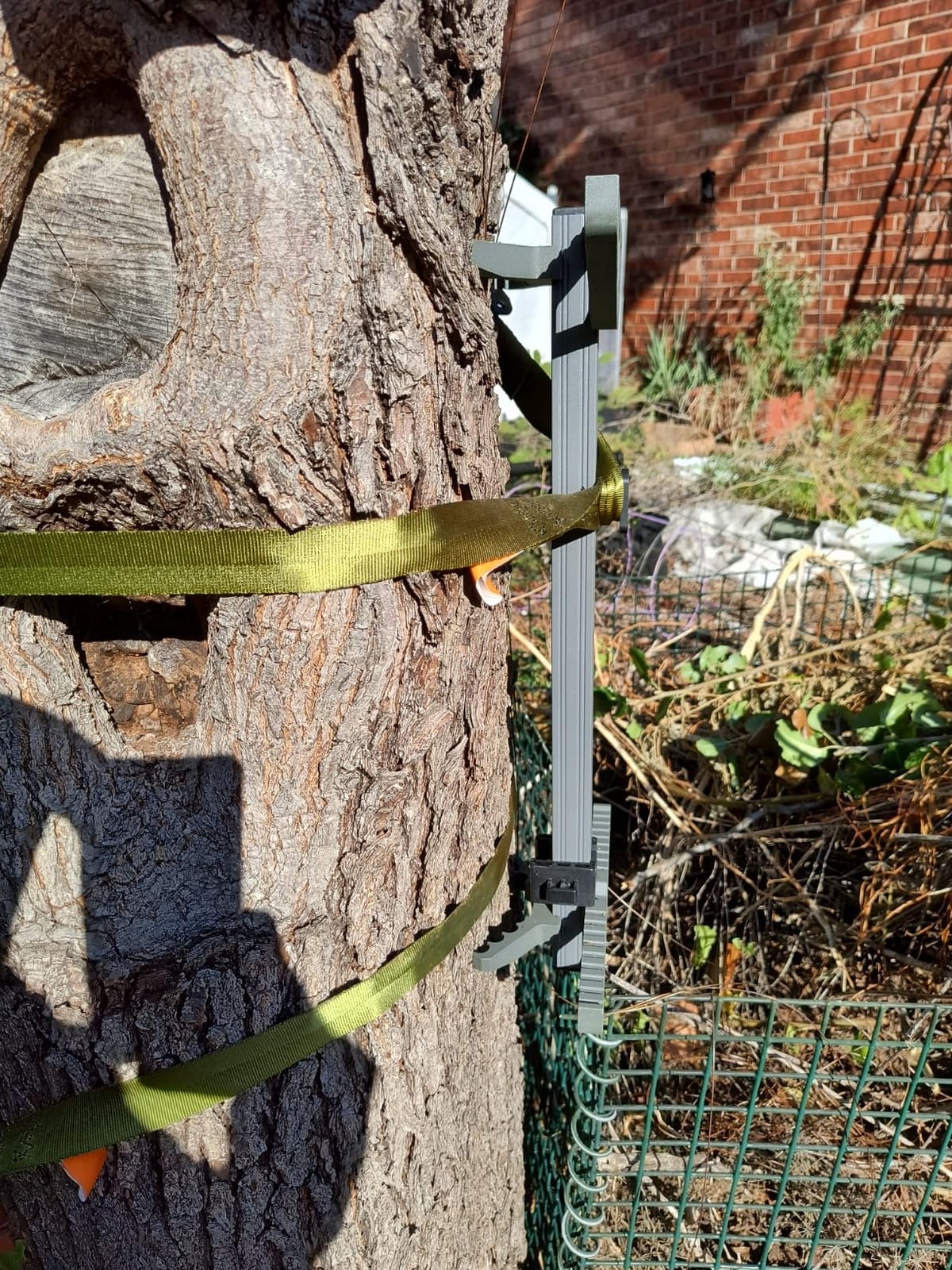
The Tomaki sticks are interesting because of two details that solve specific problems. The raised ends on each step stop a wet boot sliding forward off the front edge, which is a low-frequency accident that ends hunts, and the V-shaped gear bracket design increases both traction and the fixing force against the trunk. Owners consistently point to secure, non-slip footing as the standout feature.
The 350-pound weight limit is the highest documented rating in this roundup, which matters if you are a larger hunter and want margin rather than a bare pass. Four upgraded straps are included, and the sliding lock clip handles both storage and silent transport, which removes the loose-rattle problem many nesting systems have.
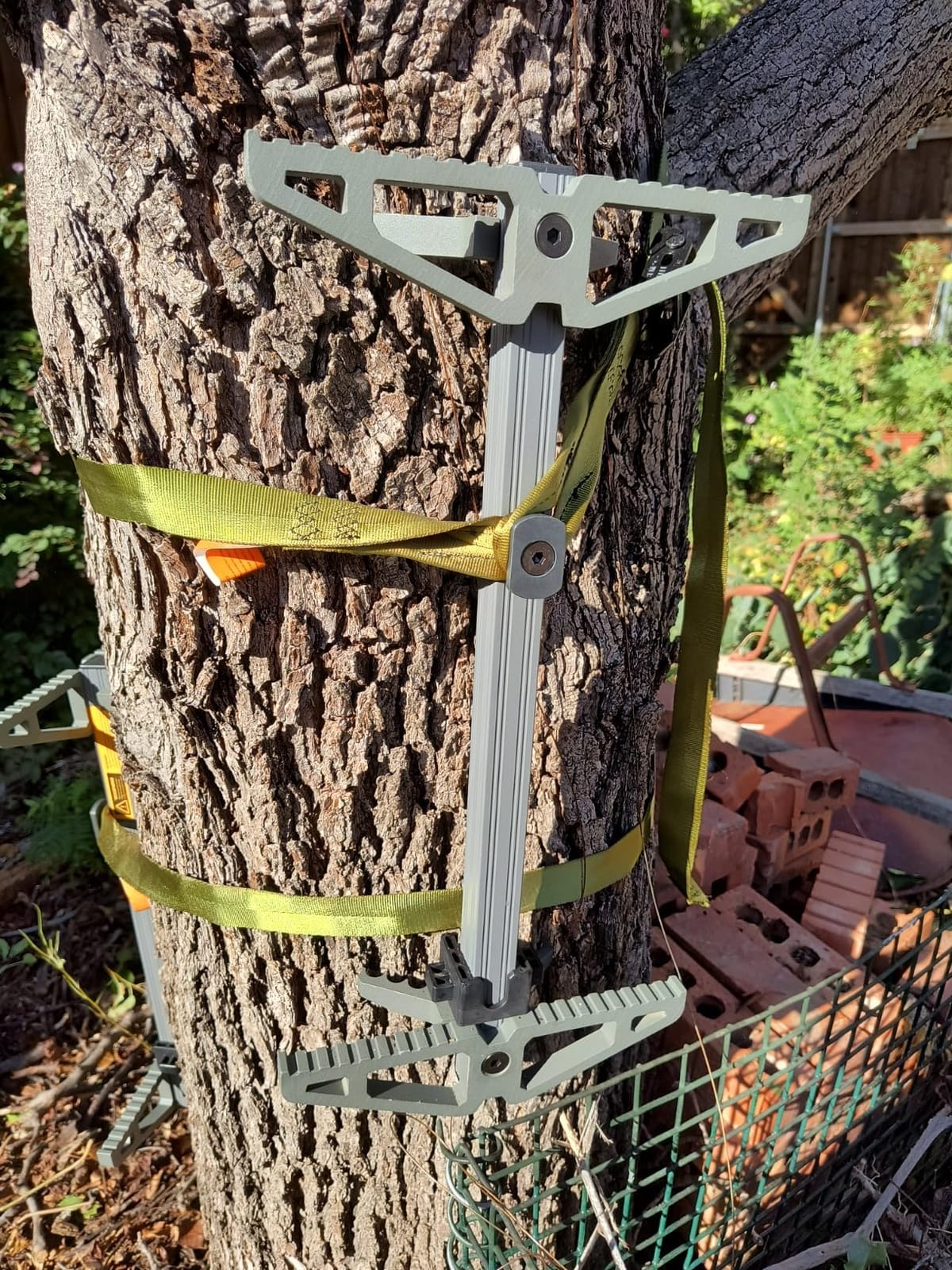
At 4.6 across 120 reviews with 78 percent five-star ratings, the feedback is solid for a smaller listing. Buyers emphasize the grip, the non-slip raised step design, and the quiet lock clip for pack-out. The green finish is a minor detail that will not stand out in the woods the way a bare gray stick can.
The limitation is straightforward: this is a generic brand with a limited long-term review history. The documented warranty is listed as a two-year figure, which is better than the steel options, but there is no multi-season field history in the reviews yet. A manufacturer part number is listed as climbing sticks, Tomaki minimalist, which tells you how much documented engineering is behind it.
We would also flag that the manufacturer does not publish a per-stick weight, only a package weight of 5.22 kg for the four-piece set. That is a real gap if you are trying to hit a pack weight target, and it is the main reason this set does not rank higher despite good feedback.
Who this set suits
The Tomaki set makes sense if your climbing is wet or cold and foot placement is your worry. Raised step ends and grooved traction address a real problem that smoother aluminum steps leave open, and the 350-pound rating gives larger hunters room.
It is also a reasonable option if you want a second aluminum set as a backup or a gift, at a review volume that suggests the design is working consistently for whoever is buying it. The included straps mean no separate purchase to get started.
What to know before you commit
You are buying a design with a short documented history. Nothing in the reviews suggests a problem, but there are not yet the second-season reports that let you know how the hinge and bracket wear over time. On a tool that carries your bodyweight at 20 feet, that is worth factoring in.
If you want published per-stick weight and documented step geometry, the XOP X2 gives you both and a lifetime warranty on its cast parts. If you want a proven track record, the Hawk Helium has 985 ratings behind the same 300-pound class. The Tomaki is a reasonable middle option with genuinely good step design.
8. RiteAim Collapsible Aluminum Climbing Sticks: Lightest with a 2-Year Warranty
RiteAim Climbing Sticks, Lightweight Aluminum Hunting Climbing Steps, Non-Slip Tree Climbing Sticks for Hunting, Collapsible Climbing Ladder for Hunting Tree Stands with Climbing Straps
Cast aluminum
1.87 lb per stick
Load tested over 350 lb
Grooved steps
2 year warranty
Pros
- Second lightest set here at 1.87 pounds per stick
- Load tested well above 350 pounds
- Sliding lock clips make transport silent
- Grooved steps help with muddy boots
Cons
- Lowest rated aluminum set in the group with 7 percent one-star
- Generic design with limited field-testing history
- Some reports of durability and fit issues
The RiteAim sticks are the second-lightest set in the roundup at 1.87 pounds per cast aluminum stick, and they carry the only explicitly documented two-year manufacturer warranty among the budget aluminum imports. That combination is unusual: light enough for real mobile hunting, with warranty coverage better than the 30-day return window on both steel Guide Gear sets and a stated two-year figure on the Tomaki.
Load testing is documented above 350 pounds, and the grooved steps are designed specifically for slip resistance with muddy boots. The V-shaped gear bracket handles tree grip, and the sliding lock clips make transport silent and storage simple, which matters when your pack already has a saddle and platform strapped to it.
Four high-quality double-layer Oxford nylon webbing straps are included, and the sticks fit trees of various diameters without a published minimum, which is a genuine advantage over the Muddy Pro and BIG GAME sets that need 9 inches.
Where this set falls short is the review profile. At 4.4 it is the lowest-rated aluminum set in the group, with 7 percent one-star reviews against 99 total. That is not a failing score, but it is the widest spread of dissatisfaction in the aluminum category here. Buyers cite durability and fit issues that the reviewers themselves describe as common to budget imports, and the design is generic with limited field-testing history.
Why the light weight matters here
At 1.87 pounds per stick, a four-piece setup comes to roughly 7.5 pounds of climbing gear before straps. Community reporting on one-stick setups puts total carry weight near 5 pounds when you drop to a single stick, and forum users regularly report a full four-stick setup in the 5 to 8 pound range, which is the number most mobile hunters compare against.
Being inside that range with a two-year warranty behind it is a legitimate reason to pick this set. If your pack is already heavy and you cannot cut anything else, the weight is where the argument starts.
When the rating gap matters
The 4.4 rating and 7 percent one-star share is the reason this set sits where it does. When the XOP X2 carries a 4.7 with a lifetime warranty on cast parts at 1.6 pounds per stick, the RiteAim has to be justified on warranty length and strap inclusion alone, and that is a thinner case.
If you are comfortable with a generic design and you prioritize the documented two-year coverage, this works. If you want the lightest weight and the strongest published specifications, the XOP X2 is the better buy. If you want the most proven hardware, the Hawk Helium has roughly ten times the review history.
9. XOP 34 Inch Aluminum Climbing Sticks: Best Strap-Free Stacking
XOP 34 Inch Aluminum Climbing Sticks for Hunting – 3 Pack
Aluminum
3.2 lb per stick
34 inch length
350 lb rating
Swivel foot pegs
Pros
- Patented lock tight stacking needs no strap to carry
- Swivel foot pegs rotate 180 degrees either way
- Zero flex bite on irregular trunks and bends
- Quiet aluminum build and lifetime cast part warranty
Cons
- Bulky and heavy for daily mobile entries at 3.2 pounds each
- Only sold in 3 packs so height options are limited
- Single step per side makes climbers awkward
- Aider setups are difficult with this layout
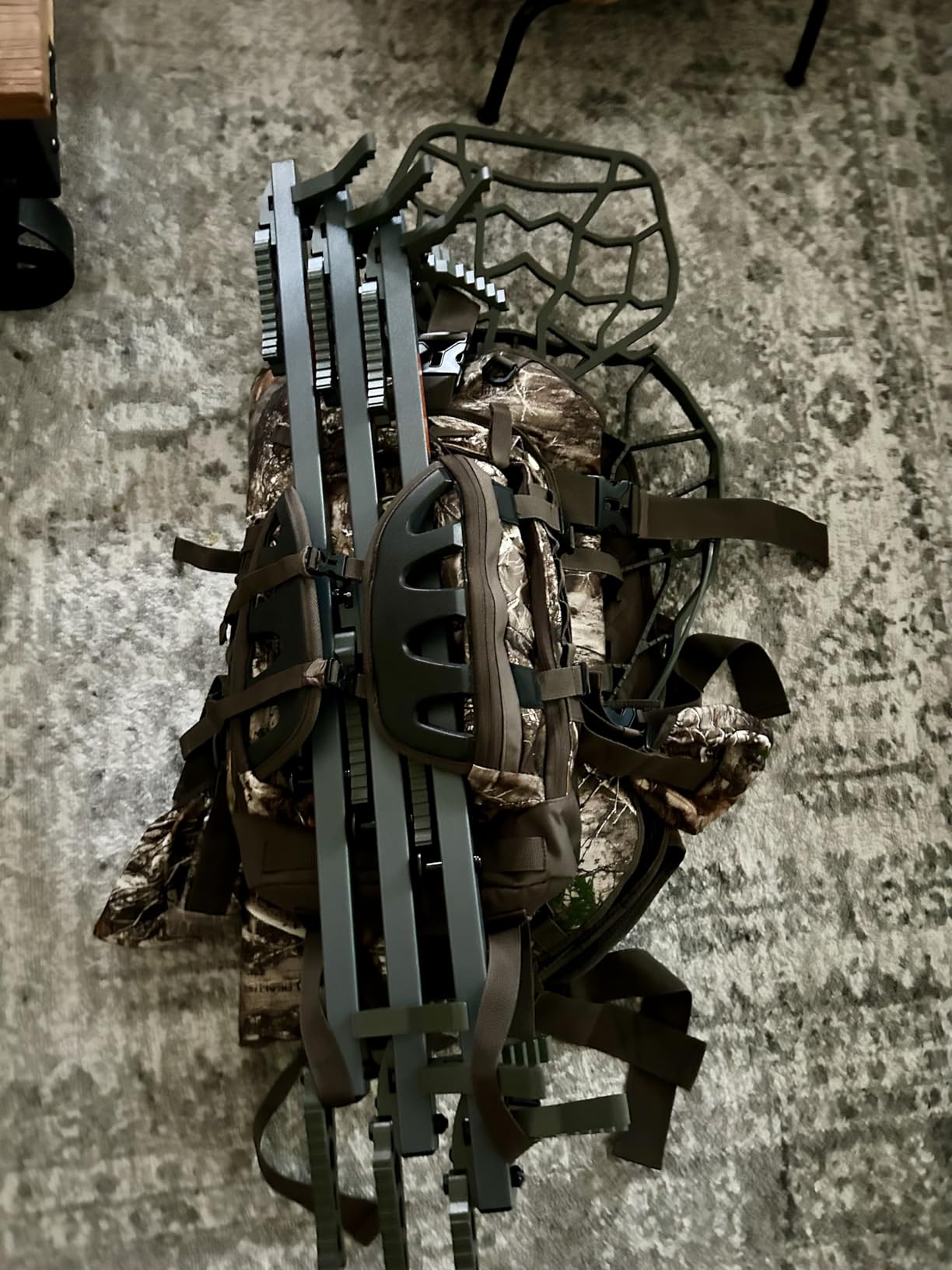
The 34-inch XOP sticks solve a packing problem in a way nothing else here does. The patented lock-tight stacking system holds the sections together with no strap, no bungee, and nothing loose to rattle while you walk. Reviewers specifically praise packing tight with no rattling and no extra straps, which is exactly the complaint that comes up with every other nesting system in this roundup.
The deep stand-off bracket adds genuine boot-to-tree clearance, and the 180-degree swivel foot pegs rotate to suit whichever side you are climbing from, which solves the single-sided step problem more elegantly than a hinge. Owners report the bite is excellent and the mount has zero flex, and that the rotational tree engagement works well on irregular surfaces and trunk bends.
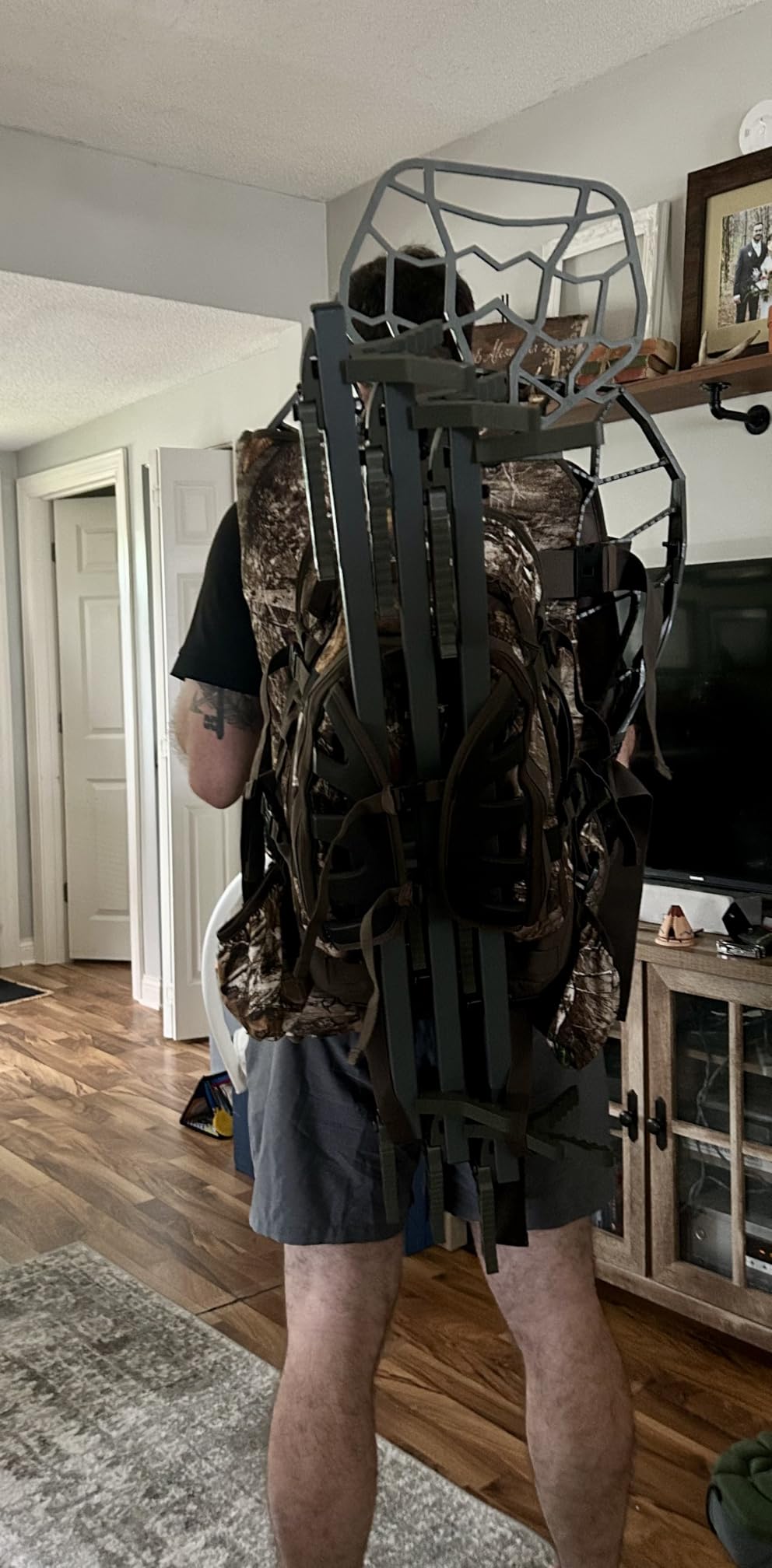
Integration with XOP hang-on treestands means the sticks can ride with the platform in silence, and the camo color needs no painting. The 350-pound rating and a lifetime warranty on cast aluminum components are both documented, and the build quality comes through clearly in the reviews.
The problem is the weight and the length. At 3.2 pounds per stick these are among the heaviest aluminum sections available, and 34 inches is long to hang and take down. Reviewers are direct about it: this is a poor fit for daily mobile hunting. Buyers also note the set is only sold in 3-packs, which limits your height options without buying multiple sets.
There is one more consequence worth planning around. The single-step-per-side layout makes climbing aiders difficult to use, so if your plan is a one-sticking or aider-assisted setup, this set works against you. For a three-or-four-stick semi-permanent climb, it is excellent.
Where the 34-inch length earns its keep
Longer sticks mean fewer placements for the same height, and that is a real efficiency on a semi-permanent setup where you hang once and hunt for days. The lock-tight stacking means you carry them to that tree once and leave the bundle intact. This is the best strap-free transport system in the roundup, full stop.
It is also the right choice for hunters with wide boots who will set up in one tree and stay there, since the deep stand-off bracket gives real clearance without requiring you to reposition sections.
When 3.2 pounds per stick is too much
If you move trees, the weight is disqualifying. Four of these is close to 13 pounds of climbing gear, which is more than most mobile saddle hunters are willing to carry, and the length makes each hang slower. The Hawk Helium at 2.5 pounds and the Tethrd Skeletors at 2 pounds are meaningfully lighter for the same job.
For aider-based climbing, look elsewhere. The single-step-per-side layout and the 3-pack-only configuration work against a one-sticking strategy, and the shorter double-step designs on the XOP X2 and the Skeletors fit that approach much better.
10. Tethrd Skeletor Climbing Sticks: Best Folding Dual Steps
Tethrd Skeletor Climbing Sticks 4 PK – Portable, Lightweight & Packable – Folding Dual Step Design That Folds Away from The Tree
Aluminum
2 lb per stick
24 inch packed
20 inch deployed
DynaLite rope and tab
Pros
- Highest rated in the group at 4.8 with 92 percent five-star
- Steps fold away from the tree to clear the climb
- Steps stay on the tree after the rope is released
- Angled step surface cuts foot fatigue
Cons
- Sits at the top of the asking range of every set we analyzed
- Rating rests on 43 reviews
- the smallest base in the roundup
The Tethrd Skeletors solve the problem that almost every other stick in this roundup ignores: your knees and shins. The folding dual step design folds the steps away from the trunk, so when you are climbing the section above, nothing is digging into your legs. The angled step surface is designed to support the arch and ball of the foot, and owners report noticeably better foot placement and less foot fatigue over a long climb.
The attachment is the patented DynaLite rope and tab system. There are no buckles and no mechanical parts to rattle, which is why owners describe the sticks as quiet once taped. The other feature we keep coming back to is retention: the steps stay attached to the tree when the rope is released, so setup and teardown both get faster because you are not catching hardware that has already dropped.
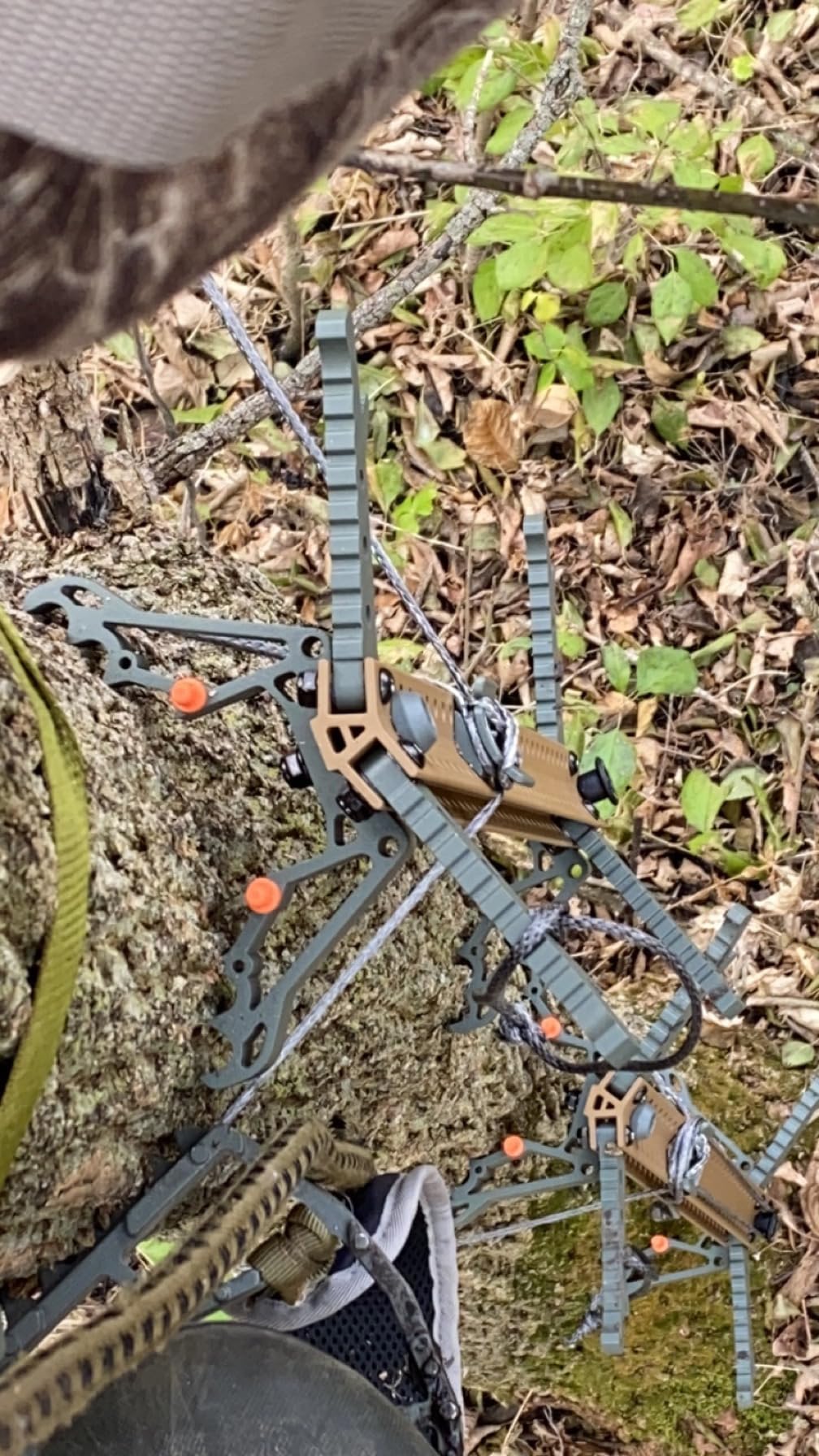
At 2 pounds per stick and 24 inches packed against 20 inches deployed, the Skeletors are light enough to ride on a backpack rather than dominate it. The StickLoc pin system handles stacking and transport without loose pieces, and the recessed retractable aider mounting in the upright keeps the design clean without adding a protruding bracket. Multiple owners have bought a second set, which is the strongest endorsement a climbing tool can get.
Here is where we have to be careful. The 4.8 rating is the highest in the roundup, with 92 percent five-star reviews, but it rests on 43 reviews, the smallest base of any product here. That is a meaningfully different risk profile from the Hawk Helium at 985 reviews. Treat the Skeletors as well-designed and well-liked rather than as battle-tested.
The second drawback is cost. This set sits at the top of the asking range for everything we reviewed, and it is the reason a buyer with the same needs might choose the XOP X2 instead and keep a chunk of that back. You are paying for a design advantage, not just a weight advantage.
Why the folding steps are worth paying for
On a long climb in cold weather wearing insulated boots, leg clearance is a comfort issue that compounds. Owners who switched to folding dual steps report the change is obvious on the first ascent, and the angled step surface is the other half of that improvement because it lets you stand more naturally.
The rope-and-tab attachment is also the quietest system in this roundup out of the box. If you are bowhunting and your entry has to be silent, there are no buckles to click and no metal to knock together. Add stealth tape and it is as close to silent as a climbing stick gets.
When something else is the better buy
If you are buying your first set and want the deepest support network behind it, the Hawk Helium has more than twenty times the review volume and a lower asking point. You give up the folding steps and the DynaLite attachment, and you get a design the community has run hard for years.
If your priority is pure weight and published geometry, the XOP X2 at 1.6 pounds per stick with a 5-inch standoff is lighter and cheaper. The Skeletors win on step design, attachment simplicity, and quiet operation, which is a different set of priorities entirely. Several owners pair the two approaches and report the Skeletors are the ones they reach for on longer days.
How to Choose the Best Climbing Sticks for Saddle Hunting
Weight comes first because it decides how far you can walk, and how far you can walk decides how many trees you can work. Start there and the rest of the decision narrows quickly. A four-stick aluminum set lands in the 6 to 10 pound range, and community reporting consistently puts a full four-stick setup in the 5 to 8 pound band once lighter hardware is used. The steel options in this roundup weigh 17, 20, and 24 pounds, which is a different category of trip entirely.
How many climbing sticks do you need?
Three sticks with an aider is the common mobile configuration. Four sticks get you a full 20-foot climb without stepping, at the cost of one more stick on your pack. One stick with an aider is the lightest setup and the most demanding to climb, and hunters who switch to it report needing significant practice before the ascent felt safe.
The math is straightforward. A 20-inch stick with roughly 17-inch step spacing puts your platform somewhere between 15 and 20 feet with three sticks and a single-step aider. A forum hunter at 6 foot 2 reports four Lone Wolf sticks plus a single-step aider reaching 25 feet, which is a useful data point for how much an aider adds. Three 34-inch XOP sticks get you higher with fewer placements but weigh 9.6 pounds doing it.
Attachment method: rope beats buckles for most hunters
Cam buckles are fast and they are heavy. Owners of the XOP X2 almost universally replace the supplied straps, and the Hawk Helium strap gets swapped often enough that the conversion is a standard community practice. Rope and tab systems like DynaLite and AmSteel add almost no weight and no mechanical parts that can rattle or freeze.
If you do convert, the process is simple: remove the buckle strap, run a length of AmSteel rope through the stick’s channel, and add a small cleat or a loop you can tie off. The result is quieter, lighter, and has nothing to seize in the cold. The one exception is if you rely on the cam buckle’s adjustability across very different tree diameters, because a fixed rope length is less forgiving there.
Standoff distance is the comfort number nobody publishes
Standoff is the gap between your boot and the bark, and it is the difference between a relaxed climb and a climb spent jamming your ankles into a tree. The XOP X2 publishes 5 inches, which is the figure to target if you wear size 12 boots or insulated winter footwear. Most other sticks in this roundup do not publish it at all.
Short standoffs of 2.75 to 3 inches are reported as uncomfortable for hunters in large boots, and that is a recurring complaint from bigger-framed hunters. If you cannot find a published standoff figure, look for a deep stand-off bracket as a design feature, which is what the XOP 34-inch sticks and the Skeletors both offer.
How to make climbing sticks quiet enough for bowhunting
Noise comes from three places: buckles, sliding connectors, and metal-to-metal contact. Stealth tape over contact points solves the third, which is why owners of the steel sets add it immediately. Swapping buckles for rope solves the first. The sliding lock clips on the Tomaki and RiteAim sticks are already quiet, and the Hawk Helium’s suction cups only need silicone lubricant on the rubber to stop squeaking.
For a genuinely silent entry, the Tethrd Skeletors have the best out-of-the-box profile because there is no buckle to click. Add tape to the step contact points and you have the quietest configuration we covered. For the steel ladder systems, expect to tape every section joint before you rely on them for a dawn setup.
Platform compatibility and ecosystem fit
Sticks and saddles are more integrated than most buyers expect. XOP sticks integrate with XOP hang-on treestands for silent transport, which lets you carry the platform and the climbing gear as one bundle. The Muddy Pro packs flat with Muddy fixed-position treestands. If you already own a platform from one of these brands, matching the ecosystem removes pack bulk for free.
Generic sticks have no such tie, but they do tend to fit more tree diameters. The Muddy Pro and BIG GAME systems both require a 9-inch minimum, which is worth checking against your timber. The RiteAim sticks fit various diameters with no published minimum, which is useful if you move between mature stands and younger trees.
Safety limits nobody should skip
Climbing sticks are not fall arrest equipment, and the first rule is to keep your upper stick at a height where a fall is survivable. Most community practice is to limit the top stick to roughly 15 to 20 feet and treat anything higher as a different activity with different gear.
Wear a full-body climbing harness and connect your safety line to a separate anchor, not to the saddle platform or to a stick. Wet bark, cold hands, and a 300-pound rating that describes static load are all reasons to take the first few climbs slowly. Solo hunters should be especially conservative, because nobody is there to hold a ladder or call for help. And if you are not certain a stick is biting properly, climb down and re-rig it rather than testing it with your body weight.
Climbing Sticks vs Hang-On Stand vs Ladder Section
Climbing sticks are one of three ways to reach a saddle platform, and the honest answer is that they are not always the fastest. Forum veterans repeatedly note that a saddle setup is not much faster to set up than a hang-on, because you still have to hang sticks and then hang the platform. What you gain is the ability to move to a new tree without leaving equipment behind.
A hang-on stand gives you one fixed spot and the fastest single setup. A ladder section gives you a fixed route with very little carry weight once installed, which suits a hunter who works one mature tree. Climbing sticks give you mobility at the cost of extra pack weight and a longer setup, and they are the only option of the three that lets you change trees on the fly.
The disadvantages of saddle stand hunting are real and worth naming. You carry more weight. You make more noise during setup. You are climbing on every move rather than once. And you need a treed landscape, not open ground. If your hunting is mostly on one reliable tree, a hang-on or a ladder section may serve you better and cost you nothing in pack weight.
Frequently Asked Questions
What is the best climbing stick for saddle hunting?
The Hawk Helium 20-inch sticks are the best all-round choice, with the deepest review history in our roundup, dual-sided steps, a 300-pound rating and 2.5 pounds per stick. The XOP X2 is the best pick if boot clearance matters, since it is lighter at 1.6 pounds per stick and publishes a 5-inch standoff. The Tethrd Skeletors win for folding dual steps and the quietest rope attachment.
Are Hawk helium climbing sticks good?
Yes, they are well regarded in the saddle hunting community and are the most widely owned set in the group, with 985 ratings at 4.6. Owners describe them as sturdy, quiet and easy to carry. The recurring complaints are suction cups that are hard to separate when new and a thin supplied strap, both of which are solved with silicone lubricant and a rope or cam cleat mod.
How many climbing sticks does saddle hunting take?
Three sticks with an aider is the most common mobile configuration, getting your platform to roughly 15 to 20 feet. Four sticks reach about 20 feet without stepping and cost one extra stick on your pack. One stick with an aider is the lightest setup and the hardest to climb, and hunters who switch to it report needing real practice before the ascent felt safe.
What are the best lightweight climbing sticks for saddle hunting?
The XOP X2 at 1.6 pounds per stick and the RiteAim set at 1.87 pounds per stick are the two lightest in our roundup. The Hawk Helium at 2.5 pounds and the Tethrd Skeletors at 2 pounds sit in the next tier and carry more proven feedback. Anything over 3 pounds per stick, like the XOP 34-inch sticks, is a semi-permanent tool rather than mobile gear.
What are the best one-stick climbing sticks for saddle hunting?
One-sticking suits experienced hunters who want the lowest carry weight, and forum users report total carry weight dropping to about 5 pounds. A light, double-step design works best, which points to the XOP X2 or the Tethrd Skeletors with their folding dual steps. Avoid the XOP 34-inch sticks for this method, since their single-step-per-side layout and 3.2-pound weight work against aider climbing.
Is saddle hunting better than a climbing stand?
It depends on whether you move. A hang-on stand is the fastest single setup and the lowest carry weight, but it commits you to one tree. Saddle hunting with climbing sticks lets you change trees on the fly, which is the real advantage. Forum veterans note it is not much faster to set up than a hang-on, since you still hang sticks and then hang the platform, and it costs more pack weight and more setup noise.
Final Verdict: Which Climbing Sticks Should You Buy?
For your first saddle hunting set, buy the Hawk Helium 20-inch sticks. Nothing else here has 985 ratings of field feedback behind it, the dual-sided steps and bark teeth are proven, 2.5 pounds per stick is a fair weight, and the two real complaints are both fixed with a bottle of silicone lube and a rope mod.
If you want the lightest carry weight and you wear big boots, step up to the XOP X2 at 1.6 pounds per stick. The published 5-inch standoff and 10-inch step are the most useful specifications in this roundup, and the lifetime warranty on the cast parts is the best documented coverage. Replace the supplied cam buckles with AmSteel rope before your first climb.
If you climb long days in the cold and your knees tell you about it, the Tethrd Skeletors are worth the money. The folding dual steps and the buckle-free DynaLite attachment solve real problems, and several owners have already bought a second set. Just weight the 43-review base against that.
And for the steel systems, buy them only if your trees are close to a road. A 17, 20, or 24-pound climbing system is a semi-permanent tree tool, not a saddle hunting pack, no matter what the label on the box says. Whichever aluminum set you choose, add stealth tape to the contact points, keep your upper stick at a height you can survive falling from, and connect your safety line to a separate anchor rather than the platform. That is the full 2026 roundup.