
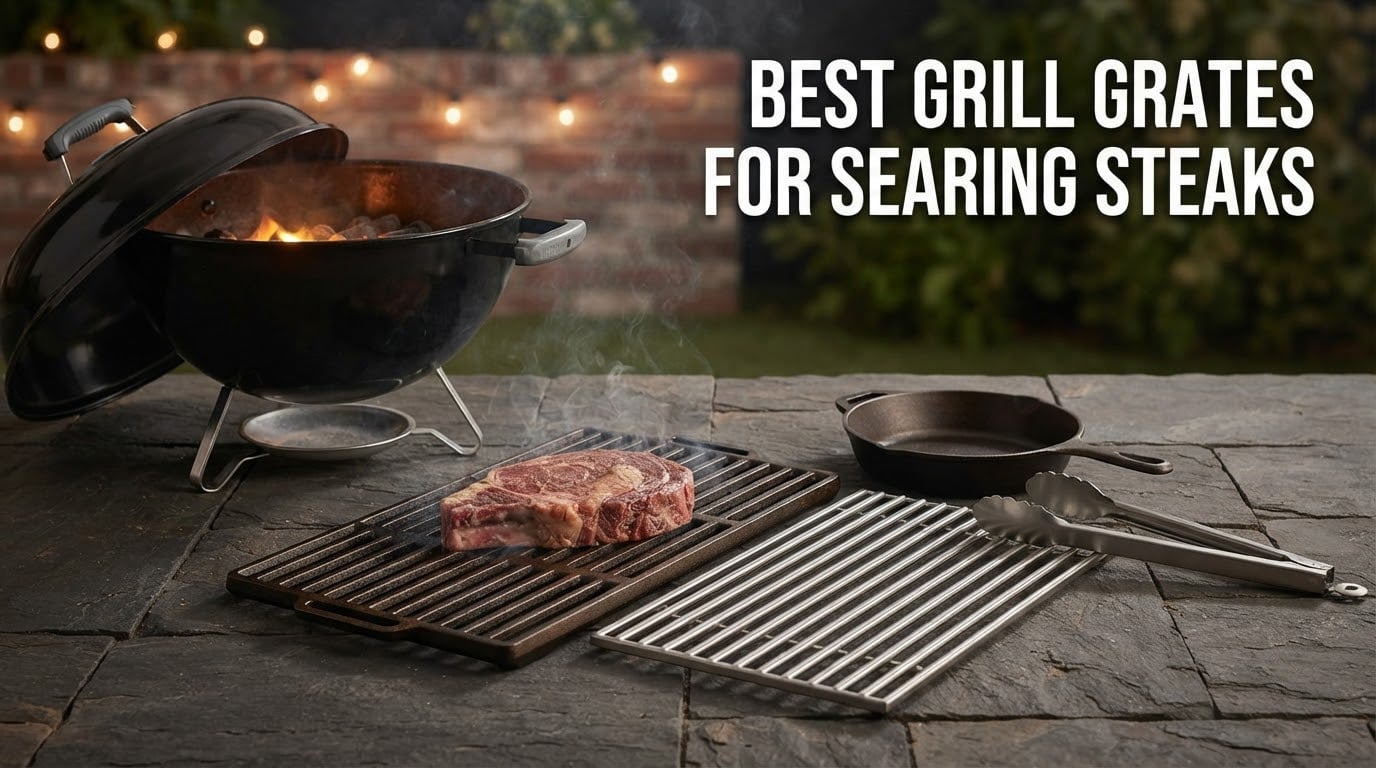
The best grill grates for searing steaks are heavy, high-thermal-mass surfaces: cast iron or cast stainless steel that stores energy and keeps its temperature when a cold steak lands, or an anodized aluminium hybrid topper that concentrates heat at raised rails. Bar diameter matters as much as the label. A thin, chrome-plated factory grate loses contact heat instantly and gives you pale marks that fade before the steak comes off.
That is the whole argument. A grill grate is the only surface touching your steak, so it caps the quality of the cook. If it cannot hold a searing window of roughly 500 to 650 degrees Fahrenheit, no amount of charcoal or propane technique downstream will fix the crust. The Maillard reaction that builds flavour starts at the surface, and a grate that has already cooled itself by 150 degrees the moment the meat touches it can never get there.
We spent weeks working through ten replacement grates and toppers, weighing them, checking part numbers, and reading what owners say after a season of use. The list covers the categories that show up in real kitchens: drop-in cast iron for Weber-style gas grills, thick 9mm rod stainless, kamado half-moon cast iron, a hinged stainless kettle grate, and two toppers for cooks who sear on top of an existing grate. Every pick lists its exact weight and the models it fits, because fit is where most purchases go wrong.
A word on what we are not doing here. We are not telling you a cheap grate and an expensive grate produce identical steaks. They do not. We are telling you which one delivers the sear you want for the grill you already own, and where the cheaper option is genuinely the smarter buy.
Table of Contents
Top 3 Grill Grates for Searing Steaks (October 2026)

QuliMetal 16-Bar SUS304 Grate
- Food-grade SUS304 stainless steel
- 16 parallel bars for even heat
- Drops in for Weber Spirit 300 and GS4

QuliMetal 9mm Genesis II Grate
- 9mm solid steel rod
- Stays flat under heavy food weight
- Replaces Weber part 66095

Uniflasy 15 Inch Cast Iron
- Matte cast iron
- Retains heat for searing and marks
- Replaces Weber part 7522
The first is our pick for most gas grill owners replacing a burnt-through factory grate. The second is the thickest rod in the set and produces the deepest marks, at a real weight cost. The third has the largest review base of any grate here and is the safest bet if you want cast iron without a brand-specific fit headache.
All 10 Grill Grates Compared in 2026
| Product | Specifications | Action |
|---|---|---|
|
QuliMetal 16-Bar SUS304 for Weber Spirit 300
|
|
Check Latest Price |
 Kamado Joe Half-Moon Cast Iron Grate
|
|
Check Latest Price |
|
QuliMetal 9mm Rod for Weber Genesis II 300
|
|
Check Latest Price |
|
Uniflasy 15 Inch Matte Cast Iron
|
|
Check Latest Price |
 Slow N Sear EasySpin 304 Stainless
|
|
Check Latest Price |
 Leship 15 Inch Cast Iron Pair
|
|
Check Latest Price |
 Lodge Pre-Seasoned Cast Iron Topper
|
|
Check Latest Price |
 Direct Store DC114 Porcelain 4-Pack
|
|
Check Latest Price |
 onlyfire 2-in-1 Cast Iron Kettle Grate
|
|
Check Latest Price |
 Direct Store DC122 Porcelain Set
|
|
Check Latest Price |
Read that as a fit chart first and a quality chart second. Nine of these ten are drop-in or platform-specific replacements, not universal parts, so the model number on your grill matters more than any material claim. Only the two toppers sit on top of a grate you already own.
1. QuliMetal 16-Bar SUS304 Grate for Weber Spirit 300
QuliMetal Grill Grates for Weber Spirit 300 and GS4 Spirit II 300 Series
Material: food-grade SUS304 stainless
Weight: 10.23 lb per set
Fits Spirit 300 and GS4 Spirit II
Pros
- Resists rust chipping and warping better than coated factory grates
- 16-bar layout spreads heat and cuts food fall-through
- Covers a long list of Weber Spirit and Genesis models
- No seasoning or rust watch after a wet cook
Cons
- Will not fit the Genesis Silver A or 2025 Spirit 300
- Extra bars reduce open grate area
Our default recommendation for a gas grill owner whose factory grates are rusting through or warping into uselessness. SUS304 is non-magnetic food-grade stainless, and the 16-bar layout is the detail that matters: more contact points under the meat means more of the steak touches hot metal at once, so you get a continuous crust rather than four thin stripes with gaps between them.
At 10.23 lb for the pair, it is a meaningful step up from folded sheet-steel grates without the two-handed lift a full cast iron replacement demands. Owners replacing burnt-through folded steel report clean, even searing with no warping after months of use, and the surface cleans with a soft non-bristle scrubber.
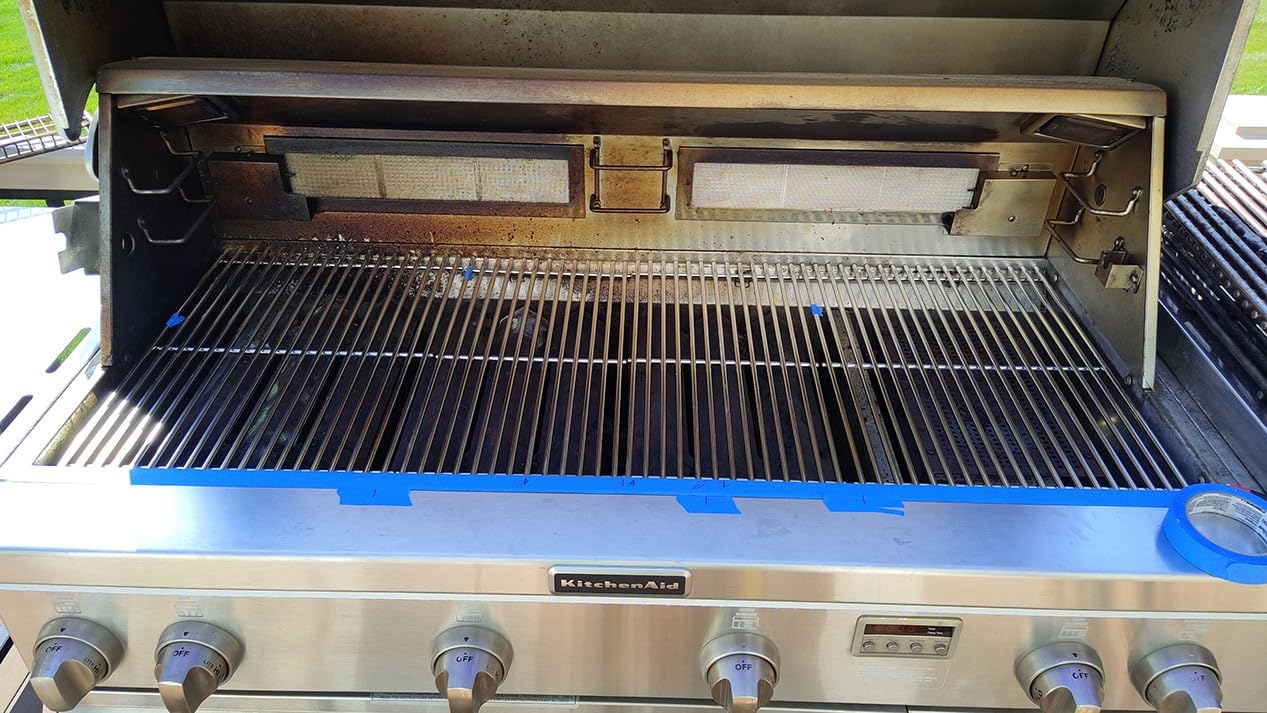
Fitment is the whole game, and the list is long but not universal. It replaces Weber part numbers 7638, 7525, 7527, 65619 and 65906, covering Spirit 300, Spirit II 300 and the 2025 Spirit 400 series, plus Smokefire EX4 and EX6 pellet grills. Measure before you order, because the two exclusions bite hard if you miss them.
For a ribeye at 1.5 inches thick, surface temperature recovery earns the sear. A 16-bar stainless grate has more thermal mass than a three-bar coated grate and does not shed heat the way thin chrome plate does. Take beef to 130 to 135 degrees internal for medium-rare, and 160 degrees is the safety floor for whole cuts.
Who this grate suits
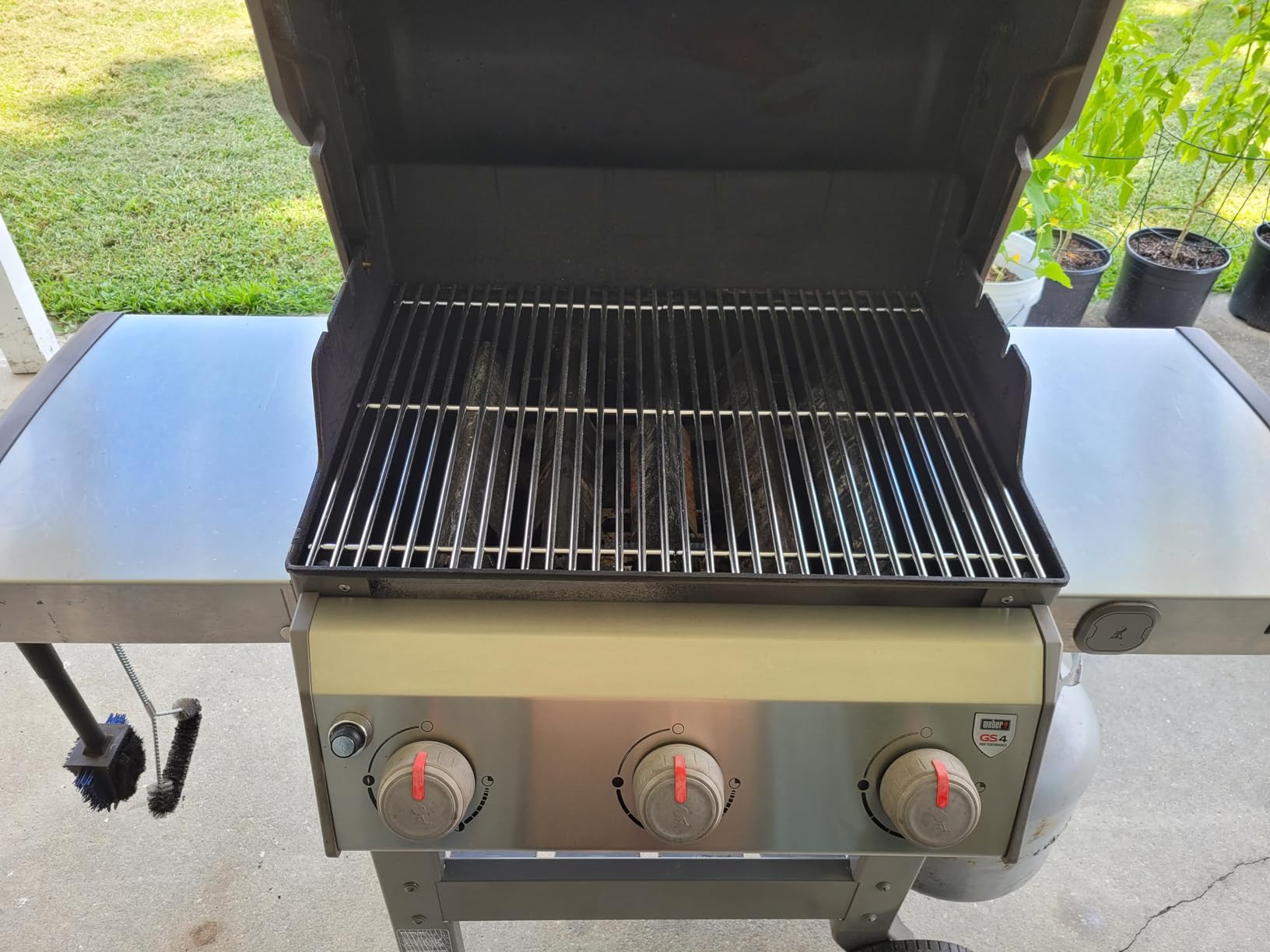
Gas grill owners on a Weber Spirit 300, Spirit II 300 or 2025 Spirit 400 platform who want a rust-proof replacement and would rather not think about seasoning. It suits casual and serious cooks equally, because there is no patina to maintain and no rust watch after a rainy week.
Where it falls short
It is not cast iron, and buyers chasing the deepest possible crust will feel the difference. Stainless has less thermal mass than seasoned cast iron of the same footprint, and no seasoning layer to make it naturally non-stick, so you still need oil on the steak and a clean grate.
It also will not fit the Genesis Silver A or the 2025 Spirit 300 despite the similar-sounding name, and the extra bars mean slightly less open area. Verify your part number before ordering.
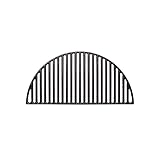
2. Kamado Joe Half-Moon Cast Iron Grate for 18-Inch Kamados
Kamado Joe Durable Half-Moon Cast Iron Cooking Grate with Grill Grate Lifter for Classic Joe 18-inch Charcoal Grill and Smokers in Black, Model KJ-HCICG
Material: cast iron half moon
Weight: 7 lb
Dimensions: 18 x 9 x 1 inch
Three year warranty
Pros
- Heavy cast iron stores heat for an even sear
- Half-moon shape gives broad surface on round grills
- Included cast iron lift tool for handling when hot
- Three year brand warranty
Cons
- Limited to 18 inch round kamado grills
- Requires seasoning and dry storage to avoid rust
Half-moon sear grates are the most under-covered category in this market, and this is the reference part. A kamado’s hinged grid splits the chamber in half, and the half-moon plate drops into one side to convert indirect cooking into a direct sear surface with a single cast iron slab under the meat.
At 7 lb it is lighter than the rectangular cast iron replacements further down this list, which matters because you are lifting it onto a ceramic dome at 500 degrees. The included cast iron lifting tool is not a gimmick; it is the difference between a confident install and a burnt knuckle.
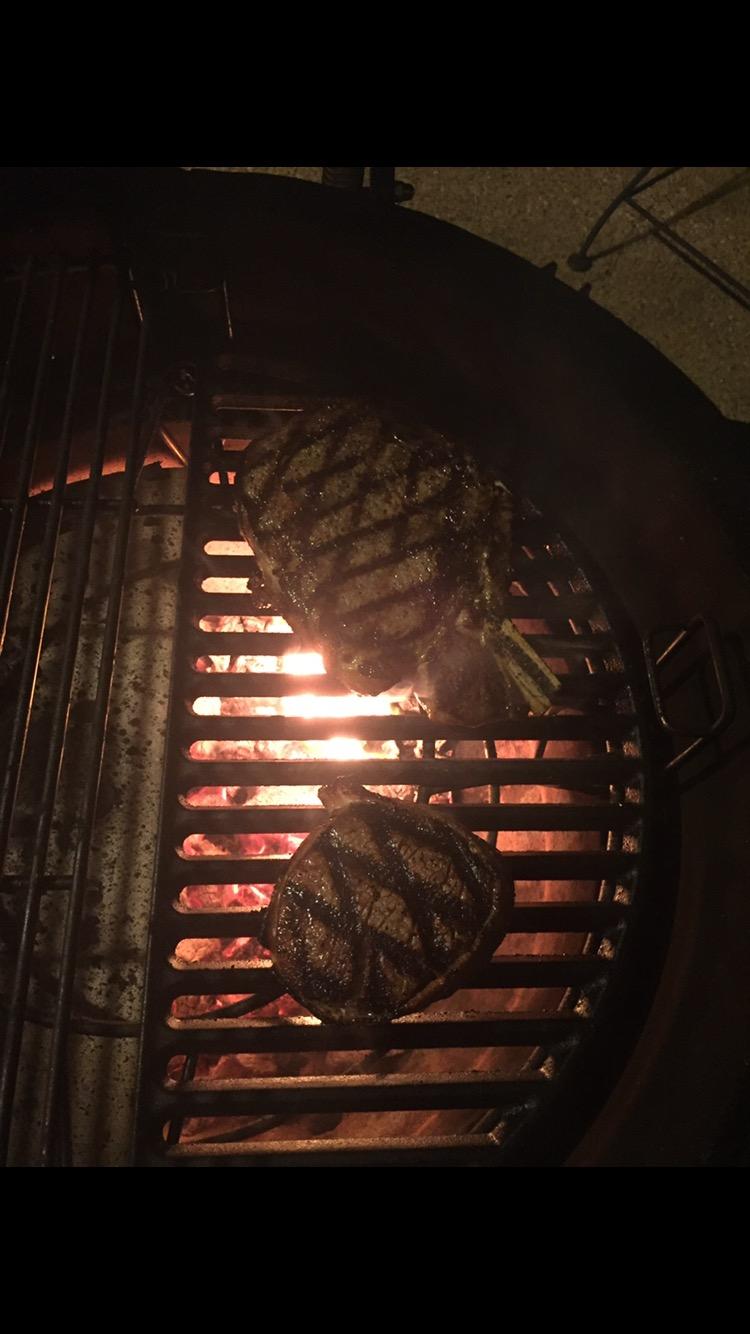
Fit is narrower than the other picks here: Kamado Joe Classic Joe series, the Large Big Green Egg, and other round 18-inch charcoal grills. The ceramic frame diameter has to match, because the half-moon geometry depends on the round chamber. Owners treat this as the standard part for 18-inch kamado searing.
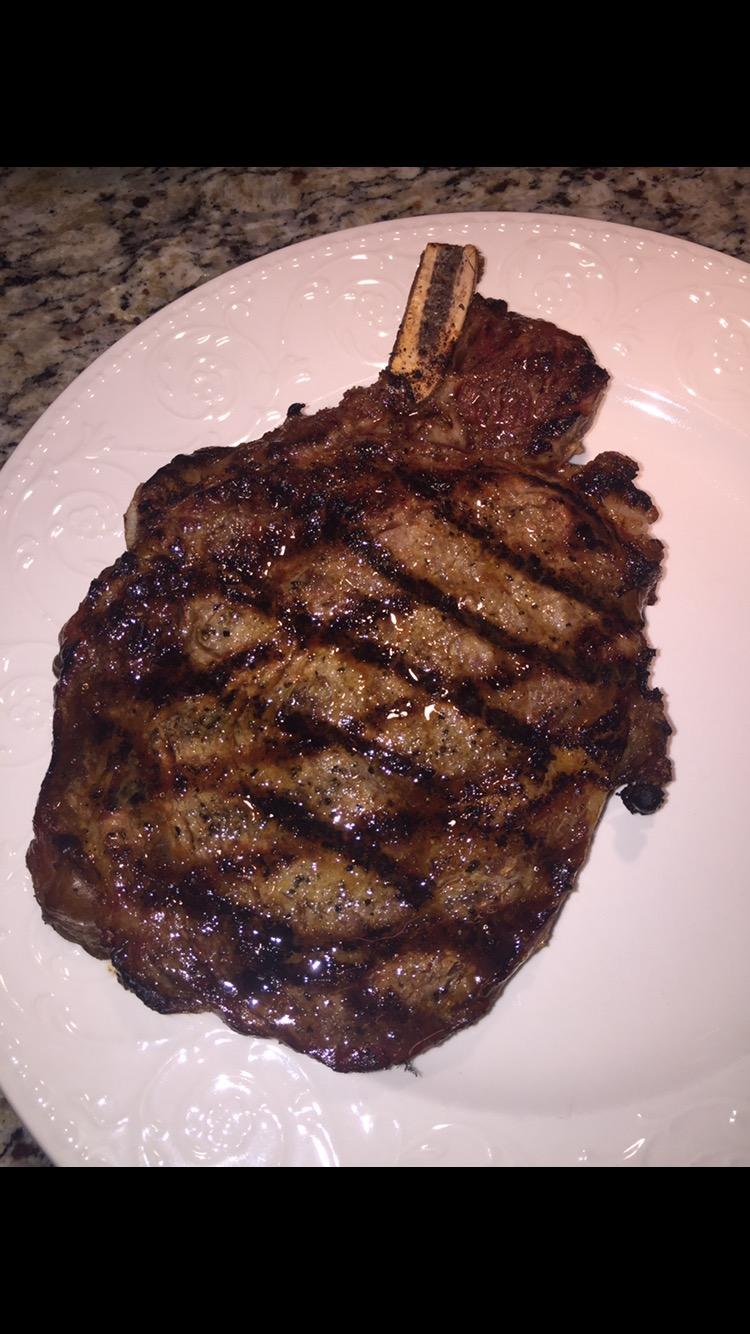
Sear by placing the half-moon on the side you want direct heat and letting it preheat with the dome closed. Kamado cooks across the board recommend pulling a straight 130 degrees for a rare finish and resting the steak on the hot grate, so the crust keeps building while the interior equalises.
Who this grate suits
Kamado and ceramic cooker owners on 18-inch round grills who want a restaurant-style sear plate rather than bars. It suits anyone running a reverse sear, because you can move food off the direct plate and back to indirect without losing the heat source.
It also suits cooks doing a lot of finishing work after a long smoke, because the plate reaches temperature faster than a full cast iron grid and takes up only half the chamber when you want smoker space back.
Where it falls short
It is a specialised part, not a general replacement. If your ceramic cooker is not an 18-inch round model, this does nothing for you, and the same applies to every rectangular gas grill on the market.
Bare cast iron needs a real seasoning routine and dry storage. In a humid climate, an uncovered half-moon will spot with surface rust, and taking that back to bare metal means starting the seasoning over.
3. QuliMetal 9mm Solid Rod Grate for Weber Genesis II 300
9MM 18.75″ Grill Grates for Weber Genesis II 300, 304 Stainless Steel 66095
Material: 9mm solid 304 stainless rod
Weight: 22.4 lb
Grate size: 18.75 x 13.25 inch
Pros
- 9mm rod is far stiffer than common 5mm and 7mm grates
- Resists sagging under heavy food and high heat
- Deep even sear marks across the whole surface
- 304 stainless resists rust and deformation
Cons
- Very heavy to lift onto a hot grate
- Middle cross bar can be welded slightly out of alignment
This is the thickest grate in the set, and thickness is the most underrated variable in searing. At 9mm solid rod it is roughly double the diameter of the 5mm and 7mm rods most factory grates use, which means far more metal in the contact zone and far less temperature drop when the steak lands.
It replaces Weber part 66095 and 66802 and also fits GS4 parts 66805, 84136 and 7599, covering Genesis II 300 and Genesis II LX 300 from 2017 onward. It is also the best-selling grate in its category, which usually means the fitment data is well tested by people who already own one.
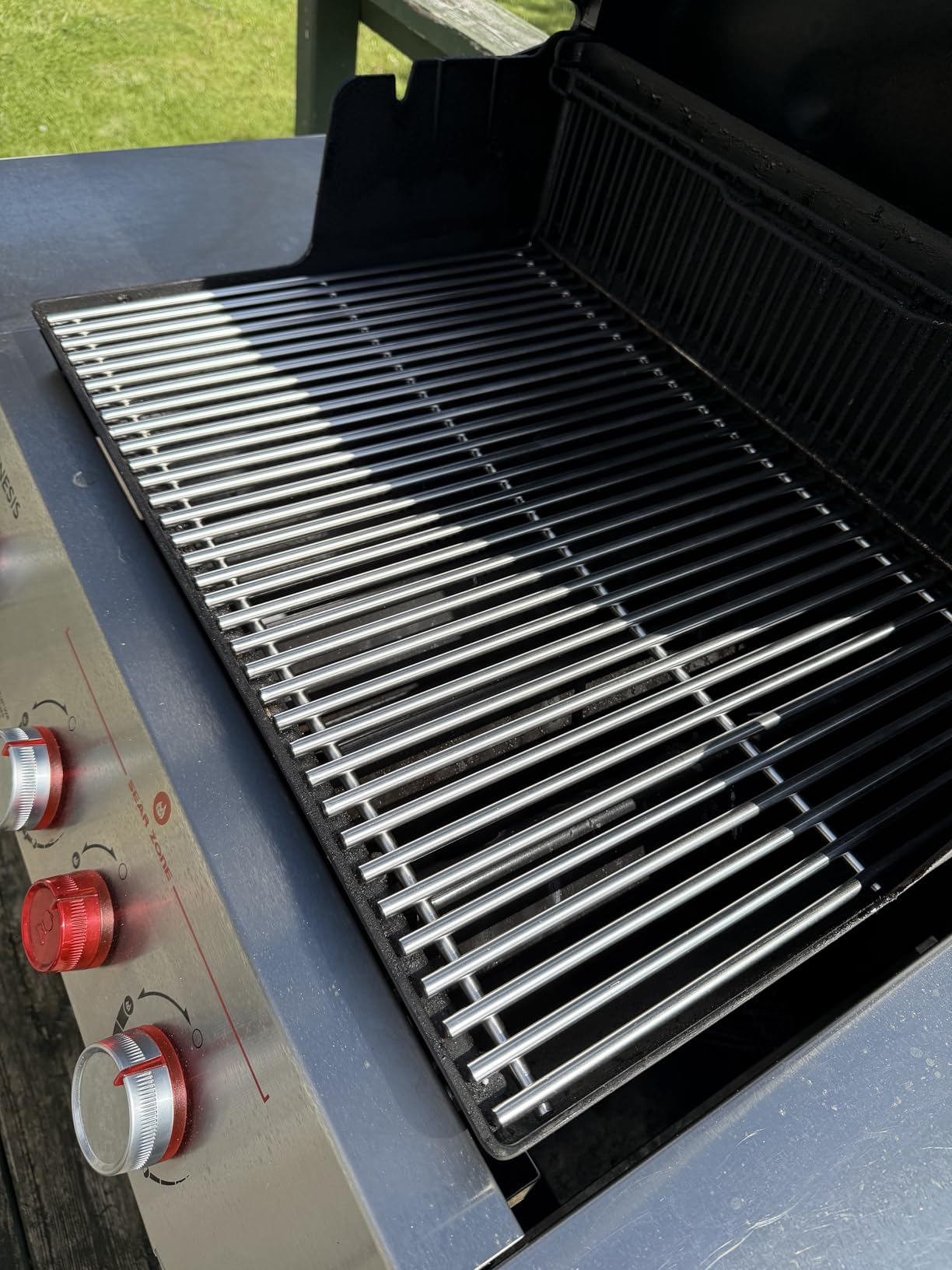
The welded frame is integrated rather than assembled from separate supports, so the cooking surface stays flat when you set a whole brisket or a cast iron pan on it. That flatness produces continuous marks instead of a stripey result, and it is why owners coming off thin wire grates describe it as more robust than the original part.
At 22.4 lb of build weight per the listing, this is a two-person lift on a hot grate. Plan for it. For temperature work, take a T-bone to 125 to 130 degrees for rare, then move it off the direct zone and let carryover finish it to 130 to 135 degrees.
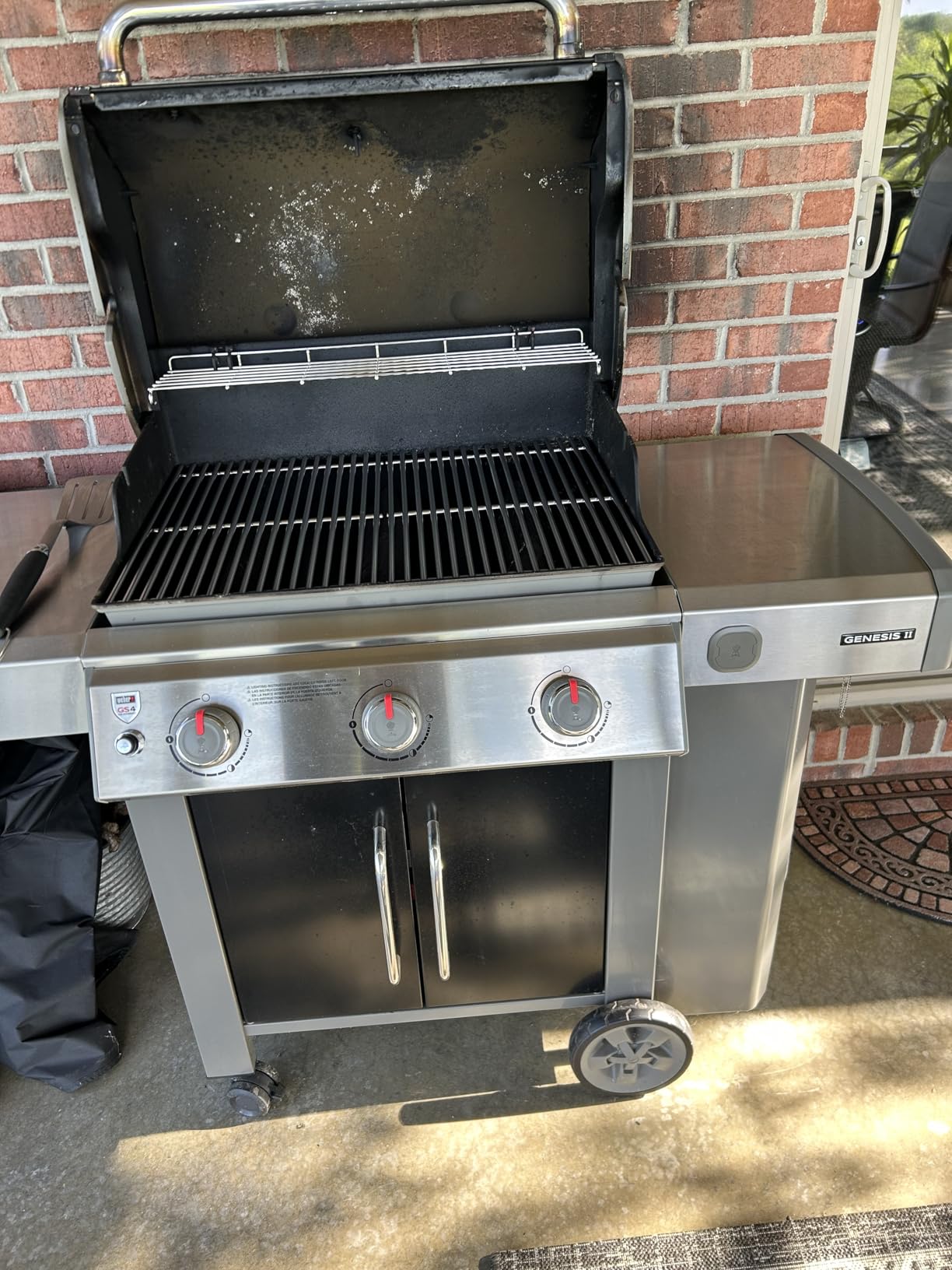
Who this grate suits
Genesis II 300 and LX 300 owners who sear often, cook heavy, and want the maximum contact temperature their grill can produce. If you regularly throw a cast iron pan, a whole fish or a thick bone-in chop onto the grate, the rigidity here is the reason to buy it.
It also suits anyone who has moved past thin wire grates and found the marks underwhelming. The 9mm rod is the step most owners describe as the point where searing became reliable rather than occasional.
Where it falls short
Weight is the real cost. At more than 20 pounds for the set, this is a two-handed, two-person job on a preheated grill, and it is unforgiving if you drop it on a porcelain enameled firebox.
A recurring complaint is that on some units the middle cross bar is welded slightly out of alignment, so the grates only seat one way round. It is an assembly inconsistency rather than a defect, but it is the most repeated negative in detailed reviews.
4. Uniflasy 15 Inch Matte Cast Iron Grate for Weber Spirit 200
Uniflasy 15 inch Grates for Weber Spirit 200 Side Control for Weber Spirit Grill Grates 15 x 11 1/4 Spirit E/S 210 Spirit 500 Genesis Silver A for Weber Grill Grate 15″ x 23″ for Spirit Parts 7522
Material: matte cast iron
Weight: 10.83 lb
Grate size: 15 x 11.25 inch each
Pros
- Matte cast iron outlasts the enameled bars it replaces
- Retains heat for searing and grill marks
- Installs in about a minute as a true drop-in
- Also covers listed Kenmore gas grill models
Cons
- Lighter than the factory cast iron it replaces
- Side-control Spirit 200 models only
- Slightly wider bar spacing than genuine Weber grates
With over seven and a half thousand reviews, this is the most thoroughly road-tested grate in the set, and the consensus is remarkably consistent: it is the affordable way to keep an ageing Weber or Kenmore grill in service. Owners rate it highly on fit accuracy, quick installation and heat retention.
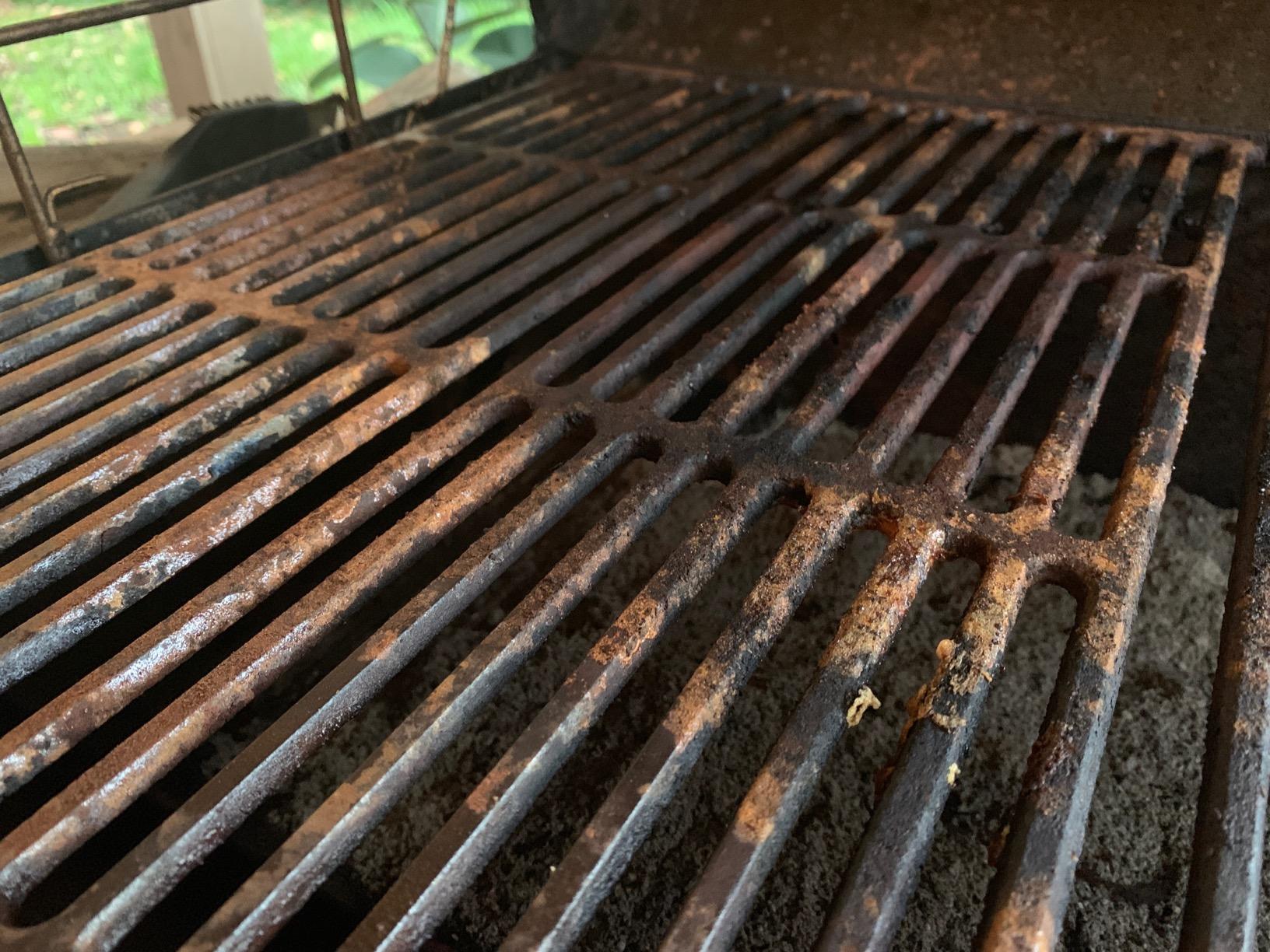
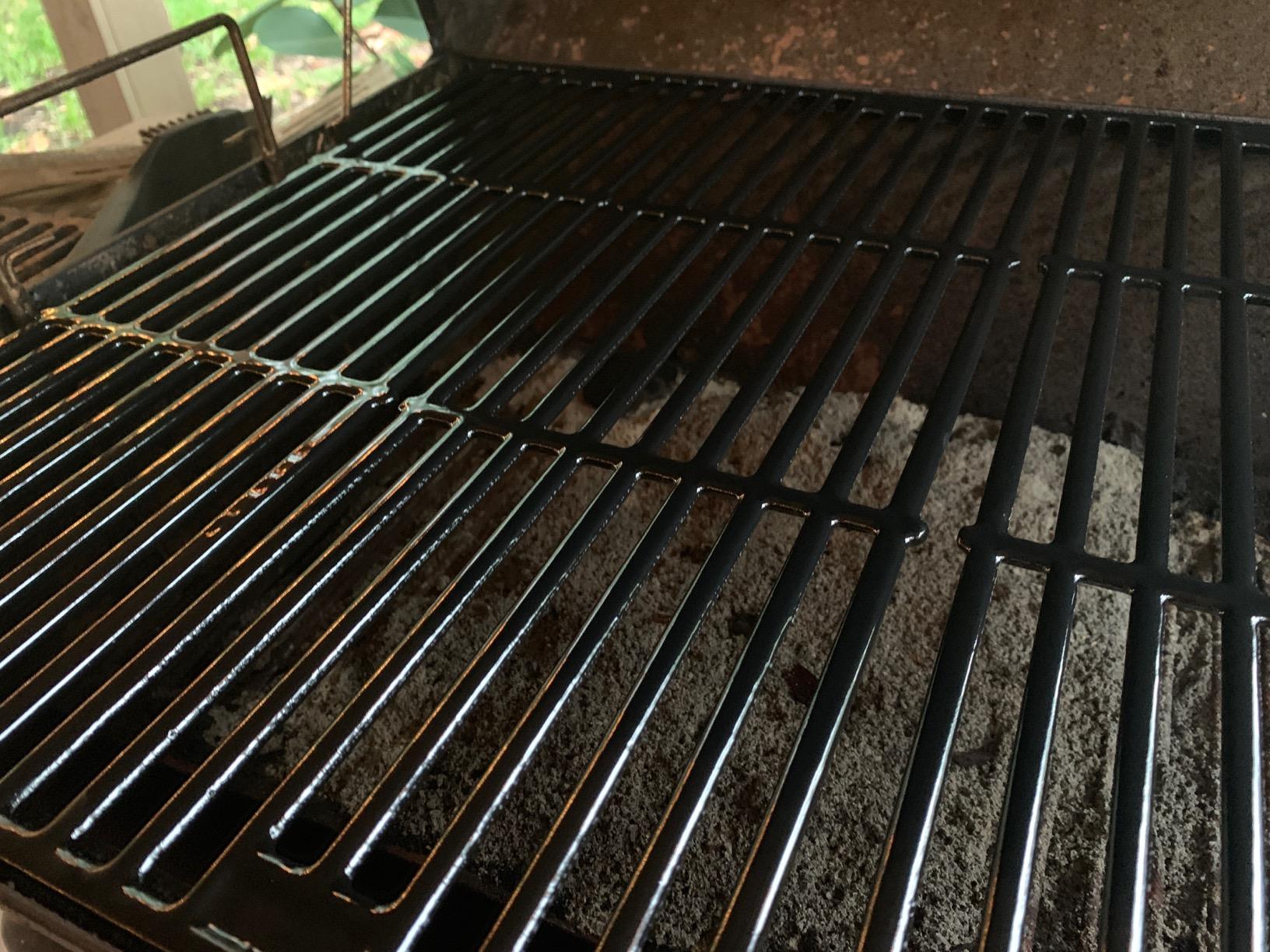
The material is matte cast iron rather than porcelain enameled, and that is the important difference. Enamelled bars chip and rust at the coating edge; bare matte cast iron takes seasoning and keeps improving. Two grates at 15 by 11.25 inch each make up a 15 by 22.5 inch cooking surface.
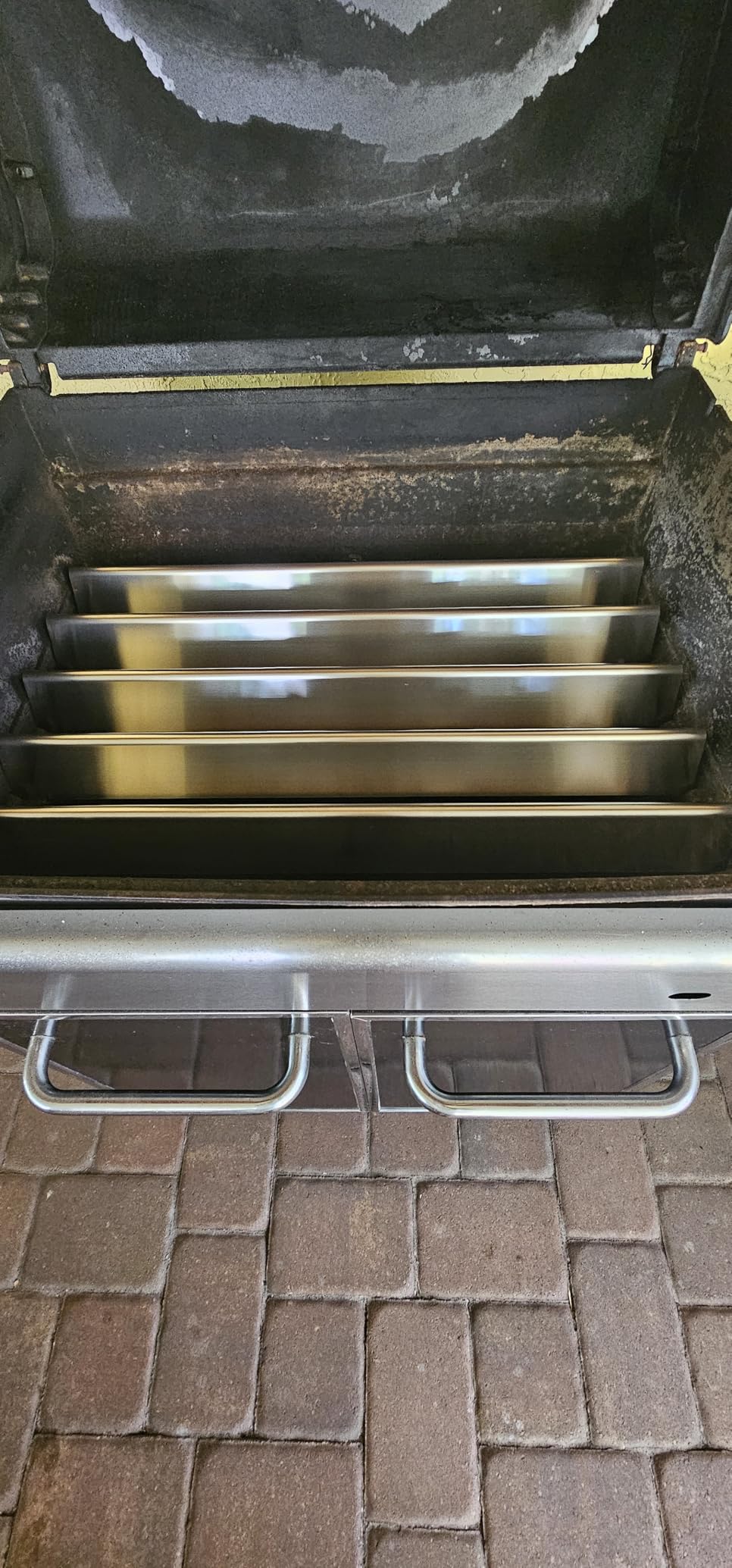
It replaces Weber parts 7522, 7523, 7521, 65904, 65905 and 6711411, covering the side-control Spirit 200 series, the Spirit 500 and the Genesis Silver A, plus listed Kenmore models from the 141.15221 through the 17228 series. If your panel is on the side, this is a strong match.
For searing, the thermal mass difference against folded steel is the whole point. An NY strip at 1.5 inches drops the surface less than a coated grate would, which is the difference between a defined crust and a tan exterior. Pull whole cuts at 145 degrees for medium and never serve beef below 160 degrees.
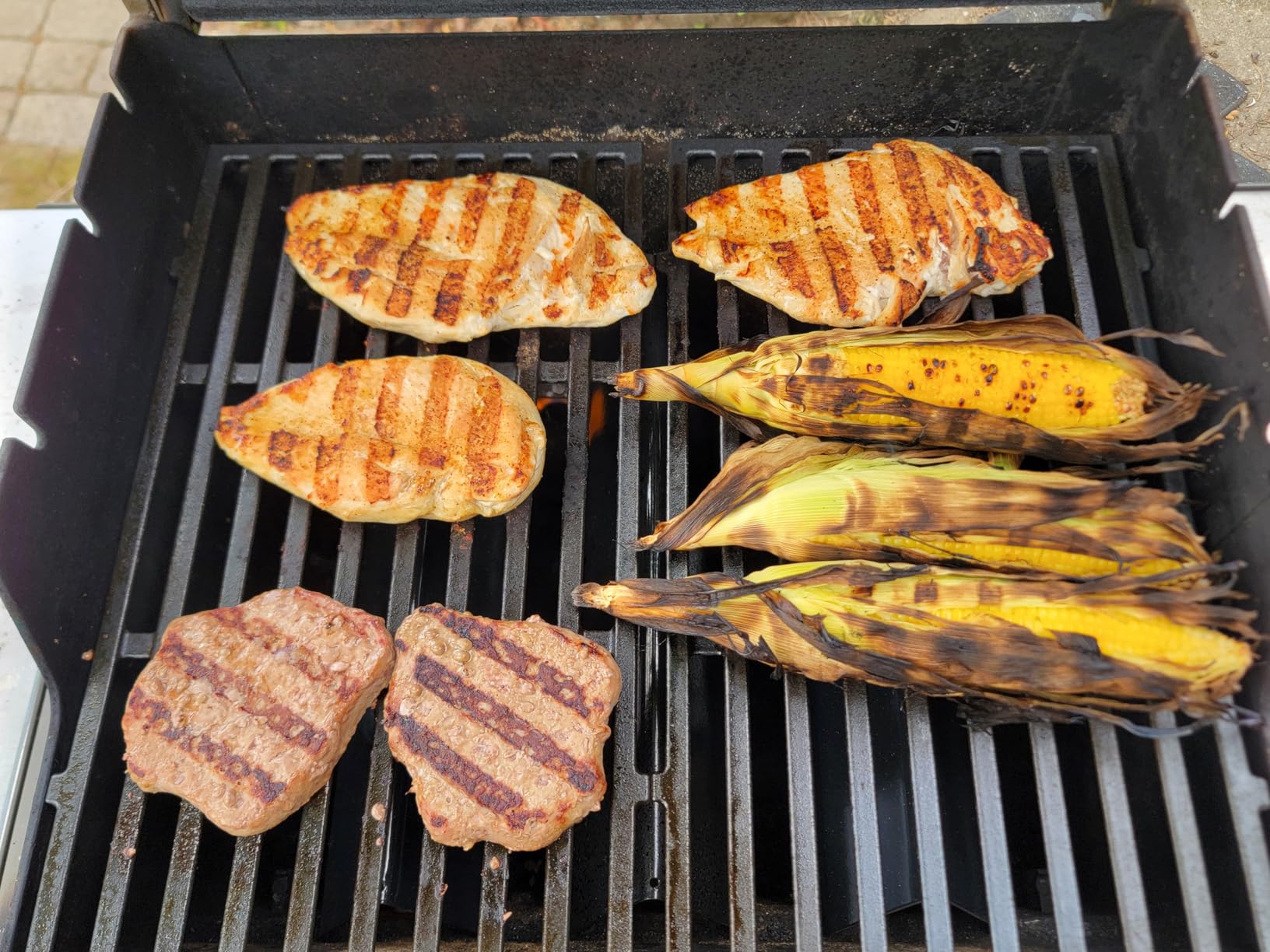
Who this grate suits
Owners of an older side-control Spirit 200, Spirit 500 or Genesis Silver A who want cast iron behaviour without a restoration project. The one-minute install and the price point make it the most likely grate in this list to sit permanently in your grill rather than in a cupboard.
It also fits cooks who like having spares, since two grates mean a broken one is not the end of your grilling season.
Where it falls short
Owners consistently note it is lighter than the factory cast iron it replaces, so the advantage over a coated grate is real but not dramatic. If you want the heaviest possible upgrade, the 9mm rod stainless carries more mass.
It is also narrower in scope than it appears. Front-control Spirit 200 models need a different part, and the bar spacing is slightly wider than genuine Weber grates, which shows if you regularly cook small food.
5. Slow ‘N Sear EasySpin 304 Stainless Grate for 22-Inch Kettles
SnS Grills EasySpin Charcoal Grill Cooking Grate, 304 Stainless Steel, Large Hinged Opening, Perfect for 2-Zone Cooking, Replacement Grate Compatible with Weber & Other Grills – Fits 22” Kettles
Material: 304 stainless steel
Weight: 6.3 lb
Dimensions: 21.5 x 21.5 x 2 inch
10-year warranty
Pros
- Hand-spinning grate moves food over or off the coals
- Large hinged opening allows mid-cook charcoal
- 304 stainless will not rust like chrome plate
- Resists warping under high heat
Cons
- Lighter gauge than some factory grates
- Sized for round kettles and not rectangular gas grills
This is the only grate here that solves a control problem rather than a mass problem. The EasySpin grate rotates by hand, so you move food away from the coals or closer to them without lifting a hot grid or gripping a handle that is already cooking.
It is also the lightest substantial grate in the set at 6.3 lb, which makes it the easiest to move on and off a hot firebox, and it carries a 10-year warranty with spare part availability listed at the same duration.
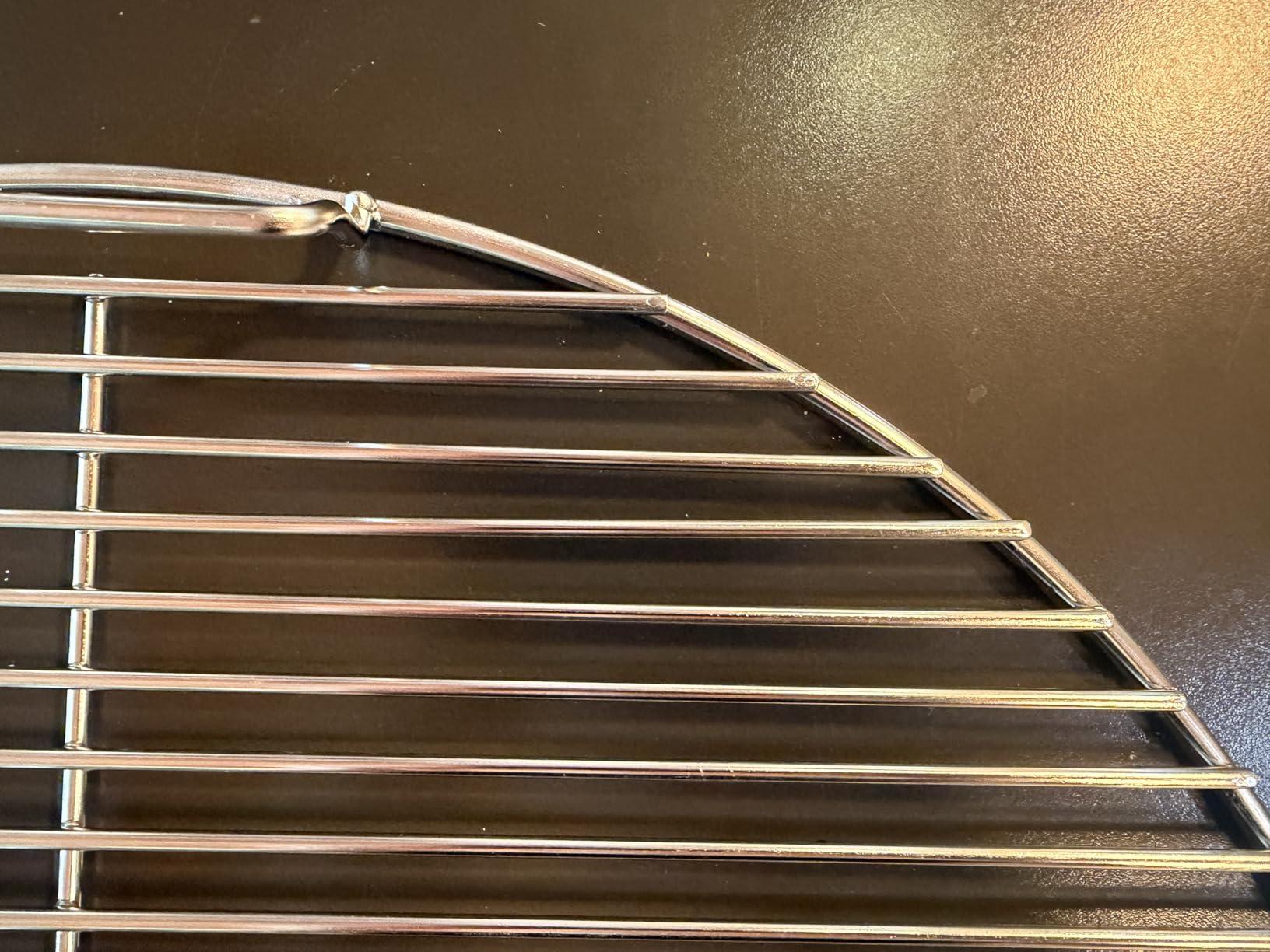
Fit covers 22-inch round kettles including the Weber Original Kettle, Performer and MasterTouch. Welded stainless handles and extra rails near those handles add usable space in exactly the area where a round grate wastes it, and the hinged opening lets you add charcoal mid-cook without moving your food.
The 304 surface is clean and smooth enough that a lightly oiled ribeye releases without tearing. Spin the grate so the steak sits over coals for two to three minutes to build crust, then spin it back for indirect finish. Verify with a thermometer: 125 to 130 degrees for rare, 160 degrees minimum for whole cuts.
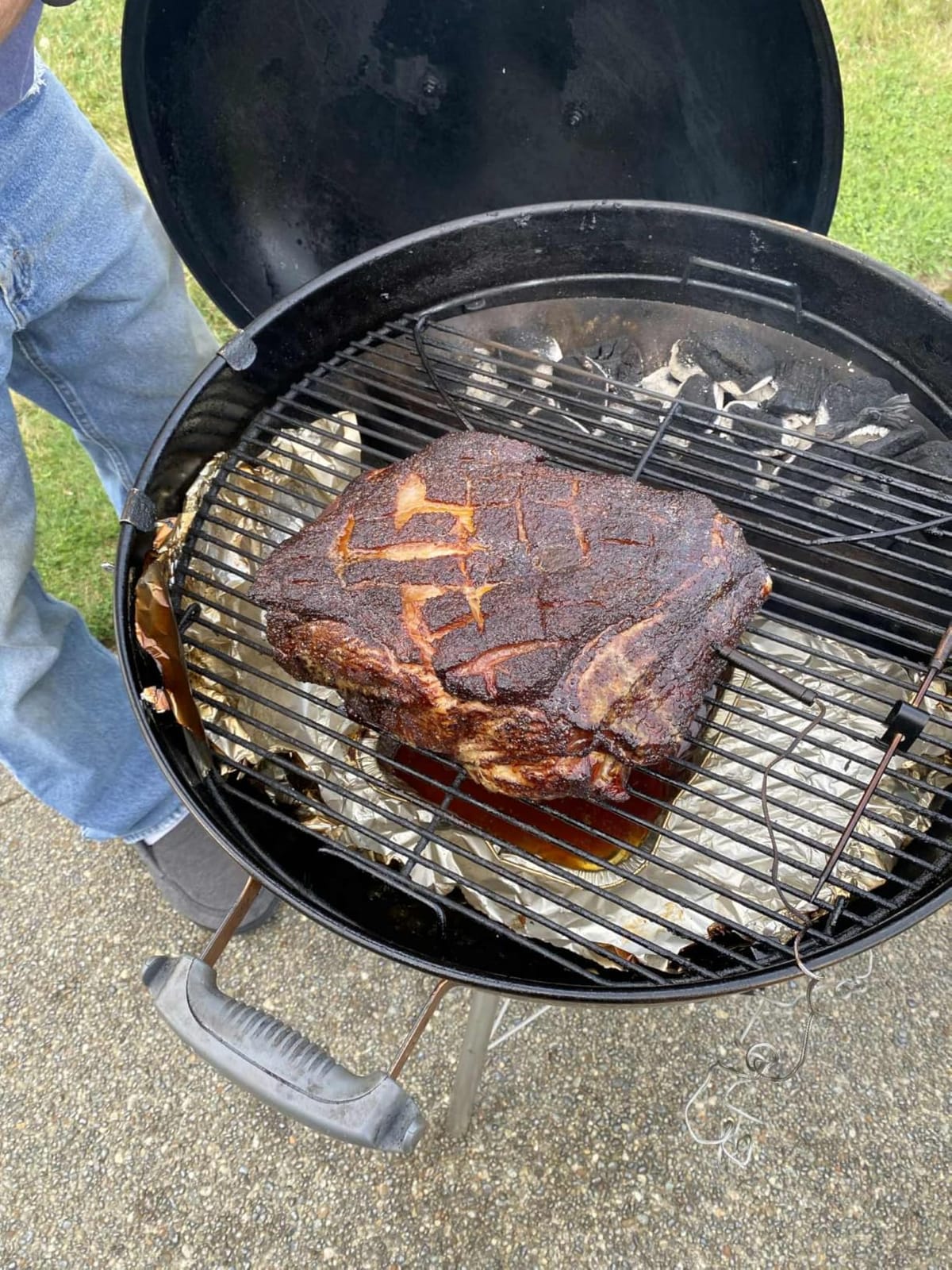
Who this grate suits
Kettle owners who cook with a two-zone fire and want to move food between zones mid-cook without opening the lid. It is the pick for anyone tired of a chrome-plated kettle grate that rusts at the rim within a season.
It also suits cooks using a charcoal basket, because the rotation control and the hinged opening work together for a long cook that starts hot and finishes cooler.
Where it falls short
It is lighter in gauge than some factory grates, so buyers who want maximum thermal mass find less than the 9mm rod option. It is a control upgrade more than a searing upgrade, and the marks are less aggressive than on heavy cast iron.
It also will not fit a rectangular gas grill. Round kettles only, which is worth stating plainly because the listing language mentions Weber compatibility generally while the geometry is specific.
6. Leship 15 Inch Cast Iron Grate Pair for Weber Spirit 200 and 500
Leship 15 inch Grates for Weber 7522 Spirit E/S 200 E/S210 Spirit 500 Genesis Silver A, Cast Iron Cooking Grid for 7523 7521 65904 65905 (15 x 11 1/4) 2PCS
Material: bare cast iron
Weight: 10.5 lb
Grate size: 15 x 11.25 inch each
Pros
- Heavy well-made cast iron that is easy to season
- Accurate drop-in fit on common Weber models
- Finish closely matches the original grates
- Inexpensive route back to full cast iron
Cons
- Not porcelain plated so the finish differs from the original grates
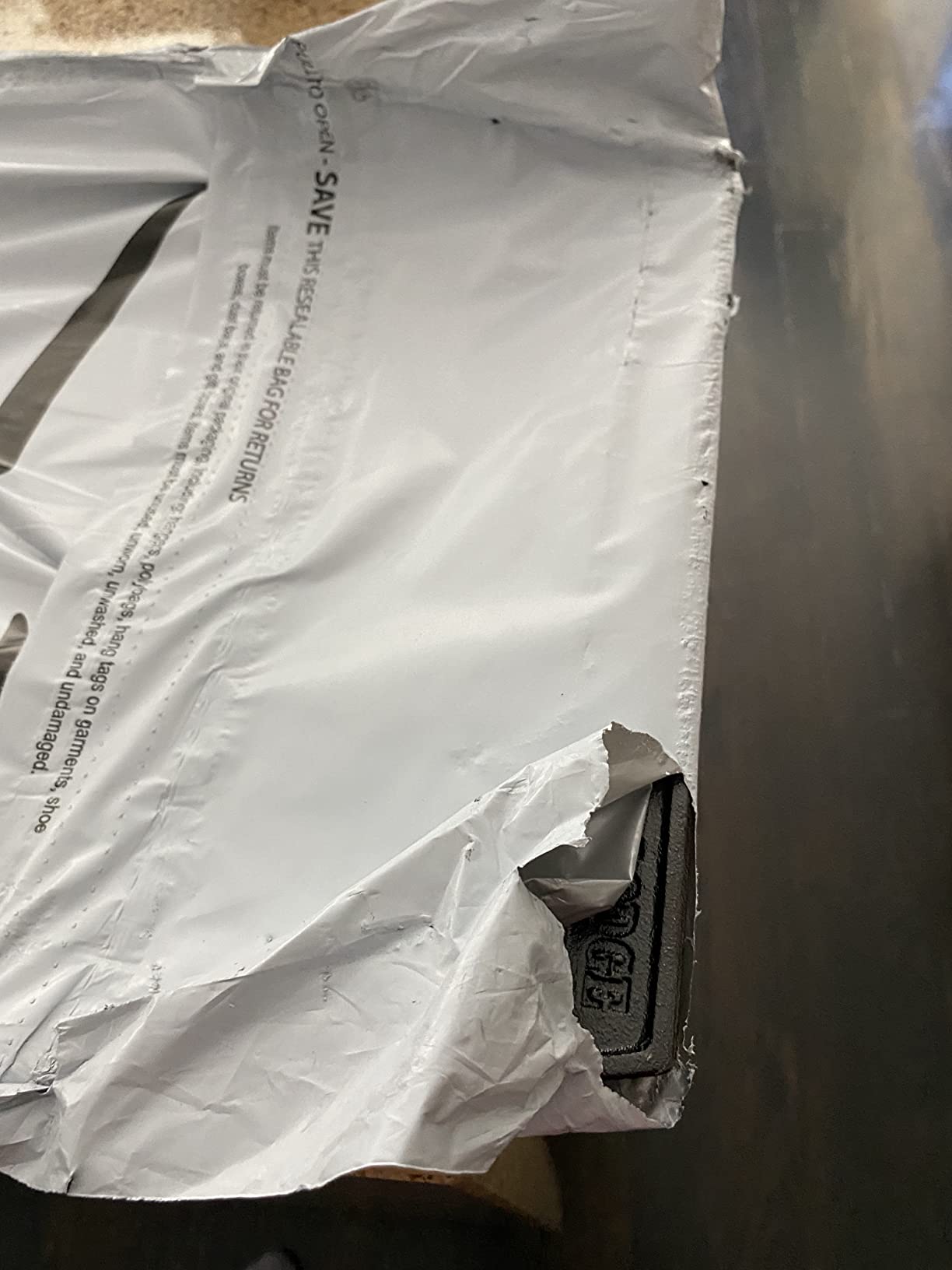
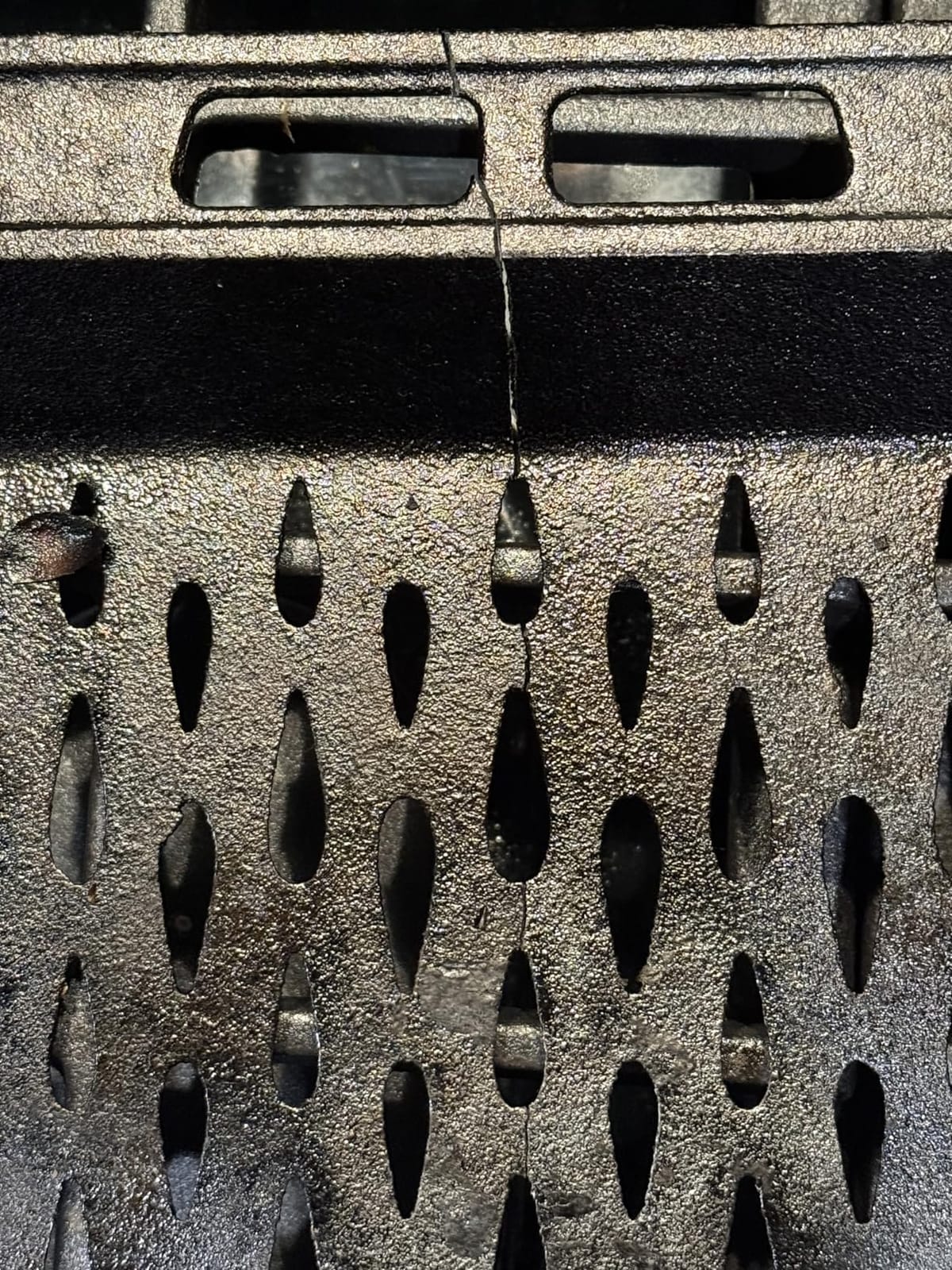
- Cast iron can arrive cracked if the package is dropped
This is the value pick for anyone whose enameled grates have chipped down to bare metal and started to rust. Two heavy duty cast iron grates at 15 by 11.25 inch restore real thermal mass to a grill that was designed for it, and the bare surface seasons into a natural patina over the first few cooks.
It replaces Weber parts 7521, 7522, 7523, 65904 and 65905, covering the side-control Spirit 200 series, the Spirit 500 and the Genesis Silver A, with additional listed Kenmore 141, 152, 162 and 172 series models. Owners report fit accuracy across that range as the main strength.
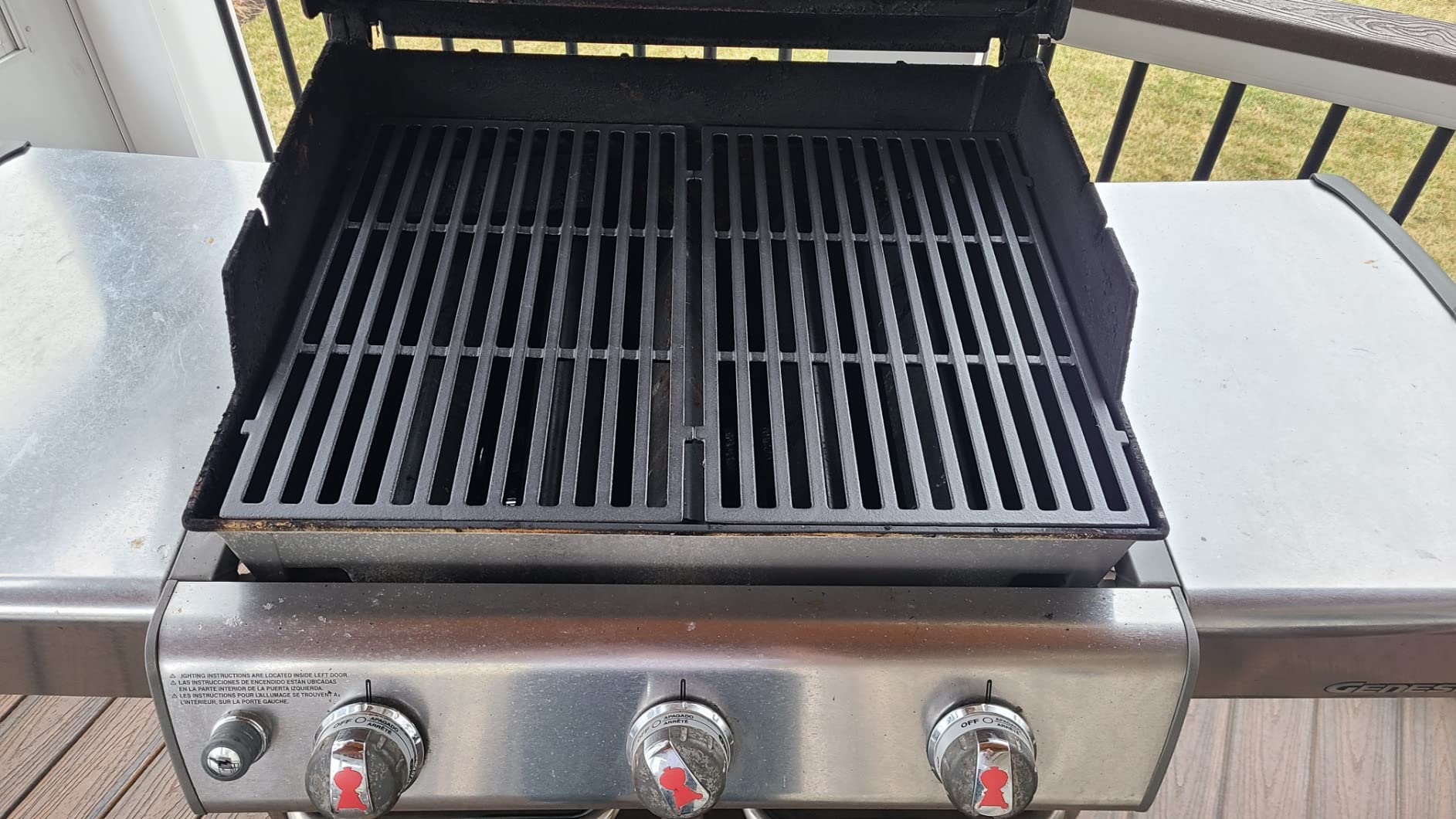
At 10.5 lb it is a comfortable two-handed lift, and the finish sits close enough to the original Weber parts that the grill still looks right in the yard. For a 1 inch-thick sirloin, the cast iron surface holds heat long enough to keep the crust forming after you flip it once.
Seasoning is the one real task. Coat both grates with a high smoke point oil, run them hot for an hour, let them cool, and repeat twice. After that, a scrape and a wipe after each cook is the entire maintenance routine for the life of the grate.
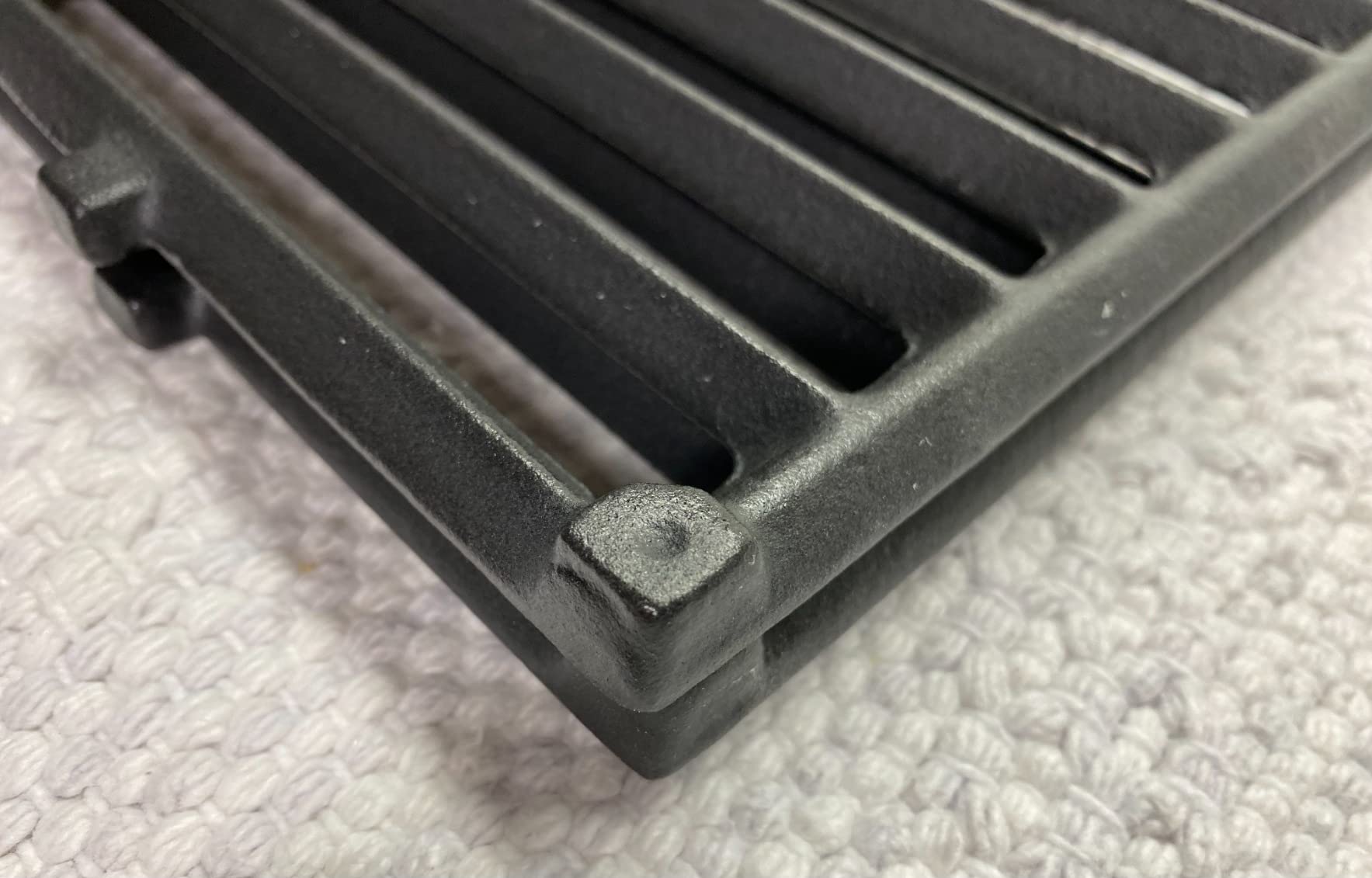
Who this grate suits
Budget-conscious owners of a Weber Spirit 200, Spirit 300 or Genesis 300 platform who want to restore searing without replacing the whole grill. For a grill otherwise in good shape, this is the single highest-impact repair available.
It also suits first-time cast iron owners who want the searing performance but not the OEM part number, provided they spend an hour seasoning before the first cook.
Where it falls short
It is not porcelain plated, so buyers who bought the grill for the shiny enameled look are disappointed. Functionally this is a non-issue, but it generates a surprising number of one-star reviews that are really about appearance.
Cast iron is also brittle in transit. A small number of buyers report grates arriving cracked after a dropped package, which is an argument for checking the box on arrival and keeping the packaging in case you need a return.
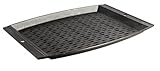
7. Lodge Pre-Seasoned Cast Iron Grill Topper, 15 Inch
Lodge Pre-Seasoned Cast Iron Rectangle Grill Topper, 15 Inches
Material: pre-seasoned cast iron
Dimensions: 14.56 x 12.66 x 0.85 inch
Listed to 500 degrees F
Pros
- Pre-seasoned with natural vegetable oil so it is usable straight away
- Grid holes stop fish shrimp and vegetables falling through
- Dual handles make it easy to move while cooking
- Even edge-to-edge heat retention
Cons
- Small 15 inch size suits cooking for one or two
- Occasional reports of cracking on arrival or first use
A topper solves a different problem from a replacement grate. It sits on top of your existing bars, so you keep your factory grate, gain a flat cast iron surface on a grill that never had one, and lift it off when you are done. Lodge pre-seasons it with 100 percent natural vegetable oil, so there is no seasoning step at all.
The grid pattern is the design point. The openings are small enough that shrimp, fish fillets and diced vegetables stay on the surface instead of dropping into the fire, which is the failure mode that makes flat plates frustrating on a grill with wide bars.
It is listed to a 500 degree Fahrenheit maximum surface temperature, so it belongs on a gas grill or kettle rather than in a screaming two-zone charcoal sear. It is made in the USA by a family-owned company founded in 1896, and it is PFOA and PTFE free.
For a thick steak the flat surface behaves more like a griddle than a grate, so you are effectively searing on a hot plate. Oil the steak, not the topper, and use a two-zone fire so you can pull the meat off direct heat to finish at 125 to 130 degrees for rare.
Who this grate suits
Anyone who wants cast iron searing without replacing a grate or lifting 20 pounds of steel onto a hot firebox. It is the pick for a portable grill, a camping setup, or a grill you share with someone who will not help you lift anything heavy.
It also suits cooks who want one pan for the grill. Fish, shrimp, vegetables and thin cuts all benefit from a surface with no bars to fall through, and the dual handles make it manageable while cooking.
Where it falls short
Fifteen inches is genuinely small. If you are cooking for more than two people, you are working in batches, and the most common wish in reviews is simply a larger version in the same material.
There are also occasional reports of cracking, either on arrival or during a first cook, and owners note the surface needs re-seasoning after about a year outdoors. Treat it as a pan that lives outside, not a permanent grill component.
8. Direct Store DC114 Porcelain Coated Cast Iron 4-Pack
Direct store Parts DC114 (4-pack) 19.75″ Porcelain Coated Cast Iron Grill Cooking Grates Replacement for Chargriller Gas Grill 2121, 2123, 2222, 2828, 3001, 3030, 3725, 4000, 5050, 5252, 5650,9020
Material: porcelain coated cast iron
Size: 19.75 x 27 inch overall
Four grids per set
Pros
- Accurate fit on the Chargriller models it replaces
- Porcelain coating resists chipping into food
- Each section packed individually to prevent transit damage
- Soap and water cleaning with a soft brush
Cons
- Missing locator pin lets the grates slide fore and aft
- Less heavy duty than original equipment cast iron
- Slightly undersized on some models such as the 5050
This set targets a specific and very common problem: a Chargriller or King Griller whose original porcelain grates have pitted and rusted. Four grids at 19.75 by 6.75 inch build a 19.75 by 27 inch cooking surface, and the coverage list runs from the 2121 and 2222 up through the 5050, 5252 and 9020.
Porcelain coated cast iron sits between bare cast iron and stainless. It heats and holds heat like cast iron, but the enamel layer does not absorb moisture the way bare iron does, so you get a non-stick surface without managing a seasoning layer, and it will not chip into your food.
The individual packaging is a small detail that matters more than it sounds: each grid is wrapped separately, which is what prevents the transit damage that usually ruins a four-piece cast iron set. Buyers also note you can run three of the four if your grill does not need the full span.
For searing, the coating releases food cleanly, so a thin NY strip will not tear when you flip it. Wash in soapy water with a soft brush, avoid the dishwasher and steel brushes, and take whole cuts to 145 degrees for medium with a 160 degree floor.
Who this grate suits
Chargriller and King Griller owners on the listed models who want a clean, non-stick surface and would rather not run a seasoning routine on every grate in the garage. It is a genuinely good fit for a cook who grills most weekends and does not want weekly care.
It also suits anyone whose grates rusted through at the porcelain coating edges, which is the most common failure point on that platform.
Where it falls short
There is no locator pin, so the grates can shift fore and aft inside the firebox. On a grill where the original pins register the grates to the burner layout, that is a real if minor loss of precision.
Owners also describe it as less heavy duty than original equipment cast iron, and dimensions run slightly small on certain models including the 5050. Confirm your model against the compatibility list and measure before ordering.
9. onlyfire 2-in-1 Cast Iron Grate for Weber 22-Inch Kettles
onlyfire 2-in-1 Cast Iron Grill Grate Replacement Weber Gourmet BBQ System
Material: painted cast iron
Weight: 8 lb
Outer grate 21.5 inch diameter
Pros
- Thick heavy cast iron with a clean finish and no casting flash
- Removable centre grate allows adding charcoal mid-cook
- Once seasoned produces strong sears with little sticking
- Drops straight into 22 inch Weber kettles
Cons
- Inner centre ring has snapped for some buyers after few uses
- Centre section bars are spaced a little wide apart
- Bare cast iron needs a full seasoning routine first
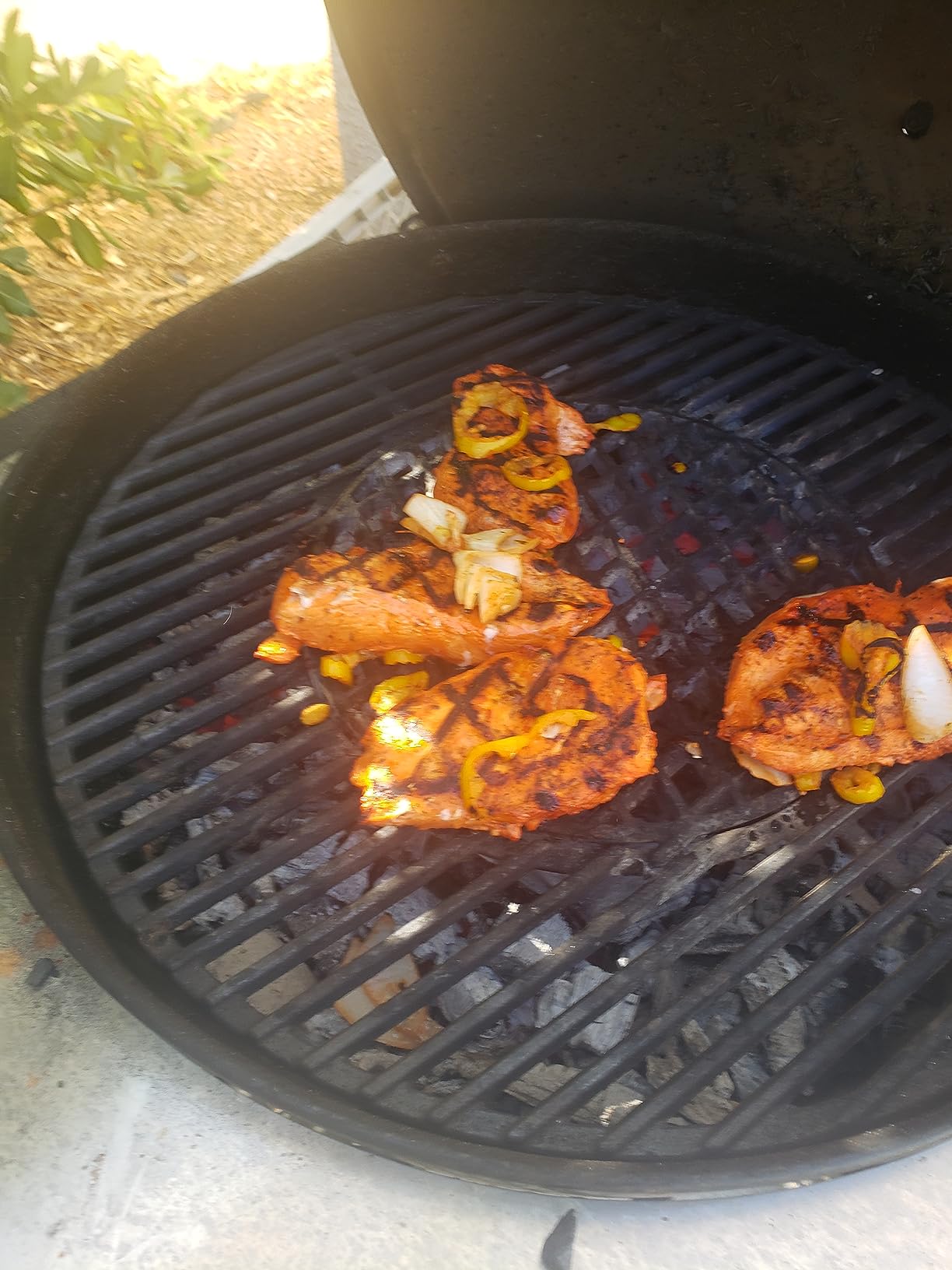
The best described upgrade from a rusted wire Weber rack, and the only two-piece design in this list: a 21.5-inch outer cooking grate with an 11.8-inch removable inner sear grate that drops into the centre. Owners emphasise the weight and the clean casting, with almost no flashing left on the surface.
That inner ring is the useful part. It lets you add charcoal without removing the outer grate and turning your food, and it concentrates the hot coals under a small area for a fast direct sear while the outer ring handles indirect cooking. Raised side handles on the inner grate make the swap possible with gloves on.
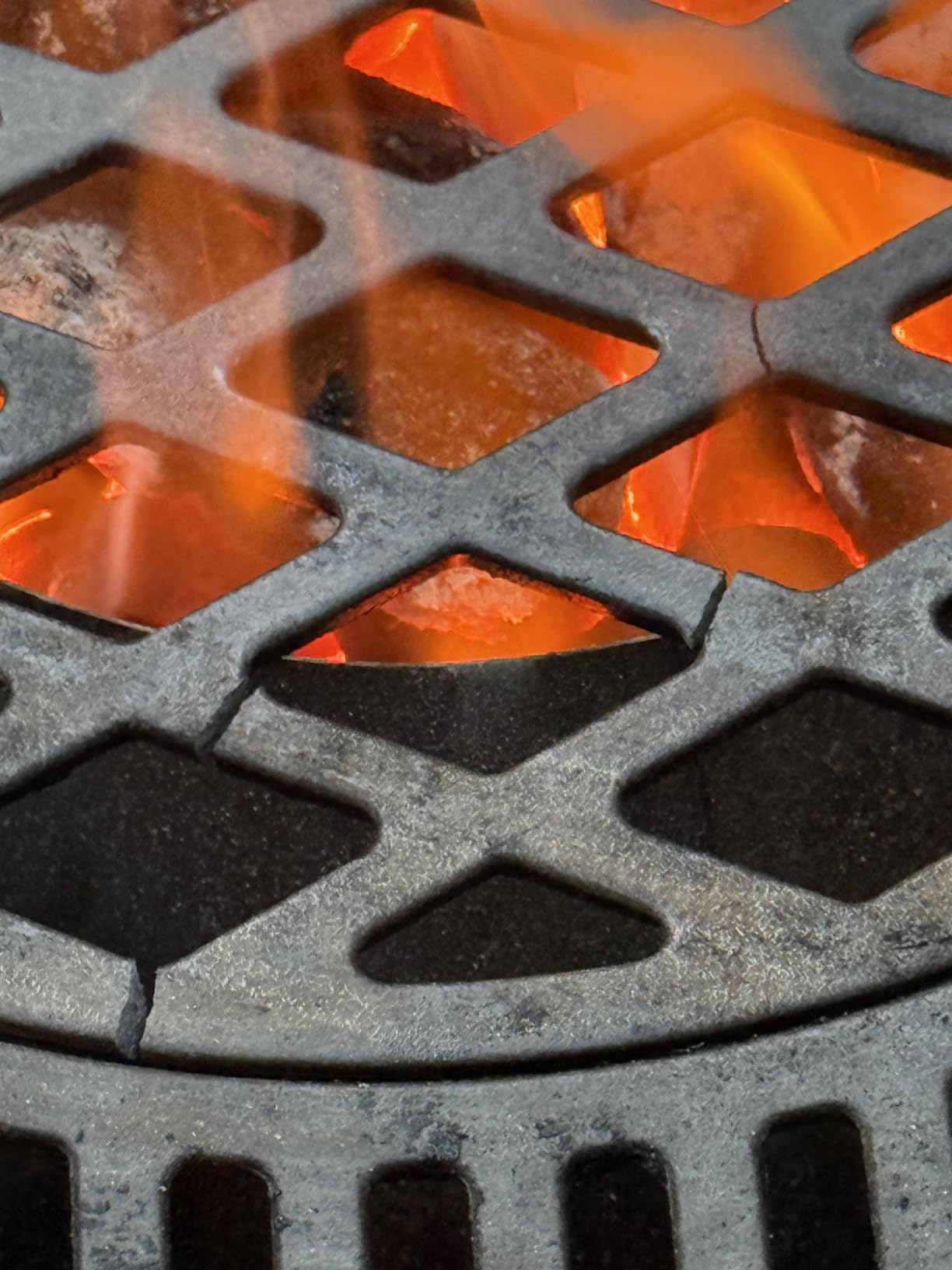
It fits the Weber 22.5-inch Original Kettle Premium, the 22.5-inch Original Kettle and the 22.5-inch Performer Premium. The listed cooking surface area is around 1450 square inches, which is a full-size kettle surface rather than a topper.
For searing, seasoning is the deciding factor. Buyers who complete a proper multi-step routine report excellent sears and very little sticking; buyers who skip it report sticking. Treat the first three cooks as seasoning cooks, not dinner.
Who this grate suits
Weber kettle owners who have been cooking on the thin wire rack that came with the grill and want a substantial cast iron replacement with a dedicated sear zone. It is a genuine step up in mass and surface quality for the most classic backyard platform there is.
It also suits cooks who want a grate and a direct sear ring in one purchase, and who rotate fuel mid-cook rather than committing to a single burn.
Where it falls short
The inner ring is the weak point. A number of buyers report it snapping apart after only a few uses, and follow-up support is described as unhelpful. Inspect the ring after each session early on, and treat it as the sacrificial part of the set.
It is bare painted cast iron with no factory seasoning, so there is a real multi-step routine before your first steak. The centre bars are also spaced a little wider than ideal, so very small food is better cooked on the outer ring.
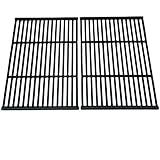
10. Direct Store DC122 Porcelain Coated Set for Charbroil and Brinkmann
Direct store Parts DC122 19″ x 25″ Charmglow 810-2320 810-6320 Non-stick Polished Porcelain Coated Cast Iron Cooking grid Replacement for Charbroil, Brinkmann, Broil-Mate, Grill Chef, Grill Pro…
Material: porcelain coated cast iron
Weight: 5.99 kg
Size: 19 x 25 inch overall
Pros
- Very heavy duty porcelain cast iron that holds heat well
- Even glass-smooth coating that resists sticking
- Weighs the same as the original grates it replaces
- Easy to season and maintain over repeated use
Cons
- Worth price-checking against the genuine manufacturer part
- Synthetic coating rather than bare seasoned cast iron
The broadest compatibility list of any grate in this roundup, and the one most likely to save you from scrapping a serviceable grill. It covers Charbroil models 4632210 through 466231203, Broil-Mate 726454 and 736454 ranges, a long Brinkmann list including the 810 and Pro Series, Grill Chef BIG-8116, Grill Pro, Turbo Grand Endeaver, Sterling and Charmglow 810-2320 and 810-6320.
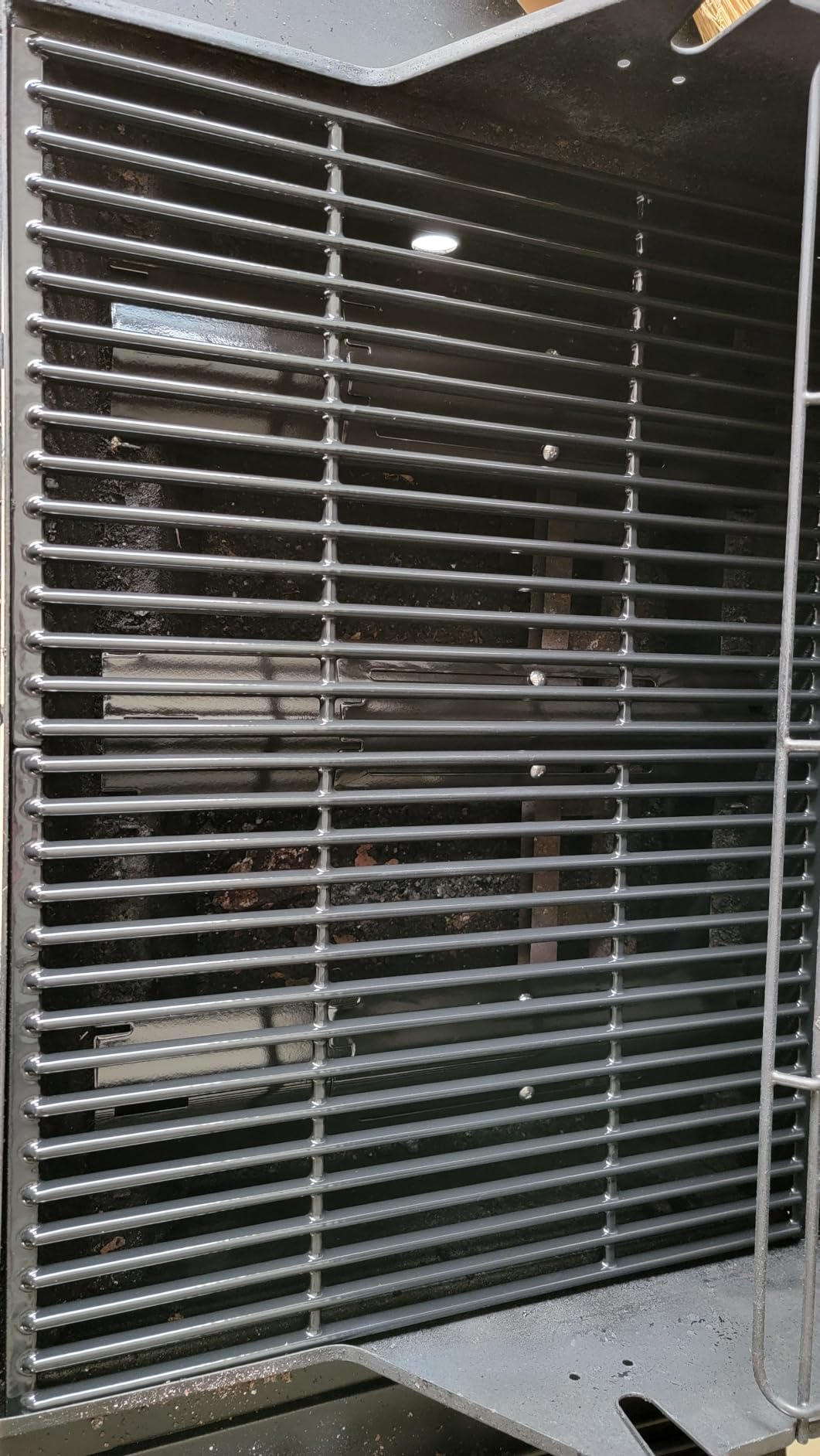
Two grids at 19 by 12.5 inch each make a 19 by 25 inch surface, and at 5.99 kg the set weighs the same as the original grates it replaces. That weight parity is unusual in the replacement market and it is why owners describe the fit as precise rather than approximate.
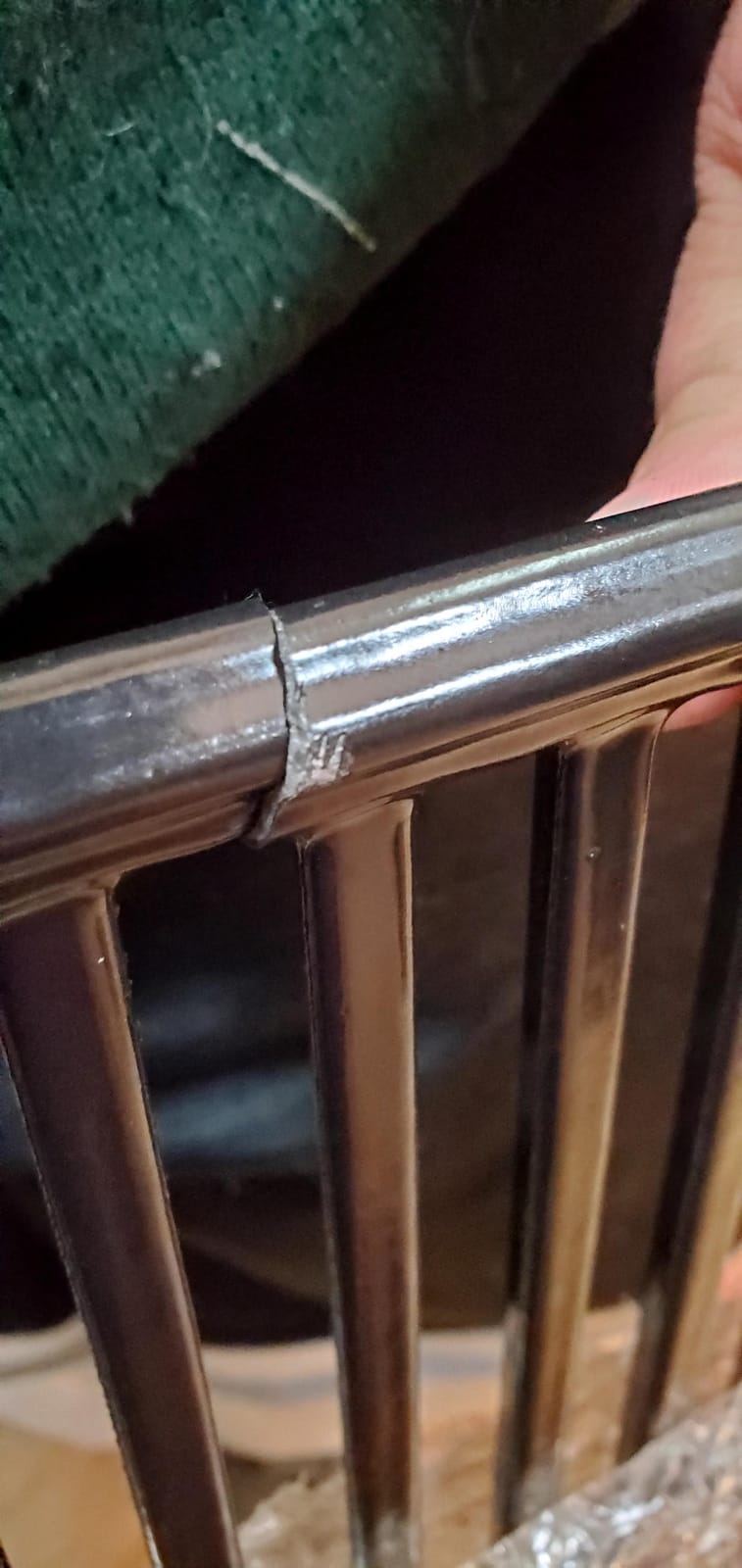
Owners report that this set regularly saved them from replacing an entire grill, which is the strongest argument for it. The polished non-stick coating cleans with soap and a soft brush, so the weekly maintenance burden is closer to stainless than to bare cast iron.
For searing, the coating means food releases cleanly, which matters most on delicate cuts. A 1 inch-thick strip with a two-minute sear per side needs the surface temperature up in the 500-plus range, and take poultry to 165 degrees internal, always.
Who this grate suits
Owners of Charbroil, Brinkmann, Broil-Mate, Charmglow, Grill Chef or Grill Pro gas grills whose grates have rusted through and who do not want to replace the appliance. The weight parity with the original parts also means it handles like the grill was designed to handle.
It suits cooks who prefer a coated surface to bare cast iron, and who will not do a seasoning routine. Once oiled, the porcelain gives a clean release without any of the patina maintenance.
Where it falls short
The most sensible advice attached to this product is to price-check with the grill manufacturer before buying, because genuine replacement parts for some of these older models can cost less than a third-party set. On a low-cost brand grill, the OEM part is sometimes the cheaper route.
It is also a synthetic coating rather than bare seasoned cast iron, so it will eventually chip at the edges and the failure mode repeats the original problem after enough seasons. You are buying years, not decades.
Cast Iron vs Stainless Steel: Which One Sear Better?
Cast iron sears better, and if searing is the only thing you care about, that is the answer. Bare cast iron stores more heat per pound than any steel grate in this roundup, so when a cold steak lands on a seasoned cast iron surface the temperature drop is smaller and the crust starts forming immediately. Stainless steel wins on maintenance, rust resistance and weight, and it loses on peak crust quality by a margin most serious steak cooks can taste.
Heat retention: Cast iron wins clearly. A seasoned cast iron grate behaves like a small slab of hot metal rather than a set of hot wires, and that thermal mass is the entire reason restaurant grates look the way they do. Stainless sits in the middle. Thin tubular stainless bars lose contact heat fastest, which is why the 9mm solid rod option outranks most stainless replacements.
Maintenance: Stainless wins without argument. There is no seasoning to build, no rust watch after a wet cook, and a soft non-bristle scrubber is the entire cleaning routine. Cast iron asks for an initial seasoning session and a wipe-down after every cook, plus dry storage between uses.
Lifespan: Cast iron wins when it is maintained, staying in service for decades. Porcelain coatings on budget grates are the shortest-lived option here, typically chipping at the edges within a few seasons. Stainless is the most forgiving of neglect.
Weight: Stainless wins on handling. A 6.3 lb stainless kettle grate is easy to move; a 22.4 lb rod stainless set needs two people on a hot firebox. If your searing habit means moving the grate at all, weight matters more than grams of thermal mass.
Where cast iron actively hurts: A heavy cast iron grate is a poor choice for low-and-slow cooking. It absorbs heat from the fire rather than radiating it back into the chamber, so a long cook at 250 degrees runs cooler than the same cook on a lighter grate. Cast iron also cracks under thermal shock, so never pour cold water on a hot grate.
Where stainless actively hurts: Stainless has no seasoning layer, so a protein left on it bonds directly to bare metal. It needs a clean grate before every sear and a lightly oiled steak, and it has less mass than cast iron of the same size, so it recovers temperature more slowly after you open the lid.
The practical resolution most cooks reach: a heavy grate for searing and the grill’s own lighter grate for indirect work. If you only ever replace one set, and you cook steaks on direct heat most of the time, make it cast iron or the thickest stainless you can comfortably lift.
How to Measure Your Grill Before Ordering a Replacement Grate
Measure first. Fitment is the most repeated question across every grill forum, and it is the one problem you can solve in five minutes with a tape measure before spending anything.
1. Find the part number. Look on the side of the grill’s frame, under the lid, or on the original grate itself. Weber part numbers such as 7522, 66095 and 7638 identify a grate exactly. If the number is illegible, the model number on the same plate is enough to search.
2. Measure the grate, not the firebox. Lift one original grate out and measure length and width at the widest points, including the frame rails. A grate with a centre divider measures as two halves, not one continuous surface.
3. Measure the support ledges. The grate rests on ledges inside the firebox. Measure the distance between the inside faces of those ledges and the depth of the drop. This is what catches people who assume a close-enough width will seat properly.
4. Check the control panel position on Weber models. The same nominal size covers side-control and front-control versions, and they take different parts. Side panel means the Spirit 200 family; front panel means it does not.
5. Confirm the material and coating. If your original grate was porcelain coated, a bare cast iron replacement is a genuine change in behaviour, not an equivalent part, and it may not sit in the same rails without checking the profile.
6. Match grill type to grate type. Charcoal kettles want a round grate sized to the bowl. Kamados want a half-moon plate sized to the ceramic chamber. Gas grills want the model-specific part. Pellet grills need a grate matched to their peak temperature, because a grate that is too heavy will not get hot enough inside a temperature-limited firebox. Portable grills need a topper rather than a replacement, since the grate is usually welded in.
A file will fit a slightly undersized grate, and a thin shim can take up a millimetre of play in the rails. Neither substitutes for measuring, but both save a perfectly good grate from becoming a return.
Seasoning and Care: Keeping a Cast Iron Grate Searing
Seasoning is the polymerised oil layer that fills the microscopic pores in cast iron. It is what makes bare iron non-stick, and it is also what rusts off if you leave it wet. Maintenance effort is the real reason stainless wins for casual cooks, so here is the honest picture.
Bare cast iron, first seasoning. Remove all packaging and any rust with coarse steel wool, wash and dry completely, then coat every surface with a thin layer of high smoke point oil. Set the grill to its highest setting with the grates in place for one hour, let them cool to the touch, and repeat twice. Three cycles is the minimum, four is better. Wipe the grates with a paper towel after each cycle to remove the tacky excess before it polymerises into a gummy surface.
Bare cast iron, per cook. While the grate is hot, scrape it with a brass or stainless scraper, then wipe with a paper towel. Once it cools, wipe it thin with oil and hang it to dry. That is a five-minute routine, and skipping the oil step is what starts the rust cycle.
Storage. Do not put a warm cast iron grate inside a closed grill. Warm iron plus trapped moisture equals surface rust, and it will find you by morning. In a humid climate, store it under cover with a little oil on the surface and wipe it off at the start of the next season.
Stainless steel. Brush with a stainless or brass bristle brush while hot, wipe with oil if you want food to slide off, and dry it. No cycling, no layers, no panic. The soft non-bristle scrubber that comes up repeatedly in owner reviews matters here: a steel wool pad scratches the surface and makes food stick more readily over time.
Porcelain coated cast iron. Soak in soapy water, clean with a soft brush, dry, and keep it away from the dishwasher and steel brushes. A chip exposes bare iron, and that bare spot will rust unless you seal it with a grill-safe enamel paint.
One food-safety note that applies to every material: searing is about surface flavour, not doneness. Take whole cuts of beef to at least 160 degrees Fahrenheit internal, poultry to 165 degrees, and verify with an instant-read thermometer rather than by touch. A crust forms at 300 degrees and above, so you have a wide margin between browning and safe.
Sear Technique: Getting More From Any Grate
The right grate is the cheapest upgrade available, and it is still only half the result. Six steps do most of the work.
1. Preheat the grate fully. Set up a two-zone fire, or let a gas grill burn at full output for ten minutes with the lid closed. The grate needs a searing surface temperature of 500 to 650 degrees Fahrenheit, and the way to confirm it is an infrared thermometer aimed at the bars, not at the air.
2. Scrape and oil the grate before the food goes on. Carbon on the bars insulates the steak from the metal underneath and gives you a black, bitter crust instead of a brown, savoury one.
3. Oil the steak, not the grate. A neutral high smoke point oil on the meat surface is what creates the Maillard reaction. Oiling the grate mostly just makes smoke.
4. Lay the steak down away from you and leave it alone. Do not flip it for two to three minutes, do not rotate it, and do not press it. Moving it early tears the crust that is forming.
5. Use the grate’s geometry. For a reverse sear, cook low and slow to about 115 degrees, then move the steak over the hottest part of the grate for ninety seconds a side. For a two-zone charcoal fire, sear over direct coals first, then move to the cool side to finish.
6. Rest on the hot grate. If you pull beef early, leave it on the grate in the indirect zone for the first minutes of the rest, which keeps building crust and returns some of the lost heat to the meat before you slice it.
Thicker cuts need more direct heat and longer contact time. A ribeye at 1.5 inches wants two to three minutes per side. A thin sirloin at three-quarters inch wants about ninety seconds a side, and moving it early is how you lose the crust entirely.
When a Grate Upgrade Is Not Worth the Money
Sometimes the grate is not the problem, and buying a heavier one will not fix a bad cook. These are the cases where you should spend your money elsewhere.
If your sear is pale and patchy on a hot day with a clean grill. Look at fuel and airflow before hardware. A gas grill with clogged burners, a partially closed side vent or a dirty firebox will not deliver the heat the grate can hold.
If you do not own a thermometer. A good instant-read thermometer costs less than most grates in this list and tells you more than any upgrade. Without it you are guessing at doneness, and no grate fixes a guess.
If you cook steak twice a year. A brand-specific replacement grate is a poor investment at that frequency. A pre-seasoned cast iron topper does the same job for a single purchase and works on any grill you own now or the next one.
If your grill is otherwise finished. New grates on a fifteen-year-old grill with a rusted firebox and tired burners will underperform a decent grate on a sound appliance. Grates are the first cheap fix, not the last one.
And if you decline to buy anything: a preheat stone, an inverted sheet pan or a blowtorch held a few inches above the steak all produce a hard sear on a grate you already own. The grate is the most elegant solution, not the only one.
Frequently Asked Questions
Which is better, cast iron or stainless steel grill grates for searing steaks?
Cast iron sears better because its thermal mass drops less when a cold steak lands, so the surface stays in the 500-650F range and the crust starts forming immediately. Stainless steel wins on maintenance, rust resistance and weight, but loses on maximum crust quality. If searing is your priority and you will maintain a seasoning routine, choose cast iron. If you grill casually or want zero upkeep, choose solid stainless rod.
What type of grill is best for searing steaks?
A gas grill with a sear burner, or a charcoal kettle that can hold a two-zone fire, gives you the two things searing needs: a very high local temperature and enough control to move food off that heat. Kamado and offset setups also sear well, but only if you can get a direct sear zone. Pellet grills are limited by their peak temperature, so a thick cast iron or hybrid topper helps compensate for the lower ceiling.
How do you get a good sear on a grilled steak?
Preheat the grate to a 500-650F surface temperature, scrape off any carbon, and wipe the bars with an oiled paper towel. Oil the steak rather than the grate, lay it down away from you, and leave it untouched for two to three minutes before turning. Sear over direct heat first, then move to indirect heat to finish to your target internal temperature before resting.
What is the 3-3-3 rule for grilling steaks?
The 3-3-3 rule is a simple timing guide: three minutes on the first side, three minutes on the second side, and three to five minutes of rest. It works as a starting point for a steak of roughly one and a half inches cooked over a two-zone fire. Adjust for thickness, grill temperature and your preferred doneness, and always confirm with a thermometer rather than the clock alone.
How do I measure my grill for a replacement grate?
Remove one original grate and measure its length and width including the frame rails, then measure the distance between the inside faces of the firebox ledges. Check the part number stamped on the grate or the model plate on the grill, because a single nominal size covers side-control and front-control versions that take different parts. For a topper you only need the grate surface dimensions.
Do cast iron grill grates rust?
Yes, if you leave them wet. Seasoned cast iron resists rust, but a raw or rust-stripped grate will spot with surface rust in a humid climate or a condensing garage. Dry the grate on the grill after every cook, wipe it with a thin layer of oil, and store it uncovered rather than sealed warm inside a closed grill. Surface rust can be removed with steel wool and re-seasoned.
Is it better to cook steak on a cast iron pan or on a grill grate?
A cast iron pan gives you the most even, well-controlled sear because the whole surface is one continuous slab of hot metal, and it works at any heat. A grill grate gives you the smoke and the grill marks, but heat arrives through narrow bars, so a thin or worn grate marks well without searing evenly. For a reverse sear, use a grate for the finish and a pan for the low cook.
The Verdict for 2026
The best grill grates for searing steaks in 2026 come down to two numbers: how much metal sits under the steak, and whether it fits. For most gas grill owners replacing a burnt-through factory grate, the QuliMetal 16-bar SUS304 set is the pick that solves both. It replaces a long list of Weber part numbers, it will not need seasoning, and its 16-bar layout puts more hot metal in contact with the meat than a three-bar coated grate ever will.
If you want the deepest crust and will do a three-cycle seasoning routine, go cast iron. The Uniflasy set for side-control Spirit 200 grills is the most-reviewed option here, and the Leship pair is the cheaper route to the same material. On a kamado, the half-moon plate is the correct geometry for a direct sear zone. On a Weber kettle, the onlyfire two-piece grate gives you a dedicated sear ring without rebuilding your cookware setup.
Two things to do before you order. Measure your grate and measure your firebox ledges, because nine of the ten options here are model-specific parts and a close-enough width will not seat. And buy a thermometer, even if you are spending on cast iron; crust forms at 300 degrees and above, but doneness is decided well below that, and only a probe tells you which one your steak has reached.