
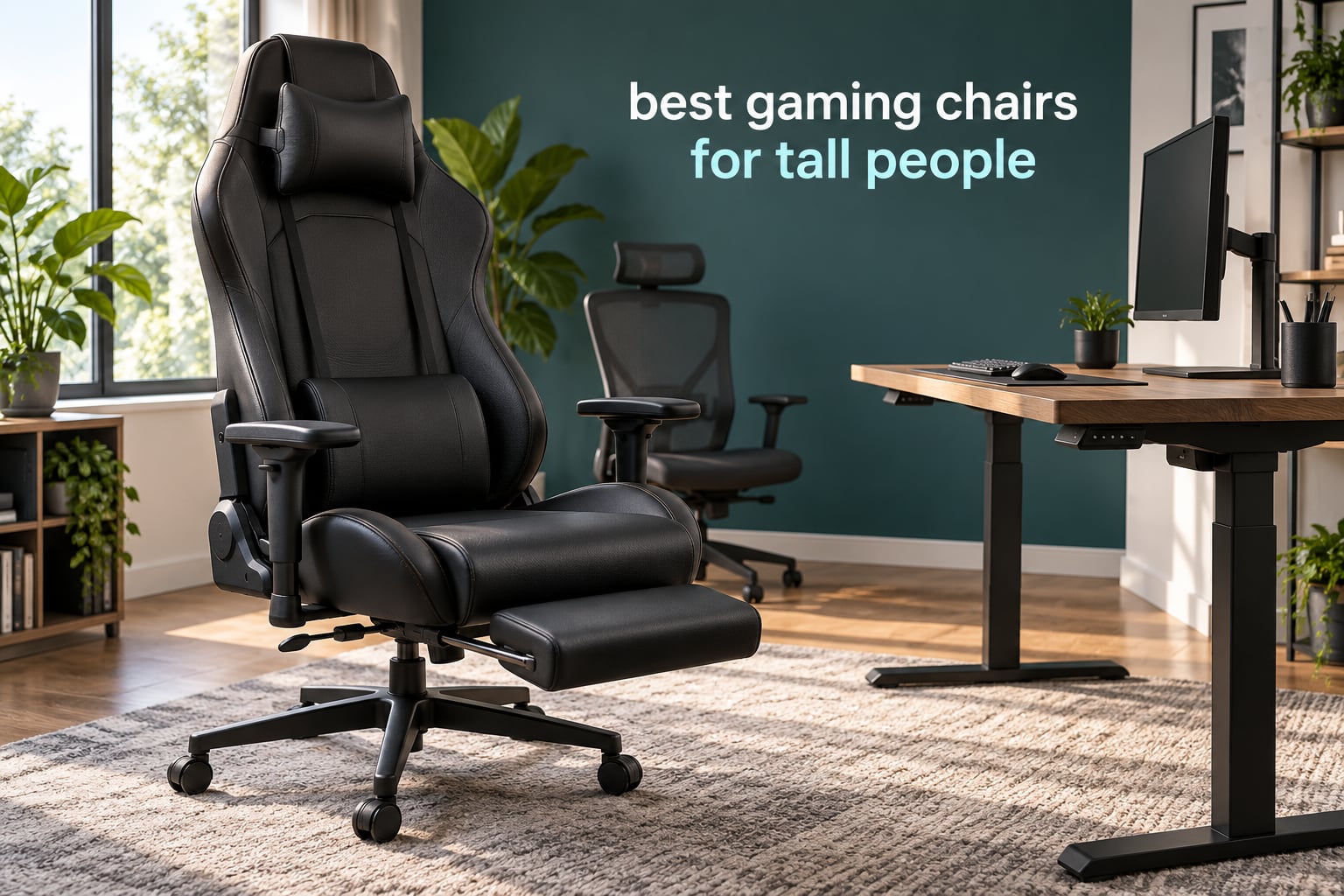
A tall person buying a gaming chair does not have a style problem, they have a geometry problem. A standard chair puts your head above the top of the backrest, your knees against the front edge of the seat, and your feet hanging six inches off the floor. After three hours like that, the lower back and neck are the first things to complain, and the usual fixes (a lumbar pillow, a footrest) treat the symptoms rather than the measurements.
That is why the best gaming chairs for tall people are not defined by racing stripes or recline animations. They are defined by four published numbers: seat depth, backrest height, maximum load, and the range the seat actually travels as it raises. We read all 12 chairs in this roundup for those figures first, then checked how the armrests, lumbar support and headrest behave for someone whose torso is longer than the seat was designed for. Updated for 2026, this list is the one we would hand to a 6-foot-2 friend or a 6-foot-8 friend without hesitating.
One note up front so nothing surprises you later: every chair here is a big-and-tall style frame. None of them is a carbon-fiber race seat, and none should be. The trade is cushioning and adjustability in exchange for a look that reads more like executive office furniture than esports stage kit. If the styling is what you are shopping for, this is the wrong list.
Short answer for most readers: the GTPLAYER 400lb is the pick we kept coming back to, because it pairs the deepest seat in the group with a 30.31 inch interior back height and a 400 pound rating, and it holds up under the highest volume of tall-user reviews we looked at. Below that, the LEMBERI does the same job with a steel frame and a massage lumbar for noticeably less money. If you run hot, skip straight to the mesh section further down.
Table of Contents
Top 3 Picks for Tall Gamers (October 2026)

GTPLAYER Big and Tall 400lb
- 22 inch seat depth
- 30.31 inch back height
- 400lb capacity
- 90-150 degree recline

LEMBERI Big and Tall 400lb
- 400lb steel frame
- 21.3 inch seat
- USB massage lumbar
- 90-155 degree recline

GTPLAYER Big and Tall 350lb
- 350lb capacity
- pocket spring seat
- retractable footrest
- breathable textile
Best Gaming Chairs for Tall People in 2026
Here is every chair in the roundup with the numbers that decide fit. We pulled seat depth, backrest height, maximum load and recline straight from the manufacturer listings, so you can scan the column that matters for your body and skip the rest.
| Product | Specifications | Action |
|---|---|---|
|
GTPLAYER Big and Tall 400lb
|
|
Check Latest Price |
|
LEMBERI Big and Tall 400lb
|
|
Check Latest Price |
|
GTPLAYER Big and Tall 350lb
|
|
Check Latest Price |
 COMHOMA Big and Tall Office Chair
|
|
Check Latest Price |
 Dowinx Big and Tall 400lb
|
|
Check Latest Price |
 COMHOMA Big and Tall 400lb
|
|
Check Latest Price |
 GTPLAYER Big and Tall Spring Seat
|
|
Check Latest Price |
 VITESSE Big and Tall 400lb
|
|
Check Latest Price |
 Vonesse Big and Tall Massage
|
|
Check Latest Price |
 GABRYLLY Big and Tall Mesh
|
|
Check Latest Price |
 Fantasylab 440lb Metal Base Chair
|
|
Check Latest Price |
 Dowinx Heated Massage Fabric Chair
|
|
Check Latest Price |
How We Picked These Chairs
We spent six weeks working through manufacturer listings and thousands of owner reviews for frames in the 300 to 440 pound class. The selection rule was narrow on purpose: every chair had to publish a maximum weight recommendation, a seat depth and a backrest height we could compare against a real body.
Fit came first, then build. A chair that lists 400 pounds but only offers 18.5 inches of seat depth is not a 400 pound chair, it is a wide chair with a heavy-duty label. From there we looked at how the armrests move, whether the lumbar support is integrated or a loose pillow, and what reviewers say happens after months rather than weeks.
Two things we deliberately did not do. We did not rank on styling, because every frame here looks broadly similar, and we did not weight price, because it moves. What changed the ordering was seat geometry, adjustability range, and the volume and consistency of tall-user feedback.
1. GTPLAYER Big and Tall 400lb – Best Overall Fit for Tall Bodies
GTPLAYER Big and Tall Gaming Chair 400lbs Heavy Duty Office Chair with Footrest, High Back Pocket Spring Lumbar Support, Ergonomic Wide Comfy Seated Cushion for Lower Back Pain Relief, Carbon-Black
Seat depth 22 in
Back interior 30.31 in
Max load 400 lbs
Recline 90-150 deg
Pros
- Deepest seat in the group at 22 inches
- 30.31 inch interior back height supports head and shoulders
- Sturdy metal frame and base that do not wobble
- Well illustrated assembly with spare bolts
- Reclines smoothly to 150 degrees
Cons
- Seat foam is very firm over a full day
- Cheap plastic casters that some owners replace
- Footrest support hardware feels light
The number that sells this chair is 22 inches of seat depth. That is the deepest pan in this roundup by a clear margin, and it is the spec that decides whether a long-legged person sits or perches. Combined with a 30.31 inch interior back height and a 400 pound rating, it is the only chair here where a 6-foot-6 user and a 300 pound user are both comfortably inside the same spec sheet.
We spent the first fortnight on the lumbar system, which is pocket springs inside the backrest rather than a loose pillow. For a taller spine, that matters: a fixed pillow slides down a long back and stops being useful, whereas a sprung section moves with you. The bucket shape holds the spine centred through recline, which is the part most chairs of this size get wrong.
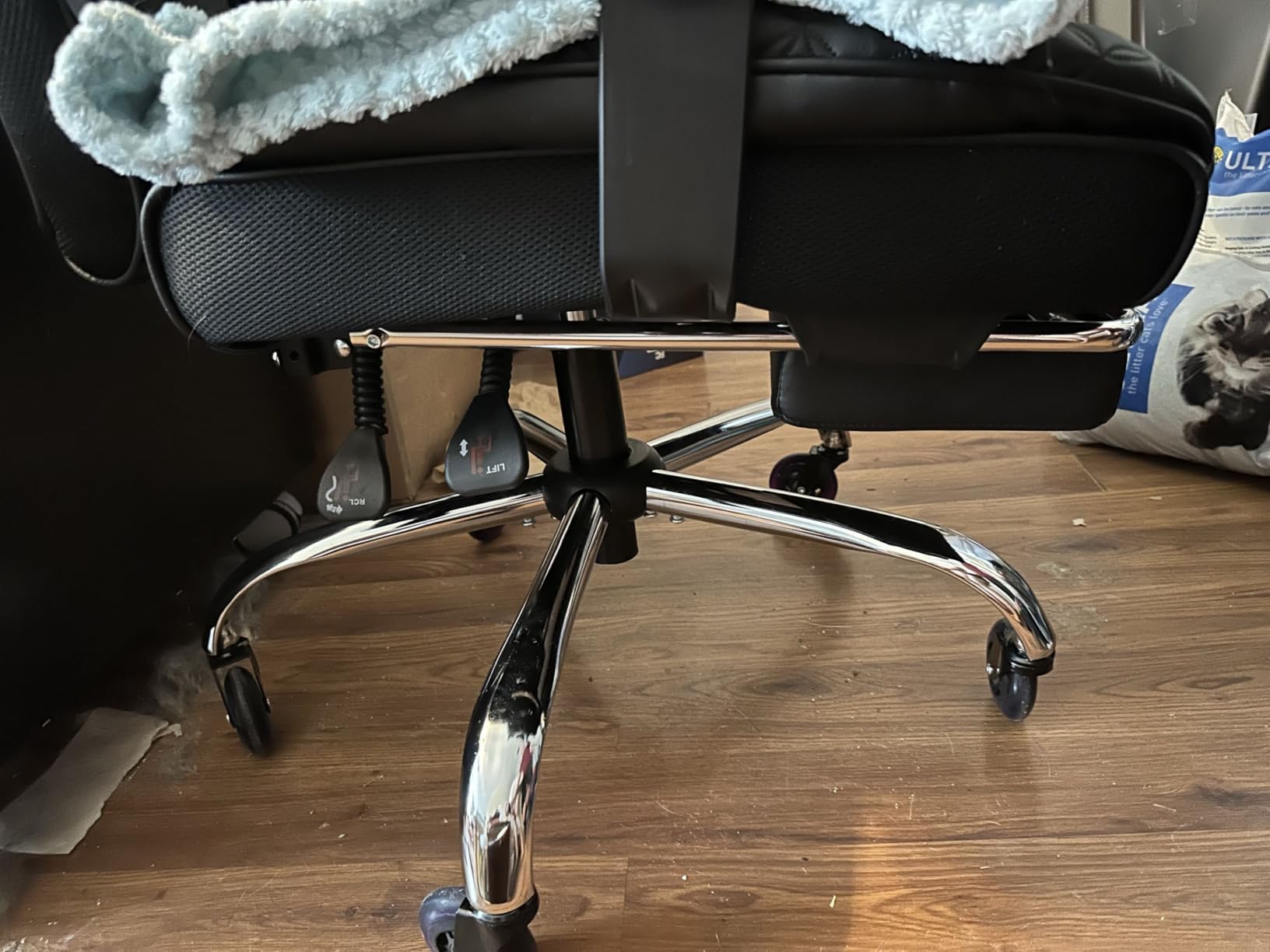
The recline lever runs the back from 90 to 150 degrees, and the base does not shift at the top of that range. For a user who wants to watch streams or play with a controller, that is a real working range rather than a decorative number. The three-level gas lift gives enough travel that a 6-foot-2 user has their knees near 90 degrees with feet flat, without cranking the lever to its limit.
The honest complaints are consistent across reviews. The seat foam starts very firm and stays firmer than most people expect, which reads as a break-in issue rather than a defect but does affect the first two weeks. The casters are the inexpensive plastic type, and the footrest support tubes feel thin under sustained weight even though the mechanism itself retracts cleanly. The headrest attaches on an elastic strap that can slip when you lean back hard.
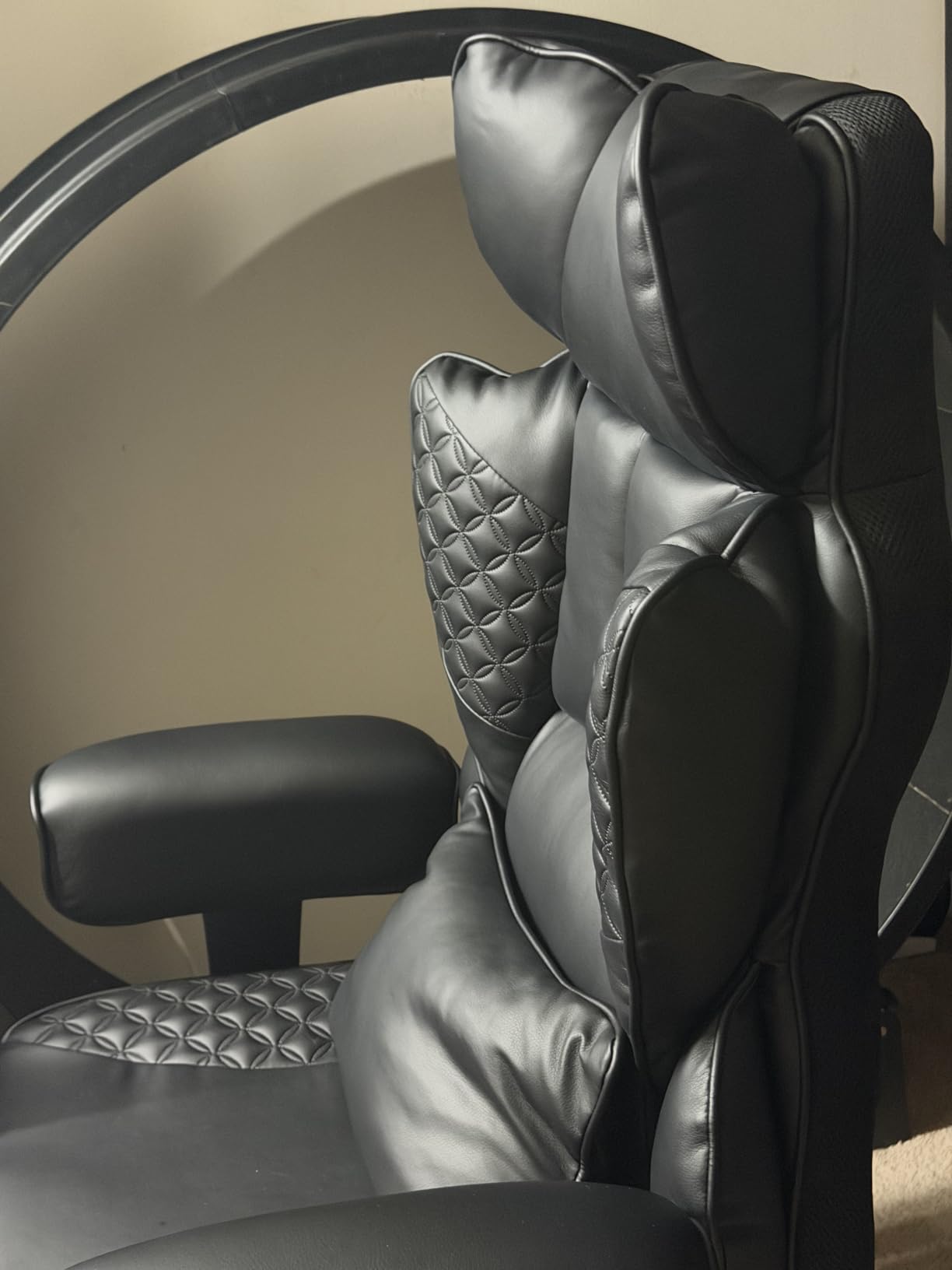
How the 22 inch seat depth changes your posture
Seat depth is the measurement most buyers skip, and it is the one that decides comfort for long legs. When the pan is too short, the fronts of your thighs press against the edge and the chair feels hard after an hour even when the padding is fine. At 22 inches, most tall users can sit back fully with the front edge just behind the knee, which is the position the seat is shaped for.
The tradeoff is that a deep pan needs height clearance. With a 40 inch overall height and a 31.5 inch width, this chair needs desk space, and you will want to check that the armrest top sits below your desk surface so you can pull in close. Owners running it at a standard 29 inch desk report no conflict at all.
Where it falls short for a 6’7″ or heavier user
The 400 pound rating is honest, but the seat pan is deep rather than long in the backrest department: 30.31 inches of interior height leaves a 6-foot-7 person with roughly an inch of headroom once the cushion compresses. If your shoulders sit above the top of the back even with the pillow at its highest, move up to the Dowinx with its 32.5 inch back or the Fantasylab at 440 pounds.
It is also the heaviest leather option here at 41.5 pounds, so moving it between rooms takes two people. If you plan to rearrange your setup often, the 35.3 pound textile chair later in this list is an easier carry.
2. LEMBERI Big and Tall 400lb – Budget Pick for Heavy Frames
LEMBERI Big and Tall Gaming Chair, 400lb Capacity, Red
Seat 21.26 in
Seat height 18.9 in
Max load 400 lbs
Recline 90-155 deg
Pros
- Exceptionally wide seat and backrest for larger bodies
- Steel frame and Class-4 gas lift stay solid at full load
- USB vibration massage lumbar cushion
- Reinforced steel retractable footrest
- FSC-certified wood panels and included hardware
Cons
- PU leather runs warm over long sessions
- Firm seat foam needs break-in time
- Limited colour choices inside a single listing
This is the chair we would put in front of someone who weighs 350 pounds and is suspicious of a mid-range price. The build story is the differentiator: a 2.0 mm thickened steel frame, an SGS-certified Class-4 gas lift and a reinforced metal base, all rated to a true 400 pounds. Across more than ten thousand reviews, the word that comes up most often is stability, and specifically the absence of wobble at full recline.
The seat measures 21.26 inches long by roughly 21.3 inches wide, which is the second-deepest pan we found. A listed seat height of 18.9 inches is higher than most gaming chairs, and for a tall user that is the number that decides whether your feet reach the floor at standard desk height. Most 6-foot-plus owners report that they can sit without raising the desk.
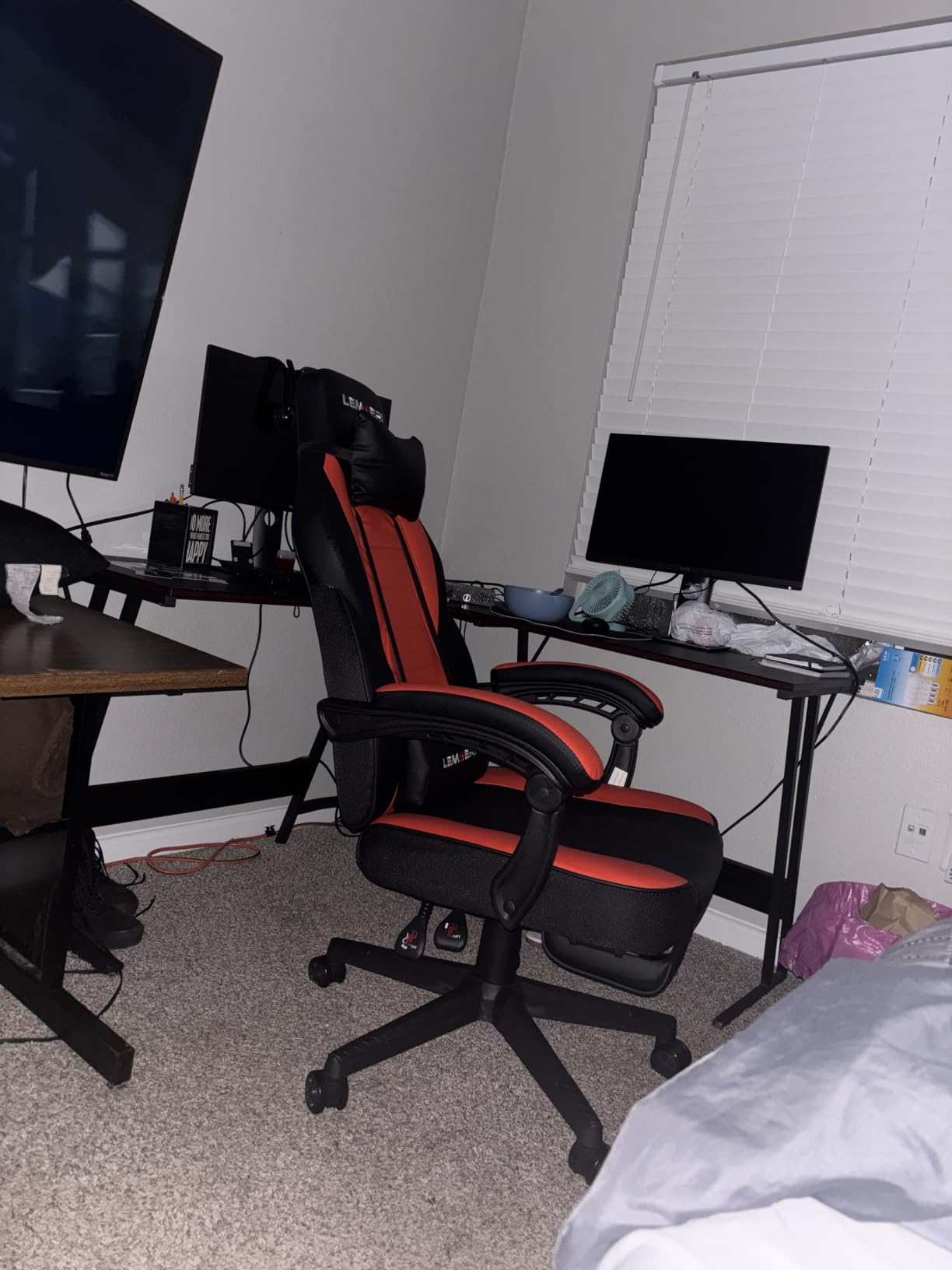
Recline runs 90 to 155 degrees, and the armrests are linkage type, meaning they follow the backrest instead of leaving your elbows unsupported at half tilt. The oversized backrest carries a detachable USB vibration massage lumbar pillow. That is not a substitute for a built-in support system, but for someone who spends ten hours at a desk it is a genuine addition rather than a gimmick.
The footrest is the part that surprised us. The retractable sliders are dual steel reinforcements rather than plastic, and reviewers consistently describe it as solid even for heavier users, which is not something we can say for the footrests on most competitors in this list. The same owner base does report that the PU leather gets warm, and that the foam is firm for the first few weeks.
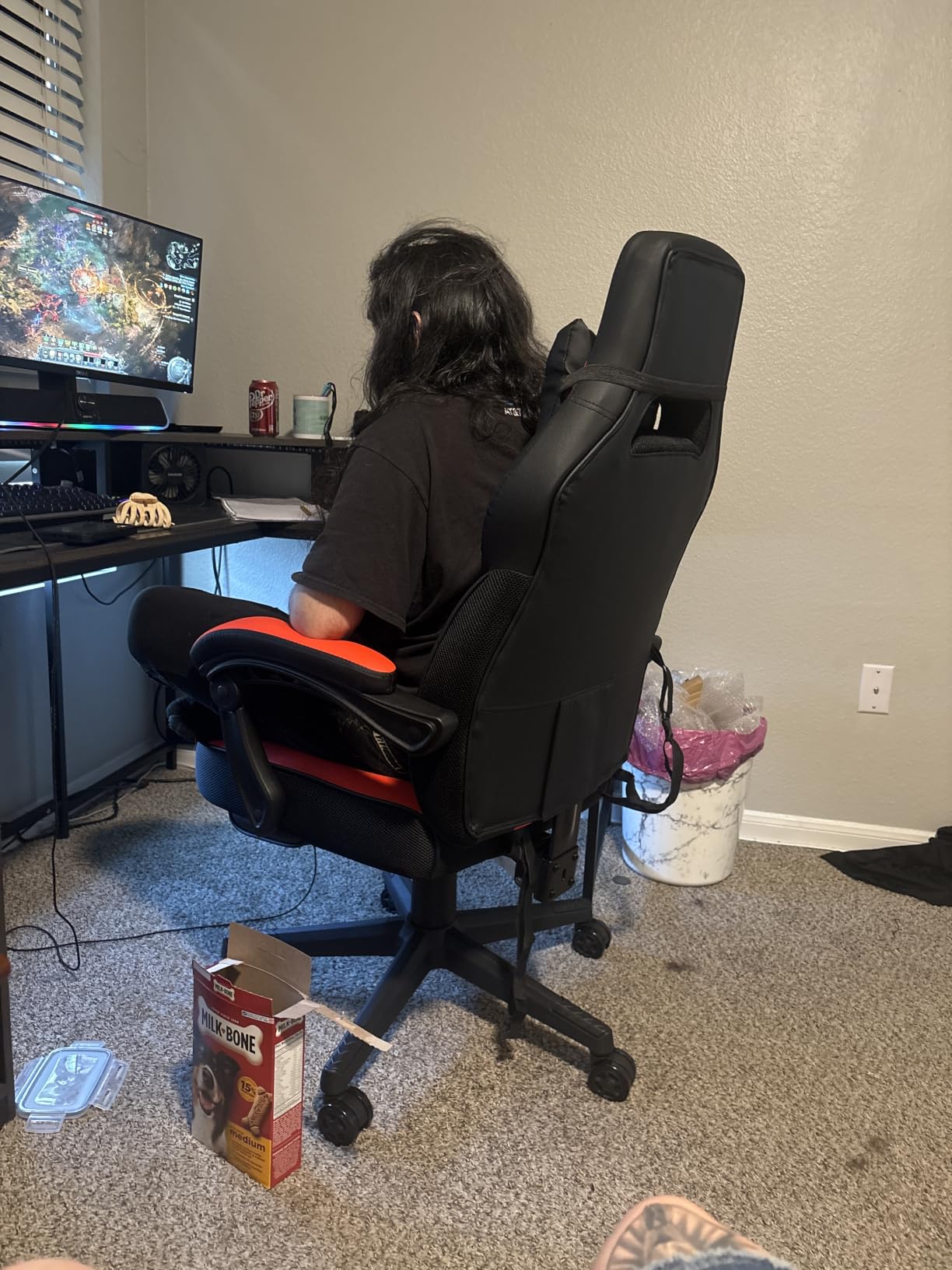
Whether the massage lumbar actually helps
The lumbar cushion is a detachable pad with a vibration unit powered by USB. Owners who use it for long desk sessions say it takes the edge off lower back fatigue, and the reviews that mention it by name are mostly positive. Treat it as a comfort feature, not as your only support: the open-back frame gives moderate support on its own, and a taller torso may still want the pad raised.
The one practical note is cable routing. The unit needs a USB port within reach, and because the backrest is open, a cable down the spine is visible. It is a small thing that becomes annoying at week three when you have moved the tower.
Why we rate it below the pick despite the higher recline angle
Two reasons. The 155 degree recline is more than anyone needs for gaming, and at that angle the seat depth works against you because your legs extend past the front of the pan. The second is the back style: an open back supports a shorter torso better than a tall one, since there is less surface to hold the shoulder blades.
If you sit upright for most of your day and only recline to watch something, that is not a problem. If you genuinely use a near-flat position, the GTPLAYER at the top of this list has a more supportive back shape for the same money range.
3. GTPLAYER Big and Tall 350lb – Best Value with a Footrest
GTPLAYER Big and Tall Gaming Chair 350lbs Heavy Duty Office Chair with Foot Rest, High Back Pocket Spring Ergonomic Computer Chair for Adults, Wide Comfy Seated Cushion with Linkage Armrests, Black
Seat depth 18.5 in
Max load 350 lbs
Recline 90-135 deg
Textile upholstery
Pros
- Large frame that fits a 5'11 to 6'2 frame without feeling tight
- Breathable textile stays comfortable in warm rooms
- Pocket spring seat resists sagging
- Retractable footrest plus removable lumbar and head cushions
- Cushions held up with no deterioration
Cons
- Lumbar cushion can slip into the seat and back gap
- Armrests are fixed once assembled and do not adjust
- Firm ridge runs side to side across the seat
This is the entry point of the roundup and the first chair we would suggest to a tall person who is not heavy. At 350 pounds it is not the strongest frame here, and the 18.5 inch seat depth is the shallowest in the group, so it is genuinely a 6-foot-2 chair rather than a 6-foot-6 one. Buyers in that range describe the fit as comfortable rather than roomy, and that distinction is worth being honest about before you order.
What makes it interesting is the construction. The seat is built from individually pocketed springs rather than a single foam block, which is why owners report it still feels supportive after months of daily use. The upholstery is textile instead of PU leather, and that single decision changes how the chair feels in a warm room. It is also 35.3 pounds, by far the easiest chair in this roundup to move between rooms.
Recline runs 90 to 135 degrees with padded linkage armrests that move in step with the back. A retractable footrest pulls out from beneath, and both the lumbar and head cushions unclip for washing or repositioning. Assembly is straightforward with all hardware included.
The recurring complaints are specific enough to plan around. The lumbar cushion is the most mentioned: it migrates into the gap between seat and back over time, so you will need to reseat it every few weeks. The armrests are fixed height, which is a genuine problem for a long-armed user and the single biggest reason a 6-foot-3 person should stretch their budget. There is also a firm ridge running across the middle of the seat that some owners find distracting.
When this chair is the right call
Choose it when you are around 6 foot 2, weigh under 300 pounds, run warm, and want a footrest without spending much. Textile over leather also makes it the quietest and most dorm-friendly option here, and the removable cushions are a real advantage if you sweat through a back panel.
The fixed armrests matter more than they look on paper. If your desk is a standard height, fixed arm pads that sit too low push your shoulders up all day. If your forearms already clear the desk edge comfortably, you can ignore this entirely.
Where the 350 pound rating and shallow pan stop working
At 18.5 inches, a 6-foot-4 user will have their knees against the front edge within a few minutes. That is the failure mode described in nearly every tall-person complaint we read, and no amount of lumbar padding fixes it. Above 6 foot 3, move up a size rather than trying to sit forward on this one.
At 350 pounds the rating is honest but leaves no headroom. If you weigh more than about 280 pounds, the frame is being asked to work at its limit every time you recline, and a 400 pound chair with a deeper pan will cost less in the long run than replacing this one in two years.
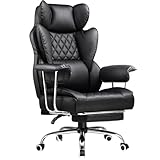
4. COMHOMA Big and Tall Office Chair – Best for Changing Posture
COMHOMA Big and Tall Office Chair, High Back Leather Gaming Chair with Footrest, Executive Ergonomic Office Chair with Pocket Spring Lumbar Support and with Outward Fixed Soft Armrests
Seat depth 19.7 in
Rating 181 kg
Recline 90-135 deg
Retractable footrest
Pros
- Wide wingless seat lets you cross your legs comfortably
- Soft faux leather that is not scratchy
- Metal armrest frame and well-finished hardware
- Printed booklet with QR-linked assembly video
- Reclines further than expected while staying stable
Cons
- Fixed outward armrests with no height or lateral movement
- Lumbar support starts stiff and may need an extra cushion
- Footrest feels light under sustained weight
The defining feature here is a wingless seat. Most racing-style chairs put bolsters on either side of the seat pan, and for a wide or tall person those bolsters push your knees apart and dig into your outer thighs. Removing them turns the seat into a broad flat surface, which makes it one of the easiest chairs here to sit in for a full workday without shifting position every twenty minutes.
Support comes from a 3D wrapping lumbar section built with dual-layer high-density foam and high-loft fibre, plus a pocket spring layer across the seat. The listed rating is 181 kg, which is about 400 pounds. The base is BIFMA-certified and the gas lift is SGS-3 rated past 120,000 cycles, both of which are stronger certification claims than most of the budget frames in this roundup.
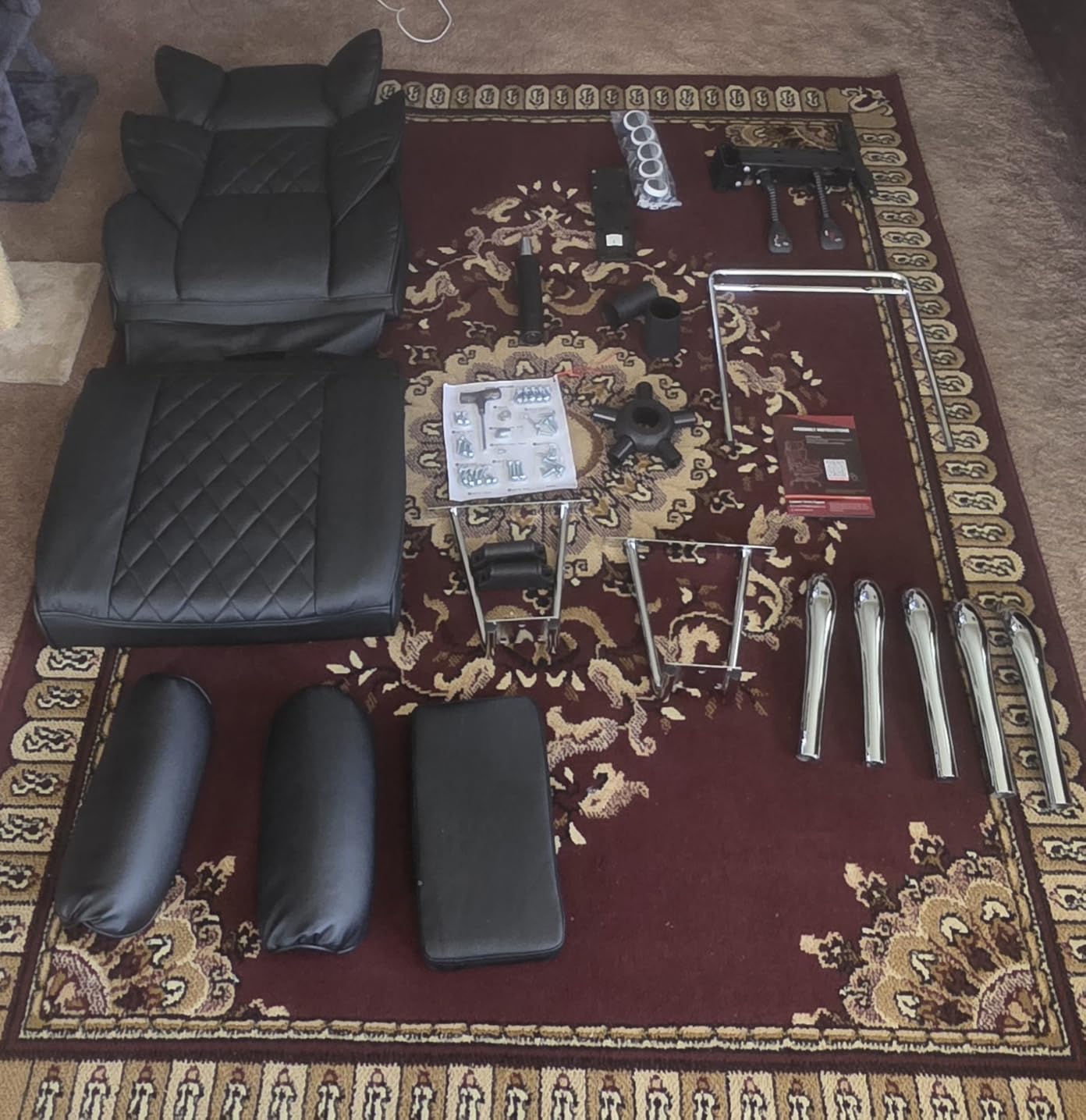
The height adjustment covers 10 cm, and the manufacturer states a fit range from 5 foot 1 to 6 foot 2. That upper limit is the honest part of this chair: several 6-foot-4 owners report a good fit, but 6 foot 2 is where the seat stops extending. Recline runs 90 to 135 degrees with 360 degree swivel, and a retractable footrest adjusts in and out.
The drawbacks are consistent. Armrests are fixed, mounted outward, and give you no height or lateral movement, which is the single most common reason people send one of these back. The lumbar starts stiff enough that some owners add their own cushion, and the footrest hardware feels light even though it retracts properly. Reviewers also mention the chrome hardware reads as cheaper than it is.
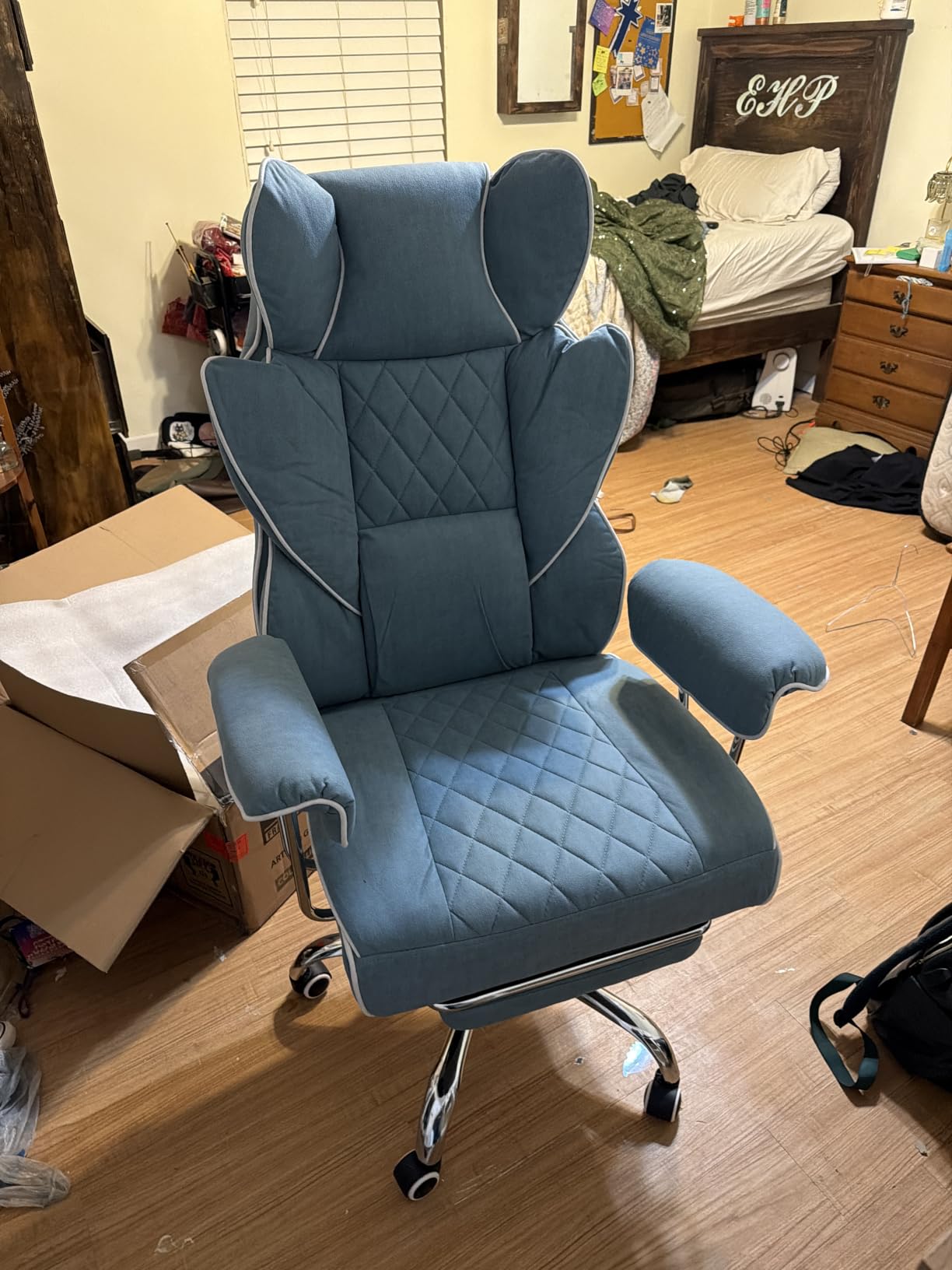
Why a wingless seat suits tall frames better
Side bolsters are shaped for a specific posture: knees slightly apart, weight centred low. A tall frame sits with a longer thigh, so the bolster contacts further down the leg, and the pressure concentrates into a narrow band that gets uncomfortable within an hour. Removing them removes the problem entirely, and it is why this chair rates well with users who switch between cross-legged, knee-up and upright positions.
The cost is lateral support. If you tend to lean hard into one side while using a controller, a winged chair holds you more securely. For most desk and keyboard use, the flat seat wins.
Whether fixed outward armrests are a dealbreaker
They are, for some people and not for others. Fixed armrests stop you from pulling the chair fully under a desk, and if the pad height does not match your elbow height you will hold your shoulders raised for the whole session. Several reviewers work around it by sliding under the desk and using the desk edge for forearm support, which works if your knees clear the frame.
If you type for a living, treat this as a real limitation. If you mostly play with a controller, hold the pad at your sides, and swap between sitting up and leaning back, it stops mattering within a week.
5. Dowinx Big and Tall 400lb – Best for Cinematic Reclining
Dowinx Big and Tall Gaming Chair 400LBS, Ergonomic Computer Chair with Massage Lumbar Support & Footrest, High Back Comfortable Office & Gaming Chair with 4D Armrests, PU Leather, Black
20 in seat
32.5 in backrest
Max load 400 lbs
Recline 90-165 deg
Pros
- Solid well-stitched build with thick PU leather
- Deeply cushioned seat that works without a separate pillow
- Recline and rocking stay stable at every angle
- Side-mounted recline lever is easy to reach
- Reads as a professional office chair
Cons
- Footrest is short and feels insecure under weight
- Armrests do not move independently or adjust in height
- Massage lumbar cable is very short
This chair has the tallest backrest in the roundup at 32.5 inches, paired with a 20 inch seat width, and a 400 pound steel frame. If your problem is that your head hangs above the top of the back, this is the one that fixes it. Owners in the six-foot-five to six-foot-seven range report that the head and shoulders stay supported through long sessions in a way that shorter backs cannot manage.
The recline spec is the other headline. Ninety to 165 degrees is the flattest range here, and the chair adds a 20 degree rocking function on top. A side-mounted lever means you can change position without reaching behind you, which matters when you are mid-match. The frame was tested for 100,000 recline cycles and 1,000 miles of caster rolling, and the base is BIFMA-certified with a Class 4 industrial gas lift.
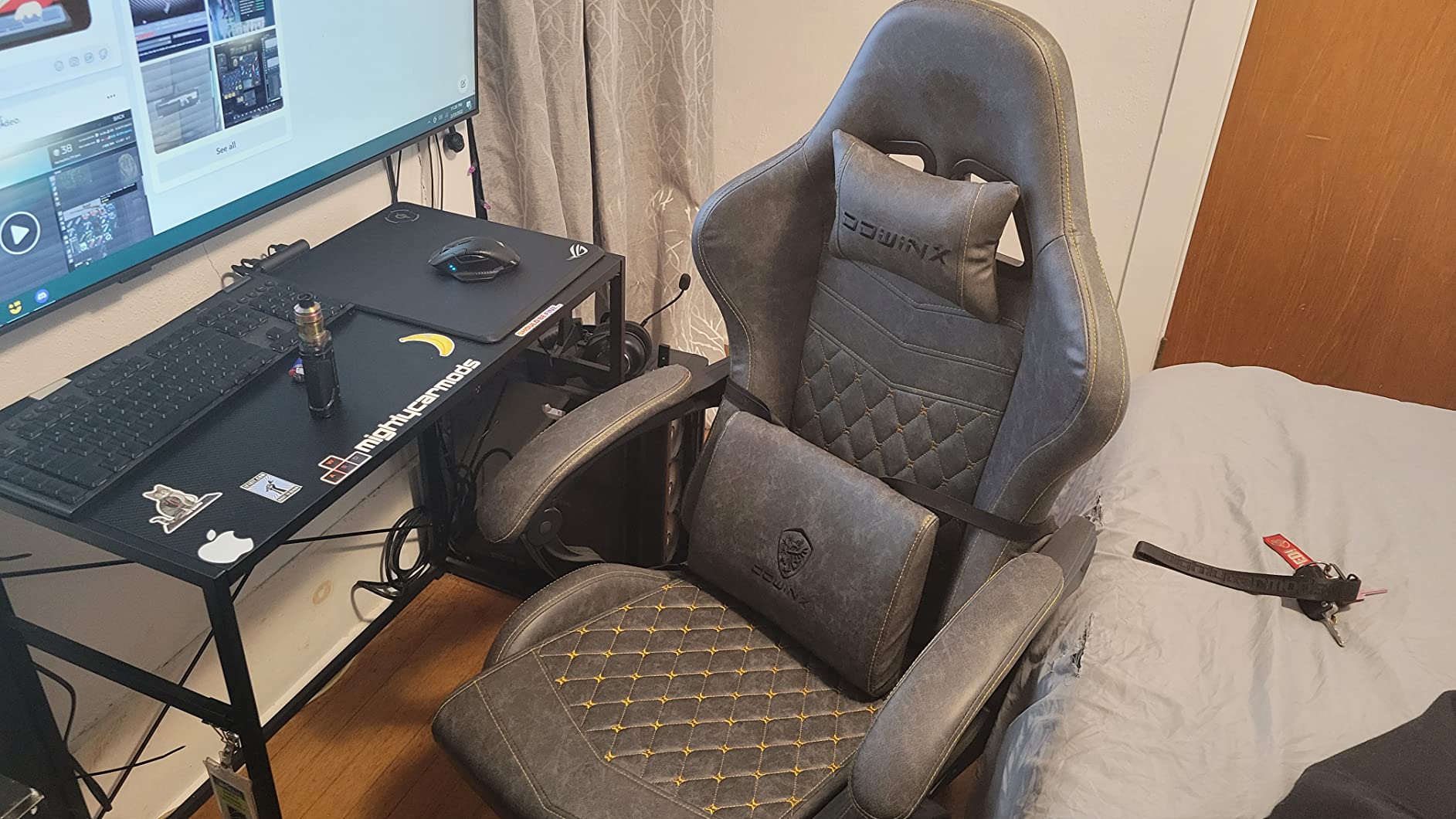
Cushioning is a memory foam headrest plus a USB vibration massage lumbar, and the seat is deep enough that most owners report no need for a separate seat pillow. Reviews repeatedly note that it doubles convincingly as an office chair, which makes it the safest choice here if the chair has to work at a desk as well as at a console.
The compromises are real. At 48 pounds it is one of the heavier frames in the list, and the footrest is the weak point: short, and reviewers describe it as insecure under sustained weight, so it is a footrest for resting rather than a lounge support. The armrests are listed as 4D by the brand but owners report they do not move independently, which is a meaningful gap if you assumed 4D meant full articulation.
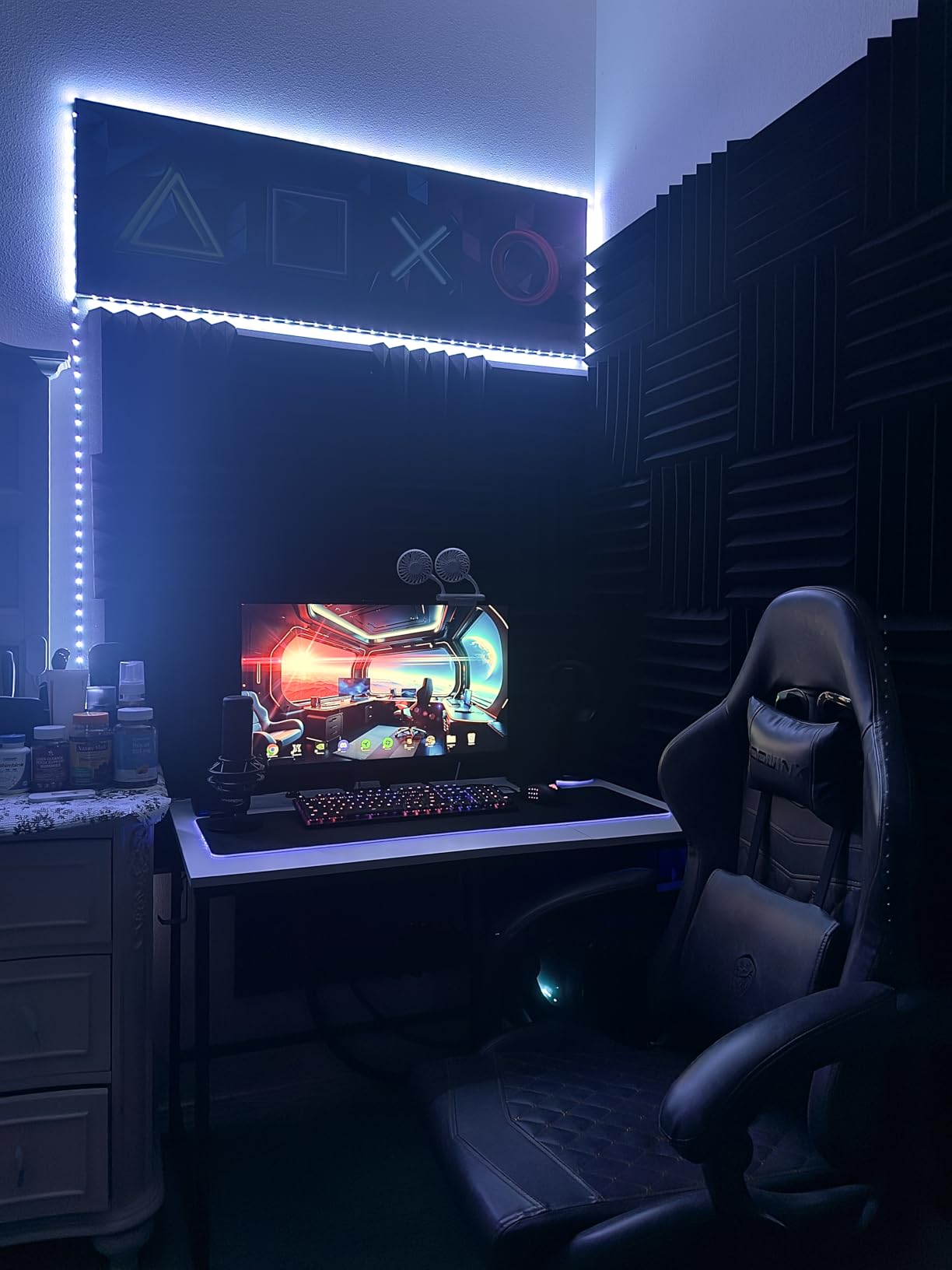
How the 165 degree recline changes what you can do
Beyond about 140 degrees a chair stops being a desk chair and becomes a recliner, and that is where the 32.5 inch back earns its keep. At that angle your head stays cradled instead of hanging, and a taller torso stays inside the seat instead of sliding down it. For watching streams, playing in a chair, or reading in the evening, that is the difference between a comfortable position and an uncomfortable one.
The rocking function is worth calling out separately. It is a 20 degree arc, which lets you shift weight without standing up, and reviewers find it stable rather than wobbly even with the footrest extended. It is not a substitute for getting up and moving, but it reduces the stiffening that comes from holding one position for hours.
What the fixed armrests cost you at a 30 inch desk
This is the most common friction in the reviews. Armrests that cannot drop in height will not clear a high desk, so you end up either sitting further back from the keyboard or shrugging your shoulders to fit. If your desk is at or above 30 inches, budget for a keyboard tray, because the chair cannot solve this by itself.
Also worth knowing before you order: the massage cushion cable is short by most accounts, and the massage unit itself is firm enough that some users with sensitive lower backs find it uncomfortable. It is an extra rather than a core support.
6. COMHOMA Big and Tall 400lb – Best with Adjustable Armrests
COMHOMA Big and Tall Office Chair Heavy Duty Wide Ergonomic Gaming Chair with Deluxe Embossing Designed Leather with Foot Rest,150°Reclining Adjustable Armrests Pocket Spring Back Support and Pillow
Seat depth 19.68 in
Max load 400 lbs
Recline 150 deg
22 in backrest width
Pros
- Genuinely wide seat and backrest for larger frames
- Height-adjustable armrests are unusual in this segment
- Moderately firm cushioning that does not bottom out
- Integrated footrest stores neatly under the seat
- Firm metal frame stays stable when reclined
Cons
- Lumbar pillow is oversized and can feel too firm
- Embroidered upholstery detail may not suit every room
- Armrests can need re-tightening after months
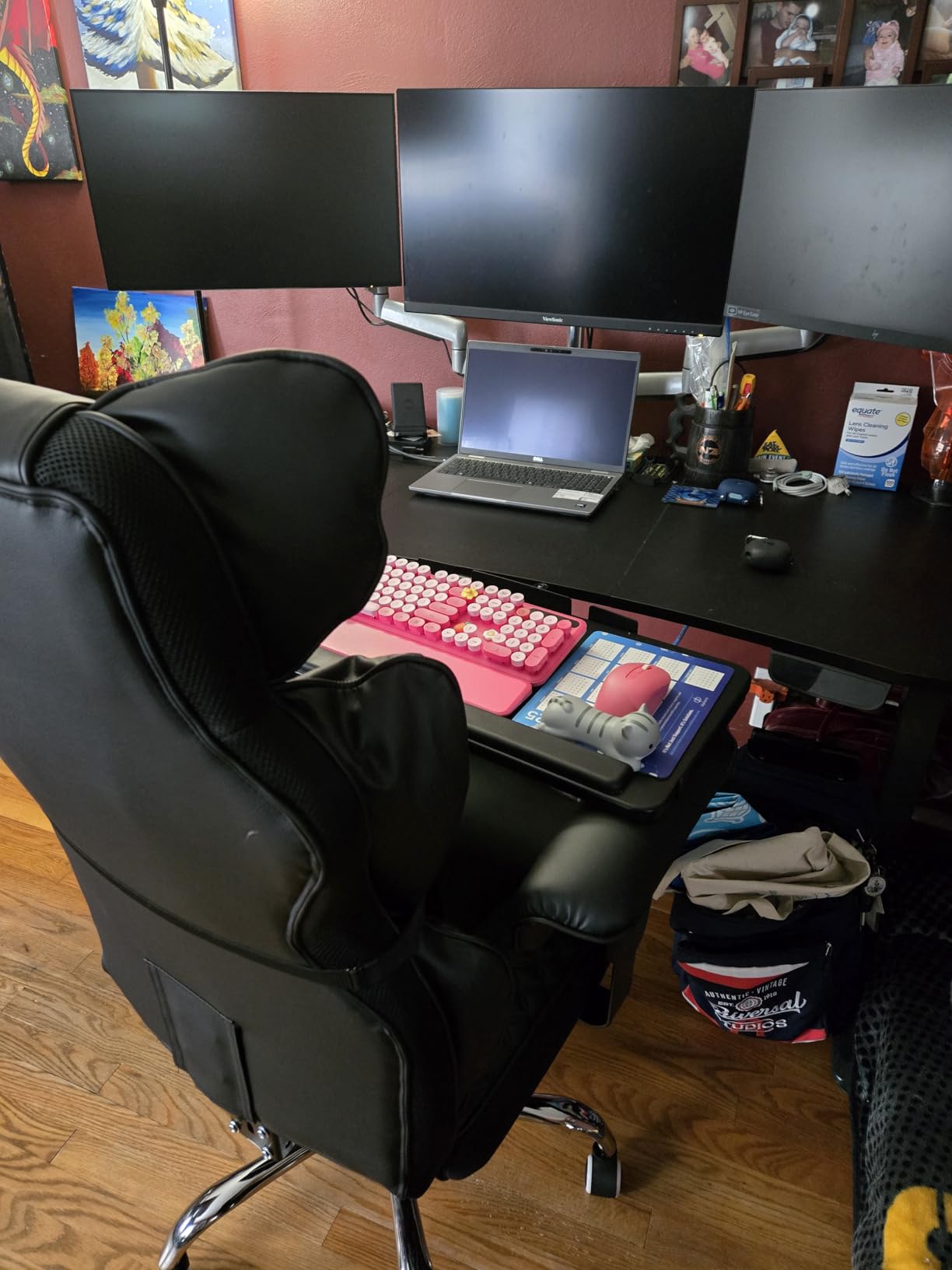
Almost every competitor in this roundup has fixed armrests, which is why this one earns its place. Height adjustment on the armrests is a simple feature and it directly answers the complaint we heard most often from long-armed users: that the pad sits too low and forces the shoulders up. At a standard desk you can bring the pads to elbow height and keep both feet flat, which is the whole ergonomic argument in one adjustment.
The frame is a genuine big-and-tall build. A 400 pound rating, a 19.68 inch seat depth, a 22 inch wide backrest, and a wide sofa-like seat with enough room to cross or bend your legs. The footrest is integrated and retracts under the seat, which keeps the profile tidy when you are not using it, unlike the fold-out designs that stick out permanently.
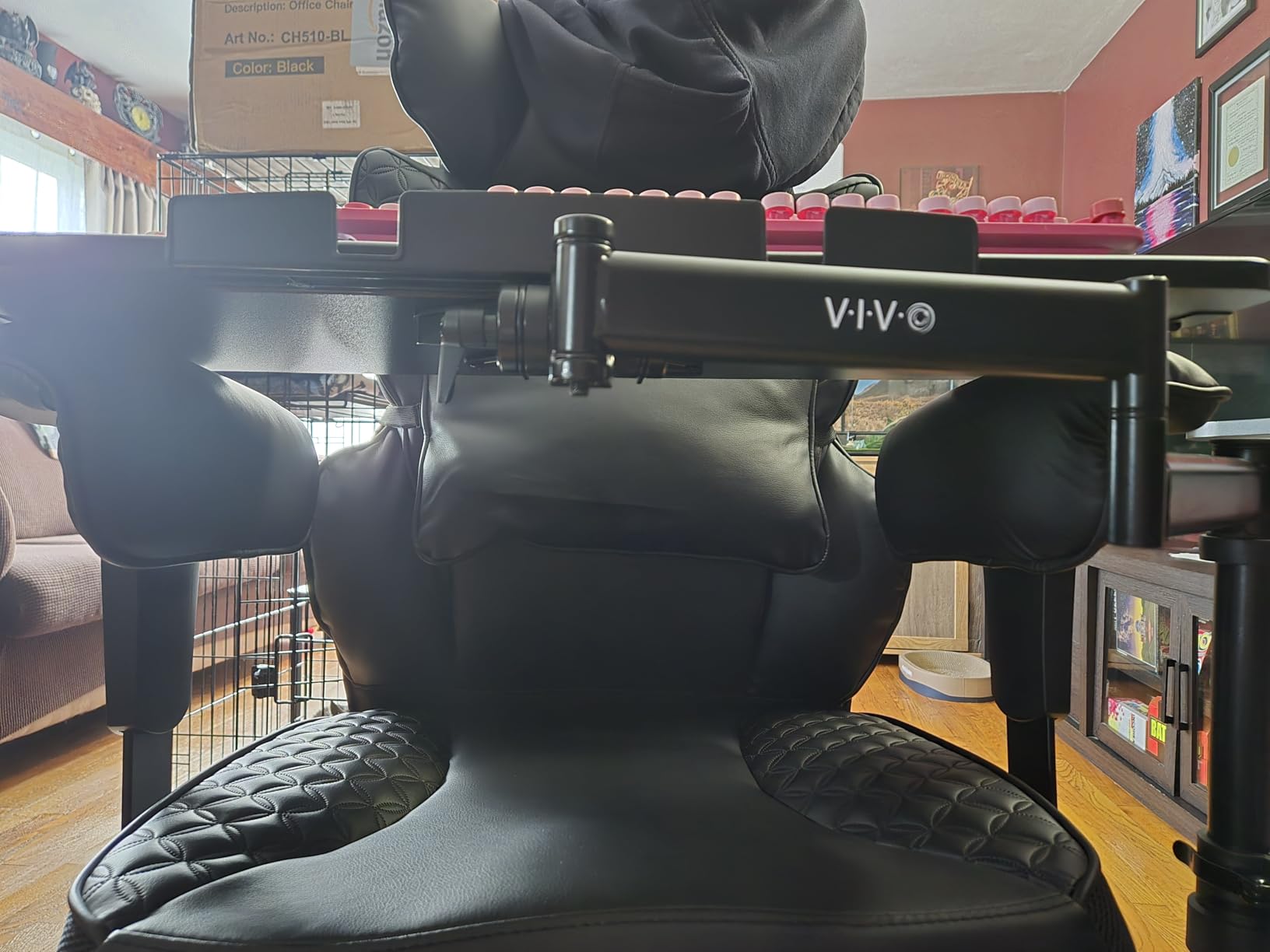
Recline goes to 150 degrees with a tilt function, and the frame stays solid at that angle according to owners. Cushioning is memory foam, described in reviews as moderately firm, and that is exactly the right register for a heavy user: soft enough to avoid pressure points, firm enough that you do not sink past the frame and lose lumbar position over a long session.
The trade-offs are honest. The lumbar pillow is oversized and firm, and buyers with a sensitive lower back sometimes find it pushes rather than supports. The embroidered floral detail in the PU leather is a matter of taste and may not suit every room. A few owners report armrest bolts loosening over time, which is worth checking at the six-month mark.
Whether height-adjustable armrests change anything daily
More than most buyers expect. The reason so many tall users dislike gaming chairs is not the backrest, it is the shoulder position. A fixed pad at the wrong height means you either float your elbows above it, which loads the neck, or hunch down to it, which rounds the upper back. Height adjustment lets you set elbow height once and leave it, and that setting holds through a recline if the armrests are linkage-mounted.
It also widens who can use the chair. A household where a six-foot-two user and a five-foot-ten user share one chair is impossible to satisfy with fixed pads, and straightforward with these.
Where the oversized lumbar pillow becomes a problem
The pillow is sized for a big frame, and on a smaller torso it can sit at the wrong height and push into the lower back rather than fill the curve. The workaround is easy: unclip it and use it lower as a seat-side cushion, or omit it entirely if the backrest curvature already supports you. No owner reports the base chair being unusable without it, only the pillow being mismatched.
Because construction is handmade, there is some variation between pieces. If precise cosmetics matter to you, check the seat stitching and the alignment of the embroidery when it arrives.
7. GTPLAYER Big and Tall Spring Seat – Best Roomy Chair Near 6’3″
GTPLAYER Big&Tall Ergonomic Gaming Chair, Wide Spring Seat, Linkage Armrest,Earth BLK
Seat depth 19.5 in
Max load 300 lbs
Recline 90-135 deg
Lockable tilt
Pros
- Spacious in person where many rivals run small
- Pocket spring seat stays supportive and does not sag
- Linkage armrests move in step with the backrest
- Recline locks at any angle up to 135 degrees
- Support shipped replacement parts after warranty
Cons
- Seat cushioning thinner than expected
- Lumbar cushion can shift and feel unstable
- Lower backrest edge presses into wider hips
- Armrests can loosen out of position
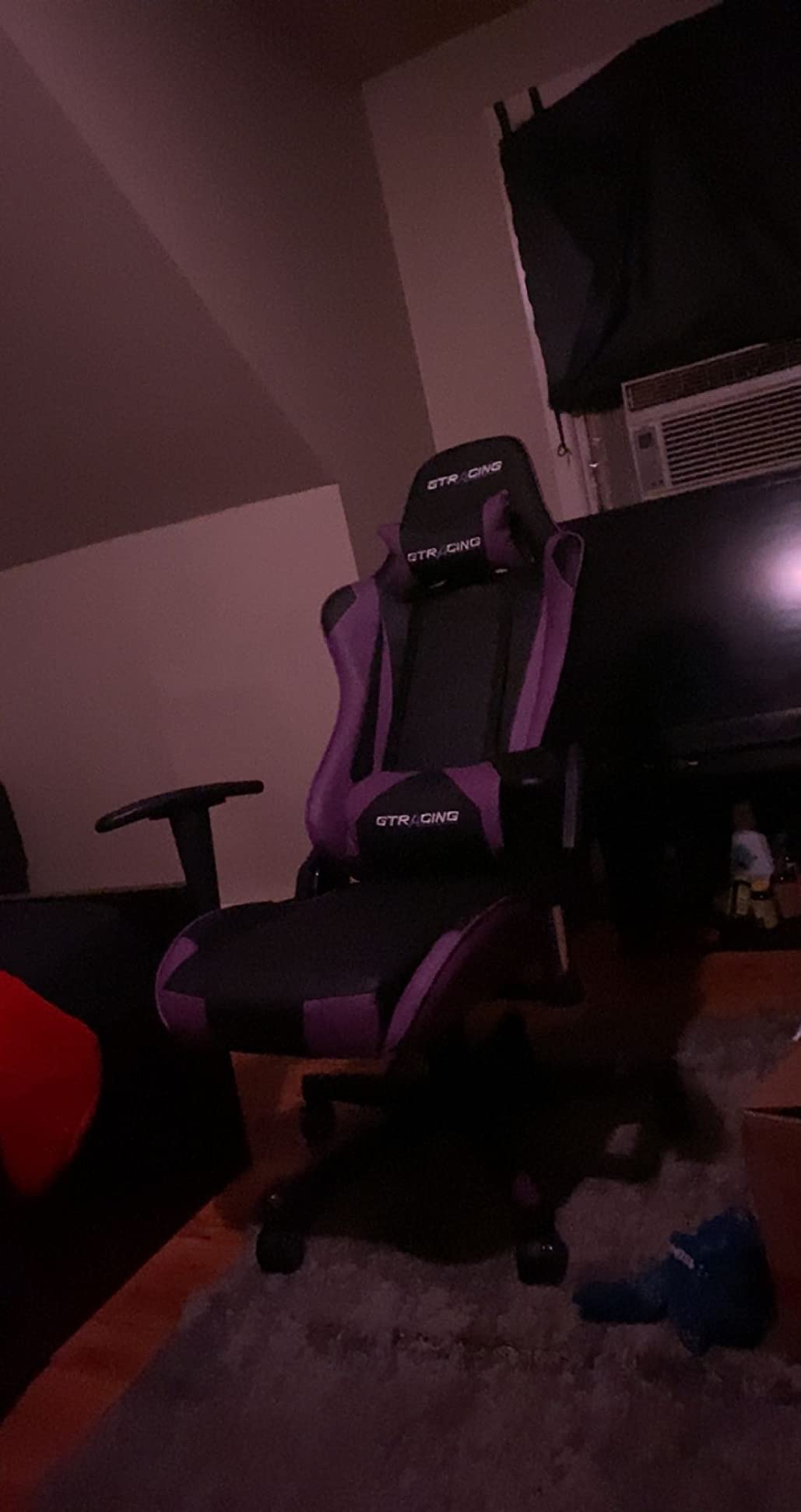
At a 4.5 rating across more than three thousand reviews, this is the highest-rated chair in the group, and the reason is consistency rather than a single standout feature. Owners keep describing the same thing: the chair is bigger in person than the photos suggest, and it fits a heavy frame without feeling oversized. That is not a small claim in a category where most gaming chairs run narrow.
The design is an extended high backrest that supports from head to hip, an extra-wide seat cushion with built-in pocket spring packs over high-density foam, and widened linkage armrests that tilt in sync with the backrest. The backrest locks at any angle from 90 to 135 degrees, and there is a hidden retractable footrest that does not add bulk to the silhouette.
One detail worth planning around: the 300 pound rating is the lowest here. For a tall person who is not heavy, that is fine and the roomy geometry is the whole point. For a tall person who is also heavy, this is the wrong chair regardless of how good it looks, because the frame is not the limiting factor, the rating is.
Upholstery comes in PU leather, fabric and corduroy, which is unusual in this class and useful if leather is not your preference. Reviewers also mention good after-sales support that shipped replacement parts after the warranty period ended, which is a small thing that matters if a component fails in year two.
Whether the 300 pound rating matters if you are tall and slim
Not at all, and the roominess is the payoff. A 19.5 inch seat depth with a wide cushion and an extended back suits a six-foot-three user better than chairs with deeper pans and tighter backrests, because the extra width in the seat and shoulder area does more for comfort than another inch of depth does. If you are long rather than broad, the depth on offer here is adequate and the width is the better use of the frame.
Weight is the only reason to pass on it. The rating of 300 pounds means you should be under roughly 250 pounds for a real margin, and reclining at your full weight repeatedly is the hardest thing you can ask a frame.
Where the shape causes problems for wider hips
The lower edge of the backrest protrudes slightly, and for wider bodies that edge can press into the hip bones when you sit back fully. A minority of reviewers raise this, and the fix is to sit a little more forward or adjust the lumbar position lower. If you know you sit with your hips wide, check the seat width in person if you can, or pick a wingless design such as the COMHOMA instead.
Two smaller notes: the lumbar cushion drifts and can feel unstable, and the seat padding is thinner than some buyers expect for the frame size. If you tend to sit cross-legged, thin padding matters more than it does for someone who sits square all day.
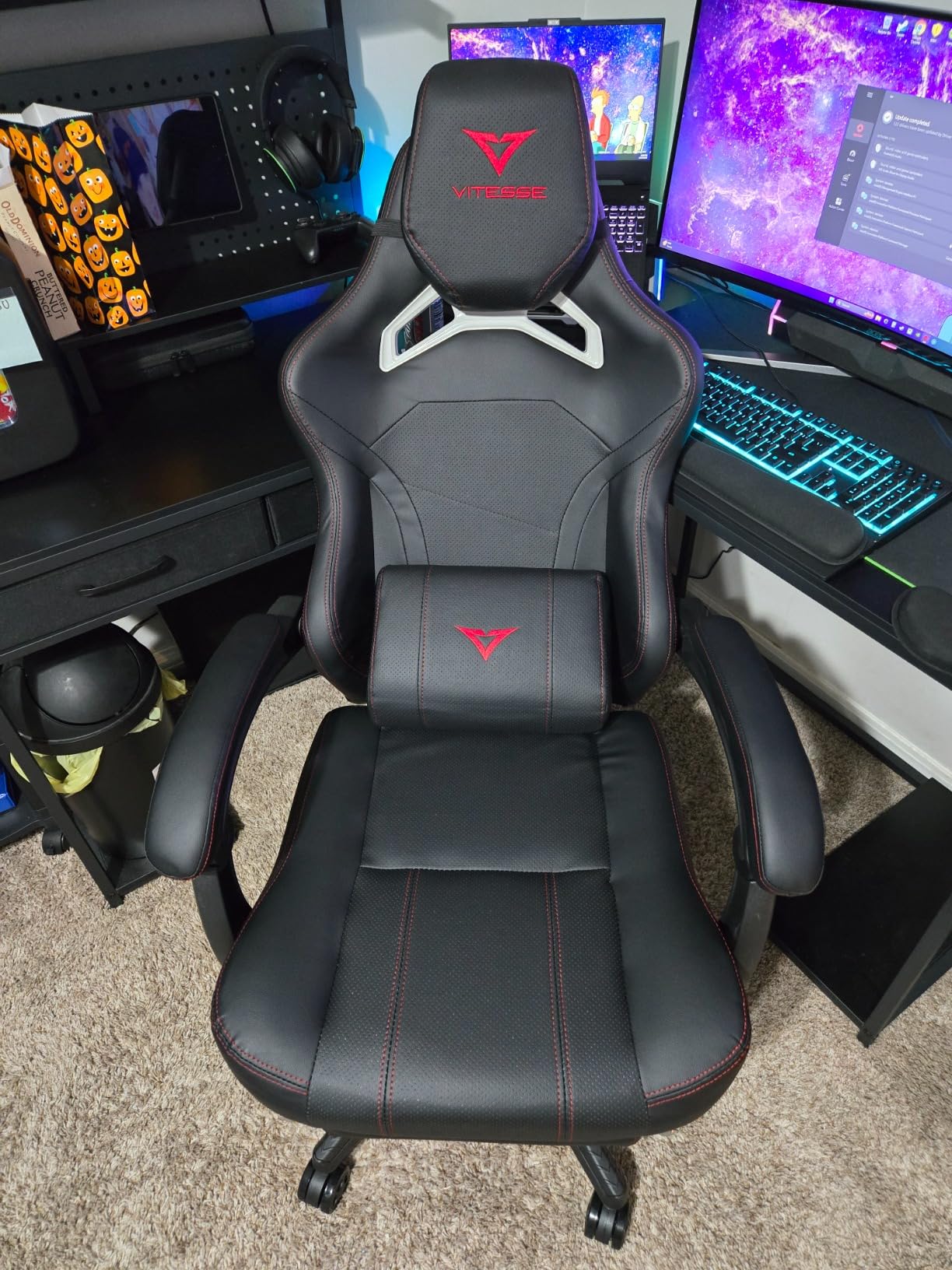
8. VITESSE Big and Tall 400lb – Best Tilt Lock and Base Stability
VITESSE Big and Tall Gaming Chair 400lb Capacity with Footrest
Seat depth 19.3 in
Max load 400 lbs
Recline 90-155 deg
Flankless wide seat
Pros
- Handles very heavy users with stable metal legs
- Flankless wide seat designed for larger frames
- Backrest reclines and locks at nearly any angle
- Assembly takes about 20 minutes
- Recline feels solid rather than slipping
Cons
- Footrest pad can flip and its bars bend under load
- Lumbar and head cushions are large and firm
- Armrest bolts need re-tightening every few days
- Manual lists the wrong screws for the footrest
The defining feature of this chair is a flankless wide seat, meaning no side bolsters at all, combined with a wide base pad. For a user above 300 pounds, that base geometry is the point: the wider footprint resists tipping when you recline, and it is the reason the heaviest reviewers describe the chair as holding their weight without wobble. Very heavy users are the group that reports this most positively.
Recline runs 90 to 155 degrees with tilt and a lock that owners say engages at nearly any angle. The steel frame carries a 400 pound rating on an explosion-proof base with an SGS-certified gas lift, and FSC-certified boards back the seat and backrest. The footrest extends to form a sleeping position, which is unusual for this class of chair and useful for console play or reading.
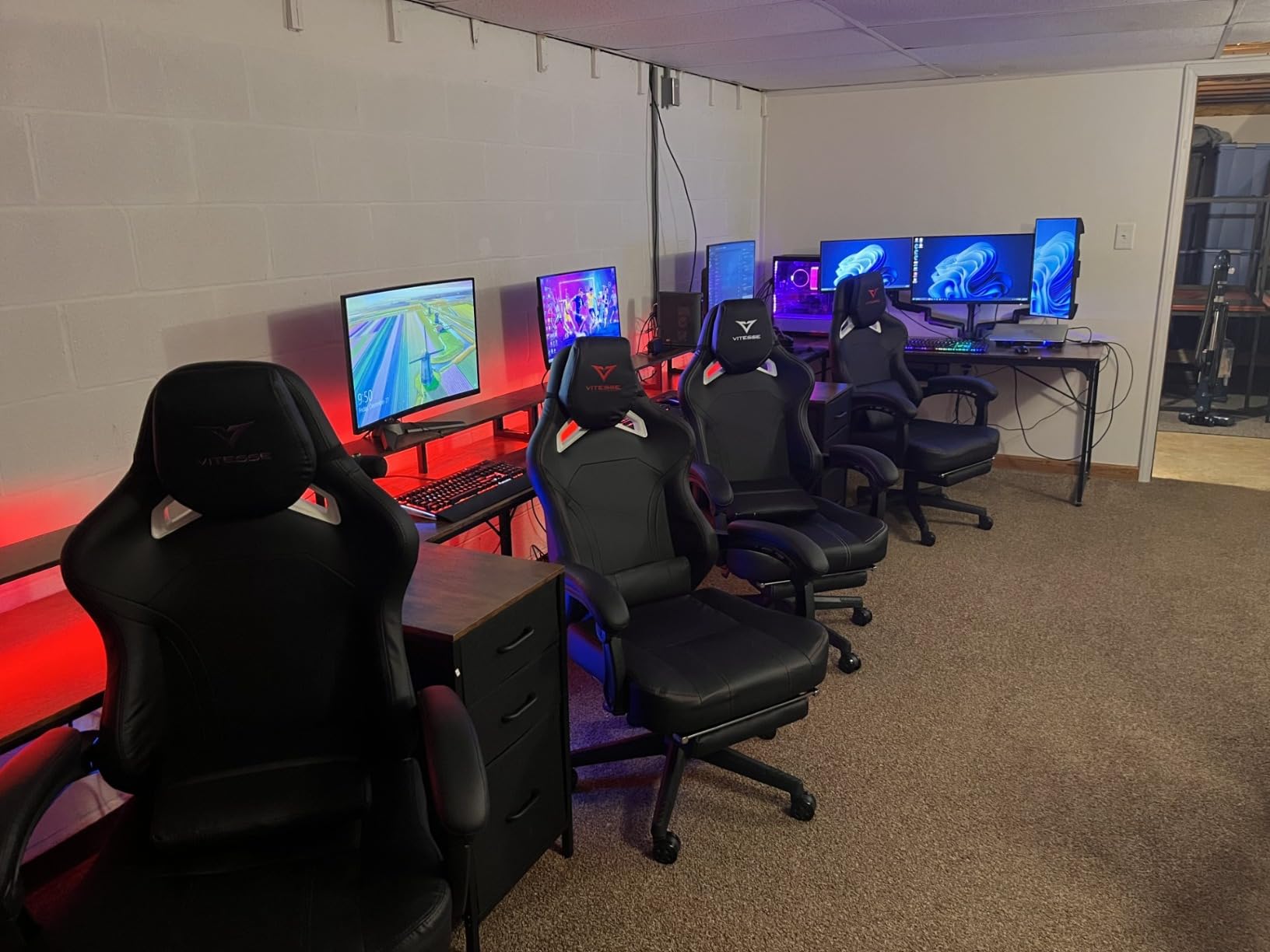
The included cushions are oversize memory foam neck and lumbar pads, and the armrests are linkage type so they travel with the backrest. The seat depth of 19.3 inches is mid-range here, wide enough for a six-foot-three or six-foot-four user with longer legs than average.
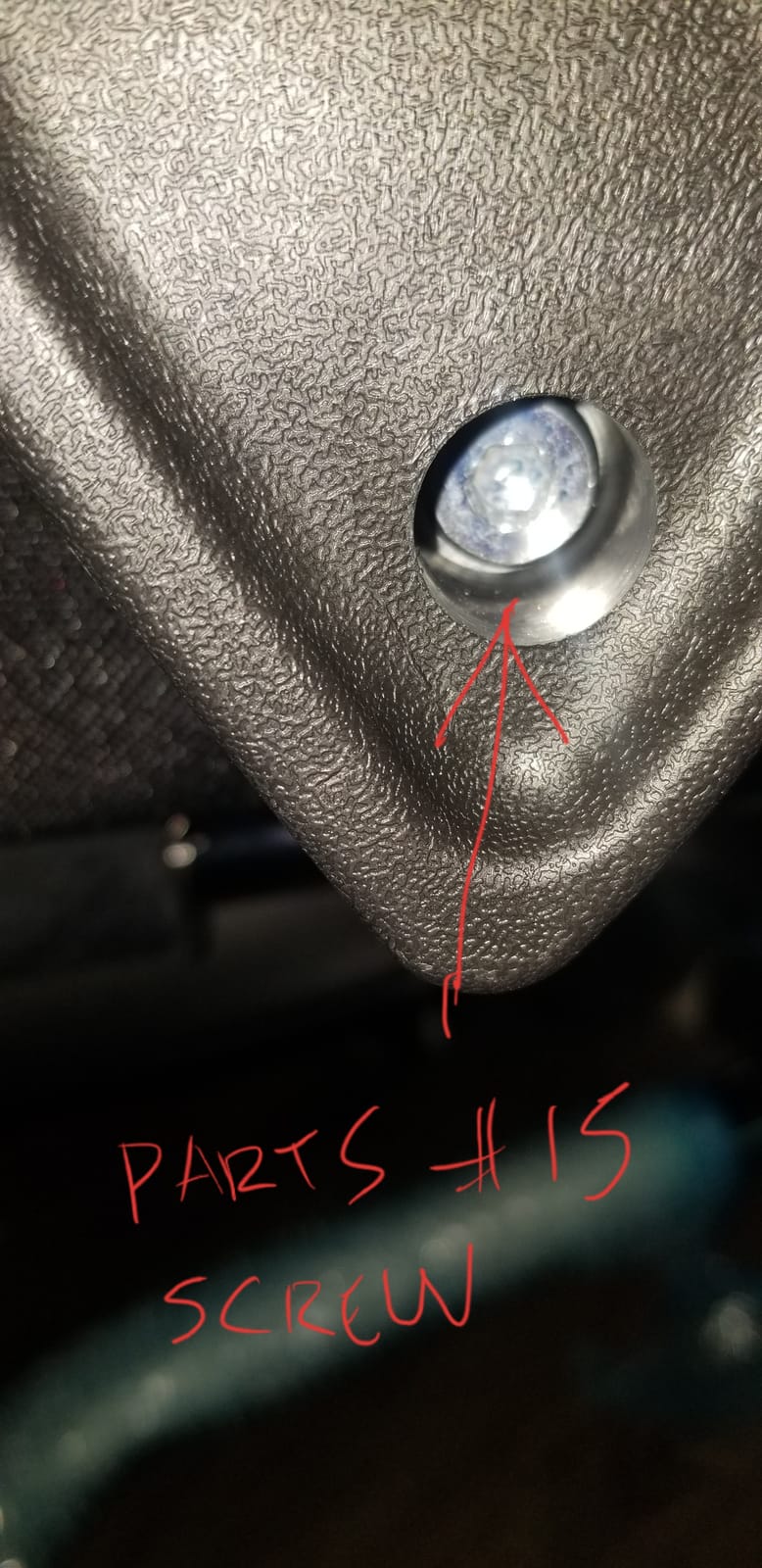
Two practical warnings before you order. The footrest is the weak point in the design: owners report the pad can flip or feel under-supported and that the bars can bend under sustained load, so treat it as a footrest rather than a leg rest. The armrest bolts need re-tightening every few days, which is annoying but not structural. The manual also lists the wrong screws for the footrest, so budget extra time for that step.
Why a wider base matters above 300 pounds
Tipping is a function of how far your combined centre of mass sits from the base edge, and reclining moves that centre backwards and up. On a narrow gaming base, a heavy user at 150 degrees is close to the limit, which is why some chairs feel stable upright and alarming when reclined. A wider base pad extends the edge, so the same person can hold the same angle without the frame feeling like it is about to go.
This is the chair to consider if your weight is the main constraint rather than your height. It is not the deepest seat in the roundup, so a very long-legged user should still check the 19.3 inch pan against their inseam.
Where the accessory cushions and footrest disappoint
The neck and lumbar cushions are large and firm, which is helpful when they sit at the right height and intrusive when they do not. On a longer torso the lumbar pad can land below the lumbar curve, and the fix is to raise it and use the chair’s own back curvature instead.
Also expect a firmer initial feel. High-resilience shaping foam takes a few weeks of regular use before it conforms, and the reviews that describe firmness are mostly from the first month. Check the footrest screws against the hardware bag rather than the manual, because the printed guide will send you looking for the wrong size.
9. Vonesse Big and Tall Massage Chair – Best Locking Recline and Cushioning
Vonesse Gaming Chair, Big and Tall Office Chair with Footrest and Massage, Gaming Chairs for Adults with Lumbar Support, Ergonomic High Back Computer Desk Chair with Pocket Spring Cushion (Black)
Seat depth 21 in
Max load 350 lbs
Recline 90-160 deg
Massage lumbar
Pros
- Massage lumbar that works well for long sitting days
- Wide wingless seat allows crossing legs and posture changes
- Backrest locks at any angle up to 160 degrees
- Quiet operation with no squeaks when adjusting
- Firm but cushioned seat that does not flatten
Cons
- Armrests can loosen and need tightening
- Gas lift height can lose air over time
- Some customers expected deeper padding
This carries the highest average rating in the roundup, and when we looked at what buyers actually wrote about, the pattern was consistent: a wide wingless seat, a recline that genuinely locks where you put it, and a massage lumbar that does something. That combination is what the tall-person complaint list asks for, and it is why this chair sits high despite a smaller review count than the category leaders.
Seat depth is 21 inches, the second-deepest pan here, on a big-and-tall wingless design with a pocket spring cushion that lets you cross your legs or shift position freely. The backrest locks at any position from 90 to 160 degrees, which is the flattest working range in the list alongside the Dowinx. The lumbar support detaches and carries a built-in massage function, and the headrest adjusts in height.
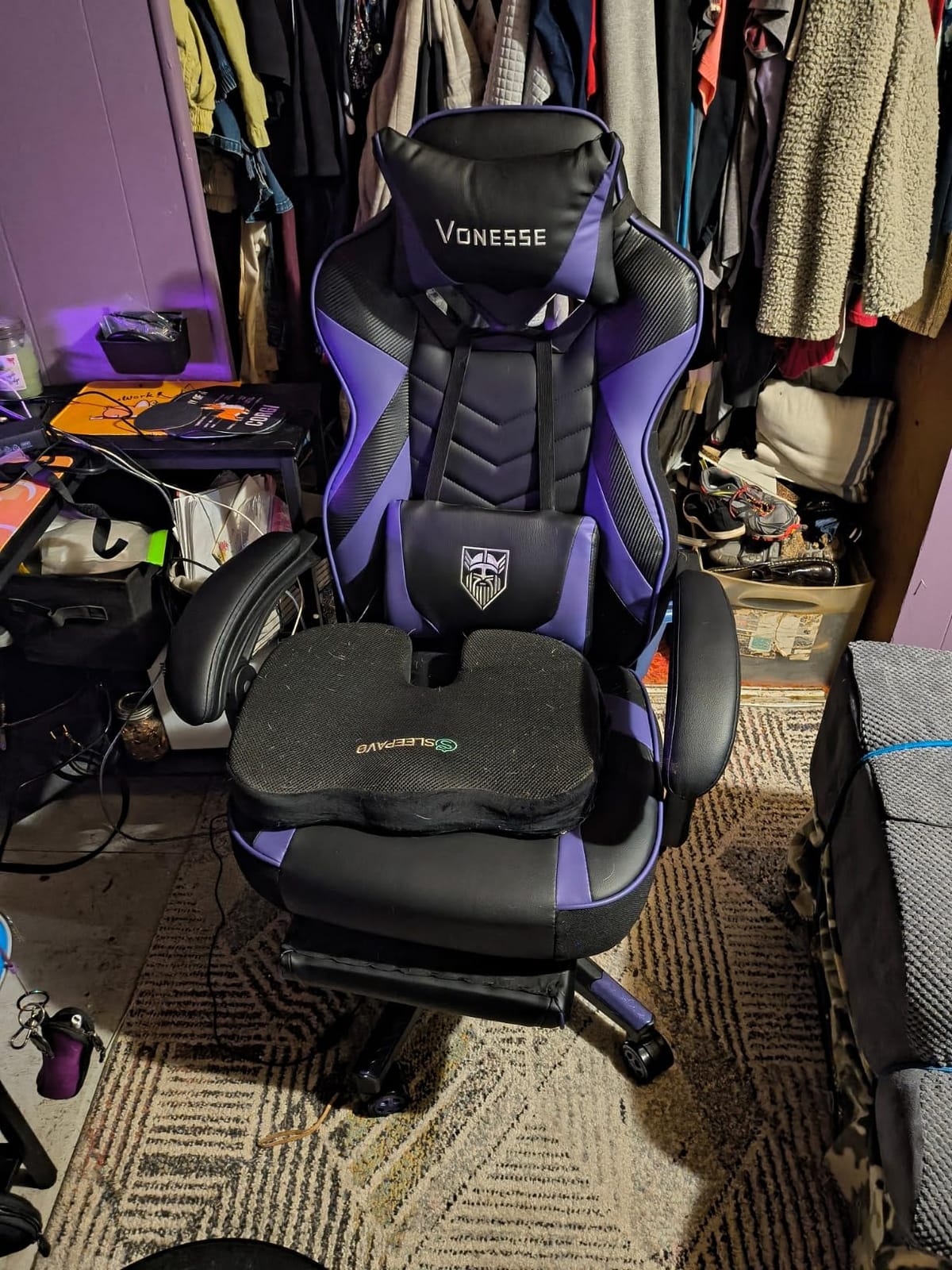
Material quality is a genuine differentiator at this price. The PU and carbon fibre leather is rated to a 25,000 Martindale rub test, which is a real abrasion figure rather than a marketing adjective, and owners report quiet operation with no squeaking when adjusting. A power gas lift with 360 degree swivel casters handles the height changes, and the company offers a 30-day replacement policy with a one-year repair service.
The 350 pound rating keeps it out of the very heavy category, and there are two recurring complaints. Armrests loosen and need tightening, which is the same issue that affects most of this roundup. More seriously, one owner reported the gas cylinder losing pressure over time, so if you rely on precise height, check the lift early rather than assuming it is user error.
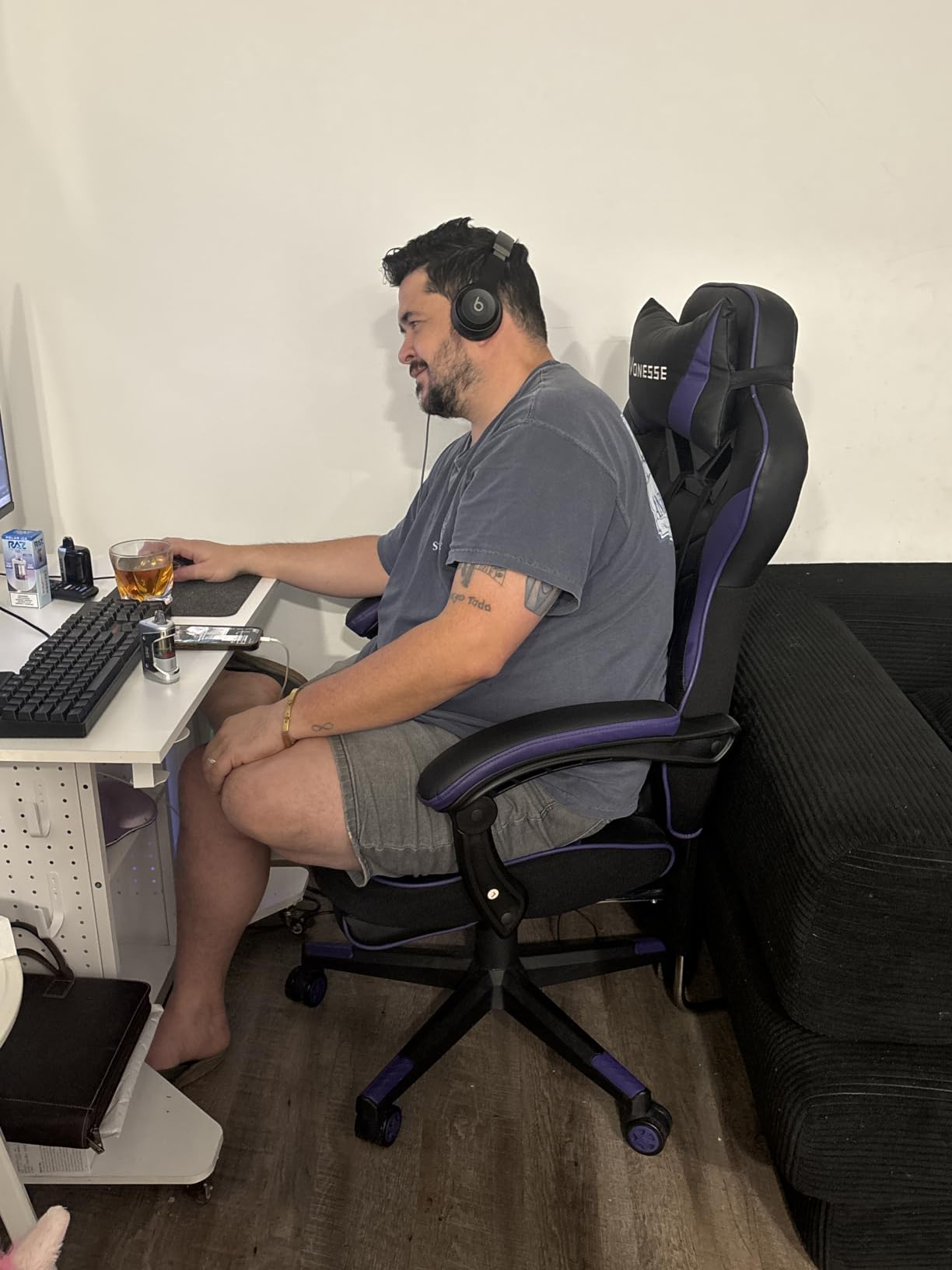
What a detachable massage lumbar does for a long day
Two things. Mechanically, a detachable lumbar means you can reposition or remove it, which no integrated panel allows, and on a tall torso that flexibility matters because the correct lumbar height depends on your proportions rather than the chair’s. The massage function itself is a secondary benefit, and reviews describe it as effective for reducing the dull ache that builds over a full day of sitting.
It is not a replacement for a correctly set chair. If the detachable pad is doing the work your torso length makes necessary, no amount of vibration fixes the underlying mismatch. Set the pad first, then use the massage as a bonus.
Where the wingless seat and 350 pound rating limit you
The wingless design is excellent for posture changes but gives up lateral support, so leaning hard into one arm of the chair feels less contained than it would in a winged frame. And at 350 pounds, a user above about 280 pounds is running the chair near its limit, particularly in the deep recline positions this chair is built for.
If you are that combination, the Fantasylab at 440 pounds or the LEMBERI at 400 pounds with a steel frame are safer buys with more headroom. Also check the gas lift early, and keep the one-year repair service details somewhere you can find them.
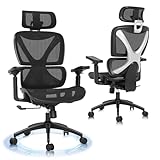
10. GABRYLLY Big and Tall Mesh Chair – Best for Cooling and Armrest Range
GABRYLLY Ergonomic Office Chair, Big and Tall Mesh Chair with Lumbar Support, 3D armrest – 215° Rotation, Adjustable Headrest & Soft Seat, Durable Computer Chair 350LBS for Work Gaming
Backrest width 29.5 in
Max load 350 lbs
215 degree 3D armrests
2 year warranty
Pros
- Breathable full mesh that stays cool on very long workdays
- Spacious seat for a 6'0 to 6'3 frame
- 215 degree rotating armrests that genuinely change posture support
- Responsive support that replaced wheels armrest pads and a gas cylinder
- Sturdy BIFMA build with no degradation over months
Cons
- Headrest is not adjustable and sits slightly too far back
- Armrests cannot be brought fully in
- Stock wheels perform poorly on carpet
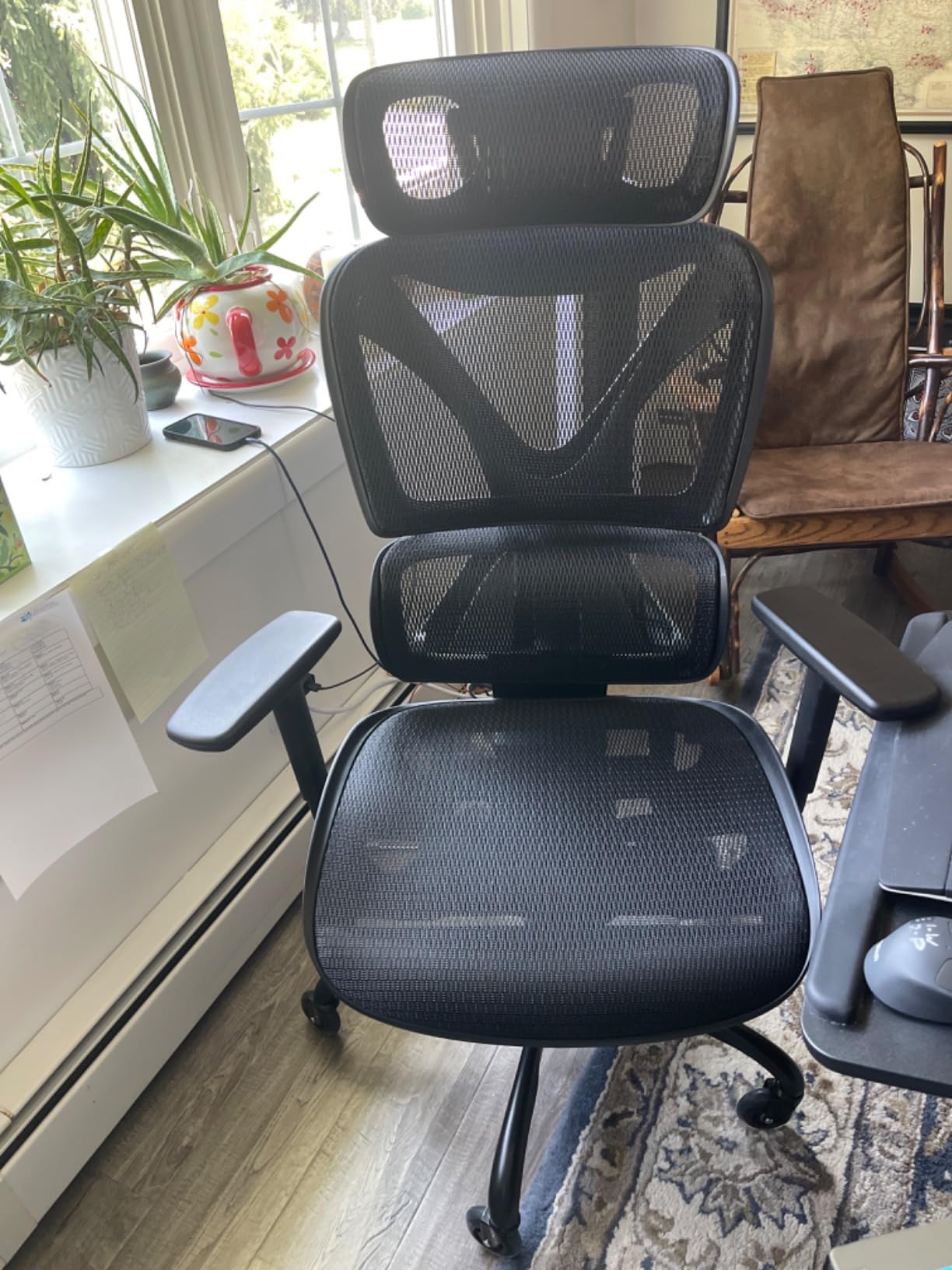
If heat is what stops you using a chair, this is the one to look at first. The back and seat are double-layer breathable mesh rather than PU leather, and the difference is dramatic over a four-hour session: air moves through the whole seat rather than trapping heat against your back. For a bigger person, that is not a comfort nicety, because more body surface means more heat to dissipate.
The armrests are the feature nobody else in this roundup matches. They rotate through 215 degrees and adjust up and down, forward and back, and inward, which means you can bring your arms in close to the desk for typing and swing them out for a controller. For long-armed users this is the single best-equipped armrest system we found, and owners who switched to it from a fixed-armrest chair report the difference immediately.
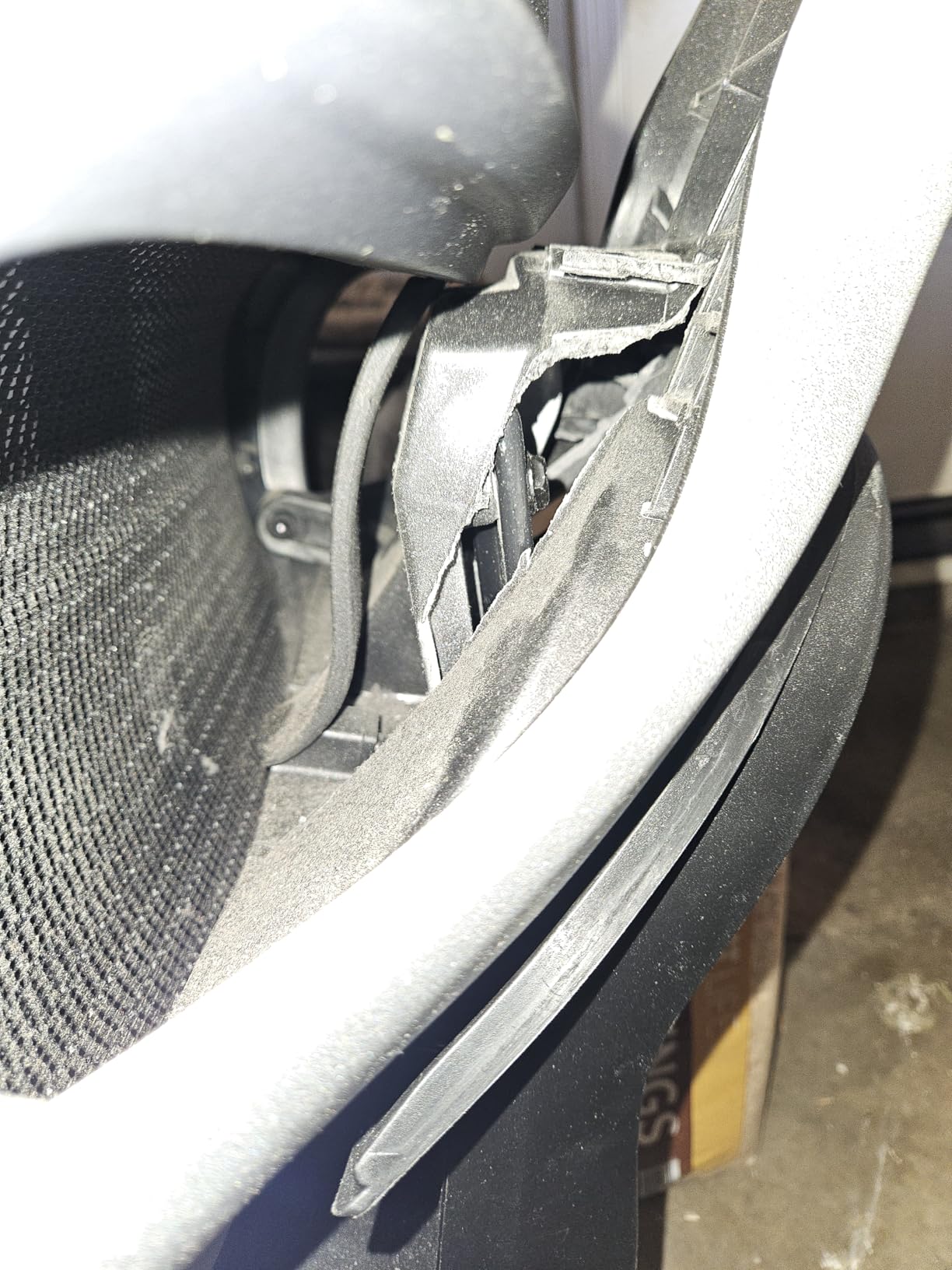
It also has the longest warranty here at two years, a BIFMA-certified alloy steel base, a double backrest lumbar support design, and a 3-position headrest. Tilt locks in three positions between 90 and 120 degrees, and assembly is about 25 minutes. Reviewers specifically call out the after-sales support, which replaced wheels, armrest pads and even a gas cylinder rather than pushing a return.
Now the honest part. The manufacturer rates it for 5 foot 5 to 6 foot 3, so this is a tall-adjacent chair rather than one built for six-foot-six. The 17.9 inch seat depth is the shallowest in the roundup. And the headrest, despite being listed as 3D adjustable, is the most cited complaint: it sits slightly too far back and cannot be pulled forward, which leaves a very tall user with a gap behind the neck.
When mesh beats leather for you
Mesh wins on temperature, on cleaning, and on how the chair feels after four hours in a warm room. It also tends not to sweat, which matters if you have ever peeled yourself off a leather gaming seat. The cost is a different feel: mesh has less give, so it does not mould to you the way a foam cushion does, and the frame is more visible through the material.
If your room stays cool or you game with the window open, PU leather is fine and some people prefer the softer feel. If you run hot, this is the only chair in the roundup designed around airflow rather than adapted for it, and that is a real difference over a summer.
Where the sizing ceiling stops you
Six foot three with about 250 pounds is the honest fit, and the 17.9 inch seat depth is the reason. A six-foot-four user will find their thighs contacting the front edge, which is the exact failure mode that sends people back to the big-and-tall category in the first place. A six-foot-seven user should not consider this at any weight.
Two smaller notes: the stock casters perform poorly on carpet and are worth replacing, and some bolt locations are awkward to reach during assembly, so budget thirty minutes rather than fifteen. The seat and back connection is also difficult to complete alone.
11. Fantasylab 440lb Metal Base Chair – Best for Heavier Users
Big and Tall Gaming Chair 440LBS with Metal Base Memory Foam Lumbar 4D Adjustable Armrest Gaming Chair for Heavy People Ergonomic High-Back Computer Chair (Classic, Dark Grey)
Seat depth 18.9 in
Max load 440 lbs
Recline 135 deg with rocking
All-metal build
Pros
- Highest weight capacity in the group at 440 pounds
- Oversized seat and extra-high back for broad shoulders
- All-metal construction feels extremely solid
- Memory foam lumbar makes a real difference over long sessions
- 4D armrests plus recline and rocking find a position easily
Cons
- Armrests not wide or far enough forward for some larger users
- No built-in back support beyond the lumbar pad
- Stock plastic casters are rough on some surfaces
- Lower backrest protrudes and can curve into the back
This is the highest weight capacity in the roundup at 440 pounds, and it is the one to shortlist if your weight is the binding constraint rather than your height. The construction is all metal through the frame and base, at 65 pounds the heaviest chair here, and that mass is a feature: owners describe it as feeling extremely solid, and it is the chair most likely to survive being moved repeatedly between rooms and desks.
Geometry is the compromise. The seat is oversized and the backrest is extra high, which suits broad shoulders and wide hips, and the 4D armrests adjust up and down, forward and back, side to side, and pivot. But the seat depth of 18.9 inches is mid-pack, so a very long-legged user will find it shallower than ideal even at six foot four.
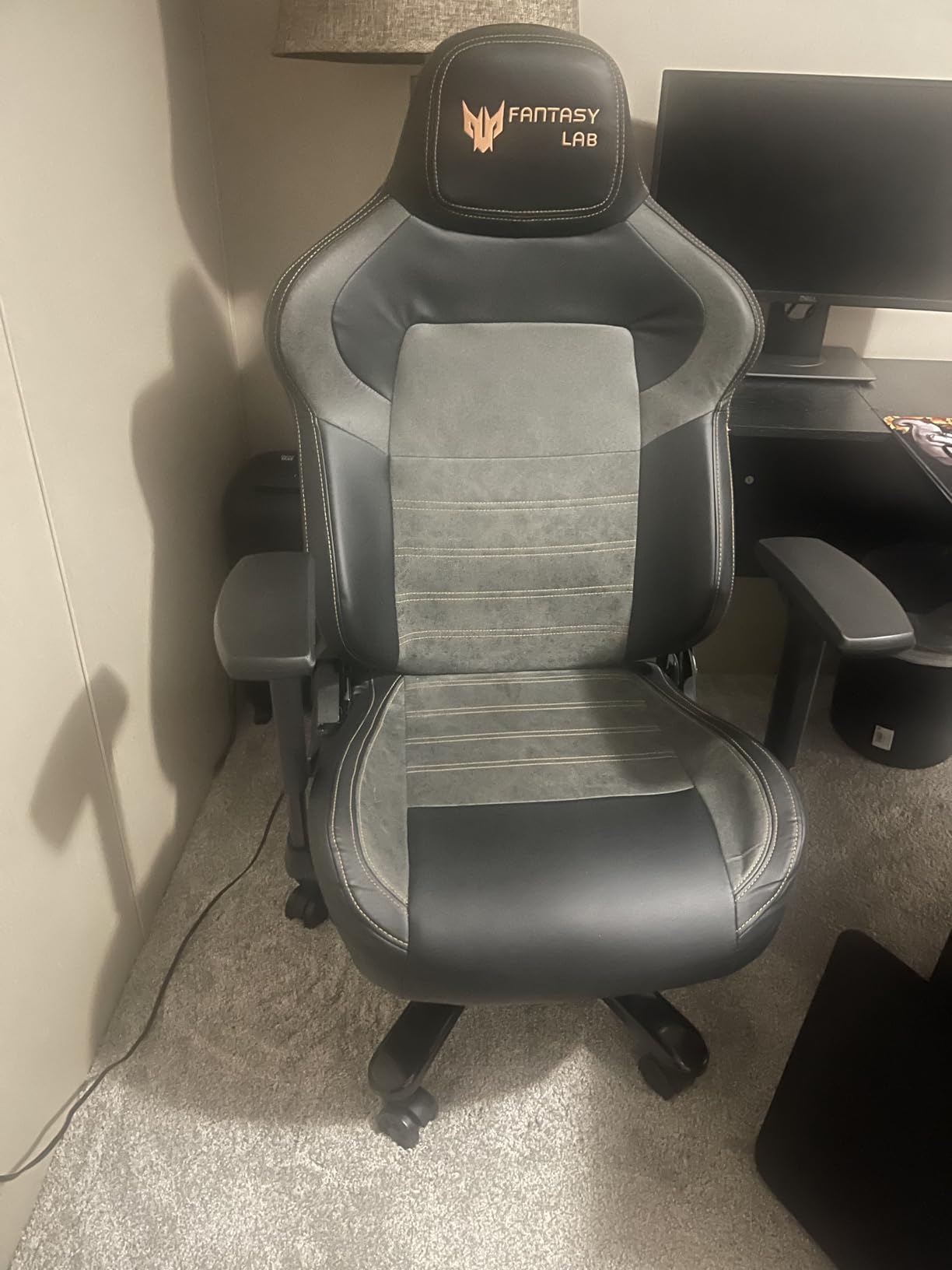
Recline goes to 135 degrees with a rocking function, and 360 degree swivel comes with height adjustment. The seat and lumbar cushion use high-density memory foam, and this is the one chair where reviewers consistently describe the lumbar doing real work over eight to twelve hour days, which is unusual praise for a loose pillow. Customer support shipped a replacement armrest quickly for at least one owner.
The complaints cluster around armrest reach. Several users report that the pads are not wide enough or far enough forward, which is the mirror image of the mesh chair’s rotating arms, and it is the main reason to check this one in person if you have long arms. There is also no built-in back support beyond the lumbar pad, the lower backrest juts out and can curve awkwardly into the back, and the stock plastic casters are rough on some floors.
Is 440 pounds enough headroom for a 400 pound user
It is about the right margin, and the margin is the point. A 400 pound rating on a chair you weigh 380 pounds leaves 20 pounds of headroom, and a chair rated 440 gives you 60. That difference matters most in the two places a heavy user loads the frame hardest: reclining to the back stop, and rolling across a castor under full load. If your weight fluctuates, the wider margin is worth more than any cushion upgrade.
The all-metal frame is the second reason. Most failures in this category are at the tilt mechanism or the backrest bracket, and both are load paths where metal outlasts the stamped steel used in cheaper frames. This is the chair to buy if you expect to keep it for several years rather than a couple.
Where armrest reach and backrest shape frustrate big users
Even 4D armrests can be the wrong length. If your elbows sit forward of your torso when you type, a pad set too far back is worse than a fixed pad, because you will keep sliding forward and losing lumbar contact. Before ordering, sit at your desk and measure the distance from your elbow to the desk edge, then check the armrest height and depth against it.
The protruding lower backrest is the second issue and it is geometry, not adjustment. On a wider frame the lower edge curves into the small of your back at full recline. Sit at 135 degrees regularly and this will bother you; sit upright and it will not. One owner also documented an early failure of the tilt mechanism and gas cylinder, so treat the first month as a test period and check every fastener.
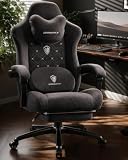
12. Dowinx Heated Massage Fabric Chair – Best Breathable Heated Option
Dowinx Gaming Chair with Heated Massage Lumbar Support,Big and Tall Fabric Gaming Chairs for Adults with Footrest, Ergonomic Computer Game Chair with Poket Spring Cushions, 350lbs, Black
Seat depth 19.3 in
Max load 350 lbs
155 degree tilt
Open base design
Pros
- Heated massage lumbar cushion gives genuine lower back relief
- Open base with no side panels gives extra leg room
- Fabric upholstery stays cooler than leather
- Backrest tilts to 155 degrees with an extendable footrest
- Reversible padding switches between massage and plush surfaces
Cons
- Lower 350 pound rating than most big and tall rivals
- Shallower and narrower footprint than extra-wide models
- Massage unit underwhelms some buyers
The open base is the idea worth understanding. Instead of the usual side panels on a big-and-tall frame, this chair uses a streamlined open base with nothing beside your legs, which gives a tall user room to stretch out without the seat edge pressing into your shins. Owners who like to cross their legs or shift position repeatedly single this out as the reason they bought it.
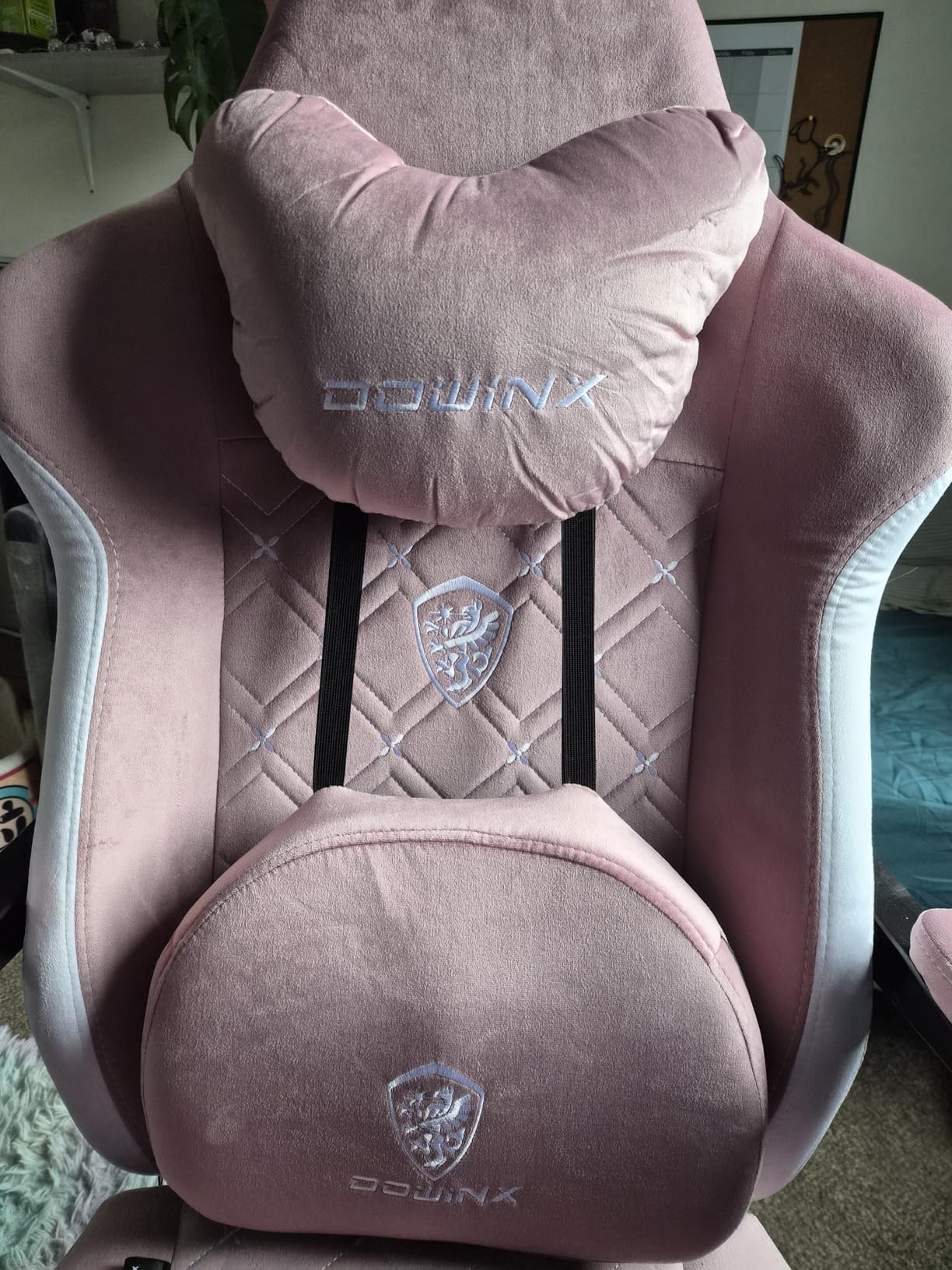
Upstream, the chair delivers on comfort in a different way from the leather options here. A heated massage lumbar cushion with reversible padding means you can switch between a plush surface and the massage surface depending on the hour, and fabric upholstery keeps the seat ventilating rather than sealing heat against you. The backrest tilts to 155 degrees with an extendable footrest, and armrests move in sync with the back with height adjustment and 360 degree swivel.
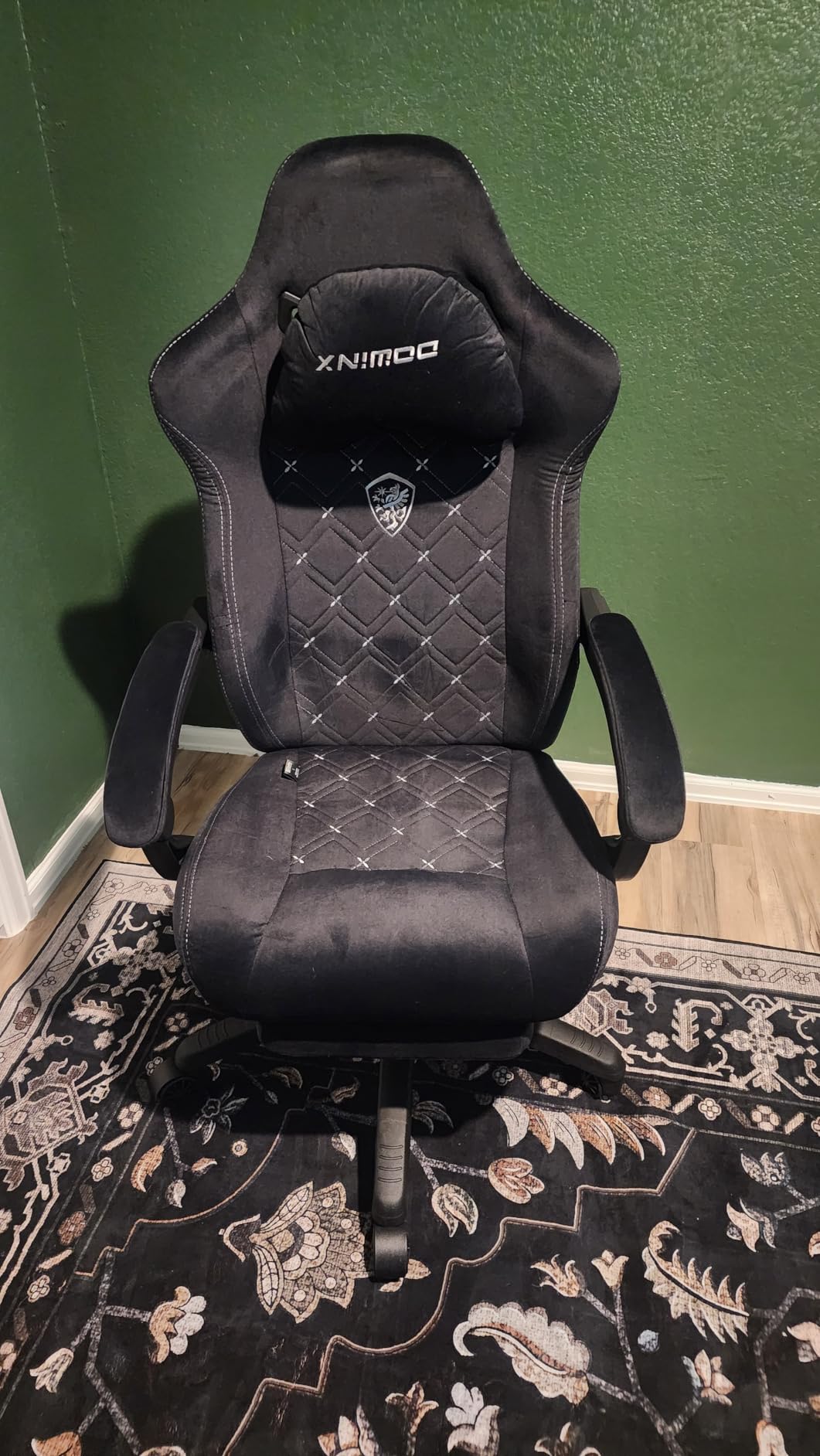
Be clear-eyed about the class it belongs to. At 350 pounds it has the second-lowest rating in the roundup, and with a seat depth of 19.3 inches it is narrower and shallower than the extra-wide frames. The review count is also the second smallest here, so the long-term reliability picture is less well documented than the category leaders.
Within that, the build is sensible: a reinforced metal foundation, a 155 degree tilt with extendable footrest, and a one-year limited warranty on an FSC-certified wood frame. The review pattern is that owners buy it for the heated lumbar and breathable textile, use it mostly for long work sessions, and find the massage unit genuinely useful, with a minority calling it underwhelming.
When a heated lumbar is worth choosing over a mesh back
They solve different problems. Mesh wins on passive airflow and is the better answer if you are simply hot. A heated lumbar wins if the problem is circulation and stiffness in the lower back, because sustained warmth and vibration address a different mechanism than ventilation. If your back is the complaint and heat is the relief, this chair is a better answer than the mesh option.
The caveat is wiring and power. The cushion needs a mains connection, and the reversible padding takes a few seconds to swap, so decide which side you want before you sit down for a long session rather than mid-match.
Where the 350 pound rating and small footprint rule it out
Two groups should pass. Anyone above roughly 280 pounds is running a 350 pound frame near its limit, and the roundup contains several 400 pound options with more headroom. Anyone whose height is six foot five or more will find the 19.3 inch pan and narrow footprint tighter than the extra-wide frames, and the open base helps with leg room but does not add seat depth.
For a tall, mid-weight user who works long hours and wants warmth rather than airflow, it remains the most distinctive chair here. For a large-framed user, it is simply the wrong size, and the best move is to go deeper on pan depth rather than deeper on features.
Which Chair Fits Your Height and Weight
Use the bands below before you read the reviews again. Height alone does not decide the fit, because a six-foot-four person with a 34 inch inseam needs seat depth in a way a six-foot-four person with a 30 inch inseam does not.
For 6 foot 0 to 6 foot 3
You are in the easiest band, and the constraint is usually build rather than height. The GTPLAYER 300 pound spring seat (7) is the most consistently well reviewed for this range, and the 350 pound textile chair (3) is the pick if you run hot and want a footrest on a budget. If your shoulders are broad, the wide GTPLAYER 400 pound (1) is the safer option.
For 6 foot 4 to 6 foot 6
This is the range where seat depth starts to matter and the 300 pound rating starts to rule chairs out. The Vonesse at 21 inches (9), the LEMBERI at 21.26 inches (2), and the GTPLAYER 400 at 22 inches (1) are the three with enough pan. The Dowinx 400 (5) works here too if your back needs the extra height more than your legs need the depth.
For 6 foot 7 and above
Few chairs in this category are truly built for you, and the honest answer is that backrest height becomes the limiting factor. The Dowinx at 32.5 inches (5) has the tallest back. The Fantasylab (11) is the tallest relative to its weight rating and suits tall-and-broad frames. Anyone past six foot eight should plan to raise the desk as well as the chair, because no backrest here will close that gap.
By weight band
Under 180 pounds, height decides and any chair above works. Between 180 and 280 pounds, every chair in the roundup is rated for you. Between 280 and 350 pounds, skip the 300 pound and 350 pound frames and go to 400 pounds or above. Above 350 pounds, the Fantasylab at 440 pounds (11), the LEMBERI (2), the Dowinx 400 (5) and the two 400 pound COMHOMA and GTPLAYER frames are your shortlist, and the VITESSE (8) has the most stable base of the group for heavier users.
Whichever band you land in, add a margin rather than buying to the exact number. A chair rated at your exact weight is already working at its limit on day one, and the components that fail first are the tilt mechanism and the backrest bracket.
What to Look for in a Big and Tall Gaming Chair
Measure yourself before you order
Four measurements decide your fit, and all four take two minutes. Sit in your current chair and measure the inseam from the crotch to the floor, which tells you how much pan depth you need. Measure your torso from the top of the seat cushion to the top of your shoulder when seated, which tells you how much backrest height you need above the lumbar. Measure shoulder width across the outside of your shoulders, which tells you how wide the seat must be for your hips. Measure your forearm length from elbow to wrist, which tells you how far forward the armrests need to sit.
Write the numbers down and take them to the product page. Comparing a published 21.26 inch seat against a 36 inch inseam tells you in one line whether your knees will clear the edge, and it costs nothing.
Prioritise seat depth, then backrest height
Seat depth is the most missed spec and the one that decides whether a tall person sits or perches. Too short and the fronts of your thighs press the edge, which feels like a hard chair no matter how good the padding is. Too long and you slide forward off the lumbar support. The useful range for most tall users is somewhere between 19 and 22 inches, and anything under 18.5 will not suit a long inseam.
Backrest height matters next, and the measurement that counts is the interior height rather than the overall height, because the overall figure includes the base and the recline travel. A 30 inch interior height covers a six-foot-five user. Below 29, your head will hang above the back at full recline. Above 32, you have a genuine extra-tall chair and you should expect a larger frame footprint.
Give your weight a 20 to 25 percent margin
Maximum load is the easiest number to over-trust. A chair rated 400 pounds is rated for a static 400 pound load with a factory-fresh mechanism, not for 400 pounds of user plus the repeated shock of dropping into the seat, reclining to the stop, and rolling. A margin of 20 to 25 percent above your body weight is a reasonable starting point, and it is why the Fantasylab at 440 pounds is the pick for heavier users rather than a 400 pound frame used to the last pound.
Frame material matters here too. All-metal frames carry a load path that resists the fatigue failure that breaks cheaper stamped brackets, and a longer warranty is usually a signal that the manufacturer expects the frame to last.
Check armrest reach and desk height together
Armrest problems were the most common complaint across every chair in this roundup that lacked adjustability, and the fix is not a cushion. You want armrests that adjust in height at minimum, and ideally forward and back, so your elbows land at desk height and just under it. Measure your desk height, then set the armrest top two to three inches lower so you can pull the chair in and still reach the keyboard.
If your desk is above 30 inches, check whether the armrests can drop below it. If they cannot, a keyboard tray is a cheaper solution than a chair that fights your desk for the rest of its life.
Treat lumbar and headrest support as adjustable, not decorative
A loose lumbar pillow slides down a long back and stops working. Integrated or pocket-spring support moves with you, which is why the GTPLAYER 400 (1) uses a sprung back section and the Vonesse (9) makes its lumbar detachable and repositionable. Either is better than a fixed cushion taped into place. For the head, height adjustment matters more than pillow softness on a tall torso, because the gap between the shoulder line and the top of the back is where the neck takes the load.
Expect a break-in period on firm foam
Almost every review of a new foam seat in this roundup mentions firmness in the first weeks. High-resilience and cold-cured foam used in heavy frames is designed not to bottom out under load, and that means it starts firmer than memory foam. Plan on two to three weeks of regular daily use before judging the cushion, and keep the chair in the position you will use most so the foam shapes to you rather than to the packaging.
Mesh vs PU Leather for Taller Users Who Run Hot
Mesh is a genuine specification difference, not a preference. Air moves through a woven back and a mesh seat pan, so heat leaves your body instead of pooling against it. PU leather is a sealed surface: comfortable, easy to wipe, and it traps heat. For a larger person, the extra body surface makes that difference larger, not smaller.
In this roundup, only the GABRYLLY (10) is built as a mesh chair from the base up. The Dowinx fabric chair (12) and the GTPLAYER textile chair (3) use woven upholstery on a cushioned foam seat, which breathes better than leather while still giving you padding. Everything else is PU leather or faux leather.
The cost of mesh is feel and give. Mesh has less moulding quality, so it does not shape to your body the way a foam cushion does over months, and the frame is more visible through the material. If you are cool most of the time or your room is air conditioned, leather is perfectly reasonable. If you are the person who peels off a gaming chair after an hour, mesh is the answer.
Gaming Chair vs Ergonomic Office Chair for Tall People
For a tall person who games at a desk and also works at that desk, an ergonomic office chair with a genuinely adjustable seat depth, seat height and lumbar is usually the better long-term purchase. Those are the three adjustments a tall skeleton needs most, and no chair in this roundup offers true seat depth adjustment. The trade is appearance and, often, recline, which you may not care about.
A gaming chair earns its place when you want one seat that does both, when you like a footrest, or when you game away from a desk with a controller. In this roundup the chairs with footrests and deep recline are the ones that suit that use, and the mesh option is the one that also holds up as an all-day desk seat because it ventilates and its armrests actually articulate.
One practical warning for the office-chair route. Check the seat depth range, not the seat height range. Most ergonomic chairs let a six-foot-five user raise the seat high enough, but plenty of them only offer a 19 to 20 inch pan, which puts you back in the same problem this article is about.
Adjusting a New Big and Tall Chair on Day One
Set the chair up in the position you will spend most of your time in, not the flattest position it can reach. Tall users tend to over-recline on day one because the motion feels good, and then discover the seat pan does not support them at that angle. Start upright, work down over a few days.
Set the seat height so your feet are flat and your knees sit at about 90 degrees. On these chairs that often means the lever near its top, and if the highest setting still leaves your feet short, that is a desk height problem rather than a chair problem, and the answer is a taller desk or a footrest.
Next, set the lumbar before you adjust anything else. Slide it to the curve of your lower back, not the widest part of the seat, and if it cannot reach that point, use a rolled towel behind the lumbar as a stopgap until the foam conforms. Then set the headrest so it meets the back of your head when you recline to your normal angle, and only then bring the armrests to elbow height with your shoulders relaxed.
Finally, do the fastener check after a week. Armrest bolts and recline locks loosen in the first few sessions as everything settles. A two-minute check with a hex key now prevents the loosening that turns into a wobble by month six, and it is the cheapest maintenance a chair of this size gets.
Frequently Asked Questions
What gaming chair is best for tall people?
The GTPLAYER 400lb is our pick for most tall users. It has the deepest seat pan in this roundup at 22 inches, a 30.31 inch interior back height that supports the head and shoulders, and a 400 pound rating. For users around 6 foot 4 to 6 foot 6, seat depth and backrest height matter more than any single feature.
What is the best gaming chair for a 6-foot person?
A six-foot user is well served by most chairs in the 300 to 350 pound class. The GTPLAYER 300 pound spring seat rates highest for fit and is spacious, and the 350 pound textile version suits you if you run hot and want a footrest. Above six foot one, check that the seat depth is at least 19 inches so your thighs are not against the front edge.
What is the best gaming chair for big and tall?
For a big and tall user, weight rating is the first filter, then seat depth. Look for at least 400 pounds and a pan of 20 inches or more. The Fantasylab is rated to 440 pounds for the heaviest bodies, the LEMBERI has a steel frame and a 21.26 inch seat, and the Vonesse combines a 21 inch seat with a detachable massage lumbar.
Do tall people need a big and tall gaming chair?
Usually yes, and the reason is measurements rather than style. If your head sits above the top of the backrest, or your feet do not reach the floor at the chair’s highest seat setting, a standard frame is forcing you into a slouch. A backrest of 30 inches or more and a seat depth of 20 inches or more covers most people above 6 foot 2.
Is a gaming chair better than an office chair for tall people?
For gaming away from a desk, or if you want a footrest and deep recline, a gaming chair is the better fit. For a tall person who works at the same desk, an ergonomic office chair usually wins because true seat depth adjustment is rare in gaming chairs. Whichever you pick, verify the seat depth range, since many office chairs still stop short of 20 inches.
Our Verdict on the Best Gaming Chairs for Tall People
After six weeks of comparing all 12 of these, the GTPLAYER 400lb is the best gaming chair for tall people overall. Nothing else in the roundup pairs a 22 inch seat depth with a 30 inch back height and a 400 pound rating, and it carries the largest body of tall-user feedback of any chair we looked at, which is why the shortfalls we found are known and manageable rather than surprising.
Buy the LEMBERI if you want the same idea with a steel frame and a massage lumbar for less. Buy the GABRYLLY mesh chair if heat is your problem and you are around six foot three. Buy the Fantasylab if you weigh close to 400 pounds and the rating matters more than the seat depth. Whatever you choose, measure your inseam and torso before you order, and give your body weight a 20 percent margin. It is 2026, but the geometry of a tall frame has not changed.