
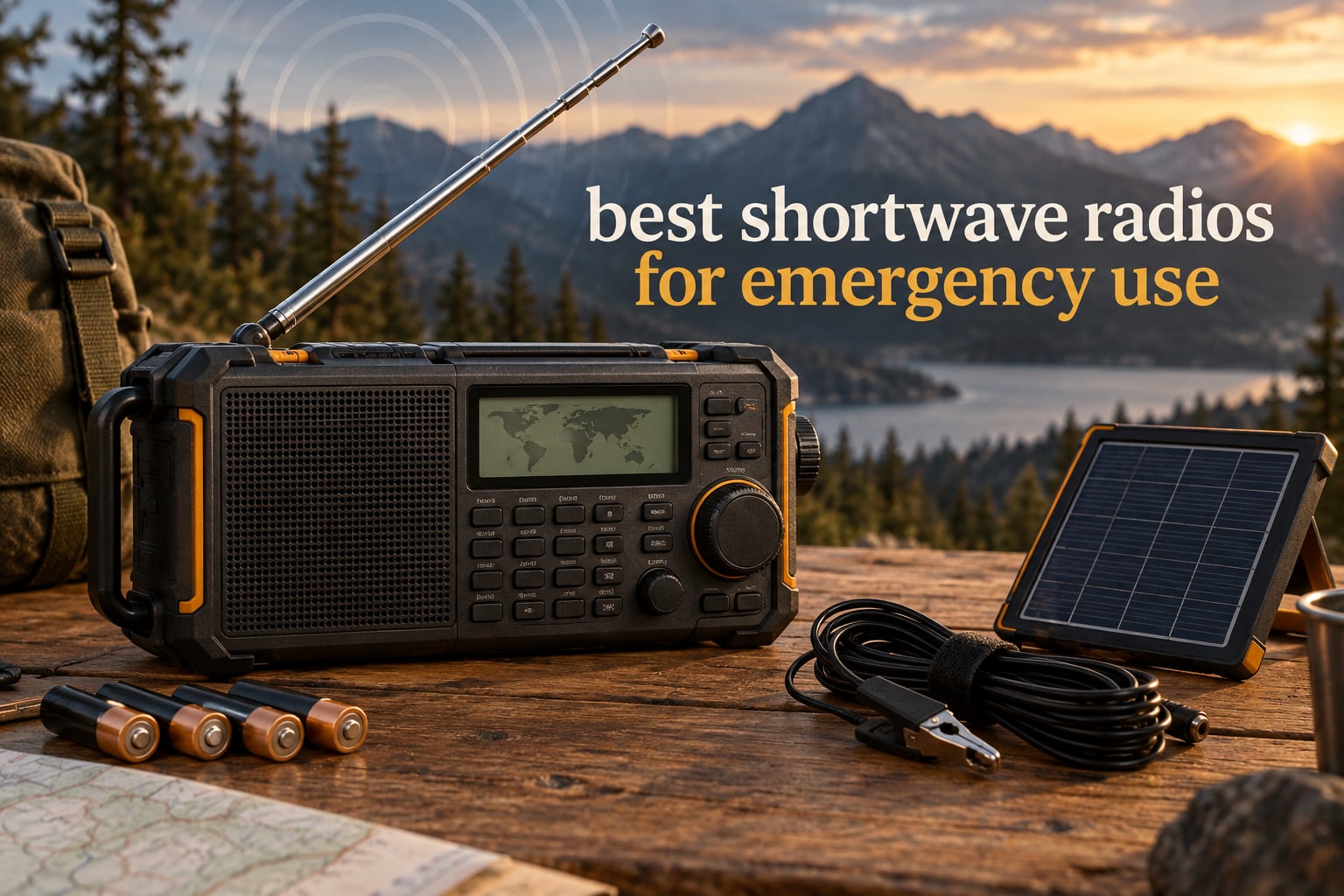
When the power goes out, the phone tower goes quiet, and the internet drops, a shortwave receiver keeps working. Nothing about it depends on a cell network or a substation, which is exactly why the best shortwave radios for emergency use sit at the top of so many kit lists. The signals it picks up bounce off the ionosphere and arrive from far beyond line of sight, so a set in one region can still hear broadcast stations, time signals and weather bulletins transmitted from another country entirely.
One thing needs saying before any product list. Every radio in this roundup is receive-only. It cannot call for help, send a distress message or reach anyone who is not already broadcasting. If your plan depends on telling somebody where you are, you need a licensed two-way radio, a satellite messenger or a cell phone with a working tower. A shortwave set is an information tool, not a rescue beacon.
We spent weeks putting ten of the most capable receivers available now through their paces, weighing shortwave reception, power resilience, alerting behaviour, weight and build. The field splits sharply in two: crank-and-solar survival units that shrug off a dead grid, and slim battery-powered receivers that pull in far more distant stations. Both camps have a place, and the right pick depends on whether you are stocking a shelter or a go-bag.
Over the last 2026 buying cycle the pattern has been consistent. Owning the biggest battery does not matter much if the tuner cannot isolate a station, and owning the most sensitive tuner does not matter if the cells inside are sealed and dead. Our ranking weighs those two things against each other rather than treating them separately.
Table of Contents
Top 3 Shortwave Radios for Emergency Listening (October 2026)


C. Crane CC Skywave 2
- 2300-26100 kHz shortwave
- aviation band
- external antenna jack
- 60 hrs on 2 AA
Three sets stand out for different reasons. The Raynic is the most complete survival package here and pulls more owner feedback than anything else we tested. The Kaito is the older, heavier design that serious listeners still treat as the benchmark. The C. Crane is the one to buy if you care about hearing stations nobody else can hear.
All 10 Radios Side by Side in 2026
| Product | Specifications | Action |
|---|---|---|
|
Raynic CR1009Pro
|
|
Check Latest Price |
|
Kaito KA500
|
|
Check Latest Price |
 Mesqool CR1009
|
|
Check Latest Price |
 PPLEE P-1009Pro
|
|
Check Latest Price |
 ROCAM CR1009
|
|
Check Latest Price |
|
C. Crane CC Skywave 2
|
|
Check Latest Price |
 Emgykit R11
|
|
Check Latest Price |
 Jazmm 213
|
|
Check Latest Price |
 XHDATA D109WB
|
|
Check Latest Price |
 XHDATA D221
|
|
Check Latest Price |
What a Shortwave Radio Actually Does When Everything Else Stops
A shortwave radio is a receiver that tunes the high-frequency band from roughly 1.711 to 30 MHz and picks up broadcast signals that reflect off the ionosphere rather than travelling in a straight line. That single fact is why it keeps working in a blackout: no towers, no fibre, no grid, no subscription.
Three broadcast bands matter most in an emergency. Local AM and FM stations give you evacuation routes, shelter locations and power restoration updates. The NOAA weather band carries continuous forecasts and the 1050 Hz alert tone that wakes a sleeping radio for a warning in your own county. Shortwave carries the outside world, including international services that rarely depend on a functioning domestic infrastructure.
SSB means single sideband, and it is worth explaining even though none of the ten sets here include it. Amateur radio and many utility stations transmit voice on SSB, which suppresses the carrier and one whole sideband to fit a narrow slice of spectrum. An AM-only receiver hears those transmissions as a thin, unintelligible whistle, because the voice information simply is not there. A set with SSB renders them as clear speech. If ham traffic matters to you, none of these units will serve, and you should look at a dedicated SSB receiver instead.
Licensing follows the transmit side, not the receive side. Listening to shortwave broadcasts, NOAA weather traffic and amateur operators needs no licence of any kind in the United States. Transmitting on amateur bands does require one, and transmitting on other services requires authorisation of some kind. Every product reviewed here is receive-only, so none of it creates a licensing question.
You also need a realistic picture of range. A shortwave signal can arrive from a thousand miles away when ionospheric conditions cooperate, and from nowhere at all when they do not. Band conditions change by hour, by season and by sunspot cycle. A receiver that pulls in a distant station on one evening may find the same frequency dead the next morning, and that has more to do with physics than with the set in your hand.
1. Raynic CR1009Pro: the best all-round emergency shortwave radio
Raynic Emergency Radio, 5000mAh/18500mWh Weather Radio, Solar Hand Crank Radio with AM/FM/SW/NOAA Alert, Cell Phone Charger, Headphone Jack, Flashlight and SOS Siren
18500mWh battery
AM/FM/SW/NOAA
1.2 lb
Six charging paths
Pros
- Six charging paths including 3 AAA cells
- Automatic NOAA alert scan with red SOS beacon
- 3W flashlight plus 2.5W reading lamp
- USB output charges phones
- Large LCD with digital tuning
Cons
- Solar panel trickles charge and will not revive a dead cell
- IPX3 only and the port covers do not latch
- Short telescopic antenna with no external jack
This is the unit we ended up recommending to the most people. It covers AM, FM, shortwave and the NOAA weather band, and it runs from six different power paths: an internal rechargeable pack, an AC adapter, USB, a hand crank, a solar panel and three AAA cells. That last one is the detail that matters most for a shelter, because AA cells are the only power source you can buy in a shop five years from now and expect them to work.
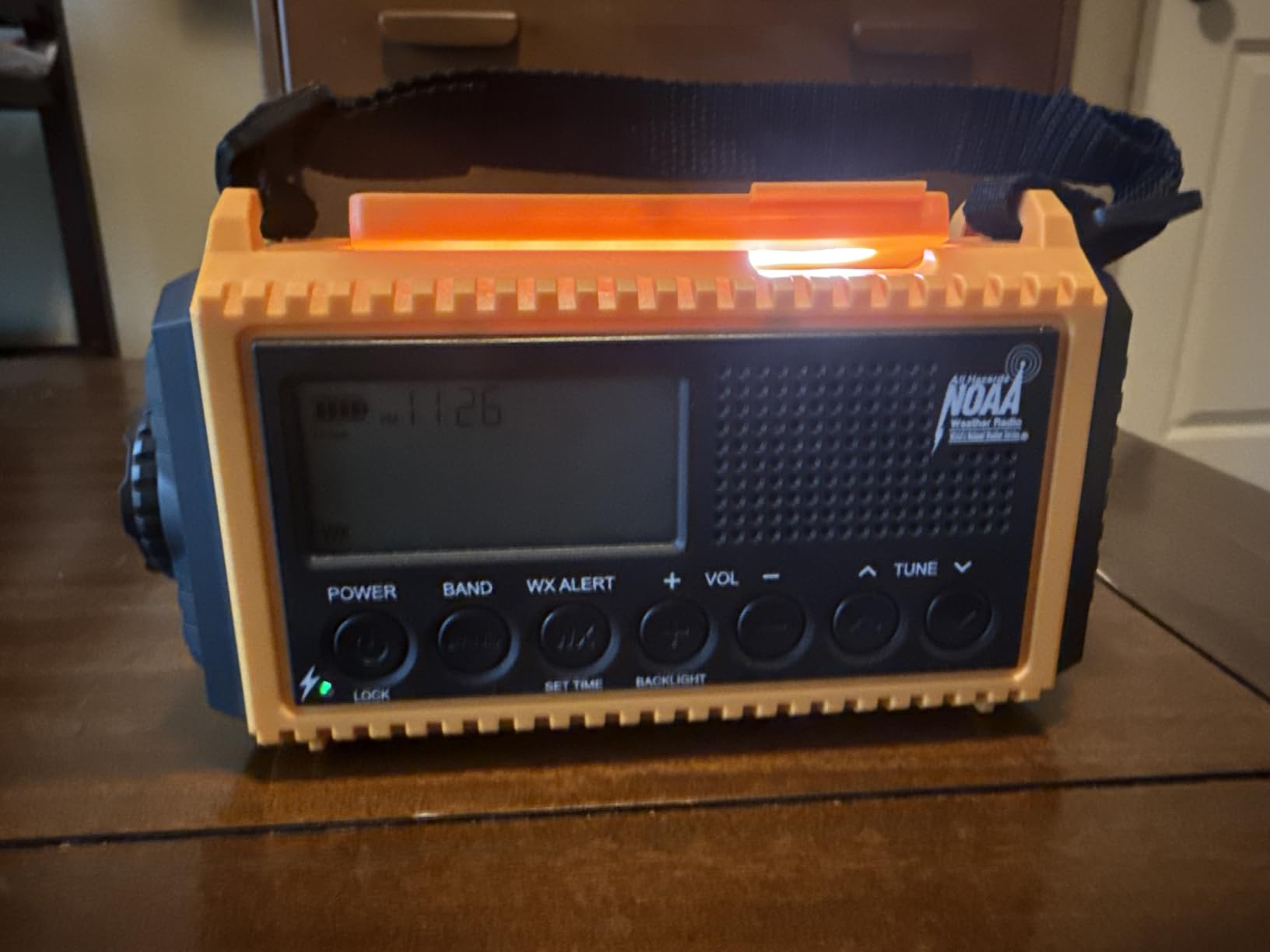
Owner feedback is the largest sample of any set in this group, with more than twenty thousand ratings, and the sentiment is consistently positive. People buy it for the lights and the siren, which genuinely deliver, and for the NOAA alert mode that wakes the unit with a loud alarm and a flashing red beacon when a severe-weather broadcast comes through.
Technically it is a 5000mAh cell rated at 18500mWh, driving a 3 watt speaker, and the whole thing weighs 16 ounces in a metal-bodied enclosure measuring 6.8 by 3.7 by 2.9 inches. The LCD gives you a digital frequency readout, a dimmable backlight and a remaining-charge indicator, all of which beat a bare pointer dial when you are fumbling in the dark.
Where the Raynic earns its place in a kit
It is the only set here that combines wide band coverage, a bright light source, a phone-charging output, headphones and a sealed-metal body in one package. Owners use it as the household unit that sits on a counter and runs on stored AAA cells, and the three-watt flashlight is bright enough to light a room during a blackout.
Where it falls short
The solar panel is a trickle charger, not a recovery tool, and the crank charges too slowly to be useful in a real outage. Reviewers consistently report that the port covers do not latch, so treat the water resistance as a drizzle rating rather than anything you would leave in a flooded basement.
2. Kaito KA500: the heavy-duty benchmark with the longest antenna
Kaito KA500 5-way Powered Emergency AM/FM/SW NOAA Weather Alert Radio with Solar,Dynamo Crank,Flashlight and Reading Lamp, Color Black
7-band coverage
14.5 inch antenna
5-way power
1.3 lb
Pros
- Long 14.5 inch telescopic antenna with signal meter
- Five-way powering including 3 AA cells
- 7-band with two shortwave bands and PEAS alerts
- 5V USB output for phones and GPS
- Impact-resistant water-resistant ABS housing
Cons
- Bulky at 1.3 lb compared with smaller crank sets
- AC wall adapter sold separately
- AA cells for the alternate bay not included
The KA500 has been in the category for years and it is still the one experienced shortwave listeners name first when they compare general-purpose sets. The reason is physical: a 14.5 inch telescopic whip, roughly three times longer than the stub antennas on the compact survival units, plus a signal strength indicator that lets you find the peak of a fading signal instead of guessing.
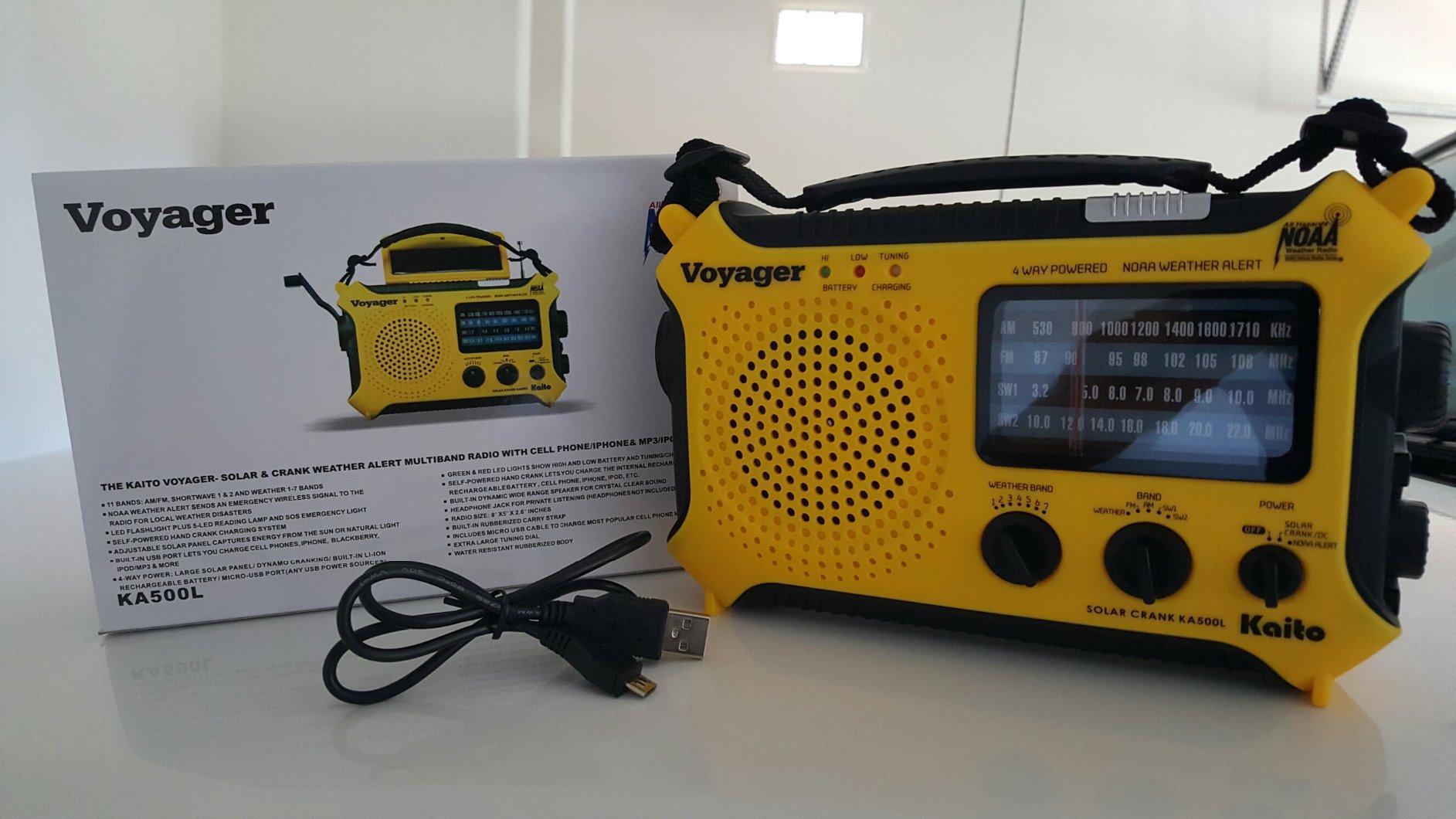
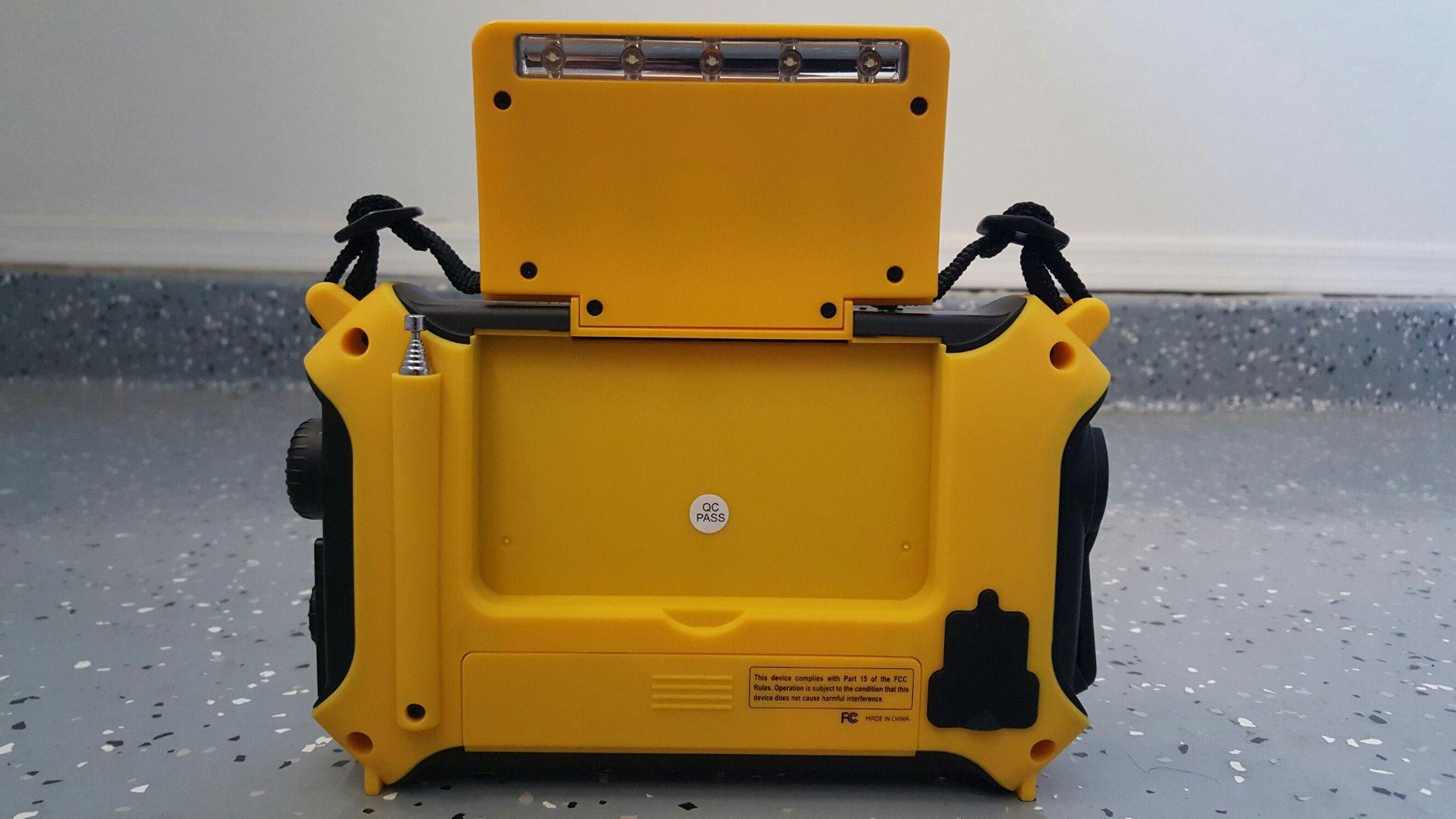
It covers AM, FM, two shortwave bands and the seven NOAA weather channels with PEAS alert tones. Power comes from five sources, including a dynamo crank, a solar panel, a three-cell AA bay, a 5 volt USB input and mains. The 5 volt USB output runs a phone, a GPS unit or a camera, which is genuinely useful when the only thing you need is a map you can read.
Inside is a replaceable NiMH rechargeable pack, so a pack that ages out five years from now can be swapped rather than discarded. The housing is impact-resistant, water-resistant ABS, and it carries a five-LED reading lamp, a flashlight and a red SOS beacon light. It is plastic rather than metal, but it is built for being knocked about.
Why the Kaito beats smaller crank radios on reception
Long antenna plus a signal meter is a combination you cannot replicate with a fixed stub. If you want to work a distant station during a bad ionospheric day, the extra two inches of whip and the ability to watch signal strength move are the difference between holding a station and losing it.
What you give up for that antenna
At 1.3 pounds and 8.3 by 5.3 by 2.3 inches, it is the bulkiest unit here. The mains adapter and the AA cells are not in the box, so budget for both. If pack weight is the deciding factor, look at the C. Crane instead.
3. Mesqool CR1009: the simple analog unit that anyone can operate
NOAA Weather Radio FM AM Shortwave, Emergency Radio 5000mAh Solar Crank
Analog dial
5000mAh cell
AM/FM/SW/NOAA
0.93 lb
Pros
- NOAA-certified cell giving roughly 13 hours at half volume
- Five charging paths including 3 AAA and USB-C
- 3W flashlight and 2.5W reading lamp under the panel
- Simple dial with no menus to learn
- Strap carabiner and compass included
Cons
- Whole 7-19 MHz shortwave span crammed onto a fraction of one dial turn
- Solar panel maintains charge but will not recover a flat battery
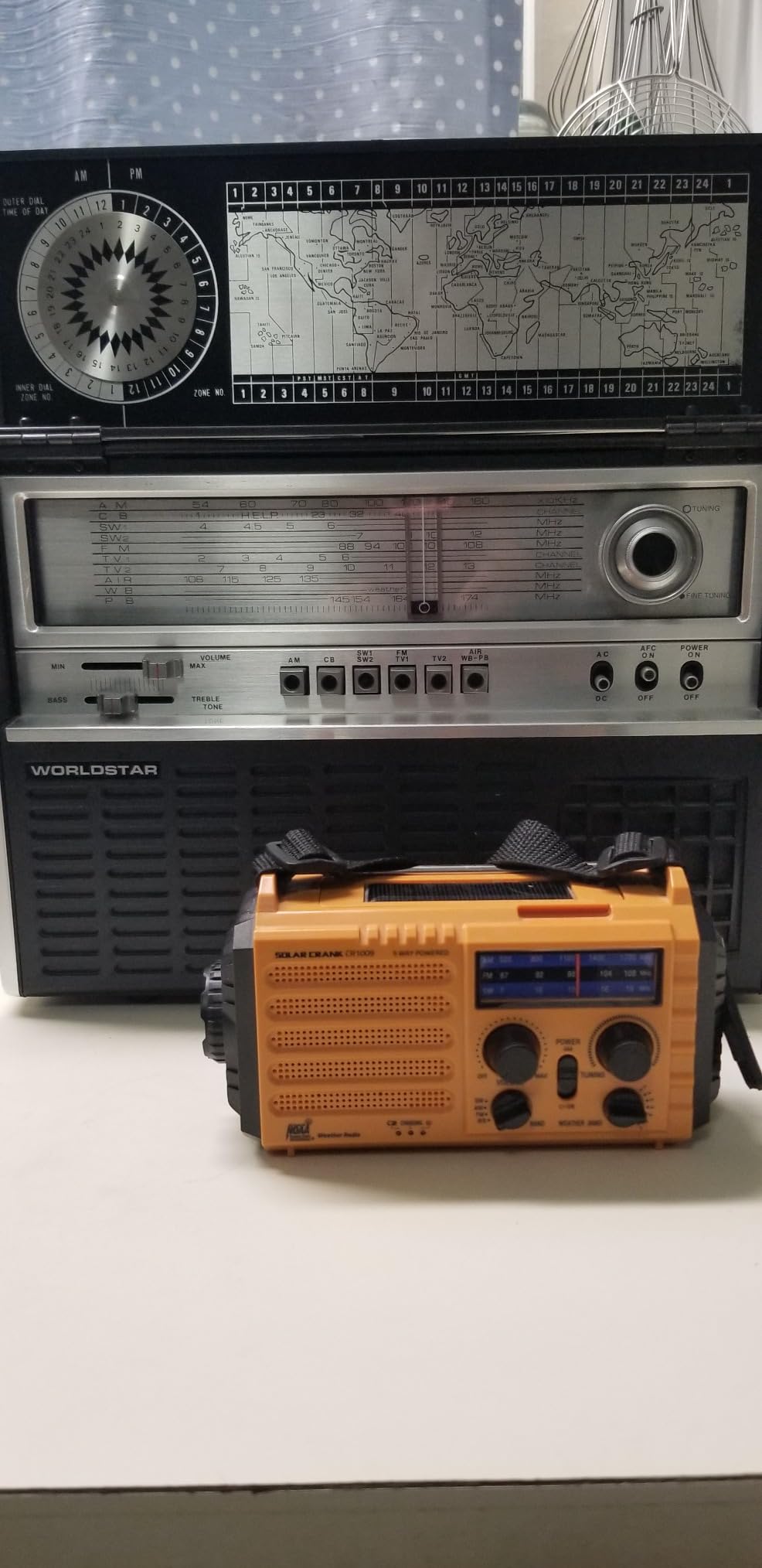
The Mesqool is the radio you hand to a grandparent. There is no menu system, no band select button and no display to read. You turn a knob until you hear a station, and that is the entire operating procedure, which in a stressed household is a feature rather than a limitation.
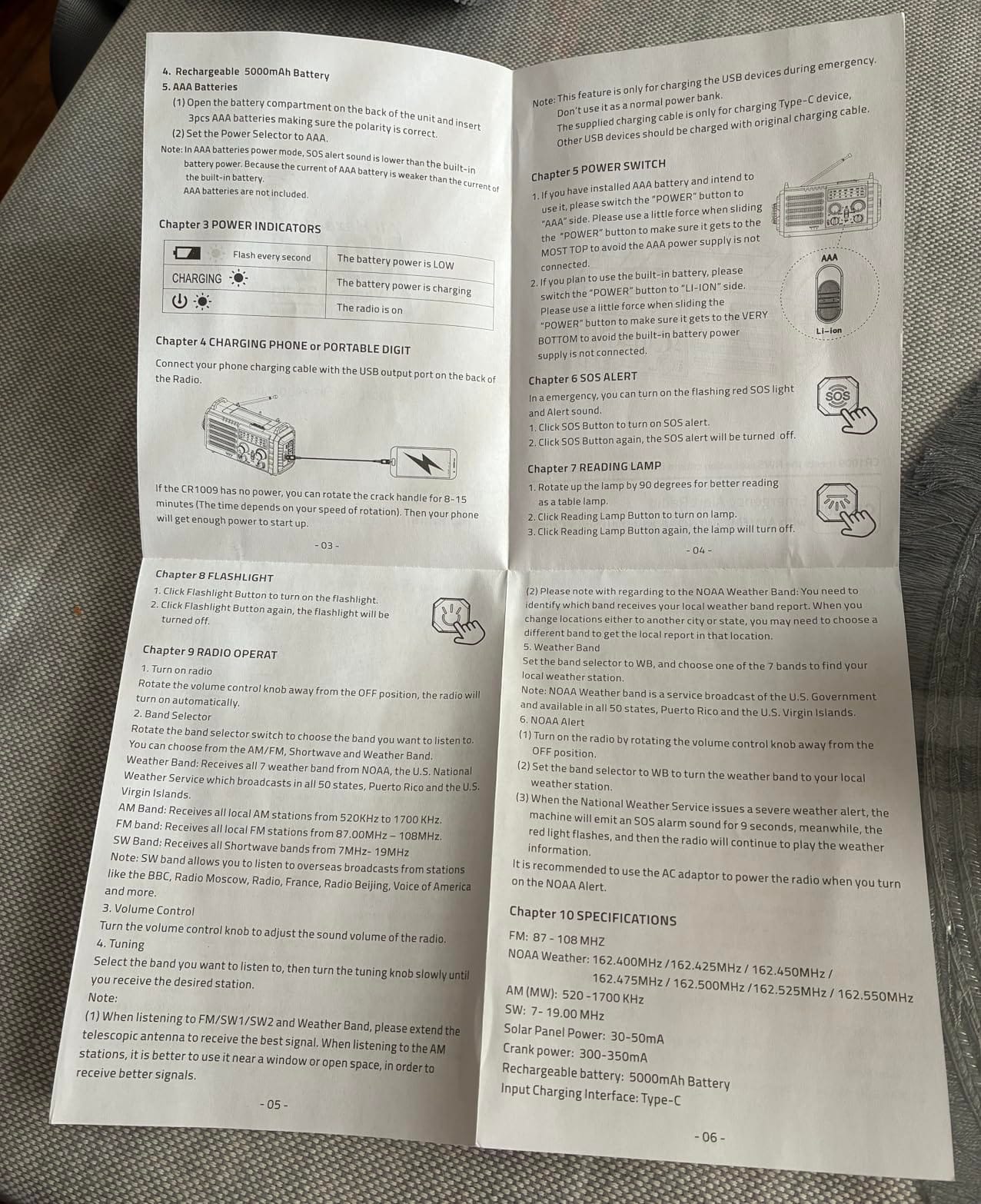
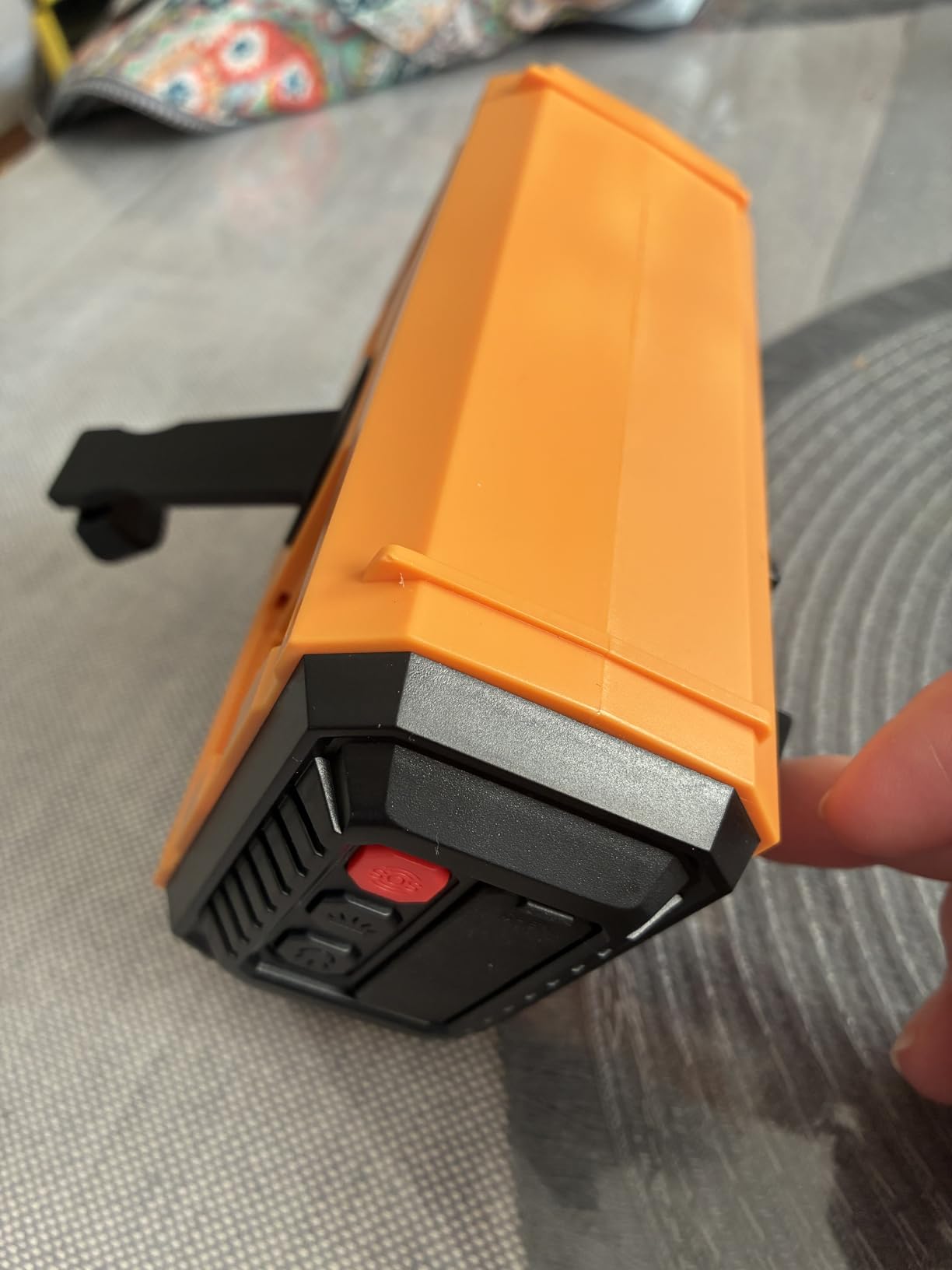
Underneath the simplicity the hardware is respectable. A 5000mAh cell rated at 18500mWh delivers about 13 hours of listening at half volume, and the five charging routes include USB-C, three AAA cells, solar and a hand crank. The dual-brightness 3 watt flashlight and 2.5 watt reading lamp sit under a flip-up panel, and the SOS siren measures 116 decibels, which is genuinely startling in a quiet room.
At 12.8 ounces it is the lightest full-featured crank radio here, and a strap, a carabiner and a compass are included in the box. The warranty runs three years against manufacturing defects, the longest cover in this group.
Why the Mesqool suits a mixed-experience household
Every member of a family can use it without training, and the AAA bay means you can keep loose cells on hand for years. For a shelter where several people will need to check in on conditions, that beats any amount of interface polish.
What frustrates shortwave listeners about it
The dial packs the entire 7 to 19 MHz shortwave range into a fraction of a single rotation, so isolating one station is fiddly work. Experienced users report drifting off the frequency almost immediately. If chasing distant signals is the plan, this is the wrong tool.
4. PPLEE P-1009Pro: the go-bag radio with a lock button and long warranty
Emergency Crank Weather Radio with NOAA Auto Alerts and Shortwave, 5000mAh
5000mAh cell
Digital tuning
Auto NOAA alert
16 oz
Pros
- Automatic NOAA alert mode with loud alarm and red flash
- Five power options including 3 AAA cells
- Lock button stops accidental presses inside a pack
- 3.5mm headphone jack and bidirectional USB
- 365-day warranty with responsive support
Cons
- Shortwave reception inconsistent and one owner reported the SW band absent
- Tuning advances one step at a time even on long press
- Knobs feel fragile if the unit is dropped
The detail that separates this one from the other generic crank sets is the lock button. Once it is engaged the controls stop responding, so the radio cannot be switched on and drained flat while it sits in a rucksack. Small thing, and exactly the kind of failure that ruins gear you rarely check.
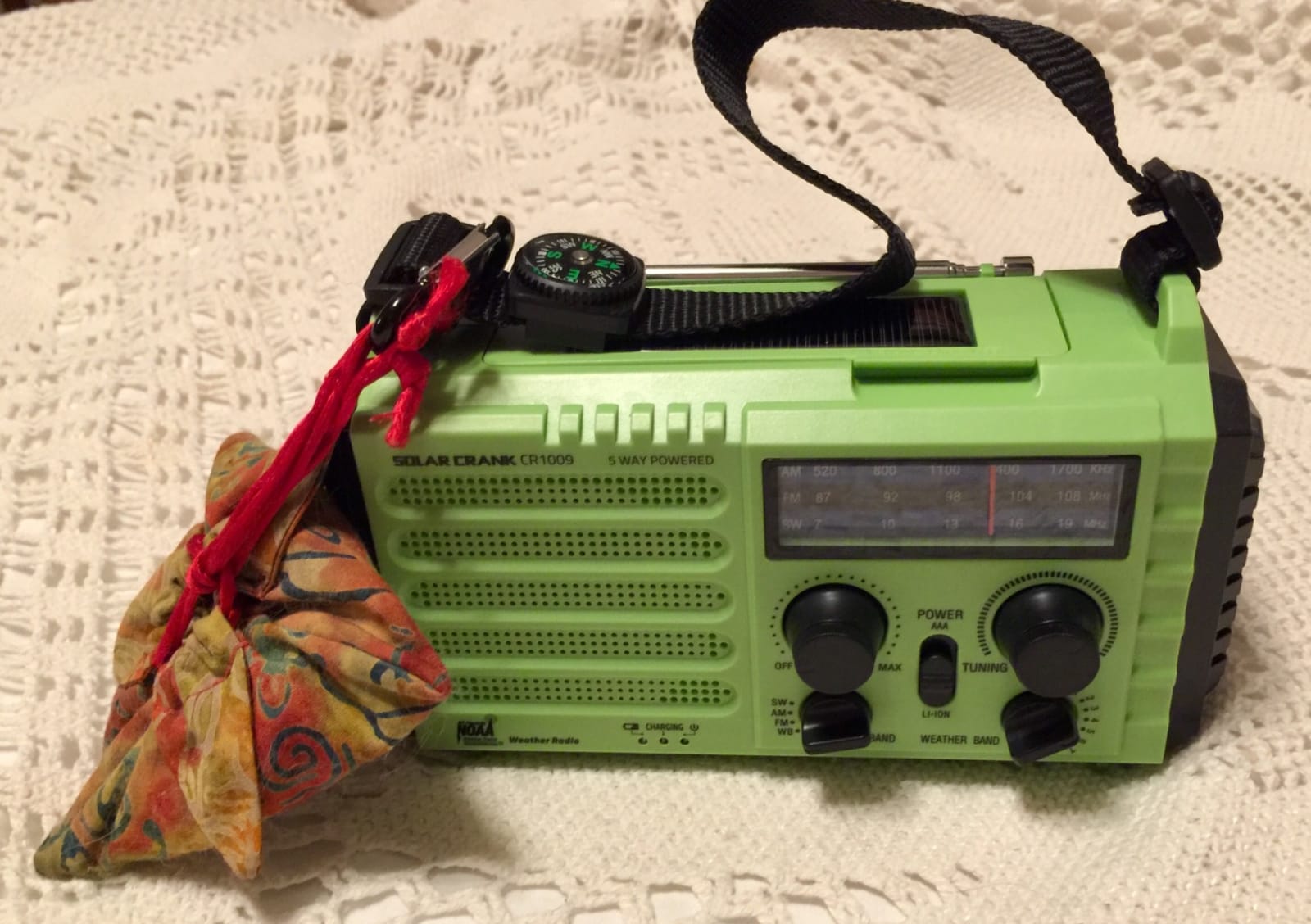
Power options are comprehensive: a 5000mAh internal battery, 5 volt USB, three AAA cells, solar and a hand crank. The large LCD shows the remaining charge and doubles as a clock. Lighting comes from a 3 watt flashlight and a 2.5 watt reading lamp, and the SOS alarm adds a Morse-style beacon that is visible from a distance.
Reviewers rate the build quality and the alert behaviour positively, and the manufacturer has a record of replacing faulty units even outside the return window. That kind of support matters for gear you intend to keep for a decade rather than a season.
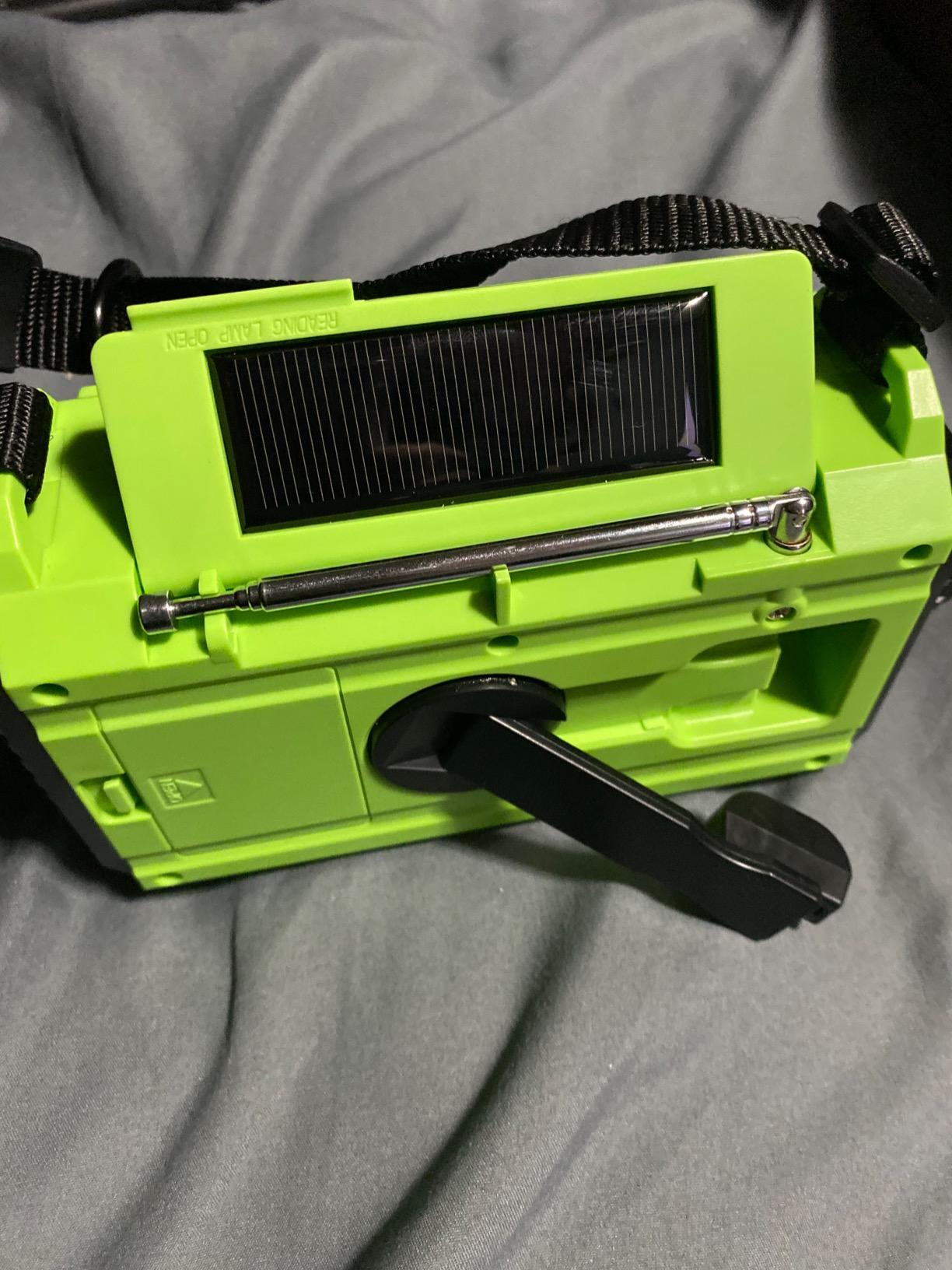
What the PPLEE does well in a go-bag
The lock, the AAA fallback and the bidirectional USB port make it easy to keep in a pack without draining. Automatic NOAA alerting means the set speaks up on its own during a storm warning, without anyone touching it.
Where owners report problems
Shortwave is the recurring complaint. Some buyers hear nothing at all on the SW band, and others describe a one-step-at-a-time tuner so slow that scanning the band becomes a chore. The solar panel maintains charge rather than restoring it, and the crank produces enough power for immediate use while storing almost nothing.
5. ROCAM CR1009: the rugged IPX6 unit for wet scenarios
Pros
- IPX6 water resistance tougher than the IPX3-rated rivals
- Brighter 3W flashlight and adjustable 6-LED reading lamp
- Loud NOAA severe-weather alarm
- 18500mWh cell doubles as a power bank for phones and tablets
- Carry strap with hang buckle
- 12-month warranty with 90-day replacement
Cons
- Analog pointer display with no digital frequency readout
- Heavier than most competing 5000mAh units
- Included compass is a backup aid not a navigation instrument
Read the water resistance rating before you buy anything in this category, because most of these sets are not sealed. IPX3 protects against spray from any angle for up to three minutes, which is fine on a kitchen counter. IPX6, as on this ROCAM, protects against powerful water jets from any direction, which is a different conversation entirely when the concern is flooding or a storm.
The rest of the specification is familiar and solid: AM, FM, shortwave and seven pre-programmed NOAA channels, an 18500mWh rechargeable cell, solar, hand crank, three AAA cells and a USB input. The cell doubles as a power bank for phones and tablets, which is the single most useful emergency feature on this list once the grid is gone.
Buyers pick it out of the 5000mAh crowd specifically for the housing rating, and they rate the lights as brighter than expected for the class. The telescopic antenna, 3.5mm headphone jack and loud SOS alarm round out a package that is otherwise conventional.
Why the ROCAM makes sense for flood and storm response
For anyone in a hurricane, flood or wildfire zone, the higher ingress rating removes a whole category of worry. A radio that survives being rained on while you are checking conditions outside is worth more than one with an extra feature but a sealed-flap assumption.
What you trade away
The analog pointer display means no frequency readout, so you note frequencies on paper and hunt for them again. At 16 ounces it is at the heavy end of this class, and the included compass is decorative rather than navigational, so do not rely on it for route finding.
6. C. Crane CC Skywave 2: the reception leader for people who just want to hear stations
C. Crane CC Skywave 2 AM, FM, Shortwave, NOAA Weather + Alert, VHF Aviation Band, Small Battery-Operated Portable Travel Radio with Clock and Alarm
SW 2300-26100 kHz
Aviation band
External antenna jack
2 AA power
Pros
- Class-leading sensitivity pulling in distant AM FM and shortwave stations
- Full shortwave range with aviation band and NOAA alerting
- Digital multiband tuning with selectable bandwidths and fine tuning
- 400 memories including 10 aviation presets
- External shortwave antenna jack
- About 60 hours on 2 AA cells
- Earphones and carry case included
Cons
- No hand crank
- solar panel or rechargeable battery
- Not water resistant
- FM selectivity is average and the backlight cuts out after about 10 seconds
This is the set to buy if you want to listen rather than survive. Long-term owners and DXers consistently describe it as the best-sounding small radio they have owned, with noticeably better AM and FM sensitivity than similarly sized alternatives, and the C. Crane company draws praise for parts availability and responsive repair support.
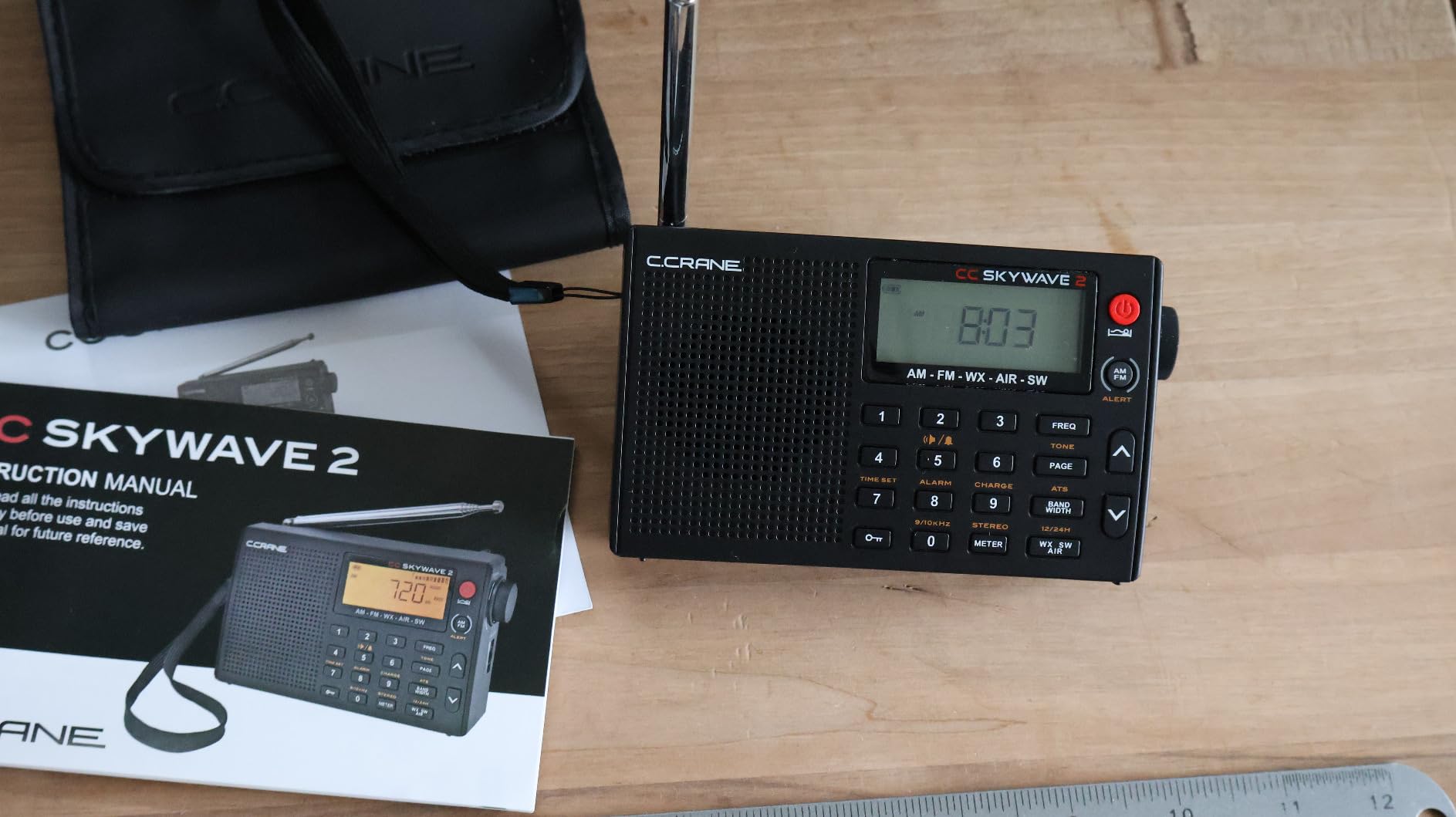
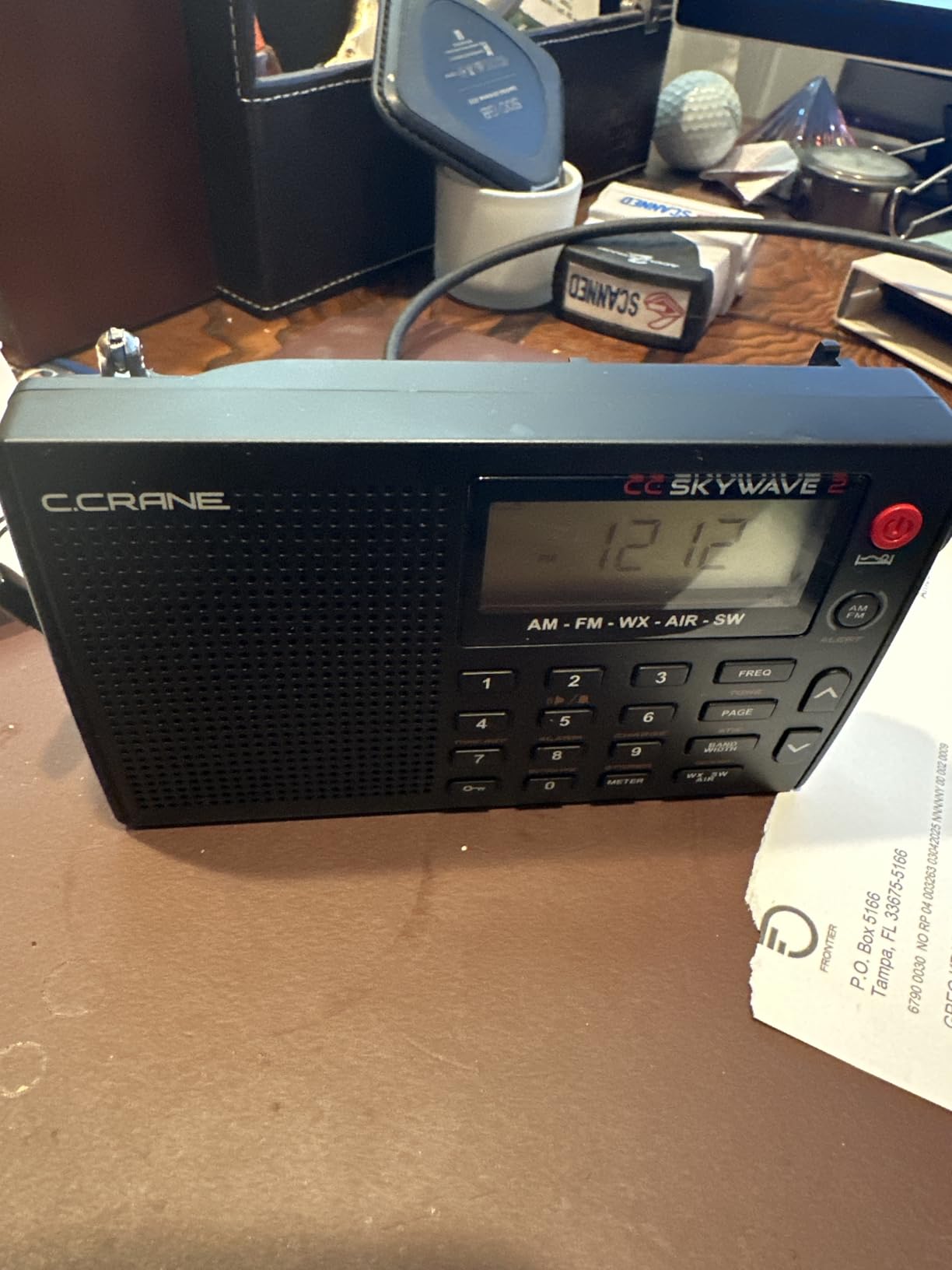
Coverage is wide: AM, FM, the NOAA weather band with alerting, shortwave from 2300 to 26100 kHz and the VHF aviation band. Tuning is digital with selectable bandwidths, fast and fine steps, direct frequency entry, auto scan and 400 memories, ten of which are scannable aviation presets. The external shortwave antenna jack is the detail serious listeners look for first.
Power is the counterpoint. Two AA cells give roughly 60 hours on the built-in speaker or 70 hours on earbuds, and it will take standard rechargeable AA cells too. There is a clock, an alarm, a fold-out stand and a stereo headphone jack. The whole thing weighs 6 ounces and measures 4.75 by 1.1 by 3 inches, which is genuinely pocketable.
Why reception quality matters more than features here
Every other set in this roundup has a hand crank and a flashlight, and several of them cannot hold a station reliably. The Skywave trades those away for a genuinely better receiver, wide bandwidth choices and an external antenna socket, which is the right trade when the goal is information rather than illumination.
Where it will disappoint you
There is no hand crank, no solar panel and no rechargeable cell, so during a long outage you depend on stored AA batteries. It is not water resistant, its FM selectivity is average rather than sharp, and the backlight shuts off after about ten seconds on battery power. Preset memories can also be lost if the batteries are removed.
7. Emgykit R11: the radio that doubles as a Bluetooth speaker
Portable Shortwave Radios with NOAA/SW/AM/FM, for Camping & Home
Bluetooth 5.0 playback
4000mAh cell
210 stored channels
SW and NOAA
Pros
- Bluetooth 5.0 with a 5 watt speaker for room-filling audio
- Automatic scan stores up to 70 channels per band for 210 total
- TF card playback plus 3.5mm headphone jack
- Hand crank and solar for emergency recharging
- 7 nature sound presets with a 10-70 minute auto shut-off timer
- NOAA alerts
- compass and phone charging
Cons
- Digital search is automatic scan and store rather than manual display tuning
- 4000mAh cell is smaller than the 5000mAh rivals
- Bulkier and heavier than pocket shortwave sets
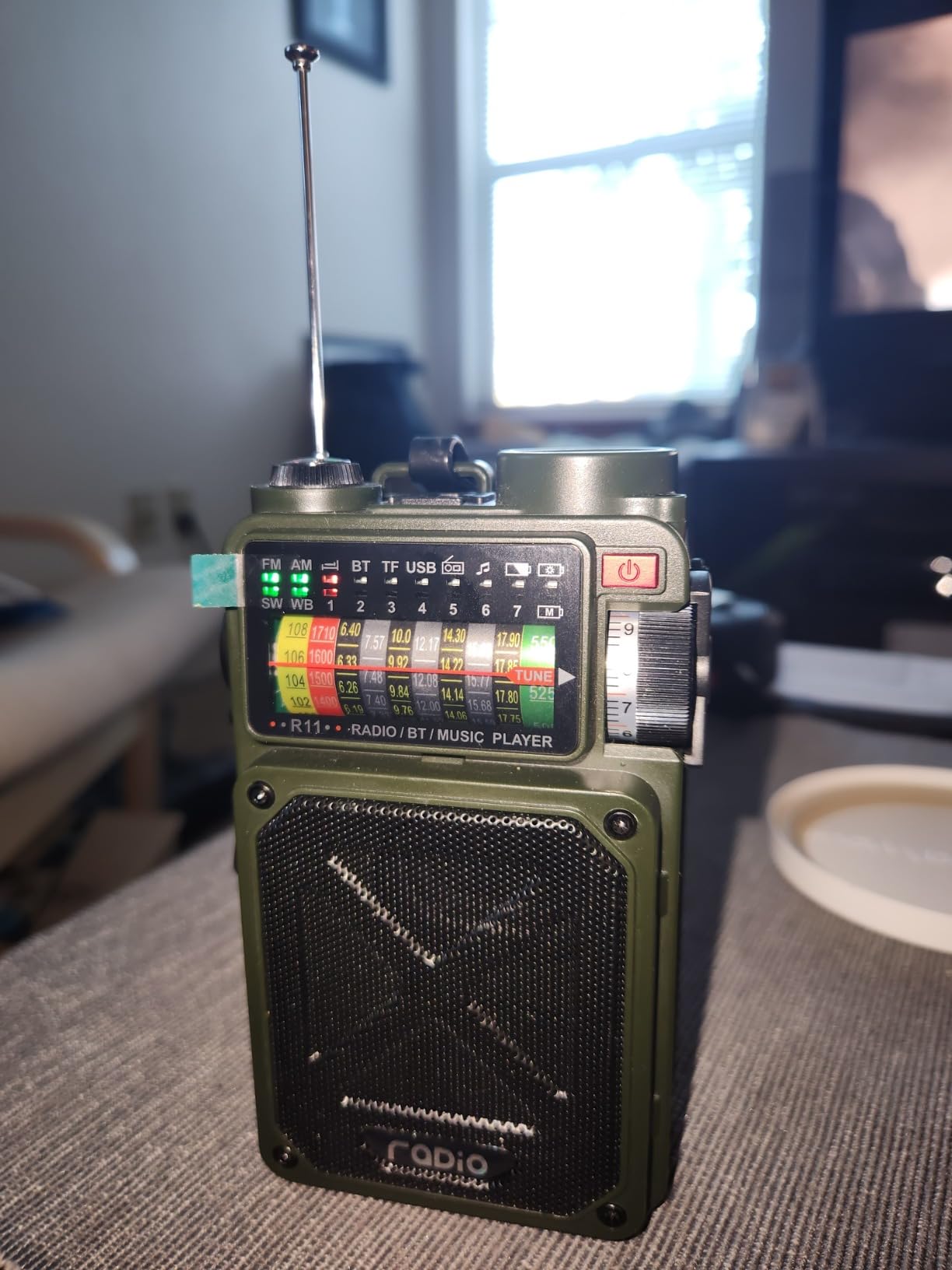
The Emgykit is bought as a multi-purpose device. A 5 watt Bluetooth speaker, TF card playback, a sleep timer and seven nature-sound presets mean the same box handles ordinary household use as well as emergency reception, which is the argument for owning a radio you will actually keep somewhere accessible instead of sealed in a drawer.
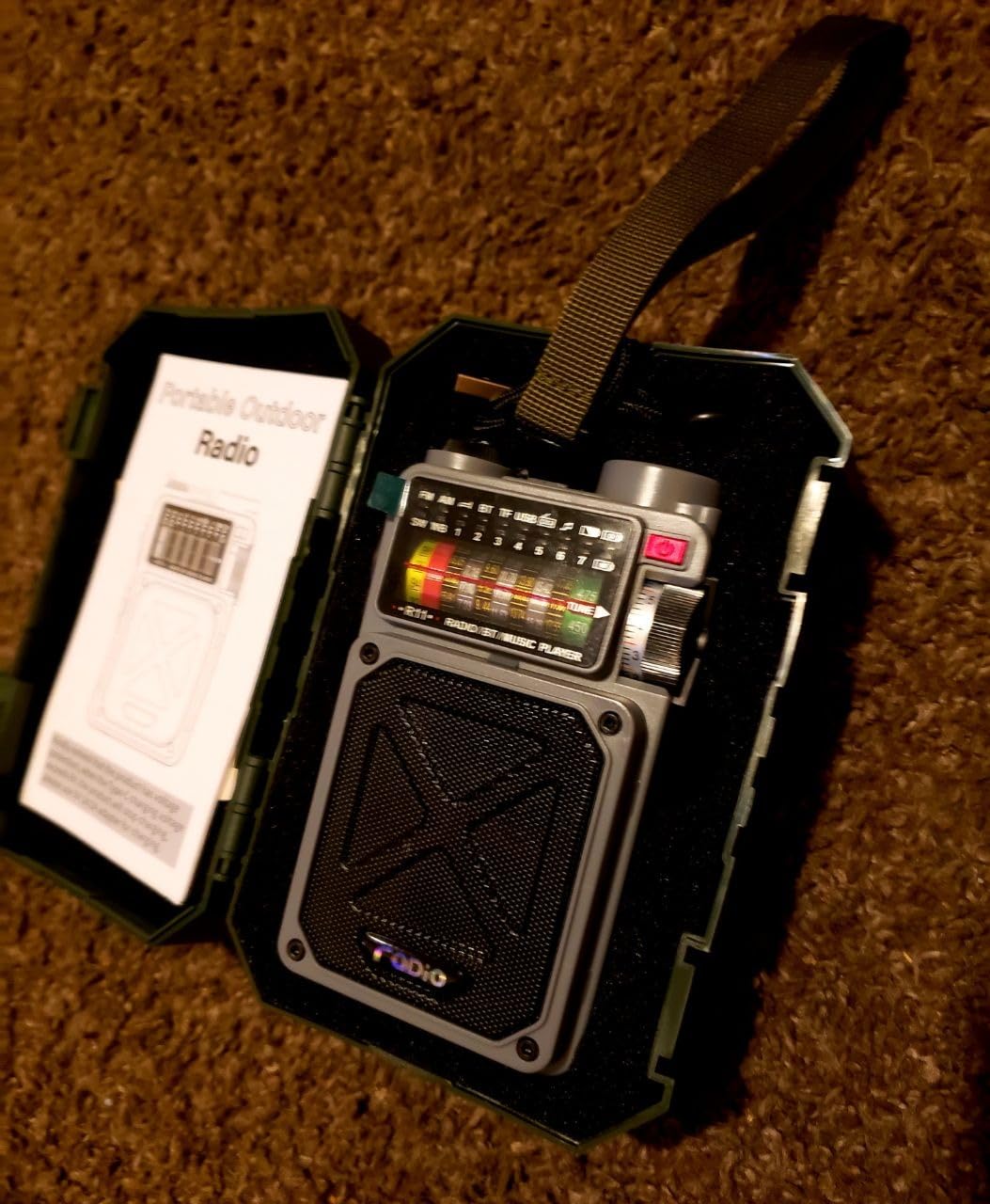
Reception covers NOAA, AM, FM and shortwave, with an automatic search and store function that holds up to 70 channels per band for 210 total. The 4000mAh rechargeable battery runs up to 32 hours of playback over Type-C, and the hand crank and solar panel provide emergency recharging. There is a 120-lumen flashlight, a compass, SOS alert and phone charging on top.
It comes in a military-style gift box with a carrying strap, which sounds like a small thing until you are trying to find the controls at three in the morning.
Why this suits a household that values one box doing several jobs
Bluetooth audio and TF playback mean the device earns its shelf space between emergencies, which is when most preparedness gear quietly disappears into a cupboard. The seven white-noise presets and the auto shut-off timer are genuinely useful at night when a radio left on drains a battery.
What to know before buying
The digital search scans and stores automatically rather than letting you type in a frequency, so results depend entirely on local signal conditions and you cannot return to a known station. The 4000mAh cell gives less headroom for phone charging than the 5000mAh units, and at 3.15 by 2 by 5.02 inches it is bulkier than a pocket set.
8. Jazmm 213: a four-band DSP unit you can actually tune precisely
AM FM Shortwave Radio with NOAA Weather Alert,1250mAh Rechargeable Battery
SW 4.75-21.85 MHz
1250mAh USB-C
5 watt speaker
Bluetooth 5.4
Pros
- DSP chip across FM AM shortwave and weather band
- 5 watt speaker with six EQ presets and headphone jack
- 1250mAh rechargeable cell giving 10-12 hours over USB-C
- Bluetooth 5.4 speaker mode and TF playback up to 128G
- 100 preset stations with automatic search
- Sleep timer from 10 to 120 minutes
- Only 131 g with a back clip and wrist strap
Cons
- 1250mAh is small and the manual advises recharging every 60 days
- AM tunes in 10 kHz steps so stations between steps cannot be dialled in
- Loud mode-change announcements with incremental volume control
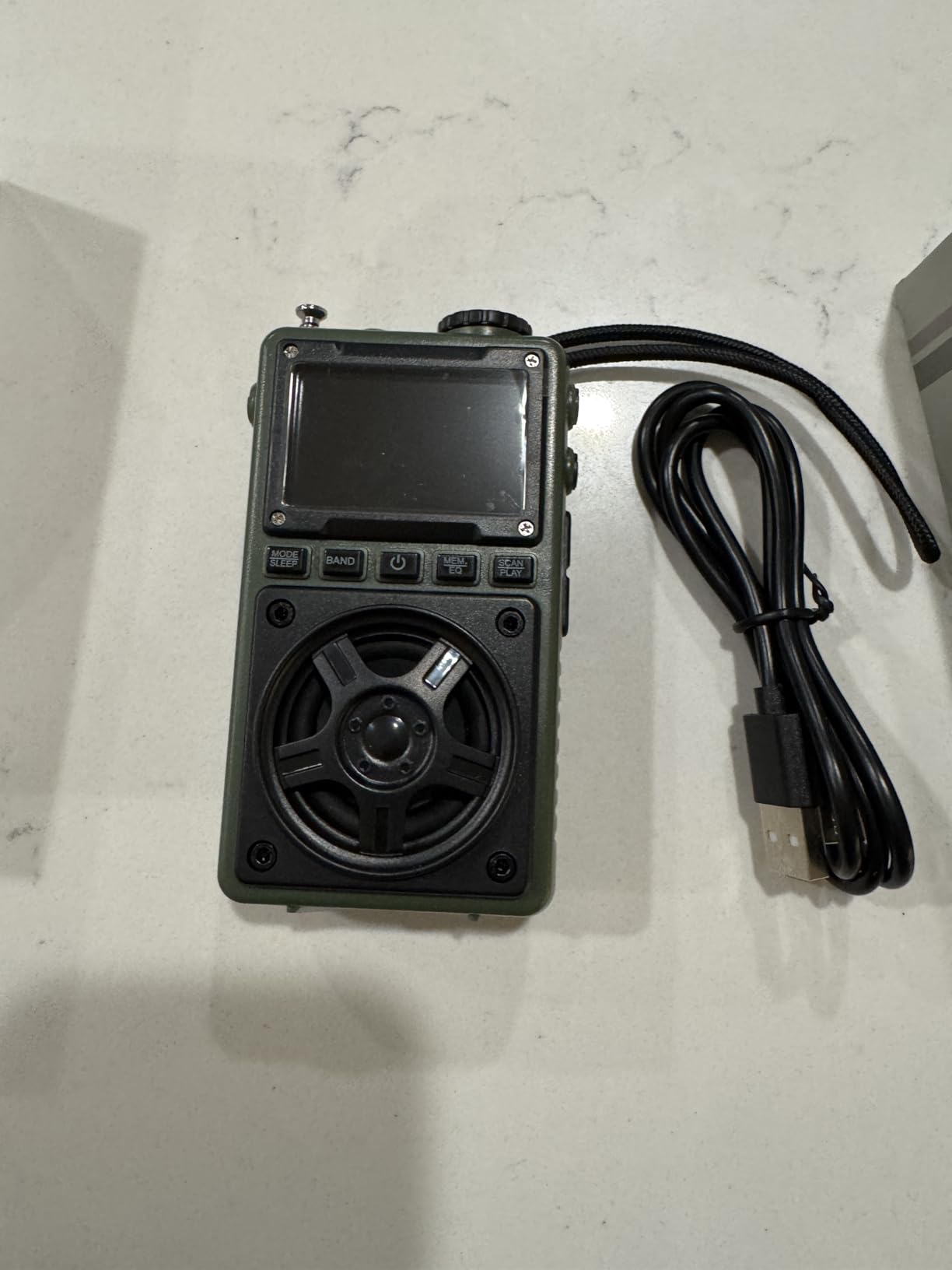
The Jazmm is the only pocketable set here with a properly specified shortwave range on the datasheet, 4.75 to 21.85 MHz, driven by a DSP chip. It is also the lightest at 131 grams, with a back clip and wrist strap, so it is the one to put in a jacket pocket rather than a pack.
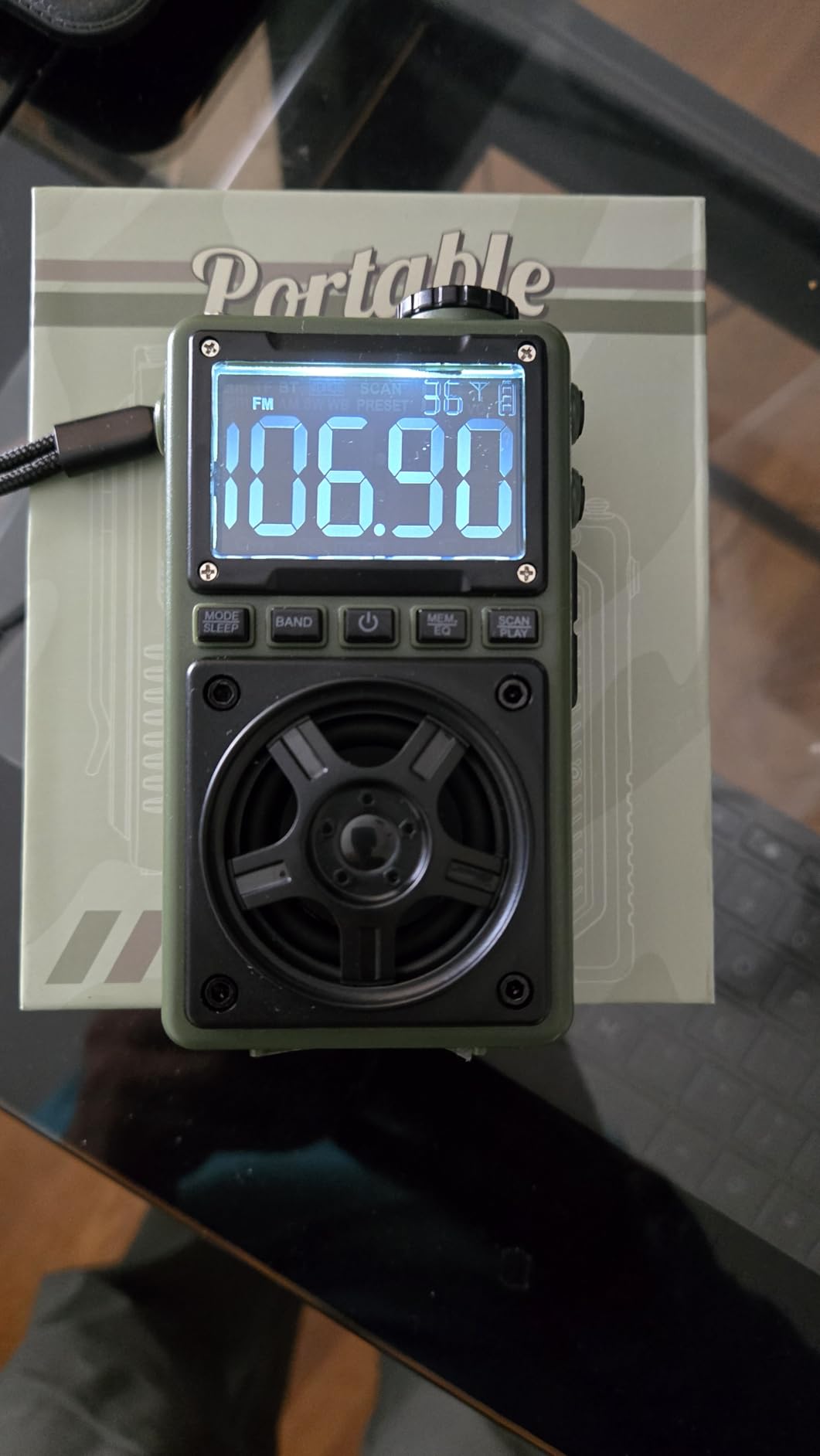
Audio is unusually good for the size, a 5 watt speaker with six EQ stereo presets and a 3.5mm headphone jack. It also works as a Bluetooth 5.4 speaker and plays TF cards up to 128G across MP3, WMA, WAV, FLAC and APE. There are 100 presets with one-step automatic search, a backlit display, a sleep timer and a built-in flashlight.
Owners praise the sound, the telescoping antenna and the fact that it holds up better over time than disposable models of the same size.
Why the Jazmm works as a grab-and-go set
Weight and size are the deciding factors for a radio that has to be carried rather than stored, and at 131 grams with a clip it disappears on a belt or in a jacket pocket. USB-C charging means one cable covers the radio and your phone.
What the small battery and coarse AM stepping cost you
1250mAh gives 10 to 12 hours per charge, and the manual itself advises recharging every 60 days if the set is unused, which is a reminder that sealed lithium cells do not sit still. AM tuning moves in 10 kHz steps, so stations between steps cannot be dialled in exactly. The mode-change voice announcements are loud and the volume control is incremental rather than analogue.
9. XHDATA D109WB: long wave coverage almost nobody else offers
XHDATA D109WB Portable AM/FM/SW/LW/WB Weather Radio Shortwave Radio Receiver with NOAA Alert, Battery Operated Great Sound Wireless BT Mp3 Speaker, SOS Alert Alarm Clock Sleep Function
5 bands including LW
SW 1711-29999 kHz
39cm antenna
Type-C battery
Pros
- Only set here with long wave at 153-513 kHz alongside full shortwave
- DSP chip and a 39cm antenna for better sensitivity
- 40mm stereo speaker with clear distortion-free output
- Bluetooth speaker mode with call handling and TF playback
- Two alarm clocks with MP3 radio and beep modes
- Automatic frequency search
- One year after-sales service
Cons
- Rechargeable battery and Type-C only with no crank solar or dry-cell fallback
- Shortwave and long wave reception still depends on location and antenna conditions
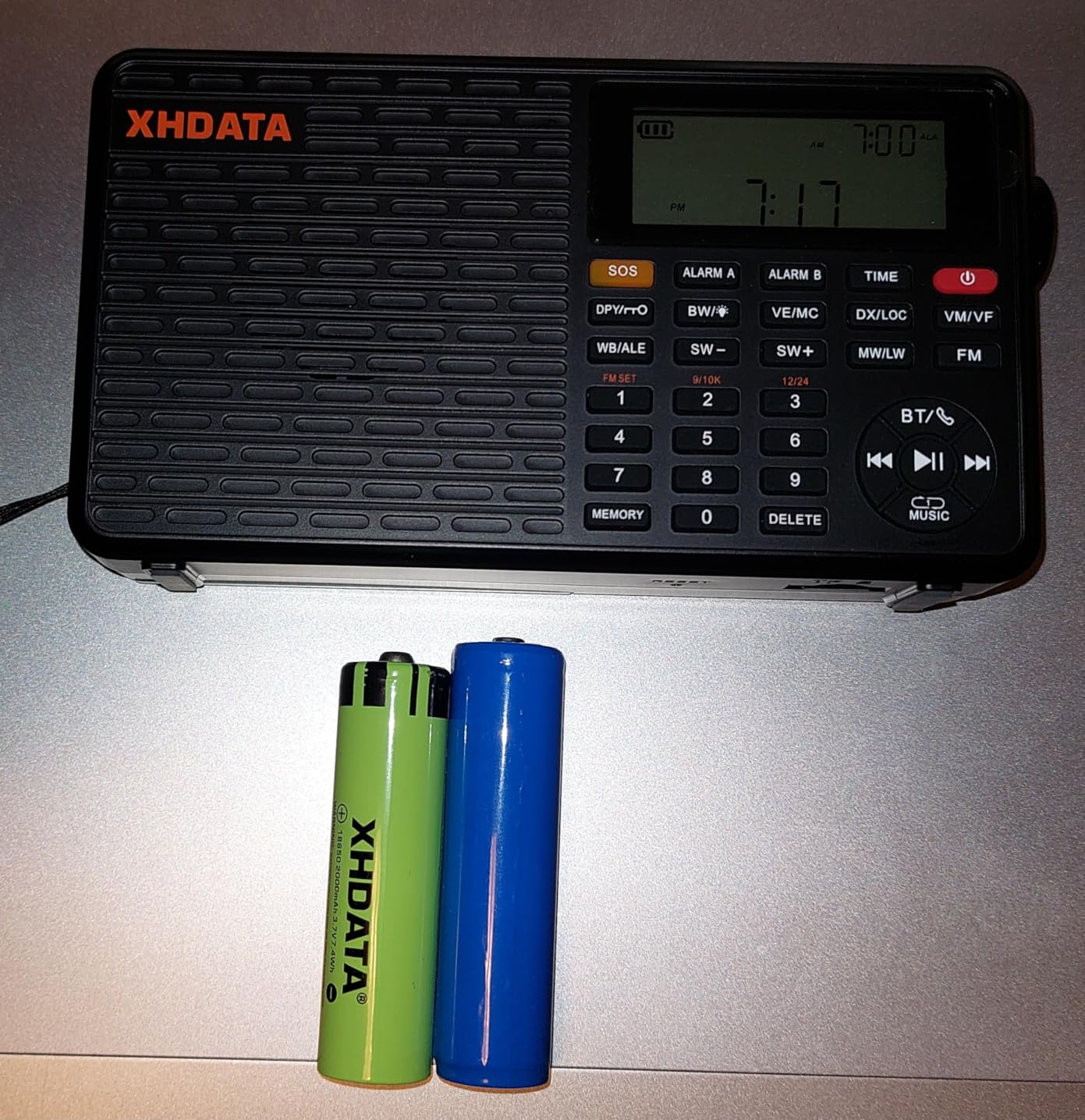
The D109WB is unusual in a way that is easy to miss if you only read the feature list. It is the one unit here that tunes long wave, from 153 to 513 kHz, on top of FM 64-108 MHz, AM 520-1710 kHz, shortwave 1711-29999 kHz and the NOAA weather band. Long wave carries aviation and maritime navigation traffic and some surviving time signals, and almost nothing in this price bracket covers it.
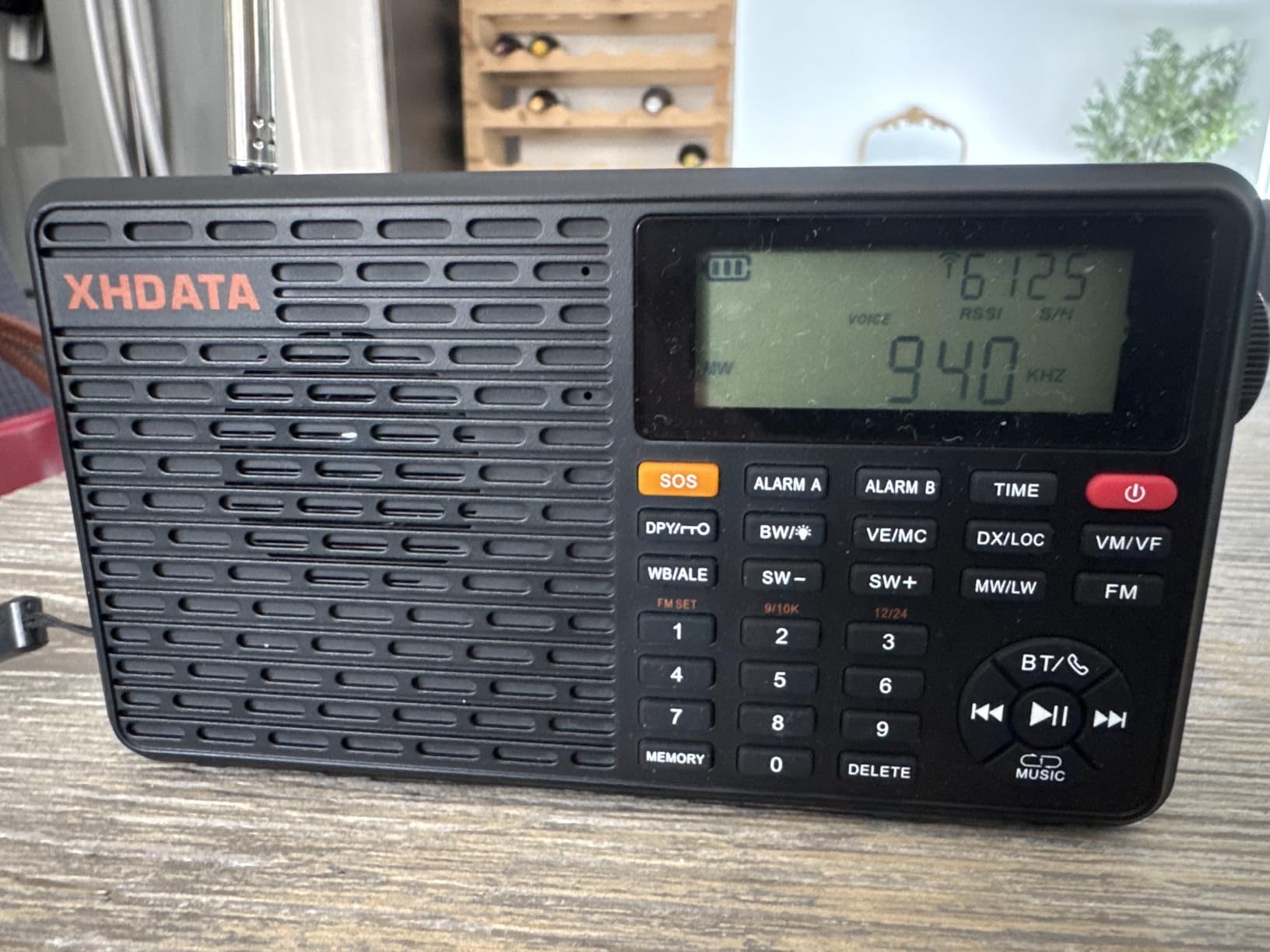
A DSP chip and a 39cm antenna do measurable work for sensitivity, and the 40mm stereo speaker produces clear output with a 3.5mm headphone jack. It runs as a Bluetooth speaker with wireless call handling, plays TF cards, and carries two alarm clocks with MP3, radio and beep modes alongside an automatic frequency search function.
Power is the weak point. There is a Type-C rechargeable battery with the level shown on screen, and that is the entire list. No hand crank, no solar panel, no dry-cell bay.
Why the long wave band matters for a serious listener
Long wave is where navigation and time-beacon services traditionally sit, and having the band available costs you nothing extra at the point of use. If you monitor aviation or maritime traffic rather than only news broadcasts, that coverage alone separates this set from the field.
Why it ranks low in an emergency list
Sealed rechargeable power is the single biggest problem in an outage. With no crank, no panel and no cell bay, a set like this depends entirely on a battery that has been sitting at partial charge since you last used it. Reception on the lower bands also still varies sharply with location and antenna conditions.
10. XHDATA D221: the AA-powered pocket backup that always has power
XHDATA D221 NOAA Weather Radio Portable AM FM Shortwave Radio Receiver
2 AA battery power
SW 5.6-22.0 MHz
DSP chip
125 g
Pros
- Runs on two easily replaced AA cells including standard rechargeable AA
- Extremely light at 125 g and small enough for a pocket
- Good sensitivity for the size on NOAA and shortwave
- Loud clear speaker with headphone jack and pop-out kickstand
- One-handed operation with tuner and volume on the right side
- Simple dial that is easy to hand to an elderly user
Cons
- Volume knob doubles as the power switch and is extremely sensitive
- Tuning knob loses stations as soon as you release it
- No SSB
- no rechargeable battery
- no crank and no solar panel
The D221 exists to solve one problem that no other set on this list solves: the sealed battery dying. Two AA cells, which you can buy anywhere and store for years, mean this radio works whenever you turn it on, regardless of how long it has been sitting in a drawer. It is 125 grams and small enough for a pocket.
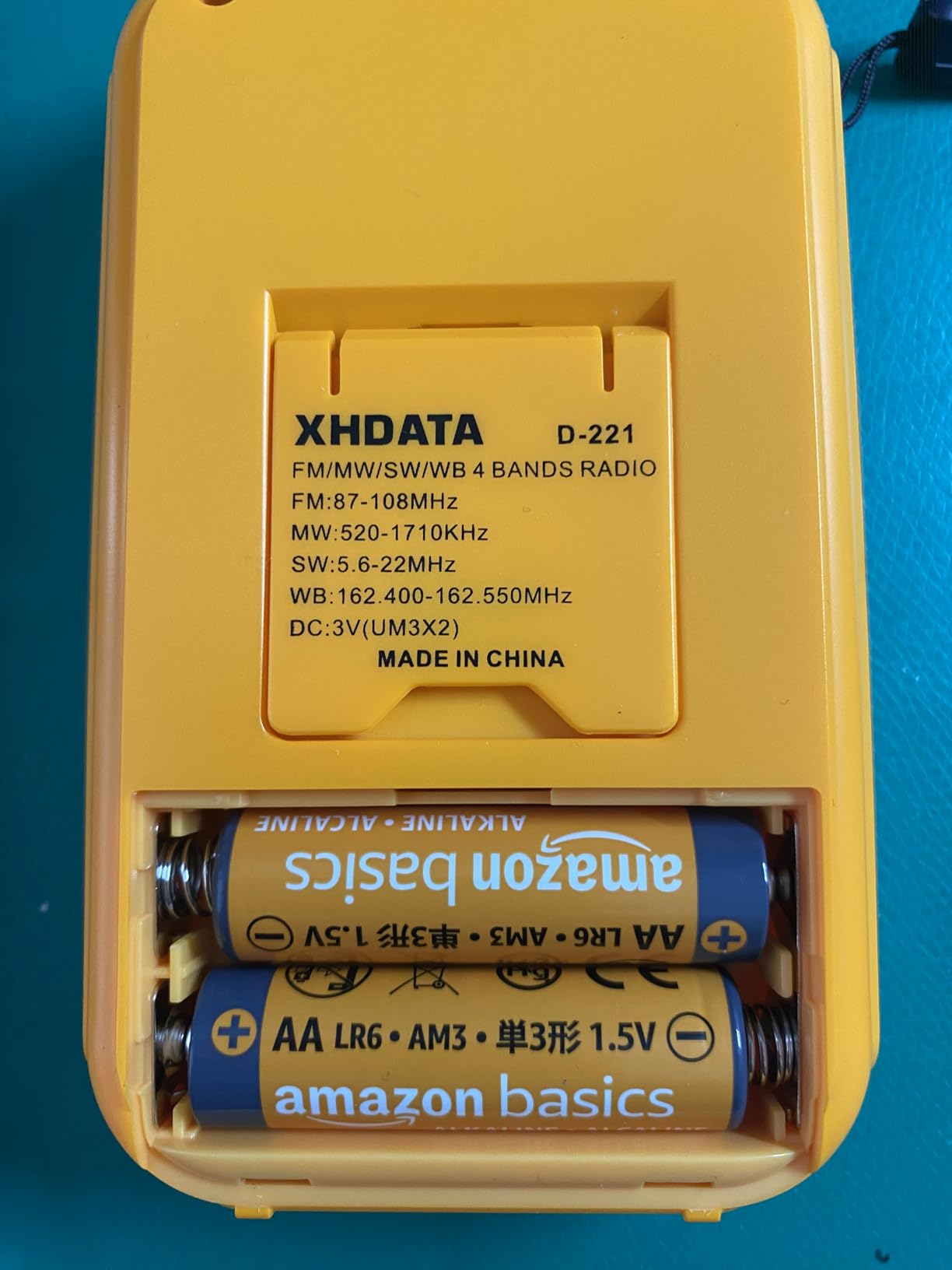
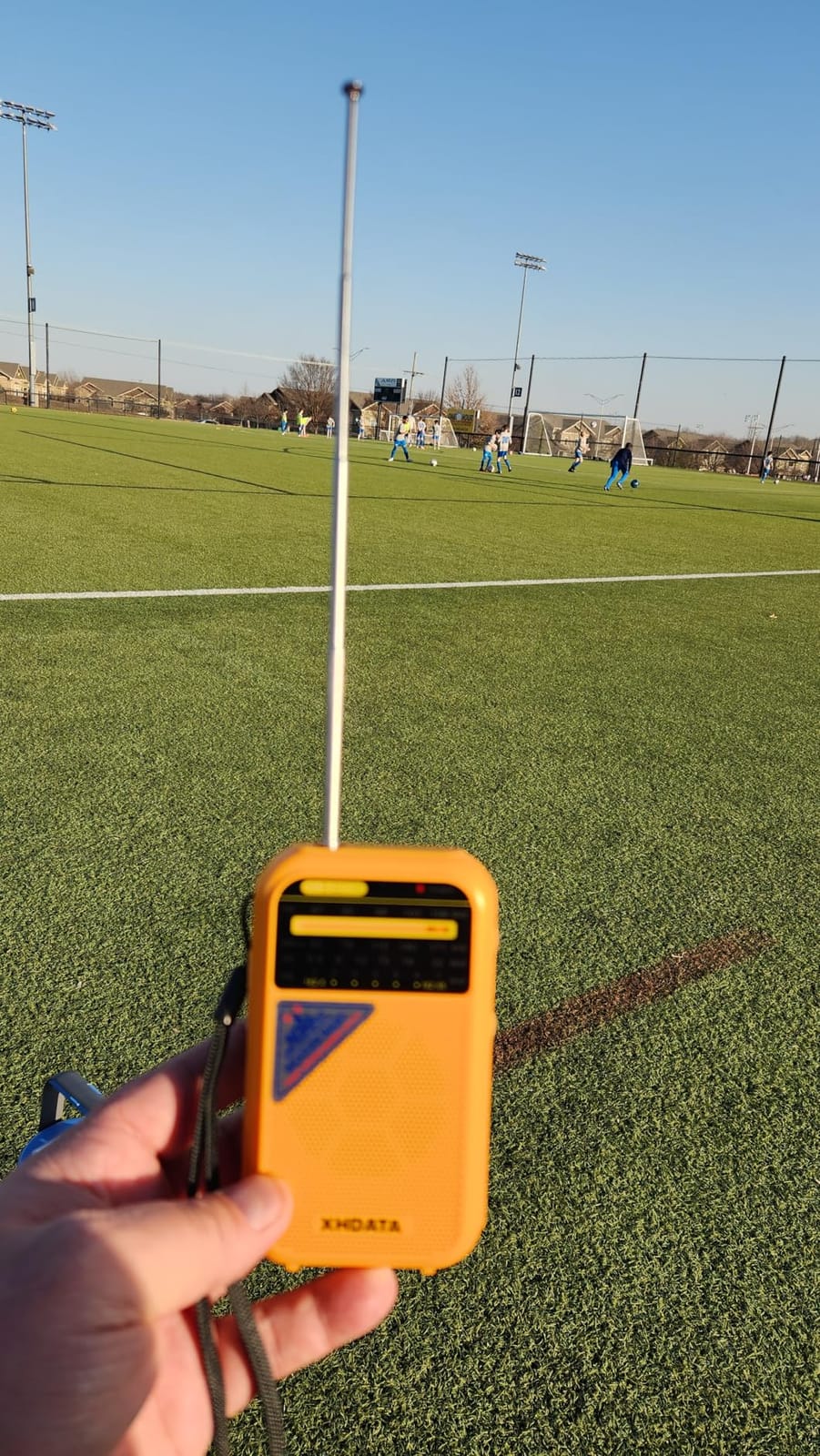
Coverage is four bands: FM 87-108 MHz, AM 520-1730 kHz, shortwave 5.6-22.0 MHz and the NOAA weather band, all handled by a DSP chip. Owners report good sensitivity for the size, pulling in weather channels and shortwave stations on first use, and the speaker is loud and clear with a 3.5mm jack and a pop-out kickstand for tabletop listening.
Everything is on the right side, so it works one-handed, and the simple dial makes it the easiest unit here to hand to someone with no radio experience.
Why the D221 is the right third radio
Two or three radios, not one. A pocket AA-powered backup that you will still find working in five years costs you almost nothing in weight and eliminates the single most common failure mode in this category, which is a sealed cell that has quietly drained.
What you accept for that reliability
The control feel is the near-universal complaint. The volume knob doubles as the power switch and jumps to maximum, and the tuning knob is so sensitive that stations drop out as soon as you stop touching it. Shortwave spans 5.6 to 22 MHz on a tiny analog dial, and there is no SSB, rechargeable cell, crank or solar.
How We Picked and Ranked These Radios
We scored every set on five weighted criteria rather than on feature count. Shortwave reception quality carried the most weight, because a radio that cannot isolate a station is not an information source. Power resilience came second. NOAA alerting was third, portability fourth, and physical build last.
The reasoning behind those weights comes straight from owner reports. Across shortwave forums, the same complaints recur: batteries that are obsolete before the radio is, precision tuning that drifts off station, solar panels that only maintain charge, and crank ratios too weak to matter. Reception and power are where radios are actually won or lost.
Every specification in this guide, from frequency ranges to battery chemistry to weight, comes from the manufacturer listing and the owner feedback attached to it. Where reviewers disagree with the spec sheet, we have said so rather than repeating the marketing claim.
How to Choose a Shortwave Radio for Emergency Use
Start with the failure mode you are worried about. That single question removes most of the decision.
1. Decide between dry cells and sealed cells. If your concern is a device that still works in five years, buy AA-powered. Lithium-ion cells self-discharge while stored, and a radio in a drawer slowly becomes a brick regardless of how good its reception is.
2. Check that the shortwave band is genuinely tunable. A listing that says shortwave may mean one fixed slice of the band on a rotating knob. Look for a frequency readout, direct entry, or a stated range in MHz.
3. Verify NOAA alerting, not just weather band reception. A weather band radio plays forecasts on request. A weather alert radio wakes itself with the 1050 Hz tone for a warning in your area. Only the second one is useful while you sleep.
4. Read the IP rating. The first digit is dust protection, the second is water. IPX3 means spray for up to three minutes. IPX6 means powerful water jets from any direction. IPX7 and above means temporary immersion. Only the higher numbers matter outdoors in a storm.
5. Check the antenna length and any external jack. The Kaito’s 14.5 inch whip outperforms a stub antenna in almost every condition, and a clip-on long wire improves a portable set more than any other single accessory.
6. Count real power paths. A radio with an internal cell, USB and three AAA cells has three independent ways to be alive. A radio with one sealed cell has one.
7. Set a weight budget before you shop. Above about a pound, a radio is a shelter item rather than a go-bag item, and that changes which of these makes sense.
8. Accept the price tiers as a quality ladder. The cheapest crank units cluster tightly together and differ mostly in housing rating and light output. The step up to a sensitive battery-powered receiver is where reception quality genuinely changes, and it is the tier worth spending on.
Power, Batteries and What to Store
Most hand cranks produce roughly enough power to run a radio immediately and to store very little. The realistic expectation is that a minute of cranking buys a few minutes of listening, which makes cranking a genuine last resort rather than a daily charging method. Treat solar panels the same way: they maintain a charge over a week of daylight far better than they recover a flat battery.
Which makes stored cells the real answer. Alkaline AA cells keep for years in a cool, dry place. Lithium-ion cells lose charge sitting unused, which is why manuals for sealed-cell radios advise topping them up periodically even if you never listen to the thing.
Our storage discipline, after comparing both approaches across this list, is simple. Keep the sealed-cell units in a state of partial charge in a place you will actually visit, and keep a bag of AA cells for the dry-cell sets. Check both every few months. A radio you never test is an assumption, not a plan.
One more note on cranking and solar. Experienced shortwave listeners on forums are openly sceptical of both as primary charging methods, and the owner feedback here backs them up. Buy them as insurance, not as a system.
What to Tune To on the First Night of a Blackout
A radio is only as useful as the list you bring to it. Here is what actually transmits during a regional outage, roughly in the order you should try.
1. Local NOAA weather band channels. Continuous forecasts, hourlies, and the alert tone for your own county. Learn the channel for your area before you need it.
2. Local AM and FM. Emergency management, first responders and utilities broadcast shelter, evacuation and restoration information here, and it is the most locally actionable content available.
3. Time signals on shortwave. These transmit continuously with no programming schedule, so they are there whenever you turn on and they let you confirm your receiver is actually working rather than just quiet.
4. International shortwave services. Large international broadcasters maintain shortwave transmitters precisely for the situation where domestic infrastructure fails. Rotate slowly through the band and expect the strongest signals to change hour to hour.
5. Aviation and maritime bands, if your set covers them. Controllers repeat position reports continuously, and during a major incident the traffic density tells you what is happening long before any news bulletin does.
Technique matters more than antenna hardware. Tune slowly at night when the ionosphere is most stable and signals travel furthest, extend the whip to full length, and rotate the set rather than the antenna. Moving a few feet can be the difference between a station and static.
Building a Two-Radio Loadout and Using an External Antenna
One radio is a single point of failure. A sensible household runs two, with different failure modes, and adds a two-way set for communication.
For a home base, choose a unit with crank, solar and a bright light, and keep AA cells with it. For a go-bag, choose something under a pound with AA cells or a USB-C rechargeable cell you top up regularly. A dedicated two-way radio, properly licensed where required, is what actually lets you talk to another person, and no receiver substitutes for it.
On antennas, experienced listeners on shortwave forums consistently recommend a clip-on long wire for portable sets. The C. Crane in this list has a dedicated external shortwave jack, which is the main reason it earns its place for people who want to work distant stations. On sets without a jack, a clip-on wire attached to the telescopic whip still helps.
Frequently Asked Questions
What is the most reliable emergency radio?
For a home shelter, a crank-and-solar unit that also accepts three AA cells is the most reliable choice, because dry cells never self-discharge in storage. The Raynic CR1009Pro is the strongest all-round example, covering AM, FM, shortwave and NOAA alerting with six power paths and a 3 watt flashlight.
What kind of radio is best for emergencies?
Three different kinds, for three different jobs. A weather alert radio with the 1050 Hz tone wakes you for local warnings. A shortwave receiver gives you information from beyond your region when the local infrastructure is down. A licensed two-way radio lets you talk to someone, which no receiver can do.
Do I need a license to listen to shortwave radio?
No. Receiving shortwave broadcasts, NOAA weather traffic and amateur radio transmissions requires no licence. Only transmitting on amateur bands requires an FCC licence, and every radio reviewed here is receive-only, so no licensing question arises.
What is a good portable radio for an emergency?
The C. Crane CC Skywave 2 is the best portable option, weighing 6 ounces with full shortwave coverage from 2300 to 26100 kHz, an aviation band, an external antenna jack and roughly 60 hours of runtime on two AA cells. It has no crank, so it depends on stored batteries.
What is the best doomsday radio?
There is no single unit, but for a household the answer is two radios with different power sources. Pair a crank-and-solar set with a flashlight and NOAA alerting for the shelter, and a pocket AA-powered set like the XHDATA D221 as a backup you can still operate in five years.
Which shortwave radio has the best reception quality?
Among these ten, the C. Crane CC Skywave 2 leads on sensitivity, pulling in distant AM, FM and shortwave stations that smaller sets miss. It offers selectable bandwidths, fine tuning and an external shortwave antenna jack. The Kaito KA500 is the closest runner-up thanks to its 14.5 inch telescopic antenna.
Can a shortwave radio call for help in an emergency?
No. Every radio in this roundup is receive-only and cannot transmit a distress message or contact anyone. If your plan depends on being reached, you need a licensed two-way radio, a satellite messenger or a phone with a working cell tower.
Is a hand crank and solar panel worth it on an emergency radio?
As insurance, yes. As a charging system, no. A minute of cranking buys a few minutes of listening, and a small solar panel maintains charge far better than it recovers a flat battery. Buy both features, but plan on stored AA cells as your real power reserve.
Conclusion: The Shortwave Radios for Emergency Use We Would Buy
After weeks of comparison, the best shortwave radios for emergency use come down to a match between your power plan and your listening ambitions. The Raynic CR1009Pro is the one we would buy first, because wide band coverage, a 18500mWh cell, three AAA cells, a bright flashlight and phone charging in a single sealed body cover more failure modes than anything else here.
Add a second radio with a different failure mode, and keep AA cells with both. The Kaito KA500 is the better all-round receiver, and the C. Crane CC Skywave 2 is the one that will hear stations the others cannot. Whichever you choose, test it monthly, and remember that a receiver informs while a two-way radio communicates.