
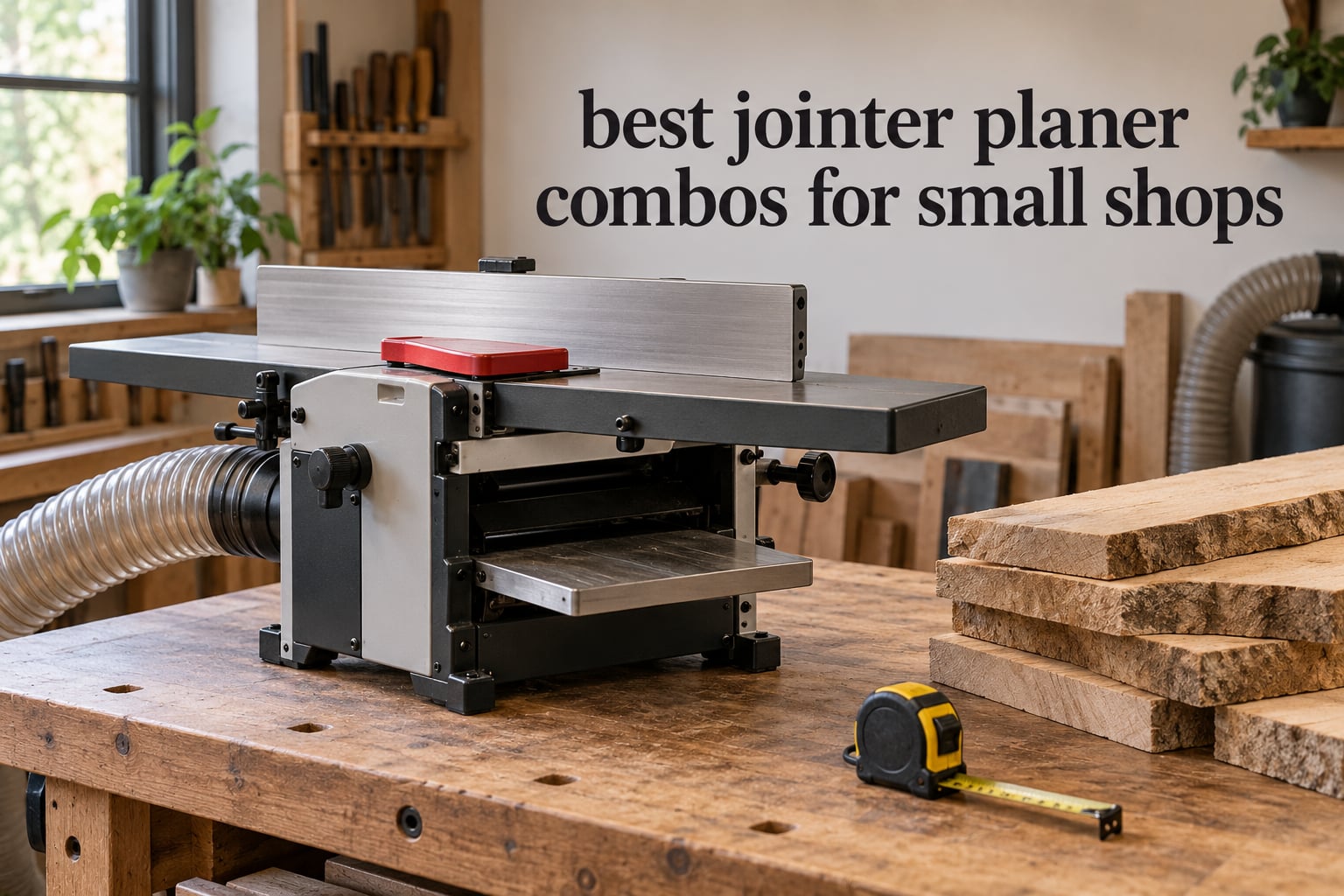
The best jointer planer combos for small shops are not the biggest machines on the market. They are the ones that fit your wall length, match the circuit already in your garage, and can be moved by one person on a Saturday. A combination machine gives you a jointer and a thickness planer sharing one cutterhead, one set of infeed and outfeed tables, and one dust port, so you buy one clearance zone instead of two.
That floor-space saving is the whole reason this category exists. Separate machines need clear floor in front of each one for the full length of your longest board, and in a one-car garage that often means a machine you cannot use without rearranging the shop every time.
I spent several weeks reading owner feedback and manufacturer specs on the combos below, and I want to be straight with you before the list: only three of the seven machines here have enough owner reviews to judge, and two of those have fewer than 20. Where owner data is thin, I say so instead of guessing. This is a category where the spec sheet and the reality often diverge, and the reviews in this roundup update as more owners report in.
Table of Contents
Are Jointer Planer Combos Worth It in a Small Shop?
Yes, for a one-person shop working with rough or dimensioned lumber, a jointer planer combo is usually worth it. The saving in floor space outweighs the changeover time and short-bed limits, as long as you batch your jointing and planing rather than alternating between them all day.
What you give up is real. A combo cannot joint and plane at the same time, and it cannot be handed to a second operator while you run another machine. Owners on woodworking forums also raise a specific complaint that the editorial roundups we studied do not address: several report that their combo had trouble staying parallel between the two functions, and one summed up the trade-off in a single line, recommending a separate benchtop planer instead. That complaint is not universal, and it is a maintenance and setup issue more than a design flaw, but you should factor it in.
The clearest rule we found: buy a combo if your longest board is roughly six feet or shorter, you are the only operator, and your shop is short on wall length. Buy separate machines if two people work at once, you work with long boards routinely, or you have room for both.
Top 3 Jointer Planer Combos for Small Shops (October 2026)

Scheppach HMS1080
- 254 mm planing width
- 1500W motor
- Two HS knives plus spares
- Compact benchtop body

Hoteche 10-Inch Combo
- 10-inch width
- 13A at 120V
- Matching stand included
- 37.3 inch jointer table

WEN PL1337 and JT630H Bundle
- 13-inch planer width
- Two feed rates
- Spiral cutterheads on both machines
- 45 degree beveling fence
All 7 Jointer Planer Combos at a Glance in 2026
| Product | Specifications | Action |
|---|---|---|
|
Scheppach HMS1080
|
|
Check Latest Price |
|
Hoteche 10-Inch Combo
|
|
Check Latest Price |
|
WEN PL1337 and JT630H Bundle
|
|
Check Latest Price |
 FORESTWEST BM10420H
|
|
Check Latest Price |
 Yokoma 220V Benchtop Combo
|
|
Check Latest Price |
 JARYANNIX 8-Inch 220V Combo
|
|
Check Latest Price |
 Acivirdde 1500W Benchtop Combo
|
|
Check Latest Price |
1. Scheppach HMS1080 – the best overall pick for a one-person shop
Scheppach Planer & Jointer HMS1080 | Power 1500W | Planing Width 254 mm | Pass Height: 120 mm | Iron Rotation Speed 9000 min-1 | Plus 2 Extra Irons
254 mm planing width
1500W motor
9000 RPM
37.8 inch body
Pros
- Compact footprint for tight shops
- Cranks make height changes simple
- Two HS knives plus two spares included
- Vibration-dampening rubber feet
- 90 to 135 degree fence adjustment
Cons
- Struggles at full 254 mm width
- Boards over 2 m are hard to keep flat
- Fence must be unscrewed to fit dust extraction
The HMS1080 is the machine in this group with the most owner history behind it, and that history is genuinely mixed rather than promotional. Across 75 reviews averaging 3.9 stars, roughly half of owners give it five stars and just under a third give it four. Another 14 percent gave it one star, and that minority is where the real mechanical complaints live.
What owners consistently praise is the footprint. At 37.8 inches long and 18.11 inches wide, this is a machine you can set on a bench or a light stand against a garage wall and still have walking room, which is exactly the constraint a small shop runs into. The crank-based height adjustment is the second most-mentioned positive, since it lets you set planing depth by feel rather than by hunting a small wheel.
The weaknesses are consistent too. Owners report visible motor strain when working the full 254 mm width, which tells you the 1500W motor is comfortable at furniture-scale board widths but not at maximum capacity for long stretches. A second recurring note is that boards longer than about two meters get difficult to keep flat through the pass, largely a table-length problem rather than a power problem.
What to check before you commit to this machine
Ask yourself how long your boards actually are. If your rough lumber comes in eight-foot lengths, the two-meter limitation is a real constraint and you will want roller stands on both ends. If you are working furniture panels and hardwood stock in shorter lengths, it is a non-issue.
Second, check your electrical supply. This is a 230V machine, so it will not run on a standard 120V North American circuit without a step-down transformer, and it is not a 120V shop tool despite the European brand name being familiar from small machines.
Where it will disappoint you
The dust extraction arrangement is awkward enough that owners single it out. You have to unscrew the jointer fence to attach a hose, which is an extra step every time you change functions. Plan your dust collection around that rather than expecting a quick-connect setup.
Knife setting also takes patience. The included setting gauge reportedly needs work, so budget time for careful initial setup with a straightedge, and expect the two-knife head to want sharpening sooner than a helical head would, since the same cutterhead handles both jointing and planing duty.
2. Hoteche 10-Inch Benchtop Combo – the only 120V package with a stand
Hoteche 10-Inch Benchtop Planer and Jointer Combo with Stand 13-Amp Heavy Duty Thickness Planer for Woodworking, Adjustable Depth 0-3mm
10 inch planing width
13A at 120V
9000 RPM
Stand included
Pros
- Stand included
- no separate bench needed
- 13A motor is ample for the class
- 37.3 inch jointer table
- Cast iron base adds stability
Cons
- Ratings skew heavily toward one star
- Shallow cut per pass
- Heavy and awkward to reposition alone
- Limited documentation
What makes this one notable is that it arrives as a complete package. The matching stand is in the box, so unlike most benchtop combos you are not hunting for a separate base, and the cast iron base gives it the mass to stay put during a pass. At 36.22 inches long it still fits a normal bench footprint.
Its jointer table is the standout spec. At 37.3 by 10 inches it is longer than the 30 inch jointer table on the WEN bundle, which directly attacks the short-bed complaint owners raise across this category. If you joint stock longer than the Scheppach handles comfortably, this table is the reason to look here.
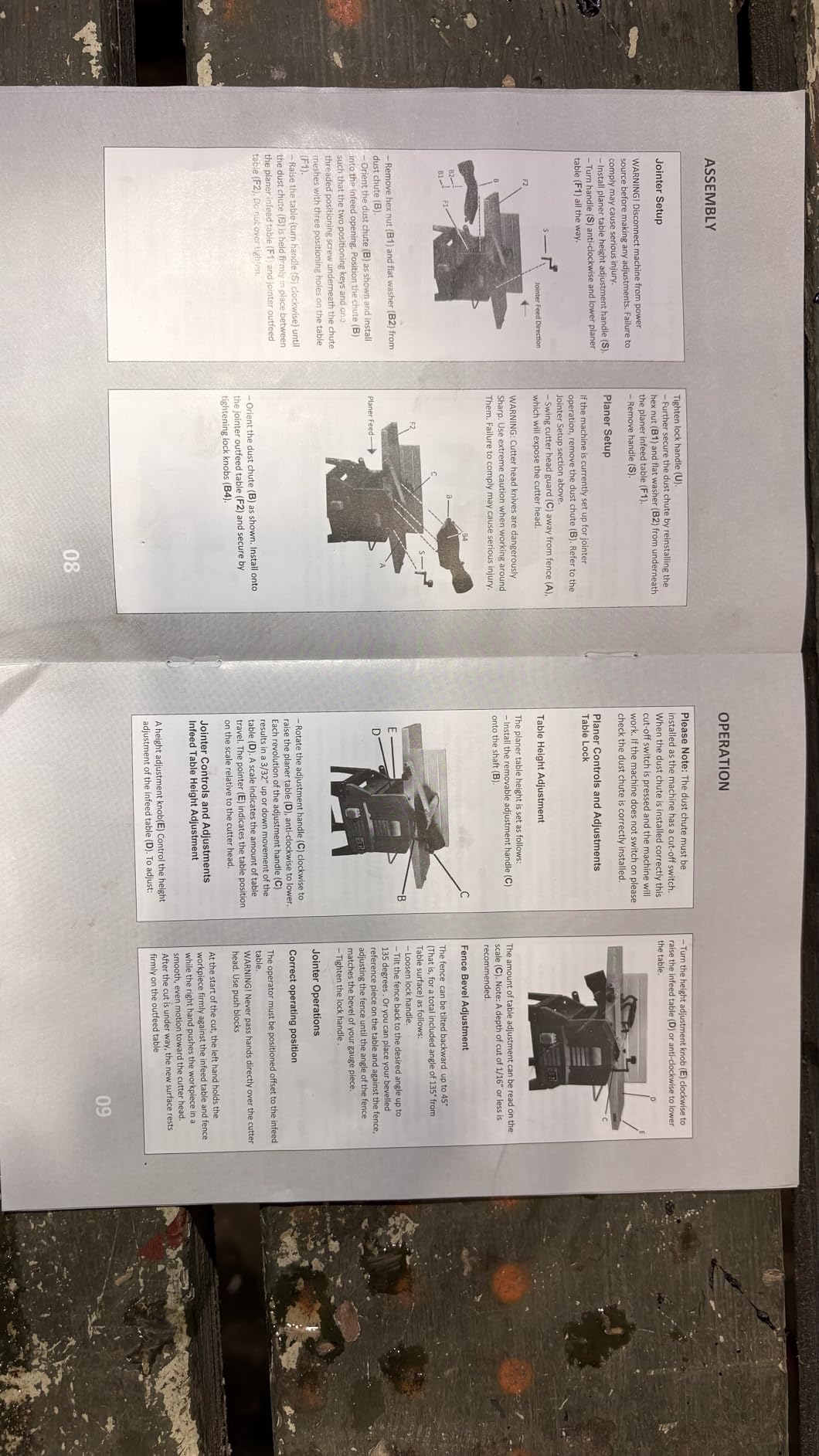
Now the honest part. The 3.5-star average across 18 reviews comes with a wide spread, and the ratings skew toward one star far more than the marketing suggests. That pattern usually points to build or assembly inconsistency from batch to batch rather than a bad design, but it is a real risk on a machine you would rely on daily. The documentation on the difference between jointer and planer mode is also thin, so plan on learning the changeover yourself.
Why the 120V rating changes the calculus
Running on 13 amps at 120V means you can put this on an existing household circuit with no electrician. The three heavy benchtop machines further down this list are 220V only, so this is the sole option here that plugs into a garage or basement circuit you already have.
The two-speed element people look for in a planer is not here, but the 6 meter per minute feed speed is more than adequate for dimensioned lumber prep. Jointer depth runs 0 to 3 mm and planer depth 0 to 2 mm, with a cutting depth range of 5 to 120 mm.
Where it will disappoint you
The listed maximum cutting depth of 0.5 inches is shallow for anyone reducing rough lumber hard in a single pass. You will be making multiple light passes instead, which is fine if you plan for it and frustrating if you expect to flatten a warped slab quickly.
Owners also report the machine is heavy and awkward to reposition alone, which undercuts the compact-shop story a little. If your setup location is not final, budget for a second pair of hands or a furniture dolly.
3. WEN PL1337 and JT630H Bundle – the finish-quality bench pairing
WEN Thickness Planer (PL1337) and Jointer (JT630H) Woodworking Machine Bundle
13 inch planing width
Two feed rates
Spiral cutterheads
30 inch jointer table
Pros
- Two feed rates trade speed for finish
- Spiral heads on both machines
- 13 inches of planing width
- 45 degree beveling fence
- Two machines for less outlay than buying separately
Cons
- Only two reviews
- so reliability is unproven
- 30 inch jointer table is short
- Two machines to align and store
This entry is not a single combination machine, and that distinction matters for how you read this list. The WEN bundle pairs a PL1337 thickness planer with a JT630H jointer as two separate bench machines sold together, which is exactly the alternative strategy several commenters in woodworking forums recommend against buying a combo.
What you get for that trade is finish quality. Both machines carry spiral cutterheads with staggered HSS blades, and the planer runs at two feed rates, 26 FPM and 16 FPM, letting you slow down for a final surface pass on figured stock. The planer handles boards up to 13 inches wide and 6 inches thick, which is wider than any single-body combination machine in this roundup.
The perfect 5-star rating comes from just two reviews, so treat it as directional rather than proven. Long-term durability data for this bundle does not exist yet, and a machine you rely on every day deserves more than a two-review track record.
When the bench pairing beats a combo
If you already have a bench and a dust collector, two bench machines can be the better answer. You can run planing and jointing at the same time, or hand the planer to a second operator, which a combo physically cannot do. Neither machine is locked into 220V-only service, which widens where you can install it.
Measure your bench depth first. Two machines means two footprints plus the same infeed and outfeed clearance in front of each, which is the space saving the combo format was supposed to deliver. If your shop is genuinely tight, that saving matters more than the finish quality gains.
Where it will disappoint you
The 30 by 6 inch jointer table is short by the standards of this group, and the bundle inherits the same short-bed complaint that runs through the category. Boards over six feet will be difficult to keep flat through a single pass without roller support at the outfeed end.
You also own two dust extract connections, two alignment setups and two maintenance schedules rather than one, and a single shared cutterhead advantage disappears. If you are willing to accept that in exchange for the finish, the two-speed feed is a genuinely useful feature most benchtop combos skip.
4. FORESTWEST BM10420H – the widest board capacity in the group
FORESTWEST 10420H, 16.4-Amp 12-Inch Jointer Planer Combo with 9,500RPM Helical Cutterhead
12 inch board width
28-blade helical head
16.4A
91 pounds
Pros
- Widest capacity of any single-body combo here
- 28-blade helical head at 9500 RPM
- 90 to 135 degree fence range
- Cast iron tables add mass
- Integrated 4 inch dust port
Cons
- No owner reviews yet
- 2.5HP will not hold depth at full width
- Ninety-one pounds of cast iron means a two-person move
This is the machine to look at if your boards run wider than eight inches. It pairs a 12-inch capacity with a 28-blade helical cutterhead turning at 9500 RPM, a combination none of the other single-body machines on this list offers. A helical head spreads cutting load across many small inserts rather than two full-width knives, which is why it produces the smoothest surfaces, and the owner in our research who ran a helical head called the finish fantastic.
The cast iron working tables and 4 inch dust port signal a machine built for volume rather than occasional use. A 90 to 135 degree fence range covers chamfers and bevels that narrower machines reach awkwardly, and a one-year warranty is included.
All of that is manufacturer specification. There are no customer reviews and no rating yet, so nothing about real-world durability is confirmed by owners. Treat the performance figures as unverified until feedback accumulates.
What the specs mean for a small shop
The 2.5HP motor will not sustain maximum depth of cut across a full 12-inch width, and the listed depth is 3 mm anyway. Plan light passes on wide rough lumber rather than expecting a full-width heavy cut, and the 16.4A draw means you need a 20A circuit.
At 91 pounds on the spec entry, with some listings showing 102 pounds, this is heavy enough that it is a two-person job on stairs. Measure your basement stairwell and your helper availability before committing.
Where it will disappoint you
You are buying a machine whose fit and finish nobody has reported on yet. On a purchase this heavy, with cast iron tables that can take a hard knock in transit, that is a meaningful amount of risk to carry with no owner history behind it.
It is also one of the widest units here, which means a long clearance requirement. Before ordering, walk the room and mark out the machine width plus your longest board on both sides, because a helical head will not help you if the machine does not fit where you need it.
5. Yokoma 220V Benchtop Combo – the ground cast iron table and protected motor
Yokoma 220V Heavy-Duty Woodworking Benchtop Jointer and Planer with Precision-Ground Cast Iron Table, Wood Surface Planer Dovetail Lifting Mechanism for Professional Woodworking 4pcs Cutting Blades
2200W copper motor
Precision-ground cast iron
Dovetail lift
Lockable casters
Pros
- Dovetail lift resists deflection under load
- Precision-ground cast iron stays flat
- Overload and thermal cut-off protection
- Lockable casters for one-person moves
- Quick-lock fence at 45 and 90 degrees
Cons
- No owner reviews or rating
- No long-term reliability record
- 220V only
- so not a 120V shop machine
Flatness is what matters most in jointing and planing, and this machine is built around holding it. The table and fences are precision-ground cast iron, and the depth adjustment runs on a dovetail-guided lifting system with graduated scales, which resists loosening under load in a way lighter mechanisms do not.
Two details stand out for small-shop use. The NHD safety electromagnetic switch monitors current and temperature and cuts out on overload, which protects an expensive motor in a shop where nobody is watching the machine. And the four lockable rotating casters mean one person can roll it aside to clean underneath, a small courtesy that matters in a tight garage.
As with the FORESTWEST, there are no customer reviews and no rating. Everything above comes from the listing’s engineering claims, and nothing has been confirmed by an owner yet.
Why the electrical requirement is the real question
This is a 220V-only machine. In a North American shop running on 120V, that means a dedicated 20A 220V circuit installed by an electrician, and that installation is a real part of the decision rather than an afterthought. If your garage or basement has only household circuits, this machine is not currently usable there.
Four cutting blades are included, and the fence locks at both 45 and 90 degrees with a sliding design that cuts setup time. Confirm the jointer-versus-planer changeover procedure with the seller before you commit, since the listing does not walk through it step by step.
Where it will disappoint you
You are paying a serious specification list, cast iron and copper windings, on the seller’s description alone with no owner history behind it. Ask the seller for a video of the machine running before you commit.
Lockable casters also mean it is not a machine you reposition casually once it is loaded with a board. Plan the position before the first cut, because moving it is a deliberate task rather than a casual one.
6. JARYANNIX 8-Inch 220V Combo – the narrow choice for 220V shops
JARYANNIX Woodworking Jointer Planer 8 Inch Heavy-Duty Benchtop Thickness Planer and Jointer Combo 220V 2.2KW with Mobile Casters for Precision Woodworking Professional Use
8 inch planing width
2.2KW 220V motor
5000 RPM
Dovetail lift
Pros
- 2.2KW copper motor holds output on wide runs
- Dovetail lift with graduated scale
- 5000 RPM suits general surfacing
- Locking swivel casters
- Chrome-plated ground table
Cons
- No owner reviews or rating
- Eight inches is a narrow capacity
- Listed dimensions are unusually large
- 220V only
Among the heavy benchtop options, this one covers eight inches of board width, which is the furniture-scale width most small shops actually cut. The 2.2KW pure copper winding motor with high heat resistance is the largest power figure on any 220V benchtop combo here, and copper windings are the part of these machines that owners in this class most often credit for holding output on long continuous runs.
The construction follows the pattern of the other heavy benchtop units: dovetail lifting structure with a clear scale on the table, a box-type integrated transmission for smooth feed, and a sliding fence with quick positioning at internal and external 45 and 90 degrees. Locking swivel casters keep a cast iron machine from creeping during a pass.
One thing to check before anything else is the footprint. The listed package dimensions of 72.2 by 72.2 by 32.2 inches are unusually large for something described as a benchtop unit, so confirm the actual machine size and package dimensions with the seller rather than planning your bench around the listing.
Matching it to a real workflow
Eight inches covers shelves, drawer parts, panel stock and most furniture components. It will not cover a full sheet of plywood edge to edge, and it will not handle wide rough lumber, so this is a machine for finished-component work rather than rough stock prep.
The 5000 RPM rotor speed is lower than the 9000 RPM figures on the lighter machines in this roundup. That is not a defect, but it does mean the finish quality on figured hardwoods will depend more on feed rate discipline than on cutterhead speed.
Where it will disappoint you
There are zero reviews and no rating, so none of the specification claims have been tested by an owner. Combined with the unusual listed dimensions, this is a purchase that needs more verification before money changes hands than any other on this list.
It is also 220V only, which rules it out of a 120V shop entirely. If your electrical service is not already up to it, the circuit work will cost more in time and money than the difference between this and a 120V alternative.
7. Acivirdde 1500W Benchtop Combo – the least documented machine here
220v Electric Bench Top 1500W Wood Thickness Planer, Jointer Planer Combo Woodworking Machine
20.4 cm planing width
1500W at 220V
9000 RPM
Stainless steel table
Pros
- Stainless table resists corrosion
- Scaled knob for repeatable depth
- Material clamp limits workpiece shift
- Integrated frame keeps it rigid
- 9000 RPM supports a clean finish
Cons
- No owner reviews or rating
- 20.4 cm width is very narrow
- 220V only
- Two-function capability unconfirmed
This machine covers 20.4 cm, about eight inches, and the listing describes a benchtop thickness planer with an integrated support frame rather than a clearly documented two-function machine. That ambiguity is the first thing to resolve with the seller before you order.
Where the details are concrete, they are sensible. A 1500W motor at 9000 RPM covers rough through to fine passes, the stainless steel worktable resists corrosion and gives moderate friction for smooth feeding, and the thickness adjustment knob carries clear scale markings for repeatable depth settings. A material clamping mechanism keeps the workpiece from shifting mid-pass.
The integrated frame means you do not need a separate stand, which helps in a tight shop. There are no customer reviews and no rating, so none of this is confirmed by owners.
Questions to ask before you buy
Confirm that the machine performs both jointing and thickness planing functions, and confirm the jointer table dimensions. A thickness planer with an integral frame is a very different proposition from a combination machine with a fence, and the listing copy does not make the distinction clearly.
It is 220V only, so a 120V shop needs rewiring or a step-down transformer before it can run. With a 20.4 cm width and no confirmed jointer function, this is the machine on the list with the least to offer a typical one-person small shop.
Where it will disappoint you
Twenty centimeters of capacity will feel small the first time you try to joint a piece of wider stock, and there is no way to work around it the way you can with a 12-inch machine and roller supports. The width is fixed at purchase.
Combined with zero owner data and a listing that does not clearly separate the two functions, this is the entry in the roundup we would most want to see independently verified before recommending it as a shop’s primary surfacing machine.
How to Choose a Jointer Planer Combo for a Small Shop
Start with the constraint you cannot change, which is usually the room. Measure the wall length available, then measure your longest board, because a machine needs clear floor in front of the infeed table and behind the outfeed table for the full length of that board. You need that clearance once for a combo, not twice. This is the one calculation that quietly rules machines in and out, and it costs ten minutes with a tape measure.
Pick the width class that matches your stock
Eight inches covers furniture components, drawer parts and shelf stock. Ten inches adds cabinet side panels and wider boards without a large jump in footprint. Twelve inches is where you handle full-size panel stock and wider rough lumber, and it is the point where floor space and weight start to become real problems in a garage. Match the width to the widest board you intend to process regularly, not to the widest board you might someday need.
Also match the width to your table length. A 12-inch machine with a short table is a worse proposition in a small shop than a 10-inch machine with a long one, because long boards are where small shops run out of room first.
Add roller stands at both ends of the infeed and outfeed tables before you judge any of these machines on a long board. Support at the far end is what separates a pass that stays flat from one that drifts.
Choose your cutterhead before anything else
A two-knife or three-knife head uses full-width HSS blades that need sharpening on a schedule you set yourself, typically a few times a year depending on use. It is cheaper up front and the parts are easy to source, and the finish is perfectly good on straight-grained lumber.
A helical or spiral head uses many small tungsten carbide inserts spread around a cylinder. Each insert takes a light cutting load, so the surface stays smooth and edges hold their shape far longer between changes, at the cost of a higher purchase and more expensive consumables. Owners with helical heads in this category consistently describe the finish as the reason they would not go back.
One thing to know about both: a combo uses one cutterhead for two jobs, so wear accumulates faster than on separate machines. Whatever head you choose, budget sharpening or insert rotation into your maintenance calendar from the start.
Match the machine to your circuit
120V machines drawing 13 amps will run on a standard household circuit with no electrical work. That is a decisive advantage in a garage or basement that has never had anything more demanding plugged into it, and it is why the 10-inch package in this roundup appeals to more buyers than its spec sheet alone suggests.
220V machines need a dedicated 20A circuit installed properly. Have the electrician run it before the machine arrives, and plan the circuit location near the machine’s final position rather than where you think you might put it.
Reduce changeover friction in a one-person shop
The honest weakness of a combo is the switch between functions, which takes roughly forty seconds each time. In a one-person shop that adds up fast if you alternate. Batch instead: run all your jointing for a project, then all your planing, and only change over when a stage is finished. Keep a short checklist of the changeover steps for your specific machine and tape it to the stand, because the first few times are always slower than they need to be.
Buying used, and what to check
Used is a common route for small shops, and a helical-head combo holds value well. Inspect the table surfaces for flatness with a straightedge first, then check that the fence runs square at 45 and 90 degrees, and finally confirm the depth adjustment holds under load. Run a test pass on a scrap board and look for witness marks that indicate the table is dished. Ask whether the blades or inserts are original, because replaced ones tell you the previous owner was maintaining it, and confirm that parts are still available for that model before you commit.
The one recurring owner complaint worth weighing is loss of parallelism between the jointing and planing functions, and it is a maintenance issue as much as a design one. Check both functions on a known-flat board before you trust either one, and re-check after any fence or table adjustment.
Frequently Asked Questions
Are planer jointer combos worth it?
For a one-person shop working with rough or dimensioned lumber, yes. A combination machine gives you both functions in one infeed and outfeed zone, which frees the wall length two separate machines would need. The trade is changeover time, a table that limits long stock, and the inability to run both functions at once. Buy separate machines if two operators work simultaneously or you process long boards regularly.
What is the best planer for a small workshop?
Most small workshops are best served by a benchtop thickness planer between 12 and 13 inches wide paired with a separate jointer, or by a combination machine in the 8 to 10 inch class. Benchtop machines fit a normal bench, run on household circuits in the 120V models, and are easier to move. If your shop is genuinely short on wall length, a combination machine beats separate units on floor space alone.
What is the best 8-inch jointer for small shops?
There is no 8-inch jointer planer combination in this roundup with strong owner review history beyond the Scheppach HMS1080, which covers 254 mm, or about 10 inches, and carries 75 owner reviews at a 3.9 average. Among true 8-inch machines, the JARYANNIX unit covers 8 inches but has no owner reviews yet, so judge it on specification rather than reported experience.
What is the best jointer planer combo for the money?
The Hoteche 10-inch package is the strongest value in this group because the stand is included, it runs on a 13A 120V household circuit with no electrical work, and the 37.3 inch jointer table is longer than most benchtop combos. Its 3.5-star average across 18 reviews reflects real assembly inconsistency, so inspect the machine on arrival rather than assuming the good examples are the rule.
What is the most affordable jointer for a small shop?
For a small shop, the most affordable path is usually a benchtop combination machine in the 120V class that includes a stand, since a separate stand can add more than you expect. The Hoteche 10-inch package fits that description. The used market is the other common route, and a helical-head combo holds its value well, provided you check table flatness with a straightedge and verify both functions stay parallel on a test pass.
How does a jointer planer combo work?
A combination machine shares one cutterhead between both functions. In jointer mode the cutterhead flattens one face and squares an edge against the fence. To switch, you unlock and raise the jointer table, reposition the dust hood, set the planer height to your target thickness, engage the feed rollers and run the board through for consistent thickness. The whole change takes roughly forty seconds.
The Best Jointer Planer Combos for Small Shops in 2026
The Scheppach HMS1080 is our pick for the best jointer planer combos for small shops in 2026, because it has the deepest owner review history in the group, a footprint that fits a tight garage, and a 1500W motor that handles furniture-scale stock comfortably. If your shop has only 120V service, the Hoteche 10-inch package is the alternative, and it arrives with the stand already included.
For wider boards and a smoother finish, look at the FORESTWEST 12-inch helical-head machine, with the understanding that no owner has reported on it yet. Measure your clearance and check your circuit before any of these arrive, because those two facts eliminate more machines than any spec on the list.