
Somewhere beneath the soil of nearly 70 countries, an estimated 110 million landmines remain buried and active. Most were planted during wars that ended decades ago, yet they continue to kill or injure thousands of civilians every single year. Understanding how landmines are cleared after a conflict reveals one of the most painstaking and dangerous humanitarian operations on earth.
Humanitarian demining is not the same as military breaching. Military forces clear a narrow path through a minefield as fast as possible, accepting residual risk. Humanitarian deminers must remove every single mine to a certified depth so civilians can farm, build, and live on that land again. The work follows five stages: survey, marking, detection, excavation, and destruction.
I spent weeks studying reports from the United Nations Mine Action Service (UNMAS), the HALO Trust, and firsthand accounts from deminers who have worked in Cambodia, Afghanistan, and Ukraine. Here is what I learned about the process, the people, and why it will take centuries to finish the job at the current pace.
Table of Contents
What Is Humanitarian Demining?
Demining, also called mine clearance, is the process of finding and safely removing landmines and explosive remnants of war from an area so civilians can use it again. It is one of the five pillars of mine action recognized by the United Nations, alongside risk education, victim assistance, stockpile destruction, and advocacy for the Mine Ban Treaty.
The distinction between military and humanitarian clearance matters. Military engineers use armored vehicles, plows, and explosive charges to blast a lane through a minefield in minutes. Humanitarian deminers crawl across the same ground inch by inch, sometimes taking an entire day to clear just 20 to 50 square meters. The difference is precision: humanitarian clearance certifies that the land is genuinely safe for a farmer to plant rice or a child to walk to school.
According to the Landmine Monitor 2026, at least 6,279 people were killed or injured by landmines and explosive remnants of war in 2024 alone. Most victims are civilians, and a disproportionate number are children. Around 60 million people live in affected areas, unable to use farmland, access roads, or return to their homes.
The work falls to a network of organizations: UNMAS coordinates overall strategy; specialized NGOs like the HALO Trust, MAG (Mines Advisory Group), and Norwegian People’s Aid carry out field clearance; and national mine action centers manage operations in individual countries. APOPO trains giant African pouched rats to detect mines using scent, and the Cambodian Mine Action Center (CMAC) has become a global training hub.
How Landmines Are Cleared: The 5 Stages of Mine Clearance
Every humanitarian clearance operation follows the same five-stage framework defined by the International Mine Action Standards (IMAS). Understanding these stages shows why the work is so slow, expensive, and dangerous.
Stage 1: Non-Technical Survey
A non-technical survey is research without entering the suspected area. Survey teams interview local residents, study old military maps, review conflict records, and visit the edges of suspected hazardous areas to gather evidence. The goal is to identify where mines might exist and, crucially, to release land that was incorrectly suspected of contamination.
This stage can dramatically reduce the workload. In many countries, non-technical surveys have shown that large swaths of land marked as “mined” on outdated maps never actually contained mines. Releasing that land without requiring expensive physical clearance frees up resources for the areas that genuinely need them.
Stage 2: Technical Survey
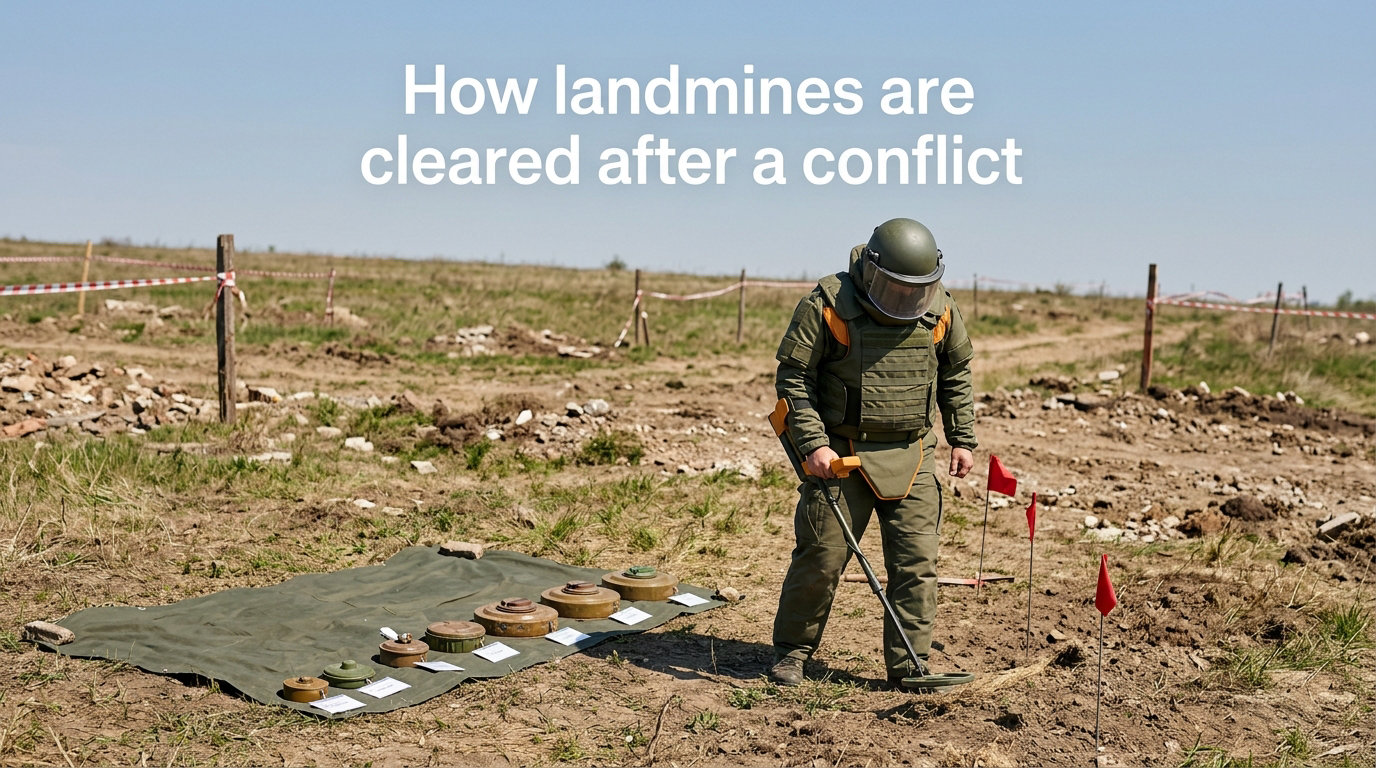
Once a suspected hazardous area is confirmed as potentially mined, a technical survey team enters the site. They walk in disciplined formation, using metal detectors to scan shallow strips of ground. They mark the boundaries with colored tape or posts, record GPS coordinates, and take samples to understand the soil type and likely mine types present.
The technical survey produces a detailed map of the contaminated area. This map tells the clearance team what they are dealing with: the type of mines, the density of mines per square meter, the terrain, and any obstacles like vegetation or structures.
Stage 3: Detection
Detection is the core of clearance. Deminers use metal detectors, mine detection dogs, mechanical equipment, or emerging technologies like ground-penetrating radar to locate individual mines. The method depends on the terrain, the type of mines, and available resources.
Most detection happens through hand-held metal detectors. A deminer walks slowly across the cleared lane, sweeping the detector in an arc close to the ground. Every signal, no matter how small, must be investigated. A Cambodian study found that 99.6 percent of metal detector signals turn out to be harmless scrap metal. But the remaining 0.4 percent can kill.
Stage 4: Excavation
When a detector signals, the deminer marks the spot and begins the most dangerous phase: excavation. Kneeling or lying prone, the deminer uses a wooden or plastic prodder to probe the soil at a shallow angle, carefully working around the suspected object. The prodder technique is deliberately gentle: too much pressure could detonate an anti-handling device.
The goal is to expose enough of the mine to identify it without disturbing the detonation mechanism. Once the mine is visually confirmed, the deminer decides whether to remove it for safe disposal or destroy it in place. This phase accounts for most deminer casualties. Eddie Chaloner, a UK vascular surgeon who volunteered with HALO Trust in Afghanistan and Iraq, described witnessing two separate mine blast incidents during his deployments.
Stage 5: Destruction or Disposal
After a mine is safely exposed, it must be neutralized. Deminers have two options. Controlled detonation uses a small explosive charge placed next to the mine to destroy it on the spot. This is safer but damages the surrounding soil and creates a crater. Alternatively, carefully extracted mines are carried to a designated demolition site for batch destruction.
Some mines can be disarmed by trained explosive ordnance disposal (EOD) technicians who remove the fuse or detonator. This is the least common method because it carries extreme risk. Most clearance operations prefer in-situ destruction to minimize handling.
Manual Demining: The Primary Clearance Method
Manual demining remains the backbone of humanitarian clearance worldwide. Despite advances in technology, no machine or animal matches the precision of a trained human with a metal detector and a prodder.
A typical manual deminer wears full personal protective equipment: a blast-resistant visor, body armor, and reinforced gloves. They work within a pre-marked lane, moving forward on their knees while sweeping a metal detector from side to side. The detector covers a strip roughly 1.5 meters wide. Every signal triggers the probing process.
The daily clearance rate for manual demining is painfully slow: between 20 and 50 square meters per day depending on soil type, vegetation, and mine density. In heavily contaminated areas like Cambodia’s border regions, a single deminer might spend an entire day clearing a patch smaller than a tennis court. The HALO Trust reports that its teams have cleared over 304,592 hectares across multiple countries, but the global backlog remains enormous.
The psychological toll is significant. Deminers must maintain absolute concentration for hours at a time. A moment of fatigue or carelessness can be fatal. False positives from metal fragments cause frustration: some deminers report digging up hundreds of pieces of harmless scrap before finding an actual mine. Forum discussions among EOD professionals highlight that the excavation phase, not detection, is where the real danger lies. Getting a mine out of the ground by hand is the highest-risk moment of the entire clearance process.
Mine Detection Dogs: Faster but Not Perfect
Mine detection dogs (MDDs) offer a faster alternative to metal detectors in certain conditions. A trained dog can screen 1,500 square meters per day, roughly 30 to 75 times the area a manual deminer covers. Dogs work by detecting the chemical scent compounds that leak from landmine casings into the soil.
German Shepherds, Belgian Malinois, and Labrador Retrievers are the most common breeds used. Training takes four to six months, and dogs work in partnership with a handler who reads their behavioral changes when they detect explosive scent. The dog signals by sitting or lying down at the location of the scent, which is then marked for manual investigation.
The accuracy of detection dogs varies. In ideal conditions with well-maintained soils and familiar mine types, dogs can achieve detection rates above 95 percent. In hot, humid climates where scent disperses quickly, or in areas with high ground moisture, accuracy drops significantly. A major study found that dogs are most effective in temperate climates with dry, sandy soils.
APOPO, a Belgian nonprofit, pioneered the use of HeroRATs: giant African pouched rats that weigh about 1.3 kilograms and are too light to trigger anti-personnel mines. The rats can screen 200 square meters in 20 minutes, a task that would take a human deminer four days. APOPO has deployed HeroRATs in Cambodia, Angola, and Mozambique, where they have helped clear thousands of mines.
A newer technique called Remote Explosive Scent Tracing (REST) uses dogs or rats to screen soil samples collected from suspected areas in a laboratory setting. This removes the animals from the hazardous area entirely. REST is particularly useful for confirming that cleared land is genuinely safe before certifying it for civilian use.
Mechanical Clearance and Emerging Technology
Mechanical clearance uses armored vehicles fitted with flails, tillers, or rollers to process large areas quickly. A flail machine swings a series of heavy chains with steel balls attached, beating the ground to detonate or unearth mines. Tillers use rotating blades to churn the soil, destroying mines at shallow depths. Rollers are pushed ahead of a vehicle, triggering pressure-activated mines by simulating the weight of a person or vehicle.
Machines clear 1,000 to 4,000 square meters per hour depending on the equipment and terrain. That speed makes them ideal for preparing large areas before manual teams move in. However, machines cannot guarantee 100 percent clearance. They struggle with uneven terrain, dense vegetation, and deep-buried mines. After a machine pass, manual deminers still need to verify the ground.
Ground-penetrating radar (GPR) is the most promising emerging detection technology. GPR sends radio pulses into the ground and measures the reflected signals to create a subsurface image. Unlike metal detectors, GPR can locate plastic-cased mines that contain little or no metal. The US military’s HSTAMIDS system combines a metal detector with GPR in a single handheld device, significantly reducing false alarm rates.
Unmanned aerial vehicles (drones) equipped with hyperspectral cameras and thermal sensors are being tested for survey work. These drones can scan large areas from the air, identifying soil disturbances and chemical signatures that indicate buried mines. While drones cannot replace ground-level clearance, they can dramatically speed up the survey phase and help prioritize which areas need attention first.
Researchers are also experimenting with biological detection methods beyond rats. Elephants have shown the ability to detect TNT through their highly sensitive trunks. Bees can be trained to associate the scent of explosives with a food reward and will extend their proboscises when they detect it. The Arabidopsis plant, a relative of mustard, has been genetically modified to change color when exposed to nitrogen dioxide released by decomposing mines.
Where Landmines Remain: The Most Contaminated Countries
Landmine contamination is concentrated in countries that experienced prolonged conflict during the late 20th and early 21st centuries. Some of the most affected nations include:
Cambodia remains one of the most heavily mined countries on earth. Between 4 and 6 million mines were laid during the Khmer Rouge era and the Vietnamese occupation. The country has cleared millions of mines since 1992, but contamination persists along the Thai border and in remote rural areas. Cambodia’s CMAC has become a global training center, sending demining experts to Ukraine and other conflict zones.
Afghanistan has suffered four decades of continuous conflict, leaving an estimated 630,000 mines and millions of pieces of unexploded ordnance scattered across the country. The HALO Trust operates one of its largest programs there, employing thousands of local staff to clear agricultural land and road corridors.
Ukraine became the most urgent demining challenge after the 2022 Russian invasion. An area estimated at 174,000 square kilometers, roughly the size of Syria, is contaminated with mines, cluster munitions, and other explosive remnants. Ukrainian farmers have improvised remote-controlled mine-clearing machines by welding parts from destroyed Russian military vehicles onto tractors. The mine-detection dog Patron became a national symbol during the conflict, and Vietnamese and Cambodian demining experts traveled to Ukraine in 2023 to share their knowledge.
Angola’s 27-year civil war left the country littered with mines, particularly around former battlefields and border areas. HALO Trust and other organizations have made significant progress, but rural communities still live with the threat. Bosnia and Herzegovina, more than 30 years after the Yugoslav Wars, still has approximately 80,000 mines remaining in the ground.
The Economics of Mine Clearance
The economics of landmines are grim. A basic anti-personnel mine costs between 3 and 75 dollars to manufacture and lay. Removing that same mine costs between 300 and 1,000 dollars. This staggering asymmetry means that the countries least able to afford clearance are often the ones that need it most.
Clearance is funded through a combination of international donors, affected-state budgets, and treaty-mandated contributions. The Ottawa Convention, also known as the Mine Ban Treaty, requires signatory states to clear all mines within 10 years of ratification. Few have met that deadline. Many countries have requested extensions, and some, like Afghanistan and Myanmar, have not signed the treaty at all.
At the current global clearance rate of roughly 100,000 mines per year, it would take approximately 500 years to remove all existing mines. That calculation assumes no new mines are laid, which is unfortunately not the case. Several ongoing conflicts continue to plant new mines, and improvised explosive devices (IEDs) add to the contamination.
The cost of inaction is far higher than the cost of clearance. Each landmine casualty generates medical expenses, lost productivity, and community trauma that far exceed the cost of removing the mine. The Mine Ban Treaty, which entered into force in 1999, has helped reduce the number of countries producing anti-personnel mines from 54 to fewer than 10. But the legacy of decades of mining will persist for generations.
Frequently Asked Questions
How long does it take to clear a country of landmines?
There is no fixed timeline. Cambodia has been clearing mines since 1992 and still has contaminated areas. At the current global clearance rate of roughly 100,000 mines per year, it would take approximately 500 years to remove all existing mines worldwide, assuming no new mines are laid.
How much does it cost to remove a single landmine?
Removing one landmine typically costs between 300 and 1,000 dollars, compared to just 3 to 75 dollars to manufacture and plant one. This 10-to-1 cost asymmetry makes clearance one of the most expensive humanitarian operations in the world.
What kind of detector is used to find landmines?
The most common detector is a hand-held metal detector that uses electromagnetic induction to locate metallic components in buried mines. Ground-penetrating radar (GPR) is increasingly used alongside metal detectors, especially for detecting plastic-cased mines with minimal metal content. Mine detection dogs and giant pouched rats (HeroRATs) detect chemical scent compounds from explosive materials.
Can a landmine be disarmed without exploding it?
Yes, but it is extremely dangerous and rarely done in humanitarian clearance. Explosive ordnance disposal (EOD) technicians can sometimes remove the fuse or detonator from a mine, but most clearance operations prefer controlled detonation or in-situ destruction because handling a live mine carries too much risk.
Why is Cambodia so heavily contaminated with landmines?
Cambodia’s mine contamination dates to the Khmer Rouge era (1975-1979) and the subsequent Vietnamese occupation, during which an estimated 4 to 6 million anti-personnel mines were planted along borders, around military positions, and in agricultural areas to control population movement. Decades of conflict and the lack of accurate minefield records have made clearance especially challenging.
Which country has the most unexploded landmines?
Exact numbers are difficult to verify, but Afghanistan, Cambodia, and Angola are among the most heavily contaminated countries. Ukraine has rapidly become a major contamination zone since the 2022 Russian invasion, with an estimated 174,000 square kilometers affected by mines, cluster munitions, and explosive remnants of war.
Conclusion
Understanding how landmines are cleared after a conflict reveals the scale of a crisis that most people never see. The five-stage process: survey, marking, detection, excavation, and destruction, is slow, expensive, and deadly dangerous for the deminers who carry it out. At the current pace, it will take roughly 500 years to remove every mine in the ground.
The organizations doing this work, from the HALO Trust and UNMAS to APOPO’s HeroRATs and national mine action centers, deserve far more attention and funding than they receive. Every mine removed is a life saved, a field restored, and a community that can rebuild. The Mine Ban Treaty has reduced production, but the legacy of decades of mining demands a response that matches its scale.