
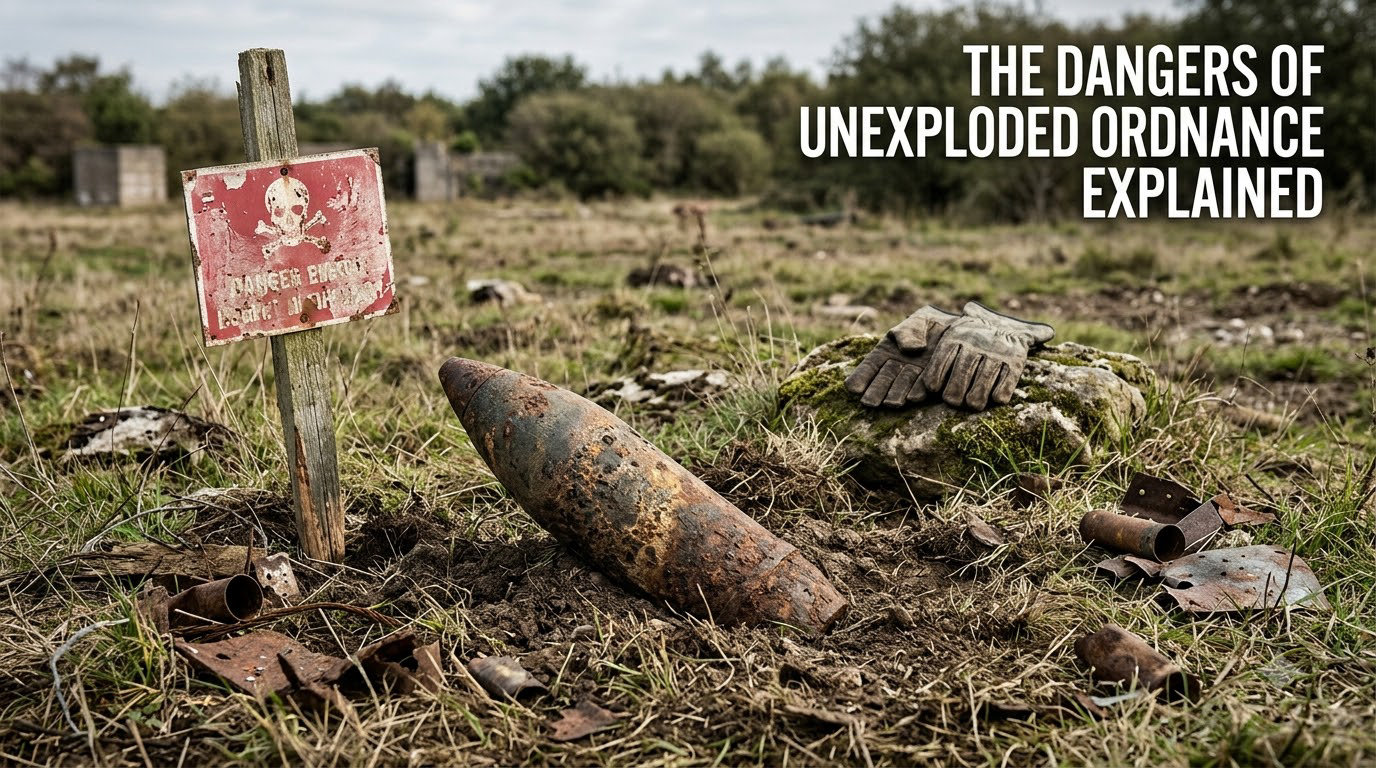
Every year, thousands of people are killed or injured by weapons that were dropped, fired, or deployed decades ago but never detonated. Unexploded ordnance—bombs, shells, landmines, and grenades left behind by past conflicts—continues to claim lives across every continent. Between 1999 and 2008 alone, unexploded ordnance caused over 2,184 casualties in Laos, with children accounting for roughly half of all victims since 1975.
The dangers of unexploded ordnance extend far beyond the initial blast zone. These weapons contaminate soil and groundwater, block agricultural land, derail construction projects, and create psychological trauma in communities that live alongside them. Whether you’re a civilian in a former conflict zone, a construction worker breaking ground, or a firefighter responding to a wildfire, understanding what unexploded ordnance is and how to respond could save your life.
Table of Contents
What Is Unexploded Ordnance?
Unexploded ordnance (UXO) refers to explosive military munitions—such as bombs, artillery shells, grenades, landmines, and cluster submunitions—that failed to detonate when deployed but remain live and dangerous. These weapons retain their explosive filler, fuzing mechanism, and detonator, meaning they can still explode if disturbed, sometimes decades after they were originally used.
The term is often used interchangeably with “explosive remnants of war” (ERW), though ERW is a broader category that includes abandoned munitions and other military debris. In practical terms, any piece of military explosive hardware that was not deliberately detonated and remains potentially lethal qualifies as unexploded ordnance.
UXO exists on every continent. An estimated 80 million landmines are scattered across 60+ countries. Millions of tons of unexploded bombs remain buried across European farmland from World War II. Southeast Asia still carries the burden of millions of cluster bomblets dropped during the Vietnam War era. Iraq, Syria, Ukraine, and Afghanistan all face massive UXO contamination from recent conflicts.
Types of Unexploded Ordnance
UXO comes in many forms, each with unique risks and characteristics. Here are the most common types encountered worldwide:
Aerial bombs. Large aircraft-dropped munitions, often weighing hundreds of pounds. WWII-era bombs are still being discovered across Europe and the Pacific, and their explosive filler remains potent decades later.
Artillery shells. Projectiles fired from cannons and howitzers. These range from small-caliber rounds to massive naval shells. Duds are common—failure rates in some conflicts reached 10-30%.
Landmines. Buried or surface-placed explosive devices designed to detonate when triggered by pressure, movement, or proximity. Anti-personnel mines specifically target people and remain active for decades.
Cluster munitions and submunitions. Weapons that release dozens or hundreds of smaller bomblets. Submunitions (also called “bomblets”) have notoriously high failure rates—sometimes 20-40% fail to detonate, scattering live explosives over wide areas.
Grenades. Hand-thrown or launched explosive devices. Old military grenades are frequently found in attics, garages, and former military sites.
Mortars. Short-range explosive projectiles. Mortar rounds are common finds on former battlefields and training ranges.
Naval mines. Large underwater explosive devices designed to damage ships. Unexploded naval mines remain in harbors and coastal waters worldwide.
Why Unexploded Ordnance Is So Dangerous
UXO presents multiple categories of risk that affect individuals, communities, and entire nations:
Lethal threat to civilians. UXO is designed to kill or maim. Even decades-old munitions retain full explosive power. In many post-conflict countries, civilians—including farmers tilling fields, children playing outdoors, and construction workers digging foundations—are the primary victims. Unlike active military personnel, civilians typically have no training in recognizing or avoiding explosive hazards.
Environmental contamination. Explosive compounds leach into soil and groundwater over time. TNT, RDX, and perchlorate contaminate drinking water supplies and agricultural land. Perchlorate—a common component in military propellants—has been detected in groundwater near former military bases and training ranges at levels exceeding safety standards.
Economic disruption. UXO blocks agricultural land, halts construction projects, delays infrastructure development, and depresses property values. In countries like Laos, Cambodia, and Vietnam, vast tracts of fertile land remain uncultivated because of contamination. Even in wealthy nations, UXO discoveries cause expensive project delays—a single WWII bomb find in a European city can shut down entire neighborhoods for days.
Humanitarian crisis. UXO creates long-term fear and psychological trauma in affected communities. Parents restrict children’s movements, farmers avoid productive land, and entire villages live with the knowledge that death lies just beneath the surface. The HALO Trust estimates that landmines alone kill or injure 15-20 people every day.
How Old Ordnance Becomes More Dangerous Over Time
Counterintuitively, unexploded ordnance often becomes more dangerous as it ages, not less. This happens through two primary mechanisms:
Chemical fuze deterioration. Many WWII-era bombs used chemical delay fuzes containing celluloid discs and acetone. As these components age, they can become unpredictable. A fuze designed to delay detonation by seconds might become so unstable that the slightest vibration could trigger it. In 2010, three veteran German EOD technicians—each with 600-700 prior successful disarms—were killed by a 65-year-old WWII bomb with an unstable chemical fuze in Göttingen.
Picrate formation. When explosive filler (such as TNT) corrodes in the presence of metals like lead or copper, it can form picric acid salts called picrates. Picrates are far more sensitive to friction, impact, and heat than the original explosive compound. A bomb that was relatively stable when manufactured may have become hypersensitive after decades underground.
Corrosion and casing degradation. As the metal casing rusts and weakens, the explosive contents become more exposed and more vulnerable to environmental triggers. Temperature fluctuations, ground movement, and even the vibrations from nearby construction or traffic can potentially trigger detonation.
In October 2024, a WWII bomb that had been buried undetected for nearly 80 years detonated spontaneously beneath a taxiway at Miyazaki Airport in Japan. The explosion left a large crater, cancelled more than 80 flights, and served as a stark reminder that old ordnance does not become inert with time.
Where You Might Encounter Unexploded Ordnance
UXO contamination is more widespread than most people realize. Here are the most common locations:
Former conflict zones. Anywhere major fighting occurred—Europe, North Africa, Southeast Asia, the Middle East, and increasingly Ukraine—is likely contaminated. Battlefields from WWI and WWII continue to yield ordnance during farming, construction, and archaeological work.
Military training ranges. Even “friendly” training areas accumulate UXO over decades. Camp Pendleton in California, for example, has required ongoing clearance operations to address training munitions used over generations.
Construction sites. Developers in European cities routinely encounter WWII bombs during excavation. Berlin, London, Hamburg, and other heavily bombed cities have dedicated UXO survey protocols for any major construction project.
Agricultural land. Farmers in Laos, Cambodia, Vietnam, Angola, and many other countries regularly plow up live munitions. The soil can push ordnance to the surface over time through freeze-thaw cycles and erosion.
Coastal and harbor zones. Unexploded naval mines, torpedoes, and aerial bombs rest on the seabed near ports and along shipping lanes. These can be disturbed by fishing trawlers, anchor drags, or construction.
Wildfire zones. When wildfires burn through former military training areas, the heat can trigger buried UXO to detonate. Firefighters in parts of the western United States face this specific hazard.
The 3 Rs of UXO Safety: Recognize, Retreat, Report
The official military safety protocol for encountering unexploded ordnance is the “3 Rs”—Recognize, Retreat, Report. This protocol is endorsed by the U.S. Army, U.S. Marines, the EPA, and international demining organizations:
Recognize. Learn to identify potential UXO. Look for unusual metallic objects, especially those with fins, cylindrical shapes, or military markings. Rusty, corroded objects are not harmless—remember that old ordnance becomes more dangerous with age. Common misidentifications include old pipes, construction debris, and scrap metal that turn out to be live munitions.
Retreat. If you encounter a suspicious object, stop immediately. Do not touch it, kick it, pick it up, or attempt to move it. Do not take photos from close range. Back away carefully along the same path you came in. Move at least 300 meters (1,000 feet) away if possible. Keep others away from the area.
Report. Call emergency services (911 in the U.S., 112 in Europe, or your local emergency number) immediately. Describe the object’s location, size, shape, and any markings if you observed them from a safe distance. Do not return to the area until cleared by authorities.
What NOT to do:
Never touch, move, or attempt to disarm suspicious objects—even if they appear old, rusty, or harmless. In 2008, a Civil War enthusiast was killed attempting to disarm a 34kg naval shell in his Virginia driveway. Even trained EOD professionals with decades of experience have been killed by aging ordnance.
Never use metal detectors in former conflict zones without proper training and local knowledge. Metal detecting hobbyists regularly discover live munitions and sometimes trigger them.
Never burn debris near suspected UXO areas. Heat can trigger detonation of buried ordnance.
How Unexploded Ordnance Is Detected and Removed
Clearing UXO is painstaking, dangerous work performed by specialized Explosive Ordnance Disposal (EOD) teams and humanitarian demining organizations like the HALO Trust and UNMAS. Detection and removal typically follows this process:
Historical research and risk assessment. Before any physical search, teams study military records, aerial photographs, bombing mission logs, and local knowledge to identify areas likely to contain UXO. This narrows the search area and informs the type of ordnance expected.
Geophysical survey. Detection technologies include ground-penetrating radar (GPR), which creates subsurface images; magnetometers, which detect metallic objects; and electromagnetic induction systems. Modern surveys increasingly use drone-mounted sensors to cover large areas quickly and safely.
Visual inspection. Trained teams systematically walk designated lanes, visually scanning for exposed ordnance, disturbed soil, or suspicious shapes. This is especially effective in areas where erosion or farming has pushed objects toward the surface.
Excavation and identification. When a potential UXO is detected, technicians carefully excavate by hand to expose the object and determine its type, condition, and fuze status. This is the most dangerous phase of the operation.
Render safe or controlled detonation. Depending on the type and condition, EOD technicians either carefully remove and disarm the ordnance or perform a controlled detonation on-site. Some items are too unstable to move and must be destroyed where they lie.
Advances in technology are improving both the speed and safety of UXO clearance. AI-assisted analysis of geophysical data can identify likely UXO signatures with greater accuracy. Remote-controlled robots and drones can approach and inspect suspicious objects without putting human technicians at risk. However, the scale of global contamination—estimated at hundreds of millions of items—means clearance will continue for generations.
Notable Unexploded Ordnance Incidents
These real-world events illustrate the ongoing danger of UXO and the importance of awareness:
Göttingen, Germany (2010). During the attempted defusal of a 1,100-pound WWII-era bomb, three experienced EOD technicians were killed when the bomb’s deteriorated chemical fuze detonated unexpectedly. The incident shocked Germany and highlighted that even experts with extensive track records face fatal risks from aging munitions.
Miyazaki Airport, Japan (October 2024). A buried WWII bomb spontaneously detonated beneath an active airport taxiway, creating a large crater and cancelling over 80 flights. The bomb had lain undetected for nearly 80 years. No injuries occurred only because the detonation happened during a gap in flight operations.
Camp Pendleton, California (2013). Four U.S. Marines were killed during a routine UXO clearing operation. The accident involved grenades being passed hand-to-hand—a practice that was permitted but discouraged due to inherent risks.
SS Richard Montgomery, Thames Estuary. A WWII American cargo ship that sank in 1944 with 1,400 tons of explosives aboard remains on the seabed off the coast of England. The munitions have been slowly deteriorating for 80 years. If the ship’s cargo were to detonate, the explosion would cause catastrophic damage to nearby communities. The wreck is continuously monitored but deemed too dangerous to move.
Laos (ongoing). Laos remains the most heavily bombed country per capita in history. Between 1964 and 1973, the U.S. dropped over 2 million tons of ordnance on Laos, including an estimated 270 million cluster bomblets. Up to 30% failed to detonate. Since the war ended, over 20,000 people have been killed by UXO in Laos, with children disproportionately affected.
Frequently Asked Questions
What does unexploded ordnance mean?
Unexploded ordnance (UXO) refers to explosive military weapons—such as bombs, shells, grenades, landmines, and cluster munitions—that failed to detonate when deployed but remain live and capable of exploding. These weapons retain their explosive filler and detonation mechanisms, making them dangerous indefinitely.
How long can unexploded ordnance remain active?
Unexploded ordnance can remain active and dangerous for many decades. WWII-era bombs are still being discovered and causing casualties in 2026. Corrosion can actually make old UXO more sensitive over time, as chemical compounds in the explosive filler and fuzing mechanisms deteriorate unpredictably.
What should you do if you find unexploded ordnance?
Follow the 3 Rs: Recognize the object as potential UXO, Retreat by backing away carefully along your original path, and Report to emergency services immediately. Do not touch, move, photograph up close, or attempt to disarm the object. Move at least 300 meters away and keep others clear of the area.
Which country has the most unexploded ordnance?
Laos is considered the most heavily contaminated country per capita, with an estimated 80 million unexploded cluster bomblets remaining from the Vietnam War era. France and Belgium also carry massive WWI contamination, while Germany, Japan, and the UK have extensive WWII-era UXO. More recently, Ukraine has become heavily contaminated from the ongoing conflict.
Can old unexploded ordnance still explode?
Yes, and old UXO is often more dangerous than when it was originally deployed. Chemical fuzes deteriorate unpredictably, and corrosion can form new explosive compounds like picrates that are more sensitive to disturbance than the original filler. In 2010, three experienced bomb disposal experts were killed by a 65-year-old WWII bomb in Germany.
Who is responsible for removing unexploded ordnance?
UXO removal is handled by specialized Explosive Ordnance Disposal (EOD) teams, typically military units trained for bomb disposal. Humanitarian organizations like the HALO Trust and the United Nations Mine Action Service (UNMAS) also conduct clearance operations in post-conflict countries. If you encounter suspected UXO, contact local emergency services who will coordinate with appropriate disposal teams.
Conclusion
The dangers of unexploded ordnance are real, persistent, and global. These weapons do not become safe with age—they often become more unpredictable and more sensitive. From the rice paddies of Laos to the construction sites of London, from the beaches of Normandy to the fields of Ukraine, UXO continues to kill and injure civilians every year.
If you live in or travel to an area with a history of conflict, take the time to learn the 3 Rs: Recognize, Retreat, Report. Never touch or approach suspicious objects. Support organizations like the HALO Trust and UNMAS that work to clear contaminated land. The unexploded ordnance problem will not solve itself—but awareness, caution, and sustained clearance efforts can save lives.