
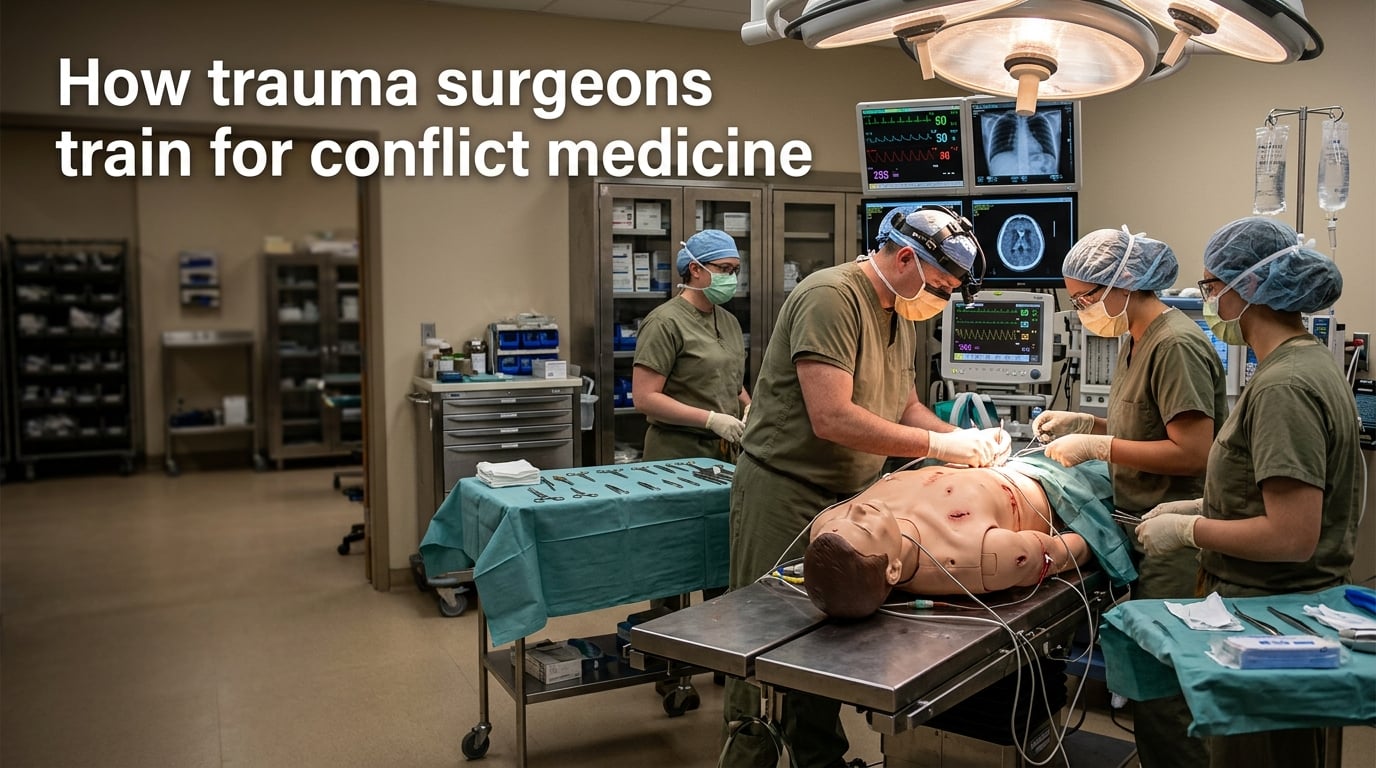
Trauma surgeons train for conflict medicine through a multi-stage pipeline that begins with medical school, continues through a five-plus-year general surgery residency, and culminates in fellowships, military-specific courses (TCCC, BATLS, ATOM, HEST), simulation labs, and rotations at high-volume civilian Level I trauma centers. By the time a surgeon deploys with a Forward Surgical Team, they have typically invested 12 to 15 years in structured training and ongoing skill sustainment.
I have spent weeks going through Army Medicine policy documents, the David Nott Foundation’s published curriculum, peer-reviewed papers in Military Medicine, and first-person surgeon accounts from Ukraine and the Middle East. This guide walks through every stage of that training pipeline, the courses that shape combat readiness, and the simulation tools that keep skills sharp between deployments.
Table of Contents
What Is Conflict Medicine and Why Training Is So Different
Conflict medicine is the branch of trauma surgery practiced in war zones and other active-combat or post-combat settings. It focuses on damage-control surgery, ballistic and blast injuries, traumatic amputations, severe burns, and mass casualty response under austere, resource-limited conditions.
Elective civilian trauma practice and conflict surgery diverge sharply. A general surgeon in a U.S. Level I trauma center may treat penetrating wounds weekly, but the volume, mechanism mix, and resource constraints in a combat zone are different. Dr. Ghassan Abu Sittah, a reconstructive surgeon who worked in Gaza and Beirut, has described how the war surgeon of the past was a “generalist who could open a belly, do a craniotomy, deliver a child by cesarean section, and put in an external fixator” – a profile that Western super-specialization has steadily eroded.
That gap is exactly why structured conflict-medicine training exists. Without it, even excellent civilian trauma surgeons describe feeling unprepared for the pace, complexity, and ethical weight of treating patients under fire.
The Unique Demands of Combat Surgical Care
Combat surgical care is dominated by what military planners call the “kill cycle”: blast and fragmentation wounds from improvised explosive devices, high-velocity gunshot injuries, traumatic amputations, and severe burns. Hemorrhage control – tourniquets, hemostatic dressings, junctional tourniquets, and resuscitative endovascular balloon occlusion of the aorta (REBOA) – is the dominant pre-operative task.
Damage control surgery replaces definitive repair. Surgeons stop bleeding, control contamination, pack the abdomen, and evacuate the patient forward to the next echelon of care rather than completing the operation in one sitting. That single conceptual shift – definitive care becomes staged care – is something most civilian residencies spend little time teaching.
The Training Pipeline: From Medical School to the Frontline
Becoming a conflict-ready trauma surgeon takes roughly 12 to 15 years of post-secondary training, plus ongoing sustainment. Here is the chronological pipeline that U.S. Army, U.K. Royal Army Medical Corps, and NATO-allied surgeons typically follow.
- Undergraduate degree (4 years): Pre-medical coursework in biology, chemistry, and physics. Cadets in the U.S. service academies or R.S. scholarship students commission at this stage.
- Medical school (4 years): Either the Uniformed Services University (USU) for military physicians, the Health Professions Scholarship Program (HPSP), or civilian medical school with a military service obligation afterward.
- General surgery internship (1 year): First postgraduate year, usually at a military treatment facility or a civilian partner hospital.
- General surgery residency (4-5 years): Builds operative breadth across trauma, vascular, thoracic, abdominal, and critical care. Many residents complete a dedicated research year in years 2-3.
- Optional critical care or trauma fellowship (1-2 years): Adds ICU leadership and complex trauma decision-making. Surgical critical care fellowships are ACGME-accredited in the U.S.
- Military-specific transition courses: Officer Basic Leader Course, Combat Casualty Care Course, and unit-specific orientations.
- Individual Critical Task Lists (ICTLs): Each surgeon maintains a personal checklist of operative skills they must be current on, validated by a senior reviewer.
- Pre-deployment work-up (90 days): Medical, dental, and psychological screening plus family readiness and legal preparation.
- Mission-Specific Training (MSTC, up to 90 days): Theater-specific briefings, language and cultural familiarization, weapons familiarization, convoy drills, and mass casualty exercises.
- Military-civilian partnership rotations (AMCT3): Embed in a high-volume civilian trauma center for 2-3 weeks at a time to maintain operative currency.
- Forward Surgical Team assignment: A 20-person unit with two surgeons, two nurse anesthetists, and support staff capable of running two operating tables for 72 hours of self-sufficient care.
- Skill sustainment between deployments: Continuous simulation, cadaveric labs, telementoring, and case-volume tracking to fight peacetime skill decay.
The total post-bachelor’s timeline is roughly 12 to 15 years before a first deployment as a fully credentialed combat surgeon, with another several years of sustainment between missions.
How Long the Pipeline Takes Around the World
U.S. Army surgeons typically follow the pipeline above. U.K. Royal Army Medical Corps officers take a similar route through the Royal College of Surgeons of England, supplemented by courses run at the Royal Centre for Defence Medicine at Queen Elizabeth Hospital Birmingham. French military surgeons train through the École du Val-de-Grâce and the Percy Military Teaching Hospital, and NATO allies share standards through the NATO Centre of Excellence for Military Medicine in Budapest.
Civilian surgeons who want to deploy with humanitarian NGOs follow a different but parallel pathway – typically several years of post-residency practice, a hostile-environment course, and an NGO fellowship.
Pre-Deployment Courses Every Conflict Surgeon Takes
Short, intensive courses are the backbone of conflict-medicine preparation. Each fills a specific gap that residency training does not cover. The most important courses are summarized in the comparison below.
| Course | Full Name | Duration | Provider | Purpose |
|---|---|---|---|---|
| TCCC | Tactical Combat Casualty Care | 2-3 days | Defense Medical Readiness Training Institute / NAEMT | Pre-hospital battlefield care for medics and surgeons alike |
| BATLS | Battlefield Advanced Trauma Life Support | 3 days | U.K. Defence Medical Services | British counterpart to ATLS, tuned to combat patterns |
| ATOM | Advanced Trauma Operative Management | 2 days | American College of Surgeons | Operative management of penetrating injuries (lab-based) |
| HEST | Hostile Environment Surgical Training | 5 days | David Nott Foundation | Operative conflict-zone surgery for civilian and military surgeons |
| HEAT | Hostile Environment Awareness Training | 3-5 days | Multiple providers (including NGOs) | Personal security, mine awareness, convoy and check-point drills |
| SOCM | Special Operations Combat Medic | 36 weeks | U.S. Army Special Operations Command | Advanced medic course for Special Forces medics |
| CMST | Combat Medic Specialist Training | 16 weeks | U.S. Army Medical Center of Excellence | Foundational training for Army combat medics |
TCCC: Tactical Combat Casualty Care
TCCC is the entry-level standard for anyone caring for combat casualties outside the operating room. It teaches tourniquet application, hemostatic gauze, needle decompression of tension pneumothorax, and the three-phase paradigm of care under fire, tactical field care, and tactical evacuation care. Most military surgeons recertify every two to three years.
BATLS and the British System
Battlefield Advanced Trauma Life Support is the U.K. equivalent of civilian ATLS, but rewritten around combat injury patterns. U.K. surgeons complete BATLS as part of their initial military training, then move on to higher-level courses.
ATOM: The Penetrating-Injury Lab
The Advanced Trauma Operative Management course, run by the American College of Surgeons, is a two-day cadaveric lab focused on the operative management of penetrating abdominal and thoracic injuries. Senior residents and attendings practise incisions, vessel control, and organ repair on fresh-tissue cadavers. Reddit users in r/surgery consistently rate ATOM as one of the most useful short courses for trauma currency.
HEST: The David Nott Foundation Course
Hostile Environment Surgical Training was developed by British war surgeon David Nott and runs five days at a London hospital cadaveric lab. It teaches vascular control in disaster and conflict settings, damage-control thoracotomy, and decisions around working in active war zones. Surgeons who complete HEST often deploy with the David Nott Foundation, MSF, or the U.K. Emergency Medical Team.
HEAT: Surviving the Environment
Hostile Environment Awareness Training is not a surgical course – it teaches personal security, vehicle checkpoints, mine and IED awareness, and basic survival in conflict zones. NGOs, journalists, and military officers alike take HEAT before deployment.
How Simulation Shapes Combat Surgery Skills
Simulation is what keeps surgeons current between deployments. The military uses a layered stack of simulators that move from low-fidelity box trainers up through full-body computerized mannequins and live-tissue labs.
- Synthetic task trainers: Low-cost box trainers for staples, sutures, and laparoscopic skills. Used daily for warm-up.
- High-fidelity computerized mannequins: SimMan and similar platforms that breathe, bleed, and respond to interventions. Used for team-based trauma scenarios.
- Cadaveric labs: Fresh-tissue and embalmed cadaver work for operative procedures (ATOM, HEST, and many military courses).
- Live tissue training (LTT): Anesthetized animal models that bleed realistically – controversial but still used by some NATO militaries for hemorrhage-control drills.
- Hyper-realistic moulage: Silicone wounds, fake blood, and theatrical effects applied to role players and mannequins to force stress inoculation.
- Virtual reality (VR) and augmented reality (AR): Newer platforms that walk surgeons through procedures step by step, including some that allow remote proctoring.
- Telementoring: A senior surgeon in a tertiary center guides a far-forward surgeon through a procedure in real time using head-mounted cameras and audio.
Why Live Tissue Training Remains Controversial
Live tissue training produces the most realistic hemorrhage and tissue-handling feedback available outside an actual patient. Animal-welfare groups have pushed for synthetic alternatives, and several NATO countries have moved away from LTT. U.S. Special Operations Command has continued to defend its use for high-acuity procedures, citing better skill transfer.
Telementoring: The Newest Capability
Telementoring is one of the fastest-growing areas of conflict-medicine training. A far-forward surgeon wearing a head-mounted camera can be coached through a difficult case by a senior consultant watching from another continent. The technology is mature enough that pilots have run between Role 2 surgical teams and U.S. Level I trauma centers.
Military-Civilian Partnerships: AMCT3 and Level I Trauma Rotations
After operations in Iraq and Afghanistan wound down, the U.S. Army discovered that peacetime surgical volume at military treatment facilities was no longer enough to maintain combat readiness. The Army Military-Civilian Trauma Team Training (AMCT3) program was built to fix that.
AMCT3 embeds Army surgeons, nurses, and medics at seven civilian Level I trauma centers for two-to-three-week rotations multiple times a year. Those partner centers include Cooper University Hospital, Oregon Health and Science University, and the University of Miami Ryder Trauma Center. Surgeons there see the penetrating-injury volume that military hospitals cannot provide.
Skill Decay and How AMCT3 Counters It
Studies cited by U.S. Army Medicine have shown that surgeons who do not perform at least 50 operative trauma cases per year lose measurable speed and confidence. Peacetime is the enemy of combat readiness, which is exactly the problem AMCT3 was designed to solve.
Critiques of Residency Preparedness
A peer-reviewed paper in Military Medicine noted that the U.S. minimum five-year general surgery residency is sufficient in length, but residents increasingly sub-specialize and may graduate without enough penetrating-trauma experience to deploy. AMCT3 rotations, ATOM, and HEST courses are how the system patches those gaps after residency.
The Forward Surgical Team: Structure and Roles in Combat
The Forward Surgical Team (FST) is the smallest deployable surgical unit in the U.S. Army. It has 20 personnel and can run two operating tables for 72 hours of self-sufficient care.
An FST includes two general surgeons (often with trauma or critical care fellowship training), two nurse anesthetists, an emergency physician, an operating room nurse, a scrub nurse, a critical-care nurse, and medics. Together they perform damage-control surgery close to the front line, then hand patients to a Combat Support Hospital (CSH) or evacuate them out of theater.
Role 1, Role 2, and Role 3 Echelons
NATO defines surgical care in tiers:
- Role 1: Battalion aid station – triage, hemorrhage control, basic resuscitation.
- Role 2: Forward Surgical Team – damage-control surgery, resuscitation, short post-op hold.
- Role 3: Combat Support Hospital – definitive surgical care, ICU, imaging, blood bank.
- Role 4: Out-of-theater hospitals, typically in the continental U.S. or Germany.
Understanding where a casualty falls in this chain shapes every clinical decision in the field.
Civilian Surgeons and the Conflict-Zone Pathway
Not every conflict surgeon wears a uniform. Civilians deploy through humanitarian NGOs, and they train on a parallel but distinct pathway.
The David Nott Foundation runs the Hostile Environment Surgical Training (HEST) course and places surgeons in conflict zones for short teaching deployments. Global Response Medicine (GRM) runs a surgical fellowship in Ukraine that has trained dozens of U.S. civilian surgeons since 2022. Médecins Sans Frontières (MSF) and the International Committee of the Red Cross (ICRC) run their own in-house surgical training programs.
What a Civilian Fellowship Adds
A typical NGO fellowship combines two to four weeks of structured operative experience under senior conflict surgeons, prior HEAT and HEST courses, and ongoing mentorship. Fellows return home with operative logs that include damage-control laparotomies, external fixations, and amputations they would never see in civilian practice.
The Capacity-Building Debate
Some in conflict medicine – including Dr. Ghassan Abu Sittah – argue that expatriate surgeons should focus less on short-term service and more on training local surgeons who will remain in their countries after the cameras leave. This “capacity building” model is controversial because it can slow immediate care, but it is increasingly favored by funders and the WHO.
Historical Evolution and the Future of Conflict Surgery Training
Modern conflict-medicine training is the product of hard-won lessons from past wars. World War II established the chain-of-evacuation model. Korea introduced Mobile Army Surgical Hospital (MASH) units and helicopter medevac. Vietnam refined triage and forward surgical doctrine. Iraq and Afghanistan drove the tourniquet revolution and massive transfusion protocols.
Each conflict ended with the same warning: skills gained under fire degrade quickly in peacetime. After every drawdown, the next generation has had to relearn lessons the previous generation forgot.
What Is Changing in 2026 and Beyond
Three trends are reshaping how surgeons train for conflict medicine. First, virtual reality and augmented reality platforms are expanding the volume of simulation that can be delivered without expensive cadaveric or live tissue labs. Second, telementoring is making senior expertise available to far-forward surgeons in real time. Third, near-peer and hybrid warfare scenarios are forcing civilian planners to prepare their trauma systems for mass casualty events they have not seen since the Cold War.
Each of these trends depends on the same foundation: surgeons who already understand damage-control principles, who maintain operative currency, and who can work in teams under fire.
Frequently Asked Questions
How are trauma surgeons trained?
Trauma surgeons train through a multi-stage pipeline that begins with four years of medical school, continues through a five-year general surgery residency, often adds a one-to-two-year trauma or critical care fellowship, and finishes with military- or NGO-specific courses such as TCCC, BATLS, ATOM, and HEST. Sustainment comes through simulation labs and rotations at high-volume civilian Level I trauma centers.
What simulators does the military use?
The military uses synthetic task trainers, high-fidelity computerized mannequins such as SimMan, fresh-tissue cadaveric labs, live tissue training (LTT), hyper-realistic moulage on actors, and newer virtual reality and augmented reality platforms. Telementoring now allows far-forward surgeons to be coached remotely by senior consultants.
What is pre-deployment training in the Army?
Pre-deployment training in the Army includes recertification in Tactical Combat Casualty Care (TCCC), Advanced Trauma Operative Management (ATOM), and Battlefield Advanced Trauma Life Support (BATLS), plus a 90-day Mission-Specific Training cycle that covers theater orientation, language familiarization, weapons handling, and mass casualty exercises.
What is the relationship between trauma and conflict?
Conflict dramatically shifts the volume, mechanism, and complexity of trauma. War zones produce high numbers of blast, fragmentation, and high-velocity gunshot injuries, traumatic amputations, and severe burns – all under resource-limited conditions. Conflict medicine is the branch of trauma surgery built specifically for that pattern.
What are the 5 stages of deployment?
The five stages of a typical military deployment are pre-deployment work-up (medical, dental, family, and legal preparation), Mission-Specific Training (theater orientation and skills validation), deployment and operations, post-deployment reconstitution and debrief, and reset and skill sustainment during the inter-deployment period.
Are trauma surgeons in high demand?
Trauma surgeons are in steady demand in U.S. Level I trauma centers, and demand rises sharply in conflict and post-conflict settings. Demand is highest for surgeons who combine trauma surgery with critical care fellowship training, since that combination matches the skill profile of forward-deployed and humanitarian teams.
Is it hard to be a trauma surgeon?
Trauma surgery is one of the most demanding specialties. Training takes 12 to 15 years after college, the work involves nights, weekends, and mass casualty surges, and conflict-zone practice adds the physical and ethical stress of working in austere, sometimes dangerous environments. Many residents are nevertheless drawn to the field because the clinical work is varied and the impact on patients is immediate.
How difficult is it to be a combat medic?
Combat medic training is shorter than surgeon training but intense. The U.S. Army Combat Medic Specialist Training (CMST) course runs 16 weeks, while the Special Operations Combat Medic (SOCM) course runs 36 weeks. Combat medics operate close to the front line and are responsible for the first critical minutes of casualty care, which makes the role both physically and psychologically demanding.
Conclusion
How trauma surgeons train for conflict medicine is less a single course and more a sustained pipeline: medical school, residency, fellowship, military or NGO courses, simulation, and continuous rotations at high-volume civilian trauma centers. Each stage adds a layer of skill that the previous stage could not cover alone.
If you are considering this career path, start by talking to military recruiters or NGO fellowship directors early in medical school, and look into ATOM, BATLS, HEST, or HEAT courses once you have completed your residency. Sustained training is what keeps the next generation of conflict surgeons ready for the next war.