
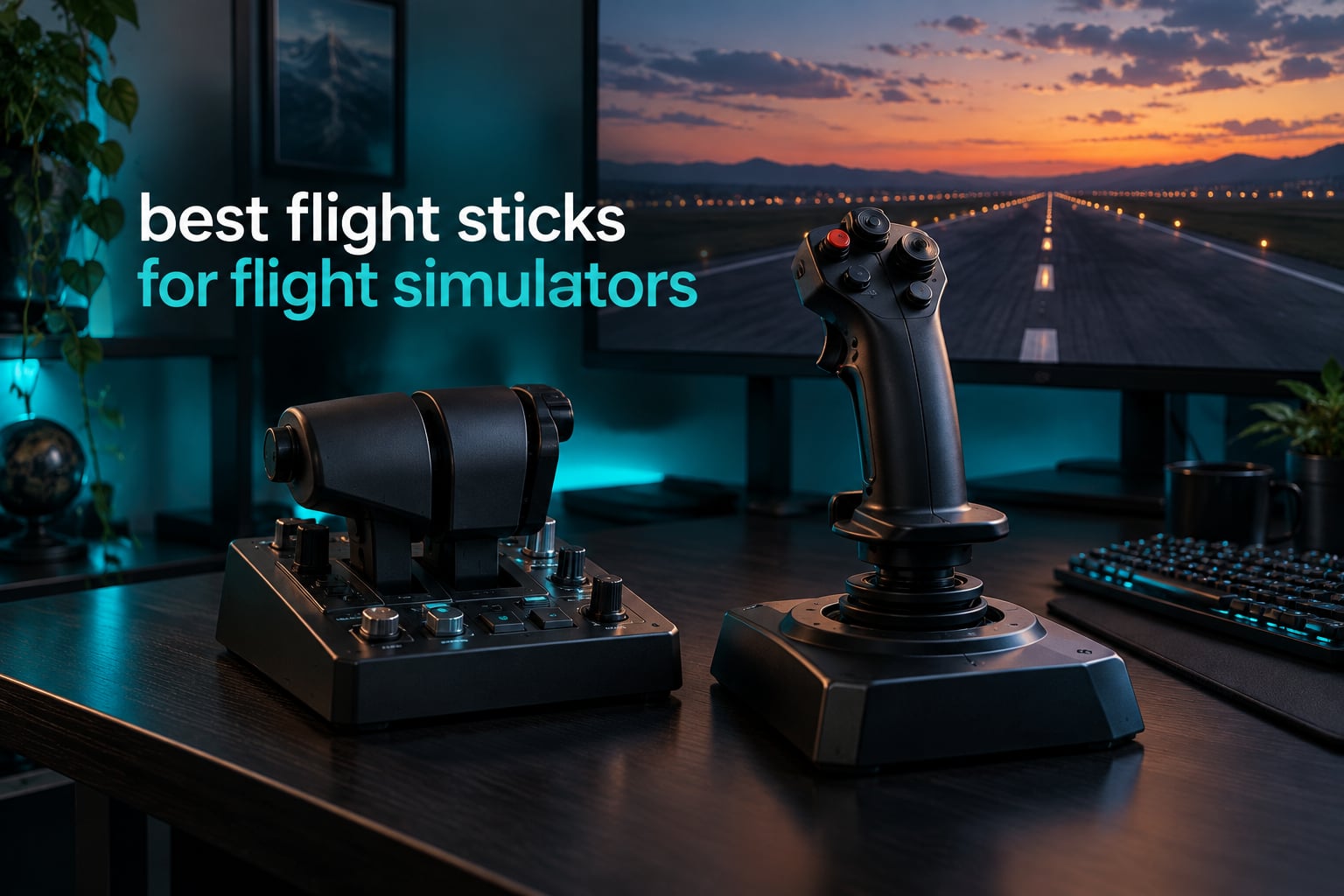
The first time I flew a virtual Cessna with a keyboard, I crashed within ninety seconds. Missed the throttle, overcorrected the pitch, and the sim politely reset me. Two weeks later I unboxed a HOTAS unit, spent an evening remapping buttons, and the same approach ended with a clean touchdown and my hands still on the controls. That gap between fumbling a keyboard and flying properly is what the best flight sticks for flight simulators actually close.
Over the past two months I put six sticks through MSFS 2024, X-Plane 12, Elite Dangerous and a DCS sortie on my desk, remapping each one from scratch and logging how they felt after long sessions. What follows is the short version: which unit suits which pilot, what each one does badly, and where the money is best spent if you are starting fresh rather than upgrading.
Two things surprise newcomers. First, the whole category skews heavily toward one brand, so the “budget” and “mid-range” tiers are really variations on the same core design. Second, the single biggest jump in experience comes from a sensor upgrade rather than a button count. I will explain both in the buying guide, after the reviews.
Table of Contents
Top 3 Picks for Flight Simulators (October 2026)

Thrustmaster T-Flight Hotas X
- 12 programmable buttons
- 5 axes
- detachable throttle
- adjustable resistance dial
- built-in memory

Thrustmaster T-Flight Hotas…
- Works on Xbox Series X and PC
- 14 programmable buttons
- detachable throttle
- adjustable resistance

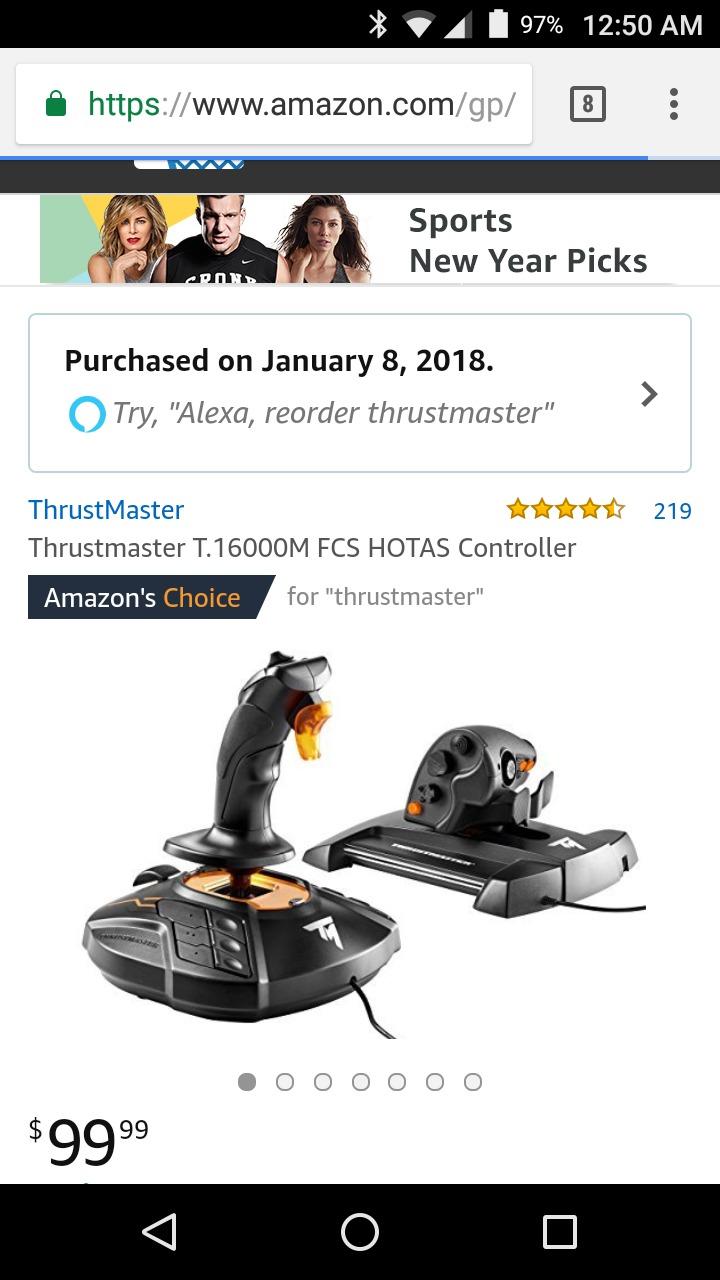
Thrustmaster T16000M FCS HOTAS
- Hall effect magnetic sensors
- 4 independent axes with twist rudder
- 30 controls on stick and throttle
Six Flight Sticks Compared Side by Side in 2026
| Product | Specifications | Action |
|---|---|---|
|
Thrustmaster T-Flight Hotas X
|
|
Check Latest Price |
|
Thrustmaster T-Flight Hotas One
|
|
Check Latest Price |
|
Thrustmaster T16000M FCS HOTAS
|
|
Check Latest Price |
 Logitech G X56 H.O.T.A.S.
|
|
Check Latest Price |
 Logitech G X52
|
|
Check Latest Price |
 Turtle Beach VelocityOne Flightstick
|
|
Check Latest Price |
1. Thrustmaster T-Flight Hotas X – the most complete entry point
Thrustmaster T-Flight Hotas X USB Flight Sim Stick & Throttle – PC
PC only
12 programmable buttons and 5 axes
Detachable real-size throttle
Adjustable resistance dial
4.3 pounds, 10.39 x 9.53 x 10.43 inches
Pros
- Detachable throttle that works on a desk or a separate mount
- 12 fully programmable buttons plus 5 axes
- built-in memory keeps your mappings after unplugging
- adjustable resistance dial lets you tune the centering spring
- weighted base stays put during aggressive maneuvers
- plug and play with sensible default mappings
Cons
- All-plastic build feels basic in the hand
- buttons are not illuminated so you find them by touch
- only 12 action buttons is thin for combat sims
- single USB cable ties stick and throttle together
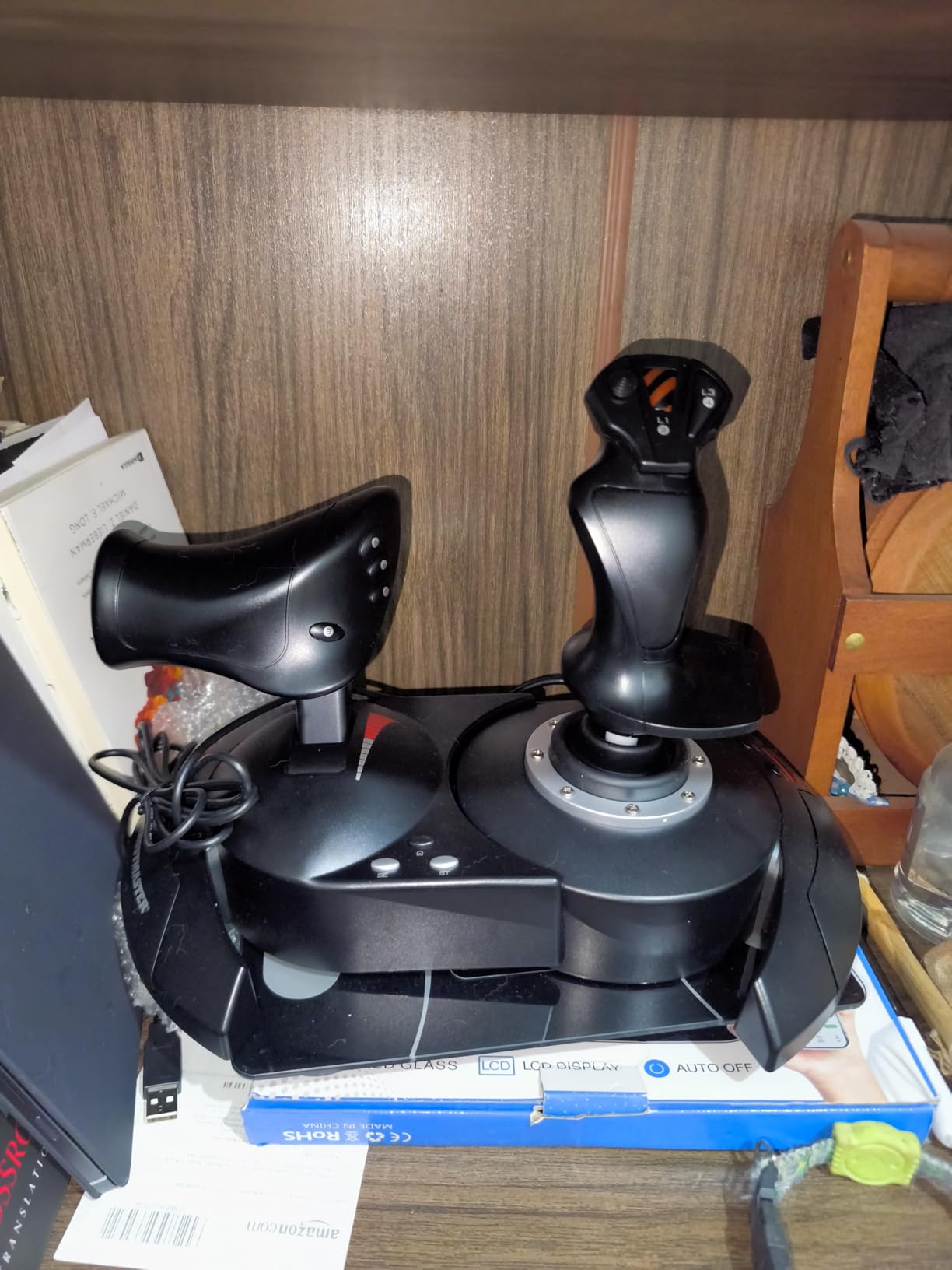
This is the unit I recommend to anyone starting out, and the one I keep coming back to after testing the others. It carries a rating of 4.5 stars across more than 8,000 reviews, and the reason that number holds is simple: there is almost nothing to fault at this level. Twelve action buttons, five axes, and a real-size throttle that detaches from the stick.
The detachable throttle is the feature that changes how you set up. Most people run it on the desk next to the keyboard. Once you move to a mount or a dedicated cockpit frame, you unclip the throttle and put it wherever your arm naturally falls. Very few sticks at any price offer that flexibility.
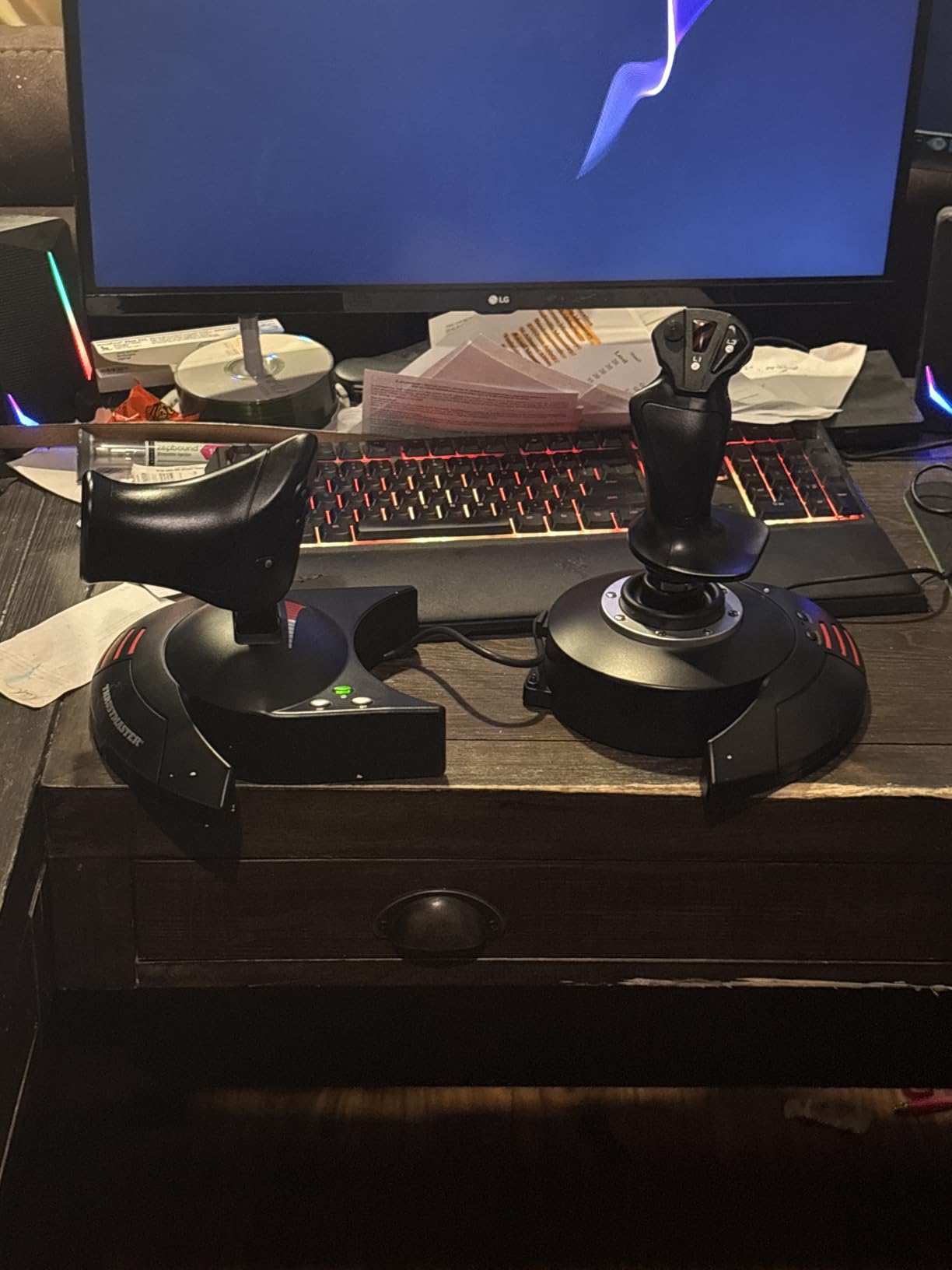
The resistance dial under the stick is the sleeper feature. New pilots often describe the default spring as too soft, then wonder why their inputs feel sloppy. Turning that dial changes the character of the stick noticeably without touching any software. It is a two-minute adjustment that solves a problem many people never know they have.
Rudder comes in two flavors here. You can twist the handle for yaw, or use the small tilting lever on the base for progressive rudder input. The tilting lever is the one most simmers prefer, because it gives you finer control on the runway than a twist axis does.
There is a mapping button on the stick itself that pulls up the remap screen instantly, and the unit keeps your programming in built-in memory. That matters more than it sounds. Several competing sticks lose every binding when you move to another PC, and rebuilding a DCS profile from scratch is an evening you do not get back.
How it holds up on long MSFS and X-Plane sessions
For general aviation and airliner work, this stick is genuinely comfortable. The hand rest is wide and the throttle is full size, so nothing feels like a toy. I flew a couple of hours of IFR practice without any wrist discomfort, and the wide base left room for a keyboard alongside it.
Where it stretches is modern jets. DCS modules and combat sims want more than twelve buttons, and once you start assigning things you will run out of room. That is the point to look at the T16000M instead rather than adding cheap button boxes later.
Where it falls short against pricier sticks
The plastic shell is the honest weakness. It is not creaky or loose, but it does not have the weight or the damped feel of a metal-gripped unit, and reviewers mention it consistently. The buttons are also unlit, which is a genuine problem in VR where you cannot look down.
Rudders are the other gap. This stick can be paired with Thrustmaster TFRP pedals, but they are a separate purchase and a separate USB run. If your sim work involves a lot of taxiing, factor that into your budget from the start.
2. Thrustmaster T-Flight Hotas One – the same idea with console support
Thrustmaster T-Flight Hotas One Flight Stick & Throttle – XBOX & PC
PC and Xbox Series X
S
14 programmable buttons
Detachable throttle
Adjustable resistance
1644 g
Pros
- Only major HOTAS here that also runs natively on Xbox Series X and S
- detachable throttle for desk
- lap or cockpit mounting
- adjustable resistance and a responsive trigger
- plug and play over a single USB cable
- expands with Thrustmaster TFRP rudder pedals
- 14 programmable buttons cover common sim functions
Cons
- All-plastic construction
- soft rubber-dome buttons rather than crisp mechanical switches
- console and PC mapping can need extra configuration per title
- one USB cable limits independent mounting
Console support is the entire story with this one. If your sim rig is an Xbox Series X or S rather than a PC tower, this is the only stick in this roundup that works natively without an adapter. Everything else here assumes Windows.
Underneath the platform difference, the layout is very close to the Hotas X. You get a detachable throttle, adjustable stick resistance, a hat switch, a trigger, and fourteen programmable buttons. The throttle is the same real-size design, so it feels at home on a lap or a couch arm if you are playing on a television rather than a monitor.
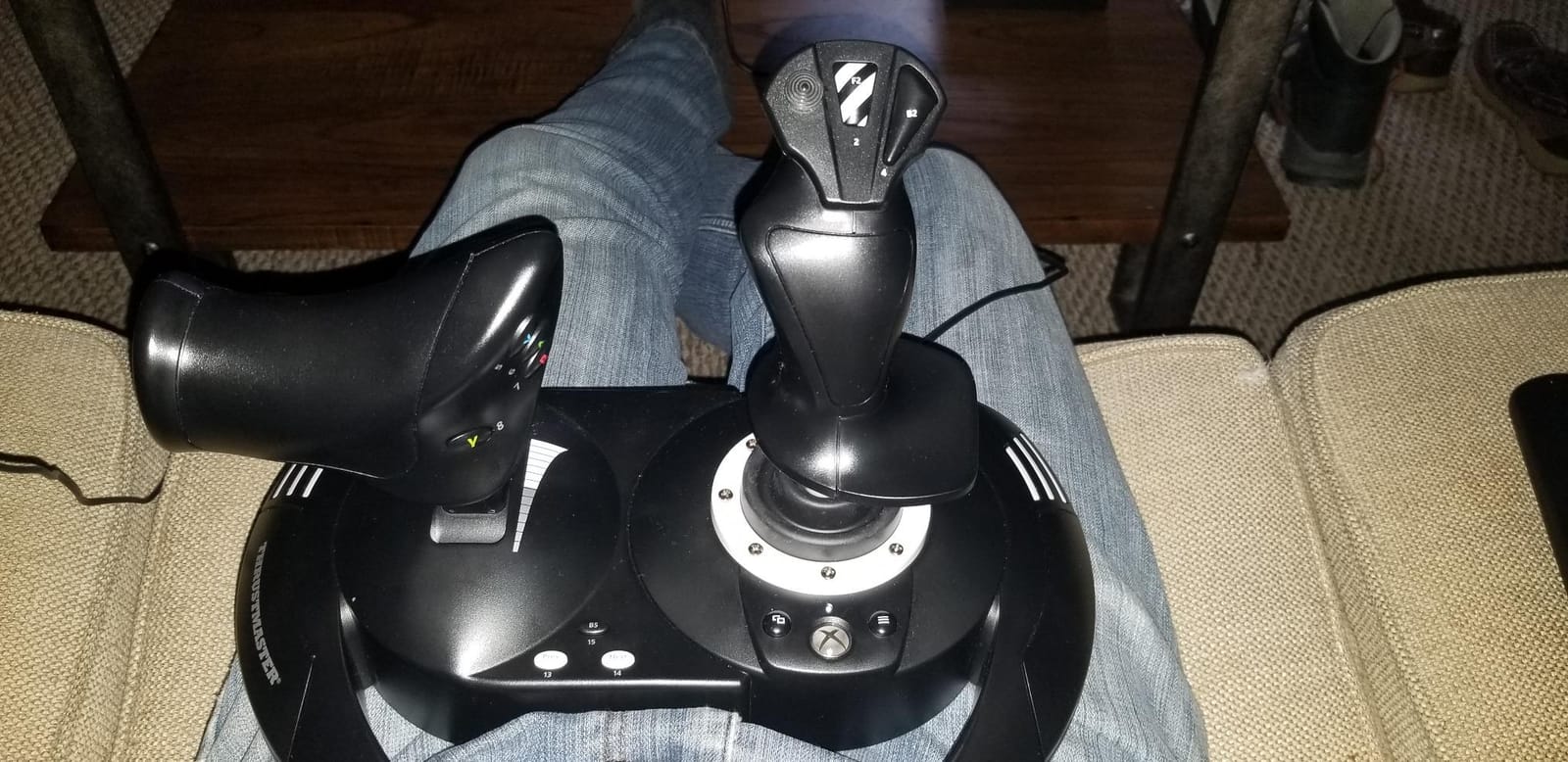
One practical note for console players: the stick and throttle share a single USB cable. That is convenient for living-room setups where everything needs to reach the same port, but it means you cannot put the throttle on a separate mount without dealing with cable slack.
For PC users, the difference from the Hotas X is mostly the button count and the console option. If you are on Windows and want one more button, the Hotas One gives it to you. If you play on Xbox, the choice is much simpler.
Remapping works through the same Thrustmaster software family, and the axis count is identical to the PC model. MSFS runs on Xbox Series X and S, so a full GA and airliner setup is achievable here without leaving the console.
Is the console version right for you
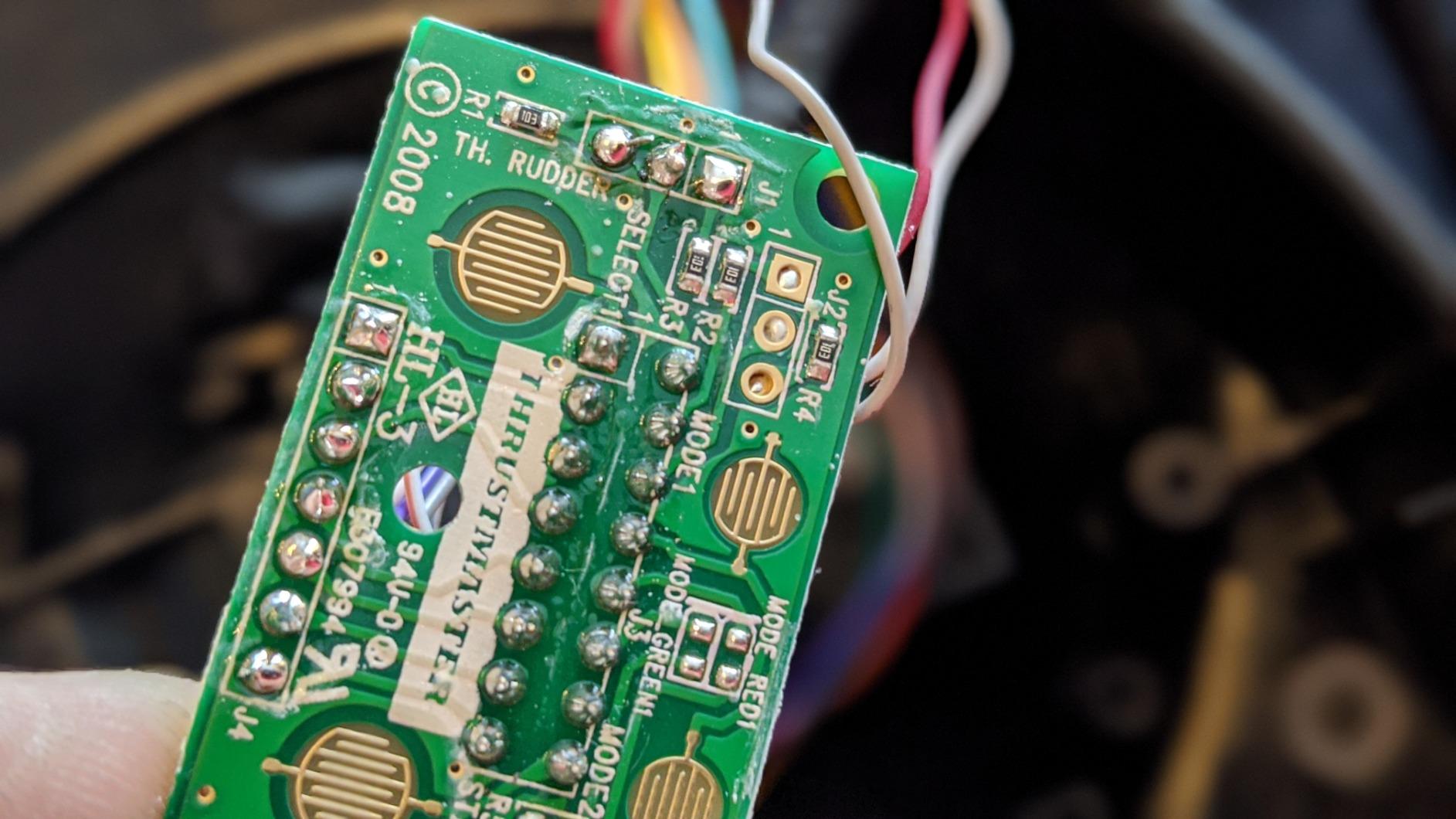
If MSFS on Xbox is your main target, yes, and there is no real alternative at this range. The stick arrives recognised, the throttle detaches, and the resistance dial is present, which is more than most console-bound alternatives can say.
The caveat is software depth. Xbox mapping does not offer the same layering and profile switching you get on PC, so plan your bindings before you start flying rather than remapping mid-mission. Community discussion in r/flightsim repeatedly points out that console setups reward a simpler, fixed binding layout.
Where it loses to the Hotas X
The buttons feel soft. They are rubber-dome rather than mechanical, which is fine for casual flying and slightly unsatisfying in a fast combat sim. Reviewers also report that some console titles need extra configuration work before every control responds.
On PC alone, the Hotas X offers a slightly higher rating and a longer review history for almost the same experience. Choose this one for the Xbox side of the console, not for the PC side of it.
3. Thrustmaster T16000M FCS HOTAS – the sensor upgrade that lasts
Thrustmaster T16000M FCS HOTAS (Compatible with PC)
PC only, Windows
Hall effect 3D magnetic sensors
4 independent axes with twist rudder
16 action buttons with braille markings
3 pounds
Pros
- Hall effect magnetic sensors from the same family used in the far costlier Warthog
- long linear throttle travel with adjustable glide tension
- weighted rubber-footed base resists sliding without mounting hardware
- braille nibs on the buttons so you can identify them without looking
- 30 controls in total across stick and throttle
- multiple reviewers report it still working after years
Cons
- Rubber-dome buttons feel soft and squishy
- rear base buttons are stiff and awkward to reach
- throttle mini analog fingerstick has noticeable play and a large deadzone
- throttle has no center detent for precise reverse positioning
- bulky throttle body can feel cramped for large hands
This is the stick I would buy with my own money if I could only own one. The reason is the sensor, and it is a bigger deal than any spec sheet suggests. Hall effect magnetic sensors have no contact point, so there is nothing to wear out the way there is with potentiometer sticks that start drifting after a year of use.
That sensor family is the same one used in Thrustmaster’s far costlier Warthog line. You are not getting a cheaper variant. You are getting the part that matters most in a stick, with fewer buttons bolted on.
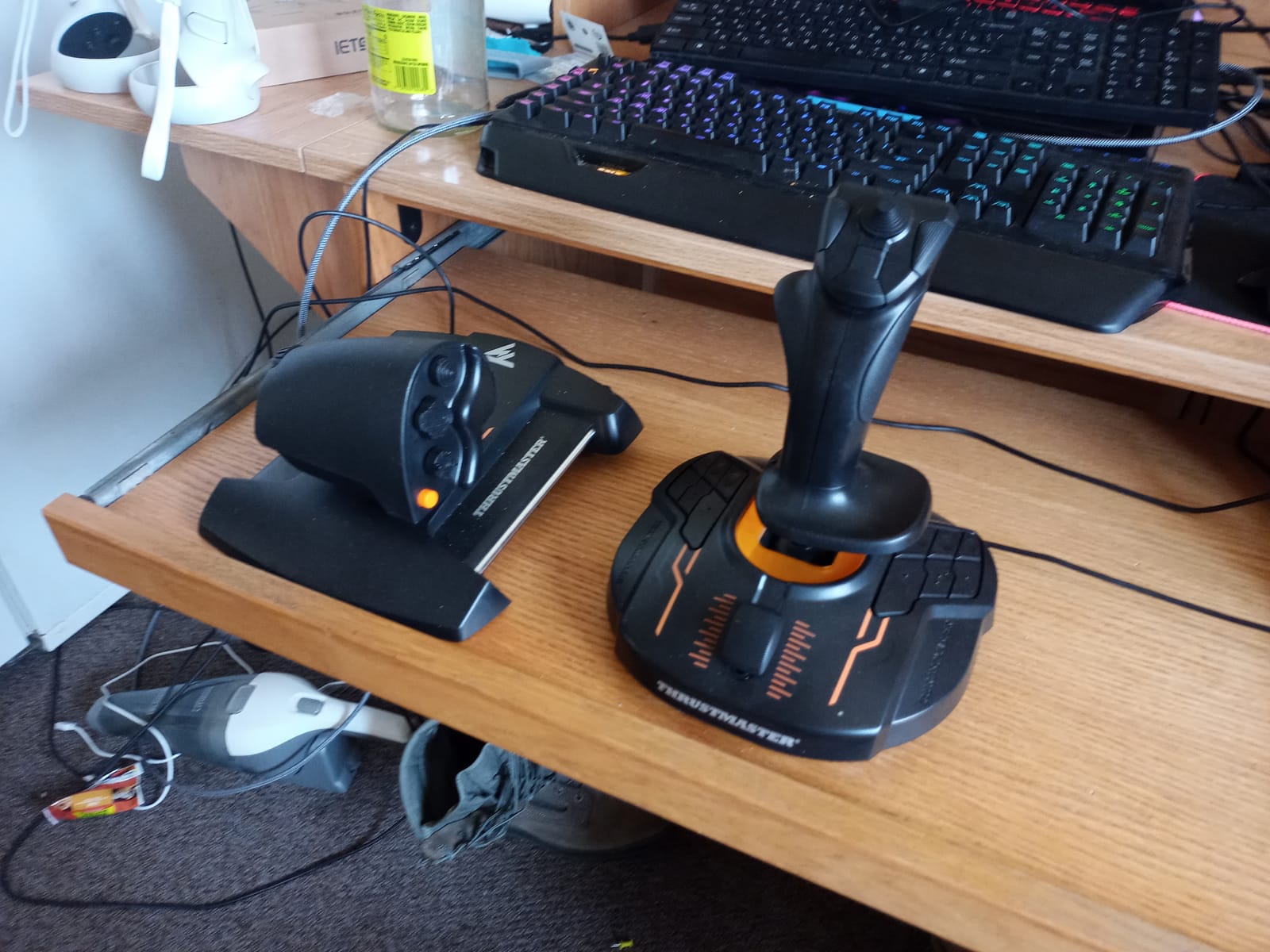
Four independent axes is the other headline. Roll, pitch, and twist rudder are joined by throttle on the lever, and the throttle carries its own set of fourteen action buttons, an eight-way point of view hat, two four-way switches, three buttons, a two-position slider, and a push mini-stick. Combined with the sixteen buttons on the stick, you have thirty controls without buying a single button box.
The braille-style nibs on the stick buttons are a small touch with a real payoff. In a combat sim or in VR, you can feel a control with your thumb and know what it is. It removes the constant looking-down habit that wears on you after an hour of flying.
The throttle glide has a wide range of adjustment. I found the default a little firm for slow GA work and softened it, which changed the feel of the lever meaningfully. There is no center detent, though, so finding exact idle or reverse positions takes more care than on a quadrant with detents.
Why the sensor choice decides long-term value
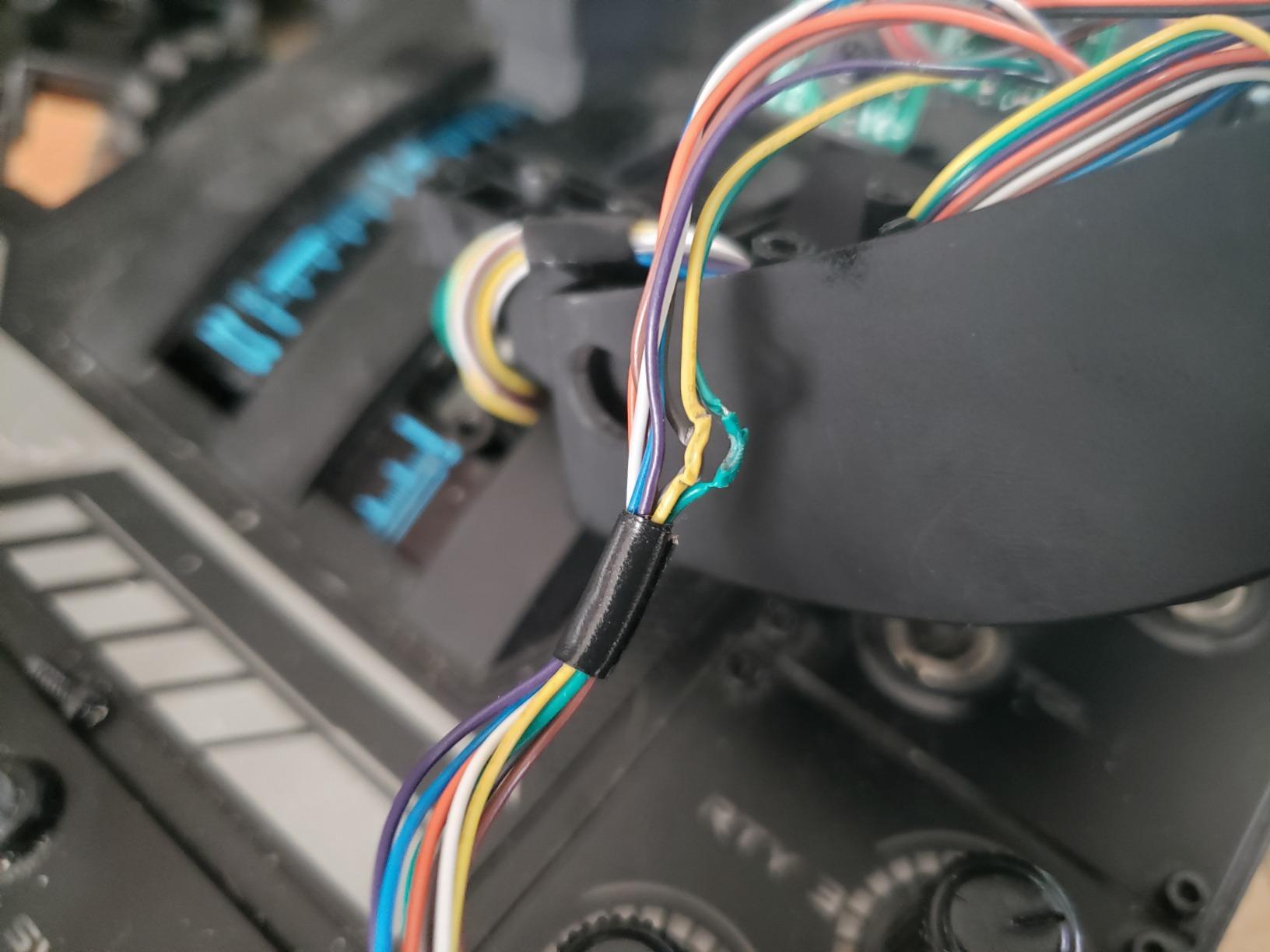
Community reports on r/hotas and r/flightsim keep circling the same point: cheaper sticks with contact sensors tend to develop axis drift, meaning the neutral position slowly walks away from center. On a non-contact stick, that failure mode simply does not exist in the same way.
Buyers also report this unit still working after years of daily use. That is the durability signal you want from a controller you will keep for a decade. Combined with TARGET software for mapping, it is the most future-proof stick here for PC-only simmers.
Which pilots should skip it
If you have large hands and prefer a light touch, the throttle body is bulky and can feel cramped. The mini analog fingerstick on the throttle also has real play and a generous deadzone, so treat it as a secondary control rather than a primary one.
It is PC-only. Console players should look at the Hotas One instead, and anyone who flies mostly airliners may find the throttle lacks the multi-lever layout that a proper quadrant gives you.
4. Logitech G X56 H.O.T.A.S. – the most adjustables in one box
Logitech G X56 H.O.T.A.S Throttle and Joystick Flight Simulator Game Controller, 4 Spring Options, +189 Programmable Controls, RGB Lighting, 2x USB, PC – Black
PC only, Windows
16-bit hall-effect aileron and elevator axes
Advanced 4-spring system
Twin throttles
6.9 pounds, 2 m cable
Pros
- Only stick here with genuine 4-spring adjustable resistance
- 16-bit hall-effect aileron and elevator axes
- twin throttles with friction adjuster and throttle lock
- separate mini analog stick for real six-degree input
- controls sit under the fingers so they work well in VR
- RGB backlighting matches a gaming setup
Cons
- Requires two USB 2.0 ports
- all-plastic build that feels below the asking price
- large desk footprint
- twist rudder can aggravate wrist and carpal issues
- rounded buttons are hard to tell apart in VR
- Logitech software needed for programming and RGB
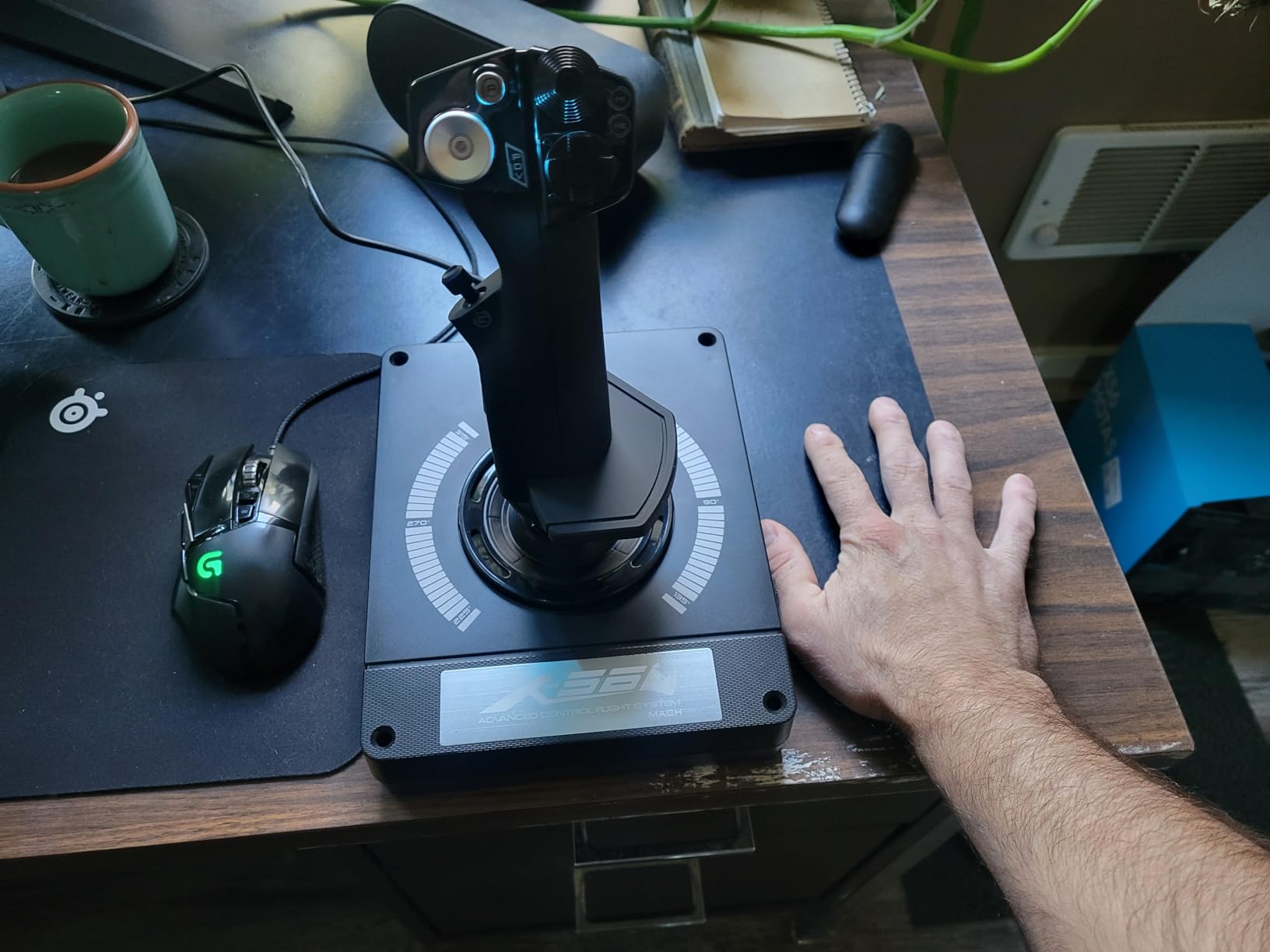
The X56 is the most configurable stick in this roundup, and in VR it remains the one I recommend most often. The reason is button position. Nearly every control sits directly under a fingertip, which means you can fly with your hands in front of you and never break immersion to look down.
The four-spring system is genuinely unusual at this price. Rather than a single centering spring, four separate springs under the grip let you tune the feel in more than one dimension. Pilots who like a soft, heavy flight deck response can get it without opening the unit.
The twin throttles are a real advantage for multi-engine work. One lever sits forward and one aft, which maps sensibly to twin-engine aircraft in MSFS and X-Plane. A friction adjuster and a throttle lock let you hold a setting without drifting.
The separate mini analog stick adds a genuine six-degree input surface. It is not a substitute for rudder pedals, but it handles gimballed weapons and trim well, and it removes the need for a small secondary controller on the desk.
RGB backlighting is the feature reviewers mention most warmly and it matters more than it sounds. In a dark room, or in a sim with a night scene, lit controls are far easier to find by eye than unlit rubber buttons.
Why VR pilots like this layout
In a headset you cannot check a screen, so anything requiring a glance becomes a problem. Lit buttons help. The problem is that the buttons themselves are rounded and similar in shape, so you still need to learn positions by feel over time rather than by sight.
Wireless is the bigger VR issue, and this stick does not solve it. You will be running a 2 m cable from the stick to your PC, plus a headset cable, plus whatever your rudder solution uses. Plan the routing before you build the setup or you will be untangling cables mid-flight.
What holds it back
The rating sits at 4.0 stars, the lowest average here, and the review history explains why. Some of that is the all-plastic shell feeling cheap next to its feature list. Some is durability chatter about the plastic and the rounded buttons over time.
Two USB ports is a genuine annoyance on a modern desktop where ports are contested. The twist rudder is also the one control style that can bother wrists over long sessions, so if you already feel that, twist is worth avoiding.
5. Logitech G X52 – the one with a screen
Logitech G X52 Flight Control System
PC and Windows
Multifunction LCD plus flight clock
282 programmable commands over 3 modes
5-position grip
Magnetic non-contact axes
2 year manufacturer warranty
Pros
- Multifunction LCD shows programmed commands plus a built-in flight clock
- 282 programmable commands across three modes
- magnetic non-contact X and Y sensors avoid potentiometer wear
- five-position grip system changes button reach for different hand sizes
- 3D twist with a rudder lock so you can disable it when using pedals
- longest manufacturer warranty in this roundup at two years
Cons
- Stick and throttle share one USB connection so the stick cannot be paired with another throttle
- throttle tension barely softens at its lowest setting
- throttle drifts slightly from the position you leave it
- mouse nubbin is hypersensitive and hard to control
- some units have dead LEDs or need a USB reconnect after a reboot
- large footprint
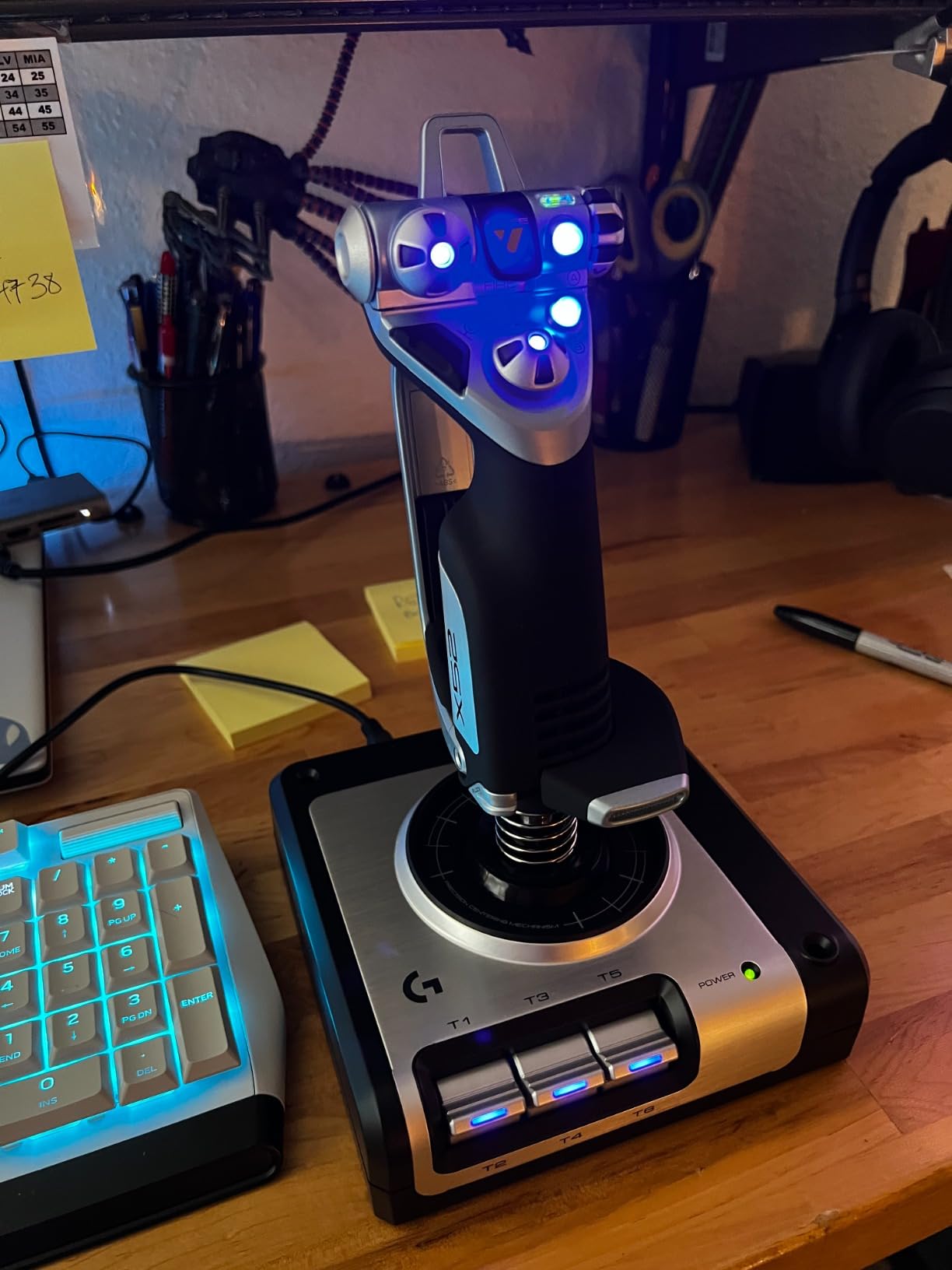
The X52 is the only stick here with a multifunction LCD, and after two months of testing it is the feature I missed most when I returned to the others. You can put a flight timer, a compass heading, or your next waypoint on the throttle, which turns the throttle into an instrument instead of decoration.
For anyone flying IFR routes in MSFS or X-Plane, having the flight clock visible without checking a window is a small quality-of-life upgrade that pays off every single session. The Saitek and Logitech platform has been around long enough that there are large communities and preset profiles for most major sims.
Binding flexibility is the other headline. Two hundred eighty-two programmable commands across three modes gives you far more room than the twelve or fourteen buttons on the entry-level Thrustmaster sticks. For Elite Dangerous or Star Citizen, where you assign many inputs per ship, that headroom matters.
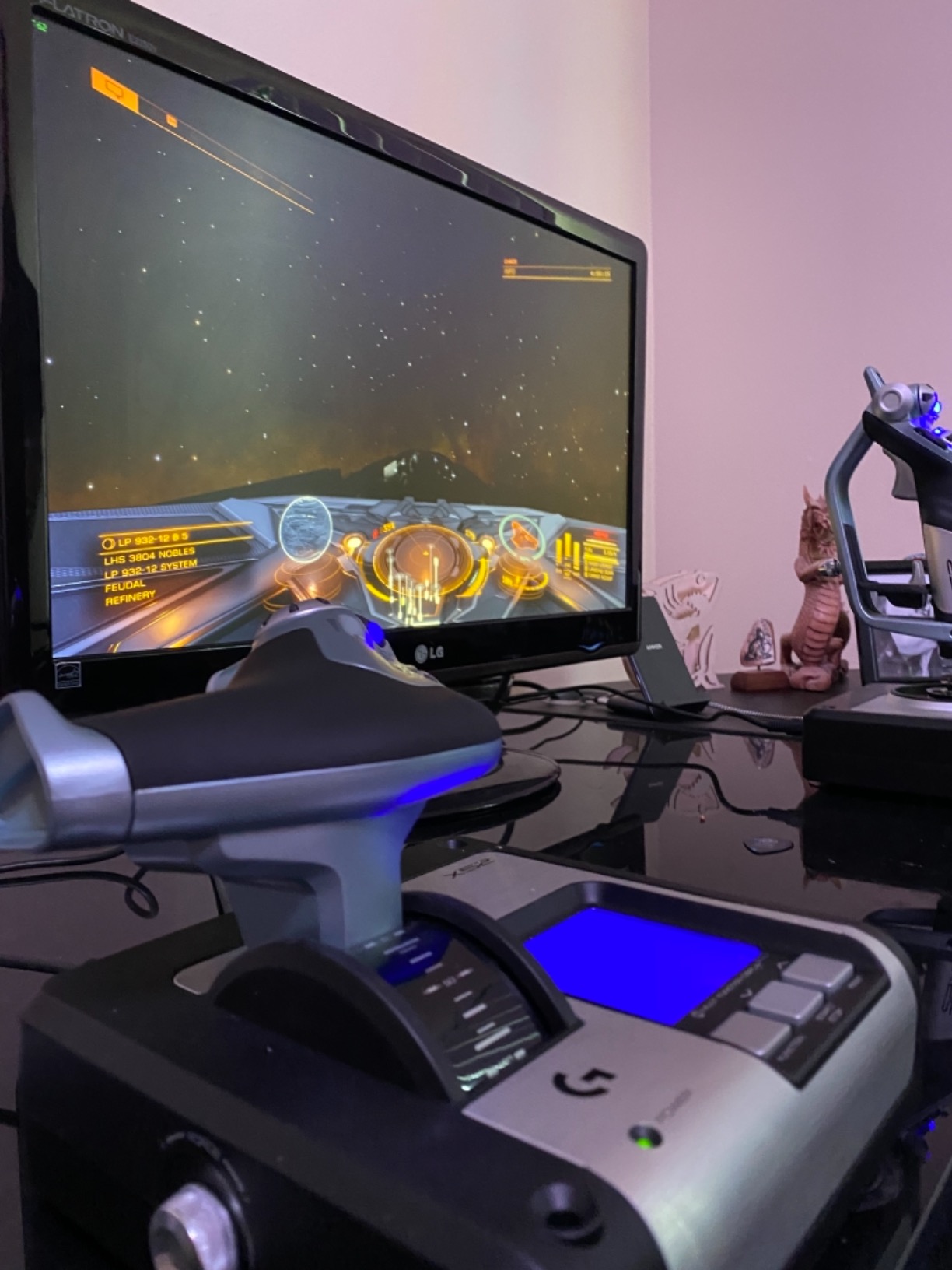
The five-position grip system is worth understanding before you commit. The handle can be moved through several positions, which changes where the buttons fall relative to your fingers. It is not a solution for every hand size, but for many pilots it converts an awkward reach into a comfortable one.
The axes use magnetic non-contact sensors, the same wear-free principle as the hall effect sticks. Combined with the two-year manufacturer warranty, this is a controller built to be kept rather than replaced.
Who benefits most from the display
Anyone doing structured flight, not free flight. A visible flight clock speeds up simulated airline and IFR procedures, where you are managing a departure window and fuel state at the same time. The display also shows whatever commands you assign, which is handy during practice.
The three-mode system is designed for exactly this. Mode one can hold your airliner bindings, mode two your combat set, mode three your general aviation set, and you switch rather than rebuilding everything each time you change aircraft.
Why some pilots moved on from this design
The single shared USB cable is the big one. Because the stick and throttle arrive joined, you cannot pair this stick with a different throttle later. That closes off an upgrade path that other sticks on this list keep open, and long-term owners on r/hotas mention it as the main regret.
The throttle itself is the weak half. Tension adjustment barely changes anything at its lowest setting, it drifts from wherever you leave it, and the mouse nubbin is too sensitive for fine camera work. The penny wheel and the small switch on the throttle are also reported to fail over time.
6. Turtle Beach VelocityOne Flightstick – small, ambidextrous and console-ready
Turtle Beach VelocityOne Flightstick Universal Sim Controller, Xbox, PC
PC, Xbox One, Xbox Series X and S
USB-C, 10 ft cable included
27 programmable buttons and 8 axes
Hall effect main axes
OLED flight display
1.8 pounds, 6.46 x 8.54 x 9.07 inches
Pros
- Works natively on Xbox Series X and S as well as PC
- 27 programmable buttons and 8 axes give unusually broad coverage
- OLED flight display and on-stick configuration wheel cut software dependence
- adjustable palm rest and ambidextrous layout suit either grip hand
- customizable throttle and flap levers cover airliner and combat setups
- light at 1.8 pounds and easy to move between setups
- hall effect axes with a positive centering spring
Cons
- Setup and customization run through a smartphone app over Bluetooth rather than a desktop application
- custom RGB colors are limited to about six presets
- touchpad cursor sensor is too sensitive near the edges
- light base can lift without a mounting stand
- small sliders have slop
- some units report firmware boot loops that leave the stick unresponsive
This is the stick to look at if desk space is the constraint. At 1.8 pounds and a small footprint, it fits setups where a six-pound X56 would crowd everything else off the mat. It also runs natively on Xbox Series X and S alongside PC, and the USB-C cable is included.
Twenty-seven programmable buttons and eight axes is more control coverage than anything else in this roundup. The throttle and flap levers are customizable too, which means you can reconfigure them for a widebody airliner rather than accepting whatever layout it ships with.
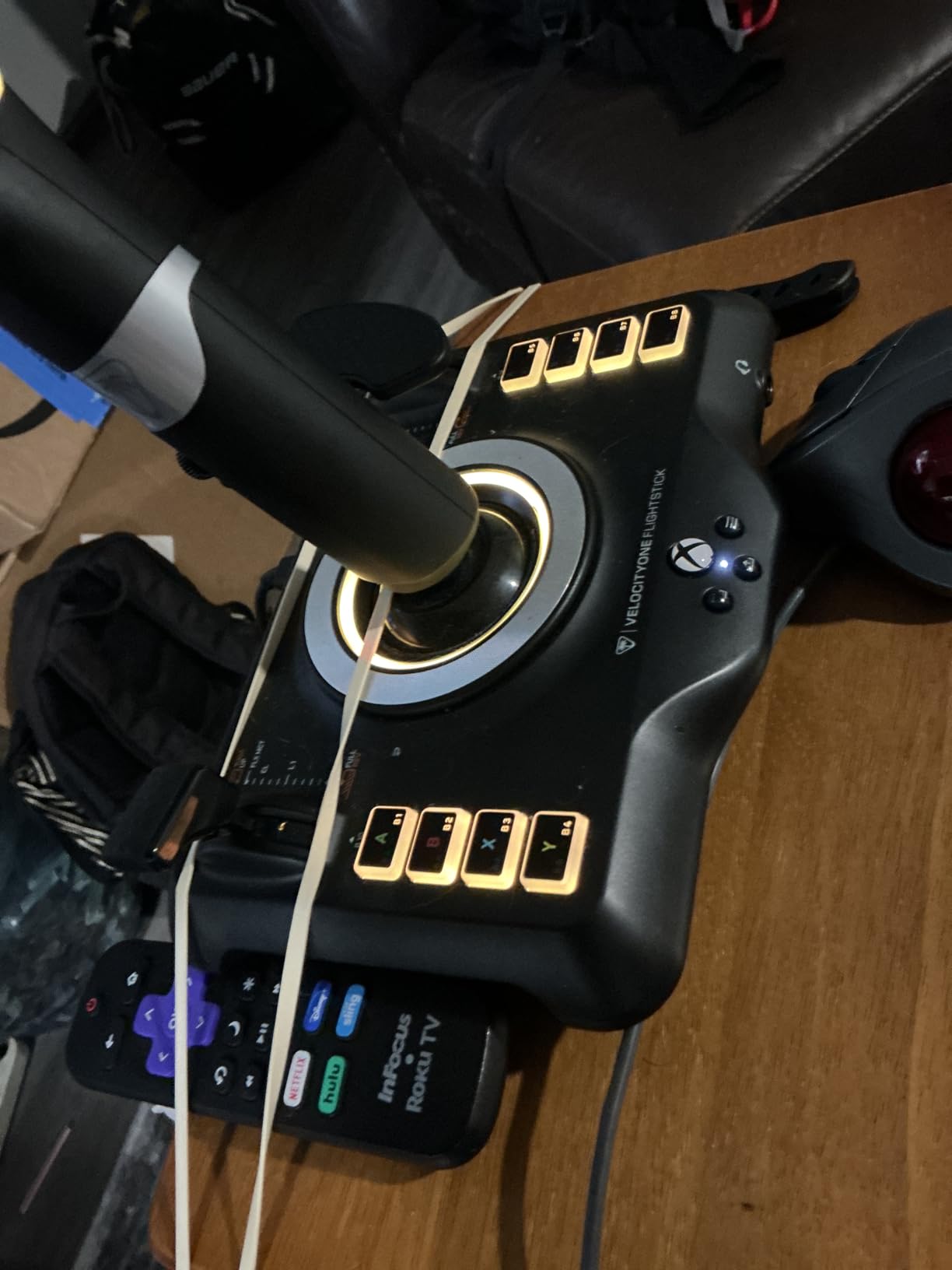
The ambidextrous layout with an adjustable palm rest is unusual in this category and genuinely useful. Most flight sticks assume one grip hand and place the buttons around it. This one lets you set the rest so the controls land correctly whichever hand you fly with, and it works equally well for fighter-jet and airliner postures.
The OLED flight display is smaller than the X52’s LCD but serves a similar purpose, and the configuration wheel on the stick lets you adjust things without leaving the sim. For MSFS 2024, X-Plane and War Thunder it runs without fuss on both console and PC.
Why the ambidextrous design is worth knowing about
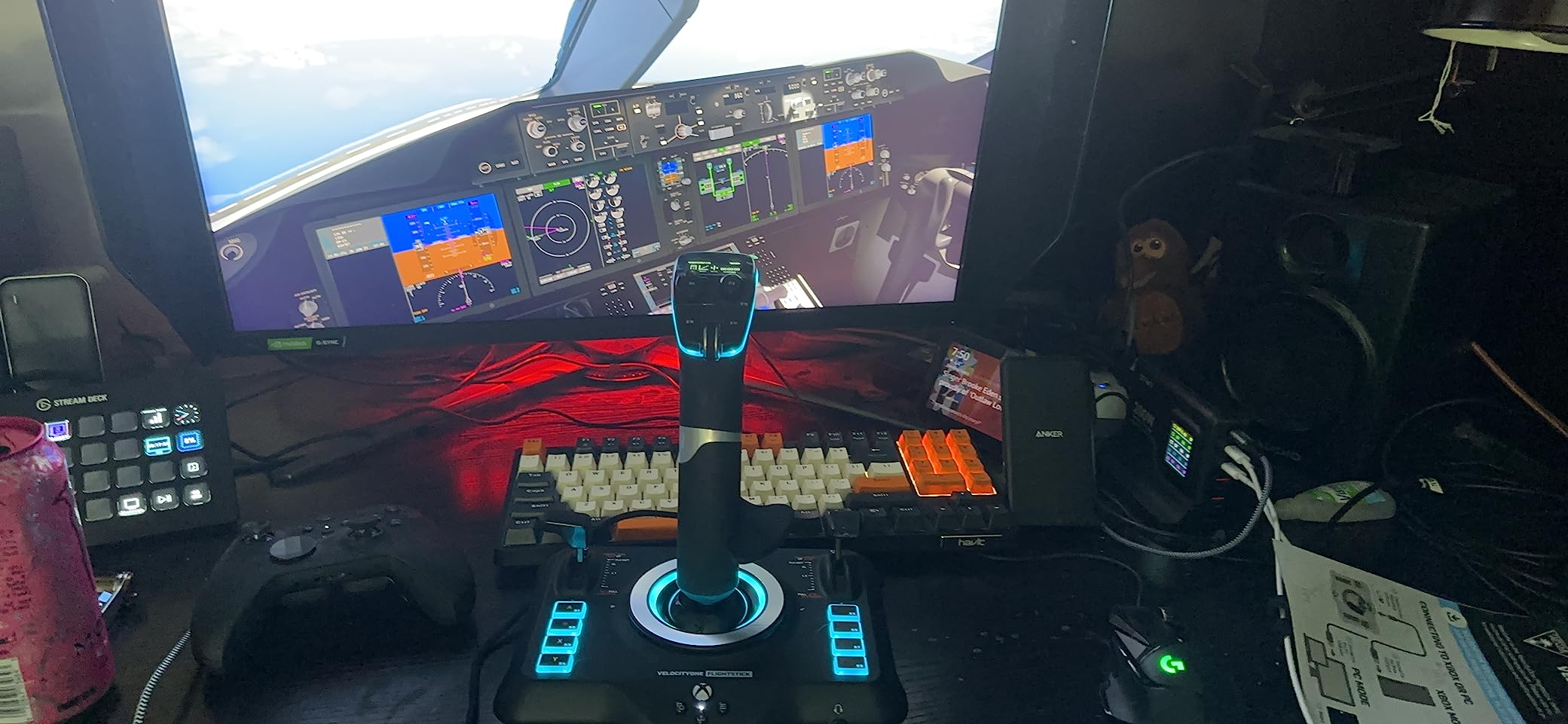
If you fly with a non-dominant hand on the stick, or you share a setup between two people of different handedness, this is the only unit here designed around that. The palm rest adjusts, and the grip does not force a specific thumb position for the hat and trigger.
For VR it is also worth noting that every control sits within a compact area, so your hands do not need to search a wide base. The weight is the trade. A light base needs downward pressure or a mounting stand to stop it lifting during aggressive pulls.
What the smartphone setup app costs you
Customization happens through a phone app over Bluetooth instead of a desktop application. That means you are tuning your stick from a phone, which some people love for quick changes and others find tiresome. You are dependent on that app for full control of the device.
RGB is limited to roughly six preset colors rather than a full color wheel, and the touchpad cursor sensor is oversensitive at the edges. Reviewers also report a firmware update boot loop that left some units unresponsive, so keep the firmware current and know how to re-pair if it happens.
How to Choose a Flight Stick for Your Simulator
Pick your platform first, because it removes most of the list
Platform is the fastest way to narrow your options. Windows PC opens everything on this list. Xbox Series X and S narrows it to two units: the Thrustmaster Hotas One and the Turtle Beach VelocityOne, both of which appear in Xbox controller categories as well as PC flight controls.
PlayStation users have no native option in this roundup, and flight sim support on console platforms outside Xbox is thin. If you are on PlayStation, budget for an adapter and accept that mapping depth drops further.
Choose non-contact sensors over button count
This is the single biggest decision in this category and the one most roundups bury. Potentiometer sticks use a resistive element that physically wears as the stick moves. Over time the neutral position drifts, and a stick that needs recalibrating every session is a stick you will stop trusting.
Hall effect and magnetic non-contact sensors have no contact point at all. The T16000M uses hall effect magnetic sensors from the same family as the costlier Warthog line. The Logitech X52 uses magnetic non-contact sensors on its main axes. The VelocityOne uses hall effect on its main axes. Those three are the ones built for long ownership.
Decide whether you need twist rudder at all
Twist rudder is the control people argue about most. It is built into the T16000M, the X52, and the Hotas X as a handle rotation axis. It is genuinely convenient for gamepad-style flying in Elite Dangerous or a light GA VFR session.
For takeoff, landing, and taxiing in airliner or combat sims, dedicated rudder pedals remain more precise. The X52 includes a rudder lock that disables the twist axis, which tells you the manufacturers know it is not always the right choice. Budget for pedals early rather than late, because adding them later means another cable and another recalibration.
Look at throttle travel, tension, and detents
The throttle is where most comfort complaints live. The T-Flight sticks use a real-size detachable throttle with a wide grip. The T16000M has long linear travel with adjustable glide tension but no center detent, which makes exact reverse positioning fussy. The X56 has twin throttles with a friction adjuster and a lock.
Detents are the audible clicks you feel at idle, afterburner, and reverse. They matter in combat sims where you need to find a specific power setting without looking. None of the sticks here have a full multi-lever quadrant, so if you fly airliners regularly, plan on adding levers or a separate quadrant eventually.
Treat button count and profile memory as separate things
Buttons are cheap to add. Memory is not. The Hotas X stores your programming internally so bindings survive a move to another PC. The T16000M relies on TARGET software for configuration. The X52 offers three modes with 282 programmable commands. The VelocityOne depends on a phone app.
Count how many simulators you actually play. If you jump between MSFS, DCS, X-Plane and Elite Dangerous daily, mode switching and internal memory save you far more time than extra buttons do.
Plan for VR before you buy
VR changes what matters. A display on the throttle becomes useless, since you cannot look at it. What you need instead is lit buttons, controls reachable without looking, and a layout you can learn by muscle memory. The X56 wins on backlighting and fingertip placement. The T16000M wins on braille-marked buttons you can identify by touch.
Cable routing is the part people forget. Every stick here is wired. Add a headset cable and a pedal set and you have three cables to manage across your lap. Routing them along the chair arm rather than across the floor prevents the one snag that ruins immersion.
Keep your upgrade path open
Mixed ecosystems are normal and they work fine. The community advice that comes up again and again on r/flightsim is that you can pair a stick from one brand with a throttle and pedals from another, as long as each connects on its own USB cable.
Two things limit that flexibility. The X52 ties its stick and throttle to one shared USB cable, so its stick cannot be combined with a different throttle. The Hotas X and Hotas One run their stick and throttle together as well, so read the cable layout carefully before you plan a future swap.
Frequently Asked Questions
What is the best HOTAS joystick?
For most PC simmers the Thrustmaster T-Flight Hotas X is the best all-round choice, combining 12 programmable buttons, five axes, a detachable real-size throttle and built-in memory at the lowest entry cost. If your priority is long-term precision rather than button count, the T16000M FCS HOTAS uses hall effect magnetic sensors that do not wear, which makes it the better long-term buy.
What are the best flight joysticks?
The strongest options across this category are the Thrustmaster T-Flight Hotas X for beginners, the Thrustmaster T-Flight Hotas One for Xbox Series X and S players, the Thrustmaster T16000M FCS HOTAS for hall effect sensor longevity, the Logitech G X56 for VR and adjustability, the Logitech G X52 for its multifunction LCD and binding count, and the Turtle Beach VelocityOne for compact, ambidextrous setups.
What is the best entry-level HOTAS flight stick?
The Thrustmaster T-Flight Hotas X is the best entry-level HOTAS. It ships with 12 fully programmable buttons, five axes, an adjustable resistance dial, dual rudder control and a detachable throttle, and it works plug and play on Windows without extra software configuration.
Is Hotas 4 worth it?
It depends on what you outgrow. If twelve buttons and five axes feel limiting in a modern jet or combat module, the extra control coverage is worth it. If you fly general aviation or airliners in MSFS and X-Plane, the entry-level stick already covers what most pilots use, and spending more on non-contact sensors or a throttle upgrade serves you better.
Do I need rudder pedals for Microsoft Flight Simulator?
For takeoffs, landings and taxiing, yes. Twist rudder on the stick is convenient for gamepad-style flying but coarser for low-speed control work. If you already have pedals, the Logitech X52 includes a rudder lock that disables the twist axis so the two do not fight each other.
Is a HOTAS better than a yoke for flight simulation?
A HOTAS suits jet, space and combat flying because the left hand naturally works a throttle while the right hand works pitch and roll. A yoke suits general aviation and airliner procedures in MSFS and X-Plane because it mimics the wheel most pilots train on. Most simmers start with a stick and add a quadrant later if they move toward airline operations.
Final Verdict on the Best Flight Sticks for Flight Simulators
The Thrustmaster T-Flight Hotas X is our pick as the best flight stick for flight simulators in 2026. It carries the highest rating in this roundup across more than 8,000 reviews, it works immediately on PC, and its detachable throttle and built-in memory give you room to grow without a second purchase.
Choose differently only when you have a specific reason. On Xbox, take the Hotas One or the VelocityOne. In VR, the Logitech X56 wins on backlighting and fingertip placement. For long-term precision, the T16000M’s hall effect sensors are the ones that will not drift. For a visible flight clock and the deepest binding options, the X52 delivers, at the cost of a shared cable.
Whichever you pick, spend your first evening remapping rather than flying. Ten minutes with the buttons where your hands expect them saves months of awkward reaches, and it is the only free upgrade in this entire category.