
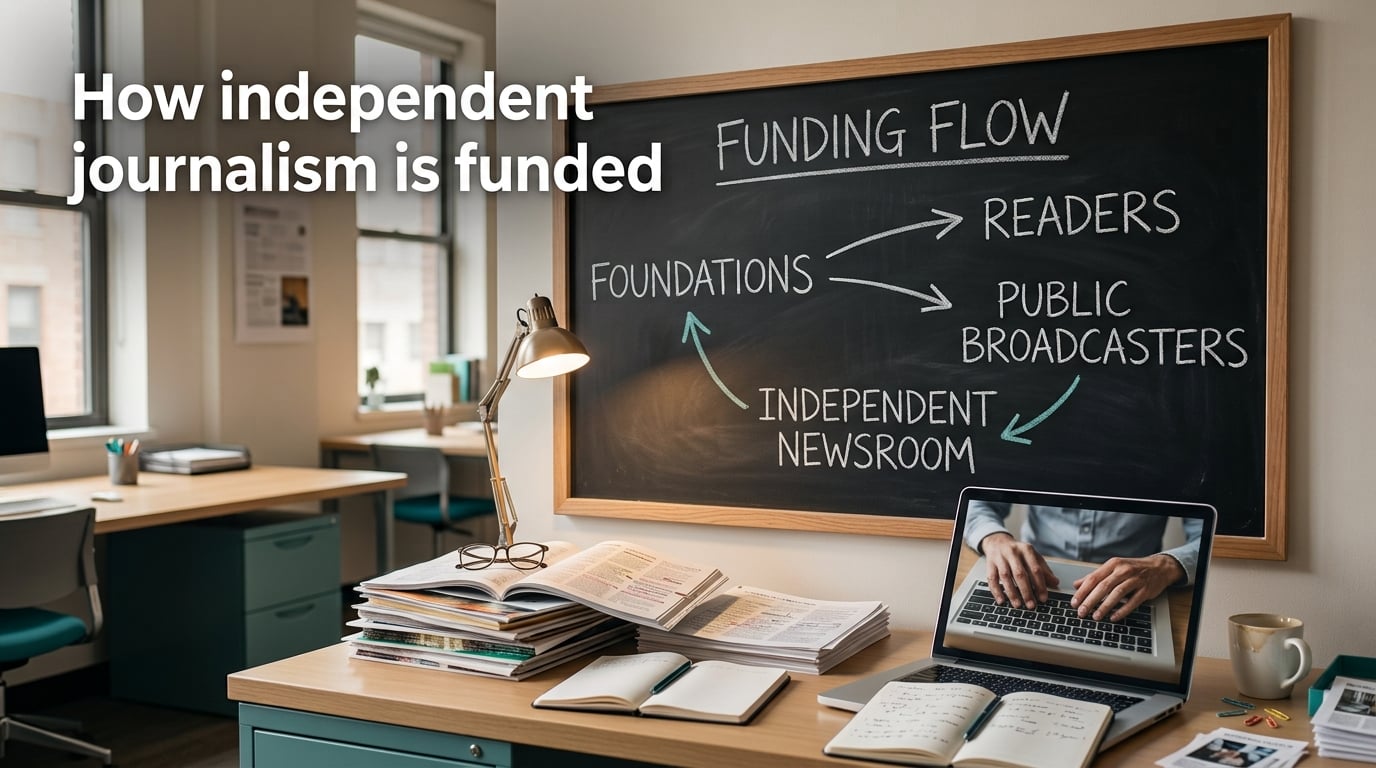
Independent journalism is funded through a mix of philanthropic foundation grants, reader donations and subscriptions, public broadcasting budgets, crowdfunding campaigns, and limited advertising. The most resilient outlets combine several of these streams, because relying on any single source creates vulnerabilities that powerful interests can exploit.
I have spent the past three months digging into how newsrooms across the United States, Ukraine, Central America, and West Africa actually keep their lights on. What I found surprised me. The picture is not one of helpless outlets scrambling for scraps. It is a layered ecosystem where nonprofit newsrooms, member-supported publications, public broadcasters, and emergency crowdfunding campaigns each play a different role.
Understanding how independent journalism is funded matters for anyone who cares about press freedom, whether you are a journalist building a newsroom, a donor choosing where to give, or simply a reader who wants quality reporting to survive. This guide walks through every major funding mechanism, the trade-offs each carries, and what the 2026 landscape looks like after the seismic USAID funding shifts of 2026.
Table of Contents
How Independent Journalism Is Funded: The Major Sources
Independent journalism is funded through six main channels: foundation grants, reader-supported revenue, public broadcasting budgets, crowdfunding, advertising, and corporate sponsorship. Most sustainable newsrooms blend at least three of these to avoid single-point-of-failure risk.
Here is the breakdown of how each source works, who typically uses it, and what trade-offs come with the money.
- Foundation grants — large philanthropic organizations (Knight, Ford, Open Society) award multi-year grants to nonprofit newsrooms and investigative projects.
- Reader revenue — direct contributions from audiences through subscriptions, memberships, and one-time donations, including tax-deductible giving through 501(c)(3) affiliates.
- Public funding — taxpayer or license-fee revenue channeled through public broadcasters like the BBC, Voice of America, NPR, and ABC Australia.
- Crowdfunding — emergency or project-specific campaigns on GoFundMe, Kickstarter, or dedicated platforms during crises.
- Advertising — display ads, sponsored content, and programmatic revenue, the model that built legacy newspapers but has collapsed for most local outlets.
- Corporate sponsorship — restricted or unrestricted gifts from businesses, often with ethical firewalls to protect editorial decisions.
Each of these streams carries its own pressures. Foundation grants can come with reporting requirements and topic restrictions. Reader revenue demands constant audience engagement. Public funding raises concerns about state influence. Crowdfunding is reactive, not strategic. Advertising can quietly distort coverage. The art of sustainable newsroom finance is stacking these sources so no single donor can pull the plug on your editorial mission.
What Is Independent Journalism?
Independent journalism is news reporting produced by outlets that are free from government control and from the commercial pressures of media owners or advertisers. Independence is not just a legal status; it is an operational reality shaped by who pays the bills.
The term covers a wide spectrum. At one end sits a nonprofit investigative outlet like ProPublica, funded almost entirely by foundations and donations. At the other end sits a freelance reporter on Substack with a few hundred paying subscribers. Both qualify as independent because neither answers to a government editor or a corporate owner.
Why does funding define independence so heavily? Because editorial decisions follow money. When a newspaper depends on a single advertiser for half its revenue, the editor hesitates before publishing investigations into that advertiser. When a broadcaster is funded by a ministry of information, certain stories never get commissioned. Independent journalism requires financial structures that insulate editorial choices from whoever signs the checks.
This is also why the question of how independent journalism is funded is really a question about how a society protects accountability reporting. Without diverse, stable funding, even talented journalists cannot afford to spend nine months on a single investigation when their landlord expects rent on the first of the month.
Foundation Grants and Philanthropy
Foundation grants are one of the largest sources of independent journalism funding. Between 2010 and 2015, 6,568 foundations distributed roughly 1.8 billion dollars in journalism and media-related grants, according to a 2018 Northeastern University study. That figure has only grown since.
The major journalism funders fall into a few categories:
- U.S. national foundations — Knight Foundation, Ford Foundation, Open Society Foundations, Luminate, the Pulitzer Center.
- International media development funds — International Fund for Public Interest Media (IFPIM), Thomson Reuters Foundation, European Endowment for Democracy.
- Specialized journalism funds — Fund for Investigative Journalism, McGraw Fellowship for Business Journalism, Pulitzer Prizes.
- Membership associations — Global Forum for Media Development (GFMD), Global Investigative Journalism Network (GIJN).
How do these grants actually work? A nonprofit newsroom applies through a competitive process, usually with a detailed budget, an editorial plan, and outcome metrics. If awarded, the foundation transfers funds either as a general operating grant (the most flexible form) or as a project grant (restricted to specific topics like elections coverage or corruption investigations). Multi-year grants ranging from roughly a quarter million to two million dollars are common for established outlets.
The trade-off is real. Foundation grants come with reporting burdens, and topic restrictions can quietly shape what a newsroom investigates. The Open Society Foundations, for example, focus on justice and equity issues. Knight tends to favor local news and media innovation. A newsroom that depends heavily on one funder may find its editorial calendar drifting toward that funder’s priorities. This is why diversifying foundation support across at least three funders is considered best practice.
Reader-Supported Models: Subscriptions, Memberships, and Donations
Reader-supported journalism is funded directly by the audience through subscriptions, memberships, and donations. This model has grown rapidly because it puts the editorial relationship between the journalist and the reader, with no advertiser or foundation in between.
Three flavors dominate the landscape.
Hard paywalls charge a fee for full access, like The New York Times or The Information. Most independent outlets cannot reach the scale required to make this work, but mid-sized investigative publications like The Markup have succeeded with modest annual fees in the low double digits.
Memberships ask readers to pay a recurring monthly amount in exchange for newsletters, events, or community access. The Marshall Project, focused on criminal justice reporting, runs a thriving membership program where contributors receive exclusive journalism and behind-the-scenes access. Memberships feel less transactional than subscriptions and tend to retain donors longer.
Donations are voluntary contributions, often tax-deductible when routed through a 501(c)(3) affiliate. The Nation Fund for Independent Journalism, a 501(c)(3) organization, allows U.S. donors to give tax-deductible support to investigative and progressive journalism. ProPublica runs the same structure and has built a donor base of more than 200,000 supporters.
The economics are challenging. Reader-revenue newsrooms need scale. A typical rule of thumb is that at least 2 to 5 percent of free readers need to convert to paying supporters for the model to sustain a small team. Many Substack writers and Patreon creators, the modern equivalent of freelance columnists, earn modest but real income this way, though most supplement it with other work.
Reddit users on r/Journalism regularly recommend donating to ProPublica for national investigative journalism and to local outlets directly, noting that 501(c)(3) status makes donations tax-deductible for U.S. supporters.
Public and Government Funding
Public funding for journalism flows from governments through license fees, direct parliamentary grants, or foreign-aid budgets. The model is most developed in Europe and parts of the Anglosphere.
Several flagship examples illustrate how different countries approach this:
- BBC (United Kingdom) — funded primarily by a mandatory license fee paid by households with televisions, currently £169.50 per year. The BBC operates under a Royal Charter that guarantees editorial independence from the government of the day.
- Voice of America (United States) — financed by U.S. taxpayers through congressional appropriations, originally created during World War II as a propaganda tool but later governed by an editorial firewall.
- NPR (United States) — receives a small portion of funding from the Corporation for Public Broadcasting (federal) with the majority coming from member station underwriting and corporate sponsorships.
- ABC Australia and SBS — funded through direct parliamentary appropriation, operating as national broadcasters with charter obligations.
The model has clear strengths. Public funding insulates newsrooms from advertiser pressure and delivers programming that commercial outlets would never produce, like long-form rural reporting or minority-language news.
The weaknesses are equally clear. Public funding can become a tool of state influence, with governments threatening budget cuts to critical outlets. In Hungary, the government has steadily starved independent public media of resources while funding friendly outlets. In the United States, the 2026 USAID funding freeze showed how abruptly foreign-aid budgets can be weaponized against journalism overseas. CNN is not federally funded, but the existence of public broadcasters like VOA and PBS often confuses readers about how American media finance works.
The honest answer to “is journalism publicly funded” is that it depends entirely on the country and the outlet. Public broadcasting is one tool in the kit, not a universal solution.
The USAID Funding Crisis and Its Global Impact
The USAID funding crisis of 2026 sent shockwaves through independent journalism worldwide. When the U.S. administration froze foreign aid disbursements in early 2026, in-process grants to media development organizations totaling roughly 28 million dollars for the promotion of investigative journalism in Southern, East, and West Africa were paused indefinitely.
USAID had been one of the largest funders of independent media in developing democracies for decades. Through programs managed by organizations like Internews, IREX, and the International Research and Exchanges Board, U.S. taxpayer money supported training, equipment, legal defense, and direct operational grants for hundreds of outlets from Ukraine to Colombia to Nigeria.
The freeze exposed how dependent many newsrooms had become on a single funding stream. Investigative outlets in countries with weak press freedom often could not fall back on domestic philanthropy because local foundations were small, government-controlled, or unwilling to fund journalism that challenged power. When USAID money stopped, some newsrooms had to lay off reporters within weeks.
The response has been a mix of emergency measures and structural reform. Some outlets, like Slidstvo.Info in Ukraine and OCCRP (the Organized Crime and Corruption Reporting Project), launched appeals to their existing donor networks for bridge funding. Others accelerated long-planned diversification efforts, pursuing European Union media freedom grants and exploring membership models for the first time.
The crisis also created political space for new coordination mechanisms. The International Fund for Public Interest Media (IFPIM), which pools philanthropic and corporate money and disburses it through independent governance, gained attention as a model that could replace or supplement single-donor government funding. Whether IFPIM and similar vehicles can scale fast enough to absorb the USAID gap is the central question facing global independent journalism through the rest of 2026.
Crowdfunding and Emergency Campaigns
Crowdfunding raises small contributions from many supporters, usually through dedicated platforms, to fund specific reporting projects or to keep a newsroom alive during a crisis. It is not a stable funding model, but it is increasingly the difference between survival and closure for many outlets.
The most cited recent example is the Kyiv Independent. When Russia’s full-scale invasion of Ukraine disrupted advertising and forced the outlet to relocate staff and operations, the publication launched a GoFundMe campaign that raised 53,000 dollars in its first week. That money paid for satellite internet, bulletproof vests, and emergency stipends for reporters in frontline areas. Subsequent campaigns continued to fund operations as the war dragged on.
Crowdfunding works because it tests editorial trust in real time. Readers vote with their wallets on whether a newsroom’s mission is worth supporting, and the speed of response (hours, not months) makes it ideal for emergencies. The downside is unpredictability. Crowdfunding fatigue sets in quickly, and most campaigns cannot sustain operations beyond a few months.
For freelancers, crowdfunding has become a meaningful income source. Platforms like Beacon, Ko-fi, and Patreon allow individual journalists to build small recurring donor bases. A reporter with 200 Patreon subscribers paying a few dollars a month earns roughly a thousand dollars monthly, enough to cover basic expenses while working on long-form projects.
The lesson from successful campaigns is consistent: crowdfunding rewards transparency. Outlets that publish budgets, explain exactly what money will fund, and report back to donors after the fact raise more, more often, than those that treat campaigns as donations ATMs.
Advertising, Corporate Sponsorship, and Their Limits
Advertising built the modern newspaper industry, but it has collapsed as a funding source for most independent and local journalism. Between 2005 and 2020, U.S. newspaper advertising revenue fell from roughly 49 billion dollars to under 9 billion dollars, a decline of more than 80 percent, as digital platforms absorbed the market.
The remaining advertising revenue concentrates at the top. A handful of national outlets capture most programmatic digital ad spending, while local and independent newsrooms compete for scraps. This is the economic reality behind the wave of local newspaper closures in the United States, the United Kingdom, and much of Europe.
Corporate sponsorship offers a different model. A company pays a newsroom directly to underwrite a specific section, podcast, or newsletter, typically with an explicit firewall guaranteeing that the sponsor has no input into editorial decisions. The Intercept pioneered this approach with major gifts from Pierre Omidyar’s First Look Media. The Marshall Project accepts corporate sponsorships for criminal justice reporting with published ethics policies.
The trade-offs are predictable. Corporate money can fund important reporting that foundations have ignored, but it raises immediate conflict-of-interest questions. Will an outlet sponsored by a pharmaceutical company investigate drug pricing? Will an outlet sponsored by a tech company publish unflattering stories about platform moderation? Strong editorial firewalls answer these questions in theory, but the perception of influence can be as damaging as actual influence.
Many independent journalists interviewed in r/Journalism threads report turning down advertising to maintain editorial independence, accepting lower income as the cost of credibility.
Emerging Models: Cooperatives, Merged Newsrooms, and IFPIM
New funding structures are emerging to address the gaps left by traditional models. Three deserve close attention.
Cooperative ownership transfers newsroom ownership to readers, staff, or community members. The outlet operates as a co-op, with democratic governance and surplus revenue reinvested in journalism. Examples include The Bristol Cable in the United Kingdom and several emerging U.S. cooperatives. Cooperative models align editorial incentives with audience needs in ways that investor-owned media cannot.
Merged or collaborative newsrooms pool resources across multiple outlets to share costs for investigations, technology, and back-office operations. The Investigative Reporting Workshop and regional collaborations like the Pulitzer Center’s networked investigative projects allow small newsrooms to undertake reporting they could never afford alone. This is structural efficiency as much as it is funding.
The International Fund for Public Interest Media (IFPIM) is a pooled fund supported by multiple governments, foundations, and corporate donors, governed independently to disburse money to media outlets in countries with press freedom challenges. IFPIM was specifically designed to address the single-donor vulnerability that the USAID freeze exposed. By blending money from many sources and insulating grant decisions from any one contributor, IFPIM offers a template that more funders are now studying.
None of these models is a silver bullet. Cooperatives struggle to raise the capital needed for ambitious investigations. Merged newsrooms require coordination overhead. IFPIM depends on continued donor commitments that no one can guarantee. But together, they point toward a more resilient architecture than any single funding source can provide alone.
How Readers Can Support Independent Journalism
Readers play a central role in funding independent journalism. Without audience support, foundation grants and public funding cannot reach the newsrooms doing the most difficult reporting. If you want to support quality journalism, here is a practical action list.
- Subscribe to a local outlet directly. Local investigative reporting is the most underfunded category. A modest monthly subscription to your local nonprofit newsroom has more impact than a pricier annual subscription to a national paper.
- Donate to a 501(c)(3) journalism fund. Organizations like the Nation Fund for Independent Journalism, ProPublica, the Fund for Investigative Journalism, and the Pulitzer Center accept tax-deductible donations and distribute money to high-impact reporting.
- Become a member, not just a reader. Memberships create recurring revenue that newsrooms can budget around. Many outlets offer member-only events, newsletters, or community forums that deepen the editorial relationship.
- Support international outlets through IFPIM or similar pooled funds. If you care about press freedom abroad, pooled funds are the most efficient way to support outlets in countries where local giving is constrained.
- Pay for individual journalists directly. Substack, Patreon, Ko-fi, and Ghost memberships let you fund specific writers whose work you trust. Even small monthly amounts aggregate into meaningful income.
- Share the work. Distribution is a form of support. Sharing well-reported stories with your networks grows the audience that newsrooms can convert into paying supporters.
- Engage constructively. Comments, letters, and tip submissions help journalists understand what their audience cares about and where the stories are.
Reddit users on r/Journalism emphasize that direct giving is more reliable than algorithmic amplification because platforms can throttle or remove journalism content without warning. Donations stay with the newsroom regardless of platform policy.
The Future of Independent Journalism Funding
The future of independent journalism funding is built on diversification, pooled mechanisms, and reader ownership. The 2026 USAID crisis accelerated trends that were already underway: newsrooms diversifying away from any single donor, funders experimenting with pooled governance, and readers becoming an explicit funding constituency rather than a passive audience.
The next two years will likely bring more nonprofit newsrooms reaching financial sustainability, more cooperative ownership experiments, and more international coordination on press freedom funding. The outlets that survive will be the ones that treat funding diversity as an editorial discipline, not an afterthought.
For anyone who values accountability reporting, the message is clear. Sustainable independent journalism requires readers, donors, and policy choices that treat press freedom as infrastructure, not charity. The funding exists. The challenge is matching it to the newsrooms that need it most.
Frequently Asked Questions
How does an independent journalist make money?
Independent journalists earn money through a mix of foundation grants, reader subscriptions and donations, paid freelance assignments, crowdfunding campaigns, Patreon or Substack memberships, speaking fees, and book deals. Most successful independent reporters combine at least three of these streams to avoid dependence on any single source.
Who funds investigative journalism?
Investigative journalism is funded by philanthropic foundations (Knight, Ford, Open Society, Luminate), public broadcasters (BBC, NPR, ABC Australia), government media development programs (historically USAID, plus European Union and Nordic funds), pooled mechanisms like the International Fund for Public Interest Media (IFPIM), and direct reader donations routed through 501(c)(3) affiliates.
Is CNN federally funded?
No, CNN is not federally funded. It is a commercial cable news network owned by Warner Bros. Discovery and supported by advertising revenue, cable subscription fees, and corporate sponsorship. The U.S. federally funded outlets include Voice of America (VOA) and PBS, which receive congressional appropriations but operate under editorial independence rules.
Do independent journalists make good money?
Income varies widely. Established investigative reporters at well-funded nonprofit outlets like ProPublica earn competitive salaries, while freelance journalists and small-publication reporters often earn below the median income. Most independent journalists supplement reporting income with teaching, consulting, books, or speaking engagements. Financial sustainability remains one of the biggest challenges in the field.
How can I support good journalism?
You can support good journalism by subscribing directly to local and nonprofit newsrooms, donating to 501(c)(3) journalism funds like the Nation Fund or ProPublica, becoming a paying member of outlets you trust, supporting international pooled funds like IFPIM, paying independent writers on Substack or Patreon, and sharing well-reported stories to grow the audience that newsrooms depend on.
Conclusion
Understanding how independent journalism is funded reveals the architecture of press freedom itself. The answer is not a single source but a portfolio: foundation grants, reader revenue, public broadcasting budgets, crowdfunding, carefully structured advertising, and emerging cooperative and pooled mechanisms. Each stream carries trade-offs, and the most resilient newsrooms balance them.
If you are a journalist, the takeaway is to diversify before crisis forces your hand. If you are a donor, direct your giving to newsrooms with multiple revenue streams and clear editorial independence policies. If you are a reader, remember that a subscription or a small monthly donation is one of the most reliable forms of support a free press has.
Independent journalism survives because people decide it should. Every subscription, every grant, every shared article is a vote for accountability reporting to continue. The funding ecosystem is fragile, but it is also more innovative and more reader-driven than at any point in the past fifty years. That is the foundation worth protecting.