
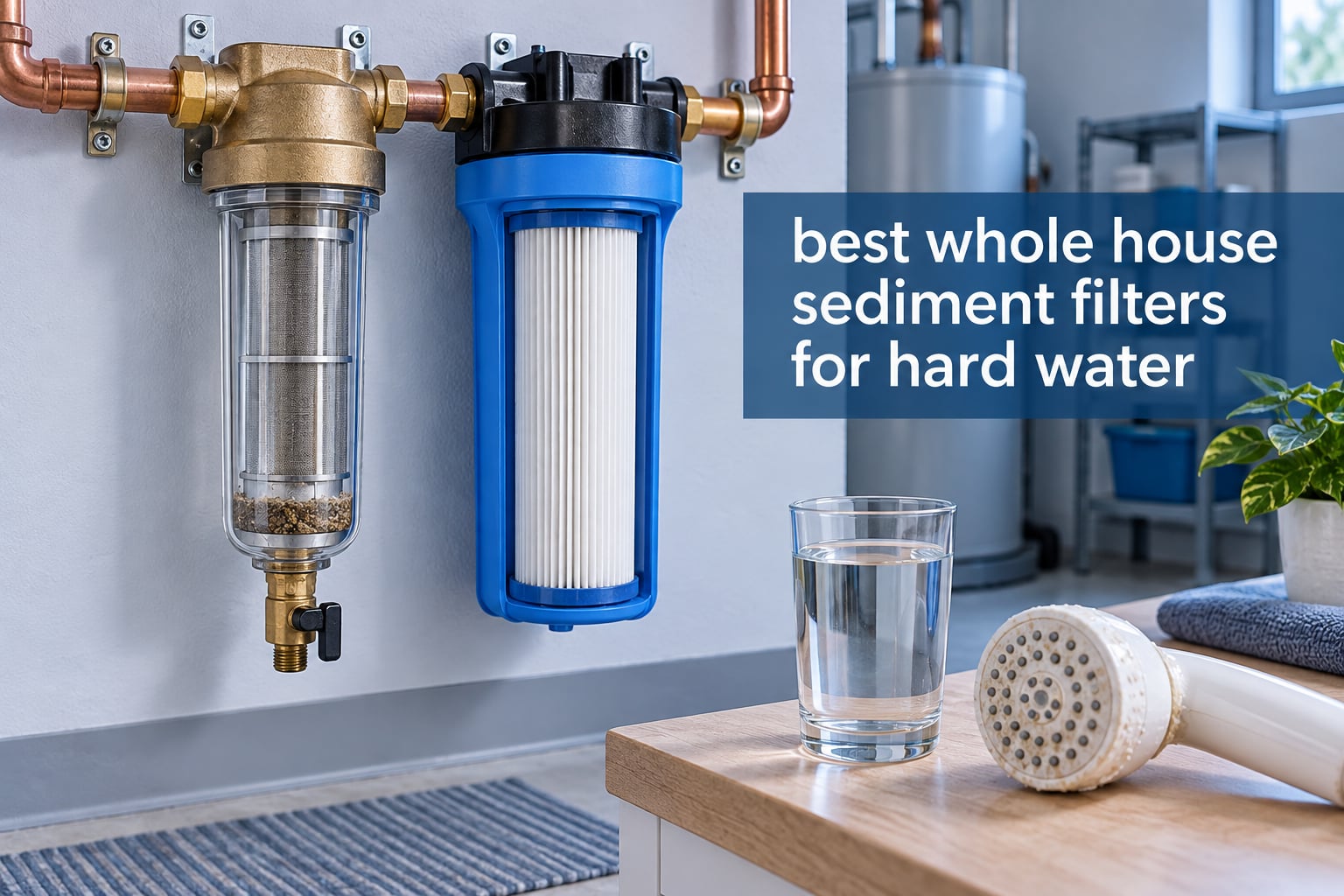
Let me clear up the biggest misconception first, because it drives everything else in this guide: no, a sediment filter does not soften hard water. A sediment water filter traps particles that are suspended in the water — sand, silt, rust flakes, grit from old galvanized pipe, iron sediment from a well. Hardness is different. Calcium and magnesium are dissolved at the molecular level, so they pass straight through any mesh, cartridge or carbon block and never clog anything.
That said, sediment filtration is exactly what a hard water home needs, because dissolved hardness is what creates the conditions that generate particles. Scale flakes off of pipe walls and water heater elements, corrosion sheds rust, and that debris is what ends up in your faucets, your dishwasher spray arm and your water softener resin bed. A point of entry filter catches that debris before it travels anywhere.
Over the past few months our team compared twelve whole house sediment filters on hard water plumbing, looking at micron rating, flow rate, service interval, housing quality and the kind of hard water problems each one actually solves. We also mapped how each filter behaves when paired with a water softener, which is the configuration most hard water households end up running.
Here is the short version of the best whole house sediment filters for hard water: our top pick is the iSpring WGB21B-DS, a two-stage anti-scale system that handles sediment, chlorine and scale inhibition in one bracket. On silty or well supply, put the reusable iSpring WSP-50 spin down filter in front of it as a coarse first stage, and if your budget is the deciding factor the Filtrete grooved cartridge pair costs so little that replacement frequency stops being a worry.
What a sediment filter will not do is lower your hardness reading, stop white scale on a faucet, or protect you from a water softener that has never been installed. For that you need ion exchange. This roundup covers the filtration hardware, and the sizing and ordering guidance at the end shows where the softener belongs in the line.
Table of Contents
Top 3 Whole House Sediment Filters for Hard Water Homes (September 2026)
These three are the ones we come back to. One is the reusable first stage, one is the all-in-one system for hard water scale, and one is the cartridge that does the most good per dollar across a full year of replacements.

iSpring WGB21B-DS 2-Stage Anti-Scale Filter
- CTO carbon block plus anti-scale polyphosphate
- 50000 gallon capacity
- 12 gpm on 1-inch ports
- Pre-assembled bracket

iSpring Ultimate Whole House Auto-Flush…
- Auto-flush spin down first stage
- Three stage carbon and compound media
- 250000 gallon capacity
- 15 gpm flow

PUREPLUS 5 Micron 10 x 4.5 in Pleated Filter
- 5 micron pleated polypropylene
- Up to 30000 gallon rating
- Fits standard heavy duty housings
- Sold as a two pack
Whole House Sediment Filters for Hard Water in 2026: Quick Overview
All twelve products below are point of entry units, sized for typical residential flow. The table is a quick reference; the full reviews follow in the same order.
| Product | Specifications | Action |
|---|---|---|
|
iSpring WGB21B-DS 2-Stage Anti-Scale Whole House Water Filter
|
|
Check Latest Price |
|
iSpring Ultimate Whole House Filter with Auto-Flush Sediment Filter
|
|
Check Latest Price |
 Express Water Whole House Filter, Anti-Scale, 3-Stage
|
|
Check Latest Price |
 iSpring WSP-50 Spin Down Sediment Filter, 50 Micron
|
|
Check Latest Price |
 A. O. Smith Whole House Sediment Filter with Valve-in-Head
|
|
Check Latest Price |
 Pentair Pentek DGD-5005 Big Blue Whole House Sediment Filter
|
|
Check Latest Price |
 Waterdrop WHF21-PG 2-Stage Whole House Water Filter, 5 Micron
|
|
Check Latest Price |
 Waterdrop RPFK Spin Down Sediment Filter, 40-50 Micron
|
|
Check Latest Price |
 Waterdrop BG103 Mega Spin Down Sediment Filter
|
|
Check Latest Price |
 Filtrete Standard Grooved Whole House Water Filter 2-Pack
|
|
Check Latest Price |
|
PUREPLUS 5 Micron 10 x 4.5 in Whole House Pleated Sediment Filter
|
|
Check Latest Price |
 Aquaboon 5 Micron 20 x 4.5 Whole House Pleated Sediment Filter
|
|
Check Latest Price |
Pick the right micron rating before you pick a filter
The single most useful decision you can make before shopping is the micron rating, because that single number determines how often you service the filter and whether it clogs in your water.
A micron is one millionth of a meter. It sounds microscopic because it is. For context, fine sand sits around 100 microns, silt runs 10 to 50 microns, and rust and clay particles land below 5 microns. A 50 micron filter passes everything smaller than a grain of playground sand, so it catches scale flakes, sand and grit while letting the finer stuff keep moving. A 5 micron filter catches the silt and rust film that makes glassware look grimy.
For most hard water homes on municipal supply, a 20 micron spin down as the first stage plus a 5 micron cartridge as the polishing stage is the pairing we recommend. Well water usually needs a 50 micron or 100 micron reusable screen in front because silt loads a fine cartridge in weeks rather than months. Installing a 5 micron cartridge as your only stage on silty well water is the single most common expensive mistake we see, and reviews of the spin down units in this roundup repeat the same lesson: start coarse and finish fine.
Flow rate matters just as much. Small homes with one to three bathrooms are comfortable at 10 to 15 GPM, larger homes want 20 GPM or more, and anything below 6 GPM becomes visible in the shower. That is the reasoning behind the A. O. Smith unit in this list, whose 6 GPM rating is the main reason it sits low in our ranking despite doing a clean job.
1. iSpring WGB21B-DS 2-Stage Anti-Scale Whole House Water Filter
iSpring WGB21B-DS 2-Stage Anti-Scale Whole House Water Filter System
50000 gallon capacity
12 gpm max flow
1-inch ports
16 x 8 x 18 inches
26 pounds
Pros
- Two-stage CTO carbon plus anti-scale design targets sediment and hard water scale
- Sturdy thick-walled housings with 1-inch ports for low pressure drop
- Clear improvement in taste odor and dishwasher spotting
- Pre-assembled bracket makes the install straightforward
- US support provides replacement parts at no cost
Cons
- Threaded fittings can weep if not carefully taped and tightened
- Some reports of small leaks at the housing O-rings after install
- Cartridges need changing roughly every 6-12 months
- Does not reduce total dissolved solids
This is the unit we recommend first for a hard water home that has no filtration at all, because it addresses two problems in one bracket. Stage one is a CTO carbon block that handles chlorine, taste and odor. Stage two is an anti-scale polyphosphate filter that sequesters calcium and magnesium so they stop precipitating into pipe scale.
Reviewers report the visible results quickly: clearer water, less spotting on dishes pulled straight from the dishwasher, and a steadier flow than a bare spin down offers. The 1-inch inlet and outlet are a genuine upgrade over the 3/4-inch fittings common at this level, and 12 GPM is enough for a family of four without anyone noticing a pressure drop.
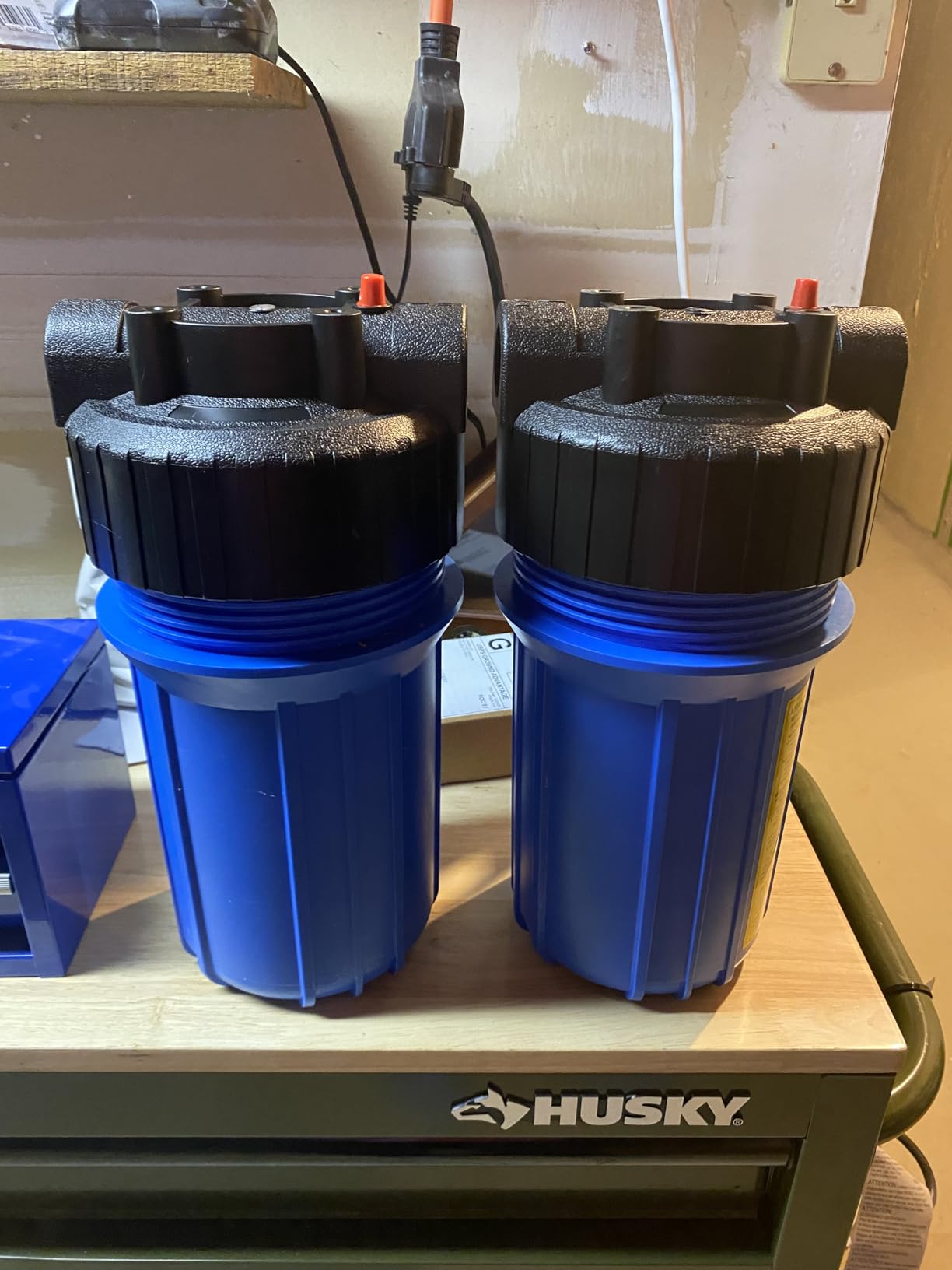
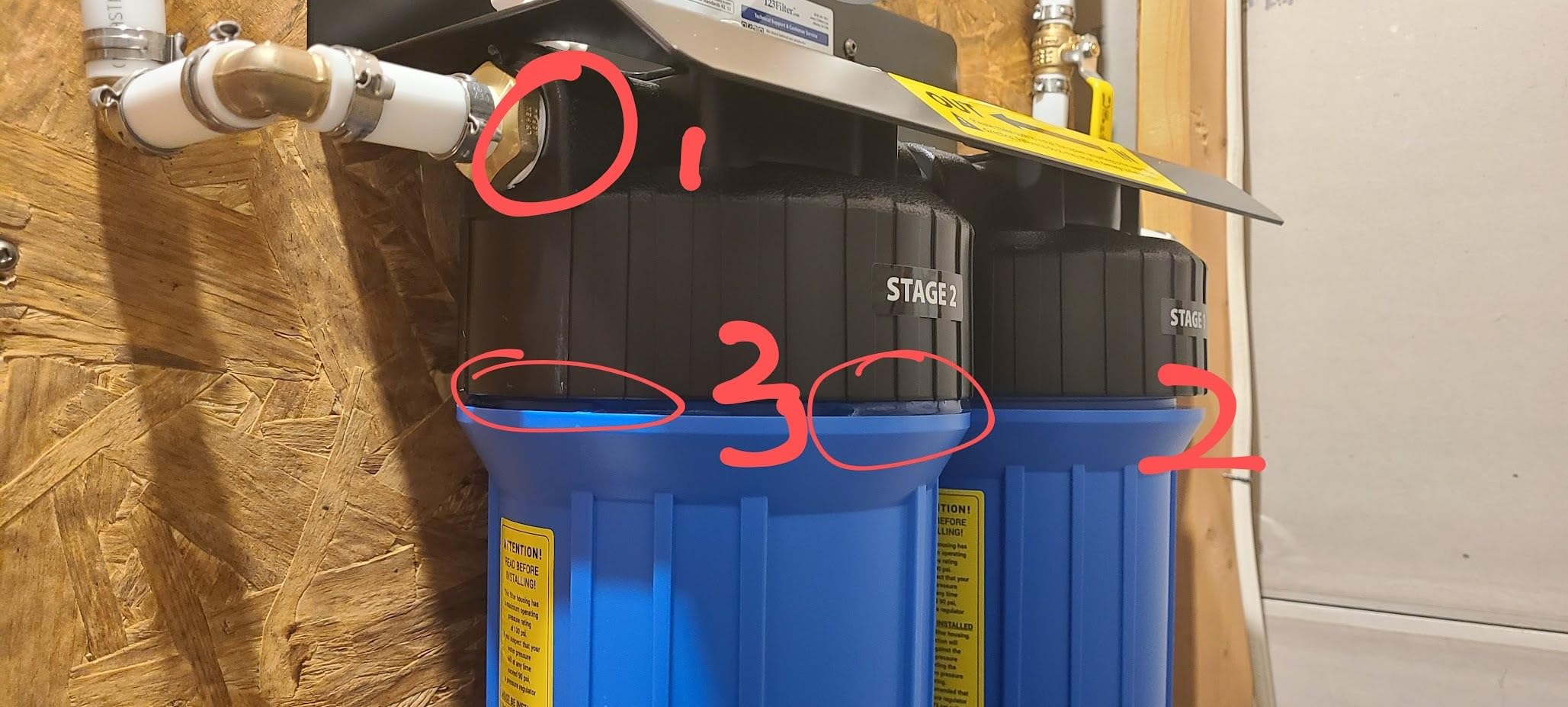
The honest weakness is installation technique. The NPT threads bite into the plastic housing, and reviewers who skip proper Teflon tape report slow weeping at the joints. A handful of owners also report a small leak at the O-ring seat after a filter change. None of that is a defect in the design, it is a tightening problem that costs five extra minutes and proper tape.
Customer service comes up repeatedly as a genuine strength. Multiple reviewers describe support resolving leaks and sending replacement housings or O-rings at no cost, which is not the normal experience with budget whole house gear. That service alone covers most of the small fitting complaints over the life of the unit.
Who this filter suits best
It suits a home on chlorinated city water with moderate hardness, no water softener, and an owner who wants a single install rather than a staged build. The 50,000 gallon rating means a typical family runs a long stretch before the first change, and the two-stage layout means chlorine and sediment are handled at the same time instead of one stage at a time.
It also suits anyone about to install a softener. Running this ahead of the softener keeps carbon fines and sediment out of the resin bed, which is exactly the pre-filtration the resin manufacturers ask for.
Who should pick something else
Skip it if your water comes from a well with heavy sand. There is no reusable pre-screen in this bracket, so the carbon block becomes the first thing to load and the cartridge interval collapses. A spin down stage in front of it solves the problem properly.
It is also the wrong tool if your goal is to stop white scale on fixtures. Polyphosphate inhibits scale that has not formed yet, and it does not remove hardness that is already deposited, so existing crust on a faucet or shower head stays exactly where it is.
2. iSpring Ultimate Whole House Water Filter with Auto-Flush Sediment Filter
iSpring Ultimate Whole House Water Filter w/Auto-Flush Sediment Filter
250000 gallon capacity
15 gpm max flow
Three stages plus auto-flush
25 x 22 x 17 inches
66.7 pounds
Pros
- Three stages combine an auto-flushing sediment prefilter with compound and carbon media
- 250000 gallon rated capacity suits high-use households
- Anti-scale polyphosphate stage targets hard water scale and corrosion
- Auto-flush module removes manual spin-down maintenance
- No power source required
Cons
- Bulky 66.7 pound assembly needs real mounting space
- Highest cost of the systems analyzed
- Polyphosphate inhibits scale rather than removing calcium and magnesium
This is the most complete point of entry system in the group, and the only one that resolves its own first-stage maintenance. The WSP50ARB spin down filter on the front has a touch-screen auto-flush module, so the coarse sediment layer clears itself on a schedule instead of waiting for you to open a hose bib and spin the head.
Behind it sits a compound filter handling chlorine, lead, mercury, H2S, heavy metals, pesticides and herbicides, then a coconut shell carbon block for taste and odor, then a patented polyphosphate scale inhibitor. The 15 GPM rating and 250,000 gallon capacity give a high-use household real headroom, and no power connection is required.
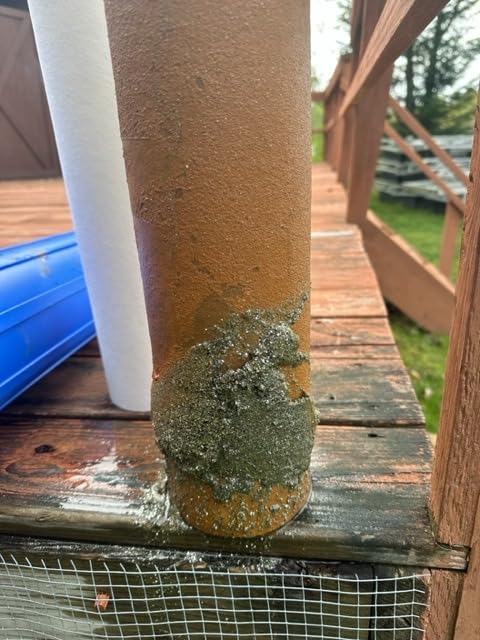
What reviewers consistently notice after installation is whole-home water quality rather than one fixture. Clearer water at the tub, less scale and corrosion inside the plumbing, and noticeably less debris reaching the downstream stages. Several owners pair it with a softener and report that the auto-flush stage is what keeps the carbon cartridges alive longer than expected.
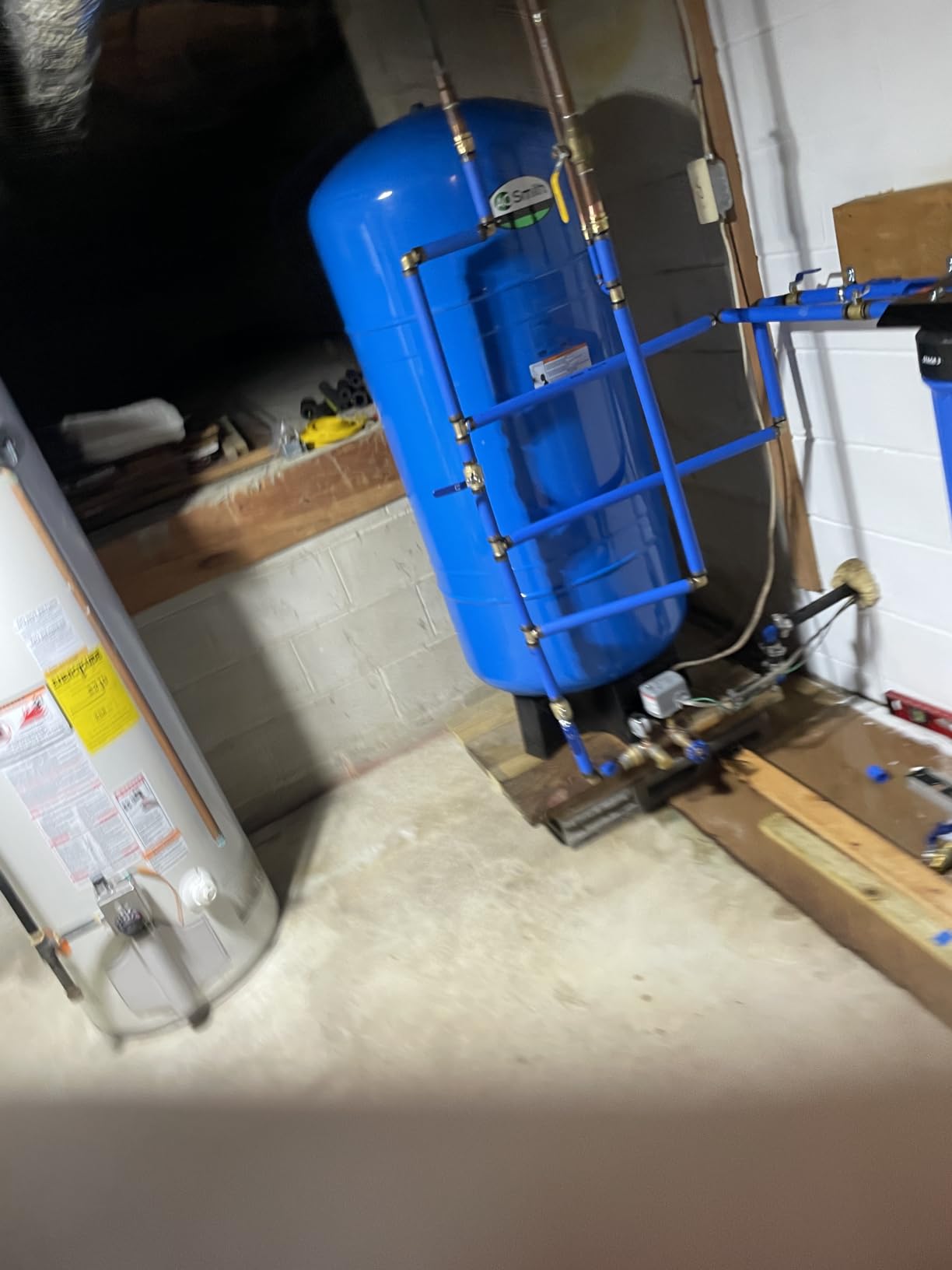
The criticism that comes up again is physical. At 66.7 pounds and 25 by 22 by 17 inches, this is not a unit you squeeze into a tight utility closet. Plan the mounting space before you buy, and confirm the wall can carry the assembly when it is full of water.
Who this system suits best
It suits a family that has already been through a couple of filter iterations and does not want to keep remembering to flush a spin down head. The auto-flush module turns the highest-drudge part of whole house ownership into something the system handles on its own, which is worth a great deal over a decade.
It also suits a home that wants sediment, carbon and scale inhibition handled at one point in the line rather than across three housings, and that has the plumbing volume to support 15 GPM.
Who should pick something else
It is the wrong call for a small apartment, a rental or a mechanical room with limited clearance. The weight and footprint alone can rule it out, and the cost is difficult to justify where the household demand is under 10 GPM.
It is also the wrong answer for very hard water that has already formed scale. Like every polyphosphate stage in this roundup, it keeps new scale from forming while the polyphosphate is present. It does not soften water and it will not dissolve the scale already in your water heater.
3. Express Water Whole House Water Filter System, Anti-Scale, 3-Stage
Express Water Whole House Water Filter System, Anti-Scale, 3-Stage
15 gpm max flow
20-80 psi operating range
Three 20 in cartridges
23 x 8 x 29 inches
Stainless steel frame
Pros
- Three-stage system with an explicit anti-scale stage built for hard water homes
- Heavy-duty stainless steel frame feels commercial-grade
- Pressure gauge and release button on every stage
- Reviewers report less staining on sinks and toilets
- Manufacturer recommends installing ahead of a softener
Cons
- Replacement KDF and carbon cartridges are relatively pricey
- Coarse threads need many wraps of Teflon tape
- Reversed filter threads confuse some installers
- Sediment stage loads fast on high-sediment well water
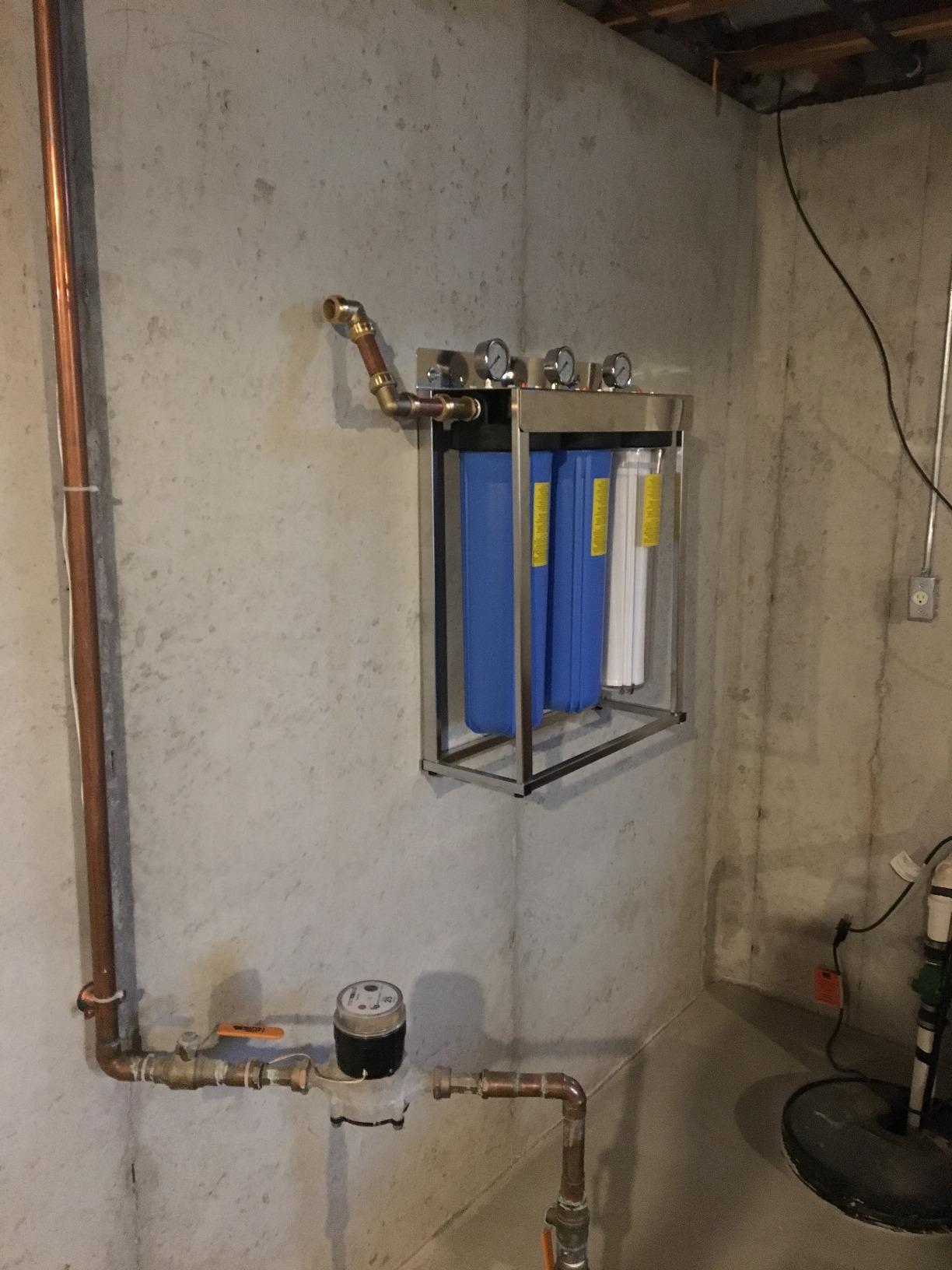
This system stands out for hardware rather than media. The bracket and free-standing frame are stainless steel rather than polypropylene, and each of the three 20 inch housings carries its own pressure gauge and pressure release button. That gauge is the feature we appreciate most: you can see which stage is loading up instead of guessing when to change a filter.
Long-term owners describe holding up for years, with filters swapped on roughly a six-month cycle and measurable improvements in water clarity, taste and the orange staining that hard water leaves on fixtures. The 15 GPM rating on 1-inch connections and the 20 to 80 psi operating range put it comfortably above household demand.
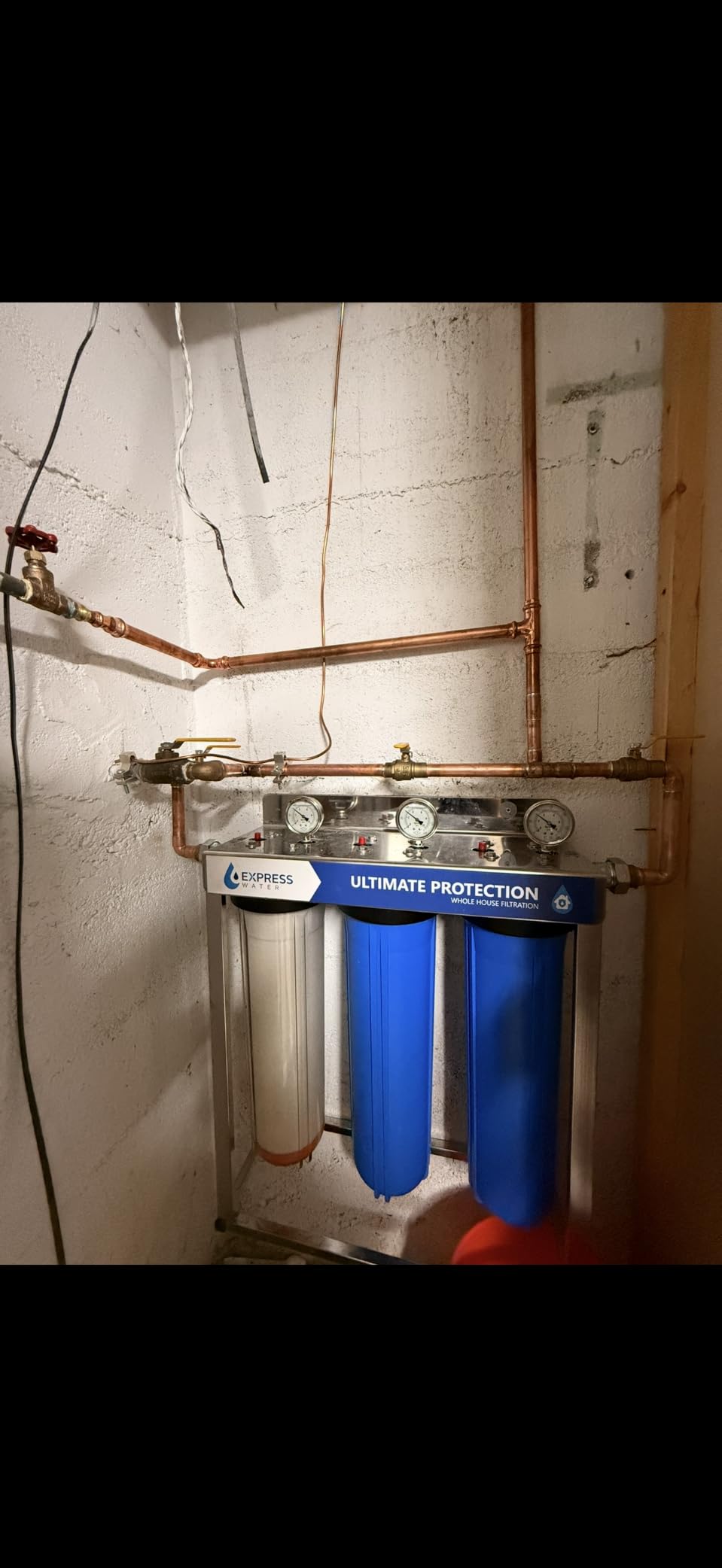
The most consistent piece of installation advice in the reviews is to add a spin down prefilter ahead of stage one. Without one, the first cartridge on a sedimented supply is doing two jobs and wearing out on schedule. With one, owners report the KDF and carbon stages last far longer.
Two details will trip up a first-time installer. The threads on these housings are coarse and want 15 to 20 wraps of Teflon tape before the joint will stop weeping, and the filter threads are reversed, so turning the housing the normal way loosens it. Both are documented in the manual once you know to look.
Who this system suits best
It suits a homeowner who likes to see what is happening. Separate pressure gauges per stage turn filter monitoring from a guess into a reading, and the stainless frame means the assembly will outlast several cartridge generations without shifting on the wall.
It also suits anyone with a larger home or a busy household that runs multiple fixtures at once, since 15 GPM and three 20 inch housings give more capacity per stage than the 10-inch systems in this list.
Who should pick something else
It is a poor fit for maintenance-sensitive households. The KDF and carbon cartridges are among the pricier consumables here, and a three-stage system means three sets of replacement parts to track rather than one.
It is also a poor fit as the only filtration on a well with sand. The reviews are blunt about the sediment stage loading quickly in that condition, which is a case for putting a spin down filter in front of it.
4. iSpring WSP-50 Spin Down Sediment Filter, Whole House Prefilter, 50 Micron
iSpring WSP-50 Spin Down Sediment Filter, Whole House Prefilter, 50 Micron
50 micron stainless mesh
Lead-free brass head
3.5 x 3.5 x 9 inches
16 ounces
Rated 15-115 psi
Pros
- Effectively protects downstream filters and softeners from coarse sediment rust and sand
- Reusable stainless mesh with fast simple flush cleaning
- See-through housing shows when cleaning is needed
- Lead-free brass head feels commercial quality
- Support will swap in a different micron screen to match your water
Cons
- 50 micron mesh clogs quickly in silt-heavy water and cuts flow
- Needs frequent manual flushing on silty well water
- Fitting to a 1-inch housing can be tight on the threads
- The screen O-ring can wear out over time
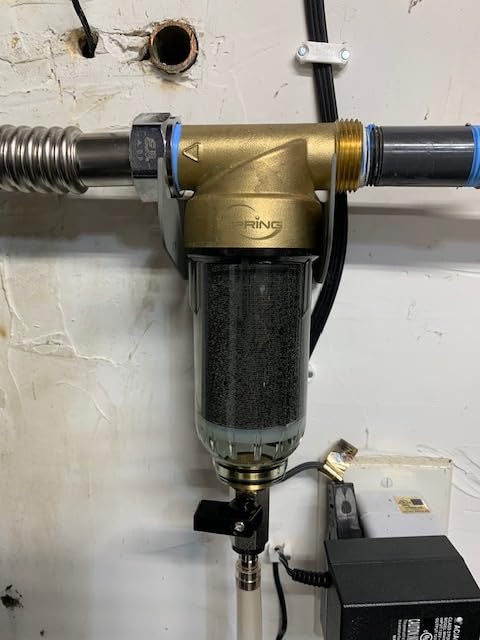
This is the filter we install before anything else in a hard water house, and the reasoning is simple. It is a 50 micron stainless steel mesh screen in a lead-free brass head with dual O-rings, you flush it with a garden hose when it loads, and you keep using it. There is no cartridge to buy and no media to throw away.
What it does is protect everything behind it. Softener resin, carbon blocks and fine cartridges all last longer when coarse scale debris never reaches them, and because the housing is transparent you can see the captured sediment and know exactly how dirty your water is. Reviewers consistently endorse it as a first-stage prefilter ahead of fine whole house cartridges and water softeners.
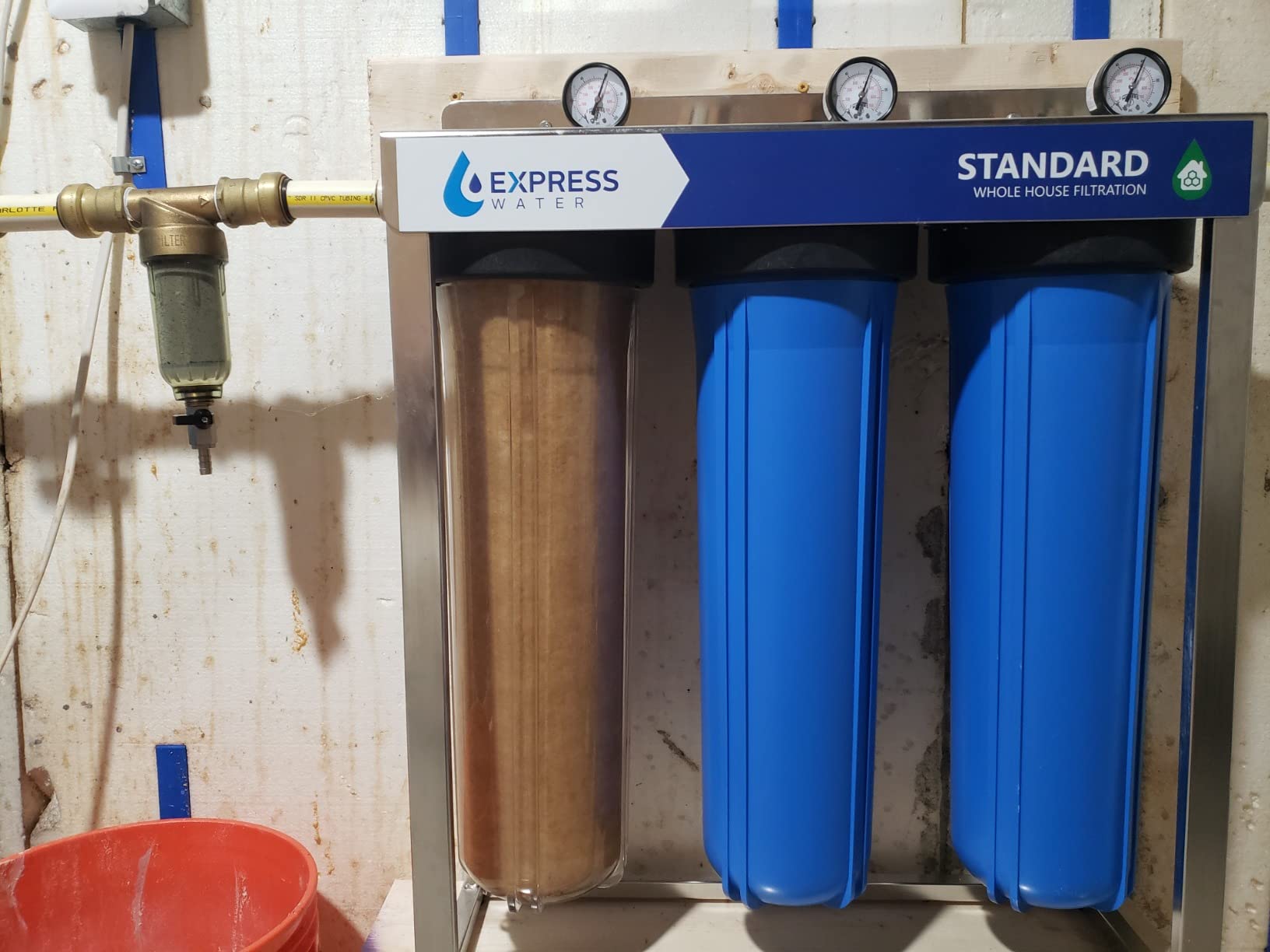
The recurring lesson across reviews is about micron sizing rather than quality. Several well water owners report the 50 micron screen clogging within days in silt-heavy water, and switching to a 100 or 200 micron screen restored flow immediately. The mesh is available in three ratings, which turns what sounds like a failure into a tuning decision.
Construction details get called out too. The dual O-ring and solid brass head hold up, and iSpring support repeatedly supplied replacement screens or alternate micron ratings at no charge, which owners rate as a major plus over the long term.
Who this filter suits best
It suits anyone building a staged system, which in practice means most hard water homes. Put the WSP-50 at the point of entry as the coarse stage, then a 5 micron cartridge or carbon system behind it, then the softener. Owners running that arrangement report downstream cartridges lasting far longer than they did as a first stage.
It also suits well water households and anyone on a municipal supply with old galvanized pipe, because both produce the coarse rust and grit this screen is built to intercept.
Who should pick something else
It is not a standalone solution. On its own, a 50 micron screen leaves everything smaller than 50 microns in the water, which means the fine rust film and silt that cause stained glassware are still flowing to your faucets. You need a fine cartridge behind it.
It is also the wrong choice if you will not flush it. The visible housing makes it obvious when the screen is loaded, but a spin down filter that only gets cleaned twice a year will starve everything downstream and drop your flow. Budget a few minutes a month.
5. A. O. Smith Whole House Sediment Filter, Valve-in-Head
A. O. Smith Whole House Sediment Filter | Valve-in-Head | AO-WH-PREV
24000 gallon capacity
6 gpm max flow
3/4-inch connections
15 x 6 x 5 inches
24000 gallon life
Pros
- Valve-in-head bypass makes filter changes quick without cutting water
- Clear housing lets you confirm sediment loading visually
- Cuts visible rust sand and dirt ahead of softeners
- Low-profile body fits tight mechanical rooms
- Well regarded as a reliable inexpensive prefilter
Cons
- Clear housing reported cracking at the threaded collar over time
- Threads on some units need many wraps of tape and may not seat
- Weak mounting bracket on some variants
- 6 gpm rating is tight for larger homes
- Lowest average rating in this roundup at 4.3 stars
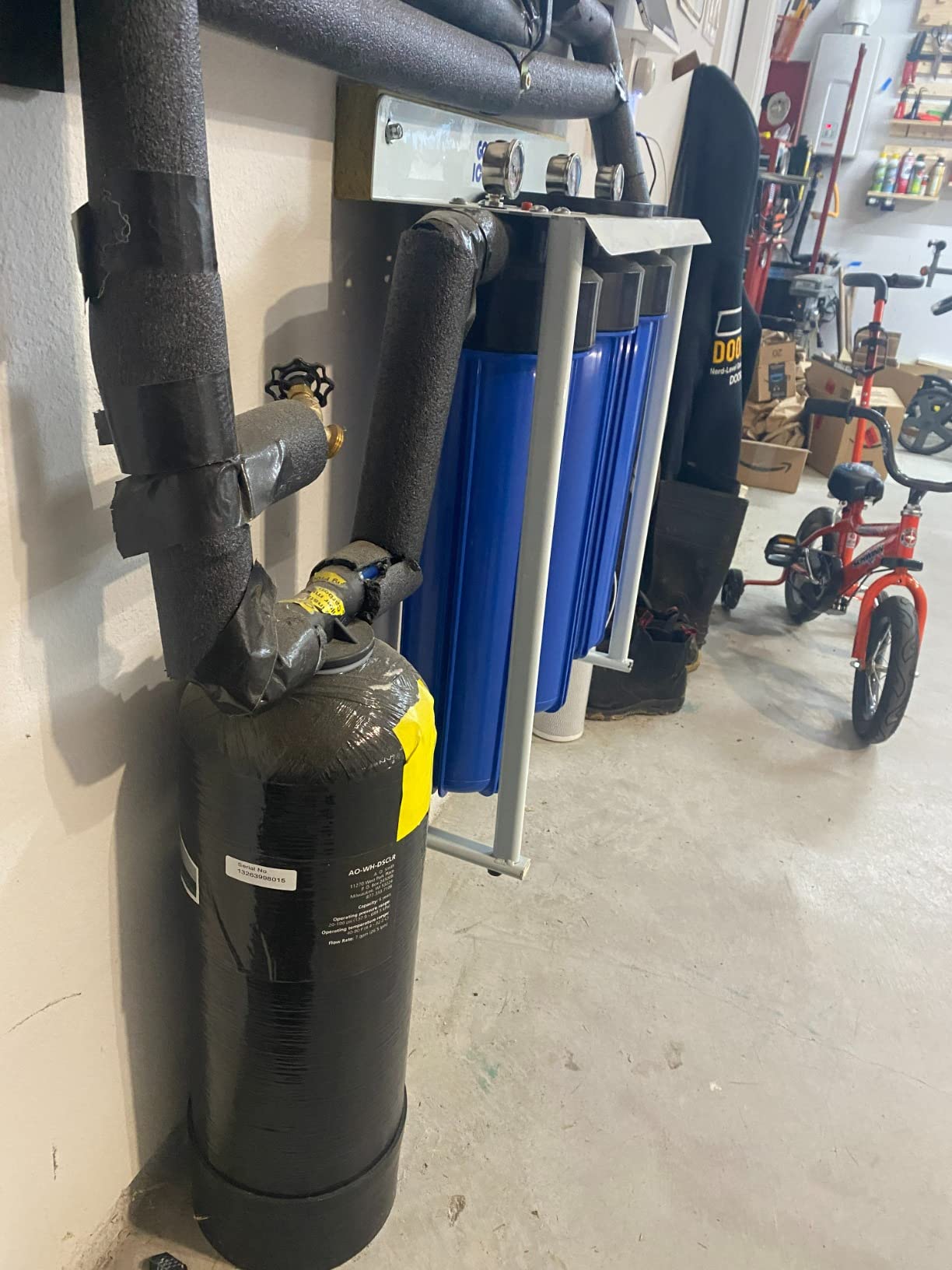
This is a straight single-stage sediment prefilter built around one genuinely useful idea: the valve-in-head bypass. The shut-off and bypass are integrated into the head, so you change the cartridge without shutting off water to the house. For a filter you expect to service twice a year, that removes the most annoying part of the job.
It is NSF/ANSI Standard 42 certified for particulate reduction, and buyers who pair it with a softener or carbon stage describe it doing exactly what a sacrificial prefilter should: catching rust and sediment before they reach the more expensive cartridges behind it. The 24,000 gallon rating and clear housing make service timing straightforward.
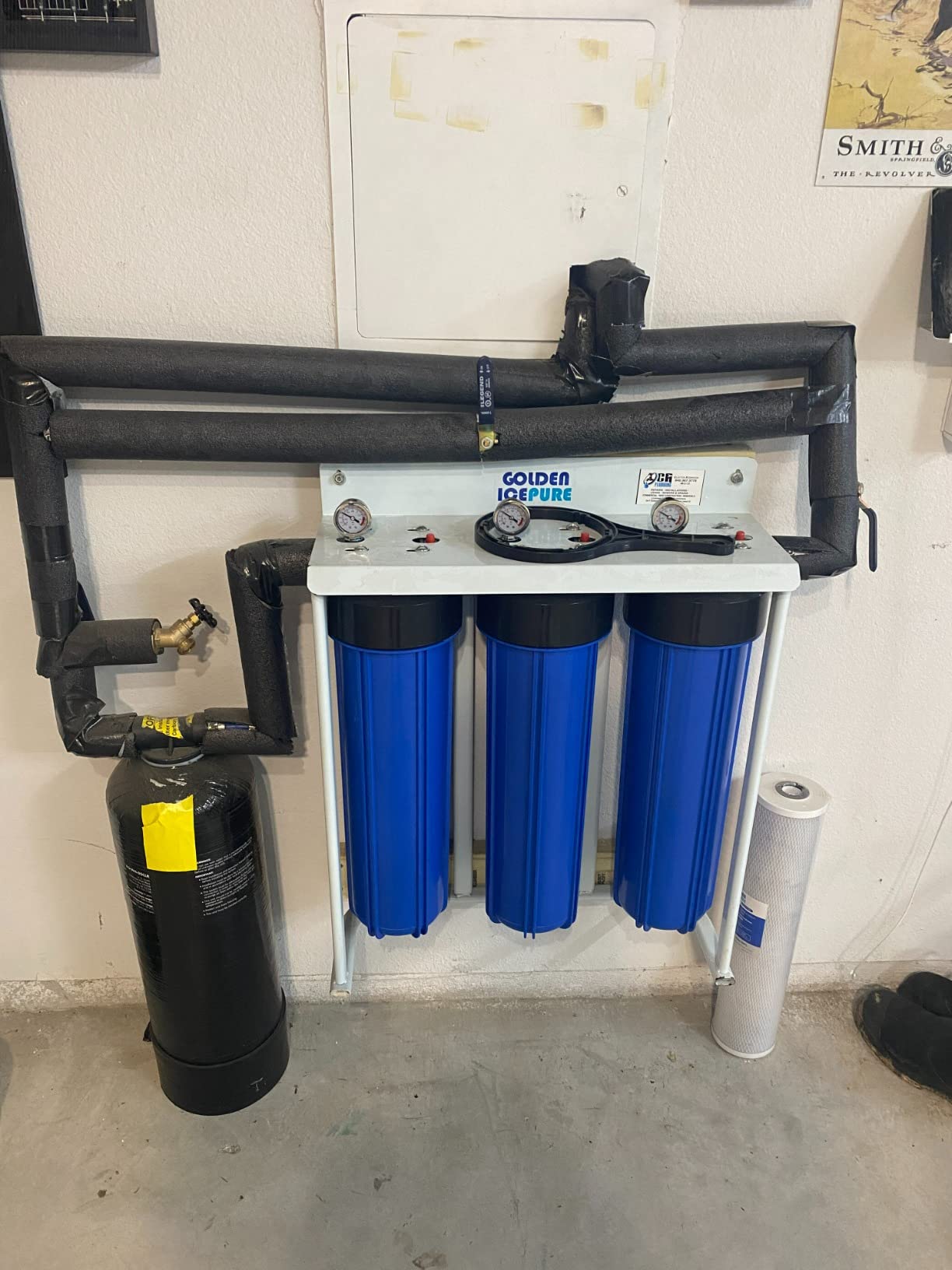
Durability is the dominant complaint, and it is worth taking seriously. Owners of the larger clear-housing versions report cracking at the threaded collar roughly annually, which means replacing the housing rather than just the cartridge. Thread sealing quality and bracket strength come up as secondary issues.
The 4.3 average, the lowest in this roundup, reflects a product that works as specified but does not age as gracefully as the brass and stainless options above it. If you are comfortable replacing a housing every year or two, that is a fair trade for the bypass and the compact footprint.
Who this filter suits best
It suits small homes and tight mechanical spaces. At 15 by 6 by 5 inches with 3/4-inch connections, it installs where a 20-inch three-stage system simply will not, and a 1 to 2 bathroom household will not push the 6 GPM rating hard enough to notice.
It also suits renters and landlords who need something inexpensive and predictable, and anyone who wants a bypass valve without buying a separate one.
Who should pick something else
Avoid it on a household with four or more bathrooms or any irrigation on the same line. At 6 GPM this is the smallest capacity unit in the roundup, and reviewers specifically call out the pressure limits it places on larger homes with high demand.
Skip it if you have hard water with a lot of suspended iron. Cracking housings and frequent cartridge changes add up, and a spin down filter ahead of a sturdier cartridge will cost less over the same period.
6. Pentair Pentek DGD-5005 Big Blue Whole House Sediment Filter
Pentair Pentek DGD-5005 Big Blue Whole House Sediment Filter
5 micron nominal rating
Under 1 psi drop at 10 gpm
Fits 10 x 4.5 in housings
4.5 x 4.5 x 10 inches
Two pack
Pros
- Dual-gradient density construction holds more dirt than generic spun cartridges
- Fits standard 10 x 4.5 in Big Blue housings with very low pressure drop
- Pure polypropylene will not impart taste odor or color
- Reviewers use it successfully ahead of softeners in very hard water
- Low rate of one-star reviews for this category
Cons
- Cartridge only
- so a separate housing is required
- Some buyers note the same two pack is cheaper at big-box stores
- No taste or odor removal despite common pairing with carbon stages
This cartridge does one thing and does it better than the generic spun-poly alternatives: hold dirt. The dual-gradient density construction increases density from the outer surface toward the core, which the manufacturer claims gives up to three times the dirt-holding capacity of a similar-size cartridge and 233 percent greater effective filter depth.
In practice owners describe it as a dependable, no-nonsense filter, most often used as a first stage before a softener or ahead of carbon filtration. Reviewers in very hard water report their systems running well with it in place. The under 1 psi pressure drop at 10 GPM figure matters more than it sounds, because it means the filter is not the reason your shower pressure drops.
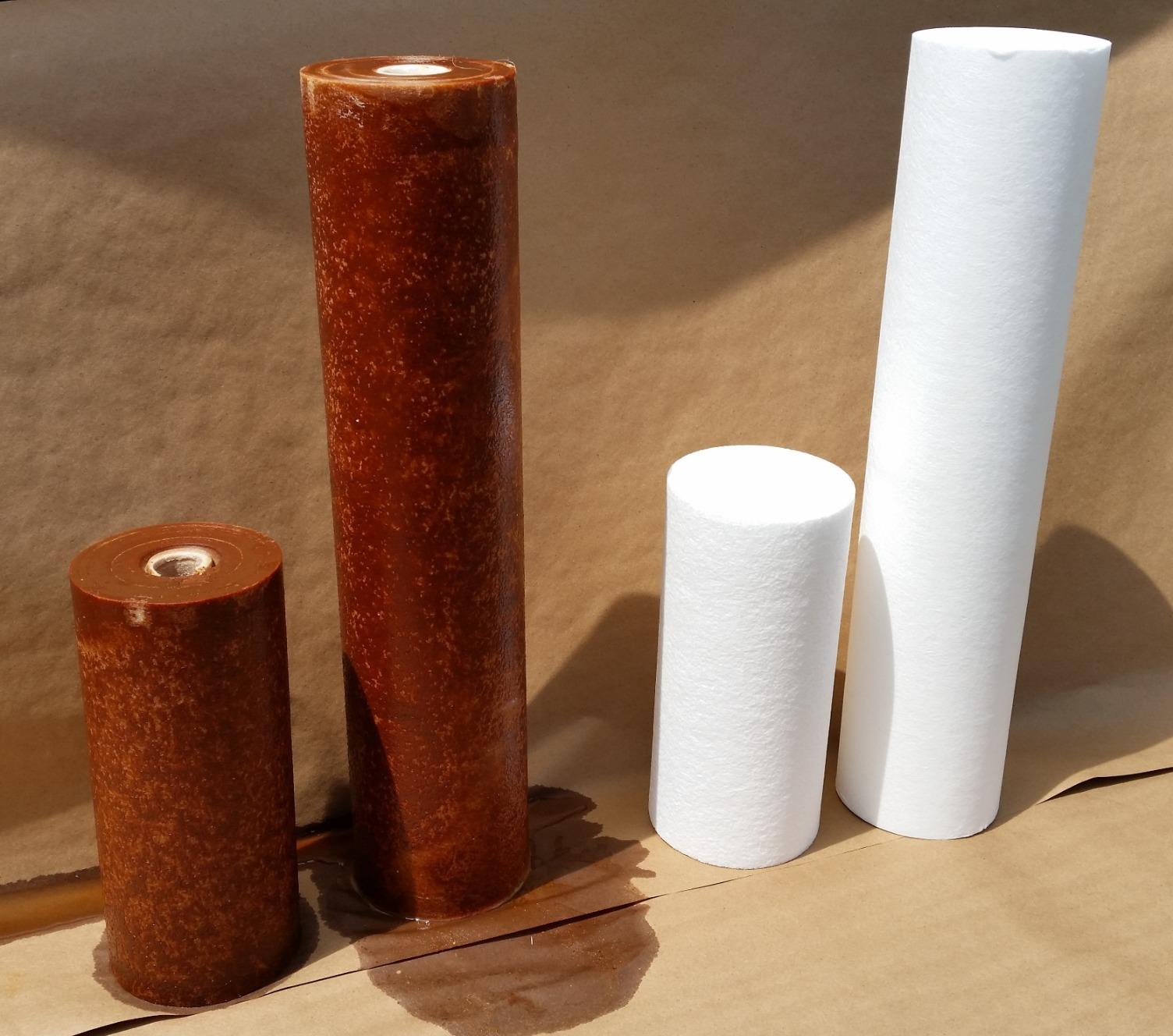
Two facts frame the rest. First, this is a cartridge, not a system, so you need a compatible 10 inch Big Blue or other 10 by 4.5 inch heavy duty housing already installed. Second, replacement is roughly every six months, which is normal for fine sediment media and the main ongoing cost of any cartridge-based approach.
Review tips are consistent across the sample: grease the housing O-ring, do not overtighten, and judge remaining life by looking at the cartridge rather than by calendar. In heavily sedimented water the interval shortens, which is the argument for putting a spin down stage in front of it.
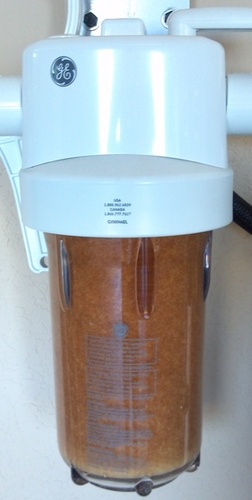
Who this cartridge suits best
It suits households that already have a 10 inch housing and want a better cartridge inside it. Swapping a generic spun filter for this one is a five-minute job that changes how long you go between changes in a well water home.
It also suits hard water homes using it as the pre-softener stage, which is the configuration reviewers recommend most and the one the pressure drop spec supports.
Who should pick something else
It is the wrong pick for someone starting from an empty plumbing system, because nothing here includes a housing or bracket. Buy a complete unit instead unless you specifically want to select your own housing size.
It is also the wrong pick if your main goal is taste, odor or chlorine. This is sediment media only, and pairing it with carbon is a job for a separate stage that you will have to buy separately.
7. Waterdrop WHF21-PG 2-Stage Whole House Water Filter, 5 Micron
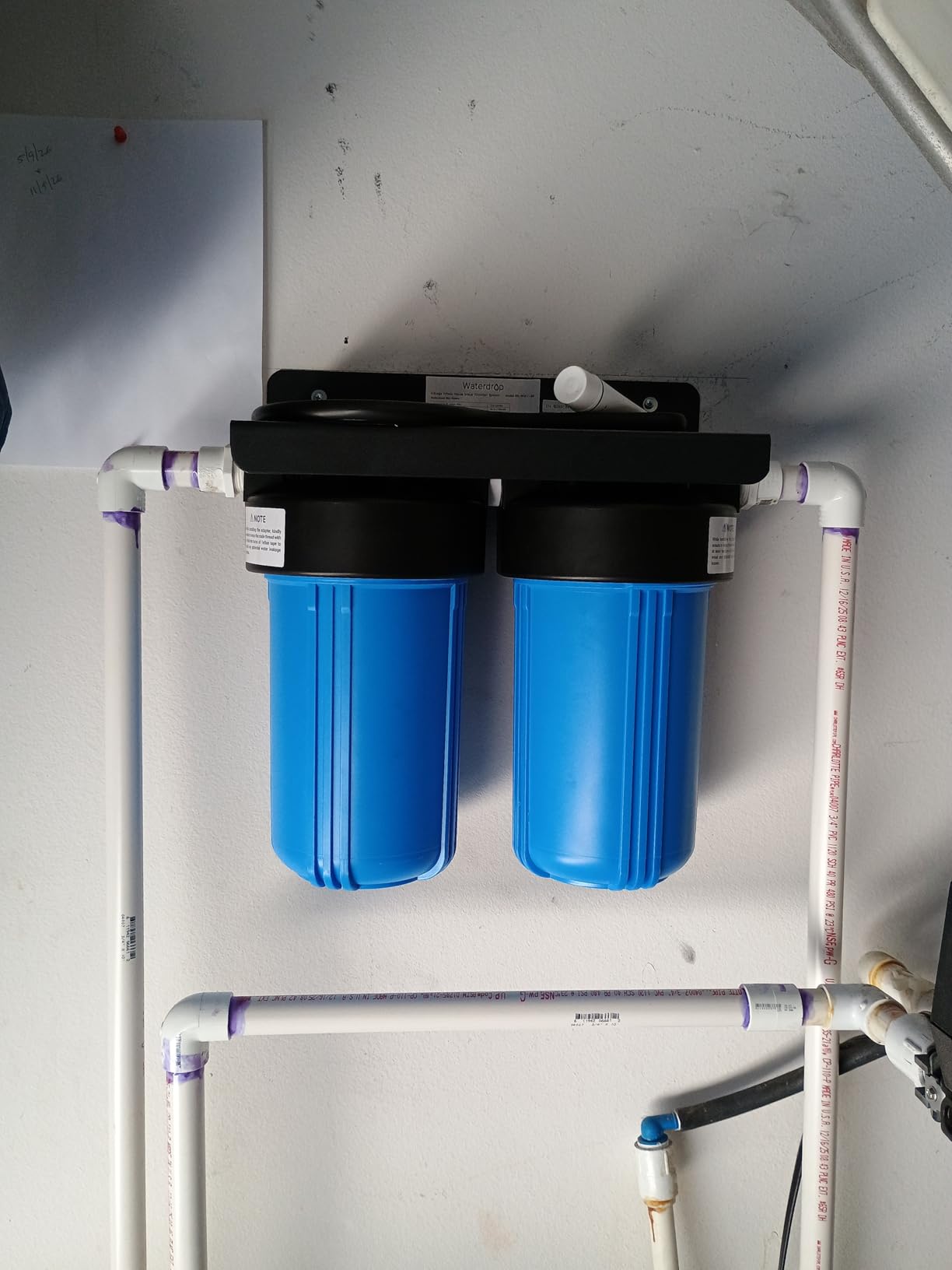
Waterdrop WHF21-PG 2-Stage Whole House Water Filter System, 5 Micron
50000 gallon capacity
15 gpm max flow
PP sediment plus GAC carbon
14.37 x 7.48 x 15.55 inches
6 month life
Pros
- Two-stage PP sediment and GAC carbon at an entry-level whole house price
- Coconut shell carbon improves taste and odor noticeably
- Food-grade housing tested to 100000+ water hammer cycles
- Straightforward DIY install with included wrench
- Good pre-treatment ahead of a water softener
Cons
- Lowest average rating among the full systems here at 4.4 stars
- Cartridges replaced every 3-6 months
- Best performance on municipal water as well water shortens life
- No anti-scale or hardness treatment at all
This is the sensible first system for someone on a budget who has municipal water and a taste or chlorine problem. Stage one is a 10 inch PP meltblown sediment filter, stage two is a 10 inch GAC coconut shell carbon block, and together they handle particles above 5 microns plus chlorine, lead, benzene and mercury.
Owners generally find it effective, citing better taste and odor within a few weeks and an installation that a competent DIYer can complete in an afternoon. The housings are tested to 25 to 90 psi and 100,000+ water hammer cycles, and the wrench is included, so nothing extra is needed for a basic install.
The 4.4 average, with about 6 percent one-star reviews, comes down to cartridge life being shorter than people expect. The PP filter changes every 3 to 6 months and the carbon at roughly six months, so the ongoing cost is a real line item that a one-time purchase price hides.
There is also no anti-scale stage, which matters if you picked this article because of hard water. This system will keep sediment out of your softener and improve taste, but it does nothing at all about scale formation, and it will not stop the white crust on a faucet.
Who this system suits best
It suits a household on city water with moderate sediment, no softener, and a modest budget. The 15 GPM rating and 50,000 gallon capacity are more than adequate for a family of three or four, and the two-stage layout covers both sediment and chlorine in a compact bracket.
It is also a good front-end for a softener install. Reviewers commonly recommend it as pre-treatment rather than as a standalone hard water solution, which is exactly the role it plays well.
Who should pick something else
Choose elsewhere if you are on a well. The reviews are direct that well and heavily sedimented water shortens cartridge life, and a fine meltblown stage is the wrong first filter for sand and grit. Start with a spin down screen instead.
Choose elsewhere if hard water scale is your primary complaint, since there is no scale inhibition media anywhere in this housing pair. The iSpring WGB21B-DS or the Express Water system address that directly.
8. Waterdrop RPFK Spin Down Sediment Filter, 40-50 Micron, BPA Free
Waterdrop RPFK Spin Down Sediment Filter, 40-50 Micron, BPA Free
50 micron 316L screen
20 gpm max flow
14.5-72 psi range
3.78 x 2.56 x 7.9 inches
Lead-free certified
Pros
- Stainless spin-down screen traps rust and grit before fine filters
- BPA-free PA12 housing and nano-coated lead-free brass fittings
- 20 GPM flow rating limits pressure loss
- Backwash function makes cleaning fast and tool free
- Multiple fitting sizes simplify retrofit onto existing plumbing
Cons
- Sediment pre-treatment only with no scale or hardness capability
- Cartridge-style maintenance is not applicable since the screen is reusable
- Small housing limits visibility compared with larger clear housings
This spin down filter is built around materials. The screen is 316L food-grade stainless steel, the housing shell is German-made PA12 that is BPA-free, and the copper fittings carry a corrosion-resistant blue nano coating and are lead-free certified to NSF/ANSI 372. The housing is tested to withstand bursting pressure above 600 psi.
Performance-wise, the 20 GPM rating is the highest of the spin down units in this roundup alongside the Waterdrop BG103, which matters if you have a large home or want headroom before a future softener install. The 14.5 to 72 psi operating range covers typical residential supply pressure comfortably.
The fittings package is unusually helpful. It includes 1 inch MNPT, 3/4 inch MNPT, 3/4 inch FNPT and 3/4 inch push-fit connectors, so retrofitting onto existing plumbing rarely requires a trip to the hardware store. The backwash function cleans the screen through the valve without tools or a replacement cartridge.
One thing to note about this listing: the research data returned 1,223 reviews at a 4.4 average, with 72 percent five-star and 4 percent one-star ratings, but no individual review text to draw on. The specification data is solid and the material claims are specific, so we are rating it on fit and finish rather than on reported long-term experience.
Who this filter suits best
It suits a large home or a household with high simultaneous demand, where a 10 to 15 GPM filter would be the limiting factor. At 20 GPM with a 50 micron screen, it catches coarse debris without becoming the weak link in your flow.
It also suits anyone who cares about material contact, since the lead-free certification and BPA-free housing remove two variables that matter on a line feeding drinking water.
Who should pick something else
Do not choose it as your only filter. A 50 micron screen leaves the fine silt and rust film that causes stained glassware and dishwasher spots completely untouched, so it needs a fine cartridge behind it to do anything visible at the tap.
Skip it if you want to see how loaded the screen is. The compact housing gives you less visual feedback than the larger clear spin down bodies in this list, so you will be flushing on a schedule rather than on appearance.
9. Waterdrop BG103 Mega Spin Down Sediment Filter, 500 + 200 Micron
Waterdrop BG103 Mega Spin Down Sediment Filter, 500 + 200 Micron
500 plus 200 micron dual screens
25 gpm max flow
6.9 x 5.7 x 15.9 inches
7.1 pounds
Forged brass head
Pros
- Dual 500 and 200 micron screens handle muddy sand-laden well water
- Very high 25 GPM flow with almost no measurable pressure drop
- Heavy 3.2 lb forged brass head feels commercial grade
- 360 degree power flush and two-way bypass make cleaning thorough
- Built-in magnetic scale prevention adds a secondary hard water benefit
Cons
- Mounting bracket rests the unit without holding it firmly
- Supplied wrench is hard to use in place and off position does not isolate backflow
- Needs cleaning about every two weeks in silty water
- Replacement cartridges for this model are reportedly hard to source
- Larger and heavier than standard spin down units
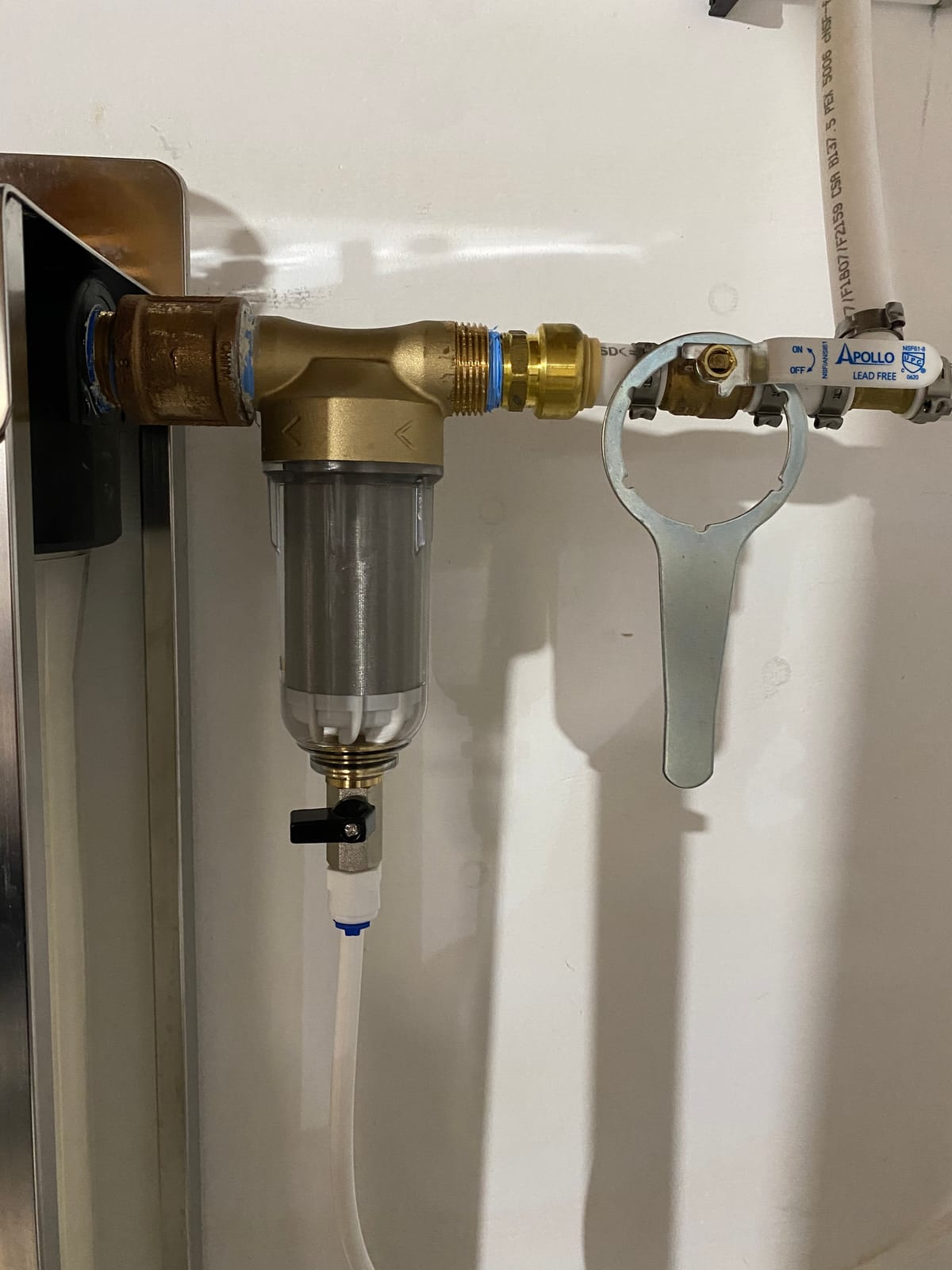
This is the one to buy if your water is genuinely muddy. The chamber is 20 times larger than a standard spin down and carries two screens, a 500 micron outer and a 200 micron inner, with the outer mesh 7 times larger and the inner 4.2 times larger than a typical unit. That is the difference between a filter that clogs weekly and one that keeps moving.
Owners with sandy or silty well water report it clearing sediment that had repeatedly blocked nozzles and other pre-filters, and several highlight the near-zero pressure drop alongside the 25 GPM rating. The 3.2 pound forged brass head with nano-coating feels like commercial plumbing rather than a plastic fitting.
Its magnetic scale prevention component disrupts the crystal structure of calcium and attracts ferrous particles, which gives it a secondary hard water angle that the other spin down units here do not offer. It is a modest benefit, not a substitute for a softener, but it is something extra for a hard water well.
The complaints are all about hardware rather than filtration. The wall bracket is described as a rest rather than a proper mount, the included wrench struggles with the filter ring, and the off position on the two-way bypass does not stop gravity backflow, so an isolation valve is worth adding. Replacement cartridges for this model are also reportedly hard to find.
Who this filter suits best
It suits well water households with sand and grit, especially on a shallow well or after rain. The dual 500 and 200 micron screening is designed for exactly the particle sizes that choke ordinary spin down filters within days.
It also suits anyone who wants one large first stage feeding a fine cartridge and a softener, because the 25 GPM rating leaves flow for everything downstream and the deep chamber stretches the cleaning interval.
Who should pick something else
Skip it on municipal supply with light sediment. You would be paying for capacity and micron range you will not use, and the cleaning schedule still applies. A standard 50 micron spin down handles city water comfortably.
Avoid it if maintenance is a problem, since owners report cleaning roughly every two weeks with a deep clean monthly in silty water. That is a real commitment, and the mounting and wrench complaints add friction to a task you will perform often.
10. Filtrete Standard Grooved Whole House Water Filter, 2-Pack
Filtrete Standard Grooved Whole House Water Filter 4WH-STDGR-F02, 2-Pack
5 micron grooved cartridge
Universal sump style fit
2.55 x 5.1 x 9.85 inches
Six month rated life
Two pack
Pros
- Lowest cost per cartridge in the roundup for frequent replacement schedules
- Largest review base here with a consistent 4.6 average
- Easy drop-in fit in standard sump style whole house housings
- Protects dishwashers water heaters showers and clothing washes
- NSF Standard 42 certified
Cons
- Cartridge darkens quickly so remaining life is hard to judge visually
- On well or heavily sedimented water the six month life is much shorter
- No carbon media so it does little for odor or taste alone
- Requires an existing compatible sump style housing
The argument for this cartridge is arithmetic. It is the least expensive sediment filter per unit in this roundup, it comes in a two pack, and for owners who change filters every few months that unit price determines the total cost of the setup more than any other single spec.
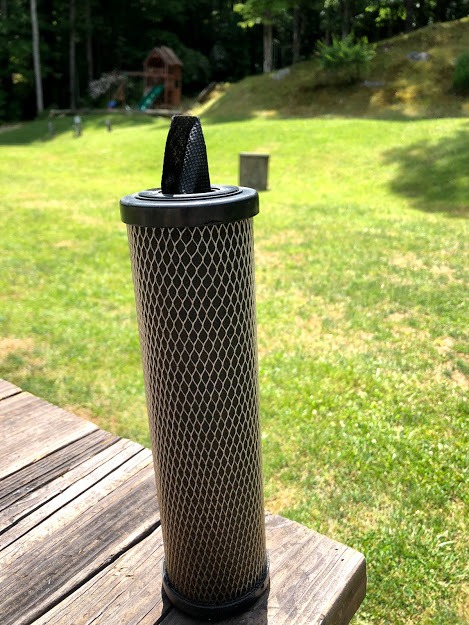
It is a 5 micron grooved cartridge for sand, silt, rust and soil, made by 3M and NSF Standard 42 certified, sized for households up to four people and two bathrooms. Owners on iron-heavy well water describe it as the value leader, with some reporting they cut household filter costs by more than half compared with other brands.
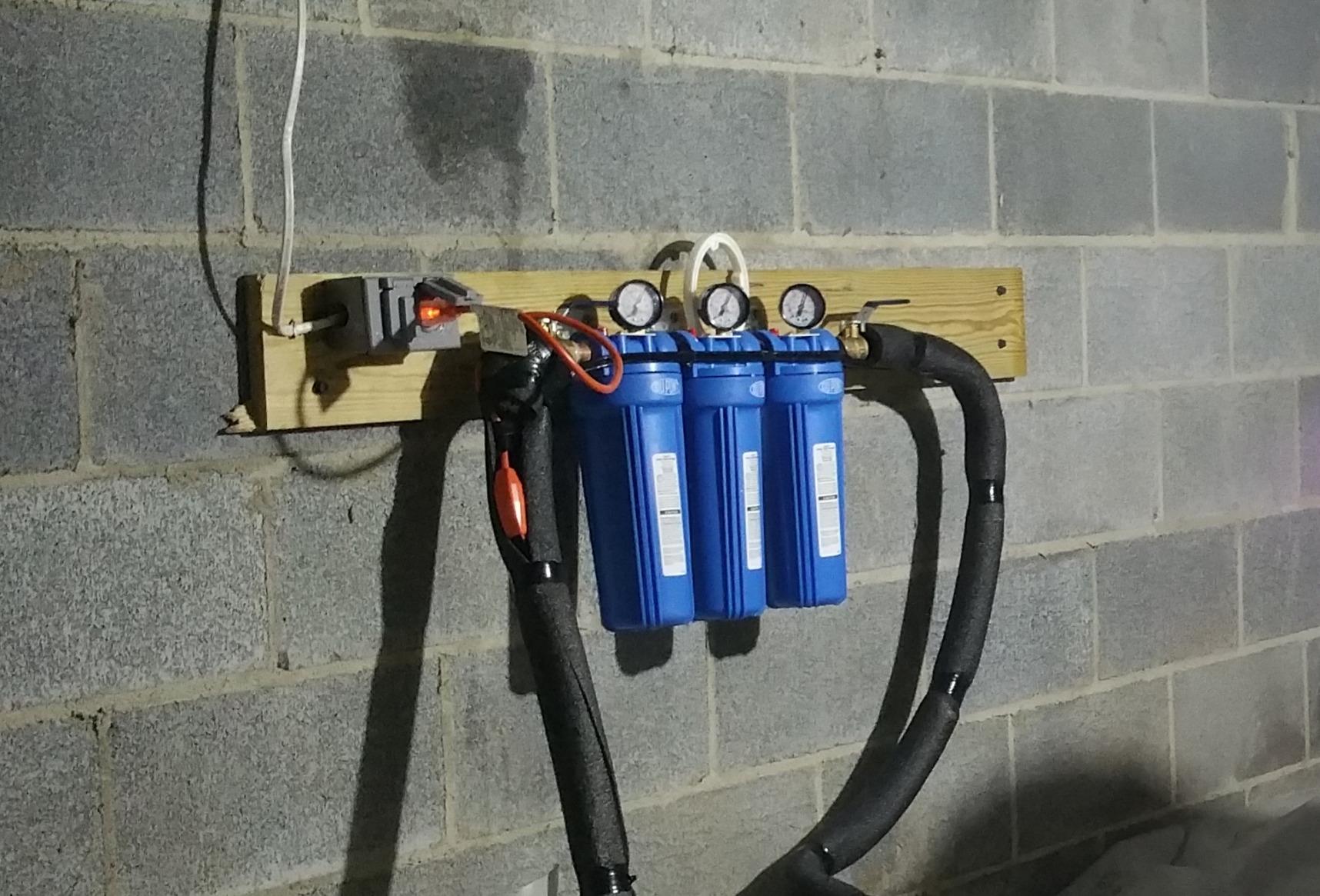
The honest caveat is that frequent replacement is part of the design, not a flaw. The owners who rate it most highly are the ones who have accepted a routine of changes every few weeks to a few months depending on load. If you will not maintain that rhythm, the cartridge will load and the water will tell you about it.
There is also no visual gauge of remaining capacity because the cartridge darkens quickly, so you are working from a calendar and an impression of the water rather than from a clear signal. And it is sediment only, so odor and taste need a separate carbon stage.
Who this filter suits best
It suits households on a strict replacement budget, particularly on well water where the six month rating collapses into weeks. Over a year of frequent changes, the per-unit cost is what makes or breaks the operating budget.
It also suits anyone with a standard capacity sump style housing already installed who wants a certified, widely available cartridge that is easy to find and does not require tools.
Who should pick something else
Choose elsewhere if you are starting from scratch, since no housing or bracket is included. Complete systems in this roundup solve that for you, and several cost less per year of service than this cartridge does in well water.
Choose elsewhere if your problem is taste or odor. This is sediment media with no carbon, so on chlorinated city water you will notice almost no change in what comes out of the tap. Pair it with a carbon block or pick a two-stage system.
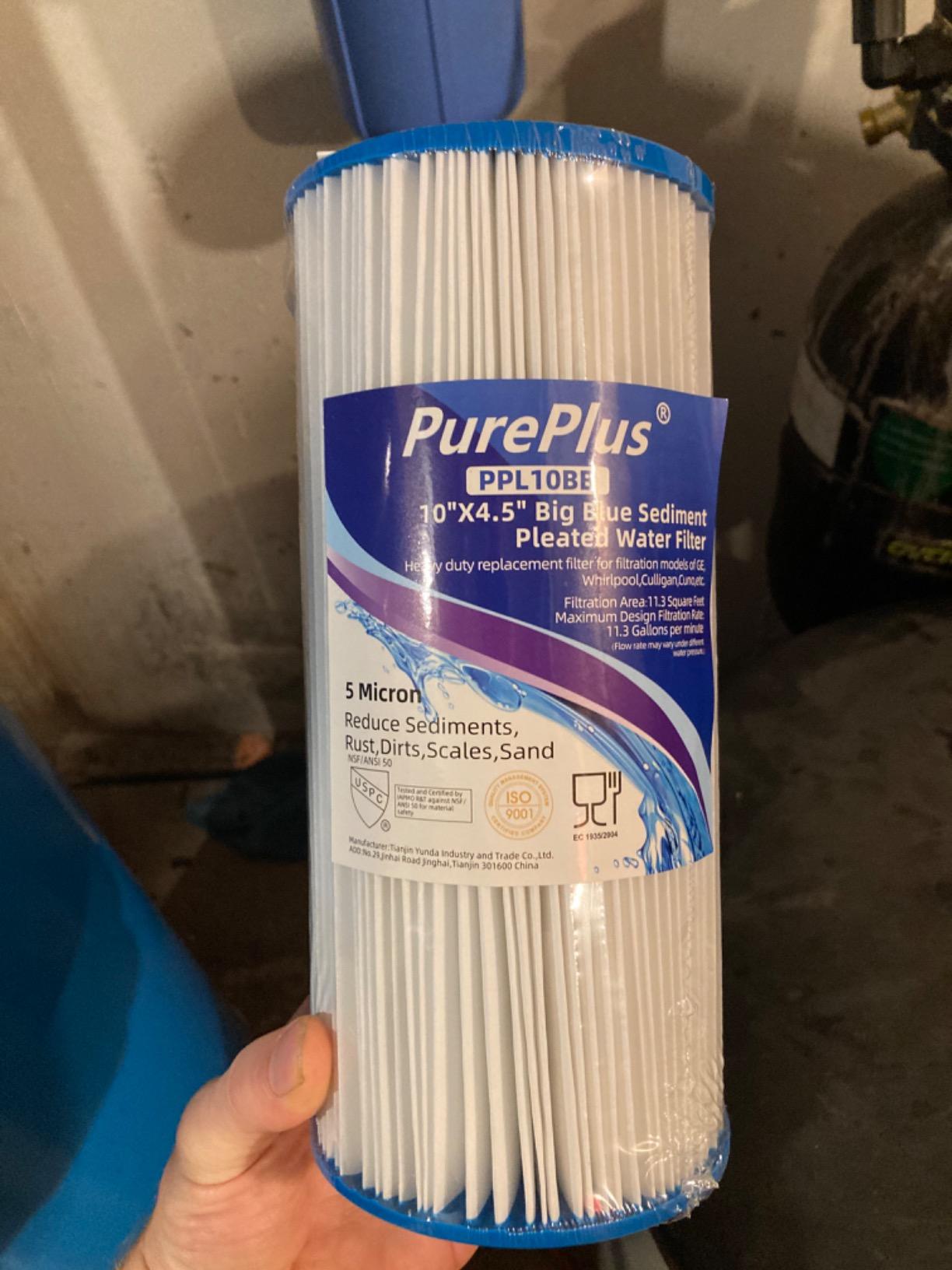
11. PUREPLUS 5 Micron 10 x 4.5 in Whole House Pleated Sediment Filter, 2-Pack
PUREPLUS 5 Micron 10″ x 4.5″ Whole House Pleated Sediment Filter,2 Pack
5 micron pleated media
Up to 30000 gallon rating
4.5 x 4.5 x 10 inches
400 psi cartridge test
Two pack
Pros
- High 4.7 rating across nearly 3900 reviews with a very low one-star share
- Pleated media holds more dirt than generic string-wound cartridges of the same size
- Universal fit across Pentek GE Culligan American Plumber and HDX housings
- Two packs cost far less per filter than singles
- Reviewers report better flow than bulk heavy duty alternatives
Cons
- Sediment only with no chlorine odor hardness or scale treatment
- Recommended replacement every 3-6 months in dirty water
- Not interchangeable with washable OEM styles without removing the washer
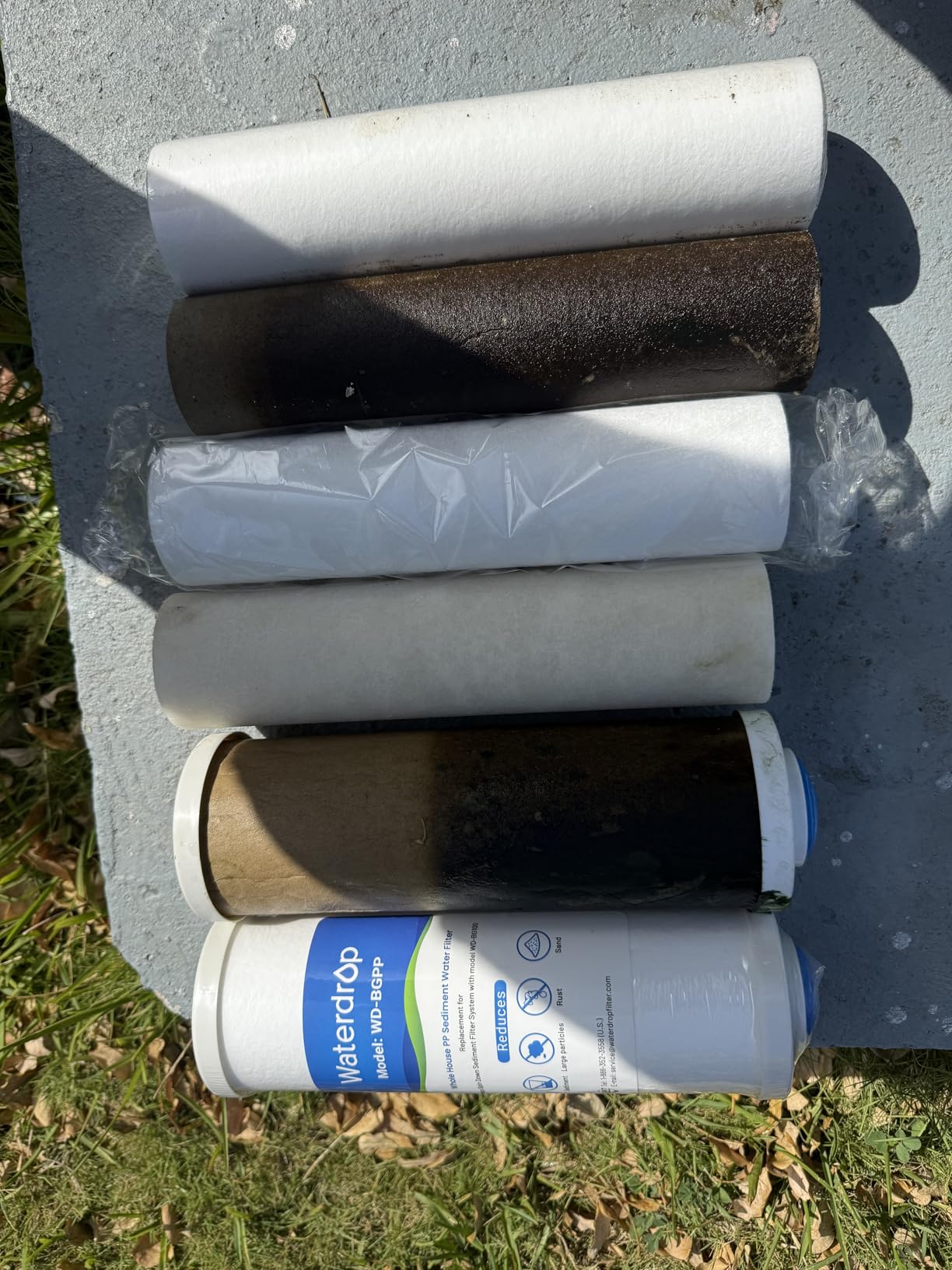
Pleated media is the reason this cartridge performs. The 3D woven pleats give it far more surface area than a string-wound element of the same dimensions, and surface area is what determines how much dirt a sediment filter holds between changes. Reviewers consistently report better flow than the bulk heavy duty cartridges some of them replaced.
That flow point matters in hard water homes, where scale and rust load a filter faster than in soft or clean supply. Buyers in staged setups, with a spin down prefilter first and a carbon third, report clear improvement in clarity, taste and odor and consider it the best value in the category, particularly in multi-packs.
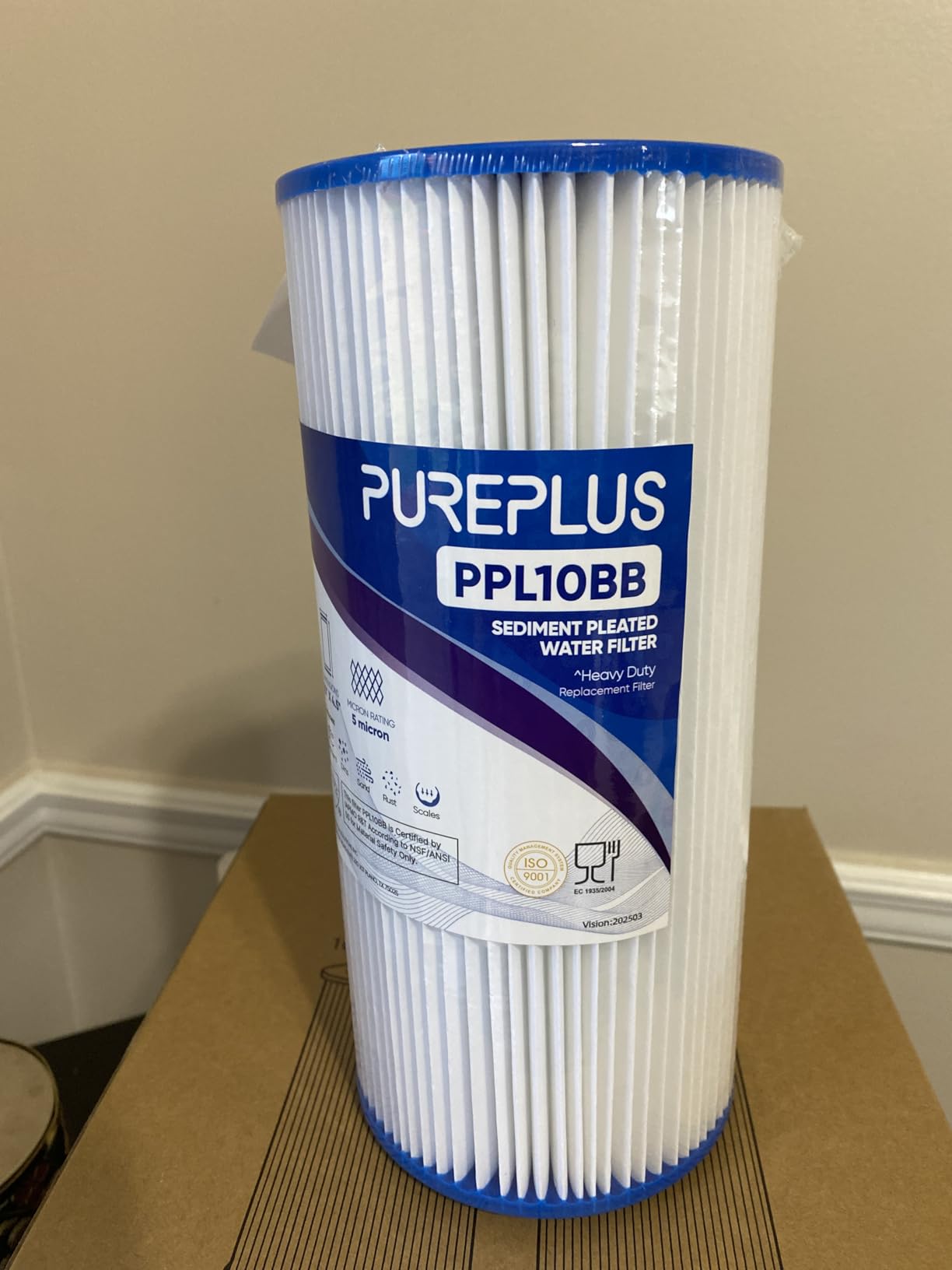
Fit is the other strength. It fits standard 10 inch by 4.5 inch heavy duty housings from Pentek, GE, Culligan, American Plumber and others, and the listed compatibility covers a long list of major brand housings. Each cartridge is pressure tested to 400 psi and run through 10,000 water hammer tests.
Keep the caveats in view. It is sediment media only, so chlorine, odor, hardness and scale all fall outside its scope. In well water, replacement frequency runs from roughly 60 days to 6 months depending on sediment load, and a few users note they are not interchangeable with washable OEM styles without removing the washer.
Who this cartridge suits best
It suits owners of a 10 inch heavy duty housing who want more capacity per cartridge than a string-wound element gives them. The longer intervals between changes are what make the difference in a hard water home where rust and scale are constantly loading the media.
It also suits anyone building a multi-stage setup, since it slots in as the fine polishing stage behind a spin down and in front of a softener or carbon system without any adapter work.
Who should pick something else
Do not choose it as your only filter, particularly on a well. A 5 micron cartridge as a first stage in silty water will clog on a schedule that makes ownership frustrating, and the spin down first stage costs far less to solve the same problem.
Skip it if you need chlorine, taste or scale treatment in the same housing. Choose a two-stage system with carbon and a polyphosphate stage, or plan a separate carbon unit behind this one.
12. Aquaboon 5 Micron 20 x 4.5 in Whole House Pleated Sediment Filter, 2-Pack
Aquaboon 5 Micron 20 x 4.5 Whole House Pleated Sediment Water Filter 2-Pack
5 micron pleated media
20 x 4.5 in format
4.5 x 4.5 x 20 inches
ANSI and NSF certified materials
Two pack
Pros
- Large 20 inch pleated format holds more sediment than 10 inch cartridges
- Long-standing community well owners use it to pre-stage a downstream 1 micron filter
- Exact fit in 20 x 4.5 in housings with no compatibility issues
- Roughly half the cost of equivalent filters sold through water dealers
- Can be washed and reused in practice by some owners
Cons
- Some reviewers describe the media as thin or flimsy for the price
- Largest cartridge size here so it needs a 20 inch housing
- Sediment only with no chlorine hardness or scale treatment
This is the high-capacity cartridge option. At 20 inches by 4.5 inches with extended pleats, it offers considerably more dirt-holding surface area than a 10 inch element, which means longer intervals between changes in homes where the fine filter is doing the polishing work on a lot of water.
Repeat buyers on community wells describe it as a dependable, good value replacement that fits 20 by 4.5 inch housings exactly. Several long-term well owners specifically use it to keep sediment out of a downstream 1 micron cartridge, and they note the cost is roughly half what water dealers charge for equivalent filters.
The recurring criticism is build thickness. Multiple reviewers call the media a little flimsy while still rating the cartridge well, which suggests the paper is not heavy duty but performs acceptably in service. Others wash and reuse them with a mild bleach flush, which extends the economics further if you are comfortable with that routine.
Because it is the largest format in the roundup, it also has the fewest compatible housings. If you are starting from scratch, a 20 inch housing is a more specialised purchase than a standard 10 inch Big Blue, so plan the full system before committing to this size.
Who this cartridge suits best
It suits homeowners who already run a 20 by 4.5 inch housing and want maximum dirt capacity inside it. The larger pleat area is the deciding factor when daily water volume is high enough that a 10 inch cartridge would need changing constantly.
It also suits community well households that want a coarse polish stage before a 1 micron membrane, which is the arrangement long-term owners in the review sample describe working for them.
Who should pick something else
Choose elsewhere if you have no housing yet, because the 20 inch format narrows your options and the cartridge alone is not a system. A complete 10 inch or 20 inch assembly will usually be simpler to plan.
Choose elsewhere if your housing is a 10 inch Big Blue format. The fit is wrong, and forcing a 20 inch cartridge into a 10 inch housing is not a modification worth attempting. Match the format to the housing you have.
How to size, order and install a whole house sediment filter
Sizing starts with flow, not with the filter. A household of one to three bathrooms typically needs 10 to 15 GPM, four to six bathrooms want 20 GPM or more, and a home with irrigation on the same line needs to account for that demand separately. Filters rated below about 6 GPM produce a shower you can feel, which is the pressure drop anxiety that shows up constantly in homeowner discussions.
Next, pick the filter type. Spin down units are reusable, cheap to service and ideal as a coarse first stage, but they need a flushing habit. Cartridge units deliver finer filtration with no moving parts, at the cost of recurring media purchases. Backwashing systems regenerate media in place and suit very heavy sediment, at the cost of more plumbing, more space and a drain connection.
For most hard water homes the third consideration is ordering, and getting it wrong is expensive. The sequence runs point of entry coarse sediment first, fine sediment or carbon second, water softener third. The softener should never be first, because resin beads are easily fouled by sediment and iron particles, and once fouled the resin does not recover.
Plan for service access before you buy. Every housing needs room to pull a 20 inch cartridge, every unit needs a bypass valve so you can change it without shutting off the house, and a pressure regulator downstream keeps line pressure spikes from stressing the housing and the rest of your plumbing. Adding a pressure regulator is a small addition that several homeowners in plumbing forums recommend as standard practice on any point of entry filter.
Finally, test your water before you buy. A hardness number tells you whether you need a softener at all, and a sediment or iron reading tells you which micron rating to start with. Guessing at either one is how people end up with a 5 micron cartridge as their only filter in silty well water, replacing it monthly and wondering why.
Frequently Asked Questions
Do sediment filters help with hard water?
No. A sediment filter removes suspended particles such as sand, silt, rust and grit, but hardness comes from calcium and magnesium dissolved in the water, which pass straight through any mesh, cartridge or carbon block. For hardness you need ion exchange in a water softener, or a salt-free scale conditioner if you only want to control scale. A sediment filter still matters on hard water because it catches the scale flakes and corrosion debris that hardness creates, protecting your softener resin, carbon blocks and appliances.
What is the best sediment water filter for a whole house?
The best choice depends on your water. On municipal supply, a two-stage system such as the iSpring WGB21B-DS handles sediment, chlorine and scale inhibition in one bracket. On well water, start with a reusable spin down filter such as the iSpring WSP-50 at 50 micron, then add a 5 micron pleated cartridge such as the PUREPLUS for polishing. The spin down stage protects the fine cartridge and gives you a visual read on how dirty your water is.
What is the best water filter for very hard water?
For very hard water, no single device is enough. Use a two-stage approach: a sediment filter at the point of entry to catch particles and a water softener to remove hardness minerals. If you want scale control without softening, add a polyphosphate anti-scale stage such as the one in the iSpring WGB21B-DS or the Express Water system. The sediment filter always goes first so the softener resin stays clean.
How do I know what size sediment filter I need?
Match both micron rating and flow rate to your situation. On city water, 20 micron for a coarse stage and 5 micron for fine filtration is a solid pairing. On well water, begin at 50 or 100 micron with a reusable spin down and add a finer stage after it. For flow, one to three bathrooms need 10 to 15 GPM, four to six bathrooms want 20 GPM or more. Anything under 6 GPM is felt in the shower.
Should a sediment filter go before or after the water softener?
Always install it before the softener. Softener resin beads are easily fouled by sediment and iron particles, and resin that has been blinded with grit does not regenerate properly. Putting a spin down or cartridge sediment filter ahead of the softener keeps the resin bed clean, improves the softener’s performance and extends the life of the resin and the brine system.
How often should I replace a whole house sediment filter?
It depends on micron rating and sediment load. Fine 5 micron cartridges are typically rated at about six months on city water and may need changing every 60 days on well water. Reusable spin down screens are not replaced at all, just flushed, often every few weeks in silty water and every few months on municipal supply. A visible clear housing or a pressure gauge per stage is the most reliable way to judge when service is due.
Final Recommendations for Hard Water Homes in 2026
After working through twelve whole house units, one pick stands out. The iSpring WGB21B-DS is our top recommendation for a hard water home with no filtration installed, because a 50,000 gallon two-stage bracket in 1-inch ports handles sediment, chlorine and scale inhibition in a single install. On silty or well supply, pair it with the iSpring WSP-50 spin down filter in front, since a reusable 50 micron stage is the cheapest insurance you can buy against sediment damage and it shows you what your water is actually doing.
For a household that wants the maintenance handled for them, the iSpring Ultimate auto-flush system is the most complete point of entry build we reviewed, provided you have the space for a 66 pound assembly. For anyone on a tight budget changing filters often, the Filtrete grooved two pack keeps the annual cost of filtration as low as it gets, and the PUREPLUS pleated pair is the better per cartridge buy when you want longer intervals between changes.
Whatever you choose, remember what this roundup keeps coming back to. A sediment filter catches particles. Hardness is dissolved and needs a softener, and the filter belongs in front of that softener, not behind it. Test your water first, size for flow, and get the ordering right. That is the difference between filtration that protects your plumbing for a decade and a cartridge you replace every month.