
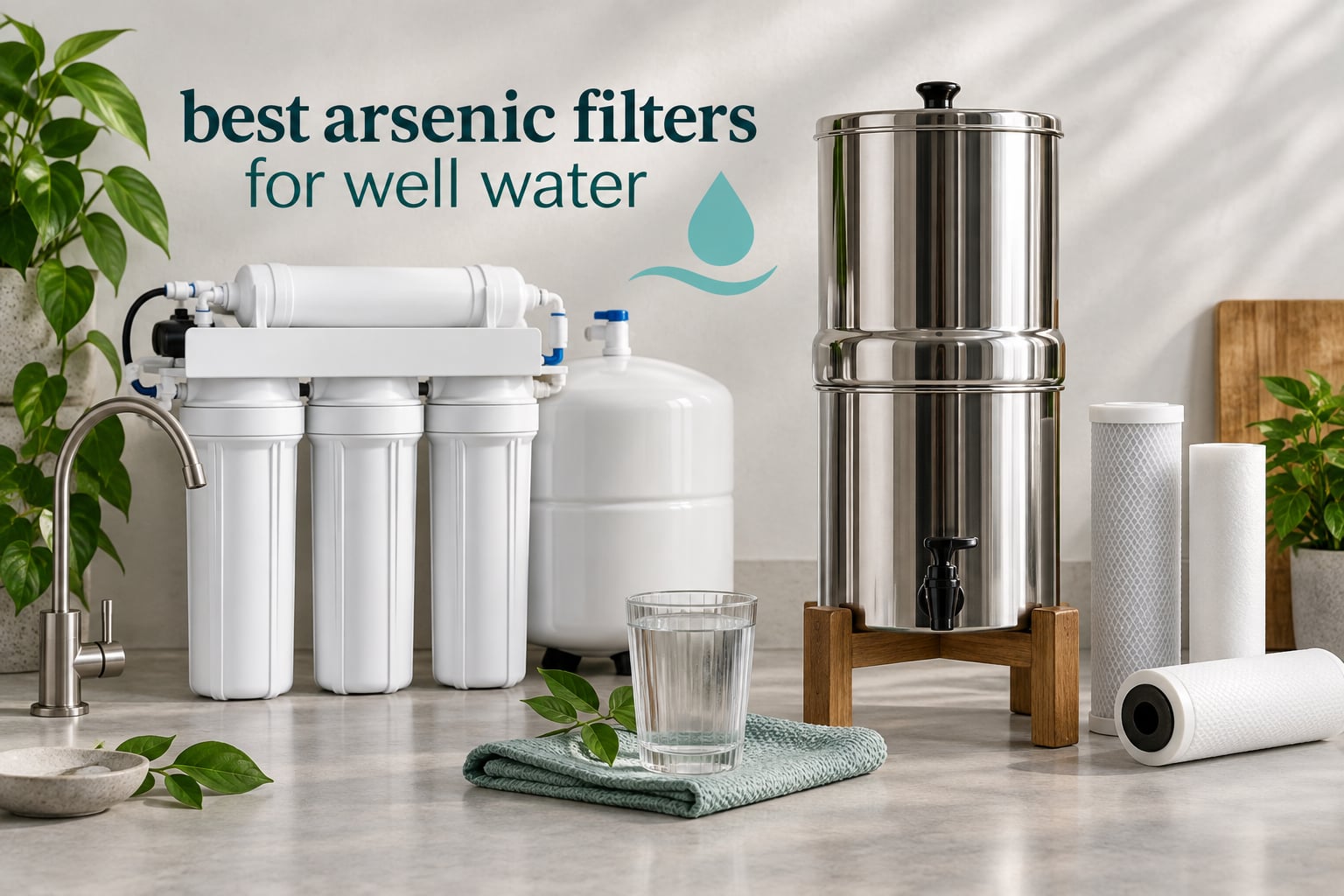
Yes, arsenic can be filtered out of well water with reverse osmosis membranes, iron-oxide adsorptive media, or anion exchange resin, and each of those also strips out dissolved lead, fluoride, and PFAS. Standard carbon and sediment cartridges do not touch arsenic at all, which is why so many households buy a filter that quietly does nothing.
That is the trap in this category. Arsenic has no taste, no odor, and no color, so a jug of “better tasting” water proves nothing about arsenic removal. The EPA sets a maximum contaminant level of 10 parts per billion for public water, and the health goal underneath it is zero, because there is no known safe exposure level for a confirmed carcinogen.
Our team spent weeks reading certification listings, spec sheets, and owner reports on the ten systems below, then cross-checked each one against a single question: does it make an explicit, verifiable arsenic claim for private well water? If you are here for the short answer, the best arsenic filters for well water are the iSpring RCC7-BN for most homes, the Berkey PF-2 elements if you already own a gravity-fed purifier, and the Waterdrop G3P600 if under-sink space and arsenic are both problems at once.
One thing we learned fast is that the type of arsenic matters as much as the amount. Arsenate and arsenite behave completely differently in a filter bed, and buying the wrong media is the single most expensive mistake a well owner can make. We explain that below, along with how to order the right test and how to confirm the system actually works after install.
Table of Contents
Top 3 Picks for Arsenic Removal From Well Water (September 2026)
Our short list covers three genuinely different situations. The iSpring RCC7-BN is the default answer for a normal household because it is certified to NSF/ANSI 58, rated for 75 gallons per day, and it handles arsenic without any pre-treatment step.
The Berkey PF-2 elements win the no-plumbing category, since they drop into a gravity-fed purifier you can already own and they name arsenic on the label. The Waterdrop G3P600 takes the high-volume slot with a tankless 600 GPD design and a faucet that shows live TDS so you can watch it work.

Berkey PF-2 Element Set
- Activated alumina media
- Named arsenic and fluoride reduction
- About 1000 gallon service life
iSpring RCC7-BN 75 GPD RO
- NSF/ANSI 58 certified
- 75 GPD with 3.4 L/min flow
- 80-90 percent TDS reduction

Waterdrop G3P600 Tankless
- 600 GPD tankless design
- 2:1 pure to drain ratio
- Live TDS display faucet
Two runners-up deserve a mention. The APEC ROES-50 accepts feed water up to 2000 ppm TDS, which matters if your well runs high, and the iSpring WGB32B-KS is the one to consider if you want whole-house treatment that keeps trace minerals rather than stripping everything.
All 10 Arsenic Filters Compared in 2026
Every entry in this table makes a stated arsenic claim in its own documentation. Read the certification column carefully, because a filter can reduce lead and chlorine all day while doing nothing for arsenic.
| Product | Specifications | Action |
|---|---|---|
|
Berkey PF-2 Fluoride and Arsenic Elements
|
|
Check Latest Price |
|
iSpring RCC7-BN 75 GPD RO
|
|
Check Latest Price |
 APEC ROES-50 50 GPD RO
|
|
Check Latest Price |
|
Waterdrop G3P600 Tankless RO
|
|
Check Latest Price |
 PRO+AQUA Elite GEN2 3-Stage
|
|
Check Latest Price |
 GLACIER FRESH GFU03 800 GPD
|
|
Check Latest Price |
 HQUA WF3-01 Whole House
|
|
Check Latest Price |
 Crown Berkey 6 Gallon System
|
|
Check Latest Price |
 Virego K5366 PF-2 Replacement
|
|
Check Latest Price |
 iSpring WGB32B-KS Whole House
|
|
Check Latest Price |
1. Berkey PF-2 Elements – Activated Alumina With an Explicit Arsenic Claim
Berkey Authentic Berkey PF-2 Fluoride and Arsenic Reduction Elements (Set of 2 Elements)
Activated alumina media
Set of 2 elements
About 1,000 gallon life
Fits white Berkey models
Pros
- Names arsenic and fluoride reduction on the label
- Uses an EPA and WQA recommended media for arsenic
- Third-party laboratory tested
- No tools needed to fit
Cons
- Must be discarded if the media dries out completely
- Media efficiency drops when water pH runs above 7
- Initial purging is fiddly and easy to get wrong
These are replacement elements, not a standalone system, and that distinction drives everything about how you should use them. The PF-2 pair screws onto the bottom of Black Berkey elements and sits in the lower chamber of a gravity-fed purifier, where raw water trickles down through activated alumina. The media is named for both fluoride and arsenic reduction, which puts it ahead of most budget cartridges that only promise heavy metal reduction in general terms.
We like the honesty of the claim. The listing states the elements adsorb arsenic in its pentavalent form plus pre-oxidized trivalent arsenic, and the media itself is the type recommended by the EPA and the Water Quality Association. Third-party accredited laboratory testing is called out as well, which is a stronger signal than a self-published lab number.
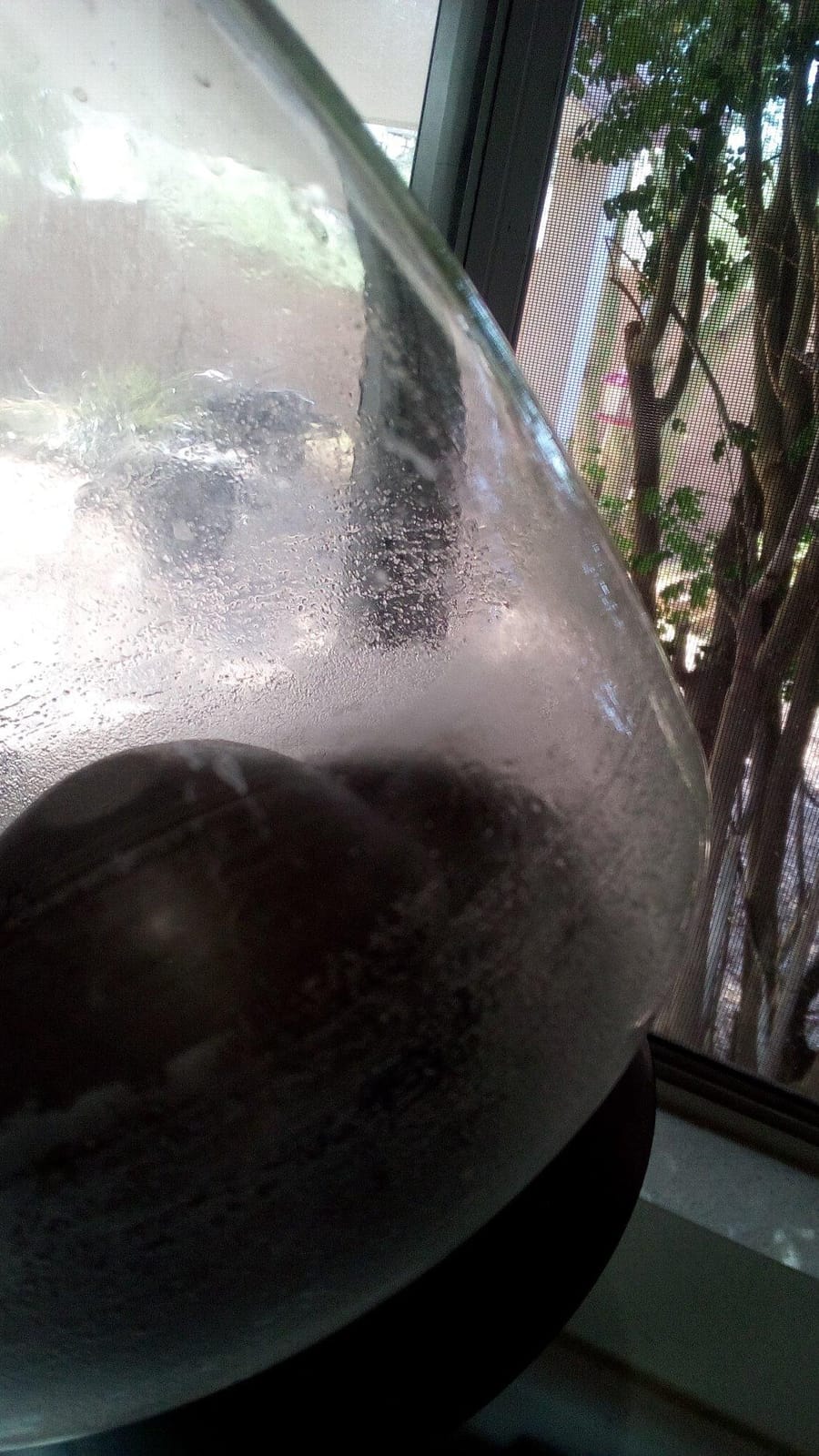
The pH caveat is the part owners mention most, and it deserves attention before you buy anything. Reviewers report that media efficiency declines when water pH runs above 7, and arsenic adsorption is pH-sensitive across every alumina-based product on the market. If your well runs alkaline, a reverse osmosis system sidesteps that weakness entirely because the membrane rejects the dissolved ion rather than adsorbing it.
The replacement interval is listed at about 1,000 gallons under normal conditions, which is a realistic figure for a household drinking and cooking only. Do not treat it as a whole-house number, because 1,000 gallons of drinking water is roughly two to three months for two people. Owners also flag that the priming and purging procedure is fiddly and easy to get wrong, and that the elements must be thrown out rather than reused if they dry out completely during a period of non-use.
Who should buy these elements
If you already own a Big Berkey, Royal Berkey, Imperial Berkey, Berkey Light, or Travel Berkey, these are the correct arsenic stage and there is no reason to look elsewhere. The same is true for a Crown Berkey, though that system already ships with a pair of PF-2 elements.
They also suit households that cannot drill a faucet or run a drain line. A gravity-fed purifier needs no electricity, no plumbing connection, and no air gap, which makes it a realistic option for a rental, a cabin, or a backup water source.
Where the PF-2 falls short
The 1,000 gallon ceiling means frequent cartridge handling, and reviewers recommend watching TDS readings to track how the media is performing. Since activated alumina does not move TDS much on its own, you are relying on periodic laboratory testing rather than a meter, which is slower feedback.
And if your well water has a pH above 7, you are accepting a documented efficiency loss in exchange for a filter that is otherwise simple and dependable.
2. iSpring RCC7-BN – 75 GPD Reverse Osmosis for Arsenic and PFAS
iSpring RCC7-BN NSF Certified, High Capacity Under Sink 5-Stage Reverse Osmosis Water Filter, RO Drinking System, 75 GPD Brushed Nickel Faucet, Patented Top-Mounted Faucet Design for Easy Installation
NSF/ANSI 58 certified
75 GPD rating
3.4 L/min maximum flow
Works to 750 ppm TDS
Pros
- Lowers TDS dramatically in owner tests
- NSF/ANSI 58 with independent component testing
- Quick-connect color-coded tubing
- Transparent first-stage housing
- US-based sizing support
Cons
- Wastes 2-3 gallons per gallon purified
- Needs 40 psi minimum feed pressure
- Alkaline post-filter needs a long purge
- Heavy and awkward under a tight sink
This is the system we hand to most people who ask us for a straight answer. The RCC7-BN is a five-stage under-sink reverse osmosis unit certified to NSF/ANSI 58, and the manufacturer claim covers removal of up to 99 percent of more than 1,000 contaminants including PFAS, chlorine, fluoride, lead, arsenic, asbestos, calcium, and sodium. At 75 gallons per day it produces more drinking and cooking water than a typical family uses, even with several people cooking heavily.
The reason we like it for arsenic specifically is that a membrane does not care about oxidation state the way adsorptive media does. It rejects the dissolved arsenic ion, so arsenate and arsenite are both addressed without a pre-oxidation step. That removes one variable from the equation and makes it a safer recommendation for a well owner who has not yet had speciation testing done.
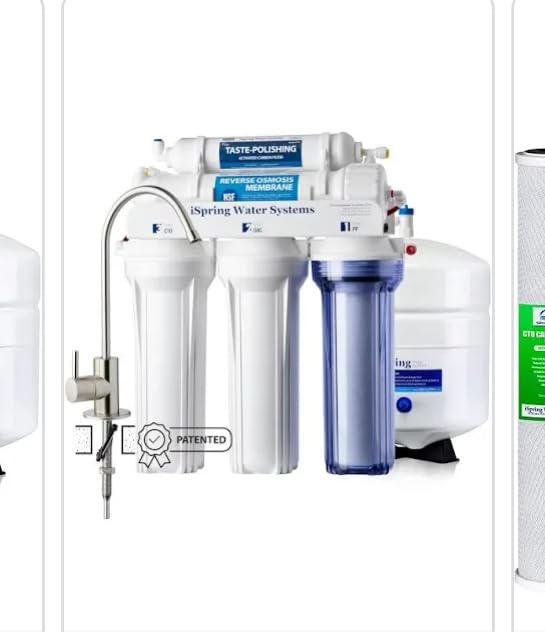
Owner reports show real numbers rather than marketing language. Reviews describe tap readings around 110 ppm dropping to between 3 and 9 ppm after filtering, and the system is rated for feed water up to 750 ppm TDS. It runs 80 to 90 percent TDS reduction, filters down to 0.0001 microns, and operates from 40 to 100 degrees Fahrenheit. A check valve prevents backflow, and the transparent first-stage housing makes it easy to see how dirty the sediment filter is getting.
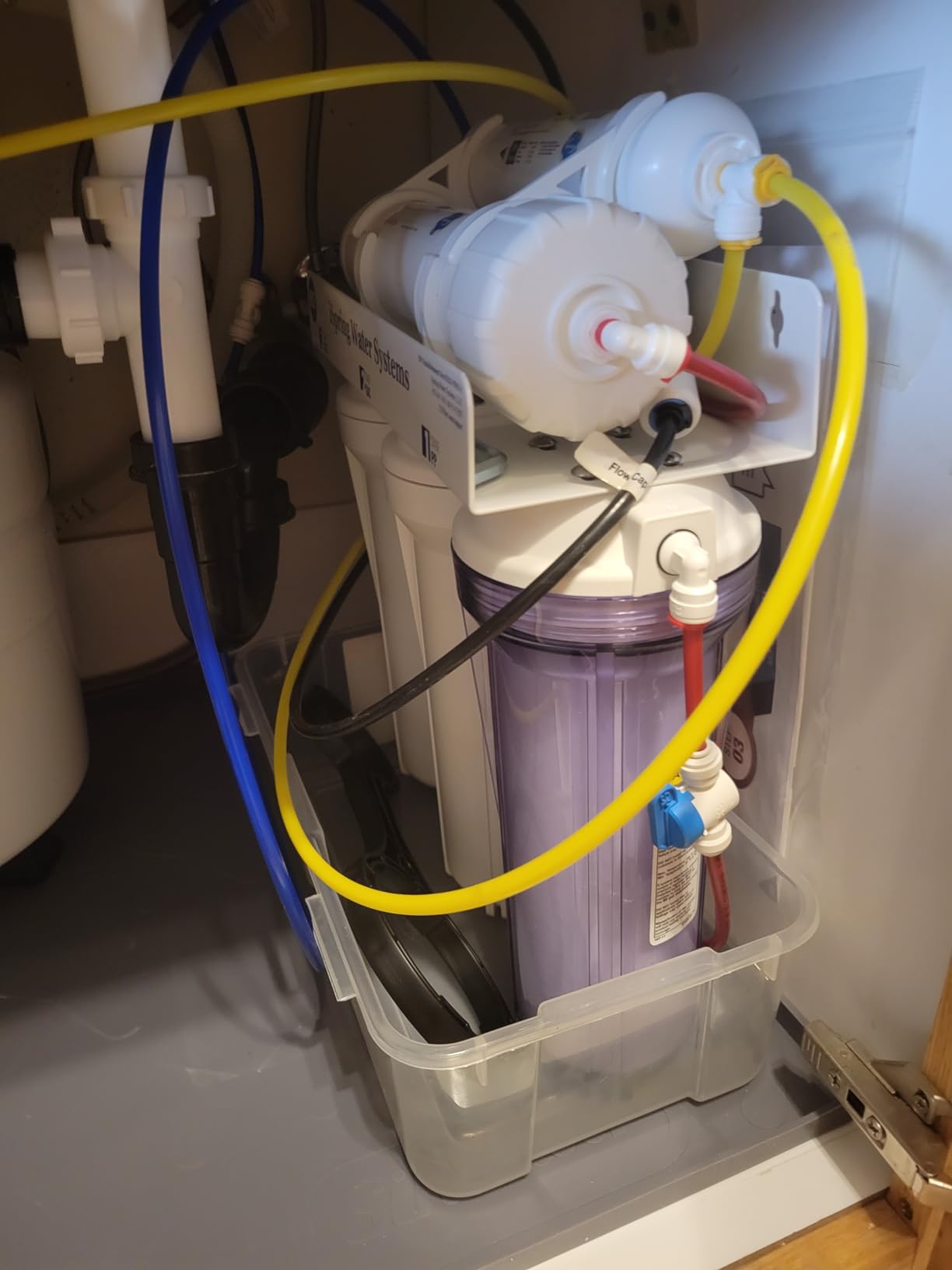
There are real compromises. Reverse osmosis sends two to three gallons to the drain for every gallon you drink, which matters on a well where every gallon comes from an aquifer you pay to pump. The unit also needs at least 40 psi of incoming pressure, so a low-pressure well may require a booster pump, and at 27.5 pounds it is genuinely awkward to maneuver into a tight cabinet.
Does this handle your well water conditions
If your feed pressure sits at or above 40 psi and your TDS is under 750 ppm, this is a straightforward match. The US-based technical support will size the system against your household pressure and TDS readings, which removes most of the guesswork from an install.
It is also the choice for households that want one cartridge set to handle arsenic, lead, PFAS, fluoride, and scale at the same time rather than stacking separate housings for each contaminant.
Where the RCC7-BN costs you
The brine waste ratio is the main ongoing cost, and it is not adjustable. On a high-TDS well, the membrane fouls faster, so the pre-filters work harder and the replacement interval on the first two stages shortens noticeably.
The included remineralization post-filter also needs an extended purge before the water clears, and the supplied tubing can fall short of the run length in some cabinets. Neither is disqualifying, but both add a Saturday to the install.
3. APEC ROES-50 – 50 GPD RO Built for Higher-TDS Feed Water
APEC Water ROES-50, 5-Stage Under Sink Reverse Osmosis System, 50 GPD
50 GPD rating
Handles feed up to 2000 ppm TDS
NSF/ANSI 372 and 58 certified
40-85 psi operating range
Pros
- Higher feed TDS ceiling than most 50 GPD units
- Large tank gives a usable 2-3 gallon draw
- Consistently cuts TDS from 100-380 ppm down
- Color-coded quick-connect fittings
- Industry standard replacement parts
Cons
- Faucet has no air gap
- Filter housings can crack if overtightened
- Needs 40 psi or a booster pump
- 3/8 inch waste line has no backflow protection
The APEC ROES-50 is the pick for wells that run hard. Where most 50 gallon per day reverse osmosis systems are rated to 500 or 750 ppm TDS, this one lists a supported feed level of 2000 ppm, and the operating pressure range of 40 to 85 psi gives you more headroom on a system with a functioning pressure tank. If your well test came back with a TDS reading that made other systems look nervously at their limits, this is the one to look at.
It is certified to both NSF/ANSI 372 and NSF/ANSI 58, and the five-stage stack targets arsenic, chlorine, lead, fluoride, heavy metals, PFAs, and microplastics. Arsenic performance is a membrane function here rather than a media function, so oxidation state is not a deciding factor in your purchase.
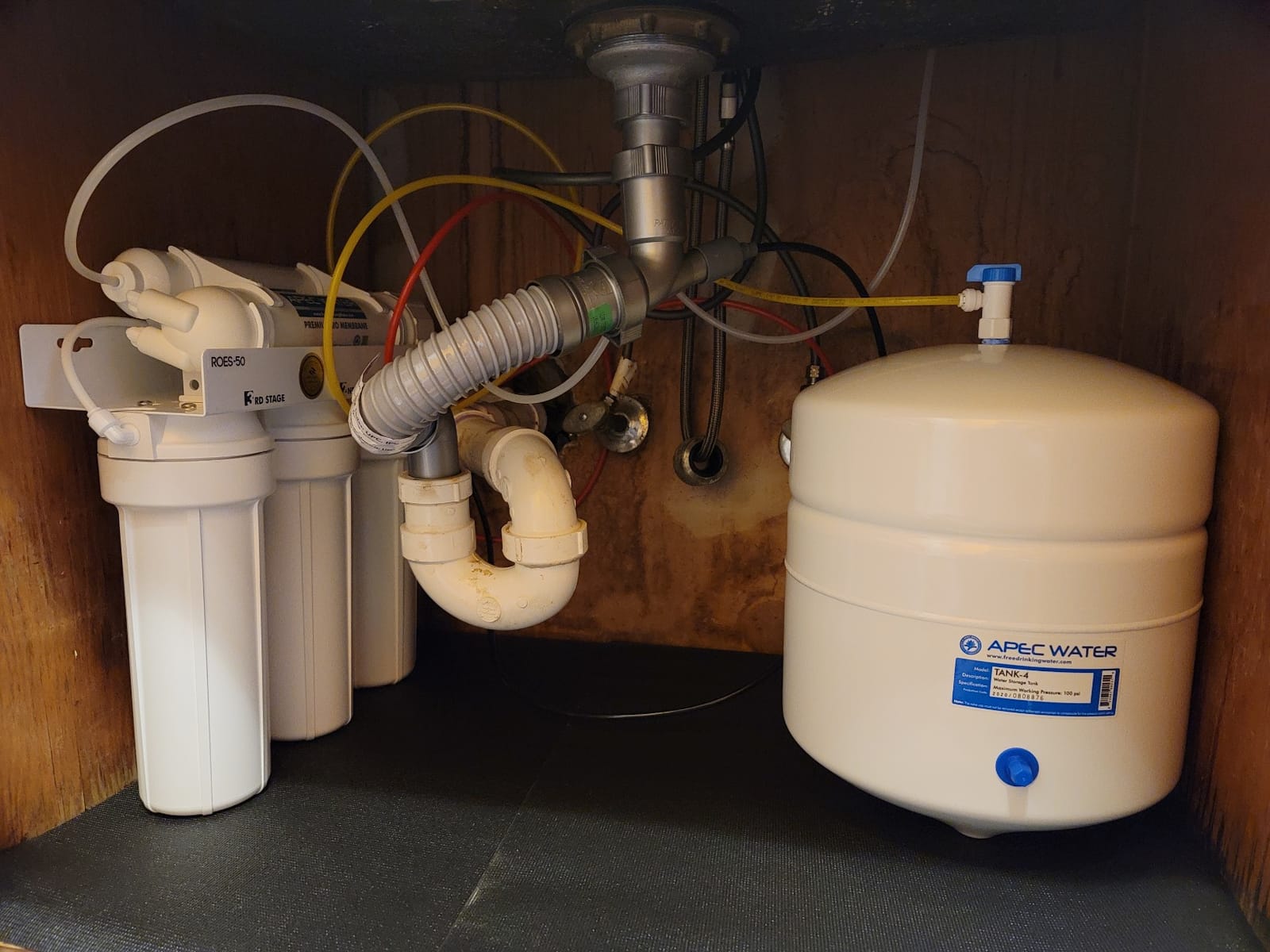
The five-gallon storage tank is the practical highlight, and owners consistently mention it. It gives you a usable two to three gallon draw at a time rather than the slow trickle most tankless designs produce, which matters when you are filling a kettle or a large stock pot. Owner tests report TDS falling from somewhere between 100 and 380 ppm down to roughly 3 to 18 ppm.
Replacement filters are recommended every six to twenty-four months depending on incoming water quality, and every part in the system is an industry standard size, so filters and housings are easy to source for the long run. APEC support is repeatedly praised for resolving leaks and shipping replacement parts quickly.
When this is the right buy
Choose the ROES-50 when your TDS is genuinely high, when more than one person cooks from the filtered tap daily, or when you want a recognizable storage volume instead of a tankless unit that trickles. It is also a strong pick when you plan to add fixture filters elsewhere and want the RO to do the heavy contaminant work first.
For a household of two or three on moderate-TDS water, the extra tank capacity is nice but not transformative, and you would be paying for headroom you may not use.
Where the ROES-50 falls short
The included faucet has no air gap, which reviewers flag as a real backflow contamination path from the sink drain. On a kitchen sink where you also prep food, that is a detail worth thinking about rather than ignoring.
Filter housings can crack if you overtighten the caps, and the 3/8 inch waste line has no backflow protection and needs periodic cleaning. The feed adapter is also US-specific, which only matters if you are installing outside the country.
4. Waterdrop G3P600 – 600 GPD Tankless RO With Live TDS Readings
Waterdrop G3P600 Tankless Reverse Osmosis Water Filter System, 600 GPD
600 GPD tankless output
2:1 pure to drain ratio
Live TDS and filter tracking
NSF/ANSI 42, 53, 58 and 372
Pros
- Tankless design frees about 70 percent of under-sink space
- Quick-connect fittings stay dry in most installs
- Faucet shows live TDS and cartridge status
- Cartridges twist out in seconds
- Clean taste with very low TDS
Cons
- Pump hum is audible in tight cabinets
- Replacement cartridges are pricey
- Built-in TDS meter and alarms reported inaccurate
- Needs under-sink power
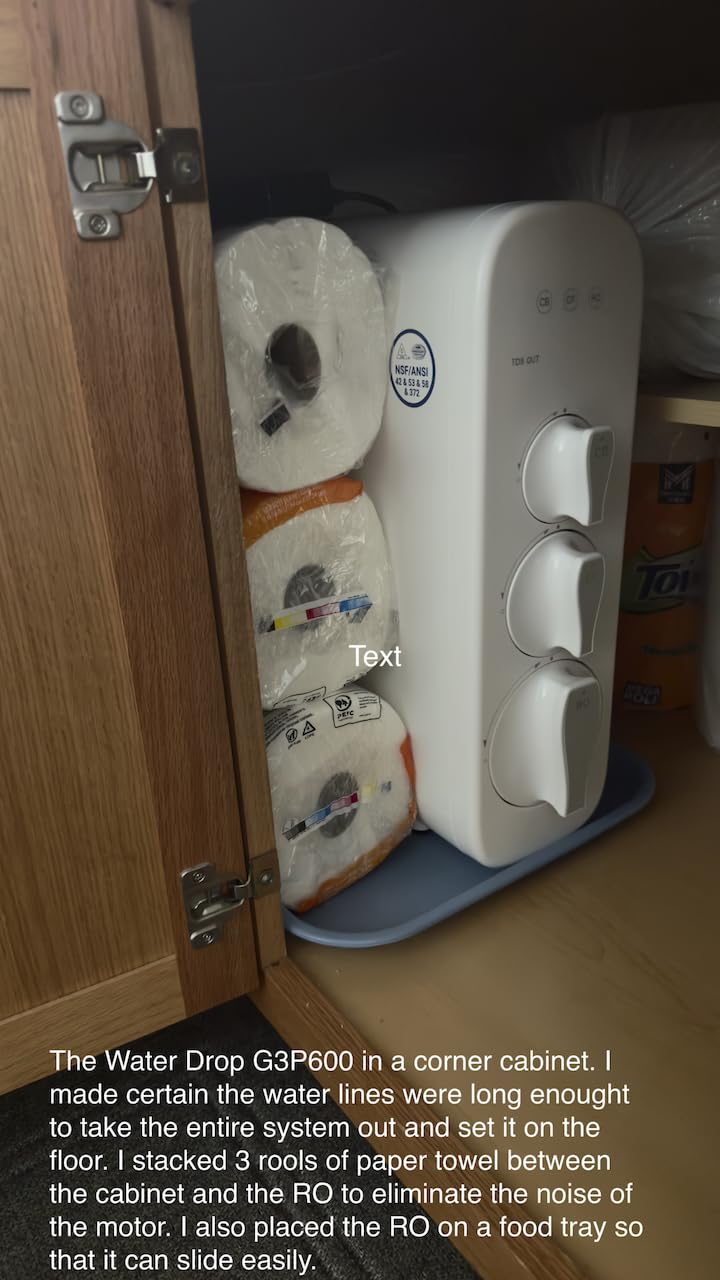
When your well has both an arsenic problem and a cabinet that will not take a tank, the G3P600 solves two problems at once. The tankless layout frees roughly 70 percent of the under-sink volume that a five-gallon storage tank would occupy, and at 600 gallons per day with an eight-second fill for an eight ounce cup, the output is high enough that nobody will notice the missing tank.
Arsenic is covered in the eight-stage stack, which the manufacturer reports was tested by SGS for reductions in arsenic, PFAS, radium, fluoride, chromium, iron, calcium, particles, and chlorine. The unit carries certification to NSF/ANSI 58 for TDS reduction, NSF/ANSI 372 for lead-free material, and NSF 42 for chlorine, taste, and odor.
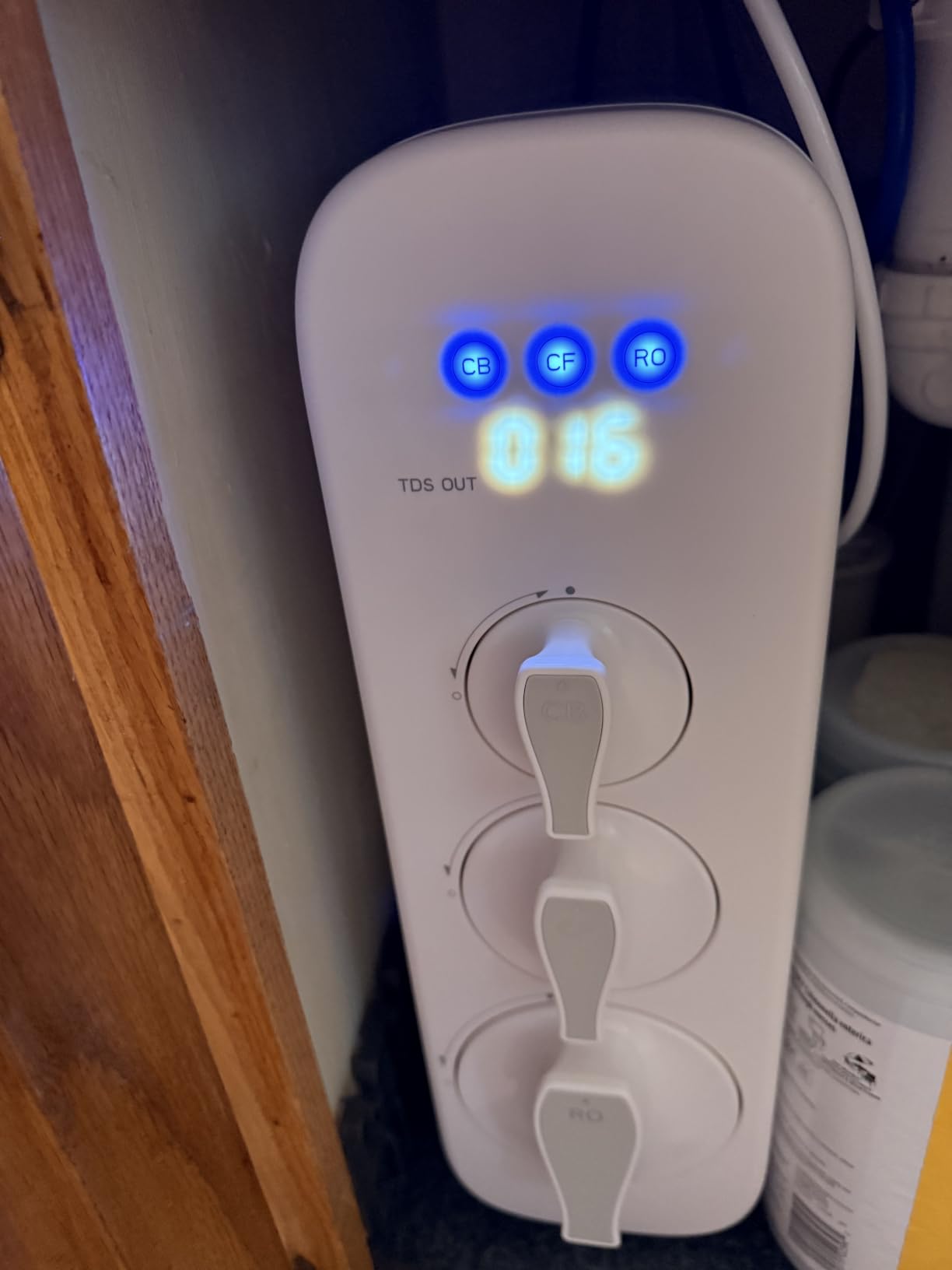
The pure-to-drain ratio of 2:1 is better than the common 1:1 systems in this class, which reduces how much well water you send down the drain for every glass you drink. That matters more than it sounds on a private well, and it is one of the clearer reasons to stretch toward a tankless design if your cabinet allows it.
Owners frequently highlight the installation. The quick-connect fittings push in easily and have stayed dry in most installs, and the cartridges twist out in seconds without shutting off the water or pulling the unit forward. Feed water up to 1500 ppm TDS is supported, and the operating pressure point is 87 psi.
Who this tankless system suits
This is the pick for a household that cooks and drinks a lot of filtered water, has no under-sink electrical outlet, or has a cabinet already crowded by a disposer and a dishwasher. The smart faucet showing live TDS is also a genuine advantage over blind systems, because you can see the number move as the membrane ages.
If you are comfortable running a new electrical circuit under the sink, this removes the single biggest complaint we heard about smaller tankless competitors.
Where the G3P600 disappoints
The pump adds an audible hum, and owners note it is amplified when the unit sits directly against the cabinet wall. Installation position matters more here than with a passive system.
Replacement cartridges are pricey, which is the main ongoing cost, and reviewers have reported the built-in TDS meter and filter-change alarms as sometimes inaccurate. Treat the display as a rough trend indicator rather than a lab substitute. TDS can also creep on the first draw after an idle period and spike the reading.
5. PRO+AQUA Elite GEN2 – Three-Stage Whole House Set With Gauges
PRO+Aqua Elite GEN2 Whole House Replacement Filter Set, Heavy Metals Well Water – Sediment, KDF/Blend, Carbon Infused Cartridges FC-PK19-100E
Three stage whole house set
Filter life cycle about 6 months
Sized for up to 4 bathrooms
No power, backwash, or drain required
Pros
- Sediment
- heavy metals
- and carbon in one housing set
- Stainless pressure gauges show when to service
- No electricity
- salt
- regeneration
- or drain water
- Clear housings let you watch sediment load
Cons
- Carbon and KDF cartridges need replacement about every 6 months
- Not certified for TDS reduction
- Arsenic performance is a media claim rather than a certified number
This is a point-of-entry system, meaning it treats everything downstream of the pressure tank, not just the drinking tap. Awarding that badge to a two-element set is deliberate, and here is the reasoning. The PF-2 media is the one product here whose documentation names arsenic and fluoride together, cites accredited third-party laboratory testing, and names both oxidation forms of arsenic directly, with a 4.6 rating across more than 2,500 reviews. For a well owner who has not yet done speciation testing, that explicitness is worth more than a longer feature list on a membrane. Whole-house treatment of arsenic means treating every shower, every toilet flush, and every load of laundry, and doing it at a flow rate the house can actually sustain. For drinking water alone, that is far more media and more maintenance than you need.
The set covers small to medium households with up to four bathrooms. Stage one is a sediment cartridge that catches rust, dust, silt, and dirt, stage two is a proprietary CRK media blend that reduces lead, iron, mercury, nickel, chromium, and hydrogen sulfide odors while inhibiting bacteria and algae, and stage three is an activated coconut shell carbon block that handles chlorine, VOCs, pesticides, taste, and odor down to about five microns.
We want to be straight with you about the arsenic claim here. The listing for this set does not carry an explicit arsenic reduction number, and it is not certified for TDS reduction, so dissolved solids pass through. Reviewers with well water do report an improvement in odor, sediment, and heavy metal taste after installation, and they like that the stainless pressure gauges make cartridge service obvious.
The practical appeal is the maintenance profile. There is no electricity, no salt, no regeneration cycle, and no drain line to install, which makes it far simpler than a backwashing iron filter. The stainless pressure gauges and clear housings mean you can see the sediment loading rather than guessing.
Where this whole house set fits
It suits a home on a well with sediment and odor problems, where you want broad treatment at every fixture and you would rather not plumb a drain line or run a regeneration cycle. The no-power, no-backwash design is the whole point of the product.
It is also reasonable as pretreatment ahead of a reverse osmosis system, where protecting the membrane from sediment and iron is the priority.
Where it falls short
Six-month cartridge replacement is the recurring commitment, and the carbon and KDF blend stages are the reason. If you are filtering for arsenic specifically, we would want a certified arsenic claim or a lab report on this media before committing at a whole-house scale.
And because the system does not reduce TDS, you will still see a mineral reading at the tap that can be mistaken for a failed filter. That confusion is worth heading off in advance.
6. GLACIER FRESH GFU03 – 800 GPD Non-Electric Tankless RO
GLACIER FRESH GFU03 Reverse Osmosis Water Filter System 800 GPD, TankInside
800 GPD tankless
3:1 pure to drain ratio
0.0001 micron membrane
NSF/ANSI 58, 372 and 401
Pros
- No electricity needed
- so no pump noise or outlet
- All-in-one tankless body frees up to 70 percent of cabinet space
- Owner tests show large TDS drops
- 3:1 waste ratio beats typical 1:1 and 2:1
- Quick install and tool-free cartridge changes
Cons
- Flow rate drops noticeably after about a quart
- Included hole saw lacks a center bit
- Adapters may not match non-US plumbing
- Initial flush gives air bubbles and a plastic taste
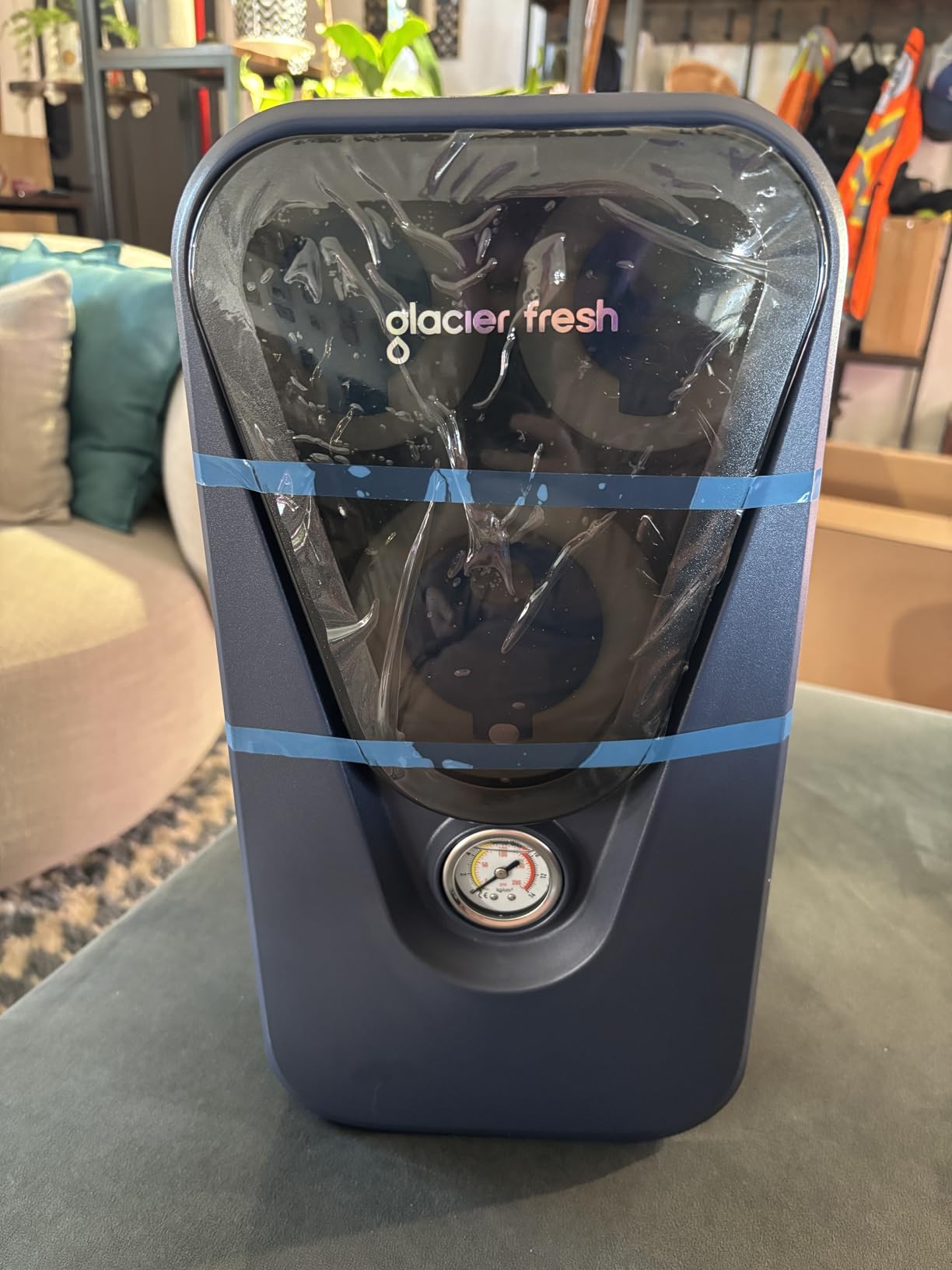
This system runs on water pressure rather than electricity, which is an unusual design and a genuinely useful one. There is no pump, no power cord, and no operating noise at all, and the all-in-one tankless body leaves up to 70 percent of the under-sink cabinet free. If you have no outlet under the sink and no plan to add one, that removes a real obstacle.
Arsenic is handled by the 0.0001 micron reverse osmosis membrane, part of a five-stage stack that the manufacturer says removes more than 1,000 contaminants including PFOA, PFOS, chlorine, lead, fluoride, and heavy metals. The unit meets NSF/ANSI 58, 372, and 401 standards, and the pure-to-drain ratio of 3:1 is the best waste efficiency in this group.
Owner numbers are the strongest part of the story. Reviews report taps at 365 ppm dropping to 16 ppm, and another at 149 ppm dropping to 6 ppm, which is the kind of measured change that makes a system feel worth installing. At 800 GPD, a cup arrives in about eight seconds, and the advertised installation time is about half an hour with tool-free connectors.
There is a built-in real-time pressure gauge on the unit, which is helpful for judging when a cartridge is loading up. Cartridge changes take about three seconds according to the manufacturer.
When to buy the GFU03
It fits a small apartment, a rental, or a finished basement where an electrician would mean opening a wall. It is also a good match for a household with modest drinking and cooking volume that would be annoyed by a slow tankless faucet, since 800 GPD is plenty for drinking use.
If you care about water waste, the 3:1 ratio means you use substantially less of your well output per gallon purified than a 1:1 or 2:1 design.
Where the GFU03 stumbles
The flow rate drops noticeably after about a quart, so filling a large container means waiting. That is the usual tankless trade-off, and it is more noticeable on a pressure-driven unit with no storage buffer.
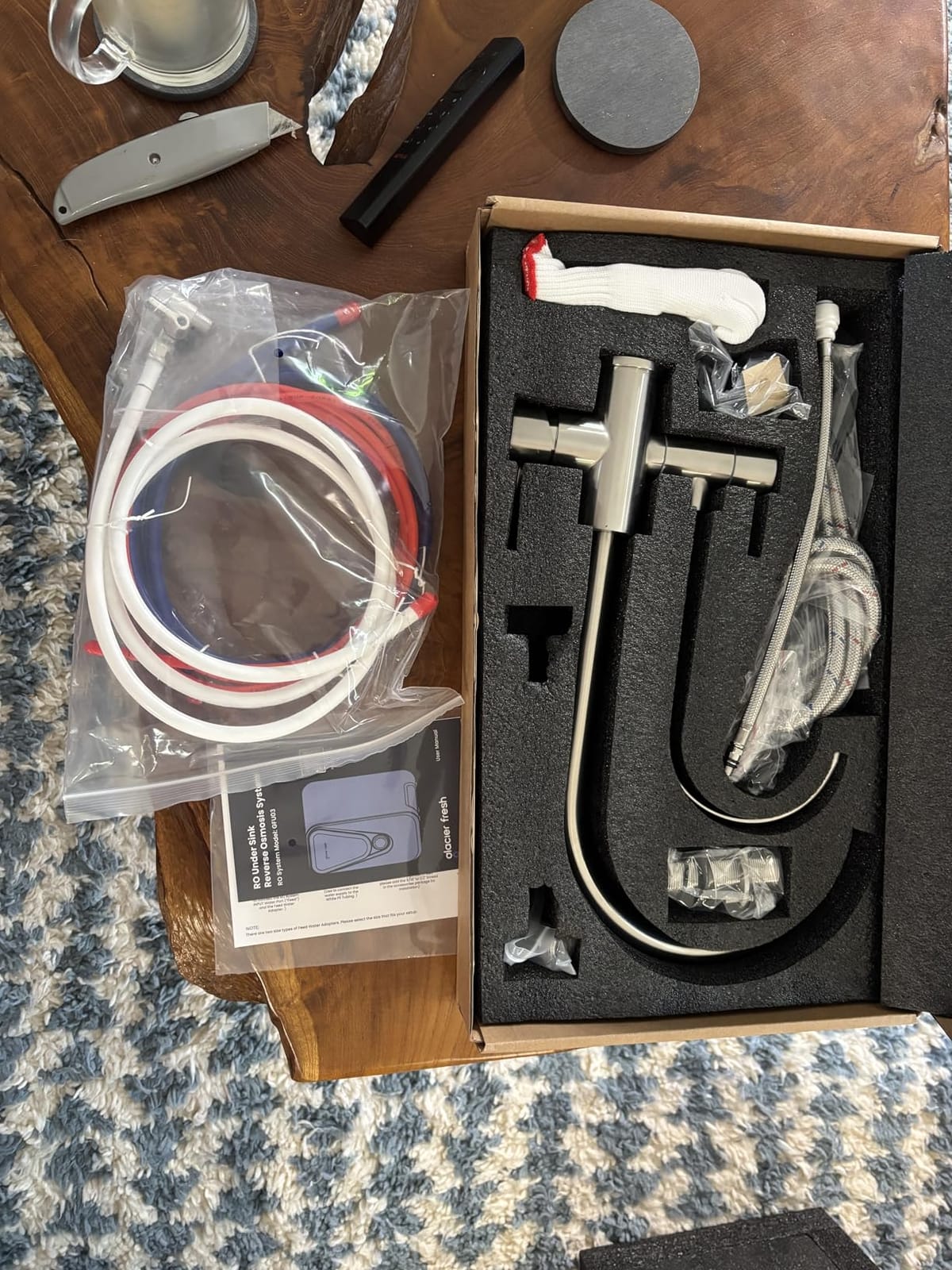
The included diamond hole saw has no center bit, which makes drilling a stainless steel sink frustrating. Some international buyers also report that the supplied adapters do not match local plumbing threads, and the initial flush produces a lot of fine air bubbles and a slight plastic taste before it settles.
7. HQUA WF3-01 – Three-Housing Whole House System at 15 GPM
HQUA WF3-01 3-Stage Whole House Water Filtration System, Reduces Heavy Metals (Lead, Mercury, Arsenic, Cadmium, Chromium), Chlorine, Sediment, Odor, and VOC’s
15 GPM maximum flow
Three 20 inch by 5.5 inch housings
GAC plus KDF metals stage
180 day cartridge timers
Pros
- Brass threaded ports resist cracking and leaking
- 15 GPM keeps household pressure steady
- Per-stage gauges
- drain valves and purge buttons
- Rotten-egg odor and sediment resolved on well water
Cons
- Each housing needs two O-rings that the manual does not state
- Some reports of leaks at the stainless reducers
- Bulkier and heavier than smaller systems
- Does not reduce TDS
The WF3-01 is built for houses where flow matters. Three 20 inch by 5.5 inch housings sit about 31 inches high, 23 inches wide, and 8 inches deep overall, and they move up to 15 gallons per minute at an operating pressure range of 25 to 116 psi. That throughput is what keeps pressure steady when multiple fixtures run at once, which is the failure mode owners complain about with undersized whole house units.
Stage one is sediment and carbon block pre-filtration for dirt, rust, sand, silt, and suspended solids. Stage two is a compound GAC and KDF media stage that targets lead, mercury, arsenic, cadmium, chromium, and chlorine. The housing hardware is where this one earns its reputation: brass threaded ports and heavy-duty housings that resist the cracking and leaking common in cheaper systems.
Owners on well water report the rotten-egg odor and sediment problems being resolved, which tells you it is doing real work on sulfur and iron. The maintenance kit is unusually complete, with pressure gauges, timers, pressure relief and drain valves, a housing cleaning brush, spare gaskets, adapters for three-quarter inch or one inch NPT, and a maintenance record card.
Why high flow matters on a well
A whole house system only works if it can keep up with demand. At 15 GPM, this handles a busy household without the pressure drop that makes smaller housings noticeable when a shower and a laundry cycle overlap.
The per-stage pressure gauges and the built-in 180 day filter life timers remove the guesswork from service intervals, and the reversible inlet and outlet let you re-plumb without reversing the housing.
Where the documentation gets in the way
Each housing requires two O-rings, and the main instructions do not state this clearly. Several installers reported all three housings leaking until they found the second ring, so budget time for a careful first setup and check every housing with a full pressure test before closing the wall.
A few buyers report stubborn leaks at the stainless threaded reducers. The system is also bulkier and heavier than smaller whole house options at 44 pounds, and it does not reduce TDS, so a mineral reading at the tap will persist regardless of how well the media is working.
8. Crown Berkey 6 Gallon – Gravity-Fed Arsenic Filtering With No Power
Crown Berkey Gravity-Fed Water Filter System 6 Gallon with 2 Black Berkey Elements, 2 PF-2 Fluoride and Arsenic Reduction Elements
6 gallon stainless steel chambers
Gravity fed, no power or plumbing
Includes 2 Black and 2 PF-2 elements
Black elements rated to 6,000 gallons
Pros
- Largest Berkey countertop capacity
- Clear great-tasting water with far less sediment
- No power
- plumbing
- or tools needed
- PF-2 elements target arsenic V and pre-oxidized arsenic III
- Stainless steel with a long service life
Cons
- High up-front cost against pitcher filters
- Tall footprint with about a 13 inch base
- Spigot can weep if the lid is not tightened
- PF-2 purging takes longer than the manual states
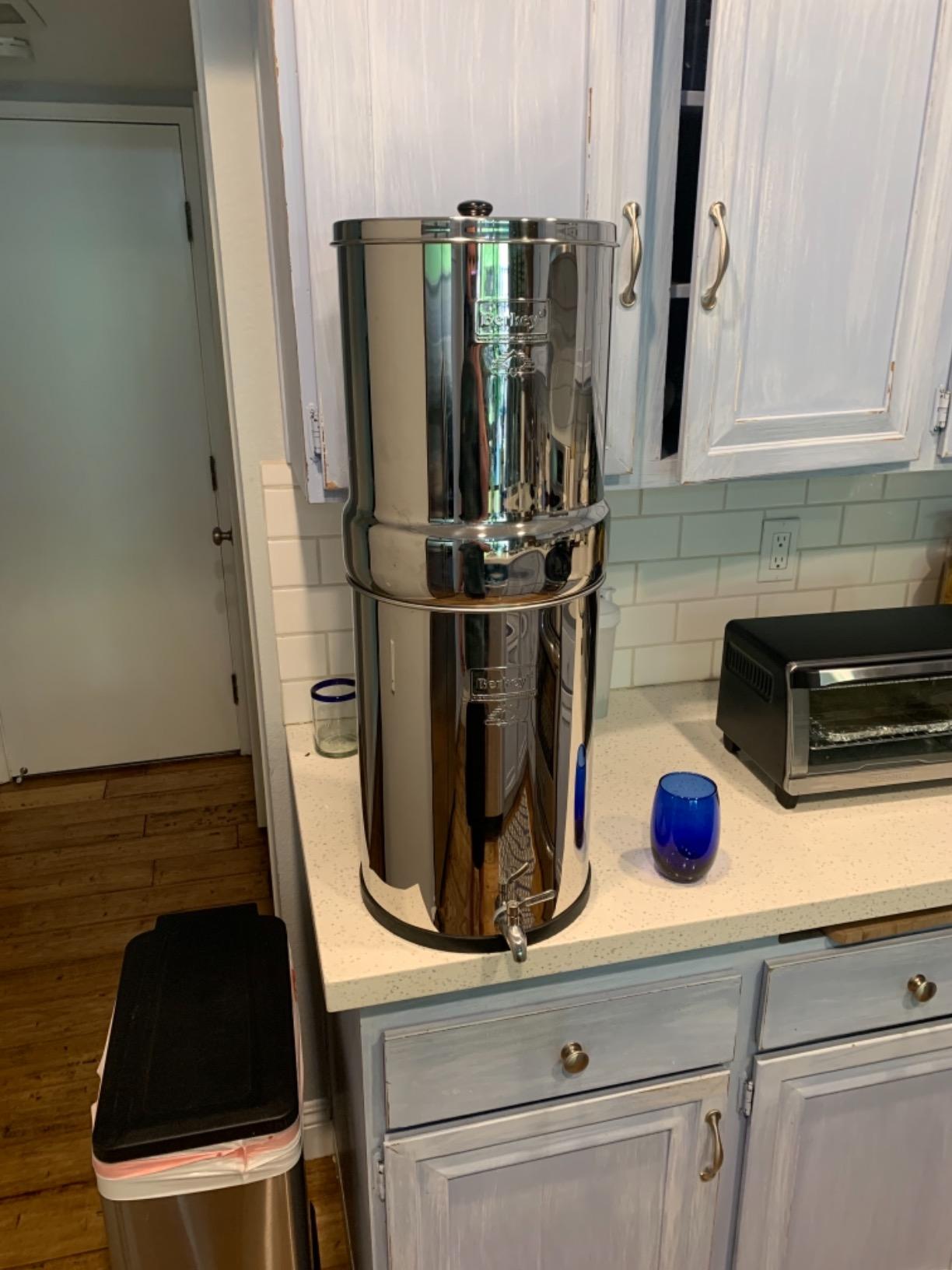
This is a complete system rather than a set of replacement elements, and it comes with two Black Berkey elements plus two PF-2 fluoride and arsenic reduction elements already in the box. That is the appealing part. You are not bolting an arsenic stage onto an existing purifier, you are starting from a full six gallon stainless steel unit with both stages present.
Both elements do different jobs. The Black Berkey elements are rated for up to 6,000 gallons and are independently tested to reduce more than 200 typical contaminants. The PF-2 elements are the arsenic and fluoride stage at about 1,000 gallons, working by adsorption of arsenic in its pentavalent form plus pre-oxidized trivalent arsenic.
Nothing is required but a countertop. There is no electricity, no plumbing, and no tools, and feed water up to 1000 ppm TDS is supported. Owners describe using it on pond and stream water during outages, which is the clearest statement of what a gravity-fed system is actually for.
The six gallon capacity is the practical headline. It is a large reservoir compared with a pitcher, so a family can refill in one trip rather than four, and owners repeatedly mention the clarity and taste of the finished water and the drop in visible sediment compared with tap.
The stainless steel chambers are rated at a 60 month shelf life, and at 12 pounds the unit is portable enough to move when you want the counter space back.
Where a gravity-fed system earns its keep
It fits households with no under-sink plumbing to spare, rentals where drilling is not an option, and anyone building an emergency water supply that works without power. If your well pump fails, a system like this is the one that keeps running.
It is also the easiest way to see filtration working. Put a clear glass under the spigot and the improvement in clarity is immediate, which is more than a TDS meter will tell you about a non-TDS-reducing media.
Where it falls short
The counter footprint is real. At 10 by 10 by 25.75 inches with roughly a 13 inch diameter base, this is a tall object on a kitchen counter, and owners cite the up-front cost against pitcher filters as the main drawback, even when they report a payback in roughly a year.
Two smaller issues show up repeatedly: the spigot can weep if the lid is not tightened fully, and overfilling the upper chamber causes water to overflow between chambers. Also note the PF-2 purging process takes far longer than the thirty seconds the manual states.
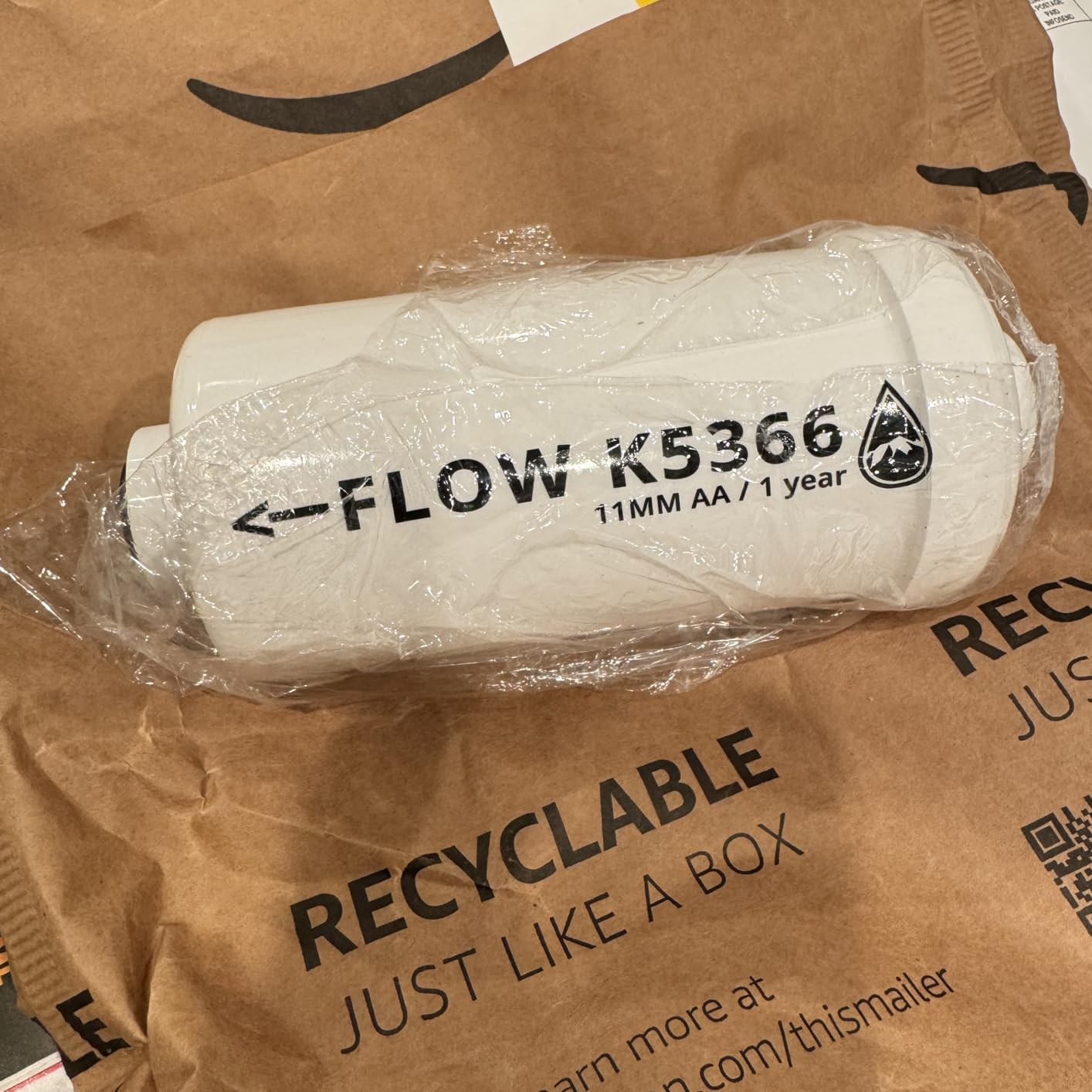
9. Virego K5366 – Lower-Cost PF-2 Replacement for Berkey Owners
Fluoride and Arsenic Filter NSF/ANSI 42 Certified,Replacement for PF-2® Fluoride Filters,K5366 Replacement for Berkey Fluoride Filters Compatible with Berkey Gravity Filtration System-Pack of 2
Carbonate apatite mineral synthesis media
Set of 2 elements
About 1,000 gallon replacement interval
NSF listed
Pros
- Fits Big
- Travel
- Royal
- Imperial
- Crown
- and Light housings
- Noticeable taste difference on fresh install
- Absorbs about 99 percent of residual chlorine and fluoride
- Much lower cost per element than OEM filters
- Primes using the same procedure as the original
Cons
- Some users report clogging around the four month mark
- Does not reduce TDS
- No third-party arsenic data beyond the NSF listing
This is a third-party replacement for the PF-2, and the pitch is straightforward. It uses carbonate apatite mineral synthesis media instead of activated alumina, is listed to the same 1,000 gallon replacement interval, and fits the same range of Berkey housings including the Big, Travel, Royal, Imperial, Crown, and Light models. It primes using the same procedure as the original elements.
On chlorine and fluoride the claims are specific, with about 99 percent absorption of residual chlorine and fluoride, and the listing also names arsenic, heavy metals, odor, color, sediment, and large particles. The cost per element is well under the name-brand PF-2, and that difference adds up over a recurring cartridge schedule.
Where we would pause is the evidence. The listing notes NSF as the external testing certification, but reviewers note there is no independent third-party arsenic performance data beyond the NSF listing. If arsenic is your primary reason for filtering, the difference in confidence between a documented alumina media with published laboratory results and a mineral synthesis media with a certification listing is meaningful.
Users do report a noticeable taste difference when the filters are freshly installed, and the fit is described as correct across the Berkey range. The most common negative theme is shorter-than-expected cartridge life, with clogging reported around the four month mark.
Who should consider this instead of the PF-2
A household that filters mainly for taste and chlorine, uses modest amounts of water, and wants to keep the recurring cost down. If you already have a Berkey and are comfortable verifying performance with periodic laboratory testing, the cost math is genuinely attractive.
The chlorine absorption number is useful on a well with any iron or manganese issues, since chlorine residual and those metals interact.
Where we would not lean on it
If your water test came back with arsenic above the EPA limit, we would rather you had a media with published third-party arsenic performance data. An NSF listing without a published arsenic figure does not tell you what you need to know about the number that brought you here.
Four-month clogging and a complete absence of TDS reduction mean you are replacing more often and flying blind between tests, since the meter will not move.
10. iSpring WGB32B-KS – Whole House Heavy Metals System With 1-Inch Fittings
iSpring WGB32B-KS Heavy Metals Whole House Water Filter System
3 stage whole house system
15 GPM at 1 inch NPT
Rated 100,000 gallons or 12 months
Does not reduce TDS
Pros
- 20 inch by 4.5 inch housings hold large capacity cartridges
- 15 GPM suits whole-house demand
- Clear housings make filter condition easy to check
- Retains healthy minerals while removing metals
- US-based technical support
Cons
- Does not reduce total dissolved solids
- All three cartridges replaced together about every 12 months
- Large housings need clearance and plumbing changes
The WGB32B-KS is the option for people who do not want reverse osmosis. Where an RO system strips the water down to near pure and then adds minerals back through a remineralization cartridge, this one removes contaminants while leaving trace minerals in place. Buyers describe that difference in taste and in approach, and it is a legitimate reason to choose adsorptive and carbon media over a membrane.
Stage one is a five micron polypropylene sediment cartridge. Stage two is a 20 inch by 4.5 inch compound KDF and GAC filter targeting chlorine, lead, mercury, hydrogen sulfide, heavy metals, pesticides, and herbicides. Stage three is a coconut shell carbon block. The stage two bed is where metals reduction happens, and heavy metals including arsenic are within its stated target list.
Flow is up to 15 gallons per minute on one inch NPT inlet and outlet, and the cartridge set is rated at about 100,000 to 150,000 gallons or twelve months of use. The 20 inch housings are the reason the service interval is measured in a year rather than six months, which is the single biggest practical advantage over smaller sets.
Installation is DIY with a printed manual and video walkthroughs, and the support is US-based in Atlanta. At 52 pounds and roughly 27.75 by 7.75 by 24.25 inches, this needs real clearance and possibly some plumbing modification, so measure the space before you commit.
When adsorptive media beats a membrane
It wins when you are not comfortable with near-pure water, when you want hardness and trace minerals retained for taste, and when you would rather not plumb a drain line under the sink. Treats every fixture rather than just the drinking tap.
For a household that wants arsenic and chlorine handled at the point of entry with a once-a-year service interval, the economics are hard to argue with.
Where the WGB32B-KS falls short
It does not reduce total dissolved solids, and that is not a defect so much as a design choice. Just know that a TDS reading at your tap will not change, and do not read that as a failing filter.
All three cartridges are replaced together at roughly the twelve month mark even if the carbon stage has more life left, and the large housings demand installation clearance and plumbing modifications. Arsenic capacity on a KDF and GAC bed also depends on competing ions, so treat the twelve month interval as a ceiling rather than a schedule.
Start With Your Water Test: Arsenic Level, Speciation and Co-Contaminants
No filter on this list should be bought before a test, and the test you want is not the cheap one. Ask a certified laboratory for a private well panel that includes arsenic with speciation, meaning the result separates arsenate from arsenite. Most generic panels report total arsenic only, which is like asking a mechanic to diagnose a noise without telling them where it is coming from.
The EPA maximum contaminant level of 10 ppb exists for public water systems, and private wells are unregulated for this contaminant. Arsenic shows up most often in bedrock and volcanic aquifers, with well owners in the Southwest, New England, and the Upper Midwest reporting results above 10 ppb repeatedly. The health goal, the number at which there is no known safe exposure, is zero.
Here is the speciation rule in plain language. Arsenate is negatively charged and adsorbs onto iron-based media reasonably well. Arsenite is electrically neutral, slides past most adsorptive media almost untouched, and is more common in low-oxygen well water. If your water is arsenite-dominant and you install an adsorptive filter without pre-oxidation, you can spend years replacing cartridges and change almost nothing.
Pre-oxidation converts arsenite into arsenate before the water reaches the media. The practical options are air injection, which adds oxygen as the water passes through, chlorine injection ahead of the filter, or a manganese dioxide media bed that does the conversion as a side effect. Reverse osmosis sidesteps the entire question because the membrane rejects the dissolved ion either way, which is our main reason to recommend an RO unit as the default for a well with no speciation data.
Ask about co-contaminants on the same panel. Arsenic frequently travels with iron, manganese, and sulfur on the same well, and that combination changes the order of operations. Heavy iron will foul a reverse osmosis pre-filter on a schedule you did not plan for, and homeowners in that situation report changing sediment cartridges monthly until the iron load is brought down.
One more measurement to insist on: total dissolved solids. TDS tells you how much dissolved load the membrane will be pushing against, and it is the single best predictor of filter life on a well. It is also the number that explains why cartridge life claims fall apart in practice.
What Certification to Look For: NSF/ANSI 58 vs 53 and How to Verify It
NSF/ANSI 58 covers reverse osmosis systems and the reduction claims made for them. NSF/ANSI 53 covers health-effect filtration, and it is the standard that governs most adsorptive and carbon media components, including filters sold for arsenic. If a product page shows only NSF 42, that is a taste and odor standard for chlorine reduction and tells you nothing about arsenic.
Look for three things together: the standard number, an explicit arsenic claim, and third-party laboratory data. A listing that says certified to NSF 58 and separately lists arsenic among the reduced contaminants is telling you both the performance claim and who verified it. A listing that says heavy metal reduction as a single catch-all phrase is not.
Verification is easier than most people assume. Go to the NSF website listings, search the model number, and confirm the component carries the claim you expect. Waterdrop in this group, for example, carries certification to NSF/ANSI 58, NSF/ANSI 372, and NSF 42, with arsenic named in the eight-stage performance testing. The iSpring RCC7-BN lists NSF/ANSI 58 certification with arsenic named in its contaminant list. A claim you cannot find in a third-party database is a claim you should treat as unverified.
Be equally clear about what certification does not tell you. It does not tell you how long the media lasts in your water, because rated capacity assumes favorable conditions. It does not tell you anything about arsenic speciation. And it does not account for the competing ions in a real well, which is where the gap between a rated gallon figure and your actual experience comes from.
Reverse Osmosis vs Adsorptive Media: Which One Fits Your Well
Reverse osmosis is the strongest single answer for arsenic on well water, and it is the recommendation we lead with for good reason. A membrane rejects dissolved arsenic regardless of oxidation state, it does not compete with silica or phosphate for adsorption sites, and it removes lead, PFAS, and fluoride in the same pass. The costs are the brine waste, the low-pressure sensitivity, and the near-pure taste that some people find flat.
Adsorptive media, which includes iron oxide, granular ferric compounds, activated alumina, and KDF blends, is the right answer when you want trace minerals retained or when a drain line is not an option. Its weakness is chemistry. Capacity depends heavily on pH, and silica and phosphate in the water compete directly for the same binding sites, so a rated capacity figure transfers poorly to a real well.
Pitchers and countertop carafes are where we would push back hardest. Ion exchange media on a high-TDS well exhausts fast, and owners in the r/WaterTreatment community consistently report replacement filters lasting days rather than the months claimed, with a fishy smell developing in the spent media. If your TDS is above roughly 300 ppm, a jug-based approach is the wrong tool regardless of what is printed on the label.
Whole-house adsorptive units make sense when you want every fixture treated, when showers and laundry are part of your concern, or when a softener or iron filter is already in the plan. The maintenance is real, and the media needs periodic replacement, but the flow and convenience at every tap are worth it for many households.
A common combination is point-of-entry sediment, carbon, and iron treatment feeding an under-sink reverse osmosis for drinking and cooking. That pairing handles the well water cocktail of iron, manganese, and arsenic while keeping the RO membrane protected from fouling, and it is the arrangement we would design if we were building this for our own house.
Installation, Space and Ongoing Maintenance
Space is the first constraint and it is a hard one. Tanked under-sink reverse osmosis systems with a five gallon tank need roughly 15 by 5 by 17 inches of clear cabinet, and the iSpring RCC7-BN at 27.5 pounds is the heaviest item in this group. Tankless designs such as the G3P600 and the GFU03 free up about 70 percent of that footprint, at the cost of a pump, an outlet, or slower flow.
Pressure is the second constraint. Most membrane systems want at least 40 psi at the feed, and the APEC ROES-50 lists a 40 to 85 psi working range while the Waterdrop G3P600 operates at about 87 psi. If your well has a pressure tank that is old or undercharged, add a booster pump to the budget before you order anything, because discovering it after the install means starting over.
Whole-house units demand more space and more planning. The HQUA WF3-01 stands 31 inches high and 23 inches wide, and the iSpring WGB32B-KS needs clearance for 20 inch housings plus plumbing modification. Measure the actual run of pipe, not just the wall you want to use, and confirm you can shut off water and drain the cabinet during the swap.
Ongoing cost is dominated by cartridges, and the honest way to think about it is gallons per dollar rather than dollars per filter. The PF-2 elements at about 1,000 gallons each are the shortest interval in this group and suit a household filtering for drinking and cooking only. Whole-house sets at twelve month or 100,000 gallon ratings deliver far more treated volume per cartridge, because every fixture in the house is consuming treated water.
Plan the verification schedule too. We recommend retesting at one month after install to confirm the system is working, then at six months, then annually after that, with an extra test after any cartridge change on a system treating arsenic. Until you have a laboratory number, a TDS meter is only a rough trend indicator, and on non-TDS-reducing media it will not move at all.
One practical habit saves money and headaches: change the sediment pre-filter on a schedule rather than a symptom. On a well with iron or sediment, the pre-filter is doing the protecting, and a clogged pre-filter is what kills membrane and media performance before the expensive stage is even involved.
Frequently Asked Questions
Can arsenic be filtered out of well water?
Yes. Arsenic can be removed from well water by reverse osmosis membranes, iron-oxide and activated alumina adsorptive media, anion exchange resin, or distillation. Standard carbon and sediment cartridges do not remove arsenic. Arsenate (As V) is easier to remove than arsenite (As III), which requires pre-oxidation before adsorptive filtration.
What are the best arsenic filters for drinking water?
For most households the iSpring RCC7-BN under-sink reverse osmosis system is the strongest starting point, since NSF/ANSI 58 certification and membrane rejection handle arsenic in either oxidation state. Berkey PF-2 activated alumina elements are the pick if you already own a gravity-fed purifier. The Waterdrop G3P600 covers high-volume use where cabinet space is tight.
How common is arsenic in well water?
Arsenic is a naturally occurring contaminant concentrated in bedrock and volcanic aquifers, most often in the Southwest, New England, and the Upper Midwest. It has no taste, odor, or color, so it cannot be detected without testing. The EPA sets a maximum contaminant level of 10 ppb for public systems, while private wells are not federally regulated and many go decades without a test.
Does reverse osmosis remove arsenic?
Yes, and it is the most reliable single technology for the job. A reverse osmosis membrane rejects dissolved arsenic as an ion, so it removes arsenate and arsenite without needing pre-oxidation. Performance depends on keeping the membrane clean, which means the sediment and carbon pre-filters must stay ahead of the water on a well with iron or sediment.
What certification should an arsenic filter have?
Look for NSF/ANSI 58 for reverse osmosis systems or NSF/ANSI 53 for adsorptive and carbon media, plus an explicit arsenic reduction claim and third-party laboratory data. NSF/ANSI 42 is a taste and odor standard for chlorine and says nothing about arsenic. Verify the claim by searching the model number in the NSF listings database rather than trusting the product page.
How do you flush arsenic out of the body?
There is no at-home detox or supplement that removes arsenic, and the body’s handling of arsenic is largely a matter of time, hydration, and nutrition. If your water is above the 10 ppb limit, the effective step is switching to verified filtered water and asking your doctor about a urine test and any exposure history. Prevention at the tap matters far more than anything you can do after the fact.
Conclusion: The Best Arsenic Filters for Well Water in 2026
Test first, always. A speciation result and a TDS number from your own well will narrow ten products down to two or three, and it costs far less than a system that never worked.
Our recommendation for most households is the iSpring RCC7-BN, because certified NSF/ANSI 58 reverse osmosis removes arsenic in either oxidation state without pre-oxidation and also handles PFAS, lead, and fluoride in the same pass. If you already own a gravity-fed Berkey, the PF-2 elements are the right arsenic stage and there is no reason to change anything else.
The Waterdrop G3P600 solves the case where arsenic and a crowded cabinet are both problems at once, and the APEC ROES-50 is the safe answer for high-TDS feed water. For whole-house treatment, the iSpring WGB32B-KS keeps trace minerals while stripping metals, and the HQUA WF3-01 handles high-flow homes with fifteen gallons per minute. Retest at one month, then at six months, then annually, so you are trusting numbers rather than taste.