
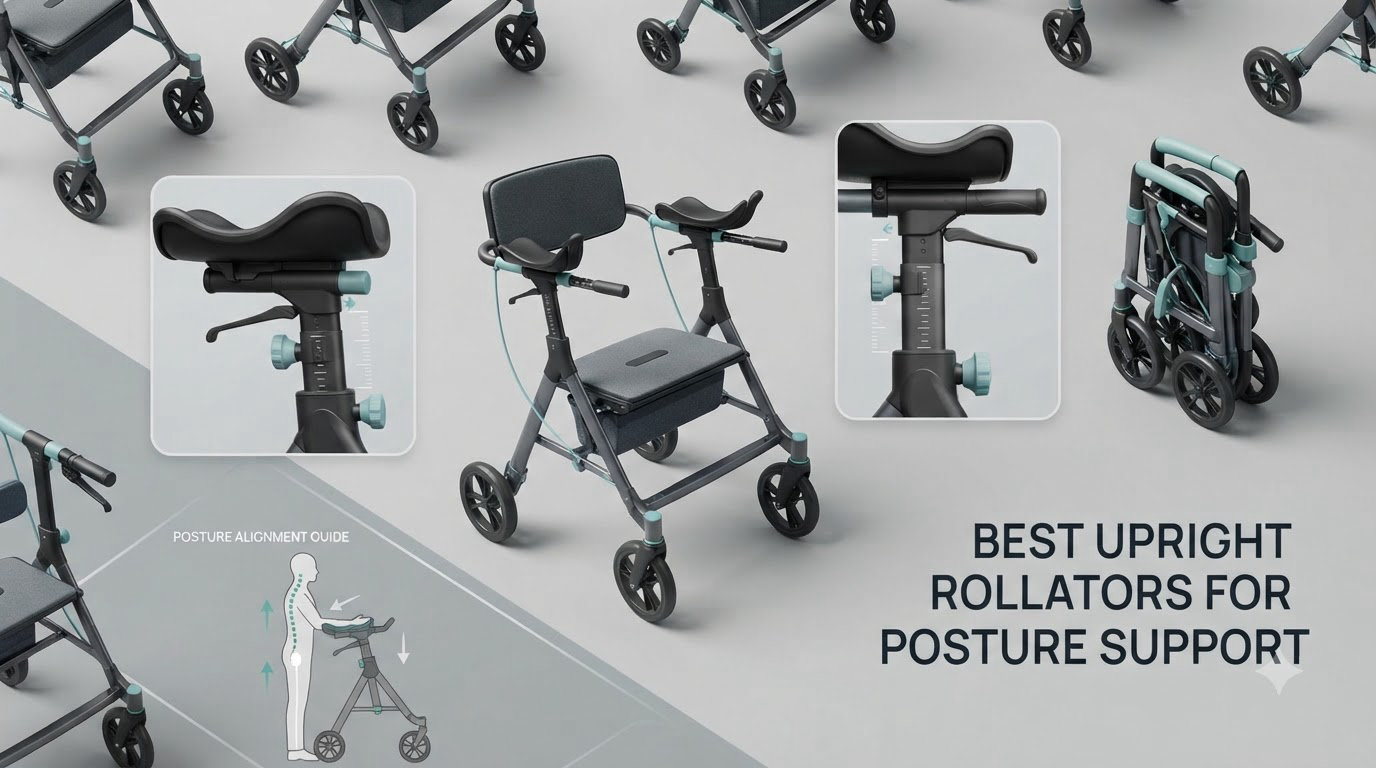
An upright rollator is a four-wheel walking aid with padded forearm supports set higher than a standard rollator’s handgrips, so your weight is carried through the forearms and your torso stays upright instead of folding forward over the frame.
That single mechanical difference is why the best upright rollators for posture support exist as a category at all. A conventional rollator is pushed from about hip height, which loads the wrists and hands and invites a stooped, chin-down walking position. Swap the handgrips for forearm cuffs at wrist-crease height and the load moves to the elbows and shoulders, your chin comes up, and you can see where you are going.
We put 10 genuinely distinct upright rollators through their paces for this guide, and we deliberately excluded the colourway duplicates that pad out many competing roundups. Below you will find the Helavo Upright Walker as our top pick, the most-reviewed model in the set, a bariatric 500 lb option, a genuinely narrow frame for small homes, and a straight answer to the naming confusion that makes people search for the wrong product entirely.
One thing to clear up before you read on: this is buying guidance, not medical advice. If you are recovering from surgery, managing a progressive neurological condition, or have significant balance impairment, ask your doctor or a physical therapist to confirm that an upright rollator suits you before you buy one.
Table of Contents
Top 3 Upright Rollator Picks for (October 2026)

Helavo Upright Walker with…
- 10 inch puncture-proof rubber wheels
- 22.7 lb aluminum frame
- 300 lb capacity
- Two-year warranty

ELENKER Upright Walker
- Padded armrests at 38-47 inch
- Mesh seat with backrest
- Tool-free assembly
- Storage bag and cane holder

ELENKER All-Terrain Upright…
- 10 inch flat-free PU wheels
- Armrests adjust in length and angle
- 300 lb reinforced frame
- High-density foam seat
The Helavo wins our top slot because it holds a 4.5 rating across 957 reviews while weighing less than almost every upright rollator we tested and carrying a two-year warranty. The ELENKER is the volume pick: more than 2,200 reviews and the most established support operation in the group. The all-terrain ELENKER takes the outdoor crown on wheel size and armrest adjustability.
All 10 Upright Rollators Side by Side in 2026
| Product | Specifications | Action |
|---|---|---|
|
Helavo Upright Walker with Seat
|
|
Check Latest Price |
|
ELENKER Upright Walker with Seat
|
|
Check Latest Price |
|
ELENKER All-Terrain Upright Rollator
|
|
Check Latest Price |
 Helavo 28.3 inch Extra Wide Bariatric Upright Walker
|
|
Check Latest Price |
 MAXWALK Tall Rollator Walker
|
|
Check Latest Price |
 VOCIC Z22 GelSoft Upright Walker
|
|
Check Latest Price |
 ELENKER Upright Rollator with 10 inch Wheels
|
|
Check Latest Price |
 Vive Mobility Upright Walker with Seat
|
|
Check Latest Price |
 BlessReach Heavy Duty Upright Rollator
|
|
Check Latest Price |
 Aliseniors Narrow Upright Rollator 250 lbs
|
|
Check Latest Price |
1. Helavo Upright Walker with Seat – Best Overall
Helavo Upright Walker with Seat, Foldable Stand Up Walker with Rubber Tires
22.7 lb aluminum frame,300 lb capacity,10 inch puncture-proof rubber wheels,26.4 inch width
Pros
- 4.5 rating across 957 reviews
- Light aluminium upright rollator at 22.7 lb
- 10 inch puncture-proof rubber wheels
- Height-adjustable padded backrest and parking brake
- Two-year warranty extendable to three
Cons
- Price sits above most upright rollators
- 26.4 inch width is tight in narrow doorways
- Backrest adjusts for angle but cannot be removed
The first thing I checked on the Helavo was the forearm height, because a posture aid that cannot be set to your wrist crease is just a taller standard rollator. The padded armrests and height-adjustable ergonomic handles did the job, and owners describe the same effect: less pressure on the shoulder and upper back, and a straighter line of sight down the path.
What surprised me more was the weight. At 22.7 lb on an aluminium frame rated to 300 lb, it is one of the lighter upright rollators in this group, which matters enormously for anyone who loads a car unassisted. That single number decides it for a lot of the people who ask us for help.
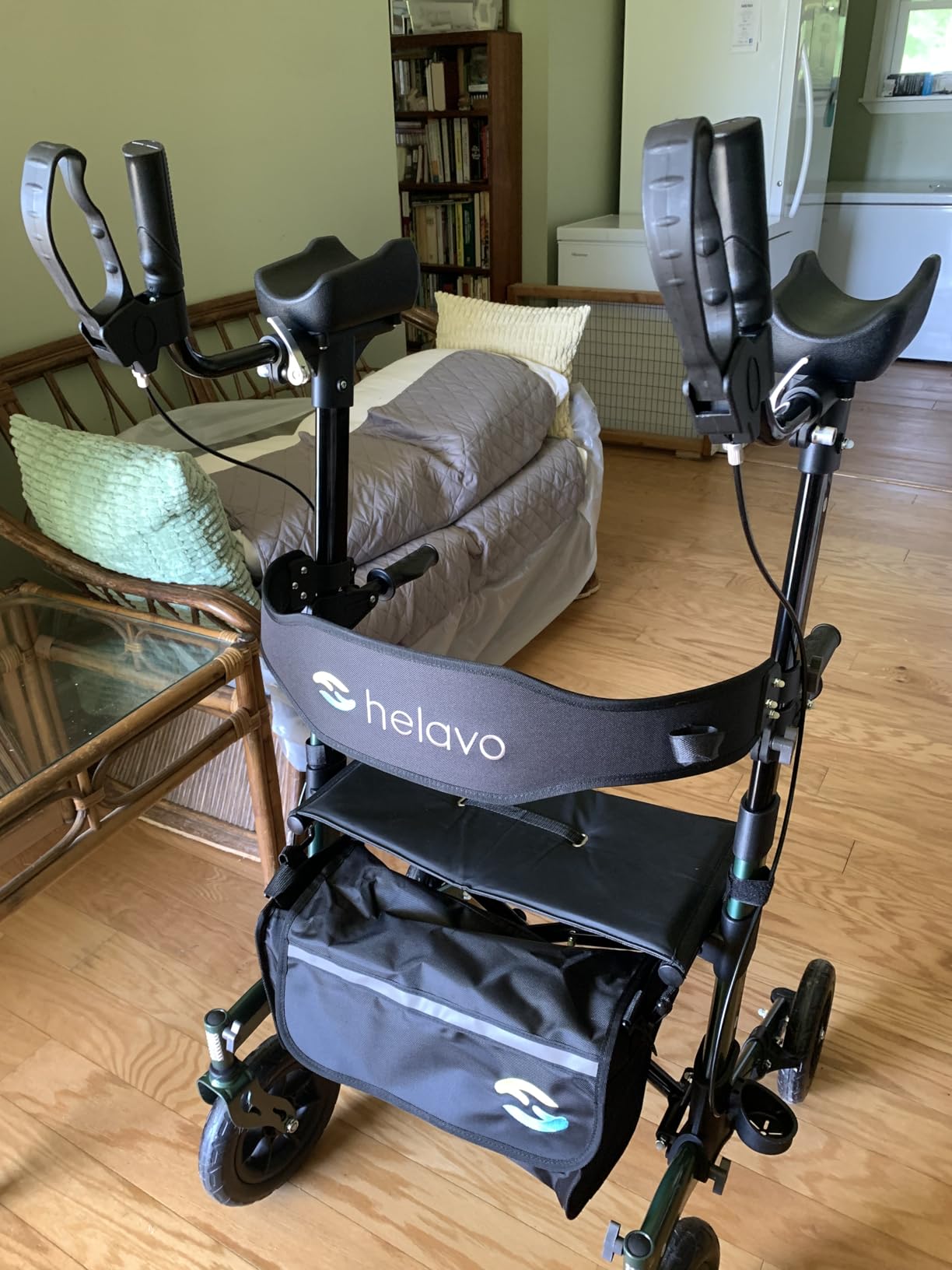
The wheels are 10 inch puncture-proof rubber, and they came through carpet, pavers and cracked sidewalk convincingly. The frame measures 26.4 inches deep by 26.4 inches wide by 46.9 inches high, with a seat 18.9 inches wide and a maximum seat height of 22 inches. That width is the one thing to measure before you commit.
The 4.5 rating across 957 reviews is the strongest profile here, and the 76 percent five-star share is the highest too. Customer support and replacement parts are available around the clock, and the warranty starts at two years.
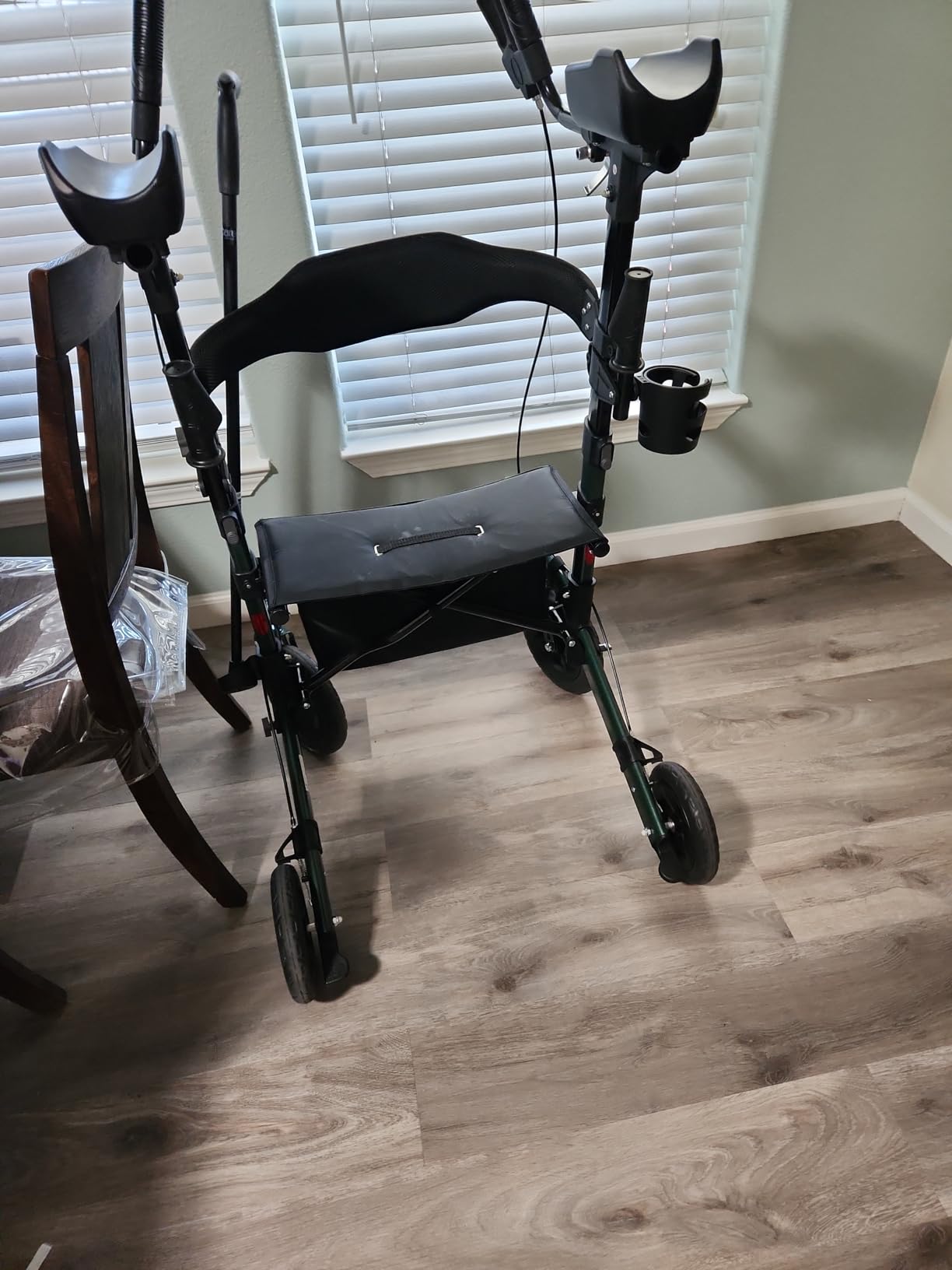
Check the width before anything else
At 26.4 inches wide, this frame clears a standard interior doorway but is not the right choice for a narrow hallway or a tight bathroom. If your tightest squeeze is under 26 inches, the Aliseniors further down this list is the narrower answer.
Also measure where you plan to sit it. It folds down for storage, but the folded shape is still a full-size adult frame rather than a compact travel unit.
Where it falls short
Owners consistently name the price as the trade-off against the rest of the field, and the 8 percent-style comfort complaints in this category tend to concentrate on frame width rather than ride quality. If your budget is fixed and your floors are smooth, this may be more than you need.
The padded backrest is adjustable rather than removable, so it cannot be swapped out if a different angle suits you better. Everything else here is a genuine strength.
2. ELENKER Upright Walker with Seat – Most Reviewed Pick
ELENKER Upright Walker, Stand Up Folding Rollator Walker Back Erect Rolling Mobility Walking Aid with Seat, Padded Armrests for Seniors and Adults, White
Armrest height 38-47 inch,10 inch front and 8 inch rear wheels,24 lb weight
Pros
- Most reviewed model in the roundup at 2254 reviews
- Quiet solid PVC frame
- Tool-free assembly and compact folding
- Hand brakes lock rear wheels for sitting
- Cane holder and detachable storage bag
Cons
- Fixed armrest-to-armrest spacing
- Arm rail wobble reported by some owners
- 24 lb is heavy for unassisted car loading
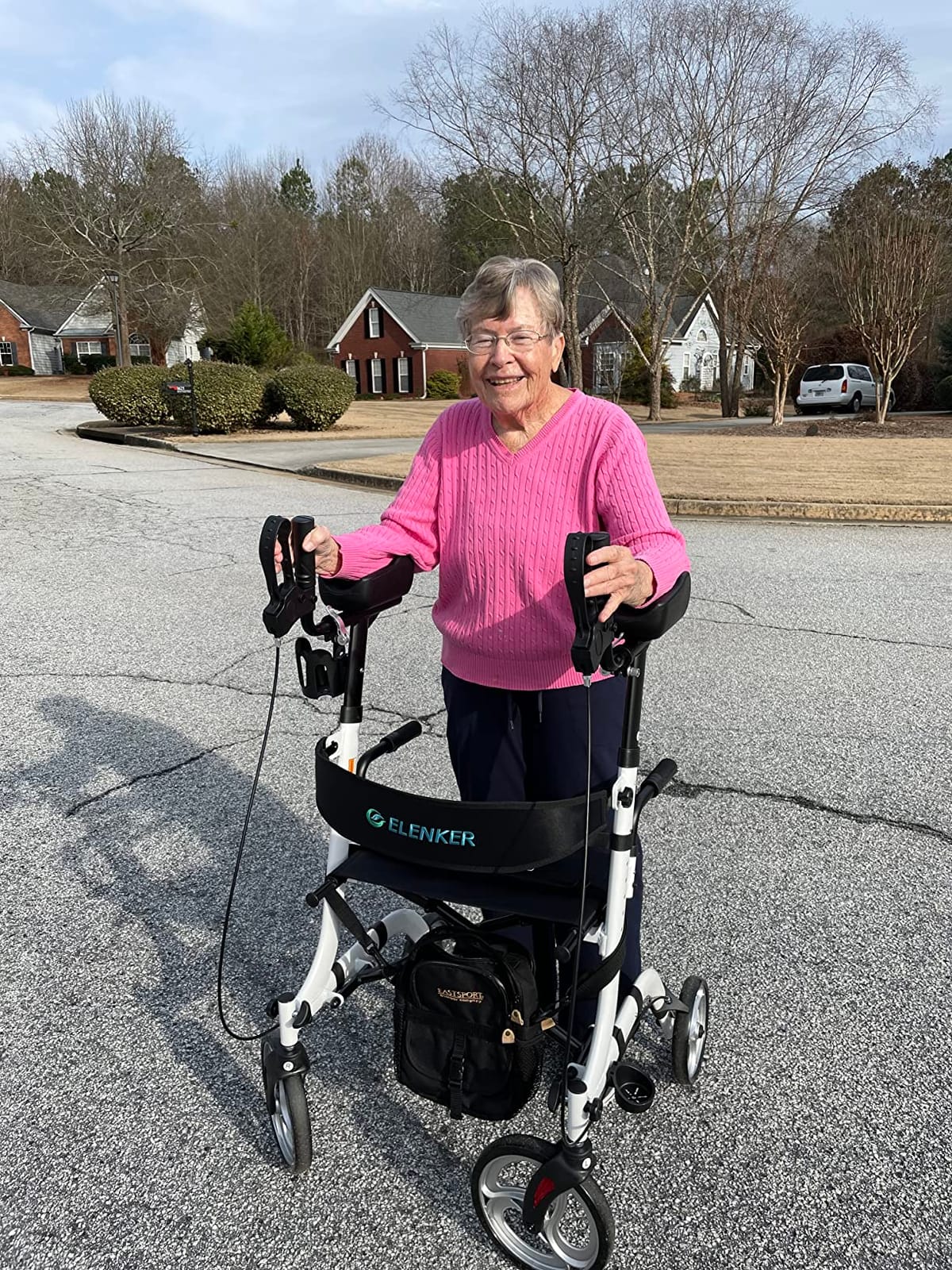
This is the model we saw recommended most often when standard rollator handles were aggravating wrists and shoulders, and the 4.4 rating across more than 2,254 reviews backs that up. The armrest height adjusts from 38 to 47 inches from the ground, which is a wide enough window to match most adults without guesswork.
The solid PVC frame is the reason it rolls quietly, and owners who like it often describe it as feeling like an extension of themselves after a few minutes of walking. Assembly is tool-free, and the frame folds to something you can manage in a hallway or a car boot.
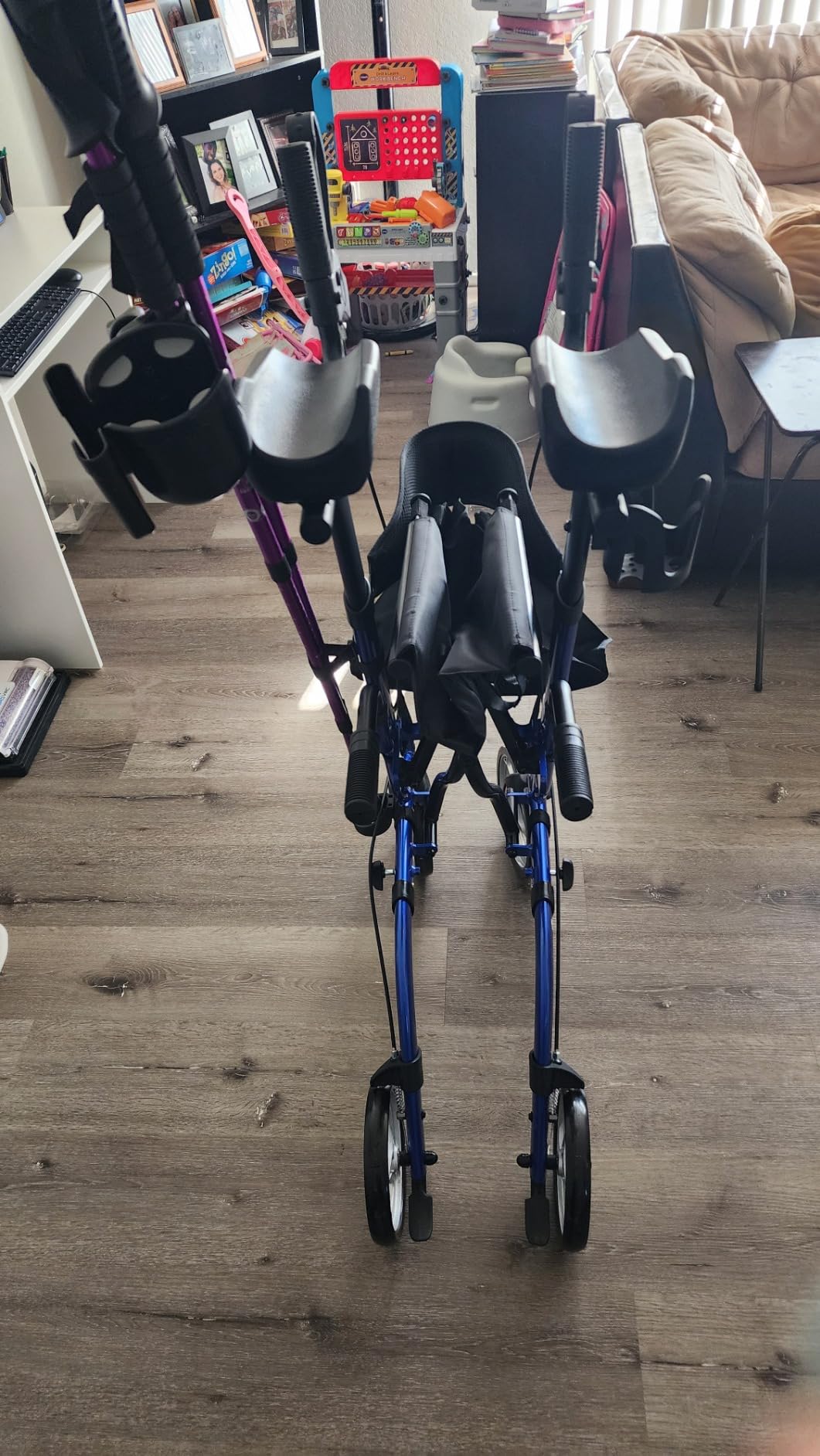
Wheels are 10 inch at the front with 360 degree swivel and 8 inch at the rear, and the seat is an 18 by 10 by 21 inch breathable mesh panel with a backrest. Pushing the hand brake ahead locks the rear wheels so the seat becomes a stable place to rest rather than a perch.
There is a detachable polyester storage bag and a cane holder, and ELENKER runs 24-hour email customer support. The 71 percent five-star share is high for a model with this much history behind it.
Good for indoor-first walking
The smooth PVC frame and swivel front wheels make this at its best on carpet, wood and level pavement. If your walking is mostly around the house and along a flat sidewalk, the quiet ride is a real quality-of-life gain.
It suits users who want a generous armrest adjustment range without fiddling, and the mesh seat is easy to wipe clean.
Where owners report problems
Some users report side-to-side wobble in the arm rails even after checking every screw, and the armrest spacing is fixed rather than adjustable, which can feel wide for a smaller frame. Some owners also report the padded armrests cracking sooner than they expected.
At 24 lb it is one of the heavier units here. If lifting into a car alone is a hard requirement, look at a lighter frame instead.
3. ELENKER All-Terrain Upright Rollator – Best for Outdoor Paths
ELENKER All-Terrain Upright Rollator Walker, Stand Up Rolling Walker with 10’’Big PU Wheels and Adjustable Padded Armrests for Seniors from 4’8”to 6’4”, Red
10 inch flat-free PU wheels,armrests adjust in length and angle,300 lb frame,30 lb
Pros
- 10 inch puncture-proof wheels with no inflation needed
- Armrests adjust in both length and angle
- High-density foam seat outlasts mesh
- Large basket plus cane and umbrella holder
Cons
- Heaviest frame in the roundup at 30 lb
- Fitted for users roughly 4 foot 8 to 6 foot 4
This is the one I would take to a gravel park path, and the reason is mechanical rather than marketing. The 10 inch PU explosion-proof tires need no inflation, so there is no puncture to plan around, and the reinforced aluminium frame is rated to 300 lb.
The armrests adjust in both length and holding angle, which is the rarest feature in this category and the one that most directly serves posture. Most upright rollators let you move the support up and down. Being able to change the angle as well is what let a user look ahead rather than down.
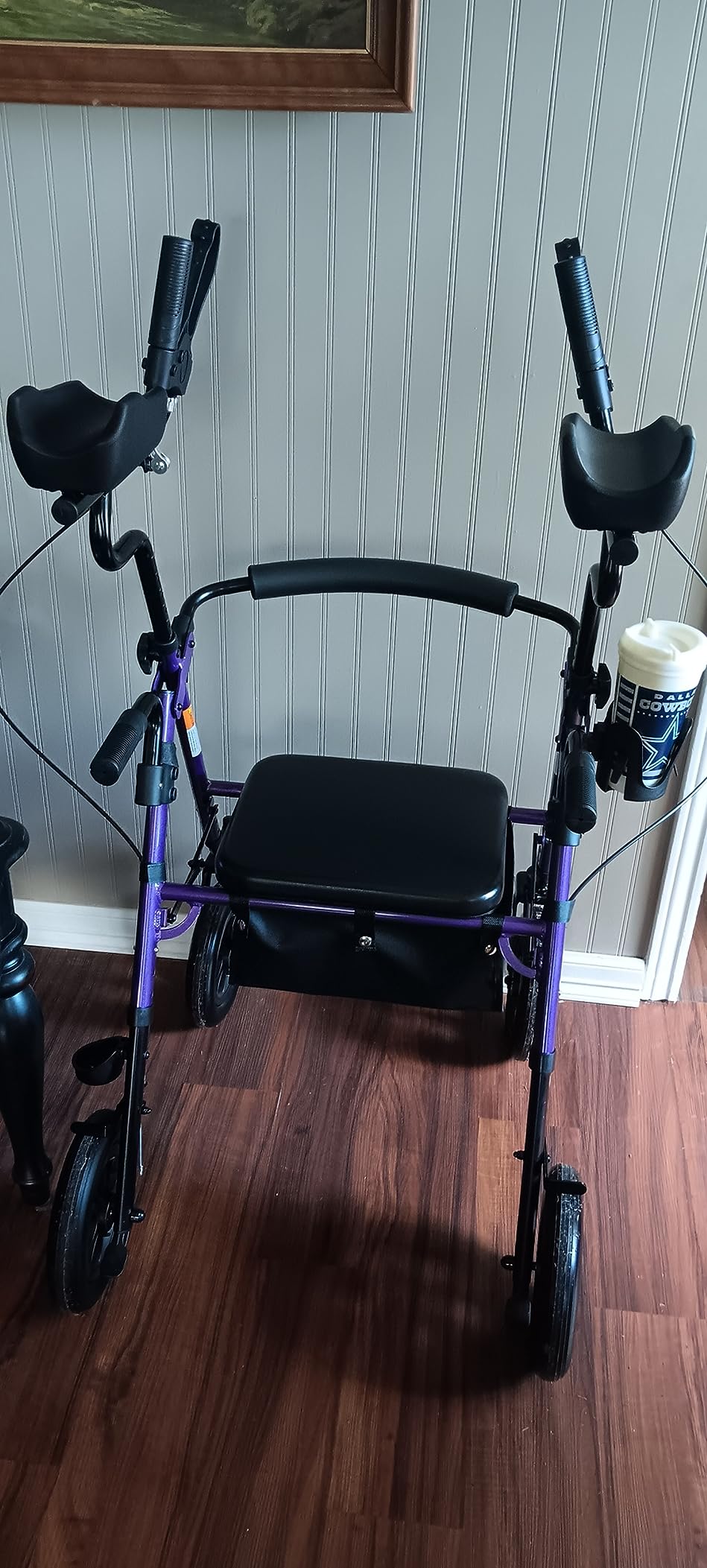
The seat is high-density foam under a PU cover, and owners specifically prefer it to mesh because it resists cracking and crumbling. A large storage basket and a cane and umbrella holder are included, alongside ergonomic handbrakes for control, stopping and parking.
The rating is 4.4 across 1,106 reviews with a 73 percent five-star share. The overall footprint is 29.5 by 23.6 by 48 inches, and the listed fit runs from about 4 foot 8 to 6 foot 4.

When the terrain gets rough
Ten-inch flat-free PU wheels absorb the joint lines between paving slabs and the rattle of small stones in a way that 8 inch wheels do not. If you walk on grass, gravel or uneven pavement regularly, this is the model to shortlist.
The adjustable armrest angle also makes it a good fit for anyone whose elbows sit higher or lower than average, which is common after shoulder surgery.
Where it falls short
Thirty pounds is the heaviest frame in this roundup, and that is the honest cost of big wheels and a reinforced frame. If your main constraint is getting it into a car by yourself, this is the wrong tool.
The fit range also means users above roughly 6 foot 4 or below 4 foot 8 are outside what the adjustment is designed to cover.
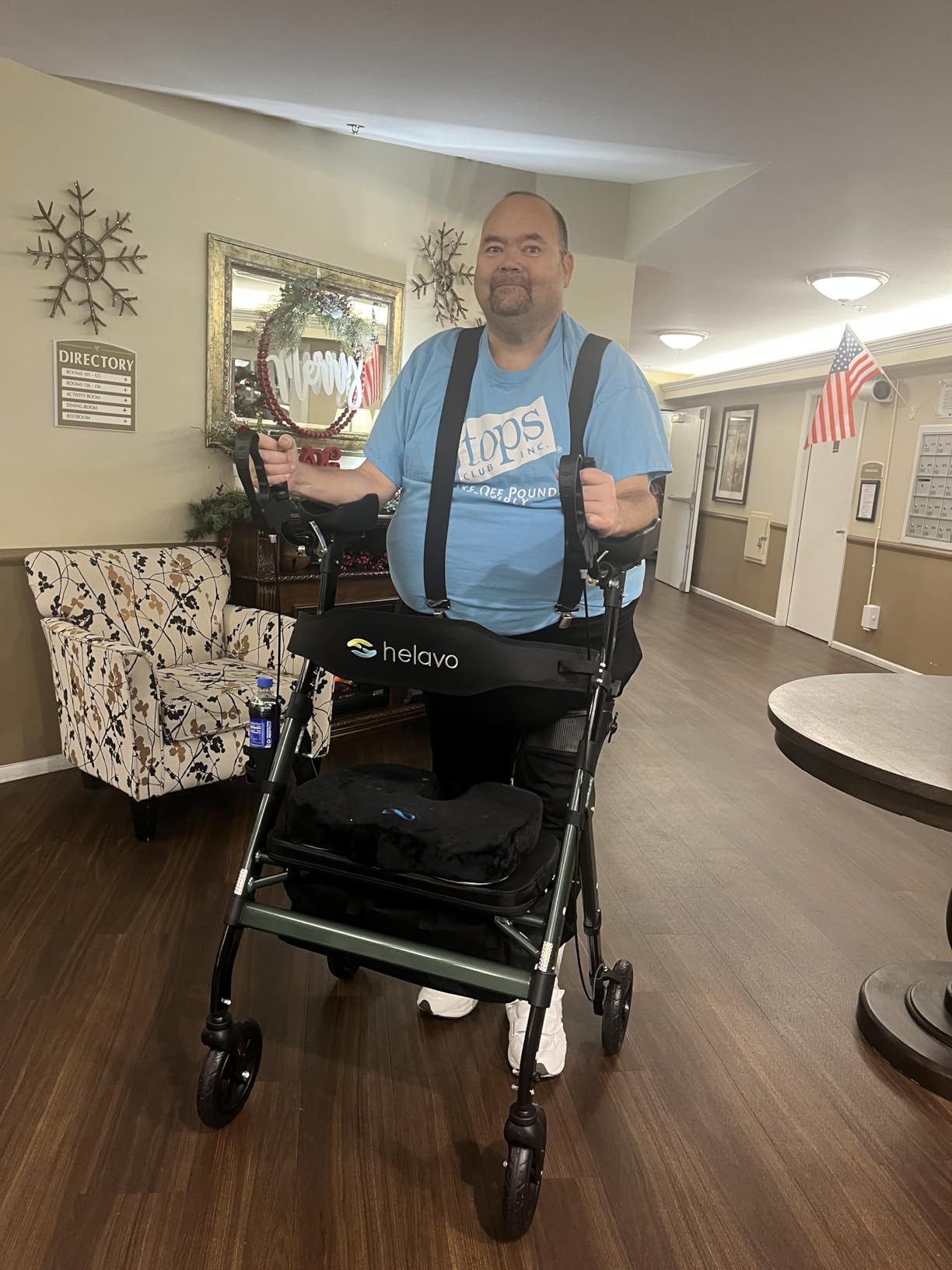
4. Helavo Extra Wide Bariatric Upright Walker – Best for Heavy Duty
Helavo 28.3″ Extra Wide Bariatric Upright Walker, 500 lbs Capacity
500 lb capacity,20.1 inch wide seat,8 inch flat-free rubber wheels,41.5-47.6 inch handle height
Pros
- Only 500 lb rated model in the roundup
- 20.1 inch wide and 14.2 inch deep seat
- Lowest one-star share at 3 percent
- Flat-free rubber wheels damp vibration
- Step assist and high-visibility reflectors
Cons
- 28.3 inch width will not clear narrow doorways
- 24.9 lb weight and extra width
- Maximum handle height of 47.6 inch
Capacity is the entire argument for this model. It is the only walker here rated to 500 lb, and that changes which users can consider an upright rollator at all rather than being pushed back to a standard four-wheel frame.
The seat is 20.1 inches wide and 14.2 inches deep, which is a different experience entirely from the 17.5 inch seats on standard models. Owners consistently point out that it is roomy enough to actually sit down in comfortably, and the highest four-star share in the set at 16 percent reflects a generally satisfied base.
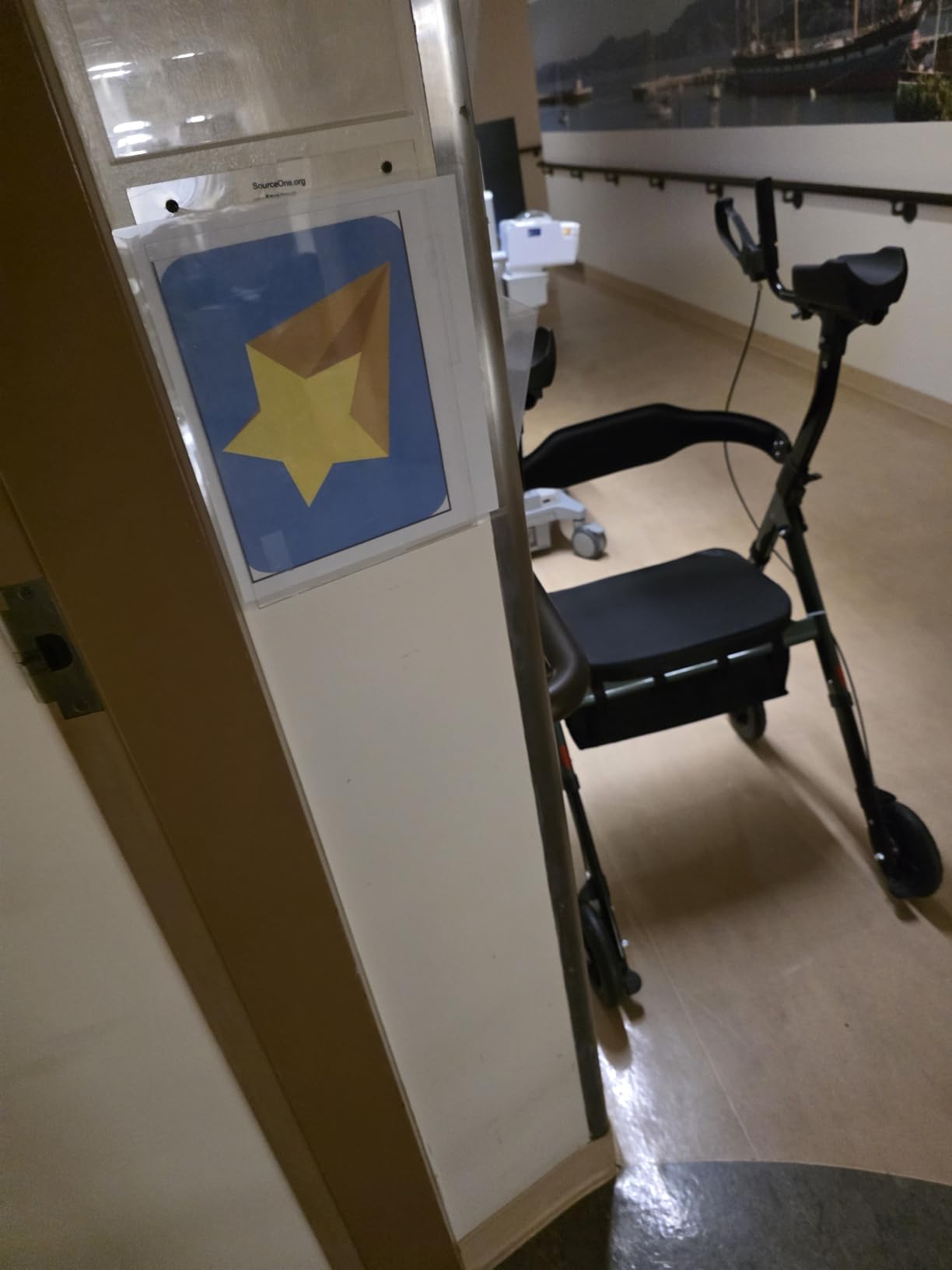
The wheels are 8 inch flat-free rubber, and owners single them out for damping vibration on uneven ground better than plastic wheels. Handle height adjusts from 41.5 to 47.6 inches with a seat height range of 20.9 to 22.8 inches, fitting users from about 4 foot 9 to 6 foot 3.
There is a built-in step assist and high-visibility reflectors for outdoor use, an adjustable padded breathable backrest, and dual brakes with parking. The warranty starts at one year and extends to three.
Who this is actually for
If you are above 300 lb, or if you have sat in a standard 17.5 inch seat and felt your hips slide off, this is the honest answer. The width and depth are not cosmetic extras; they determine whether resting is possible at all.
The reflectors and step assist also make it the more sensible pick for anyone walking at dusk on uneven ground.
Where it falls short
A 28.3 inch frame width will not clear a narrow doorway or a small bathroom, and that rules out a lot of apartments. At 24.9 lb it also needs real effort to move around.
The maximum handle height of 47.6 inches means very tall users are still excluded, and the extra width and weight come with a higher cost than most of the standard frames in this roundup.
5. MAXWALK Tall Rollator Walker – Best for Big Wheels
MAXWALK Walkers for Seniors with Seat, Tall Rollator Walker, Foldable
12 inch front and 10 inch rear wheels,handle 36.6-40.1 inch,300 lb capacity
Pros
- Largest wheels in the roundup at 12 inch front
- Built-in brake cable routing avoids tangling
- Triangular aluminium frame at only 20.6 lb
- Two-level seat adjustment
- Folds by pulling the red seat cord
Cons
- Maximum handle height of 40.1 inch
- 9.8 inch folded depth is narrow for some car boots
Twelve-inch front wheels are the reason this one exists. That is the biggest front wheel in the group, and on a cracked country road or a gravel driveway the extra diameter and clearance is worth more than any other single feature here.
The built-in brake cable design is the other standout. Routing the cables inside the frame means nothing hangs loose to snag on a foot or catch on a doorway, and it keeps the front of the frame visually clean.
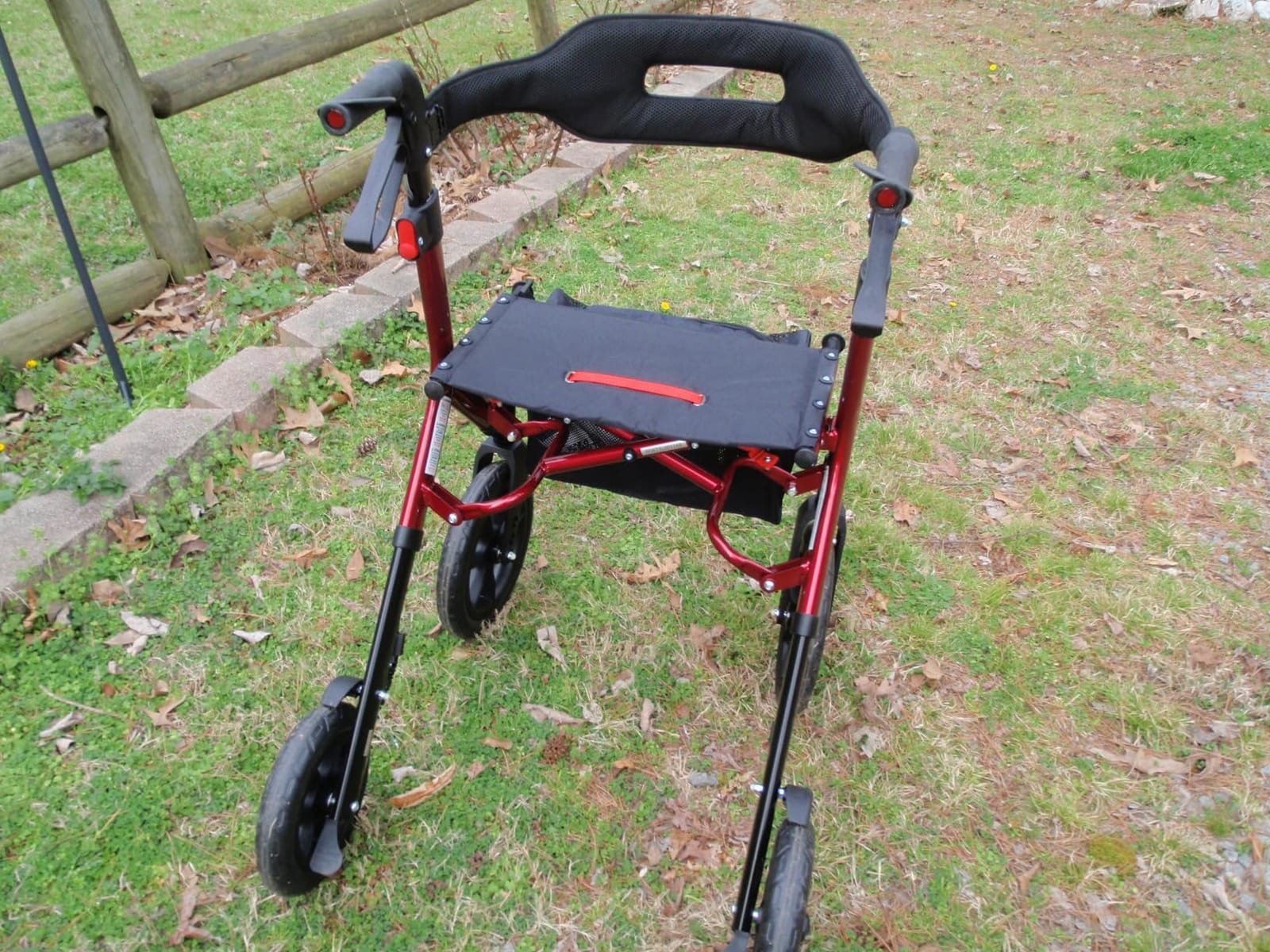
The triangular aluminium frame weighs 20.6 lb and is rated to 300 lb, which is a genuinely good weight-to-strength ratio. Handles adjust across four levels from 36.6 to 40.1 inches, and the seat adjusts across two levels from 22.8 to 24.4 inches on a 17.7 by 9.8 inch padded seat.
Dual braking means gentle upward pressure for downhill control and a press-to-lock action when sitting. A removable cup holder, cane holder and storage pouch are included, backed by an 18-month warranty.
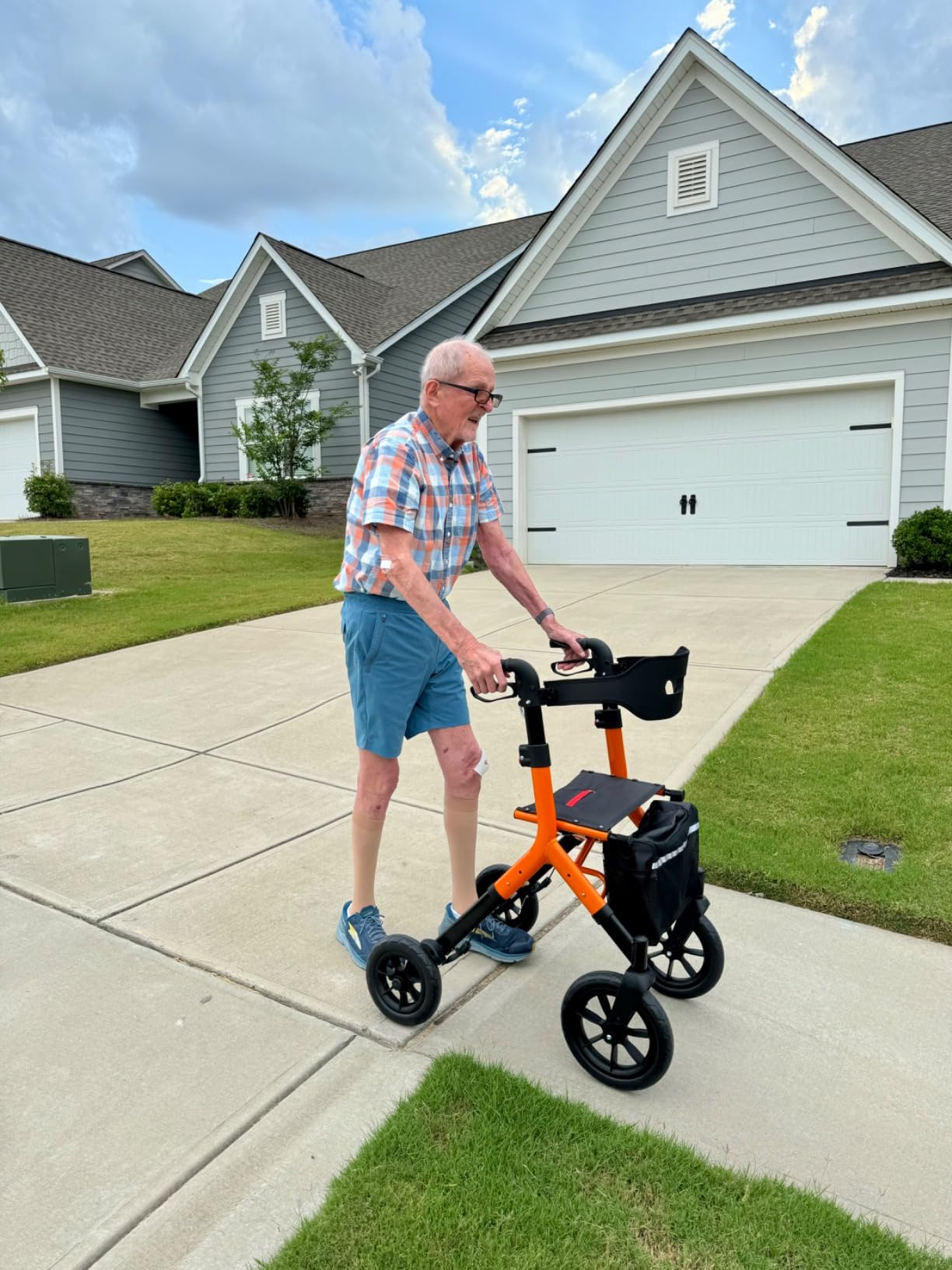
Best for uneven ground and long walks
Anti-skid wheel patterns and 360 degree swivel on the front casters make this the steadiest option on loose ground. If your route includes grass, gravel or a park trail rather than pavement, wheel size is the deciding factor and this leads the field.
Users who need a higher seat than most upright rollators offer will also appreciate the two-level seat adjustment.
Where it falls short
Because the model is named for tall users, the handle range looks generous until you compare it with the 45 to 52 inch ranges elsewhere. A 40.1 inch maximum suits users up to about 7 ft, but anyone taller should check before buying.
The folded depth of 9.8 inches is narrow, so on some car boots the seat needs to come off first. Plan the loading before you commit.
6. VOCIC Z22 GelSoft Upright Walker – Best for Elbow Comfort
VOCIC Z22 Upright Walkers for Seniors with Seat, GelSoft Stand Up Walker
GelSoft armrests,handle height 40-47 inch,seat height 20-22 inch,300 lb capacity
Pros
- GelSoft armrests spread elbow pressure better than hard plastic
- Flip-out armrest adds 4.7 inch of seat width
- Handle range suits very short users
- Responsive replacement-part service
- 3D non-slip tread holds grip in rain and snow
Cons
- Narrow seat for users above roughly 200 lb
- Armrests cannot move when seated
- Hand brakes require firm grip strength
The headline feature is a soft gel layer bonded to the armrest surface, and it does what gel is supposed to do: spread the load across the underside of the forearm instead of concentrating it in one spot. Across reviews this is repeatedly described as the most comfortable arm support in the group.
The second feature matters just as much for posture. A patented flip-out armrest releases to add 4.7 inches of usable seat width, so the support gets out of the way and you can actually sit down without squeezing past the frame.
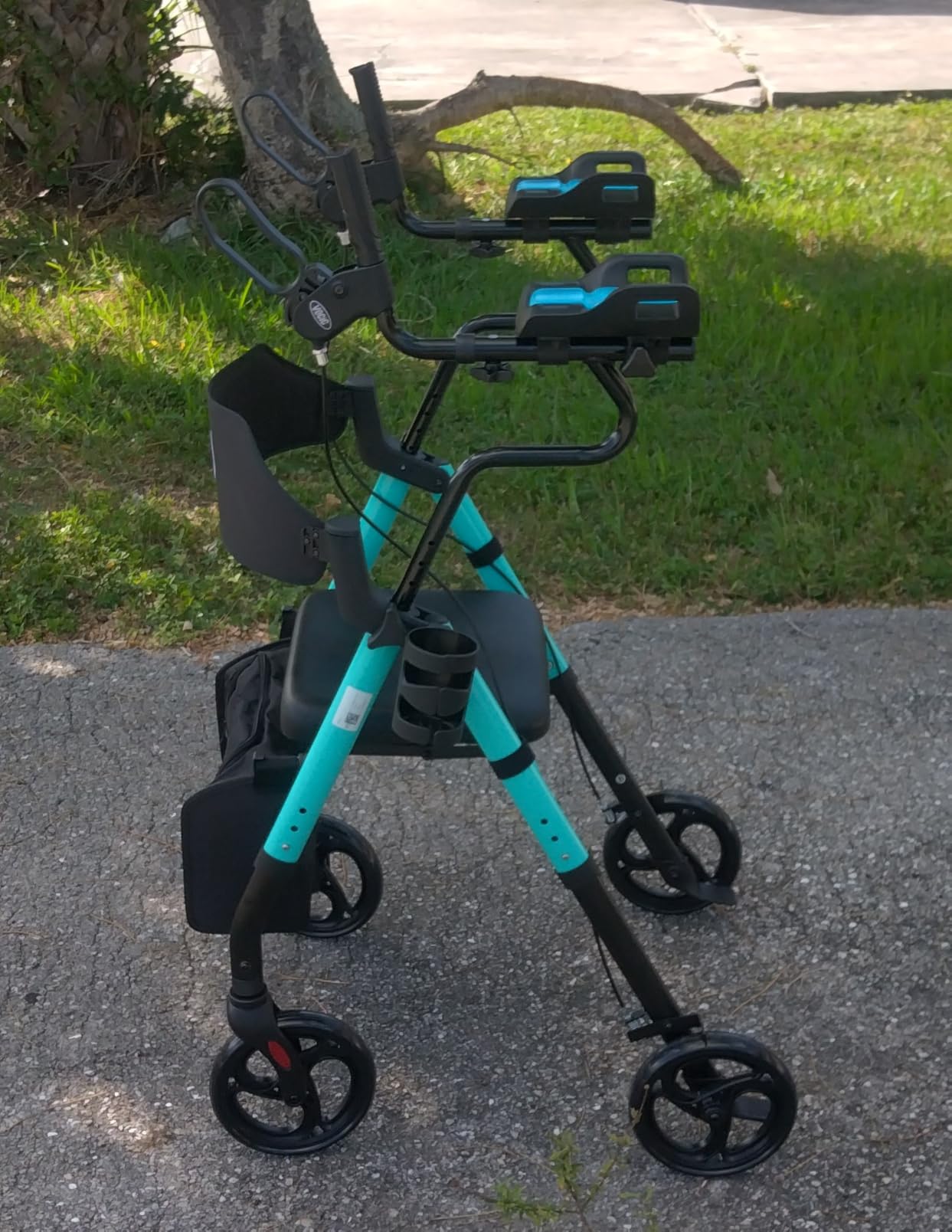
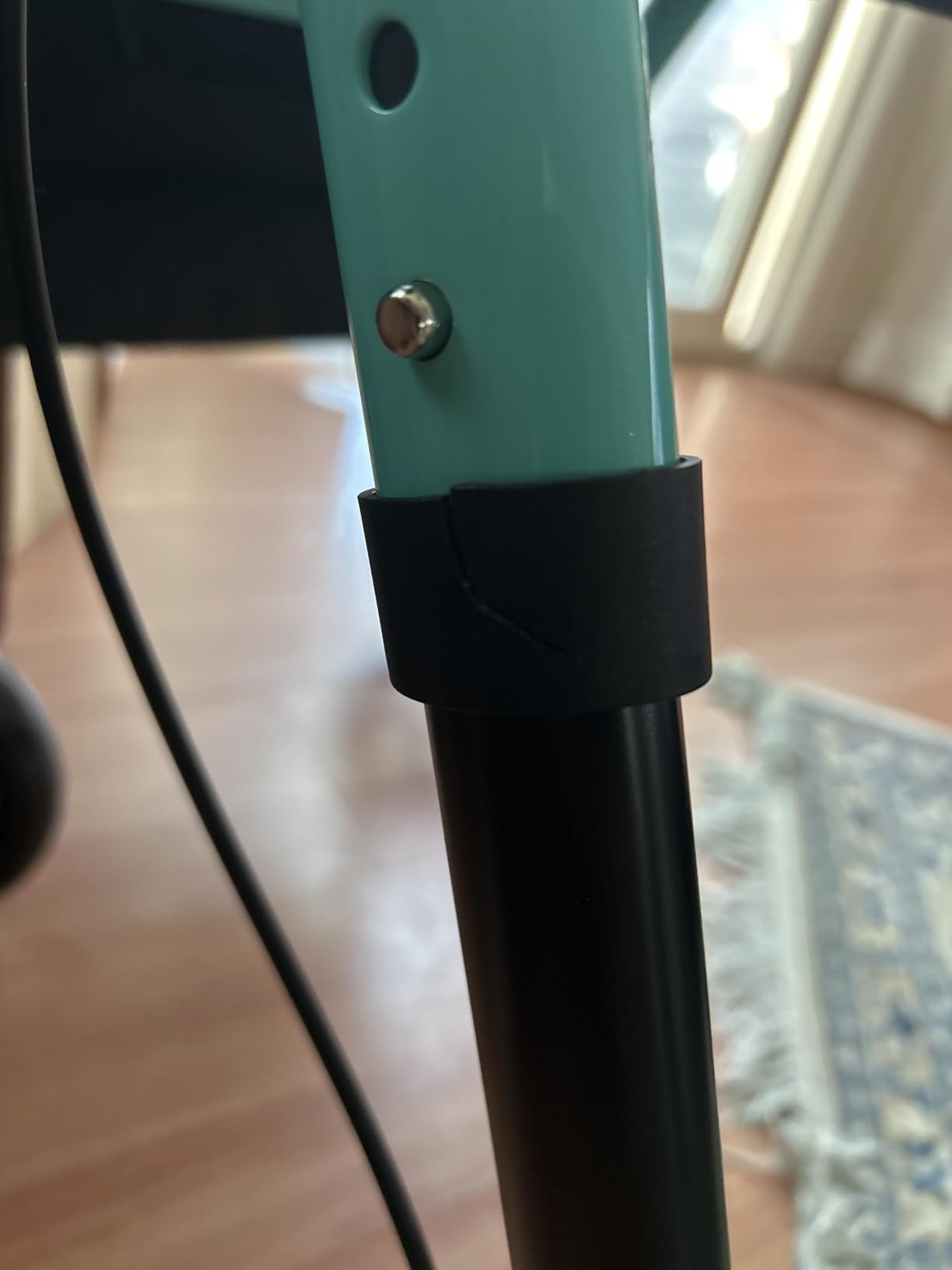
The 8 inch wheels use a 3D non-slip tread pattern that owners report holds grip in rain, snow and on slippery paving, and the front wheels steer through 360 degrees for narrow spaces. The frame is a reinforced triangular design with tubes roughly 30 percent thicker than standard.
Handles adjust from 40 to 47 inches, which comfortably fits very short users, and one reviewer at about 4 foot 7 confirms it. Customer service stands out: owners report replacement armrests arriving after photos were requested, with no return needed.
Best for forearm and elbow pressure
If your forearms are the sore point, gel is the direct answer. The cushioned surface lets you lean into the support for longer distances than hard plastic allows, which is exactly the behaviour that keeps the spine upright.
The handle range starting at 40 inches also makes this one of the better options for shorter adults, and the flip-out armrest solves a problem most compact models do not address.
Where it falls short
The seat is still narrow, and reviewers above roughly 200 lb report it is too tight to sit in comfortably. That is a genuine limit, not a nitpick, for anyone who plans to use the seat as a rest stop.
The armrests do not swing or lower when seated, so they press near the face and there is nowhere to put the arms while resting. This model also relies on hand brakes with no foot brake, so it needs real grip strength.
7. ELENKER Upright Rollator with 10 inch Wheels – Best for Durable Armrests
ELENKER Upright Rollator Walker, Stand Up Walkers for Seniors with Armrest, Front Pouch, 10”Wheels, Sponge Padded Seat and Backrest, Fully Adjustment Frame, Orange
Hard moulded armrests,reinforced front cross-brace,10 inch anti-slip tread wheels,26 lb weight
Pros
- Hard moulded armrests survive heavy leaning
- Reinforced cross-brace fixed a real weld failure point
- Footprint is a few inches narrower than the earlier model
- Larger under-seat basket plus removable pouch
- Quick assembly and five colour options
Cons
- Top-heavy feel on turns
- 26 lb is heavy to load into a car alone
- Moulded armrest can be firm under heavy lean
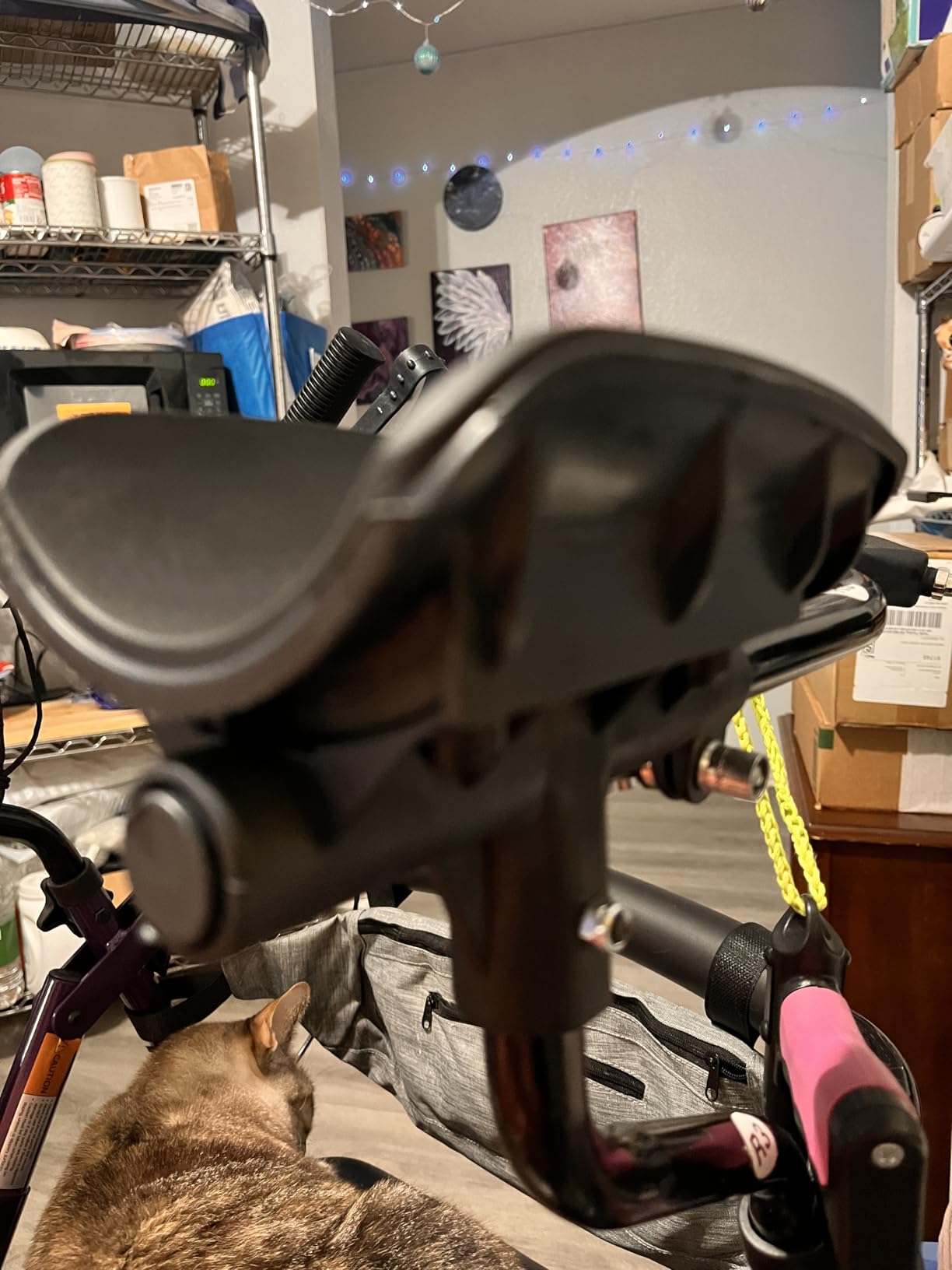
Most owners arriving at this model already own an earlier ELENKER, and that is exactly why it stands out. It was built to fix two real complaints: split foam arm pads, and a front brace weld that snapped under load. The armrests are now hard moulded rather than foam-capped, and the front cross-brace carries triangular flanges.
The second change is harder to appreciate until you have a wide frame in a hallway. This footprint is a few inches narrower than the previous model, which makes it noticeably easier to manoeuvre indoors.
The 10 inch wheels carry an anti-slip tread pattern intended to hold across mixed terrain, and the sponge-padded seat and backrest are better suited to long seated rests than a mesh panel. The frame adjusts handlebar height, seat height and handgrip angle, for users from 5 ft to 6 ft.
Storage is generous: a larger under-seat basket, a removable pouch on the back bar, a cup holder and a cane holder. A front backrest pouch holds items so you avoid bending.

For users who lean hard on the frame
People who push down on the armrests rather than resting lightly are the ones who break them, and a rigid moulded surface tolerates that far better than foam. If your walking style is brace-heavy, this is the more sensible pick.
It is also a good second purchase for anyone whose earlier foam-pad model started cracking.
Where it falls short
The one safety concern worth stating plainly: reviewers report a top-heavy feel, and one describes the walker tilting on turns with a fall. Upright rollators are taller and narrower than standard rollators by design, so turn slowly and avoid kerbs.
At 26 lb it is heavy for unassisted car loading, and the moulded surface can be firm under a heavy lean for users sensitive to elbow pressure.
8. Vive Mobility Upright Walker with Seat – Best for Lightweight Travel
Vive Mobility Upright Walker with Seat – Stand Up Rollator
20 lb aluminum frame,8 inch flat-free wheels,handle height 45-52 inch,300 lb capacity
Pros
- Lightest frame here at 20 lb with 300 lb capacity
- Forearm pads slide forward and backward
- Handle range of 45-52 inch suits taller users
- Seven colour and bag combinations
- Folds for a car trunk or backseat
Cons
- Lowest rating in the group at 4.1
- 8 inch wheels suit smoother surfaces
- Padded forearm supports can tire over long walks
At 20 lb this is the lightest aluminium upright rollator in the group, and it still carries a 300 lb rating. For anyone whose day involves lifting a walker into a car, that combination is hard to argue with.
The forearm pads slide forward and backward rather than only up and down, which is a different adjustment axis from most of the field. Owners with shorter forearms find that it makes the support sit where it should instead of where the frame happens to put it.
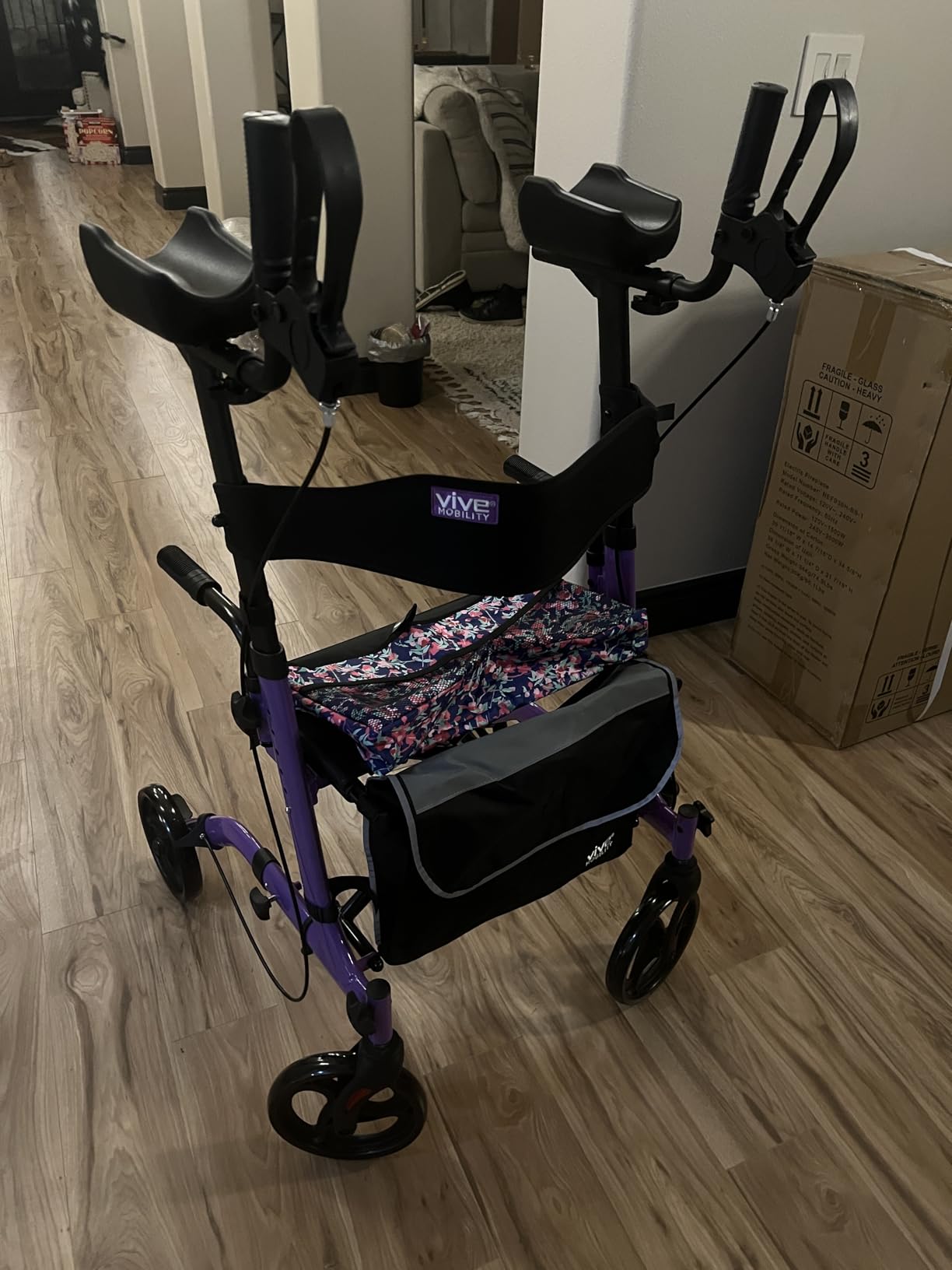
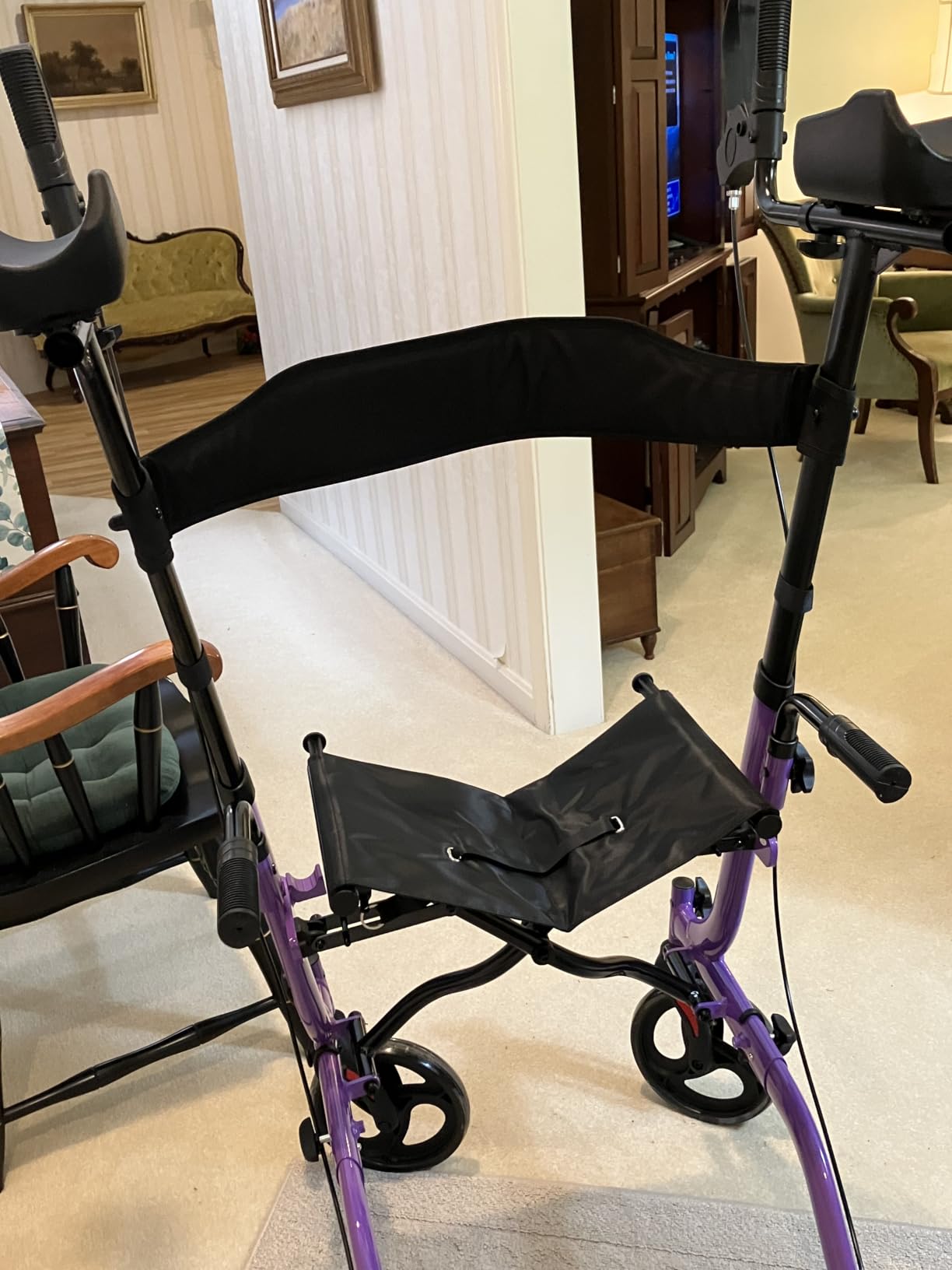
Handle height runs 45 to 52 inches, the tallest range in this roundup, and the listing fits users from about 5 foot 2 to 6 foot 4. The 17.5 inch seat is paired with loop brakes that lock the wheels for stable sitting, and a detachable shoulder bag carries essentials.
The frame folds down to fit a car trunk or backseat, and the product carries a one-year guarantee. Seven colour and bag combinations are offered, which is unusually broad.
For frequent car transport and taller users
Users who compare rollators constantly talk about loading weight as the deciding factor rather than a preference. This is the lightest frame in the group, and the tall handle range makes it one of the few options here that genuinely accommodates users above 6 foot.
It is also a good fit for smooth indoor floors and level pavements where extra wheel diameter buys nothing.
Where it falls short
This model holds the lowest average rating in the roundup at 4.1, with a higher share of one-star feedback than the leaders. The main complaint is the 8 inch wheels, which are less sure on rough outdoor ground than the 10 to 12 inch options.
Padded forearm supports rather than full padded armrests can also become uncomfortable over very long walks, and a one-year guarantee is the shortest here.
9. BlessReach Heavy Duty Upright Rollator – Best for Quick Folding
BlessReach Heavy Duty Upright Rollator Walker for Seniors with Seat, Blue
6-level handle adjustment,300 lb reinforced frame,8 inch all-terrain PU wheels,21 lb weight
Pros
- Six-level handle adjustment dials in forearm height precisely
- Reinforced industrial-strength frame rated to 300 lb
- Flip-up seat folds in 3 seconds
- 21 lb suits users with limited strength
- Dual brakes plus cup holder and large bag
Cons
- 8 inch wheels limit rough-terrain performance
- Dual brake levers take learning
- 12 percent of reviews sit at three stars
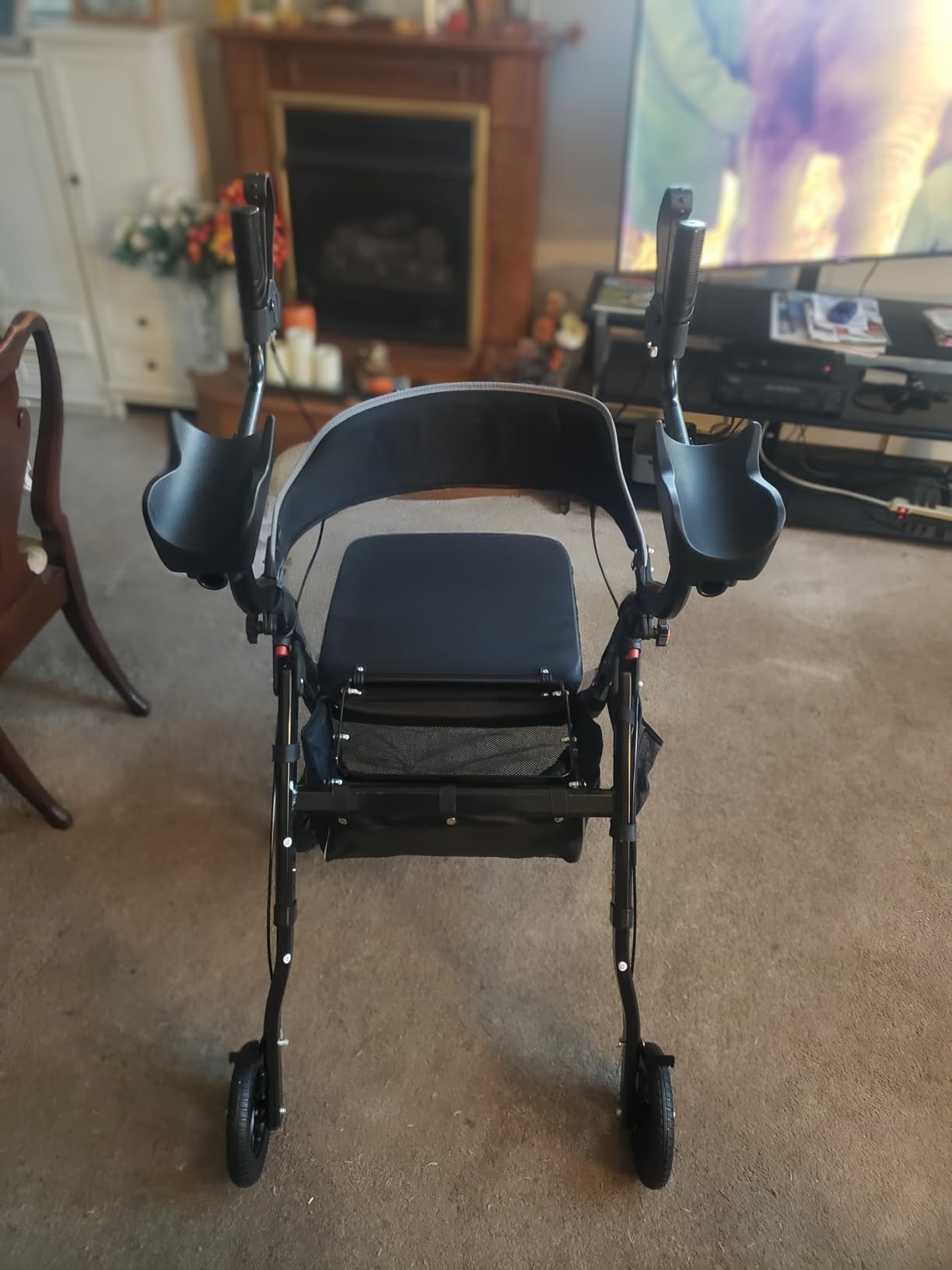
The flip-up seat with quick-release levers is the reason this folds in three seconds, and in practice that is what decides whether a walker gets used or left in the hallway. Few designs here are quicker to collapse.
Six levels of handle adjustment give finer forearm-height control than the four-level alternatives, and owners say the effect on shoulder and back pressure is visible within a few walks. The reinforced frame is rated to 300 lb at 21 lb, which is light for a heavy-duty frame.
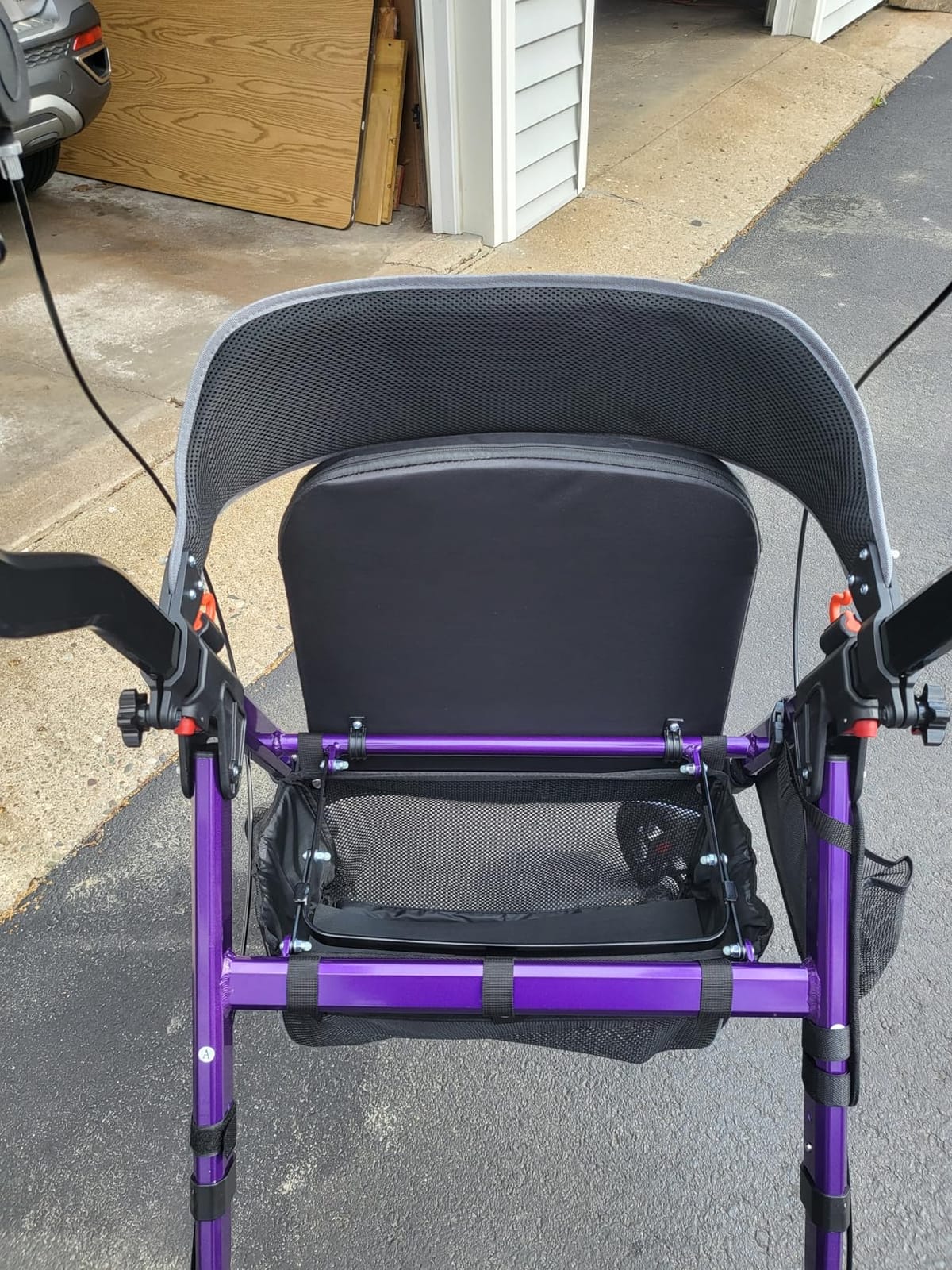
The brakes are genuinely dual: lift the levers up for gradual slowing, pull them down for an instant stop, and the wheels lock when you sit. The 8 inch all-terrain PU wheels have 360 degree swivel fronts that glide over carpet, sidewalks and uneven ground.
A thick foam-padded seat, an adjustable breathable backrest, a cup holder and a large-capacity bag are included, backed by 30-day returns and round-the-clock support.
For anyone who needs a quick collapse
If the walker has to go in a car trunk between every outing, or be tucked away before a relative arrives, the three-second fold removes the main reason people stop using theirs. The 21 lb weight stays manageable for one-handed loading.
Six-level handle adjustment also makes this a good candidate for a household where two people at different heights share one device.
Where it falls short
The 8 inch wheels are among the smallest here, so expect less confidence on gravel and broken paving than the MAXWALK or the 10 inch ELENKER models.
Learning two separate brake actions takes a few days, and the 4.1 rating with a 9 percent one-star share indicates a wider spread of experiences than the leaders in this list.
10. Aliseniors Narrow Upright Rollator – Best for Narrow Spaces
Aliseniors Upright Walkers for Seniors, Foldable Rollator with Seat, 250lbs
24 inch narrow frame,19.6 lb weight,17.5 inch padded seat,250 lb capacity
Pros
- Narrowest frame here at 24 inch wide
- Lightest upright rollator at 19.6 lb
- Armrest height restores an upright posture
- Reflective storage bag doubles as a backpack
- Seven colour options
Cons
- Lowest capacity here at 250 lb
- Seat is sized for slim to medium users
- Hand grip poles can be fitted backwards
A 24 inch frame is narrower than the 26 to 28 inch frames most upright rollators ship with, and one reviewer confirms it clears doorways that their previous standard walker could not. In a small apartment or a narrow hallway, that is the difference between using the walker indoors and keeping it in a closet.
It is also the lightest upright rollator in the group at 19.6 lb, and a buyer who got one for their 90-year-old mother reports loading it into a car unassisted. For a user with limited lifting strength, that number is decisive.
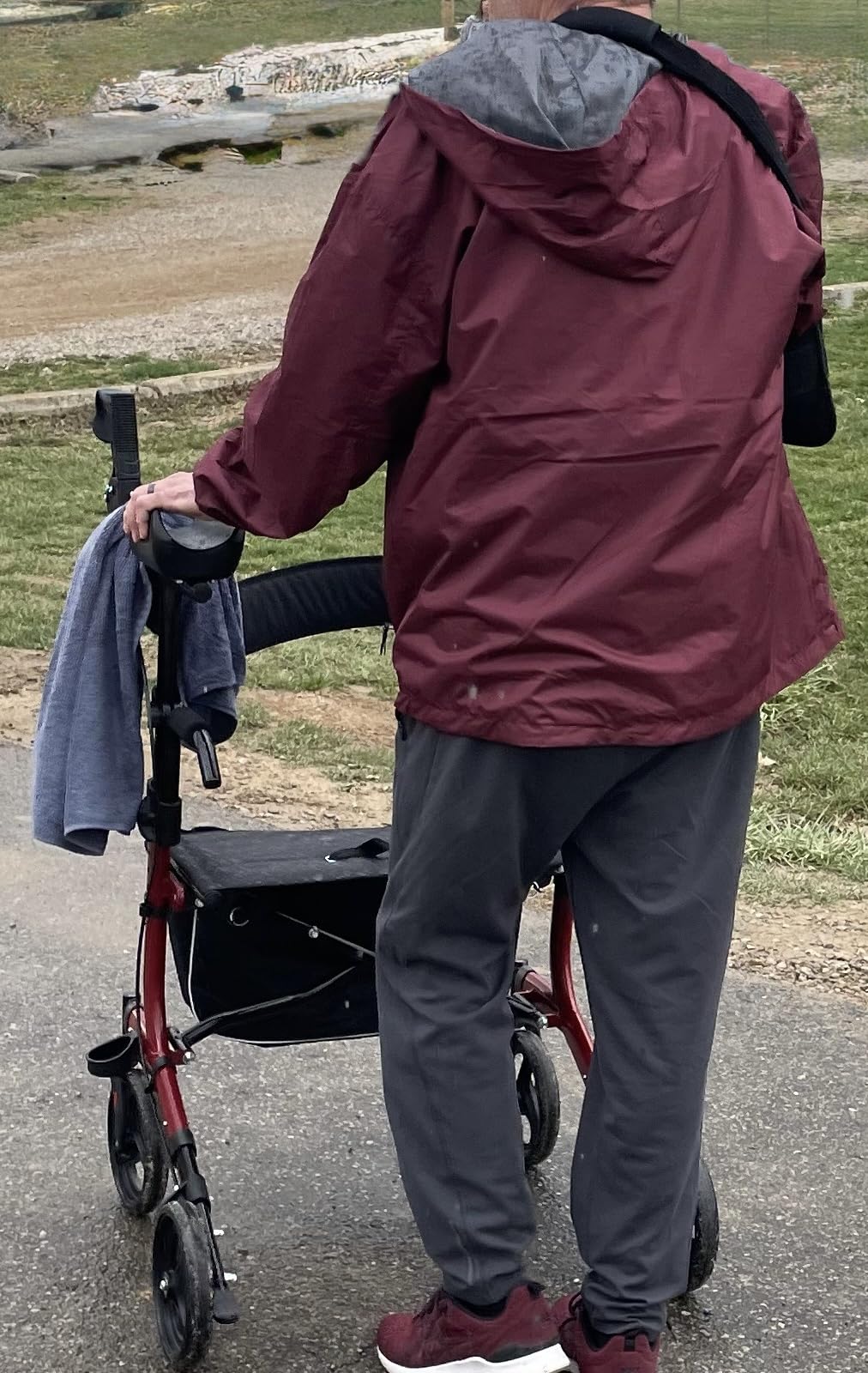
The 8 inch solid polyurethane explosion-proof tires carry a 360 degree rotating front wheel, and the dual braking system handles both parking and gradual slowing. A 17.5 inch padded seat comes with a height-adjustable backrest, and the fit range is 5 ft to 6 ft 2.
The quick-fold frame, reflective storage bag that doubles as a backpack, cane holder and tool-free assembly round out a package aimed squarely at people who live in tight spaces.
For small homes and independent car travel
This is the model to buy when the constraint is the building, not the terrain. The narrowed frame keeps you out of the bathroom wall and through the front door without turning sideways, which also makes it easier to use indoors rather than just outside.
The backpack-style bag is quietly useful for shopping trips, since it keeps your hands on the forearm supports.
Where it falls short
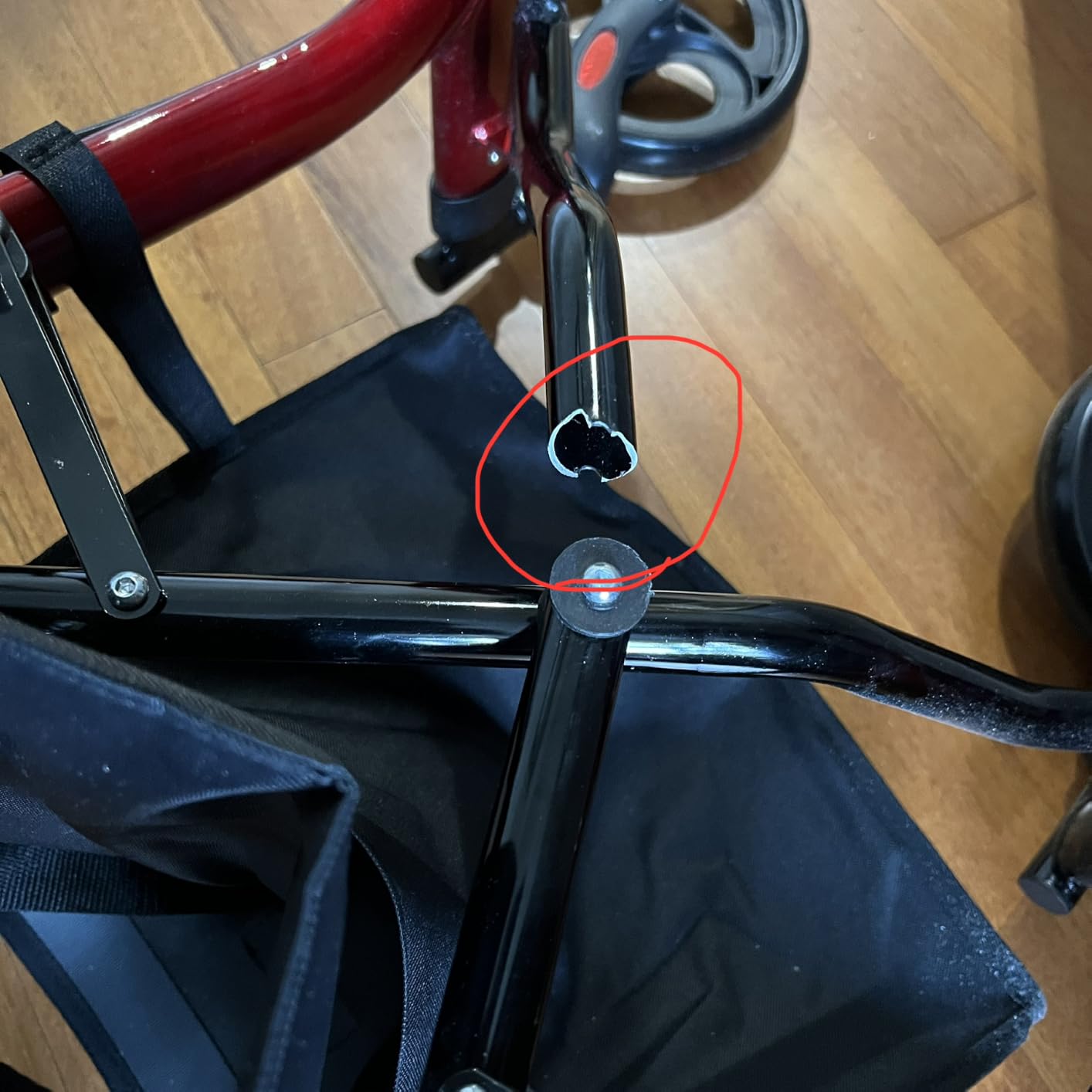
The 250 lb capacity is the lowest in this roundup, and a narrow frame carrying that rating invites reasonable durability questions. One reviewer reported a crack at the under-seat frame bolt after two months and a fall, and another received a box missing the folding locking strap with no seller response.
The seat is sized for slim to medium users, and the hand grip poles can be fitted backwards, which makes assembly confusing the first time.
Upright Rollator vs Standard Rollator vs UPWalker: The Naming Confusion Solved
These are three different product families, and they appear side by side in the same shopping results even though they solve different problems. People searching for an upright rollator routinely land on a desk-frame UPWalker and conclude it is the same thing at a different price.
A standard rollator puts handgrips at roughly hip height. Support comes through the hands and wrists, and the natural result is a forward lean. A cane-style handle also runs the risk of pushing back on the arm rather than carrying it, which is where shoulder and wrist complaints come from.
An upright rollator raises padded forearm supports to around wrist-crease height while you stand tall. The support surface moves up, the load transfers to the elbows and shoulders, and your spine has a much better chance of staying vertical. That is the entire posture mechanism.
A UPWalker is a fixed four-post frame with a seat and a desk-height top rail. You push it across a room rather than walk it continuously, and its larger footprint and weight suit indoor, supported standing and seated rest rather than long independent walking. For someone who cannot stand for long at all, that difference is decisive and often the opposite of what the shopping carousel suggests.
So: an UPWalker is not better than a rollator in general, because they are not competing for the same job. The upright rollator wins for walking and posture correction over distance. The UPWalker wins for supported standing, seated rest and indoor stability. A standard rollator wins only for users with no wrist or shoulder pain and a need for the lowest weight and price.
How We Chose These Upright Rollators
We rated every model on seven criteria, weighted toward the posture question rather than toward popularity, since the strongest review counts often sit on weaker designs.
First, forearm support quality and adjustment range, because that is what produces or defeats an upright posture. Second, weight capacity against realistic user loads. Third, wheel size and tire type matched to the ground users actually walk on. Fourth, frame width and the doorway test. Fifth, the frame weight, since loading a car alone is a hard requirement for many buyers. Sixth, brake design, including whether a parking function exists. Seventh, seat and backrest sizing, since resting is half the point.
We excluded colourway duplicates of the same frame entirely, and we did not pad the list to reach a round number. We also did not rely on manufacturer marketing copy; every judgement above traces to specification data and owner feedback.
We earn a commission when you buy through the links on this page, and that never changes the ranking. Criteria come first, popularity second.
Buying Guide: Getting the Fit Right
Measuring for the right forearm support height
Stand upright with your arms hanging loose and measure down to your wrist crease. That is your target height for the top of the forearm support. Set it there and check the elbow: a relaxed bend of roughly 20 to 30 degrees is the working position.
If the support is too low, you lean forward and the posture benefit disappears. If it is too high, your shoulders lift and you trade wrist pain for neck and shoulder pain. This is the single most important adjustment on the entire device.
Frame width and the doorway test
Measure the narrowest doorway and hallway in your home before choosing, then subtract an inch of clearance on each side. Frames in this roundup run from 24 inches on the narrow Aliseniors up to 28.3 inches on the bariatric Helavo, and that four-inch spread decides whether a walker lives in your hallway or in your car.
Wheel size and the ground you actually walk on
Eight-inch wheels handle carpet, smooth flooring and level pavement. Ten-inch flat-free PU wheels add shock absorption for broken paving and grass. Twelve-inch front wheels, as on the MAXWALK, clear gravel and uneven tracks best. Buying wheel diameter you do not need just adds weight.
Flat-free or solid polyurethane tires need no inflation, which removes punctures entirely at the cost of a slightly harder ride than pneumatic.
Weight capacity: size up rather than max out
Common advice is to choose a rating at least 50 lb above your body weight, so the frame is not working at its limit every day. Most models here rate 300 lb, and the bariatric Helavo goes to 500 lb. Note that a 250 lb model with a narrow frame is a weaker proposition than a 300 lb model with a reinforced triangular frame.
Brakes and the hand-grip strength caveat
Here is the contradiction nobody in this category talks about openly: the most common reason people want an upright rollator is wrist or hand arthritis, and almost every upright rollator still uses hand-operated brakes that require a firm squeeze. The VOCIC Z22 listing states the requirement plainly, and other models in this roundup use the same hand-brake design.
If your grip is genuinely weak, an upright rollator is not automatically the answer. Ask your clinician about forearm crutches, a two-wheel transport chair rollator with a caregiver-pushed mode, or a model with a brake requiring minimal squeeze. Never assume the product category solves the problem that made you want it.
Seat width, backrest and rest support
Seats in this group run from 17.5 to 20.1 inches wide. Standard 17.5 inch seats suit slim to medium users, and reviewers report that larger users find them tight. The VOCIC adds width on demand with a flip-out armrest, which is a useful middle ground.
Also check whether the armrests move or fold when you sit. Where they do not, as on the VOCIC, they press near the face and leave nowhere to rest your arms during a long stop.
Medicare and durable medical equipment coverage
A walker may qualify as durable medical equipment when a physician documents a mobility limitation and the item meets Medicare coverage criteria, and it is often supplied through a DME supplier rather than purchased directly. An UPWalker is generally treated differently and is less often covered, which is why the two questions about Medicare payment come up so often.
Coverage rules vary by plan and region, so confirm with your supplier and insurer before you buy, and ask whether a rental programme is available. Rental is a reasonable alternative for short-term recovery, and a supplier can tell you quickly.
Frequently Asked Questions
What is the best upright rollator?
The Helavo Upright Walker with Seat is the best overall in our testing round-up, holding a 4.5 rating across 957 reviews while weighing only 22.7 lb on a 300 lb-rated aluminum frame. It pairs 10 inch puncture-proof rubber wheels with adjustable padded armrests and a parking brake. Best all-terrain alternative is the ELENKER 10 inch model, whose armrests adjust in both length and angle.
Are upright rollators better than standard rollators?
They are better for posture and for anyone with wrist, hand or shoulder pain, because the padded forearm supports sit at wrist-crease height and move the load off the hands. A standard rollator is still lighter and cheaper, and it remains the better choice for users with no upper-body pain. The benefit depends entirely on setting the forearm support to the correct height.
Is an UPWalker better than a rollator?
No, because they are different product families. A UPWalker is a fixed four-post frame with a desk-height top rail that is pushed across a room for supported standing and seated rest. An upright rollator is a rolling four-wheel aid walked over distance to correct posture. Choose the rollator for walking and posture, and the UPWalker for standing support and indoor rest.
Will Medicare pay for an UPWalker?
Medicare may cover a qualifying walker as durable medical equipment when a physician documents a mobility limitation, but a UPWalker is usually treated as a different category and is less often covered. Coverage varies by plan and region. Ask your DME supplier to verify your specific plan before purchasing, and ask whether a rental programme is available instead.
How safe are upright walkers?
Upright walkers are safe when fitted correctly, but they are taller and narrower than standard rollators, so a top-heavy feel on turns is a reported complaint on some models. Set the forearm supports to your wrist crease with a 20 to 30 degree elbow bend, use the parking brake before sitting, and turn slowly rather than pivoting. Ask a physical therapist to check your fit if your balance is significantly impaired.
What are the disadvantages of using a rollator walker?
Common drawbacks include bulk and width, with frames from 24 to 28.3 inches that will not clear narrow doorways. Frames weighing 19.6 to 30 lb are hard to load into a car alone. Most models require hand-brake grip strength, which limits their use for people with severe hand arthritis. Some owners also report arm-rail wobble, narrow seats and difficulty turning at speed.
What are the best walkers for people with arthritis?
For wrist, hand or psoriatic arthritis, an upright rollator with well-padded forearm rests reduces the load on the hands, and gel-cushioned armrests such as the VOCIC Z22 spread elbow pressure best. The critical caveat is that most upright rollators still need hand-brake grip, so confirm your grip is adequate or consider forearm crutches or a caregiver-pushed transport chair rollator instead.
What is the highest rated rollator?
Within this round-up the Helavo Upright Walker and the Helavo bariatric model both hold 4.5, the highest averages here, with 957 and 134 reviews respectively. The most reviewed model is the ELENKER Upright Walker at 4.4 across 2,254 reviews. Ratings are copied as listed, and higher rating is not the same as better fit for your height, doorway or terrain.
How do I know if I am too tall or too short for an upright rollator?
Compare the stated handle height range against your height, and check the listed user range in the specifications. Most upright rollators top out between 45 and 52 inches of handle height, which excludes users above roughly 6 foot 4. The MAXWALK is built for taller users up to about 7 ft, and the VOCIC Z22 starts low at 40 inches for shorter adults.
Final Verdict: Our Best Upright Rollators for Posture Support in 2026
The Helavo Upright Walker with Seat takes our final verdict for the best upright rollators for posture support, because its forearm adjustment, 22.7 lb weight, 300 lb rating and two-year warranty make it the most complete package we tested. If your ground is rough, the ELENKER 10 inch all-terrain model with angle-adjustable armrests is the better tool.
Go to the Helavo bariatric for a 500 lb rating and a 20.1 inch seat, the MAXWALK for 12 inch wheels and taller users, the VOCIC Z22 for gel forearm comfort, and the Aliseniors if your doorway is the limiting factor. Set the forearm support to your wrist crease before you walk a step, and check that you can work the brakes before you commit to any of them.