
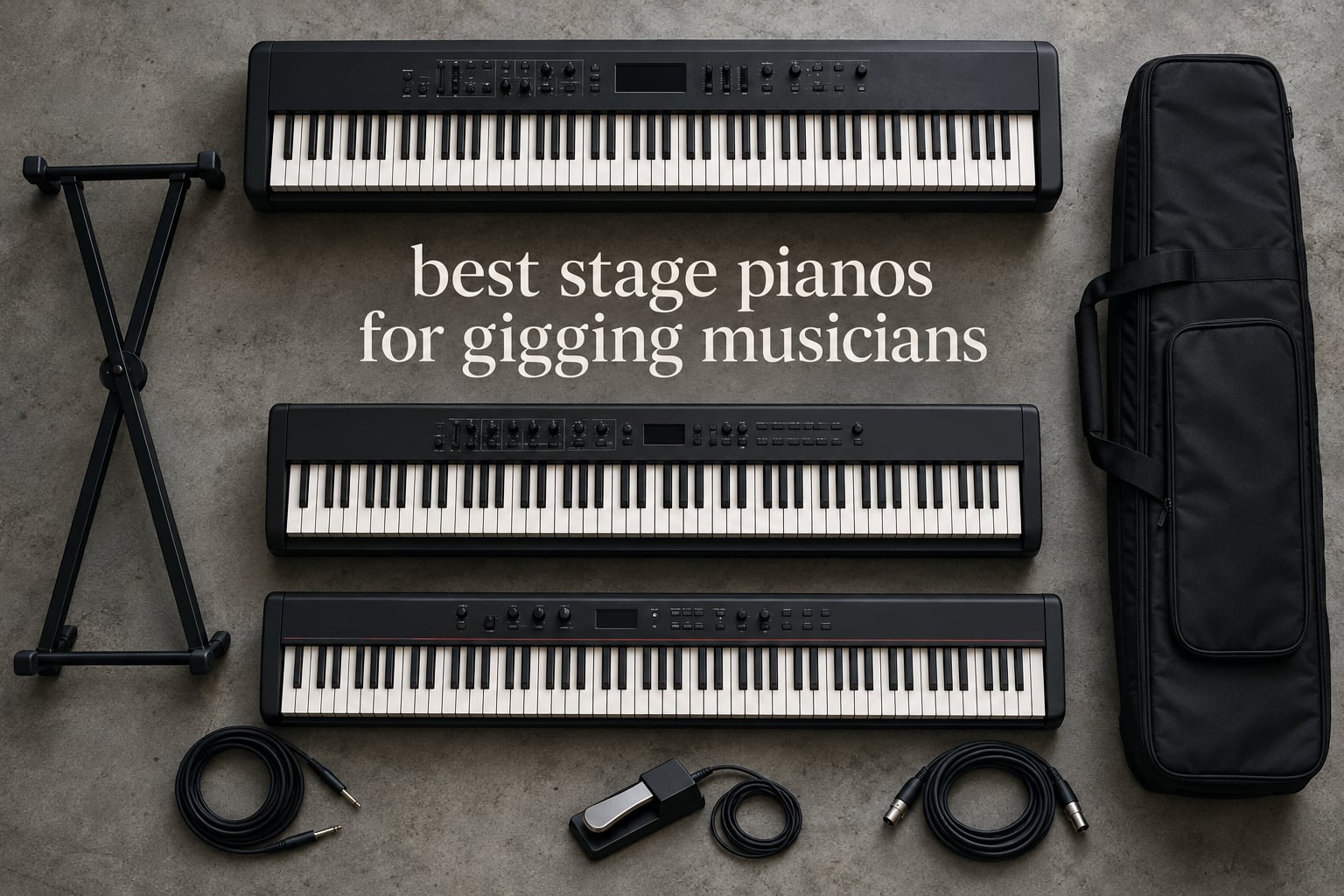
If you play live, the stage piano you bring has to do three jobs at once: it has to feel right under your hands at speed, it has to sound like itself through a loud PA, and it has to survive the walk from the car to the stage. The best stage pianos for gigging musicians handle all three without turning a sound change into a menu dive. That last part is the one most spec sheets skip.
We spent 2026 going through every current-generation stage piano on the market and reading what owners actually say after carrying them out of a van. The results run from a 28.9 pound Yamaha with built-in speakers to a 76 pound Kawai built for players who care more about touch than weight. This roundup covers all ten so you can match the board to your actual load-in, not to a spec sheet.
Who this is written for: worship and church keys players, musical theatre pit players, function and wedding band keyboardists, touring players, session players who demo on the road, and students who gig enough that a furniture-style home digital piano stops being practical. If you only play at home with headphones, most of what follows is overkill and we say so in the buying guide.
One thing we did deliberately: we kept manufacturer claims separate from owner feedback. When a spec comes from the product listing we say so. When a complaint comes from reviews we say that too. Where the two disagree, you get both.
Table of Contents
What Is a Stage Piano?
A stage piano is a portable digital piano built for live performance rather than lessons. It has a weighted or semi-weighted keybed, a sound library weighted toward acoustic piano, electric piano, clav and drawbar organ, and it has hands-on split, layer and program controls on the front panel instead of buried menus. It has balanced line outputs that feed a mixer or stage box, MIDI and USB for a laptop or external synths, and no built-in speakers, no furniture cabinet and no lesson mode. That combination is what lets it cut through a band mix and change sound mid-set without a dropout.
The home digital piano is the opposite trade. It has speakers, a cabinet, a screen and hundreds of lessons, and it is built to sit in a corner and sound good to one listener. Put it on a stage and you are fighting a weak onboard amp, a menu-based interface and a chassis that was never designed to be carried.
Top 3 Stage Pianos for Gigging Musicians (October 2026)
These are the three we would put in a van first, based on owner ratings, review volume and how they hold up in a live setting.

Yamaha CK88
- 28.9 pounds
- 88-key wooden-key hammer action
- Two split points
- Built-in speakers
- 160 memory locations


Korg SV2-SP
- K-ARRAY speakers at 15 watts per side
- German and Italian grand samples
- 72 sounds
- 64 memory locations
Best Stage Pianos for Gigging Musicians in 2026: Quick Comparison
All ten boards in one place, with the specs that actually change a gigging decision.
| Product | Specifications | Action |
|---|---|---|
|
Yamaha CK88 88-Key
|
|
Check Latest Price |
|
Roland RD-08
|
|
Check Latest Price |
|
Korg SV2-SP 88-Key
|
|
Check Latest Price |
 Nord Electro 6D 61
|
|
Check Latest Price |
 Roland RD-2000 EX
|
|
Check Latest Price |
 Yamaha CP73 73-Key
|
|
Check Latest Price |
 Roland RD-88 EX
|
|
Check Latest Price |
 Kawai MP11SE
|
|
Check Latest Price |
 Nord Stage 4 88-Key
|
|
Check Latest Price |
 Korg Grandstage X
|
|
Check Latest Price |
How We Judged These Boards
Five things decided the order, and none of them is price.
Carry weight and load-in reality. A board is only as good as the stairs it can climb. We recorded the listed weight of every model and asked a simple question: can one person get this from a car to a stage and set it up before soundcheck, alone. Two boards in this list are a clear no.
Keybed feel. Weighted hammer action with graded resistance, a lighter semi-weighted waterfall keybed and a wooden-key action are three different instruments. We recorded the action type from the product data and we flagged the reviews that describe how the keys feel after months of playing rather than on day one.
Front-panel access. On stage you cannot hunt through screens. We looked for split, layer, program and effect controls you can find by touch, and for boards that switch sounds without cutting a held note.
Outputs and connectivity. Balanced XLR or 1/4 inch TRS line outputs, real MIDI DIN, and a USB audio and MIDI interface matter when a sound engineer is running your channel. Headphone and auxiliary jacks alone are not enough for a band rig.
Evidence quality. We weighted boards with a solid owner review base more heavily than boards with a single glowing review. Where a model has almost no owner feedback yet, we tell you, and we base the verdict on the specification sheet alone.
1. Yamaha CK88: The Best All-Round Board for Working Giggers
Yamaha CK Series 88-Key Stage Keyboard with Built-In Speakers, Black (CK88)
28.9 pounds
88-key wooden-key hammer action
160 memory locations
Built-in speakers
Pros
- Lightest full 88-key board in this roundup at 28.9 pounds
- Authentic wooden-key hammer action
- Two split points for three sounds
- 160 memory locations for set-list sounds
- Built-in speakers for rehearsal and quick setups
Cons
- No sustain pedal or music rest included
- Built-in speakers are thin and not a substitute for a PA
- Large feature count means a steep learning curve
The CK88 is the board I would hand a working gigger with no particular brand loyalty. It weighs 28.9 pounds, which makes it the only 88-key instrument here I would describe as genuinely solo-carryable up a flight of stairs, and the wooden-key hammer action gets described by owners as recalling an acoustic rather than imitating one.
It also has two split points, which means you can put three separate sounds across the keyboard at once. In a worship set that is a pad on top, a piano underneath and a bass split to the lower octave, all from one front-panel move. The 160 memory locations give you room for a full set list without rewriting patches between shows.
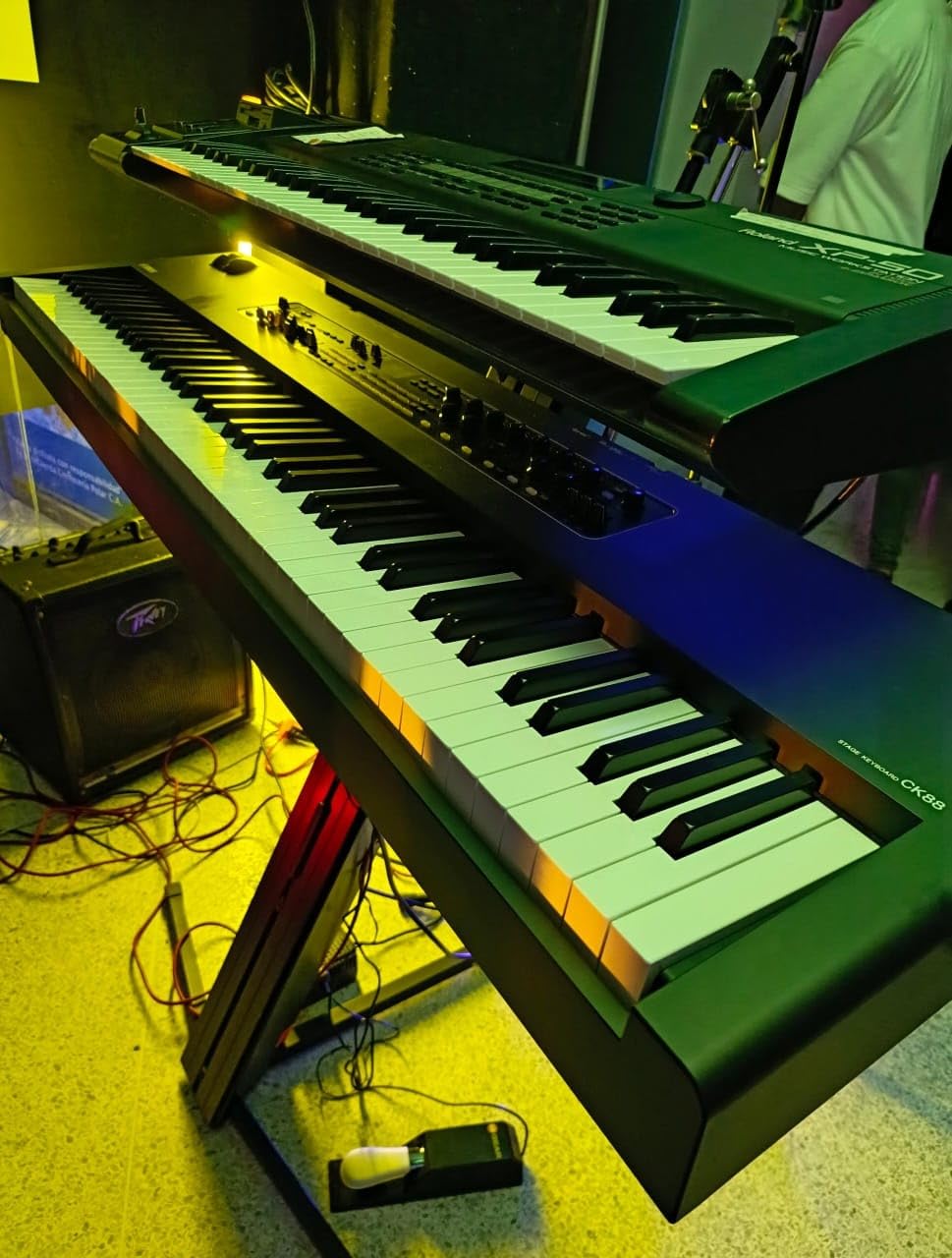
The organ section is the part owners bring up most. Yamaha’s listing calls out everything from vintage drawbar types to combo transistor-based organs, and reviewers single out these as the best in the Yamaha line. Strings, brass ensembles and real-time controllable synth voices fill out the set, so it is not a piano-only instrument in disguise.
USB playback of WAV files straight from a stick is a small feature that matters more than it sounds. If you use backing tracks, you do not need a laptop on the music stand eating a channel and a power outlet.
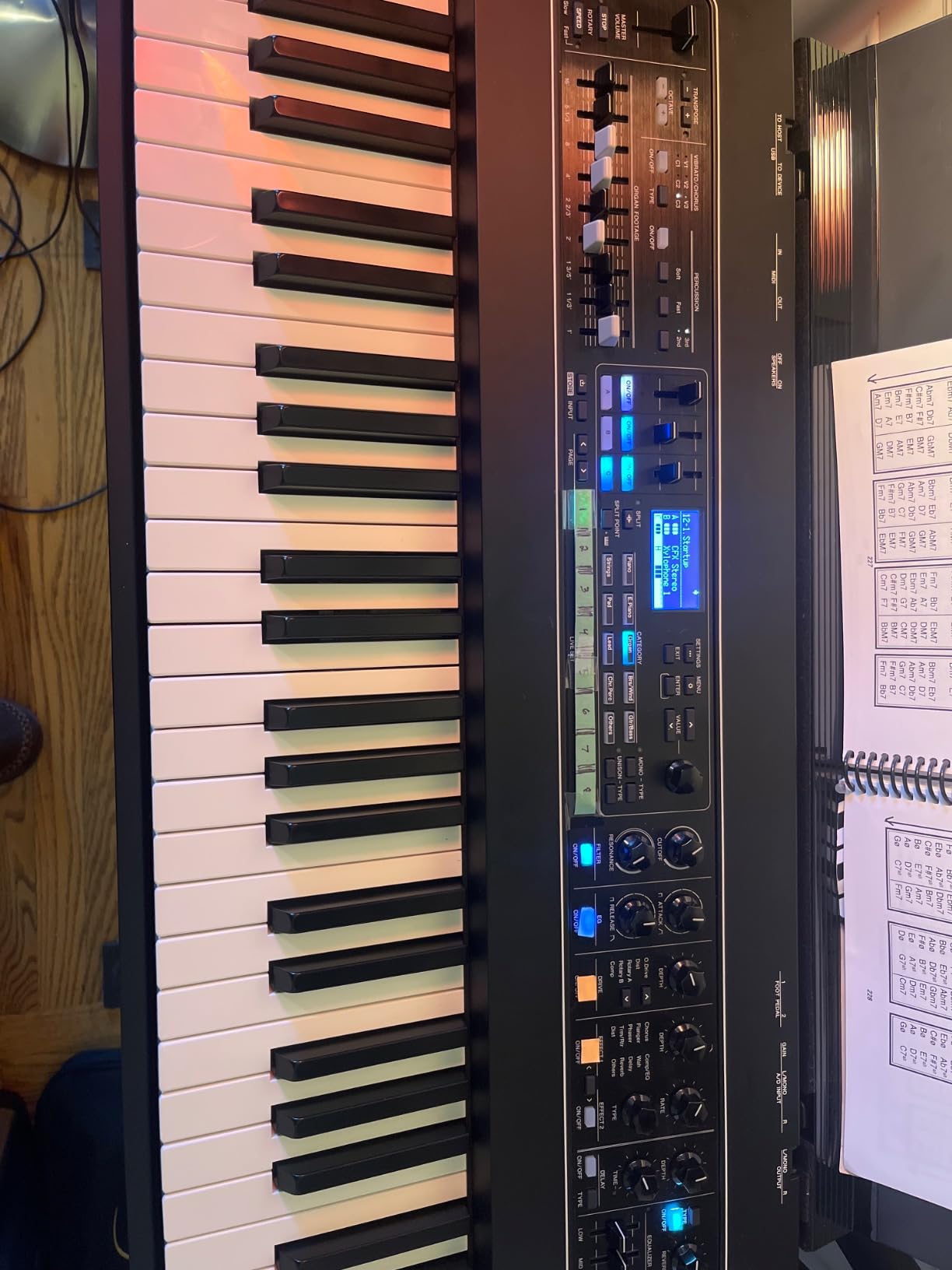
The catch is what is not in the box. No sustain pedal and no music rest, and owners report the dedicated YMR-03 rest is hard to source and has mounting complaints. Budget for a pedal and a clamp-on rest before the first load-in.
The onboard speakers are genuinely thin. They are fine for a rehearsal room and useless behind a drummer, which is exactly what you would expect from a board this light. The steeper learning curve is real too, mostly because the feature count is high, but nothing about the layout is hostile.
Who the CK88 Works Best For
This is my pick for worship keys players doing several services a week, and for function band players who move gear alone. The weight is the headline: at 28.9 pounds you can carry it from a car, up a step-free or short-stair load-in, and still have a hand free for cables.
If you play a lot of organ material alongside piano, the two split points and the drawbar range make this more capable than its weight class suggests. It is also a good board for a player who writes at home and demos the same day, since the USB stick playback handles the track without a computer.
Who Should Look Elsewhere
If your rig is a full XLR stage box and you never play without amplification, you are paying for speakers you will never use. The CK88 still has the line outputs to feed a mixer, so this is not a dealbreaker, it just is not where the money went.
Players who want a genuinely deep electric piano and organ catalog will find 88 keys of 160 locations goes a long way, but the RD-08 has over 3000 additional sounds. If variety across instruments matters more than carry weight, move up a tier.
2. Roland RD-08: The Best Value in a Real Hammer-Action Board
Roland RD-08 Stage Piano, 88-Note Weighted-Action PHA-4 Keyboard
39.5 pounds
PHA-4 weighted action with Ivory Feel
SuperNATURAL engine
3000+ additional sounds
Pros
- PHA-4 weighted action widely praised by players
- Sounds from the RD-2000 and RD-88 platforms
- Over 3000 extra sounds including organs synths strings and brass
- Plugs straight into a DAW as a MIDI controller
Cons
- Onboard stereo speakers are extremely weak
- Una corda is not supported by the built-in piano engine
- USB audio interface needs a paid upgrade
The RD-08 answers a fair question: can you get a proper weighted hammer keybed without buying a workstation. Owners across the review set describe the PHA-4 action with Ivory Feel as superb, and the SuperNATURAL engine sounds good enough that several reviewers pair it with external monitors or a DAW rather than onboard monitoring.
What you get inside the Roland name matters. The sound engine is the same lineage as the RD-2000 and RD-88, and the ZEN-Core engine adds over 3000 further sounds including organs, synths, strings and brass, plus vintage Xp-80 and JV-1000 patches. For a player covering several instruments in one set, that catalog is the real value here.
It is also the cheapest route to a board that works as a plug-and-play MIDI controller for DAW work without any extra purchase. The USB MIDI works out of the box, which matters if you are running MainStage or a laptop rig on small dates.
Two things to know before you commit. The onboard stereo speakers are described as extremely weak and unusable in a small room without external amplification, which is fine if you are always on a PA and useless if you are not. And the internal piano engine does not support una corda, so the soft pedal is not doing what an acoustic-trained player expects it to do.
Where the RD-08 Earns Its Place
This is the board for a player who wants hammer feel at the entry tier and plans to run it into a small PA or monitors. At 39.5 pounds it is heavier than the CK88 but still a two-person carry at worst and a solo carry up a short load-in.
It is also a strong choice as a writing and demoing keyboard. Plug it into a laptop over USB MIDI and you have a weighted controller with a professional sound engine behind it, which is a different use case entirely from the one most owners describe.
What You Give Up
The paid upgrade path is the fiddly part. The USB audio interface feature requires a separate upgrade installed from a USB drive using legacy Roland and Boss software, and reviewers report real frustration with that process. MIDI over USB works without it, so this only matters if you need audio return from the board.
Transpose is a menu operation rather than a front-panel control, which is exactly the kind of small irritation that shows up mid-set when you need it fast. If transpose and split must be instant, check the panel before you buy.
3. Korg SV2-SP: The Best Board With Speakers That Actually Work
Korg SV2-SP 88-key Stage Vintage Piano
64.7 pounds
K-ARRAY speakers at 15 watts per side
72 sounds
64 memory locations
Pros
- Onboard K-ARRAY speaker system with 15 watts per side
- German Italian Austrian and Japanese grand piano samples
- Sample data more than ten times deeper than earlier SV models
- 64 memory locations for stored setups
Cons
- Heaviest board in the roundup at 64.7 pounds
- Fixed 72-sound set on an older platform
- Only 72 sounds limits multi-instrument layering
The SV2-SP exists for a specific problem: rehearsal rooms and small stages where you have no monitor and no amp. The speakers were designed by Italian company K-ARRAY and put out 15 watts per side, which is more genuine onboard amplification than anything else in this list. That is the whole pitch, and reviewers consistently come back to it.
The piano sounds are the other draw. The listing calls out professional-level German, Italian, Austrian and Japanese grand piano samples, and owners describe the sample data as more than ten times deeper than earlier SV models. It is a piano-first instrument by design.
Onboard controls are straightforward for a piano-focused board, with 72 sounds across 64 memory locations. If your set is piano and a little else, that is enough room. This model is also available in 73-key and 88-key configurations with and without speakers, which is worth knowing if the 88-key version is more than you need to move.
Now the hard part. At 64.7 pounds this is the heaviest instrument in the roundup, and reviewers call load-in and load-out alone genuinely difficult. If you are a one-person band, this is not your board.
Who This Suits
Church players running a worship team into a small PA with no dedicated monitor, and teachers who do a lot of accompaniment in rooms they do not control, are the clearest fits. The speakers mean one fewer thing to cart, one fewer thing to power and one fewer failure point at load-in.
It also suits anyone who wants their acoustic piano sound in the room rather than through a PA. For solo recital, accompanist work and function-band piano duties in a dining room, that is a genuine advantage no monitor can fully replace.
Where It Falls Down
Weight is the deciding factor and it is not close. A 72-sound set on an older platform also means less layering depth than the modern engines in this roundup, and the 4.3-star average with a notable share of two-star reviews suggests some owners expected a modern workstation and got a piano-first board.
If your rig already has amplification and you play organ, synth or strings, look at the Grandstage X or a Roland instead. You will get a much deeper catalog and a lighter chassis.
4. Nord Electro 6D 61: The Lightest Board in the Roundup
Nord Electro 6D 61 Stage Piano, 61-Note Semi-Weighted Waterfall Keybed
17.9 pounds
61-key Fatar semi-weighted waterfall keybed
Three independent sections
Physical drawbars and Live Slots
Pros
- Under 18 pounds
- the easiest carry here
- Semi-weighted keybed favors fast organ and synth playing
- Three independent sections for simultaneous layering
- Physical drawbars and four Live Slots
- Carrying case and sustain pedal included
Cons
- Only 61 keys limits your range
- Semi-weighted action is not a match for hammer action on acoustic repertoire
- Older catalog placement rather than a stage-piano listing
At 17.9 pounds the Electro 6D 61 is the board you can carry up three flights of stairs, into a pub back room, or put in an overhead locker on a short tour without a second person. Nothing else in this roundup is close on weight, and that single fact changes who can play a full 88-note instrument on a walk-up load-in.
The trade is the keybed. It is a 61-key velocity-sensitive Fatar semi-weighted waterfall keyboard, and reviewers favor it for fast organ and synth playing rather than for acoustic-style repertoire. If you learned on an acoustic, the touch will feel unfamiliar in a specific direction: less resistance, no escapement, and a key dip you can play through.
What you get in exchange is the classic Nord section architecture. Organ, Piano and Sample Synth are three fully independent sections usable as layers or splits, with 6 keyboard split points and a split point crossfade, so the lower octave can be a bass and the upper two an organ and pad simultaneously.
Live control is genuinely front-panel. There are 9 physical drawbars, 4 Live Slots, 8 banks of 50 programs, and an Organize or Page mode that groups up to four programs per page. The Nord Piano Library adds acoustic, electric and digital pianos with piano filters, and Sample Library 3.0 brings expanded memory and polyphony to the synth section. A carrying case and sustain pedal are included, which is rare in this list.
Where the 61 Keys Work
This is the board for a multi-instrument player rather than a pianist. If you are covering a soul or funk set with organ swells, a pop set with layered pads and a ballad with piano, the three-section architecture and physical drawbars are built for exactly that.
It is also the answer for small stages and travel. A function band playing a hotel function room, a solo act with a backing track, a worship volunteer moving between rooms. At this weight the load-in conversation ends immediately.
Where 61 Keys Ends
It is not a substitute for hammer action on acoustic repertoire, and reviewers are clear about that. If your set is a piano, a technician will notice the absence of resistance and the missing high end, particularly on classical and jazz material.
Sixty-one keys also caps your range. A right hand part that goes past F6 has nowhere to go. And this listing sits in synthesizers rather than stage digital pianos, so check that the model is current before you commit. For a multi-instrument player on a small rig it remains the most practical thing here.
5. Roland RD-2000 EX: The Best Live Control Surface
Roland Premium Digital Stage Piano RD-2000 EX
62 pounds
PHA-50 keyboard action
Two independent sound engines
Nine sliders and eight encoders
Pros
- PHA-50 action praised by owners of earlier Roland boards
- Two independent engines with modern controller features
- Two V-Piano expansion titles pre-installed
- Nine sliders and eight encoders with LED indicators
- Built-in equalizer without echo artifacts
- Sustain pedal in the box
Cons
- Roughly 62 pounds is awkward to move between venues
- Onboard stereo speakers are weak
- The EX package costs more than the base model plus its upgrade path
The RD-2000 EX is built around a single idea: on a stage you do not touch a screen, you turn a knob. Nine sliders and eight encoder knobs with LED status indicators cover volume, tone, effects and the parameters of each engine, and two fully independent sound engines let you stack a piano and a synth without sacrificing either.
Owner feedback on the PHA-50 keyboard is the most enthusiastic in this roundup, particularly from people who owned earlier Roland boards. The V-Piano modelling engine with full polyphony comes with two expansion titles pre-installed, German Concert and Essential Upright, so the piano sounds are strong out of the box rather than a purchase away.
The SuperNATURAL engine handles electric pianos and everything else at 128-voice polyphony, which is plenty for organ pads, strings and brass under a piano layer. The built-in equaliser is worth singling out: owners of the RD-88 EX report an echo artifact from its onboard effects, and the RD-2000 EX’s equaliser is specifically praised for not having that problem.
Virtual Technician-style editing is not the headline here, but the parameter depth is real, and a sustain pedal is included in the box, which saves you a purchase.
Who Wants This Control Layout
Cover band players and worship keys players who change sound often and refuse to wait for a menu. If your set moves between a ballad piano, a funk organ patch and a synth-pad verse without a break, having the parameter on a physical knob is worth a lot at 20 minutes to soundcheck.
It is also the pick for a player who records at home. Two independent engines with modern controller features translate directly into a DAW setup, and the balanced control surface doubles as a mixer strip for outboard gear.
Where the RD-2000 EX Costs You
Weight is the headline problem. At roughly 62 pounds it is one of the two heaviest boards here, and owners call it awkward to move between venues. This is a two-person carry in anything but a walk-up load-in.
The EX package is also the reason this is not a value pick. Owners note it costs substantially more than buying the base RD-2000 and taking the expansion route yourself, so the premium buys you the pre-installed titles rather than better hardware. Weak onboard speakers are the third caveat, and you are buying amplification either way.
6. Yamaha CP73: The Best Fit for Small Stages and Short Load-Ins
Yamaha CP73 73-Key Balanced Hammer Action Stage Piano with Sustain Pedal
73 keys with balanced hammer action
XLR and 1/4 inch TS outputs
FC3A sustain pedal included
Onboard delay reverb and EQ
Pros
- Compact and light enough for small stages
- Three premium grands two uprights and five electric pianos
- Master delay reverb and EQ on dedicated real-time controls
- Sound switching without note cutoff
- FC3A sustain pedal and power supply included
Cons
- Owners report the key feel degrading after heavy long-term church use
- Hammond-style organ voices are the weakest of the set
- Synth capabilities are basic
- Listed weight figure is inaccurate
The CP73 is the odd one out in this roundup, and that is exactly why it is here. Seventy-three keys with balanced hammer action gets you a real weighted feel and a compact footprint, which is a combination almost nobody offers. Owners describe it as light enough for small stages and difficult load-ins, and one pro reports it sounding great enough to cut through a seven-piece band live.
Its output section is genuinely stage-grade. You get balanced XLR and 1/4 inch TS stereo outputs plus dual AUX inputs, which means it drops into a stage box or a small snake without adapters. On a board this size, that is unusual and it matters for church installs and theatre pits.
The sound set is piano-led: three premium grand pianos, two uprights and five electric pianos, with Bösendorfer and EP patches singled out by owners. Vintage organ tones including Vox and Farfisa are described as a standout, though the Hammond-style voices are the weakest part of the set and reviewers do not recommend them for featured organ parts.
Master delay, reverb and EQ effects have dedicated real-time controls rather than a menu, and sound switching is seamless in the sense that you can change sounds while holding notes without a cutoff. The FC3A sustain pedal and power supply are in the box.
Why 73 Keys Is a Feature Here
It is a real trade-off with real benefits. A 73-key board is roughly a quarter less width than 88, which means a narrower X-stand, less stage width, and a keyboard that fits into a pit or a booth. For musical theatre, small church stages and hotel function rooms that is the difference between working and not.
The master effects on dedicated controls matter most in a fixed install where you tune once and leave it. For a player moving between rooms, the AUX inputs and XLRs let you feed it from a house system at whatever level the engineer wants.
Durability Is the Question Mark
The most serious owner feedback in the review set concerns longevity, not sound. A player doing heavy church work reports the weighted key feel degrading into something springy and clicking after about two and a half years. That is a single report, but it is exactly the failure mode to consider if this board is your weekly workhorse.
Synth capability is basic, and this is a piano and electric piano instrument above all else. Also flagging something practical: the listed weight figure in this listing is wrong, so confirm the real weight with the manufacturer before you plan a load-in. On the balance of reviews, the sound and the portability are excellent, but the durability question deserves asking.
7. Roland RD-88 EX: The Best Mid-Tier Starting Point
Roland RD-88 EX Stage Piano, 88-Note Keyboard
41.5 pounds
88-note PHA-4 hammer action
SuperNATURAL Acoustic Piano 3 Expansion
DP-10 damper pedal included
Pros
- PHA-4 hammer action with Ivory Feel delivers expressive playing
- Acoustic Piano 3 Expansion included
- Onboard stereo speakers for practice situations
- USB audio and MIDI interface with MainStage control mode
- USB memory port for WAV playback and backups
- DP-10 damper pedal in the box
Cons
- Some owners report an echo artifact from the onboard effects
- 41.5 pounds is heavier than the most portable boards
- Small 13-review base limits owner feedback
The RD-88 EX is the mid-tier Roland that most giggers should look at first. It has an 88-note PHA-4 hammer action with Ivory Feel, the same keybed family owners praise across the Roland range, and it ships with the SuperNATURAL Acoustic Piano 3 Expansion rather than making you buy the better piano separately.
Connectivity is where it earns its tier. There is a USB audio and MIDI interface with MainStage control mode, plus a USB memory port for MP3 and WAV playback and for data backup. In practice that means one cable to a laptop for tracks, control changes and audio return, and it is why this board shows up in a lot of home-studio-and-gig rigs.
The ZEN-Core engine adds over 3000 further sounds, built-in rhythms cover the times you want a drummer, and the onboard stereo speakers mean you can practise and run a small room without an amp. The DP-10 damper pedal is included, which is the single most-used accessory on a stage piano and one you will otherwise buy anyway.
It ranks third in the Stage Digital Pianos category, the strongest category position in this roundup, which tells you something about where the volume of real use is.
Where the RD-88 EX Fits
This is my recommendation for a gigging player who wants a proper 88-key Roland action at a middle price and wants to keep the option of a laptop rig. The USB audio and MIDI interface is the differentiator over cheaper boards, and MainStage control mode means program changes from a connected setup rather than from the panel.
It is also a good first serious stage piano for a student who is gigging, because the DP-10 pedal and the onboard speakers cover the two most common beginner complaints about moving from a home digital piano.
What Owners Flag
The echo artifact is the one repeated issue, with some owners of this platform reporting an audible echo from the onboard effects. The RD-2000 EX is the direct answer to that specific complaint, since its equaliser is praised for avoiding it.
At 41.5 pounds it is heavier than the truly portable boards, and the review base is thin at 13 owners, so treat the long-term durability picture as less well documented than it should be.
8. Kawai MP11SE: The Best Board for Players Who Care About Touch
MP11-SE Digital Stage Piano
76 pounds
Grand Feel wooden-key action with escapement
SK-EX SK-5 and EX grand sounds
GFP-3 triple pedal unit
Pros
- Most authentic wooden-key touch in the roundup
- SK-EX and Bechstein-class grand sounds
- Virtual Technician editing parameters
- Triple GFP-3 pedal unit supports full pedal behaviour
- Highest average rating here at 4.7 stars
Cons
- Roughly 76 pounds
- the toughest instrument here to move
- No internal speakers so an amplifier must be bought separately
- Cases are hard to source and add roughly 35 pounds
The MP11SE has the highest average rating in this roundup at 4.7 stars, and the review set explains why: a classical pianist’s verdict dominates it, calling the Grand Feel wooden-key action and SK-EX sound genuinely convincing against a real Bechstein. The simulated escapement is the detail that separates this from every lighter board here.
Wooden keys change everything about how a piano responds to dynamics. The resistance builds more gradually through the mid register, so you can play softly and still have the note speak, which is the whole point of the mechanism on a real grand. If you are a piano player first, this is the only board in the list that gives you that.
The sound side matches. SK-EX, SK-5 and EX acoustic grand piano sounds, with a wide variety of Virtual Technician parameters for tone shaping each instrument individually. The GFP-3 triple pedal unit, made by Kawai, supports full sustain, soft and sostenuto behaviour, and XLR connectivity handles stage and studio use.
The panel is described as intuitive, with independent sound sections and effects. Build quality and styling come in for praise from owners.
Who Should Buy This
Trained pianists, musical theatre pit players working in a fixed venue with a house PA, and church players who move between a fixed install rather than a touring rig. For these use cases the weight becomes a solved problem rather than a problem at all.
It is also the board to buy if you are mostly a piano player who occasionally needs organ and strings. The Virtual Technician depth is what you are paying for beyond the action.
Why Most Giggers Should Skip It
At roughly 76 pounds this is the heaviest instrument in the roundup, and it is not close. If your income depends on playing a different venue every week, this is not a touring board.
There are no internal speakers, so an amplifier has to be bought separately, and cases are hard to source and add roughly 35 pounds on top. Owners also report that firmware and voicing changes can require a full panel reset to restore settings, which is a real hazard when you are about to walk on.
The forum consensus on Piano World calls the MP11SE’s action the best in a stage piano. It is also the instrument that most clearly is not for a gig you have to carry up stairs.
9. Nord Stage 4 88-Key: The Best Board for Deep Layering
Nord Stage 4 88-Key Digital Piano
43.2 pounds
Triple-sensor weighted hammer action
Up to seven independent layers
512 programs and four assignable outputs
Pros
- Triple-sensor 88-note hammer action with authentic dynamic response
- Seven independent layers for complex live arrangements
- 512 program storage plus the Nord Piano and Sample Libraries
- Four assignable audio outputs and USB MIDI
- Bundle includes stand bench sustain pedal and headphones
Cons
- Highest price in the roundup by a wide margin
- Only four reviews so long-term reliability is not documented
- 43 pounds plus stand and bench is a substantial solo load
The Stage 4 is the reason the Nord Stage name comes up in every forum thread about stage pianos. The triple-sensor 88-key weighted hammer action gives it per-note dynamic response that two-sensor keybeds cannot, and owners describe the resulting feel as an authentic grand response rather than an approximation.
The layering is the headline feature. Up to seven independent layers across the piano, organ and synth sections means a full arrangement on one board, which is why it is the default recommendation on r/synthesizers for players who cover many instruments in a band. With 512 program storage and access to the Nord Piano and Sample Libraries, your set list does not run out of room.
Routing is the other reason professionals choose it. Four assignable audio outputs plus USB MIDI let you send a pad, an organ and a piano to separate channels, which is far cleaner than summing everything into one stereo pair and fighting the engineer with EQ.
This particular listing is a bundle. It includes an adjustable stand, bench, sustain pedal, headphones, an instrument cable and a polishing cloth, so it is playable the moment it arrives. That is worth crediting because on other boards in this roundup the pedal alone is a separate purchase.
Be clear about the limits of the evidence. With only four reviews, owner feedback is too thin to draw conclusions about long-term reliability, so the verdict here rests on the published specification.
Who Justifies This Price
A touring or working professional who plays several instruments in one set and sends audio to a sound engineer will extract value from the layering and the four assignable outputs. Players running MainStage or a laptop rig get the same routing flexibility with a much smaller cheque.
It is also the board to choose if you want the instrument to be the last one you buy for a while. The program storage and library access mean the sounds keep growing after purchase.
Who Should Not Pay For This
If you play piano and organ, live occasionally, and carry your own gear, the price gap to the RD-88 EX or RD-2000 EX buys you capabilities you will not use on a bar gig. Three of the four layers will stay empty.
Weight is the secondary issue. At 43.2 pounds before the stand and bench, this is a two-person load for most people. And with a review base this small you are buying on reputation rather than on evidence, which is a reasonable thing to do with a flagship but worth naming honestly.
10. Korg Grandstage X: The Best Outputs on a Board With Warranty Backing
Korg Grandstage X 88-key Digital Piano with Real Weighted Hammer Action
55.1 pounds
RH3 weighted hammer action
Seven engines and 700 sounds
XLR and 1/4 inch TRS balanced outputs
Pros
- RH3 hammer action with a graded lower and upper register
- Seven engines including SGX-2 acoustic and EP-1 electric piano
- 700 sounds with 13 main grand piano voices
- Balanced XLR and 1/4 inch TRS outputs plus three foot-controller inputs
- Five-year manufacturer warranty
- Made in Japan
Cons
- Only one review on record so owner feedback is essentially absent
- 55.1 pounds is heavy for a touring instrument
The Grandstage X is the board to shortlist if balanced outputs and pedal control are your priority. Two 5-pin MIDI I/O, three foot-controller inputs, and balanced XLR and 1/4 inch TRS outputs give it the most complete stage connectivity per pound in this roundup, and the three foot-controller inputs mean you can run expression, sostenuto and a footswitch without a MIDI controller in the chain.
The action is RH3 weighted hammer with a genuinely graded design, heavier in the lower register and lighter toward the top, which is closer to real grand weighting than a flat-weighted keybed. Seven sound engines with 700 sounds in total, including the SGX-2 acoustic piano engine and the EP-1 electric piano engine, and 13 main piano voices drawn from German, Italian and Japanese classic grands.
Quick layer and split functionality is specified for live performance, and there are onboard delays, reverbs, EQ and a Nutube tube effect. There is also a rhythm and chord progression section with automatic bass accompaniment, which is genuinely useful for a solo act with a backing track or for playing alone at a church without a bassist.
The warranty is the quiet strength here: five years, made in Japan. That is longer than anything else in this roundup, and it is the kind of thing that matters when you intend to keep a board for a working life.
Why This Ranks Where It Does
This is a low position only because of evidence, not because of specification. There is one review on record and it is positive, so the judgement here rests entirely on the published specification sheet, which is strong on every axis that matters live.
For a player who wants a full workstation sound library, graded hammer feel, balanced stage outputs and a long warranty without moving to the very top tier, the Grandstage X is worth putting in your hands before you commit.
What to Watch Before Buying
At 55.1 pounds it is heavy for a touring instrument and needs a two-person carry in most load-ins. The single-review base means you have no owner evidence on build quality or long-term reliability, so the five-year warranty is doing more work here than it would on an established model.
It is also a newer platform, so expect the accessory and case ecosystem around it to be less established than the long-running names in this list. Allow for that when you budget the rig around it.
How to Build a Gig-Ready Patch Set in Five Steps
No competitor covers this properly, and it is the part of stage piano ownership that actually saves you at soundcheck. Five steps, and the whole set becomes one button press per song.
Step 1: Choose one base piano and commit to it. Do not build a patch with three different pianos layered. Pick the one grand or upright that sits closest to the band mix you play in, set its tone, and leave it alone. Everything else layers on top of that.
Step 2: Set the tone before the split, not after. Get the piano sounding right in the room first, with the band or through the PA. Once the piano sits where you want it, add layers. Reversing the order is how you end up fighting an EQ that was compensating for a tone problem.
Step 3: Add a split bass on the lower octave. Split between E2 and F2 depending on your material, put a clean electric piano or a soft synth voice in the lower range, and set that zone’s volume independently. The reason a piano disappears on stage is that the bass notes are being played by the same patch with no separate level control.
Step 4: Layer one sustained voice, not three. A pad, an organ or a string section is enough. Two layers that fight for the same frequencies will muddy the mix, and you will spend soundcheck cutting frequencies you should never have added. Set the layer volume low enough that you barely notice it is there, then raise it on the record button.
Step 5: Save the whole thing to a program and build a list. One program per song, named consistently, in sequential memory locations. Then step through the songs once in order before the show. The CK88 gives you 160 locations, the Nord Stage 4 512, and the SV2-SP 64, so you have space for a full set list in every case.
Once that set exists, write a sound check checklist around it. Confirm both output levels, confirm the split point on the first song, confirm the program change moves without cutting a held note, and confirm your sustain pedal is on the right jack. Ten minutes of that saves the two minutes you would otherwise lose in front of a room.
Buying Guide: Carry Weight, Keybed, Sounds and Connections
Here is how to narrow the field without buying the wrong board for your actual working conditions.
Carry weight is the first filter, not the last
Under 20 pounds and one person can do anything: the Electro 6D 61 at 17.9 pounds is the only board here that lives in that band. Between 25 and 30 pounds, one person can handle a normal load-in: the CK88 at 28.9 pounds is the clear example.
Between 40 and 45 pounds you will want a second person for anything involving stairs, which covers the RD-88 EX at 41.5, the Stage 4 at 43.2 and the RD-08 at 39.5. Above 50 pounds you are planning for a road case, a trolley or a permanent install: the Grandstage X at 55.1, the RD-2000 EX at 62, the SV2-SP at 64.7 and the MP11SE at 76.
Weight also decides your stand. Wide 88-key boards need a full X-stand, which is another object to carry and another thing to set up correctly. The 61-key and 73-key boards fit narrower supports and narrower stage footprints, which is a real advantage in a pit or a small function room.
Match the keybed to your instrument, not to your taste
Wooden-key action with simulated escapement, which is the MP11SE, is the closest to a real grand and the heaviest. Hammer action with graded resistance, which is the PHA-4 and PHA-50 in the Rolands, the RH3 in the Grandstage X and the balanced hammer action in the CP73, is the working stage standard. A semi-weighted waterfall keybed, which is the Electro 6D, is faster for organ and synth work and is not a substitute for hammer action on acoustic repertoire.
Forum discussion on this topic keeps circling the same trap: pianists who have not played an acoustic in years liking a lighter action and then being unsettled by it. The fix is not theory, it is playing two boards back to back for twenty minutes. The action you dislike on a shop floor may be the one that grows on you at a gig.
Decide whether the sound library is piano-first or everything-first
Piano-first boards give you fewer sounds, better pianos: the SV2-SP with 72 sounds and 64 locations, and the CP73 with three premium grands, two uprights and five electric pianos. If you play piano and accompaniment, that is enough and the sound quality is where the money went.
Everything-first boards give you depth across instruments: the RD-08 and RD-88 EX with over 3000 additional sounds, the Grandstage X with seven engines and 700 sounds, the Electro 6D with three independent sections, the Stage 4 with up to seven layers and 512 programs. For a cover band or a church player moving between organ, synth and piano, this is the axis that matters.
Check the outputs, not just the ports
Balanced XLR or 1/4 inch TRS line outputs feed a stage box or a long snake without hum problems. Unbalanced 1/4 inch or 3.5 mm outputs work fine for a short cable to a small amp and get noisy in a long run. The Grandstage X and CP73 both give you balanced XLR plus unbalanced options; the MP11SE gives you XLR; several of the lighter boards give you unbalanced stereo outputs only.
For MIDI, real 5-pin DIN in and out beats USB-only if you run external synths, since a DIN connection has no driver dependency. The Grandstage X and the Electro 6D both provide 5-pin MIDI I/O. USB audio and MIDI interfaces, which the RD-88 EX includes with MainStage control mode, are what you want when a laptop is running your rig.
Finally, program change footswitch inputs. If your band triggers sounds from a MIDI pedal or a DAW, a program change capability saves you reaching for the panel mid-song.
Budget for the whole rig, not the board
The piano is rarely the total cost. You will also need a proper X-stand, a gig bag or a flight case depending on how often you move, a half-pedalling sustain pedal if you play classical or acoustic repertoire, and an expression pedal if you use organ or strings. The Kawai includes a GFP-3 triple pedal unit, the RD-2000 EX and the RD-88 EX include a sustain or damper pedal, the CP73 includes an FC3A, and the Electro 6D includes a case and a pedal.
Adding it up matters for the boards that include nothing. The CK88 needs a pedal and a music rest before its first use, and the Stage 4 bundle is the one listing here where stand, bench, pedal and headphones all arrive together.
Buying new or buying used
The used previous-generation route is real, and the forum consensus on GearSpace points to used Nord Piano 88, Nord Stage 88 and Roland RD700NX instruments as the value path for players who want a stage sound at a fraction of current flagship cost. The trade is firmware support, warranty and the review base you are relying on.
My rule of thumb: buy used for a sound and a keybed you already know, and buy new if you are still working out what you want. Paying flagship money to learn that a stage piano is not for you is the expensive mistake; paying mid-tier money for a two-year-old instrument you have researched is the cheap one.
Who should not buy a flagship at all
Students, worship volunteers and budget giggers should not. A worship volunteer playing two services a month does not need seven independent layers or four assignable outputs. A student gigging locally needs a weighted action, a sustain pedal and a price they can absorb if the band ends.
For those players the CK88 or the RD-08 covers the actual requirements at the entry tier, and both will do more for a weekend gig than a flagship doing nothing but adding weight to the van. Save the flagship for the day your set list needs layers your current board cannot hold.
Why the Nord Stage 4 Costs What It Costs
The Stage 4 is the most expensive board in this roundup by a wide margin, and even Nord-leaning forum regulars describe the price as steep. The honest answer is that you are paying for three specific things: a triple-sensor keybed that measures release and retrigger separately from velocity, up to seven independent layers rather than two or three, and four assignable audio outputs that let you send each layer to its own channel.
Add 512 program storage and the Nord Piano and Sample Libraries, and the price stops looking arbitrary. It is a routing and layering workstation that also happens to be an excellent piano, not a piano with extras bolted on.
So who should not pay it? A player whose set is piano and organ, who carries their own gear, and who gigs a couple of nights a month will use two of those seven layers and one of those four outputs. The RD-88 EX or the RD-2000 EX covers that player properly, and the money saved buys a gig bag, a proper sustain pedal and a flight case, which affect the gig far more than a fifth layer does.
Who should pay it? A touring or working professional running several instruments in one set, sending audio to a sound engineer, who will never need to upgrade the instrument again. For that player it is a one-time cost across a working life, and the alternative is upgrading again in four years.
Frequently Asked Questions
What are the best stage pianos for live performances?
The strongest all-round choice in this roundup is the Yamaha CK88, at 28.9 pounds with an 88-key wooden-key hammer action, two split points and 160 memory locations. The Roland RD-08 is the best value option, pairing a PHA-4 weighted keybed with over 3000 additional sounds. For deep layering and separate output routing, the Nord Stage 4 leads, with up to seven independent layers and four assignable audio outputs. For players who care most about touch, the Kawai MP11SE has the most authentic wooden-key action here.
What is the best stage piano right now?
It depends entirely on your load-in, not on the spec sheet. If you carry your own gear, weight decides it, and the CK88 at 28.9 pounds is the only 88-key board here one person can comfortably manage. If you play several instruments in one set, look at the RD-2000 EX for its two independent engines and physical control surface. If touch matters more than weight, the MP11SE has the best action. Match the board to your carrying situation first and the tone second.
What is comparable to a Nord Stage 4?
The closest alternatives here are the Korg Grandstage X and the Kawai MP11SE. The Grandstage X gives you seven sound engines with 700 sounds, a graded RH3 hammer keybed and balanced XLR plus 1/4 inch TRS outputs, with a five-year warranty. The MP11SE trades layering depth for the most authentic keybed in the roundup. Neither matches the Stage 4’s seven independent layers or four assignable audio outputs, but both cover most working players without the flagship cost.
Why is the Nord Stage 4 so expensive?
You are paying for a triple-sensor keybed that measures key release and retrigger separately from velocity, up to seven independent sound layers rather than two or three, and four assignable audio outputs that send each layer to its own mixer channel. Add 512 program storage and you have a routing workstation, not just a piano. A player whose set is piano and organ will use two layers and one output, so mid-tier Roland boards serve them better.
Why is Nord Stage so popular?
Nord Stage boards are the default recommendation on forums for players who cover many instruments in a band, for three reasons. The piano, organ and synth sections are fully independent and can be layered or split simultaneously, the front panel gives direct access without menus, and the program storage scales from hundreds of locations upward. The Stage 4 adds triple-sensor action and four assignable outputs, which is what makes it a routing centre for a working rig.
How heavy should a stage piano be?
Under 20 pounds if you carry it solo up stairs, and the Nord Electro 6D 61 at 17.9 pounds is the only board here in that band. Between 25 and 30 pounds covers a normal load-in for one person, which is where the Yamaha CK88 at 28.9 pounds sits. Above 50 pounds you should assume a road case, a trolley or a permanent install. Weight is the number one complaint in gigging forums, so decide it before tone.
Do I need weighted keys for gigging?
It depends on whether you are a pianist first. If you play acoustic repertoire, classical, jazz or worship leading on piano, weighted hammer action matters and the heavier boards are worth their weight. The Kawai MP11SE has the most authentic wooden-key action, while the Roland PHA-4 and PHA-50 keybeds are the working stage standard. If you are primarily an organ, synth or pop player, a semi-weighted waterfall keybed like the Electro 6D is faster and far lighter.
What are the best keyboards for performing live?
A stage piano is built for the job: weighted or semi-weighted keybed, split and layer controls on the front panel, balanced line outputs, MIDI and USB, and no speakers or cabinet. A portable arranger keyboard adds accompaniment styles, rhythms and often unweighted keys, which is useful for a solo act with backing tracks but awkward for a band. A home digital piano has speakers and lessons and a furniture build, so it is the least practical of the three on a stage.
Conclusion
The Yamaha CK88 wins this roundup because gigging is a logistics problem before it is a tone problem, and at 28.9 pounds with a wooden-key hammer action, two split points and 160 memory locations it is the only board here that handles the load-in and the set. It is our editor’s choice, and it is the pick I would put in front of a worship keys player or a one-person function band.
Go deeper when the job demands it: the RD-2000 EX for physical live control, the RD-88 EX for a laptop rig, the CP73 for small stages and short load-ins, the Grandstage X for balanced outputs and a five-year warranty, and the MP11SE or the Stage 4 when you are buying an instrument rather than a tool. All ten were reviewed in 2026 against the same criteria, and every board here is a current-generation model.
Work out your weight limit first, build the five-step patch set, and check the output panel against your stage box. Those three decisions narrow this list of ten down to one quickly.