
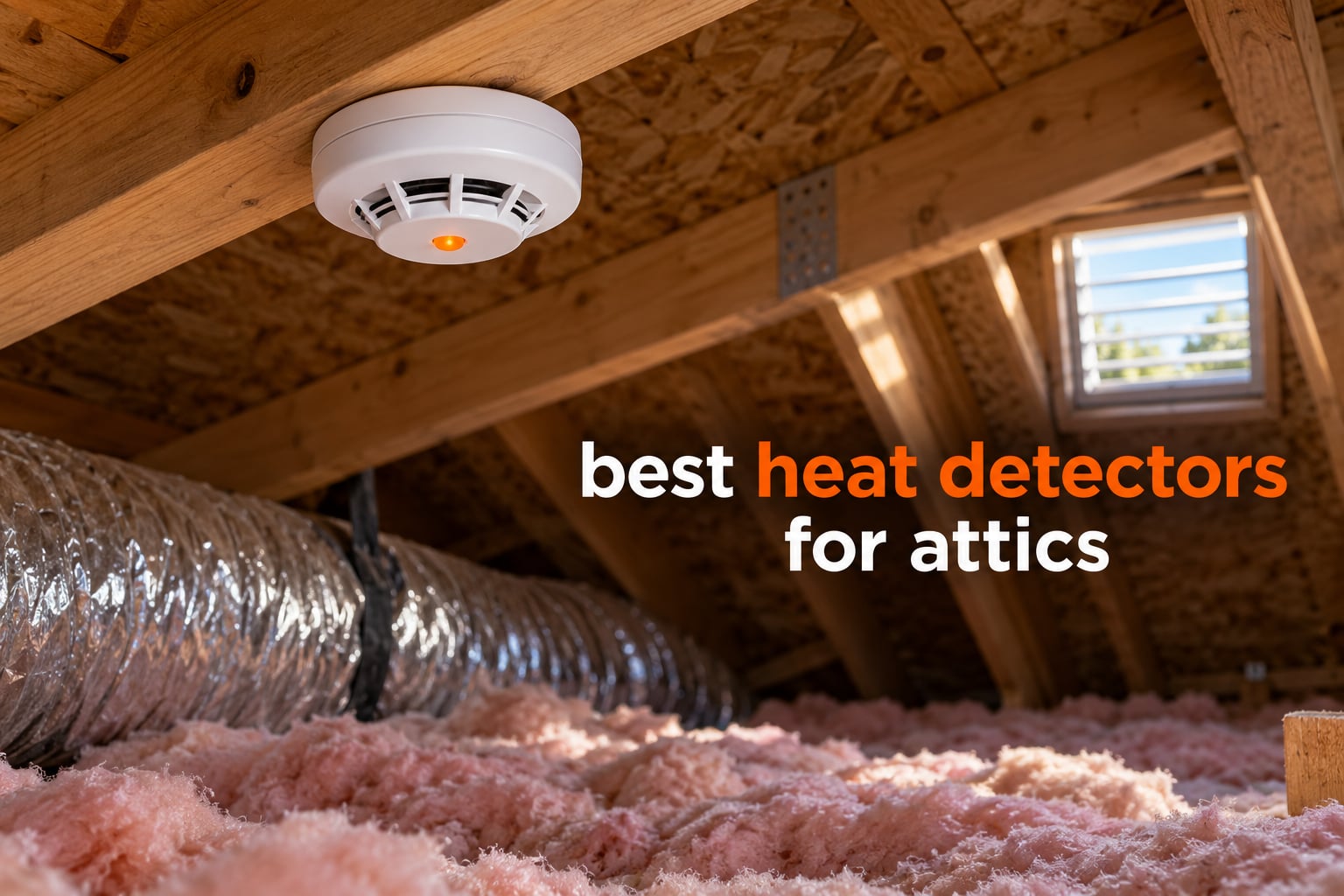
Short answer: the best heat detectors for attics are temperature-rated units with a 194F trip point, not the standard 135F residential alarms that dominate shopping results. An unconditioned attic regularly runs 20 to 40F hotter at the ceiling plane than the air reading you get at floor level, and NFPA 72 Section 17.6.2.3 requires the detector rating sit at least 20F above the maximum expected ambient ceiling temperature. A 135F alarm in that space is not broken; it is working exactly as designed, and the fix is a higher rating rather than a relocation.
That single rule is what separates a useful attic detector from an expensive paperweight. Fire-alarm practitioners have been blunt about it for years: in unconditioned attic spaces, standard practice is 174F or 200F devices, not 135F. Yet most consumer roundups, and most shopping carousels, still lead with 135F units because those are what homeowners search for and click. We compared the ten best-selling and best-reviewed attic-appropriate detectors available now, checked the fixed-temperature rating and sensing technology on every one, and sorted out which actually suit a hot, dusty, unconditioned space.
Why attics deserve their own detector category at all is worth stating plainly. An attic fire develops at the top of the house, above the ceiling plane, where smoke travels through framing cavities before anyone on the main floor knows anything is happening. At the same time, the attic is the worst possible place for a smoke alarm: insulation dust, soot, and seasonal temperature swings trigger nuisance alarms, and homeowners who get tired of a chirping unit in July pull the batteries out. We saw exactly that pattern described again and again across homeowner forums, alongside a second recurring problem, which is detectors dying far short of their advertised life because sustained attic heat degrades the battery.
We do not recommend installing smoke or carbon monoxide detectors in unfinished areas of the home. This includes attics, crawlspaces, garages, unheated areas.
That is not our opinion. It is the position First Alert takes in its own manufacturer support guidance, and the same reasoning runs through practitioner forums, where the consensus on unfinished attics is consistent: too dirty, too much heat, not rated for the environment, so heat detectors are the right choice. What follows is a ranked look at ten options, followed by the temperature-rating framework you need to pick between them and the placement rules that decide whether the device actually works.
Table of Contents
Top 3 Attic Heat Detector Picks for (October 2026)

Kidde HD135F Heat Detector
- 135F rate-of-rise sensing
- 85-decibel audible alarm
- 120V hardwired with 9V backup
- Interconnects up to 18 devices

System Sensor 5601P
- 135F fixed plus rate-of-rise
- Single-circuit wiring
- Reversible mounting bracket
- Low-profile plain housing

First Alert HD6135FB
- Hardwired with battery backup
- Ionization sensing
- Designed for nuisance-prone spaces
- Low-profile ceiling mount
Best Heat Detectors for Attics in 2026: Quick Overview
All ten devices below are hardwired or panel-powered, because that is what an attic installation realistically requires. Ratings and review counts are taken from the manufacturer listing data for each product.
| Product | Specifications | Action |
|---|---|---|
|
Kidde HD135F Heat Detector
|
|
Check Latest Price |
|
System Sensor 5601P
|
|
Check Latest Price |
|
First Alert HD6135FB
|
|
Check Latest Price |
 System Sensor 5604
|
|
Check Latest Price |
 Kidde HD135F Interconnectable
|
|
Check Latest Price |
 System Sensor 5602
|
|
Check Latest Price |
 First Alert Hard-Wired 120V
|
|
Check Latest Price |
 Thermotech 302-EPM-194
|
|
Check Latest Price |
 Silent Knight IDP-Heat-IV
|
|
Check Latest Price |
 Notifier FST-951-IV
|
|
Check Latest Price |
1. Kidde HD135F Hardwired Heat Detector – Best Overall Attic Choice
Kidde Heat Detector, Hardwired with Battery Backup & 2 LEDs, Interconnect Capability, Ideal for Garages
135F rate-of-rise
85 dB alarm
120V hardwired with 9V backup
Interconnects 18 devices
Pros
- Largest reviewed base in this roundup at over 1000 ratings
- Hardwired power with battery backup survives outages
- Interconnects with up to 18 initiating Kidde devices
- Quick-connect harness shortens install time
- Test-Hush button for quick verification
Cons
- 135F rating is too low for a hot summer attic
- Interconnection limited to compatible Kidde devices
- Red LED is generic and does not identify alarm cause
The Kidde HD135F is the unit most homeowners end up with, and for a lot of attics that is the right outcome. It carries a 4.6 average across more than a thousand ratings, a larger review base than any other device here, which gives you a clearer picture of long-term behaviour than a handful of specialist devices further down this list. Buyers consistently single out three things: rate-of-rise sensing, hardwired power with a backup cell, and the ability to pull an entire house of Kidde alarms onto one circuit.
Installation is genuinely quick. The quick-connect power harness means you are not improvising wire terminations on a ladder in an unconditioned space, and the unit mounts to a standard ceiling or back box. The Test-Hush button on the face is the feature we would prioritise above everything else, because a detector you cannot easily test is a detector that quietly stops working.
Interconnection is the reason this lands at the top of the list for most households. It can drive up to 24 compatible Kidde devices, of which 18 can be initiating devices, with room for six strobes or relay modules. If your goal is a single attic heat detector that also makes noise in the hallway and pushes a notification to your phone, this is the shortest path there.
Here is the honest caveat, and it is not a small one. This is a 135F device. In a garage, a basement utility room, or a temperate attic in a moderate climate, that is exactly right. In an attic that regularly pushes the ceiling plane past 115F in July, it is the wrong rating, and no amount of installation care changes that. Judge it against your own attic before you commit.
What to check before buying this model
Confirm your attic ceiling plane temperature on the hottest day of your last summer, not the air temperature at the access hatch. A cheap panel-style thermometer clipped to a rafter tells you the number that matters, and it is often 20 to 40F higher than the reading from downstairs. If the answer comes back above roughly 115F, skip this unit and move to a 194F device in the list below.
Also confirm your alarm wiring is actually there. This is a hardwired unit, and the classic attic retrofit problem is that the homeowner wants a detector in a space that was never wired. If you find no cable at the intended mount point, a low-voltage panel device with a relay output is the more realistic purchase.
Where this model falls short
Interconnection is brand-locked. You can pair it with up to 18 other initiating Kidde devices, but mixing in a different manufacturer’s detectors on the same line is not part of the design. If your existing home already runs a mixed-brand or smart-home system, this is not a natural fit, and a panel-compatible model will serve you better.
There is also a data-quality wrinkle worth knowing. Some listings describe the sensor type inconsistently, so the detection technology is not fully clear from the listing alone, and the red status LED is labelled generically enough that it does not tell you whether an alarm event was heat-driven. In practice the Test-Hush button resolves that ambiguity in seconds.
2. System Sensor 5601P – Best Value 135F Combination Detector
System Sensor 5601P 5600 135 Degree Fixed Temperature Rate-of-Rise, Single-Circuit Mechanical Heat Detector with Plain Housing
135F fixed plus rate-of-rise
Single-circuit device
Reversible bracket
4.9 by 5.2 inch footprint
Pros
- Combines fixed-temperature and rate-of-rise elements
- Inexpensive drop-in for expired legacy sensors
- Fits existing alarm loops without rewiring
- Reversible bracket gives a flush ceiling look
Cons
- Visual alarm only with no on-device sounder
- No test button
- Plain plastic housing is widely criticised cosmetically
The system sensor 5601P is a 135F fixed-temperature and rate-of-rise device in a plain residential housing, and it earns its place here on value and versatility rather than polish. It holds a 4.6 average across 66 ratings with 79 percent five-star, which is a strong result for a component that most people never see once it is mounted.
Its strongest use case is replacement. Reviewers repeatedly describe it as an inexpensive drop-in for expired legacy sensors, because the single-circuit design fits existing alarm loops and the reversible mounting bracket lets it sit flush depending on orientation. For someone with a panel already installed upstairs, that means a swap in minutes rather than a rewire.
Users also report good results in kitchens, garages, and utility spaces, which is the same cluster of rooms where smoke detection is impractical. That is worth noting because it means the 5601P is not attic-exclusive, even though it appears on this list for the 135F combination behaviour that matters when heat develops quickly.
The limitation is straightforward. The alarm type is listed as visual, meaning there is no sounder in the housing and notification comes entirely from the panel. If your attic is not on a supervised circuit, this device needs a relay or notification appliance alongside it. There is also no test button, so verifying function means relying on panel diagnostics rather than a press-and-hold check at the device.
What makes this the value pick
Set against the consumer alarms on this list, the economics are straightforward. You get both a fixed-temperature element and a rate-of-rise element in one device, on a platform that technicians already service. The 5600 series is described in the product data as a widely deployed 5600 series, which means parts, documentation, and familiarity are all in your favour.
The bracket detail matters more than it sounds. Flipping the mounting orientation changes how the unit presents against the ceiling, and in a space like an attic where the detector hangs below exposed joists, that decides whether the install looks deliberate or looks like a temporary fix.
When to choose something else
Do not buy the 5601P as a standalone attic alarm with no panel behind it. Without a sounder in the housing, a detection event produces no noise in the space, and nobody upstairs hears anything. It is a panel component, and it works well as one.
Cosmetic complaints are the other recurring theme. The housing is criticised as dated and mismatched against other plastics in the same room, and one reviewer wishes for a test button. Neither issue affects detection, but both show up in a finished space where the detector is in plain sight.
3. First Alert HD6135FB – Best for Homes With Existing Interconnected Alarms
First Alert Hard-Wired w/Battery Back-up Ionization Heat Alarm
Hardwired with battery backup
Ionization sensing
Audible alarm
Low-profile ceiling mount
Pros
- Hardwired design with backup cell covers power outages
- Ionization sensing responds fast to developing heat
- Large installed base means parts and guidance are easy to find
- Low-profile styling suits a visible ceiling
Cons
- Ionization sensing is not a pure heat-only device
- Backup cell needs periodic replacement
- Brand-locked wiring limits retrofit flexibility
The First Alert HD6135FB is a hardwired ionization heat alarm with battery backup, and it exists for a specific situation: a home where the alarm platform is already established and you are replacing a unit that has been nuisance-tripping. It holds 4.5 across 60 ratings with 74 percent five-star.
Buyers consistently value the pairing of hardwired reliability with a backup cell. In an attic, where a single missed power event could leave a detector silent for months before anyone climbs up there, that redundancy is the whole point of the purchase. Ionization sensing also responds quickly to fast-developing heat events, which is the scenario that matters most in a confined attic void.
It is marketed explicitly for areas where smoke detectors are prone to false alarms, which is precisely the attic case. The styling is modern and low-profile, and it disappears against a ceiling better than most of the industrial devices in this roundup.
Two things temper the recommendation. First, ionization sensing also detects smoke, so this is not a pure thermal device, and if your goal is a detector that only ever responds to temperature, keep reading. Second, the backup cell requires periodic replacement, and in a hot attic that is the part most likely to be neglected, which is the same failure mode we hear about from homeowners who find dead units after a couple of seasons.
Why this one fits certain homes and not others
If your house already has First Alert or BRK hardwired alarms downstairs on the same circuit, this is a clean addition. The form factor is legacy-compatible, so the existing wiring and mounting position work, and the audible alarm means the device makes noise on its own rather than relying on a panel notification appliance.
If your home has no hardwired circuit in the attic at all, none of that applies. Running new cable to an unconditioned space is a bigger job than most people expect, and a battery-powered standalone alarm is often the more honest starting point.
The ionization tradeoff
This is the most important distinction to understand on this product. An ionization sensor uses a small amount of radioactive material to make smoke visible to the sensing chamber, which gives it excellent response to fast flame development but also means it reacts to airborne particles. Insulation dust is exactly that kind of particle.
That is why the pure heat devices further down the list are the more defensible choice in a dusty attic, and why the first alert support guidance we quoted earlier advises against smoke-capable devices in unconditioned spaces. The HD6135FB is rated for it and marketed for it, but a fixed-temperature-only device removes the variable entirely.
4. System Sensor 5604 – Best 194F Fixed-Temperature Choice for a Hot Attic
System Sensor 5604 194°F Fixed Temp Single Circuit Heat Sensor
194F fixed temperature
Single-circuit connection
5600 series platform
Light unit at 3.2 ounces
Pros
- 194F trip point tolerates slow heat rise in a hot attic
- Part of the widely deployed 5600 series
- Compacts into a standard back box
- Light unit is easy to position on a joist
Cons
- Fixed temperature only with no rate-of-rise element
- No on-device sounder so the panel must notify
- Highest share of one-star ratings in this roundup
The System Sensor 5604 is the first device in this roundup rated high enough to ignore ordinary attic temperature swings, and that is the entire reason it is here. A 194F fixed-temperature trip point means a hot July afternoon will not set it off, while an actual fire still pushes the local temperature past the threshold eventually.
It scores 4.3 across 58 ratings with 71 percent five-star, the lowest average among the System Sensor units listed here, and the gap is instructive: buyers who want a 194F rating without rate-of-rise are trading detection speed for ambient tolerance, and some feel the trade. Understanding that trade before you buy prevents a lot of disappointment.
Mechanically, this is a serviceable part. It is a single-circuit 5600 series device that fits standard fire alarm loops and mounts into a standard back box, and at 3.2 ounces it is light enough to position accurately on a rafter or joist face. The 5600 platform is described in the product data as widely deployed, so documentation and replacement parts are straightforward to source.
The weakness is structural rather than cosmetic. Fixed temperature only means this device will not alarm on a slow rate-of-rise fire, where temperature climbs gradually without ever spiking. In a large open attic with high ceilings and slow air movement, that is not a hypothetical gap, which is why the combination units later in this list are often the more defensible purchase.
How to decide between fixed and combination sensing
Think about how fire actually behaves in the space you are protecting. A fixed-temperature element answers one question: is the local air at the detector hot enough to matter. A rate-of-rise element answers a different one: is heat arriving fast enough to indicate combustion regardless of the absolute reading. Combinations answer both.
For a small attic with limited airflow, where heat from a roof-level fire pools quickly at the ceiling plane, fixed-only sensing at 194F is defensible. For a large volume where smoke and heat have room to stratify and rise slowly, the missing rate-of-rise element is a real cost, and the 5602 is the direct upgrade.
What to watch for in the ratings
This product carries the largest share of one-star ratings among the ten here, and reviewers describe some devices as unresponsive. Mechanically, mechanical detectors do drift, and an aging bimetal element or a contaminated chamber can slow response. That reinforces the maintenance point rather than contradicting it: attic detectors need a test interval, and the panel should carry the loop in a supervised state so a fault is reported.
There is no on-device sounder, so the panel has to be part of the plan. If you are installing this as part of a retrofit with a relay module, that solves it. If you are mounting it alone, pair it with a notification appliance on the same circuit.
5. Kidde HD135F Interconnectable Replacement – Best Drop-In Swap
Kidde Hardwire Interconnectable 135-Degree Heat Alarm HD135F
135F rate-of-rise sensing
Hardwired interconnectable
Drop-in HD135F replacement
Ceiling mount
Pros
- Exact replacement for older HD135F units so wiring and mounts fit
- Interconnection across the household alarm circuit
- Quick and straightforward installation reported by many buyers
- Consistently praised for garage use
Cons
- 135F rating is low for a hot summer attic
- Housing stands proud of the ceiling with a visible silver base
- Small footprint relative to the mounting base
This is the second Kidde HD135F listing in the roundup, and it is on the list for a different reason than the first. Almost every review here centres on one point: it is a direct like-for-like replacement for a unit installed years ago, so the existing wiring and mounting position still fit and the swap takes minutes.
It holds 4.6 across 41 ratings with 69 percent five-star. The sensing is 135F rate-of-rise, hardwired and interconnectable with other compatible alarms on the same circuit, and the same quick installation experience shows up repeatedly in buyer feedback.
If you have moved into a home and found an existing heat alarm in the attic, this is often the part that answers the question. Homeowners inspecting their own attics frequently cannot identify what is already up there, and swapping a matching model removes the guessing. Garage suitability also comes up consistently, which is the same 135F-appropriate environment.
Two complaints recur. The housing protrudes noticeably from the ceiling and the silver mount is visible, which shows up in a finished or accessible space. And the sensing footprint is small relative to the mounting base, so the active element covers less area than the trim suggests, which is worth considering if you have a wide attic and few devices.
How to use this for an attic retrofit
Confirm the existing model before ordering. Look at the back of the current unit for the model stamp, and if it reads HD135F, this is the drop-in. If it is a different family, the mounting bracket geometry and terminal arrangement are likely different, and the first Kidde listing in this roundup is the more generally applicable pick.
Verify the circuit is live and supervised before you swap anything. A hardwired interconnectable alarm on a dead or unsupervised line gives you a unit that appears to work and reports nothing, which is worse than having no detector because you will not know.
Where it is the wrong purchase
The 135F rating disqualifies it for a genuinely hot attic, in the same way it disqualifies the first Kidde. The installation convenience does not change the physics: a 194F summer ceiling reading is a genuine alarm event, and the correct response is a detector rated above it, not a quieter device.
Interconnection is also limited to compatible Kidde devices on the same line, so if you are building a mixed system or bridging to a smart hub, this is not the flexible option. In those cases a panel-addressable device with relay output gives you more control over where the notification goes.
6. System Sensor 5602 – Best 194F Rate-of-Rise Combination
SYSTEM SENSOR 5602 Single Circuit 194°F Rate of Rise and Fixed Temperature Device
194F fixed plus rate-of-rise
Single-circuit device
Reversible bracket
16 ounces
Pros
- Combines 194F fixed temperature with rate-of-rise sensing
- Covers both slow smouldering and fast-developing fires
- Easy-to-use terminal screws speed field wiring
- Fits single gang
- octagonal
- and square back boxes
Cons
- Small review base limits long-term field history
- Housing is plain rather than decorative
- Single-circuit version needs a separate device for a two-wire loop
The System Sensor 5602 pairs a 194F fixed-temperature element with rate-of-rise sensing in the same device, which means the ambient tolerance needed for an unconditioned attic and the fast response needed for a developing fire are both present. That combination is the closest any device here comes to the full answer.
It carries a 4.8 average across 13 ratings with 85 percent five-star, which is the highest score among the units in this roundup with more than a dozen reviews behind them. We want to be careful about how much weight that number deserves, because thirteen ratings is a thin base, and the review data itself notes limited long-term field history. The reason it still ranks this high is that the specification closes both failure modes the other units leave open.
Installation flexibility is the other thing buyers mention. Easy-to-use terminal screws speed field wiring, and the mounting options are unusually broad: single gang, 3.5 inch and 4 inch octagonal, and 4 inch square with a square-to-round plaster ring. The reversible bracket allows the orientation to change after the box is chosen, which saves a return trip when the joist layout does not cooperate.
The trade-offs are honest but modest. The white housing is described in the listing as plain rather than decorative. And if your existing loop is a two-wire configuration, the single-circuit version needs a separate device, because this model covers one circuit only.
Why the combination element matters most here
Consider a roof-level fire in a large attic. Heat collects at the ceiling plane, and the absolute temperature may climb slowly enough that a 194F fixed element is not reached for a meaningful period. A rate-of-rise element sees the derivative instead, the rate at which temperature is climbing, and alarms on that change well before the absolute threshold arrives. That is the fast-developing fire case, caught early.
Now consider a hot afternoon with no fire at all. Ambient temperature wanders slowly, and the rate-of-rise element stays quiet because nothing is accelerating. The 194F fixed element simply never reaches its trip point. Having both elements in one housing is what lets a single device handle both conditions without nuisance alarms or missed events.
Before you commit to this model
Understand that 13 ratings is a small sample, and the data notes limited long-term field history. If you are fitting a device into a panel system, verify the model number and the circuit configuration against your panel documentation before ordering, since the single-circuit and dual-circuit variants are not interchangeable.
Also plan the notification path. Like the other 5600 series devices here, there is no assumption of an on-device sounder. Confirm the alarm type in the listing for your variant and pair it with a notification appliance or relay on the same circuit if needed.
7. First Alert Hard-Wired 120V Heat Alarm – Best Low-Profile Replacement
First Alert Heat Alarm Hard Wired 120 V
Hardwired 120V
Audible alarm
Direct replacement form factor
Modern low-profile design
Pros
- Very easy drop-in swap for an original First Alert unit
- Hardwired 120V power for continuous operation
- Modern unobtrusive ceiling profile
- Well reviewed for replacing a nuisance-alarming smoke unit
Cons
- Only a handful of ratings so reliability is not well established
- Listing shares a GTIN and UPC with other models
- Interchangeability limited to matching First Alert wiring
This First Alert hardwired 120V heat alarm is a straightforward replacement part, and it earns a place on this list for a narrow but real reason: it drops into an original First Alert installation without adaptation. The single detailed review describes an easy swap for a unit that had been tripping during oven use, which is a familiar attic-adjacent complaint.
It holds 4.7 across 4 ratings. That base is very small, and the review data is explicit that the sample is too small for strong conclusions. We would not build an attic safety recommendation around four ratings, so treat the number as noise and the form factor as the actual selling point.
What is verifiable is the physical design. It is a hardwired 120V unit with an audible alarm and a modern low-profile profile that sits closer to the ceiling than the industrial housings elsewhere in this list. In an attic where the detector is visible from the access hatch, that shallower profile is a real difference.
The data-quality caveat is worth stating plainly rather than burying. The listing shares a GTIN and UPC with other First Alert models, so the exact part number is ambiguous from the listing alone. Before ordering, confirm the model number printed on the unit you are replacing matches.
When this is the right pick
The decision rule here is narrow and clear: if you are replacing an original First Alert unit and you want the ceiling profile to be as discreet as possible, this does that job. The direct replacement form factor means the existing wiring and mounting carry over, and the audible alarm means the device does not need panel support to make noise.
Hardwired 120V supply also means you are not managing a sealed battery on a schedule, which in a hot attic is a real advantage given how fast attic heat degrades battery life.
When to pick a different product
If you are installing new rather than replacing, the limited installed base means fewer forum threads and less troubleshooting help when something does not go to plan. For a fresh install, one of the widely deployed 5600 series devices gives you a much larger body of field knowledge.
And if the ambiguous part number cannot be resolved against your existing unit, do not force the fit. A device that is not the exact matching model is a wiring risk, and this category is one where a loose terminal on a hardwired alarm is a serious defect rather than an inconvenience.
8. Edwards-Signaling Thermotech 302-EPM-194 – Best for Large Open Attic Volume
Thermotech 302-EPM-194- Heat Detector, Coverage 1600 Sq. Ft.
194F rate compensation
1600 sq ft coverage
-40 to 150F ambient
UL and CSFM listed
Pros
- Published ambient operating range of -40 to 150F
- 1600 square foot coverage suits large open areas
- Rate compensation smooths ambient swings to avoid nuisance alarms
- UL and CSFM listed for code-compliant work
Cons
- Only 2 reviews so there is very limited independent feedback
- Surface mounting only with no back box compatibility
- Silver industrial housing is utilitarian
The Thermotech 302-EPM-194 carries a published 1600 square foot coverage figure and an ambient operating range rated from -40F to 150F, and those two specifications are why it is here. That range covers the full span an unconditioned attic can present across a year, including the cold months when a consumer alarm’s internal tolerance is a genuine question.
Coverage of 1600 square feet per device changes the arithmetic of an attic install. Instead of mounting a cluster of small units along the joists, a few well-placed devices cover a large open volume, which matters both for cost and for the practical difficulty of running wiring in a cramped space.
Rate compensation is the third piece. Unlike a simple fixed-temperature element, rate compensation smooths out ordinary ambient swings so normal attic temperature changes do not produce nuisance alarms. That directly addresses the pain point homeowners describe most often, where a detector in a hot attic produces a false alarm and the eventual response is to remove the battery.
It carries a 5.0 rating from the two reviews that exist. We will not pretend two ratings mean anything statistically, and the review data says the same. The case for this device rests on its published specification, which is unusually well aligned with the attic problem.
Why coverage rating changes the install plan
Detector coverage is specified per device for a given ceiling height and air movement condition, and a device with a 1600 square foot figure covers substantially more area than a residential alarm sized for a hallway. For a large attic, that translates directly into fewer mounting points, fewer wire runs, and fewer places where an installer has to work in tight clearances between joists and ductwork.
It also reduces the total count of devices that need routine testing, which is the practical failure mode we hear about most. Homeowners stop testing what is awkward to reach, and coverage designed for fewer devices is coverage that stays tested.
What you give up for that coverage
Surface mounting only, with no back box compatibility, means the install looks different from every other device on this list. It also means the unit hangs below the ceiling plane, and in a space where a low profile matters visually or physically, that is a consideration.
With only two reviews, you are buying on specification rather than on user experience, so verify the current datasheet against the manufacturer’s documentation before you commit. This is a commercial-oriented detector in residential clothing, and the UL and CSFM listings are the real credential here.
9. Silent Knight IDP-Heat-IV – Best for Addressable Panel Systems
SILENT KNIGHT IDP-Heat-IV ADDRESSABLE Thermal Detector
Addressable thermal detector
Reports own address to panel
Silent Knight IDP panel compatibility
Wide-area coverage
Pros
- Addressable design pinpoints the exact detector location on the panel
- Coverage suits large open attic volumes
- Panel diagnostics simplify fault troubleshooting compared to legacy devices
- Compatible with Silent Knight IDP-series control panels
Cons
- Requires an addressable panel to function
- Installation is professional territory rather than a DIY job
- Only 2 reviews that split almost evenly
- Cannot function as a standalone alarm
The Silent Knight IDP-Heat-IV sits at the professional end of this list, and the reason is architectural: it is an addressable thermal detector, meaning each device reports its own identity back to the control panel for fault and alarm identification. In a large attic with a dozen devices, knowing exactly which one triggered is worth more than any single unit’s rating.
It holds 4.5 across 2 reviews, which splits almost evenly between 5 and 4 stars, so the review data is not informative and the product data says the same. The justification here is specification and system fit, not ratings.
Panel diagnostics are the real advantage over legacy single-circuit devices. When a loop goes into fault at 2am, an addressable panel tells you which device and whether it was a fault or an alarm. A conventional zone tells you an address exists somewhere on the loop, which turns a diagnostic exercise into a ladder trip across a hot attic.
Coverage is the second argument. Addressable devices are built for larger installations than a single-home consumer alarm, which is what makes a large open attic volume a sensible application rather than an oversized one.
Who this device is genuinely for
Think of it as the correct choice for someone who already has, or is installing, a Silent Knight IDP-series control panel. In that context, the device is a natural extension of an existing system, and the addressable reporting removes a whole category of maintenance guesswork from a space that is inconvenient to service.
It is also the right concept for a property where an attic fire would be expensive, because the panel can log events, identify the source device, and integrate with the rest of the building’s notification and monitoring path.
Why it is the wrong purchase for most homeowners
Three hard constraints. It requires a compatible addressable control panel to report anything, so without one it does nothing at all. Installation moves into professional territory, because addressable loops have addressing and wiring conventions that are not a first-time DIY task. And the per-device cost makes it a poor fit for a single-room retrofit.
If your home has a conventional residential panel with zone inputs, the single-circuit System Sensor devices earlier in this list will integrate more simply and cost a fraction as much. Match the detector to the panel you actually have.
10. Notifier FST-951-IV – Best Commercial Sensor Head for New Builds
Notifier FST-951-IV – Fixed Temperature Thermal Sensor Head – Ivory
Fixed temperature sensing
Sensor head for notification circuits
Ivory finish
Requires a control panel
Pros
- Fixed temperature sensing resists nuisance alarms in dusty high-heat spaces
- Sensor head format fits standard notification appliance circuits
- Ivory finish blends into residential trim better than bare metal
- Perfect 5.0 rating from the two reviews available
Cons
- Sensor head only with a separate base required
- Fixed temperature with no rate-of-rise element
- Requires a fire alarm control panel rather than standalone power
- Only 2 reviews
The Notifier FST-951-IV is a fixed-temperature thermal sensor head in ivory, and it is the specialist option on this list rather than a homeowner purchase. Its sensor head form factor drops into standard notification appliance circuits on a fire alarm control panel, which is a commercial design pattern with a specific purpose.
It holds a 5.0 rating from the two reviews that exist, which establishes nothing on its own. The product data is equally clear that the sample is too small to draw conclusions from, so treat this as a specification decision.
Fixed-temperature-only sensing is the deliberate design choice here, and it is the same choice that makes the 5604 worth considering. In dusty, high-heat spaces where a rate-of-rise element can respond to ambient movement or airborne particulate, a deliberately high fixed trip point ignores the environment entirely. You are buying a detector that will not talk to you unless something is genuinely wrong.
The ivory finish is a small detail with a real purpose. Commercial sensor heads are frequently installed in residential or light-commercial spaces where a bare metal head looks out of place, and reviewers note it blends more easily into residential trim.
When this head is the right component
It makes sense in new construction or a commercial fit-out where a fire alarm control panel already exists and the design calls for a supervised notification circuit. In that environment the head is the correct building block, and pairing several across a large attic gives the panel a supervised device in each zone.
The single-circuit notification appliance arrangement also means the panel controls the notification, so the sound level and location of the alarm are design decisions rather than consequences of where the detector happened to go.
What makes it unsuitable for a home attic
Three practical blockers. It is a sensor head only, so you need a separate base and mounting hardware. It is fixed temperature with no rate-of-rise element, so it will miss a slow-developing fire that never reaches the trip point. And it requires a fire alarm control panel rather than standalone household power, so there is nothing for it to do in an unpanelled attic.
If you are not building or refurbishing a commercial system, the effort of sourcing a panel to drive this head outweighs anything this sensor does better than a residential alternative.
Why Attics Need a Heat Detector and Not a Smoke Alarm
An attic is the least watched space in most homes. It is outside the living area, usually unconditioned, and often visited twice a year, which means a fault can sit undetected for months. Meanwhile it is the space where a fire has the most time to grow before discovery, because everything it needs to spread is up there: framing cavities, wiring chases, ductwork, and stored contents.
Smoke detection fails in that environment for three separate reasons. Dust and soot load the sensing chamber, so the detector reads particles that are not combustion products. Seasonal temperature swings push the chamber across its operating limits, which triggers alarms with no fire present. And the ambient heat itself shortens sensor and battery life, which is why homeowners describe units going quiet after a year or two.
Heat detection sidesteps all three. A thermal element responds to temperature, not particles, so insulation dust is irrelevant. A properly rated 194F device sits above the ambient range a real attic reaches, so ordinary seasonal variation produces no alarm. And there is no chamber to clog, which removes the most common attic failure mode entirely.
Manufacturer guidance lines up with the physics here. First Alert’s own support documentation states plainly that smoke and carbon monoxide detectors are not recommended in unfinished areas including attics, crawlspaces, garages, and unheated spaces. That is the clearest possible authority for a question that online advice frequently gets backwards.
When a smoke detector still belongs in an attic
There is one meaningful exception, and it is a construction detail rather than a preference. In a finished attic converted into living space, with insulation behind drywall and the attic deck sealed as a ceiling, the environmental objections largely disappear: the space is conditioned, the dust load is gone, and smoke detection works normally. In that case treat it as any other room and follow normal smoke alarm coverage.
The distinguishing question is whether the attic deck is sealed. If you can see bare joists and loose insulation, you are in an unconditioned space and the heat detector guidance applies. If the deck is drywall and the space is part of the conditioned envelope, it is a living space and smoke detection is the correct choice.
What the numbers actually mean
Rate-of-rise elements alarm when local temperature climbs at roughly 15F per minute, which catches a fast-developing fire long before the fixed threshold arrives. Fixed-temperature elements alarm at a set degree value, which ignores ordinary ambient change entirely. Combination devices contain both elements, and for an unconditioned attic that is the specification that handles both a slow smoulder and a flash fire.
The rating numbers are the local temperature at the device, not the temperature you measure at the hatch. That distinction explains the most common attic complaint of all: a homeowner reads 95F at the access opening, the detector alarms, and they conclude it is a false alarm. It is not. Heat accumulates at the ceiling plane far above the measured room reading, and the detector is reporting accurately about where it is mounted.
Choosing a Temperature Rating: 135F vs 174F vs 194F vs 200F
The rating is the single most important specification for this purchase, and it is the one most often overlooked. The rule from NFPA 72 Section 17.6.2.3 is that the detector rating must be at least 20F above the maximum expected ambient ceiling temperature. Work from the ceiling plane temperature, not the air at the hatch, because the gap between them is routinely 20 to 40F in a sun-exposed attic.
135F is the standard residential rating. It is correct for conditioned or mild spaces, attached garages in temperate climates, boiler and mechanical rooms, and attics in cool regions that rarely see a high ceiling temperature. In a hot attic it is the cause of the summer nuisance alarm that leads homeowners to remove the battery.
174F covers mild climates and attics in a home with modest solar gain, a north-facing roof, or heavy shading. It is the practitioner recommendation for unconditioned attic space in temperate regions, where the ceiling plane may reach the 150F range on the worst day.
194F is the right default for most attics. It tolerates a ceiling plane that regularly runs into the 170s, which covers a large share of the continental United States, and it is available with rate-of-rise or rate-compensation sensing so you keep fast-fire response. Both 194F approaches appear in this roundup, in the System Sensor 5602 and the Thermotech 302-EPM-194, and both are defensible attic choices.
200F and above is for hot climates, dark-shingle roofs in the southern and southwestern states, and any attic where a 194F unit would still nuisance-trip. The trade is honest and worth naming: a very high fixed rating slows response to a slow-developing fire, so a rate-compensation or rate-of-rise element becomes more important as the fixed rating rises.
A three-step method for your own attic
Step one: measure the ceiling plane on the hottest day you can recall, not an average day. Clip a panel-style thermometer to a rafter or to the top of a joist near where the detector would sit, and leave it through a full summer. Record the peak, not the daily mean.
Step two: add 20F to that peak. That is the minimum rating you should accept, and it follows the NFPA 72 ambient rule rather than a rule of thumb. If the peak is 150F, your minimum is 170F, which points you at 174F or above.
Step three: choose the sensing type at that rating. If your peak is at or above about 150F, insist on rate-of-rise or rate-compensation alongside the fixed element, because you are trading ambient tolerance for slower absolute-temperature response and you need the derivative element to cover the gap.
What to do about a summer nuisance alarm
First, establish whether the alarm was genuine for its rating. A 135F detector in an attic that genuinely reached 135F at the ceiling is working as designed. The unit is not defective and the alarm is not false; the specification is simply wrong for the location.
Second, do not remove the battery. That is the near-universal outcome and it removes all protection from the space, which is a far worse outcome than a nuisance alarm. If the unit has a hush or silence function, use it during the heat of the day and treat the event as a prompt to replace the detector with a correctly rated model.
Third, if you cannot upgrade immediately, relocate the detector to a point away from direct solar gain and heat sources such as flue pipes and HVAC plenums. A mount near the roof peak or over a chase is the worst possible position. Relocation is a genuine improvement, but the correct fix remains the rating.
How to Install an Attic Heat Detector Correctly
Position first, because the mounting location determines whether the rating you chose is even necessary. Avoid the immediate area above the access hatch, where warm air from the house below enters and can lift local temperature. Stay clear of roof peaks and valleys, where temperature swings are largest, and keep well away from flue pipes, chimneys, HVAC ducts, and any recessed lighting housing.
Mount on the ceiling plane or the underside of a joist, in a location that lets you reach it with a ladder without standing on insulation or a duct. This matters more than it sounds, because a detector that is awkward to test is a detector that does not get tested, and an untested detector is functionally the same as no detector.
For a hardwired unit, confirm cable exists at the mount point before you buy anything. If the attic was never wired, the realistic options are a low-voltage panel device with a relay driving a notification appliance, or a standalone battery alarm mounted where you can hear it. Both are legitimate, and neither is a substitute for planning the circuit first.
Wire to the manufacturer diagram, not to a diagram of a different model in the same family. Terminal markings differ between 5600 series variants, and a misplaced wire on a single-circuit device is a fault condition the panel may or may not report clearly.
Test immediately after mounting using the device test function, then test from the panel to confirm the loop registered the device at the correct address or zone. If you installed an addressable detector, confirm the address assigned matches the physical position on a printed loop card, because a mismatch sends the next technician to the wrong rafter.
Set a recurring reminder to test monthly and to check for insect nests and dust accumulation at the same time. The recurring failure mode we hear about most is a unit that failed quietly between visits, and a monthly press of the test button is what prevents that.
Power source and maintenance realities
Hardwired with battery backup is the most dependable residential choice for an attic, because the primary supply does not depend on a sealed cell that hot conditions will degrade. A 10-year sealed battery is a marketing claim that assumes moderate ambient conditions; sustained attic heat shortens real service life, and homeowners describe units going quiet well inside that window.
If you do use a sealed battery, choose the highest rated device you can find and write the replacement date on the housing with a permanent marker before you climb back down. Writing it in the room where you will see it is more reliable than storing it in a phone.
Panel supervision is worth the extra cost if you have any wired system at all. A supervised zone reports open circuits and device faults at the panel, which converts an invisible failure into an audible one. Unsupervised wiring on a device nobody inspects for years is a system that fails silently, and silence is the outcome you are paying to avoid.
Where Each Sensor Goes: Attic, Garage, Crawlspace, Boiler Room
Attic: heat detector, rated 20F above your measured ceiling plane peak, with rate-of-rise or rate compensation at anything above about 150F peak. No smoke alarm in an unconditioned space.
Attached garage: heat detector is the right default, and 135F is usually sufficient in a moderate climate. This is the most common correct use of the 135F rating in residential fire safety, and it is why several of the units in this roundup show up in garage feedback.
Crawlspace and unconditioned basement: heat detector, with the same ambient rating logic applied. Crawlspaces with high humidity push the operating limits of consumer devices, so check the humidity tolerance figure in the listing before specifying one.
Boiler and mechanical room: heat detector, and 135F is typically right because these rooms are conditioned and have a genuine ignition source. This is a room where a rate-of-rise element adds real value because fire growth can be genuinely fast near a heat source.
Living spaces, bedrooms, hallways, and outside sleeping areas: smoke alarms, not heat detectors. Heat detection is for where smoke detection is impractical, never as a substitute in occupied space. This is the boundary that the manufacturer guidance and the practitioner consensus both draw without exception.
Kitchen: heat detectors work well in kitchens, where smoke detection false-alarms on cooking. Note that this recommendation applies to a kitchen, not to a kitchen doorway where a smoke alarm is required for the adjacent living space.
Frequently Asked Questions
What is the best fire alarm for an attic?
A heat detector rated 194F with rate-of-rise sensing, mounted on the ceiling plane away from the access hatch. The rating must sit at least 20F above your attic’s maximum expected ceiling temperature per NFPA 72 17.6.2.3. Hardwired with battery backup is the most reliable power option in an unconditioned space.
At what temperature does a heat alarm go off?
It depends on the model. Standard residential heat alarms trip at 135F. Attic-rated units come in 174F, 194F, and 200F fixed-temperature versions, and a rate-of-rise element alarms when local temperature climbs roughly 15F per minute regardless of the absolute reading. Choose a rating at least 20F above your attic’s peak ceiling temperature.
What are the two most common types of heat detectors?
Fixed-temperature detectors alarm when the local temperature at the device reaches a set degree value. Rate-of-rise detectors alarm when temperature climbs quickly, typically around 15F per minute. Many residential and attic devices combine both elements, so a fast fire is caught early and ordinary ambient changes produce no alarm.
Is it a good idea to put a smoke detector in the attic?
No, not in an unconditioned attic. Dust and soot load the sensing chamber, seasonal temperature swings trigger nuisance alarms, and ambient heat shortens sensor and battery life. First Alert’s own support guidance states that smoke and carbon monoxide detectors are not recommended in attics, crawlspaces, garages, or unheated areas. The exception is a finished attic sealed into the conditioned envelope.
Can I use a heat detector instead of a smoke detector?
In an unconditioned attic, yes, and it is the correct choice. In living spaces, bedrooms, hallways, and outside sleeping areas, no. A heat detector senses temperature rather than smoke, so a slow smouldering fire that produces little heat may not alarm. Use heat detection where smoke detection is impractical, and smoke detection everywhere people sleep and live.
What are the NFPA 72 requirements for heat detectors?
The key requirement for attics is in Section 17.6.2.3, which calls for the detector temperature rating to be at least 20F above the maximum expected ambient ceiling temperature. Because the ceiling plane runs 20 to 40F hotter than the air at the access hatch, measuring only the room reading leads people to under-rate their detector. Placement, listing, and interconnection rules apply alongside the rating rule.
Should I have a heat detector in my garage?
Yes. A heat detector is the recommended device for an attached garage because vehicle exhaust, oil, and solvents make smoke detection prone to nuisance alarms there. A 135F rated unit is usually sufficient in a moderate climate, and hardwired interconnection with your home alarm circuit means the alarm is heard inside the house.
Where should a heat detector be installed in an attic?
Mount it on the ceiling plane or the underside of a joist, away from the access hatch, roof peaks, flue pipes, chimneys, and HVAC ducts, where local temperature runs highest or swings widest. Choose a spot you can reach with a ladder without standing on insulation. Then confirm the device rating is at least 20F above the measured ceiling plane peak in summer.
Final Verdict for Attic Heat Detectors in 2026
For most homeowners with an unfinished attic, the best heat detectors for attics come down to two decisions: pick a 194F rating with rate-of-rise sensing, and pick hardwired power with battery backup. The Kidde HD135F is the strongest general-purpose choice, with the largest body of real-world ratings behind it and the widest interconnection options. If your attic ceiling plane regularly approaches 150F or above, go directly to a 194F combination device such as the System Sensor 5602 or the Thermotech 302-EPM-194 instead.
Measure your ceiling plane on the hottest day of the summer before you buy anything, add 20F, and let the number choose the unit. A 135F alarm that nuisance-trips in July is not malfunctioning, and pulling its battery out removes the only protection that space has. Get the rating right, mount it somewhere you can test, and leave it in place.