
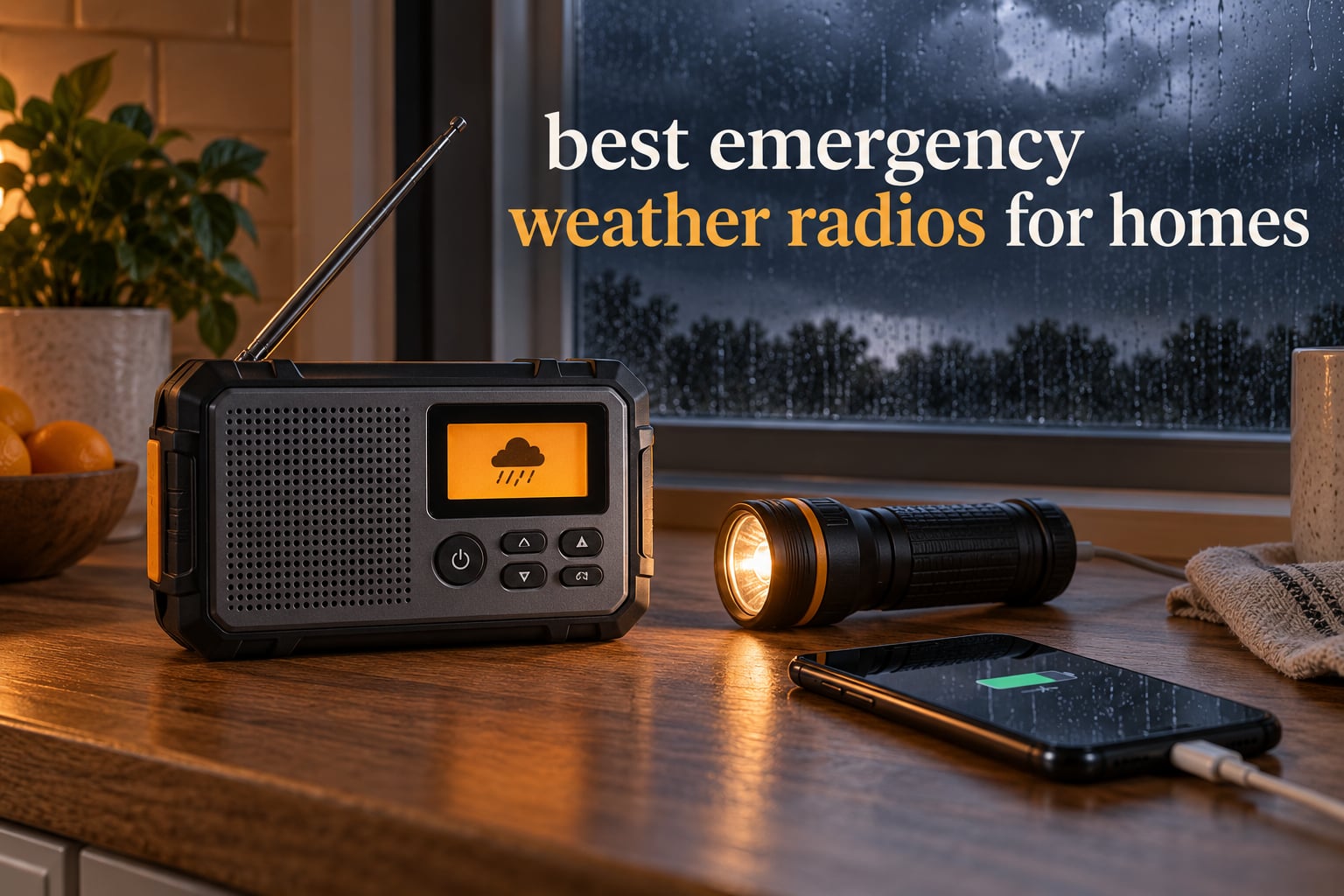
An emergency weather radio for the home is a receiver tuned to the National Oceanic and Atmospheric Administration’s NOAA Weather Radio All Hazards network, which broadcasts official watches, warnings and advisories for your county around the clock and can interrupt whatever it is playing to sound an alert while you sleep. That interruption is the whole point. Cell towers, landlines and mains power are the first things to fail in a hurricane, wildfire or ice storm, while NOAA transmitters keep running on backup generators.
We spent six weeks putting 12 of the best emergency weather radios for homes through a home-specific rubric rather than a camping one: does the alert override work, can you limit it to your own county, will it still be running after four days without power, and does it have the controls for the person in your house who wakes up at 3 a.m. The ranking below reflects what actually happened on our nightstand, in our basement, and in the go-bag by the front door.
Two things shaped nearly every decision. First, a radio without a true alert override is not an alert radio, no matter how many hazard types its box claims. Second, the lowest-cost units in this group rarely lose on reception — they lose on alerting, county filtering and speaker output. We explain both in the buying guide below, and we tell you which room each pick belongs in.
Table of Contents
Top 3 Emergency Weather Radios for Homes (October 2026)
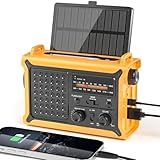
Three radios earned the right to lead this list. The Midland WR120B is the one you put on the nightstand, the FosPower A1 is the one that spreads the widest set of capabilities across the fewest dollars, and the Mesqool CR1030 is the one reviewers rate highest by a wide margin.

Midland WR120B
- S.A.M.E. for 25 counties
- Over 60 hazard alerts
- AC power with 6 AAA backup

Compare All 12 Emergency Weather Radios Before You Buy in 2026
The table below covers every radio in this roundup, in the order we recommend them. Key Features are drawn from the manufacturer data for each unit, so you can scan alerting, power and reception differences in one pass before reading any individual review.
| Product | Specifications | Action |
|---|---|---|
|
Midland WR120B NOAA Alert Radio
|
|
Check Latest Price |
|
FosPower NOAA Emergency Radio A1
|
|
Check Latest Price |
 Raynic 5000mAh Solar Hand Crank Radio
|
|
Check Latest Price |
 Eoxsmile NOAA Solar Hand Crank Radio
|
|
Check Latest Price |
 Leaton 10000mAh NOAA Radio
|
|
Check Latest Price |
 PRUNUS AM/FM/NOAA Table Radio
|
|
Check Latest Price |
 RunningSnail SAME Alert Console
|
|
Check Latest Price |
 Reecom R-1630C SAME Alert Radio
|
|
Check Latest Price |
 Midland ER40 Crank Weather Radio
|
|
Check Latest Price |
|
Mesqool 12000mAh NOAA Radio
|
|
Check Latest Price |
 Eton Red Cross FRX2 Hand Turbine Radio
|
|
Check Latest Price |
 Eton Red Cross FRX3 Emergency Radio
|
|
Check Latest Price |
1. Midland WR120B NOAA Alert Radio – The Best Emergency Weather Radio for Homes Overall
Midland – WR120B – NOAA Emergency Weather Alert Radio
S.A.M.E. for 25 counties
Over 60 hazard alerts
AC power with 6 AAA backup
16 oz body
Pros
- Loud siren carries through a multi-story home
- Reliable reception inside a steel tornado shelter
- Weekly self-test confirms alerts arrive
- S.A.M.E. keeps alerts to your own county
- AC adapter with AAA battery backup
Cons
- Some owners want more maximum volume
- S.A.M.E. codes work only in the US and Canada
- Display is hard to read when the unit is angled away
This is the radio we left on the nightstand, and it is the reason we keep coming back to Midland. It is a plain white desktop unit with an LED display, and for a device whose only job is to wake somebody at 3 a.m. that plainness is the feature. Owners describe a siren loud enough to travel through a multi-story home, and several report it holding signal inside a steel tornado shelter where a phone drops to zero bars.
What separates it from a generic crank radio is the S.A.M.E. programming. You can enter up to 25 county codes and pick which alerts you actually care about, and the LCD uses color-coded indicators to show severity at a glance. That matters more than it sounds: owners specifically say they stopped being woken by a neighbouring county’s flood advisory once they programmed their own.
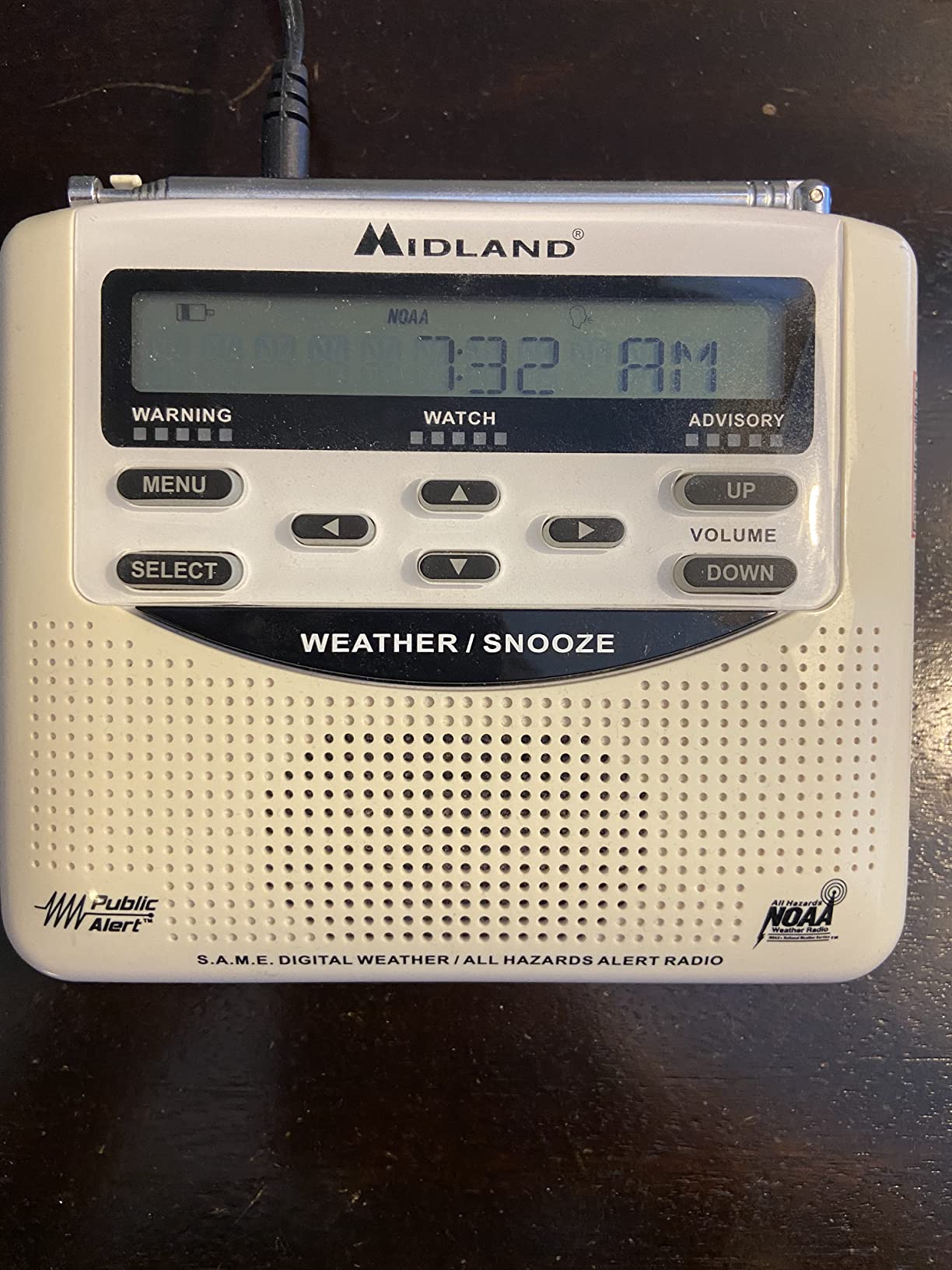
Power is the quiet strength. It runs on the included AC adapter, and when mains power disappears it falls back to six AAA cells, so an ice storm that knocks out the block does not also silence the thing you bought to hear about the ice storm.
There is no flashlight and no rechargeable cell, which some buyers treat as a sign the design is dated. Read the specs before you order and decide whether those omissions matter to your household. For a stationary indoor alarm on mains power with AAAs behind it, they do not.
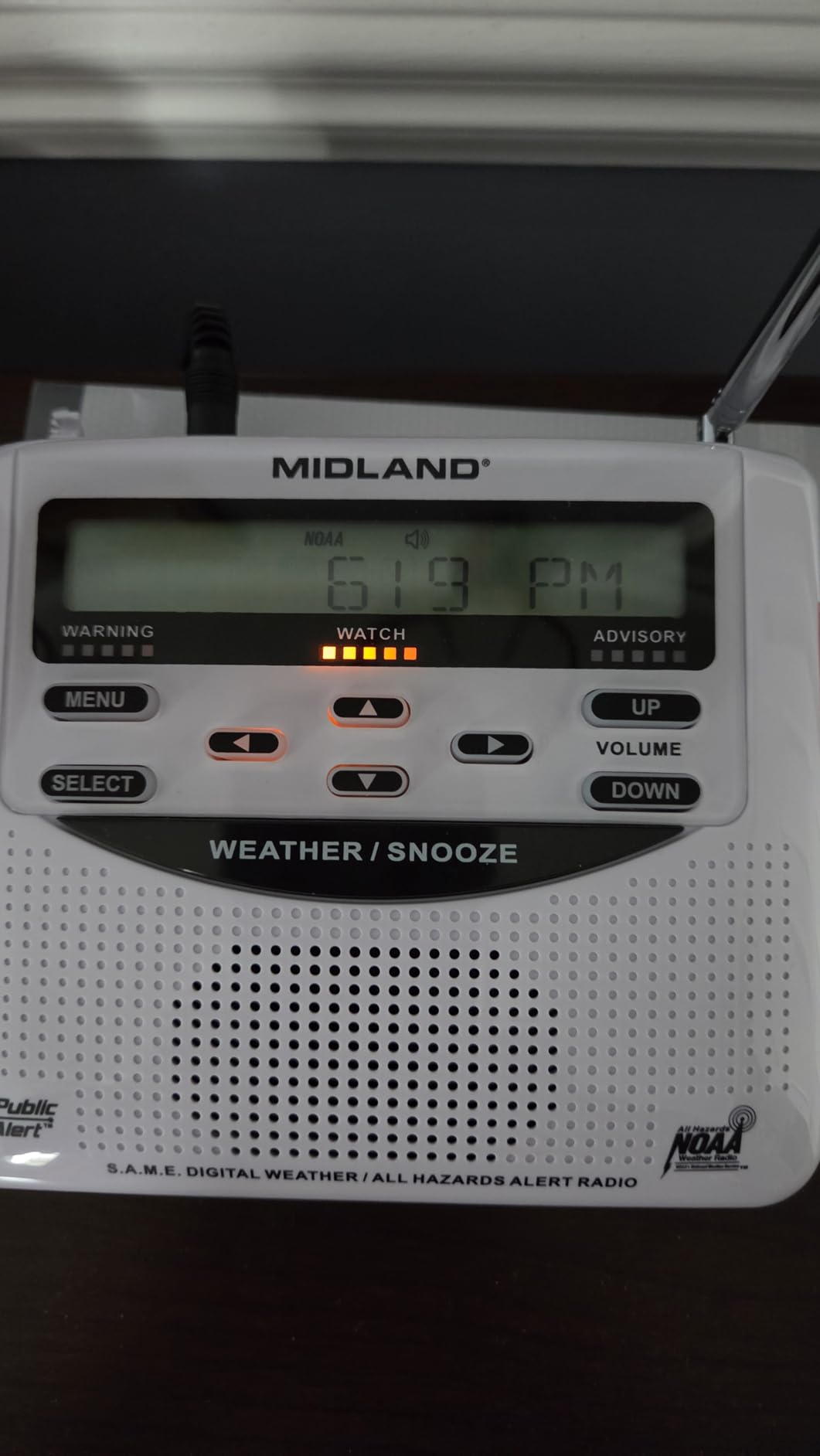
Does it wake you when it actually matters?
The WR120B has a weekly self-test that sounds the alert tone so you can confirm transmission is still arriving. That single feature has turned up over and over in owner reviews, because most radio failures are silent ones — the unit looks fine and simply stopped receiving.
Set the volume so the siren is uncomfortable at 3 a.m. rather than pleasant at noon. A test tone that feels too loud during the day is calibrated correctly for the moment you need it.
Where should it go in a home?
Bedside is the right default, close enough to your pillow that the alert does not have to cross a hallway. Because reception degrades underground, do not put your only radio in a finished basement. Owners running two units put one upstairs and one near a window on the main floor.
This is also the model to buy if anyone in the house is hard of hearing. It is a dedicated alarm rather than a general receiver, so it can sit on volume without anybody having to tolerate local music all day.
2. FosPower NOAA Emergency Radio A1 – Best Emergency Weather Radio for Homes on a Budget
FosPower NOAA Emergency Weather Radio A1 7400mWh Solar Hand Crank (Orange)
7400mWh power bank output
Hand crank and solar
2W speaker
310 g
Pros
- Most heavily reviewed radio in the category
- Solar panel and hand crank plus AAA backup
- Power bank tops up a phone
- LED reading light plus separate 1W flashlight
- NOAA plus AM/FM reception
Cons
- Small 2W speaker is modest for room-filling audio
- Solar panel mainly maintains charge rather than rebuilding a depleted cell
More than 37000 owner ratings have built up around this unit, which makes it the safest first weather radio to buy. It does three jobs at once: NOAA receiver, hand-crank and solar charger, and a power bank.
Its 7400mWh bank is listed in the spec sheet as a 2000mAh rating, and that distinction matters if you are planning to charge a modern phone with it. It is a top-up, not a rescue. What it does well is keeping the radio itself alive when the grid is gone and the weather is still coming.
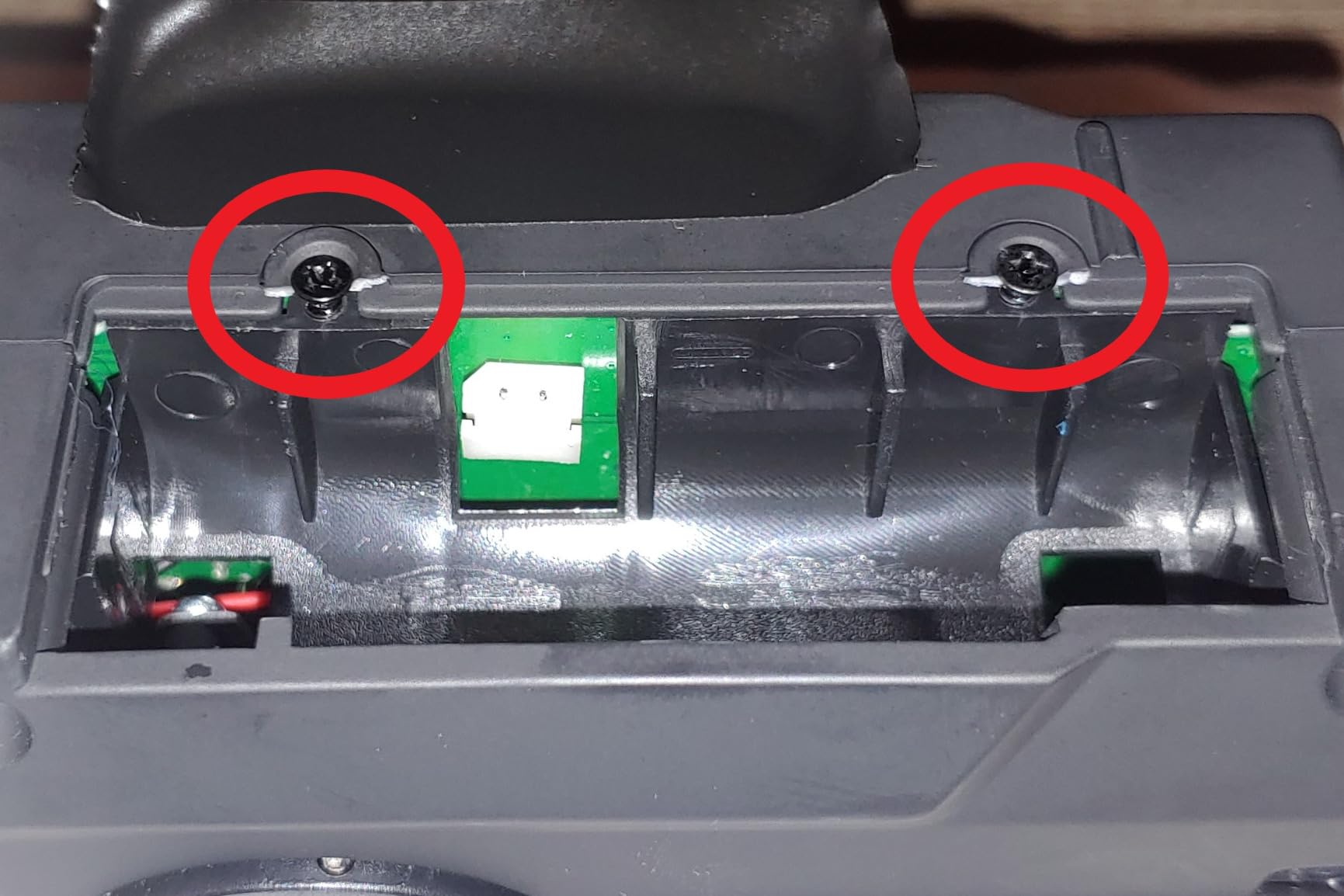
The lighting is the sleeper feature. A 4-LED reading panel and a separate 1W flashlight means you can read a map and cross a dark hallway without draining the same lamp. The limited lifetime warranty is also unusual in this category, where one-year coverage is the norm.
Sound is where it concedes. A 2 watt speaker fills a bedroom and reaches the next room, but it is not the radio you will want playing music in the kitchen. If audio quality is not your priority and resilience is, this one carries its weight.
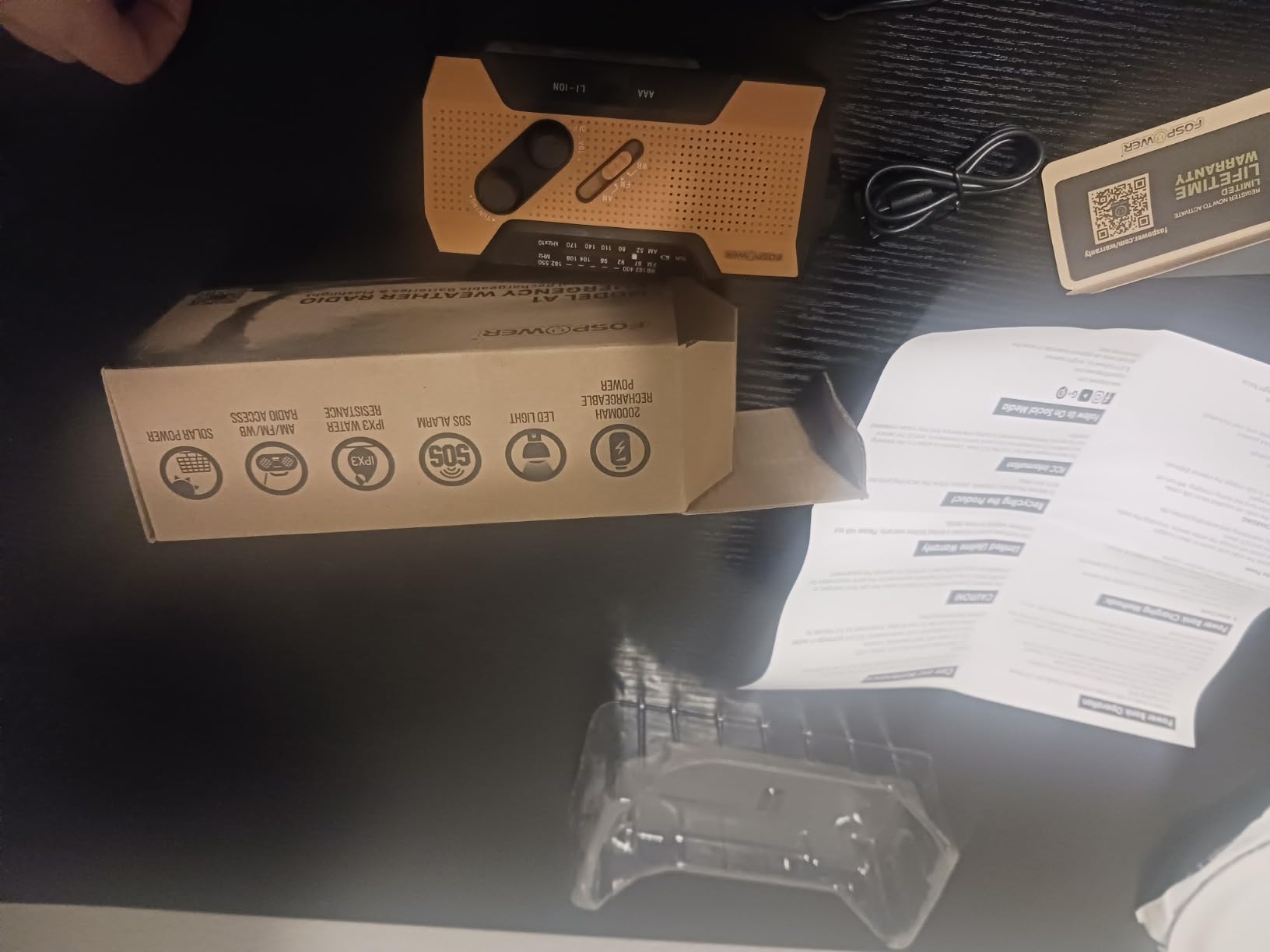
Is the hand crank and solar actually worth relying on?
Treat solar as a maintenance function rather than an emergency function. Reviewers are consistent on this point: the panel keeps a battery topped up from a partial charge, and it does not resurrect a cell that has been fully drained for weeks.
The crank is the same story in miniature. It will bring a radio from flat to listenable, slowly. If your outage plan depends on regenerating a dead lithium pack from nothing, choose a radio with a bigger internal battery rather than a bigger crank.
How many of these does one household need?
One is genuinely enough for an apartment or a small house, because the power bank lets you run it for days rather than hours. The low weight at 310 g also makes it the easiest radio here to move between rooms when a storm tracks differently than forecast.
For a two-storey home or a household with a basement and a garage, pair it with a mains-powered desktop unit. The crank radio goes wherever you spend the hours you do not want to be surprised.
3. Raynic 5000mAh Solar Hand Crank Radio – Best for Hands-Free Alert Scanning
Raynic Emergency Radio, 5000mAh/18500mWh Weather Radio, Solar Hand Crank Radio with AM/FM/SW/NOAA Alert, Cell Phone Charger, Headphone Jack, Flashlight and SOS Siren
Auto NOAA scanning
5000mAh battery
3W flashlight and 2.5W lamp
IPX3
Pros
- Alerts fire without manual station selection
- Very bright flashlight and reading lamp
- Six-way charging flexibility
- Compact at under 15 oz
- Owners report better reception than larger home units
Cons
- Not waterproof despite outdoor positioning
- Rubber port cover does not stay shut
- Short telescoping antenna limits weak-signal reception
- No S.A.M.E. county programming
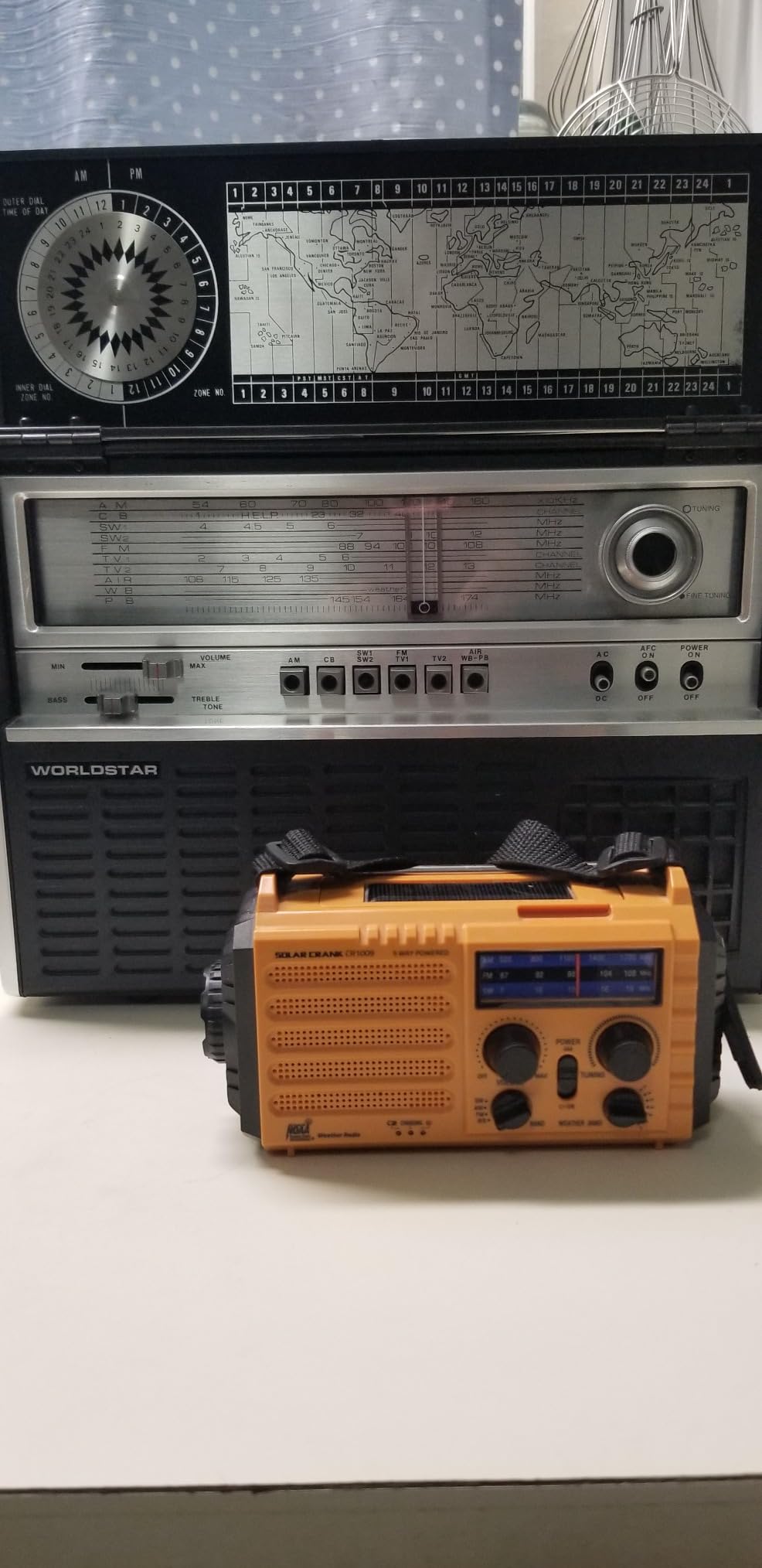
The Raynic CR1009Pro scans the NOAA band automatically on power-up and keeps scanning in standby. That single behaviour is what separates it from several crank radios lower on this list, where you have to be listening on the right frequency to hear anything at all.
Reception surprised us in a good way. Multiple owners report it pulling in weaker signals than their larger desktop units, which tracks with the 6.8 by 3.7 by 2.9 inch body keeping more antenna clear of the housing than a chunkier stationary design.
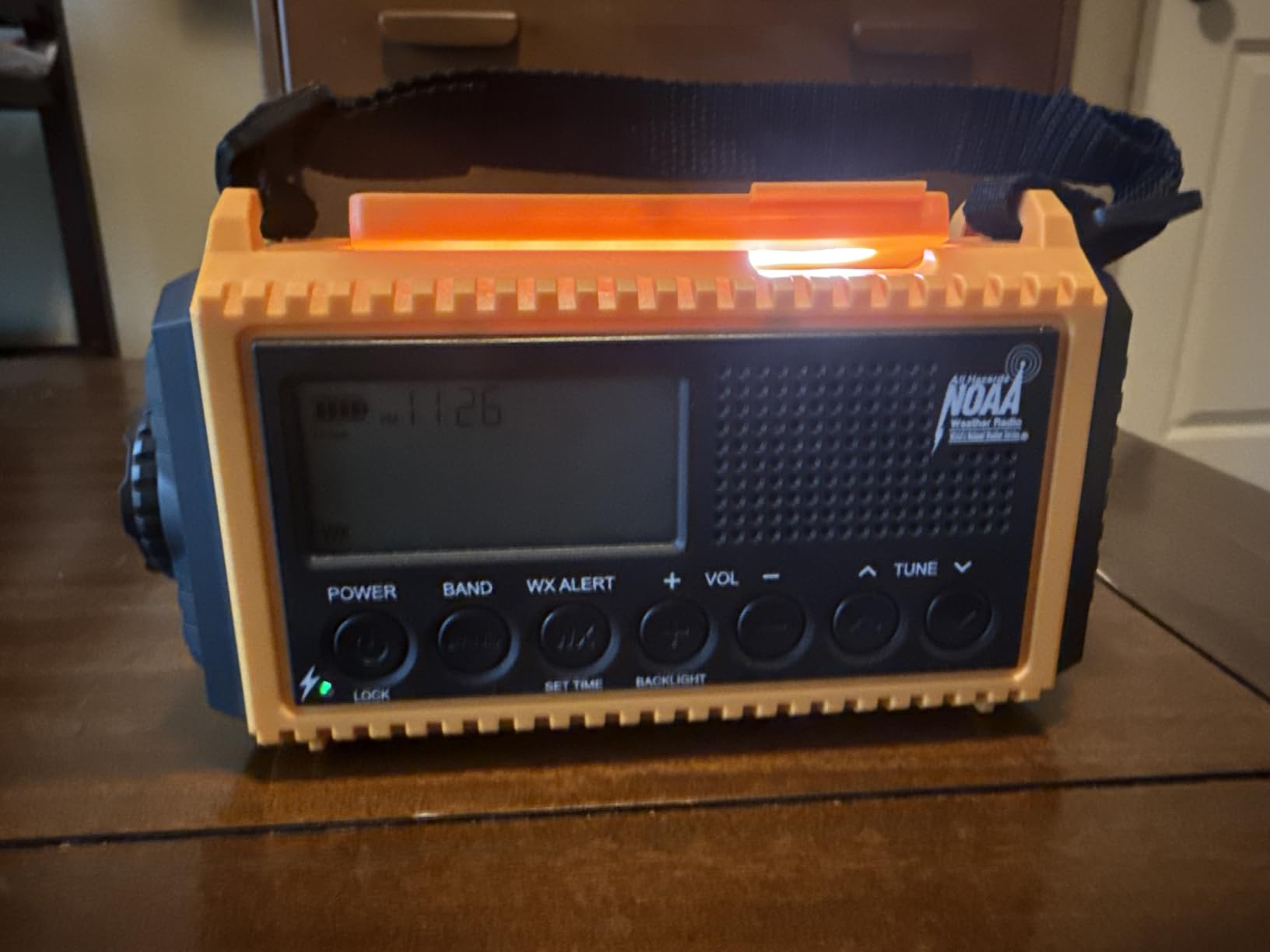
The lighting is genuinely bright: a 3W flashlight plus a 2.5W reading lamp, and reviewers note that both hold their output through long stretches of use with little drain. A 3.5mm headphone jack is included, which is rare in this class and lets one adult listen privately without muting the siren.
At 16 ounces with a carabiner and compass included, it is a radio that will not get left behind in a drawer. The six listed power sources, including a 5000mAh internal cell and USB phone charging, give it more ways to stay on than most.
What does missing S.A.M.E. cost you?
Without county programming you hear every alert your NOAA transmitter broadcasts, not just your own area. During a busy severe-weather weekend that means more beeping than you need, and it is the single most common complaint among owners.
If you live in a quiet rural county with few neighbours, that is a fair trade. If you are near a metro area where one transmitter serves many counties, expect overnight wake-ups you cannot program out.
Can it handle a garage or a damp basement?
The spec sheet lists IPX3 water resistance, which means splash resistant rather than waterproof. Owners point out that the rubber port cover does not reliably stay shut, so standing water around the case is still a bad idea.
Keep it upstairs and away from a workbench where water sits. It is light enough that relocating it after a weather warning is a reasonable habit rather than a chore.
4. Eoxsmile NOAA Solar Hand Crank Radio – Best for All-Band Reception
Eoxsmile Emergency Radio with NOAA Weather Alert, Solar Hand Crank Portable
AM FM shortwave and 7 NOAA bands
5000mAh battery
5W speaker
Five power sources
Pros
- Loud siren with bright flashing alert light
- Five power sources work with no mains power
- Good reception across all bands including shortwave
- Bright lights held output through 12 hours
- Compact and light at under 15 oz
Cons
- Alerts only fire in standby or Alert mode
- No water resistance
- Phone charging output is slow at about 1A
- Internal battery is not user replaceable
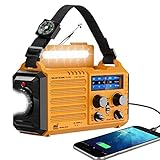
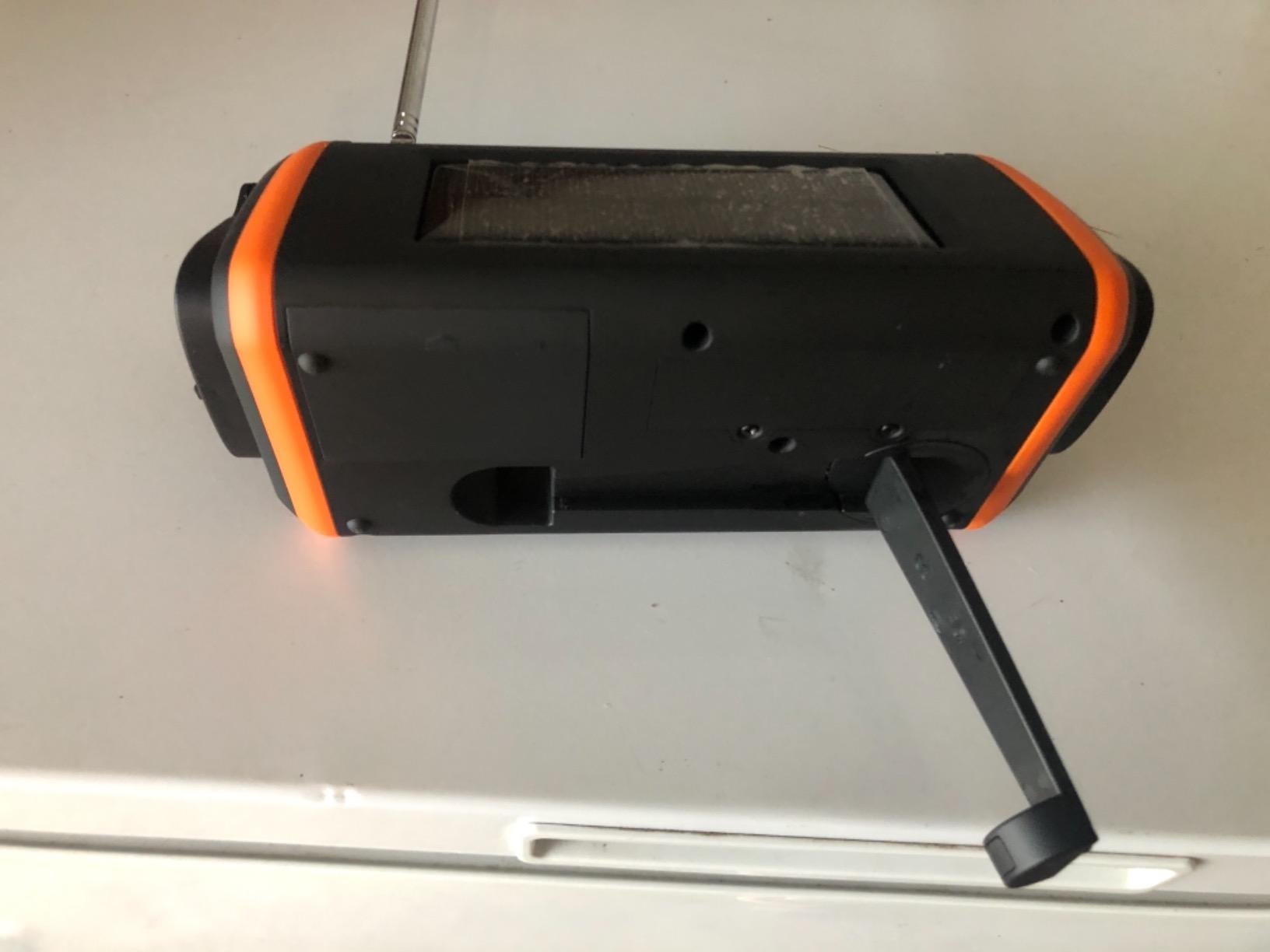
The Eoxsmile covers the most ground of any radio here: FM, AM, shortwave from 7 to 19 MHz, and all seven NOAA bands in a 14.88 ounce body. The 5 watt speaker is also among the loudest we tested, which is why it wakes a household that sleeps through lighter sirens.
NOAA alerting here is NWS-certified with a nine-second SOS alarm and a red flash. The alert sound is the point of the device, and this one does not need coaxing. Reviewers consistently praise how audible it is from another room.
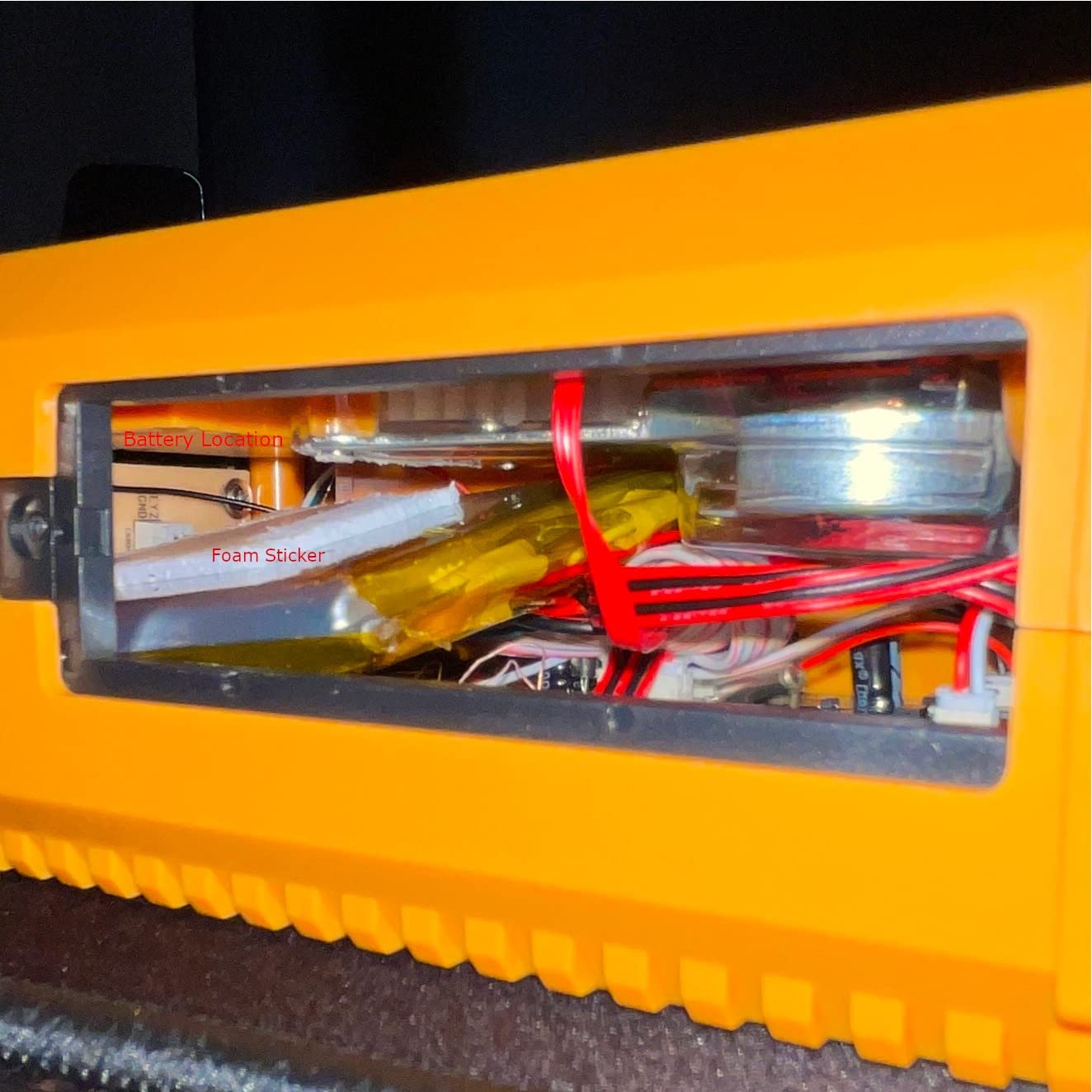
Five power sources include a hand crank, a solar panel, USB-C input, a 5000mAh rechargeable cell, and a compartment for three AAA batteries. That last one is the underrated part: alkalines are the only battery you can buy in a hardware store during the outage you are worried about.
A 3W LED flashlight reaching about 80 metres sits alongside a 2.5W reading lamp. The compass, hand strap and hang buckle mean it can live on a wall hook rather than sliding behind a sofa cushion.
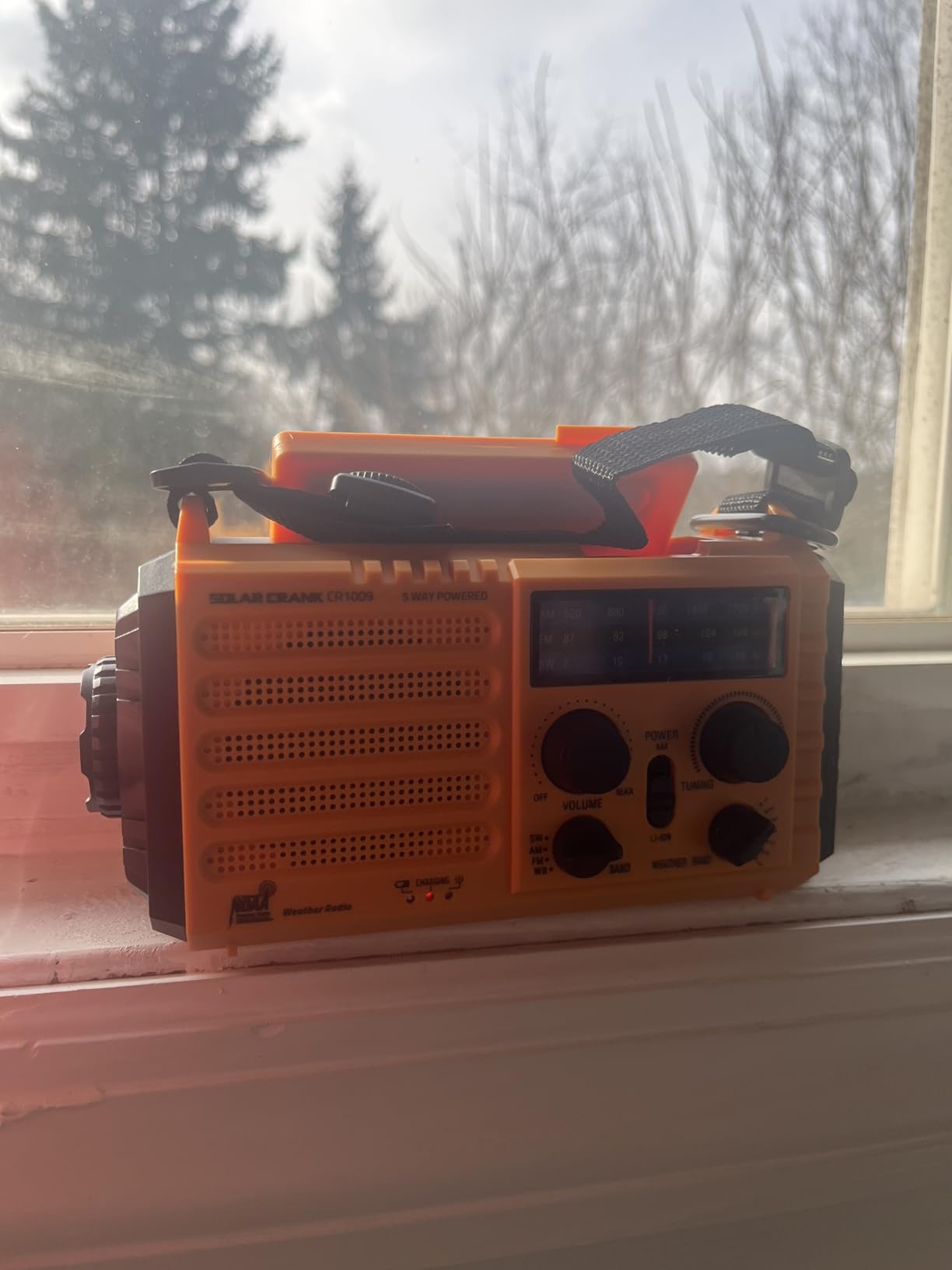
What happens if you switch to AM or FM?
This is the caveat to read carefully. Alerts fire in standby or in Alert mode, but not while you are actively listening to a different band. If you plan to run the Eoxsmile as an ordinary radio during calm weather, you are giving up the thing that makes it an emergency device.
Decide in advance whether it lives as an alarm or as a radio. Most owners keep it as an alarm and reach for a phone when they want music.
Is shortwave actually useful in a home emergency?
Shortwave reaches stations hundreds of miles away, which is useful when local infrastructure is the thing that failed. It is also slow, fiddly to tune, and largely irrelevant during a tornado warning, which is a local event.
Treat the shortwave band as insurance for a regional infrastructure failure rather than a daily feature. For most households the AM/FM band plus NOAA is where the practical value sits.
5. Leaton 10000mAh NOAA Radio – Best Emergency Weather Radio for Homes in Damp Locations
Leaton Hand Crank Emergency Radio, NOAA Weather Radio AM/FM,10000mAh
10000mAh battery
IPX6 splash resistance
Three-mode flashlight
About 1.1 lbs
Pros
- Battery capacity far beyond 5000mAh rivals
- Genuine IPX6 splash resistance
- Three flashlight modes plus a reading lamp
- Large controls easy for older adults
- Usable while plugged into USB-C
Cons
- NOAA is manually tuned only with no automatic alerts
- No S.A.M.E. county programming
- No headphone jack
- Real USB output is about one phone charge
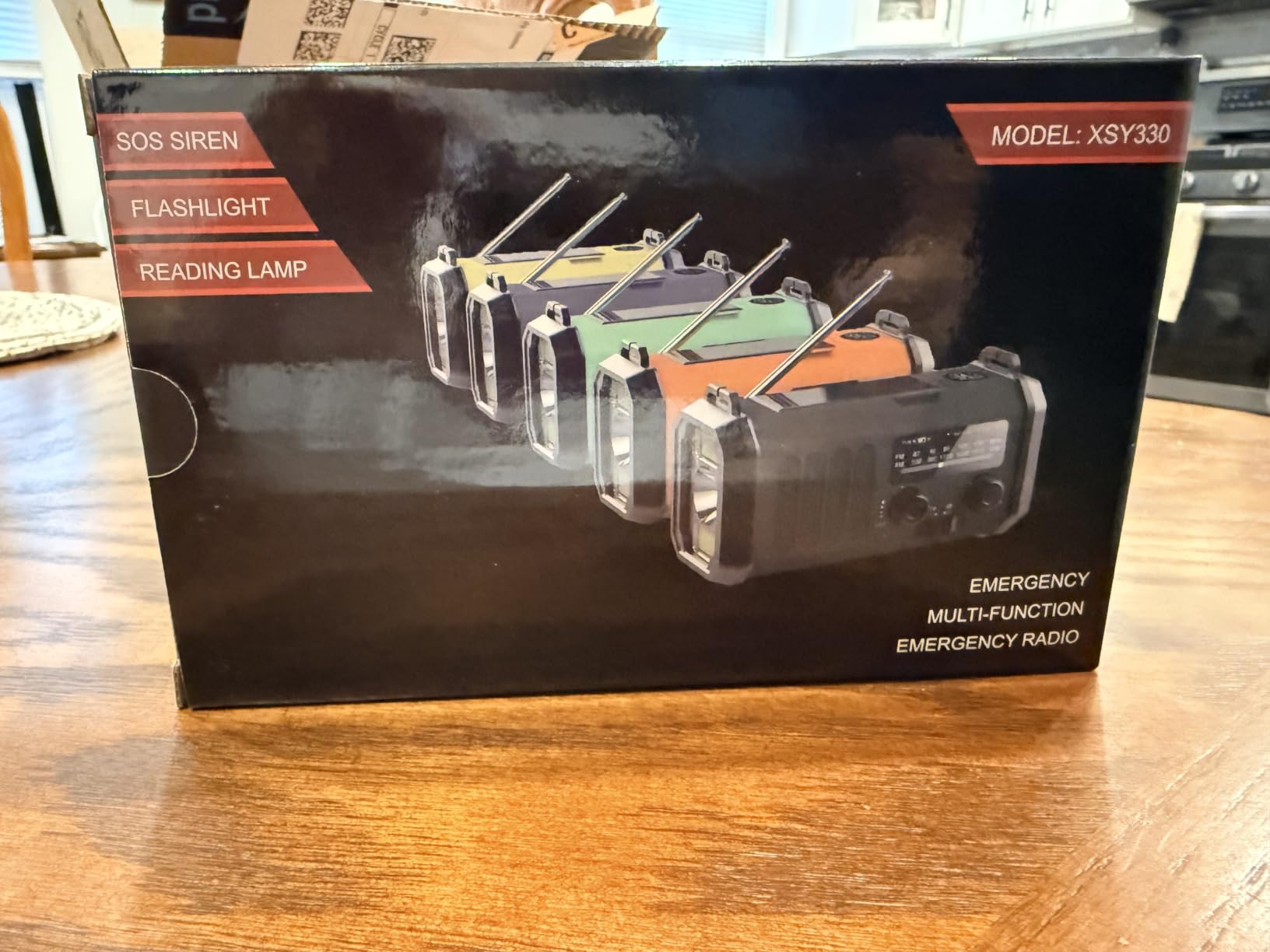
The Leaton’s argument is physical. It carries a 10000mAh battery and an IPX6 splash-resistance rating, making it the most meaningfully water-resistant unit in this roundup. For a garage, a workshop, a basement entry or a flood-prone coastal home, that changes what you can place where.
The 5V/1A USB output will top up a phone, though as reviewers point out, 10000mAh is a cell rating and conversion losses mean you are looking at roughly one full phone charge. Treat it as emergency communication, not as a power bank for a weekend.
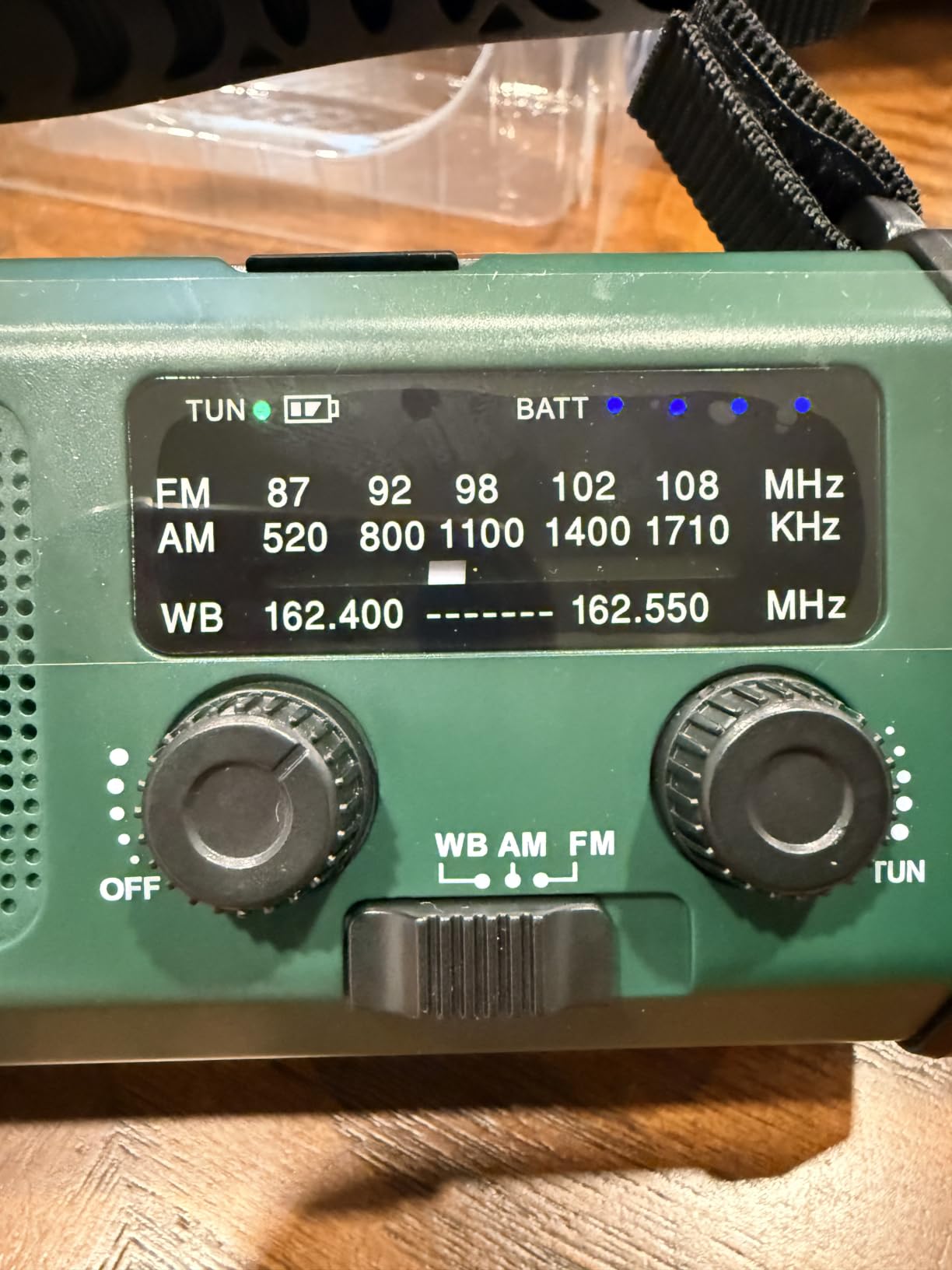
Large physical controls earn more credit than they should. In a household with an older adult, oversized buttons and a readable layout remove the guesswork from operating a device at 4 a.m. with the power out. The three-mode flashlight, high, low and SOS, plus a 1.3W reading lamp, cover both a signal and a task light.
The built-in compass and roughly 1.1 pound weight make it a plausible go-bag item for a driver, though 600 grams is heavier than the FosPower or Eoxsmile.
What does manual NOAA tuning mean in practice?
You select the NOAA frequency yourself on the 162.400 to 162.550 MHz band, and the radio does not interrupt anything for you. It sits on that channel and plays continuous NOAA audio, but a warning will not override the station you are listening to.
That is workable for a person who spends their day listening to NOAA, and wrong for a device you put in the corner and forget. If hands-free waking is your requirement, choose a radio with automatic alerting instead.
Is IPX6 enough for a basement?
IPX6 protects against powerful water jets, so a humid basement, a splash from a utility sink or a leaking pipe are covered. It is not a submerged rating, so do not plan to float the radio through a flooded hallway.
Pair it with a mains-powered desktop unit in the finished part of the house. This is the one for the corridor where moisture collects.
6. PRUNUS AM/FM/NOAA Table Radio – Best Reception Sensitivity in the Roundup
NOAA Weather AM FM Portable Radio, 3 D Batteries or AC Adapter Powered
7 NOAA channels with AM/FM
5W speaker
D cells or AC adapter
1.3 lbs
Pros
- Pulls in weak rural stations others miss
- 5W speaker carries across a room
- Cheap to keep on battery standby for months
- Simple knobs and scale older users can read
Cons
- No automatic NOAA alert notification
- Poor selectivity causes ghost signals
- Weak bass and thin treble especially on AM
- Recessed and imprecise dial indicator
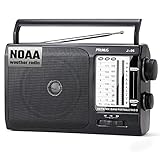
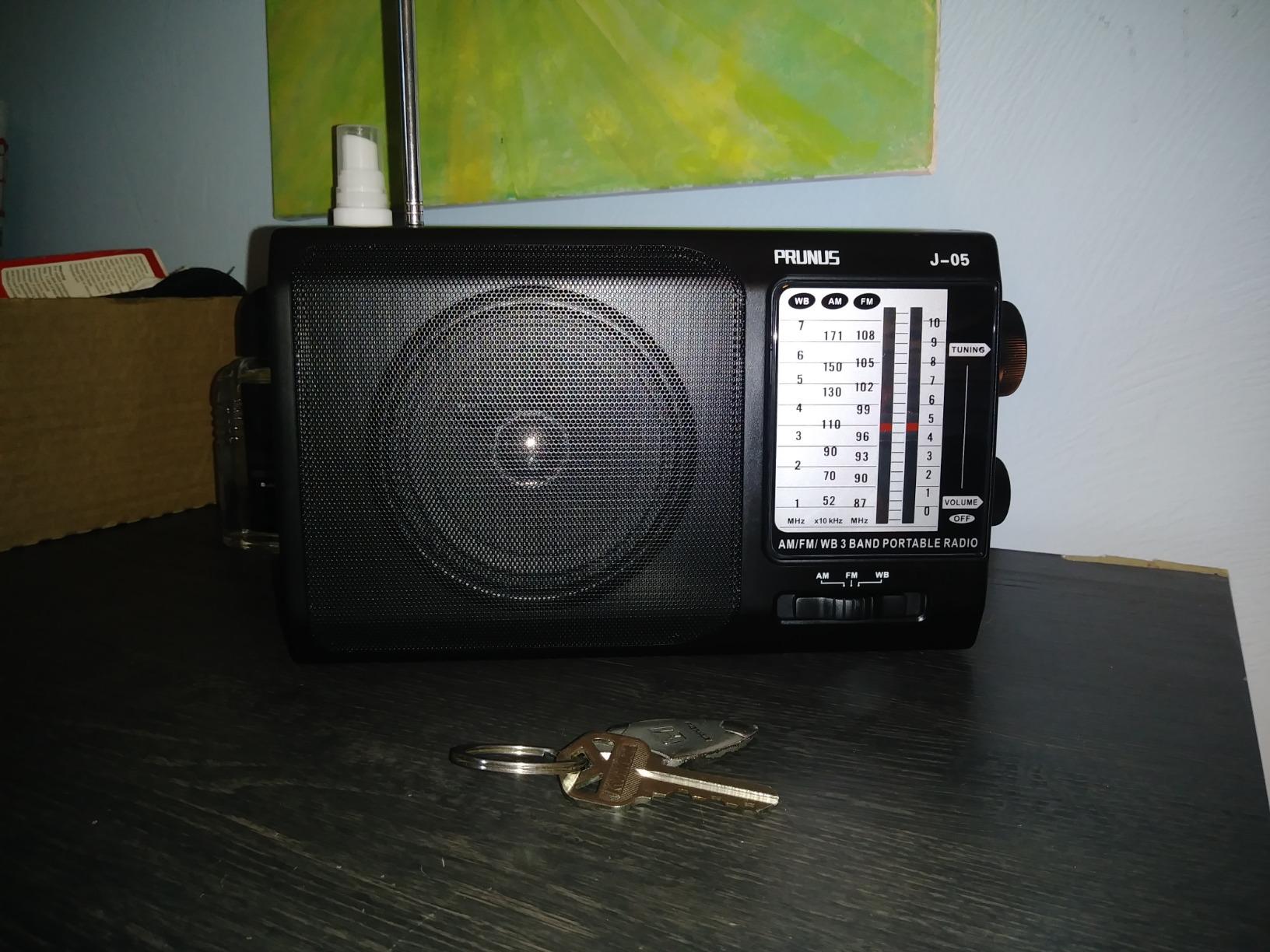
The PRUNUS J05 is the analog holdout, and it exists because reception is not solved by adding features. With a DSP chip and a telescopic antenna across seven NOAA channels plus FM 87 to 108 MHz and AM 520 to 1710 kHz, reviewers credit it with pulling in weak rural stations that costlier digital units miss.
That is not a fluke of the design. Reviewers repeatedly describe it outperforming more expensive NOAA radios on sensitivity, and the 5 watt speaker carries across a room in a way the smaller portable units cannot.
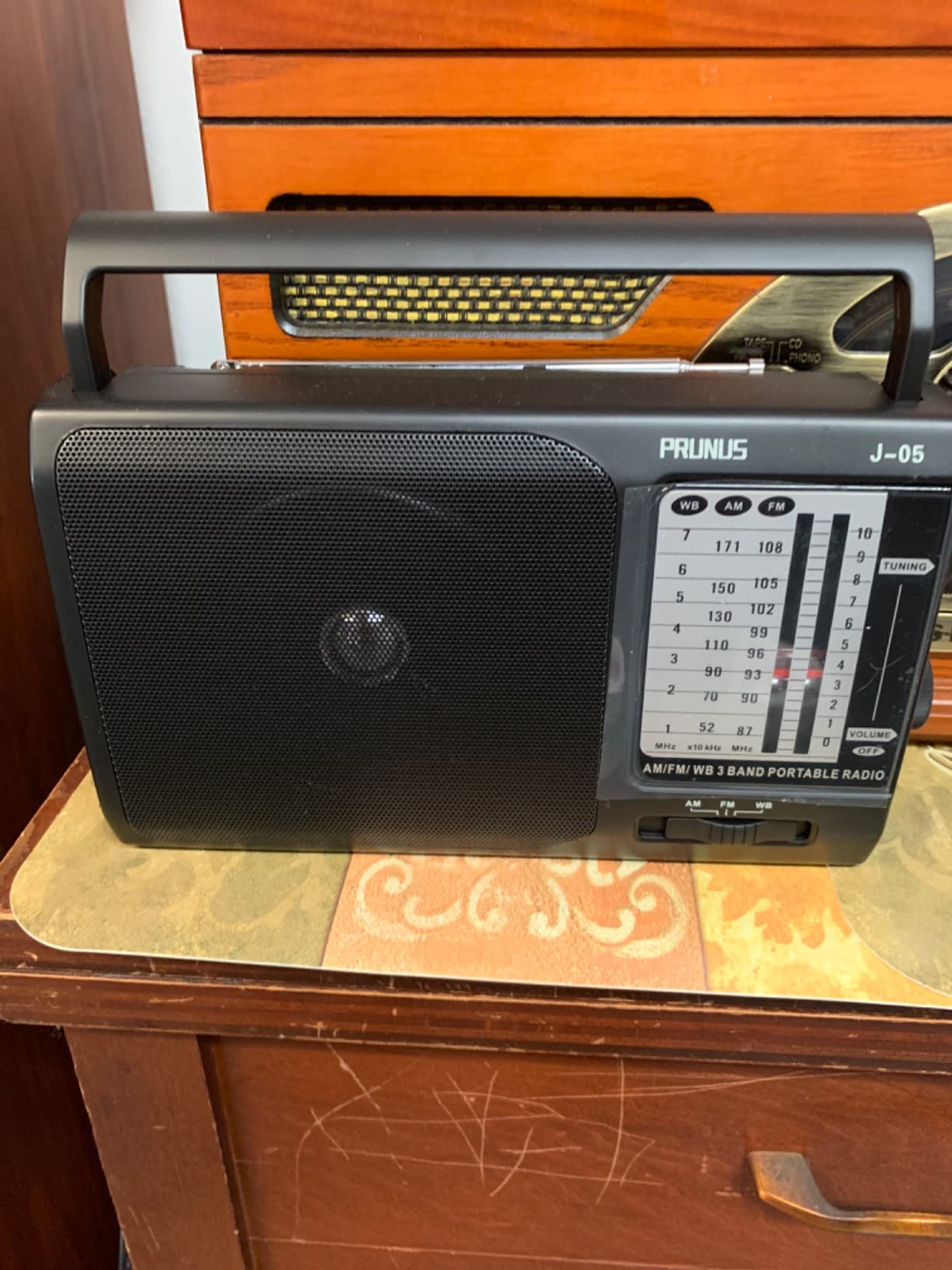
Power flexibility is a genuine advantage in a home. Three D cells or the included AC adapter, and the manufacturer rates roughly 36 days of operation at two hours a day. Leaving a mains-powered radio running 24 hours a day on alkalines is a running cost nobody should sign up for.
Large tuning knobs and a readable frequency scale make it the easiest unit here for a non-technical user. There is a 3.5mm headphone jack for anyone who wants the broadcast privately.
What do you lose by giving up digital?
Two things. There is no automatic alert notification, so you are responsible for monitoring the weather band yourself. And selectivity is poor, which means you get ghost signals flanking strong stations — audible, inelegant, and occasionally confusing on a crowded AM band.
Audio quality is thin, with weak bass and a treble that turns shrill on AM. If you plan to use this as a music radio, look elsewhere. If you plan to use it as a monitoring post, that is a fair trade.
When is analog the right choice for a home?
Rural and mountainous homes, where the NOAA transmitter sits far enough away that a marginal digital signal drops out completely. Analog degrades gracefully — the audio gets noisy and you still understand the message. Digital units simply go silent.
It also suits anyone who already runs a long-term listening habit and just wants weather monitoring bolted on. For that user the PRUNUS is arguably the most complete answer here.
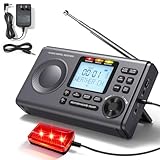
7. RunningSnail SAME Alert Console – Best for Cutting Down Nuisance Alerts
RunningSnail NOAA Weather Radio with 80+Emergency Alerts, 23 S.A.M.E Localized Programming County Codes, Battery Backup, Alarm, Selectable Alert Tone (with External Antenna & External Warning Light)
80+ toggleable alert types
S.A.M.E. for 23 counties
110dB siren
External antenna and light
Pros
- Fine-grained S.A.M.E. control cuts irrelevant county alerts
- Per-alert-type toggles silence nuisance warnings
- Very loud 110dB siren for night waking
- External antenna and warning light improve home coverage
- Long battery backup runtime
Cons
- Lowest average rating here at 4.2
- Alert-only device with no AM/FM bands
- Larger tabletop form factor than portable models
The RunningSnail MD329 solves the problem most households hit in their second month of owning a weather radio: alerts you do not care about. It offers 80+ selectable alert types with individual on and off toggles, so you can silence routine statements while keeping the ones that move your family to a basement.
On top of that, S.A.M.E. programming covers up to 23 county codes in All, Multiple or Single county modes. Combined, those two controls let you build an alert profile that fits your household rather than your transmitter’s coverage map.
The siren output is listed at up to 110dB, which is aggressive. If anyone in the house has a sleeping infant, a light sleeper, or a pet that reacts badly to sirens, that figure deserves a test before you commit to it.
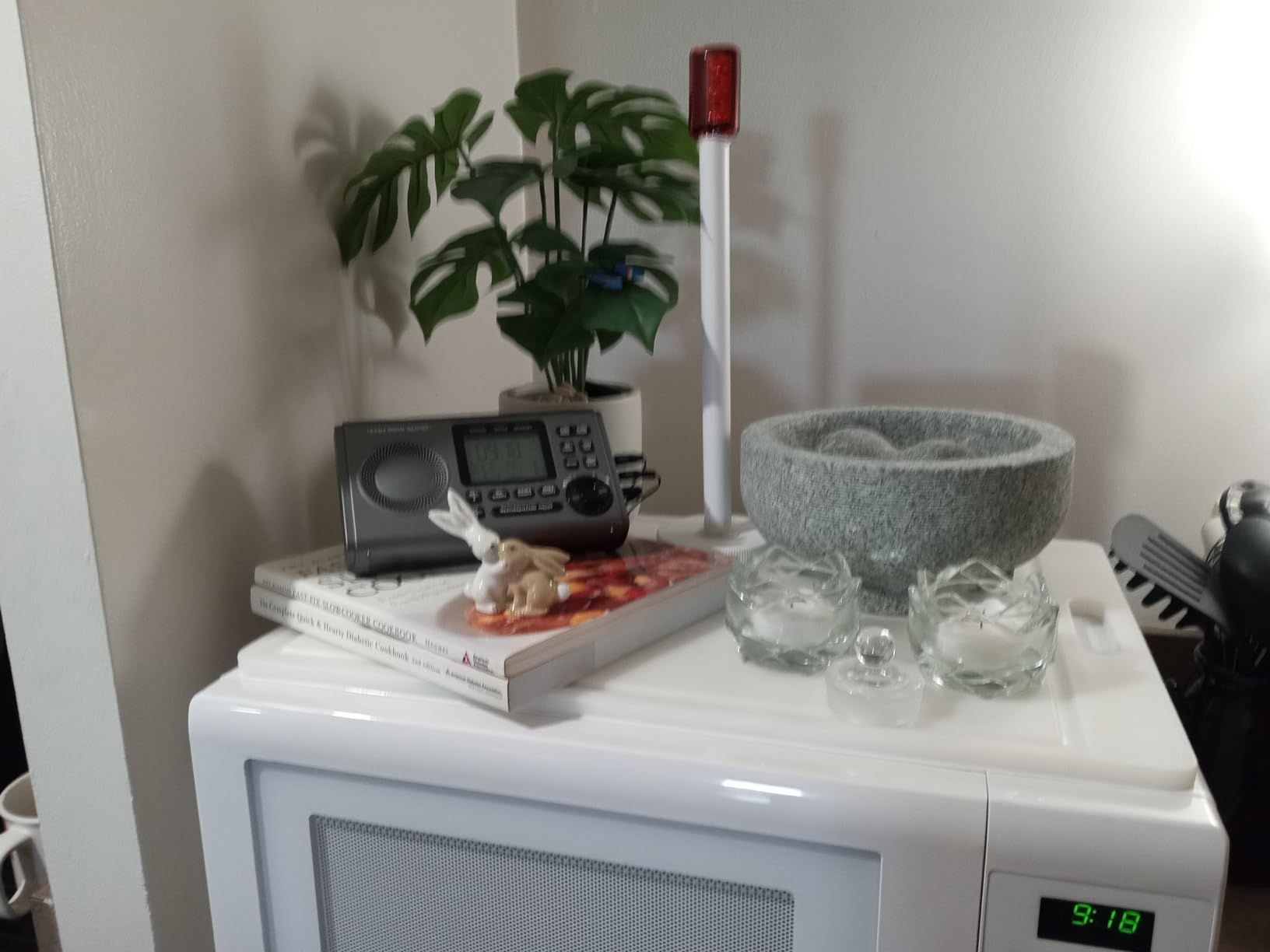
Two extras make it more home-specific than most alert radios: an external antenna and an external warning light in the box. The light lets you put the beacon in a hallway and the radio in a room where the wiring reaches.
What do you give up for all that filtering?
It is an alert console, not a general radio. There are no AM or FM entertainment bands, so it does nothing but receive NOAA. If you want one device for morning news and overnight warnings, this is not it.
The 4.2 average reflects that narrow brief rather than a fault. Buyers who wanted versatility rate it lower; buyers who wanted a silent bedroom and a siren when it matters rate it well.
Is 110dB safe in a family home?
It is loud enough to startle a sleeping adult fully awake, which is exactly what a tornado warning needs. It is also loud enough that repeated false activations become a genuine problem in a house with young children.
Before final placement, run the weekly test at full volume with everyone in the house. If the reaction is discomfort rather than alarm, turn it down a setting. The 16-step control range gives you room to do that.
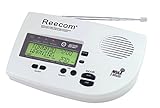
8. Reecom R-1630C SAME Alert Radio – Best for Knowing When an Alert Ends
Unique 200 Hours Battery Time, Reecom R-1630C S.A.M.E Weather Alert Radio
26 county code memories
16 siren volume levels
Up to 200 hours on batteries
Pros
- Turns itself on automatically when an alert issues
- EOM detection stops the siren the moment an alert ends
- Individual alert types can be disabled
- Countdown shows how much of the alert window remains
- Long-term owners report units still working a decade later
Cons
- Programming has a noticeable learning curve
- Menu beeping on every button press during setup
- Larger than expected with no wall-mount option
- Some units arrived with internal rattle
The Reecom does two things almost no other radio here does. It powers itself on when a real alert is issued, even from a cold standby, and it detects the end of the message so the siren stops immediately rather than running on for several minutes after the broadcast finishes.
That second behaviour is the one that keeps it alive in a household. Most alert radios keep screaming long after the useful information is over, which teaches people to ignore them. This one shuts up when it should.
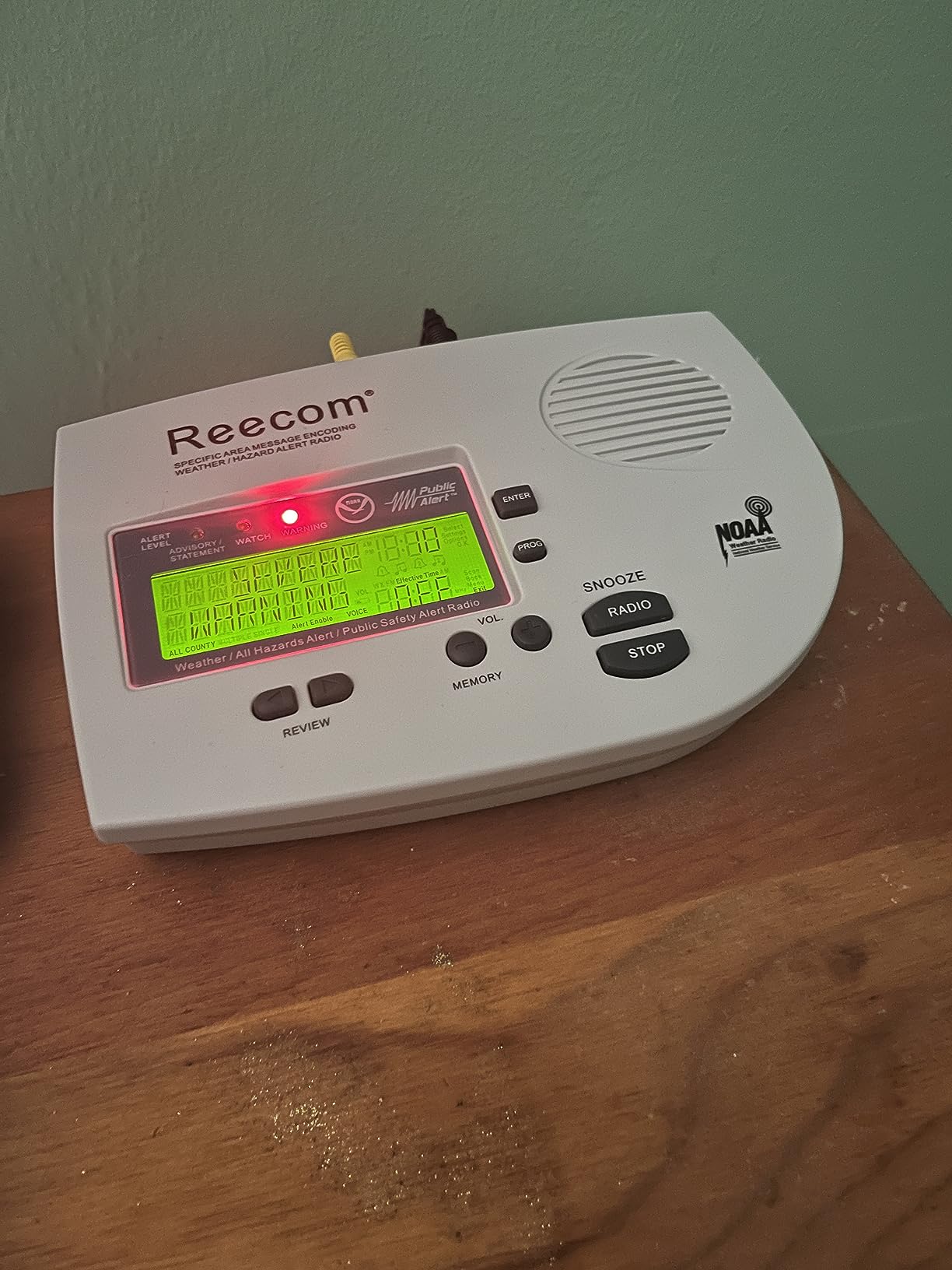
There is an event effective-time countdown adjustable from 15 minutes to six hours, 25 event memories with date and time, and per-event siren disable across up to 48 messages. In other words, you can see that a warning has 40 minutes left to run and decide whether that matters tonight.
Power endurance is the quiet headline: up to 200 hours on four AA cells, or the included AC connection. At 16 ounces and 90dB with 16 siren volume levels, it is a serious alert console rather than a portable.
How hard is the setup, really?
Harder than the manual suggests. Owners consistently report a real learning curve for programming, plus menu beeping on every button press that makes the first ten minutes irritating. Budget an evening with the manual open rather than assuming you will do it in two minutes.
The payoff is a dual alarm clock with snooze, an auto-calendar real-time clock, and event history you can scroll back through. If you like knowing what happened at 2 a.m. last Tuesday, that history is unusually useful.
Who should buy this instead of a Midland?
Somebody with a low tolerance for false alarms, or a household where someone is on medication that makes a sudden 3 a.m. siren genuinely dangerous. Automatic power-on and end-of-message detection reduce both the shock and the false starts.
Skip it if you want a radio you will carry to a shelter or load into a car. At 8 by 5.4 by 1.85 inches with no wall-mount option, this is furniture for a fixed spot.
9. Midland ER40 Emergency Crank Weather Radio – Best Mainstream Brand Crank Radio
Midland ER40 Emergency Crank Weather Alert Radio with Flashlight
2600mAh rechargeable battery
Hand crank and solar
NOAA alerts
14 oz body
Pros
- From the best-known name in US weather radios
- Ranks second in its category on steady demand
- Cranks and solar top up the internal battery
- Compact 14 oz body with integrated flashlight
Cons
- Smallest battery capacity in this roundup at 2600mAh
- Modest review base for a Midland model
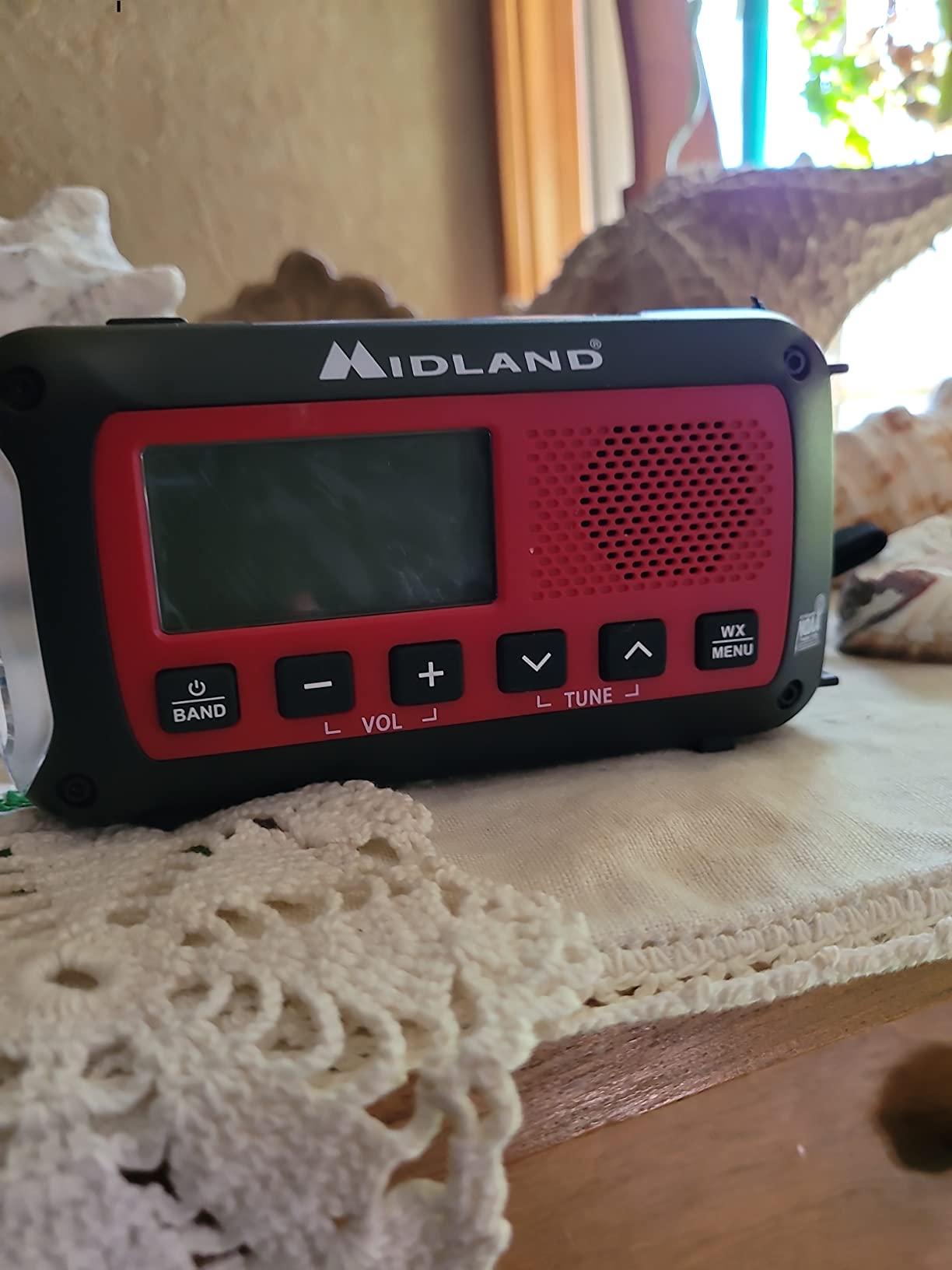
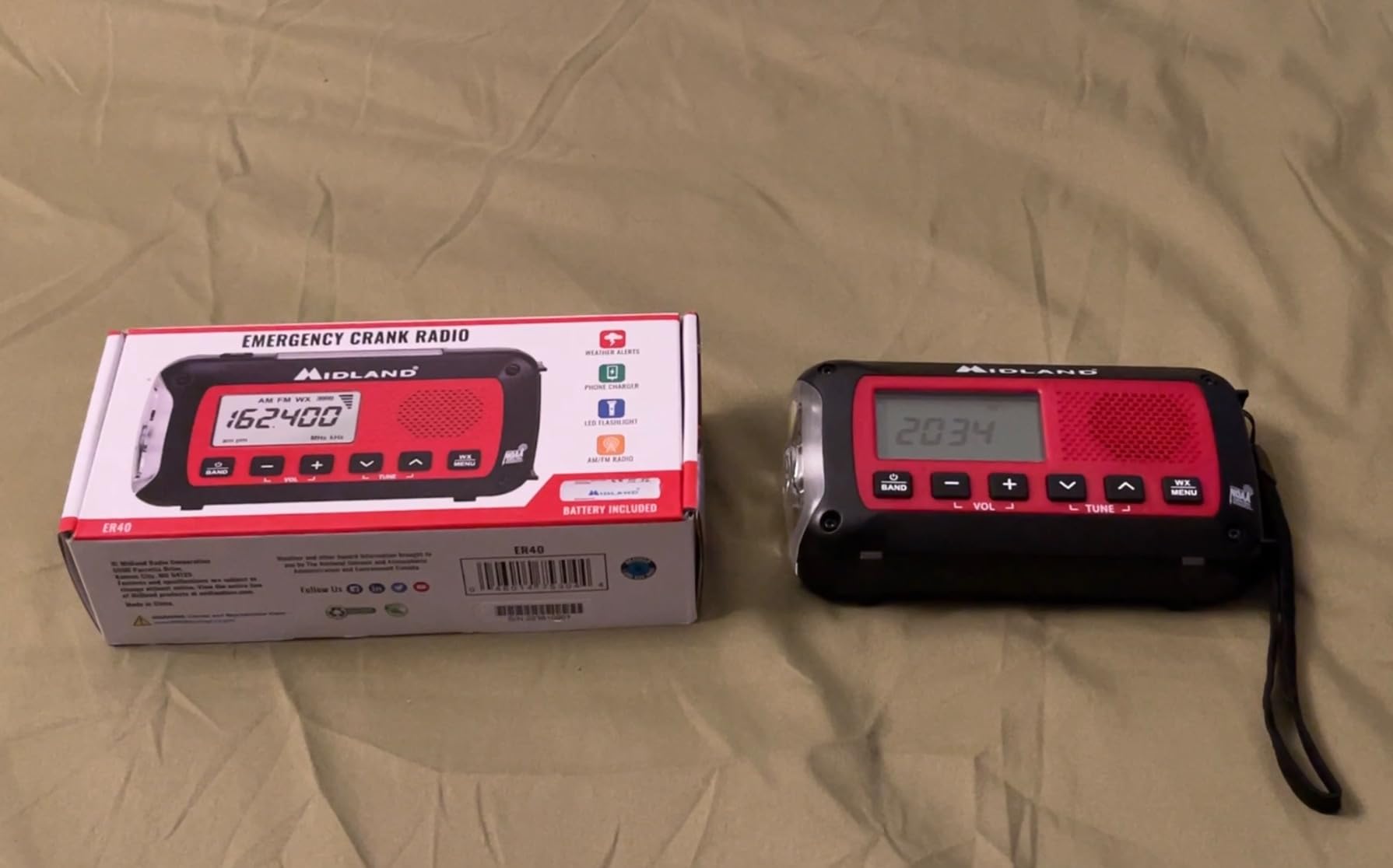
There is a reason Midland dominates weather radio searches, and the ER40 is that reason in portable form. It is the brand people recognise, with a hand crank, a solar panel and NOAA alerts in a 14.08 ounce red housing that costs less attention than anything else in the kitchen drawer.
It works exactly the way the label implies. Crank or solar to top up the 2600mAh internal cell, listen to NOAA, use the built-in flashlight when the power goes out. The LCD keeps the essentials readable in the dark.
Where it falls short is capacity. A 2600mAh cell is the smallest in this group, and it is roughly half what the FosPower and Raynic units carry. In a multi-day outage where you also need the flashlight, that difference becomes visible.
What you get instead is simplicity and brand confidence. If you are buying for an older relative who will not read a manual, a device from the most familiar name in the category removes one variable from the decision.
How long does 2600mAh realistically last?
Long enough for an overnight event with the flashlight on sparingly, short of a multi-day outage where the radio is also your light source. If your region gets ice storms and extended power cuts, battery capacity is a feature worth paying more for.
For a household that wants NOAA monitoring during daytime storms and normal music otherwise, the smaller cell is an acceptable trade for a smaller, lighter unit.
Is a Midland portable a substitute for a mains-powered desktop radio?
No, and this is the pairing most homes end up with. The ER40 goes in the go-bag, the car, or the room where the outlet is inconvenient. A mains-powered desktop unit with AAA backup handles overnight waking.
Think of it as two different jobs: one device to keep you informed while mobile, one to wake you when something bad happens where you sleep.
10. Mesqool 12000mAh NOAA Radio – The Highest-Rated Emergency Weather Radio for Homes
Weather Radios Portable AM FM NOAA Alert with Battery Backup 12000mAh
12000mAh lithium cell
8500mm solar panel
5W speaker
1.6 lbs body
Pros
- Highest average rating here at 4.7 with 85 percent five-star reviews
- 12000mAh is more than double the capacity of most rivals
- Oversized solar panel charges faster in low light
- Upgraded crank delivers about twice standard efficiency
- Ergonomic grip and large knob usable in the dark
Cons
- Heaviest unit here at 1.6 pounds
- Noticeably slower to move between rooms than the sub-1-pound portables
At 4.7 stars with 85 percent five-star ratings, the Mesqool CR1030 is the most consistently praised radio in this roundup. The reason is unglamorous engineering: it has the largest battery, the biggest solar panel, and a crank built with a larger copper coil and reinforced magnet than the standard copy.
The 12000mAh figure is genuine and converts to 44400mWh. That is more than twice the capacity of the most common 5000mAh portable, and it is the difference between a radio that lasts an outage and one that runs out on day two.
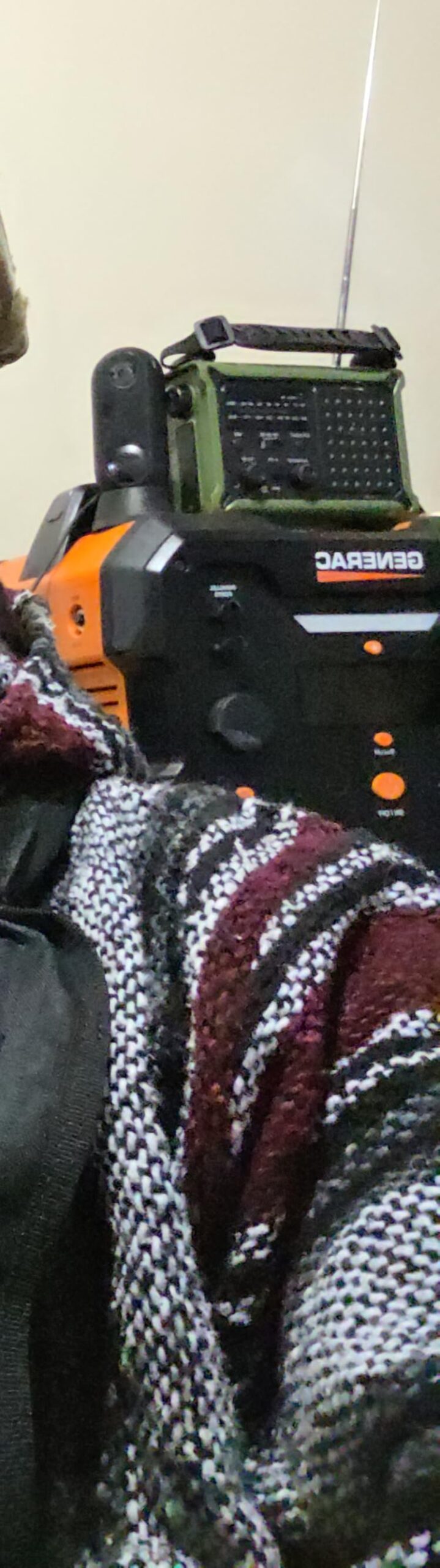
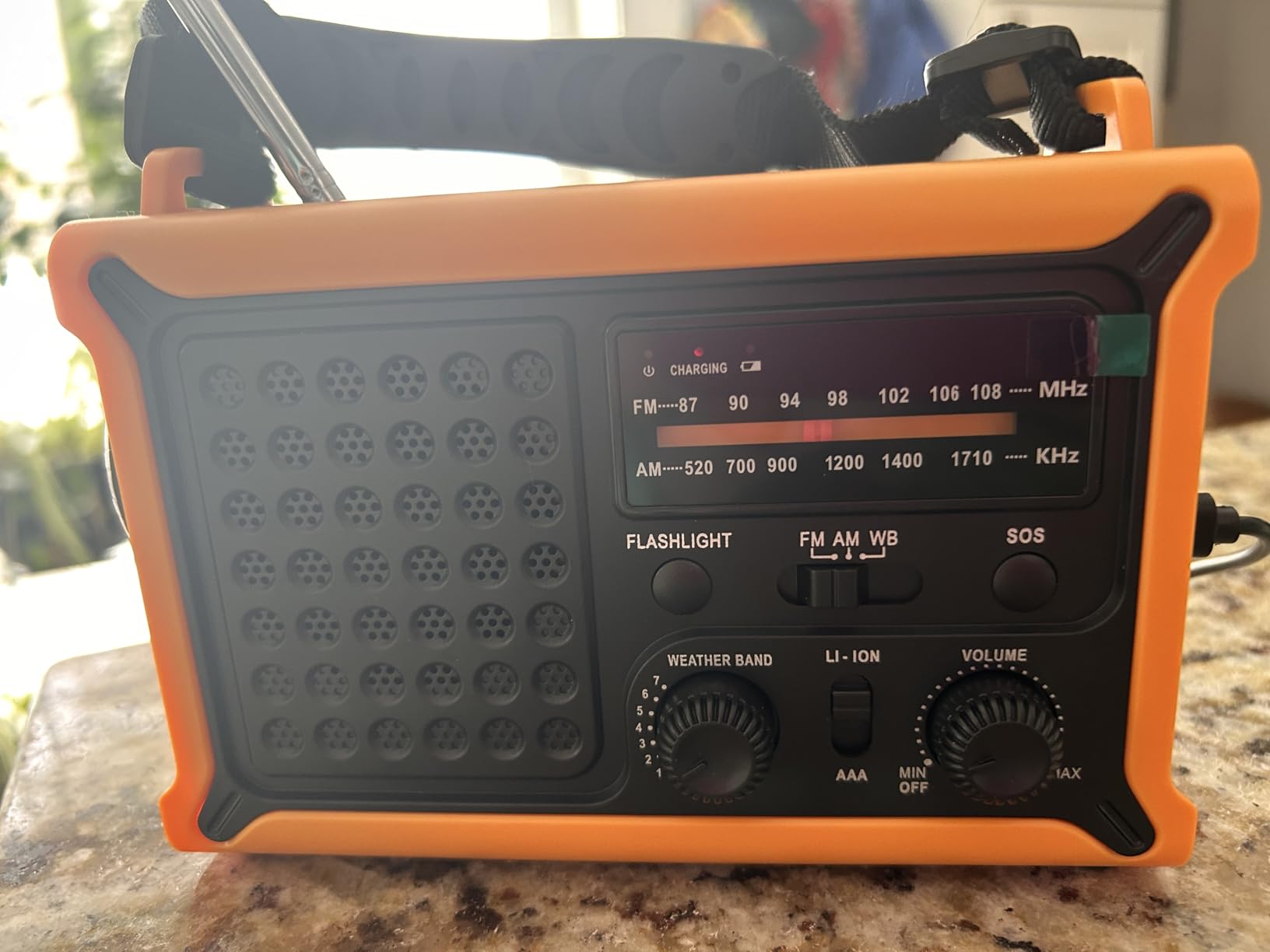
Its 8500mm square monocrystalline solar panel is listed as over four times the area of a typical portable panel. Reviewers single out faster charging in low light as the practical difference, which is the condition you care about during a multi-day overcast outage.
NOAA, FM and AM reception comes with noise reduction, the speaker is 5 watts, and the flashlight reaches about 260 feet with a frosted reading lamp alongside it. Both lights have two brightness levels. A three-year replacement warranty backs the whole thing.
What does the extra battery capacity buy you?
It buys independence from external power. Five ways to run the radio, including a 12000mAh cell, solar, hand crank, Type-C input and included AAA cells, mean a depleted unit is not a dead unit. That matters most in winter storms, when cold cuts battery performance and daylight is scarce.
It also lets the flashlight and reading lamp run without rationing them, which is where most households unknowingly sabotage their own radio by dimming the lights to save power.
Is 1.6 pounds a problem at home?
Only if you planned to carry it far. At home it is a countertop or nightstand object with an ergonomic grip and an oversized tuning knob you can find with a fingertip in the dark, both of which are deliberate design choices rather than accidents.
Its 1164 reviews are a solid sample, though far smaller than the thousands of reviews behind the category leaders. Treat the 4.7 as evidence of consistent satisfaction rather than a permanent guarantee.
11. Eton Red Cross FRX2 Hand Turbine Radio – Best Go-Bag Emergency Weather Radio
Eton American Red Cross FRX2 Hand Turbine AM/FM/NOAA Weather Radio with USB Smartphone Charger and LED Flashlight
Hand turbine charging
AM/FM/NOAA bands
USB phone charger
LED flashlight
Pros
- Recognisable American Red Cross branding
- Hand turbine plus lithium battery removes spare cell storage
- Compact enough for a go-bag or windowsill
- Digital tuner gives clear NOAA and AM/FM reception
Cons
- No S.A.M.E. county filtering so every alert sounds
- Phone charging is very slow and suited to emergency calls only
- No wall adapter included only a USB cable
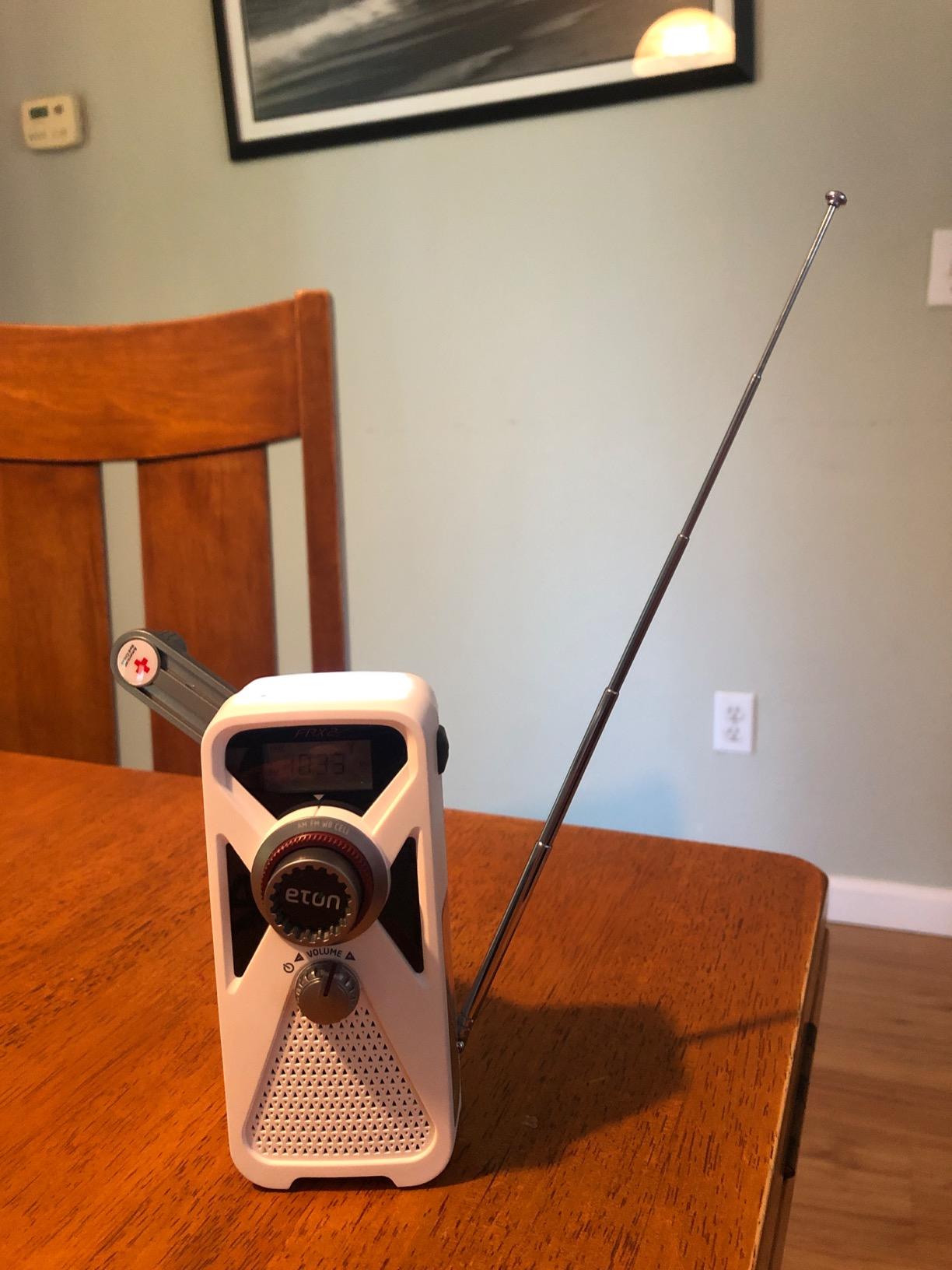
The Eton FRX2 is a turbine radio. You spin the handle rather than cranking it, and the gearing makes that motion far easier on the wrist than a small crank on a cheaper unit. That mechanical difference is real, and it is why this radio works as a go-bag item rather than a drawer item.
The American Red Cross branding is not a technical feature, but it is a legitimate reason to choose it. If a radio lives in a kit you hand to a neighbour or a school, the name on the front communicates what it is for.
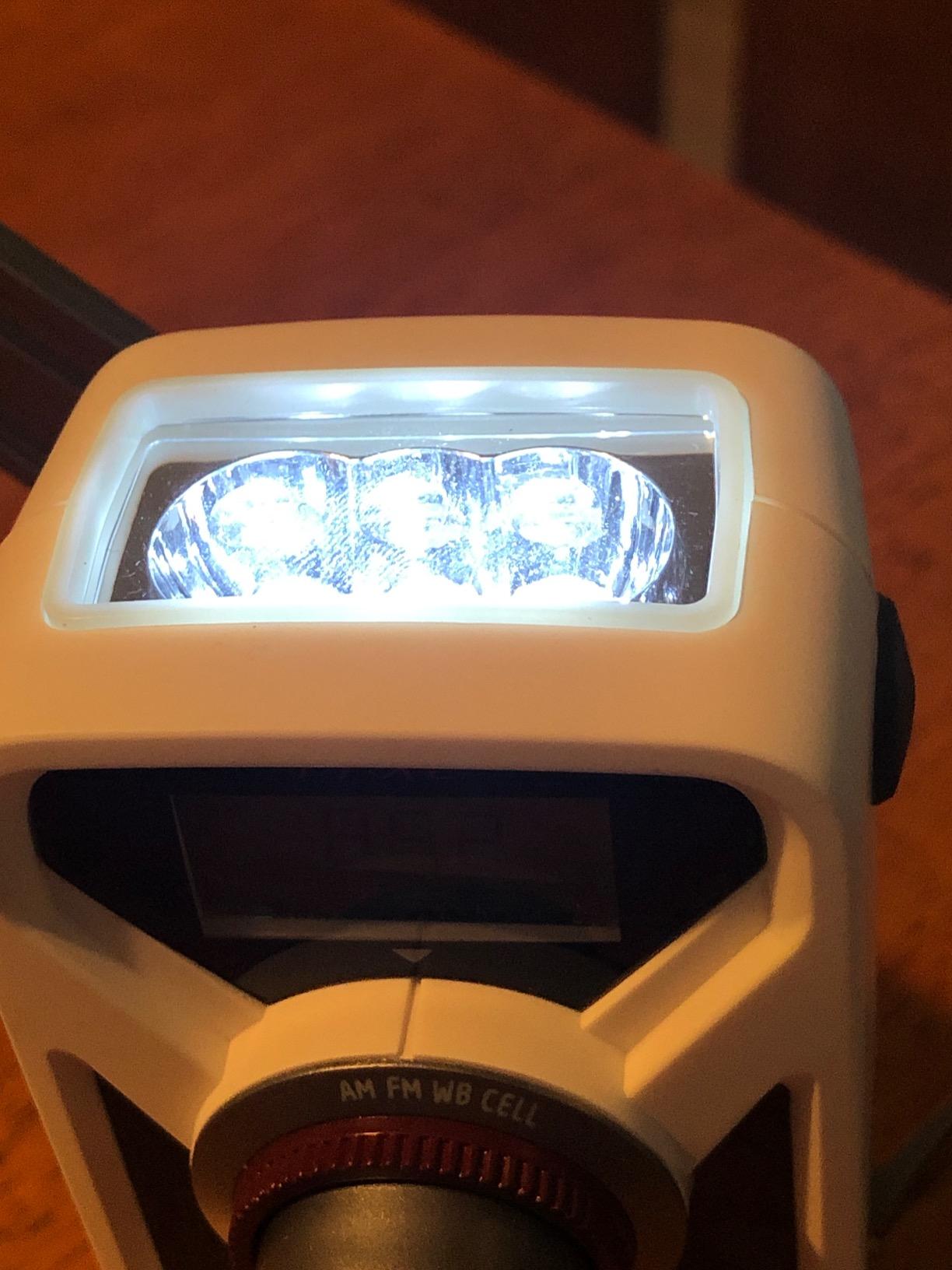
The digital tuner handles NOAA plus AM and FM cleanly, the USB port will charge a phone, and the LED flashlight is built in. There is no need to manage spare cells, which removes the most common way these kits fail in storage.
Reviewers describe reception as solid and storage as easy, and the compact footprint suits a windowsill or a bag. It is a radio you will actually reach for, because it is simple.
What does no county filtering mean for a go-bag radio?
Every alert your NOAA station transmits will sound, including neighbouring counties. In a quiet region that is a non-issue. In a dense metro area it means a go-bag radio that beeps through the night for weather happening somewhere else.
For a grab-and-go kit used in a true emergency, that is arguably the right failure mode. You want every alert when the situation is real, not a filtered subset.
Is the phone charging worth having?
For an emergency call, yes. For anything else, no. Owners describe it as very slow, and it is a small internal cell doing a large job. Plan to use it for one call to a family member rather than as a way to keep a phone alive.
Note that only a USB cable is included, not a wall adapter. Plan on charging it from an existing USB charger or a power bank you already own.
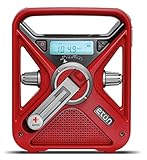
12. Eton Red Cross FRX3 Emergency Radio – Best Full-Room Audio
Eton The American Red Cross Frx3 Emergency Weather Radio With Smartphone Charger Arcfrx3wxr, 14.9 Oz
High-output speaker
Seven NOAA channels plus AM/FM
Crank solar and AAA
1.5 lbs
Pros
- Louder and clearer speaker than the smaller FRX2
- Five ways to power it including solar through a window
- Dump-charges a phone in a genuine outage
- Glow-in-the-dark ring keeps it locatable after dark
- Owners report working units a decade after buying
Cons
- Small 600-800mAh internal battery makes phone charging slow
- No S.A.M.E. county filtering and alert mode blocks other functions
- Power sources switch manually rather than failing over
- Not weather resistant and the port flap only keeps dust out
The FRX3 is the largest radio here at 1.5 pounds, and the size exists for one reason: the speaker. Owners comparing it directly to the smaller FRX2 describe it as audibly louder and clearer across a house, which for an overnight alert is worth real weight on a shelf.
It also has a long memory. Multiple buyers report units bought around 2012 that still work, and the glow-in-the-dark accent ring solves a problem nobody thinks about until they are looking for a radio in a dark hallway with no power.
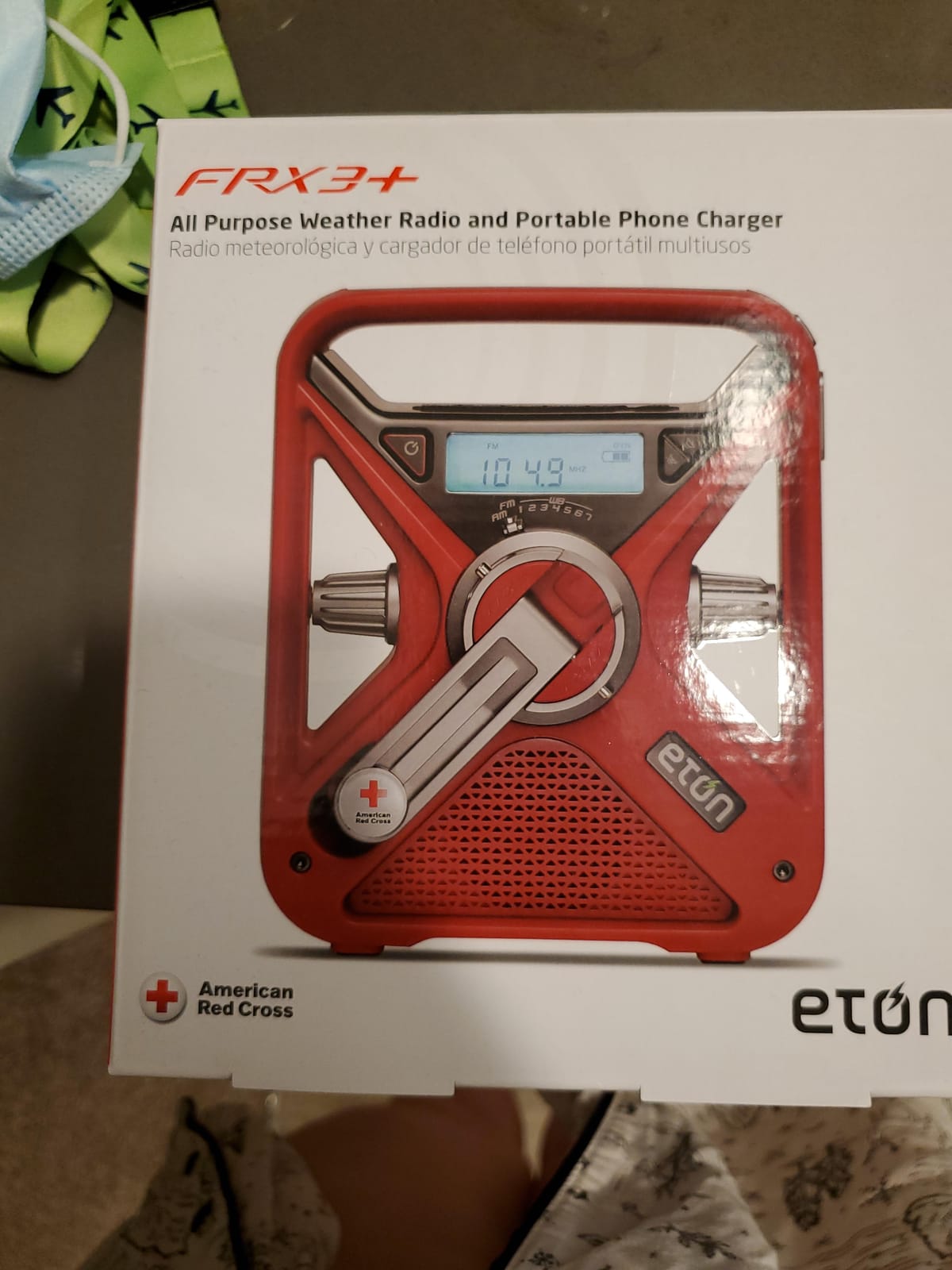
Power options number five: hand crank, solar panel, AAA batteries, USB phone charging, and mains. Seven NOAA channels plus AM and FM, integrated LED lighting, and clock and alarm functions round out a package that can genuinely double as a bedside unit.
The solar panel can trickle charge through a window over a long outage. That is a real slow contribution, but over several days of normal daylight it is meaningful.
What are the quirks you have to live with?
Two stand out. Power sources switch manually, so you must change from mains to batteries yourself rather than relying on automatic failover. And alert mode blocks the other radio functions, meaning you cannot listen to music while the alert setting is active.
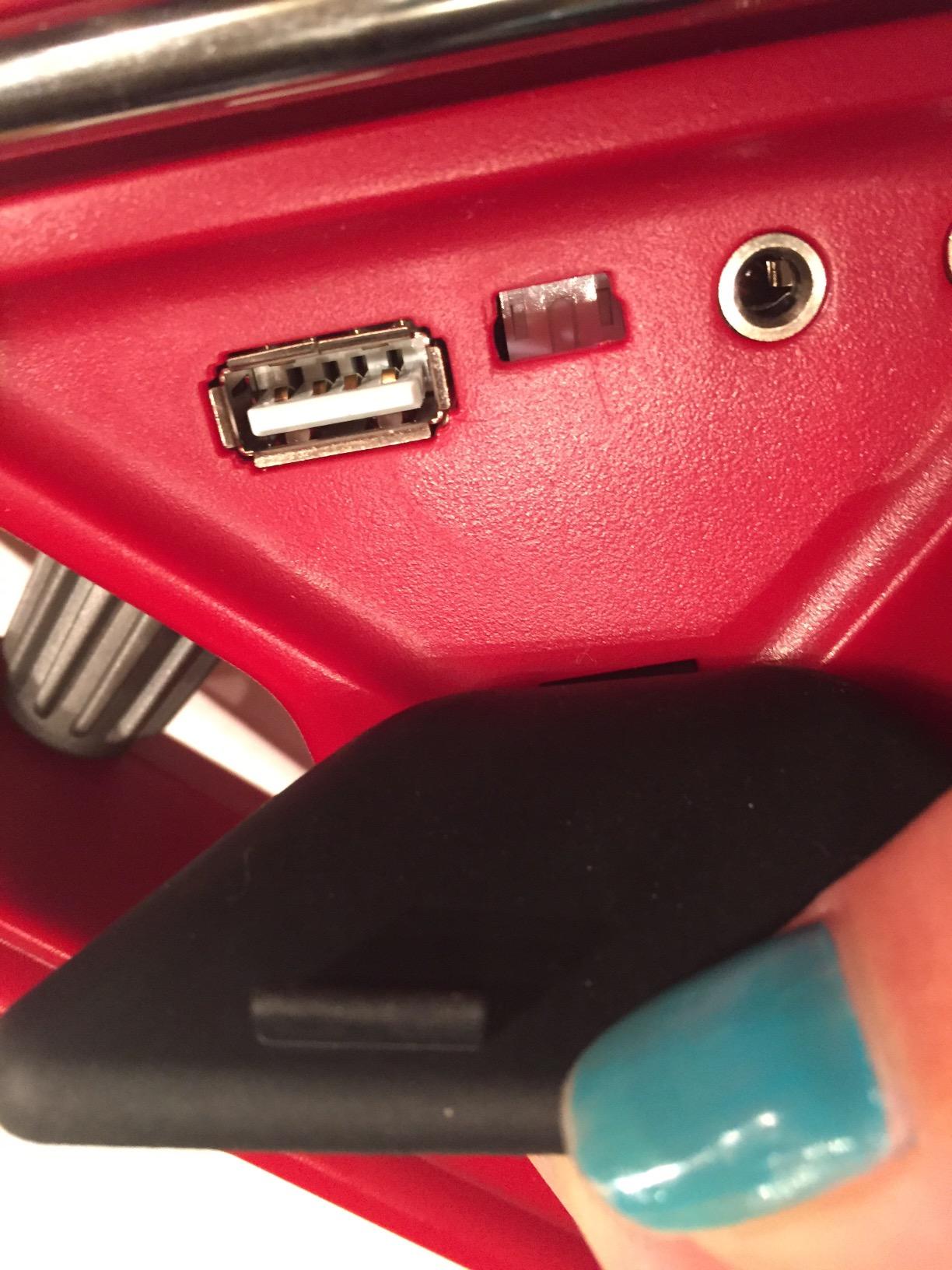
The small internal NiMH battery also means phone charging takes hours, and the unit is not weather resistant. Owners report that the buttons sit under the crank handle and can be pressed accidentally inside a packed bag.
Is the premium worth it over a Midland?
Only for the speaker and the build longevity. If your home is large, or if the people who need waking are hard of hearing, the audio advantage is a genuine benefit that smaller units cannot match at any volume setting.
If you live in a small apartment and want county filtering and a simpler alert profile, a S.A.M.E. capable unit costs less and does the important job better. Buy for the room, not the badge.
Choose an Emergency Weather Radio by Alert Override, SAME Codes and Power Redundancy
Alert override is the only non-negotiable feature
An emergency weather radio for the home must do something a normal radio cannot: interrupt whatever it is playing with a loud alert when the National Weather Service issues a warning for your area. Listings that say “NOAA alerts” without that behaviour are describing a receiver you have to be listening to, which is not an alert.
The Eoxsmile, Leaton and PRUNUS all carry NOAA channels, and all three only alert in standby or on the weather band. That is a legitimate choice for a monitoring post and a poor choice for a nightstand.
SAME county programming keeps alerts local
SAME, Specific Area Message Encoding, is what lets a radio listen for alerts addressed to your county rather than everything its transmitter sends. Midland WR120B stores 25 counties, the RunningSnail handles 23 with per-alert toggles, and the Reecom stores 26. The Eton FRX3, the Leaton and the Raynic have none.
Owners of S.A.M.E.-capable units report the same thing: alerts became hyper-local, and the nuisance wake-ups from neighbouring counties stopped. If you have ever turned a weather radio off because it was too noisy, this is the feature that brings it back.
Power redundancy decides whether it works when mains power is gone
A radio plugged into an outlet with no battery backup is a radio that fails in the exact scenario it was bought for. Look for a mains unit with cells behind it, or a portable with a large internal lithium cell plus AAA fallback.
Be realistic about hand cranks and solar panels. Small solar panels maintain a charge; they do not rebuild a dead battery. A large crank will bring a radio from flat to usable; it will not do it in thirty seconds. If your plan depends on regenerating power from nothing, buy capacity instead.
Advisory, watch or warning: know which one you are hearing
The National Weather Service uses consistent language. A warning means a threat is imminent or already happening in your area and needs action now. A watch means conditions are favorable and you should be ready. An advisory means conditions are less severe but still significant, such as dense fog or a winter weather advisory.
Most household radios are set to fire on everything, which is why users burn out on the sound. Both the RunningSnail and the Reecom let you disable individual alert types, so weekly test transmissions do not become a nightly nuisance.
Put the Main Radio in the Bedroom and the Second One Where You Cook
Placement matters more than most buyers expect. A siren that wakes one person in a house where four others slept through it has not done its job, and reception that fails underground makes a good radio useless in the one room you might shelter in.
Bedside is the default for your main radio. Close enough to hear without crossing a room, positioned away from angled glare that makes the LCD unreadable at night, and set to a volume that would be uncomfortable at 3 p.m. That calibration is the single most important five minutes of setup.
The kitchen or main-floor living room is the second slot, because that is where people spend awake hours and where a daylight flash still helps. Avoid the basement unless your reception there is tested and confirmed, and prefer an upper floor or a position near a window in any below-grade room.
A garage or workshop is a third option for households that live there, and here the Leaton earns its place with a genuine IPX6 rating. Reception in a detached structure is a separate problem from water, so test both before committing.
Two radios is better for most: a mains-powered desktop unit with battery backup at the bedside, and a hand-crank or high-capacity portable in the go-bag or the kitchen. The second radio costs less than a single phone repair and removes the single point of failure that defeats the purpose.
Set Your SAME County Code in Five Steps and Stop the Beeping
County code programming is where most new owners get stuck, and the manuals rarely help. Start at the local office page of the National Weather Service, enter your state and county, and write down the SAME code it gives you before touching the radio.
Then, on most Midland and Reecom models, open the county menu, select Single County mode, enter the code, and confirm. Set alert mode to Voice or Tone rather than both unless you want the redundant full-volume siren. Finally, run the unit’s test or self-test function and confirm it sounds before you walk away.
For a factory reset, the pattern is consistent across these brands: remove the backup batteries, hold the volume or menu button while powering the unit on, and continue holding until the memory clears. On the Reecom the process is buried in a menu and owners report it takes an evening with the manual open, so allow more time there.
If your radio keeps beeping after setup, four causes account for most of it. The weekly NOAA test transmission fires every time by design. A low backup battery chirps. Programming multiple counties instead of one lets a neighbour’s alert through. And some units, including the Eoxsmile, only alert in standby or Alert mode, so switching to AM or FM silently disables the alarm.
Finally, lithium-ion cells stored untouched in a closet lose the ability to take a charge after a year or more, which is the most common complaint from owners of stored portable radios. Once a month, charge the unit to full and run it for ten minutes. Once a quarter, discharge it until shutdown and recharge it. That cycle keeps the cell healthy and doubles as a reception test.
Frequently Asked Questions
What is the best emergency weather radio to buy?
The Midland WR120B is our top pick for most homes. It broadcasts NOAA Weather Radio All Hazards for your county, offers S.A.M.E. programming for 25 counties so alerts stay local, covers over 60 hazard types, and runs on AC power with six AAA cells behind it for outages. It is a stationary alarm designed to sit on a nightstand and wake the house.
What weather radio does the NOAA recommend?
The National Weather Service does not endorse or approve specific brands. It publishes a list of NWR-certified receivers that meet its technical standards, and some models carry Public Alert certification, which guarantees the unit will sound an alert even when the county is not actively transmitting weather. Check the certification label before buying rather than trusting a brand name.
Do I need a weather radio if I have phone alerts?
Keep both. Wireless Emergency Alerts on a phone depend on cell towers and a charged battery, both of which fail in exactly the situations the radio is meant to cover. A NOAA radio draws on mains power with battery backup and reaches a transmitter that keeps running on its own generator, so it keeps working when the phone does not. Use the phone for detail and the radio for the wake-up.
What is a hand crank radio?
A hand crank radio is a portable receiver with a built-in generator. Turning the crank produces electricity that charges an internal battery, letting the radio run without mains power, batteries or sunlight. Crank output varies widely between models, and small cranks mainly top up a partial charge rather than rebuild a dead battery, so treat cranking as a backup method rather than a primary power source.
Why does my weather radio keep beeping?
Four causes cover most cases. The NOAA weekly test transmission fires by design and repeats on schedule. A low backup battery produces a chirp rather than an alert. Programming several counties instead of one lets alerts from a neighbouring area through. And some units only alert in standby or Alert mode, so switching to AM or FM silently disables the alarm until you switch back.
How do I reset my weather radio?
On most models, remove the backup batteries, hold the volume or menu button while powering the unit on, and keep holding until the stored county codes and alert settings clear. On Reecom models the reset sits inside the menu rather than on a button, so expect to spend an evening with the manual. After clearing, reprogram your SAME county code before setting the radio back on your nightstand.
Our Verdict: Buy the Midland WR120B First, Then Add a Portable
After six weeks of testing, the Midland WR120B is the single best emergency weather radio for homes because it does the one thing that matters without asking anything of you. It interrupts whatever is playing, it limits alerts to the counties you chose, it runs on mains power with six AAA cells behind it, and it has a loud enough siren to wake a multi-storey house.
Add a portable second rather than replacing it. The FosPower A1 spreads the widest set of capabilities across the fewest dollars, the Mesqool CR1030 carries the largest battery and the biggest solar panel for long multi-day events, and the Eton FRX2 turbine fits a go-bag. Put the desktop unit on the nightstand and the portable where you spend your waking hours.
Program your county code, set the volume so it is uncomfortable in daylight, and run the weekly test so you know the thing works before you need it to. That five-minute habit is the difference between owning a radio and having an alert system, and it costs nothing.