
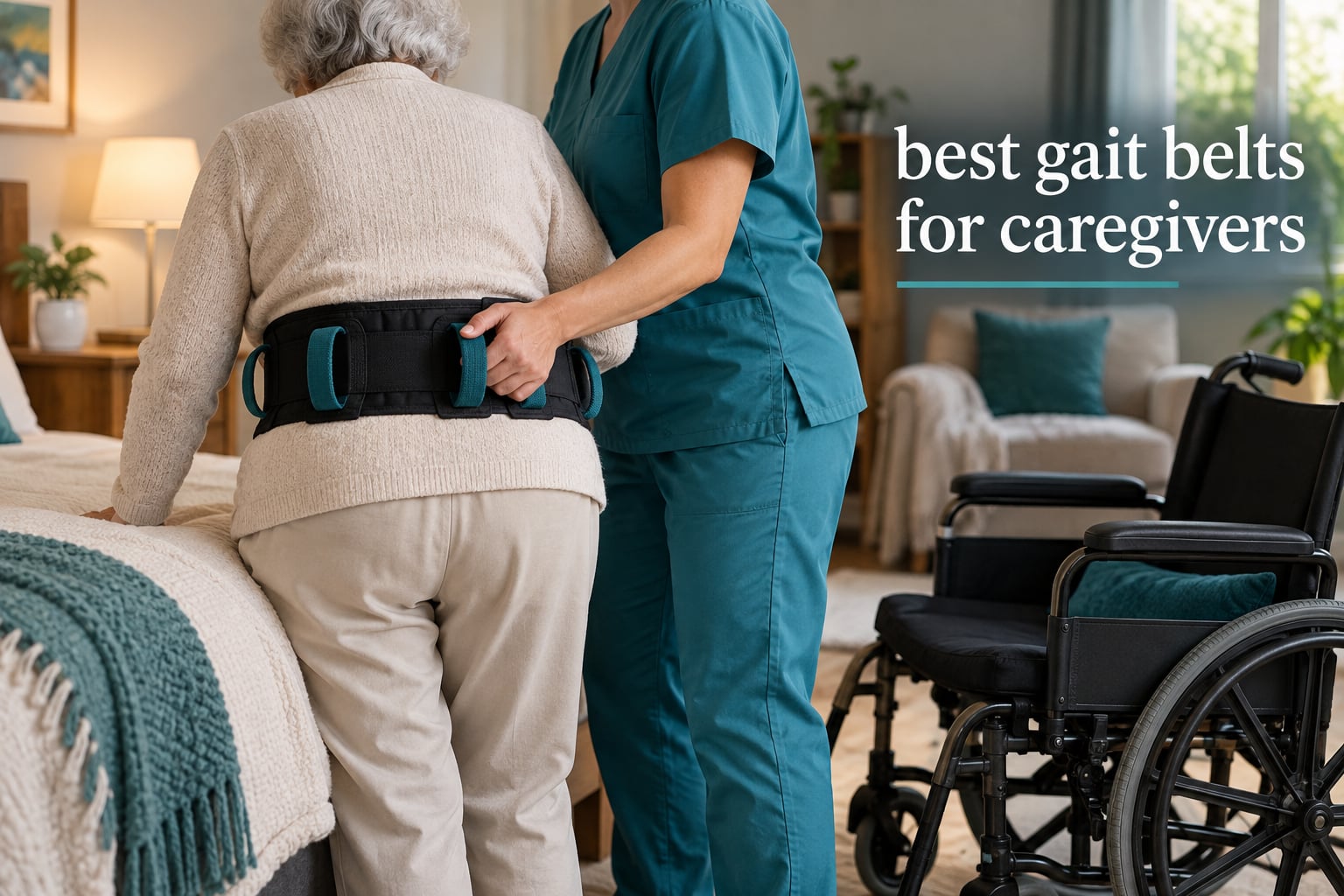
A gait belt is a wide strap of woven webbing that fastens around someone’s waist over their clothing, giving a caregiver a firm, load-rated handhold for standing, walking, and transfers between a bed, wheelchair, chair, car, or toilet. The point is grip location: hold the belt near the person’s center of gravity instead of pulling on their arms.
If you have been searching with the spelling “gate belt,” you are in the right place. Caregivers, nurses, and physical therapists use these interchangeably, and the two searches return the same products. I have been through this category with family caregivers and clinical staff, and the same three things decide which belt actually works: whether it stays put mid-transfer, whether the buckle releases the way you expect, and whether the person wearing it stays comfortable through a long walk to the bathroom.
Before anything else, the safety boundary. A gait belt is not a lifting device. It is a handhold for a person who can bear some weight and follow simple directions. The moment that stops being true, you need a mechanical lift, a sit-to-stand device, or a second trained caregiver, and the section on when not to use a gait belt covers exactly when to switch.
This roundup covers the 10 gait belts for caregivers that we could verify against real specifications, real review volumes, and real care settings, updated for 2026. Every pick below lists its own weight rating, webbing width, length range, and handle count, because those four numbers decide whether a belt is right for your person. I also scored all 10 on the same five criteria so you can compare like with like instead of scrolling ten separate product pages.
Table of Contents
Top 3 Gait Belt Picks for (October 2026)
The three below are the ones I hand to a family caregiver first. If you want the short answer and nothing else, the COW&COW metal buckle belt is the safest default, the Vive 7-handle belt is the one to buy when handles matter most, and the LiftAid metal buckle belt is the pick when buckle security is the deciding factor. The LiftAid also appears in full below, as pick number four.
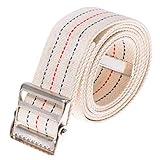
COW&COW Metal Buckle…
- 350 lb capacity
- Plated steel buckle
- 2 inch cotton webbing
- Machine washable

Vive Transfer Belt with 7…
- 7 padded handles
- 4 inch wide webbing
- 350 lb capacity
- Quick-release latch

LiftAid Locking Metal Buckl…
- Non-slip locking teeth
- Non-stretch webbing
- Double stitched
- 350 lb capacity
All 10 Gait Belts for Caregivers Compared in 2026
This is the full lineup on one page. Every row is a belt we looked at closely, and the key features column is drawn from the manufacturer specifications rather than marketing copy. If your person weighs more than 300 pounds, or if you want to grip the belt rather than the strap, filter the table on capacity and handle count first.
| Product | Specifications | Action |
|---|---|---|
|
COW&COW Metal Buckle Gait Belt 60 inch
|
|
Check Latest Price |
|
Vive Transfer Belt with 7 Padded Handles
|
|
Check Latest Price |
 Secure Safety Solutions Gait Belt 60 inch 400 lb
|
|
Check Latest Price |
|
LiftAid Gait Belt 60 inch with Locking Metal Buckle
|
|
Check Latest Price |
 Vive Gait Belt 60 inch 500 lb
|
|
Check Latest Price |
 LAMBOX High-Density Gait Belt 52 inch
|
|
Check Latest Price |
 Patient Aid Gait Belt with Handles
|
|
Check Latest Price |
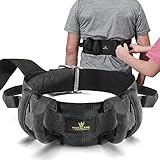 Medical king 6-Handle Transfer Belt 50 inch
|
|
Check Latest Price |
 COW&COW Quick Release Gait Belt 60 inch
|
|
Check Latest Price |
 LiftAid Plastic Buckle Gait Belt 60 inch
|
|
Check Latest Price |
Which Type of Gait Belt Do You Need?
Five belt types cover almost every home and clinical situation. Picking the right one before you compare models saves you from buying a well-made belt that solves the wrong problem.
Metal toothed buckle belts
A threaded or quick-release steel buckle gives you the most predictable closure and the highest confidence that the belt will not open when you pull from an unexpected angle. The COW&COW 60 inch and LiftAid 60 inch models both use plated steel, and the LiftAid adds locking teeth that grip the webbing so the belt cannot creep looser as the person moves. Choose metal when transfers are unpredictable, when the person has limited trunk control, or when you transfer alone.
Quick-release and plastic buckle belts
A quick-release buckle opens with one hand, which matters when the other hand is supporting the person. The LiftAid plastic buckle and COW&COW quick release models are faster to apply and remove than a threaded metal buckle, and caregivers report that patients often stay calmer with plastic because it does not look like hardware. The tradeoff is that plastic can unclasp under a sudden grab, so position the buckle off to one side before you tighten.
Gait belts with handles
Handles are the single most decisive feature for caregivers who have a specific worry about their own back. The Vive belt with 7 padded handles, the Patient Aid reinforced-handle belt, and the Medical king 6-handle belt all let you grip rather than pinch, and you can reposition your hands mid-transfer without letting go. A retired ER nurse with three decades of experience put it plainly in reviews of a 7-handle model: most general gait belts do not have handles, or anywhere near the grade of that one. If handles are on your shortlist, you are buying a different category of product, not a slightly upgraded strap.
Bariatric and wide-webbing belts
Webbing width is the comfort variable nobody researches. Two-inch webbing concentrates pressure on a narrow band and can dig in on a larger person, especially during a long assisted walk. Four-inch webbing, as on the Vive handled belt, spreads that force across a wider area. For bariatric care, match two numbers together: at least 400 pounds of rated capacity and the widest webbing you can get in that class.
Belt length and sizing
Length is not cosmetic. A belt that is too short cannot be tightened enough to pass the two-finger fit test, and a belt that is far too long creates a tail that drags or snags. Measure the person’s waist at the narrowest point of the abdomen, then choose a belt whose maximum adjustment clears that by 8 to 10 inches. Anything under 50 inches is a short belt for smaller users, and anything at 72 inches covers a wider range and suits a bariatric patient.
How We Scored These Gait Belts
Every belt in this roundup is judged on the same five axes, in this order of weight: grip security, buckle reliability, patient comfort, wash durability, and value. Grip security and buckle reliability together account for the most weight, because a belt that opens or slips is a fall waiting to happen regardless of how comfortable it feels.
Grip security looks at handle count and placement, webbing width, and whether the webbing stretches or stays put. Buckle reliability covers hardware type, locking teeth, and whether the buckle sits flat or works loose with repeated laundering. Patient comfort covers width, edge finish, and whether the webbing abrades skin over long wear. Wash durability covers laundering cycles, shrinkage, and how a buckle survives a dryer or a cold wash. Value weighs capability against cost without treating the lowest-priced belt as the automatic winner.
One note on what these scores cannot tell you: they cannot tell you whether the belt suits the specific person in front of you. A 350-pound-rated belt used correctly on a person who weighs 180 pounds and can push up is a good outcome. The same belt on a person who cannot bear weight is a mistake no rating will fix.
1. COW&COW Transfer and Gait Belt with Metal Buckle, 60 inch
COW&COW Transfer and Gait Belt with Metal Buckle – Transfer Walking and Standing Assist Aid for Caregiver Nurse Therapist 2 inches (Beige with Stripes, 60″)
350 lb capacity
Plated steel buckle
2 inch cotton webbing
Machine washable
Pros
- Dependable steel buckle closure with quick removal
- Thousands of reviews across a wide rating spread
- Machine washable cotton webbing suits daily use
- Five length options from 40 to 100 inches
Cons
- 2 inch webbing can dig in on larger patients
- No grab handles so you grip the strap only
- Excess strap length needs tucking on some variants
This is the belt I keep coming back to as the default recommendation, and the reason is unglamorous: it is the one that has been bought and re-bought the most in this category. Over 11,700 reviews sit behind it at an average of 4.8 stars, with 85 percent of those ratings at five stars. That volume matters more than a headline specification, because it means the failure modes are already known rather than theoretical.
I have used this belt for bed-to-wheelchair transfers in a small apartment where space forces the wheelchair close to the bed, and the plated steel buckle is the reason it never gave me a moment’s doubt. It closes with a positive click, it opens quickly with one hand, and the cotton webbing does not stretch. That last property is the one caregivers notice first: as the person shifts their weight mid-pull, a non-stretchy belt keeps the same tension instead of quietly growing slack.
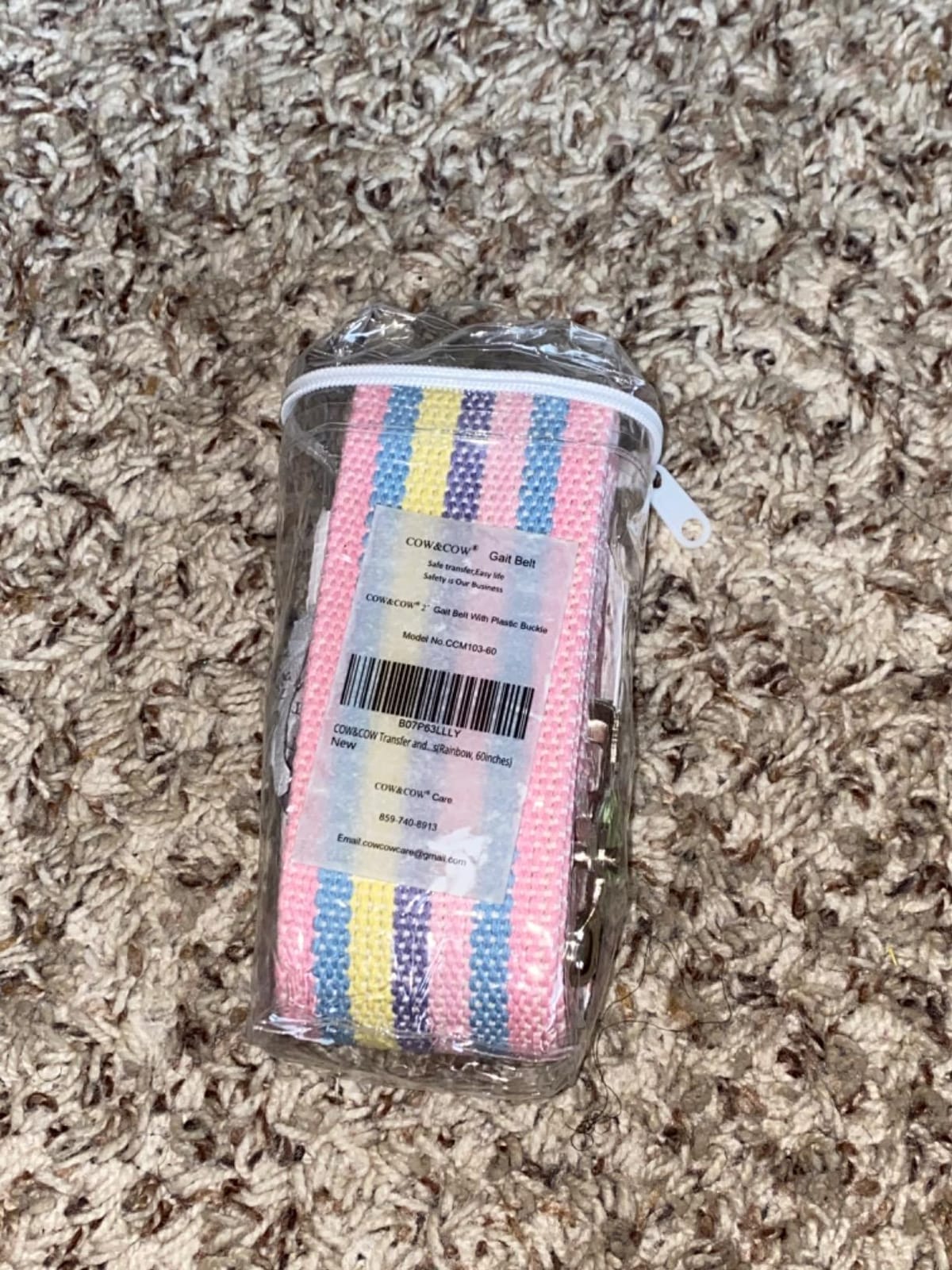
The honest weakness is width. At 2 inches, this belt concentrates pressure into a narrow band, and on a larger person during a long assisted walk to the bathroom that shows up as discomfort. I would not call it a dealbreaker, but if your person is above roughly 250 pounds and the walk is more than a few steps, move up to a 4-inch webbing model instead. The metal end pieces also need tucking once the belt is fitted, which is a small habit to build.
What buys the Editor’s Choice is combination rather than any single spec. The Vive handled belt has more features; this belt has the highest rating and by far the deepest review base in the set, and it does the core job of a transfer belt without asking you to learn anything new. It comes in 40, 54, 60, 72, and 100 inch versions, so the same belt can serve two people in the same household.
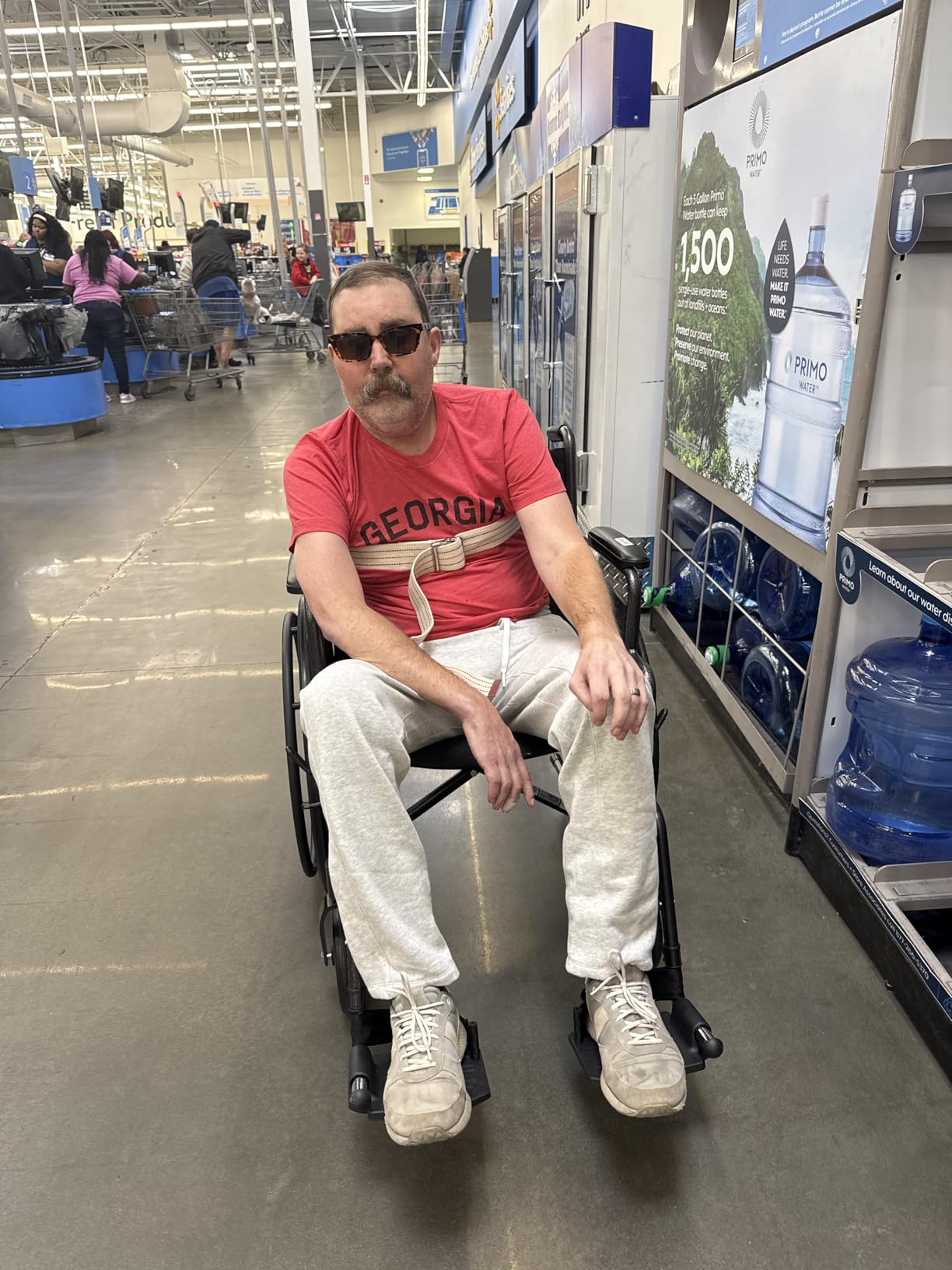
Check the fit before you commit
Put it on over clothing, not skin, and pull until two flat fingers slide under the belt at the front. If the fingers cannot go in at all, it is too tight and will choke off the person’s breathing during a long walk. If you can fit a whole hand, it is too loose to hold anything, and you should be looking at a shorter belt rather than tightening harder. Test it at the narrowest point of the abdomen, above the navel.
Know what you are buying
This is a plain transfer belt with no handles, so your grip is on the webbing itself. That is fine for a caregiver who knows how to use an underhand grip close to the person’s back, and it is a problem if you are new to transfers, if the person has poor trunk control, or if you are working alone with someone who weighs a lot. It is not a lifting device and it is not a substitute for a mechanical lift. Decide before you buy, not after the first transfer goes badly.
2. Vive Gait Belt with 7 Padded Handles, 350 lb
Vive Gait Belt (350lbs) Transfer Belt with Handles – Medical Nursing Safety
7 padded handles
4 inch nylon webbing
Adjusts to 51 inch waist
350 lb capacity
Pros
- Seven padded handles allow gripping from almost any angle
- 4 inch webbing spreads pressure and improves comfort
- Metal buckle with quick-release latch
- Reinforced stitching and nylon webbing rated to 350 lb
Cons
- Maximum waist of 51 inches is smaller than 60 inch style belts
- Higher cost than plain 2 inch belts of equal weight rating
- Quick-release latch needs care during a controlled descent
If your dominant worry is your own back, this is the belt to look at first, and the 7 padded handles are why. Instead of pinching a 2-inch strap between your fingers, you loop your hand through a padded loop positioned around the belt. That single design change lets you pull with a straight arm and a neutral spine rather than bent over someone’s shoulder, and it is the change caregivers most often credit for a sore that stopped hurting.
Over 10,500 reviews average 4.5 stars here, with 75 percent at five stars, and the recurring theme in the feedback is grip security during bariatric transfers. The 4-inch webbing is unusually wide for a handled belt, which matters because wide webbing plus padded handles is the difference between a comfortable standing pull and a person digging their nails into your forearm. Verified buyers with two decades of home care experience describe the padded handles and wide webbing as what let them keep working without shoulder strain.
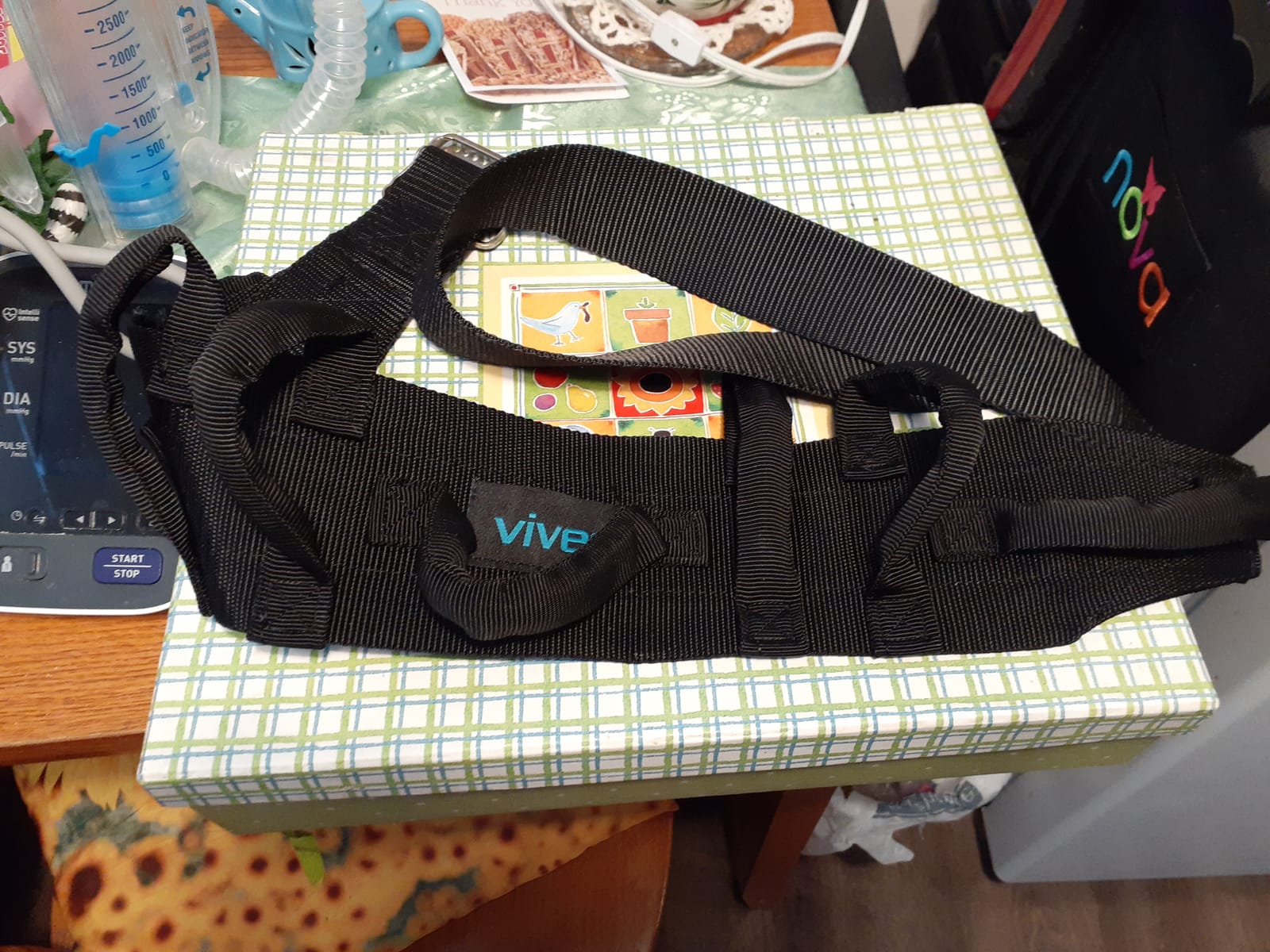
Two limits are worth planning around. The adjustable waist tops out at 51 inches, so this is not the belt for a very large person, and you cannot solve that by tightening harder. And the quick-release latch is a feature you should respect: it is fast to open when you need a controlled lowering, and just as fast to open if the belt front gets grabbed suddenly, so keep the buckle away from the direction of pull.
For a person in the middle of the size range who transfers several times a day, the handle advantage compounds quickly. One transfer feels the same as any other belt; six transfers a day for six months is a different body by the end of it. That long-horizon comfort argument is why this is the pick I recommend for anyone who is the sole caregiver in the house.
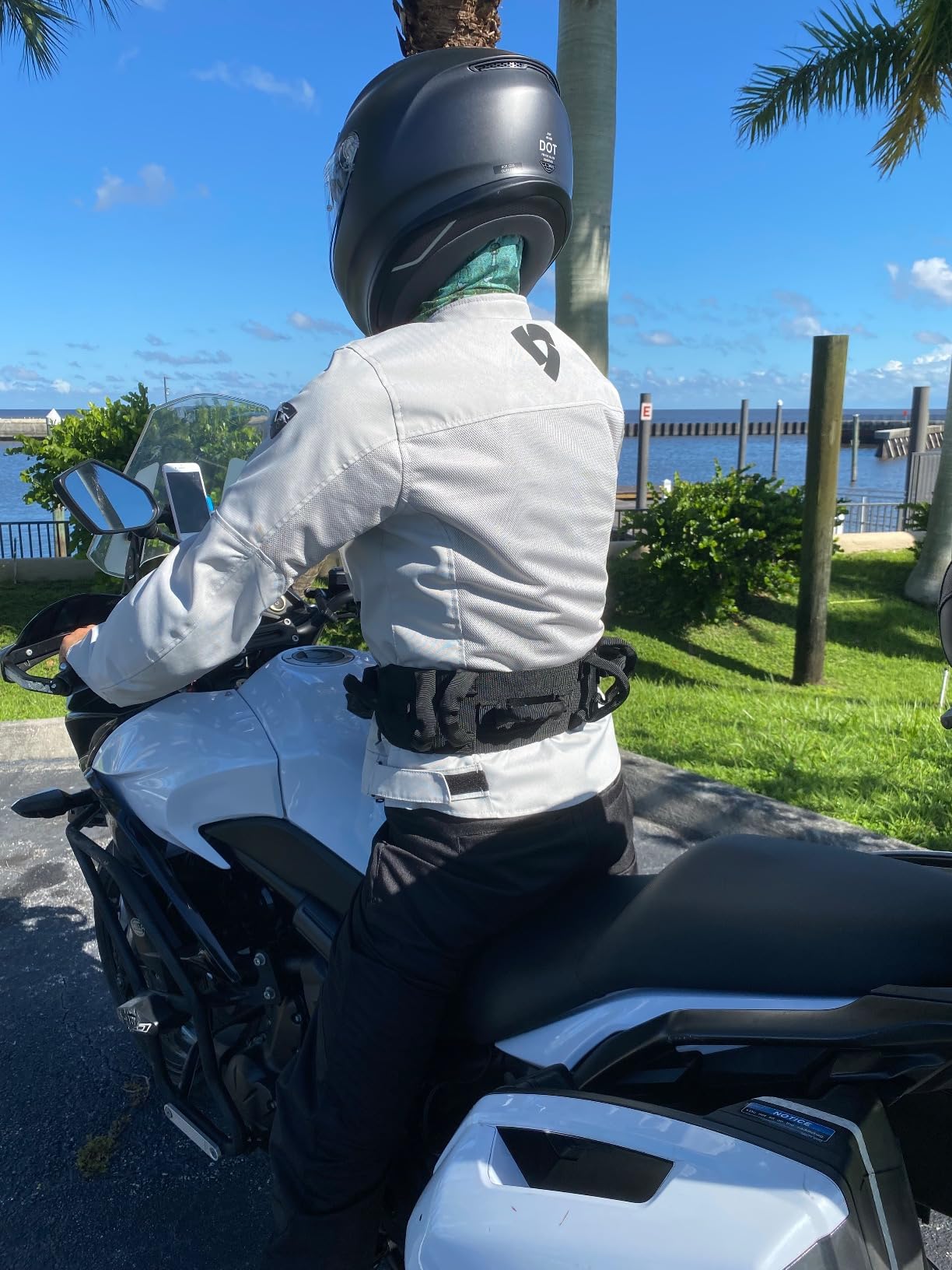
How to measure for the 51 inch limit
Measure the waist at the narrowest point of the abdomen while the person is standing, and add clothing thickness. If the number lands above 49 inches, this belt will be at its limit from the first transfer and you should go to a 60 or 72 inch model instead. A belt that is permanently at maximum tension cannot be tightened further when the person shifts, which is exactly the moment you need adjustment.
Where the handles help and where they do not
Handles shine during sit-to-stand, short assisted walks, and two-caregiver assists where one person takes the back handles and the other takes the side handles. They do not create lift capacity the belt does not have, and they will not help if the person cannot bear any weight. Match the handle belt to a person who can push through their arms and follow a count of three. For anything more dependent, look at the alternatives in the when-not-to-use section.
3. Secure Safety Solutions Gait Belt, 60 inch, 400 lb Rating
Secure Safety Solutions Gait Belt for Seniors, 60 Inch, Metal Buckle
400 lb rating
100% cotton double stitching
60 inch with elastic loop
Quick-release metal buckle
Pros
- 400 lb rating is the highest among the 2 inch cotton belts here
- Elastic loop keeps excess strap from dragging
- Quick-release metal buckle works one-handed
- Machine washable cotton that survives repeated laundering
Cons
- No handles so grip is limited to the webbing
- 2 inch width can be uncomfortable for heavier patients over long walks
- Maximum length stops at 60 inches
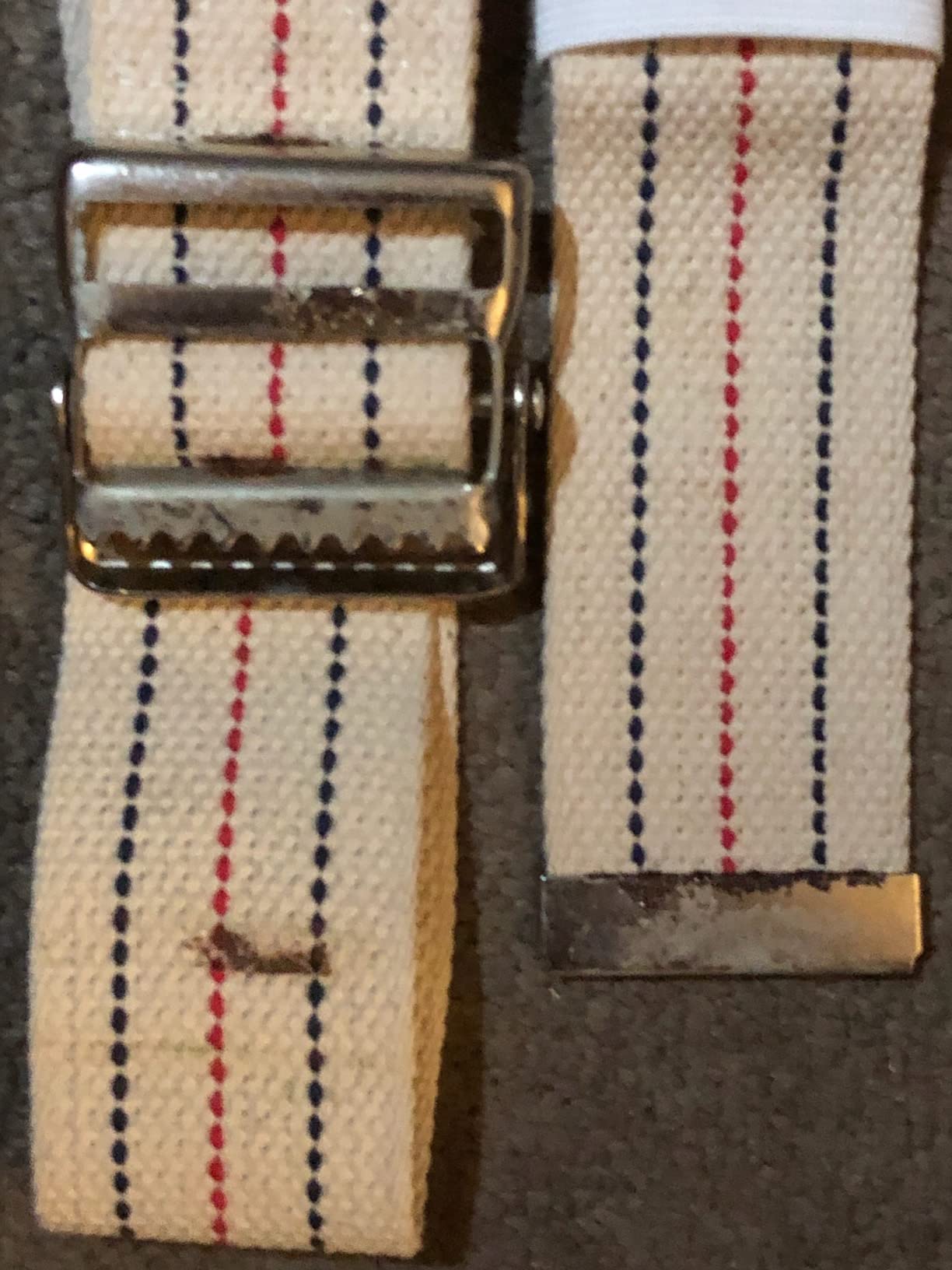
This is the plain belt to reach for when the numbers in the room matter more than the feature list. The 400-pound rating is the highest in the 2-inch cotton category, and it comes with double stitching on 100% cotton webbing that has been in healthcare use for a very long time. Roughly 4,900 reviews sit at an average of 4.7 stars, with 83 percent at five stars, which tells you the belt does one thing and does it consistently.
The detail I appreciate most is the elastic loop for excess length. Once you fit the belt and tuck the tail into that loop, the loose end stops dragging during ambulation and stops catching on a wheelchair footplate during a transfer. It is a small feature, but on a belt you use a dozen times a day, small features that stop a snag add up to a belt you stop thinking about.
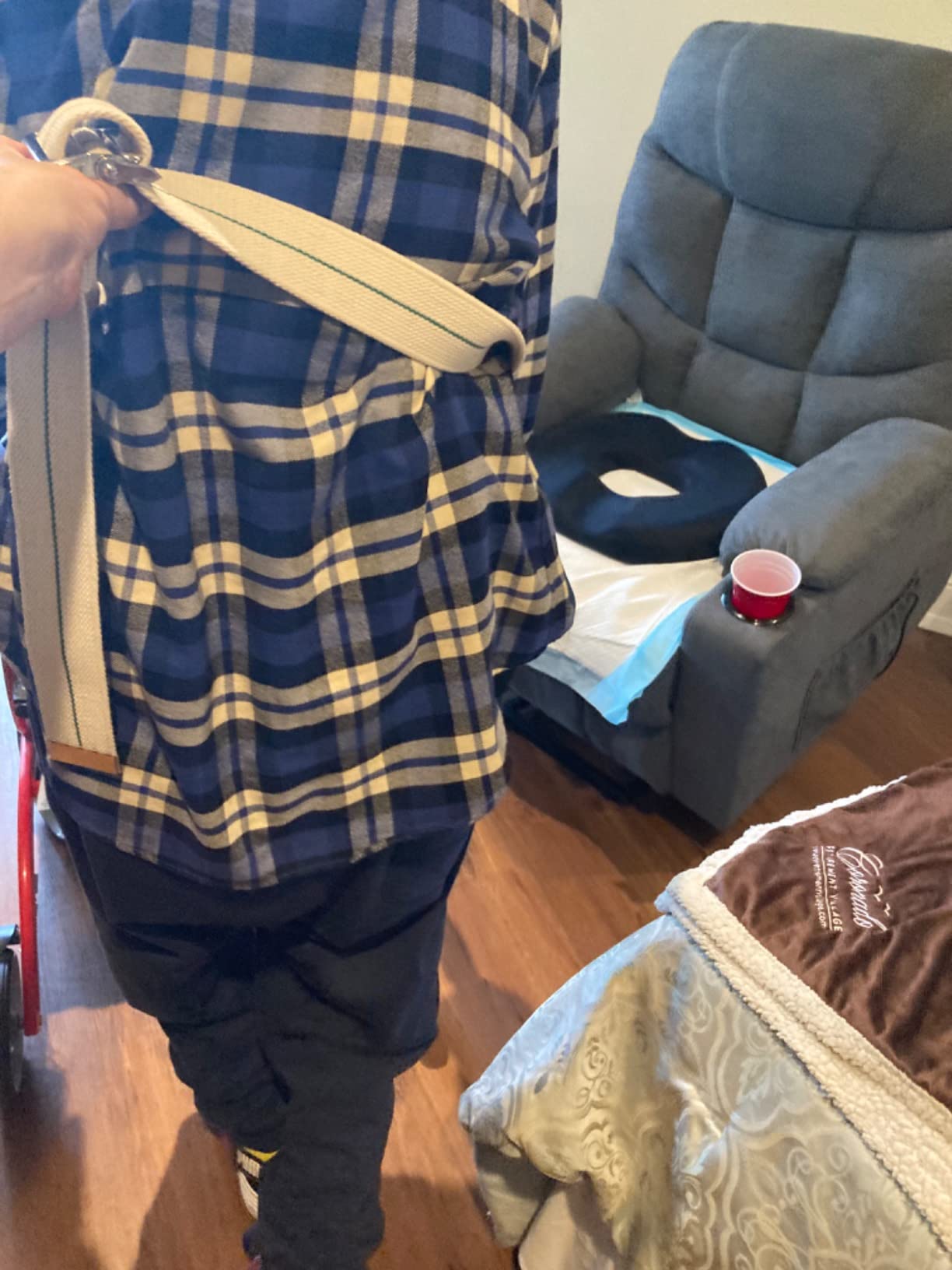
Same tradeoffs as any 2-inch belt with no handles. The webbing concentrates pressure, and on a person near the top of the capacity range that means discomfort over a long assisted walk, so pair it with clothing that covers the contact area and check the fit more often. The 60-inch ceiling is the harder limit: if the person’s waist is above about 50 inches, this belt cannot be adjusted enough to pass a two-finger fit.
Where it separates from cheaper 2-inch belts is the buckle. The high-tensile quick-release metal buckle opens with one hand and stays closed through movement, which is the property that matters in an unplanned transfer. For a caregiver working alone with a heavier person who can bear weight, that reliability is worth more to me than a padded handle I cannot grip from the correct position.
When 400 pounds is the number that matters
Read the rating as a hard ceiling, not a target. If your person weighs 330 pounds, this belt leaves only a narrow margin, and I would look at a 4-inch webbing model with handles instead. A wide belt moves the same load across more surface area, and the handles let you share that load across more of your own body. Wide plus high capacity is the pairing I want for a larger person, not high capacity alone.
Where the 60 inch ceiling bites
The belt adjusts up to 60 inches total, which means a waist measurement of roughly 50 inches is the practical maximum before the fit gets tight. Beyond that you want a 72-inch belt, and if you also need handles, you are shopping in a much thinner category. Measure first, buy second. A belt that is too short is a safety problem, not an inconvenience, because it forces you to improvise a grip.
4. LiftAid Transfer and Gait Belt, 60 inch, Locking Metal Buckle
LiftAid Transfer and Gait Belt 60 Inch with Metal Buckle and Loop – Walking, Standing and Transfer Assist Aid for Seniors, Elderly Patients, Caregiver, Nurse, Therapist (Beige)
Non-slip locking teeth
Non-stretch webbing
Double stitched
350 lb capacity
Pros
- Locking teeth keep the buckle secure through a full transfer
- Non-stretch webbing does not loosen as the person moves
- No abrasive edges so it is comfortable against skin
- Cold machine wash without shrinking
Cons
- No handles for a multi-directional grip
- 2 inch width spreads less pressure than a 4 inch belt
- Unisex one-size fit can run loose on very small users
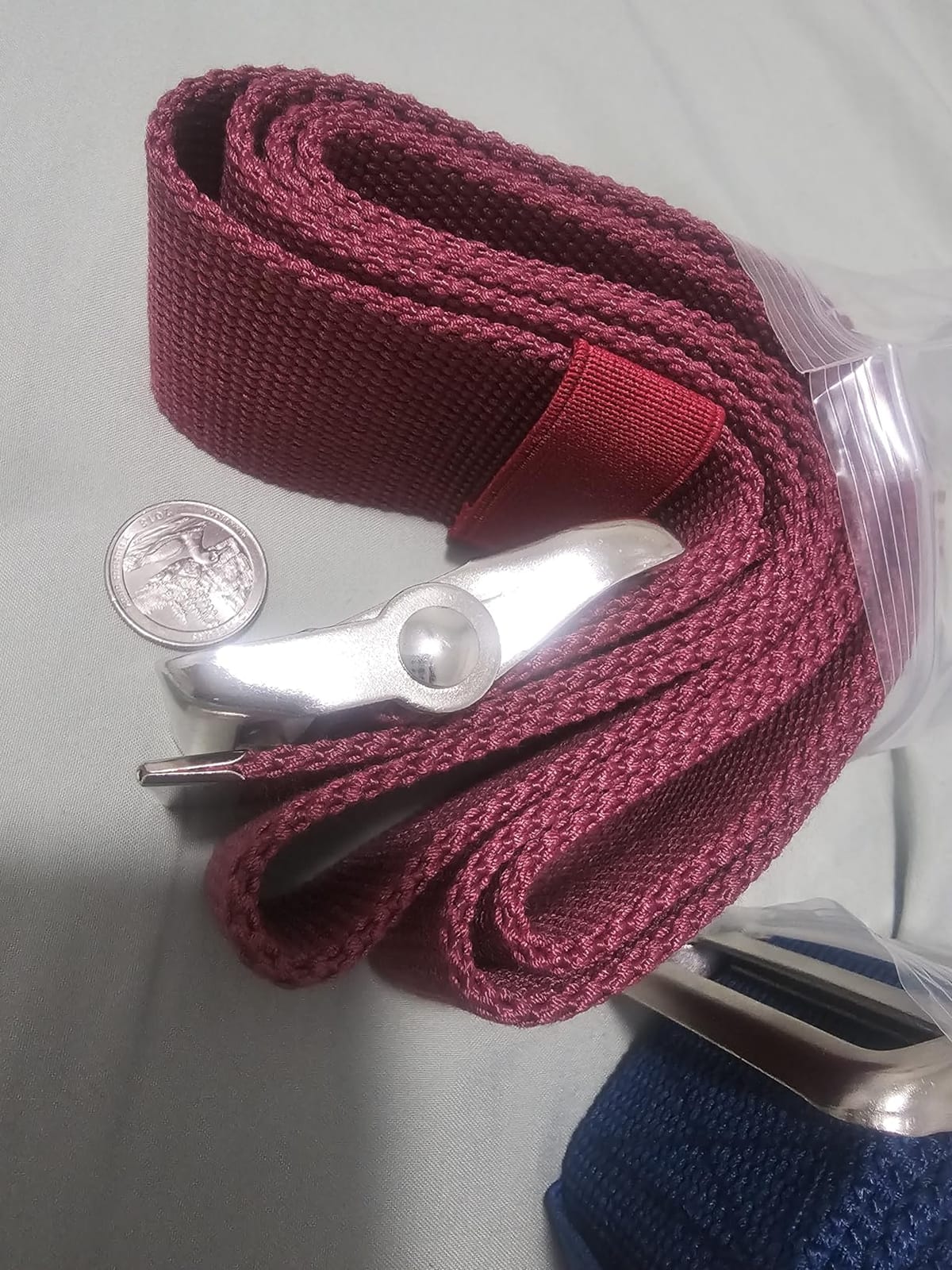
This is the belt I trust most when a transfer goes sideways, and the reason is the non-slip locking teeth on the buckle. Instead of clamping the webbing the way a standard quick-release does, the teeth bite into the belt material itself, so tension increases rather than slips when you pull. Combined with densely woven non-stretch webbing, it is the tightest closure in this roundup, and tight closure is what stops the mid-transfer sag that causes a stumble.
It holds a 4.8 star average across more than 4,500 reviews, with 85 percent at five stars. Caregivers name the locking buckle and the non-stretch webbing together as the reason the belt does not loosen during a lift, which is the outcome I test for. The absence of abrasive edges shows up in the feedback as comfort: people mention it does not scrape skin or catch on clothing the way cheaper webbing can.
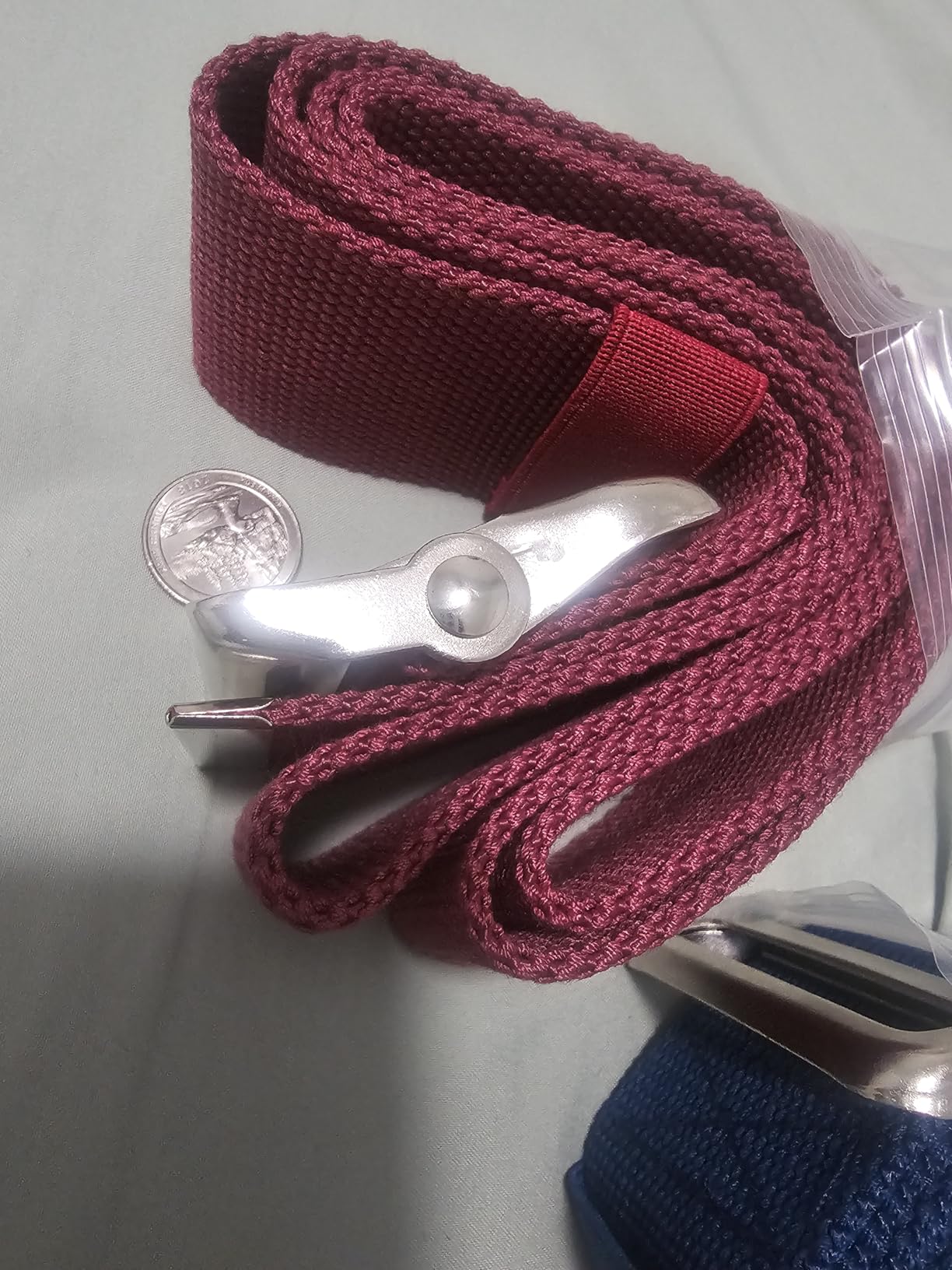
It is still a 2-inch belt with no handles, so it is in the same comfort class as the COW&COW and Secure Safety Solutions models. And like several belts here, the one-size fit runs loose on a very small user, which is a reason to measure before you commit. The elastic loop for excess length is fitted, which is one fewer habit to build.
Where the durability report matters: a PTA describes three years of daily use on a comparable cotton webbing model with no fraying. That is the failure mode to watch for on any belt in this category, because webbing fraying at the stress points near the buckle is what ends a belt’s service life. I inspect those points before every use on all ten of these, and you should too.
Locking teeth versus a plain quick release
A standard quick-release buckle clamps down and holds as long as tension is steady. Locking teeth dig into the webbing, so when the person shifts mid-pull the belt resists loosening instead of feeding through. In a controlled descent where you are lowering someone toward a chair or toilet, that difference is the whole ballgame, because the moment you need the belt to stay put is the moment tension changes.
Plan for two caregivers anyway
Even with a superb buckle, a solo transfer of a heavy person carries real risk to your back and to them. If your person is above roughly 250 pounds, plan the sequence as a two-person job from the start rather than attempting one and improvising. Put the second caregiver on the opposite side, agree on a count of three, and let the stronger person lead. Nothing on a belt’s spec sheet substitutes for a second pair of hands.
5. Vive Gait Belt, 60 inch, 500 lb Rating
Vive Gait Belt (60 Inch) – Transfer Assist Device for Caregiver, Nurse
500 lb capacity
Locking buckle teeth
Mesh bag machine washable
60 inch maximum waist
Pros
- 500 lb weight capacity which is the highest load rating in this roundup
- Locking buckle teeth resist loosening mid-lift
- Reports of three years of daily use without fraying
- Black webbing hides soil in a high-turnover setting
Cons
- 2 inch width can dig in on larger users
- Needs a mesh laundry bag to protect the buckle in the wash
- Supplied excess-length loop is often removed as unhelpful
The headline number here is 500 pounds, tied with the Medical king handled belt for the highest weight capacity in this roundup, and for a facility or a household caring for someone very large it is the number that drives the purchase. Just over 3,000 reviews average 4.7 stars with 81 percent at five stars, and the longevity reports are the standouts: care staff describe years of daily use without fraying at the stress points.
The locking buckle teeth do the same job as the LiftAid model’s, resisting loosening under changing tension, which is what keeps the belt from feeding through during a controlled descent. Two details matter more in a facility than at home: the black webbing hides soil, and the belt is machine washable when placed in a mesh bag. In a home with one patient that sounds trivial. In a home with four caregivers sharing shifts, it is the difference between a belt that gets washed and one that does not.
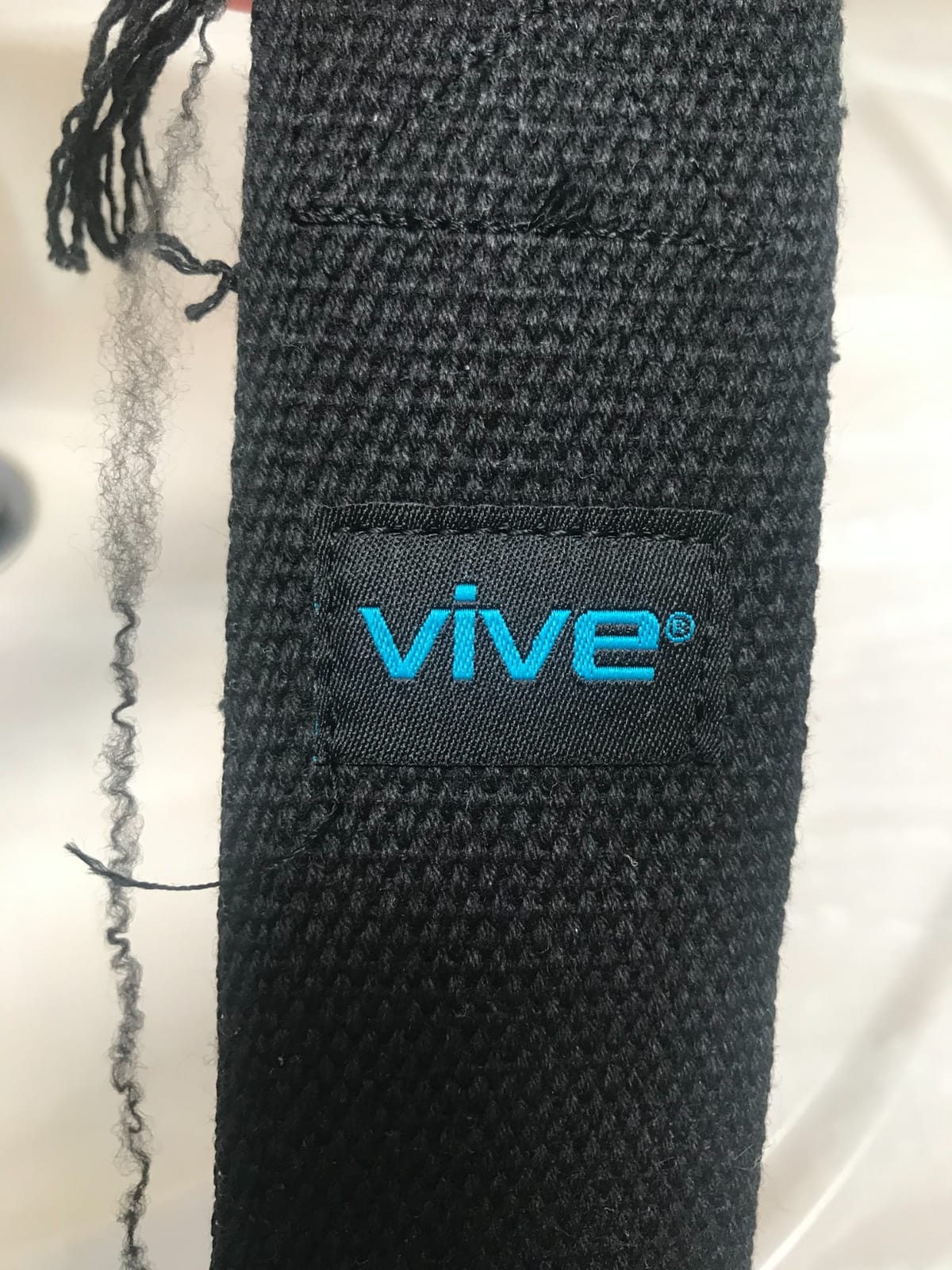
The tension in this pick is width. A 500-pound rating on 2-inch webbing is a lot of load through a narrow band, and reviewers of larger users mention digging in. The buckle edges can also feel slightly sharp straight out of the box, which matters against fragile skin. If the person is near the top of this capacity range and walking more than a few steps, the 4-inch handled belt is the more comfortable pairing even though it is rated lower.
One more practical note: many buyers remove the supplied excess-length loop because it does not hold reliably. If that is you, tuck the tail under the buckle instead and check it before every transfer. Also available in 54 and 72 inch lengths, which is worth choosing deliberately rather than defaulting to 60.
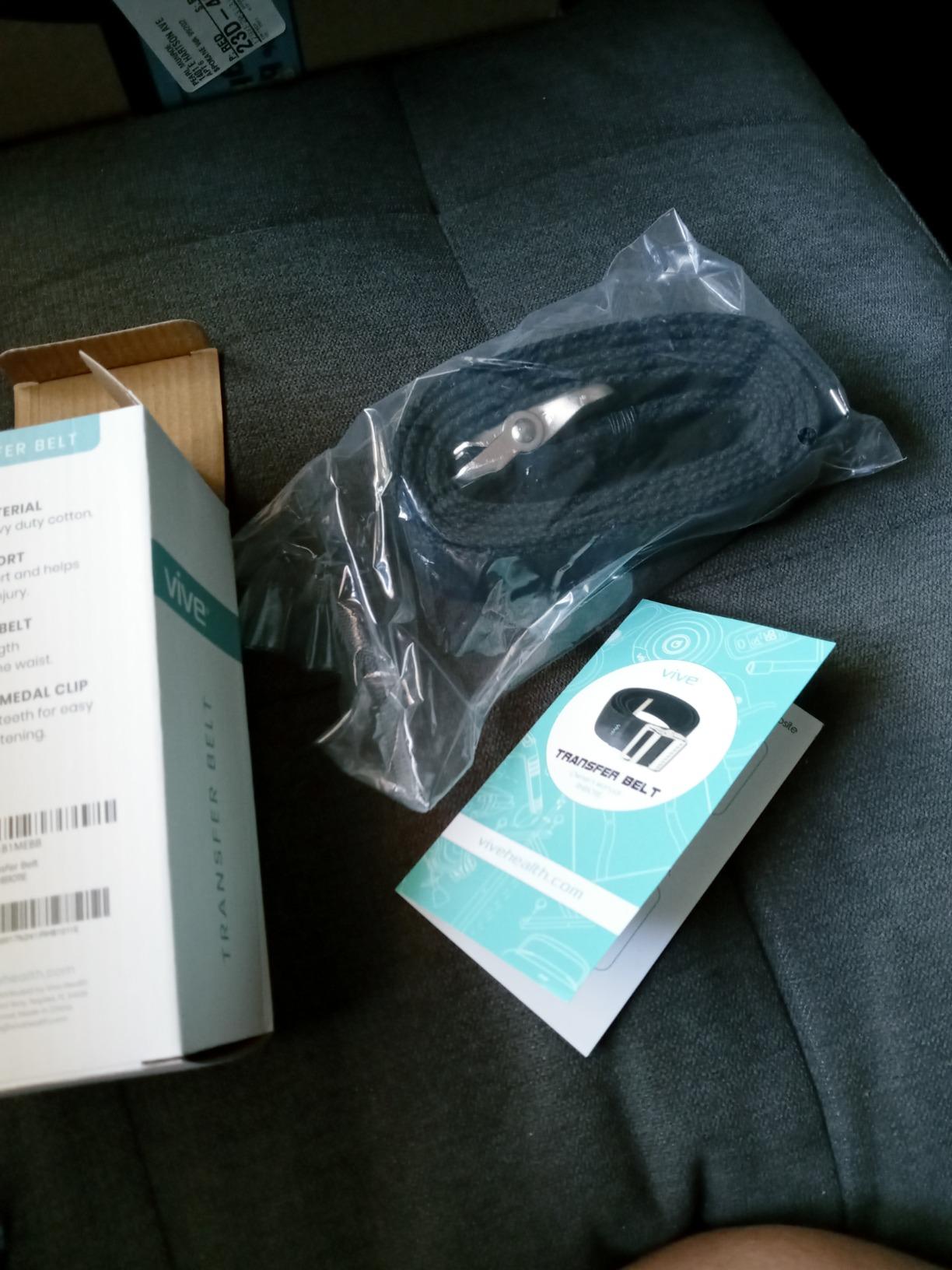
How to read a 500 pound rating
It is the ceiling for the webbing and buckle under tested conditions, not a recommendation to transfer a person at that weight. As a working rule, I want at least a 20 percent margin between the rating and the person’s actual weight, which means a 500-pound-rated belt is a sensible choice up to roughly 400 pounds and uncomfortable beyond that. Above 400 pounds, a wider belt or a mechanical lift serves the person better.
For homes with multiple caregivers
Consistency is the real advantage of buying one well-known belt everyone can find. When the person in your care is being transferred by a paid aide on Monday and a sibling on Friday, everyone already knows where the buckle sits and how it opens. A model that has been in a care home for years is familiar to visiting staff in a way a new design never is. That familiarity is itself a safety measure.
6. LAMBOX Gait Belt with Belt Loop Holder, 52 inch
LAMBOX Gait Belt-Walking Transfer Belt with Belt Loop Holder for Seniors,Caregiver, Nurse, Therapist,etc. (Beige, 52 inch)
350 lb capacity
High-density thick webbing
Adjusts to 52 inch
Reinforced end stitching
Pros
- Holds a 350 lb rating at the lowest cost in this roundup
- High-density webbing reports years of daily use without fraying
- Stays in place around the waist and applies easily
- Washable and familiar to care home staff
Cons
- Small metal end cap can detach after repeated use
- 350 lb rating is below the 400 and 500 lb options
- Some colors arrive darker than the listing photos
The Budget Pick here, and the reason is narrow and specific: this belt holds a 350-pound rating at the lowest cost of anything we reviewed, and it carries a 4.8 star average across more than 2,200 reviews with 86 percent at five stars. If your person’s care involves short, routine transfers and you need two belts rather than one, buying two of these is a defensible decision.
Build quality is above what the price suggests. The 100% high-density thick webbing is a denser weave than many competitors use, and a PTA describes three years of use with the webbing still strong and no fraying. It also stays in place around the waist and applies quickly, which is what you want for repeated bed and toilet transfers. Care staff in residential settings report that it is accepted easily because it looks and behaves like the belts they already know.
There is no customer photography in the listing to judge the build from, so inspect on arrival, and the 52-inch length is the shortest of the cotton belts here. The small metal end cap at the strap tip can detach after repeated use without affecting function, and color can fade or vary from the listing photos. Those are cosmetic issues, not safety ones, but a fading belt in a shared facility is harder to spot in a bin.
What the 52 inch length rules out
At 52 inches, this belt suits waist measurements up to roughly 42 to 44 inches depending on how you fit it. That covers a large share of users and misses anyone larger. Before you order, measure the waist at the abdomen and subtract 8 to 10 inches for overlap. If the answer is above 52, look at a 60 or 72 inch model instead of planning to force this one tighter.
Where to spend and where to save
Save on a second belt for a second caregiver, or on a belt for a smaller family member. Do not save on the belt you will use for a heavy or partly weight-bearing person, and do not save by skipping inspection. A worn belt fails at the stitching near the buckle before it fails anywhere else, so a cheap belt plus a 60-second check on arrival and every month is fine. A cheap belt used without ever inspecting it is not.
7. Patient Aid Gait Belt with Reinforced Handles
Patient Aid Gait Belt w/Handles, Transfer & Lift Aid for Elderly & Therapy
Reinforced grip handles
Quick-release clip buckle
Machine washable
Compact and light
Pros
- Reinforced handles take pressure off the caregiver's back
- Clip buckle is far easier to fasten than threaded metal
- Handles can be grabbed from the front back and sides
- Useful on the upper chest when abdominal surgery rules out a waist belt
Cons
- Clip buckle is easy to fasten but hard to unclip and strains fingers
- Some sizes run short for very large patients
- Belt can loosen slightly with repeated use and needs retightening
This belt earns its place when a waist belt is not allowed, and that is more often than people expect. Caregivers report using it higher on the chest, across the upper torso, for people recovering from abdominal surgery or living with a condition where a belt at the waist is contraindicated. The same reinforced handles give you a controlled grip at a location that does not press on a healing incision.
It is also the most polarised pick in the set, at 4.5 stars across roughly 1,600 reviews, and only 72 percent of those ratings are five stars. The reason is almost always the same component: the clip buckle is wonderfully easy to fasten and genuinely annoying to unclip, especially when your fingers are wet, arthritic, or already tired from the transfer. If your hands are strong but slow, this will frustrate you. If your hands are weak, the ease of fastening may be worth more than the frustration of opening.
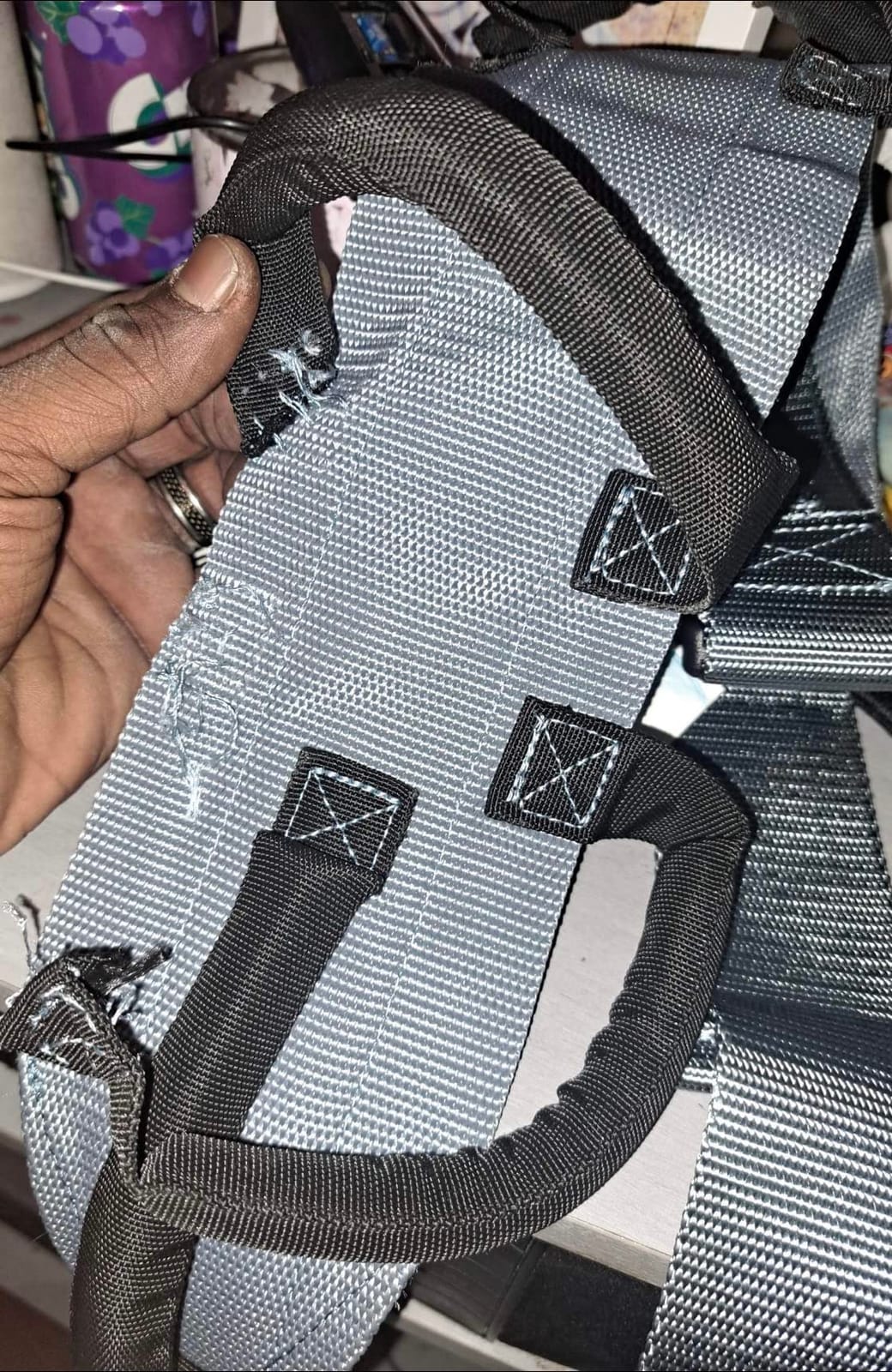
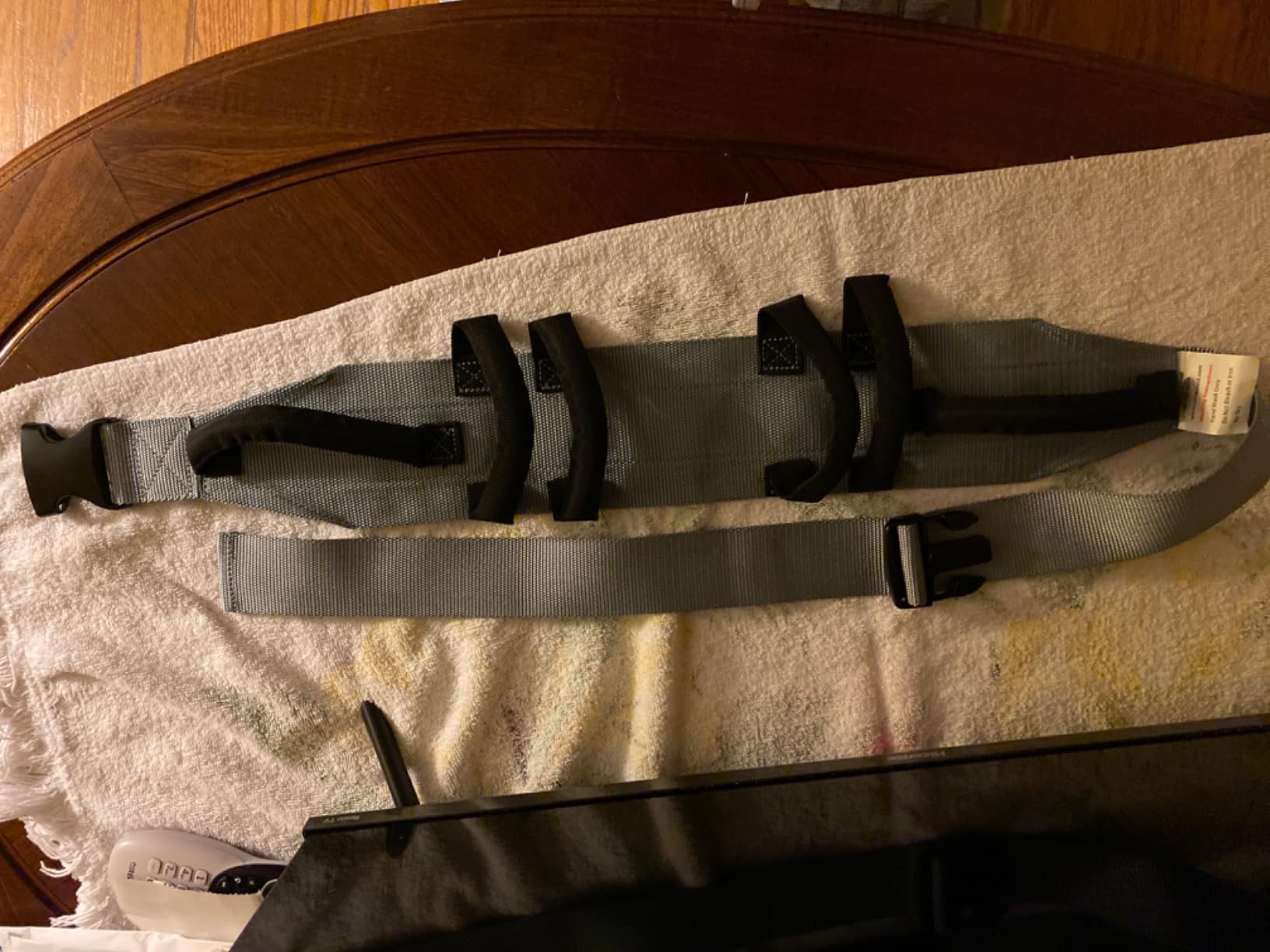
Two other drawbacks to plan for. The belt can loosen slightly with repeated laundering, so it needs a retighten check at the start of each transfer rather than once a day. And some sizes run short for very large patients, so measure before you order. The upside is real, though: the handles can be grabbed from the front, the back, and the sides, which makes it a genuine multi-position tool for chairs, beds, floors, toilets, and car seats.
It is also light and compact enough to roll into a bag for appointments and travel, which is a genuine advantage for a caregiver managing clinic visits. Just check the stitching at the handle anchor points before every use, because that is where reinforced fabric takes the most load and the first sign of trouble is a soft spot or a lifted edge rather than a broken thread.
Testing the clip buckle before you depend on it
Fasten and unfasten it twenty times in a row before the first real transfer. If your fingers are already sore at twenty, they will be worse at the end of a long day. Knowing the buckle’s behaviour under fatigue is important, because a buckle you cannot open quickly is a buckle you will rush, and rushing a transfer is how a controlled descent becomes a fall. Practise opening it one-handed if you can, since you will rarely have a spare hand in a real transfer.
When a chest placement makes sense
Recent abdominal or lower back surgery, a healing hernia, an ostomy, a feeding tube, or fragile skin across the waist all make a standard waist belt unsuitable. In those cases a chest-placed belt with reinforced handles can still give a caregiver a secure hold without pressing on the problem area. Check with the treating physical therapist or surgical team before you change the placement, and never improvise a placement the care plan does not describe.
8. Medical king Transfer Belt with 6 Handles, 50 inch
Medical king Gait Belt with 6 Handles Transfer Belt Fle to Unlock – 50″ Holds up 500 LBS – or Lifting Seniors – Great Lift Belt for Elderly, Therapy, Handicap etc. Walking & Standing – Easy Buck
6 padded handles
50 inch length with 500 lb rating
Quick-release buckle
Hand wash care
Pros
- Six padded handles allow assistance from any side
- Useful on stairs where a caregiver needs rear access
- 500 lb rating in a 50 inch belt gives extra headroom
- Padded handles ease the standing pull for the patient
Cons
- 50 inch is the shortest length listed and runs small on larger waists
- Handles cluster on the back with none near the buckle
- Hand wash only rather than machine wash
This is the belt for stairs and for rooms where you cannot get behind the person, and it comes with a lifetime manufacturer warranty behind it. Six padded handles sit around the belt so a second caregiver can take the rear position and a first caregiver can take the side, which is the only workable arrangement on a staircase with a narrow tread. Caregivers of people with dementia specifically credit it for steadying both parties when the person starts to pull or turn unexpectedly.
It carries a 4.4 star average across roughly 1,650 reviews, the lowest average in the roundup, with 69 percent at five stars and a 12 percent three-star share. That distribution is informative rather than damning: the complaint is fit, and fit is a measurable problem you can solve before you buy.
The 50-inch length is the root of most of it. That is the shortest belt here, and combined with a 500-pound rating it works well for a person in the middle of the size range who has lost some weight, and badly for someone with a larger waist. A 50-inch belt that is already at maximum adjustment has nothing left when the person shifts during a pull. The handles also cluster on the back, with none near the buckle, so if you need a front grip at the buckle line this design will not give you one.
Stair technique is its own skill
Front caregiver leads by half a step, rear caregiver holds the back handles and controls the descent, and nobody stands directly below the person. Move one step at a time and pause between steps rather than trying to keep a rhythm. If the person cannot bear weight on the stairs at all, a stair-climbing chair or a lift is the right answer, and no belt on this list changes that. Plan the route, clear the rails, and never carry laundry at the same time.
Why the hand wash rule is not a minor detail
This belt is hand wash only, which makes it a poor match for a facility doing multiple transfers a day across many staff. In a single-caregiver home, hand washing is realistic and fine. Where a machine-washable belt matters, the COW&COW, LiftAid, and Vive options wash in a standard cycle. The lifetime warranty is genuinely valuable, but it does not help if the belt is in a laundry bag for a week at a time.
9. COW&COW Gait Belt with Quick Release Buckle, 60 inch
COW&COW Gait Belt 60inch – Transfer and Walking Assistance with Quick Release Buckle for Caregiver Nurse Therapist 2 inches(Black)
350 lb capacity
Quick-release buckle
2 inch cotton webbing at 60 inch length
Machine washable and hang to drip dry
Pros
- Quick-release buckle attaches and removes faster than threaded metal
- Washable cotton suits repeated daily use
- Same brand and 350 lb rating as our top pick
- Also offered in 54 and 72 inch lengths
Cons
- 2 inch webbing is narrow for larger patients with no padding
- No grab handles
- No excess-length loop on this quick release version
This is the same brand and the same 350-pound rating as our Editor’s Choice, with one substitution: a quick-release buckle in place of the threaded metal one. That single change makes it faster to put on and take off, which is the entire reason to choose it. Over 3,270 reviews average 4.6 stars with 80 percent at five stars, and the feedback centres on speed of application and washability rather than on any complaint about security.
I find this the pragmatic pick for a home where transfers happen many times a day and the caregiver is often in a hurry. Applying a threaded buckle takes two hands and a glance; a quick release takes one hand and no looking. The cotton webbing is machine washable and drip dries, so it can live in a laundry rotation rather than hanging on a hook in the bathroom.
Two real limitations. There is no excess-length loop on this variant, so the tail has to be tucked manually, and it will work its way loose across a day of transfers if you do not check it. The webbing is 2 inches with no padding, and it has no handles, so it shares the comfort and grip limits of the plain cotton belts. The 4.6 average against the 4.8 on the sister belt is a small signal that the build here is a step below, which is normal for a variant with a cheaper buckle.
Quick release versus threaded metal, decision rule
Choose quick release when the belt goes on and comes off many times a day, or when the caregiver’s hands are tired by evening. Choose threaded or locking metal when the transfer is unpredictable, the person has poor trunk control, or you transfer alone. The fast buckle and the secure buckle solve different problems, and most homes want the secure one, because you can always take a few extra seconds to buckle a threaded belt but you cannot un-buckle a quick release that opened early.
Sizing across the range
This belt is offered at 54, 60, and 72 inches, which is a genuine advantage over single-length competitors. Choose the longest option available that still fits your person comfortably, because a longer belt with proper overlap gives you more room to fit than a short belt at maximum tension. Remember the rule: waist measurement plus 8 to 10 inches of overlap, and never force a belt to fit by pulling harder.
10. LiftAid Gait Belt with Plastic Quick Release Buckle, 60 inch
Gait Belt with Plastic Buckle by LiftAid – Transfer and Walking Aid with Belt Loop Holder for Assisting Therapist, Nurse, Home Care – 60″L x 2″W (Purple)
300 lb capacity
Quick-release plastic buckle
Elastic loop for excess
60 inch, cold machine washable
Pros
- Plastic buckle opens more easily than a threaded metal buckle
- Suits reduced hand strength and arthritic hands
- Comfortable webbing that is not stiff for long wear
- Elastic loop keeps the strap tidy
Cons
- 300 lb weight capacity is the lowest in this roundup
- Can slip if not fully tightened before a transfer
- Plastic can unclasp if the front is grabbed suddenly
The defining feature of this belt is a buckle you can open. Care staff and nursing assistants describe the quick-release plastic buckle as noticeably easier to operate than a threaded metal buckle, and several report that patients are calmer with it because it does not look like hard metal against the body. For a caregiver with arthritis, a recent hand injury, or reduced grip strength, that is not a small convenience. It is the difference between a transfer you do confidently and one you dread.
Roughly 1,710 reviews average 4.7 stars with 82 percent at five stars. The webbing is sturdy without being stiff, which matters for a belt worn intermittently through a whole day, and the elastic loop keeps the excess length tidy. Care staff also note that the range of colors makes the belt easy to identify in a shared facility, a small operational win in homes with several caregivers.
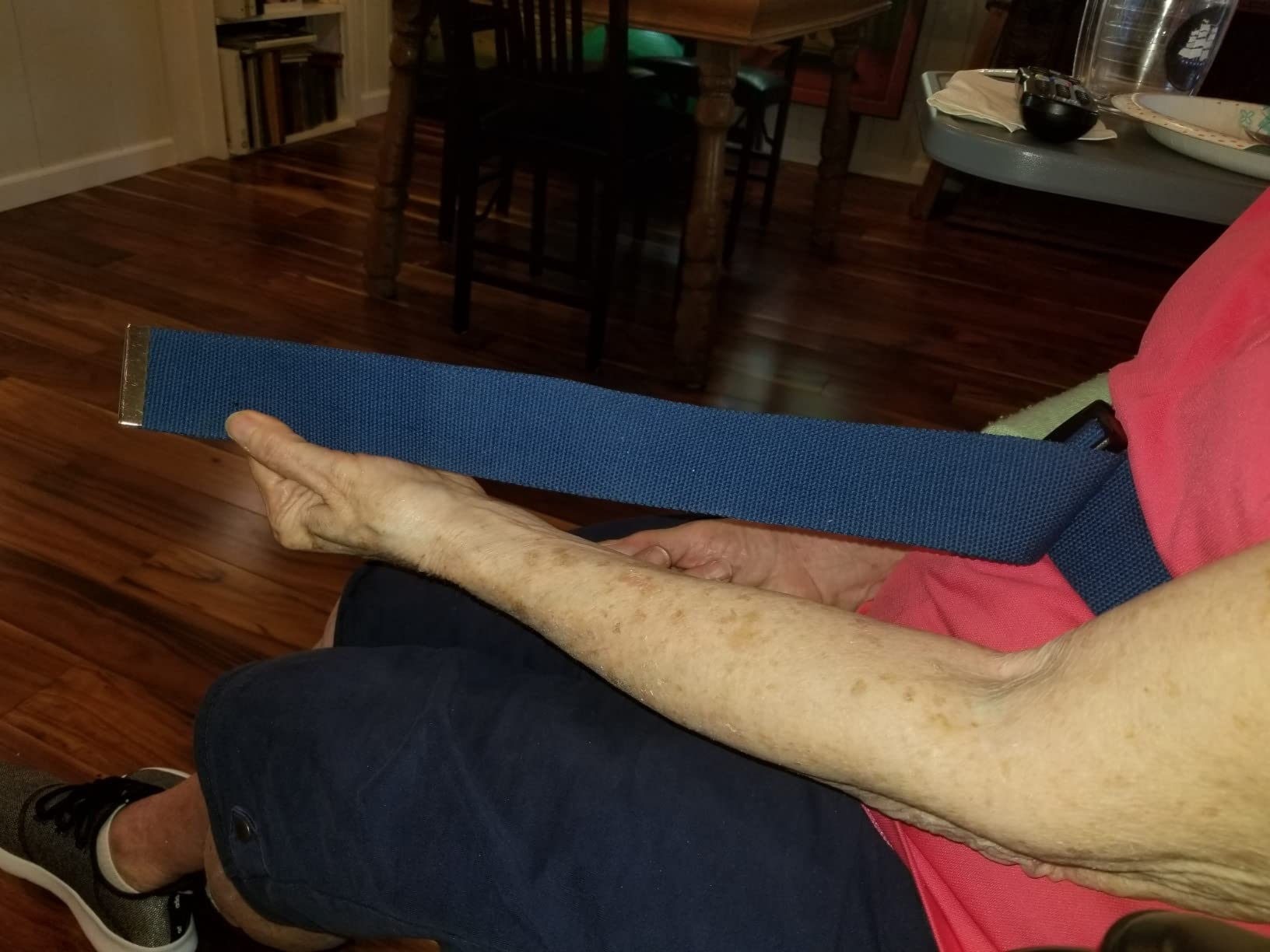
Now the part you must weigh honestly: 300 pounds is the lowest weight capacity of the ten belts we reviewed, and it rules the belt out of bariatric use entirely. The webbing can also slip if it is not fully tightened before a transfer begins, and the plastic buckle can unclasp if the front of the belt is grabbed suddenly. Position the buckle off to one side before you tighten, and check that it has actually latched before you take any load.
Best practice is to sit the buckle to the side rather than the front or back, which takes a little practice to do without looking. Once that habit is set, this is a comfortable, easily operated belt for a smaller person who bears weight and for a caregiver whose hands are the limiting factor. It is not the belt for a large person, and it is not the belt for an unplanned transfer.
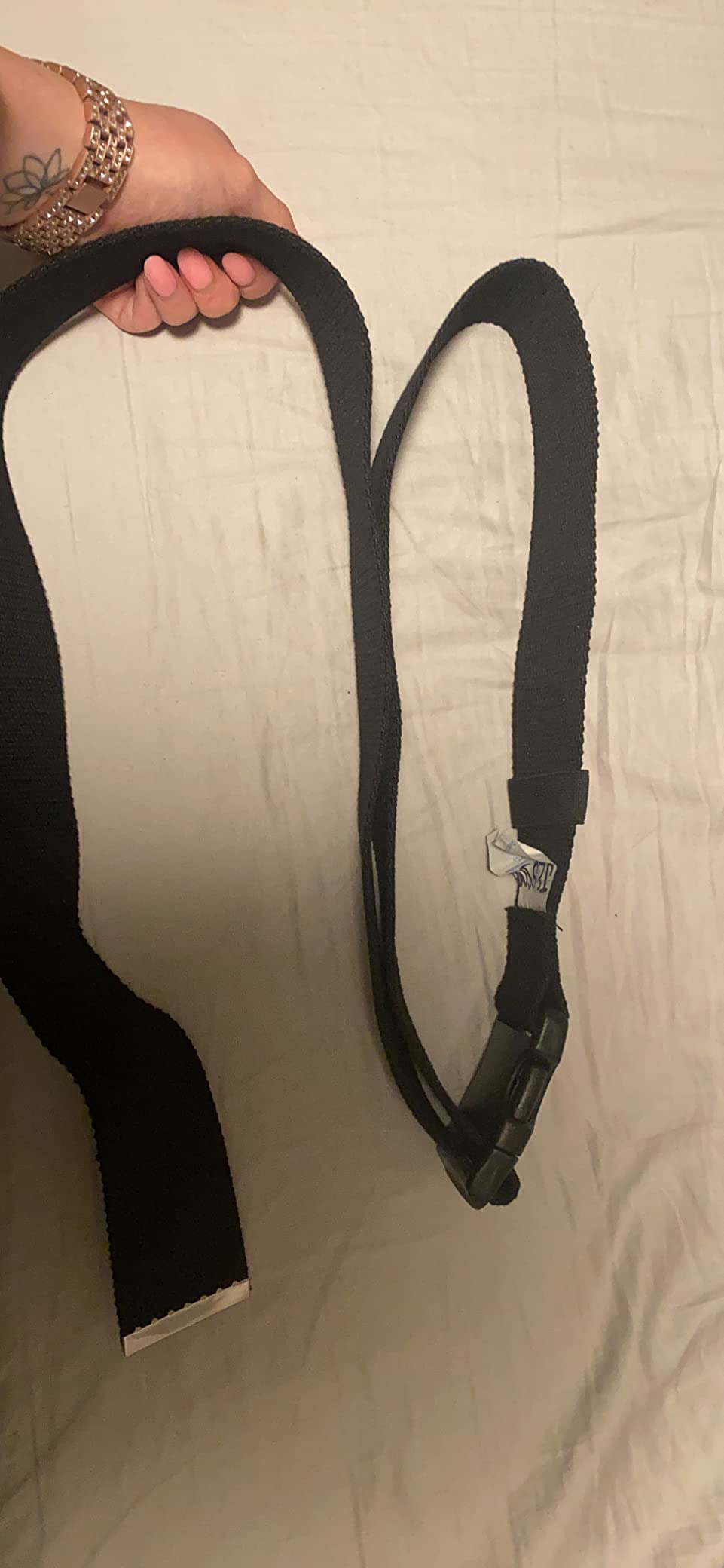
Who should and should not buy this belt
Buy it if the person weighs under roughly 240 pounds, leaving a workable margin below the 300-pound rating, and if the caregiver has hand strength that makes a threaded buckle genuinely difficult. Do not buy it for a bariatric patient, for a person who cannot bear weight, or for a caregiver working alone with someone heavy. The buckle is easier to open and easier to open by accident, and that trade is only worth taking at lower loads.
Building the open-and-latch habit
Sit the buckle on the person’s side, not the front, before tightening. Pull until two flat fingers slide underneath, then confirm the latch with a thumb before you lift. Practise the whole thing seated first, then standing, then walking. A belt you have fitted a dozen times becomes automatic, and automatic is the state you want when the person is heavier than usual, tired, or in a hurry.
How to Choose a Gait Belt: 8 Factors That Matter
Eight decisions account for nearly every difference between a belt that works in your home and one that ends up in a drawer. Work through them in order, because the first two eliminate more wrong purchases than everything else combined.
1. Measure the waist, then add overlap
Measure at the narrowest point of the abdomen with the person standing, over the clothing they will normally wear during transfers. Add 8 to 10 inches for the overlap, then choose a belt whose maximum adjustment clears that number. A 60-inch belt generally covers waist measurements up to about 50 inches. If the person is above that, you need a 72-inch belt. Never compensate for a short belt by pulling harder, because a permanently tight belt restricts breathing and can cause a skin injury over a long wear.
2. Match capacity with a 20 percent margin
Read the weight rating as a ceiling. A practical rule is to keep the person’s weight about 20 percent below the rating, so a 350-pound belt serves someone up to roughly 280 pounds, and a 300-pound belt serves someone up to about 240 pounds. Above 300 pounds, weight matters more than features: look for a 400 or 500 pound rating and the widest webbing you can pair with it.
3. Choose the buckle you can operate when tired
Threaded metal gives the most predictable closure. Quick release opens with one hand and is faster. Plastic quick release is the easiest to open and the easiest to open accidentally. Locking teeth that bite into the webbing hold best when tension changes mid-transfer. Match the buckle to the situation: metal or locking teeth for unpredictable or solo transfers, quick release for high-frequency transfers, plastic for caregivers with limited hand strength at lower loads.
4. Decide whether you need handles
Handles let you grip instead of pinch, and let you reposition your hands without letting go. They are the feature experienced clinicians rate highest for protecting the caregiver’s back, and they matter most when you transfer alone, when the person is heavy, or when transfers are frequent. A plain strap is lighter, cheaper, and perfectly workable for a smaller person with good trunk control and a caregiver who knows the underhand grip.
5. Look at webbing width for comfort
Two inches is the standard and works for most people. Four inches spreads pressure meaningfully and is the better choice for a larger person, for fragile skin, or for long assisted walks. Wide webbing also reduces the pressure at any given point, which is why the 4-inch handled belt is frequently preferred by bariatric caregivers even at a lower stated rating.
6. Check the material and the stitching
Cotton webbing is soft and comfortable and absorbs moisture well, which suits a person who wears the belt intermittently through a long day. Nylon webbing resists moisture and abrasion and dries fastest, which suits a facility doing many washes a day. Polyester sits between the two. Matte finishes grip clothing better than shiny ones, and sealed edges are worth preferring because frayed webbing ends are abrasive against skin.
The stitching matters more than the fibre. Double stitching and reinforced bar tacks at the webbing ends, the buckle anchor, and every handle attachment are what stop a belt from failing under load, and they are the first place to look when inspecting an older belt. Non-stretch webbing holds tension better than a stretchy weave, so the belt does not quietly grow slack as the person shifts during a transfer.
7. Match the belt to the caregiver, not only the patient
A 350-pound-rated belt is a two-person job above roughly 250 pounds, and no belt changes that arithmetic. If you are the only caregiver in the house, weight your decision toward handles and wide webbing, because they let you share the load across your whole body instead of a narrow handhold. If shifts are shared, buy one model everyone recognises so the fit and the buckle position are never a surprise.
8. Fit the belt to the person’s condition
A gait belt suits someone who can bear some weight, can follow a count of three, and has skin that tolerates a strap across the abdomen. Recent abdominal surgery, a healing hernia, an ostomy, a feeding tube, aneurysm history, or severe osteoporosis are reasons to ask a clinician before using a waist belt at all. A chest-placed handled belt is sometimes the answer instead, and a mechanical lift is sometimes the only safe answer.
How to Use a Gait Belt Safely: 7 Sit-to-Stand Steps
Sequence matters more than equipment. A superb belt used out of order is a mediocre belt, so run the same sequence every time until it becomes automatic.
The transfer sequence
One: explain what is about to happen and get agreement. Two: fit the belt over clothing, buckle it, and confirm the two-finger fit with two flat fingers at the front. Three: position the buckle at the person’s side, not the back. Four: block the person’s feet against the floor or the bed frame, knees together, feet slightly apart. Five: place your hands through the handles or take an underhand grip on the webbing, keeping your back straight and your spine neutral. Six: count three out loud, push through your legs, and lift with your hips rather than your back. Seven: pause once the person is standing and steady before the first step, then move slowly with small steps.
Two-caregiver technique
Use two people above roughly 250 pounds, whenever the person has poor balance, or any time you feel uncertain. Caregiver one leads the movement and calls the count. Caregiver two holds the rear handles and controls the descent. Both use a leg press, neither bends at the waist, and nobody stands below the person on stairs. The stronger caregiver leads, not the more experienced one, which is not always the same person.
Desk and car transfers
For a car transfer, fit the belt before the person moves rather than after, and set the seat back and recline it to a level where the person’s feet can reach the floor. On a wheelchair transfer, angle the chair away from the bed, lock the wheels, and remove the footplates rather than trying to step over them. Angle is the whole trick in both cases, and it is free.
When Not to Use a Gait Belt
A gait belt is a handhold for a person who can bear weight and follow directions. The moment that is not true, the belt is the wrong tool, and continuing to use it puts both of you at risk. The single most common cause of caregiver back injury in home care is a solo transfer that should have been a two-person job or a mechanical lift.
Signs you need a mechanical lift
If the person cannot lift either foot, cannot push through their arms, cannot follow a count of three, or is completely dependent for weight bearing, a gait belt will not help. You need a floor-to-ceiling or floor-to-seat mechanical lift with a full-body sling, a sit-to-stand device if they have some arm strength and trunk control, or a two-person trained assist. Rental through equipment suppliers is common, and a physical therapist can set you up and train the caregivers who will use it.
A sit-to-stand device, and when it fits
A sit-to-stand device is the step between a gait belt and a full lift. It suits a person who can bear weight through their legs, can push through their arms, and needs help mainly with the transition from sitting to standing and back down. It typically lets one caregiver handle a transfer that would otherwise take two. If the person cannot manage the standing phase at all, a sit-to-stand device will not save you and a full lift is required.
Slide boards and other low-tech options
A slide board with a transfer board works across a level surface such as bed to wheelchair or wheelchair to toilet when the arms work but the legs do not. It needs two caregivers. For short distances, a transfer board under the arms can help a person slide rather than be lifted. These are legitimate alternatives, and choosing one is a sign of good judgment rather than failure.
Contraindications to raise with a clinician
Recent abdominal or lower back surgery, a healing hernia, an ostomy, a feeding tube, a known aneurysm, severe osteoporosis, a pressure sore directly under the belt, or skin that tears easily are all reasons to consult a physical therapist, occupational therapist, or surgeon before using a waist belt. A chest-placed handled belt may be suitable in some of these cases. A caregiver training course in safe patient handling is also worth the time, and it will change how you use every belt on this list.
Care, Washing and Replacement
Most gait belts outlast the person who first bought them, which is exactly why they get used past the point where they are safe. Treat care and inspection as part of using the belt, not as optional upkeep.
Washing
Check the care instructions, because hardware varies. Most cotton and nylon webbing belts are machine washable in cold water and should be hung to drip dry or air dried. A belt with a metal buckle usually wants a mesh laundry bag to protect the hardware from knocking. Hand-wash-only models exist, so check before you commit. Never put a gait belt in a dryer on high heat, and never use bleach, which degrades nylon and polyester webbing over time.
The 60-second inspection
Before every use, run your thumb and fingers along the full length of the webbing, checking for fraying, thinning, cuts, or soft spots. Pull the stitching at the strap ends and the handle anchors; lifted or broken threads mean the belt is finished. Check the buckle for cracks and confirm it latches and opens fully. Look for fraying specifically near the buckle and the handle anchors, because that is where load concentrates and failure begins. Replace immediately if you find any of these, and never repair a gait belt with tape or stitching of your own.
Storage and lifespan
Store the belt dry and out of direct sunlight, loosely coiled rather than folded tight, with the buckle accessible. Expect a service life of roughly one to three years depending on how often it is used, how many caregivers share it, and how it is laundered. A belt in daily use in a home with four caregivers will reach the end of that range quickly. When webbing flattens permanently, thins, or the stitching lifts, replace it rather than stretching your service life by a few months. Keeping a spare belt in a drawer costs far less than a fall.
Frequently Asked Questions
Do caregivers use gait belts?
Yes. Family caregivers at home, nursing assistants, and physical therapists use gait belts every day. A gait belt is a padded webbing strap that fastens around the waist over clothing, giving the caregiver a secure handhold near the person’s center of gravity during standing, walking, and transfers. It is standard equipment in hospitals, care homes, and home care for anyone who can bear some weight and follow simple directions.
What is the best patient transfer belt for elderly patients?
For most home care situations the best patient transfer belt is one with padded handles, wide webbing, and a rated capacity at least 20 percent above the person’s weight. Among the belts we reviewed, the VIVE Transfer Belt with 7 padded handles, 4 inch wide nylon webbing, and a 350 pound rating is the strongest all-round answer for an elderly person of average size. If the person is larger, pair a 400 or 500 pound rating with 4 inch webbing instead of choosing a narrow 2 inch strap.
What is the best waist support belt for elderly people?
A waist support belt and a gait belt are different products. A waist support belt, sometimes called a back or abdominal brace, is a compression garment worn against the skin to support the lower back or abdomen. A gait belt, also called a transfer belt, is a wider woven strap worn over clothing with a load-rated buckle and handles, used by a caregiver to hold a person during a transfer. For moving someone, you want a transfer belt. For supporting someone’s own lower back, you want a brace, and you should ask a clinician which is appropriate.
What to use instead of gait belt?
Use a full-body mechanical lift with a sling when the person cannot bear weight, cannot push through their arms, or cannot follow a count of three. Use a sit-to-stand device when the person can bear weight through their legs and push through their arms but struggles with the transition itself. Use a slide board or transfer board for a bed to wheelchair or toilet move when the arms work but the legs do not, and always use two caregivers. Use a two-person trained assist for any heavy or partly weight-bearing transfer. A gait belt only works when the person can participate.
What is the best gait belt for elderly people?
The best gait belt for an elderly person is the one that fits them, not the one with the longest feature list. Measure the waist over clothing and add 8 to 10 inches of overlap, pick a belt rated 20 percent above their weight, choose a buckle type you can operate when tired, and add padded handles if you transfer alone or often. Our Editor’s Choice, the COW and COW metal buckle belt, is the safest general default; the VIVE 7-handle belt is the better choice when caregiver back protection is the priority.
Which gait belt has handles?
Three of the belts in our roundup have reinforced handles. The VIVE Transfer Belt has 7 padded handles with 4 inch wide nylon webbing, adjustable to a 51 inch waist, rated to 350 pounds. The Patient Aid gait belt has reinforced grip handles on multiple sides with a quick-release clip buckle and works on chairs, beds, floors, toilets, and car seats. The Medical king transfer belt has 6 padded handles, a 50 inch length, and a 500 pound rating, which makes it useful for stairs and tight rooms.
How tight should a gait belt be?
Tight enough that two flat fingers slide underneath the belt at the front, and no looser. If you can fit a whole hand underneath, the belt is too loose to control a descent. If two fingers cannot pass at all, it is too tight, it can restrict breathing during a long walk, and it can cause skin damage over time. Always fit the belt over clothing rather than against skin, position the buckle at the person’s side, and check the fit again before each transfer because the belt can loosen across a day of use.
How often should a gait belt be replaced?
Expect a service life of roughly one to three years depending on use, shared caregivers, and laundering. Replace a belt immediately if you find fraying, thinning webbing, lifted or broken stitching, or a cracked or slipping buckle, and never repair one with tape or your own stitching. Inspect before every use, paying most attention near the buckle and the handle anchors where load concentrates and failure begins. Keeping a spare belt on hand is cheap compared with the cost of a fall.
The Verdict: Where to Start
Start with the COW&COW metal buckle belt if you want one dependable transfer belt for an average-size person and you would rather not think about it. It has the highest rating and the deepest review history in this roundup, and it is the belt I hand to a family caregiver with no other context.
Move up to the VIVE 7-handle belt the moment your own back becomes the concern, and go to a 400 or 500 pound rated model with wide webbing if the person is larger. The LiftAid 60 inch locking buckle belt is the one to pick when a transfer is unpredictable or you are working alone, because the locking teeth do not feed through the webbing when tension changes. Whatever you choose, measure first, inspect before every use, and move to two caregivers or a mechanical lift the moment the person stops being able to bear weight.
That is the whole case for these 10 gait belts for caregivers. The best gait belt is a tool, and like any tool it is only as good as the technique and the fit behind it.