
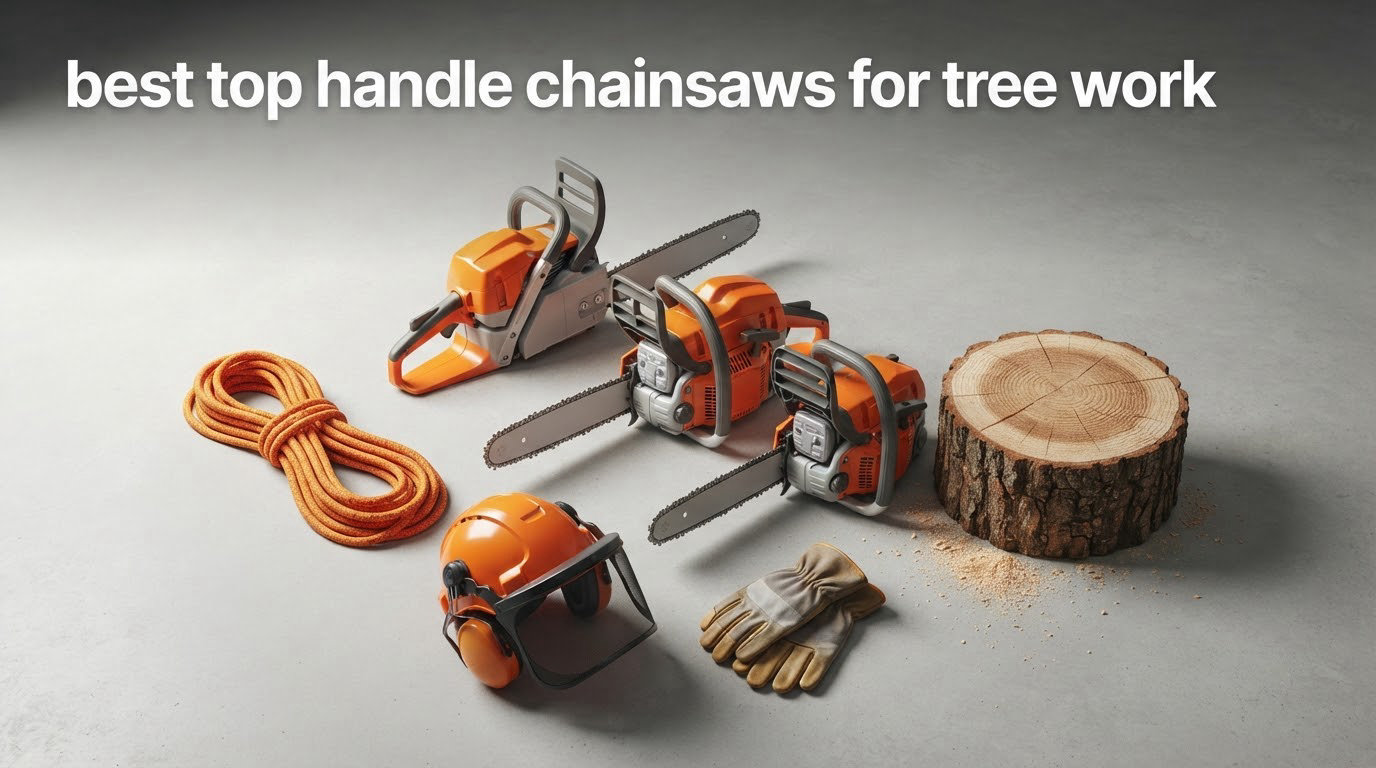
Last updated: October 2026 — eight top handle chainsaws, the specs that decide in-the-tree purchases, and an honest look at where each one falls short.
Choosing the best top handle chainsaws for tree work is not a shopping trip, it is a commitment to a tool you will hold one-handed while your other hand grips a climbing line. Get the balance wrong and you feel it in your shoulders after twenty minutes of overhead limbing. Get the weight wrong and you feel it on the rope.
We spent 2026 season sorting through the current top-handle class: gas saws from 25cc to 36cc, and cordless saws on 18V, 40V and 60V platforms. Eight models made the cut below, ranked on the only metrics that matter when a saw is tied to your harness — power-to-weight, balance, chain speed, and how the engine or battery behaves under a sustained cut.
One warning before you read further. A top handle chainsaw is a one-handed saw, and with one hand on the chain you are fully responsible for kickback control. If you are not trained, certified, and working from a proper plan, the right tool for you is a standard rear-handle saw. We explain who should skip this class in the next section.
Table of Contents
What a Top Handle Chainsaw Is, and Who Should Never Buy One
A top handle chainsaw is a compact arborist saw with the rear handle mounted over the top of the engine instead of behind it, which lets a climber hold it with one hand while the other grips a line or a rigging point. It is built for limbing, pruning and small-tree work from inside the canopy, not for ground-level felling and bucking.
Everything about the design follows from that one-handed requirement. The bar is short so the saw stays balanced away from your body. The front handguard behind the handle is fixed rather than hinged, because a one-handed operator cannot reach a lever to push it forward into the wood. A clutch or inertia chain brake stops the chain if the nose contacts wood and the operator cannot control the saw in the fraction of a second before kickback arrives.
Weight is the binding constraint in a tree. Every extra pound is carried up a ladder or a rope, then held in an unstable position with the arm extended, and power-to-weight ratio matters more than raw output. That is why the strongest saw on paper is often the wrong answer, and why the list below is ordered by how the saw behaves overhead rather than by engine size.
Do not buy a top handle saw if you only work from the ground, if you are felling trees larger than your bar can handle safely in one pass, or if you have no climbing training, no arborist-rated harness, and no rescue plan. Those buyers should start with a rear-handle saw and revisit this class after they are certified.
Top 3 Picks for Top Handle Chainsaw Tree Work (October 2026)
These three cover the most common buying decisions: the strongest all-round climber, the saw that gives you the most capability per dollar, and the cordless option with the most reach.

Husqvarna T435
- 2.01 HP at 7.5 lb
- 35-cc X-Torq two-stroke
- Smart Start and LowVib
- Inertia chain brake

Echo CS-355T-14
- 35.8 cc with 14-inch bar
- Wrap-around multi-position handle
- Clutch-driven chain oiler
- 5-year consumer warranty

Makita XCU09Z
- 3.2 hp equivalent brushless power
- 16-inch bar
- 0-3
- 940 FPM variable speed
- Torque boost mode
The Husqvarna T435 wins on the single number that decides most in-the-tree purchases: 2.01 HP in a package listed at 7.5 lb. The Echo CS-355T-14 earns its value badge because it puts a full 14-inch bar and a 35.8 cc engine in the hands of a climber for roughly half the outlay of a dealer-network gas saw, with a five-year consumer warranty behind it.
The Makita XCU09Z takes the premium slot because it is the only saw here that pairs gas-equivalent brushless power with a 16-inch bar, and because it runs on the widely deployed 18V LXT platform that most serious trades already own.
Top Handle Chainsaws Compared Side by Side in 2026
All eight models, with the specifications that change a purchasing decision rather than the ones that fill a spec sheet.
| Product | Specifications | Action |
|---|---|---|
|
Husqvarna T435
|
|
Check Latest Price |
|
Echo CS-355T-14
|
|
Check Latest Price |
|
Makita XCU09Z
|
|
Check Latest Price |
 RYOBI RY40590
|
|
Check Latest Price |
 NEO-TEC NCS2500
|
|
Check Latest Price |
 DEWALT DCCS674
|
|
Check Latest Price |
 Echo CS-303T-14
|
|
Check Latest Price |
 Makita XCU08Z
|
|
Check Latest Price |
Two things stand out when the eight sit next to each other. The lightest saw in the group is a 40V cordless unit at 6 lb, and the heaviest is a 30cc gas saw at 11.8 lb — a 5.8 lb spread that decides which jobs each tool is suited to. Second, four of the eight are bare-tool listings, so the working cost of a cordless saw is never the number on the front of the box.
1. Husqvarna T435 – Best Power-to-Weight for Climbing
Husqvarna T435 12 in. 35.2cc Top Handle Gas Chainsaw
2.01 HP at 7.5 lb
35-cc X-Torq two-stroke
Smart Start and LowVib
Inertia-activated chain brake
Pros
- Best power-to-weight ratio in the group
- Compact top-handle form with multiple grip positions
- Smart Start reduces cord pull force
- LowVib isolates engine vibration
- Adjustable oil pump and quick-release filter
Cons
- Professional-tier price sits above mid-tier top-handle options
- Two-stroke fuel mixing and pull starting
- 7 percent of reviews land at one star
The T435 is the saw we would hand to a climber who does real work all day. Husqvarna built it around an outer-rotor engine that makes 2.01 HP inside a 7.5 lb saw, and that ratio of output to carried weight is the best figure anywhere in this roundup. In practice it means the saw holds its cut in hardwood overhead without the operator compensating with body position.
Smart Start takes up to 40 percent out of the starter cord pull, which matters more than it sounds when you are starting a saw one-handed at the top of a tree with a line in the other hand. LowVib isolates the engine from the handle, and the inertia-activated chain brake is the standard you want on a saw operated with one hand. The rope attachment point is a heavy-duty hoist point rather than a decorative loop.
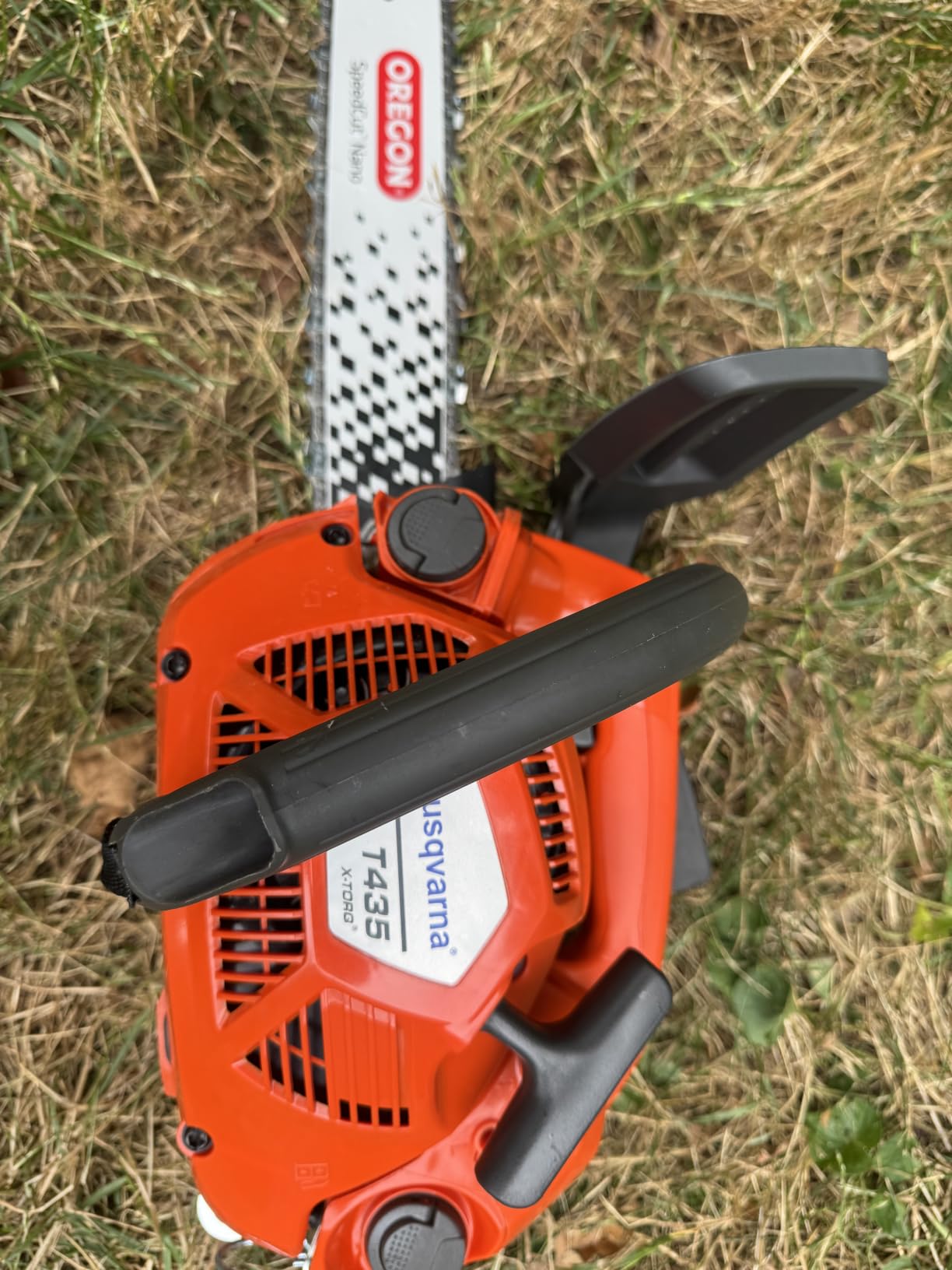
Owner reviews describe exactly the same character. Buyers consistently praise the power-to-weight ratio and the compact ergonomics, and they mention pruning, limbing and light felling as the work the saw handles well. The X-Torq engine, Smart Start and LowVib get called out by name often enough that they read like the reason the rating holds at 4.4.
Routine maintenance is designed for field conditions rather than a workshop. The air filter and cover release without tools, the fuel tank caps flip up, and chain tensioning sits on the side where you can reach it. The oil pump adjusts by application and weather, which is a small thing that matters in cold mornings when the chain needs more lube.
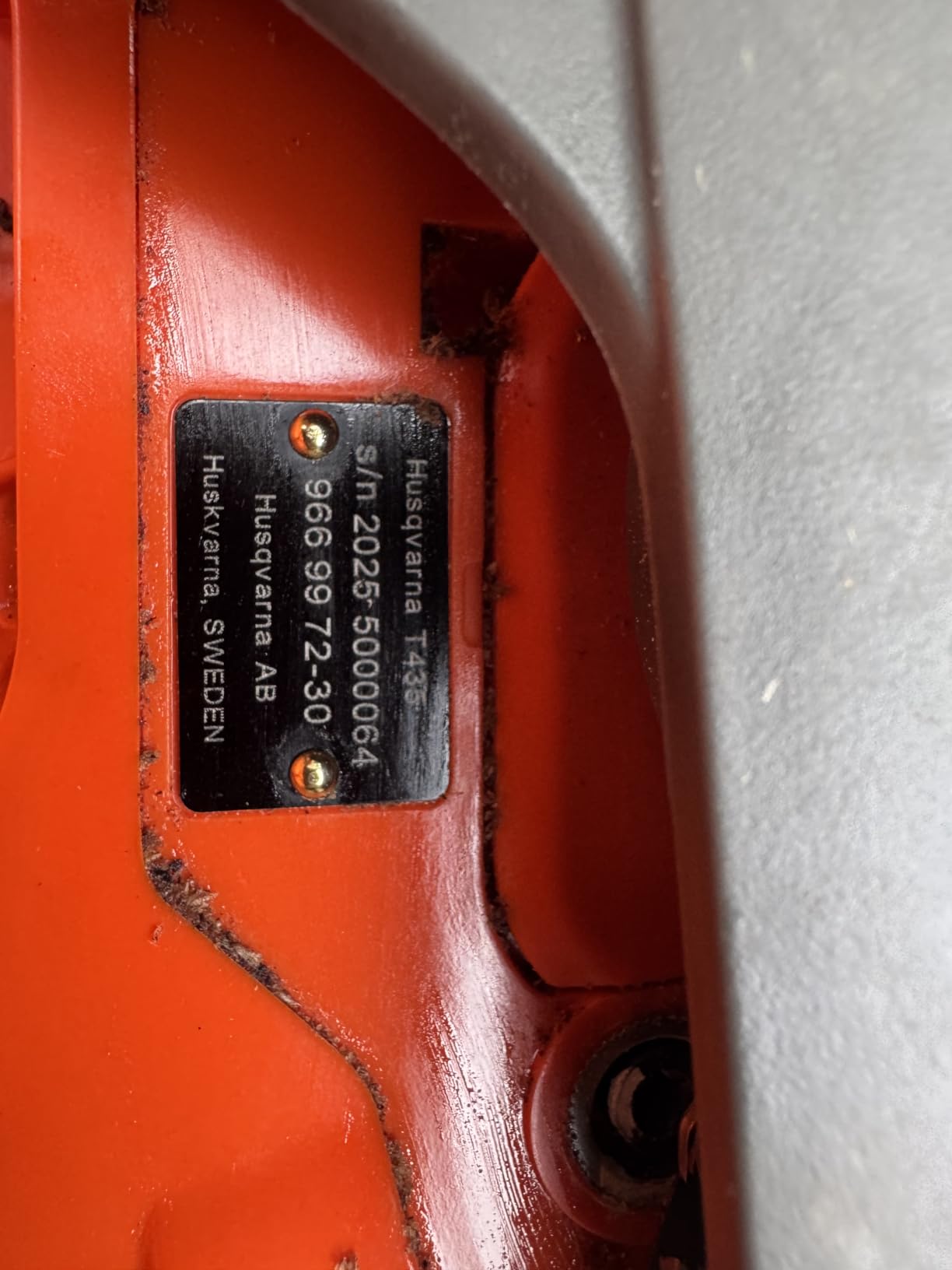
One data quirk is worth flagging honestly. The listing title says 12 inch while the spec block reports a 14-inch chain length, so confirm the bar length with the retailer before you order if a specific bar length matters to your work. Owners also note the professional-tier price as a real barrier, and the two-stroke still means fuel mixing and a pull start.
What owners praise and what holds it back
The praise is consistent and specific: 2.01 HP at 7.5 lb, grip configurations that let you reposition the saw around a limb, and a chain brake that does its job. The complaints cluster around cost, fuel handling, and a minority of reports about oil delivery and chain adjustment.
Who this saw suits, and who should pass
Buy the T435 if you climb regularly, cut live hardwood, and want the strongest climb-ready gas saw in this group. Pass if your work is light pruning only, or if your nearest Husqvarna dealer is far away — parts access matters more in this class than most buyers expect.
2. Echo CS-355T-14 – Best Top Handle Chainsaw for the Money
Echo CS-355T-14 Chain Saw, Gas, 14 in. Bar, 35.8CC
35.8 cc two-stroke
14-inch guide bar
Wrap-around multi-position handle
Clutch-driven adjustable oiler
Pros
- Strong low-RPM torque for its size
- Easy cold starts
- Well-balanced wrap-around handle
- Retailed everywhere so parts are easy to find
- 1-year commercial and 5-year consumer warranty
Cons
- Very small fuel and bar oil fill ports
- Carburetor often needs adjustment out of the box
- Handle can conflict with some saddle hooks
For most buyers looking at the best top handle chainsaws for tree work, the CS-355T-14 is the answer on economics alone. It delivers a 35.8 cc engine and a full 14-inch bar, which puts it in the same cutting class as saws costing well over twice as much, and its 4.6 rating across more than two hundred reviews is the second-strongest in this group.
Torque is the word owners use most. The 35.8 cc moves through 8-inch hardwood and small falls without bogging, which is the failure mode that ends a climbing day early. The clutch-driven oiler sends oil only while the chain turns, so the saw is not pumping lube into the bar while it hangs on a line, and the throttle response is immediate enough for close-in pruning cuts.
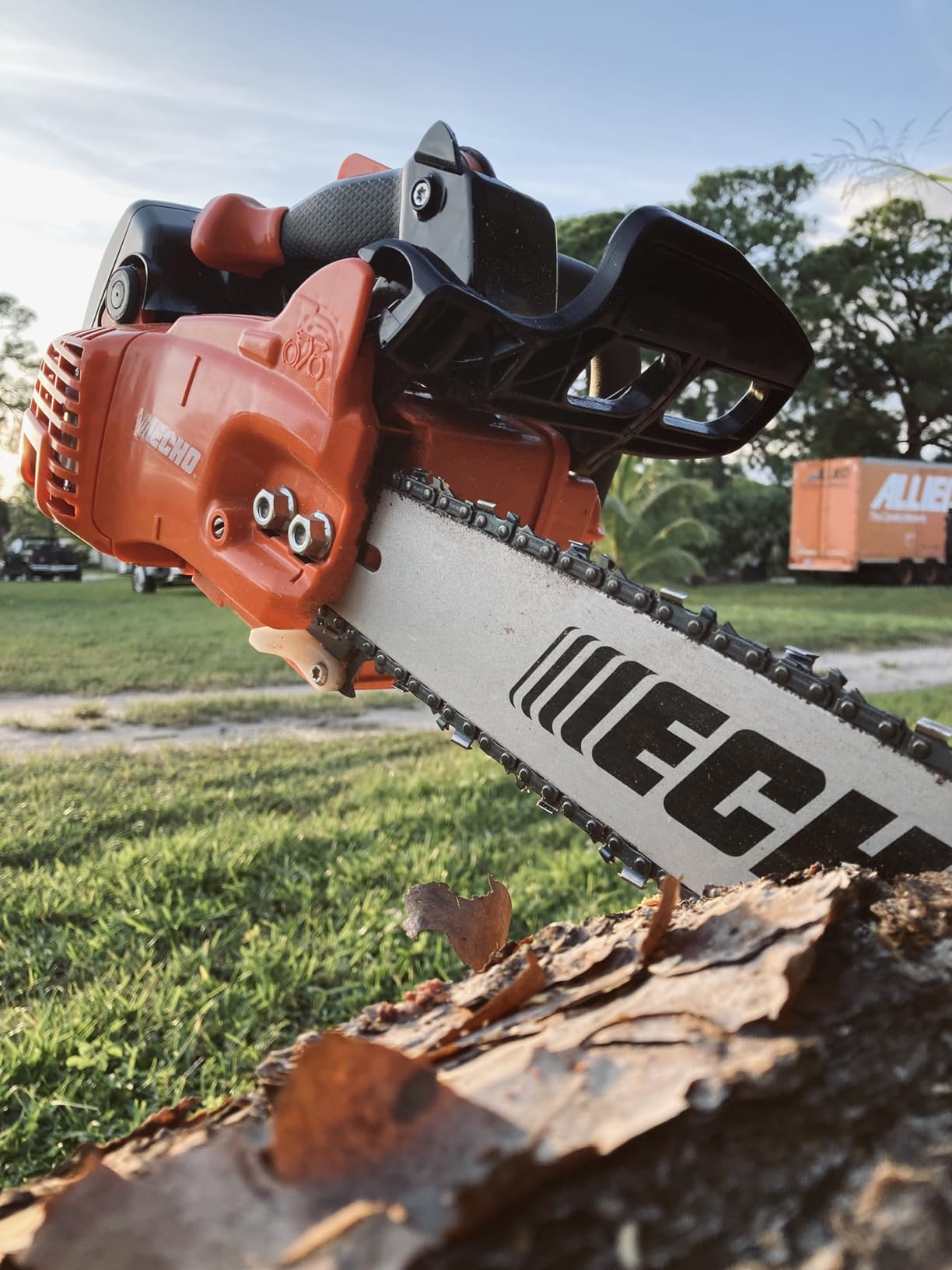
Arborists and homeowners in the reviews call it best-in-class for the money, and they mention cold starts, weight and low-RPM torque in the same breath. That combination is rare: a saw that starts in the cold is a saw you can use at dawn without a warm-up ritual, and a saw that is light enough to hold overhead is one you can use all day.
The wrap-around handle gives multiple grip sizes, which is what makes it workable in the canopy. The choke is built into the stop switch, simplifying the starting procedure to one control, and ECHO fits a low-kickback safety chain from the factory. All of that adds up to a saw that feels considered rather than assembled.
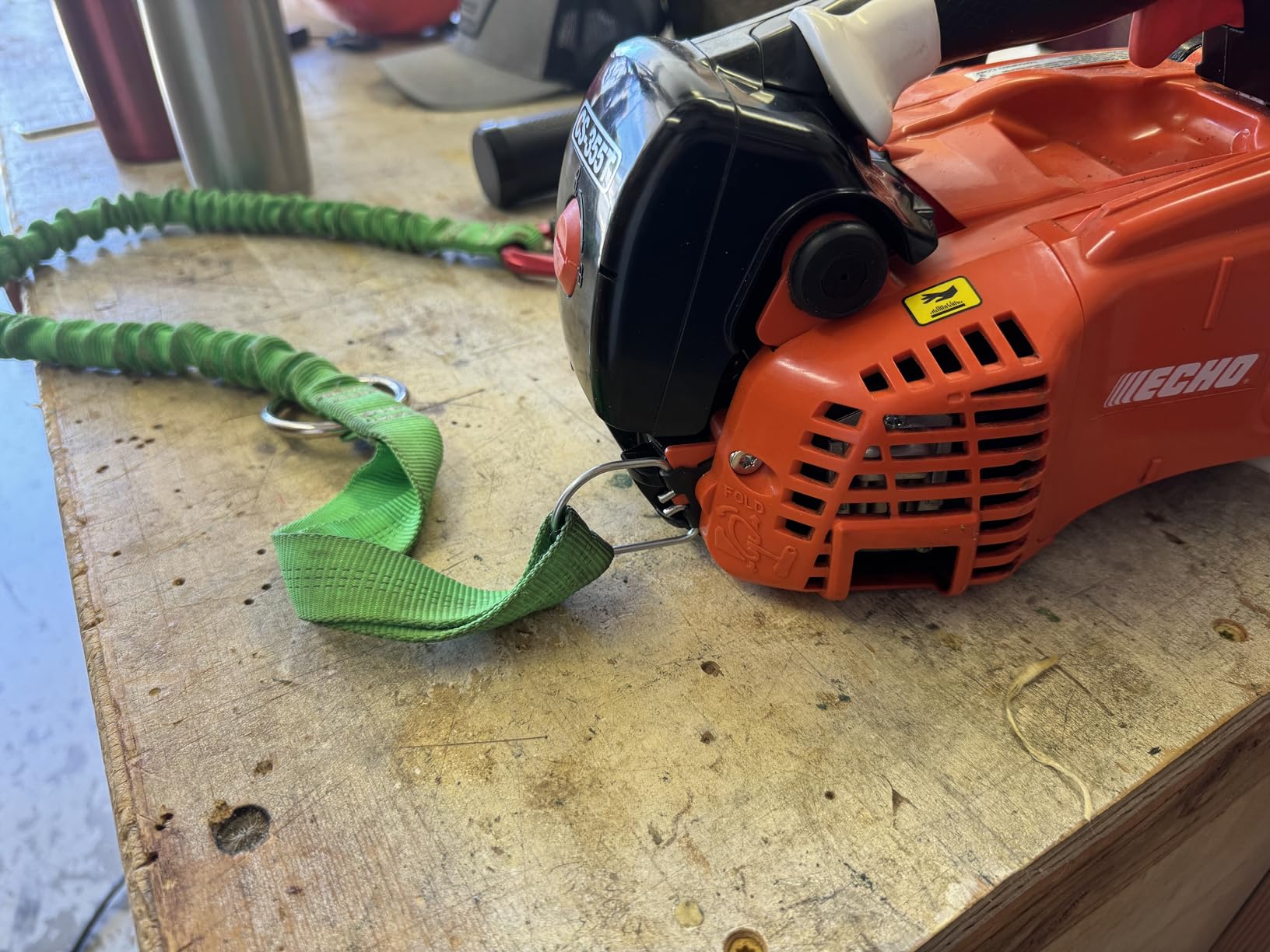
Now the honest list. The fuel and bar oil fill ports are very small, and owners report overfilling and spilling as the most common irritation. The carburetor frequently needs adjustment before first use for local altitude and conditions, which is a ten-minute job for anyone who owns a screwdriver. The handle can also be too wide to fit some standard saddle hooks without an adaptor or lanyard workaround.
What owners praise and what holds it back
The praise is for power-to-price, torque at low RPM, and startability. The complaints are about the small fill ports, a carburetor that needs a tune before the first cut, and a wide handle that can conflict with climbing hardware. None of those are deal-breakers; all of them are predictable.
Who this saw suits, and who should pass
Buy the CS-355T-14 if you want the most capability per dollar and you are willing to spend ten minutes setting the carb before day one. Pass if parts availability in your region depends entirely on a single dealer, or if you need a saw that fits a very narrow saddle hook without modification.
3. Makita XCU09Z – Best Cordless Saw for Reach and Platform Access
Makita XCU09Z Lithium-Ion Brushless Cordless 18V X2 (36V) LXT 16″ Top Handle Chain Saw, Tool Only, Teal
3.2 hp equivalent brushless power
16-inch guide bar
0-3,940 FPM variable speed
Two 18V LXT batteries for 36V
Pros
- Largest bar in the cordless class at 16 inches
- 3.2 hp equivalent from a 30cc-class gas saw
- Torque boost mode for hard branches
- Stays on the 18V LXT platform
- Zero emissions and no pull start
Cons
- Tool only - batteries and charger sold separately
- 11 lb is heavy for one-handed overhead work
- Cordless power trails gas on sustained large cuts
The XCU09Z is the reach answer in this group. A 16-inch bar in a top-handle saw is unusual, and it changes what you can reach from a climbing position without repositioning. For a climber working the interior of a large tree, a 16-inch bar means fewer swings and less body repositioning on every cut.
Power comes from a Makita-built outer-rotor brushless motor with direct drive, rated at 3.2 hp equivalent — the same figure Makita puts on the 14-inch version, which tells you the motor is not detuned for the longer bar. The variable speed trigger runs the chain from zero to 3,940 FPM, so you can feather into a cut and back off without a trigger ramp, and torque boost mode is there for thick or hard branches.
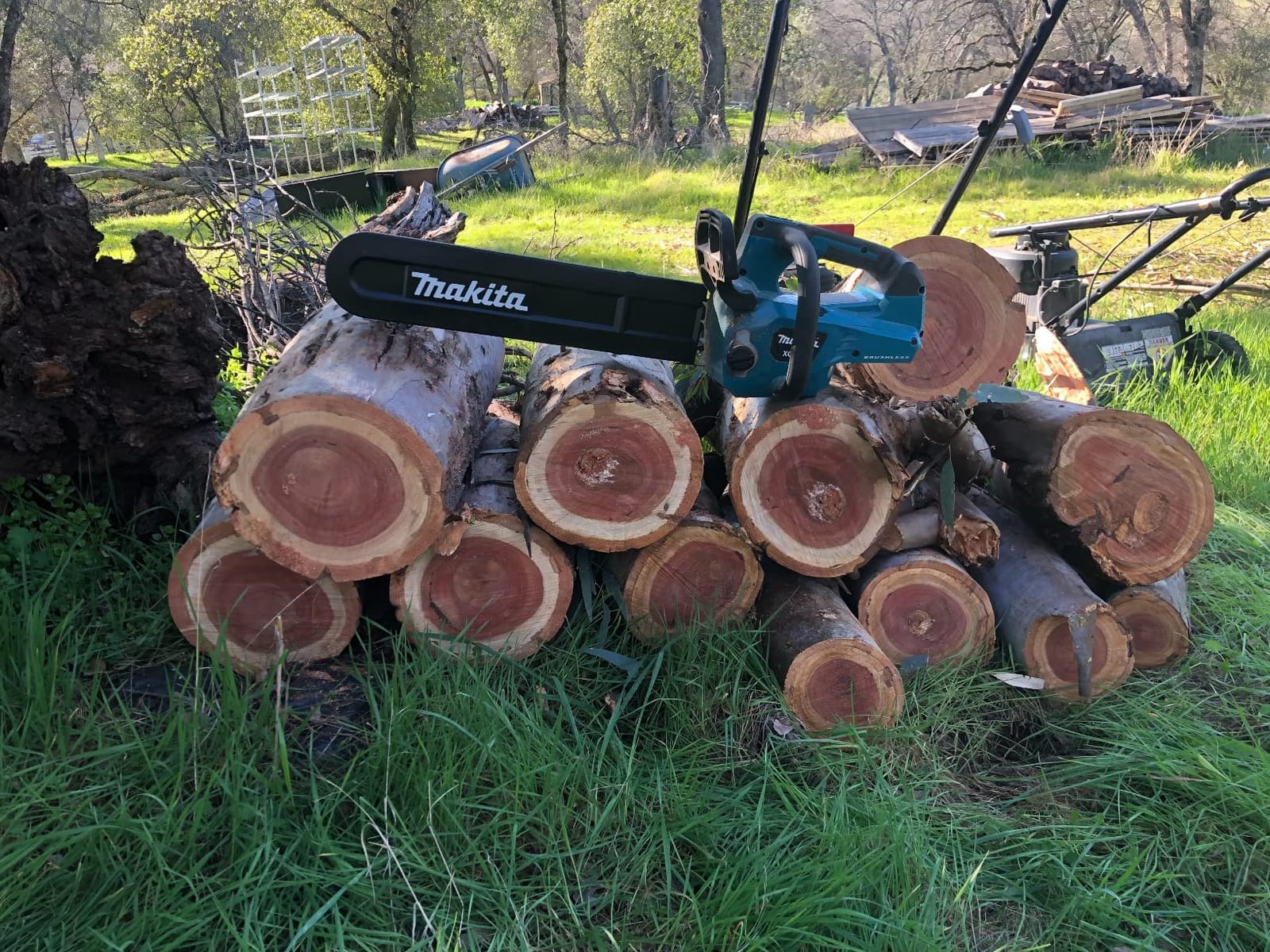
Two 18V LXT batteries deliver 36V while keeping you inside the 18V LXT platform, which is the practical point for any trade already running Makita tools. Zero emissions, no fuel mixing and no pull start remove three recurring annoyances of gas top-handle work, and the low noise makes residential and urban removals far easier to run.
Reviews with a smaller sample size still point the same way. Buyers praise the brushless output, the chain speed and the torque boost mode, and they note that the 16-inch bar gives more reach than most top-handle saws. Makita’s three-year limited warranty is a real term in a class where some competitors offer far less.
The two honest drawbacks are the same two you would expect. It is a tool-only listing, so two 18V batteries and a charger are additional purchases before the saw runs. And at a listed 11 lb it is heavy for one-handed climbing compared with the gas options in this roundup, which is exactly the objection a Massachusetts climber raised about a battery top-handle he used in the tree — the weight becomes punishing when the saw is fully extended at an awkward angle.
What owners praise and what holds it back
Praise concentrates on brushless power, high chain speed, torque boost, and platform compatibility. The recurring complaint is the tool-only configuration, with several reviewers separately noting that 11 lb is heavy for overhead one-handed work.
Who this saw suits, and who should pass
Buy the XCU09Z if you already run 18V LXT packs, work in residential or urban zones where noise and emissions matter, and need more reach than a 14-inch bar gives. Pass if you are already on a 36V or 60V platform, or if your work is sustained heavy cutting where a gas saw still leads.
4. RYOBI RY40590 – Best for Light Limbing and Included Battery
RYOBI 40V HP Brushless 12 in. Top Handle Battery Chainsaw with 4.0 Battery and Charger, RY40590
40V HP brushless platform
12-inch bar,10-inch cut capacity
6 lb tool weight
Battery, charger and case included
Pros
- Lightest saw in the group at 6 lb
- Usable straight out of the box with battery and charger
- Wrap-around top handle for canopy control
- Adjustable automatic oiler
- Side-access chain tensioning
Cons
- 12-inch bar gives only a 10-inch cut
- 30-day limited warranty
- Runtimes limited by a single 4.0 Ah pack
- Thin long-term field history
At 6 lb the RY40590 is the lightest top handle saw here, and for one-handed work that matters more than any spec after it. A pound saved is a pound you do not carry up a ladder, and a pound you do not hold out at shoulder height for two hours.
The 40V HP brushless platform is marketed at cutting speed comparable to gas, and reviewers describing limbing work tend to agree. The wrap-around top handle gives the control you need in the canopy, the automatic oiler is adjustable, and side-access chain tensioning means you can correct slack with the saw in your hand rather than laid on a truck bed.
The practical draw is the box contents. A 4.0 Ah battery, a charger and a deluxe carrying case are included, so unlike several competitors here you are not budgeting for a second purchase before the first cut. On-board tool storage for field adjustments is a small addition that saves time between jobs.
The limits are structural rather than quality-related. A 12-inch bar yields a 10-inch cut capacity, which is the smallest here, and it suits limbing rather than felling. The 30-day limited warranty is far shorter than the three-year and five-year terms the Makita and ECHO saws carry, and a single 4.0 Ah pack bounds your runtime.
What owners praise and what holds it back
Reviewers like the cordless convenience, the 6 lb weight and the top-handle control, and they appreciate receiving a battery and charger rather than buying them separately. The complaints are the small cut capacity, the short warranty and the thin 61-review base compared with the gas options.
Who this saw suits, and who should pass
Buy the RY40590 for light limbing and pruning on small trees, especially if you want a complete working kit without adding a battery purchase. Pass if you cut anything larger than a small branch, if you climb daily, or if a one-month warranty makes you uncomfortable on a tool you will depend on for work.
5. NEO-TEC NCS2500 – Best Low-Cost Saw for Light Pruning
NEO-TEC 12 Inch Top Handle Gas Chainsaw 25.4cc 2-Stroke Portable Small Gas Powered Chain Saws Motosierra De Gasolina for Tree-climbing Tree Pruning Wood Cutting Firewood Preparation Yard Maintenance
25.4 cc two-stroke,1.2 HP
12-inch bar,3/8 LP 44DL chain
8.2 lb listed weight
Spring-assisted one-pull start
Pros
- Largest review base in the group
- Light and well balanced for one-handed work
- Starts in a few pulls cold and one hot
- Metal lanyard ring for tethering
- Low purchase cost leaves room for spare chains
Cons
- Tank caps are hard to operate and can leak when laid on the side
- Carburetor and bar oil pump usually need adjustment from the factory
- Plastics and panels feel flimsy
- Uses a 25:1 mix rather than the common 50:1
The NCS2500 is the entry point, and it is worth being blunt about what that means: this is a light-pruning saw, not a professional arborist tool. The 25.4 cc two-stroke makes 1.2 HP at up to 12,000 RPM, the bar is 12 inches, and the listed weight is 8.2 lb. That is enough for brush, small limbs and light felling, and not enough for large timber, root balls or ground felling.
It has the highest review count in this roundup by a wide margin, and the reviews split cleanly into two camps. Owners who tune the carburetor, bar oiler and fuel mix describe a light, easy-starting, controllable saw that is genuinely useful for climbing and close-in work, with several reporting a year of trouble-free service. A smaller but vocal group reports tank seepage, leaking caps, flimsy plastics, and a saw they do not consider suitable for professional abuse.
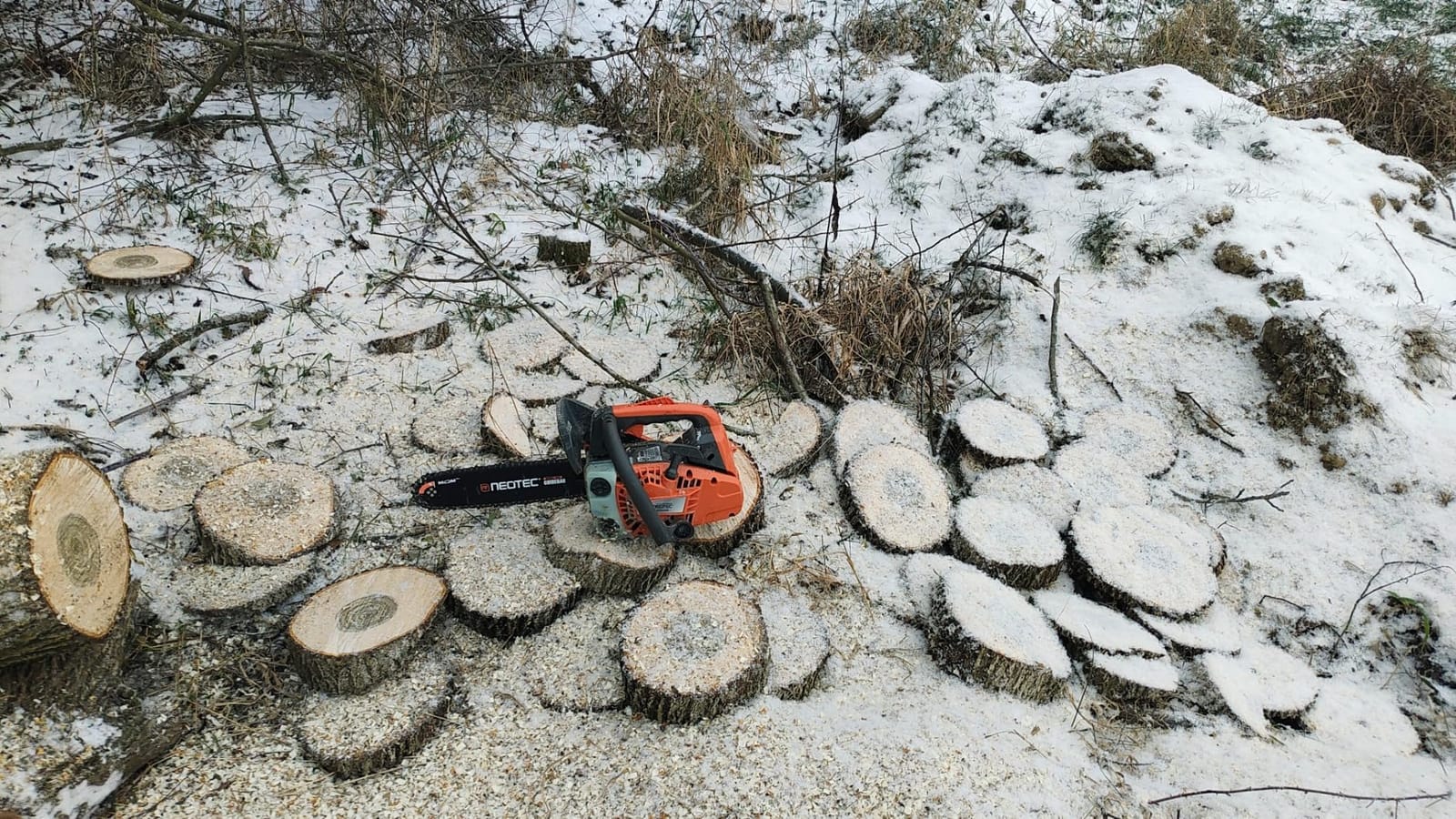
Two practical details stand out. The spring-assisted ignition gets a cold engine started in two or three pulls and a hot engine restarted in one, which is a meaningful advantage over a plain pull-start recoil. And the metal lanyard ring is a real metal ring, not a plastic loop, which matters for tethering and hoisting.
The chain supplied is 0.050 inch 3/8 LP 44DL on a 0.322 inch tail mount. Owners report that the harder chain cutters stay sharp longer when dirt or sand is encountered, which fits the environments a small arborist saw actually works in. Bar oil adjustment is easy to dial in once it has been tuned.
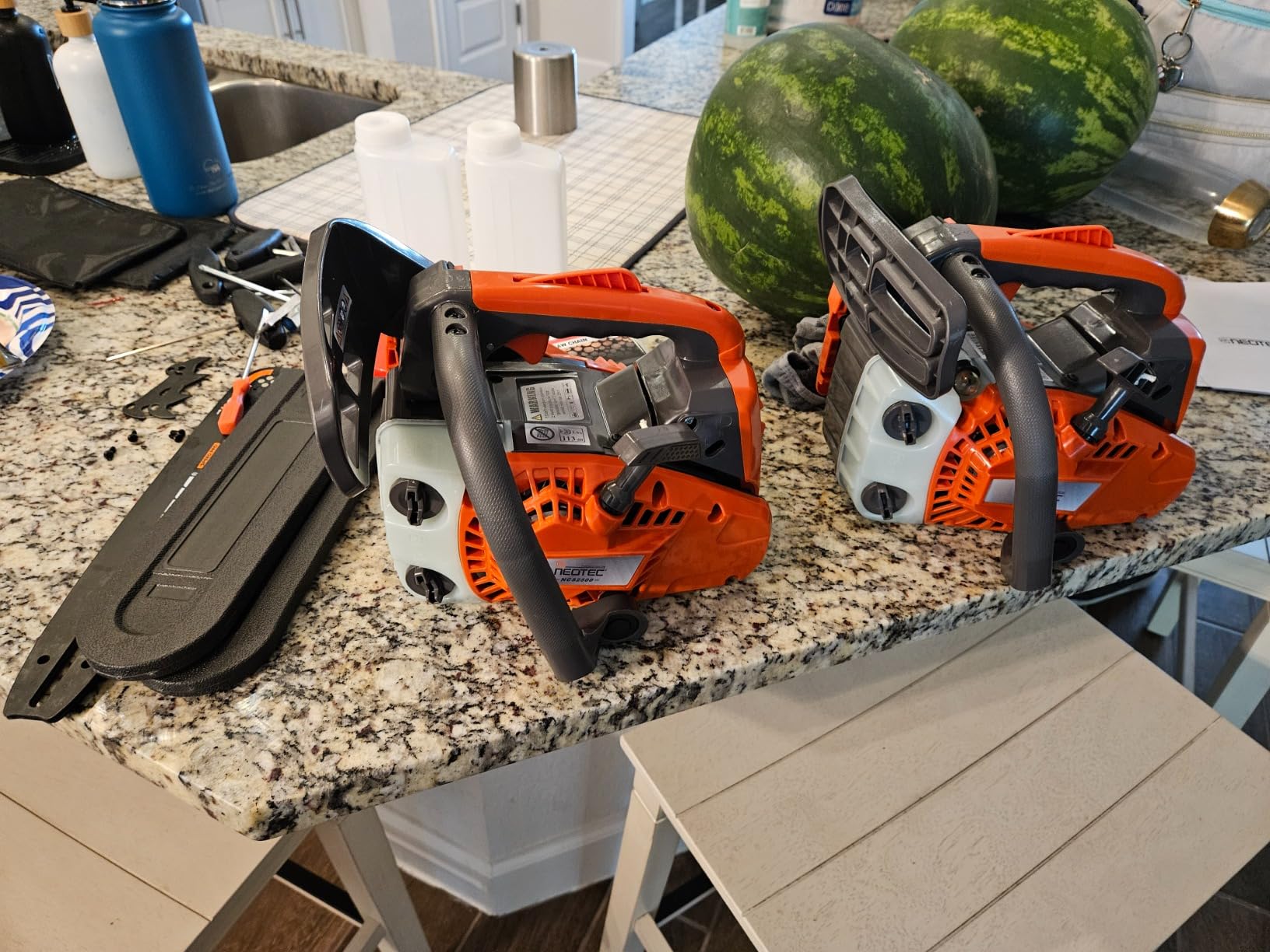
Set expectations before you buy. The fuel and bar oil tank caps are hard to start, tighten and remove, and can leak when the saw is laid on its side, which happens constantly in a tree. The carburetor usually needs adjustment out of the box, the oil pump often over-oils at the factory setting, and this saw runs a 25:1 mix rather than the 50:1 used by most other two-strokes — a mismatch that causes a lean running condition if you copy another saw’s recipe.
What owners praise and what holds it back
Praise covers the balance, the starting behaviour, the metal lanyard ring and the low cost that lets you keep spare chains on hand. Complaints cover the tank caps, the need for carb and oiler tuning, and the plastics and body panels that feel flimsy under hard use.
Who this saw suits, and who should pass
Buy the NCS2500 for orchard work, garden pruning, storm debris cleanup, or as a backup saw when your main tool is in the shop. Pass if you climb professionally, if you need a warranty behind the tool, or if you cannot commit to tuning the carburetor and oiler before the first cut.
6. DEWALT DCCS674 – Best for Chain Speed
DW 60V TOP HANDLE CHAINSAW
60V FLEXVOLT platform
About 75 ft/s chain speed
Power button with trigger safety
Chain brake redundancy
Pros
- Highest average rating in the group at 4.9 with 93 percent five-star reviews
- Chain speed roughly a third above the leading M18 top-handle competitor
- Tree care professionals report daily professional use
- Torque for large wood when paired with a 9 Ah 60V battery
- Works with existing FLEXVOLT packs
Cons
- Bare tool requires separate FLEXVOLT batteries and charger
- One-minute auto shut-off after trigger release annoys users
- Extra power button step before first use
- Entry pricing above several cordless rivals
The DEWALT’s headline number is chain speed at roughly 75 feet per second, which its maker puts about a third above the leading M18 14-inch top-handle competitor. Chain speed is the metric that separates a saw that cuts from one that chatters, and reviewers credit the difference for a much closer to gas behaviour under load.
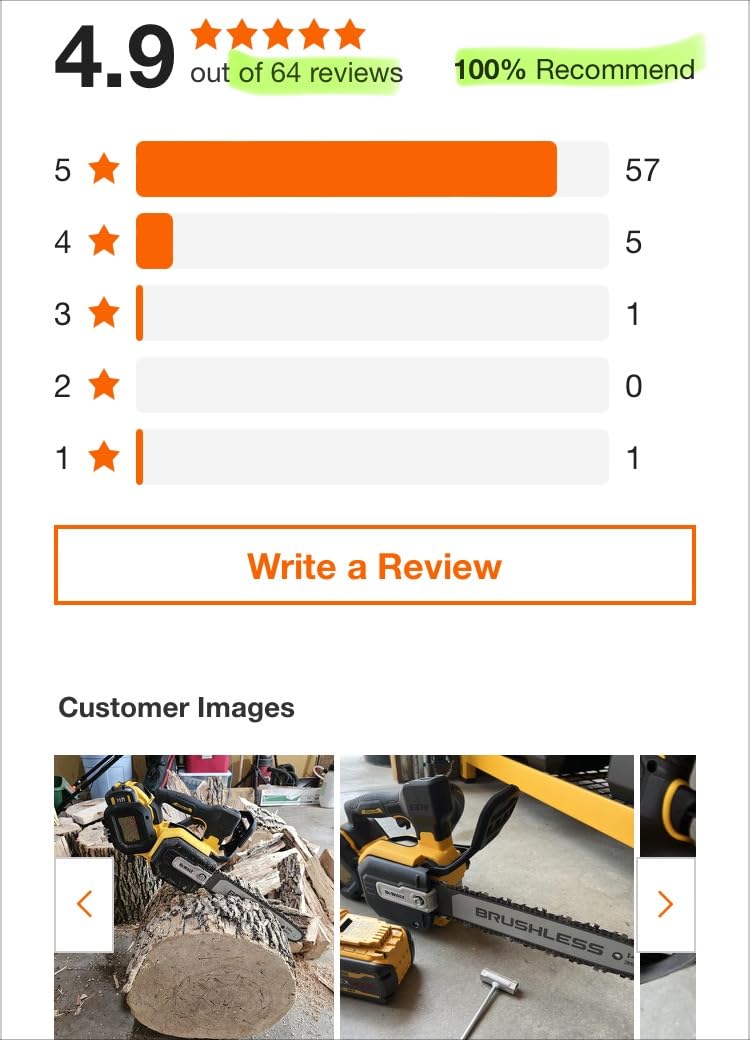
It also holds the highest average rating in this group at 4.9, with 93 percent of ratings at five stars and no one- or two-star reviews in the distribution. Tree care professionals report daily use for both climbing and ground trimming, and a Home Depot recommendation figure above 100 percent across more than fifty reviews is a strong signal for a tool used commercially.
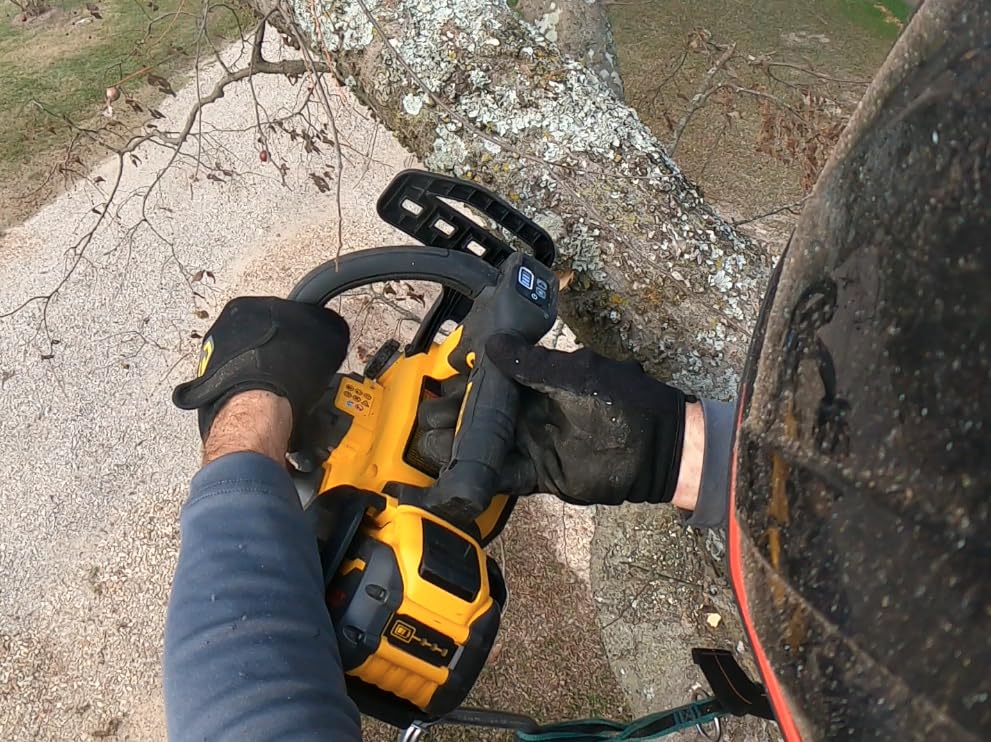
Torque is the other half of the story. Paired with a 9 Ah 60V battery, the saw has enough punch for large wood, and the maker markets it as professional-grade arborist performance. Because it runs on FLEXVOLT, anyone already in the 60V or 20V ecosystem can enter the platform without a first purchase.
Safety hardware is straightforward and duplicated by design. A power button with trigger safety sits above the trigger, the chain brake provides redundancy, and a one-minute auto shut-off fires after the trigger is released. On a saw that is used in a tree, an automatic shut-off is a reasonable feature to have.
The complaints are about workflow, not capability. Owners dislike the one-minute auto shut-off after trigger release, even with the chain brake engaged, because it interrupts the rhythm of close-in pruning. Requiring a power button press in addition to the trigger safety is another extra step. And a bare tool listing still means the batteries and charger are a separate purchase, with entry pricing above several competing cordless top-handle saws.
One reviewer note is worth repeating as a caution rather than a verdict: some buyers find the Husqvarna T540 more refined, more ergonomic and quicker to reach full speed. Chain speed and refinement are different attributes, and the fastest saw is not automatically the most comfortable one to hold overhead.
What owners praise and what holds it back
Praise centres on chain speed, the gas-like feel, torque with a 9 Ah pack, and daily professional use by tree service owners. The gripes are the auto shut-off, the extra button step, and battery cost for anyone outside the FLEXVOLT platform.
Who this saw suits, and who should pass
Buy the DCCS674 if you already own FLEXVOLT packs, work around residential clients where noise and emissions are a liability, and want the fastest chain in this group. Pass if the auto shut-off would break your cutting rhythm, or if your access to large-diameter work is the point.
7. Echo CS-303T-14 – Best for ECHO Dealers and 14-Inch Capacity
Echo 14 in. 30.1 cc Gas 2-Stroke Top Handle Chainsaw CS-303T-14
30.1 cc two-stroke top handle
14-inch guide bar
Wrap-around arborist handle
11.8 lb listed weight
Pros
- Full 14-inch bar in a compact arborist configuration
- Tied for the highest average rating in the group at 4.6
- Two-stroke gas power for sustained in-tree cutting
- Wrap-around handle designed for one-handed canopy control
Cons
- Heaviest saw here at 11.8 lb
- Oldest platform in the group
- Only 17 ratings so field history is thin
- Entry cost is high for a 30 cc class saw
The CS-303T-14 does something the newer ECHO does not: it puts a full 14-inch bar behind a 30.1 cc two-stroke in a top-handle frame. That combination is worth understanding before you buy, because it is a heavier saw than the 35.8 cc CS-355T at a listed 11.8 lb, and the extra weight comes with the engine size rather than the bar.
ECHO’s wrap-around arborist handle is the proven part of the design, giving the same multi-position grip the newer saw is known for. Two-stroke gas power means no runtime ceiling on a long climbing day and no battery logistics, which is still the strongest argument for gas in the tree for crews working away from a truck.
Its 4.6 average matches the best-rated saw in the group, but the sample is 17 ratings. Buyers who reviewed it tend to favour the compact 14-inch top-handle format and ECHO’s established reputation in professional arborist equipment. Treat that rating as encouraging rather than conclusive.
The honest caveats are weight, price and platform age. At 11.8 lb it is the heaviest saw here, which reduces one-handed handling in the tree. It is also the older 30.1 cc platform, superseded in ECHO’s own lineup, and the parts and cross-compatibility story is not as deep as the current model.
What owners praise and what holds it back
Praise is for the 14-inch capacity in a compact saw, the arborist handle and the sustained two-stroke power. Complaints are about the 11.8 lb weight, the entry cost for a 30 cc saw, and a 17-rating sample that tells you very little about long-term reliability.
Who this saw suits, and who should pass
Buy the CS-303T-14 if you already run ECHO equipment and want bar capacity over low weight, particularly for small hardwood falls where a 30 cc is enough. Pass if you climb every day and weight is your binding constraint, or if you want the newest platform and the deepest parts support.
8. Makita XCU08Z – Best for Quiet 14-Inch Cordless Work
Makita XCU08Z 36V (18V X2) LXT® Brushless 14″ Top Handle Chain Saw, Tool Only
18V X2 (36V) LXT platform
3.2 hp equivalent brushless power
14-inch bar with 3/8 LP .043 chain
3-year limited warranty
Pros
- Brushless direct drive with 30cc gas-equivalent power
- No gas
- emissions
- oil mixing or pull start
- Low noise level suits residential and urban work
- Stays inside the 18V LXT platform
- Three-year limited warranty
Cons
- Tool only - batteries and charger sold separately
- Lowest average rating in the group at 4.3 with 11 percent two-star
- Heavier feel for one-handed overhead work than 12-inch cordless options
- Cordless power still trails gas on sustained heavy cutting
The XCU08Z is the 14-inch counterpart to the XCU09Z, and the choice between them is straightforward. Same motor, same 3.2 hp equivalent rating, same 18V X2 architecture. The only real difference is the bar: 14 inches here against 16 on the XCU09Z.
That difference shows up in weight and handling. The 14-inch version is the better tool for close-in pruning and limbing where you want the saw closer to your body, while the 16-inch version wins when reach is the priority. Makita claims cutting performance 25 percent ahead of a 30cc gas engine chainsaw.
What buyers consistently like is the operating experience. No gas, no emissions, no oil mixing and no pull start removes the four recurring annoyances of gas top-handle work, and the low noise level is specifically called out as a benefit for residential and urban tree work where a homeowner complaint about noise ends a job.
The critical reviews are worth taking seriously. The 4.3 average is the lowest in this group, with 11 percent of reviews at two stars, and the sample is 29 ratings. Reviewers note the tool-only configuration requiring separate battery and charger purchases, and a heavier feel than lighter 12-inch cordless options for one-handed overhead work. Cordless power also still trails gas on sustained heavy cutting.
What owners praise and what holds it back
Praise covers the quiet, gas-free operation, the 18V LXT platform compatibility, the three-year warranty and the 14-inch capacity. The complaints are the tool-only configuration, the weight for overhead work, and the 4.3 rating with its two-star cluster.
Who this saw suits, and who should pass
Buy the XCU08Z if you are on the 18V LXT platform, work residential and urban jobs where noise is a problem, and want 14-inch capacity without the extra weight of the 16-inch model. Pass if you are just starting a platform, or if sustained heavy cutting is a regular part of your week.
How to Choose a Top Handle Chainsaw for Tree Work
Four decisions account for almost every mistake buyers make in this class. Get them right and the model choice takes ten minutes; get them wrong and no amount of money fixes it.
Gas or battery for in-the-tree work
There is no runtime ceiling on a gas saw, and no pack logistics. That is why a battery top handle is still described by some working pros as a compromise even when it is a very good one, and why a Northeast arborist who ran a stock Stihl MS 201 T for over ten years with rear-handle service describes it as the best top handle saw you could hope to own.
The battery case is genuinely strong in specific situations, and owners make the argument clearly: quiet urban removals, residential jobs under noise ordinances, sites where emissions matter, and occasional use where a two-stroke is simply inconvenient. A pro who prefers the Husqvarna T540i XP specifically for urban removals does so because of low noise and chain speed, and runs a larger battery when the smaller one lacks runtime.
There is a real failure mode to know about. Owners have reported a battery top handle dying mid-cut on a dying ash top, with blinking overheat indicators pointing to battery seating or arcing inside the saw — a failure in exactly the worst place. Whatever you choose, treat a battery saw as a tool you carry a spare pack for, and never as a tool with a guaranteed all-day charge.
Where the cordless saws are strong in this roundup is the platform question. If you already run Makita 18V LXT, FLEXVOLT or Ryobi 40V, the marginal cost of a cordless top handle is far lower than it looks. Four of the eight saws here are tool-only listings, so a battery and charger are added before the first cut — unless the saw is the RY40590, which includes a 4.0 Ah pack, a charger and a case.
What bar length do you actually need?
Bar length is the second-biggest weight decision after the engine, and it is the question buyers ask most often. It comes down to the diameter of the wood you actually cut, not the diameter you imagine cutting.
10 to 12 inch bar — light pruning and limbing only. A 12-inch bar gives roughly a 10-inch cut capacity, which is enough for branches and small brush. This is the RY40590’s class and the NEO-TEC’s class, and it is the right weight for a climber on small trees.
14 inch bar — the all-round climbing default. A 14-inch bar handles 12-inch wood, which covers the overwhelming majority of limb work in a live tree. Most of the saws here — the CS-355T-14, the CS-303T-14, the XCU08Z — sit in this class.
16 inch bar — heavy hardwood chunking, with a weight penalty. A 16-inch bar reaches 14-inch wood, useful for large limbs and small-tree felling, but adds weight and length to a saw you hold one-handed. Choose it when you know you are cutting that diameter regularly.
The mistake is over-sizing. A saw that is longer than your work makes you carry weight for nothing and, more seriously, invites a cut you should be making from a different position.
Chain gauge and chisel: how to choose
This is the decision that almost no buying guide covers and that experienced climbers discuss constantly. Gauge is the thickness of the drive link — a narrower gauge cuts faster and produces less vibration, which matters when the saw is held overhead against your body.
Three setups are worth knowing. A nano 0.325 chain is fast and smooth and is often described as the best of both worlds on a 25cc saw, cutting well without overwhelming a small engine. A quarter-inch mini micro is slower but very smooth, which makes it the right choice for pruning cuts where the saw is guided by hand rather than pulled by the engine.
3/8 inch low profile — 3/8 LP — is the all-rounder, and it is the chain supplied with the 12-inch gas saw in this group. Full chisel is the choice for dirty, abrasive or frozen wood because the square cutters hold an edge longer when the chain meets sand and grit, at the cost of more vibration and a harder cut in clean wood.
Two practical checks before you buy. Confirm the bar’s tail mount and the sprocket or nose fit the chain gauge you intend to run, because chains are not interchangeable across gauges. And note the reported failure pattern on narrow-tip stock bars: owners have reported stock narrow-tip bars blowing out the nose sprocket, forcing them to buy aftermarket broad-nose bars to correct what they describe as a manufacturing choice. If you hit that, a broad-nose bar is the documented fix.
What to check before you buy
Run this short list before you commit to any model in this class.
Lanyard loop or rope attachment point. A real metal ring, not a plastic loop, and rated for hoisting.
Climbing scabbard. Some saws include one, most do not, and you need one to move a running saw between trees.
Bucking spikes. The rear teeth that stop the saw rotating in the cut. They are load-bearing.
Chain and bar availability locally. In this class, a bar and chain you can source within a day matters more than small spec differences.
Dealer proximity. Dealers and parts access vary enormously by region, and forum consensus is that saw choice is often shaped by what local crews stock.
Carburetor adjustability, if it is gas. Out-of-the-box carb tuning is common enough across this class to plan for.
One last point on modification. Porting, straight pipes, three-point dogs, timing advance and muffler changes come up constantly in owner forums, and there is real information there. But the spark arrestor is a legal and liability question, not a tuning preference, and running a saw without an approved spark arrestor in fire-sensitive country is a decision with consequences that outlast the modification. Leave the exhaust and ignition alone unless you are prepared to carry that risk.
Frequently Asked Questions
Are top handle chainsaws better?
Only for trained climbers working in the canopy. A top handle chainsaw gives you one-handed control and a short, balanced saw, which is genuinely better for limbing and pruning from a rope. For ground work, felling and bucking, a standard rear-handle saw is safer and more capable. With one hand on the chain you also carry full responsibility for kickback control.
What is the best bar length for a top handle chainsaw?
A 14-inch bar is the default for climbing because it cuts roughly 12-inch wood, which covers most limb work. A 12-inch bar suits light limbing on small trees and gives the lowest weight. A 16-inch bar reaches 14-inch wood for heavy hardwood chunking but adds weight to a saw you hold one-handed. Match the bar to the wood you actually cut, not the wood you might cut.
What is the best top handle chainsaw for the money?
The Echo CS-355T-14 is the strongest value in this class. It pairs a 35.8 cc engine with a 14-inch bar, holds a 4.6 average across more than two hundred reviews, and carries a five-year consumer warranty. The trade-off is small fuel and bar oil fill ports and a carburetor that usually needs adjusting before the first cut.
Do professional arborists prefer Husqvarna or Stihl?
It depends on the region rather than the saw. Forum consensus repeatedly describes the Stihl MS 201 T as the standard in the Northeast, where crews rarely use anything else, while Husqvarna wins comparisons on power-to-weight and chain speed. Many working climbers own more than one brand because local dealer access and parts availability decide the purchase as much as preference does.
Which is better, Husqvarna, ECHO or Stihl?
Each wins a different category. Husqvarna leads on power density, with the T435 making 2.01 HP at 7.5 lb. ECHO leads on retail availability, warranty length and value, with a five-year consumer term and parts at almost any hardware or outdoor retailer. Stihl leads on dealer serviceability and regional brand loyalty among crews, which is a real purchasing advantage where your nearest dealer is close.
What is the most common problem with Stihl chainsaws in this class?
In top-handle service, the most common problem is drop damage rather than a manufacturing defect. One technician reports that nearly every MS 201 T repair he sees is caused by accidents or lack of maintenance, not faulty construction, and owners describe the chain brake taking the damage when a saw falls. Second-hand condition matters far more than model year when buying used.
Can you fell a tree with a top handle chainsaw?
Only a small one. Top-handle saws in this class are built for limbing, pruning and chunking inside the canopy. Some owners report small falls with a 35.8 cc saw, and a 30.1 cc model with a 14-inch bar can handle small hardwood. For anything larger, a rear-handle saw with a longer bar is the correct tool, and the decision is part of your safety plan, not just your equipment.
The Best Top Handle Chainsaws for Tree Work in 2026
The Husqvarna T435 is our pick for the best top handle chainsaws for tree work, and the reason is a single number: 2.01 HP in a 7.5 lb saw is the best power-to-weight ratio available in this class, and weight is what decides an in-the-tree purchase. Smart Start, LowVib and an inertia chain brake make it a complete tool rather than a spec sheet.
The Echo CS-355T-14 is the value answer, giving you a 35.8 cc engine and a 14-inch bar with a five-year consumer warranty. The DEWALT DCCS674 is the speed answer at roughly 75 ft per second, and the Makita XCU09Z is the reach answer with a 16-inch bar on a platform many trades already own. The RY40590 wins on weight at 6 lb, the XCU08Z on quiet 14-inch cordless work, the CS-303T-14 on ECHO dealer familiarity, and the NEO-TEC NCS2500 as an inexpensive backup for light pruning.
Before you order, confirm three things: the bar length matches the wood you actually cut, the lanyard ring is real metal, and your local dealer or retailer can supply a spare chain within a day. Then get the carburetor right, carry a spare battery if you are running cordless, and buy a climbing scabbard before the first job.