
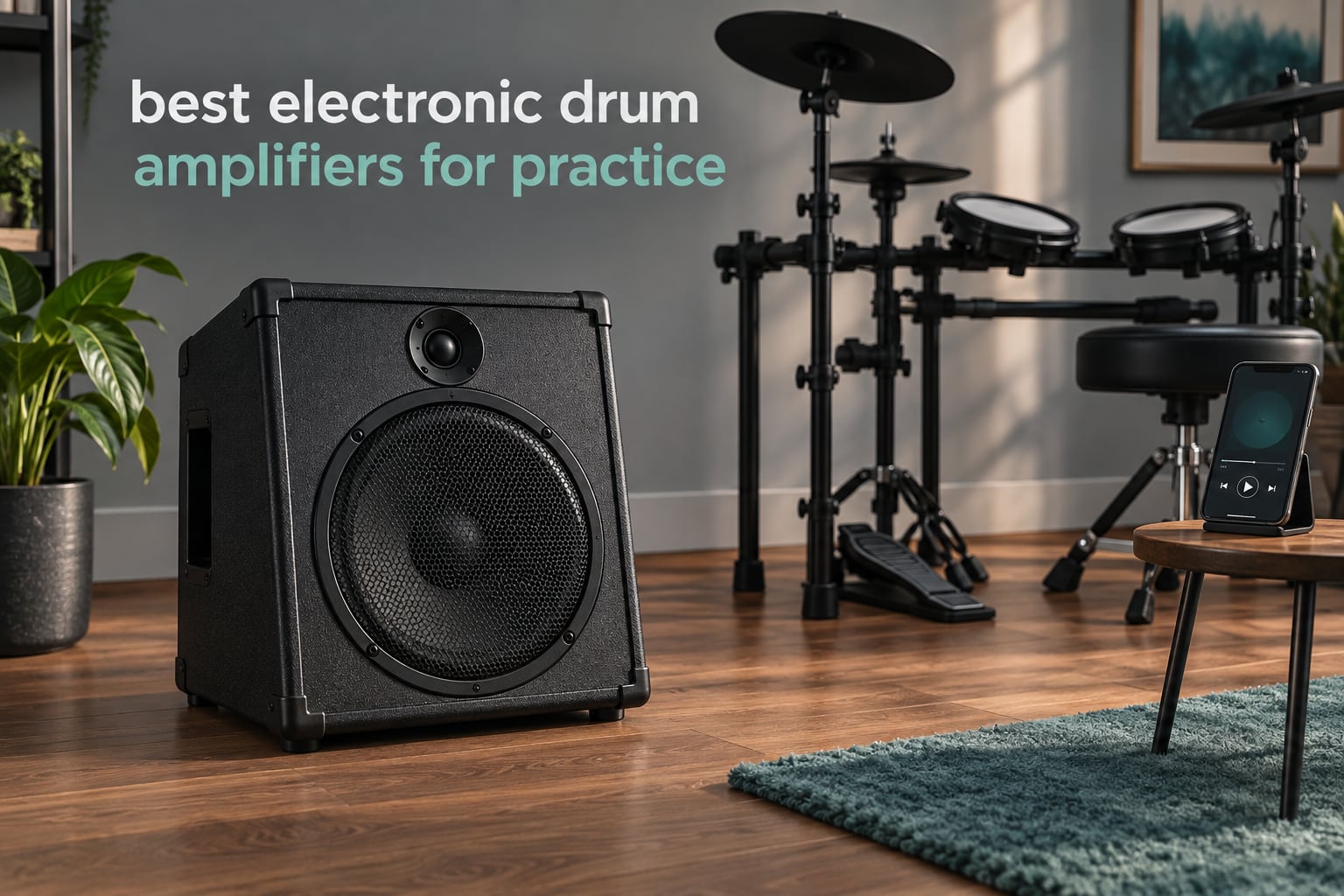
Most electronic drum kits come with earbuds, a pair of open headphones, or nothing at all. That is fine for the first two weeks. Then you notice the thing headphones cannot give you: the low end of the kick drum moving air in the room, telling your body where the beat sits without you having to count.
An electronic drum amplifier is a self-contained powered speaker built to reproduce the wide output of a digital drum module. Your module sends a line-level signal from its L/MONO and R output jacks into the amp, the amp applies EQ and volume control, and a full-range driver system reproduces kick, snare, toms and cymbals together. Practice use is a distinct job from stage use, and the amp that wins on a gigging stage is rarely the one you want six feet from your bed.
That is the lens for this roundup. We compared eight electronic drum amplifiers for practice across the range of sizes, power levels and connection options currently on the market, weighing them on the things that actually change your practice session: how much usable low end you get per watt, whether a headphone jack exists for the 11pm session, whether the box fits in a small room, and whether you can feed a recorder or a PA later on. This guide was refreshed in 2026 and every rating and review count below is taken from the current product record.
One note before we start, because it trips up almost every new e-drum owner. Do electronic drums need an amplifier? No, not strictly. They need to be heard, and headphones will do that for very little.
Several drummers on r/edrums argue that headphones sound far better than any affordable speaker, and on pure fidelity they are right. The reason to buy an amp anyway is physical feedback, which is a real skill-building tool rather than a luxury.
What follows is the full lineup, then a buying guide that covers wattage, driver size, module matching and placement, and how to keep an electronic kit civil in a shared-wall apartment.
Table of Contents
Top 3 Picks for Electronic Drum Amplifiers (October 2026)
If you want the short answer: the COOLMUSIC DM20 is the electronic drum amplifier we would put in the most practice rooms, the Donner DA-35 is the one that does the most jobs for one purchase, and the Roland PM-100 is the benchmark for low end if your room will take a 30-pound cabinet.
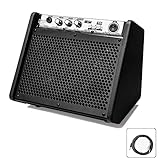
COOLMUSIC DM20 20W
- 20 watts
- 6.5 inch woofer plus 2.5 inch tweeter
- Bluetooth and USB backing track playback
- Only 4.5 kg so it moves between rooms
- Includes an e-drum noise-reduction cable
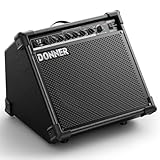
Donner DA-35 35W
- 35 watts with an 8 inch woofer and 2.5 inch tweeter
- Two inputs plus headphone output and DI out
- 3-band EQ
- 20 Hz to 20 kHz frequency response

Roland PM-100 80W
- 80 watts through a 10 inch woofer and 1 inch tweeter
- Angled cabinet built for a seated V-Drums player
- Integrated mixer with global EQ
- Dedicated V-Drums input with phasing support
The DM20 earns the top spot on the strength of the most owner feedback in this group and a design that makes sense in a small room: a slanted cabinet, 4.5 kg of weight, and a 6.5 inch woofer that punches well past what 20 watts should. The DA-35 is the feature-maximising pick, since no other amp here combines two inputs, a headphone output and a DI out in one box. The PM-100 gives you a clear step up in low end, and reviewers repeatedly single out its bass weight and build quality as a cut above the compact monitors.
All 8 Electronic Drum Amplifiers Compared in 2026
Here is the whole lineup on one page, so you can narrow it down before reading the detail. Wattage figures are the manufacturers’ stated output. Note that two of these amplifiers advertise peak power rather than continuous power, and the guide at the end of the article explains why that distinction decides which one is actually louder in your room.
| Product | Specifications | Action |
|---|---|---|
|
COOLMUSIC DM20
|
|
Check Latest Price |
|
Donner DA-35
|
|
Check Latest Price |
 Donner DDA-20
|
|
Check Latest Price |
 Vangoa 65W
|
|
Check Latest Price |
 Alesis Nitro Amp
|
|
Check Latest Price |
|
Roland PM-100
|
|
Check Latest Price |
 COOLMUSIC DM80
|
|
Check Latest Price |
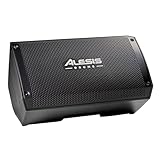 Alesis Strike Amp 8 MK2
|
|
Check Latest Price |
1. COOLMUSIC DM20 – The Small Amp That Punches Above Its Weight
Coolmusic DM20 20W Bluetooth Personal Monitor Amplifier Electric Drum Amplifier Speaker,Keyboard Speaker with USB Interface(Including E-Drum Noise-Reduction Cable) (Black)
20 watts
6.5 inch woofer plus 2.5 inch tweeter
Bluetooth and USB playback
4.5 kg
Pros
- Compact at 4.5 kg so it moves between rooms easily
- Bluetooth and USB playback for backing tracks
- Louder and boomier than 20 watts should allow
- Slanted cabinet aims sound at a seated player
- E-drum noise-reduction cable included in the box
Cons
- No headphone jack and no line out
- Tone described as boxy by some owners
- Limited bass weight next to an 8 inch woofer
The DM20 is the most recommended electronic drum amplifier in this roundup for the simple reason that it makes the least demand on your room. At 4.5 kg it is among the lighter cabinets here, and the slanted cabinet face with its hard edge frame and rubber shock pads is angled at exactly the height a seated player needs.
In a session the 6.5 inch woofer and 2.5 inch tweeter pairing is a genuine two-way design, so cymbals get their own driver instead of fighting for the same cone as the kick. That is the single biggest upgrade from the tiny single-driver monitors people start with, and it costs you nothing in cabinet size.
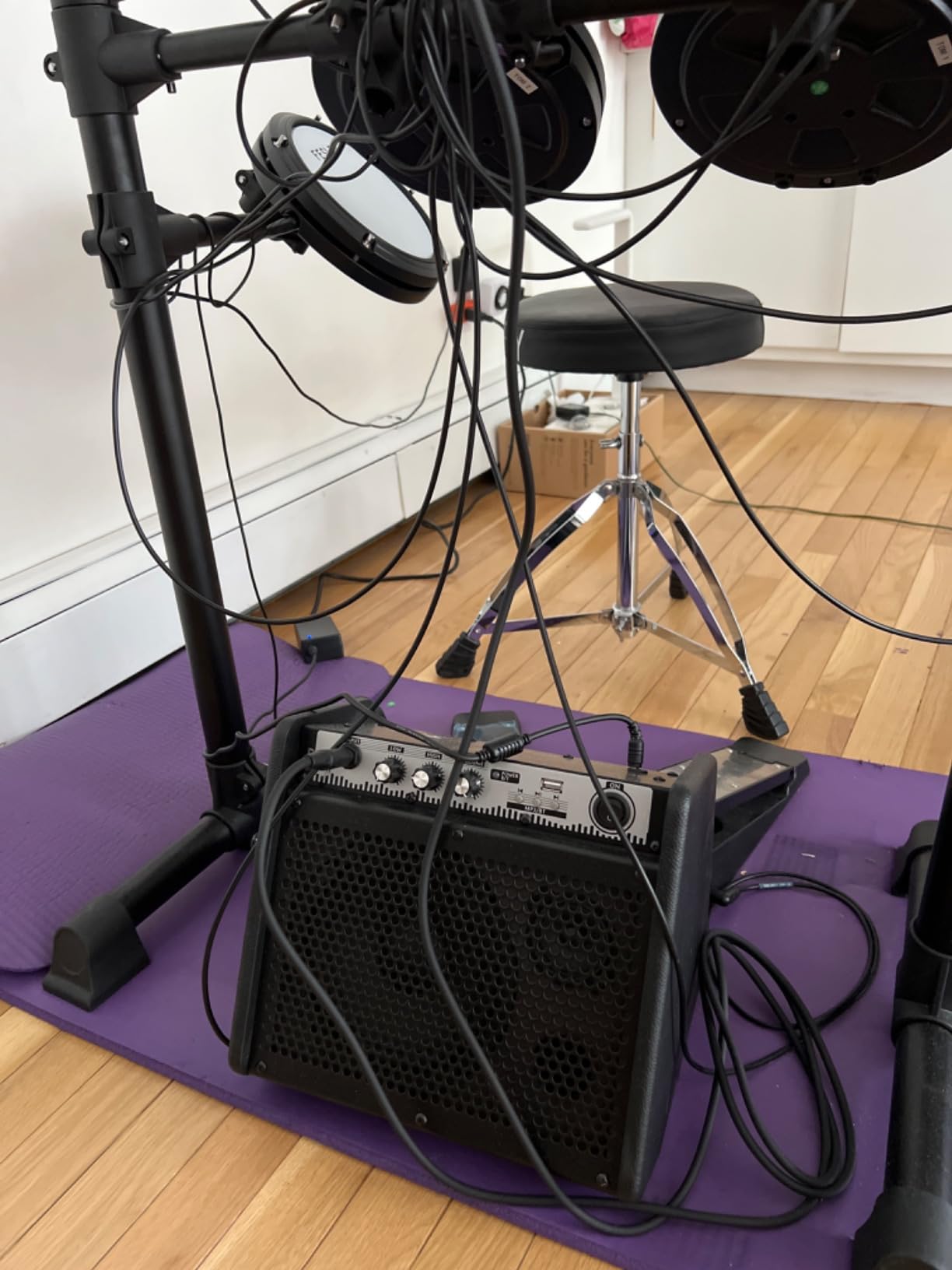
The reason this unit sits at number one in our list is the volume-to-footprint ratio, and the owner feedback backs that up: buyers repeatedly note more level than they expected from a 20-watt cabinet, along with a bass response that reads as booming rather than thin. At 875 reviews it is the most thoroughly tried amp in the group, and the five-star share of 76 percent is not a rounding error, it is the pattern.
Connectivity is where it earns its keep in a practice room. Bluetooth and USB dual playback with onboard track and volume buttons means your phone can be the backing track source without a cable, and the included e-drum noise-reduction cable is a thoughtful inclusion that most competing cabinets leave out entirely. Independent LOW and HIGH knobs plus master volume give you real tone control for a two-knob EQ.
The warranty here is 2 years, longer than the 1-year manufacturer coverage on both Donner amps in this list.
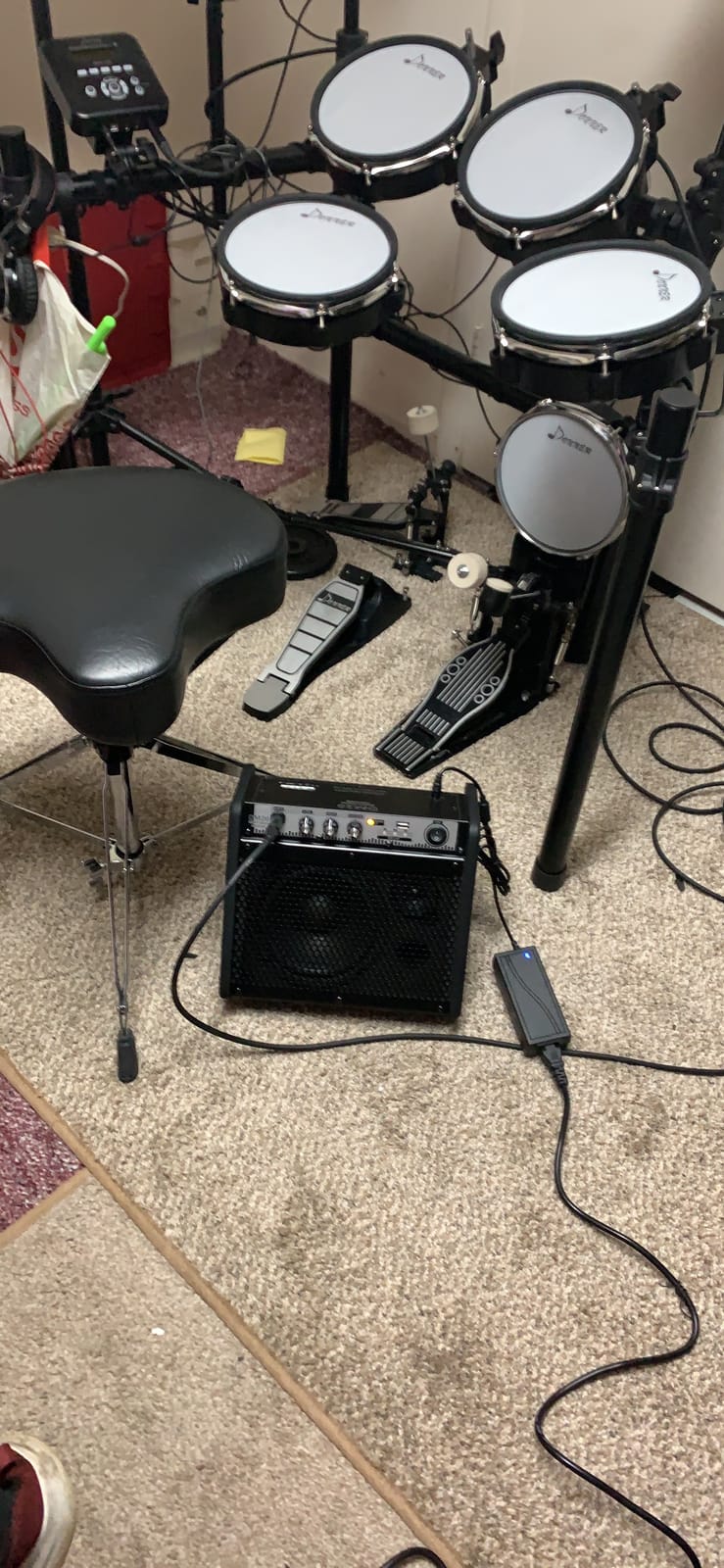
Who the DM20 suits best
This is the amp to buy if your practice space is a bedroom, a box room, or a corner of a living room with a shared wall. Twenty watts in a small reflective room gets you a level that surprises you, and the slanted face means you are hearing the kit at ear level rather than firing sound into your knees.
It is also the right first amplifier for a drummer who wants a speaker and a Bluetooth speaker in one box, and its position at number one in the Drum and Percussion Electronic Drum Amps category ranking tells you how many people make that choice.
Where the DM20 falls short
There is no headphone jack and no line output on the DM20, and that is the deal-breaker for anyone who wants to run a truly silent late-night session or capture a direct feed. If your practice hours are restricted by people sleeping next door, plan to use your drum module’s own headphone output instead of looking to the amp.
Some owners also describe the tone as boxy or mediocre, and the 6.5 inch woofer cannot deliver the floor-shaking low end that an 8 inch or 10 inch cone gives you. A minority report reliability issues after extended use, so if you are a daily two-hour player, test it hard in the first month.
2. Donner DA-35 – Two Channels, a Headphone Jack and a Real DI Out
Donner 35-Watt Electronic Drum Amplifier DA-35, 2×8 Speakers, 2-Channel, 3-Band EQ, DI Out, Wireless Audio, Black, Compatible with Electronic Drum & Keyboard, Digital Modeling Amplifier
35 watts
8 inch woofer plus 2.5 inch tweeter
Two channels and 3-band EQ
Headphone and DI out
8 kg
Pros
- Two channels for a module plus a backing track or mic
- Headphone output enables genuinely silent practice
- DI output can feed a PA or a recording chain
- Useful 3-band EQ with separate channel volume
- 20 Hz to 20 kHz frequency response
Cons
- Tone is functional rather than refined
- Not the loudest amplifier in its class
- 8 kg is a two-hand carry
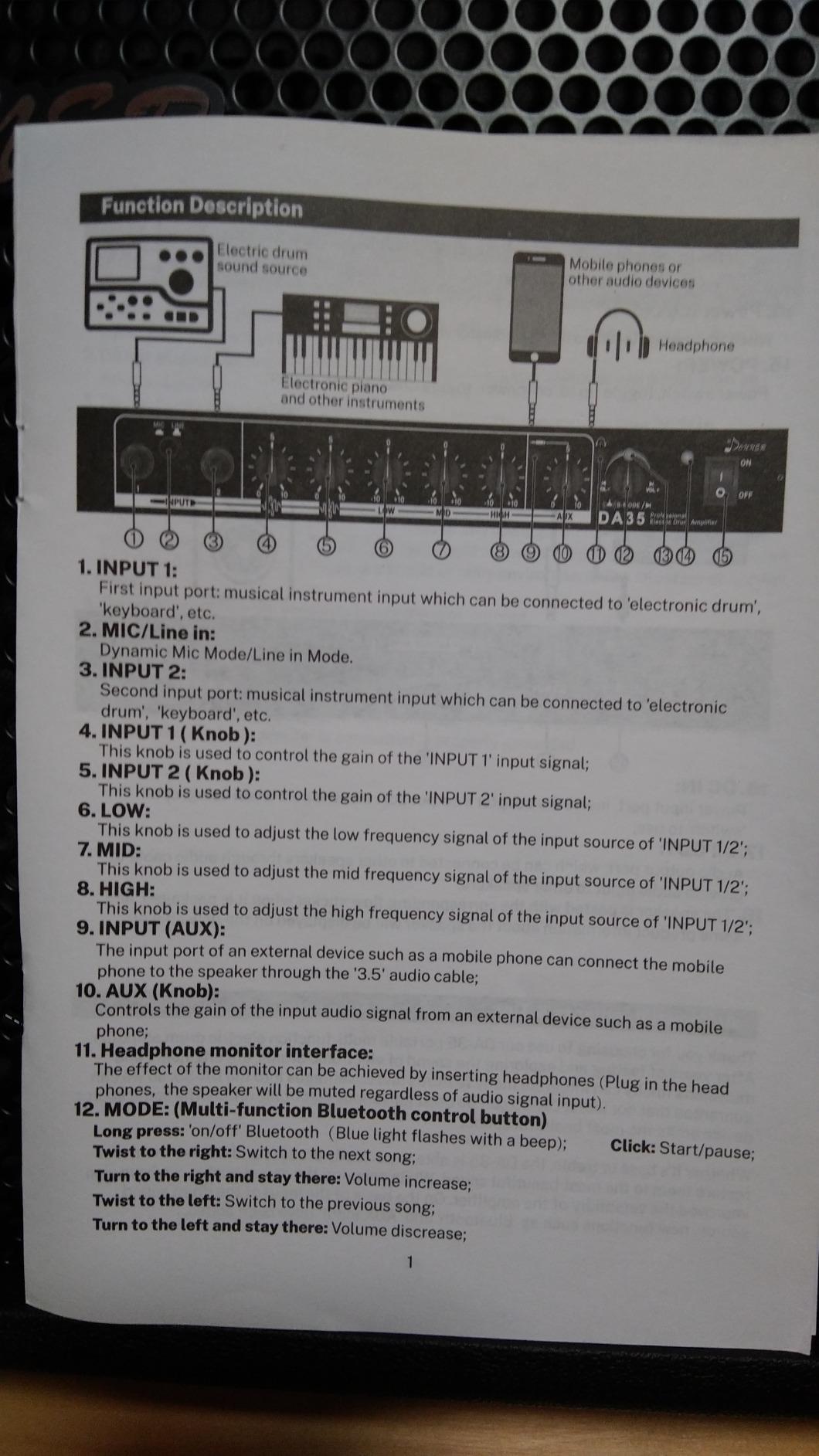
The Donner DA-35 is the most versatile amplifier for practice per purchase in this group, and the reason is the connection panel rather than the speaker. Two 1/4 inch instrument inputs with separate channel volume let you run your drum module on one channel and a microphone, second pad, or backing track source on the other, and the dynamic mic and line input modes offer impedance options at -38 dB or -48 dB.
Then there is the 1/8 inch headphone output for silent practice and the 1/4 inch DI output port for feeding an external active speaker or a recording chain. No other amplifier in this roundup has a dedicated headphone output and a separate DI output. If your practice routine is module by day and recording by night, that pair of jacks pays for itself immediately.
Sonically it is an 8-inch low-frequency woofer paired with a 2.5-inch high-frequency tweeter at 4 ohms, with a stated 20 Hz to 20 kHz frequency response. The lowest figure published by any amp on this list, and low frequency is the range that separates a convincing drum monitor from a thin one. Low frequency, more than any other part of the drum spectrum, is what makes a monitor sound like a real kit.
The 3-band EQ with treble, middle and bass controls is more than you get from a two-knob design, and for a practice amp that matters, because you are chasing a balance between a hot module output and a reflective room rather than chasing a signature tone. Buyers consistently point at the two-channel layout, the headphone jack and the DI output as the features that make this amp practical for home practice and small rehearsals, and describe the tone as solid for what it costs.
Wireless audio and a 1/8 inch auxiliary input cover the backing-track case, so this box can be your whole practice chain: kit in one channel, phone in the other, headphones on when the volume is not welcome.
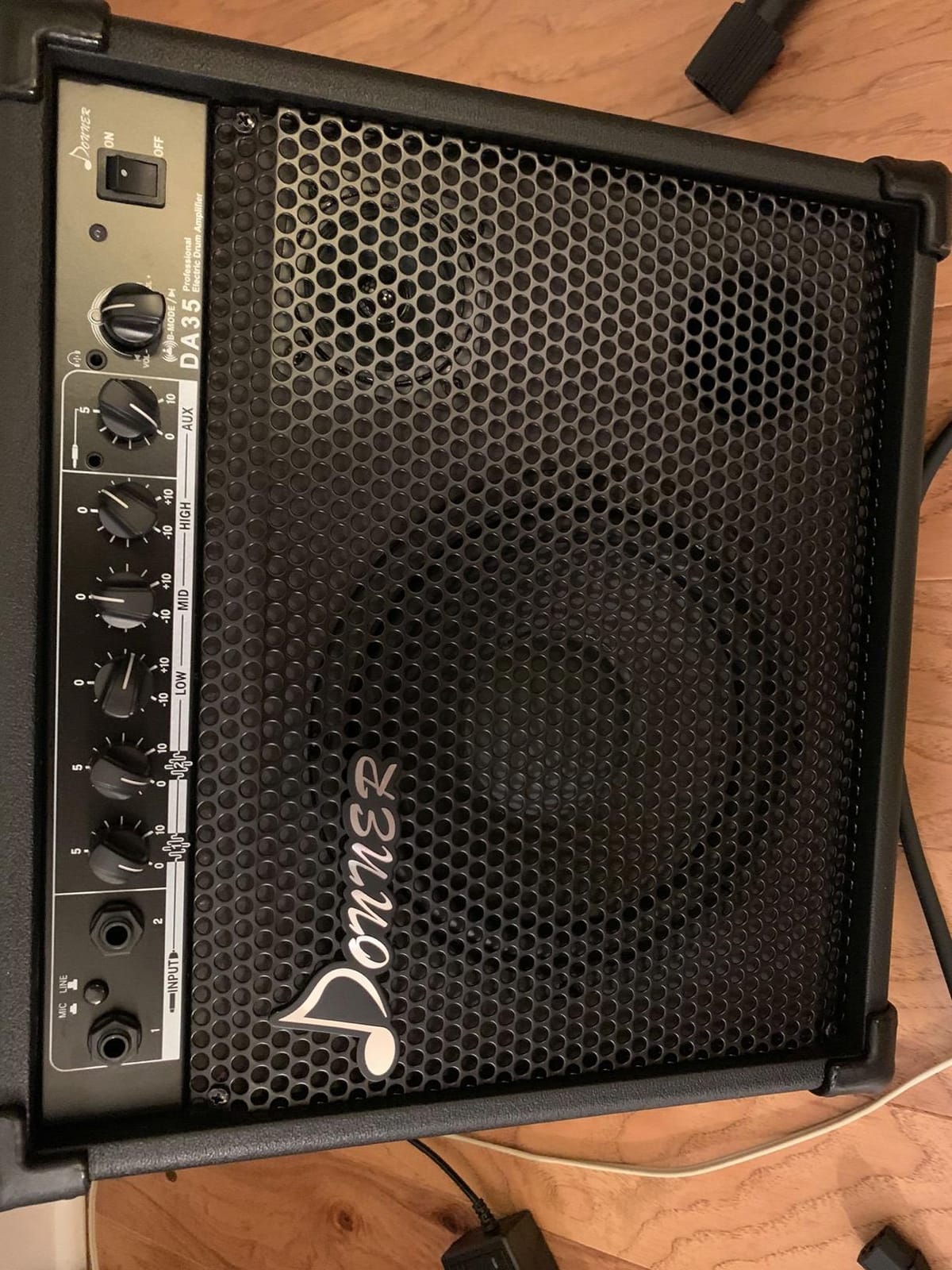
Who the DA-35 suits best
This is the amp for the drummer whose practice needs have outgrown a single-purpose monitor. Two-channel working means a rehearsal-room kit, a small room, and a mic for recording or streaming, all from one box, with no need for a separate DI box or interface for the amp-level signal.
It is also our pick if you are on shared walls and want a single switch between loud and silent. The headphone output is the specific answer to the apartment problem, and having it alongside a full 35 watts of speaker output is a combination the compact 20-watt monitors here cannot offer.
Where the DA-35 falls short
Buyers are candid that the tone is more functional than refined. It will not sound like a hi-fi drum monitor, and at higher levels the refinement gap against something like the Roland PM-100 becomes obvious to an experienced ear.
It is also not the loudest option in its class, so a drummer who pushes to hard practice at volume will want more headroom. At 8 kg and measuring 14.2 by 14.8 by 11.8 inches, it is a two-hand lift, which counts in a small flat.
3. Donner DDA-20 – A Compact Amp Built for Tight Rooms
Donner Mini Electric Drum Amp 20W, Wireless Electronic Drum Amplifier Keyboard Speaker DDA-20 Portable for Home Practice
20 watts
6.5 inch woofer plus 2.0 inch tweeter
3-band EQ
Wireless control knob
3.6 kg
Pros
- Compact footprint that suits small rooms
- Wireless multimedia control from a phone or tablet
- Three-band tone control
- Solid bass response for its size
- Hard-edged enclosure with rubber pads for stability
Cons
- 20 watts is limited for louder practice sessions
- Single input channel limits multi-source setups
- No headphone output listed
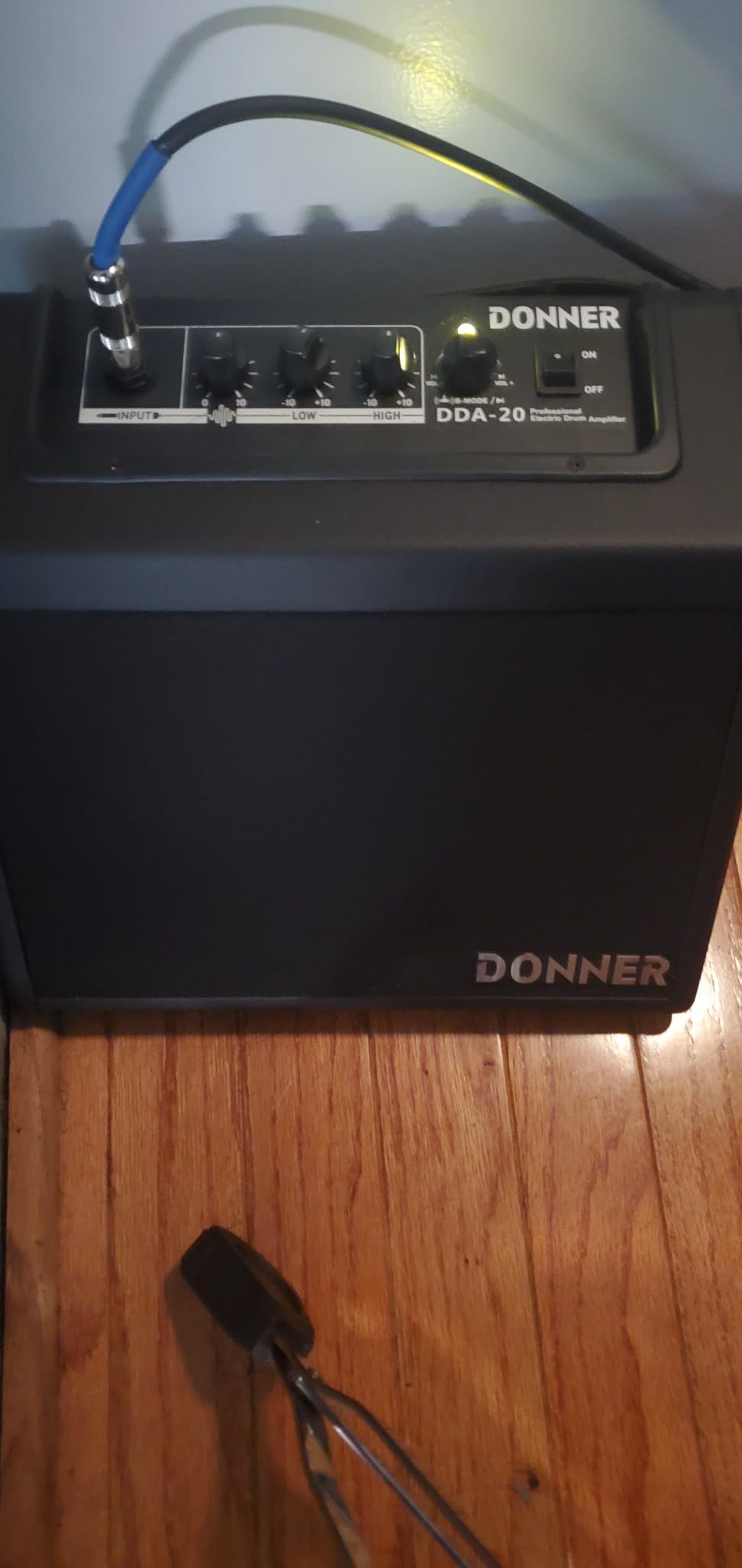
The DDA-20 is the pick if floor space is the constraint rather than budget. At 3.6 kg and 11.61 by 8.86 by 9.06 inches it is one of the two smallest and lightest amplifiers here, light enough that you can move it one-handed between the practice spot and the corner where it lives.
It is a solid-state design with a 6.5 inch woofer and a 2.0 inch tweeter, rated across a 50 Hz to 20 kHz frequency response. That lower figure is the important number to read: 50 Hz is where the kick drum body lives, and a monitor that reaches it will make a kit sound like a kit.
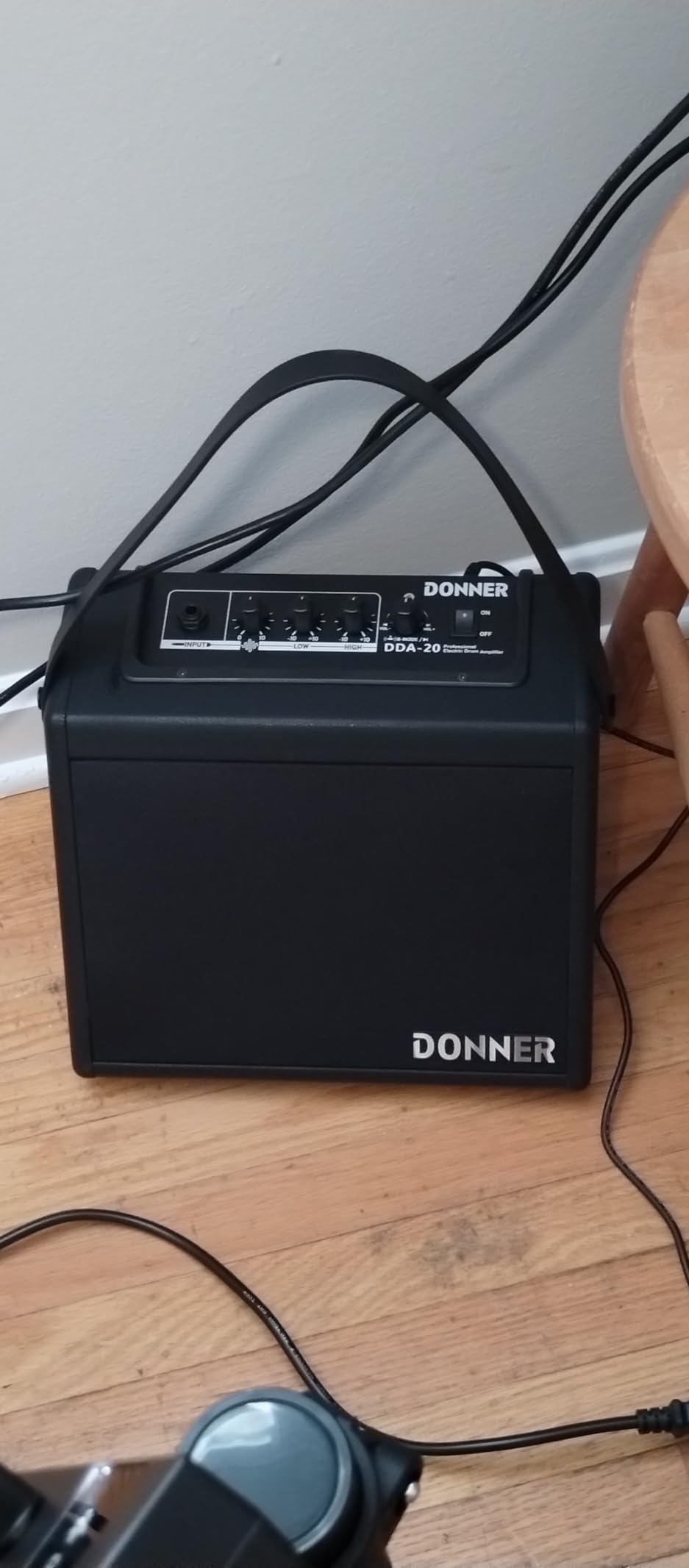
The feature that separates this from other small monitors is the multimedia control knob, which gives you wireless control of a connected phone or tablet from the amp itself. In practice that means changing a backing track or a drum app setting without walking over to the device mid-exercise, which is a small thing that gets used constantly.
Three-band tone control on an amp this compact is generous, and owners note the bass response holds up better than the size suggests. With 510 reviews averaging 4.6 and 81 percent of ratings at five stars, the pattern in the feedback is consistent: compact, good-sounding, easy to live with, and modest about volume.
The 1-year warranty is among the shortest here, so test it thoroughly before you commit to a long-term spot.
Who the DDA-20 suits best
Apartment and small-room practice, where the amp has to disappear when you are not playing and come out when you are. The hard-edged enclosure with rubber pads is stable enough to put on a hard floor, and the wireless control removes the need to keep a phone in reach.
It is also a sensible first amplifier for a bedroom kit, or a second practice amp for a drummer who has one in the rehearsal room and wants one at home without hauling anything.
Where the DDA-20 falls short
Twenty watts is the ceiling. If you play fast with a lot of headroom in the pad volume, or you want to hear the kit while standing at full tilt, you will want the Donner DA-35 or something larger.
There is a single input channel, so you cannot run a module and a second source at once, and no headphone output is listed. Check your module’s own headphone jack before you buy on the assumption that you can go silent later.
4. Vangoa 65W – More Power and a Bigger Cone Than Its Rating Suggests
Vangoa Electric Drum Amp 65W Professional Wireless Electronic Amplifier for Drum Set Speaker 3-Band EQ USB Personal Monitor Keyboard Speaker, Black
65 watts
8 inch woofer plus 2 inch tweeter
Two input channels
Headphone and USB
45 Hz to 20 kHz
Pros
- 65 watts of output for its class
- Eight-inch woofer delivers high-impact bass
- Dual independent input channels
- Headphone and USB connectivity
- 45 Hz to 20 kHz frequency response
Cons
- Among the lower average ratings in this group at 4.3
- Some buyers report modest refinement in the top end
- Weight is not published by the manufacturer
The Vangoa 65W is the value pick for a drummer whose practice room is really a rehearsal room. Sixty-five watts through an 8-inch woofer is a meaningful jump from the 20-watt class, and in a room larger than a bedroom that extra power is what stops you from playing at a quarter of the speed so you can hear the kit.
It carries two independent microphone and instrument input channels, a 3-band EQ with smooth gain and cut control, and a stated frequency response of 45 Hz to 20 kHz. Add headphone and USB interface connections plus wireless input and you have an amp that can take a module, a mic, and a phone all at once.
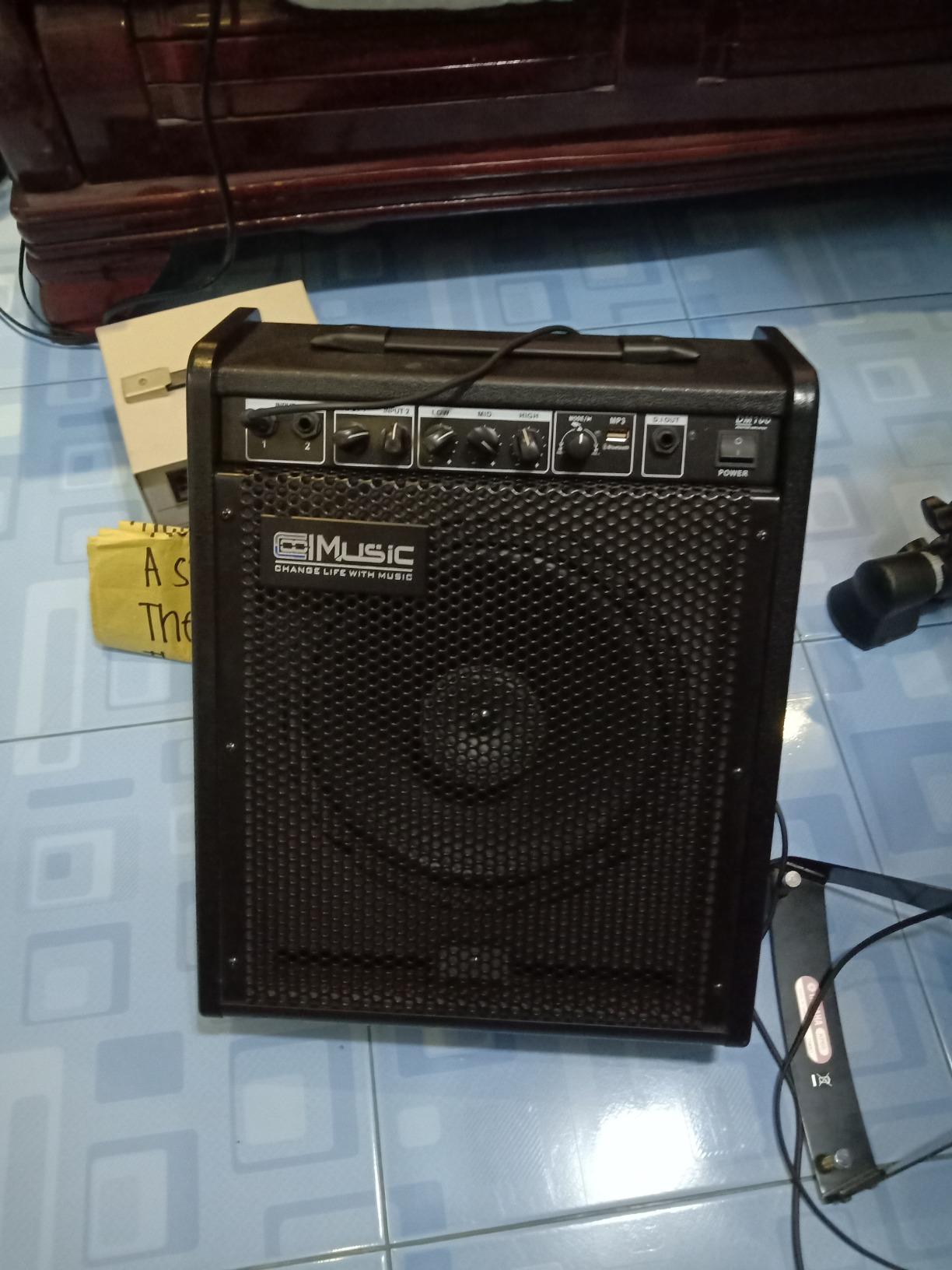
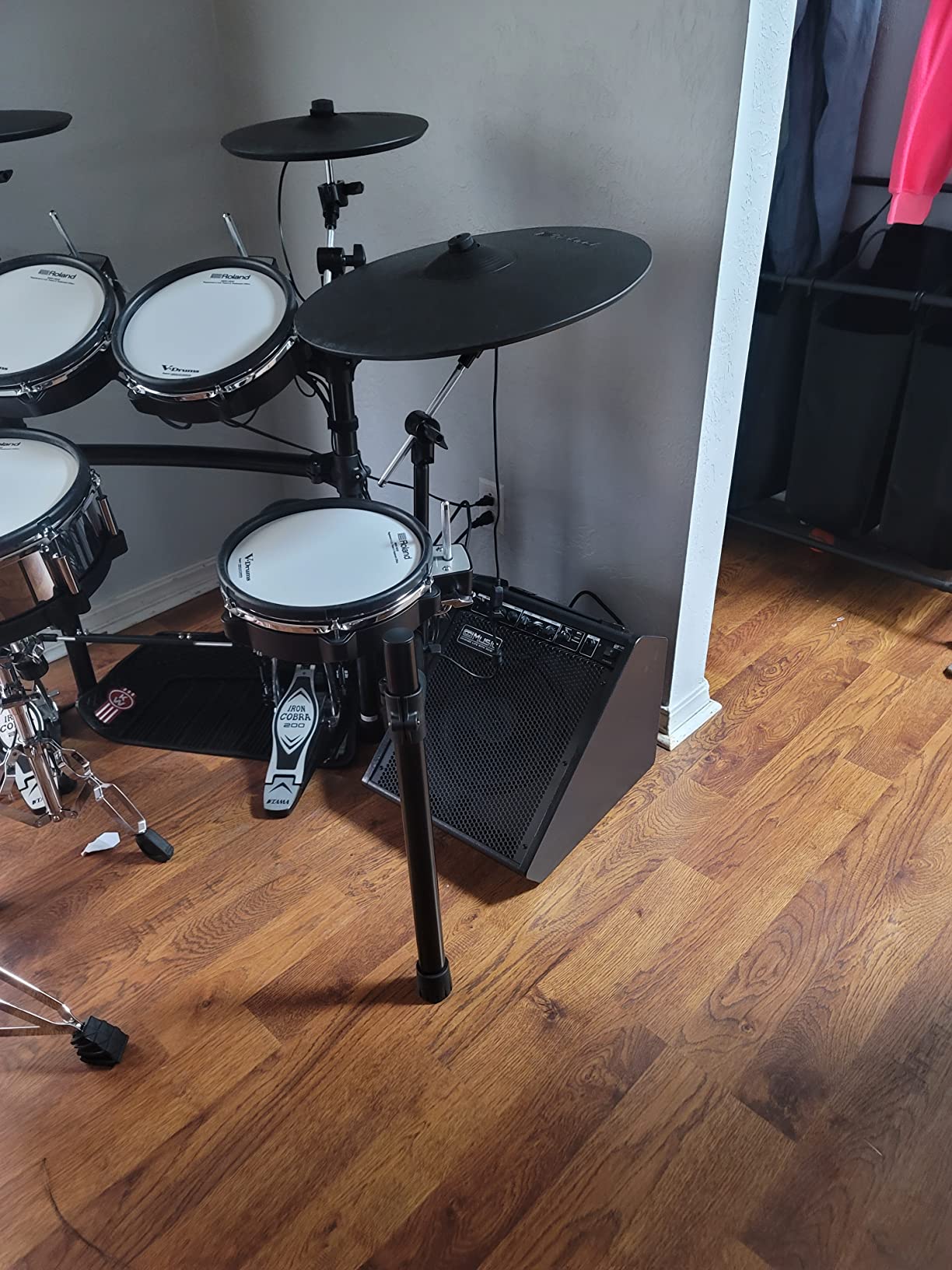
The cabinet is a metal and plastic build at 13.39 by 14.17 by 16.14 inches, which is a step up in bulk from the 20-watt monitors. That size is the point if your space allows it, and the reason to spend the room on it rather than on a 20-watt box that runs out of headroom.
Owners mainly value the power-to-price ratio and the punchy low end from the 8-inch woofer, with the dual inputs and wireless options adding flexibility. The feedback is more mixed than on the other units here: the 4.3 average is among the lower ones, and 7 percent of ratings are one star, so expect some people who did not get on with it.
Note also that the manufacturer does not publish a weight figure, which makes planning a move between rooms harder than it should be. Measure your doorway before you commit.
Who the Vangoa 65W suits best
Rehearsal rooms, garage bands, and shared houses where the practice happens in a common space with other people in it. Two channels means a second musician or a mic can join without a separate mixer, and the headphone output covers the late-night version of the same room.
It also suits a drummer stepping up from a tiny practice monitor who is tired of the volume ceiling, since 65 watts is more than three times the output of the 20-watt class at a cabinet size that is still manageable.
Where the Vangoa 65W falls short
The top end is where the compromises show. A minority of buyers find the tone less refined than premium options, and that is most audible on cymbals, which sit in the high-frequency band the 2-inch tweeter handles.
The 4.3 rating and the higher share of critical reviews mean this is the pick to audition carefully rather than order on spec. If your priority is refined tone at low volume in a small room, one of the 20-watt two-way monitors will serve you better.
5. Alesis Nitro Amp – Built to Hang Off Your Drum Rack
Alesis Nitro Amp 70W Rack-Mounted Drum Amp
70W peak Class-D
3 inch full-range driver
120 Hz to 18 kHz, 98 dB SPL
Rack-mountable
1.5 kg
Pros
- Mounts directly to a Nitro Max or Nitro Pro drum rack
- Smallest and lightest unit here at 1.5 kg
- Punchy distortion-free sound from a 3 inch driver
- Mounting hardware and cable included in the box
- Good level without dominating a small room
Cons
- Only works as a monitor at moderate volume
- 120 Hz to 18 kHz range limits deep kick reproduction
- The mounting design only makes sense on a Nitro rack
The Alesis Nitro Amp solves a problem none of the other amplifiers in this roundup is trying to solve: it is not a practice amp you put on the floor, it is a monitor that clamps onto your drum rack. Variable-angle mounting clamps let you set the height, which means the sound reaches your ears instead of your ankles.
At 1.5 kg and 4.5 by 4.5 by 4.3 inches it is the smallest amplifier here by a wide margin, and it disappears entirely on a Nitro Max or Nitro Pro rack. The box includes a 5-foot 1/4 inch TRS cable, the rack mount kit and an external power supply, so there is nothing extra to buy.
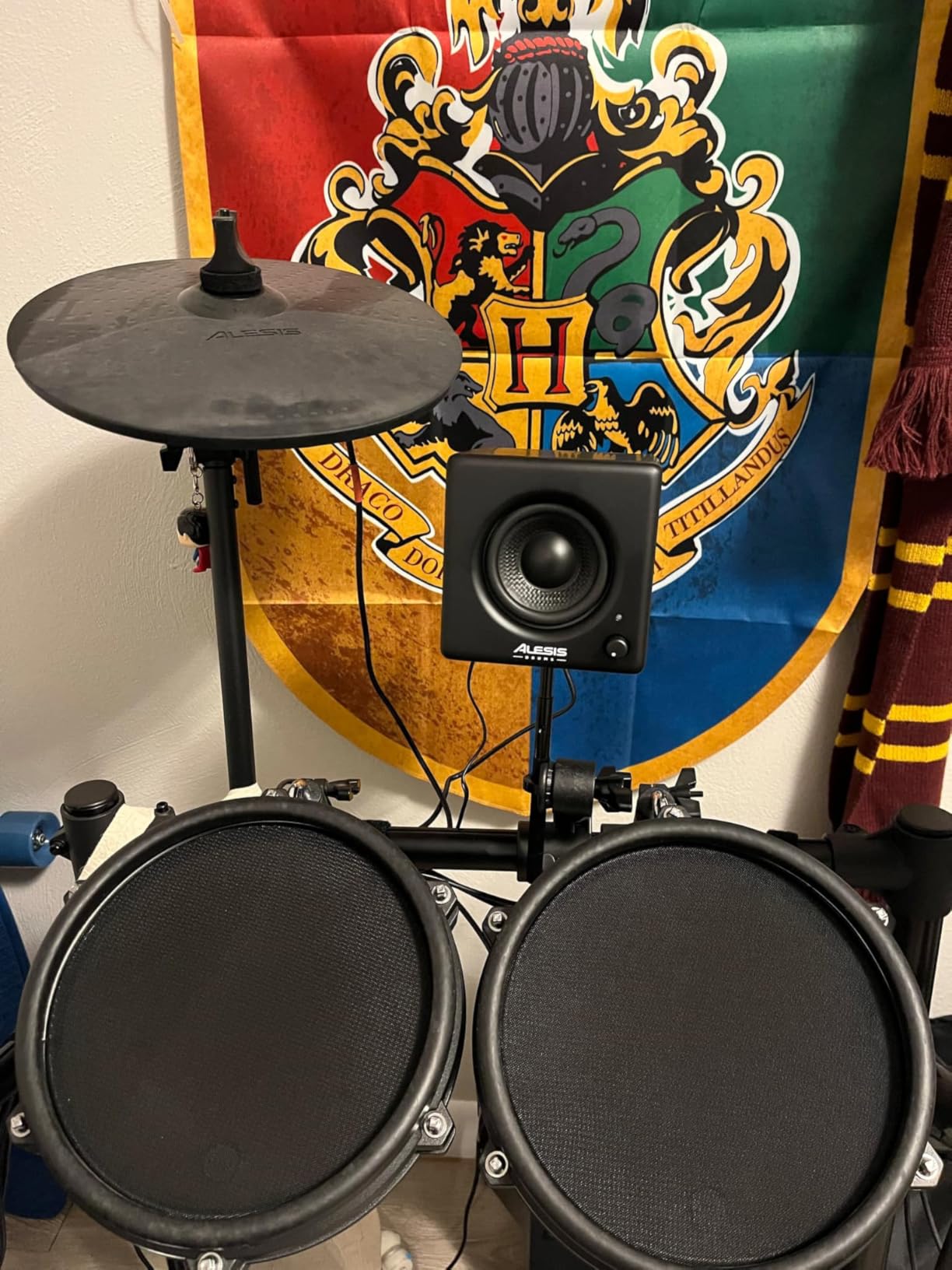
The driver is a 3-inch full-range composite unit driven by 70 watts of peak power Class-D amplification, with a stated frequency response of 120 Hz to 18 kHz and 98 dB maximum SPL. Read that lower figure against the 45 Hz or 50 Hz of the 6.5 and 8 inch monitors in this roundup and the trade-off is clear.
This is a monitoring monitor. Owners of Nitro kits like the clean integration and the near-zero footprint, and the Class-D amplification delivers clean output without the hiss or colour you get from a small analogue amp pushed hard.
The balanced and unbalanced 1/4 inch TRS input is a genuine nicety for anyone running a long cable to a studio wall, and the front-panel level control with power indicator is the whole of the operation, which is exactly right for a device that mounts out of reach.
Who the Nitro Amp suits best
Nitro Max and Nitro Pro owners, without much question. If your kit has the rack, this monitor integrates the way the designer intended and removes a floor-standing box from a room that probably does not have spare floor.
It is also a strong choice for a drummer who wants a monitor that follows the kit between rooms. Clamp it on, unplug the power, and the whole monitoring system is one carry.
Where the Nitro Amp falls short
The 120 Hz lower limit is the real constraint. Deep kick reproduction is essentially absent, so an expensive kit that has serious low-end sampled in will not show its full character through this monitor. If you have never heard your own module through full-range speakers, that is a problem.
Its 4.0 average rating is the lowest of the eight, with 9 percent two-star and 10 percent one-star responses, and the 1-year warranty is short for something that hangs in mid-air on clamps. The mounting design also only makes sense if you own a Nitro rack, so treat it as a kit accessory rather than a general practice amplifier.
6. Roland PM-100 – The Benchmark for Low End at Practice Volume
Roland PM-100 Compact Electronic V-Drum Set Monitor
80 watts
10 inch woofer plus 1 inch tweeter
Angled cabinet for seated players
Metal build
30 pounds
Pros
- Highest average rating in the group at 4.7
- Rich thumping bass with a clean high end for cymbals
- Handles low frequencies far better than 15-20W practice amps
- Dedicated V-Drums input supports module channel phasing
- Angled cabinet lets you sit close at lower volume
Cons
- No headphone jack or speaker output on this model
- Heavy at roughly 30-35 pounds
- Mono output
- Sits at the top of the range in this roundup
The best amplifier in this roundup for hearing what your kick drum actually sounds like is the Roland PM-100, and experienced drummers say so directly.
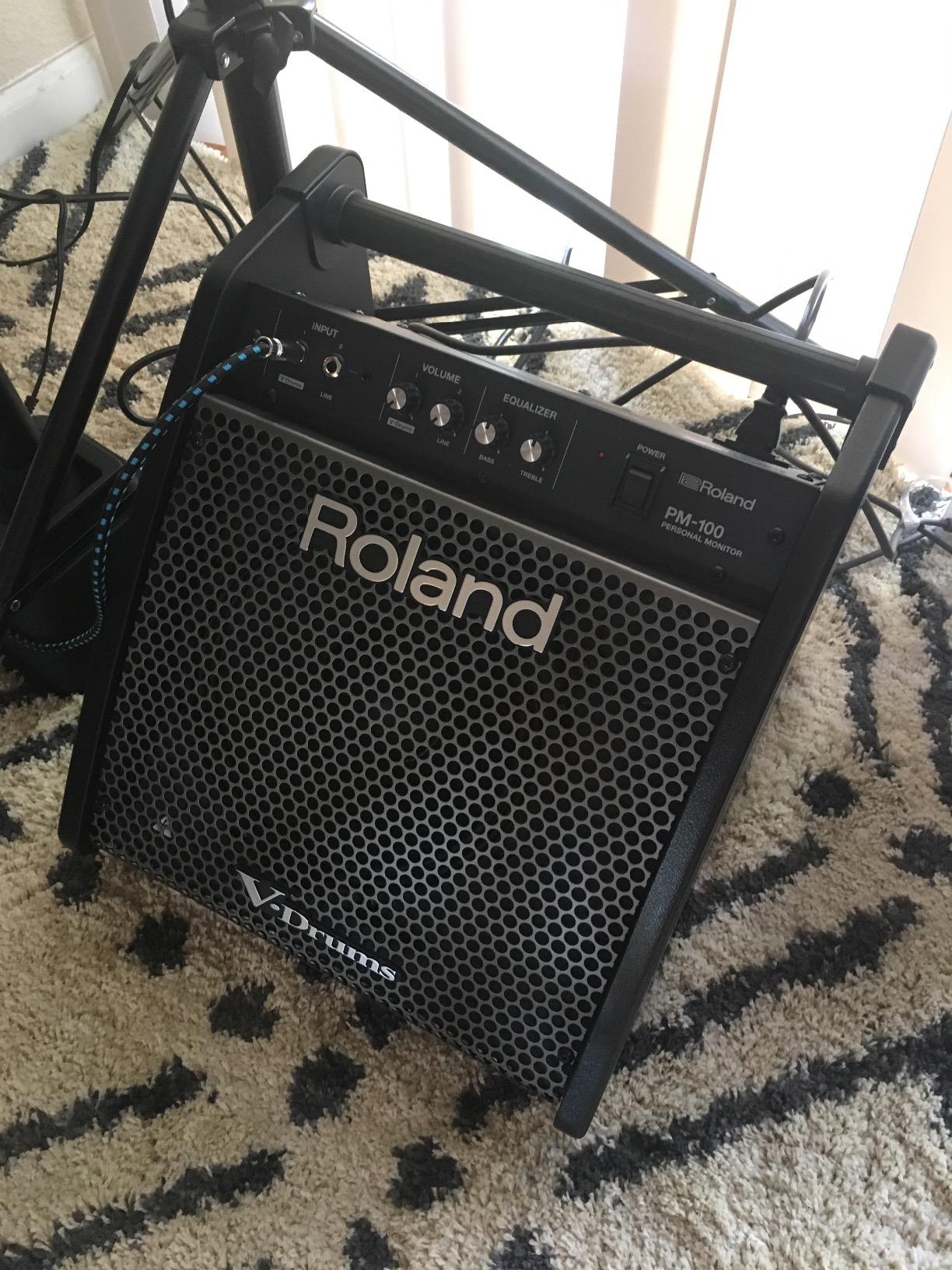
The custom 10-inch speaker paired with a 1-inch tweeter at 80 watts is what separates it. That cone size is the reason the kick drum sounds like a drum instead of a notification sound, a weight of low end that the 6.5-inch cabinets in this roundup do not reach.
The second thing that makes it work at home rather than only on stage is the angled cabinet, which is optimised for a seated V-Drums player. You get useful level at a lower setting because the cabinet aims the sound where you are, which is a genuinely neighbour-friendly feature on this list without ever being marketed as one.
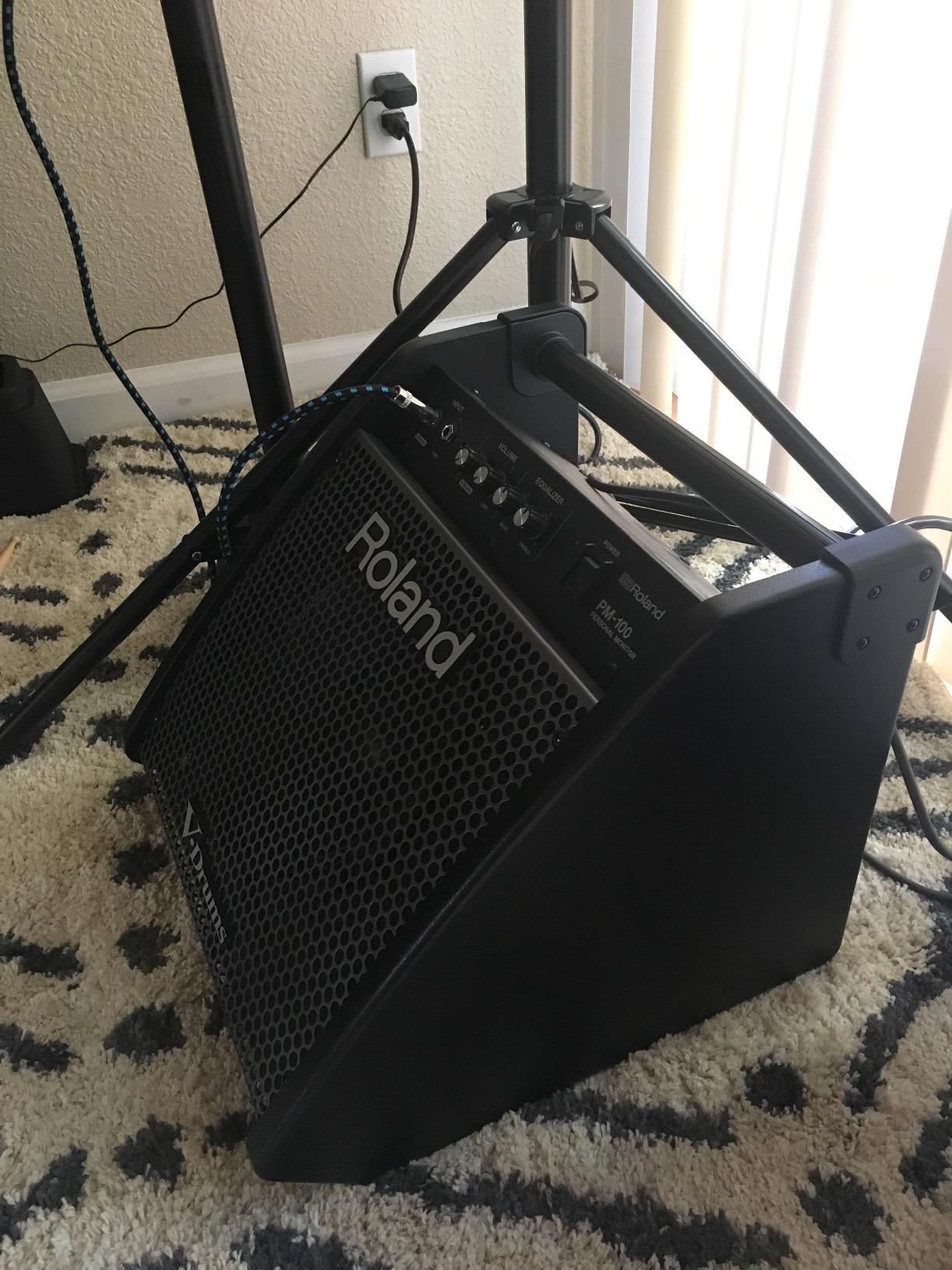
The integrated mixer with independent volume controls and a global EQ is more capable than the two-knob designs above it, and the dedicated V-Drums input accepts both channels from the module with phasing support, so a stereo module output lands the way the kit designer intended. There are also 1/4 inch and 1/8 inch line inputs for anything else.
At 4.7 average from 279 reviews it holds the highest rating of the eight here, with 82 percent five-star responses, and a commenter on drummerworld describes it as a nice little sturdy amp for home practice. Metal construction with a sturdy carry handle is the other part of that durability story.
The catch is weight. Thirty pounds is a real lift for a fifth-floor flat, and the dimensions, 18 by 19 by 21 inches, mean it claims a corner of the room permanently.
Who the PM-100 suits best
Drummers in a house, a garage, or a ground-floor room with enough space for a proper cabinet and neighbours who are not in the next room. It is also the amplifier to pick if you have just moved to e-drums from acoustic drums and the missing physical feedback is the thing bothering you most.
It suits focused practice at moderate volume. Because the low end is genuinely reproduced, you can turn the level down to a neighbour-friendly setting and still hear everything, which is a claim very few practice amps can make honestly.
Where the PM-100 falls short
There is no headphone jack and no speaker output or thru connection on this model. That means no silent late-night practice through the amp, and no daisy-chaining to a second cabinet later. It is a consumer limited warranty of 1 year parts and 90 days labour, the only split-term warranty on this list.
The output is mono, and this sits at the top of the range here. If your room is small or your budget is tighter, the difference in usable low end over a good 8-inch woofer is real but not the gap the step up implies.
7. COOLMUSIC DM80 – Steel, 80 Watts and Three Ways to Connect a Backing Track
Coolmusic Electric Drum AMP 80-Watt Electronic Drum Amplifier DM80 Keyboard Speaker with Bluetooth, with 3-Year Warranty
80 watts
10 inch woofer plus 3 inch tweeter
Bluetooth and USB
3-band EQ
LINE OUT
Steel cabinet
Pros
- 10 inch woofer delivers strong low end for its size
- Two inputs plus Bluetooth and USB for three simultaneous sources
- 3-band EQ with smooth precise chicken-head knobs
- LINE OUT works for headphones or linking to another speaker
- Steel cabinet and sturdy carry handles
- Quiet Bluetooth pairing with no announcement tones
Cons
- Faint hiss reported at idle by some buyers
- Limited top-end refinement
- Bass can distort if pushed with EQ boosted
The DM80 is the middle path in this roundup: 80 watts through a 10-inch woofer and a 3-inch tweeter, in a cabinet that feels far more substantial than its 11.81 by 11.02 by 15.75 inch footprint suggests. The heavy-duty steel construction with rounded edges and carry handles is a step up in feel from the moulded-plastic small monitors.
Its distinguishing feature is source flexibility. Two inputs plus Bluetooth and USB means three simultaneous signals, so you can run your module, a second instrument, and a phone playing backing tracks, and the cabinet is tilted upward for floor placement so the sound reaches a seated player.
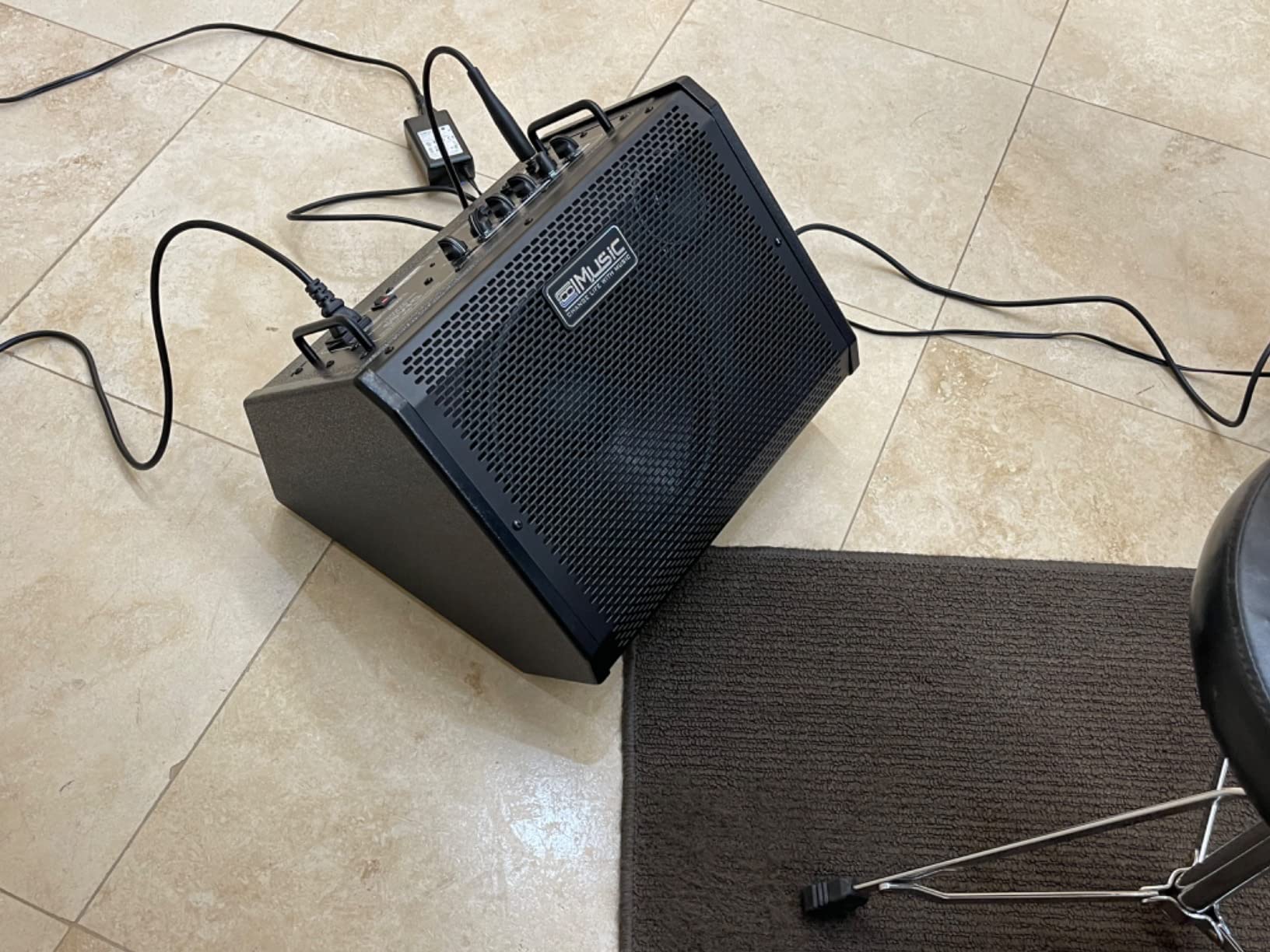
The LINE OUT is the feature that sets it apart from the other 80-watt amplifier here. It can feed headphones directly, or link to another speaker or a mixer, which turns a practice amp into the front end of a small PA or a two-speaker monitoring setup when you outgrow the room.
Buyers and keyboardists alike praise the low-end punch and the value at this power level, along with the steel build and the multiple inputs. The 3-band EQ uses chicken-head style knobs that give finer adjustment than a standard pot, and quiet Bluetooth pairing with no announcement tones is a small quality-of-life win.
The 3-year warranty is the longest in this roundup, which for a steel-cabinet speaker that will be moved around is worth something.
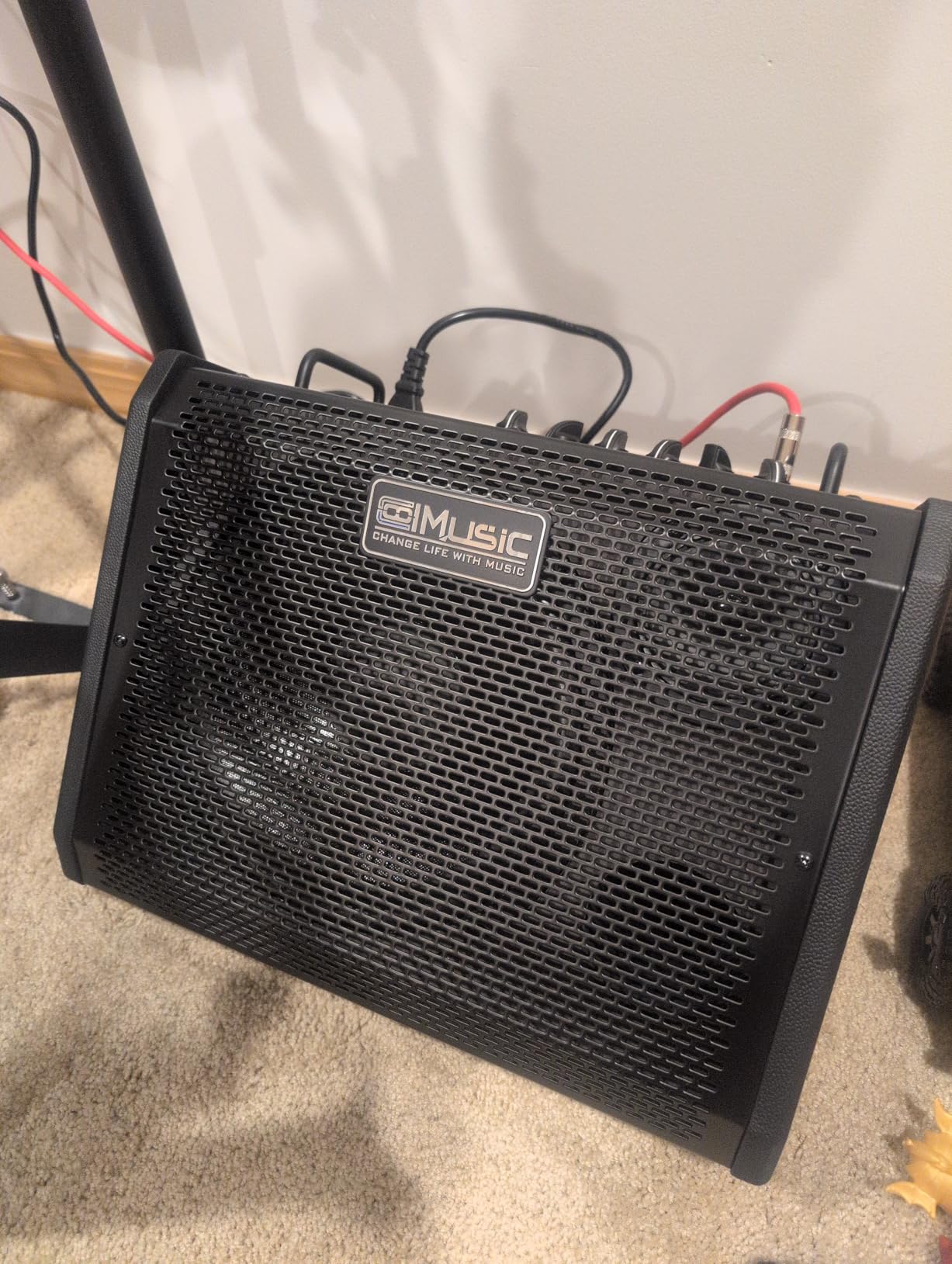
Who the DM80 suits best
Drummers who practise with tracks, which is most people practising with tracks. Three simultaneous sources plus a LINE OUT means this box can be the centre of a practice rig, a rehearsal amplifier, and a small PA feed without a mixer in the chain.
It is also a strong pick for a drummer who wants a 10-inch cone like the Roland PM-100 without the 30-pound lift, and for anyone who moves their amp between rooms regularly enough to care about build quality.
Where the DM80 falls short
Some buyers report a faint hiss at idle, and the top end is less refined than on the dedicated drum monitors here. A minority also find the bass distorts if you push it with EQ boosted, which is worth remembering before you start dialling in low frequency to compensate for a small room.
A few buyers also find the compact size disappointing if they expected a large cabinet at 80 watts, and the manufacturer does not publish a weight figure, so check the dimensions before planning a move between rooms.
8. Alesis Strike Amp 8 MK2 – Built With a Recording Path and Pro-Style I/O
Alesis Strike Amp 8 MK2 2000W Electric Drum Amp
2000W peak
8 inch woofer plus HF compression driver
Two XLR and 1/4 inch combo inputs
XLR direct out
9.76 kg
Pros
- Large headroom from the 2000W peak rating
- Specially voiced 8 inch woofer and compression driver for clarity
- XLR inputs and XLR direct out make recording or linking easy
- HPF and ground-lift switches for practical noise control
- Bluetooth 5.0 for streaming backing tracks
- Wedge
- upright or pole-mount positioning
Cons
- Bulky and heavy for a home practice setup
- Sits above the compact practice monitors on size and cost
- The 2000W figure is peak power rather than continuous
The Strike Amp 8 MK2 is the pick here with the most pro-style connection panel, and if you record at home even occasionally that changes the calculation. The XLR direct output feeds a front-of-house desk, a recording interface, or a second Strike Amp 8, and the two combo inputs accept XLR and 1/4 inch TRS with independent volume.
It also has the most considered control surface here: the HPF EQ switch cuts through muddy mixes, which matters in a small reflective room far more than any tone control, and the ground-lift switch removes grounding noise when you are feeding a chain of powered equipment.
Sonically it is an 8-inch woofer with an HF compression driver, and that compression is what keeps the cymbal band clean when you push the level.
The wedge design also stands upright or pole-mounts, so the same amplifier moves from a practice-room floor to a small stage without a different box.
Bluetooth 5.0 handles jam-along streaming, and at 9.76 kg with 9.72 by 9.96 by 17.16 inch dimensions it is a substantial object to have in a small room.
Owners of Strike kits praise the headroom and clarity for both practice and small-stage monitoring, along with the pro-style XLR connectivity; the trade-off they name is size and weight against a bedroom practice amp.
That 2000W figure is peak power, and peak numbers are marketing shorthand rather than a volume measurement.
Who the Strike Amp 8 MK2 suits best
Drummers who record at home, stream practice, or already gig small rooms. The XLR direct output and the combination of balanced inputs mean one box covers practice, capture and a front-of-house feed, and r/edrums regulars repeatedly name the Strike Amp 8 alongside the Roland PM-100 as go-to choices for exactly this kind of flexibility.
It also suits a drummer planning to grow. The pole-mount and upright options mean the amplifier you practise on now works on a small stage later, rather than becoming a bedroom-only box.
Where the Strike Amp 8 MK2 falls short
At 9.76 kg it is one of the two heaviest cabinets listed here, and it sits above the compact practice monitors on both size and cost, which is bulk and mass you do not need in a bedroom practice setup.
There is no headphone output, so silent practice still comes from your module rather than the amp, and the 1-year manufacturer warranty matches the shortest terms on this list.
How to Choose an Electronic Drum Amplifier for Practice
Wattage is where most buyers go wrong, and the reason is that two of the amplifiers in this roundup advertise peak power rather than the continuous figure that actually predicts loudness. A 2000W peak rating does not mean the amplifier is louder than a 200-watt continuous one; peak power describes a brief transient ceiling, not what the amplifier sustains while you play.
Continuous power, usually quoted as watts RMS, tells you how hard the amplifier can push for minutes at a time without the protection circuit stepping in.
When you compare amps, compare like with like: RMS to RMS. The Alesis Nitro Amp at 70W peak and the Alesis Strike Amp 8 MK2 at 2000W peak are not directly comparable to the 20-watt DM20 or the 80-watt PM-100, which are continuous output figures.
Room size matters more than brand. A 20-watt amp in a small bedroom will sound loud because the walls return the sound to you, while the same amp in a garage will sound like a toy. Bigger rooms need continuous watts, and the number you need roughly doubles when the room gets much larger.
Keep in mind that these figures describe continuous output: two of the eight amplifiers in this roundup publish a peak figure instead, which is why the distinction matters when you read across the table above.
This is the mapping we use, and it is a good starting point for anyone asking how many watts they need at home:
Bedroom or small box room under about 100 square feet: 20 to 35 watts is genuinely plenty. At this size the limiting factor becomes neighbours rather than amplification, and you should be choosing an amplifier with a headphone output so you have a silent option.
Apartment or shared-wall living space: 35 to 65 watts, ideally with a headphone jack and a bass response that reaches 50 Hz or lower so you get real low end without turning the volume up. The Donner DA-35 fits this slot.
Home studio or garage practice space: 65 to 100 watts with an 8-inch or 10-inch woofer. This is where the DM80 and the Roland PM-100 earn their place in a setup, because a bigger cone means you can set the level lower and still hear the kick.
Rehearsal room or small stage: 100 watts and up, or any amplifier with a line-level or XLR output that lets you feed a house PA. A speaker that will not fill a room on its own should be a monitor you feed into something bigger.
Driver size decides the low end, not the wattage
Here is the pattern that surprised us most while comparing these eight. The Alesis Strike Amp 8 MK2 claims 2000 watts of peak power and the Alesis Nitro Amp claims 70 watts of peak power, yet those two figures tell you almost nothing about how either amplifier sounds.
The Strike Amp 8 MK2 pairs its 8-inch woofer with a compression driver for the cymbals, while the Nitro Amp uses a single 3-inch full-range driver with a stated lower limit of 120 Hz, against 45 Hz on the Vangoa 65W and 50 Hz on the Donner DDA-20.
What that means practically: a larger woofer reproduces more low-frequency energy at the same wattage. If the feel of the kick drum through the floor is what you are missing from headphones, prioritise cone size over the number on the box.
Check the stated lower frequency limit as well, because it is the most honest figure a manufacturer publishes. Anything reaching 40 Hz to 50 Hz downward is the range worth caring about.
A separate compression driver or tweeter for the cymbals is the other half of a convincing drum sound. Single-driver monitors force hi-hats and kick to share one cone, which is where thinness comes from.
Connectivity decides what you can do later
Check three things in this order.
First, is there a headphone output? The Donner DA-35, the Vangoa 65W and the COOLMUSIC DM80 have one. The DM20, the DDA-20, the Nitro Amp, the Roland PM-100 and the Strike Amp 8 MK2 do not, and if late-night practice is part of your routine that is a hard filter.
Second, is there a line out or DI out? This is your upgrade path. The DA-35 and the DM80 both have one, which means a second speaker, a small PA, or an interface later without replacing the amp. XLR, as on the Strike Amp 8 MK2, is better still because it runs long cables without hum.
Third, how many inputs? Two channels, as on the Donner DA-35 and the Vangoa 65W, mean you can run your module and a mic or a second sound source at once, which is how most rehearsal and recording work actually happens.
On Bluetooth specifically: it is convenient for backing tracks and it works, but the added latency makes it a poor choice for a click track or a drum app you are trying to follow in real time. Use a wired input for anything you are playing in time with, and Bluetooth only for the music you are playing along to loosely. The DM20 and the DM80 pair quietly with no announcement tones, which is worth having if you practise at night.
Headphones versus a speaker, and the hybrid routine
Almost nobody in the forums argues against headphones. r/edrums regulars state plainly that headphones sound far better than any affordable speaker, and for a beginner hearing their own playing clearly that is simply true. The case for a speaker is different: it is about physical feedback rather than fidelity.
Two things only a speaker gives you. The first is low-frequency energy you feel in your chest and the floor, which is the cue that keeps your time honest when you speed up. The second is the physical sense of the room reacting, which tells you how much space your playing needs.
Headphones deliver neither, which is why some drummers find they can play a fast tempo cleanly in headphones and fall apart the moment they step into a room with a monitor.
The practical answer is a hybrid routine rather than a choice. Practise passages, timing and anything timing-critical on headphones through your module’s own output, then switch to the amplifier at lower volume for dynamics, fills and the parts of a session where you want to hear the whole kit the way a band would hear it.
That habit also keeps your neighbour-friendly days easy, because the loud part of the session becomes the one you can do silently.
One thing is worth knowing here: electronic drums transmit into the building whether or not you are using headphones. Strike heads and mesh pads send low-frequency energy through the frame and the floor, so a kit can bother an upstairs neighbour in complete silence. An amplifier does not create that problem, but a small cabinet lets you keep the speaker level low enough that the airborne part of it is not what is being objected to.
Used and previous-generation amplifiers
A used Alesis Strike Amp comes up repeatedly in the r/edrums threads as the reference point for what a second-hand unit should be worth relative to its new equivalent, and the general advice is to expect noticeably less than the new figure.
Used pricing anchors come up constantly in e-drum discussions, and the pattern is stable: the premium brands hold value better than the budget ones, because build quality is what survives a decade of daily use.
Models from earlier generations are also worth a look. Earlier Roland PM-series personal monitors, including the PM-10 and a second-hand PM-200, use the same angled metal-cabinet concept as the PM-100, so they suit the same practice room and the same rack-a-corner placement. The Peavey KB4 and KB5 come up in the same discussions as workable practice amplifiers for e-drums despite not being designed for them.
What to check on a used unit, in order: the driver for rattles or buzzing when you play a sustained low note, the input jacks for intermittent contact, and the power supply, which is the component most likely to have failed.
Ask for a photo of the label showing the serial and the original specification sticker, since replacement drivers on budget cabinets are rarely available and a cabinet with a blown driver is scrap rather than a bargain.
What we would skip for practice use
A power amplifier with no built-in speaker is the thing to avoid for a practice room. Those units need a separate cabinet, you pay for two devices instead of one, and the pairing you end up with is rarely chosen for a small room. Buy a self-contained powered monitor for home work and add a speaker only when you have already outgrown the room.
The second thing to skip is a single-driver cabinet chosen for its wattage figure. The Alesis Nitro Amp is the clearest example on this list of an amplifier where the headline power number and the practical usefulness pull in opposite directions: it works beautifully attached to a Nitro rack at moderate level, and it is the wrong tool for hearing what your kick drum sounds like.
Finally, do not buy on Bluetooth alone. Several of the strongest value amplifiers here have it, and it is genuinely useful for backing tracks, but it is not a substitute for a headphone output when your practice hours are restricted, and it is not a substitute for a reliable wired input when you are playing in time with something.
Matching your drum module to the amp input
Drum module outputs run hot, and this is the single most common support question from new e-drum owners. The symptom is a distorted, harsh kick that sounds like a fault, when it is really a gain-staging mismatch between the module output and the amp input.
The fix is straightforward. Start with the module volume at a moderate level, then bring the amp channel volume and master volume up together. If the kick distorts, pull the module output down before you touch anything on the amp. The Donner DA-35 makes this easier than most with its dynamic mic and line input modes, offering -38 dB or -48 dB impedance options to match what you are feeding it.
This is also why guitar amplifiers are a poor substitute. A guitar amp is voiced around a midrange-forward instrument with a limited low end, and electronic drums are the opposite: a wide, full-range signal that needs a woofer with real extension. Drummers are warned off guitar amps repeatedly for this reason on r/edrums, and a commenter on drummerworld notes that the Peavey KB series works well for e-drums practice and for making videos despite not being designed for them. A keyboard amp is a reasonable stopgap to try before you buy, but it is not what these amps are built for.
Placement, gain staging and the apartment problem
Above about 80 watts, low frequency stops being only an air problem. It becomes a structure problem, because a kick drum reproduced at a solid level pushes energy into the floor, the wall behind the amp, and the joists above you.
That is why so many apartment practice complaints are about neighbours rather than volume, and why headphones alone do not solve it either: the kit still transmits through the frame and the pad mesh.
Where you put the amp matters as much as how loud you run it. A slanted or wedge cabinet aimed at a seated player, as on the Roland PM-100 and the COOLMUSIC DM20, concentrates the sound where you are. Placing the cabinet away from a corner reduces the low-frequency build-up that makes small rooms sound boomy, and putting it on a rug or a drum rug rather than bare hard flooring reduces how much energy it pushes into the structure beneath you.
For a shared-wall apartment, the practical routine is straightforward. Set up on a rug or a drum rug rather than bare carpet or wood, and keep the amp off the wall behind the kit.
Then use a monitor with a 50 Hz to 20 kHz or better response so you can hear the kick without needing volume, and remember that a high-pass filter switch, as on the Strike Amp 8 MK2, is the surgical version of the same idea. The pickup-style pads and rubber-mesh heads on most modern kits do more for your neighbours than any amplifier choice, but the amplifier is what determines how low you can set that level.
Finally, remember that rooms add level. A reflective bathroom-like practice space will sound twice as loud as the same amp in a furnished room with soft furnishings, so match the amp to the room after the furniture is in place, not before.
Frequently Asked Questions
What is the best amplifier for electronic drums?
For practice at home, the COOLMUSIC DM20 is our top pick: 20 watts, a 6.5 inch woofer with a 2.5 inch tweeter, Bluetooth and USB playback, and a 4.5 kg weight that moves between rooms easily. The Donner DA-35 does the most jobs, with two channels, a headphone output and a DI out. The Roland PM-100 is the low-end benchmark thanks to its 10 inch woofer and angled cabinet.
Do electronic drums need an amplifier?
No, they do not need one strictly, because headphones will play the module. You buy an amp for physical feedback: low-frequency energy that you feel and use to judge timing, and cymbal detail that headphones can make sound harsher than it is. r/edrums regulars argue headphones sound better than any affordable speaker, and both are true. Practice with headphones for volume control and with an amp for feel.
What is a good small amp for electronic drums?
The Donner DDA-20 is the most compact general-purpose option here at 3.6 kg, with a 6.5 inch woofer, a 2.0 inch tweeter and a 3-band EQ. The COOLMUSIC DM20 is slightly larger at 4.5 kg and adds Bluetooth and USB playback. Both reach enough low end for a bedroom. If your room is a shared-wall apartment, the Donner DA-35 at 35 watts adds a headphone output, which matters more than extra power.
How many watts do I need to practice electronic drums at home?
Between 20 and 35 watts for a bedroom or small box room, 35 to 65 watts for an apartment with shared walls, and 65 to 100 watts for a home studio or garage. Judge amps by continuous RMS power, not peak claims, since a 2000W peak figure is not comparable to an 80-watt continuous one. Room size matters more than brand, because a small room reflects sound back at you.
Can I use a guitar amp or keyboard amp for electronic drums?
A keyboard amp is a workable stopgap because its 8 inch driver reproduces more low end than a guitar cabinet. A guitar amp is a compromise: it is voiced around a midrange-forward instrument, so electronic drums sound thin through it. If you already own a keyboard amp, try it before buying, but a dedicated drum monitor with a larger woofer will not need the volume turned up as far, which is the practical argument for buying one.
Conclusion
There is no single best electronic drum amplifier for practice, because the practice room decides more than the spec sheet does. Match the amplifier to the space you actually have, and then judge it on continuous watts, cone size and the connections you will use rather than the largest number printed on the front.
For a bedroom or a shared-wall apartment, start with the COOLMUSIC DM20 at 20 watts and 4.5 kg, or step up to the Donner DA-35 if you want a headphone output, a second channel and a DI out from one box.
In a larger practice room, look at cone size: the Roland PM-100 gives you a 10 inch woofer in a metal cabinet angled for a seated player, and the COOLMUSIC DM80 gives you a 10 inch woofer with a line out and a 3-year warranty. If you already own a Nitro rack, the Alesis Nitro Amp mounts to it and removes the floor-standing box entirely. Drummers who record or gig small rooms should look at the Alesis Strike Amp 8 MK2 for its XLR direct output, reading the 2000W figure as peak marketing rather than volume.
Whichever you pick, set the module level first and the amplifier level second, keep the cabinet off the wall behind you, and use headphones for the hours when the neighbours are asleep.