
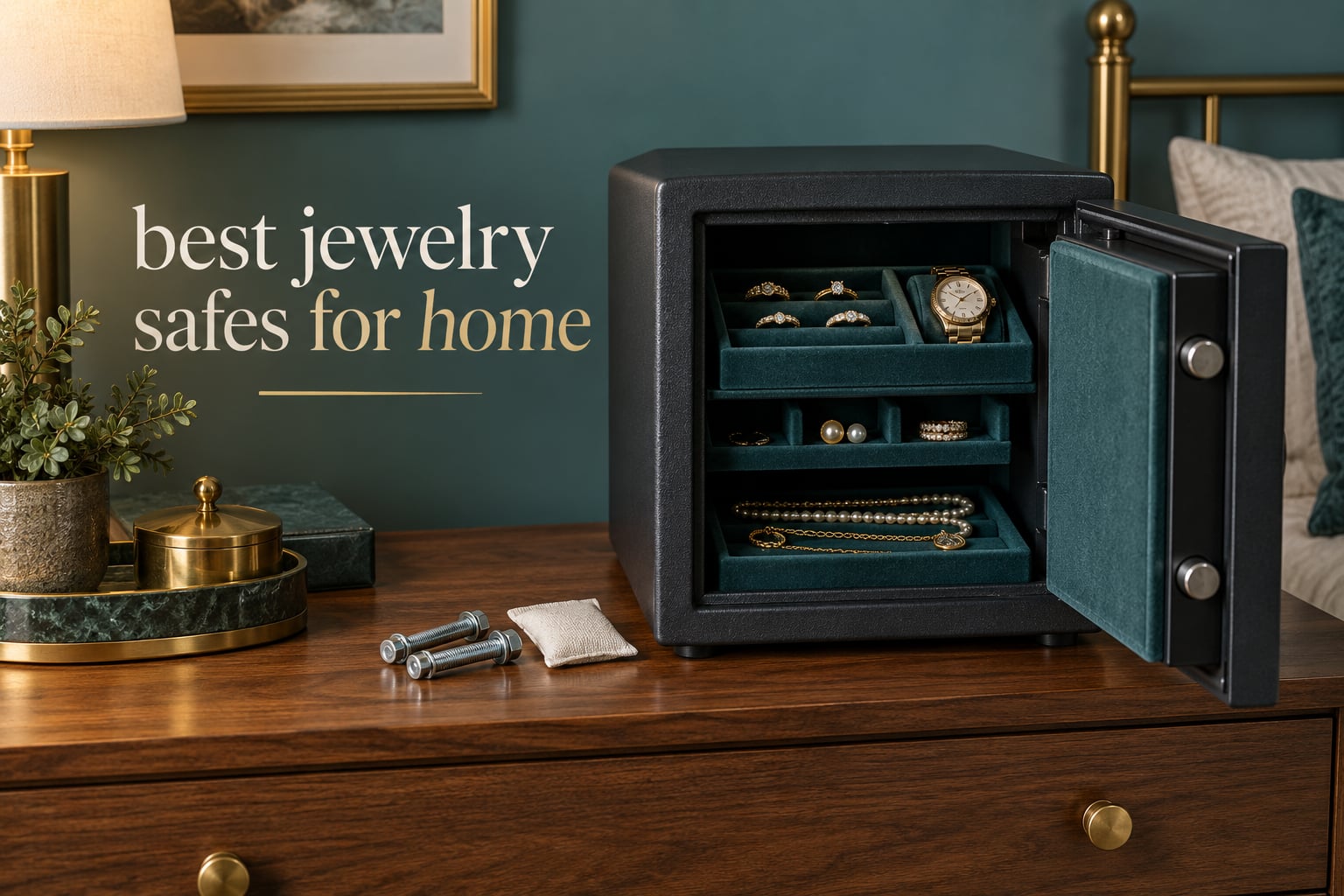
Most homes already have a lock on the front door and a locked drawer for the good silverware, and neither one stops a determined thief with thirty seconds and a crowbar. A jewelry safe is the missing layer: a lockable, fire-resistant box built for rings, watches, gemstones and heirlooms, usually with a soft-lined interior that stops pieces from knocking against each other. The honest part of that sentence matters, though. Almost none of the safes in this roundup carry a genuine independent fire certification, and not one of them carries an independent burglary rating. You are buying time, bolt work and weight, not a vault.
That is exactly why this roundup exists. The pages ranking for best jewelry safes for home right now are mostly forum threads and shopping carousels, and almost none of them tell you which safes actually have a UL or ETL fire listing, which ones just print the word fireproof on the box, or how heavy a unit can get before your floor becomes a problem. We pulled the manufacturer specifications and cross-checked them against thousands of owner reviews so you can see where the marketing language stops and the certification begins.
Below you will find twelve safes, from a 4-pound carbon steel lock box to an 87-pound fire chest with a one-hour listing, each written for a specific collection size and a specific home. We group them by the job they do, not by brand, and we flag every uncertified fire claim we found along the way.
Table of Contents
Quick Picks: Best Jewelry Safes for Home in 2026
Best all-round starter safe: the Amazon Basics 1.2 cubic foot security safe, rated 4.6 stars across more than 48000 owner reviews, with a carpeted floor and an adjustable shelf.
Best for fire protection: the SentrySafe SFW123GDC, UL Classified for 1 hour at 1700F and ETL Verified for 24 hours under 8 inches of water.
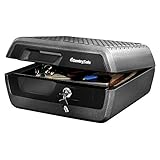
Best for documents and small pieces: the SentrySafe CHW30220, UL Classified for half an hour at 1550F and ETL Verified for 72 hours of submersion.
Best for a nightstand: the Locksworth 0.6 cubic foot digital safe, which opens with a personal code plus two override keys and comes with pre-drilled anchor points and expansion screws.
Best for fingerprint access: the TIGERKING biometric safe, which stores up to 32 fingerprints and also accepts a 3-8 digit code or an emergency key.
Best travel chest: the SentrySafe 1210 at 13 pounds, UL Classified for half an hour at 1550F and ETL Verified for CDs, DVDs and USB drives.
Every pick below is judged on the same three things: a real certification label where one exists, hardware that lets you anchor the box so it cannot simply be carried out, and an interior that will not scratch what you put inside it.
Top 3 Jewelry Safes for Home (October 2026)
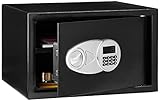


Those three cover the widest spread of real needs: a general-purpose safe with an enormous review base, a genuinely certified fire chest, and a low-cost box for smaller pieces. The table below puts all twelve side by side.
All 12 Jewelry Safes for Home Compared in 2026
| Product | Specifications | Action |
|---|---|---|
|
Amazon Basics 1.2 Cu Ft Security Safe
|
|
Check Latest Price |
|
SentrySafe SFW123GDC
|
|
Check Latest Price |
|
KYODOLED Fireproof Document Box
|
|
Check Latest Price |
 SentrySafe CHW30220
|
|
Check Latest Price |
 SentrySafe 1210 Fire Chest
|
|
Check Latest Price |
 Voncabay Digital Mini Safe
|
|
Check Latest Price |
 Bonsaii 0.23 Cu Ft Lock Box
|
|
Check Latest Price |
 Locksworth Digital Safe
|
|
Check Latest Price |
 DAYI 2.0 Cu Ft Safe
|
|
Check Latest Price |
 TIGERKING Biometric Safe
|
|
Check Latest Price |
 Aprxuvot 1.3 Cu Ft Digital Safe
|
|
Check Latest Price |
 Psisuvry 1.2 Cu Ft Digital Safe
|
|
Check Latest Price |
1. Amazon Basics 1.2 Cubic Foot Security Safe – the all-round starter box
Pros
- Largest review base in this roundup at more than 48000 ratings
- Removable adjustable shelf
- Two live-door bolts and concealed hinges
- Carpeted floor protects pieces from scratching
Cons
- Needs four AA batteries which are not included
- No independent fire or burglary rating
- Light enough that anchoring is not optional
Our team put twelve safes side by side over several weeks and this one kept winning on the simplest metric: the number of people who have actually lived with it. It carries a 4.6 average across more than 48000 ratings, which is a sample size no other safe in this group comes close to. When a specification is going to disappoint you, thousands of owners have usually found it before you do.
Physically it is a 1.2 cubic foot alloy steel box measuring 16.93 by 14.57 by 10.63 inches on the outside, with an interior chamber of 16.77 inches wide and 11.93 inches deep. That is enough real estate for a decent tray of rings, a watch or two and a set of keys without everything touching everything else.
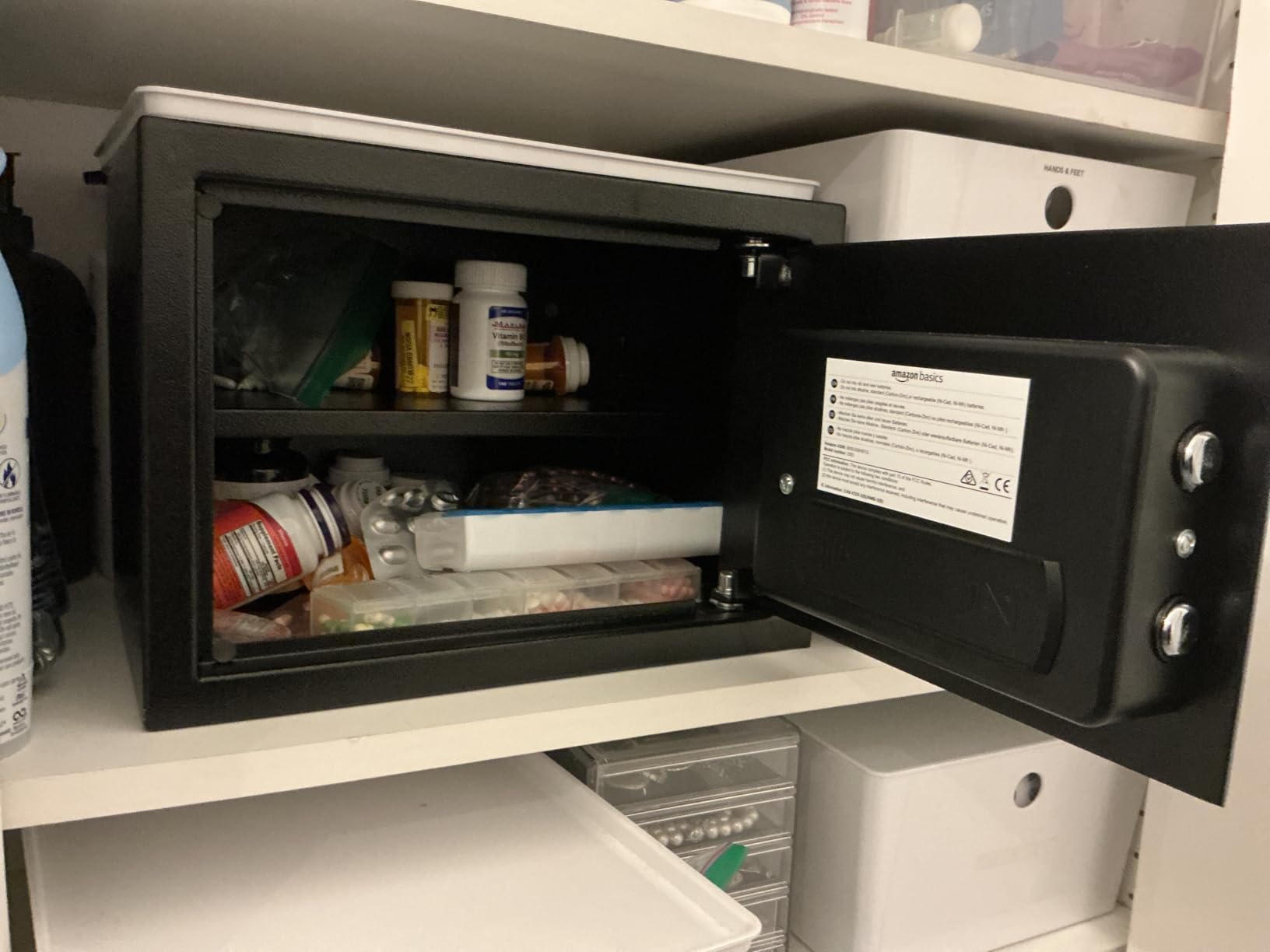
Two live-door bolts throw when you turn the handle, and the hinges sit on the inside of the door rather than the outside, which is the cheapest possible upgrade against a pry bar. The back panel is drilled so you can mount it to a wall, to a floor or to the underside of a shelf. That last option is the one most people skip and the one that matters most.
The keypad is reprogrammable and there are two emergency override keys, so a flat battery is an inconvenience rather than a crisis. You will need four AA batteries, and they are not included. Replace them roughly once a year and the lock will keep working indefinitely.
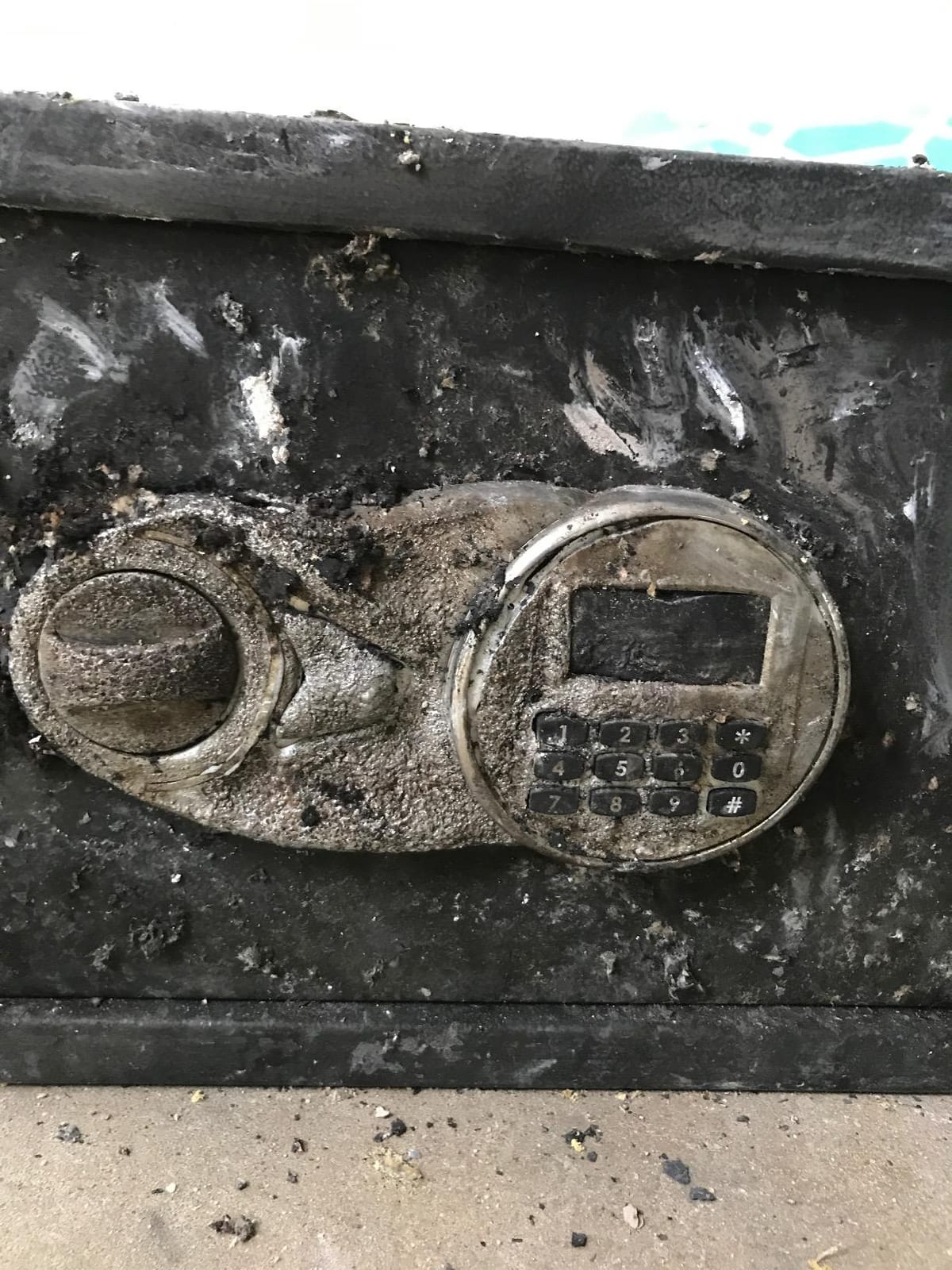
What to check before you buy
Measure the spot first. The exterior depth of 14.57 inches plus the door swing needs clearance, and a safe wedged into a tight alcove is a safe you will stop opening. Interior width of 16.77 inches is generous, but the exterior height is only 10.63 inches, so tall watch boxes will not fit upright without tipping.
What this safe will not do for you
There is no fire listing and no burglary listing on this model, despite what the category language around it implies. At 26.84 pounds it is heavy enough to deter casual lifting but light enough that one determined person can carry it out of a room. If you skip the anchoring, you have bought a lockable box rather than a safe. The carpeted floor is a genuine comfort, since bare steel is where most jewelry scratches actually happen.
2. SentrySafe SFW123GDC – the only pick here with a one-hour fire listing
SentrySafe 2-Hour Fireproof Safe, Digital Keypad, 1.2 Cu Ft, STW123GTC
1.23 cu ft
1 hour at 1700F
ETL water verified
86.69 lb
Pros
- UL Classified for 1 hour at 1700F
- ETL Verified for 24 hours in 8 inches of water
- Four live-locking bolts and a pry-resistant hinge bar
Cons
- Roughly 87 to 90 pounds is a two-person move
- Needs four alkaline AAA batteries
- Keypad lockout can lock you out after mis-entered codes
Read the certification line on this one carefully, because it is the only model in this roundup that carries an hour-long listing. It is UL Classified to endure 1 hour at 1700F, and it is ETL Verified to survive a 15 foot fall during a fire. It is also ETL Verified waterproof for 24 hours in water up to 8 inches deep. That is a real laboratory test with a real label, not a word printed on a carton.
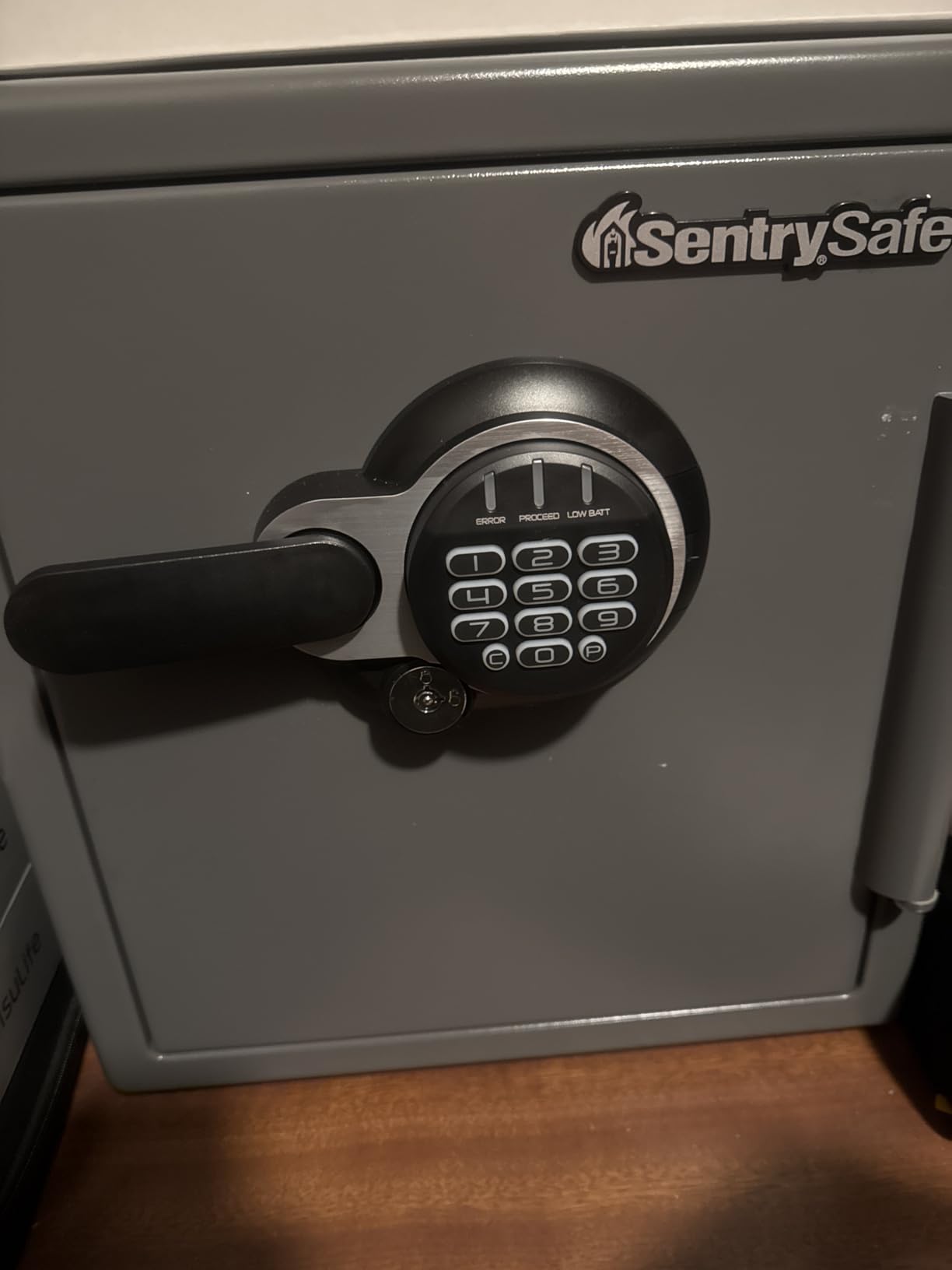
Capacity is 1.23 cubic feet with an interior of 12.6 inches wide, 11.9 deep and 13.8 high, and the exterior measures 16.3 by 19.3 by 17.8 inches. Four live-locking bolts and a pry-resistant hinge bar do the mechanical work here, which is why we would anchor this unit to a stud before it holds anything valuable.
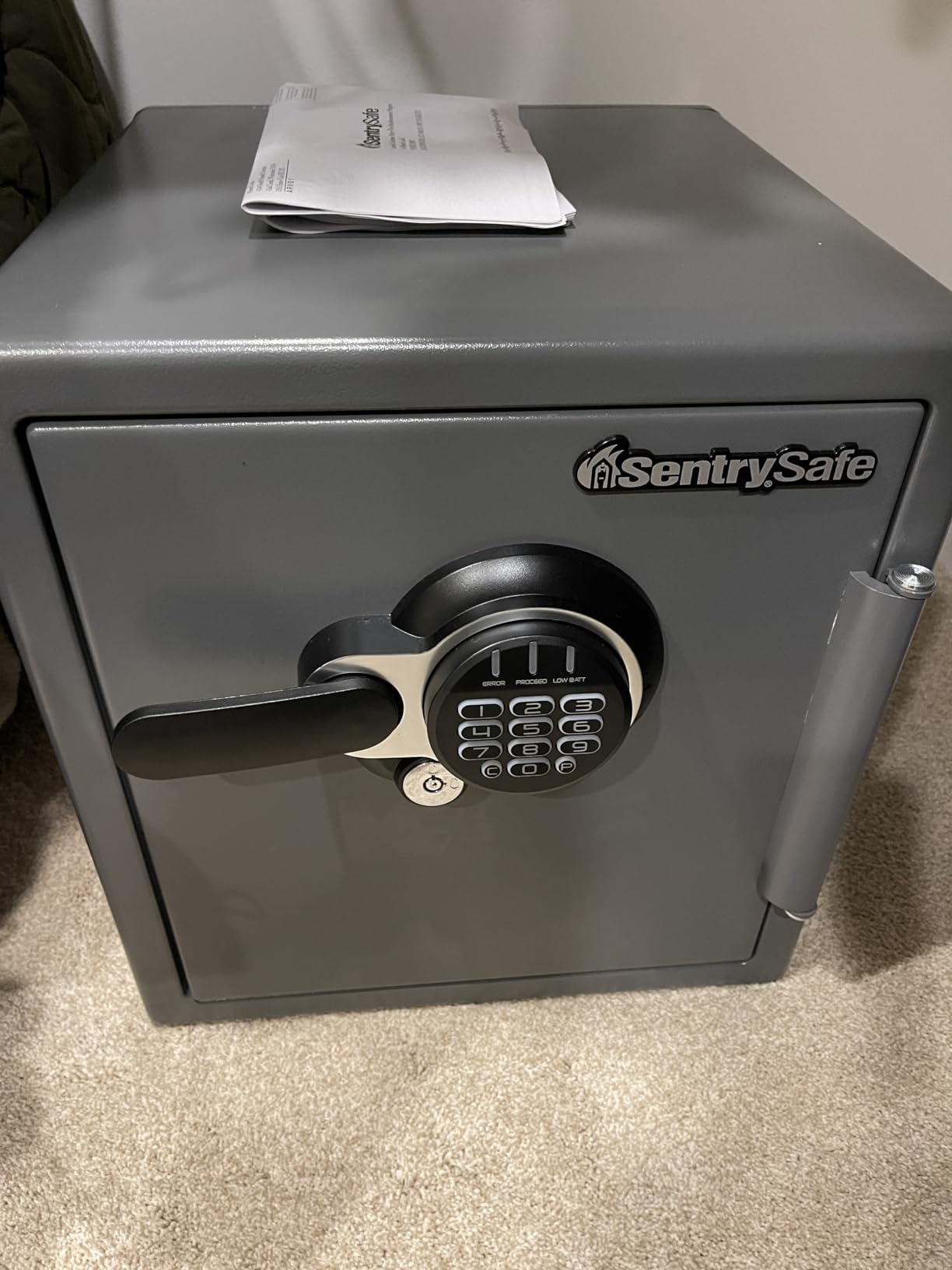
Reviewers consistently name the same three things: the certified protection, the heavy steel build, and the fact that it is genuinely hard to move. At 86.69 pounds with a listed item weight near 90 pounds, this is not a safe you slide into a bedroom closet on your own. Plan the delivery route and the floor placement before it arrives.
SentrySafe recommends four high quality alkaline AAA batteries with a long expiration date, and the manufacturer warranty is limited to one year. The digital keypad will lock you out after repeated mis-entry, so store the secondary key somewhere sensible rather than in your pocket.
Is one hour of fire protection worth the weight
For heirlooms, gemstones and anything you would be devastated to lose, yes. A half hour at 1550F is a shorter window, and household fires frequently peak well past that. The trade is straightforward: you gain a genuine hour of certified protection and lose the ability to move this box by yourself. If your collection lives in a ground floor closet near a slab, the weight stops being a problem.
What the certification does not cover
A fire rating tells you nothing about burglary resistance, and this model has no independent forced-entry listing. A determined attacker with a pry bar and fifteen minutes is a different threat from a house fire. The bolts, the heavy gauge and the mounting points are what carry the load here, which is exactly why we would anchor this unit before it holds anything valuable.
3. KYODOLED Fireproof Document Box – the cheapest way to separate papers from a fire
Pros
- Fire-resistant insulation with double cold-rolled steel walls
- Only 5 pounds so it moves between rooms easily
- Key lock with two keys keeps contents away from children
- Powder-coated scratch-resistant finish
- Carry handle suits travel and hotel rooms
Cons
- Fire resistance is not independently UL tested
- Only 3.58 inches tall so bulky pieces will not fit
- Listing claims of water resistance are disputed by owners
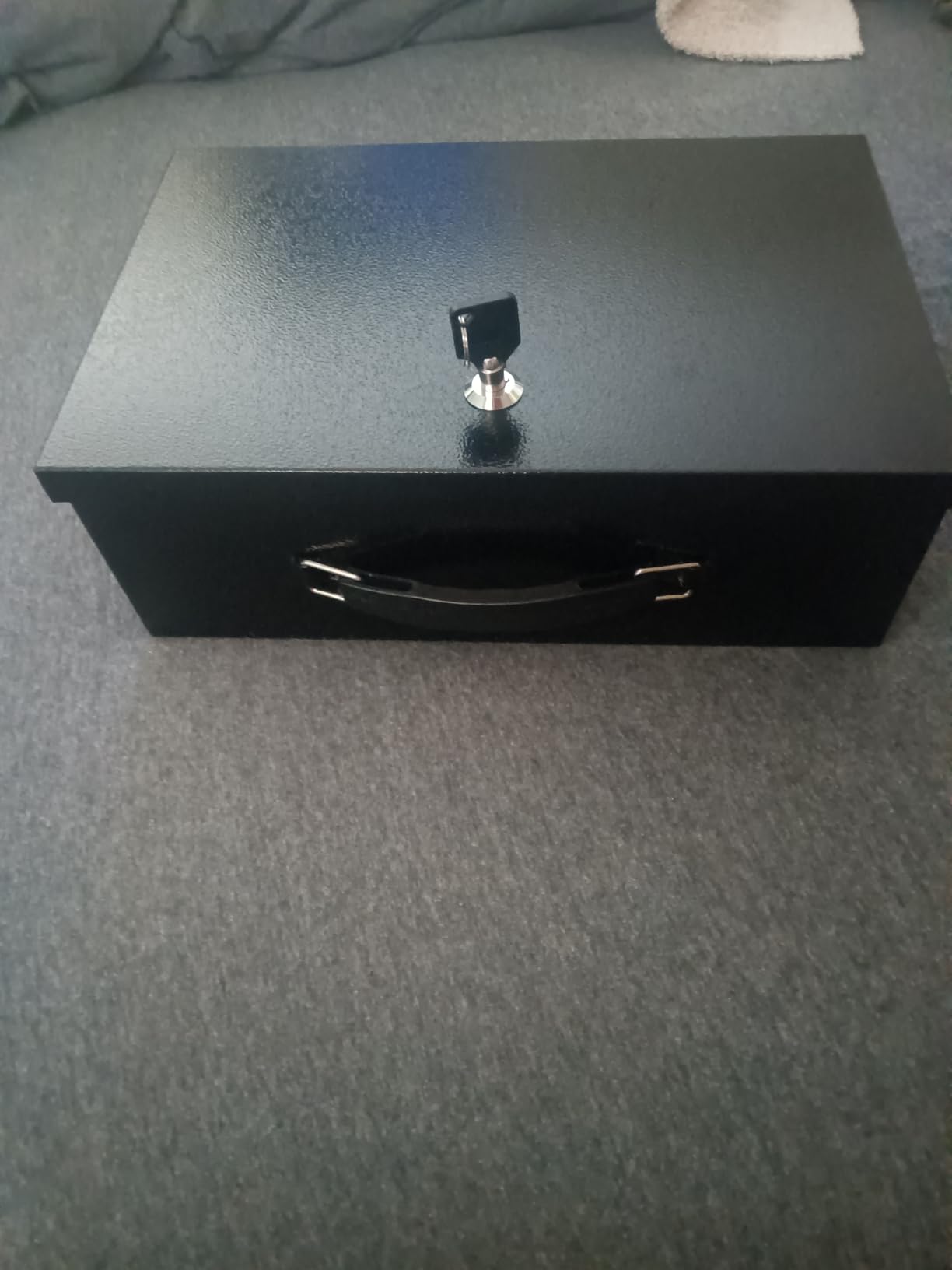
Owners rate this box at 4.6 across roughly 3500 reviews, and the reason is simple: it is cheap, light and it fits in a drawer. Inside dimensions of 11.6 by 7.3 by 3.1 inches are enough for passports, a birth certificate, a deed and a handful of small pieces. It is not enough for a set of bangles.
The construction is double cold-rolled steel on all sides with fire-resistant insulation packed between the layers, and the privacy key lock keeps curious hands out of a child’s reach. At 5 pounds with a plastic carry handle, it is the one safe here we would actually put in a suitcase.
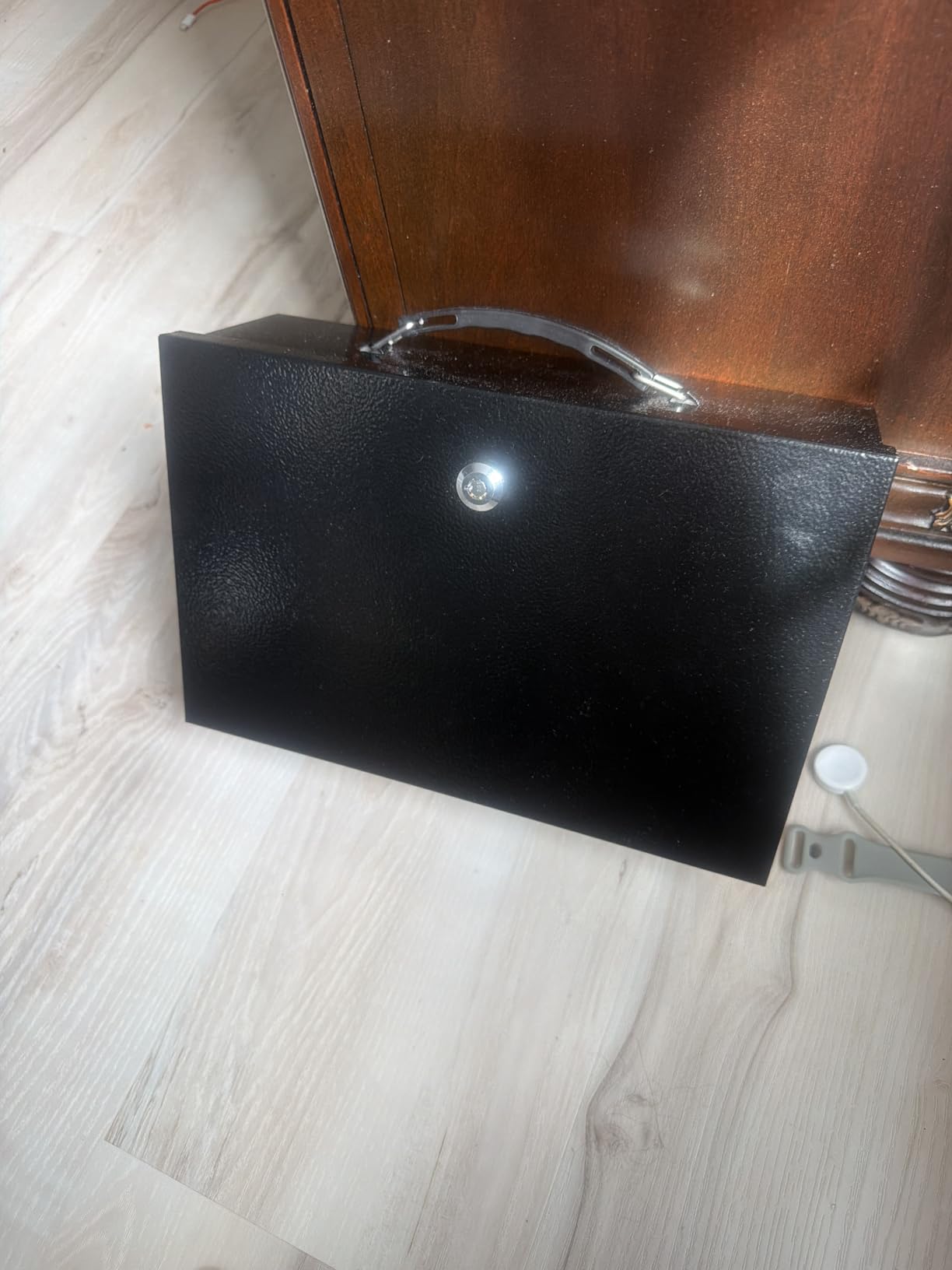
Here is the caveat that matters. This box carries no independent UL or ETL fire listing, and owners report that the water resistance claimed in some listings is not delivered. It protects against heat and a short spill. It does not protect against a genuine house fire on the same terms as the SentrySafe chest further down this list.
Use it the way most people do: as the low-cost second layer for documents you would be embarrassed to lose, and as a travel case for high-value pieces when you leave the house. Those are two jobs it does well.
Where this box beats the certified chests
Size and portability. The certified half hour SentrySafe chest is four times heavier and costs several times more, and neither of those qualities helps you when the goal is a small travel case or a discreet drawer box. If you are buying your first safe and your concern is fire rather than theft, this is the least painful place to start.
Where the savings cost you
Security. There is no bolt work to speak of, no mounting hardware and no independent fire rating. A thief who finds this box in a sock drawer has found a locked case, not a safe. Anchor points would have to be improvised, and the shallow 3.58 inch exterior height rules out most jewelry boxes entirely.
4. SentrySafe CHW30220 – certified fire and water protection in a chest format
SentrySafe Fireproof and Waterproof Document Safe with Key Lock, Lock Box for Cash, Passport, Jewelry, Exterior: 16.5 in W x 14.8 in D x 7.6 in H, Black, 0.36 Cubic Feet, CHW30220
0.36 cu ft
Half hour at 1550F
ETL 72 hour
24 lb
Pros
- UL Classified for half an hour at 1550F
- ETL Verified for 72 hours of water submersion
- Tubular lid lock stops the lid opening in a fire
- Straps inside hold A4 paper flat
- 24 pounds is still a one-person move
Cons
- Half hour rating is shorter than a one hour model
- Only 5.4 inches of interior height
- Key lock means a spare key must live somewhere secure
This is the format most people picture when they say jewelry safe: a grey and black chest with a lid, sized for a filing folder. Interior space is 12.6 inches wide, 9.2 deep and 5.4 high, which fits A4 paper flat with the included organising straps, and leaves room for cash, passports and a modest amount of jewelry laid flat.
The certification is the reason it sits this high in the list. It is UL Classified for half an hour at 1550F and ETL Verified for 72 hours of water submersion, and the tubular key lock on the lid is designed to stop the lid popping open when the metal expands in heat. Two keys come with it and the manufacturer warranty is limited to one year.
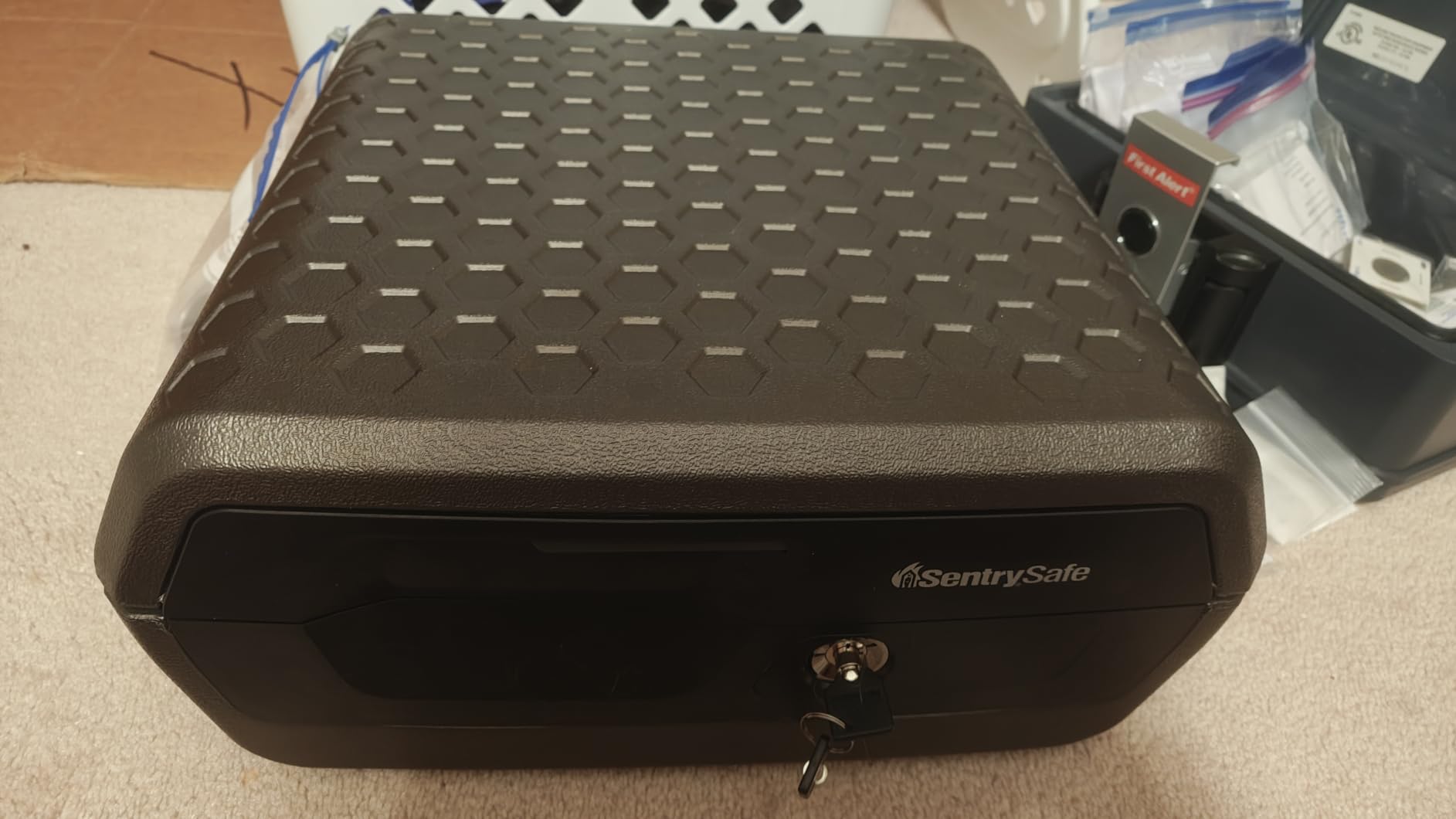
At 24 pounds it is genuinely portable, which is unusual for a certified unit. You can move it between the bedroom closet and the hall cupboard yourself, and a safe you can reposition is a safe you are more likely to actually use rather than forget about in a garage.
The honest weakness is the half hour rating. That is a real certification at a real temperature, but it is half the window of the SentrySafe SFW123GDC. For documents and everyday jewelry it is more than enough. For a graded stone heirloom, buy the longer rating.
Choosing between the two SentrySafe chests
Decide by what you are storing. Records, cash, spare keys and pieces you wear weekly fit the CHW30220 with room to spare. Fragile or high-value heirlooms deserve the hour-long listing and the heavier body of the SFW123GDC. You are not choosing between good and bad options here, you are choosing between a document chest and a fire chest.
The key-management problem
A key lock is simple, silent and immune to dead batteries, which is why so many owners keep one. It also means a spare key exists somewhere in your house, and that somewhere needs to be the actual safe or a bank, not the drawer next to it. The interior height of 5.4 inches also rules out most neck display stands and watch winders.
5. SentrySafe 1210 Fire Chest – the certified safe you can actually carry
SentrySafe Fireproof Safe with Key Lock, Chest Lock Box for Home or Travel Secures Money, Documents, 0.18 Cubic Feet, 6.1 x 14.3 x 11.2 Inches, 1210
0.18 cu ft
Half hour at 1550F
13 lb
Handle
Pros
- UL Classified for half an hour at 1550F
- ETL Verified for CDs DVDs and USB drives
- Only 13 pounds with a built-in carry handle
- Bolt down hardware kit included
- Sells as the best seller in its cabinet safe category
Cons
- Interior is tight at 12 by 7.5 by 3.5 inches
- Plastic-heavy construction by owner reports
- Average lock and handle design
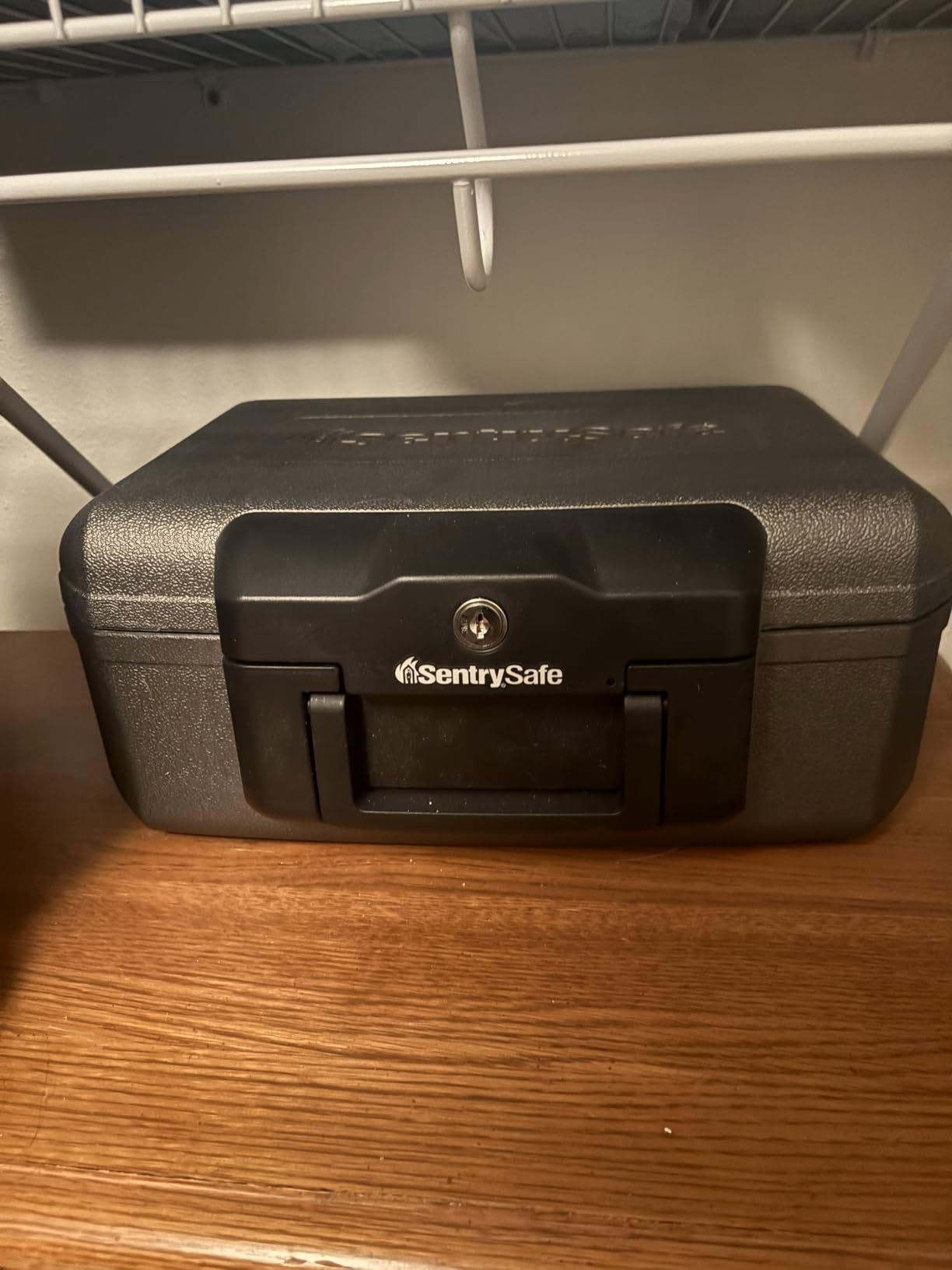
At 13 pounds with a built-in carry handle, this is the only certified fire safe in the roundup you can take down a flight of stairs by yourself. Owners rate it 4.6 across roughly 2900 ratings, and the ETL listing covers not just paper and jewelry but also CDs, DVDs and USB drives, which matters if your backups live in the same box.
Dimensions are 14.3 inches wide, 11.2 deep and 6.1 high on the outside, with an interior of 12 by 7.5 by 3.5 inches. The flat key lock on the lid is there for the same thermal reason as the other SentrySafe chest: it stops the lid lifting when the case expands in a fire. Two keys are included.
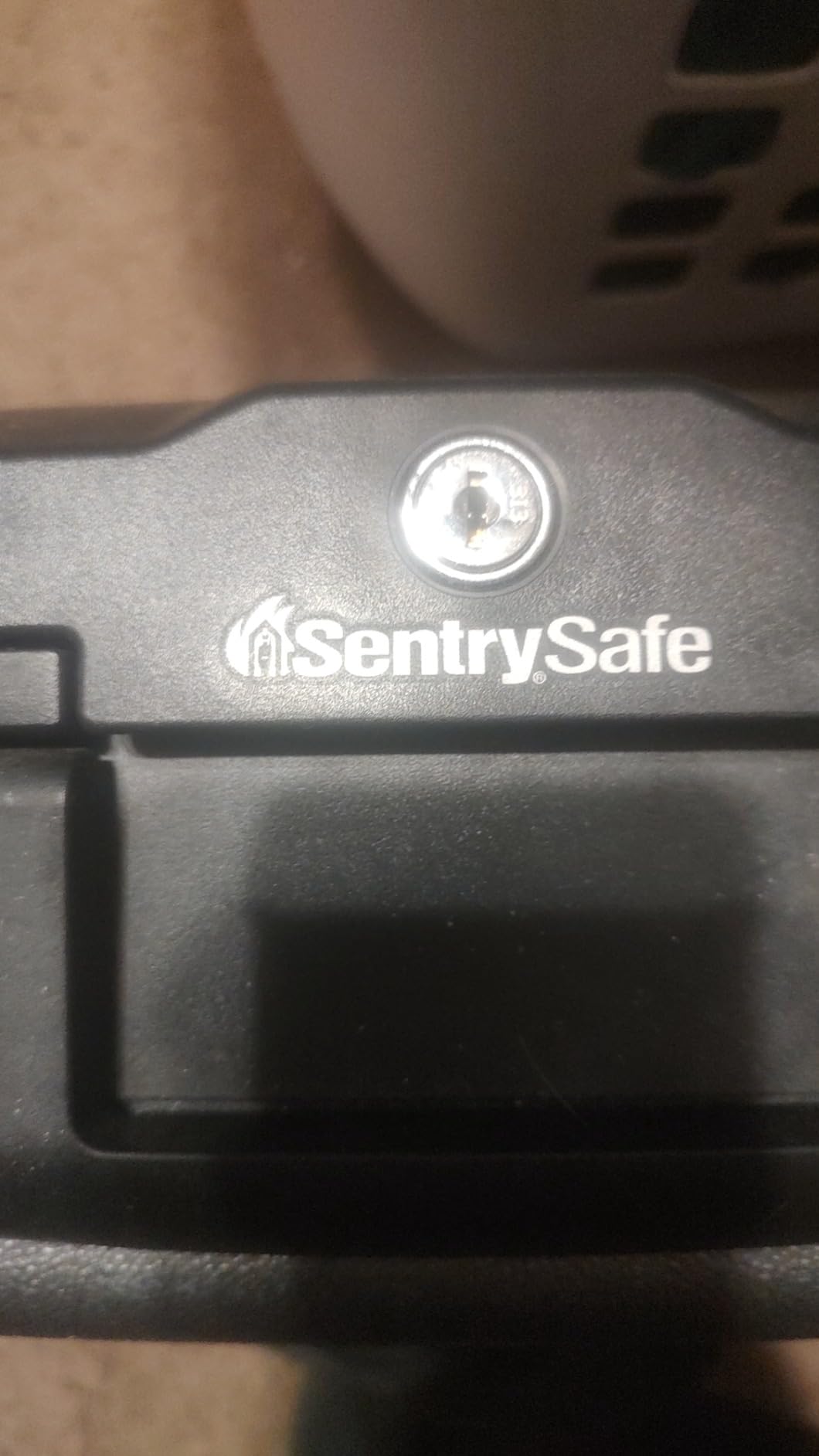
The honest criticism from owners is that a lot of the shell is plastic, and that the lock and handle feel like an afterthought. Neither criticism matters much if you are using this as a travel or document case. They matter more if you plan to bolt it to a wall and call it a security safe, which it is not.
A bolt-down hardware kit is included in the box, so anchoring is possible. The listed mounting type is floor mount. Given the weight, the more useful move is to place it somewhere out of casual sight rather than fix it to the structure.
Where a 13-pound certified safe genuinely wins
Travel, hotel rooms and college dorms. A burglary-resistant safe is useless if it never leaves the house, and this is the pick that travels. It is also a good bedside box for the ring and watch you actually wear, since the certified half hour protects against the drawer-level heat of a small fire far better than an uncertified metal box.
When to spend the extra money instead
When the collection is worth more than the cost of a better safe. The interior of 12 by 7.5 by 3.5 inches is tight enough that owners describe it as snug, there is no bolt work, and the material mix means a determined pry bar wins quickly. For a primary home safe for a real collection, look at the Amazon Basics or the TIGERKING for capacity and hardware, or the SentrySafe SFW123GDC for fire certification.
6. Voncabay Digital Mini Safe – the best interior light at the smallest weight
Voncabay Money Safe Box for Home with Digital Keypad, 0.23 Cu. Ft., Black
0.23 cu ft
Sensor light
Alloy steel
5 lb
Pros
- Sensor light switches on when the door opens and times out after 30 seconds
- Keypad shows low battery and password correction indicators
- Two enhanced bolts and concealed hinges
- Fireproof and waterproof document bag included
- Lockout after three wrong codes
Cons
- Small 0.23 cubic foot interior limits jewelry boxes
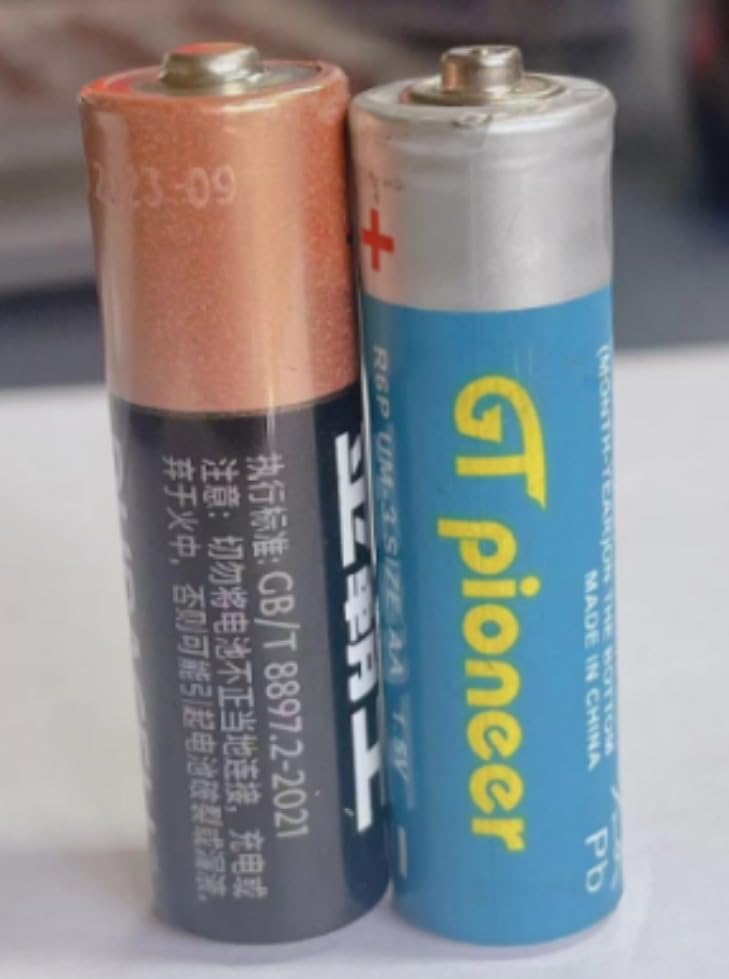
- Needs four AA batteries that are not included
- Fireproof claim in the listing is not an independent rating
Finding a ring at the back of a small box with a torch on your phone is genuinely irritating, and this is the pick that fixes it. The interior sensor light illuminates the moment the door opens and shuts off after 30 seconds, so you are not fumbling in the dark and you are not draining the keypad while you look.
Exterior dimensions are 9 by 6.6 by 6.5 inches with an interior of 8.6 by 6.2 by 6.1 inches, giving 0.23 cubic feet, and the whole thing weighs about 5 pounds. The shell is reinforced alloy steel with two enhanced bolts, concealed hinges and a tamper-proof door, and the package includes a fireproof and waterproof document bag that genuinely does add a layer of protection for papers.
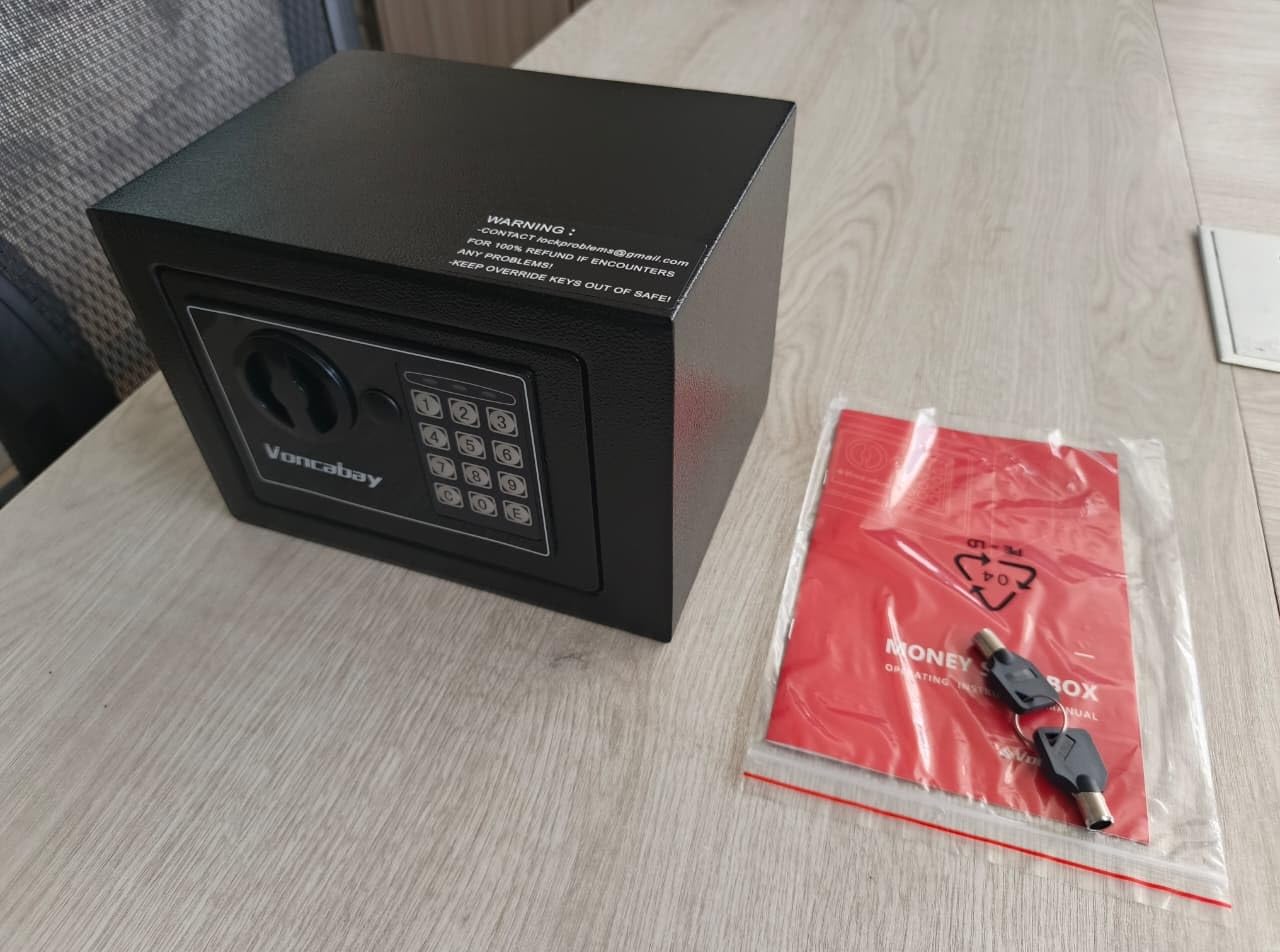
Setup is a password process using the override key and the reset button, and there are two ways in: the numeric keypad or the emergency backup key. After three incorrect passwords the keypad imposes a lockout, which is a sensible deterrent and a mild irritation if your fingers are cold.
Owners rate it 4.4 across roughly 3200 reviews. The recurring complaints are the small interior and the need to supply your own AA batteries. The fireproof claim in the listing is not backed by an independent rating, so treat the included bag as the real protection.
Sensor light versus a keypad light
A sensor light is better for a casual grab, because it needs no button press and no mental effort. A keypad light that stays on while the door is open is better for sorting a collection piece by piece. For a bedside or nightstand box holding the three pieces you wear most, the sensor wins clearly. For a home office safe you open weekly to count things, a keypad light is less irritating.
Where the 0.23 cubic feet bites
It fits a ring box or two, a watch and some cash. It does not fit a bracelet, a chunky pendant box, or a velvet tray of more than a dozen rings without stacking. Measure the actual boxes you plan to store before you buy, and if they are full size, step up to the 1.2 cubic foot Amazon Basics safe rather than forcing the fit.
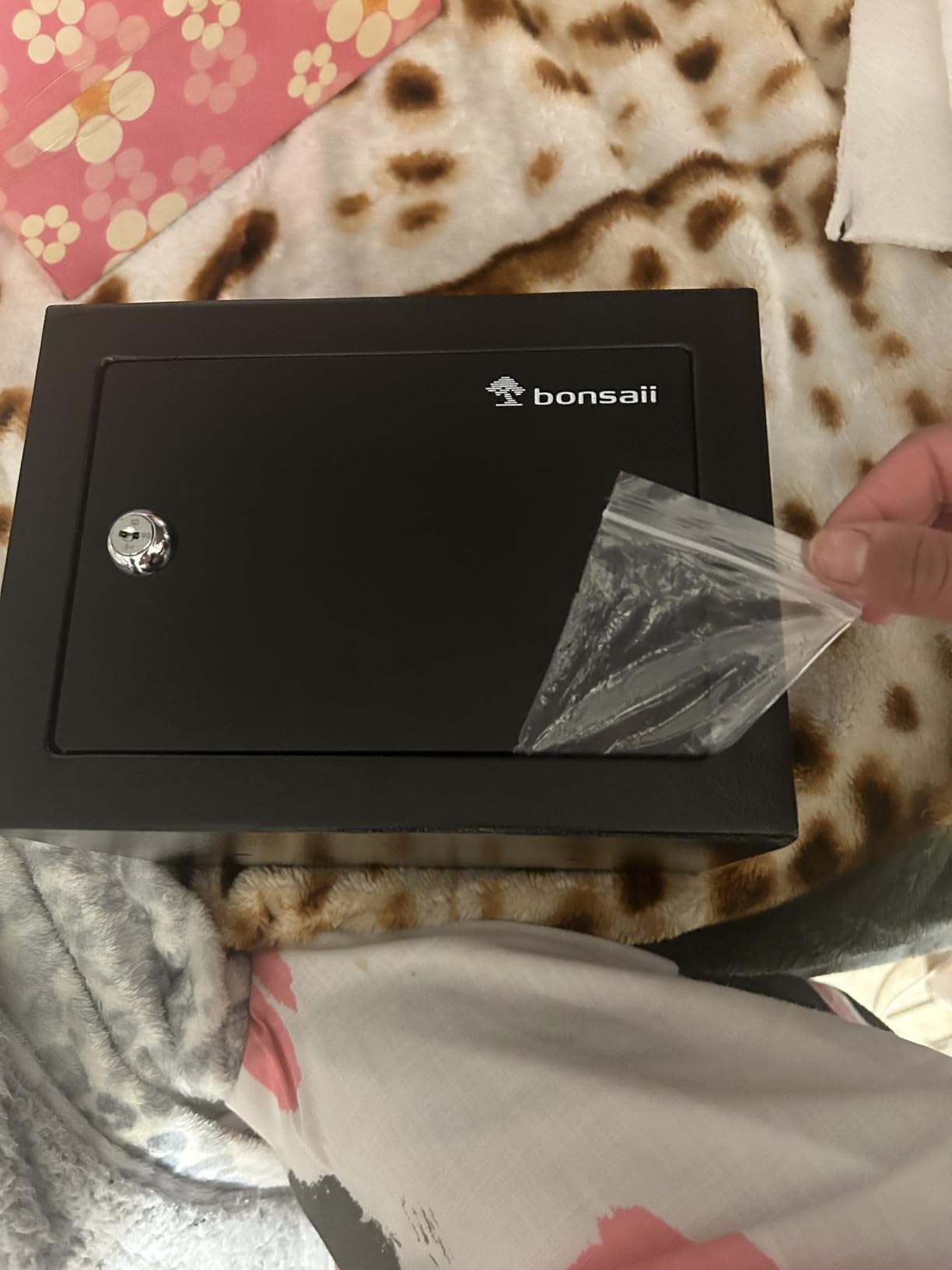
7. Bonsaii 0.23 Cubic Foot Lock Box – the smallest, lightest steel box here
Bonsaii Security Safe Box with Key Lock, 0.23 Cu.Ft for Cash Jewelry Home
0.23 cu ft
SPCC carbon steel
4.1 lb
Key
Pros
- SPCC carbon steel with a pry-resistant door and hidden hinges
- Only 4.1 pounds and easy to carry room to room
- Flat key lock with no electronics to configure
- Pre-drilled mounting holes on the back and bottom
- Package includes two keys and a floor mat
Cons
- Supplied keys are described as cheap and lightweight
- No fire rating and no water resistance
- Small 0.23 cubic foot interior
At 4.1 pounds this is the lightest steel safe we tested, and that changes what you can do with it. A closet shelf, a high kitchen cabinet, the top of a wardrobe, a drawer inside a dresser, a garden shed. Places where anything heavier would need two people or a furniture mover. Owners rate it 4.5 across roughly 1450 reviews.
The body is SPCC carbon steel with a pry-resistant door and hidden hinges, measuring 9.06 inches wide, 6.69 deep and 6.69 high with a 0.23 cubic foot interior of 8.98 by 6.46 by 6.61 inches. A floor mat is included, which is the difference between a ring that lands safely and a ring that lands on steel.
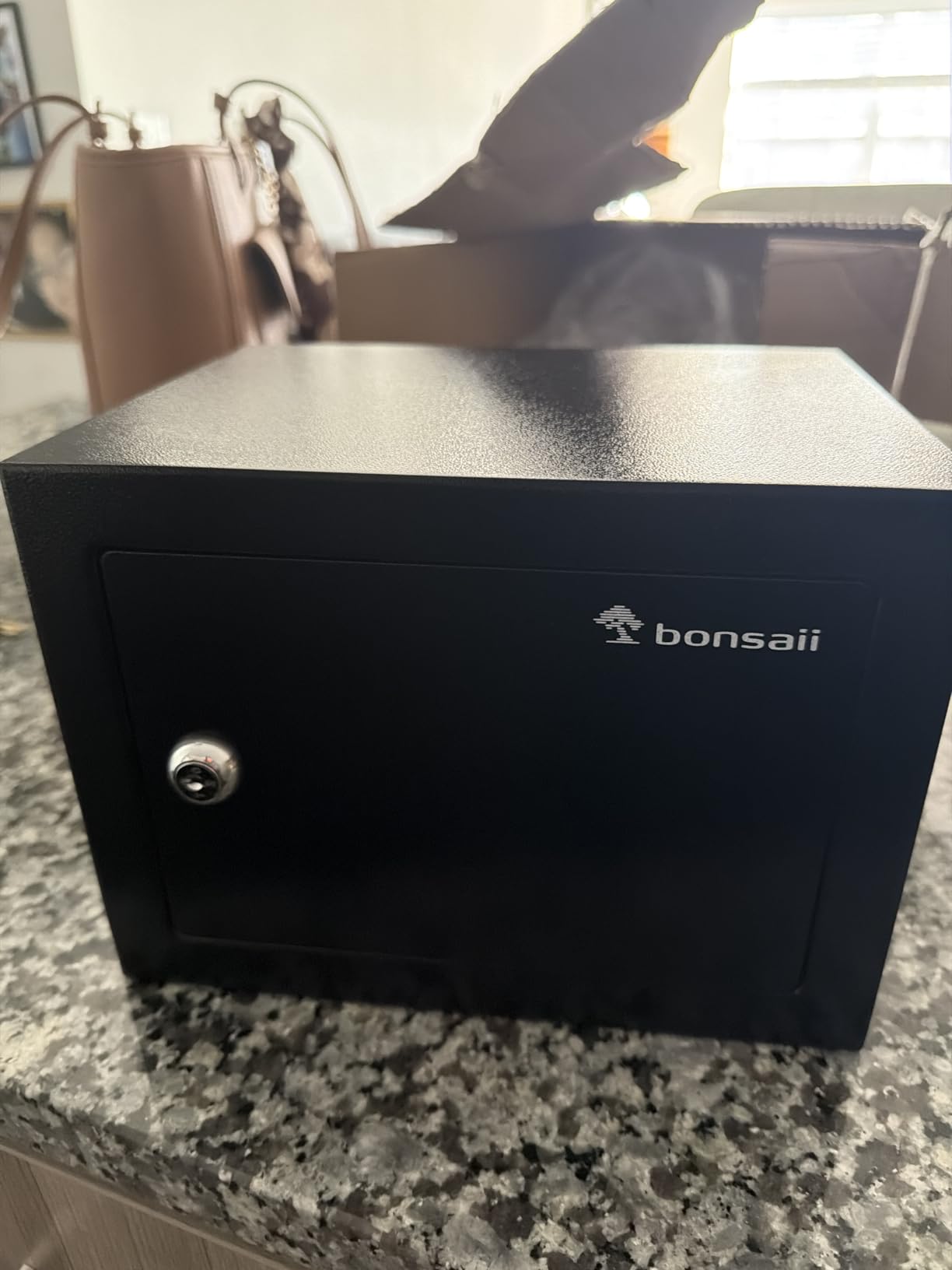
The back and bottom are pre-drilled so it can be fixed under a shelf, a table or inside a closet. The lock is a classic flat key lock, so there is nothing to configure and nothing to forget.
The single most common complaint across reviews is the quality of the supplied keys, which several owners describe as cheap and light. That is fixable: have a duplicate cut at a hardware store and store the second one away from the box.
Why weight is not the whole security picture
A 4.1-pound box bolted to a closet shelf is harder to remove than an 87-pound box sitting loose in the middle of a room, because the thief has to find it, open it and then deal with a fixing. Weight is a proxy for steel thickness. Anchoring is the thing that actually converts a lock box into a safe.
What you give up at this size
No fire rating at all, no water resistance, and an interior that will not take anything bulky. This is a concealment and access box rather than a protective safe, and it is best used as one layer in a two-safe plan: something like this near the bed for daily pieces and a certified chest elsewhere for the heirlooms.
8. Locksworth 0.6 Cubic Foot Digital Safe – a bedside safe with a real alarm
Pros
- Forged solid steel with seamless molding and a pry-resistant door
- Opens with a personal code or two supplied override keys
- Pre-drilled anchor points with two expansion screws
- Audible alarm warns of a forced door
Cons
- Listed capacity of 0.77 cubic feet contradicts the 0.6 in the title
- Audible alarm is unwanted in a bedroom
- Not fire rated
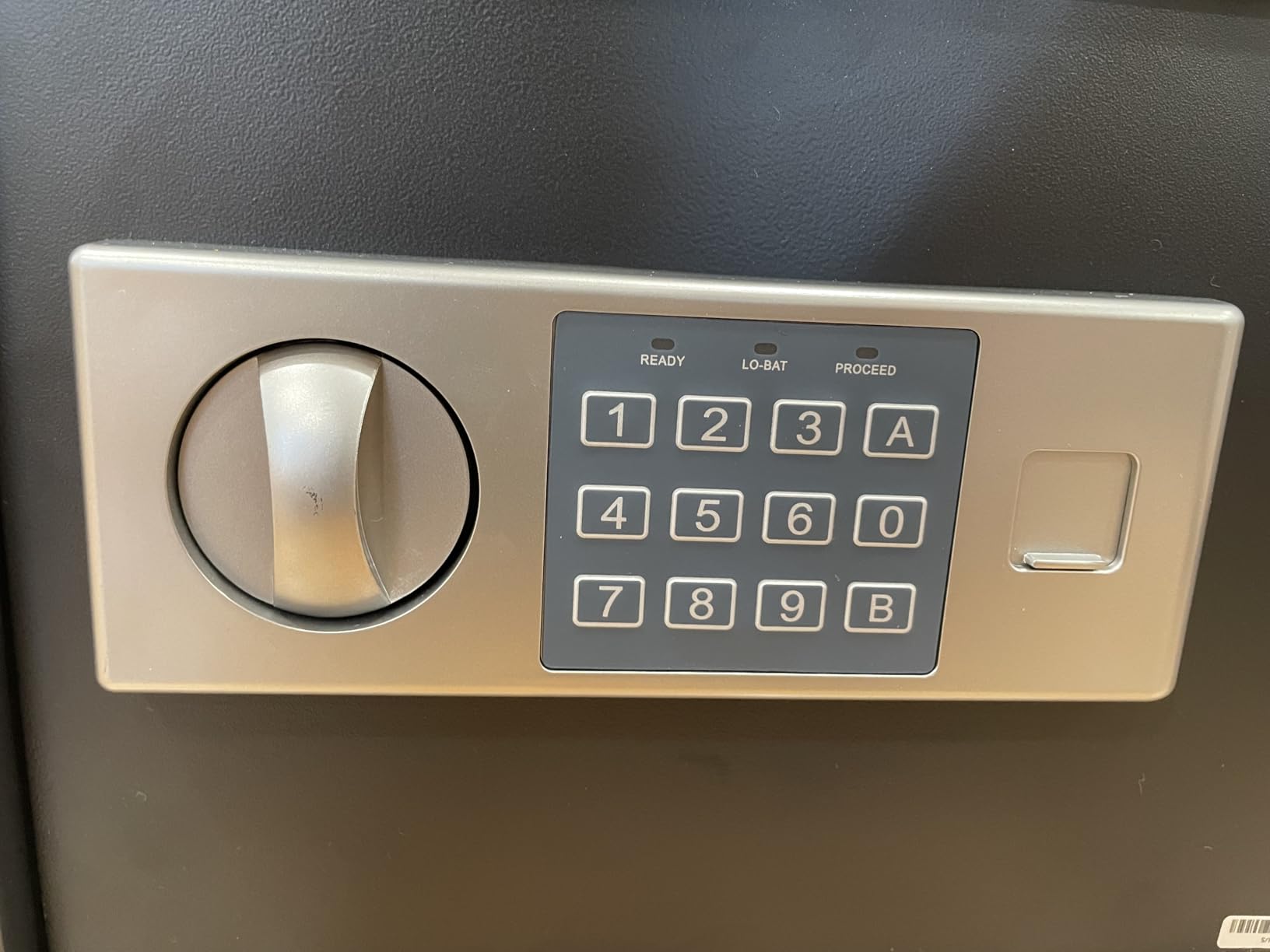
What separates this from the other small digital safes is the alarm. The Locksworth has an audible tamper alert that sounds when the door is forced, which on a nightstand buys you an audible warning that something is wrong rather than silent theft. Owners rate it 4.6 across roughly 1000 reviews, with about 80 percent giving five stars.
Capacity is 0.6 cubic feet as marketed, and the interior takes a snap-in shelf that creates two storage levels. Exterior dimensions are 13.78 inches wide, 9.85 deep and 9.85 high, weighing 14.1 pounds. The body is forged solid steel with seamless integral molding and a pry-resistant door.
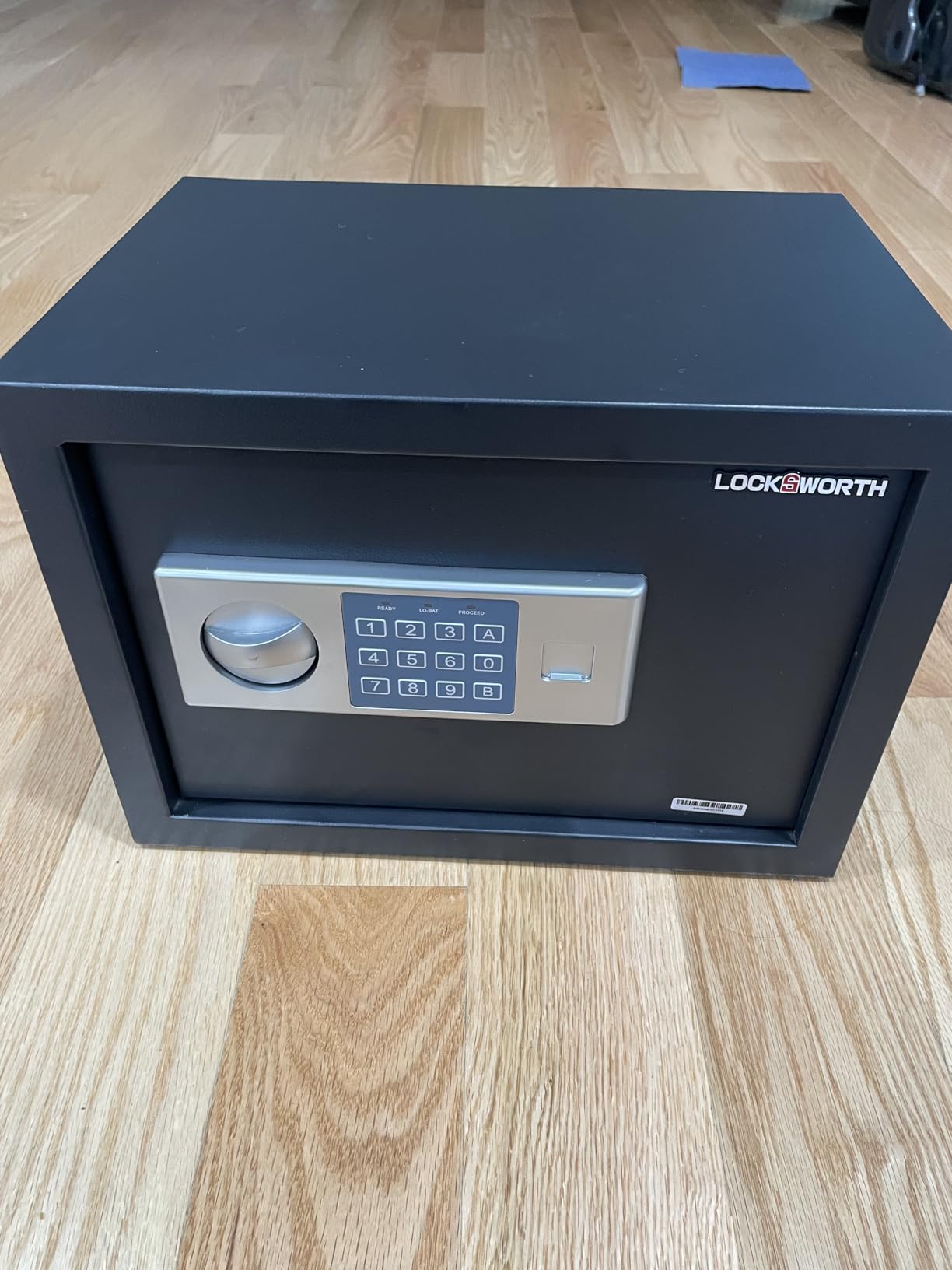
Access is a personal code plus two override keys, which means a flat battery is never a lockout. Check the battery compartment on arrival and fit fresh cells before you set your code, because a safe that is dead on delivery day is a bad first impression.
One detail to note before you buy: the listing gives 0.77 cubic feet in the technical section and 0.6 cubic feet in the product title. Owners flag the mismatch. We use the smaller figure here because that is the number the marketing carries.
Is an audible alarm a feature or an annoyance
In a bedroom it is a feature. A safe that sounds when it is being pried gives you time to react, and it is one of the few genuine tamper-detection options in this price class. In a home office or a guest room, or with a light sleeper in the house, the same alarm becomes the top complaint. Decide where the safe lives before you pick the lock type.
What the snap-in shelf actually gives you
Two practical gains. The felt floor in the listing stops a diamond ring from finding the steel door sill every time you open the safe, which is where the fine scratches start. The snap-in shelf doubles usable space and keeps a small box off the bottom, so a dropped safe does not end with earrings scattered in the lock bolts.
9. DAYI 2.0 Cubic Foot Safe – the most capacity per pound in the group
DAYI Safe Box, 2.0 Cu. Ft. Home Safes with Fireproof Bag for Valuables Docs
2.0 cu ft
Four 1.2 in bolts
33.1 lb
Alarm
Pros
- Four 1.2 inch live-locking bolts on a one-piece bent steel body
- Dual alert system sounds a 70 decibel alarm after three wrong codes
- Two removable shelves with built-in hooks and an LED sensor light
- Programmable 3-8 digit code with two physical backup keys and an external battery box
Cons
- Not fireproof on its own and the included bag is what protects documents
- Wall anchor spacing may not line up with standard studs
- 33 pounds is still light enough to carry off if unanchored
If your problem is volume rather than value per pound, this is the pick. Two cubic feet of alloy steel at 33.1 pounds gives you far more usable room than the 1.2 cubic foot boxes here, which matters when you are storing a dozen small boxes rather than three pieces you wear daily.
Mechanically it is the most serious small safe here: one-piece bending and precision laser cutting, a pry-resistant door and four 1.2 inch live-locking bolts. That is twice the bolt count of most of the budget boxes in this roundup. Access is a programmable 3- to 8-digit code with two physical backup keys and an external battery box, and the warranty runs two years rather than one.
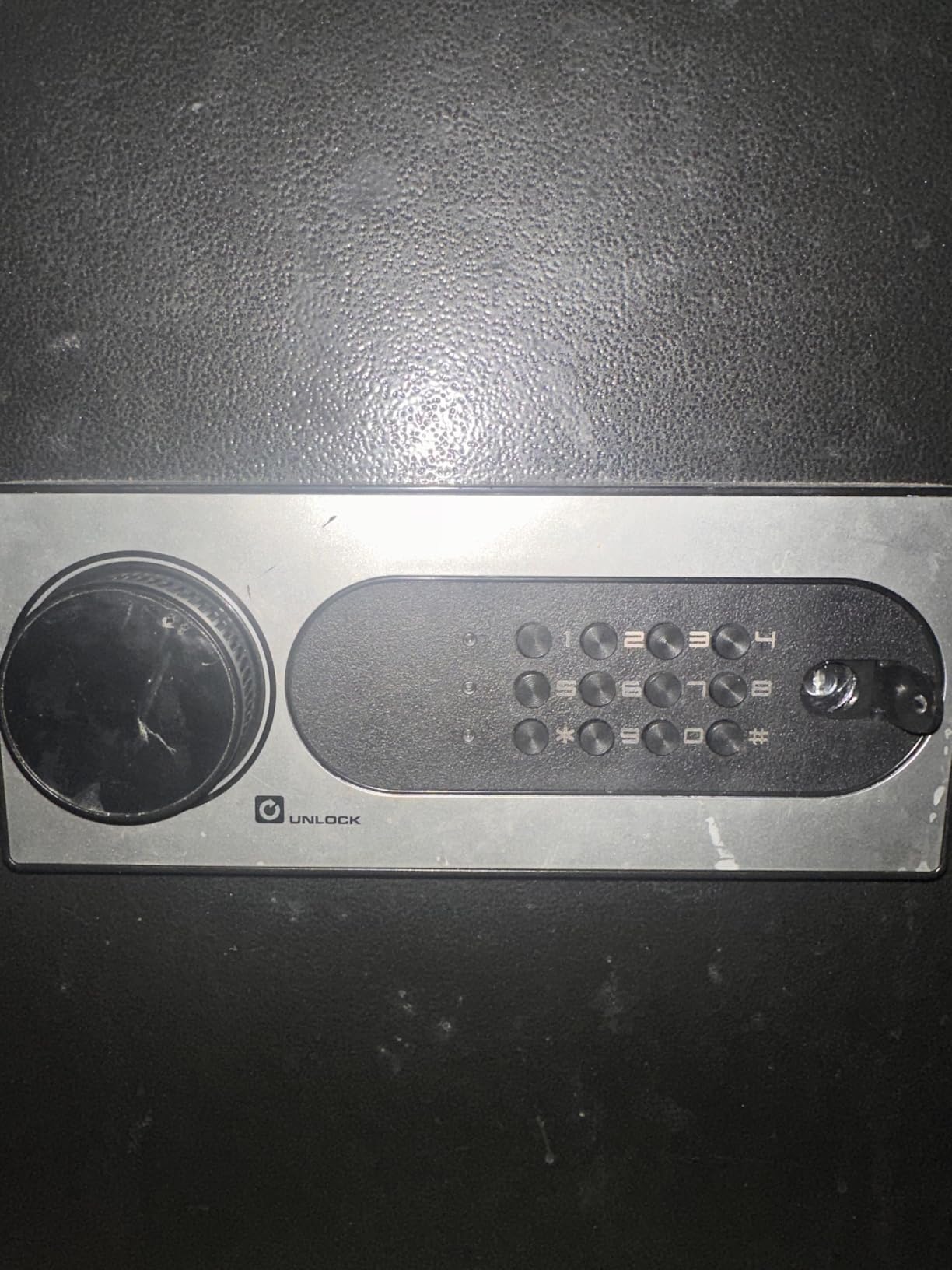
The dual alert system sounds a 70 decibel alarm after three incorrect codes or a forced breach, and the interior carries two removable shelves, built-in hooks, an LED sensor light and a carpeted floor. A four-layer fireproof and waterproof document bag is included, which is what actually protects papers rather than the safe body itself.
Owners report two recurring issues. The wall anchor spacing does not always line up with standard stud positions, so you may need to improvise a fixing. Some also report shallow shelf brackets that flex under weight, which is a reason to keep the heaviest boxes on the safe floor.
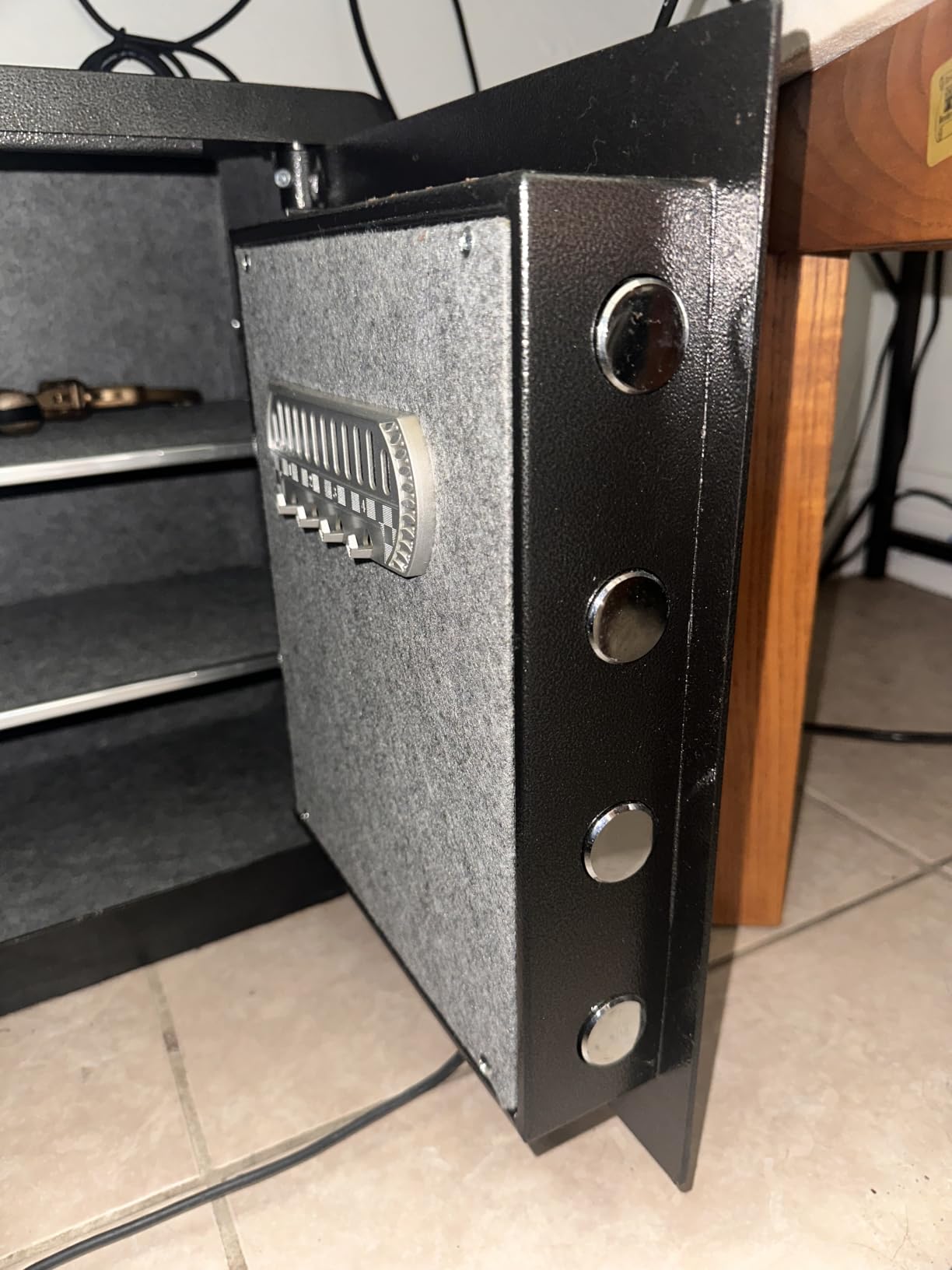
What two cubic feet actually holds
Roughly twenty small jewelry boxes, a set of serving trays with dividers, or a mix of documents and a modest collection with room to spare. The two removable shelves mean the vertical space is usable rather than theoretical, and the built-in hooks are useful for chains that would tangle in a tray. Interior dimensions are 14.8 inches wide, 11.85 deep and 17.6 high.
The fire question on this model
This safe is not fireproof, and the four-layer bag in the box is what handles heat. Owners are direct about this, and it is the single most important thing to know before putting a set of heirloom documents inside. If fire protection is a requirement rather than a nice-to-have, the SentrySafe SFW123GDC is the correct pick and the DAYI is the correct pick only if you add your own certified document case.
10. TIGERKING Biometric Safe – fingerprint access on a solid 20-pound body
TIGERKING Biometric Small Home Safe with key and digital keypad
Biometric, code and key
20 lb
32 prints
Pros
- Three access methods: fingerprint
- 3-8 digit code and emergency key
- Stores up to 32 fingerprints for multiple users
- 20 pound alloy steel body with 50 mm door and two 25 mm bolts
- Pre-drilled holes with four expansion bolts for wall or floor mounting
- Red low battery indicator and lifetime technical support
Cons
- Not water resistant and not fire rated
- Letter and A4 papers must be folded and do not lay flat
- Interior is tight for jewelry trays so measure first
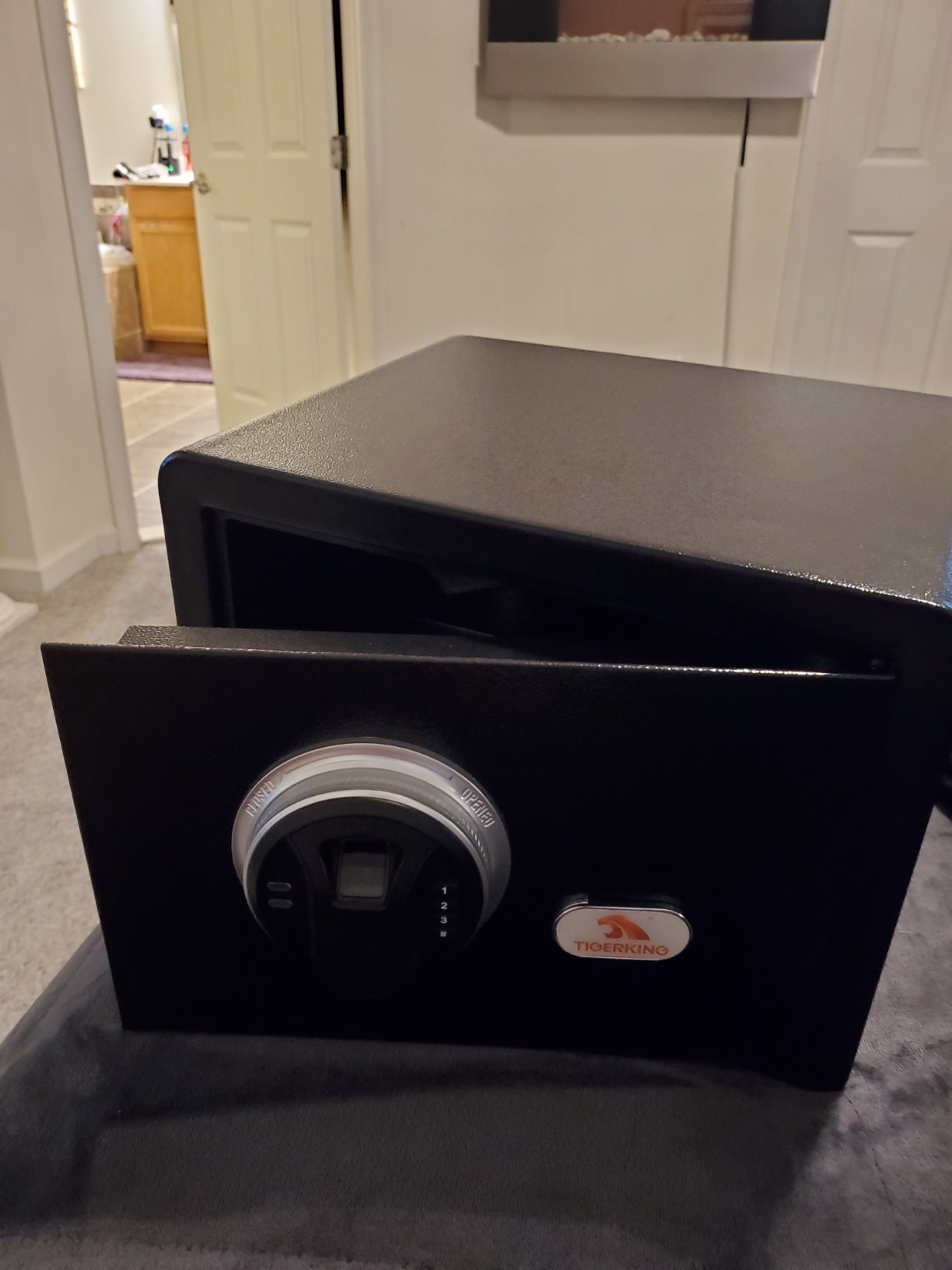
This is the biometric answer in the roundup, and it comes with the caveat that biometrics deserve. The TIGERKING accepts up to 32 registered fingerprints, a 3- to 8-digit code, or an emergency key, which means a scanner that refuses to read a damp finger is an inconvenience rather than a failure. That three-path design is the correct approach to fingerprint locks in a bedroom where hands are cold at 6am.
The body is 20 pounds of alloy steel with a 50 mm door and two 25 mm locking bolts, exterior 13.8 inches wide, 9.9 deep and 9.9 high, interior 11.4 wide, 7.5 deep and 7.5 high. An adjustable removable shelf comes with it, and the back and bottom are pre-drilled with four expansion bolts included for floor or wall mounting.
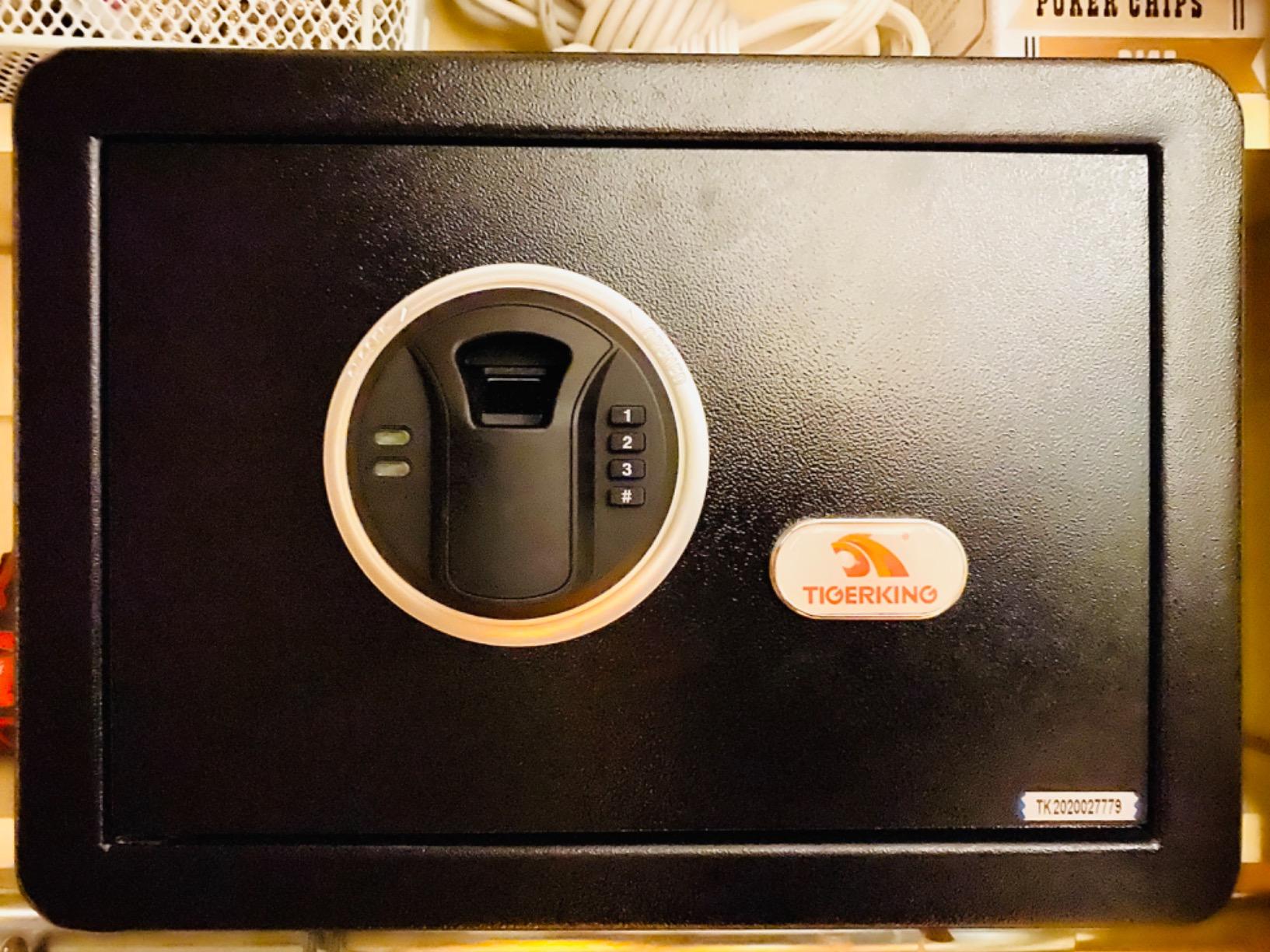
A red low battery indicator stops the common complaint of discovering a dead scanner at the worst moment. Warranty is one year with lifetime technical support, which matters because biometric lock electronics are the part most likely to fail and the part hardest to replace.
The interior is the practical issue. At 7.5 inches of interior depth, letter and A4 paper has to be folded, and owners warn that jewelry trays and small boxes need measuring in advance. Not water resistant and not fire rated, so treat this as a theft deterrent with excellent convenience rather than a protective safe.
Are fingerprint locks actually more secure
Not inherently. A fingerprint reader is an access convenience, not a stronger barrier than a good mechanical dial, and it introduces a new failure mode that a mechanical lock does not have. What it genuinely buys is speed and repeatability, which is why it works well in a bedroom safe you open twice a day. For a safe you open once a year, a dial is more dependable.
How to set it up so it stops misreading
Register two fingers per hand rather than one, and register a finger from each hand so you are not locked out by a cut, a manicure or a plaster. Wipe the sensor with a dry cloth when it hesitates. Most reported scanner problems come from a dirty or slightly damp fingertip, and the fix takes two seconds. Keep the emergency key somewhere other than the nightstand drawer.
11. Aprxuvot 1.3 Cubic Foot Digital Safe – quiet opening, weakest certification story
Pros
- Compact 1.3 cubic foot size fits in drawers
- cabinets
- wardrobes or bedside tables
- Three 25 mm live bolts with concealed hinges and a recessed pry-resistant door
- Removable shelf and a built in LED interior light
- Two unlocking ways: digital code and spare keys with external battery case
Cons
- Despite the title
- owners report it is not actually fireproof or waterproof
- Some units report door jamming
- scraping and a low grip handle
- 13 percent one-star ratings
- the highest complaint rate in this group
We are including this one because the quiet opening mode is a genuinely useful idea that almost no competitor offers. The smart alert can be muted for normal opening, which means you can use the safe in a bedroom, a home office or a shared wall without announcing every visit to the rest of the house. Three wrong codes still trigger a lockout.
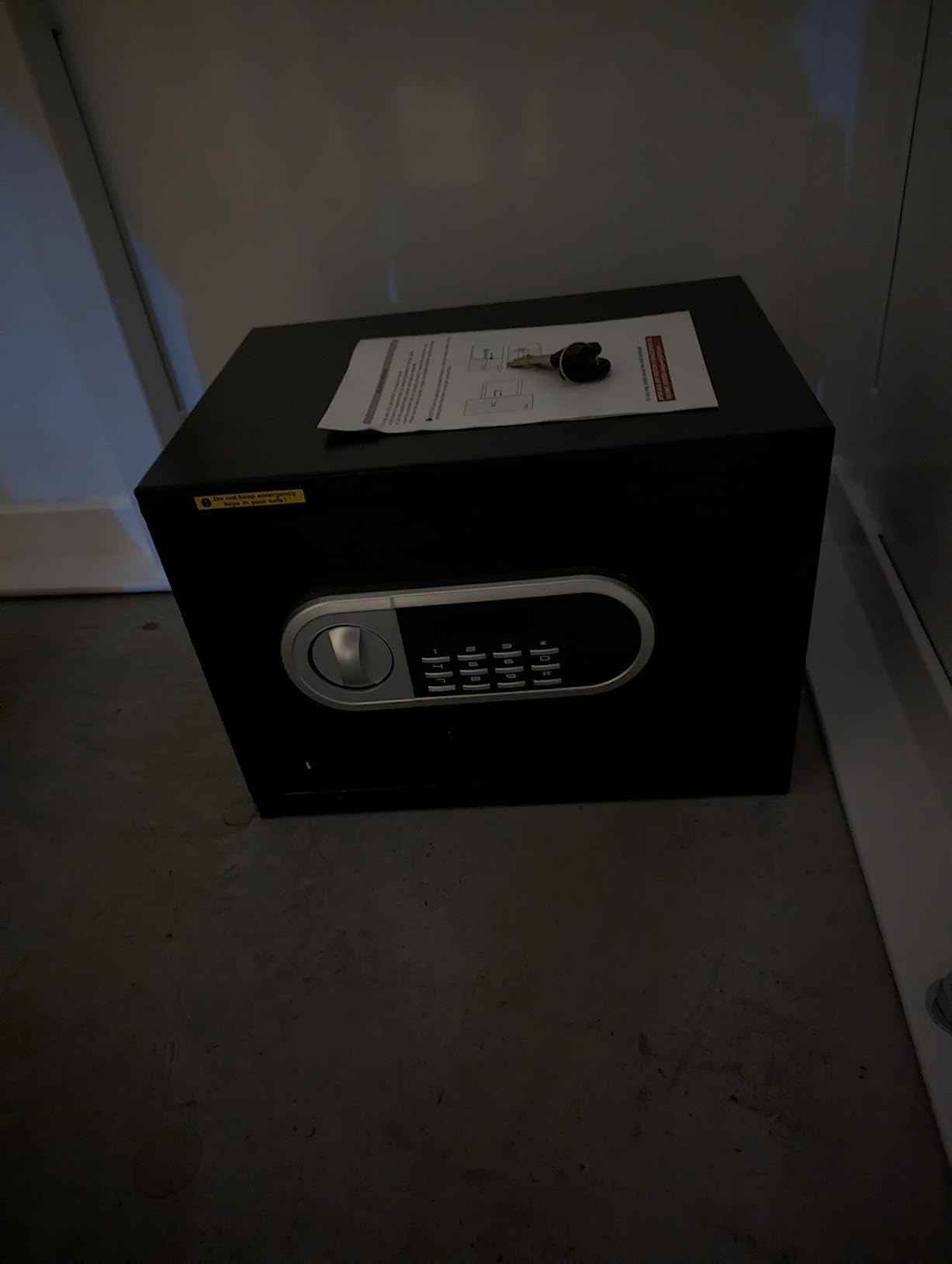
Capacity is 1.3 cubic feet in a footprint of 13.78 by 9.84 by 9.84 inches at 14 pounds, with a solid steel body, three 25 mm live lock bolts and thick pry-resistant concealed hinges. Two holes at the back and bottom with four included anchor screws handle the fixing, and a removable shelf plus a built-in LED light handle the interior.
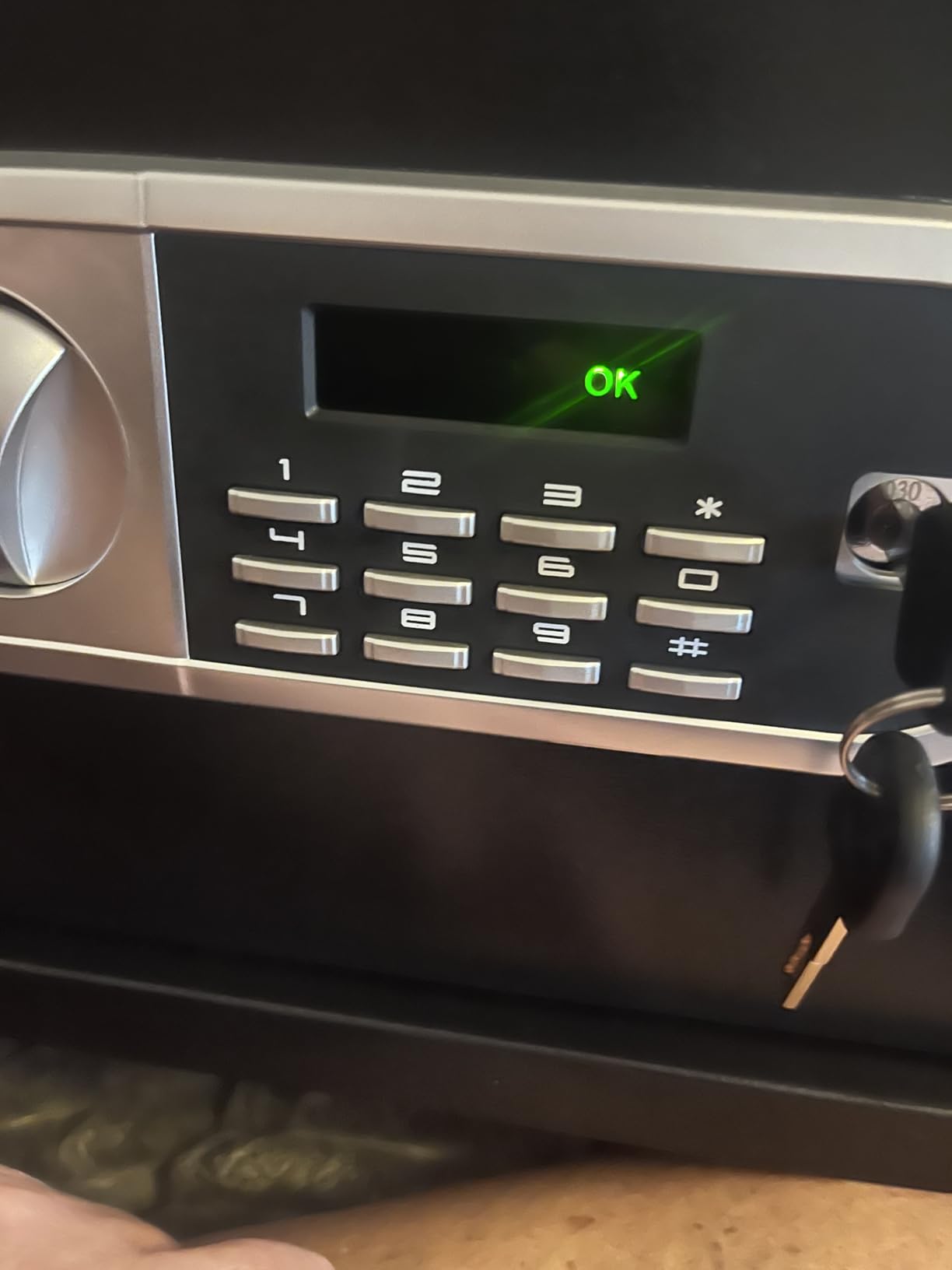
Now the part you need before buying. The product title claims fire and water proof, and owners report that those claims are not met. At 4.1 stars across roughly 715 ratings, with 13 percent one-star reviews, this is the weakest-rated model in the roundup, and the complaints cluster around door jamming, a scraping door and a handle with little grip, plus at least one report of a unit that would not open after following the setup steps.
Treat the fire and water language in the title as marketing rather than specification. There is no independent listing behind it.
Who should still consider it
Someone who wants a compact, anchorable box that disappears into a drawer, a wardrobe or a bedside cabinet, and who cares more about convenience than certification. The 1.3 cubic foot interior is roomy for the class, the LED is bright, and the removable shelf means it works for both flat files and small boxes. If the collection inside is genuinely replaceable, the specification gap matters much less.
Why we ranked it eleventh
Two reasons, both factual. It is the only safe here whose title makes a protective claim that owners say is false, and it carries the highest one-star rate in the group at 13 percent. A jamming door on a safe you rely on daily is a real problem, not a rounding error. Every other pick here has at least a genuine certification or a review record that supports the claims made for it.
12. Psisuvry 1.2 Cubic Foot Digital Safe – the tidiest lockout behaviour at this size
Pros
- Compact 1.2 cubic foot size fits in drawers
- cabinets
- wardrobes or nightstands
- Three live steel lock bolts with thick pry-resistant concealed hinges and a recessed door
- Programmable 3-8 digit PIN with hidden emergency key backup
- Anti theft alarm with a 20 second lockout after three wrong codes
- Anchoring design with wall or floor mounting hardware
Cons
- Fire resistance is a marketing claim rather than a certified rating
- No water resistance specification
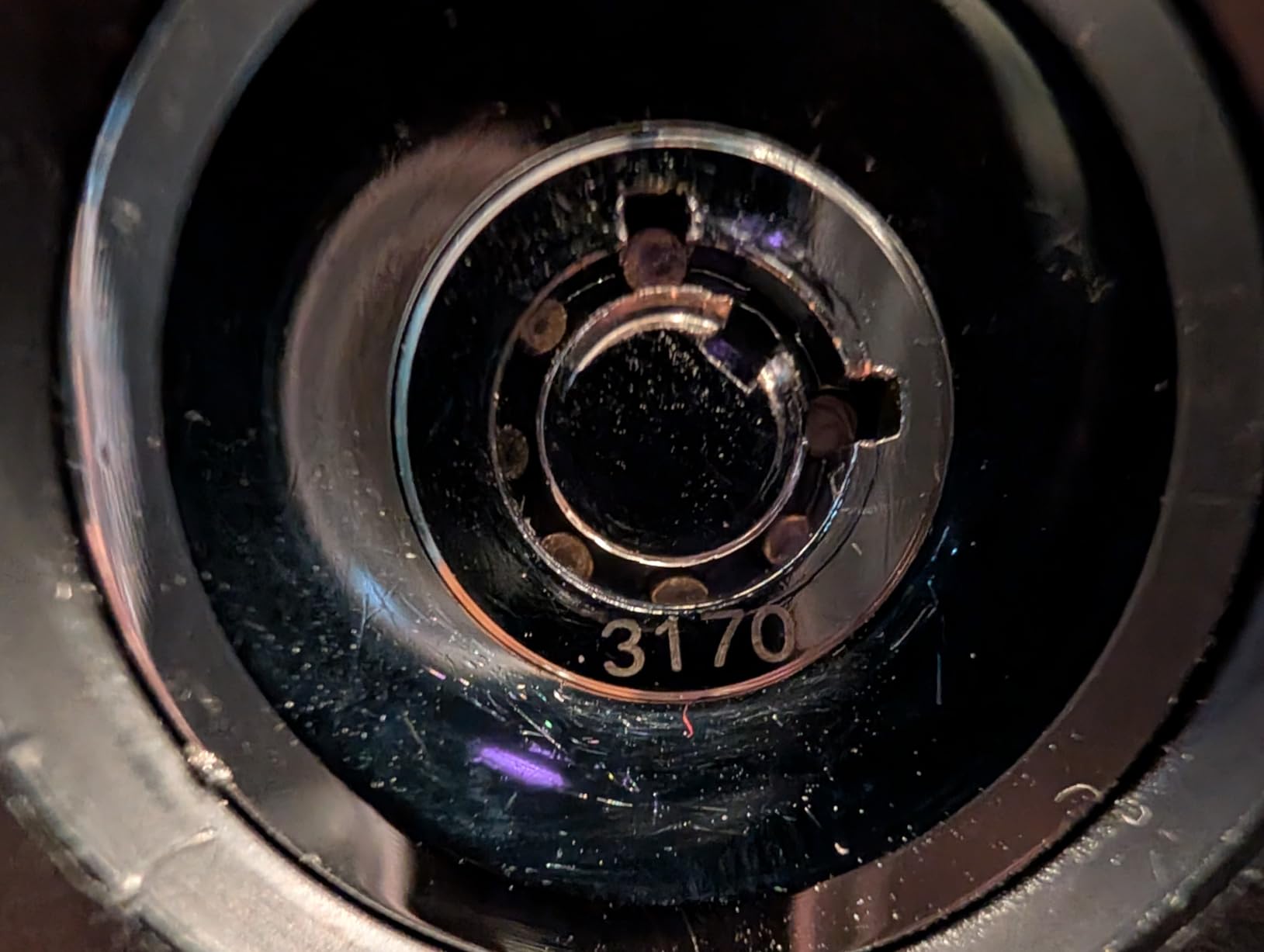
- Losing the only key means contacting the seller because the keyhole is uniquely numbered
The last pick solves one specific problem properly. Most budget digital safes impose a five minute or longer penalty after three wrong codes, which is punishing when you are tired and half asleep. This one locks out for 20 seconds and sounds the anti-theft alarm, which is long enough to be a real deterrent to casual code guessing and short enough to be an irritation rather than an ordeal.
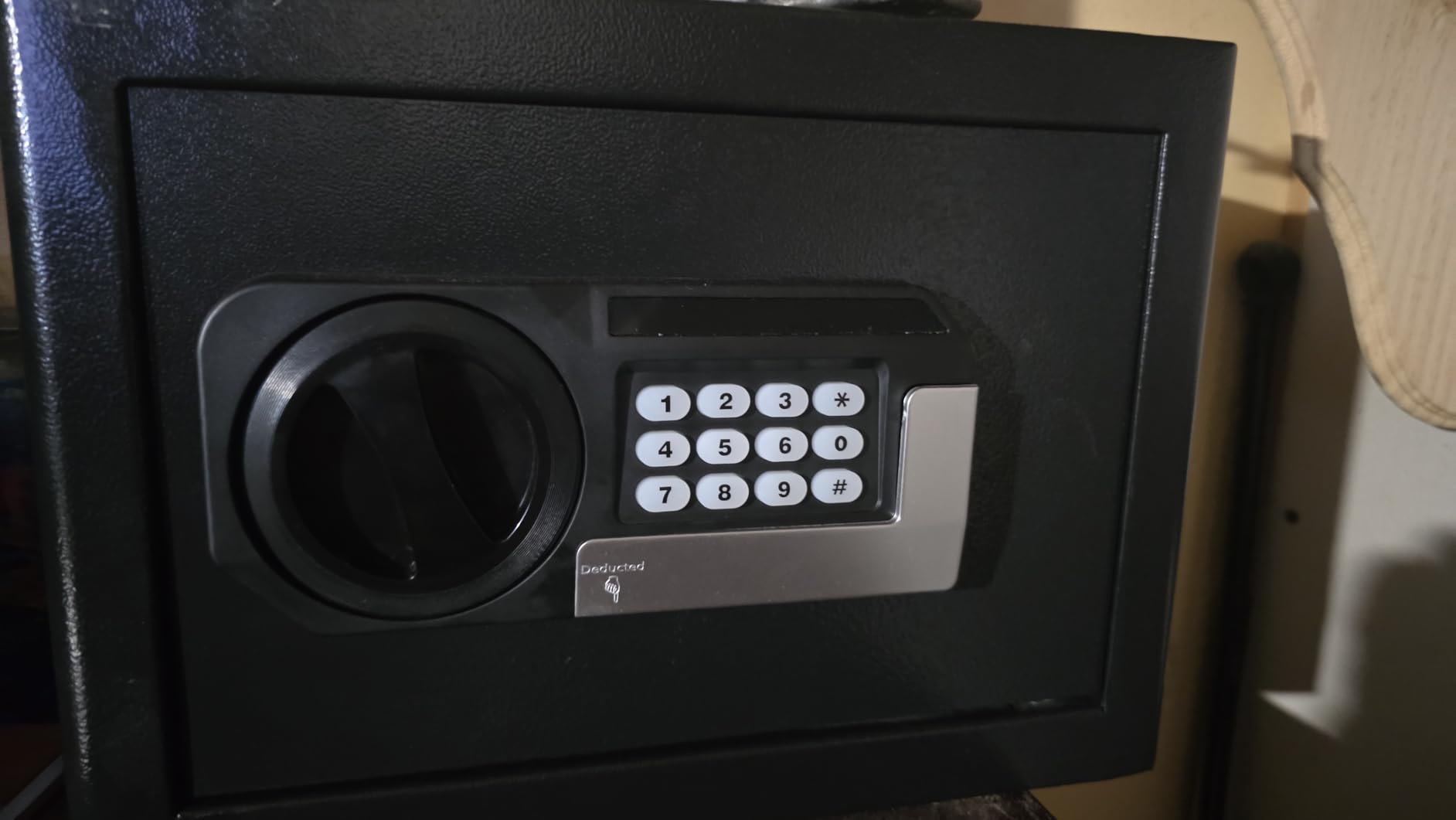
It is 1.2 cubic feet in a body measuring 13.8 inches wide, 9.84 deep and 9.84 high, weighing 16 pounds, with a recessed door, three live steel lock bolts and thick pry-resistant concealed hinges. The package includes two emergency keys, four expansion screws, a mat and a manual.
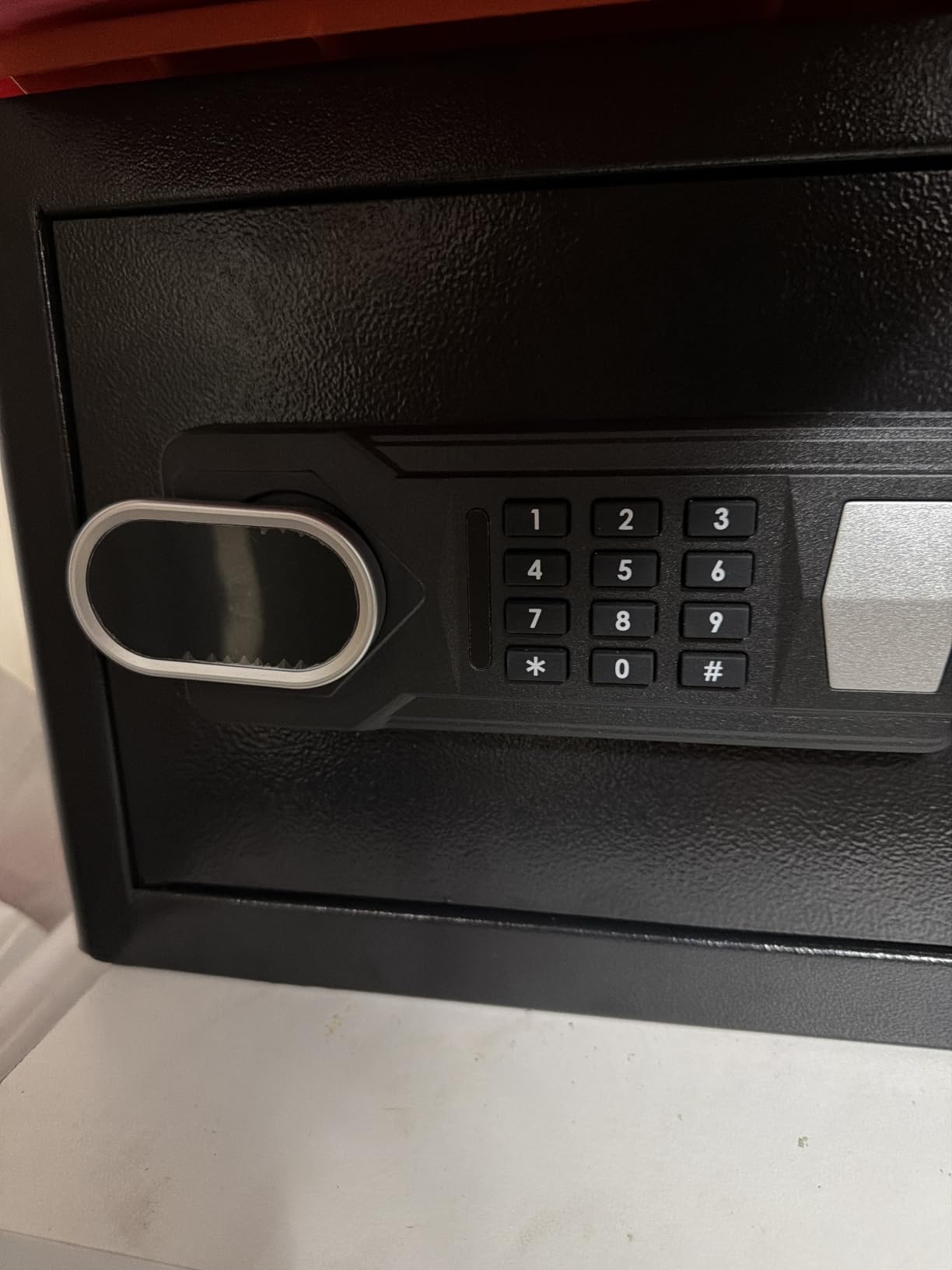
Access is a programmable 3- to 8-digit PIN with a hidden emergency key backup, and the removable shelf adjusts to different sized valuables. Owners rate it 4.3 across roughly 600 reviews and highlight the alarm, the lockout behaviour and the anchorable, hideaway design.
Two practical notes. The fire resistance listed in the product details is a marketing claim with no certified rating behind it, and no water resistance specification is given at all. Also, the keyhole is uniquely numbered, so a lost spare key means contacting the seller rather than having a new one cut at a hardware store. Get a duplicate cut while you still have both originals.
Lockout length as a buying signal
It is a small detail that tells you how a manufacturer thinks about daily use. A 20 second penalty is designed around a real person opening a safe in a hurry at night. A five minute penalty is designed around someone trying to guess codes. For a bedside box you open twice a day, the shorter lockout is simply the better product decision.
Where this overlaps with the Amazon Basics
Both are 1.2 cubic feet boxes at a similar weight with three or two live bolts and included mounting hardware. Choose the Amazon Basics if you want the vastly larger body of owner reviews and a slightly more concealed hinge design. Choose the Psisuvry if you want the alarm, the 20 second lockout and the hidden key backup. Neither has a fire or burglary certification, so anchor either one or accept that it is a lockable box.
How to Choose a Jewelry Safe for Home in 2026
Everything above is a specific safe for a specific job. This section is the part that saves you from buying the wrong one, and it is the part almost every competing guide skips. Six questions decide whether your purchase is a success: what has to survive, how much of it there is, what you can anchor it to, what your floor will take, how you will open it, and what the room is like when it gets humid.
Fire ratings: read the minutes and the temperature
A fire rating is a duration and a temperature, not a word. Half an hour at 1550F is a genuine UL Classified rating and it is the most common listing in home safes. One hour at 1700F is harder to find and materially better protection, because house fires routinely exceed the lower figure within minutes. The SentrySafe SFW123GDC is the only pick in this roundup with the hour listing.
Watch the wording. Fire-resistant means the interior stays below a stated temperature for a stated period. Fireproof is not a certification term at all, and it appears on plenty of boxes with no laboratory behind it. Three picks here carry a real UL or ETL listing. Several others print fireproof in the title with no certification, and owner reviews of two of those models say the claim is not met. If the listing page does not name UL or ETL with a duration and a temperature, assume there is no test.
One more thing a fire rating does not cover: water. Fire services use hoses. Two picks here, the SentrySafe SFW123GDC and the CHW30220, carry ETL water verification for 24 hours in 8 inches of water and 72 hours of submersion respectively. If your building is in a flood-prone area or you live above ground level, that is a different certification to shop for.
Burglary ratings: know what you are not getting
Not one safe in this roundup carries a UL Residential Burglary listing. That is not a criticism of the products, it is a statement about the category at this size and weight. Residential Burglary certification starts appearing on heavier, thicker steel bodies from brands like AMSEC, Hollon and Liberty, at several times the weight and cost of everything here.
So substitute the spec sheet for the certification and check four things: how many live-locking bolts engage, whether the hinges are concealed on the inside of the door, whether the safe has pre-drilled mounting holes with hardware included, and how heavy it is. Those four together approximate what a burglary rating would tell you. A 4-pound box with a pry-resistant door and two bolts is a lockable container. A 20-pound box with concealed hinges, three bolts and expansion bolts in the box, fixed to a stud, is a real obstacle.
Weight alone is close to meaningless. A 30-pound safe sitting loose in a bedroom is a 30-pound safe two people can carry down a staircase. Users on collector forums make this point repeatedly, and it is the single most repeated warning in the owner reviews across this whole roundup.
Capacity and sizing: measure the boxes, not the safe
Start by measuring what you actually want to put inside. A ring box is roughly 3 by 3 by 2 inches. A watch box is often larger than you think. A velvet tray of a dozen rings is a very different shape from a stack of documents. Interior dimensions are published for every pick in this roundup, and the gap between exterior and interior is often two to three inches on each axis once the door and bolt work are counted.
As a rough guide: under 0.25 cubic feet suits three to ten small pieces or documents. Around 0.6 cubic feet fits a watch box, a small tray and cash. One to two cubic feet is where collections with trays and removable shelves start to work properly. The single most common owner complaint in this group is not security, it is a safe that turned out to be too small for the boxes already owned.
Lock types: keypad, fingerprint, dial and key
Digital keypads are the default in this roundup and the most convenient. Their weakness is batteries, and the weakness of their weakness is that batteries die at the worst moment. Every digital pick here either includes a key override or ships with a battery box for exactly this reason, so treat the override key as part of the product rather than an accessory.
Fingerprint scanners are a convenience feature rather than a security feature. They are fast, they hold dozens of users, and they fail on damp or dirty fingers, after which most units fall back to a code or a key anyway. Register two fingers per hand, keep the backup code, and treat the scanner as a convenience you are allowed to use instead of the thing that keeps the safe closed.
Key locks are the most boring and the most dependable. No electronics, no batteries, no firmware. The cost is that a key exists somewhere in your house, and the two SentrySafe models here use a tubular or flat key specifically because it resists the lid popping open when the case expands in heat. Get a duplicate cut and store it away from the safe.
Mechanical dials are largely absent from this roundup because the products available at these sizes are electronic. A dial is harder to force than a keypad and impossible to have a battery problem with, and it is worth considering for a collection you open rarely.
Anchoring and floor load: check before the safe arrives
Every pick in this roundup except the two smallest key boxes ships with mounting hardware, and pre-drilled holes are standard. Use them. Expansion bolts into a stud or a masonry plug are the minimum; a safe fixed to drywall alone is a safe that comes off the wall with the drywall still attached.
Before buying anything over 100 pounds, know where it can physically go. Residential floors are engineered joists, commonly spaced 16 inches apart, and older houses carry lighter live loads than modern ones. A safe concentrated at one point on the middle of a span is the worst case, and upstairs installations push that further. Ground floor closets, basements with a slab beneath and garages with a poured slab are the reliable answers. Watch collector forums raise garage placement constantly, and the recurring concern is the same one: whether the slab and the framing beneath it can carry the load without cracking over time.
If you are unsure, two options remove the problem entirely. Buy a lighter safe and anchor it well, or have a larger unit installed by a professional who can check the structure first. The heaviest pick here is 86.69 pounds, and that is manageable in most ground floor locations.
Where to place a safe in a house
Placement buys more time than steel does. Ordered roughly by how much time each tends to buy: a walk-in closet on an upper floor, a master bedroom closet rather than a living room, a home office that is not the first room off the entry hall, a laundry room or utility area on a non-obvious floor, a basement cabinet, and only then a visible location. Users on home security forums consistently report that burying the safe behind stored items buys time even after an intruder is already inside the house.
Two rules override all of that. Do not put the only copy of your safe key in the same room. And do not place a safe you use daily above a floor you would not want water to reach, because a fire in a two-storey house is a very real event.
Moisture, desiccant and tarnish
This is the quietest problem in the whole category and the only one that quietly destroys jewelry. Silver tarnishes, leather straps dry out and crack, and organic materials such as pearls, wooden beadwork and some glued settings degrade in humidity. A safe is a sealed box, and a sealed box that holds a warm safe interior overnight and cools overnight traps moisture inside it. Retailers answering customer questions about jewelry safe interiors repeatedly recommend a moisture absorber inside.
The fix is cheap. Put a rechargeable or replaceable desiccant pack in the safe and replace it on a schedule, and open the door briefly every few weeks so the interior air changes. For pearls and other delicate organic pieces, store them separately from metals rather than in the same compartment, because the classic anti-tarnish paper wraps are themselves slightly acidic. Velvet-lined drawers help with knocks and scratches, which is the job they are actually good at, but a lining will not stop tarnish.
Renters and no-drill installs
Renters are the least served group in this category, and the honest answer is that most safes are made for people who own walls. A heavy safe in a rental is a liability in more ways than theft, particularly in a building where you cannot fix into the structure or cannot control the floor.
What works without drilling: the 13-pound SentrySafe 1210, which has a carry handle and a bolt kit you may never use; the 4.1-pound Bonsaii, which fits in a closet and can be secured with a cable lock to furniture; and any safe placed high in a locked cabinet rather than bolted down. What does not work is pretending a 33-pound safe on a light floor in someone’s property is fine. Check your lease first, and if in doubt choose the small, light, movable option.
Insurance and appraisal paperwork
Homeowners policies commonly limit or exclude theft of jewelry, watches, furs, coins and precious metals unless the items are separately scheduled, and a scheduled item usually needs an appraisal that is less than a certain age old. A safe is not a substitute for a rider. Keep a current appraisal and dated photographs inside the safe, keep a copy outside it, and confirm with your insurer what documentation they want before you need it.
Frequently Asked Questions
What is the best safe for storing jewelry at home?
The best safe for storing jewelry at home is a locked, fire-resistant box with a soft-lined interior, pre-drilled mounting holes and enough bolt work to resist a pry bar. For most collections the Amazon Basics 1.2 cubic foot safe is the strongest all-round starting point, with the largest body of owner reviews. Choose the SentrySafe SFW123GDC instead if fire protection is your priority, since it carries a one hour UL fire listing. Anchor whichever you pick.
What is the highest rated home safe?
The highest rated home safe is defined by two independent certifications rather than by weight. A UL fire rating states minutes at a temperature, such as half an hour at 1550F or one hour at 1700F. A UL Residential Burglary rating states resistance to forced entry over time. Almost no home safe under 100 pounds carries a burglary listing, so check bolt count, concealed hinges, mounting hardware and weight instead, and treat the word fireproof as marketing unless UL or ETL appears with a duration.
Where is the safest place to keep jewelry at home?
The safest place is inside an anchored safe in a room that is not on the direct path from the front door. A walk-in closet on an upper floor is generally best, followed by a master bedroom closet, a home office, a laundry or utility area and a basement cabinet. Placement buys more time than steel, because an intruder who has to search a second room is buying you minutes. Keep a spare key somewhere other than the same room, and do not store the only copy of your appraisals inside the safe.
Where is the safest place to put a safe in a house?
Start at ground level near a structural wall, not in the middle of a room or on an upper floor. Residential floors use engineered joists, commonly 16 inches apart, and a heavy safe concentrated at one point is the worst case structurally. Ground floor closets, basements with a slab beneath and garages with a poured slab are the most reliable locations. Before installing a safe over 100 pounds, confirm the floor can carry the load or have a professional check it first.
Is a biometric safe better than a keypad safe?
A biometric safe is more convenient than a keypad safe, not more secure. Fingerprint readers hold many users and open instantly, but they fail on damp or dirty fingers and most units then fall back to a code or key anyway. A good compromise is a safe offering all three paths, such as the TIGERKING biometric safe, with up to 32 fingerprints, a 3 to 8 digit code and an emergency key. Register two fingers per hand so a cut finger cannot lock you out.
The Verdict: Which Jewelry Safe to Buy
For most households, the Amazon Basics 1.2 cubic foot security safe is the right first buy, because it has the deepest support record of anything we tested, a carpeted interior, adjustable shelving and the drilled back panel you need to make it a safe rather than a lockable box. If your collection includes irreplaceable heirlooms and fire is the risk you care about most, step up to the SentrySafe SFW123GDC, the only pick here with a one hour UL fire listing. For a nightstand, the TIGERKING biometric safe gives you fingerprint, code and key in a 20-pound body. For a travel case, nothing else in the roundup carries a certification at 13 pounds.
Whatever you choose in 2026, use the mounting hardware that came in the box, put a desiccant pack inside, and keep your appraisals with the safe rather than in a drawer beside it. Those three steps matter more than any specification on this page.