
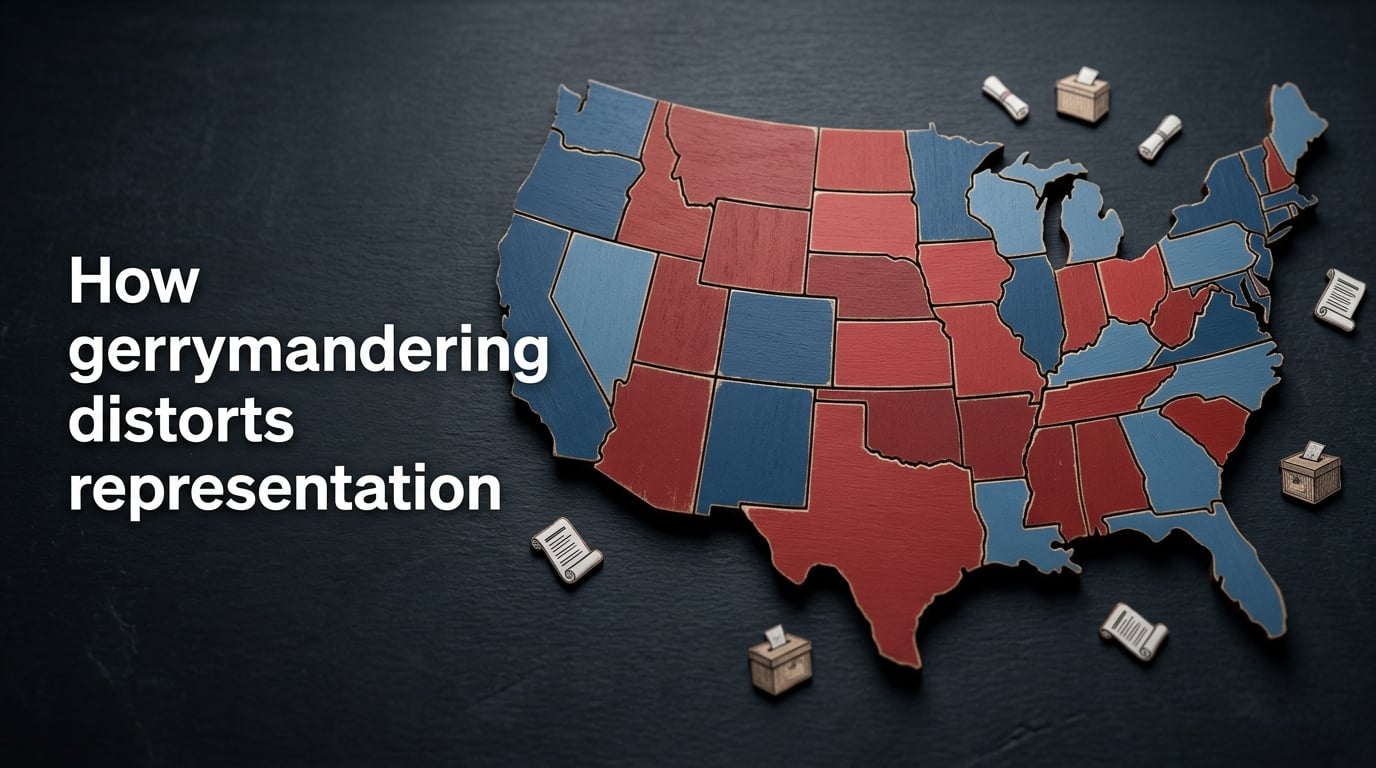
Gerrymandering is the deliberate manipulation of voting district boundaries to give one political party an unfair advantage in elections. When you ask how gerrymandering distorts representation, the answer lies in the math: by drawing lines a certain way, mapmakers can predetermine who wins before a single vote is cast. In the United States, this practice affects congressional races, state legislatures, and local government—silencing millions of voters whose preferences get engineered out of relevance.
This guide breaks down exactly how gerrymandering works, why it persists, and what reforms could restore fair representation. You will learn the two manipulation techniques at its core, how it dilutes minority voting power, and what states are doing to fight back.
Table of Contents
What Is Gerrymandering?
Gerrymandering is the practice of drawing electoral district boundaries to favor a particular political party or group. The term dates back to 1812, when Massachusetts Governor Elbridge Gerry signed a redistricting bill that created a district so contorted it resembled a salamander. A newspaper coined the portmanteau “gerrymander,” and the name stuck for over two centuries.
At its heart, gerrymandering exploits a simple reality: in a winner-take-all system, the shape of a district determines who wins it. By concentrating or dispersing certain voters, the party in control of redistricting can manufacture a disproportionate number of “safe” seats—districts where their candidate is virtually guaranteed victory.
Unlike voter fraud, which is rare and illegal, gerrymandering is perfectly legal in most states. The party that controls the state legislature after a census typically controls the map-drawing process, creating an inherent conflict of interest.
How Redistricting Works After the Census
Every ten years, the U.S. Census counts every person in the country. That population data drives two processes:
Reapportionment redistributes the 435 House seats among the 50 states based on population shifts. States that gained people may receive additional seats; states that lost people may lose some.
Redistricting redraws the boundaries of congressional and state legislative districts within each state to ensure equal population per district. This is where gerrymandering enters the picture.
In most states, the state legislature controls redistricting. That means the party in power gets to draw the lines for the very elections those politicians will run in. Only a handful of states—currently around ten—use independent or bipartisan redistricting commissions to remove that conflict of interest.
The redistricting cycle following the 2020 Census produced some of the most aggressive gerrymanders in American history. Several states faced lawsuits before new maps were even finalized, and mid-decade redistricting battles in states like Ohio and North Carolina continued through 2026.
Packing and Cracking: The Two Core Manipulation Techniques
Mapmakers use two primary techniques to gerrymander districts. Understanding packing and cracking explains how gerrymandering distorts representation at a mechanical level.
Packing means cramming as many opposing-party voters as possible into as few districts as possible. If a state has 10 districts and the opposition tends to win urban areas, a gerrymander might concentrate all urban voters into just 2 or 3 districts. Those districts become overwhelmingly blue—but the remaining 7 or 8 districts lean red. The opposition wins a few seats by huge margins while the controlling party wins many seats by comfortable margins.
Cracking means splitting up clusters of opposing-party voters across multiple districts so they never form a majority in any single one. A city that reliably votes one way gets divided into four or five suburban-dominated districts. Each fragment is too small to influence the outcome. The opposing voters are still there—they just cannot win anywhere.
Most gerrymanders combine both techniques. The packing districts absorb surplus opposition voters, while the cracking districts dilute the rest. The result: a party that wins 50 percent of the statewide vote might capture 70 percent of the seats.
Racial Gerrymandering vs. Partisan Gerrymandering
Not all gerrymandering targets the same group. Two distinct forms operate under different legal standards.
Racial gerrymandering manipulates district lines based on the race or ethnicity of voters. This form is subject to stricter legal scrutiny. The Voting Rights Act of 1965 prohibits redistricting plans that dilute minority voting power. Courts have ruled that race cannot be the predominant factor in drawing districts unless the plan satisfies strict scrutiny—a high legal bar.
Partisan gerrymandering targets voters based on their political party affiliation. For decades, courts treated partisan gerrymandering as a “political question” beyond judicial reach. That changed temporarily when the Supreme Court accepted challenges in cases like Gill v. Whitford (Wisconsin) and Rucho v. Common Cause (North Carolina). In 2019, however, the Court ruled in Rucho that partisan gerrymandering claims are non-justiciable at the federal level—meaning federal courts cannot block them. This shifted the fight to state courts and legislatures.
The distinction matters because racial gerrymandering remains actionable in federal court while partisan gerrymandering largely does not. In practice, the two often overlap: packing minority voters into a few districts serves both racial and partisan goals.
How Gerrymandering Distorts Representation in Congress
The core question—how gerrymandering distorts representation—has several concrete answers. Each one chips away at the democratic principle that every vote should carry equal weight.
Manufactured majorities. In the 2018 midterms, Wisconsin Democrats won 53 percent of the statewide Assembly vote but captured only 36 percent of Assembly seats. Similar mismatches have occurred in North Carolina, Ohio, and Maryland. Gerrymandering lets a party translate a minority of votes into a majority of seats.
Uncompetitive elections. According to the Cook Political Report, roughly 90 percent of House seats are considered “safe” for one party in a typical cycle. When districts are drawn to be non-competitive, general elections become formalities. The real contest shifts to low-turnout primaries, pushing candidates toward ideological extremes.
Voter dilution. When your district is packed with the opposing party, your vote still counts—but it cannot change the outcome. Millions of voters live in districts so lopsided that their preferred candidate has no realistic chance. This breeds apathy and depresses turnout.
Minority underrepresentation. Cracking communities of color across multiple districts prevents them from electing candidates of their choice. The Supreme Court recognized this harm in Thornburg v. Gingles (1986), establishing criteria for when minority communities must be given the opportunity to form majority-minority districts.
Accountability erosion. Representatives in safe districts face no incentive to compromise or listen to constituents across the aisle. They answer only to primary voters, who tend to be more partisan. This dynamic contributes to congressional gridlock and declining public trust in government.
The Efficiency Gap: Measuring Gerrymandering
One of the biggest challenges in fighting gerrymandering has been proving it exists in a legally actionable way. The efficiency gap, a metric developed by political scientists Stephanopoulos and McGhee in 2015, offers a single number to quantify partisan bias in a map.
The efficiency gap measures “wasted votes”—votes cast for a losing candidate or votes cast for a winning candidate beyond what was needed to win. In a fair map, both parties should waste roughly equal numbers of votes. When one party systematically wastes far fewer votes than the other, the efficiency gap is large, indicating a significant gerrymander.
An efficiency gap above 8 percent in a state legislative election is considered strong evidence of a gerrymander. For congressional districts, the threshold is lower. After the 2020 redistricting cycle, multiple states posted efficiency gaps well above these thresholds.
While not perfect—the metric can be sensitive to turnout fluctuations—the efficiency gap has given courts, journalists, and reform advocates a concrete tool for evaluating maps. It is now cited in redistricting lawsuits and reform proposals across the country.
How Technology Supercharges Modern Gerrymandering
Gerrymandering existed long before computers, but modern technology has transformed it from a blunt instrument into a precision tool.
Granular voter data. Campaigns and mapmakers now have access to individual-level voter files: party registration, voting history, demographic data, consumer behavior, and even social media activity. This data feeds directly into redistricting software.
Mapping software. Programs like Maptitude for Redistricting and ESRI’s tools allow legislators to draw districts at the census-block level—areas containing as few as a few dozen households. A mapmaker can add or remove a single block to shift a district’s partisan lean by a fraction of a percentage point.
AI and simulation. Researchers use algorithmic approaches to generate thousands of neutral redistricting plans and compare them against enacted maps. If a legislature’s map is a partisan outlier among thousands of simulated alternatives, it is strong statistical evidence of intentional gerrymandering. Courts have increasingly accepted this “ensemble analysis” as evidence.
The irony is that the same technology enabling extreme gerrymandering also empowers reformers. Citizens can now evaluate their own districts using free tools like Dave’s Redistricting App, and independent mapmakers can produce fair alternatives in days rather than months.
Real-World Gerrymandering: State Case Studies
Examining specific states reveals how gerrymandering plays out in practice.
Wisconsin. After the 2010 Census, Republicans controlled the redistricting process and drew maps that locked in a supermajority of Assembly seats even in years when Democrats won more total votes. The plan, known as Act 43, became the subject of Gill v. Whitford, which reached the Supreme Court in 2018. While the Court sent the case back on standing grounds, Wisconsin’s maps remained a national symbol of partisan gerrymandering until they were redrawn following court orders in 2023.
North Carolina. The state has cycled through maps repeatedly. After 2010, Republican-drawn congressional maps were struck down for racial gerrymandering. After 2020, new partisan gerrymanders were challenged again. In 2023, the state Supreme Court reversed its earlier position and allowed partisan gerrymandering, leading to a congressional map that gave Republicans 10 of 14 seats in a near-evenly divided state. This volatile history illustrates both the power and fragility of redistricting protections.
Ohio. Voters approved redistricting reforms in 2015 and 2018 requiring maps to reflect statewide voter preferences. Despite these reforms, the Ohio Redistricting Commission repeatedly adopted maps that the state Supreme Court struck down as unconstitutional. The standoff lasted through much of the 2020 redistricting cycle, demonstrating that reform without enforcement mechanisms can fall short.
How to Fix Gerrymandering: Solutions and Reforms
Reformers have pursued several approaches to curb gerrymandering, each with strengths and limitations.
Independent redistricting commissions. States like Arizona, California, Colorado, Michigan, and New York have created commissions that remove map-drawing power from legislators. These bodies typically include citizens from multiple parties plus independents. Evidence suggests they produce more competitive and less partisan maps than legislatures.
Court intervention. State courts have become the primary venue for challenging gerrymanders since the Supreme Court closed federal courts to partisan claims. State constitutions in Pennsylvania, North Carolina, and elsewhere contain provisions that courts have interpreted to prohibit extreme partisan manipulation.
Federal legislation. Proposals like the Freedom to Vote Act and the John Lewis Voting Rights Advancement Act would establish national redistricting standards, require independent commissions, and restore federal oversight of redistricting in states with histories of discrimination. Neither has passed as of 2026, though versions continue to be reintroduced.
Expanding the House. The House of Representatives has been capped at 435 members since 1929. Some scholars argue that expanding the House—perhaps to 600 or more members—would reduce the population per district, making each seat harder to gerrymander and easier for a candidate to represent. The Center for American Progress and others have modeled this approach.
Citizen-led ballot initiatives. In states that allow them, citizens have bypassed legislatures entirely. Michigan’s 2018 Proposal 2, which created an independent redistricting commission, was driven entirely by grassroots organizers. Similar efforts have succeeded in Colorado and Arizona.
Frequently Asked Questions
What is gerrymandering and how does it work?
Gerrymandering is the practice of manipulating voting district boundaries to give one political party a disproportionate advantage. It works through packing, which concentrates opposing voters into few districts, and cracking, which splits them across many districts so they cannot win. The party controlling redistricting draws lines that predetermine election outcomes.
Is gerrymandering legal in the United States?
Yes, partisan gerrymandering is legal in most states. The Supreme Court ruled in Rucho v. Common Cause (2019) that federal courts cannot block partisan gerrymanders. However, racial gerrymandering remains illegal under the Voting Rights Act, and some state courts have struck down extreme partisan maps under state constitutions.
How does gerrymandering distort representation?
Gerrymandering distorts representation by letting a party win far more seats than its vote share warrants. It creates uncompetitive districts, dilutes minority voting power, and allows politicians to choose their voters instead of voters choosing their representatives. In Wisconsin in 2018, Democrats won 53 percent of votes but only 36 percent of Assembly seats due to gerrymandered maps.
What is the difference between packing and cracking in gerrymandering?
Packing concentrates as many opposing-party voters as possible into as few districts as possible, giving the opposition a few overwhelming wins but wasting most of their votes. Cracking splits a concentrated group of opposing voters across multiple districts so they never form a majority in any single one. Most gerrymanders combine both techniques.
Which states are the most gerrymandered?
Wisconsin, North Carolina, Ohio, and Maryland are frequently cited as heavily gerrymandered states. Wisconsin’s Act 43 maps were the subject of a landmark Supreme Court case. North Carolina has cycled through struck-down maps repeatedly. Maryland’s Democratic-drawn 6th district was challenged as a partisan gerrymander targeting Republican voters.
How can gerrymandering be fixed?
The most effective reforms include independent redistricting commissions that remove map-drawing from legislators, state court challenges under state constitutions, federal legislation establishing national standards, expanding the House of Representatives beyond 435 members, and citizen-led ballot initiatives that bypass legislatures entirely.
What is the efficiency gap in gerrymandering?
The efficiency gap is a metric that measures partisan bias in a redistricting plan by comparing wasted votes between parties. An efficiency gap above 8 percent in state legislative elections is considered strong evidence of gerrymandering. It gives courts and reformers a single number to quantify how much a map favors one party.
Does gerrymandering affect voter turnout?
Yes. Research shows that voters in heavily gerrymandered districts are less likely to vote because the outcome feels predetermined. When general elections become formalities, the real competition happens in low-turnout primaries. This dynamic discourages moderate voters and depresses overall participation, which further entrenches the gerrymander.
Conclusion
Gerrymandering remains one of the most consequential threats to fair representation in American democracy. It distorts election outcomes, silences minority communities, and erodes public trust in government. Understanding how gerrymandering distorts representation is the first step toward demanding reforms. Whether through independent commissions, court challenges, or citizen-led ballot initiatives, the tools to fight back exist. The question is whether enough voters will use them before the next redistricting cycle locks in another decade of manufactured outcomes.