
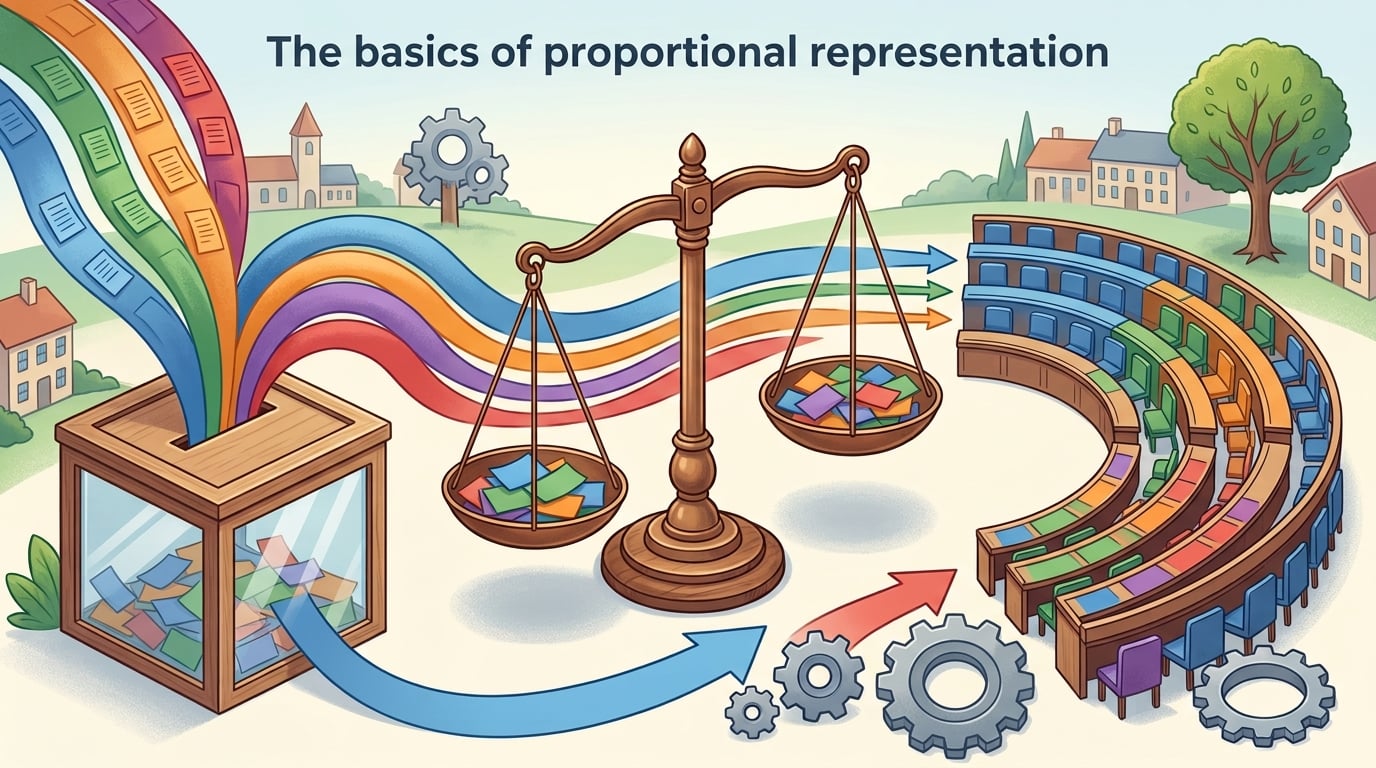
Proportional representation (PR) is an electoral system where political parties win seats in a legislature in proportion to the share of votes they receive. If a party earns 30% of the vote, it gets roughly 30% of the seats — instead of 100% or 0% under winner-take-all rules.
This guide walks you through how PR works, the three main types used around the world, the formulas that turn votes into seats, and the real trade-offs countries face when they adopt it. By the end, you’ll have a working understanding of the system that elects parliaments in most democracies.
TL;DR — The Short Version
- PR matches seats to vote share, so legislatures look more like the voters who elected them.
- Three main types: Party List (most common), Mixed-Member Proportional (MMP), and Single Transferable Vote (STV).
- It reduces gerrymandering and gives smaller parties a chance, but it often produces coalition governments and weakens ties to a local district.
- About 80 to 90 countries use some form of PR, including Germany, the Netherlands, Sweden, New Zealand, and most of Latin America.
- The United States uses winner-take-all in single-member districts, which is why a party can win a majority of seats with a minority of votes.
Table of Contents
What Is Proportional Representation?
Proportional representation is a family of electoral systems designed to make legislative bodies mirror the political makeup of the electorate. Instead of dividing a country into single-member districts where only one winner takes all, PR systems combine votes across larger districts — sometimes an entire country — and award seats to parties based on their vote share.
The core idea is fairness of translation: votes and seats should match as closely as possible. In a 100-seat legislature with pure PR, a party winning 27% of the vote should walk away with about 27 seats, not zero and not 100.
This is different from what most Americans and Canadians experience today. Under a winner-take-all system in single-member districts, the candidate with the most votes wins the seat, and everyone who voted for someone else is, in legislative terms, unrepresented. In a safe district where one party always wins by 30 points, half the voters essentially elect no one.
Three building blocks make PR work:
Multi-member districts. A PR district elects several representatives at once rather than just one. District magnitude — the number of seats up for grabs — is the single biggest factor in how proportional a system feels. A district that elects 5 representatives will be more proportional than one that elects 2.
Seat allocation formulas. Once votes are counted, a mathematical formula divides seats among parties. The most common are the D’Hondt method, the Sainte-Laguë method, and the largest remainder (Hare) method. We’ll cover those in detail later.
An electoral threshold. Many PR systems require a party to clear a minimum vote share — usually 3% to 5% — before receiving any seats. The threshold keeps tiny fringe parties from flooding the legislature, but it also locks out some legitimate minority voices.
How Proportional Representation Works Step by Step
The mechanics vary by system type, but the basic flow is the same. Here is how votes become seats under a simple party list system.
Step 1: Voters cast ballots for a party. In a closed list system, voters pick a party. In an open list, they pick a candidate within a party. Either way, the votes get tallied nationally or by region.
Step 2: Vote totals are calculated. Add up all valid votes for each party. The total share is what matters, not which district the votes came from.
Step 3: A formula divides the seats. Most PR systems use a highest-averages method (D’Hondt or Sainte-Laguë) or a largest-remainder method (Hare). The math decides how many of the available seats each party wins.
Step 4: Candidates are assigned to seats. In closed list, the party decides the order ahead of time and top-of-list candidates win first. In open list, candidates with the most personal votes fill the seats. In MMP and STV, this step looks different — we’ll get there.
A Worked Example: 100 Seats, 4 Parties
Imagine a country with 100 legislative seats and four parties competing. After the election, the votes break down like this:
- Party A: 45% of the vote
- Party B: 30% of the vote
- Party C: 15% of the vote
- Party D: 10% of the vote
Using the simplest proportional method — multiply each party’s vote share by total seats — the results would be:
- Party A: 45 seats
- Party B: 30 seats
- Party C: 15 seats
- Party D: 10 seats
Under winner-take-all with 100 single-member districts, the same vote might produce 75 seats for Party A, 25 for Party B, and zero for Parties C and D — even though C and D together earned 25% of the vote. PR captures those voices; winner-take-all silences them.
Real-world formulas produce similar but not identical numbers. We’ll unpack the math in the formulas section below.
Proportional Representation vs Winner-Take-All
Winner-take-all is the default in the United States, the United Kingdom, Canada, and India. Each district elects one representative, and the candidate with a plurality wins the seat. The party with a majority of seats usually forms the government.
PR flips the logic. Districts elect multiple representatives, and seats track vote share. The result is usually a multiparty legislature that must form a coalition to govern.
Here is how the two systems compare on the features that matter most:
| Feature | Winner-Take-All (FPTP) | Proportional Representation |
|---|---|---|
| District size | One representative per district | Multiple representatives per district or nationwide |
| Vote-to-seat match | Often distorted — a party can win a majority of seats with a minority of votes | Close match between vote share and seat share |
| Number of viable parties | Usually 2 (duopoly) | Often 4 or more |
| Wasted votes | High — losing votes elect no one | Low — most votes contribute to a seat |
| Gerrymandering risk | High — district lines decide outcomes | Low — fewer or larger districts reduce partisan line-drawing |
| Government type | Single-party majority common | Coalition governments common |
| Local representation | Strong — one MP per geographic area | Weaker — multiple reps share a district |
| Typical countries | U.S., U.K., Canada, India | Netherlands, Sweden, Germany, New Zealand |
The U.S. system rewards geographic concentration. If your party’s voters cluster in a region, you can win the seat even with a small national vote share. PR does the opposite: it rewards broad national appeal. That single difference explains most of the downstream effects — more parties, more coalitions, more proportional outcomes.
The Three Main Types of Proportional Representation
Almost every PR system in the world is one of three flavors. They differ in how voters cast ballots, how votes are counted, and how candidates are chosen.
1. Party List Proportional Representation
Party list is the most widely used PR system, especially across continental Europe and Latin America. Voters pick a party (and sometimes a specific candidate within it). Seats are then allocated to parties based on vote share, and parties fill those seats from a ranked list of candidates.
Three list variants matter:
Closed list: The party orders candidates before the election, and voters simply vote for the party. Top of the list gets elected first. Voters have no say over which individual candidates win. Used in Spain, South Africa, and many other countries.
Open list: Voters choose a party but can also indicate a preference for a specific candidate. Candidates with the most personal votes fill the seats. Used in the Netherlands, Sweden, and Brazil.
Flexible list (or free list): A hybrid where parties suggest an order but voters can shuffle it by giving extra votes to candidates. Used in Denmark.
2. Mixed-Member Proportional (MMP)
MMP combines single-member districts with proportional top-up seats. About half of legislators are elected in local districts (like winner-take-all). The other half are elected from party lists to make the overall legislature proportional to the national vote.
Germany is the textbook example. Voters cast two ballots: one for a local candidate, one for a party. If a party wins 30% of the party vote but only 20% of the local seats, it gets enough list seats to bring its delegation up to 30%. New Zealand adopted MMP in 1996 after a public referendum, and several Canadian provinces have adopted variants.
The advantage of MMP is balance. Voters keep a local representative and still get a proportional legislature. Critics argue it produces two classes of legislators — constituency MPs with real local ties, and list MPs whose connection to any place is fuzzy.
3. Single Transferable Vote (STV)
STV is the most complex and arguably the most voter-driven PR system. It works in multi-member districts where voters rank candidates in order of preference. To win a seat, a candidate must reach a quota (usually one more than the number of seats divided by total votes plus one).
Candidates who exceed the quota have their extra votes redistributed to voters’ next choices. Candidates with the fewest votes are eliminated, and their votes transfer too. The process repeats until all seats are filled.
STV is used in Ireland for parliamentary elections, in Malta, and in the Australian Senate. Several U.S. cities, including Cambridge, Massachusetts, and Minneapolis, Minnesota, use STV (often called choice voting or ranked-choice voting) for local elections.
STV is the only PR system where you vote for individual candidates, not parties. That makes it friendlier to independents and to voters who want to express nuanced preferences.
Comparing the Three Systems
| Feature | Party List | MMP | STV |
|---|---|---|---|
| Ballot | Vote for a party (sometimes a candidate) | Two votes: one for a local candidate, one for a party | Rank candidates in order of preference |
| District size | Large multi-member or nationwide | Mix of single-member and large regional | Multi-member (typically 3 to 5 seats) |
| Voter chooses candidates? | Only with open list | Yes for the local ballot, no for the list ballot | Yes — voters rank candidates |
| Local representation | Weak | Strong for local MPs | Moderate — multi-member districts still have a geographic base |
| Complexity for voters | Low | Medium — two ballots to fill | High — ranking takes thought |
| Example countries | Netherlands, Spain, Sweden, Brazil | Germany, New Zealand, Bolivia | Ireland, Malta, Australian Senate |
Seat Allocation Formulas Explained
Once votes are tallied, a mathematical formula decides how many seats each party wins. The choice of formula has real political consequences — slightly different results can keep a small party out of parliament or hand it a foothold.
The D’Hondt Method
The D’Hondt method is the most common highest-averages formula. For each party, you divide its vote total by 1, then by 2, then by 3, and so on. The seat goes to the party with the highest resulting number at each step. D’Hondt tends to favor larger parties slightly. Spain, Belgium, and most of Latin America use it.
The Sainte-Laguë Method
Sainte-Laguë divides votes by odd numbers: 1, 3, 5, 7. It treats smaller parties more generously than D’Hondt. Germany, Sweden, and New Zealand use Sainte-Laguë for their proportional seats, partly because it pairs better with a 5% threshold that already filters out tiny parties.
The Largest Remainder (Hare) Method
This is the simplest approach. First, calculate the quota (total votes divided by total seats). Give each party one seat for every full quota it earns. Then distribute leftover seats one at a time to the parties with the largest remainders. It’s easy to understand but can produce odd results when many parties compete for few remaining seats.
Which Formula a Country Picks Matters
For 100 seats and the vote totals in our earlier example (45/30/15/10), all three formulas give nearly identical results. The differences show up when vote shares are tight or when many small parties compete. A system using D’Hondt with a 5% threshold might exclude a party with 4.9% of the vote entirely, while a system using Hare without a threshold might give that same party 4 seats.
Advantages of Proportional Representation
PR produces outcomes that more closely match voter preferences. That single fact cascades into a long list of benefits that political scientists have measured across dozens of countries.
Proportional outcomes. A 25% party earns roughly 25% of seats. Voters who support smaller parties see their views represented in the legislature, and no party can claim a majority it didn’t earn.
Reduced gerrymandering. Gerrymandering works by manipulating district lines to concentrate or disperse the opposing party’s voters. PR systems typically use larger districts or nationwide seats, which leaves fewer lines to draw and less partisan advantage to extract. New Zealand abolished gerrymandering concerns overnight when it switched to MMP in 1996.
Stronger minority and third-party representation. Greens, regional parties, and ethnic minorities that would be locked out under winner-take-all can win seats under PR. The Welsh nationalist party Plaid Cymru and the Scottish National Party both hold seats in the UK House of Commons only because they win in their regional strongholds — but under the UK’s winner-take-all system, parties like the Liberal Democrats routinely win 10% of the vote and walk away with 2% of seats.
Higher voter turnout. When your vote can actually elect someone, you’re more likely to cast it. PR countries average voter turnout 5 to 10 points higher than winner-take-all countries, according to data from the International Institute for Democracy and Electoral Assistance.
Less polarization. Coalitions force parties to negotiate and compromise. A party with 30% of seats cannot dictate policy; it needs partners. That dynamic tends to pull parties toward the middle.
Disadvantages and Criticisms of Proportional Representation
PR is not a magic fix. It comes with real trade-offs, and the criticisms are worth taking seriously.
Coalition instability and fragmented legislatures. When no single party wins a majority, governments depend on coalitions. Israel has held five elections in four years partly because no coalition could hold together. Belgium went 541 days without a formal government in 2010 to 2011. Coalition deals can fall apart over small policy disputes.
Weakened local representation. In a multi-member district with five representatives, no single legislator “owns” the area. Voters who want to bring a problem to their MP may find five offices and five replies. Local accountability — the sense that you know exactly who to call — is harder to maintain.
Party list control over candidates. Closed list systems hand the party machinery enormous power. Party leaders can reward loyalists and punish rivals by placing them low on the list, effectively deciding who gets elected. Critics call this the “democratic deficit” of closed lists. Open and flexible lists address this concern but add complexity.
Threshold exclusion of smaller parties. A 5% threshold sounds small until your preferred party earns 4.8% and gets nothing. In Germany, parties below the threshold get no seats and no list compensation. Smaller voices sometimes disappear entirely.
Complex ballot counting. STV, in particular, takes longer to count than a simple plurality race. Voters also need to understand how ranking works. Most countries handle this fine with voter education, but it is a real barrier.
Countries That Use Proportional Representation
Most democracies in the world use some form of PR. The exceptions — the U.S., the U.K., Canada, India, and a handful of others — stand out precisely because they are exceptions.
Europe
The Netherlands uses an open-list party system with no threshold. It has produced 13 different coalition cabinets since 2000. Sweden uses Sainte-Laguë with a 4% threshold and has had eight parties represented in parliament in recent elections. Germany uses MMP with a 5% threshold. Denmark uses flexible list proportional representation. Norway, Finland, and Switzerland also use proportional systems.
Oceania
New Zealand adopted MMP in 1996 after public referendums in 1993 and 1994. Australia’s Senate uses STV, while its lower house uses single-member districts with preferential (ranked-choice) voting — a hybrid approach.
Latin America
Most Latin American countries use some form of PR. Brazil combines open-list proportional representation for state-level seats with executive elections for president. Argentina, Chile, and Mexico also use PR variants.
Could PR Work in the United States?
The short answer is yes — but it would require a major shift. The U.S. electoral system is decentralized: states, not the federal government, draw congressional districts. Any change to federal House elections would need state-level action or a constitutional amendment, the latter being politically near-impossible in 2026.
The more likely path is gradual adoption at the local level. Several U.S. cities — Cambridge, Minneapolis, Albany (New York), and a growing list — already use STV for city council elections. State legislatures can and have adopted proportional systems for their own chambers. Maine used ranked-choice voting in federal congressional races for several election cycles. Alaska adopted ranked-choice voting in 2020 and repealed it in 2024.
For a national shift, MMP would be the most politically viable PR option because it preserves single-member districts. Voters keep one local representative and add a proportional top-up layer. The Fair Representation Act, introduced in several sessions of Congress, would require multi-member congressional districts with ranked-choice voting — effectively bringing MMP to the House.
Frequently Asked Questions
What is proportional representation in simple terms?
Proportional representation is an electoral system where political parties win seats in a legislature based on their share of the total vote. If a party earns 30 percent of votes, it receives roughly 30 percent of seats, instead of winning everything or nothing as in winner-take-all systems.
How does proportional representation work in elections?
Voters cast ballots for a party or rank candidates in multi-member districts. Vote totals are tallied and a mathematical formula — typically D’Hondt, Sainte-Laguë, or Hare — divides the available seats among parties in proportion to their vote share. Candidates are then assigned to those seats from party lists or by vote transfer.
What are the three types of proportional representation?
The three main types are party list proportional representation (the most common, used in the Netherlands, Sweden, and Spain), mixed-member proportional or MMP (used in Germany and New Zealand, which combines local districts with proportional top-up seats), and single transferable vote or STV (used in Ireland and Australia, where voters rank candidates).
What are the advantages and disadvantages of proportional representation?
The main advantages are fairer representation, fewer wasted votes, reduced gerrymandering, stronger minority representation, higher voter turnout, and less polarization. The main disadvantages are coalition instability, weakened local representation, party control over candidate lists, threshold exclusion of small parties, and more complex ballot counting.
Which countries use proportional representation?
Most democracies in the world use some form of proportional representation. Examples include the Netherlands, Sweden, Germany, Denmark, Norway, Spain, Brazil, Argentina, New Zealand, Ireland, and South Africa. The United States, United Kingdom, Canada, and India are notable exceptions that use winner-take-all systems in single-member districts.
What is the difference between proportional representation and winner-take-all?
Winner-take-all elections in single-member districts award each seat to the candidate with the most votes, so a party can win a majority of seats with a minority of votes. Proportional representation uses multi-member districts and seat allocation formulas so that a party’s share of seats closely matches its share of the vote, leading to more multiparty legislatures and frequent coalition governments.
Can proportional representation work in the US?
Yes, but it would require significant changes. Most reform proposals focus on state-level adoption of ranked-choice voting in multi-member congressional districts — effectively a US version of MMP. Several US cities already use single transferable vote, and state legislatures can adopt proportional systems for their own chambers without federal action.
What is the formula for proportional representation?
There is no single formula. The three most common are the D’Hondt method (used in Spain and Belgium), which slightly favors larger parties; the Sainte-Laguë method (used in Germany and Sweden), which treats smaller parties more fairly; and the largest remainder or Hare method, which gives each party one seat per full quota then distributes leftovers. The choice of formula affects which parties win seats in close elections.
Conclusion: Why Proportional Representation Matters
Proportional representation is more than a procedural tweak. It changes who gets represented, which parties win, and how governments form. In an era of declining trust in democratic institutions and rising frustration with two-party dominance, PR is back at the center of serious reform debates in the U.S., Canada, and the U.K.
The basic facts to remember: PR systems use multi-member districts and seat allocation formulas to match legislative seats to vote share. The three main types — party list, MMP, and STV — each solve the proportional problem differently. The trade-offs are real — coalition instability, weaker local ties, and party list power all need to be weighed — but the upside is a legislature that looks like the country it governs.
If you want to dig deeper, start with the FairVote and Protect Democracy explainers linked earlier in this article, or compare the Wikipedia entry on proportional representation with the historical record from the U.S. House of Representatives’ Office of Art and Archives. Both are excellent primers for understanding how this idea spread across the democratic world — and why it remains one of the most debated ideas in 2026.